THROUGH THE SIKH WAR (continued 6)
Reading edition
"As you know he succeeded his father as Dewan of Mooltan, and in fact of all the country beyond the Jhelum, in 1844. He nominally remained neutral, but there was very little doubt that he would have taken part in the war had he seen his opportunity, and would have joined the Sikhs with every man he could put in the field on the condition that when we were crushed his government should be altogether independent of that of Lahore. The passage of General Napier's army overawed him at that time. He had promised to pay to Lahore a large sum of money in return for the confirmation by the durbar of his succession to his father's office; but when once firmly established in it he declined to pay the stipulated amount, and with the army in a state of mutiny the durbar was unable to compel him to do so; nor had he paid the regular revenue of the province.
"Accordingly one of the first measures of the durbar after things had settled down at the end of our campaign was to send a force against him. Moolraj, however, completely defeated it. Henry Lawrence then acted as mediator, and matters were arranged on the basis that Moolraj should pay up a considerable amount of arrears, and should, for three years from last autumn, pay a fixed sum annually. Last November he paid a visit here, and expressed to John Lawrence, who had succeeded his brother Henry as Resident, that he wished to give up his position as Dewan of Mooltan and its province, his reason being that by the new arrangement the people under his government had the right of appeal to Lahore, which interfered greatly with his power of taxation.
"Lawrence recommended him not to carry out his determination; but he insisted on sending in his resignation to the durbar. They at first refused it, but after some negotiations it was accepted on the understanding that it should, for a time, remain secret. When, six months later, in the beginning of March, 1848, Mr. Lawrence was about to give up his post to Sir Frederick Currie, the former wrote to Moolraj saying that if he wished to reconsider his resignation he had now the opportunity of withdrawing it. Upon his reply that he had not changed his mind, Sir Frederick took the matter up and laid it before the durbar, who had hitherto, in accordance with the agreement between Lawrence and Moolraj, remained in ignorance that the latter had persisted in giving in his resignation. The durbar, who I have no doubt were glad enough to be rid of a governor whose power and ambition rendered him very formidable, accepted the resignation, and have appointed Khan Singh in his place. He sets out to-morrow with us for his new government. We take with us as our escort a regiment composed of Ghoorkas in the Sikh pay six hundred strong, about the same number of Lahore Sikh cavalry, and a battery of native artillery.
"Such a force as this is not, of course, required for our protection on the road, but is intended as a garrison for Mooltan, where, for aught we know, the people may view the change of governors with disapprobation. You know yourself, Mr. Groves," he added with a smile, "that governors are not always amenable to orders from Lahore."
Percy laughed. "That is true, sir; I believe it is often the case. My uncle often said he would give up the governorship as soon as a maharajah with power to keep order was firmly seated on the throne; but to have given it over when there was neither law nor order would have been to have given up his life as well as the fortress. He has always recognized the authority of the durbar in all other matters, and has sent the revenues in regularly, deducting only the actual amount of pay given to his troops and his own pay as governor, according to the terms of his appointment by Runjeet Singh."
"Yes; I am aware that he has done so," Mr. Agnew said. "The matter was brought up at the first durbar I attended, by one of Ghoolab Singh's party, and I was asked whether I would give my approval to a force being sent against your uncle; but as both the Lawrences strongly protested against civil war when the matter was brought before them one after the other, I threw my weight altogether against such a project, especially at the present time when there will be trouble at Mooltan. But, indeed, the majority of the durbar were equally opposed to any action being taken, first upon the ground that the revenue was punctually paid by Colonel Groves, which was much more than could be said for most of the other sirdars; and in the second place, because the fort had already repulsed an attack by fifteen thousand of the regulars, or as they call them Khalsa troops, with great loss, and that another attempt might prove equally disastrous. But at bottom I think the real reason for the opposition to the proposal was that, were your uncle to be succeeded by Ghoolab Singh's son, the district would virtually become part of Cashmere, and Ghoolab's power is already much too great and threatening. From the instructions left by the two Lawrences for the guidance of their successors, I know that upon this ground alone, if upon no other, they opposed any operation that would tend to increase Ghoolab Singh's dangerous authority."
"At what time do we mount to-morrow, Mr. Agnew?"
"We do not mount at all. Our party, with our servants and baggage, will go down the river in boats. The troops will march, and we shall join each other at the Eedgah, a mile or so from the fort of Mooltan. There will be a boat for ourselves, one for our servants and baggage, and a flat for our horses."
"That will be much more pleasant, sir, than a march through the heat. I enjoyed my journey up from Calcutta by water very much indeed."
The journey was performed by easy stages, as the rate of travel by the boats had to be timed by that of the troops; but on the 18th of April they arrived at the Eedgah, a spacious Mohammedan building, round which the troops had already pitched their camp. Upon the journey Percy had been able to be of considerable service to the party in their communications with the natives at the various points at which they stopped. Mr. Agnew and Lieutenant Anderson had both some knowledge of the language, but were unable to converse with anything like the facility that he had attained. Mr. Agnew had with him several moonshis to translate for him and to act as clerks. The conversation in the boat had naturally turned upon the subject of Moolraj's probable course.
"I am wholly unable to understand," Mr. Agnew said, the first time the matter was discussed, "what the man's object is in resigning the governorship. It is, of course, less profitable than it was, owing in the first place to certain districts being taken from his jurisdiction, and in the second, because the right of appeal to Lahore by persons who consider themselves oppressed renders it impossible for him to carry his exactions to so great an extent as before. Had Moolraj been a peace-loving man I should understand his resigning an office he considered no longer profitable; but he is an ambitious one, and has always been credited with the desire and intention of one day making himself independent of Lahore, just as Ghoolab has done. His natural course would have been to announce that he could not afford to pay so heavy a sum annually, and to declare that if pressed he should defend himself; especially as, on the last occasion, he defeated the troops sent from Lahore. Resignation means the annihilation of his hopes, and a descent from the rank of dewan to that of a sirdar of no great consideration. His conduct is an entire mystery to me. It is the very last thing one would have expected from a man of his character. If it had only been decided in a moment of irritation I could have understood it; but it is six months since he first sent in his resignation; he has again and again had opportunities of withdrawing, but has persisted in resigning. What do you think, Khan Singh?"
"I can understand it no more than you can, sahib," the new dewan replied. "I do not see what design he could have in thus maintaining his resignation if he did not intend to carry it out."
"That is the point," Mr. Agnew said thoughtfully. "If he wanted to raise the flag of rebellion he could have done so at any time, for they say that his troops are well paid and devoted to him."
"If he never meant all along to resign," Lieutenant Anderson remarked, "it seems to me that he could only have pretended to do so in the hope that the durbar would send a considerable force with his successor, and yet something less than an army, in which case he might have surprised and destroyed it, and thus have scored a material and moral success to begin with. He would scarcely have calculated upon his successor being accompanied by three British officers."
"That does seem a feasible explanation, Anderson. No doubt in that case our coming up with twelve hundred troops and a battery will have altogether destroyed his calculations, for although he might feel himself strong enough to defy Lahore, now that the resources of the government are so diminished, he would never be mad enough to think that he could oppose with the remotest hope of success the power of England."
Upon the morning after their arrival at Eedgah, Moolraj rode in with a small party of his officers and had an interview with Mr. Agnew. He expressed his satisfaction that his successor had arrived, and that he should now be relieved of a government that was burdensome to him. He said that he would return in the afternoon, when he would inform them of the arrangements he had made for handing over the fort on the following morning. This promise he fulfilled, and the arrangements were then completed for the fort to be transferred to Khan Singh early the next morning, Moolraj saying that he himself would be present to see that matters went off smoothly.
That evening when Percy went to his room he found his two men waiting for him there.
"What are you sitting up for?" he asked. "You know I never want you after dinner."
"We wanted to speak to you, sahib," Bhop Lal said. "Is it true that the fort is to be handed over to-morrow morning to Khan Singh?"
"It is quite true, Bhop Lal; the arrangements have all been made with Moolraj this afternoon."
"And will you go into the fort with Khan Singh, sahib?"
"No. Mr. Agnew and Lieutenant Anderson are going with him; and as there are arrangements to be made for the purchase of provisions for the troops, and other matters, Mr. Agnew asked me to remain here."
"That is a comfort indeed, sahib."
"Why so? Do you think there is going to be trouble?"
"I don't know that there will be trouble to-morrow, sahib; I cannot say what the plans of Moolraj are; but there is going to be trouble. You told me this morning to try and find out the sentiments of the people, so I dressed myself as a peasant and went boldly into the town. Everyone there thinks there will be fighting. They say the troops will never accept Khan Singh as their dewan instead of Moolraj, and the budmashes of the city all seem to be of the same opinion.
"They are not, they say, going to submit, like the people of Lahore, to be governed by a man who is but a servant of the Feringhees. What they will do I don't know, but the place is all in an uproar, and I greatly fear there will be trouble. Now that we know you are going to remain here, we shall no longer be anxious. The Ghoorkas and the guns can defend the place if the Sikh cavalry go over, and at any rate we will have Sheik and our own horses saddled and in readiness either for fighting or flight."
The next morning, as soon as Mr. Agnew was up, Percy went to him and told him what he had learned from Bhop Lal. The officer, however, made light of it. "All that was, of course, to be expected, Mr. Groves. Soldiers may grumble when a leader who has paid and fed them well is removed; but one must not take their grumbling in earnest. As soon as they learn that they will not be disbanded, but that their new dewan will take them all into his service and will treat them well and liberally, they will soon be contented enough. As to the rabble of the town, no doubt they would be ready enough for any mischief, providing the troops were with them; but as soon as they learn that the fort has been handed over and that the troops have accepted Khan Singh as their dewan, they will know better than to give trouble. Moolraj is going with us to the fort, and his influence will easily bring the troops to a better frame of mind."
Percy had so much confidence in Bhop Lal, and the latter was so evidently convinced there was danger of serious trouble, that he by no means shared Mr. Agnew's sanguine anticipation that all would pass off well. He felt, however, that it would be altogether out of place for him, a newly-joined assistant, to urge his opinion against that of Mr. Agnew, and he therefore merely bowed and said:
"Very well, sir, I hope that it will all go off well, and that your anticipations as to the troops accepting Khan Singh will be realized."
An hour later Moolraj, with a number of officers, rode up to the Eedgah. Mr. Agnew, Lieutenant Anderson, and Khan Singh mounted, and started with the two companies of Ghoorkas who were to be placed in possession of the fort. Still feeling extremely uneasy, Percy first looked to the priming of his pistols, placed them and his sword in readiness near the table at which he was sitting, and then proceeded to interview the natives who came in offering to furnish supplies of grain, forage, and other provisions. An hour and half elapsed, and then Akram Chunder came in.
"Is anything the matter, Akram?"
"I don't know, sahib. I have been on the roof of the house looking towards the fort, and it seemed to me half an hour since that there was a sudden confusion at the bridge over the ditch. There were a number of men gathered round there, and directly afterwards I saw a group of horsemen, I think Moolraj and his officers, gallop away towards the city. Then presently I saw an elephant with a few footmen coming this way, but no signs of the white sahibs. The elephant is coming hither, and I can see by the trappings that it belongs to a person of importance. Will you call the troops under arms, sahib?"
"No; I can't do that until I know something definite. As likely as not they will refuse to take orders from me. Besides, there can be no danger from this elephant and a handful of footmen, and if all is well Mr. Agnew would naturally be very indignant at my interference."
Putting his pistols in his coat pockets and taking his sword in his hand, Percy went to the door. The elephant was now but two or three hundred yards distant, but a native who had run on ahead was close at hand.
"My master, Rung Ram, brother of the Dewan Moolraj, sends his greeting. The white officer is badly hurt, and he is bringing him hither; he and Khan Singh have themselves bound up his wounds as they brought him along in the howdah."
Percy at once called the servants to the door and then hurried forward to meet the coming party, anxious to discover which officer it was that had been wounded. When he came up with them he saw Mr. Agnew supported in his seat by Rung Ram and Khan Singh. He was conscious, and leaning forward said to Percy:
"Order the troops under arms at once, Mr. Groves."
Percy hurried away to the camp, and in two minutes the trumpets were calling to arms and the men hurrying out from their tents, surprised at this sudden summons. As soon as he saw that the troops were falling in, Percy returned to the house. Mr. Agnew had been carried into his room and laid on the couch.
"You were right, Mr. Groves, and I regret that I did not treat the warning you gave me as one of importance. Sit down, please, and take pen and paper. I must send off a despatch at once to Sir Frederick Currie. I am too weak to talk much, and you will learn what has happened from the despatch I dictate to you."
Percy was about to begin when Bhop Lal entered.
"There are a party of Ghoorkas carrying a litter approaching, sahib."
"Go out at once, Mr. Groves, and see if it is Anderson they are bringing in. I did not know what had become of him, and am most anxious concerning his fate."
"Your horse is ready, sahib," Bhop Lal said as Percy hurried out.
"Bring it round at once, and mount your own and ride with me."
The party were still but half-way between the fort and the Eedgah when Percy started, and dashing forward at full gallop he was soon alongside. Lieutenant Anderson was lying motionless on the litter.
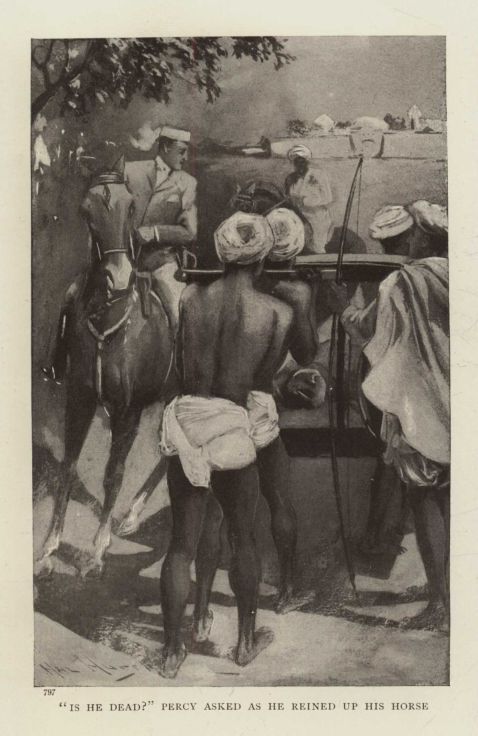
"IS HE DEAD?" PERCY ASKED AS HE REINED UP HIS HORSE
"Is he dead?" Percy asked as he reined up his horse.
"No, sahib; he is insensible from loss of blood, but his heart beats."
"How did it happen?" Percy asked the native officer in command of the party.
"I had just placed the sentries at the gate when, as the two officers rode over the bridge, one of Moolraj's soldiers who was standing on it rushed at the Sahib Agnew, knocked him off his horse with a spear, and then struck him twice with a sword. Then a trooper of the escort who was riding behind him spurred his horse forward against the sahib's assailant, and knocked him into the ditch. Lieutenant Anderson raised the Sahib Agnew. Moolraj, who was riding by him, pushed on across the bridge, and forcing his horse through the crowd rode away. A sirdar on an elephant then came forward, and the sahib was lifted into the howdah. Khan Singh got off his horse, and also mounted with the sirdar and Mr. Agnew. It seemed to me that all was over. Our men, who had piled their arms, had run to them when I cried out; but directly afterwards some of Moolraj's own party rushed at Lieutenant Anderson as he was remounting his horse and cut him down. They then rode off and the crowd dispersed, fearing no doubt that our men, who now crowded the wall, would fire on them; but this we did not do; we had no one to give orders, and feared that if we fired it might make matters worse. So when the place was clear I went out with this party, and finding that the white officer still lived, thought it best to bring him here at once."
While the native officer had been telling the story the party with the dhooly had continued their way, and Percy rode forward at full speed to acquaint Mr. Agnew with what had happened.
"Order that everything possible shall be done for him," Mr. Agnew said when he had made his report, "and go on with the despatch. Every moment is of importance. I will tell you what happened first; and you can then tell the rest as you have heard it, for I myself know nothing about it."
Mr. Agnew then dictated the first part of the despatch, saying that he had entered the fort with Moolraj and Khan Singh. The former had handed over the keys to him, the Ghoorkas had taken possession and had replaced the Mooltan sentries. Seeing that Moolraj's soldiers looked sullen and discontented Mr. Agnew addressed them, telling them that they would not lose by the change of governors, but that their services would be retained on the same terms as before. Then, thinking by their manner that he had allayed their discontent, he had ridden out of the fort. He was conscious of receiving a heavy blow that knocked him from his seat, and remembered nothing more until he found himself in a howdah on an elephant, with Rung Ram, who had been introduced to him as Moolraj's brother-in-law, bandaging up his wounds.
When Percy had written the native officer's report of the affair, Mr. Agnew dictated an earnest appeal to the Resident to send forward troops with all possible speed, as it was likely they would be besieged in the building, which certainly could not hold out for many days against the whole force at Mooltan.
This letter was at once sent off, and another was then dictated to Lieutenant Edwardes, a young political officer who had with him a Sikh force of twelve companies of infantry, three hundred and fifty troopers, two cannon, and two camel guns. He was on the other side of the Indus, and was occupied in settling the country and collecting revenue. Lieutenant Edwardes was urged to advance immediately with all speed to his assistance.
This letter also despatched, Mr. Agnew dictated a letter to Moolraj calling upon him to prove that he was innocent of all complicity in the attacks by at once arresting the criminals and coming in in person to the Eedgah. At the time that Moolraj received this letter he was presiding over a council, while the garrison, which was composed of Afghans, Hindus, and Sikhs, were taking the oath of allegiance to him. He briefly replied to Mr. Agnew's letter, saying that he could not comply with his request, for the garrison of the fort were all in rebellion, and the British officers had better look to their own safety. On the following evening a strong body of Moolraj's cavalry swept down and carried off the whole of the baggage animals of the force, the troops offering no active opposition. As, with the loss of the baggage animals, there was no possibility of the column retiring, the force was called into the building and ordered to prepare to repel an attack. Mr. Agnew was now so far recovered as to be able to get up and to issue the necessary instructions to the native officers.
"Things look very bad, sahib," Bhop Lal said as he and his comrade came into Percy's room when he went in with the intention of snatching a few hours' sleep, as he had been up the whole night before with Lieutenant Anderson.
"You think we shall not be able to defend ourselves until help comes?" Percy asked.
"There will be no defence at all, sahib. There have been men all day in camp moving about under pretence of selling things, but really as messengers from Moolraj and his officers, calling upon the men not to fire upon their brethren, but to join those who were resolved to fight to the death against the Feringhees and the traitor Lahore government who are their servants. All in Mooltan—Sikh, Mohammedan, and Hindu—had united for the common cause. Moreover, resistance, it was said, would be vain; no help could reach the Eedgah, and all who drew sword in defence of the Feringhees would be slain."
"And were they successful, Bhop Lal?"
"You will see, sahib, that not a shot will be fired when Moolraj advances against the place."
Percy went down again to Mr. Agnew, and told him what he had heard.
"I cannot doubt what you tell me, Mr. Groves; your man's information proved right before. But in any case there is nothing to be done. Anderson can scarcely stand. I am not fit to be out of bed. You and your two men, with perhaps the moonshis, seem to be alone to be relied on; and I need not say that resistance, even by two or three hundred men, would be hopeless, and would but entail the death of all. Escape, as far as Anderson and myself are concerned, is out of the question. We could not sit our horses half a mile, and the motion would cause our wounds to burst out bleeding again at once. It is not to be thought of. Danger for us there can be none. Moolraj can have no object in murdering two defenceless men, especially as he must know that such a crime would never be forgiven, and would involve him in a desperate war with England. At present he can assert that the attack upon us was the work of fanatics, and that he regrets the matter greatly, as, although determined to free himself from the dictation of Lahore, he had no thought of any hostility towards the British. Our lives, therefore, are perfectly safe. But I see no use in your waiting to share the captivity that we may probably have to undergo for a time, and I should recommend you to mount and ride off with your two men this evening."
"I can't do that, sir," Percy said bluntly. "I cannot desert you and Mr. Anderson, wounded as you are. It is possible, too, that the troops will, after all, prove faithful. But in any case it is impossible that I should leave you. It would be a bad beginning indeed of my service in the Company were I to run away and leave two of its wounded officers behind me."
Mr. Agnew was silent for a minute. "I cannot press the point, Mr. Groves," he said gravely, "for I feel that were I placed as you are I might myself disobey instructions. Stay, therefore, if you will; but I give you my stringent orders, and I will write them down and hand them to you in the morning, that if the troops here mutiny and surrender the place to Moolraj you are, if possible, to effect your escape and carry the news at full speed to Lieutenant Edwardes. If he marches on alone, ignorant of what has happened here, he will be met and overwhelmed by the whole of Moolraj's forces, and it is even probable that his troops, when they hear that those here have fraternized with the enemy, may also go over in a body. But whether they do so or not, it is of the highest importance that you should warn Lieutenant Edwardes of the treachery of the troops here. I shall put that down in writing in the morning, and I rely upon you to carry out the order. You can do no possible good to us by staying, and would probably indeed do us harm, as it might excite the passions of the Mooltan men when they enter to see one of us still uninjured, and blood once shed we might all be killed."
"Very well, sir; if you give me the written order I shall, of course, obey it, and, indeed, I acknowledge that your view of the matter seems to me unanswerable. The destruction of Lieutenant Edwardes' force would be a great misfortune, for it would immensely encourage the people here, and would enable them to make all their preparations for war undisturbed, as it would be a long while before the Lahore people could get together an army capable of capturing Mooltan.
"I see that I cannot be of use to you, and I agree with you. Moolraj will naturally protect you and treat you well, as he cannot wish to bring down the vengeance of the government of India upon him."
The two men were still waiting in Percy's room when he returned to it.
"Get the horses in readiness to mount at any moment," he said. "I have Mr. Agnew's orders that if the troops here join Moolraj, I am to ride at all speed to carry the news to Lieutenant Edwardes, who was ordered to advance from Dera-Futteh-Khan and to cross the ferry at Leia, where I shall probably find him. It is ninety miles away, but our horses will carry us there."
"It would be better to start to-night, sahib. We shall be hotly pursued if we go off in the daytime."
"I know that," Percy replied; "but it must be risked. Until it is certain that the troops here intend to join Moolraj I cannot go."
"Very well, sahib, whatever are your orders we shall obey them. If we get but a fair start there are not many horses in Mooltan that will be able to overtake us."
"That is so, Bhop Lal; and any that do come up with us we shall probably be able to give a good account of."
"We will watch by turns to-night, sahib; it is possible these rascals may intend to surrender the place to Moolraj before morning."
CHAPTER XV.
THE NEWS OF THE MASSACRE.
The night of the 19th of April passed off quietly. In the morning the guns of the fort opened fire against the Eedgah. A single shot only was fired in reply by the battery of the garrison, and then the whole of the artillerymen quitted their guns. The fort continued to fire for some time, but the distance was too great for any damage to be done, and the fire presently ceased. Mr. Agnew and Percy went to the gunners and exhorted them to return to their duty, but the men listened in sullen silence and gradually dispersed. In a short time they began to leave the building in parties of twos and threes, and by mid-day half the garrison had deserted.
"Here are your orders, Mr. Groves," Mr. Agnew said, placing a letter in Percy's hands. "You can use your own judgment as to going now or waiting until nightfall. My own opinion is, that it would be best for you to start at once. I do not know why Moolraj delays, for he must know that he will meet with no resistance. However, at night the place may be surrounded, and you might have more difficulty in getting off. In the next place, as you are ignorant of the country, you might miss your way and lose much precious time. And lastly, every hour is of consequence to Edwardes. Even now emissaries from Mooltan may be at work among his troops. I have mentioned in my orders that as the troops here have refused to fire and are deserting in great numbers, it is evident that Moolraj can enter whenever he chooses; and as it is of paramount importance to warn Lieutenant Edwardes to arrest his march, I have ordered you to start immediately, as you have expressed your willingness to undertake the service, although it is undoubtedly one of great danger. I have said that your own wishes would have led you to remain here with myself and Anderson and to share our fate whatever it might be, but that you have yielded to my anxiety that Lieutenant Edwardes should be warned. I have also inclosed a note to Edwardes, saying that your services will be at his disposal until you receive orders from the Resident."
"I will start at once, sir, as you think it best," Percy said, much moved at the thoughtful kindness of the wounded officer; "and there is little doubt I shall get through safely. I am splendidly mounted, and my men have also very good horses. I trust, sir, that I shall ere long meet you again."
"I hope so, confidently, Mr. Groves. It is evidently Moolraj's interest to treat us well, even if he keeps us as hostages, and I cannot think there is any danger. Good-bye, lad, and a safe ride to you!"
Percy then went in and said good-bye to Lieutenant Anderson, and with a heavy heart went out to his men.
"I am ready to start," he said; "get the horses to the back entrance without attracting more notice than you can help. These fellows might oppose our leaving. I will follow you in a minute or two and join you at the gate."
"There are many more of them about there, sahib, than there are at the main entrance. They are slinking away by scores, and I do not think that there is even a sentry on guard at this end. If we bring the horses up here and you mount, Akram Chunder shall mount also and lead my horse. I will run forward and unbar the gate, and if any of the fellows standing about interfere with me the three of us will be able to overpower them. We will have our pistols in readiness."
"Very well, perhaps that will be the best plan. I see there are very few of them about here. Do you fetch up the horses at once; I will get a couple of bottles of wine and some bread for our journey."
Percy was at the door of the court-yard again before the men came up with the horses. As they did so several of the soldiers standing about moved forward with scowling faces. They were, however, unarmed, having ostentatiously piled their muskets when the firing ceased. Percy drew the pistols from his holster, slipped the bottles and bread into their place, and leapt into the saddle.
"Stand back, men," he said authoritatively; "any one who interferes with us will get a bullet in his head. Keep abreast of me, Akram," he went on; "lead the other horse between us."
Bhop Lal ran forward ahead to the gate and began to undo the bars. Several of the men loitering near ran to stop him, but as Percy and Akram rode up they shrank back from the four levelled pistols. Bhop Lal threw the gate open, and leaping on his horse they rode out together, regardless of the angry shouts that pursued them.
"We will ride quietly for a while," Percy said, reining his horse into a canter when they had gone a few hundred yards. "We shall be within sight of the walls of Mooltan as we ride along between it and the river, and if we are galloping hard they may suspect something. The great point is to get to the ferry at Beelun before they are close to us. Once across we can laugh at them."
When they had gone half a mile Akram Chunder looked back.
"They are after us, sahib. There are fifty horsemen at least just coming out from behind the Eedgah, and," he added, "there are four men away to our right galloping at the top of their speed towards Mooltan."
"Then we will quicken our pace," Percy said, touching his horse with his heel. "We have six miles to ride to the ferry. We will gain another quarter of a mile on them if we can."
The horses were now put to their full speed and went along at almost racing pace. When abreast of the fort of Mooltan, which lay a mile away on their right, they could perceive that they had sensibly increased their lead. They had gone a quarter of a mile further when there was the boom of a heavy cannon, and a ball ploughed up the field a short distance behind them.
"I expected that," Percy said. "Those fellows from Eedgah have taken them the news of our escape. They are only wasting their shot. The betting is a thousand to one against their hitting us at this distance, going the pace we are."
Six guns were fired, but none of the shots came as near them as the first had done, and in twenty minutes they drew up their horses at the ferry. The boat was not there but was coming across and was within a couple of hundred yards of the shore.
"Do you dismount, sahib, and stand by your horse," Akram Chunder said; "they will take us for natives. But if they see you they may refuse to bring their boat up, for the sound of the cannon will have told them that something is wrong."
Percy did as his follower suggested.
"How slowly they come!" he said impatiently.
"There is time, sahib; it would not do to shout to them to hurry. We will dismount and lead our horses down to the water's edge; if you keep close to their heels you will not be noticed."
Some twenty country people got out of the boat when it touched the shore. Percy's men at once led their horses on board and he followed. The four boatmen looked surprised at seeing an Englishman, but made no remark.
"Push off at once," Bhop Lal said.
"We are going ashore to get our meal," one of the men replied; "we shall not start till we have got a boat-load."
"You will go at once," Bhop Lal said, drawing a pistol. "I will pay you as much as a whole boat-load would do, but I have no time to spare."
As the others also drew their pistols the men sullenly thrust their poles into the water and pushed off. They had gone less than a hundred yards when a body of horsemen rode furiously down to the water's edge and shouted to them to return.
"Go on," Percy said authoritatively; "if one of you hesitates for a moment, he is a dead man."
Seeing that the boat continued its way the sowars opened fire with their pistols, but though the balls fell round the boat the distance was too great for accurate shooting, and in two or three minutes they were altogether beyond range, the men poling lustily now so as to place themselves out of danger. The Indus is of great width at this point, but the waters are comparatively shallow and the stream gentle, and in an hour they gained the opposite shore. Percy had directed them to make for a point half a mile below the town of Kote, instead of the ordinary landing-place, where they might have encountered a number of people waiting for the boat to return, as the traffic was considerable and they had on their way across met two laden boats. As the water was shallow they had to get the horses over the side fifty yards from shore, and then, having well paid the boatmen, they rode to the bank. Cutting across the fields they avoided the town altogether, and struck the road a mile beyond it. Before leaving the river bank they saw that there were seven or eight loaded boats half-way over, the troopers having doubtless seized some of the country craft to convey them across.
"We shall be three or four miles on our way before they have all landed and mounted." Akram Chunder said. "We shall see no more of them."
The road was a good one, and for some time they rode fast; then they reined in their horses and proceeded at a slower pace.
"We have ninety miles in all to do," Percy said, "and we must not risk foundering the horses. They have had no exercise since they left Lahore and we must husband their strength. The troopers are not likely to pursue more than thirty miles from the ferry at the outside, perhaps not half that. When they learn that we are keeping our distance ahead of them they will see that they have little chance of overtaking us and will not care about killing their horses in a hopeless pursuit."
Whenever they passed through a village they went through at a regular pace as if in no way pressed for time. The natives were doubtless aware of the attack on the two English officers, but could hardly know that the Sikh troops had proved faithless, and would imagine that the white officer and his two men were riding ahead of that force on its way to join Lieutenant Edwardes. Before leading the horses out from the stable the men had filled their bags with grain, and after riding twenty miles from the ferry they stopped for two hours under some trees on elevated ground, where they could command a view down the long straight road two or three miles. As there were no signs of their pursuers at the end of that time they felt sure that these had given the chase up as hopeless, and therefore continued their journey at the pace the horses could best keep up. Soon after they started night fell, and the riding was much more pleasant than it had been during the heat.
They halted again for three hours at midnight, finished their bread and wine, and gave the horses another good feed. At eight o'clock in the morning they approached Leia, but hearing from some peasants that no force had arrived there up to the previous evening, they made a circuit of the town and crossed the river at the ferry, two or three miles distant from it. As they rode into the next village they saw that the street was crowded with Sikh soldiers, who were engaged in cooking their food.
"Are you from Mooltan?" a young officer asked, running out as they drew rein at the house where they had been told Lieutenant Edwardes had taken up his quarters.
"We are," Percy said, as he threw himself off his horse. "We left the Eedgah at one o'clock yesterday."
"How are Agnew and Anderson? Doing well, I hope?"
"They were both doing well when I left them, as far as their wounds went; but they are in a desperate position."
"Why, the place is a strong one; I know it well," Lieutenant Edwardes said. "Twelve hundred men with a battery of artillery ought to be able to hold it at least some days against all the troops in Mooltan."
"They might have done so if the troops had fought," Percy said; "but they have gone over to Moolraj. Half of them had left when I came away, and the others were leaving fast. I do not think there would be a score of men left them by sunset yesterday. I have a note for you, and I shall be glad if you will read Mr. Agnew's written orders to me. You will see that I did not leave the two wounded officers willingly."
By this time they had entered the house.
"Sit down and take something to eat while I glance through these papers. Mr. Agnew does you full justice," he went on, more warmly than he had before spoken, after reading the two documents. "You were, of course, obliged to obey orders, and could have been of no use to them under the circumstances. Agnew was evidently thinking much more of me than of himself. What do you think will happen to them?"
"Mr. Agnew was perfectly confident that as it was clearly to the interest of Moolraj not to draw the English into the quarrel between him and Lahore, he would protect and take good care of them."
"I sincerely hope so," Lieutenant Edwardes replied; "but Moolraj showed a very hostile front to us when Napier passed through with his force to join Sir Hugh Gough. He professed to stand neutral, but there was no doubt he would not have been neutral had he dared fight. Besides, there are the Mooltan rabble to deal with. Agnew would have done better to surrender at once to Moolraj directly he saw that the Sikhs had turned traitors. If he puts it off till night the budmashes of Mooltan, knowing that the Eedgah is no longer defended, may take the matter in hand, in which case I would not give a rupee for the lives of the two Englishmen."
"When did the messenger reach you with the news?" Percy asked.
"At eight o'clock last night. So you have gained some fourteen hours upon him, as the despatch is dated half-past eleven."
"I was well mounted," Percy said. "I might have been here some hours earlier, but my horse is a very valuable one, and I knew that an hour or two could make little difference."
"I sent off a messenger as soon as I got Agnew's despatch, to Lieutenant Taylor, who is with General Van Cortlandt, who is, as I daresay you know, an officer in the Sikh service at Bunnoo, begging him to send me a regiment of cavalry and four guns at once. I then issued orders for my force to start at daylight, and we have marched twelve miles. I intended to go on to Leia and halt there for the night and to move forward quietly till Van Cortlandt's detachment joined me, and then push forward with all speed. What you have told me now, of course, changes the situation altogether. I shall go forward to Leia as I intended, but shall halt there and intrench myself, and wait to be attacked. I may be able to raise my force considerably from the Pathan portion of the population, between whom and the Sikhs there is a long-standing enmity. I see Mr. Agnew has placed your services at my disposal, Mr. Groves. I shall be glad indeed to have an Englishman with me. It is a great relief to have someone to chat with and discuss matters in one's own language. Of course you are quite new to this district. I suppose you have only just come up country. You have dropped, indeed, into a very hot corner for a young civilian."
Percy laughed. "I daresay you think I look very young even for a young civilian, Mr. Edwardes."
Lieutenant Edwardes joined in the laugh.
"Well, I was thinking so. Of course you must be twenty or you would not have been sent up from Calcutta, but you do not look more than eighteen."
"I am a month or two under that age," Percy said; "but I do know the country pretty well, though not on this side of the Punjaub; and in fact I speak both Punjaubi and Pathan almost as well as I do English." He then gave Lieutenant Edwardes a sketch of his life since his arrival in India.
"I congratulate myself very heartily," Lieutenant Edwardes said cordially. "You will indeed be of assistance to me. I can quite understand now your being in the service so young and your being appointed as assistant to Agnew. It will be an immense comfort to me having with me one who understands the people so thoroughly, and can speak both with the Sikhs and Afghans. But it is time for me to be moving forward, or I shall not get my men across in time to occupy Leia before nightfall. I will leave a party of fifty men here, so you and your two followers can rest yourselves and your horses and join me to-morrow."
"Thank you. I feel quite capable of going on with you, but I certainly should be glad to let the horses have twenty-four hours' rest after doing something like a hundred miles since they started yesterday."
"You may as well take possession of these quarters. I think it is the best house in the place, and as the owners are Afghans they are ready to do anything they can for us."
A quarter of an hour later the Sikhs started on their forward march. Percy found his men had been told that they were to have a halt till the following morning, and so, after seeing they had comfortable quarters and paying a visit to his horse, he lay down and slept until evening. Then he got up and had a meal, walked round the village and had a talk with the Sikh officer of the detachment, and then turned in again until the next morning, when, as soon as the sun was up, he started with the detachment, and presently joined Lieutenant Edwardes at Leia. The latter had occupied the town without opposition, Moolraj's governor, with the small body of troops he had with him, having retired at his approach.
The next few days were occupied in throwing up intrenchments round the town. They heard that Moolraj was about to cross the Chenab with five thousand men on his way to attack them, but as he hoped that Van Cortlandt's regiment with the four guns would join him before Moolraj could arrive, Lieutenant Edwardes determined to maintain his position. One morning, however, he came with a serious face into Percy's room.
"I have terrible news," he said; "a messenger has just returned—the one I sent with a letter to Mr. Agnew telling him that I would be with him as soon as possible. On the way he met Moolraj's force, and, mingling with them, learned what had happened at Mooltan after you left. By nightfall there remained at the Eedgah only some twelve men, the native clerks, and the officers' servants. Mr. Agnew had already sent to Moolraj to say that he was ready to surrender, and begging him to come in person to take over the place. Whether Moolraj delayed purposely in order that the work should be finished before he arrived was a matter of doubt, but at any rate he did not come. Soon after dark a mob of the ruffians of the town with some soldiers, among whom were many of the Sikh mutineers, proceeded to the Eedgah, burst in the doors, and with shouts of "Death to the Feringhees!" rushed in. Mr. Agnew was sitting by the bedside of Anderson. They had heard the tumult of the approaching mob, and doubtless felt that their fate was at hand. Agnew rose as they entered, and was cut down at once and despatched by two or three blows. They then rushed at Anderson and hacked him to pieces."
"This is terrible indeed," Percy said, much moved at the news of the death of the two gentlemen with whom he had spent the last fortnight. "Do you think that Moolraj was a party to this atrocity?"
"They say that Agnew's head was taken to him, and, in his presence and with his apparent approval, treated with every indignity. Certainly he rewarded his murderer with a large present and a robe of honour, and also gave presents to the man who had taken the principal part in the murder of Anderson. From my own knowledge of Moolraj, although he is doubtless ambitious, I should say that he is a weak man, without courage or resolution. I do not think he had anything to do with the first attack on the two officers, but seeing that the harm was done, knowing that he would be blamed for it, and being really in the hands of his turbulent soldiery, he resolved to throw in his lot with them, and from that moment he was, like many other timid men when driven to the wall, in favour of desperate measures. He would, no doubt, consider that by allowing, if he did not direct, the murder of the two officers, he bound the soldiers all the more closely to his interests, as the deed would put an end to all possibility of a reconciliation.
"Of course this sad affair altogether alters my position. I was ready to push forward at all hazards until I heard from you that the Sikhs had mutinied; then the necessity for speed was at an end, for it was evident that the Eedgah would be captured the day you left. Another serious circumstance has occurred that renders it more than doubtful whether I can maintain myself here. One of the native officers has just brought me a document that has fallen into his hands. It is an address from the Sikhs who deserted at the Eedgah to the men here, calling upon them to join their countrymen and make common cause against the English, for that all the Punjaub was about to take up arms against the Feringhees. The worst of it is, the officer says that from what he learns this document has been here for the last two days, and has been read by all the soldiers; and if that is the case I can no longer place the slightest reliance upon them.
"I am desirous of holding on here until the last moment for two reasons. I hear that Moolraj has sent men all over the country to enlist the Pathans. They are by far the most warlike people here, and will certainly take service with him unless they take service with me. For choice perhaps they would join me, because they have no love of the Sikhs, who conquered their country. So long, then, as I remain here they will believe that the success of Moolraj is not assured, and not only shall we get a large number of valuable recruits, but prevent their going to Mooltan. In the next place, I have to pay the men I enlist, and to do so I must collect, as far as possible, the revenues of the districts in this neighbourhood, for the money, like the recruits, will go to Mooltan if it does not come to me. So you see it is of the greatest importance that I should hold on here as long as possible in spite of this ugly business of the Sikhs. I wish I could get rid of them altogether, but that, until I can get together a strong force of Pathans, is impossible."
Percy was greatly struck with the energy and firmness of the young officer. Edwardes had for the past year been acting as political agent in the greater part of the district between the Indus and the foot of the mountains, and had also completely pacified Bunnoo, a most turbulent district, inhabited by tribes of the Afghan race who had for five-and-twenty years successfully resisted the efforts of the Sikhs to conquer them, while he had so completely gained their confidence that at his bidding they levelled the four hundred forts that constituted the strength of their country, and many of them had already sent in offers of service.
For the next two or three days there was no outward change in the position. A good many Afghans were recruited, and messengers had arrived, saying that the whole of Van Cortlandt's force were on the march to join him; but as these had not arrived, while Moolraj's force, which was provided with eighty guns, had approached within a day's march, Edwardes deemed that it would be imprudent to remain longer when he was more than doubtful of the fidelity of two-thirds of his men. He accordingly evacuated Leia and recrossed the Indus. He had hardly done so when he received news that the bulk of the enemy's army had suddenly changed their course and marched north; and he therefore directed a body of some two hundred Pathans who had not yet crossed the river to remain there. Four hundred of the enemy occupied Leia, and the Pathans were ordered to retire across the river if they advanced. Thinking it probable that they would not do so, as a retreat is of all things the most distasteful to men of this race, he sent over fifty more men to reinforce them. The enemy did advance; the Pathans defended the bank of a nullah, and after a time took the offensive, rushed across the nullah and fell furiously upon the enemy, whom they utterly routed, pursuing them a long distance and retaking possession of Leia. The town, however, was not retained, for Edwardes had just received orders to undertake no operations on the eastern side of the Indus, but to confine himself to preventing the passage of the river by the enemy and to maintaining order in his district. He therefore marched his whole force a few miles up the river to the fort of Girang, where he awaited the arrival of General Cortlandt with his command.
That officer joined him there on the 4th of May, with the Mohammedan regiment of Loobdan Khan and a battery of six guns. Moolraj did not attempt to cross the river, and by the 19th further reinforcements had arrived, bringing up Edwardes' force to about four thousand eight hundred men, of whom four thousand were believed to be faithful, while the eight hundred Sikhs were known to be disaffected. More than this, he had heard from Bhawul Khan, the Rajah of Bhawulpoor, a state on the southern side of the river Ghara, that he was ready to move in a short time against Mooltan from the south, and with this assistance Lieutenant Edwardes felt strong enough to offer to undertake the blockade of Mooltan for the rest of the hot season and through the rains, if commissioned to do. The first step taken, however, was the capture of Dera-Ghazee-Khan, a strong place on the western bank of the Indus, interrupting his communication with Bhawulpoor and forming a strong outlying post to Mooltan. The governorship of this place and the country round had been given by Moolraj to one of his followers named Julal Khan, belonging to the Lugharee tribe, to the great anger of a powerful chief, Kowrah Khan, a personal enemy of Julal.
Kowrah at once made his submission to the British, and sent his son Gholam Hyder with a contingent of men to join General Cortlandt, who was moving with a part of the force to besiege the town. On the 20th of May Gholam Hyder told General Cortlandt that he was ready to go on in advance, to raise the whole of his father's clan, and with them alone to drive Julal Khan and the troops with him across the river. General Cortlandt accepted the offer, though doubting much Gholam Hyder's ability to carry it out. However, the young man at once left the column with his contingent and rode rapidly on ahead to his father's place.
Having obtained the latter's consent, messengers were sent off in all directions to call upon the tribe to assemble, and the same night a desperate attack was made upon the town. The men of the Lugharee tribe, who formed the principal part of the garrison, fought stoutly, and the combat continued without success on either side; but when morning broke Gholam Hyder Khan led his men forward with such bravery that after a severe hand-to-hand contest he gained a complete victory, killing numbers of the Lugharees, among whom was one of their chiefs, and making another prisoner. Some of the garrison shut themselves in the fort, but capitulated in a few hours on condition of being allowed to cross the river unmolested. Moolraj's force moved to Koreyshee with the intention of crossing by boat and retaking the town, and, failing in doing this, of opposing any attempt on the part of Edwardes to cross.
They found that the boats had been removed, and the two armies remained for over a week watching each other across the wide river. Kowrah Khan and his son received the thanks of Sir Frederick Currie, and the durbar bestowed an additional rank upon them. They shortly afterwards joined the army with four hundred horsemen of their tribe, who fought gallantly through the whole campaign. They received no pay for their services, but at the end of the war were rewarded by the grant of an estate and pension.
By this time, although communications were still uncertain, Lieutenant Edwardes learnt that, for the present, no British force would advance against Mooltan. The commander-in-chief felt that, in the first place, no confidence whatever could be placed upon the Sikhs, who would be a source of danger rather than of aid. In the second, it would take a considerable time to collect an army sufficiently large for the purpose. Lastly, it was considered extremely unadvisable to engage a large British force upon arduous operations during the hot season. The rebellion of Moolraj was against the Sikh government, and the durbar at Lahore was called upon to take active steps to repress it. Later on Moolraj would be called to account by the British for the murder of the two officers.
The Lahore government had accordingly despatched three columns, who were to converge upon Mooltan and blockade the town. These were commanded respectively by the Rajah Sher Singh, Sheik Emamoodeen, and Jowahir Mull Dutt. The Nawab of Bhawulpoor's troops were to form a fourth column and to meet the others before Mooltan. The three Sikh columns, however, made very little progress, the commanders being each doubtful what the others would do, and uncertain as to the fidelity of their troops. The Nawab of Bhawulpoor was perfectly ready to do his share of the business, but he altogether declined to march upon Mooltan until he saw the other columns making fair progress in that direction.
Lieutenant Edwardes, on learning of the hesitation of the three Sikh commanders, again wrote offering to undertake the blockade of Mooltan with his own force in conjunction with that of the Nawab of Bhawulpoor. He had now got rid of his Sikh regiment, which he had just sent off accompanied by two hundred and fifty Pathan horsemen, and under the general command of a Pathan chief, to garrison the fort of Mithun Kote, where they were out of the way of doing mischief, and far removed from the influence of their co-religionists at Mooltan.
The passage of the Indus at this time was difficult and hazardous. Augmented by the melting snow on the hills it was rushing down in a mighty river fifteen miles wide, and it was impossible for either army to cross in the face of the other. At the beginning of June, however, the nawab crossed the river and advanced towards Soojabad; and having sent a pressing request to Sir Frederick Currie that Edwardes should have permission to co-operate with him, the injunction against that officer crossing the Indus was removed, to his immense satisfaction and that of Percy.
By this time the Pathan force had increased to three thousand men, while two thousand of the same race had joined General Cortlandt, so that it was possible to leave a force sufficient to ensure order in the district west of the Indus, and yet to carry a considerable number to reinforce the nawab. The prospect was all the brighter since a Pathan officer who had come to Leia when Edwardes occupied that town, under the pretence of negotiating on the part of Moolraj, now sent him information that the Pathan officers at Mooltan, who had from the first taken no part in the attack on the Eedgah, and were altogether opposed to the war, would desert as soon as an opportunity offered, and with their men join the British.
Slow as the nawab's advance was, it alarmed Moolraj, and his army was ordered to fall back from the Indus and take post at Soojabad. Edwardes was well informed by his spies of the movements of the enemy. They broke up their camp by the river before daylight on the 10th of June, and before nightfall he had conveyed a portion of his army across the wide river in the great fleet of boats he had collected. General Cortlandt was to follow with the rest the next morning, for they had been joined by so many of the chiefs from Bunnoo and by zemindars of the district, that he had no fear of disturbance breaking out in his rear, so long at any rate as all went well at the front.
Percy had been very busy during the halt at Dera-Ghazee-Khan in marshalling the native levies as they arrived, acting as Lieutenant Edwardes' mouthpiece, and paying complimentary visits to the chiefs and thanking them for their loyalty. Bhop Lal had acted as drill-instructor to the Pathan recruits, who were formed into companies as they arrived; and Edwardes would have appointed him to the command of one of these bodies, but he declined the offer, saying that although ready to aid at other times, in the day of battle his place was by his master's side, and nothing would induce him to leave it. Akram Chunder, not being able to speak the Pathan language, could not be utilized in the same way as his comrade, and indeed the Pathans would hardly have obeyed anyone not of their own nationality save an Englishman; and he therefore continued his usual work as Percy's attendant, looking after his horse and cooking for him and Lieutenant Edwardes, who took their meals together.
Percy was delighted when a forward move was at last made. Lieutenant Edwardes had at first thought of attaching him to General Cortlandt's column, but he afterwards decided to take him with him, feeling how great was the comfort of having someone with him to whom he could talk over all his plans and difficulties, and whose opinion, however modestly given, he came, as time went on, to regard as valuable.
When the force reached the opposite bank of the river, Edwardes learned from coolies who had been forced to assist in carrying the enemy's baggage and were now returning to their homes, that they had halted at Khangurh. This was a disappointment, as it showed that they were making for Soojabad instead of, as he had hoped, for Mooltan; and a few hours later he received a letter saying that two thousand men with four guns had already been sent from Mooltan to Soojabad, and orders had been issued for another two thousand men to march there. Had the nawab shown a little more activity he could easily have possessed himself of Soojabad, in which case the army of the Indus must have fallen back to Mooltan, against which town the allies could then have marched without opposition; whereas Moolraj was now concentrating his whole force at Soojabad, and it was evident that a battle would have to be fought there before advancing against Mooltan.
The next day Edwardes' anxieties were greatly increased by the news that the column of Jowahir Mull Dutt, which was at last approaching Leia, was in a state of disorganization, and that one of the cavalry regiments had deserted and joined Moolraj. This fresh proof of the general disaffection of the Sikhs was alarming, especially as the Sikh force at Bunnoo was composed almost entirely of old soldiers who had fought against us on the Sutlej. Fearing for the safety of his assistant, Lieutenant Taylor, at that place, he sent him orders to leave Bunnoo and establish himself at Dera-Ismail-Khan.
CHAPTER XVI.
SEVEN HOURS OF SUSPENSE.
Lieutenant Edwardes pressed forward with all speed, in hopes of effecting a junction with the Bhawulpoor force before the Mooltan army could fall upon them. Unfortunately the River Jelum intervened between the allies, and had the rebel army used expedition they could have annihilated the Bhawulpoor contingent before Edwardes joined them. The latter had already made every preparation for his advance, having sent on messengers ahead to collect boats at Koreyshee, with instructions that his ally should avoid battle if possible and retire before the enemy until joined by him.
On reaching the Jelum late in the evening he heard that the Mooltan force had just arrived at a point three miles from the camp of his ally, but had established themselves and evidently did not intend to attack until the next morning. "You had better start at once across the river, Groves, and see that the nawab's force is in a position to defend itself if the enemy attack before I can get across. Its commander is an old man, and, as I hear from our agent, Peer Ibraheem Khan, hopelessly muddle-headed and inefficient. You will find Ibraheem himself a thoroughly good and reliable officer, and he will aid you in every way. It is he who has got all these boats collected in readiness for us. Two or three of the nawab's regiments are commanded by Englishmen. If you find that the general will do nothing, I authorize you to take the command out of his hands, and to make the best dispositions you can under the advice of Ibraheem. The boats are coming up fast, and I shall begin to cross at daylight with the infantry to aid the Bhawulpoor men in keeping the enemy at bay until Cortlandt can get the guns across. Until we have them to help us we shall be at a terrible disadvantage, for the enemy have at least twelve pieces. Remember to-morrow is the 18th of June, the anniversary of Waterloo; it is a good omen for us."
As Percy was about to ride down to the river bank a boat came across, and he stood chatting with Lieutenant Edwardes until it arrived. It contained a messenger from Peer Ibraheem, saying that the force would march down to a point opposite the ferry during the night and so cover the crossing.
"Could you guide this officer," Lieutenant Edwardes said, "so that he can meet the army on the march?"
The messenger said that he could do so, and Percy with his two men and horses took his place in the boat. After two hours' ride from the other side of the river they met the head of the approaching column, and Percy, hearing that Peer Ibraheem was with the regiment that followed, waited till he came along and then handed him a pencil note that Edwardes had given him, repeating to Peer Ibraheem the instructions he had already given Percy.
"I am very glad that you have come, sahib," the officer said. "Futteh Muhommud pays no attention to what is going on, and is in fact no better than an idiot. I received authority from Edwardes sahib yesterday to supersede him if it were absolutely necessary, but it might possibly cause discontent among the troops, and it were better to leave him in nominal command."
The morning was breaking when they approached the river. When half a mile distant they met three thousand of the Pathans, who with fifty mounted chiefs had effected their passage during the night under the command of Foujdar Khan, a capable and energetic native officer who acted as Edwardes' adjutant-general. A halt was ordered, and Percy and Peer Ibraheem tried to get the men into line and to remedy the tremendous confusion that prevailed, baggage animals, waggons, elephants, and guns being all mixed up in the column. There was the more occasion for haste, as the rising sun showed the enemy marching towards them. Their object had evidently been to take possession of the ferry and thus separate the two allied forces; but the night march of the Bhawulpoor men and the passage of the Pathans had forestalled them, and they at once took up their position on the salt hills of the village of Noonar and their guns in a few minutes opened.
Two or three of the nawab's guns were with the greatest difficulty extricated from the confused mass and returned the fire of the enemy, and the Bhawulpoor men, uttering, as was their custom before fighting, the name of the rajah in a sonorous shout, rushed headlong without order or regularity against the enemy. In vain Percy and Peer Ibraheem and their own officers shouted to them to stand their ground. They went forward at a run until they were checked by volleys of musketry from the traitorous Sikh troops, while the guns swept them with grape. Though accustomed to irregular warfare, the nawab's troops were new to fighting disciplined soldiers, and, confounded at the storm of lead and shot to which they were exposed, they fell back in disorder.
At this time Lieutenant Edwardes, who had crossed the river in a small boat, arrived upon the spot. He found the most utter confusion prevailing; the excitement had apparently dissipated the remains of sense in Futteh Muhommud's brain, and the old man was sitting under a tree counting his beads apathetically, while a group of officers were standing round vainly endeavouring to recall his shattered senses and to get him to issue orders. Lieutenant Edwardes at once took the command. He saw at once that after the severe check the Bhawulpoor men had received, and amid the confusion that prevailed, the battle was lost if the enemy at once advanced. Turning to Peer Ibraheem, who had just arrived, and the chief officers, he pointed out that the enemy had taken up a strong position and evidently expected to be attacked, and that therefore they had time to get the men in order and to retrieve the day.
The guns of the nawab were old pieces of various sizes, quite unfit for service, and there was no hope of successfully contending against the far better guns and experienced artillerymen of the enemy. Nothing could therefore be done until General Cortlandt arrived with his artillery, which was a match for that of the Sikhs. He therefore ordered that the troops, after being got into order, should all lie down, and that the guns should keep up an incessant even if an ineffectual fire. Feeling confident now that they had a commander on whom they could rely, the officers hurried away to carry out their instructions, and similar orders were sent to the Pathans, who had with the greatest difficulty been restrained from following the example of the Bhawulpoor men and rushing against the enemy's position. A messenger was instantly sent off to Cortlandt, urging him to get his guns across the river with the greatest possible despatch and to bring them forward to the field of battle.
Lieutenant Edwardes then rode along the line, and was loudly cheered both by the allies and his own men. The latter had stuck their standards upright in the turf and were lying down in a line behind them. When he had made an inspection of the line and seen that his orders had been carried out, Edwardes despatched another messenger to Cortlandt lest the first should have gone astray, telling him that he thought it possible to hold the position until three o'clock in the afternoon, but that if he did not arrive with the guns by that time the battle would be lost.
It was now but eight o'clock in the morning, and for several hours this body of undisciplined troops would have to support in patience the fire of the enemy, a situation most trying even for the most disciplined soldiers. For six hours it continued without slackening. The enemy's guns were directed principally to the right, where the Bhawulpoor artillery continued to fire steadily, but sufficient shot fell among the Pathans to work them up into a state of desperation, so that numbers kept leaping to their feet and demanding to be led against the enemy instead of lying there to be killed without even firing a shot.
At two o'clock Futteh Muhommud recovered his senses sufficiently to issue an order for his army to retire, and as it was supposed that the order was authorized by Edwardes it was obeyed, and without the latter being aware of what was taking place the Bhawulpoor force gradually fell back. From his position on the opposite hill Rung Ram, who was in command of the enemy, observed the movement and at once prepared to take advantage of it. He sent forward his cavalry to reconnoitre, and moved his infantry and artillery slowly down the hill. Hitherto ten camel guns that the Pathans had brought across the river with them had been silent, as the men were partly concealed in the jungle, and Lieutenant Edwardes was anxious to avoid betraying their position and drawing the fire of the enemy upon them by the use of these small pieces, which could do but little execution at that distance.
It was now necessary to run the risk, and the camel guns opened upon the enemy's cavalry, who cantered back to their lines in disorder. Their guns, however, at once began to play, and their shot tore into the jungle, rendering it more difficult than ever for Lieutenant Edwardes to restrain the impetuosity of his men. The enemy's cavalry soon rallied and again advanced. As nothing had been heard of the guns, and the moment was most critical, Edwardes ordered Foujdar and all the chiefs and mounted officers to form into a compact body and charge the enemy's cavalry. Delighted at being at last employed on service however dangerous, the brave fellows mounted and with a shout charged down upon the enemy, and, in spite of their inferior numbers, drove them back in headlong flight upon their infantry. They rallied quickly, however, and the whole line again advanced.
"I can no longer delay," Lieutenant Edwardes said to Percy; "our only chance is in a general charge. If we remain here we must be beaten, whereas if we go at them and escape annihilation by the artillery and musketry as we advance it is just possible we may be successful."
He rose from his seat under a tree to give the order, when a bugle sound was heard in the rear. As if by magic the sound of excited and angry talk along the Pathan line ceased, until a minute later the bugle-call was again heard.
There was no mistaking it. Van Cortlandt's guns had passed the river and would soon be at hand, the long and terrible time of waiting was over, and at last the tables would be turned. Messengers were sent off to the guns to tell their commander how urgent was the need of their arrival, while officers were despatched all along the line of Pathans to bid the men stand up, and, when the word was given, to advance in good order and in regular line, company by company, against the enemy. With shouts of delight the Pathans sprang to their feet, standards were plucked up and waved enthusiastically in the air, and then the long line stood panting, eager as greyhounds in the slips, for the order to advance. Soon the rumble of guns was heard, and then amid wild cheers the six guns passed through a space opened for their passage, unlimbered, and opened fire upon the advancing enemy.
The effect was instantaneous. The Sikhs, believing that the day was won, were advancing in good order through the intervening fields of sugar-cane, breast-high; but as the balls sung overhead they disappeared from sight, dropping among the canes as suddenly as if each had been mortally struck. They had believed that the only guns opposed to them, those on the right, had left the field, and at the discharge in regular order of guns of equal weight and calibre, the truth broke upon them that the force under the white officer who had so long withstood them had crossed the river and was ranged on the field before them. Not only had the guns arrived, but Van Cortlandt had managed to send two of his Mussulman infantry regiments with them, and these, breathless with the speed at which they had hurried after the guns, now came clattering up. They were ordered to lie down to the right and left of the guns, while the Pathans took post behind them.
For a few minutes the guns of the contending forces discharged volleys of grape at each other, but Cortlandt's gunners were better trained and cooler. Two of the enemy's pieces were silenced and as the men serving the others were in confusion, Edwardes gave the word for the Mussulman regiments to charge. With a cheer the brave fellows dashed forward at full speed, but not so swiftly but that a little party of seven or eight of the Pathans' mounted officers dashed past them, and charging the guns captured two of them while the gunners were in the act of hastily withdrawing them before the approach of the charging infantry. The infantry captured the only other gun which awaited the assault. During the charge Cortlandt's guns poured grape into the canes where the enemy's infantry were lying. Hearing their own artillery retiring, the infantry abandoned their cover and retreated at full speed, rallying, however, at the point where their guns halted, when the artillery on both sides renewed their duel. The Pathans were now ordered to charge, and with a yell expressive of their delight at the prospect of avenging their losses during the long hours of the day, they rushed forward through the smoke.
The enemy were unable to withstand the onset of the brave irregulars and the two newly arrived regiments, but hastily retired, falling more and more into confusion, and pressed in their retreat by the eager Pathans, while the nawab's troops, anxious to retrieve their first retreat, now hotly pressed on the enemy's left. Something like order was maintained by the Sikhs until they reached the crest of the hill on which they had been posted during the early hours of the day. Then they threw away their arms and fled in utter disorder towards Mooltan, pursued by the nawab's cavalry, and mowed down by the guns that opened upon them as soon as they could be got into position on the hill.
Eight out of the ten guns that they had brought from Mooltan were captured by the victors. Some twelve hundred were slain, and great numbers of the fugitives at once made for their homes. Their Pathan cavalry had, for the most part, remained inactive during the day, and the heaviest loss fell upon the revolted Sikh regiments, the Goorkhas who had so basely deserted Agnew suffering very severely. The loss upon the part of the allies amounted to three hundred killed or wounded. The enemy's tents, ammunition, and stores at Noonar all fell into the hands of the victors.
Percy had remained with Lieutenant Edwardes but a short time, having been despatched by him to aid Peer Ibraheem in keeping the Bhawulpoor men in their position. When the order had come for them to retreat he had made his way as rapidly as possible through the jungle to inform Edwardes of what had taken place, but arrived only in time to see the charge of the mounted officers.
"You must get them back into their places again, Groves. Here is an order to Peer Ibraheem;" and he scribbled a line on the page of a note-book and tore it out. "He is to bring them back into position again, and to disregard any orders that Futteh Muhommud may give."
Percy hurried away again, and by his exertions and those of Peer Ibraheem the Bhawulpoor men were brought up in time to join in the final charge and pursuit of the enemy. He accompanied the native cavalry as they chased the fugitives across the country, and it was almost dark before he returned to the scene of battle. Edwardes shook him warmly by the hand as he dismounted.
"It has been a great day, Groves, but I would not go through those seven hours' waiting again for any money that could be offered me; it was an awful time."
"It was, indeed," Percy agreed. "I thought at one time that it was all up with us."
"So did I. It was well indeed that you were able to bring up the nawab's men in time. They were not wanted for the fighting, but if it had not been for their horse the rebels would have got away in some sort of order, and their leaders might have taken them in a body into Mooltan. As it is, I expect the great proportion of them will scatter to their homes. I have just sent off a messenger with my report of the engagement to the Resident. It will be a relief to him, for although he gave way at last to my entreaties, I know he thought I ought never to have crossed the Indus. Now, if they will but give us leave, I think that we can take Mooltan."
A few days later Lieutenant Lake, who had been appointed political agent to the nawab, arrived at the camp, thereby relieving Edwardes of the anxiety caused by the inefficiency of Futteh Muhommud, as Lake's authority completely overrode that of the general. He was, too, an intimate friend of Edwardes, and being full of life and animation, he was a great addition to the pleasure of the little mess. Marching forward, they were joined by Sheikh Emamoodeen with the remains of his division. His Sikh troops had all deserted him, and he had with him but a few Mussulman infantry and a strong body of cavalry.
On the 1st of July the force started for its last march towards Mooltan. They had received news that the Sikh gooroo—a man regarded with the greatest veneration—had, after consulting the stars, declared that day to be a most auspicious one, and that Moolraj had decided, therefore, upon again giving battle. He came out in great force, and took up his position at a bridge across a wide and deep canal. As this could not be forced without heavy loss, Edwardes moved along the west of the canal towards Mooltan.
Moolraj followed on the other side of the canal, crossed by a bridge near Mooltan, and at one o'clock moved forward against Edwardes in order of battle. The Bhawulpoor men, commanded by Lieutenant Lake, were on the right; General Cortlandt's two regiments and ten guns were on the right centre; the Pathan levies were next to these, having on their left Sheikh Emamoodeen's troops. The battle began on the right, Lieutenant Lake seizing some mounds in front of him, and placing his guns there opened a heavy fire on the enemy's left. This was returned by the Sikh guns, and in a short time the battle became general along the whole line. The village of Suddoosam was in the centre of the enemy's position. His troops lay for the most part concealed in jungle, the guns occupying two or three small villages. The allies were superior in artillery, and the rebel guns were presently obliged to withdraw from their position.
The order was then given for an advance, and the whole line pressed forward. Village after village was captured at the point of the bayonet, the Sikhs, inflamed with religious ardour, offering most determined resistance, favoured by the nature of the ground, which was largely covered with jungle and date groves and intersected by irrigation canals. There was, however, no check in the advance. A brilliant charge was made by one of Cortlandt's regiments led by Mr. Quin, a young man who had a few days before come up as clerk or writer to Lieutenant Edwardes. The guns were captured, the whole line then went forward with a rush, and the enemy broke and fled in complete disorder.
The loss on the part of the allies in killed and wounded was under three hundred; that of the enemy was vastly greater, being the result to a large extent of the cowardice of Moolraj, who was the first to leave the field, and who, in order to check pursuit, planted guns at the bridge over the canal, with orders to allow no one to pass. The Sikh fugitives on their arrival were fired at by the artillery; the greater part of the crowd, pressed hard by their pursuers, forced a passage, but hundreds were drowned in trying to cross the canal. At the close of the day the allied force halted for the night within range of the guns of the fortress.
Percy saw but little of the fight, as early in the advance he was struck by a matchlock ball while riding forward with the Pathan cavalry. He for a moment lost sensibility and fell. When he recovered himself his two followers were beside him.
"Where am I hit?" he asked.
"In the left shoulder, sahib; it is a bad wound, and will be troublesome, but thanks be to Allah, it might have been much worse. Now that you have recovered I will fetch up a dhooly with its bearers and carry you on after the others. The white sahibs will know best what should be done with your wound."
A few minutes later Percy was placed in a dhooly, and was borne in the rear of the advancing troops, and as soon as these halted for the night he was brought forward to the house which had been chosen by Edwardes as his head-quarters.
"Not badly hurt, I hope, Groves?" that officer said, running out from the house as soon as he heard that Percy was outside. "I have been wondering what has become of you, but had no idea you had been hit."
"I do not think that it is serious," Percy said. "My left shoulder-bone is smashed, I think, by a ball, but my men were close behind me, and bandaged it up; then one of them fetched a dhooly for me, and we have been following pretty close behind you all the afternoon."
"Lake and I will bandage it up properly, and will soon have you comfortable. It is a nuisance that we haven't an English surgeon with us. These native doctors are quite useless. If it is nothing worse than a smashed shoulder I think we can manage well enough, and you may hope to be about again with your arm in a sling before long. The only thing we have to be afraid of in this hot place is fever. Still, I hope that we shall avoid that."
During the weeks that followed Percy lay on a charpoy. The heat was terrible, although everything possible was done by putting tatties in front of all the windows and keeping them soaked with water; Bhop Lal and his comrade sat by turns night and day fanning him, while a punka, made of a door taken off its hinges, was kept constantly going overhead. He was not alone in his misfortunes, for Lieutenant Edwardes was lying, also wounded, in a bed in the same room. Two days after the battle he had, on the news that the enemy were again sallying out, hastily thrust his pistols into his belt, but being engaged in giving orders he paid little heed to what he was doing. The hammer of one of the pistols caught in his scarf, and without looking down he seized the barrel in his right hand to pull it down, when the pistol exploded. The ball went through the palm of his hand, shattering the bones and inflicting a wound that deprived him of the use of his right hand for life.
Fortunately, twelve days later, an English surgeon arrived from Lahore, and at once afforded him some relief from the intense pain he was suffering from the unskilful treatment of a native surgeon. Percy, too, gained great benefit from the arrival of the doctor, and was in a few days able to be about with his arm strapped tightly to his side. Immediately after the battle of Suddoosam Edwardes had written off to Lahore begging that a few heavy guns might be sent to him, in order that he might undertake the siege of the place, which he, Lieutenant Lake, and General Cortlandt were convinced could be successfully carried out, Moolraj's garrison being greatly weakened by desertions after the two battles, and disheartened by the failure of the gooroo's prophecies. The request had been refused by the governor-general and the commander-in-chief, whose opinion was that no operations should be undertaken by English troops until the hot season was over.
He pointed out that Lieutenant Edwardes, who had now received the rank of brevet-major as a reward for his great services, had carried out all that he had proposed to do. The districts to the west and south of Mooltan had been wrested from Moolraj, and the collection of revenue was going on quietly and regularly. Moolraj was cooped up in Mooltan, and was practically powerless for mischief, therefore all that was necessary was that Edwardes should carry out the plan he himself had originally proposed, namely, to drive Moolraj into his fortress and blockade him there through the hot season.
A few days later, however, Sir Frederick Currie, influenced by a letter Edwardes had sent him before the decision of the government had been arrived at, determined to take upon himself the responsibility of ordering General Whish, with two regiments of European and two of native infantry, three regiments of native cavalry, three companies of European and one of native artillery, and two troops of native horse-artillery to march from Lahore. They left on the 24th of July, were taken down by water to Bhawulpoor, and reached Mooltan on the 18th of August. The heavy guns, however, did not arrive until the 4th of September.
In addition to the pain Edwardes had been suffering from his wounds he had been going through a period of great anxiety. The whole Sikh nation was in a ferment. The disasters that had befallen Moolraj had in no way checked their ardour. Chuttur Singh, the father of Sher Singh, was in open rebellion, and had, it was known, been urging his son in the name alike of patriotism, religion, and family honour to join in a great national effort to wipe out the defeats of the last campaign and to restore to the Punjaub its lost territory.
So far Sher Singh had resisted these entreaties, and had given every evidence of his desire to remain faithful to the government of Lahore. But from the first he had been almost powerless in the hands of his troops. Numbers of them had deserted and made their way to Mooltan. Constant communications were kept up with the rebels, and it was certain that at the first opportunity that offered the whole force would go over in a body to Moolraj. While the battles of Koreyshee and Suddoosam were being fought, the divisions remained inactive at a little more than a day's march from Mooltan, and Moolraj showed, by sending out every available man to attack the force of Edwardes, that he had no fear whatever of hostility on the part of the Sikhs. When, therefore, a few days after Suddoosam, Sher Singh's army advanced and encamped within half a mile of the allies, a heavy burden was added to the various anxieties of the wounded English commander. Sher Singh himself visited him frequently, and was profuse in his declarations of loyalty, as were the two officers next in command, Uttur and Shumsher Singh; but while the former hoped that his troops would remain faithful, his two lieutenants were absolutely convinced that they would all go over to the enemy.
Edwardes felt that should the understanding between the Sikhs and Moolraj be complete, and the former fall upon his flank while the whole Mooltan force attacked him in front, his position would be one of the greatest difficulty. It was a great relief to him when two or three more English officers came up, and he was at last certain that the orders he issued from his bed of sickness would be thoroughly carried out by them. It was a still heavier load off his mind when General Whish arrived with his force, and assumed the command of the siege operations.