THROUGH THE SIKH WAR (continued 5)
Reading edition
"From the hills fifty miles north of Serinagur. Cashmere has no authority there, and the hill tribes have their wars with each other without interference. I was fifteen when our village was attacked and destroyed by a tribe we had raided a few months before. Most of the people were killed, but I was fleet-footed and got away. I worked for a time at Serinagur, but got tired of carrying burdens from morning till night, so I went on to Jummoo, and stopped there for three or four years; and then, when I was about one-and-twenty, went down to Lahore, and finding it hard work to get a living in any other way, I took service in Runjeet Singh's army, and had the good luck to enlist in the regiment of my lord your uncle, and there I have remained ever since. It was a lucky day when I chose his regiment, and I did so because I heard two soldiers in the street speak well of him. Had I been in one of the others, I should most likely have fallen at Ferozeshah or Sobraon, even if I hadn't been killed before."
That night they slept at a khan in the town. There were but few other guests, and the keeper of the place bitterly bemoaned the change of times.
"In the days of Runjeet," he said, "there were seldom less than a hundred travellers stopping here nightly; after his death the number fell to about twenty, for who would go to Lahore if he could help it, when, for aught he knew, he might find fighting going on in the streets, or the city being sacked when he arrived there? Now it is rare for more than three or four to pass the night here; no one will travel for trade or for pleasure; no one will go to Lahore as long as the English are there. Sometimes, it is true, a caravan comes down, such as that which stayed here last night; but there are few of these, and were it not for the passage of those who, like yourselves, are on their way to their homes, or to take service in Cashmere, I might as well close and lock the gates, and go away to earn my bread at some other business. The country is being ruined fast. There are even those who say that it would be better the English should come and be our masters; there would be peace then, and they would soon put a stop to robbery and dacoitism, as they have done wherever they have established their rule, and the peasants would be able to plough their fields, and the traders to carry on their business without fear of any man so long as they paid their taxes and kept the law. I do not say that those are my opinions," he added hastily, "but I know that such is the talk among the peasants, who have had, it must be owned, a rough time since Runjeet Singh died. Heavily taxed they were in his time, but beyond that they had nought to complain of; but of late, what with one trouble and another, their lot has been hard."
"There is no doubt about that," Bhop Lal agreed heartily. "I have been a soldier, but I have been a peasant too, and know where the shoe pinches. Perhaps things will be better now."
The man shrugged his shoulders. "I see not how this is to be," he said; "the Lahore durbar is under the protection of foreigners, and no one heeds it, as it has no power save in the city. Better a thousand times a prince who can make himself obeyed, even were it Ghoolab Singh, or else a strong foreign rule. I would rather have a native prince; but far better than the nominal rule of a boy, protected by foreign bayonets, would be the rule of the foreigners themselves, for they, at least, can make the law respected, punish ill-doers, and preserve peace and order."
"I fancy there are a great many who think as you do," Bhop Lal said; "but these for the most part keep their thoughts to themselves. Well, we shall see what we shall see. Things will never go on long as they are at present; and, as you say, the Punjaub will either be ruled by a strong native prince, or it will, like Scinde, become a possession of the English. I have had enough of fighting, and mean to remain quiet until one or other of these things comes about."
"There are many like you; but some of the soldiers who come through say they would like to fight the English again."
"Then take my word for it," a soldier sitting by said, "the men who said that were not among those who fought on the Sutlej. There were brave men there, and plenty of them, but I do not believe one of those that fought there will ever wish to fight the white troops again. There was no withstanding them. They came on as if they minded the rain of iron and lead no more than if it had been a thunder-shower. It was that which beat us; we were told by our chiefs that it was impossible, absolutely impossible, for men to force their way into our lines, and when we saw them do it, we said to ourselves it is hopeless to fight against such men; and we who, under Runjeet, have won victory after victory, and that against stout fighters like the Afghans, lost heart for the first time in our lives, when we felt that we, though two to one, were no match for these terrible soldiers."
"Is it true," the keeper of the khan asked, "as all have told me, that they neither plunder nor rob; and though really masters of Lahore, the English go about quietly, ill-treating none?"
"It is quite true; they have discipline; brave as these men are, they are quiet and orderly, as our troops never were even in the days when Runjeet was strong and firm. Not a man has been robbed, nor a woman insulted, since they crossed the Sutlej. They are our enemies, but they are a great people."
"If you have aught to lose, gentlemen," the other said, "be careful how you ride to-morrow; scarce one has arrived from the north for the last week who does not complain bitterly of being robbed on the way. Some were wounded sorely, having ventured on resistance. They say there are as many as two hundred disbanded soldiers lurking among the woods and bushes between this and the next town. The Sirdar Lal Mizrah, moved by the complaints of the country people, cleared the road of them a few days since, breaking up their parties, and killing many; therefore, at present they are more cautious. That is how the convoy got through safely yesterday. I should advise you, therefore, to travel by country roads, though even these are not safe, for the robbers, finding that people have deserted the main road and have taken to these paths, have beset them also."
"We have nothing to lose but our lives," Bhop Lal said, "but as these are somewhat precious to us, we will take all the care we can to avoid these gentry you speak of."
After a consultation with Percy, it was agreed that, as time was no particular object, they would strike off at once to the west, travel for a day in that direction, and then make north, thereby getting well out of the line followed by travellers from Lahore.
"After having been through three battles," Percy said, "it would be folly to risk getting our throats cut merely for the sake of saving a day's journey."
Accordingly the next morning they took this route. They passed several villages in the course of the day; as they were seen approaching, men and women ran into their houses and closed the doors, and not a soul was to be seen in the streets as they passed through.
"We need not have been afraid of being questioned," Percy said; "it is evident that the whole population of the country is scared by the exactions of these disbanded soldiers, and that they are only too glad to see us pass by without interfering with them. It would have been well for the country if the Sutlej had risen another foot on the day of the storming of Sobraon, it would have relieved the country of some thousands more of these plunderers."
They met with no adventure whatever until they arrived within a few miles of the fortress. Then, as they were riding along through a wood, a party of men on foot suddenly sprang out from among the trees. Before they had time to draw their swords Akram Chunder and Percy were struck from their horses. Bhop Lal, who happened to be a horse's length behind his comrades, snatched his pistol from his belt, and shot two of the assailants; then a ball from a matchlock struck him, and he fell from his horse. As he lay he was gashed with a dozen severe wounds, and was speedily stripped of his arms and clothes; the party then gathered round the two prisoners.
"I know this man," one of them said, stooping over Akram Chunder; "he is one of the men at the white colonel's fortress. I know him because he was servant to one of the officers, and when I went in there with ghee, he bought some of me and came back accusing me of having sold him false weight. He fetched his master, who examined my scales, and found that somehow a bit of lead had got stuck under one of them, and the villain had me flogged, and told me if ever I entered the place again he would cut off my ears. I swore I would pay this fellow out some day, and having changed my appearance somewhat went back some time ago to find him and pay him with a knife stab if I got a chance, but I heard from a friend I had there that he had gone away; he had ridden off with a party that went with the colonel's nephew. The rest had returned all but this fellow and another; and as it was just when the war broke out, it was supposed they had gone with the young sahib to act as his servants, for both were accustomed to that sort of work."
"Well, there are three of them here," the other said; "maybe it is a lucky day for us, and that the third of them is the white lad."
"Sure enough it's the governor's nephew," one of the men exclaimed as he walked across to Percy, who was lying a little apart. "I have seen him a dozen times at the fortress."
"Then this is a fortunate day for us indeed," the leader of the party exclaimed; "put them both on their horses again and mount without delay; we will settle what to do with them afterwards. We have two strings to our bow: it is certain that we can get a handsome ransom from the colonel, but I fancy Ghoolab Singh would give us still more. You remember the talk there was of a party of his men lying in ambush here to capture this lad as he came up two years ago; and everyone knows it was his doing that the place was besieged three months since."
"Would it not be as well to give this fellow a stab and leave him here?" the man who had recognized Akram Chunder asked.
"Not at all," the leader said harshly; "at any rate not at present. We may find him useful if we want to send a messenger in to the white colonel. Besides, if we ransom the boy to his uncle it is no use setting him against us by killing his servant. Even if the colonel agreed to leave us unmolested, some of his men might take the matter up and make the country too hot for us. I am always against killing unless there is something to be gained by it, and I see nothing to be gained by this fellow's death."
Percy had been stunned by the blow from the heavy cudgel that struck him off his horse, but he heard the latter part of the conversation. He knew that resistance would be fatal, and submitted quietly to be placed on his horse. His hands were first bound in front of him, the reins were then cut, and two horsemen, one on either side of him, took the ends. Akram Chunder was similarly treated, and, surrounded by the whole party, numbering about twenty, they rode off. By their dress and attire he judged the men into whose hands they had fallen were not discharged soldiers but regular dacoits, and when he heard one of them address the leader by the name of Goolam Tej, he recognized it as that of a dacoit who had for years been a scourge to that part of the country, although he had seldom ventured to molest the villages in the colonel's district, knowing how speedy and relentless would be the pursuit. He had heard numberless stories of the atrocities committed by this band; how they had tortured men and women to force them to reveal the hiding-places of their money; how they had slaughtered not only those who ventured to offer resistance, but their wives and families. However, he had no fear as to his own safety; there was nothing to be made by killing him, while there might be a large sum to be obtained as a ransom from his uncle or by his sale to Ghoolab Singh.
The band were all mounted on wiry little ponies, and for some hours they rode at a rapid pace. They halted in a wood at the foot of the hills. Here the leader, upon asking the question whether any of them had ascertained beyond the possibility of doubt that the man they had left behind was dead, was furious at finding that none of them had done so. The men who had stripped him declared they felt quite certain of it: "He had half a dozen wounds any one of which must have killed him," one of them said; "and that being so, I did not think of putting my hand on his heart to feel if it beat. Make yourself easy, Goolam Tej, the fellow is dead beyond all doubt."
"There is never any saying," his leader replied; "some men are so tough that they get over wounds which should have been sufficient to kill them a dozen times. It is always well to make sure, either by a stroke with a dagger through the heart, or by cutting off the head. There is no great trouble about either job, and it prevents mistakes occurring. If I determine on sending to Ghoolab Singh first, I don't want the colonel to know what has happened till we are at the other end of the country. If that fellow should be found on the road, and his wounds bound up, he may recover so far as to tell them what has happened, and then we shall have the colonel scouring the whole country with his force. Besides, he may send to Lahore and lay a complaint before the durbar, and as he and the boy are English they would get up a hue and cry after us through the whole of the Punjaub. I daresay the man is dead, still there ought not to be a possibility of a doubt about it, and I blame myself as much as I do you for not having given a thought to the matter."
On dismounting, Percy's legs were firmly bound, and he was laid down on the ground at a short distance from his follower, a dacoit with a gun and sword taking his seat by each of them, so that even conversation was impossible. The next morning they started up the hills, and after some hours' riding crossed the crest, and then, leaving the bridle-path by which they had travelled, dismounted and led their horses along the steep face of the hill until they reached a perpendicular crag standing out from it, upon the summit of which stood a castellated building. A long shed had been erected upon a comparatively flat piece of ground among the trees at its foot; into this the dacoits led their ponies, and then mounted, a path a few inches wide cut in the rock, and leading up to a strong door which gave access to the building. A watchman on the wall had seen them coming, and as they entered they were greeted with cries of joy by a number of women.
Percy saw at once that the building was ancient, but that it had recently been roughly repaired, and doubted not that it was a deserted fortalice that the band had occupied and made their head-quarters. During that day's ride the dacoits had taken the precaution of bandaging the eyes of their prisoners, and only unloosened the wraps when, on nearing the place, the ground had become so steep and difficult that it was necessary for them to have the use of their eyes. The prisoners were taken to a small room in a little tower at one of the angles of the building, their cords were then unloosened, and they were left alone together.
"This is a nice fix that we are in, Akram Chunder," Percy said.
"It is, indeed, sahib. I care not so much for myself, but to think that you, after going through those battles, should be seized by these robbers within a few miles of home, cuts me to the heart."
"I am awfully sorry for Bhop Lal," Percy said. "Do you think he was killed?"
"That I cannot say, not having seen his wounds, but if they were not in a vital place he may live through them, for he is as hard as a piece of iron, and was not given to drink. Men who drink have but little chance of making a good recovery. He would have the sense, I know, to lie still and sham dead; but I hope ere this he may have carried the news to your uncle. He would obtain help and assistance from the first passer-by when he told his story, for there is not a peasant in the district who does not love the colonel."
CHAPTER XII.
A PRISONER
Percy went to the window and looked out. There were three of these, mere arrow slits, and from each of them he had a view of the wood stretching away down the hillside into a narrow valley, which a short distance down took a turn and the hills cut off further view.
"Where are we, think you, Akram Chunder?"
"I have no idea, sahib, beyond the fact that by the position of the sun we are looking eastward. I should say the place where we halted yesterday was some thirty miles to the north-east of the fortress; it may have been more, but it certainly was not less, or I would have known the country. To-day we were mounting all the time till the last hour, and then I could feel that we descended sharply. I should say that we were some six hours on horseback; we travelled part of the way at a trot, but more often walked, so at five miles an hour we should be thirty from our camp of last night. If we travelled straight to the east all the time we may have crossed the main crest of the hills; if not, we may be anywhere among them, for they tied the bandages so carefully over my eyes that I could see nothing, not even the road under the horse's feet."
"It would not have helped you much had you done so," Percy said with a laugh; "one road is a good deal like another."
"The shadows would have shown me the direction in which we were travelling, sahib, more accurately than I could tell by the heat of the sun."
"So they would, Akram. I did not think of that. At any rate we may take it that we are in some very out-of-the-way spot, where it would be difficult for anyone to find us without a guide."
"That is so, sahib. I can see nothing but trees, and no signs of human handiwork. This place could not be seen at a great distance, for it does not rise very much above the tops of the trees. The rock was about thirty feet high where we mounted it, though it must be well-nigh double that on the lower face. The building itself is not any great height; though it could be seen well enough from that valley down there, it could not be made out from above, and even from the hillside was scarcely visible. It would be a difficult place to capture except by a force provided with cannon, for it occupies the whole of the top of this crag, and, as far as I could see, that is quite unclimbable except by the path up which we mounted. Above the gate there was a projecting turret, and the loopholes of those at the corners both commanded it. A dozen men with muskets ought to be able to hold that path against any number; for even if they got up to the gate, I noticed as I entered that there are holes in the floor of the turret above by which they could fire down or pour hot lead on the heads of any trying to break open the gate."
"You heard what they said about the ransom?"
"I heard them, sahib, and only hope that they will go direct to the colonel; but I am afraid they will try Ghoolab Singh first. They know that he has plenty of money in his treasure-chests."
"I am afraid so too, Akram. The fact that Ghoolab tried to catch me before shows that he thinks he could work upon my uncle through me; and as he seems to have set his mind upon obtaining possession of the fortress, I should think he would pay any sum these scoundrels elected to ask."
The man nodded. "He will pay anything, sahib; it is not only that he wants the place, but that he owes the colonel a grudge for having held it so stoutly in spite of him, and Ghoolab never forgets an injury or forgives one he hates."
"I see no chance of making our escape," Percy said, again examining the windows.
"None, sahib; a rat could hardly creep through these loopholes, and had we means to cut away the stone we should be no nearer escape, unless we had also a rope, and that a long one, for we are at the lower angle of the rock, and I should say these loopholes must be eighty feet above the ground. We have nothing to make a rope of, as you see they have stripped me to my cumberband, and have taken away your coat; so our clothes, if torn up and twisted together, would scarce make a rope eighty feet long that would support its own weight. I see no shadow of a chance of escape that way, nor in any way if the guard is vigilant. We may have a better chance if we are taken to Ghoolab; he would not have us at Jummoo, for should any complaint be laid against him on your account, he would, of course, deny that he knows aught about you; but wherever we are taken, we shall probably find better chances of escape than there are here. Once free, we might manage; it is not likely that any of these dacoits can know that I'm from Cashmere, and you may be sure I shall not let them find out that I speak the language. If we could get out, then, I could pass as a peasant, and however hot the pursuit, we ought to be able to evade it."
Five days passed; the prisoners had nothing to complain of in their treatment, being kept well supplied with food. This was always brought in by two armed men, while two others stood at the door, partly, Percy guessed, to prevent any attempt to escape, partly to see that they held no conversation with those who brought in the food.
"They can't trust each other," Akram Chunder said; "they know well enough that the bribe you could offer for assistance to escape would be too much for any single dacoit to resist, and their leader is wise not to trust them."
"The sooner we are out of this the better," Percy said. "I am heartily tired of looking out of these loopholes, and don't care how soon I am on my way to Cashmere. How long will it be, do you think, before a message can come from Ghoolab Singh?"
"If he is at Jummoo a messenger should be able to go and come in five or six days, sahib; but it will probably be some little time before he can get an interview with Ghoolab. This is the fifth day since we were brought here; if we hear nothing to-morrow it will be either that he is not there, or that the dacoit has demanded so large a sum for you that he is unwilling to give it. Ghoolab is too fond of money to pay if he can help it; and it is quite possible that when the messenger gets there he will seize and torture him until he reveals the position of this place, and will then send a force to capture you without the necessity of paying for you. I wonder whether the dacoits have foreseen that possibility. It is just the sort of thing that Ghoolab would delight in."
"I hope he won't attempt anything of the sort," Percy said; "if the dacoits find themselves surrounded and attacked here, they would likely enough avenge themselves upon him by cutting our throats before his men could force their way in."
"That is just what they would do, sahib; but as Ghoolab would foresee the risk, it will, I hope, prevent him from carrying out that plan. He will learn from the messenger that the place can hardly be taken by a sudden surprise, and, therefore, he may think it better to pay the sum demanded, provided it is not too large, to running the risk of losing you altogether. He would not be ill-pleased to hear of your death, for he would reckon that were you out of the way, sooner or later the fortress and district would fall into his hands; but doubtless he would rather have you, in order that he may drive a good bargain with the colonel and get him to hand the place over in exchange for you."
"I hope my uncle will do nothing of the sort," Percy said.
Akram Chunder shook his head. "You are his son by adoption," he said, "and to save your life he will give up the fortress."
"Well, I hope at any rate he will negotiate for some time, Akram, in which case it will be hard if we don't manage to slip away somehow. I wish we had our knives with us."
"What for, sahib? The stonework of the windows is solid, and it would take us an immense time to enlarge one of the loopholes so that we could slip through."
"I was not thinking of that; but if we had our knives we could get off one of the back legs of the charpoy, so that its loss would not be noticed, and cut it up into wedges, which we could drive in all round the door if we heard a row going on outside. The door is a very strong one, and if we could fasten it like that inside they might not be able to break it open before Ghoolab's men could fight their way in."
"That is a good idea, sahib, and if we had knives we would carry it out, but without them I don't see that we could do anything. We might move the two charpoys against the door, but half a dozen men pushing on the other side would soon drive them out of the way."
"No, there is nothing to be done," Percy agreed; "and I do hope that Ghoolab will quite see that in the event of his trying to take the place, the dacoits will be pretty sure to finish me before his men can get in."
That evening they unlashed the thin binding that held one of the beds together, and each armed himself with one of the legs.
"It is not much of a weapon," Percy said, "but it is something anyhow, and it would be a thousand times better to make a fight of it than to stand still and have one's throat cut. We will take it by turns to keep awake to-night, so as to hear if there is anything stirring."
The night, however, passed without any unusual sound being heard. Just after daybreak they heard a shout.
"That is likely to be the messenger returning," Akram Chunder said. "If it had been an enemy, they would have come in the dark."
"But they would not be able to find their way," Percy objected.
"They would make the messenger act as their guide, sahib; there would be no difficulty about that. Besides if it had been an enemy, we should have heard other shouts; the whole place would be in a turmoil. I have no doubt that it is the messenger, and we shall presently hear what Ghoolab says."
An hour passed, and then the door opened and the men brought in food. "You are to eat this quickly," one said, speaking for the first time since they had been imprisoned; "you have to mount and ride in a quarter of an hour; and Goolam Tej bade me tell you that you had best eat a good meal, for you have a long ride before you, and may not get another before nightfall."
When, after eating a hearty meal, Percy and his follower mounted and made off, escorted by twelve of the dacoits, they congratulated themselves that they had escaped the danger they feared.
"I think that your life is quite safe now, sahib," Akram said. "Whatever Ghoolab Singh may threaten, he will scarcely venture to do you harm. He was always opposed to war with the English, knowing that they would assuredly defeat the soldiers, and he is far-sighted enough to see that ere long the Punjaub will belong to them. It is true that another time the Sikhs might put a larger force in the field than that with which they last fought; but so can the English, for had the war lasted two weeks longer, the army that was coming up from Scinde would have joined that which fought at Sobraon and would have well-nigh doubled its strength. This being so, Ghoolab Singh, who has received the kingdom of Cashmere at the hands of the English, would fear that, did he murder one of your race, troubles would arise when the English became masters of the Punjaub. In the case of your uncle he would have no scruples, for, as all know, Englishmen who take service with native princes do so without the consent of their government, and forfeit all right to their protection. Besides, it will be represented that the colonel was in fact a rebel against the durbar, since he held by force the government of which he had been deprived by the orders of Runjeet Singh and his ministers, and that his life was thereby forfeited. He may not know that you have been serving as an officer in the English army; but you must let him hear that, and that the governor-general himself has promised you an appointment in the Company's service, and has taken great interest in you, and that, should anything befall you, he will assuredly punish whoever may be the author of the deed. I think that if Ghoolab had known that, he would not have accepted the dacoits' offer. Before, you were only a relative of a man with no friends save his own soldiers, and had he executed you publicly as a rebel in the market-place of Jummoo there would have been no one to gainsay him. But now that you are known to the governor-general and the commander-in-chief, he will see that he cannot act as he will without drawing upon himself the anger of the English authorities, when the colonel reports the fact to them."
"There is something in that, Akram, but not much. Were he asked to explain why he had put one of English blood to death, he would simply reply that he was the nephew of a man who had set the government of Lahore at defiance, had maintained himself by arms, had inflicted heavy losses on the force sent to place the lawful governor appointed by the durbar in power; that the person executed had taken part in this act of rebellion, and that his life was justly forfeited. As all this would be in a way true, there could really be no answer to it, and the English would certainly not embroil themselves with a powerful prince, with whom they were anxious to keep on good terms, on such a matter. Still, if I do see Ghoolab himself, I shall certainly make the most of the kind expressions of Sir Henry Hardinge and the commander-in-chief when I left them at Lahore. I should hardly think, however, that he will see me. He would prefer being able to deny, without chance of contradiction, that he knew anything at all about me."
"But in that case, sahib, how could he use you as the means of forcing the colonel to give up the fortress and his governorship of the district?"
"I should think that most likely he will send word to my uncle that he has learned I have fallen into the hands of some dacoits, and that if my uncle will surrender the fortress he will take measures to rescue me from these men, who will otherwise put me to death."
"The colonel will never believe that," Akram said decidedly; "he will guess at once that you are in the hands of Ghoolab."
"Very likely he will, Akram, but he won't be able to prove it, and Ghoolab will know well enough that if he were to put me out of the way my uncle could not accuse him of my death, as he would have no evidence of my death to produce in support; and indeed, if Bhop Lal recovered and took him the news of our being carried off, all he could say would be a confirmation of Ghoolab's story, and would show that I had indeed been carried off by a band of dacoits. It will most likely be known that Goolam Tej's band were in the neighbourhood, and were doubtless the party who attacked us."
Akram Chunder was silent. He could not gainsay Percy's argument, and it seemed to him that Ghoolab Singh had indeed the game completely in his hands.
"I am afraid it is as you say, sahib," he remarked after a while, "and that we shall have, as we agreed, to slip out of their hands somehow. I see no chance at present."
"Certainly not," Percy agreed; "we have no arms, and though they have not tied us this time, they must be sure that we dare not try to escape, surrounded as we are by them, for they would be able to shoot us down before we had ridden ten yards. Moreover, the wood is too dense for us to force our way through, and even if we got away at first, we should be overtaken."
The road they were traversing was a mere track cut through the dense forest, and it was with difficulty that they rode two abreast. Six of the dacoits rode ahead of them, six behind, those immediately following them having, as they observed when they mounted, their pistols in their hands, in readiness to shoot at the first indication of an attempt to escape.
"Do you think we are going towards Jummoo?" Percy asked after they had ridden for some three hours.
"I cannot say for certain, sahib, but I think not. I feel sure that Jummoo lies much to the right, and I believe that we shall come down into the valley of Cashmere somewhere between that and Serinagur. Winding about as we have been doing in the bottom of valleys, it is very difficult to judge which way we are really going."
"I agree with you, Akram. I have been watching the way in which the sun falls upon us, and as you say, though we have wound and turned a good deal, I do not think we have ridden to the right as we should have done had we been making for Jummoo. It does not make much difference whether we are taken there or to Serinagur," Percy said; "the end of the journey will be a prison in any case."
"There is no doubt about that, but I would rather they took us to Serinagur, sahib. Ghoolab Singh has been years at Jummoo, and you may be sure that in that time he has built new and strong prisons, from which it would be very hard to escape. Serinagur is an old place, and its prisons would not be like those of Jummoo, and ought to be much easier to get out of; besides, being so much farther from the frontier, they might not watch us so closely, thinking we should know it would be next to impossible for men ignorant of the language to make their way down the valley, however disguised."
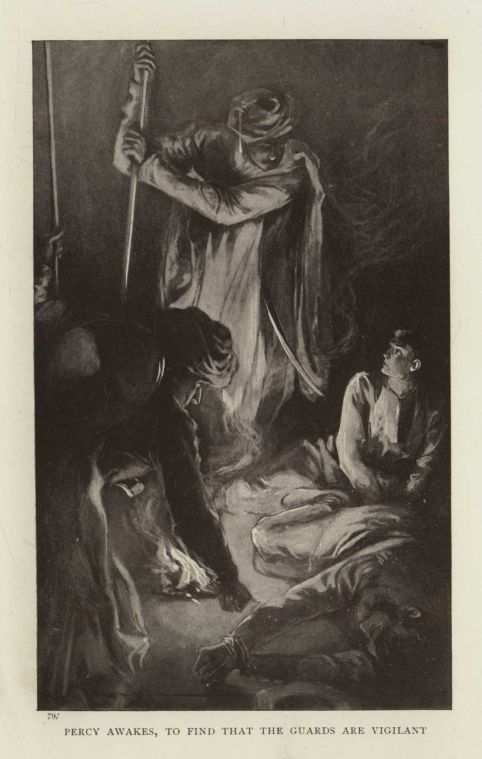
PERCY AWAKES, TO FIND THAT THE GUARDS ARE VIGILANT
Half an hour later they passed through a village, and as the forest thinned as they approached it, and the path became broader, the dacoits closed in on both sides of the prisoners and completely surrounded them. The inhabitants fled into their houses as the troop rode through. No halt was made, and they presently came upon a broad road, and following this again began to mount. All day they travelled among very lofty hills, but towards evening made a long and steep descent.
"I think I know that last pass we went through," Akram Chunder said; "I believe we are now descending into the valley of Cashmere. If I am right, this road will fall into it ten miles below Serinagur."
Shortly afterwards a halt was called, the dacoits turned their horses loose to graze, and proceeded to light a fire to cook the food they had brought with them. They gave the prisoners a share, but when the meal was concluded tied them securely hand and foot and placed two guards over them. These were relieved at short intervals, and one of the men kept the fire burning briskly. Percy woke several times in the night, and each time found the guard vigilant; and being convinced that there was no possibility of an escape while in their charge, he at once went off to sleep again.
In the morning their bonds were loosed, and they resumed their journey. About mid-day they came down into a wide flat valley. A large river meandered with many turns and windings down it, and smaller streams fell into it at many points.
"Are those small rivers for the most part navigable?" Percy asked, pointing to the silver threads among the bright green expanse of vegetation.
"Yes, sahib, the rivers are the roads throughout the valley; it is by them that the peasants take in their products to Serinagur. I do not say they would carry a large barge, but small boats can make their way along them right up to the foot of the hills."
"It must be a very rich country judging from the numbers of villages scattered about."
"It is, sahib; with good government Cashmere would be a paradise. It is never very hot or very cold; the air is soft and balmy, the soil is so rich that everything grows in abundance with but little trouble to the cultivator; he has but to gather his crops and pitch them into his boat, and he can make his way to market without the necessity for horse or bullock. But the government is bad, and has been so for long. Ghoolab is a hard master, but no harder than its former rulers have been. The people would be rich and contented indeed under such a rule as that of the English, firm and just, for in addition to agriculture they have many other means of earning their living, there are the shawl-weavers and silver workers, and those who paint on lacquer, and every member of the family can help to earn something.
"The mountains abound with game, and there is pasturage for countless flocks and herds. The poets of India have always sung of Cashmere as the fairest and most blest by nature of any spot south of the Hindoo Koosh; and they have not spoken a bit too strongly. With good rulers it would be that and much more. The fault is that the country is so fair, the climate so balmy, and life so easy, that the people are too soft in their habits to make good soldiers, and the country has therefore been overrun countless times by more warlike races. At present the Sikhs are masters, but their rule is likely to be even shorter than that of others who have conquered it. When the English are lords of the Punjaub, they will see how fair and how rich is this valley of Cashmere, and that they have but to stretch out their hand to take it. It will be a blessed day indeed for the people when they do so."
"I don't think they want further conquests, Akram; they would gladly have left the Punjaub alone, but they were forced against their will into annexing first the provinces beyond the Sutlej, now Jalindar, and next time perhaps the rest of the country, but there can be no aggressions from Cashmere."
"No, sahib, but the same necessity may arise here as elsewhere. The English hate oppression, and if Ghoolab or his successors grind down the people beyond a certain point, they will interfere. Moreover, Cashmere is necessary to them. Through it runs the best road over the great northern chain of mountains. It is, quite as much as Afghanistan, the door of India, and round the valley at its northern end are troublesome tribes, whom the rulers of Cashmere have never been able to keep in order; the boundaries of China are not far away. A generation or two at the outside and the English will be rulers at Serinagur I think, sahib. What a blessing it would be to the country! In the first place, there would be neither over-taxation nor oppression. All would live and till their lands and work their loom, secure of enjoying their earnings in peace. Money would flow into the country, for the sahibs would come in great numbers from the plains, for health and for sport, and would spend their money freely, and would buy our manufactures from the weavers and silversmiths at first hand, while now they have to be sent down to market at great expense, and in troublous times at great risk. There, you see, sahib, we are taking the northern road; in two hours we shall be at Serinagur."
"All the better, Akram; this is a lovely view, and I should be a long time before I was tired of looking at it; but I am eager to see what kind of a place we are going to be shut up in so as to judge our chance of escape. I wish we could get hold of a couple of long knives and hide them somewhere about us, before we reach the town;" for the clothes they had worn when they were captured had been restored to them before starting.
"One might persuade one of these fellows riding by us to part with his knife, sahib; but our pockets are empty; at least mine are, and I don't suppose they have left you any better provided."
"No, Akram, but I have twenty gold pieces wrapped up in flannel and stowed away in a flap-pocket at the bottom of my holster. My uncle had it made on the day I left him. He said that it might be useful to have a small store of money there in case I ever fell among thieves; and it is so contrived that even if anyone put his hand right down to the bottom of the holster he would not suspect that there was a pocket there, for the flap exactly fits it, and makes a sort of false bottom. The money was stowed away there, and I have never thought of it since."
"It must be well hidden, sahib," Akram Chunder said with a laugh, "for I have put the saddle on and off a hundred times, and put your pistols and sometimes food into the holster, and never for a moment suspected that there was money lying there. Are you sure that it hasn't been taken?"
Percy put his hand down into the holster.
"It is all right, Akram, I can feel the roll of flannel under the flap."
"Well, sahib, if you can get out four pieces it is hard if I don't manage to get a couple of knives from this fellow next to me; as for the rest, if we can but hide them about us they may prove the means of our getting free from prison. Thinking it over, it seemed to me that our greatest difficulty was that we had no means of bribing anyone."
Percy managed to get out four gold pieces, and passed them quietly to his follower.
"Comrade," the latter said in a low voice to the dacoit riding beside him, "you have two knives in your girdle, at what do you value them?"
The man looked keenly at his prisoner. Their clothing had been searched with scrupulous care, and he felt sure that no hiding-place could have been overlooked.
"It depends on who wanted to buy," he said cautiously.
"Suppose I wanted to buy."
"Then they would be worth two gold pieces each."
"That is beyond my means. I would not mind giving a gold piece for each of them."
"Where are the pieces to come from?"
"That is my business; perhaps I have them hidden in my mouth or my ears, or my hair."
"I dare not do it," the man said; "it might be noticed."
"Not if you managed it well," Akram said. "You might ride close up to me when the road happens to be narrow, and pass them in a moment; besides we are not thinking of escape now; but they may be useful to us afterwards."
"It is too great a risk," the man repeated irresolutely.
"Well, I will give you three pieces for the two, though it is hard that you should beggar me."
The man nodded, and presently Akram saw him shift the two knives to the side of his girdle next to him. A short distance farther on he glanced round at the two men riding behind. They were laughing and talking together, and evidently paying but little attention to the prisoners. A moment later he touched his horse's rein, and his knee rubbed against Akram's. The latter passed three gold pieces into his hand, snatched the knives from his girdle, and thrust them under his coat, and the dacoit at once drew off to his former position. Riding close together, Akram had no difficulty in passing one of the knives to Percy, who then again opened the flap in the holster and took the money from its flannel inclosure and handed seven pieces to Akram.
"Where do you mean to hide them?" he asked.
"In the folds of my waist-sash; that is the only place to put them at present. Of course if they search us they will discover the money and the knives, but they will be so sure that the dacoits have taken everything from us that they may not think it worth while to do so. If they once leave us in a room alone we can hide them away so that nothing but a careful search will find them; but at present we must trust to chance."
They were now approaching the town, which extends some two miles on either side of the river Jelum, across which several bridges are thrown. Percy was disappointed at the appearance of the place, which contained no buildings of sufficient importance to tower above the rest. He was most struck with the green appearance of the roofs. On remarking this to Akram, the latter replied:
"They are gardens, sahib; the roofs are for the most part flat, and they are overlaid with a deep covering of earth, which keeps the houses warm in winter and cool in summer. The soil is planted with flowers, and forms a terrace, where the family sit in the cool of the evening."
"That explains it. It is a pity the same thing is not done in other towns; it looks wonderfully pretty."
The people they passed on the road were dressed somewhat differently to those of India; the men wore large turbans and a great woollen vest with wide sleeves; while the women were for the most part dressed in red gowns, also with large loose sleeves. Bound the head was a red twisted handkerchief, over which was thrown a white veil, which did not, however, cover the face.
"Is the language at all like Punjaubi?" Percy asked.
"No, sahib, it differs altogether from all the Indian tongues, so far as I have heard, and is therefore very difficult to be learned by the natives of other parts."
Before reaching the town the horsemen turned off from the main road, and making a wide detour so as to avoid it altogether, continued their course along the foot of the hills on the left of the valley, and after proceeding some two miles above the upper end of the city, mounted the hill, and in half an hour reached a building standing at considerable height above the valley.
"That is just as we expected, sahib. You see we have avoided the town, and Ghoolab will, if questioned, be able to affirm that we have never been brought there. None of the people we met on the road will have noticed us, dressed as we are, in the middle of this band, whom they will take to be the following of some sirdar."
"If that is to be our prison, Akram, it does not look anything like such a difficult place to get out of as the dacoit's castle; but of course it all depends on where they put us."
They stopped at the entrance to the building. They were evidently expected, for an officer came out at once, followed by six armed men. He addressed no questions to the dacoits, but simply nodded as they led the two prisoners forward. Two of the men took the bridles of the horses and led them inside the gates, which were then closed.
Percy and Akram dismounted, and the officer, entering a door from the court-yard, ordered them in Punjaubi to follow him. To Percy's great satisfaction he led the way up a staircase, instead of, as the lad had feared might be the case, down one leading into some subterranean chamber. After ascending some twenty steps they went along a narrow passage, at the end of which was a strong door studded with nails. One of the men produced a key and opened it, and on entering Percy found himself in a chamber some fifteen feet square. It was not uncomfortably furnished, and had two native bedsteads. The floor was covered with rugs. A low table stood in the centre, and there were two low wooden stools near it. Percy's first glance, however, was towards the window. It was of good size, and reached to within a foot from the floor. It was, however, closed by a double grating of strong iron bars, with openings of but four or five inches square.
"Do not fear, no harm is intended you," the officer said. "For a time you must make yourselves as comfortable as you can here. Your servant will be allowed to be with you. If there is anything you require it will be supplied to you."
So saying he left the room, and the door was then locked.
"Thank goodness you are left with me, Akram," Percy exclaimed. "The thing I have been dreading most of all is that we should be separated; and if that had been so, I should have lost all hope of escape."
"I have feared that too, sahib, though I did not speak of it; but before we think of anything farther, let us hide one of the knives and half the money in the beds."
"Why not hide them both?" Percy asked.
"Because we might be moved suddenly, sahib. Ghoolab might order us to be taken to another prison, or might send for us down to Jummoo; there is never any saying; so it is well to keep some of the money about us. Of course we may be searched, but in that case we should lose but half. However, I do not think they will do that now. They will make quite sure that the dacoits will have taken everything there was to take."
CHAPTER XIII.
ESCAPE.
Having carefully hidden one of the knives and nine pieces of gold in the beds, they divided the remaining eight pieces between them. Akram took off his turban, unrolled his hair, and hid his four pieces in it. He then, with the point of a knife, unripped two or three stitches in the lining of Percy's coat and dropped his money into the hole.
"How about the knife, Akram? That is a much harder thing to hide."
"It must be hidden on you, sahib, so that if we are separated you will be able to use it if you see an opportunity."
He took the knife, and with it cut off a strip an inch wide from his cloak; then he pulled up one of the legs of Percy's long Sikh trousers, and with the strip of cloth strapped the knife tightly against the side of the shin-bone; the handle came close up to the knee, the point extended nearly to the ankle-bone.
"There is no fear of that shifting," he said when he had fastened the bandage and pulled the leg of the trouser down again. "And even if they felt you all over they might well omit to pass their hands over the leg below the knee."
"It is certainly a capital hiding-place, Akram; I should never have thought of putting it there, and it is the last place they would think of searching for anything. Now, we can have a look at the window; it is very strongly grated."
Akram shook his head. "There is no getting through there, sahib; these bars have not been up many years. The stonework is perfect, and with only our knives it would be absolutely impossible to cut through that double grating. The room has doubtless been meant for someone whom they wanted to hold fast and yet to treat respectfully. We may give up all idea of escaping through the window. That stonework was evidently put up at the same time as the gratings. You see the rest of the wall is of brick."
"I don't see it, Akram; it is all covered with this white plaster."
"Yes, sahib; but all the houses here are built of brick, that is to say of brick and woodwork, and I noticed this one is also; besides, if you look at the plaster carefully you can make out the lines of the courses of brick underneath it; it is a thin coat, and badly laid on."
"It is a nuisance it is there," Percy remarked. "If it hadn't been for that it might have been possible with our knives to have cut away the mortar between the bricks, and so have got them out one by one, till we made a hole big enough to get through. Of course it would be a long job, but by replacing the bricks carefully in their places and working at night it might have been managed. But this white plaster renders it quite impossible unless the whole thing could be done in one night, which would be out of the question. There is the floor; we must examine that presently. I have read of escapes from prison by men who managed to raise a flooring stone, made a hole underneath big enough to work in, and so made their way either into another room or through the outside wall. It would need time, patience, and hard work; but unless we are able to bribe the man who brings us in food, that is how it must be done."
He pushed aside one of the rugs. The floor was composed of smooth slabs of stone about a foot square. "It could not be better," he said. "There should be no great difficulty in getting up a couple of these slabs. They are fitted pretty closely, but we ought to be able to find one where there is room for the blade of a knife to get in between it and those next to it."
"That is good, sahib; I should never have thought of getting out that way. However, if you tell me what to do I will do it;" and Akram went to the place where he had hidden his knife.
"There is no hurry, Akram. We can fix on a stone while there is daylight, but we can't begin until we are sure that everyone is asleep. They may bring us in some food at any moment; and before we begin in earnest we shall have to find out the hours at which they visit us, and how late they come in at night."
At this moment they heard steps coming along the passage.
"Sit down on that stool," Percy said, while he threw himself down on one of the charpoys. "We must look as dull and stupid as we can."
A man brought in a dish of boiled rice and meat. Akram addressed him in Punjaubi, but he shook his head and went out without a word.
"If none of these fellows speak anything but their own language, sahib, it will be difficult to try and get them to help us, for it will not do to let out that I can talk the language; for if we once get free, that will be our best hope of getting through the country."
"We will try the other way first at any rate, Akram. The money we have is not sufficient to induce a man to risk his life in assisting us, and he might possibly think he could do better by betraying us; in which case we might be separated and put in a much worse place than this."
"That is true enough, sahib; at the same time the money we have is a very large amount here. He would not get above three or four rupees a month, so that it would be four or five years' pay. Still there is the danger of his betraying us. As you say, we had better try in the first place to get out as you propose."
"It is nothing to what men have done sometimes, Akram. They have escaped through walls of solid stone. They don't build like that here. The bricks are not generally well baked, and are often only sun-dried. As soon as we have finished this food we will examine the stones. We will begin near the outside wall—we might get into an inhabited room if we went the other way—and working towards the outside we know we have only to get through it to be free, for these rugs will make ropes by which we can slide down without difficulty."
Examining the flags along the side of the outer wall they found two or three where, without much difficulty, they could insert a knife in the interstices.
"Let us set to work at once, Akram; we can hear the man's footstep right along the passage, and shall have plenty of time to drop the stone in and throw the rug over it before he reaches the door. I want to see what is underneath, and I specially want to have a place to hide the two knives in case they should take it into their heads to search us."
The cement in which the flat slabs were laid was by no means hard, and in half an hour they had cut it all round one of the stones. This was, however, still firmly attached to the cement below it. "I am afraid to use any pressure, Akram, for we might break the knives."
"That is so, sahib; if we had an iron bar we might break the stone, but I see no other way of loosening it. Perhaps if we were to jump upon it we might shake it."
"I don't think there would be much chance of that, and if there is anyone in the room below they might come up to see what we are doing. We might fill the cracks with water all round and by pouring in more water from time to time it might soak in and soften the cement, but of course that depends entirely upon its quality; however we might as well do that at once."
They filled the cracks with water, drew the rug over the place, and then returned to their seats. Presently Akram said:
"We might try wedges, sahib."
"So we might, I did not think of that; and there are the beds, of course."
"Yes; I could cut away some pieces from the under part of the framework of one of the beds."
"That will do capitally."
It was slow work cutting out a piece of bamboo sufficiently large to make a couple of dozen of wedges, and it was dark long before Akram had finished. It took another three hours to split it up and make it into wedges. As soon as these were completed, they drove them in close to each other along one side of the stone, pressing them in with the haft of a knife with their united weight. When all were wedged in Akram tried the stone.
"It is as firm as ever, sahib."
"Yes; I did not expect that we should be able to move it, especially as we have not hammered in the wedges. If it does not move by morning we must tap them in, giving a tap every four or five minutes; that would not be noticed; but I hope we shall find it is loose then. You see the crack is full of water, and so the wedges will swell and exercise a tremendous pressure. In some places they split stone like that."
They threw themselves down on the beds and slept till morning broke. Percy was the first to open his eyes, and at once leapt up, ran across the room, moved the rug, and examined the stone.
"It has moved, Akram. The side opposite the wedges is jammed hard up against the next stone."
"It is as firm as ever, sahib," Akram said, trying it with his knife.
"Yes, because it is held by the pressure of the wedges. When we get them out we shall find that it is loose from the cement."
They found, however, that there was no possibility of getting out the strips of wood.
"We have only to wait," Percy said. "As soon as they are dry they will be loose." It was, however, two days before the moisture had evaporated sufficiently for them to be able to draw out the wedges.
"Now let us both put our knives in on this side and try and lift it."
Repeated trials showed them that this could not be done. In the evening, however, when the lamp was brought them, they heated the point of one of the knives in the flame until it had so far lost its temper that they were able to bend the point over by pressing it on one of the flags. Again heating it they dipped it in water to harden. They then ground the point down on one of the stones until they were able to pass it down the joint that the action of the wedges had widened. The bent point caught under the stone, and they had no difficulty in raising it.
"There is the first step done," Percy exclaimed in delight. "You had better warm the knife and straighten the point again."
They experienced no great difficulty in getting up the next stone, which they had loosened in a similar way to the first while waiting for the wedges to dry. As soon as this was up they began cutting into the cement. The surface was hard, and the knives at first did little more than scratch it; but below they found it much softer and got on more rapidly. As they removed the cement they placed the powder a handful at a time on the window-sill, and blew it gradually out through the grating. After three nights of continuous work they had made a hole a foot deep and come down upon wooden planking.
"This is doubtless the ceiling of the room underneath," Percy said. "There can be no one sleeping there or they would have heard the scratching overhead." By lifting up the stones, which they always replaced at daybreak, they could hear voices, and did not recommence their work at night till they were well assured that no one was stirring below. As the stones they had taken out were next to the wall, they now commenced operations on the brickwork. This they found much easier, as the mortar was nothing like so hard as the cement, and on cutting it out between the bricks they had no great difficulty in moving these. After two nights' work they had taken them all out with the exception of the outside layer, as they were able to calculate by the thickness of the wall at the window. During the daytime the bricks that had been removed were stowed away in the hole.
"We shall be out to-night," Percy said exultantly, as they replaced the flags for the last time. "This last layer will be easy work, for as soon as we have cut round one brick we shall be able to pull it in, and can then get a hand through the hole, and the others will come quite easily as soon as we cut away the mortar a bit. There will be no occasion to tear up the rugs to make a rope. We are not more than eighteen or twenty feet from the ground, and two or three of them knotted together will be enough. We will set one of the beds over the hole and tie the end to that."
Percy felt nervous all day, being in fear every time he heard a footstep in the passage that something might occur which would upset all their plans. They had now been ten days in their prison, so there was time for a messenger to have gone to Jummoo, and thence to the fortress and back. Still he hoped that his uncle would at any rate refuse to accept Ghoolab Singh's first offer, whatever it might be, and that lengthy negotiations would go on. Nothing out of the ordinary routine happened; their guard came three times a day as usual with their food; and after his last visit Percy sprang from the couch.
"Hurrah! Next time he comes he will find the place empty, Akram. Now let us set to work at once."
Four hours of hard work sufficed to make a hole large enough for them to crawl through. The charpoy was brought over the hole, the money stowed away in their clothes, and the rugs knotted. Then, feet foremost, Percy wriggled out through the hole, holding the rope tightly, and slid down to the ground, while two minutes later Akram stood beside him. They had already taken off their turbans and rewound them much more loosely, so as to resemble closely those worn in Cashmere. They started at once up the hill, and continued their course until they reached a wood high up on the mountain side. They had already determined upon their course. It was of the greatest importance that they should obtain dresses of the country, for though they might have made their way along the hills they would have difficulty in buying food, and might find horsemen already posted at the various passes by which the mountain ranges were traversed. At daybreak Akram took off his long coat, arranged his clothes in the fashion of Cashmere peasants, and started boldly for the town.
"The shops will soon be open," he said, "and unless anyone happens to go round to the back of our prison, which is not likely, they will not find out that we are gone until the man enters at nine o'clock with our food, and long before that I shall be here again. You need not be uneasy about me, sahib. Being really a native of the valley, no one can suspect me of being anything else."
Soon after eight o'clock he returned with two complete suits, in which they were soon attired. As the natives of Cashmere are fairer than those of the plains of India, it needed but a slight wash of some dye Akram had brought up with him to convert Percy's bronzed face to the proper tint, and as soon as this was done they descended the hill and came upon the main road below the city. Soon afterwards some horsemen passed them, galloping at a furious rate. These did not even glance at the supposed peasants, but continued their course down the valley. Other and much larger bodies of horsemen afterwards passed them, but, like the first, without asking a question.
"Doubtless they think we have at least twenty miles start," Akram said. "I expect the first party were going right down to the mouth of the valley, warning all the towns and villages to be on the look-out for us. The others, when they think they must have passed us, will scatter and occupy all the roads and passes. Some of them will push on until almost within sight of the fortress, so as to catch us there if we manage to get through the woods and pass the lines of watchers."
At a leisurely pace they proceeded down the valley, Akram sometimes entering into conversation with peasants they met, and going into shops and buying provisions; he learnt in the villages that strict orders had been given to watch for a Sikh with a young Englishman who had escaped from a prison at Serinagur. Akram joined in their expressions of wonder as to how an Englishman could have got there, and how the escape had been managed, and mentioned that he was on his way to visit some relations at Jummoo.
When near the mouth of the valley he purchased some cotton cloths, such as peasants working in the fields would wear, and presently they put on these and left those behind them that had proved so useful, Percy's skin being stained brown wherever exposed by this more scanty costume. Thus attired they issued out from the mouth of the valley and went forward into Ghoolab Singh's country, as they agreed that this was the place where they were the least likely to be looked for. They had been four days on their way down from Serinagur, and decided to travel still farther west, so as to return to the fortress from the side opposite to that where a watch was likely to be kept up for them.
Three days' more walking, and, having made the detour, they approached the fortress on the west. They met with no suspicious party on their way, and as they ascended the zigzag road from the valley felt with delight that they were now perfectly safe. As usual the drawbridge was down and the gates open, and they passed in without question from the men on guard there. As they went down the street they saw a figure they recognized, and Percy ran forward and exclaimed:
"Bhop Lal, I am indeed glad to see you! So those rascally dacoits did not kill you after all?"
"Blessed be the day, sahib!" Bhop Lal exclaimed with delight. "There has been sore grief over you. The colonel has been in a terrible state since I was carried in here and told him how you had been seized by dacoits, and still more has he been troubled since, ten days ago, he learned from a messenger of Ghoolab Singh that you had fallen into the clutches of that notorious scamp Goolam Tej. The Ranee is ill and keeps her bed.
"Ah, Akram Chunder! truly I am rejoiced to see you also. I was glad indeed that you were with the young sahib, for I knew you to be a man of resources."
"It was the young sahib himself who devised the plan by which we escaped, Bhop Lal; and how are your wounds?"
"They are very sore yet, and the hakim says that it will be many weeks before I am fit to sit in the saddle again; but now that our sahib is back safely I shall have no more to fret about, and shall mend rapidly."
By this time they had arrived at the door of the colonel's residence, and Percy ran in.
"You cannot enter here, fellow," a servant said, as he was about to push aside the hangings of the entrance to the private apartments.
Percy laughed, and without waiting to explain pushed the man aside and ran in.
"Well, uncle, here I am," he exclaimed, as he entered the room where his uncle was sitting writing. The latter leapt to his feet with a cry of joy.
"Why, Percy, is it you in this disguise? Welcome back, my boy, a thousand times! But before you tell me anything, come in to see Mahtab, who has been downright ill from grief since Bhop Lal brought in the news of your being carried off by dacoits."
The Ranee's delight at seeing Percy was unbounded, and it was some time before she and her husband could sit down quietly and listen to his story.
"All is well that ends well," the colonel said when he had brought it to a conclusion. "You have had a bad time of it, Percy; but I doubt if your aunt and I have not had a worse. Of course, I was a good deal troubled when I heard that you were carried off; but as to that Bhop Lal could tell us nothing, having been shot down at once, and so hacked that he knew nothing of what took place until he was revived by water being poured down his throat. Three traders coming along the road on their way here had found him, and as soon as they learned from him who he was and what had occurred, they bandaged his wounds and had him carried here in a dhoolie. They reported that they had seen nothing of you, and one of them at once rode back with me with a troop of horse to the spot where they had found your man, and as, after a most careful search, we could find no trace of blood, we concluded that you had been carried off.
"We followed the traces of the band for some distance, but then lost them just as it was becoming dark. As they had had some eight hours' start of us, and were making for the mountains, we gave up the pursuit and returned here. I made sure that in the morning I should receive a message from the rascal demanding a ransom for you, but as the day went on I became more uneasy, as the idea struck me that they might not be dacoits, but fellows in the pay of Ghoolab. It certainly did not seem likely that he could have heard that you would be on your way back; but his men might have been there for weeks, for he would guess that when the war was over you would be making your way back here again.
"For the next six days I sent out parties of horsemen all over the country, but could obtain no news whatever, and was getting in a terrible state of mind when a man rode in with a letter from Ghoolab Singh. He stated that he had learned that you were in the power of dacoits somewhere among the mountains. He said that it would be a long and difficult task to find them, but that he would use every effort to do so, and would either by force or bribery obtain you and restore you if I, on my part, would undertake to resign the government that I held in defiance of the orders of the durbar. As a rebel, he felt that he should not be justified in exerting himself on my behalf, but if I would submit to the orders of the durbar he would guarantee that my past conduct should be overlooked and that you should be restored to me. I had very little doubt that you were already in the scoundrel's hands when he sent the message, but in any case I saw that he had me on the hip. I don't suppose he expected a direct answer to his proposal, and he did not get one. I sent an answer back that I was ready to pay any reasonable sum for your ransom; but as for resigning my governorship and handing over the fortress, I wished to know what guarantee he could offer that I should be permitted to retire from the Punjaub in safety with my family and treasures. To that I received an answer that he was ready to take the most solemn pledge for my safety, and that he was sending off to Lahore to obtain a free pardon for me from the durbar, and a permission for me to retire with all my family and as many of my followers as might wish to accompany me across the Sutlej. I then wrote back that this would be perfectly satisfactory, but that, naturally, I should require that you should be handed over to me prior to my evacuating the fortress. To this I received no answer. I thought perhaps he was waiting for a reply from Lahore, but I now understand that before the messenger returned with my second letter you had already slipped through his fingers. I should have liked to have seen him when he received the news of your escape. Now, Percy, tell us all about your adventures since you left us. There was no believing any of the reports that reached us about the various battles. I know, of course, that the Sikhs must have been thoroughly thrashed, or we should never have had a British occupation of Lahore. Beyond that I really know nothing for certain."
It took some time for Percy to describe all the military operations.
"I knew that it would be so," the colonel said gleefully when he concluded. "I told them over and over again that if they thought, because they had won victories over the Afghans and other tribes, that they were a match for the English they were completely mistaken.
"They scoffed at the idea of defeat; but now they find that I was right, and so was old Runjeet Singh. These fellows have plenty of courage and plenty of dash, but though a good many thousand have been drilled in our fashion they cannot be called soldiers. They have no generals and no officers to speak of, and when it came to fighting they would be nothing better than a mob. Still our fellows must have fought well to turn them out of their strong intrenchments. In the open field I had no doubt whatever as to the result, but behind earthworks discipline does not go for much, and a brave fellow who is a good shot counts for nearly as much as a trained soldier. Now you may as well get yourself into decent clothes again, Percy, and while you are doing that I will go out and see your man, and tell him that I am well pleased with his conduct, and that he and his comrade shall both be well rewarded for the dangers they have passed through."
In the evening Percy went more into details, and the colonel was highly pleased to hear that he had attracted the attention of the heads of the army, and that the governor-general himself had promised to apply at once for a civil appointment for him.
"What are you thinking of doing, uncle?"
"I shall hold on, Percy. You say there is to be a British Resident at Lahore, and that probably troops will remain there permanently, in which I agree with you, for it is morally certain that if the maharanee and her son are making peace with us and surrendering the Jalindar Doab, they would be turned out and probably massacred the moment the troops retired. Well, with an English Resident there, and being to a great extent under British protection, and having besides no regular army, Lahore will be glad enough to let me alone. So there is only Ghoolab. He is not very certain of his position yet, and I have no doubt he knows as well as we do that before long there will be another war, which will end in our people annexing the whole of the Punjaub. I think, therefore, that there is no chance of his trying again to take this place by force. He may, of course, and I daresay he will, try assassination again, but I shall be on my guard."
"I think, uncle, there ought to be more care at the gate. We came in without being questioned, and we might, for aught the guard knew, have been two men sent by Ghoolab to assassinate you. I think that every man coming into the place ought to be questioned as to his business."
"But they would lie, my boy. What is the use of questioning?"
"Ah! but I would not let them in, uncle, unless they could prove that they had business with some person living in the fort. You are not recruiting now, and if you were you could get plenty of men well known in the district. I don't say that you could keep assassins out, whatever the means you adopt; but I do think that if it were known in the district that no one is admitted within the walls until after he has given a satisfactory account of himself, Ghoolab would find it more difficult to get men to undertake so hazardous a business."
As the Ranee thoroughly agreed with Percy the colonel consented to make more rigid rules, although still maintaining his opinion that no precautions of the sort would be of the slightest avail in keeping a determined man from entering the place.
The next morning another horseman came in from Ghoolab.
The colonel laughed as he read the letter he had brought.
"The old fox still hopes to catch you again, Percy; he simply continues negotiations, and asks what guarantee I can offer on my part that I will retire from the fortress if you are, as I demand, given up to me before I surrender. I will put him out of his agony."
So the colonel wrote a short note to the effect that his nephew had returned, and having informed him who was the brigand into whose hands he had fallen, there was no longer any need for any further negotiations on the subject.
"You must be doubly careful now, Roland," the Ranee said when her husband told her what lie had written to Ghoolab. "He has always been your bitter enemy, but he will be more so than ever now. I do beg that you will again have that guard you had during the siege, and that you will have the two men who have proved so faithful to Percy to sleep always at the entrance to our apartments."
"I hate being guarded," the colonel said; "still, if it will make you more comfortable, of course it shall be as you wish."
When the officers of the garrison understood that Ghoolab had again been foiled, there was a general opinion that too great precautions for the colonel's safety could hardly be taken.
The watch at the gate was carried out most vigilantly, for the colonel was so much beloved by his men that each considered himself personally responsible for his safety, and whatever might be the story told by strangers arriving at the gate, they were not allowed to pass until the trader or other person they wished to see was brought down to the gate to vouch for the truth of the statement.
During the next three months seven or eight men whose story proved to be false were seized and imprisoned. The officers were all in favour of applying torture to them to extract the truth, but the colonel would not hear of it.
"I will have no one tortured in my district. Such a thing has never been done to my knowledge since I was appointed governor ten years ago, and I won't have it begun now. In the second place, you cannot depend in the slightest upon anything that may be told under torture. And lastly, if I knew it for certain, as I think it probable, that they were agents of Ghoolab, I should really be none the wiser. They came here with a false story, and, therefore, for no good purpose. Consequently they should be punished. Therefore, let each man who is convicted of lying be kept for a week in the cells; then give him a sound flogging, shave off his hair, moustache, and beard, and turn him out. That will be quite enough to deter other people from following his example."
This decision met with general approval, and was in each case carried into effect, the shaven men being turned out from the gates amid the gibes and jeers of the soldiers, with many threats of what would happen if they were again found in the neighbourhood.
Six months after his return to the fortress Percy received a letter (forwarded to him by Mr. Henry Lawrence, the Resident at Lahore, from the Court of Directors), saying that in accordance with the very strong recommendation of the governor-general he had been appointed to the Civil Service of the Company on the date of his attaining his nineteenth birthday, that a note had also been made of his willingness to serve at an earlier period if required, and that instructions had been given to that effect to the Resident at Lahore, who was authorized to employ him if required, in which case his appointment would date from the day of his commencing service.
The time passed pleasantly to Percy. He rode, practised shooting and sword exercise, and worked for several hours a day at the Pathan language, in which, by the end of eighteen months, he had become almost as efficient as in Punjaubi, for, there being several Afghans among the officers, he was enabled to learn it colloquially. At the end of that time he wrote to the Resident at Lahore saying that he was now well up in Pathan, and thought it right to inform him of this in case any occasion should arise for the use of his services on the northern frontier.
Six months later he received a letter from Sir Philip Currie, who had just succeeded Mr. Lawrence as Resident, stating that he had been requested by Mr. Agnew, who was going as political officer to Mooltan, to furnish him with an assistant capable of speaking both Punjaubi and Pathan fluently. The Resident added that from what he had heard of Mr. Groves' conduct during the campaign, and from the strong manner in which the governor-general had personally recommended him to the Court of Directors, and the very favourable terms in which his friend Mr. Fullarton had more than once spoken of him, he would be well fitted to undertake the duties of assistant to Mr. Agnew. Having been authorized by the Court of Directors to appoint him at any time to a post where his services might be useful, he had therefore much pleasure in now nominating him Mr. Agnew's assistant.
CHAPTER XIV.
TREACHERY.
Bhop Lal and his comrade were delighted when they heard that Percy was again going off, and that, as before, they were to accompany him as his servants.
"There will be no fighting or adventures this time," Percy said. "I expect your life will be just as quiet there as it is here. Still it will be a change, and I suppose that sometimes I shall have to ride out from Mooltan to see people in the district. Your being a Pathan will be a great advantage, Bhop Lal, on this occasion, just as Akram Chunder's being a native of Cashmere got me out of a bad scrape last time. As a Pathan you will be able to gather intelligence, as the population is largely composed of your countrymen. Of course, on your journey you will take your arms with you, but you will have no occasion for them there as the followers of a peaceable civil servant."
"Arms are always useful," Akram Chunder said. "The Pathans are quarrelsome fellows, though Bhop Lal is an exception. The population of Mooltan are said to be the most turbulent of those of any town in the Punjaub. You will miss your horse, sahib. I suppose it is in Ghoolab Singh's stables. The one you ride now is a good one, but not so good as Sultan."
"My uncle has just given me Sheik. He says it will be more useful to me than to him."
"Then, sahib, you need never fear being caught when you are once on his back. Even with the colonel's weight there is not a horse in the district can touch him, and with you in the saddle he will go like the wind."
Before starting Colonel Groves presented the two men with horses of his own breeding.
"Without being comparable with Sheik, they are powerful and well-bred horses, fast, and capable of accomplishing long journeys. As I know you will serve my nephew as well and faithfully as you did last time, I shall never regret having parted with the horses," he said to them. "One or other of you will always be with him, and it is useless for a master to be well mounted if his followers cannot keep pace with him. I do not say that either of these horses could keep up with Sheik if he were pressed, but at least you will find few that can go faster."
The men were overjoyed with the present. The Sikhs, like the Indian irregular cavalry, provided their own horses and equipments, and it was a matter of personal pride to be well mounted. To be the possessors of animals like these, uniting the hardiness of the native horse with the power and speed of their English sire, was an unhoped-for pleasure, and they expressed their thanks in the warmest terms.
As it was evident that Mr. Agnew would very shortly be leaving for Mooltan, and that therefore speed was necessary, Percy and his two men started at daylight next morning and rode by long stages down to Lahore.
Until the last halt before reaching the city Percy had ridden in native dress, as, although things had now settled down a good deal, the feeling was as strong as ever against the British, who still, at the earnest request of the maharanee and the durbar, maintained a force at Lahore to support the young maharajah's authority. It was, therefore, advisable to avoid attention until they reached the capital. As soon as they arrived there Percy rode to the Residency.
"I am glad you have come, Mr. Groves," the Resident said as he was ushered into the study. "You must have come down fast indeed. I told my messenger to carry my note as quickly as he could, but I hardly fancied that you could have been down for another three days; and Mr. Agnew starts to-morrow, so you are just in time."
"You did not mention in your letter, sir, the day on which he would set out; but I came down as rapidly as I could in order to catch him here if possible." At this moment a gentleman in civilian dress, with a young officer, entered the room. They hesitated on seeing that the Resident was engaged.
"Come in, Mr. Agnew," Sir Frederick Currie said. "This is Mr. Groves. He has come down post-haste to take up his appointment as your assistant."
"I am very glad that you have arrived in time, Mr. Groves. I have learnt a good deal about you from the memorandum handed over to Sir Frederick by his predecessor, and shall be very glad to have your assistance. This is Lieutenant Anderson of the 1st Bombay Fusiliers, who also accompanies me. We will leave Sir Frederick to his work at present and talk over matters. I need not ask if you are well mounted," he went on when they were seated in another room; "the speed with which you have come down shows that. Are there any preparations you want to make in the way of hiring servants?"
"I have two excellent men, sir. They were with my uncle for many years, and accompanied me through the last campaign. They are thoroughly trustworthy, are up to their work in every way, and have plenty of courage."
"You are fortunate, Mr. Groves, in getting two such men. Sikh servants as a rule are not to be depended upon, especially in any trouble with their countrymen; while servants from other parts of India are of little use here from their ignorance of the language. Do you know anything in reference to the situation at Mooltan?"
"Nothing, sir. I know, of course, that Moolraj's conduct was very doubtful during the last campaign, and that it was considered probable he would have attacked General Napier's force coming from Scinde had it not been too strong to be meddled with. I do not know anything more than that."