THROUGH THE SIKH WAR (continued 3)
Reading edition
"Why don't you keep a strong guard in the house, uncle?"
"Because, my boy, I don't know who the traitors are. The officer in command might be the very man himself, and he might so contrive it that the guard was composed of men whom he had corrupted. Where should we be then?"
"But you might appoint Nand Chund to be always officer of the guard?"
"Constable of the palace—eh, Percy?"
"Well, you might call him what you like, uncle, but surely he would be able to pick out a dozen men of whose fidelity he was assured. The duty would not be severe, they would only have to furnish the two sentries at the door, instead of these being sent from one or other of the regiments."
"I will think of it, Percy. Just at present there is less ground for fear than usual, for if an expedition is on foot to attack us openly, such a plot as this would most certainly be delayed until there was a force outside where the conspirators could betake themselves after carrying their designs into execution. The fact that, even were they successful, they would certainly be pursued, and for the most part hunted down and slaughtered by the cavalry, has, no doubt, been one of the reasons why no such attempt as that we are talking of has been made long ago."
"Well, I do hope that when an army approaches you do what Percy suggests," Mahtab, who had been listening silently to the conversation, said to her husband. "You have escaped so many times, Roland, that you have come to think that no attempt against your life will ever succeed, and certainly it is likely that Ghoolab, while organizing an open assault upon you, will take measures to secure his aim being carried out in other ways if possible."
"Very well, wife; you may consider it settled that on the day when an attacking force crosses the boundary of the province, Nand Chund shall be installed as chief of a special bodyguard here."
CHAPTER VI.
A SIEGE.
Not a day passed now without messengers coming in with warnings of approaching danger, and one morning early the officer on guard reported that a large number of persons could be seen approaching by the road from the south.
"Do they look like troops?" the colonel asked.
"No, sahib; they are on horseback and on foot, and there are many carts among them."
"I have no doubt then, Kur Aloof, that they are merchants of the towns coming in here for refuge. The enemy cannot be far off, and they know how the soldiers would squeeze them if they had a chance."
"Will you let all those people in here, uncle? They will eat up our provisions and drink up our water."
"As I told you, Percy, we have sufficient of both for a number double that at present within the walls. Did four times the total now here arrive the supplies would still hold out six months, and two months is the utmost that the siege is likely to last. One need never be afraid of a long siege by men commanded by leaders having no authority over them. A powerful prince might send troops on a siege and order them to maintain it until they captured the place, even if it took them ten years to do so, but at present the Punjaub is without a master, and the troops have only been induced to come here by the prospect of plunder. But as soon as they find that they make but little impression upon us, and that the siege, with its labours, and hardships, and dangers, may continue for many months, they will soon get tired of it, and in the absence of a controlling power will march away.
"They have a good many deserters from our service among them, and little as they love Europeans they will utilize their services, and I anticipate that for a while at least it will be made very hot for us. There are a score of points on that hillside half a mile away where guns can be posted to play on us, while we could make but a feeble return, and there is nothing like a plunging fire kept up night and day to weaken the spirits and lower the confidence of a garrison. That will be the time when the traitors, if there are any, will be busy among the men, and it will need unceasing care and vigilance to prevent trouble."
In a short time the people seen in the valley below began to enter the fortress. They were, as the colonel had anticipated, merchants and other people having something to lose, from the various towns in the district. Most of them brought with them carts laden with their choicest merchandise, and all had their portable valuables and money with them. They reported that news had come in the evening before, that a very large force had arrived at a point within fifteen miles of the frontier of the province, and that the soldiers had been promised the sack of all the towns and villages as an inducement for them to undertake the siege of the fortress.
"But how am I to feed so many mouths?" the colonel asked one of the leading merchants, with a smile.
"We know that our lord has great stores laid up in his magazines," the merchant answered, "and we are, of course, ready to pay for all that he will let us have."
"I have no doubt that the magazines will hold out as long as it is necessary," the colonel replied, "and as I regard all who enter here as my guests, each man, woman, and child shall draw rations of what food we have as long as it lasts. It has been bought out of the revenues of the province, and as each of you contributed, so shall you now share. But you know you will fare worse if the place is taken and you are found here than you would have done had you remained quietly at home."
The merchant shook his head. "There could be no worse, sahib. The soldiers plunder, kill, burn, and destroy as they did in Cashmere; they can do no more if they find us here. But we are not afraid of their taking the fortress. It is strong, and everyone knows my lord's valour and experience. The army will never be able to win their way in here."
"I hope not, my friends; I will certainly do my best to prevent them from doing so. And now about yourselves. The stream of fugitives grows broader and thicker every hour, and if it goes on like this, by nightfall we shall have over five thousand persons here in addition to the strength of the garrison. Against that I say nothing, a thousand at least will be able-bodied men capable of bearing arms, and I shall expect each to do his best; but where am I to stow so great a number? The barracks are already full, and but few indeed will be able to find lodging in the houses of the traders. I have tents and straw for two thousand people, but how can they be pitched? The ground is solid rock. There is no way of driving tent-pegs, and I see not how they can be erected."
"We might spread them over the carts, and so obtain a protection from the night air and a shelter for the women and children, and they might even erect poles in the carts themselves and stay them by ropes to the sides."
"That is a very good idea, and I will order the officer in charge of the stores to issue a tent to each owner of a cart, the others must manage as best they can. I daresay five hundred can be stowed away in the lofts of the stables and in other places not in use, while some with poles leaned against a wall and canvas spread over them can make shelters good enough on a pinch. The oxen must be given over to one of my officers, who will see that they are fed from the granaries and will kill them for food."
The colonel had not over-estimated the number of those likely to arrive, and before nightfall over five thousand had entered the fortress. Stringent orders were laid down that none save the regular troops should be allowed to approach the walls, and each party as it arrived was conducted to the spot allotted to it. Every open space was covered with shelters of one kind or another, the larger constructed of tents, the smaller of shawls and blankets. The principal street was left clear of such erections in order to admit of a free passage for the troops, but it was ordered that all cooking operations should be performed there, as fires would be dangerous in the extreme among the crowded tents. When night came, strong guards were placed on the walls, especially on that facing the shoulder of the hill, upon which any open attack must fall. Percy's idea was carried out, and a body-guard composed of six men from each of the two infantry regiments, and an equal number from the cavalry, marched into the governor's house under the command of Nand Chund. Their instructions were that no one was to be allowed to enter the house, whatever he might allege to be the nature of his business, unless furnished with a written order to do so from the governor.
Percy had been busy all day seeing that the new-comers fell into their places, and in aiding them to shake down in some sort of comfort, and he was thoroughly tired out when he joined the colonel and his wife in their room that evening.
"Well, uncle, I am glad it is coming at last. It is much better to know the worst than to go on wondering when it was going to begin."
"I don't know, Percy. I have been in so many troubles and frays and battles since I came out here, that the thought that we might have to stand a siege was no very great trouble to me; besides, there was always the possibility that something might occur to postpone it altogether. The soldiers and most of the sirdars seem bent upon having a fight with the English, and I greatly hoped that it would begin before Ghoolab's intrigues against me had come to a head. However, now it has come we must make the best of it, and I have no great fear of the result. While you have been busy with these people this afternoon I have been superintending the mounting of two heavy howitzers as mortars, and if they erect batteries on the hill, as I expect they will, we will see if we cannot drop a few shell among them. Nothing unsteadies artillery-men more than finding that the earthworks in front of them do not as they expect protect them, and that by no ingenuity can they defend themselves from missiles that seem to drop down from the sky upon them."
"But how do you do that, uncle?"
"Simply by the amount of powder you put in. A mortar is always fixed at a certain angle, and of course you fix a howitzer the same way when you use it for that purpose. With a mortar the amount of powder of a given strength required to send a shell to a given distance is known to every artillery-man, but with a howitzer one must get it by experiment. You first put in the amount of powder you think sufficient. The ball is fired up into the air, and you watch where it drops. If it is short you add an ounce or two of powder, as the case may be. If it is too far you decrease the charge until you find that the shell drops just behind the enemy's earthworks among the artillerymen serving a gun. Having once got the exact charge of course you stick to it. This sort of thing annoys the Sikhs, who are not much accustomed to shell. A few of them were sent up to Lahore, and I managed to get hold of one and had several hundred cast here to fit those two howitzers, and had a large number of fuses made and stored away for future use. If they try to climb the rocks, a few shells rolled down from the walls are likely to be very effective."
"What are to be my duties principally, uncle?"
"Your chief duty will be to watch, Percy, especially at night. The officers will, of course, go their rounds frequently, but as there may be a traitor among them, I can place no absolute reliance on their vigilance. I shall myself be about as much as possible, but as I shall have to look after everything in the daytime I must take some rest at night; one cannot do two or three months without sleep. I shall release you from all duty during the day, although in case of a serious attack you will take your place on the wall; otherwise I wish you to sleep in the day and to keep a sharp look-out on everything at night, being constantly upon the walls seeing that the sentries are vigilant, and listening intently for anything that might indicate a movement from below. I shall tell off four of Nand Chund's party to accompany you, for if treachery is intended there would be no hesitation in planting a dagger in your heart and then getting rid of your body over the wall. You are nearly sixteen now, and strong and active, but on a dark night that would avail nothing against a lurking assassin."
"Shall I begin to-night, uncle?"
"There is no occasion for that. The enemy have not arrived yet, and indeed no one would dream of attempting to ascend the craig unaided. I fancy they will try an open assault to begin with. When they find that fails they may try surprise."
About midnight an officer reported that a dull confused sound could be heard down the valley. The colonel took a couple of signal rockets, with which one of the boxes brought by Percy from England was filled, and proceeded, accompanied by his nephew, Nand Chund, and four of his guard, to the wall at the lower end of the rock. Lanterns placed on the ground were burning here, and a party of artillery-men were standing by the four guns looking down the valley.
"How far do you think they are away?" the colonel asked the officer in command there.
"A party of them have just crossed the wooden bridge over the stream, sahib. I heard the trampling of their horses upon it distinctly."
"That is fourteen hundred and thirteen yards from the foot of the rock. Drive those wedges a little farther. That is right. I cut those nicks upon them the other day when we had got the exact depression required to lay the guns on the bridge. Now let us wait until another body of them are crossing."
Three or four minutes later the sound in the distance became suddenly louder.
"Now, Nand Chund, fire that rocket. I think you have got it about the right angle."
The rocket flew up in the air, and burst some distance away throwing out a dozen fire-balls. Their light enabled the governor to see right down the valley. Some slight alteration in the direction of the guns was made, and then one after another they were fired. Another rocket was now thrown up, and by its light the dark mass of men on or behind the bridge could be seen to be broken up and retreating. Almost at the same moment four guns were fired from an upper bastion.
"That is grape, Percy," the colonel said. The officer there was told to wait till the men could see a body of troops advancing up the valley. "Listen, there go the cavalry scampering back as hard as the horses can lay their feet to the ground. I doubt whether we shall hear anything more of them to-night."
"They could hardly hope to have passed without our noticing them. They must have been sure that we should have warning of their coming."
"No doubt, lad, but they may not have calculated on our opening fire upon them in the dark. They will not have reckoned upon the rockets, and hoped, I have no doubt, to push a part of their force past the place and up on to the brow before morning, for they would know well enough that they could not pass under the fire of our guns when the sun was once up."
"But how will they get there, uncle? now we have shown them that it is almost as dangerous by night as by day."
"Probably they will march round among the hills, and come down upon us. There will be no difficulty in infantry doing it, and they may manage to drag a few light guns with them, but they can't get anything like heavy artillery up there except by bringing them along below, and taking them up the regular road. That is the first of the difficulties they have to encounter, and as I have a large stock of blue lights I don't see how they are going to get up the hill, which is commanded by a dozen of our guns. They will be safe enough from our fire as they pass along under the craig, for there is not a gun that can be depressed sufficiently to bear upon them there, though we can annoy them by pitching shell and hand-grenades down upon them. Still, determined men might manage that, and might even make their way up the hill in face of our fire, but they could never drag heavy guns up a road which we can sweep with grape. So you see they have got a stiff problem to solve before they can get a battering-gun to play on our northern wall."
For another hour they kept watch. There was still a confused sound from the lower end of the valley, but nothing to indicate any renewed advance. They therefore returned to the house.
Percy was aroused at daybreak, and at once made his way to the battery, where they had been the night before. The colonel and several of his officers were already there. The lower end of the valley was occupied by a great mass of men, horses, and waggons. Tents had been erected here and there, and the banners of their occupants were flying before them.
"How strong do you think they are, uncle?" Percy asked.
"It is difficult to say, mixed up as all arms are in such confusion just as they reached the ground last night, but we guess them at about fifteen thousand. They have four batteries of field guns. There they are away to the right. They evidently came up together, and have kept something like order. We can make out several heavy guns mixed up with the waggons, but whether there are ten or twenty of them I could give no opinion. Do you see that large tent with the red and white flag? Those are the colours of Ghoolab Singh, and the tent no doubt is occupied by his son, the gentleman who was named my successor a week after the death of the Old Lion. He has been waiting some time, and is likely to wait longer. He is no doubt the nominal leader of the expedition; but I believe that he has none of the talent of his father or uncles, and matters will be directed really by the chiefs of the army. I have no doubt a council has been going on all night as to what the next move shall be, and the decision they have probably arrived at is to wait until they can get a better idea of the fortress and its surroundings."
A considerable movement was now going on in the enemy's camp, and the wind bore the sound of trumpets to the fortress.
"They are trying to get into something like order," Nand Chund remarked. "The waggons are drawing out of the mass to take up their positions in the rear, and the assembly calls of the different regiments are sounding. Ah! there is a party going out to reconnoitre."
As he spoke a party of horsemen rode out to the left of the camp. Several bright banners streamed in the air, and an escort of some fifty cavalry followed them. They mounted the hill on the opposite side of the valley until they reached a spot two or three hundred feet higher than the summit of the fortress, and just opposite to it. As soon as their object had been made out the colonel had sent word to the gunners at the batteries along that face ordering them not to fire.
"I do not wish to make any more bitter enemies," he said to his officers in reply to their look of surprise when he issued the order. "At present they are only fighting against me as instruments of Ghoolab Singh, and except on the ground that I am a foreigner, the soldiers have no animosity against me. If we were now to kill two or three of their favourite leaders, and perhaps some of the sirdars who have been bribed into entering upon this business, it would create an active animosity against me. Of course, when fighting begins they must all take their chance, but I don't wish to slay anyone before a single shot has been fired on their side."
The group of officers, who were but half a mile away, remained for ten minutes closely examining the fortress. They then slowly returned to camp.
"Our guns would carry easily enough into the midst of the camp, sahib," one of the officers remarked.
"I know they would, but I won't begin, for the same reason that I would not fire at the group of officers. We will let them open the ball."
An hour later a body of men which they estimated at five thousand marched away with two of the batteries of field guns, and soon were lost to sight as they wound round the hills skirting the valley.
"We shall see them at daylight to-morrow established on the hillside above us," the colonel said. "I have thought several times of establishing a fort near the crest there; but I should not be able to give it much support by my guns, and its garrison would not make any prolonged resistance when they once found themselves cut off altogether from us. With troops one could rely upon thoroughly, such a fort would immensely hinder the operations, and indeed they could do nothing until it was captured.
"It is a standard rule with us out here, Percy," he said afterwards, "never to count upon the natives unless you are with them yourself. The Sikhs are brave, but they want good leaders, and are not to be relied upon unless under the eye of an officer they respect. They may hate us as Europeans, but in the wars of Runjeet Singh they fought like lions under our command. You will see that that will be their weak point if they come to blows with the British. They will fight, and fight pluckily, but without Europeans to lead them they will fall into disorder, and there will be no one to rally and control them, to take advantage of any temporary success, or to retrieve a temporary failure. They don't know it themselves, but they will speedily learn it. Given English officers, the natives of India fight as well as our own men. The Sepoy regiments in Clive's days, and ever since, have shown themselves worthy of fighting by the side of their white comrades; but they would be worth very little if deprived of their European officers. Another thing against them is the slowness with which they work their guns. A battery of British artillery would fire five shots while they fire one, and their infantry are proportionately slow in their movements. We have all tried, but tried in vain, to get them to work with smartness. It does not seem, however, to be in them."
That night a vigilant watch was kept along the northern wall, but nothing was heard; and it was not till an hour after sunrise that a column was seen coming along the side of the hill above them. The guns were all manned and ready for action, but the colonel delayed giving the order until the enemy reached a sort of terrace on the face of the hill half a mile away, and three hundred feet higher than the level of the fortress. "Now," he said, "we will give them a hint to come no further. We could not prevent their establishing themselves on that terrace, but they must learn that they can come no nearer. Two or three shots will be a sufficient hint."
The guns opened fire, and the enemy, who were just commencing a further descent, retired hastily, and a few minutes later their field guns opened fire. They were no match, however, for the much heavier pieces on the walls; and after half an hour's exchange of shots they drew back their guns, two of which had been dismounted by well-aimed shots from the wall. Some of the party established themselves well back on the terrace, where they were out of sight of the fortress, but the main body ascended the hill again and encamped on the crest. Occasionally a gun was run forward, discharged, and withdrawn; and to this fire the garrison made no reply, the guns being very badly aimed, some of the shot flying right over the fortress, while others struck the ground outside the wall.
"Now we shall have quiet for a time, sahib," Nand Chund said to Percy, who was standing next to him. "They have done so much, and will want to settle what the next movement is to be."
"I think it will be our turn to move next, Nand Chund," the colonel, who had overheard his remark, observed. "To-night when it gets dark we will sally out, and see if we cannot take those gentlemen with the guns by surprise."
"It may be, colonel, that they will expect a sally, and will move their whole force down again on to the terrace after nightfall."
"It all depends who their leader is. If he is an enterprising fellow, that is what he would do."
"Do you know, uncle, I have been thinking that their camp down in the valley is smaller to-day than it was yesterday."
"Do you think so, Percy? I will go to the battery at the other end and have a look at it. It is possible that they may have sent off another party to join those fellows up there. If they have done that, they intend to try the effect of a coup de main, and to attack us in earnest some time before morning."
After a close examination of the enemy's camp, the colonel and his officers were all of opinion that although it occupied as much space as before, there were fewer men moving about than upon the preceding day.
"You have sharp eyes, Percy, and it is well that you noticed it. Had you not done so we might have run our heads into a trap, and instead of surprising them been surprised ourselves, and that by greatly superior numbers. I shall abandon the idea now and prepare to resist a serious assault to-night, and we will have every man capable of bearing arms in readiness. We will keep only a few men on the walls, and let the rest lie down at once with orders that they are to sleep if they can, as there will be no sleep for them to-night. Nand Chund, do you post half a dozen of your men at different points on the walls; let them keep a vigilant watch down upon the town itself, and see that no flag or other signal is waved from a roof or window. It may well be that there has been some arrangement made with a traitor here to give notice by signal of any intended sortie on our part."
Following his uncle's advice, Percy lay down for some hours; but he could not sleep, being too excited at the thought of the conflict that would probably take place during the night. When he went in to dinner the colonel was absent, being engaged in mustering and assigning to their various posts the able-bodied men among the fugitives. These were posted round the circuit of the walls, which were all, with the exception of the northern face, entrusted to their charge.
"It is probable," he told them, "that the enemy will make a diversion on this side when they attack on the other. It will not, however, be serious, for they can do nothing unless with the assistance of friends on the wall."
Among the servants of the traders were a good many who had served in the army. These were stationed at the guns, and enjoined to open fire upon the enemy's camp if they brought the heavy artillery they had there into play. To each battery and section of the wall a number of blue lights and fire-balls were served out—one or more of the former was to be lighted every few minutes, and the fire-balls occasionally thrown into the valley, so that no considerable body of the enemy could escape observation. The traders were appointed as commanders at the various points. Of the garrison a thousand men were placed on the north wall; the rest were stationed close at hand in readiness to support them, or to move to any point threatened.
"Percy," the Ranee—as she was usually called in the fortress—said, as they sat waiting the colonel's return, "I want you to devote yourself to the protection of my husband to-night. I have no fear of the wall being carried by assault, it is too strong and will be too well defended for that, but I do fear for his life. That we have one or more traitors here we are sure, and an occasion like this with its confusion and excitement will afford them just the opportunity they desire. When all are engaged in repulsing the attack of an enemy it would be easy for an assassin to use knife or pistol without fear of the action being noticed, and the colonel will be thinking of nothing but directing his men and repulsing the attack. Therefore, I pray you station yourself near him. Leave the fighting to others, and keep your eye closely upon those about him, and your pistol in your hand in readiness for action."
"I will do so, aunt. If there is anyone here who wants to assassinate him, it is just the time he would choose for the attempt. I think it would be as well to ask Nand Chund to pick me out four of his best men, and to hand them over to my orders. However sharply I might look out in the darkness and confusion, someone might spring suddenly forward upon uncle from the side opposite that on which I was standing; but with five of us on the watch, we ought to be able to prevent anyone getting near him. I will tell no one the purpose for which I require the men, and will bid Nand Chund be equally silent. There is no saying who the traitor may be, perhaps someone we have never thought of suspecting; and if he knew we were on the watch he might drop it altogether. I only hope he will try it, it would be the best thing that could happen, as it would relieve us from the uncertainty we have been feeling. Nand Chund himself with the rest of his men will, I know, be on duty here; for I heard uncle give him his orders, which were that he was to suffer nothing, not even the entry of the enemy into the town, to induce him to leave the house, as traitors would be very likely to take advantage of the confusion to rush in and perhaps to kill you, and plunder and fire the place. There will be one advantage of my having these men with me. Uncle might send me round with a message to some other part of the wall, and I should be obliged for a time to be absent; but with them round him, I could leave him for a few minutes without fear."
"Do not do it if you can help it, Percy; the night will be dark, and if you keep well behind him he may not notice you, for he will have other things to think about. Should he send you on a message, take it yourself if it is of great importance; if not, send one of the men in your place. I rely upon you more than on anyone else. Ah, here is Roland at last."
By ten o'clock everyone was at his appointed post. The colonel took Percy with him on a circuit round the walls, where he exhorted everyone to be watchful and vigilant and to preserve absolute silence until they could hear the enemy in motion down the valley.
"I have no fear there whatever," he said, as he returned to the northern wall. "Even were there a score of men among our troops who have been bought over to play a treacherous part, they could do nothing where there are so many around them on the watch. Treachery strikes when least expected. It is powerless among a multitude, and all the traders and others from the towns know that their lives are at stake, and are just as well aware as I am that the place on that side is all but impregnable unless the assailants were aided from within. They can be trusted, therefore, to keep their eyes well open. I shall not assign you any special duty, Percy. I have told Ram Bund, your commander, that I shall keep you near myself, but there is no occasion for you to stay close to me. If you see any point specially threatened you can go there and encourage the men by your voice and presence, but I have no fear whatever that they will gain a footing on the wall.
"I shall take my post over the gateway, that is where I fancy the brunt of the attack will fall. They will either try to fill up the cut there with faggots or bundles of grass, or throw planks over and then blow in the gate. At least that is how we should act under the same circumstances, and as, if they make the attack, they must have some fellow of uncommon enterprise in command, it is likely he will proceed in the same course. As for the wall, it is fifty feet from the parapet to the bottom of the cut, and there are no native Indian troops who would try to scale such a wall on ladders in the face of a strong and determined garrison. Of course, if they could have brought their heavy guns up here, made a breach in the wall, and half filled up the cut with its ruins, it would have been a different affair altogether, though even then I feel sure that we could beat them off. As it is they can only reckon on finding us quite unprepared for an attack, and on carrying the place by a sudden rush. I believe myself that a quarter of an hour will see the end of it, and that as soon as they understand we are fully prepared they will give up the idea as hopeless. Now we have nothing to do but to wait. I expect the attack about an hour before daybreak, which is the hour at which they will think they are most likely to find the sentinels drowsy."
CHAPTER VII.
STARTLING NEWS.
The hours passed slowly as the garrison awaited the attack of the enemy. The men had been told that they could all lie down where they stood, leaving only the officers and sentries on watch; and the top of the wall and the yard behind were crowded with sleeping figures wrapt in their mantles. About two o'clock those on watch were sensible of a low confused sound in the air.
"They are moving," the colonel said to Percy, who was sitting on the parapet, against which he was leaning. "It is probable that they have been ordered to leave their shoes behind them; and in any case the walk of a Sikh in his soft leather shoes is almost noiseless, besides they are as yet a long distance away. They are coming down the hill," he continued a quarter of an hour later; "the noise is certainly more distinct. But I give them credit for the manner of their approach. We should scarce notice the noise if we were not prepared for it, and a drowsy sentry would take it for the wind rising among the hills. One can hardly imagine that ten thousand men are moving down towards us."
Two or three of the officers came up to report that they were sure the enemy were stirring, and the colonel ordered them to get all the men quietly under arms. Another half-hour passed.
"They are a long time in coming, uncle," Percy said in a low voice.
"They are; they might have been here long before this. If I did not want to give them a lesson I would send up a rocket in order to find out what they are doing. I believe they are only a short distance away now, but we will wait for them to begin."
In a short time they were convinced that the enemy were within a hundred yards at most from the wall. Quiet as their movements were, a low hum as of orders being given in suppressed tones could be heard. On the walls all were in readiness. At a distance of a few yards apart men stood with portfires in one hand and matches in the other, while between them lines of muskets rested on the parapet. Several times the watchers thought they could make out dim figures on the opposite side of the deep cut at the foot of the wall. Suddenly a bright light burst out exactly opposite the gate, and a moment later twenty guns opened, sending their balls crashing through the drawbridge and gate. At the same instant a rocket soared into the air from over the gateway, and a moment later a line of blue lights flashed out along the wall. A mass of men were rushing forward towards the gate, all carrying great bundles on their heads, while a tremendous yell burst from thousands of throats. It was answered by one of defiance from the wall.
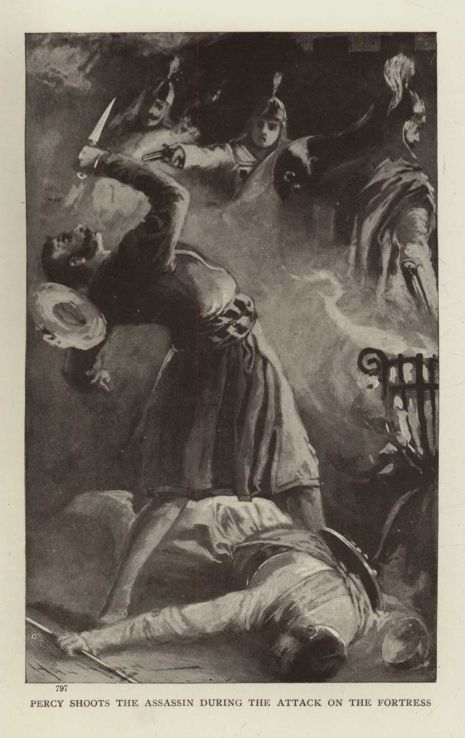
PERCY SHOOTS THE ASSASSIN DURING THE ATTACK ON THE FORTRESS
The assailants paused for a moment in astonishment at the line of lights, and the proof that the garrison were prepared; but the pause was momentary, and they rushed forward again. The leaders were but a few yards from the edge of the cut when the colonel shouted "Fire!" A flash of flame ran along the wall, and twenty guns loaded to the muzzle with grape poured their contents among the enemy. Like a field of wheat levelled by the blast of a tornado the mob of men were swept to the earth, the few that remained erect throwing down their bundles and flying for their lives. Percy, mindful of his special work, had, the moment the light flashed out opposite the gate, summoned the four men, who were standing a short distance away, and stood on the watch near his uncle.
For a few minutes there was a duel between the guns of the fortress and the Sikh cannon, which had been drawn down by hand, the wheels thickly wrapped with cotton cloths to prevent the slightest sound being made. The infantry kept up a storm of fire, which was replied to by volleys of musketry from the defenders. The din was tremendous, and presently another body of men carrying long beams and planks again rushed forward. Many of them reached the edge of the moat and tried to push the poles across, but the destruction was so great from the musketry fire from the walls, and from six guns which had been kept in reserve loaded with grape, that the survivors again fell back followed by the exultant shouts of the garrison.
At the moment that they had advanced the two port-fires over the gate went out simultaneously, and before others could be lighted Percy saw a figure that had been crouching under the parapet a short distance off spring forward. The guard nearest to him also observed the movement, and threw himself in the man's way. A knife flashed in the air and he fell. His assailant then sprung towards the colonel, whose back was turned to him, when a ball from Percy's pistol struck him in the head and he fell dead in his tracks. The pistol-shot attracted no attention amid the roar of firearms, and Percy, without paying further attention to the fallen man, ordered the remaining three guards to redouble their vigilance.
"The scoundrel may not be alone," he said. "The attempt may be repeated."
With the retirement of the second body of men charged to bridge the fosse the enemy lost heart. It was evident even to the most determined that success was impossible, now that the garrison were prepared. The guns, too, suffered so terribly from the heavier metal of those on the wall, that half of them lay dismounted, and the gunners would no longer work the others in the face of the heavy fire that mowed them down. The yells subsided and the fire ceased, and as noiselessly as they had come the assailants glided away into the darkness, pursued, however, for some time by the bullets and shot of the defenders. Convinced that there was no fear of a repetition of the assault, the colonel ordered the greater part of the troops back to their quarters.
Now that the din near at hand had ceased, the rattle of musketry and the boom of guns could be heard from the other walls. The colonel hurried away to see what was going on there. He found that the moment the firing began on the north face of the fortress it broke out from the valleys on either side, where large numbers of men had stolen up in the darkness, while at the same time the heavy guns in the camp had also opened fire. The defenders had at once replied, and the fire had been continued on both sides, but it had begun to die away on the side of the assailants as soon as it ceased on the northern face. The colonel sent for a party of artillery-men to aid the men working the guns, and ordered a steady fire to be kept up on the camp, and then dismissed his allies to their tents and returned himself to his house, to which Percy had gone as soon as the fighting was over to tell his aunt that the attack had been repulsed and that all was well.
"Then my fears were groundless, Percy?"
"No, aunt, they were the means of saving my uncle's life," and he then related the attempt at assassination and its result.
"Heaven be praised!" she said, bursting into tears. "I had a presentiment of evil, as I have more than once had before when his life has been threatened. Thank God the danger has come and gone and that he is still unharmed. Did you know who the man was?"
"I did not notice, aunt, or think of looking at him after he had fallen. There was such a tremendous roar going on that I felt quite confused, and thought of nothing but that the attack might be repeated. I will go and see who it is as soon as it is light."
By this time some hot coffee had been prepared, and Percy had already partaken of it when the colonel returned. As he entered his wife threw herself into his arms.
"Thank God you have returned safe, Roland, and have once more escaped the dangers that threatened you."
"The dangers were not great this time, love, being only from a stray bullet; for the artillery confined their fire to the gate, in hopes no doubt that a lucky shot might bring the drawbridge down. Not that this was likely, for I had it fastened up by half a dozen chains, any one of which would have held it."
"It was not the bullets of the enemy, but the knife of an assassin that I feared," she said.
"Pooh, pooh, my love! you are always dreaming of assassins."
"And not without reason, Roland; had it not been for Percy's pistol you would not be alive now."
The colonel looked surprised at Percy. "What does this mean, lad? I did not hear you fire, and, indeed, did not notice you from the time when the attack began to the time when it was over. Do you mean to say that my life was attempted, and that you saved me?"
"It was aunt's doing, not mine, uncle." Percy then related the injunctions his aunt had given him and the results.
"You have saved my life again, Mahtab," he said embracing his wife tenderly. "At least this time you and Percy have done it between you. And who is the traitor?"
"That Percy does not know; he did not think of examining the body."
"Then we will do so at once," the colonel said, putting on his cap again. "Daylight will soon be breaking, and as soon as it does the soldiers will be at work removing from the wall the bodies of those who fell in the fight. I heard just now that there were twenty-five men killed by the enemy's musket-fire, and another twenty or thirty hit in the hand or arm as they fired over the wall. Come along, Percy, you will know exactly where the man fell."
Calling a couple of his guards and bidding one bring a lantern with him, the colonel, accompanied by Percy, went to the wall, where the latter at once pointed out the body of the man he had shot, lying close to that of the guard who had fallen by his knife.
"Throw the light on his face," the colonel said, and as the soldier did so he uttered an exclamation of surprise and disgust.
"It is Azim Bund—the scoundrel! He was the last man I should have suspected. He was penniless when I picked him up years ago. He professed the greatest attachment for me, and being clever and shrewd I raised him step by step until at last he became my confidential steward. He was bound to me by every tie of gratitude, and I certainly thought him absolutely devoted to my interests. Ever since the attempt to seize you on your way here showed that there was a traitor in the fortress, he has appeared most earnest in his attempts to discover him; and to think that all this time it was the scoundrel himself! Mahtab has never liked the man, though she never suspected his fidelity. I suppose he had been heavily bribed, and had the promise of some good place from Ghoolab Singh. Well, he richly deserved the fate that has befallen him. I am glad that it was not a soldier, for I like to think that all my men are faithful to me to the last.
"That was a good shot of yours, Percy, your ball struck him just in the centre of the forehead. Well, there is one thing, there need be no fear at present of another attempt of this kind. This fellow would never have dared to make a confidant. An officer might enlist some of his men in such a plot, but a man in Azim's position would not venture to do so. A steward is not often popular with the men he looks after, and I don't think this fellow was any exception to the rule. Do you two men remain with the body until the morning, and see that no one touches it. You can search his pockets now, but it is not likely that such a cunning knave would be carrying any documents that would incriminate him, about on his person."
"There is nothing in his pockets, sahib," one of the soldiers said, "but I can feel he has a heavy belt round his body."
"Take it off and examine it."
It was found that a hundred gold mohurs were sewn up in the belt. "The first instalment of the price of my life," the colonel said. "Here is one apiece for you, men; the rest shall be laid out in charity. There must be scores of people who have been made homeless in the last day or two.
"In the morning make a thorough search of the fellow's clothes, he may have some paper sewn up in them. Now, Percy, we will go back to the house."
The Ranee was greatly agitated when she heard who was the author of the attack upon the colonel's life.
"It is terrible, Roland, to think that we can trust no one, and that for months your life has been endangered by that man. I cannot think why he waited so long."
"He was waiting for a safe opportunity, as he thought," the colonel replied. "Our private apartments are always locked at night, and during the day the opportunities for putting a knife into me without suspicion falling upon him were not frequent. No doubt he knew that Ghoolab was going to send an army here, and it was probably arranged that the affair should not take place until it arrived, as with me out of the way the garrison would probably surrender, and Ghoolab's son would only have to enter and take possession; and would, moreover, gain a certain amount of credit for what would be regarded as his capture of the place. He might, perhaps, have done it at night, but your idea of putting Nand Chund and the guard here would altogether upset that plan, and drive him to choose some other opportunity. At any rate we can sleep in peace now. It is morally certain that Azim would not run the risk of having an accomplice, especially as he would regard it as certain that he would be able to carry out his design without aid."
The morning light showed how terrible had been the effect of the fire of the besieged upon the assailants. The ground for two hundred yards back from the fosse was thickly strewn with dead, and around the spot where the cannon stood the men who had served them lay in heaps. After sending out a party to make sure that the enemy had all retired right, a force was sent out to collect and bring in the deserted guns and the wounded. There were over three hundred of the latter, and eight hundred dead were counted. Shortly afterwards two men with a white flag were seen coming down the hill.
The colonel and an officer went out to meet them, and it was found that they were the bearers of a request to be permitted to carry away the dead. This the colonel readily granted, being well pleased indeed at being saved the trouble of burying them, which would have been a work of great trouble and labour, owing to the shallowness of the soil. A large body of men came down for the purpose, but it was nightfall before the last of the bodies were carried away. The enemy's camp in the valley had, at daybreak, been removed out on to the plain, a mile and a half farther away, so as to be beyond the range of the guns.
Late in the afternoon a large force was seen to march in there, and the garrison had no doubt that this was the main body of the troops who had attacked them in the night.
A week passed without any further movement, and then it was noticed one morning that the tents had been struck, and shortly afterwards the whole army was seen to march away to the south. Some of the merchants at once sent off messengers to gather news, and by nightfall the colonel learnt that it was reported that the mother of the maharajah had consented to the demands of the army to make war against the British. An officer who had passed through the nearest town had stated that he was the bearer of despatches, ordering the force who were besieging the fortress to return at once to Lahore.
"That must have been very welcome news for every man in camp," the colonel said. "The soldiers must be already sick of the business, which must have cost them at least a thousand men, counting those that died after the fight from their wounds; and they must have seen well enough that this was nothing to what the loss would be before the place was captured. The leaders must be even more glad; the fact that no movement has been made since the repulse shows that they are at their wits' end as to what their next move should be. They must have known that another repulse might cause a mutiny among the troops, and might even cost them their lives. They must have been glad indeed at the news of their recall.
"And now, Percy, we must lose no time in warning our friends of what is intended. They may have got news already from Lahore; but we cannot risk that—their agents there may be imprisoned or killed, therefore you had better prepare to start for Loodiana in an hour's time. Nand Chund shall go with you again with fifty men. There will no doubt be many sirdars moving with their followers towards Lahore, and you will therefore excite little attention; and if questioned, Nand Chund will say that he is on his way to join the army. No, it will not be quite true; but that is a matter that will not rest at all heavily on his conscience. Lying is not considered a great moral offence at any time by the Sikhs, or indeed by any natives of India; and to deceive an enemy in time of war, is considered absolutely meritorious. There will be no occasion for you to say anything one way or another; he will appear as the head of the expedition, and you will pass unnoticed and unquestioned. Nand Chund is perfectly capable of talking for himself and half a dozen others. Fondness for using his tongue at all times is one of his principal failings."
"Am I to come straight back again, uncle?"
The colonel thought for a minute or two. "I will leave that entirely in your hands, Percy; you are old enough now to act on your own account. If you can be useful—and it is probable that you may be very useful owing to your acquaintance with the language and the knowledge that you have gained of the people—to the resident at Loodiana, I should say that it would be best for you to put yourself at his service. It would be a very useful beginning for you, and would give you a claim that might be of great advantage to you in the future. Besides, I should think you would wish to see what is going on, and there are likely to be some stirring events in the next few months. Here we shall have a quiet time of it, for with a war with England on their hands no one will think of troubling about us, and they will need every man for the work they have cut out for themselves. Do you agree with me, Mahtab?"
"Yes, I shall be sorry, very sorry for him to go; but I think it would be best for him. You always tell me that if my people go to war with yours it is sure to end in the Punjaub being annexed. There will then be no career for him here, and it will be better so since his life would be, as yours has been, one of constant danger. Thus then, it will be much better for him to make friends with officers in the Company's service, so that he may, as you have pointed out many times, become an officer of theirs when they are masters of the Punjaub."
"You will want a servant; indeed you had better have two. They must be trusty men above all things, and shrewd fellows too, whom you can, if necessary, despatch on difficult errands. I should say you had better let Nand Chund pick you out two of his men, unless you have any fancy yourself."
"He spoke very highly to me of those he chose for me last night, uncle. However, I will speak to him."
"Do so, Percy; a man may be faithful and an excellent guard, and yet not be the one you would choose as a servant. You want two cheery good-tempered fellows, who will always do what they are told without grumbling. I should say that you had better have Pathans, for a Sikh's sympathies would certainly be with his countrymen. I will walk down with you myself and have a chat with Nand Chund; next to a good horse and good arms, a good servant is the most important point on entering on a campaign; a handy fellow will make you comfortable under almost all circumstances, while with one who has not a knack of cooking, or of managing things for your comfort, you will be in all sorts of straits."
When the matter was explained to the officer he said: "You could not do better than take Akram Chunder, he is a Pathan, and one of the men you had last night. He was Sohan Verdi's own man for a time; but the major is hot-tempered, and spoke sharply to him one day, and he chose to go back into the ranks again. Sohan has told me more than once that he was one of the best men he ever had. He is a good soldier, he has been in your service for ten years, and he has a high character for courage. I do not think that the young sahib can do better than take him. As to the other he shall have my own man, Bhop Lal. He is an invaluable man in the field, merry, good-tempered, eager to please, ready to do anything for his master's comfort. Here, however, he has been too long inactive, and is getting idle. Were I going on a campaign I should be sorry indeed to part with him; but as it is I can find a man who will suit me just as well, and he is the very man for the young sahib; he is intelligent and trustworthy, a good groom and cook."
"Then Percy cannot do better than try them. Send for them to come to my house at once, I will myself speak to them and see how they like the proposal; a man who goes unwillingly had much better stop behind. I am obliged to you, Nand Chund, for giving up your man to my nephew."
Ten minutes later the servant announced that the two men were at the door, and they were at once brought in.
"My nephew is going to Loodiana," the colonel began, "and it may be that he will remain with his friends. You have, of course, both heard the news that the maharanee has yielded to the wishes of the army, and that they are going to war with the English. My nephew is going to join his own people, and will, I daresay, remain with them until the war is over. He wants two servants, good fellows who can be thoroughly relied upon, who can look after his comfort in the field, carry messages if necessary from one end of the country to the other, and who can be relied upon to be thoroughly faithful and devoted to him. I have consulted Nand Chund, and he has strongly recommended you both. I do not wish you to go unless you are perfectly willing to do so. While you are with him, you will receive double pay, and a present will not be wanting when he returns here if he gives a good report on your services. Now, what do you say?"
Both men expressed their willingness to follow Percy, and it was evident by their manner that they considered it no small honour to have been selected to attend upon the colonel's nephew.
"That is settled then," the colonel said. "I need tell you nothing about your duties, for you are both accustomed to the work. I will see that you are well mounted. Have you each good arms and a brace of pistols?" Both replied in the affirmative. "Make your preparations at once. Nand Chund will start in half an hour with fifty men to escort my nephew to Loodiana."
The men saluted and retired, and the colonel gave orders that two good horses should be picked out for them. Three quarters of an hour later Percy rode out from the gate of the fortress with his escort, his two followers falling in in the rear. Being this time unencumbered by baggage animals, the march was more rapid than it had been on the way up. As the country was full of armed parties making their way to Lahore, their passage attracted no attention until they turned off from the road to that city. After that they avoided towns, and riding without a halt for twelve hours they crossed the Sutlej on the evening of the fifth day, and on the following morning rode into Loodiana. A considerable change had taken place since Percy had left it six months before. Then there were but two or three battalions of troops stationed there, now the long line of tents showed that this force was largely augmented, and that six or seven thousand men were collected in the camp. It was evident that the British authorities were alive to the coming danger, and that they would not be surprised by the unprovoked invasion of the Sikhs.
Sir Henry Hardinge had arrived in July as governor-general, and being warned by the Residents at Loodiana and other frontier stations of the probability that the Sikh army would insist upon war, and overcome any opposition on the part of the maharanee, he had quietly made preparations for the event by moving up considerable bodies of troops to the north-west. It had indeed for some time been evident, that unless Ghoolab Singh accepted the office of prime minister troubles must come. He was the one man in the country whose personal power and influence would enable him to control the mutinous army, and his refusal to accept the post rendered it certain that the struggle would come sooner or later.
Ghoolab possessed talent and astuteness equal to that of his brother Dhyan, and was, like him, convinced that the power of England was too great for that of the Sikhs; he was, therefore, strongly against war. On the other hand his position was a difficult one. Had he attempted to stem the tide of popular clamour his own army would have turned against him, and he might have lost both his possessions and his life. He was therefore obliged to temporize, and believed that he would gain advantages whichever way the struggle went.
To the Sikhs, then, he professed a complete agreement with their views, but at the same time under one excuse or another he remained at Jummoo, replying to their repeated requests that he would advance with his army to Lahore, by saying that he was perfectly ready to do so, but that he thought it would be in all respects better to keep his army as a separate force and so co-operate with the main body. On the other hand he sent secret messages to the British, assuring them of his friendship, and promising them that whenever he saw the opportunity he would throw the whole weight of his influence and power into the scale on their side.
Nand Chund and his detachment of cavalry did not enter Loodiana, but took leave of Percy when they came within sight of the place, and started at once on their return.
"I shall travel by another road," he said, "and if we should be questioned hereafter we can strongly deny any report that we have paid a visit to Loodiana, for were it known it would excite a feeling against our lord, who would be accused of being in communication with the English. There is, it is true, no cause whatever to fear another attack upon the fortress while the war continues, but it might prejudice him afterwards, and if things go badly with the Sikhs some fanatic might endeavour to take vengeance upon him."
"Give my love to my uncle and aunt, and tell them I hope to see them again before long."
Percy's two followers closed up behind him, and as soon as the troops had started he rode with them into Loodiana.
The Resident was alighting from his horse at the door of his bungalow when Percy rode up.
"Ah, Groves, is it you?" he said. "I was wondering whether I should see you soon. I heard that an army had marched to attack your uncle's place, and a few days ago my agent at Lahore wrote me there were rumours that they had been repulsed with very heavy loss, which I was glad to hear, not only for your sake, but because a reverse of that sort would not raise the spirits of their army. How did it all end, and what are you here for? But you can tell me that while we are having tiffin; you know it is about my hour. You have become a regular young Sikh. I did not recognize you at the first glance in that finery."
"I have worn it ever since I have been there," Percy said. "I did not like it at first, but I soon got accustomed to it, and it is certainly cooler than my own clothes. But there is such a prejudice against Europeans that my uncle thought that I had much better follow his example and dress in the fashion of the country. I brought a couple of English suits down with me in my valise, but I was obliged to ride down in this dress in order to escape notice. Shall I change before tiffen, sir?"
"No, you look very well as you are, Groves. Have you come far this morning?"
"Only about ten miles. I came down with an escort of fifty men, and crossed the Sutlej yesterday evening. They left me a couple of miles outside the town."
"Well, you had better go in to your old room and have a wash while I take my bath. Tiffen will be ready in a quarter of an hour."
Two or three officers were present at tiffen, and these had difficulty at first in crediting Mr. Fullarton's assurance that the young Sikh to whom he introduced them was really an English lad. At tiffen Percy related the events of the siege of the fortress at his host's request.
"It must be a strong place by your description," Mr. Fullarton said when Percy concluded his narration, "and would puzzle even British troops to carry it by assault. Still I have no doubt our engineers would manage somehow to get heavy guns on to the hill commanding it, and once there it could not hold out long."
"My uncle was quite aware of that, sir; but the Sikhs are very clumsy with their cannon, and he calculated that the troops would soon be tired of the siege. But it would certainly be a very difficult matter to get heavy guns up there. There is some sort of road round behind through the hills, but I believe it is a mere track, and uncle thought it hardly possible at any rate for the Sikhs to bring heavy artillery along it. The only other road is that commanded by the guns of the fortress, and runs but a little more than a quarter of a mile away from it. The guns could not be taken up without very heavy loss."
After the officers had left, Mr. Fullarton asked, "And how about yourself, Groves? What are you thinking of doing, and what can I do for you?"
"My uncle thought I might be of use, sir. I can speak Punjaubi well enough to pass as a native, and he thought that you might accept my services as a volunteer, and might find me useful in obtaining information, communicating with any of the Sikh nobles who might be friendly, or in any other way. I have two men with me, both of whom can be trusted thoroughly, either as messengers or to go into the Sikh camp if necessary to gather information. I started the moment the Sikhs moved away from before the fortress, and we had news that they were summoned to join the main army at Lahore as the maharanee had given way to the wishes of the war-party. The news was so important that my uncle sent me off at once, thinking that probably your agent at Lahore might be unable to send you news, as anyone known to be in communication with you would probably be arrested at once when war was finally determined on."
"You are the first bearer of the news," Mr. Fullarton said. "It is ten days since I had a message from Lahore. It was in that letter my agent sent me the news that the first assault on the fortress had failed. He said then that the war-party had completely gained the ascendency, and that he thought the final decision would shortly be taken. He warned me that he might be unable to send me further news at present as he was in very bad odour, it being known he was in communication with me, and that he was sure to be watched if not imprisoned.
"Not having heard, I felt no doubt whatever that war had been decided upon and wrote accordingly to the authorities, but I have had no absolute certainty until now, as other causes may have prevented my agent from writing. Take a seat out in the verandah for a few minutes. I must send off a despatch at once with the news, and also inform Brigadier Wheeler, who is in command here, that the reports that the Sikhs have determined on war are now confirmed. After I have sent the despatches off I will join you again and talk over what you were saying about volunteering."
CHAPTER VIII.
IN THE SERVICE.
Percy was not kept waiting long, for in twenty minutes Mr. Fullarton joined him in the verandah.
"Now about yourself, Groves. I have no doubt that you will be able to make yourself very useful, and I at once accept your services as a volunteer in the civil service. I do not know yet whether I myself shall accompany the troops if they march from here. If I do I will take you with me, if not I will introduce you to General Wheeler, and transfer your services to him. There is a great dearth of men who speak Punjaubi, and I am quite sure he will be very glad to have someone with him so well acquainted with the language as you are. I expect him here shortly; he is sure to come across to talk matters over with me as soon as he receives my note. I will introduce you to him then. Before he comes you had better change and get into English dress. He is a soldier of the old school, and might regard your present attire as a sort of masquerading, and receive an unpleasant impression of you."
Half an hour later General Wheeler and three or four officers of his staff rode up to the door and had a long interview with the Resident. At its conclusion a servant brought a message to Percy that Mr. Fullarton desired to see him. He had by this time changed his clothes.
"This is the young gentleman of whom I have been speaking to you, general," the Resident said as Percy entered. "He is the nephew of the Colonel Groves who has been many years in the Sikh service. His father was an officer in our own army. He speaks Punjaubi like a native. He has volunteered, and will, I am sure, be very useful to us. I came out with him in the same ship from England, and formed a high idea of his intelligence. It is, I believe, his wish to enter the service of the Company later on. He is not without some little experience in war, for but a week ago he took part in the defence of his uncle's fortress when attacked by fifteen thousand Sikhs, whom they beat off handsomely. I have been telling General Wheeler, Groves, that you might be very useful in obtaining information or in communications with the natives, and that the fact that there might be some little peril in the work would not be any obstacle to your undertaking it. I said that I was going to keep you by me as a sort of civilian aide-de-camp, but the general has been good enough to say that he will attach you to his staff nominally as interpreter, but in fact as an extra aide-de-camp; and as my assistant and myself both speak the language well, while the general is short of officers who know it, I feel that you will be of more service to him than to me. But I consider you as lent only, and I shall be glad at any time if General Wheeler no longer requires your services to take you on in the capacity of an extra assistant."
"Can you ride?" General Wheeler asked. "But I suppose I need hardly ask that, as you have been living among the Sikhs."
"Yes, I can ride, sir, in the Sikh fashion or the English."
"Mr. Fullarton tells me that you could pass as a native."
"In anything like an ordinary conversation I could, sir; and as I have worn the native dress for the last ten months I am perfectly at home in it."
"Very well, then, you can consider yourself as from the present time attached to my staff. Major Clissold, will you see after him? I should think that you, as adjutant-general of the division, will find him even more useful than I should do as an aide-de-camp."
"You can leave us now, Groves," Mr. Fullarton said, "but wait outside and Major Clissold will speak to you presently."
Percy bowed and withdrew. The conversation still continued to turn upon him.
"I should think one might put him in general orders, Clissold, either as an extra aide-de-camp or as attached to your department. I don't know what the rules of the service are with regard to the uniform of volunteers attached to the army. It is so seldom done now that I really do not know, but in the old days they were dressed, I believe, as officers."
"No, that won't do," Mr. Fullarton laughed. "I am going to make a civilian of him. If he does well in the campaign he might perhaps get gazetted as an ensign, but it would be very much better for him to have a claim on the civil side. Therefore, I shall take upon myself to appoint him as my deputy-assistant. I shall write to Sir Henry Hardinge asking that the temporary appointment may be confirmed, seeing the urgent necessity for more officers up in the language and with a knowledge of the country. So we may consider the appointment made. Now I lend him to you, and you can put it in general orders that the temporary services of Deputy-assistant Groves have been placed by me at your disposal as interpreter, and that he is henceforth attached to the head-quarter staff of the division. That will give him an established position, and he can wear his civilian clothes, a white helmet, and so on.
"I think that will be a very good plan," the general said.
"He has two servants with him. They are Pathans, both first-rate fellows, whom he will employ when necessary to obtain information. I would suggest that they be put on rations as a matter of convenience to Groves, and they could be entered either as civilian servants or guides. It is no question of money, for although the lad's uncle has a reputation for moderation, very rare among the adventurers who served Runjeet Singh, he must be a rich man."
"I will make a note of it," Major Clissold said, and the conversation then turned to other matters.
Half an hour later the officers came out and rode away. Mr. Fullarton said as they did so, "I will myself ride over with Groves later on," and he then came into the verandah, where Percy was waiting. "I think I have done a good stroke of business for you, Groves."
"You have indeed, sir. I am awfully obliged to you, although I would rather have stayed with you."
"And I should have been glad to have had you, but it is better as we have arranged it. You will have much greater opportunities for seeing service with the brigadier, and a report in your favour would come much better from him than it would from me, as I appointed you. It is probable that I shall remain at my post, and in that case there would be little for you to do here. While acting as an interpreter on the staff you will have abundant work, making bargains for the quarter-master's department, for waggons and transport, finding out about roads and fords for Major Clissold, and in general interpreting work. You must change your head-gear. That pith topee you have got is really better, but we generally wear either the helmet or a cap like a forage cap, with a pugaree wrapt round it, and the ends falling down behind to keep the sun off the back of the neck and spine. I should advise you to adopt that, for there is no getting a helmet here. When you ride about always take one or both of your mounted servants behind you. They are soldierly-looking fellows, and it will give you weight with the natives. I need not tell you that now you will hardly be free to go about quite as you like, and that even when there is nothing for you to do you will be expected to be at hand if required. Major Clissold is a capital fellow to serve under. He may work you hard, for there will be an immense deal of work to be done, but he is always pleasant and agreeable to his subordinates, and is very much liked in the force. I have some writing to finish, but in about an hour I shall be ready to start with you, so you may as well warn your two fellows to be ready. I have a forage cap that I have only worn once or twice, for it is too small for me. I will tell Ram Singh to put a pugaree on, and if necessary put some folded cotton inside the lining to make it fit you."
An hour later they rode into the head-quarter camp.
"I have brought you your interpreter, Clissold," Mr. Fullarton said as he entered that officer's tent, followed by Percy, their horses being held by the latter's men. "Where are you going to stow him? As there is no getting tent furniture here, I have told my man to send over what is necessary; but as I did not know whether Groves would have a tent to himself or not I told him to wait till I returned before he started."
"No, I have put him in a tent with Hunt. We can't afford a tent each for subalterns, so they are doubled up two together. But Hunt happens to be an odd man, which is lucky. Orderly," he called out, and as the soldier entered, "tell Mr. Hunt I shall be glad if he will step here."
A minute later a young officer entered. "Hunt, here is the young gentleman who, as I told you, will have to share your tent. He is a volunteer in the civil service. Mr. Fullarton has kindly lent him to us for a time as interpreter, which I am sure we want badly enough on the staff, for none of you young fellows are of the slightest use with the natives. He is the son of an officer late of our service, and has been for the last six months with his uncle, who was one of Runjeet Singh's colonels, and still holds the fortress he was appointed to some time ago, although ordered by the Sikhs to leave. I am sure you will get on well together, and I hope that you will make him as comfortable as you can, and introduce him to the other aides. He will mess with you for the present."
The young officer shook hands with Percy. "If you will come with me I will show you our tent."
"If you don't mind, Hunt, I will come with you," Mr. Fullarton said; "then I can see what is wanted in the way of furniture."
The tent was a square one with double canvas, the two walls being four feet apart, thus making a passage round it, one side being utilized as a bath-room and receptacle for luggage, the other being used by the servants as their living and sleeping apartment. There was a carpet spread over the floor, a native camp-bed, two folding chairs, a table, and a portable bath.
"All you want, as far as I can see," Mr. Fullarton said, "is another charpoy and a couple more chairs."
"That is all," Hunt agreed; "this is all the furniture one is allowed, which we think rather hard. Do you think the Sikhs are going to cross the Sutlej, sir?"
"Of course, they may do so, but the general impression is that it will not be in force; they may begin by making raids, but probably the real fighting will take place when we get across. Well, now, I shall leave you, Groves; I think you will get on very well, and I daresay we shall meet pretty nearly every day."
"Are those two fellows yours?" Hunt asked, as, going out of the tent with Mr. Fullarton, he saw the two natives sitting like statues on their horses in front of the tent, while one of them held the bridle of Percy's horse.
"Yes, they are my two servants; they are two of my uncle's soldiers. Both have been officers' servants, they are extremely useful fellows, and I can trust them thoroughly. One is a Pathan from the hill frontier of Afghanistan, the other is from Cashmere, therefore neither of them have any special leanings towards the Sikhs."
"That is a capital horse of yours?"
"Yes, he is very fast, and has much more endurance than the horses of the plains. My uncle bred him. He has a European sire, and his dam is considered as having some of the best blood in the Punjaub. What shall I tell my men to do with the horses?"
"They can picket yours over there; that line of horses all belong to the staff. Their own they can put with that line behind, those are the horses of the orderlies. I will go across with you and see about it, or some of the soldiers will be interfering."
The horses were soon picketed, and the men brought Percy's saddle and valises to his tent. By night he felt quite at home. The aides-de-camp were pleasant young men, and having already been spoken to by Major Clissold, received the new-comer cordially. Percy had inquired of Hunt as to the messing arrangements. "I am well supplied with money," he said, "and wish, of course, to pay my share of all expenses."
"That can easily be managed," Hunt replied. "The way it is arranged is this. There were five of us, Long and myself, are the general's aides-de-camps; Humphreys and Lascelles, who are deputy-assistant-quartermaster-generals; and Egerton, who is an assistant-adjutant-general. They are all lieutenants. We brought up with us a certain amount of mess stores, principally liquor, which are all common property. I will see to-morrow what stock is left, and you can hand me over a sixth of the value, which will go to the fund for general expenses. However, these are not heavy, for being under canvas we draw rations—meat and bread—and I buy what I can get in the way of vegetables, game, and so on, from the country people. Of course, if you leave us before our store of liquor is exhausted, I shall, as it were, buy your share back again."
Percy found the society very agreeable. His experience of the junior officers' mess on board a ship had prepared him for the tone of light chaff and fun that prevailed. Although by some four years the youngest of the party, the fact that he was acquainted with the country they expected shortly to invade gave him a certain weight with the others, none of whom had been in that part of India before. He was asked innumerable questions as to the Sikhs, and what he thought of their fighting powers; and had to recount in full detail the story of the attempt to storm the fortress.
"That uncle of yours must be an uncommonly plucky fellow to hold on there in the face of the whole of the Sikhs, and he must be amazingly liked by his troops for them to stick to him against their own countrymen."
"That is not so wonderful," Percy said, "for the Sikhs are constantly fighting against each other. Most of his men have served under him for eight or ten years. The rest were recruited in his district, which was only conquered by the Sikhs in Runjeet's time, so they are still considered as interlopers by the natives. Still, of course, there is always the fear of treachery; and my uncle nearly lost his life while the attack was going on; the man who attempted it was one of those he trusted most thoroughly, being his steward and the head of his household."
"You did not tell us about that," Hunt said. "How was it?" and Percy had to tell the story.
"And you shot him? Well, I have never shot a man yet, and I don't know how I should feel. Were you very uncomfortable afterwards?"
"Not in the slightest. He was going to kill my uncle, and I fired and he went down, and I thought nothing more about it till I mentioned it to my uncle after it was all over."
"I suppose you are a good shot?"
"I am a fair shot," Percy said. "I have practised nearly every day since I left England, except when I was travelling up country. Mr. Fullarton advised me to do so on board ship, and my uncle kept me regularly at that and riding and sword exercise every day, partly because he said these things would be most useful to me, and partly because the Sikhs look up to anyone who can do things better than they can."
"It must be awfully jolly to be able to speak the language, Groves?" Lieutenant Egerton said, "and I hear you speak it like a native. You must have a wonderful knack of picking up languages to have learnt it so completely in six months."
"It was not exactly in six months. I had studied Hindustani before I left England; and luckily Mr. Fullarton had a Punjaubi servant with him, and I worked with him regularly five or six hours a day throughout the voyage, so that I was able to get on pretty fairly with the language by the time I got out here."
"I wish I had spent my voyage as well," Egerton laughed, "instead of spending it spooning with a young woman who was on her way out to be married, and who did marry the man a week after she landed."
"These things are very sad, Egerton," Lieutenant Lascelles laughed. "I suppose you were heart-broken for a time."
"Not quite. I will do her justice to say that she made no secret of her engagement, and never flattered me with the hope that she intended to break it. At the same time she had no objection to flirt with me, it being an understood thing on both sides that it was to end with the voyage. It was very pleasant while it lasted; but it would have been very much wiser to have done as Groves did, and spent the hot hours of the day in getting up a language. I should be a hundred a year better off if I had passed in one of the dialects, and besides, I should have had much better chance of getting a good appointment."
"Ah, well, you can console yourself, Egerton, by thinking that if you had you would be now in some small cantonment down in Bengal, instead of having a chance of seeing whatever fun may be going on here."
"That is a consolation certainly, Hunt; but I don't care how soon the fun begins, for I own that I am getting sick of bargaining for bullocks and working like a horse eight or ten hours a day. It is all very well for you aides-de-camp, whose work consists in writing a few letters for the chief and cantering across with some message; but for us hard-worked quarter-masters it is no holiday here. I do hope most heartily that the Sikhs will not be long before they begin their raids, and give us a decent excuse for fighting them."
"How strong do you think they are likely to turn out, Groves? They tell us a hundred thousand."
"I should say a good deal more than that," Percy replied. "There will be over a hundred thousand troops, for all who have passed through the ranks will be certain to rejoin them. Then the great sirdars can put almost as many fighting men into the field."
"That sounds serious, and I suppose there is no doubt they will fight bravely."
"That they are sure to do," Percy said. "What force do you think we shall be able to put in the field?"
"There are over ten thousand men at Ferozepore, with twenty-four guns. Here we have, by the field state to-day, seven thousand two hundred and thirty-five, and twelve guns. At Umballa there are about thirteen thousand men, with thirty-two guns. You see, ever since Hardinge came out he has seen this thing brewing, and has been quietly preparing for it. When he landed in India last year there were at these three stations only between thirteen and fourteen thousand men and forty-eight guns, and in the last eighteen months he has increased the force by seventeen thousand men and twenty guns.
"At Meerut there are about ten thousand men and twenty-six guns, but as that place is two hundred and fifty miles away, we can't count upon any assistance from there at first, if the Sikhs should take it into their head to cross the Sutlej. Of course if we invade we shall wait until the Meerut force is brought up before we advance. Sir Henry arrived at Umballa on the second, and was to leave yesterday. Ostensibly he is not here for any warlike purpose whatever, but is occupied in making an inspection of the protected district, interviewing the chiefs, and ascertaining what their feeling is towards us. These states voluntarily put themselves under our protection some five-and-thirty years ago, having no desire to fall under the sway of Lahore; and they have greatly benefited, for Runjeet Singh would assuredly have annexed the whole territory between the Sutlej and the Jumna, if he had not been warned that if he attacked these petty princes he would bring us into the field against him. It has always been a sore point with the Sikhs beyond the Sutlej that we prevented them from obtaining what they considered their natural boundaries. The protected states are indeed to a great extent Sikh, and even now, although they owe the continuance of their existence as separate states to our protection, and the chiefs are all with us, the sympathies of the great body of the people are entirely with the Sikhs across the Sutlej.
"Runjeet Singh was wise enough to know that he would have risked losing all he had were he to try to wrest them from us. Had he thought himself strong enough he would have risked a war for it, for the country south of the Sutlej is far more fertile than it is to the north, and it would largely increase the revenues of the Punjaub did it form part of it. This is the real cause of their hostility to us, and of their present threatening attitude. Sir Henry is going, as I said, among the chiefs here. Some of these are really friendly, others only pretend to be so. But there is one thing certain, if any misfortune happened to our arms the whole country would be up against us; and in any case we shall have to take every possible precaution to guard our depots and communications, for directly fighting begins it would be unsafe for small parties to travel about the country."
Percy's stay in camp was of very short duration, for on the following evening Major Clissold sent for him.
"The general has just received a despatch from head-quarters, Groves; the news from the north is to the effect that the Sikhs are making great preparations there, and Major Broadfoot, the chief political agent at head-quarters, requests that you will at once proceed there to join him, as he wishes to question you as to your own personal observations of the state of feeling as you came down. I think it probable he will keep you with him for the present; and as you may have more important work to do there than buying bullocks and so on, I hope for your sake he will do so, though I shall be sorry to lose you, for I have already found by your work to-day that you would be a very valuable assistant. Still there is nothing like being at head-quarters and having the eye of the chief of your department upon you. You had better start this evening late."