THROUGH THE SIKH WAR (continued 4)
Reading edition
"Very well, sir, I will be off in half an hour. I suppose I can ride round and say good-bye to Mr. Fullarton."
"Certainly. There is no absolute occasion to start until morning, but it is always well to show zeal, and it will no doubt please Broadfoot if you arrive there by daybreak. You needn't start till two o'clock; it is only a three hours' ride. The head-quarter camp is close to Basseean."
"I am sorry you are going," Hunt said when Percy returned to his tent and told him the news, "and I hope you will be back again in a day or two. If not, it will save me the trouble of taking stock of our liquors, which I was going to do to-morrow morning. We shall be glad at any rate to have had you as our guest for a day, and shall all be sorry at your leaving."
Percy at once rode over to the Residency.
"You are in luck, Groves," Mr. Fullarton said when he told him of the order he had received. "There is nothing like getting to head-quarters; it is there that honours and rewards fall thickest; and if Broadfoot keeps you with him you may be sure that any recommendation he makes in your favour will be attended to. I have heard this afternoon that the Sikhs are certainly marching down towards Ferozepore, and are within a few miles of the river. Of course they may not cross. Once or twice before they have come down, but without crossing. Still, if they are in earnest there is no doubt it means serious fighting, for the force at Ferozepore is quite isolated and will at once be cut off if the Sikhs cross near the town, and there will be no chance of relieving it until we get together a force sufficient to give battle. Sit down a moment and I will write a letter of introduction for you to Broadfoot; it will put you on a pleasanter footing with him."
The next morning before sunrise Percy with his two followers rode into the head-quarters camp. He had at Mr. Fullarton's recommendation bought a pony, or "tat" as it is called, to carry his valises and his dress as a young Sikh sirdar.
"I should stick to that, Groves; it may be of use to you. There is no saying what work Broadfoot may give you."
Percy was, on his arrival, directed to the tent of the political agent. When the orderly took in his name he was at once called in. "I did not expect you so soon, Mr. Groves," Major Broadfoot said looking up; "nor did I expect," he added smiling, "to see quite so young a man."
"I daresay not, sir," Percy replied. "This is a letter Mr. Fullarton has given me for you."
"Sit down while I read it," the major said as he opened it. He read it through. "Mr. Fullarton speaks of you in extremely high terms, Groves, and as I know him well I am sure he would not praise unduly. Now tell me what is the opinion of your uncle and the people about him as to the state of affairs. Does he think that the Sikhs will be mad enough to cross the Sutlej?"
"He has no doubt whatever about it, sir; he is convinced that the troops have for a long time made up their minds to conquer the protected states, and as they are completely masters of the situation in Lahore there is nothing to prevent them doing so. Such was also the opinion of all his native officers, and although we did not have much communication with the people on the way down, all whom we did speak to seemed to think that war was certain."
"The news we received from Lahore has always been the other way," Major Broadfoot said. "I have received a message this morning to the same effect, but Captain Nicholson reported yesterday from Ferozepore that a considerable Sikh force had arrived within three miles of the river. Orders have been sent for a general forward movement of the troops. Sir Henry is going to ride over to Loodiana this morning to inspect the force there."
"I have two followers, sir, who can be trusted to obtain any news you may desire to get. If you like, one of them will cross the river and make his way to the Sikh force opposite Ferozepore and find out its strength and whether there is any intention of crossing; or if you prefer it, I will go myself. I have always been accustomed to wear the Sikh dress since I came out, and could, I think, pass without suspicion."
"It is most important that we should obtain some definite news," Major Broadfoot said, "and I am much obliged to you for your offer, but I do not think I can entertain it. It is too great a risk for you to run to go yourself, and the importance of the question is so great I should not dare to forward information, which would perhaps involve the movements of the whole army, merely upon the report of a native, however trustworthy he may be."
"I do not believe there is any danger whatever in my going, sir. I might take my two men with me, and should disguise myself in a dress similar to theirs. My own, which is that of a young sirdar, might so far attract attention that I might be questioned, while three of us in ordinary soldiers' dress could move about without being noticed in any way. That is just the sort of work that I came here to do, and my uncle thought that as a boy I could pass unquestioned where a man could not do so. One of my men is five- or six-and-thirty, so I could pass well enough as his son if any questions were asked, which I don't think would be the case."
"Well, Groves, if you are ready to go I do not think myself justified in refusing your offer, as it is of such extreme importance to find out the intentions of the Sikhs. When will you start?"
"I would give the horses an hour's rest, sir, and then I will be off, if I can get a disguise by that time."
"That I can manage for you. I have numbers of natives in my pay, and can get what you require, a native dress with shield, tulwar, and matchlock, in a quarter of an hour. Ferozepore is twenty miles from here, and the Sikh force some four miles farther; but, of course, you won't be able to cross the river there, and must do it ten or twelve miles higher up and then ride round. Are you well mounted?"
"Very well mounted, sir."
"Then I will get you a strong native 'tat.' Your being mounted on a good horse would attract attention. Here," he went on, pointing to a map, "is a point where the river is almost if not quite fordable for cavalry; at any rate you will not have to swim your horses far. I should advise you to make for that. It is as you see about ten miles above Ferozepore. It is not at all likely to be guarded; and should it be so, you could of course give out that you are natives of one of the protected states, say of Putiala, making your way to join the Sikh army that you hear is going to free you from the dominion of the English. As you have at present no tent of your own, you had better come across here in half an hour to make your change of clothes. I am myself going over to Sir Henry's, and may be detained there some time, but I will tell my servants to get breakfast ready for you. We must not send you off fasting."
Three hours later Percy and his two followers arrived at the bank of the Sutlej. They had been directed to the ford by a peasant in a village near, and crossed without difficulty, being only obliged to swim their horses for twenty or thirty yards in the middle of the stream. When they reached the opposite bank they rode up to a small party of armed Sikhs who were watching them. Percy had asked Bhop Lal to act as spokesman.
"We hear that the army is going to cross the river and to sweep the English away," he said, "and we have come over to join them. Our rajah is all in favour of the Feringhees, but most of us are the other way, and we were not going to stop quietly at home without taking a share in the good work, so my brother and son have come off with me without waiting to ask for leave. There are thousands of others who will do the same as soon as they are sure that the army is really in the field; but there has been so much talk about it for the last two years without anything coming of it, that they are waiting to see if it is true this time."
"It is quite true," one of the men replied. "There are ten thousand men now opposite Ferozepore, and the rest are on their way down from Lahore. There will be fifty thousand of them at least, with, they say, over a hundred and fifty guns. What can the English do against them? They have not ten thousand men they can put in the field, and these are scattered over the country, and will be crushed before they can assemble."
"That they assuredly will," Bhop Lal agreed confidently. "Fifty thousand men could sweep away every white soldier this side of the Jumna, and there will be nothing to prevent them marching on to Delhi if they choose."
"We shall see about that," the man replied. "Fifty thousand is only a beginning, and there will be another fifty after them in a very short time; and I for one don't see why we should not drive the Feringhees altogether out of India."
"That is the way to talk," Shop Lal said cordially. "We shall always have trouble till the last of them have gone, and who so fit as the Sikhs to be masters in their place! How far is it to this camp you speak of?"
"About twelve miles. Ride two miles farther and you will come upon a broad road. Turn to the left, and it will bring you there."
"What are you doing here?"
"We have been sent here to see that none of the English horsemen cross the river to gather news. There are two hundred of our cavalry a quarter of a mile behind, and if we saw any of the Feringhee cavalry coming they would be here to defend the ford before they could cross."
With a nod of farewell Bhop Lal and his two companions rode on. They passed within a couple of hundred yards of the body of Sikh horsemen, encamped in a grove. But there was no sign of movement among them, a few figures sat talking together here and there, the rest had evidently lain down to sleep the hours away in the shade.
CHAPTER IX.
MOODKEE AND FEROZESHAH.
Two hours after crossing the river, Percy with his two companions saw on the plain the camp of the Sikhs. As they did not wish to enter until evening, they turned off from the road and rode into a clump of thick bush a quarter of a mile away, and there waited until sunset. Then they mounted again and rode boldly into camp. With the exception of the tents of a few of the military chiefs and sirdars, the troops were not under canvas, although many had erected shelters of bushes or blankets. Here and there some attempt at regularity marked the places where regiments of the regular troops had established themselves. Here the horses were picketed in line, but among the followers of the sirdars every man had fastened up his horse just where it pleased him, without the smallest attempt at order.
The new-comers chose a vacant spot at the edge of the encampment, picketing their three horses together, and raised in front of them a rough tent consisting of a couple of blankets supported by some sticks they had cut in the bush. Here they lighted a fire and cooked a meal. One or two of the Sikhs strolled across to question them, and Bhop Lal and his comrades repeated the story that had been told at the ford, which was accepted as perfectly satisfactory. They in turn asked a few questions as to the various sirdars present, and as to which body they had better attach themselves. When they had finished their meal they sauntered off into the camp.
There was but one topic of conversation among the troops. They were to cross the Sutlej, if not on the next day, on the one following. A portion of the army was to besiege Ferozepore, while the rest marched forward to sweep away the British forces at Loodiana and Umballa. It was evident from their conversation that they greatly under-estimated the British strength at each of these cantonments, and that the gradual arrival of reinforcements had passed entirely unnoticed by the Sikhs on the northern side of the Sutlej. They anticipated no difficulty whatever in destroying the British forces at the first onset. Their statement as to the number of troops who would take the field at once, agreed with those of the soldiers at the ford, and they deemed that this fifty thousand men would amply suffice to conquer the whole country north of the Jumna, and that with their full fighting power they should be able to overrun the whole of India.
"We have heard all that we want," Percy said to the men after they had strolled for an hour in the Sikh camp. "We had best move quietly off at once before the camp begins to get quiet. Our fire will have burnt out by this time, and even if they should notice us moving, the men near will suppose that we are merely shifting our quarters, and are moving over to the sirdar we have decided to follow."
They had some difficulty in finding their tent again in the darkness, and as soon as they did so the blankets were taken down, rolled up, and strapped behind the saddles. The picket pegs were pulled up, and leading their horses they moved off, skirting for a time the line of the camp, but gradually increasing their distance until two hundred yards away from it, when they thought it quite safe to mount and ride off in the darkness. They had some trouble in striking the road again; when they did so they halted for a consultation. It was decided to turn off and encamp again for three or four hours in order to rest the horses, and then to make for the river bank and wait there until the first light of morning showed them a point where they could swim their horses across, for the presence of the guard at the ford rendered it impossible for them to use that passage again. This plan was carried out, and they arrived at the bank, some three or four miles below the ford, just as daylight began to appear. The bed of the river was wide, and the stream, broken by sand-banks, flowed in several channels.
"There will be no great difficulty in crossing anywhere here," Percy said; "the channels are nowhere very wide, and even if we are swept down the stream it will not matter, as we can rest after each swim. We had better start at once. Should there be any Sikhs about they will hardly make us out till it gets lighter, and we may hope to be pretty well beyond musket-shot before they can come down to the water's edge. They will not be likely to try to follow us across, and if they do so, with the start of a quarter of an hour we ought to be able to throw them off our track."
They were not disturbed while making the passage. This was, however, more difficult than Percy had anticipated, for the current in two of the channels was very strong and swept them down some distance before they could obtain a footing on the sand-bank. Apparently no watch whatever was kept by the Sikhs excepting at the fords, and nothing was seen of the enemy. On reaching the opposite bank they gave the horses a short rest to recover their breath, and then rode on to Basseean.
"What! are you back already?" Major Broadfoot said when Percy was shown into his tent. "I did not expect you back until to-morrow at the earliest. Have you really been in the Sikh camp?"
"Yes, sir; we were there about three hours, which was quite sufficient to learn everything that we required;" and he then gave the officer the news that they had gathered.
"This is most important," Major Broadfoot said. "Sir Henry returned half an hour ago from Loodiana. I will take you with me to his tent. He may want to ask you further questions."
The commander-in-chief after hearing Percy's report asked him several questions in order to find out whether the statements had been made by one native only; but Percy replied that they had spoken to a score of soldiers, and that all were in perfect agreement as to the force that would cross the river, and the division that would be made of the forces and their object in so doing.
"I thank you, sir," Sir Henry said when he had finished. "Your information is most important, and you have carried out your mission with great ability and intelligence. Major Broadfoot will take notice and bring it to my attention later on."
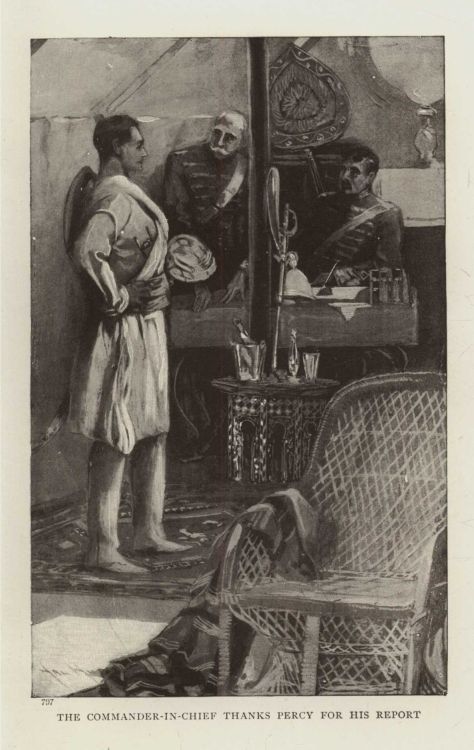
THE COMMANDER-IN-CHIEF THANKS PERCY FOR HIS REPORT
Half an hour later despatches were sent off to the commander-in-chief at Umballa, ordering him to move forward at once with his whole force; and to Loodiana, ordering General Wheeler to carry out the measures that had been agreed on between him and the governor-general on the preceding day, namely, to abandon the cantonments, to place all stores in the fort, to move there all the sick and others unfit to take the field, with a force sufficient to hold the place for a time against any attack that might be made upon it, and to march with his main body to Basseean so as to protect the vast amount of stores accumulated there, from any sudden dash by the enemy. In the evening a messenger came in from Ferozepore, saying that a large body of Sikhs had during the day crossed the river.
The next morning, the 13th of December, the governor-general issued a proclamation to the chiefs and people of the protected states, pointing out that since 1809 the British government had scrupulously fulfilled the terms made with Runjeet Singh, and that notwithstanding the disorganized state of the Lahore government during the last two years, and several most unfriendly proceedings on the part of the durbar, the governor-general had continued to evince his desire to maintain the relations of amity and concord which had so long existed between the two states.
The attitude of the Sikhs, however, had continued to be more and more unfriendly, and the army had now, without a shadow of provocation, invaded British territory. The governor-general therefore declared the possessions of Maharajah Dhuleep Singh, on the left or British bank of the Sutlej, confiscated and annexed to the British territory. The ranks of all sirdars, zemindars, and tenants in the said possessions who should evince their fidelity to the British government should be respected. The governor-general called upon all chiefs and sirdars to co-operate cordially with the British government. Those who did so would find their interest promoted thereby, while those who took the opposite course would be considered as enemies and treated accordingly. The inhabitants of all the territories on the left bank of the Sutlej were requested to abide peacefully in their respective villages, and all parties of men found in arms would be treated as disturbers of the public peace.
Fortunately the Sikhs after crossing on the 12th, instead of marching at once upon Basseean, halted until their heavy guns were taken across on the 16th. On the afternoon of the 14th General Wheeler, who had marched at daybreak, arrived in front of Basseean; and on the 16th General Gough, the commander-in-chief, arrived there, with the force from Umballa. Had the Sikhs pushed forward at once after crossing, Basseean with its great stores of provisions must have fallen into their hands, and a week or ten days must have elapsed before arrangements for provisioning the Umballa force could have been made. In that case the whole Sikh army would have been able to concentrate its efforts upon the capture of Ferozepore, which, in the absence of any fortifications capable of withstanding powerful artillery, could scarcely have been defended successfully.
Percy had been kept actively employed during the three days that intervened between his return to Basseean and the arrival of the column from Umballa, in the work of carrying copies of the general's proclamation over the country, and delivering them to the head men of the villages. He acted as interpreter to the officers who, attended by small escorts of cavalry, performed this work, and was on horseback from daylight to dark each day. After the arrival of General Wheeler's division he spent his evenings with his acquaintances there. The troops were all in high spirits because the long uncertainty was at an end, and that at last they were to meet the men who had so insolently been threatening an invasion. The fact that the odds would be enormously against them was considered a matter of no importance whatever, for the British troops had so long been accustomed to victory in India that the idea of a reverse was not entertained for a moment among the soldiers, although among the officers, who were aware of the bravery and fighting power of the Sikhs, the prospect was regarded with a good deal of anxiety.
All the accounts received bore out the correctness of the information that Percy had obtained. Twenty-five thousand Sikhs, all regular soldiers, had taken possession of the wells round the village of Ferozeshah, half-way between Basseean and Ferozepore, and entirely cut the communication between the two places; for owing to scarcity of water no other road could be used for the advance of an army except that passing through Ferozeshah. The Sikhs were well aware of this fact, and on their arrival they had at once begun to throw up strong intrenchments. Another Sikh army of twenty-three thousand, and sixty-seven guns, under Tej Singh, remained watching the British force at Ferozepore.
The British force at Basseean consisted of three thousand eight hundred and fifty Europeans and eight thousand natives, with forty-two guns, and on the morning of the 18th of December marched for Ferozepore. They reached their camping ground round the village of Moodkee at one o'clock in the day, and as soon as arms were piled began to cook their dinner. A few Sikh horsemen had retired from the village on their approach, and some scouts were sent out to ascertain if there was any considerable body of the enemy near at hand; these returned in a short time, saying that a large force had taken up a position three miles away. There were, indeed, twelve thousand of them, principally cavalry, with twenty guns. From friends at Basseean they had learnt that an advance was to be made by the British, and thinking that it would be but an advance-guard, Lal Singh had with this body of troops left the camp at Ferozeshah early in the morning and had taken up his position before the arrival of the British army at Moodkee. As soon as the news was received the troops got under arms and moved forward, the artillery and cavalry leading the way and the infantry following in support. When they had gone two miles the enemy was seen ahead of them.
The country was a dead flat, covered at short intervals with a low thick jungle and dotted with sandy hillocks. It was difficult to judge of the strength of the Sikh force, but in order to oblige them to display it, the cavalry, with five troops of horse-artillery, moved forward, and as the infantry formed into line opened fire. This was answered by a very heavy cannonade on the part of the enemy; but in a very short time the rapid fire of the horse-artillery, aided by two field batteries, so discomfited the enemy's gunners that their fire gradually subsided.
In order to allow the infantry to advance without the artillery in front of them being pushed forward too closely to the jungle, Sir Hugh Gough ordered a portion of the cavalry to make a movement on the enemy's flanks. The 3d Light Dragoons, the Governor-general's Body-guard, the 5th Light Cavalry, and a portion of the 4th Lancers dashed round the left of the Sikh army, and sweeping along the whole of its rear, forced the artillerymen to leave their guns, and put their cavalry to flight. At the same time the remainder of the 4th Lancers and the 9th Irregular Cavalry, with the Light Field Battery, performed a brilliant charge round the enemy's right. Successful as these operations were, they would have been much more so had not the enemy been so hidden in the jungle that their position could scarcely be made out.
The British guns again opened fire and the infantry advanced. Evening was now falling, and the increasing darkness added to the difficulty of the attack through the thick jungle.
The Sikhs fought stoutly, and several times clung to their positions until driven from them at the point of the bayonet; but they were not able to withstand the steady pressure of the British advance, and, astounded and discomfited at the unexpected valour of a foe whom they professed to despise, they fell back from point to point, and finally made off in the darkness. Had the battle commenced at an early hour the cavalry would have converted the defeat of the enemy into a rout. As it was, seventeen of their twenty guns were captured, and their losses in killed and wounded were very severe. Lal Singh himself was wounded, and had a narrow escape of being taken prisoner.
The British loss was sixteen officers and two hundred men killed, and forty-eight officers and six hundred and nine men wounded. Sir Robert Sale, the hero of Jellalabad, was among those mortally wounded. The defeated Sikhs made their way back to Ferozeshah, while the British returned to Moodkee, which they reached at midnight. The next morning two heavy guns, escorted by the 6th Light Infantry, and the 41st, reached Moodkee. Their march had been a long and fatiguing one, as they had made twenty-seven miles through an arid desert, and were overcome with thirst and fatigue, when some elephants sent out with water to meet them brought them relief. It was late in the evening before the column came in, and in order to give the men time to recover from their fatigue it was decided to halt for another day.
It was settled that the sick, wounded, and baggage should be left in the little fort at Moodkee, with a regiment and a half of infantry to protect them should the enemy's cavalry work round to the rear of the army. Messengers were sent off to Ferozepore to inform Sir John Littler, who commanded there, of the victory at Moodkee, and to order him to leave five thousand men to hold the town and watch Tej Singh, and to march with his five thousand remaining men and twenty-one guns to join the commander-in-chief, both forces to march at three o'clock on the morning of the 21st. Sir Henry Hardinge offered to serve as a military man under Sir Hugh Gough, and was appointed second in command of the army.
The marches were well timed, and the junction with Sir John Littler's force was effected at the village of Misriwala, within sight of the Sikh camp, at one o'clock.
The British force after the junction had been effected consisted of five thousand six hundred and seventy-four Europeans and twelve thousand and fifty-three natives, with sixty-five guns; the Sikhs numbered twenty-five thousand regular troops and ten thousand irregulars, with eighty-eight guns; while Tej Singh with his twenty-three thousand regulars and twenty-seven guns was only ten miles distant. The country was a dead flat studded with trees and jungle, and the clouds of dust that rose beneath the feet of the troops rendered it extremely difficult to direct their movements in such a country. Skirmishers were sent forward to ascertain the exact position of the enemy, but the troops were allowed to rest for some time after their hot and dusty march. The commander-in-chief would gladly have waited until next morning before calling upon them for the efforts that would be necessary to carry a position so strong as that occupied by the Sikhs. It was, however, impossible to wait, for there was no water, and moreover Tej Singh with his army would certainly be up before morning.
At Moodkee Percy had seen but little of the fighting, although for some hours he had been under fire. His place was behind Major Broadfoot, who was with the commander-in-chief's staff. The jungle at first and the darkness afterwards shut out the absolute conflict from view; and as the enemy's cannon-balls flew overhead or ploughed up the sand, and the air resounded with the sharp short ping of their musket-balls, his feeling as he sat inactive on horseback was one of far greater discomfort than he had felt when exposed to an even heavier fire at the attack on his uncle's fortress. That the British were winning he knew by the advance that was from time to time made by the party, and by the fact that the firing gradually receded.
"You have been under fire before, Groves," Major Broadfoot said to him, "so I suppose you don't mind it."
"I certainly don't like it, sir. Before, I had something to do and did not think much of the danger, and I should not at all mind if you were to send me with a message into the thick of it, but to sit here doing nothing with balls buzzing about is certainly very unpleasant."
"It is unpleasant; I find it so myself," the major said; "but as my post is here with the commander-in-chief, and there is no errand on which I can send you, we must sit it out. If the general wants to send a message and his aides-de-camp are all away, I will tell him that you will carry it for him."
There was, however, no message to be sent. Beyond the fact that the troops were steadily advancing, the commander-in-chief himself knew but little of what was going on. It was a soldiers' battle. Except for the flank movements of the cavalry there was no manoeuvring. Each regiment pressed straight forward, pushing the enemy back wherever it found him.
"We shall see more of it to-day, Groves," the major said as they were waiting for the orders for the troops to advance against the Sikh intrenchments. "There is daylight, and as the task of carrying that position will certainly be a severe one, Sir Hugh will move forward with the men, and is likely to be in the thick of it."
The Sikh intrenchment was about a mile in length and half a mile in breadth, including within its area the strong village of Ferozeshah. The Sikhs had the advantage of being thoroughly acquainted with the country, and as they were prepared for an attack upon either side of their position, it was decided that the effort should be made against the long front. The British were formed in three divisions, commanded respectively by Major-general Gilbert, Sir John Littler, and and Brigadier-general Wallace. They were formed in line, with the whole of the artillery in the centre, with the exception of a troop of horse-artillery on each flank and one in support. The second line was composed of the cavalry and the reserve under Sir Harry Smith. The artillery were first moved to the front, and the battle began by a discharge from a mortar battery. The Sikhs did not reply, and the whole of the artillery then opened fire to ascertain the position of the enemy's batteries, when the Sikhs at once responded.
The whole line then advanced and again the artillery opened fire. This movement was repeated until the guns were within three hundred yards of the enemy's intrenchments. In spite of the much more rapid fire of their guns, our artillery were unable to silence that of the enemy, whose pieces were protected to a great extent by the earthworks. Seeing this, the general gave the order for the infantry to advance to storm the intrenchments. General Littler's division directed its march against the village, and by so doing caused an opening in the line between it and Brigadier Wallace's division.
In spite of the terrible storm of grape from the enemy's batteries and the heavy Sikh musketry fire, Littler's men held on their way until close up to the works. Then they were unable longer to withstand the storm of fire, and fell back.
The left brigade of the reserve under Sir Harry Smith was at once ordered forward to fill up the opening left in the line, and advanced against the village with splendid bravery. Wallace's and Gilbert's divisions on the right and centre were more successful than that of Littler, and gallantly stormed the intrenchments in front of them in spite of the desperate bravery of the Sikhs; but just as they had achieved this feat night fell suddenly, as it does in India. The air was obscured by dust and smoke; none knew the position of the troops to the right or left of them. Great piles of dry forage were alight in the Sikh camp, and frequent explosions of loose powder took place.
Sir Harry Smith's brigade had stormed the village and held it, but were in complete ignorance of what was taking place elsewhere; while Littler's division, which had suffered terribly in its advance, had retired, but no one knew in which direction. Just before dark the 3d Dragoons, on the extreme right, were ordered to charge, and dashed headlong into the Sikh camp, adding to the utter confusion that prevailed there, and cutting down numbers of the enemy, but losing themselves ten officers and a hundred and twenty men out of four hundred.
To advance further was hopeless. There was no saying what obstacles might be encountered in the darkness—friends might fire into each other, regiments lose their way and be destroyed, and all order and regularity be lost. Consequently Sir Hugh Gough, fearing to keep his men in a position in which they would be exposed to be overthrown piecemeal by rushes of the enemy, told the officers about him to ride off and order all the troops to abandon the positions they had won, and retire outside the intrenchments, and there to lie down in readiness for a renewed attack in the early morning. Wallace and Gilbert's divisions obeyed the orders, Sir Harry Smith's received none, but after holding the village until about ten o'clock at night, and knowing nothing of the position of the troops on his right, he abandoned it and also fell back.
The position of the British was most serious; the whereabouts of the divisions of Sir Harry Smith and General Littler could not be discovered, and the other two divisions, thinned by their losses, might be attacked in the morning by a vastly superior force, for it was probable that Tej Singh with his army would arrive during the night. The Sikhs had withdrawn their guns as the British rushed forward to the assault, so that their artillery was still intact, and as soon as they found that their intrenchments were evacuated they advanced and kept up a continuous fire of cannon and musketry at the unseen foe, who were lying but a hundred and fifty yards away. The fire of one of the batteries was so destructive that Sir Henry Hardinge mounted his horse and called to the 80th Regiment:
"My lads, we shall have no sleep until we take those guns." The regiment leapt to its feet and at once advanced, and, supported by the 1st Bengal Europeans, again stormed the intrenchments, drove the Sikhs from their guns, spiked them, and retired.
Percy had had nothing to do during the advance, but when the orders were given for the troops to retire he had assisted to carry them to the different regiments, as the whole of Sir Henry Hardinge's staff, with the exception of his son, had been killed or wounded, as had most of those of Sir Hugh Gough. Major Broadfoot had fallen. Captain Nicholson, assistant political agent, was also killed, and indeed all the political agents with one exception were either killed or wounded. Percy had felt almost bewildered with the roar and din of the battle; but the feeling of excitement was so great, that although officer after officer fell round him the thought of danger to himself scarcely entered his mind. He mechanically followed with the rest of the staff as the general had ridden hither and thither along the line, but he felt almost as one in a dream until he was called upon with all the rest of the officers round the general to carry orders to the troops to retire.
On his return from this duty, Sir Henry Hardinge begged of him to ride off and to try and discover the whereabouts of the missing divisions; and, accompanied by his two men, who had kept a short distance behind him during the fight, and had both escaped unwounded, he rode about for some hours in the jungle, but without success. He was, indeed, himself lost, and at last threw himself off his horse to wait till morning should show him the bearings of the enemy's camp. But few words had been exchanged between him and his followers during the ride, for he was still dazed by the battle, and was parched with thirst and exhausted by fatigue and emotion.
"It has been a terrible day," he said, as he threw himself down on the ground after flinging the bridle over a bough of a low tree to prevent the horse from straying.
"It has, indeed, sahib," Akram Chunder replied. "Never did I hear so terrible a roar of fire. I thought that my time had come, for it seemed as if every man must be swept away. It looked like madness to attack such a position. I did not think that men could do it."
"It was wonderful," Bhop Lal joined in; "truly the British are marvellous fighters. The Sikhs are no cowards, and yet though they must have been two to one, and had strong intrenchments behind which their guns were sheltered, they could not withstand them. I have wondered often how it was that so many kingdoms have been conquered, so many armies defeated, by your countrymen. Now I wonder no longer. When you said that the English would certainly beat the Sikhs I thought you were wrong, though it was not for me to contradict you. Now I see that you were right. The Sikhs have found their masters, and after all their boasting have been defeated on their own ground, and with numbers, position, and everything in their favour."
"They are not defeated yet," Percy said; "they have again entered their intrenchments, and if Tej Singh comes up during the night their numbers will be overwhelming."
"The English will win," Bhop Lal said carelessly; "they are not to be conquered. Besides, the Sikhs move slowly, and Tej Singh will not be up till morning."
They had some bread and cold meat in their valises, Percy had a flask of brandy and water, and his two followers waterskins hung from their horses' saddles. Percy was only able to eat a few mouthfuls, and then fell asleep; but his followers ate a hearty meal, and remained smoking and talking until, when day began to break, they aroused their master. Bhop Lal climbed up into the highest tree he could find, and exclaimed:
"There are the intrenchments, sahib, two miles away at least."
They mounted and rode off with all speed, and found the troops already forming up. The commander-in-chief and Sir Henry Hardinge placed themselves in front of the troops in order to prevent them from firing. Moving round to the right, they entered the intrenchments with but slight opposition. The enemy's guns were taken in reverse, and wheeling round, past the village of Ferozeshah, the British line swept down through the Sikh encampment, and did not halt until they reached the works on the opposite side. Scarcely had they won the Sikh position and captured his guns, seventy-four in number, when the army of Tej Singh appeared in view, marching towards them.
The divisions of Smith and Littler, which had passed the night in the jungle, had joined the force just as they entered the enemy's works, and the troops now prepared to defend the position they had won.
No attack, however, was made. The crowd of Sikh fugitives made for the army they saw advancing to their assistance, and rushing down in confusion disordered its front line and communicated their panic to the newly-arrived troops. After opening fire for some time at a distance that rendered it perfectly innocuous, Tej Singh's troops turned and marched away to the river, which they crossed without a halt.
The British were too weak in cavalry to follow up the enemy. Several regiments had been sent off at daybreak to Ferozepore in order to water their horses, as they would have been useless against the Sikh intrenchments, while those that remained were unfit for active work, the animals having been twenty-four hours without food or water.
The delight of the army was immense at this unexpectedly easy termination of a fight that at one time had looked well-nigh lost, and as Sir Hugh Gough and the governor-general rode down their lines they saluted them with outbursts of cheers.
The loss, however, had been heavy, and had fallen chiefly upon the Europeans, who had four hundred and eighty-eight killed and eleven hundred and three wounded out of a total of six hundred and ninety-four killed and one thousand seven hundred and twenty-one wounded, of whom five hundred and ninety-five died subsequently or were permanently disabled.
As soon as the Sikhs retreated, every effort was made to succour the wounded, and by noon all were in quarters at Ferozepore and provided with cots and blankets.
Among the killed were Major Somerset, military secretary to the governor-general; Colonel Wallace; Major Baldwin, an old Peninsular officer; and many other officers distinguished for their bravery. The 62d, which went into the battle weak in numbers, had seven officers killed and ten wounded, and seventy-six rank and file killed, and one hundred and fifty-four wounded. This regiment belonged to General Littler's division, which had advanced against the strongest part of the Sikh position.
After the engagement was over Percy reported himself to Captain Mills, the only one of the political officers who had escaped unwounded.
"I am glad that lad went through it uninjured," Sir Henry Hardinge said when Captain Mills reported that he was the only assistant available for service. "He is a very plucky young fellow, and I noticed him several times during the fight. He was always cool and collected even under the heaviest fire, and Major Broadfoot reported to me very strongly upon his conduct in going into the Sikh camp and obtaining for us a trustworthy report of their strength and intentions. He mentioned that he was only a volunteer serving without pay, and appointed temporarily by the Resident at Loodiana on the civil staff. I shall be glad if, when you send in a written report to me, you will specially mention his name."
Although the Sikh invasion had been repelled with such heavy loss of guns and men, the British were in no condition to follow up their advantage. Were they to cross the river they might expect to meet forces far larger than those they had defeated. They were without heavy guns with which to attack fortified towns, and their numbers were altogether insufficient for such an enterprise as the conquest of the Punjaub. They were therefore forced for a time to remain inactive, pending the arrival of reinforcements and siege-guns.
CHAPTER X.
ALIWAL AND SOBRAON.
Finding that the British army did not follow up its success at Ferozeshah, the Sikhs determined to maintain their position on the left bank, and proceeded to construct a bridge of boats at Sobraon, not far from the spot where they had crossed the river in their flight. In front of the head of this bridge an exceedingly strong work was thrown up. The position was very well chosen, the bridge being placed in a curve of the river, and the artillery posted on the bank, which on their side was high, was therefore able to sweep the ground across which a force must advance to attack the work. Ten thousand men under the Sirdar Runjoor Singh were also thrown across the river near Loodiana, in order not only to menace the place with its small garrison, but to cut off the passage of supplies for Ferozepore and to interrupt the communications between the two posts.
As soon as the force at Meerut, consisting of the 9th and 16th Lancers, the 10th and 53d Foot, and the 43d and 59th Native Regiments, arrived with the battering-train, steps were taken to reinforce Loodiana and Basseean with some heavy guns; additional troops were sent to each of these posts, and the sick, with the women and children, were removed thence and sent to Umballa.
Sir Harry Smith's division was increased to seven thousand men and twenty-four guns, and he was despatched to drive the force that threatened Loodiana across the river and to cover the line of the British communications.
The whole country in that quarter was in a state of disorder. The advance of Runjoor Singh had caused great excitement among the peasantry, while it created something like a panic among the European residents of Umballa and Simla, either of which places could have been reached and plundered by the Sikhs, who from the crossing point near Loodiana were two days' march nearer to them than was the army of the commander-in-chief. It was all-important to Sir Harry Smith to reach Loodiana, where, being on the flank of the Sikh army should they advance, it would be necessary for them to meet and defeat him before they ventured upon a raiding expedition. But to do this it was necessary to pass within a short distance of Runjoor Singh's position, and as the column passed along the Sikhs sallied out, opened a heavy fire, and cut off a considerable portion of the baggage of the force, taking several officers prisoners. Sir Harry Smith did not suffer himself to be diverted from his object or to be forced to fight a battle save on ground of his own choosing. Without returning the fire he pressed forward until he reached Loodiana, the troops being completely exhausted with the efforts they had made.
Some more political officers having come up with the force from Meerut, Sir Henry Hardinge had placed Percy's services at the disposal of Sir Harry Smith. "He is a mere lad," he said to the latter, "but you will find him quite as valuable for most purposes as any older man would be. He speaks the language like a native, can go in disguise and obtain any information you may require, and has plenty of pluck. He was close behind the commander-in-chief and myself all through the fight here, and was one of the few of the staff who escaped uninjured. He is a volunteer serving without pay, no doubt in the hope of obtaining civil employment under the government in the future. This he has already richly earned, not only by his service in the battle of Ferozeshah, but by obtaining most valuable news by going in disguise to the Sikh camp before they crossed the river. Poor Broadfoot reported on his conduct very warmly indeed, in almost the last official document he sent me in, and having seen the young fellow under fire I shall certainly, at the proper time, take advantage of Broadfoot's report to recommend him to the Board of Directors for an appointment in the Civil Service, and for special employment upon this frontier."
Being recommended to him in such a manner, Sir Harry Smith had at once taken Percy upon his staff, and more than once sent for him and questioned him as to the country, the width of the river, and other points; and as Percy had on his way down crossed the Sutlej not far from Aliwal, he was able to give some valuable information on the subject. As soon as they reached Loodiana he went to see his friend Mr. Fullarton.
"Back again, Groves? You were fortunate in getting through that fight at Ferozeshah, where poor Broadfoot and several other politicals were killed or wounded. I had a note from him written the day before, saying how useful he had found you. You have come up with Sir Harry Smith, I suppose?"
"Yes, sir, they are very short of officers who speak the language, and so sent me on with him."
"It shows they think well of you; I am glad you are doing credit to my recommendation. You see it was very much better for you to go with the army than to remain here with me. Now you have been through two battles, and have fairly earned your right to a permanent post in the service. But, mind, don't let them put you on the uncovenanted branch; you will get very few chances of real promotion there. Should an offer be made to you, you had better decline respectfully and say that you would rather wait in the hope of entering the Company's service in the regular way. Three or four years' waiting would do you no harm, though I do not suppose you will have to wait anything like that time before you get appointed to our service."
"I am quite content to wait, sir, for at my age it would be absurd to think of getting such an important appointment; but I am very glad, indeed, to have found the opportunity of seeing so much."
"We shall have another battle here in a day or two," Mr. Fullarton said. "I have just seen Sir Harry. He says he must give the troops a couple of days' rest before he advances to attack Runjoor Singh. Indeed there is no hurry; now that he is here the Sikhs dare not advance, and he is therefore master of the situation. It was a bad affair losing so much of the baggage at Buddeewal, but the general was right in not bringing on a battle. The troops were worn out with their long march, and would have fought at a great disadvantage. It would not have made much difference to the white soldiers, who are always ready to fight however tired they may be; but it is not so with the natives. Fatigue, hunger, or thirst always depress their spirits, and a native who, in the morning, would have fought stoutly by the side of our own men, would be worth nothing if taken into the field tired and hungry on the evening of the same day. I hear that some of the native regiments did not do at all well at Ferozeshah, and I have no doubt that this was the reason of it. They will have a very short march before they fight this time."
After a day's rest the force moved out again to Buddeewal. Runjoor Singh's force had just received a reinforcement of four thousand regular troops, with twelve guns, and his army now amounted to nineteen thousand men and sixty guns. Early in the morning of the 28th of January Sir Harry Smith marched from Buddeewal towards the enemy. The Sikhs were so inspirited by the success that had attended their attack on the column during its passage—a success which they attributed to fear on the part of the British—that, instead of waiting to be attacked in the intrenchments they had formed, they moved forward, and took up their post in the open, the village of Aliwal being the key of the position.
The troops were already advancing in order of battle, and a column was at once directed to attack and carry the village, the artillery preparing the way by a heavy fire. The Sikh guns opened all along their line, but their fire was very wild; most of the shot went far overhead, and the attacking force suffered but little. They did not fire a shot in return, but when within a short distance of the village went at it with a rush, carrying it at the point of the bayonet, and driving the Sikh infantry headlong before them. The guns defending it fell into their hands, and as soon as they established themselves in the village, the rest of the force moved forward with admirable regularity, and the whole Sikh line was driven backwards, leaving their guns behind them.
The 16th Lancers charged the enemy, who were falling back sullenly and in order. The Sikhs threw themselves down on the ground and slashed at the horses with their swords as they passed over them, or discharged their muskets at their riders, and the regiment lost upwards of a hundred men killed and wounded. As they fell back the horse-artillery opened upon the dense masses of Sikhs, the infantry continued their steady advance, and the cavalry again and again charged. Instead of retiring towards their intrenchments, which having been denuded of their guns were now untenable, the enemy retreated direct upon the river, which they crossed at the ford. Their loss was comparatively small to that which they had suffered at Perozeshah, but the whole of their guns fell into the hands of the British.
Only one had been carried across the river. This was captured and spiked by the irregular horse and horse-artillery, who crossed the river in pursuit. The total loss of the British in killed and wounded in the battle of Aliwal was only four hundred—an astonishingly small amount when it is considered that they attacked a brave enemy of double their strength both in men and guns. The victory was a most important one. It relieved the north-west of all fear of invasion, and enabled the commander-in-chief to direct his whole attention to concentrating his force against the main body of the Sikh army at Sobraon.
Percy had watched the conflict from a distance. He had, as usual, taken his place among the staff when the general mounted his horse to advance against the Sikh intrenchments; but when Sir Harry Smith's eye fell upon him he said, "You will not ride with me to-day, Mr. Groves. I can have no occasion for your services as a political officer, and will not have you risk your life uselessly by your exposing yourself to fire. You will, therefore, please follow at considerable distance, and will, when we get within the enemy's range, take up any position you like that will enable you to see what is going on and at the same time keep you out of fire."
Percy looked a little downcast, and Sir Harry added kindly: "It is no reflection on your courage, lad, that I send you back. The governor-general himself told me how fearlessly you had exposed yourself at Ferozeshah; but as I do not require you on duty I have no justification for taking you with me under a heavy fire."
Percy brightened up as he rode off. Sir Harry Smith's staff were for the most part strangers to him, as he had not been connected with it until it marched, and he had feared at first that it might be thought the general had ordered him to the rear because he doubted his steadiness under fire.
"I am only to look on to-day," he said to his two followers as they joined him when he reined up his horse on a little knoll affording a view of the enemy's position half a mile away.
"And a very good thing too, sahib," Bhop Lal said bluntly. "I had quite enough of being shot at the other day, and have no stomach for sitting on horseback again doing nothing while they are pelting us with shot and bullets. If the sahib said 'Charge!' I would follow into the middle of the Sikh incampment, but as for sitting doing nothing I want no more of it.'
"Besides," Akram Chunder put in, "we know all about it now; for if what people say is true as to Runjoor Singh's strength, the odds are not so great as they were at Ferozeshah, even though they have seventy guns to our thirty. But what is that? The British are not to be stopped by guns; they will do as they did the other day, go right at the Sikhs and beat them. The Sikhs have thrown away their only chance by coming out from their intrenchments. Besides, they will not fight so well as they did last time. Then they thought they were invincible, now they know that the British are better fighters than they are, and that makes all the difference."
"We may as well dismount," Percy said, "and picket the horses down behind. We can see well enough over the jungle on foot, and if the Sikh gunners should notice three mounted men they might take us for officers of importance and send a few shot in this direction."
The Sikh gunners, however, were too occupied with the foes marching against them to notice the detached figures, and no shot came in their direction during the battle. Percy and his two followers watched the capture of Aliwal, and then saw the whole British force advance, and with scarce a pause push back the Sikhs all along the line.
"Truly it is wonderful," Bhop Lal said, stroking his beard. "These men in red coats make no more of the fire of sixty guns than if they were children's playthings. As for the Sikh infantry, though more than twice their numbers, they seem to sweep them before them like chaff. I thought I knew something of fighting, but I feel to-day that I know nothing, for I have seen nothing like this from the day when I first handled a sword."
"The loss cannot have been very heavy," Percy said, "it has been done too quickly."
"That is the way, sahib," Akram Chunder remarked. "If men have but the courage to go on in the face of a heavy fire they suffer much less than if they hesitate and delay; but it is only lions who rush forward with sixty cannon firing at them, to say nothing of thousands of men with muskets. That is what takes the life out of the Sikh fighting. They are brave, but they are accustomed to victory, and when they see men rushing on against them in spite of the fire which they thought would have swept them all away, they lose their confidence in themselves, and say, what use is it to fight against men like these?"
"Bring up the horses, Bhop Lal; we may as well ride forward now that the battle is nearly over, for I believe the roll of musketry and the discharge of guns still going on are caused by our troops firing at the Sikhs as they recross the river."
Great was the satisfaction that prevailed among the troops at the splendid victory they had gained over an enemy of nearly thrice their force in men and guns, and that with a loss which, considering the numbers engaged and the strength of the intrenchments, was trifling. As after so crushing a defeat as this there was little chance of Loodiana being again threatened, or of any large force endeavouring to intercept our communications, Sir Harry Smith marched back with his army and rejoined the commander-in-chief on the 8th of February.
On the following day the heavy guns from Delhi arrived, and orders were given for the whole force to prepare for the attack on Sobraon. During the fortnight that Sir Harry Smith had been absent the Sikhs had continued to labour unceasingly at their intrenchments, which were erected under the superintendence of two or three of the foreign officers who had been in Runjeet Singh's service. These were not regarded by the Sikhs with the same hostility with which they viewed Colonel Groves and two or three other English-speaking officers. They had, indeed, been deprived of their commands at the demand of the army, who objected to the European discipline and to the severe methods by which it was enforced; but several of them had been allowed to remain in the country, and the Sikhs, when the war began, gladly availed themselves of their scientific knowledge in the erection of intrenchments.
The enemy had surrounded their position with works of great strength, which could only be surmounted by the aid of scaling-ladders. The works were so arranged that they afforded complete protection to three lines of infantry, one above another, who could thus pour a tremendous fire upon an advancing foe. These works were held by 34,000 men with seventy guns. They were connected by a well-built bridge, and also by a ford, with another camp of 20,000 men across the river, and the guns of this force, placed on the high bank, were in a position to play upon the flanks of an army advancing against Sobraon.
To attack this formidable position Sir Hugh Gough had but 16,224 men, of whom 6533 were Europeans and 9691 natives. His force, therefore, was numerically inferior by 1500 men to that with which he attacked the Sikhs at Ferozeshah. His artillery force had, however, been augmented to ninety-nine guns by the addition of thirty-four heavy guns and mortars, and the commander-in-chief relied upon his artillery to clear the way for the assault of his infantry. The army was to be in motion at half-past three in the morning, in order that darkness should not, as at Moodkee and Ferozeshah, intervene to prevent the full results of victory being obtained.
The troops were under arms punctually, and at precisely the hour named marched in silence against the Sikh position. The battering guns and most of the field batteries took up their post in an extended semicircle, so as to open fire against every point of the Sikh intrenchments. It was intended that they should commence the attack as soon as it was light enough for the men to point their guns. A heavy mist, however, hung over the country, and it was not until half-past six that this lifted sufficiently to allow a view to be obtained of the enemy's works. Then the cannon opened along the whole line, and a storm of shot and shell was poured in by the gun and mortar batteries, while rockets were discharged in numbers against the intrenchments.
The Sikhs replied with equal vigour, and for a time the roar of artillery was unbroken. It had been intended that the cannonade should be continued for four hours before the infantry were called upon to make their advance, but so rapidly did the gunners work their pieces that the ammunition carried with them was becoming exhausted long before that time had elapsed, and the elephants who should have brought up reserves had become unmanageable from their terror at the tremendous din. But even had the fire continued during the whole day, it could not have made any serious impression upon such strong and extended earthworks, and its object was rather to shake the courage of the defenders than to produce any material damage. The loss of the Sikhs was afterwards found to have been heavy, but they and their general were confident that they could repulse any attack upon the tremendous works they had erected, Tej Singh having been assured by Ins chief engineer, a French officer named Mouton, that the position was absolutely impregnable.
While the artillery duel was in progress the British infantry had remained inactive in the rear of the guns, longing for the time when they should be called upon to take their share in the action; and there was a general feeling of satisfaction when the fire began to slacken, and orders were given for the advance to begin. On the left were two brigades of General Sir Robert Dick's division; these were to commence the engagement. The seventh brigade, commanded by General Stacey, was to lead the attack, headed by the 10th Foot reinforced by the 53d, and supported by the other brigade.
General Gilbert's division was in the centre, Sir Harry Smith's on the right, while Brigadier-general Campbell's command was thrown back between Gilbert's right and Sir Harry Smith's left. A part of the cavalry threatened to cross a ford and attack the enemy's horse on the opposite bank, the rest of the cavalry were in reserve. At nine o'clock Stacey's brigade, supported by three batteries, moved to the attack. The former marched steadily on in line, the latter took up successive positions at a gallop, until within three hundred yards of the heavy batteries of the enemy. The fire of cannon, camel guns, and musketry was so tremendous, that it seemed to the lookers-on impossible that any troops could advance successfully under it.
The two British regiments, and the 43d and 59th Native Infantry brigaded with them, advanced, however, with splendid bravery. This brigade had not been present at the previous battles, and had been specially selected for the desperate service of effecting the first breach in the enemy's lines because their ranks were still intact, and they had not gone through the terrible ordeal at Ferozeshah which had, in spite of their eventual success, greatly impressed those engaged in it with the courage and obstinacy of the Sikhs in defending a strong position. Well did the seventh brigade deserve the confidence the commander-in-chief placed in it. With scarcely a pause the troops pressed steadily forward, surmounted every obstacle until they reached the crest of the intrenchments, and drove the Sikhs from their guns.
The moment the success of the attack was apparent General Gilbert and Sir Harry Smith were ordered to advance with their divisions, and Brigadier Ashburnham began to move forward his brigade to support Stacey. Gilbert's advance took him in front of the centre and strongest portion of the enemy's line, and although unsupported by artillery, the 29th and the 1st Light Infantry dashed forward under a withering fire and crossed a dry nullah in front of the intrenchments, but they then found themselves in front of a high wall too steep for them to climb and exposed to a terrible fire from above. To remain there would have been to be annihilated, and the regiments were withdrawn, but only to charge again at a fresh point.
Thrice they reached the walls, thrice they had to fall back, each time followed by the Sikhs, who cut the wounded to pieces. The second division, however, managed at several points to effect a lodgment within the intrenchments, while Stacey's and Ashburnham's brigade maintained themselves in the position the former had captured, in spite of the desperate efforts of the Sikhs, who in vast numbers swarmed down upon them and tried to recapture it. Thus for a while the battle raged, nor were the British able to advance beyond the points where they had gained a footing, until the sappers cut a narrow opening through the works, by which the cavalry were able to pass in single file. As soon as the 3d Dragoons had entered the work they formed up, and charging along in the rear of the intrenchment, cut down the Sikh gunners in their batteries and captured their field-guns.
As their fire ceased the rest of the infantry poured into the works, and advancing along the whole line, while the field batteries which had entered joined their fire to that of the musketry, they pressed the Sikhs before them in masses across the river. The bridge was an excellent one, but one of the Sikh commanders had caused two of the boats forming it to be removed, in order that his men, seeing there was no mode of retreat, should defend their works the more desperately. The river had risen during the night, and the ford, which had the day before been but breast-deep, was now scarcely passable.
The scene was a terrible one; the crowded masses of the enemy threw themselves into the river, and strove to cross by wading and swimming, while the guns of the British horse-artillery, which had come up, played upon them unceasingly, and the infantry poured volleys of musketry into them, all feeling of pity being for the time dissipated by the fury with which the murder of our wounded by the Sikhs during the early portion of the fight had inspired the troops.
Hundreds of the enemy fell under the cannonade; very many hundreds were drowned. The battle terminated at noon, the infantry having been engaged without intermission for three hours. Sixty-seven cannon were captured, and upwards of two hundred camel guns. This great and decisive victory cost those engaged in it dearly. The 29th Foot had 13 officers, 8 sergeants, and 167 men killed and wounded; the 1st European Light Infantry, 12 officers, 12 sergeants, and 173 men; the 31st, 7 officers and 147 men; the 50th, 12 officers and 227 men; the 53d, 9 officers and 111 men.
These were the heaviest losses, but all the regiments engaged suffered severely, as the total loss was 2383 in killed and wounded. The losses among the staff of officers wore small compared to those which they had suffered at Ferozeshah, as it was not necessary at Sobraon for the governor-general and commander-in-chief to expose themselves close to the enemy's intrenchments as they had done on that occasion. General Sir Robert Dick, who had gone through the Peninsular War, and led the 42d Highlanders at Waterloo, was killed as he led his men forward against the Sikh intrenchments; and Brigadier-generals M'Laren and Taylor also fell. The loss of the Sikhs was never known; but the carnage was, in proportion to the numbers engaged, enormous, and many of their leading sirdars were among the slain.
At Ferozeshah, the greater proportion of the loss among the assailants was caused by the grape-shot from the enemy's guns. At Sobraon, on the other hand, in spite of the number and weight of the enemy's guns, and of their very numerous camel pieces, it was the musket that inflicted the great proportion of loss. This was due, in the first place, to the fact that a large number of the skilled Sikh gunners had fallen in the previous battles, and that the artillery fire was in consequence very wild and ill-directed. In the next place, the artillerymen were unable to depress their pieces sufficiently to play upon the British when they reached the foot of the intrenchments, while the infantry, well sheltered behind their earthworks, were able to keep up a murderous fire upon their helpless foes. These facts account for the unusually large number of men wounded in proportion to the killed.
As the division of Sir Harry Smith had only reached the camp two days before the battle, Percy remained attached to his staff and rode behind him in the engagement. He had wished his two men to remain in camp, but they resolutely declined to do so.
"If you were killed, sahib, how could we face the colonel, and tell him that while you were killed we were cooking our dinners four miles away? No, sahib, whatever comes, we must ride behind the general's escort. Had we not seen Ferozeshah, we should say that success to-morrow is impossible, for the intrenchments there were but dirt-heaps in comparison to the great works opposite. We can see with our own eyes how big and high they are. They say there are three lines of parapets for the infantry to fire over, besides all their guns. But now we know that nothing is impossible to the white troops, and believe that somehow, though we cannot say how, they will capture it, and drive the Sikhs across the river. If we live through it, it will be a thing to talk of for the rest of our lives; and if we die, you will tell the colonel, sahib, that we did our duty. He told us to watch over you, and though no watching can turn the course of shot or bullet, we can at least be near to carry you off should you fall wounded."
However, Percy escaped without being hit, as did most of the staff, though he did his share in carrying orders to the officers commanding the different regiments in the division. As they rode back from the field after the engagement was over the general called him up to his side.
"I ought to have kept you out of the battle, lad," he said kindly; "but I did not like to baulk you again. You have done very well, and I shall mention your name in my report as among the members of my staff who did good service."
The battle of Sobraon completely broke the power of the Sikhs. In these and the preceding fights all the picked regiments of the regular infantry had been destroyed or dispersed, and two hundred and twenty of their guns captured. No time was lost by the commander-in-chief in following up his success. A bridge of boats had been already thrown across the river half-way between Ferozepore and Sobraon, and messages were sent to Sir John Grey, who commanded a force there, and to Sir John Littler at Ferozepore, to cross at once. At daybreak next morning six regiments crossed the Sutlej from Ferozepore, while Sir John Grey, with two regiments of cavalry, three of infantry, and a battery, crossed by the new bridge, both forces thus placing themselves on the road by which the defeated Sikhs would retire upon Lahore. This speedy movement completed their discomfiture. Cut off from the capital, and deprived of the leadership of all the principal sirdars, they dispersed to their homes, and the bridge at Sobraon having been repaired on the day following the battle, the British crossed without opposition.
Ghoolab Singh, who had all this time been negotiating secretly with the British, while promising the Sikhs that he was on the eve of advancing to join them with his whole force, now endeavoured to figure as mediator, and came secretly into the British camp with the object of persuading the governor-general to abstain from making an advance against Lahore. Sir Henry Hardinge refused to receive him, and sent a message to him by his political officers that terms of peace would be dictated at the capital. The crafty sirdar was not to be defeated; riding back to Lahore, he took the young maharajah and rode with him to the British camp. Sir Henry received the young prince kindly, but was not to be diverted from his purpose of moving forward to Lahore, where the army arrived without a shot being fired.
Here terms of peace were dictated to the humbled Sikhs. The expenses of the war, estimated at a million and a half, were to be paid, all the guns taken were to be retained, and all others that had been used against us during the war were to be handed over; the troops were to be disbanded, and the fertile province known as the Jalindar Doab, situated between the Beas and Sutlej rivers, was to be handed over to the British. Many of the officers considered that it would have been better to have annexed the whole of the Punjaub, but even with the army that was marching from Scinde under Sir Charles Napier the force was insufficient for the work. The Sikhs had strongly fortified cities, that could scarcely have been taken without a regular battering train, and the hot season was coming on. Besides, although the army trained with so much care by Runjeet Singh had been broken up and scattered, the Sikh nation had as yet taken but little part in the struggle. It was, however, certain that they would, under their great chiefs, fight desperately to preserve their independence, and the whole of the dispersed soldiery would speedily be reunited under the banners of the leaders.
The crafty Ghoolab Singh gained the advantages he had hoped, for the treasury of Lahore was empty, and with the greatest difficulty half a million was raised to pay the first instalment of the indemnity. Ghoolab Singh, therefore, out of his vast resources paid another half million, on condition that Cashmere should be handed over to him, and that from being merely the governor of that province, he should become its independent ruler. The price paid by him for this rich province was absurdly inadequate, but so far as the British were concerned the bargain was a politic one. There was little doubt that a second war would, sooner or later, have to be undertaken; Ghoolab Singh could put a very large army into the field, and by making him ruler of Cashmere his interests were at once separated from those of the Sikhs, and his neutrality, if not his active alliance, were secured in any future struggle. It was arranged that a British force should remain in Lahore for a year, nominally to insure the payment of the rest of the indemnity, but really to maintain the authority of the maharanee and the boy maharajah, who were in no way responsible for the war against us, and who doubtless would have been overthrown by some ambitious sirdar, aided by the disbanded troops, had they been left unsupported by British bayonets.
CHAPTER XI.
AN AMBUSH.
"Mr. Fullarton had accompanied the army to Lahore, his knowledge of the country and people being so valuable that the governor-general sent over on the evening after the Sikh intrenchments at Sobraon had been stormed, to request him to join the army at once, as Loodiana had for the present ceased to be a station of importance. He had, as soon as he joined the camp, claimed Percy Groves' services, and in the negotiations that followed, and as interpreter between the British and Sikh authorities, he was found of great use, especially after they reached Lahore, where many of the Sikh sirdars, especially those whose possessions lay in the Jalindar Doab, considered it prudent to come in and to assume an appearance of friendship with the British.
"Now, Groves, what are your wishes as to entering the service?" Mr. Fullarton said to him one day, when the various court ceremonials were over, and preparations were beginning for the withdrawal of the main body of the army. "The governor-general mentioned your name to me to-day, and said that you had rendered very valuable services during the campaign. Mr. Broadfoot had reported most favourably of you; you had acted as aide-de-camp to the commander-in-chief at Ferozeshah and to Sir Harry Smith at Sobraon; the latter had mentioned you in his report, as Sir Hugh Gough and himself had both observed your coolness and readiness to carry messages under the heaviest fire at Ferozeshah; and that since then your services as interpreter had been very valuable.
"He said that you had earned an appointment, and that he should be glad to write to the Board of Directors to request one for you, but that he feared the board would consider you too young. He said, however, if you strongly desired to enter the service at once, he would put the matter in such a light that they could hardly refuse; for as you had been doing man's work throughout this campaign, you could do it during peace time. I think his own opinion was that it would be better for you to wait for another two or three years, for that, if you received an appointment now, you might be sent down to an office in Calcutta. You see that at your age you could hardly occupy a post that would not only place you in communication with native chiefs, as the British representative, but might place you in a position where, as political officer, you might have to requisition the assistance of troops and of officers old enough to be your father."
"I quite think so," Percy said, "and would much rather not enter the service for another three years, sir; even then I shall only be nineteen."
"That is about the right age to enter," Mr. Fullarton said, "and you will have great advantages over other young fellows just out. There would be your record in your favour, and your knowledge of the language and people, and you would be certain to obtain an appointment in this province such as a man direct from England could hardly hope for until after at least ten years' service. I think if I were you, I should turn my attention for the next two years to acquiring as thorough a knowledge of the Pathan language as you now have of Punjaubi. When we have annexed the Punjaub, which is a question of a few years, we shall be in direct contact with the hill tribes, who are nominally subject to Afghanistan, but are practically independent, and if you happened to be stationed in any of the northern districts you would find the knowledge of that language invaluable. You have evidently a knack of picking up languages, and your knowledge of Punjaubi will, of course, help you considerably in learning Pathan."
As Percy was anxious, now that everything was settled, to return as speedily as possible to his uncle's, he at once wrote a formal request that his services as a volunteer might be dispensed with.
The next day Mr. Fullarton said to him: "I informed Sir Henry Hardinge yesterday evening that you had sent in your resignation, and he requests me to bring you to him this morning that he might say good-bye to you, and thank you for your services."
The commander-in-chief was with the governor-general when Mr. Fullarton called at the palace, where he had taken up his quarters, but on his name being taken in he was requested to enter at once, which he did with Percy.
"I should have been sorry had you gone without saying good-bye to me, Mr. Groves," Sir Henry said. "Both the commander-in-chief and myself have noted your conduct very favourably, and reports to the same effect have been made by Mr. Broadfoot and Sir Harry Smith. I think you are wise to decide to wait another three years before entering the service. I shall write to the Board of Directors requesting them to appoint you to their civil service at once. But I shall ask them to date the appointment three years on, and at the same time to send instructions to the officer who will remain as Resident here to the effect that should there be any signs of fresh trouble before that time, he can at once ante-date the appointment and employ you in any way in which your knowledge of the country and language, and your zeal and activity, can be utilized. Should I still be in India, I shall make it a point to see that you have an appointment in this province; and should I return to England before that time, your name will be placed in the list I leave behind for my successor of promising and intelligent officers. Sir Hugh Gough will also, he tells me, keep an eye on your interests, and doubtless you will receive a notification from the Court in due time as to your appointment. You will do well, after you receive it, to write to the Resident here, telling him that although you do not wish for employment until the date of your appointment, your services are at his disposal should they be required. I have no doubt Mr. Fullarton will, before leaving, speak to him personally on the matter."
The commander-in-chief added a few words, and Percy on returning to the house began preparations for his departure.
"We shall have to be careful as we ride back, sahib," Bhop Lal said. "Things are quiet enough about here, but from what I learn the country is overrun with disbanded soldiers. They have gone back for the most part to their own villages; but what will they do there? They have lived an idle life for years, and quite considered themselves masters of the country. They will never set to at steady work to plough the fields, they will soon tire out their friends, and then they will wander away and gather in bands, and become dacoits. I hear in the bazaar that the country is everywhere unsafe for travel; that merchants dare not send their goods except in strong parties guarded by a force of disbanded soldiers they pay to act as guards. The peasants are robbed and plundered, and things are even worse than they were before the war began. After getting through the battles without so much as a scratch, it would be unfortunate, indeed, should ill befall us now that the war is all over."
"There is one thing, Bhop Lal. We shall have no dangers except from an accidental encounter with robbers. Now that Ghoolab Singh is ruler of Cashmere, he will have too many other matters to think of to trouble further about my uncle and his little district."
"Nothing is too small, as nothing is too large, sahib," Akram Chunder said, "for the greed of Ghoolab Singh. He may now have a kingdom, but that will not prevent him from fleecing a trader if he has an opportunity. See how he has filled his coffers at the expense of the people. Has he not paid half a crore of rupees to your people for Cashmere, and I doubt not he would have paid three times as much if it had been needed. There are many other sirdars could have paid the half crore, but they say that Ghoolab could buy up any four of them. It is true there is no fear that he will now try to seize the colonel sahib's government by force, at least until fresh troubles begin; but if he can have him quietly removed you may be sure he will do so, as he could then easily enough get the maharanee and the Lahore durbar to confirm the former appointment of his son as governor.
"The colonel need no longer fear force, but he must be more than ever on his guard against treachery. Still, sahib, I agree with you that just at present Ghoolab must have too many things to think of to be giving attention to your matter, and that we can travel without fear of him. As for the budmashes, we shall have to be careful of them, as my comrade says; and we must mind that no one suspects for a moment that you are English; for although the people here are respectful enough, you may be sure that outside the range of your guns there is not a Sikh, save perhaps the humblest cultivators, who is not full of rage and hatred against the English. Have you not defeated them in four battles, humbled their national pride, and taken their richest province? To be suspected of being an Englishman would be your death-warrant in the smallest village of the Punjaub. The sahib would do well to-morrow not to wear his dress of a sirdar, but to dress as he did when we visited the camp of Tej Singh. Then, if we are questioned, it is we who will do the talking; while, if you are dressed as a chief, it is to you the questions will be put. Besides, most of the sirdars are known by name, at least to the bulk of the people, and it would be difficult for you to reply to close questioning; whereas, passing as disbanded soldiers, who are tired of doing nothing in our native village, and are going north to take service with Ghoolab Singh, our story is simple and natural enough."
"But Ghoolab himself cannot be popular in the country at present," Percy said; "they must all see now that he has been playing a double part; and that he has, moreover, wrenched from the Punjaub a territory as valuable as that which we took after such hard fighting."
"That is so, but Ghoolab is everywhere feared; no man offends him or his without paying for it; and besides, they may hope that if there is again trouble, Ghoolab may join them against the British. They may not like him, but there must be many disbanded soldiers who have been going to take service under him, and the people will bear us no ill-will for that: it is the most likely story for us to tell, and the one that will be least questioned."
"I think you are right, Akram Chunder; at any rate I will ride to-morrow dressed as you are."
The next morning they started from Lahore at daybreak, and rode north. They had agreed to travel by the main road, as they would there attract no attention; whereas passing through villages on unfrequented roads, their passage would excite comment. After riding for fifteen miles they came upon a party of ten men, evidently disbanded soldiers, seated in the shade of a clump of trees by the roadside, cooking their breakfast.
"Better stop and talk with them," Bhop Lal said; "it will look strange if we ride on."
They reined in their horses, and Bhop Lal gave the usual salutation. After the customary return of greetings, one of the men said, "Will you not dismount and share our breakfast?"
"We took food before we started from Lahore," Bhop Lal replied.
"Ah, you came from Lahore: what is the last news there?"
"There is nothing new, everything is quiet, and they say that most of the English will soon march away."
"We will make short work of the maharanee and her son as soon as they go," the man said savagely. "They are but puppets now in the hands of the English, and have signed away the best doab in the Punjaub so as to buy protection for Dhuleep Singh. He is no longer a Sikh prince, and we will speedily place one of our own sirdars on the throne."
"That is what we all mean to do," Bhop Lal agreed; "we want no boy as our ruler now, but a sirdar who can lead us to battle. It will be different next time; last time we despised the English, and so they beat us; next time it will be they who will make too sure, and we shall beat them."
"Where are you going?"
"We are thinking of taking service under Ghoolab Singh."
"The old fox is a traitor," the man said angrily, while a general murmur broke from his comrades.
"There is no doubt that he played us false," Bhop Lal agreed; "but now that he is master of Cashmere he may think it his interest to go with us next time; and besides, at present his gold is as good as another's, and none of the other sirdars will increase their forces until the English have retired; so there is just the choice of taking service with Ghoolab or of starving."
"There is no occasion to starve for those who have got arms," the man said; "and we find it easier to help ourselves and to be our own masters than to serve anyone else. You had better join us, comrades."
"Thank you; we have thought it over, you may be sure; but we have had enough of marching about and sleeping in the air for the present, and we are likely at any rate to sleep and eat our meals in peace with Ghoolab. There is little chance of any rising for a long time yet, and till then, at any rate, there will be peace in Cashmere. When fighting begins again here, we have made up our minds to come back, if we find that Ghoolab has forgotten that he is a Sikh. And now, with your permission, we will be riding on," and Bhop Lal turned his horse, and with his companions trotted off.
"We got through that well enough," Percy remarked.
"They did not think we were worth robbing, sahib; and as we are well armed, it would not have been worth their while to meddle with us. Besides, you see their horses are on the other side of the grove, and they must have noticed that we were well mounted, and could have got a long start before they were off. It is as likely as not that they did not believe my story, but thought we were on our way to join some other band we knew of. I have no fear of these fellows if we meet them openly in the daytime. The danger will be if we come upon them suddenly, and they attack us before they see what we are."
In the course of the day they passed several parties of threes and fours, sometimes mounted and sometimes on foot; but they did not draw rein, and contented themselves with the exchange of passing salutations. Only once they came upon a large party. It consisted of twenty carts laden with merchandise, and escorted by some thirty men armed to the teeth.
"You see they get employment both ways, sahib," Akram Chunder remarked; "some of them make money by turning robbers, others make money by selling their services to merchants to protect their goods from robbers. No doubt those carts are on their way down from Serinagur and Jummoo, and are laden with shawls and embroidery, and such other goods as the merchants think the English officers at Lahore will be glad to buy to send home to their friends."
"I should think they will make a good venture," Percy said, "for the bazaars at Lahore are very poorly stocked. Trade has been bad there for a long time, owing to the troubles and disturbances, and I hear that many of the traders who had remained fled when the news came of the defeat at Sobraon, fearing that the English army would act as the Sikhs would have done under the circumstances, and would march straight to Lahore and plunder the city. What part of Cashmere do you come from, Akram?"