Part 2 — Note VIII. Page 45. Zoophytes of the Chalk.
Reading edition
Note VIII. Page 45. Zoophytes of the Chalk.
Zoophytes, especially sponges, occur in such prodigious numbers in some of the chalk strata, that the nucleus of almost every flint nodule is an organic body. In many instances the silex has completely permeated the animal substance, as in the pebbles before described; but sometimes the sponge is a white calcareous mass, occupying a hollow in the flint: a branched specimen of this kind, exposed on breaking a small nodule, is represented at Lign. 24, fig. 2.
In describing sponge as an animal substance, it may be necessary to explain that the sponge in ordinary use is the flexible skeleton of a living zoophyte, and was originally invested with a gelatinous or slimy matter, which lined all the pores and channels. When alive in the water, currents constantly enter the outer pores, traverse all the internal inosculating canals, and issue from the larger orifices which often project above the surface in perforated papillæ. By the circulation of the sea-water through the porous structure, the nutrition of the animated mass is effected; and the modifications observable in the number, size, form, and arrangement of the pores, canals, and apertures, in the different kinds of this type of organization, are subservient to this especial function.
But associated with the true Poriferæ or sponges, are numerous zoophytes which resemble them in form, but are of an entirely distinct nature; for they are the fossilized remains of Polyparia, that is, of the frame-work of an aggregation of polypes, each individual of which had an independent existence, although the whole were united by one common living integument, like the Alcyonium, or dead-men's fingers, of our coasts.[AP]
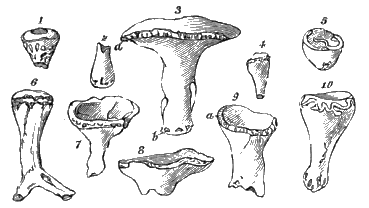
Lign. 25:—Flints deriving their forms from the zoophytes they enclose.
FUNGIFORM FLINTS.
Among the flints whose forms depend on the organic bodies they enclose, are some which bear so close a resemblance in shape to Fungi, that they are provincially called in Sussex "petrified mushrooms;" several of them are figured above (Lign. 25). In these fossils there are openings at the base, and a groove on the margin of the upper part, in which the structure of the enclosed body is generally more or less distinctly seen; and upon breaking one of these bodies, a section of a funnel-shaped zoophyte is obtained. The origin of these flints will be understood by reference to the four interesting specimens here delineated, one-sixth of the natural size in linear dimensions.
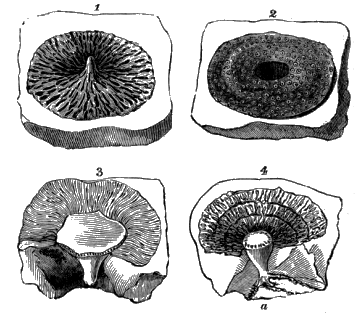
Lign. 26
:—Ventriculites from the Chalk, Lewes.
1. A perfect specimen in Chalk, shewing the external net-like surface.
2. An expanded specimen, displaying the inner surface studded with cells.
3. A Ventriculite with the lower part enveloped in Flint.
4. Part of a Ventriculite; the base invested with Flint: the root-like fibres are seen at a.
VENTRICULITES.
This zoophyte, to which the name of Ventriculite has been given to denote its usual shape, was a hollow inverted cone, terminating at the base in a point, whence radicles or root-like processes were sent off, by which the animal was firmly attached to the rock. The outer integument was disposed in meshes like a net (see Lign. 26, fig. 1), and the inner surface was beset with regular circular openings, the orifices of tubular cells (fig. 2); each of which was probably occupied by a polype. The substance of the Polyparium, or general support of this family of animalcules, which alone occurs in a fossil state, appears to have been analogous to that of the soft Alcyonia, and to have possessed a common irritability; the entire mass contracting and expanding, as is the case in many recent zoophytes.[AQ]
The flints, figs. 3, 7, 8, 9, Lign. 25, were evidently formed in the manner exemplified in fig. 3, Lign. 26; figs. 2, 4, 6, are illustrated by fig. 4, Lign. 26; for the chalk specimens, Lign. 26, shew that all these flints have been moulded around Ventriculites, and that their diversity of figure has arisen from the quantity of silex that happened to permeate the substance of the zoophyte; if but a small portion, flint like figs. 2 and 4, were the result; if the quantity were considerable, the larger fungiform examples were produced.