Part 2 — Note VII. Page 43. Isle of Wight Pebbles.
Reading edition
Note VII. Page 43. Isle of Wight Pebbles.
ISLE OF WIGHT PEBBLES.
The nodules and veins of flint that are so abundant in the upper chalk, have probably been produced by the agency of heated waters and vapours; the perfect fluidity of the siliceous matter before its consolidation is proved, not only by the sharp moulds and impressions of shells and other organisms retained by the flints, but also by the presence of numerous remains in the substance of the nodules, and the silicified condition of the sponges and other zoophytes which abound in the cretaceous strata.
Now although silex, or the earth of flint, is but sparingly soluble in water of the ordinary temperature, its solution readily takes places in vapour heated a little above that of fused cast iron, as has been proved by direct experiment;[AL] and similar effects are being produced at the present moment by natural causes. The siliceous deposits thrown down by the intermittent boiling fountains, called the Geysers, in Iceland, are well known;[AM] and in New Zealand this phenomenon is exhibited on a still grander scale. From the crater of the volcanic mountain of Tongariro,[AN] which is several thousand feet above the level of the sea, jets of vapour and streams of boiling water highly charged with silex, are continually issuing forth, and dashing down the flanks of the volcano in cascades and torrents, empty themselves into the lakes at its base. As the water cools, siliceous sinter is deposited in vast sheets, and incrustations of flint form around the extraneous substances lying in the course of the thermal streams. Silex is also precipitated by the boiling waters in stalagmitic concretions, and in nodules resembling in colour and solidity the flints of the English chalk. The complete impregnation and silicification of organized bodies is attributable to an agency of this kind; and although the origin of the siliceous waters that deposited the nodules and veins of flint in the chalk is still involved in obscurity, the mode in which the latter were formed is satisfactorily elucidated.
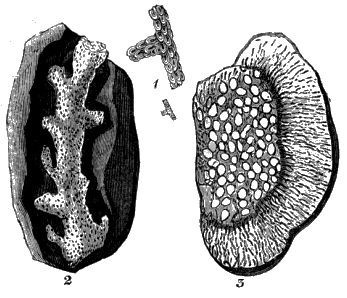
Lign. 24:—Zoophytes in Chalk and Flint. 1. A minute coral from chalk and flint; the lower figure is of the natural size. 2. Branch of a sponge in flint. 3. Pebble enclosing a zoophyte.
Of the perfect transmutation into flint of the most delicate organic structures, the pebbles strewn along the sea-shore of the south coast of England, afford a beautiful illustration; those from the Isle of Wight are especially celebrated for their rich and varied colours. The most common and interesting are those which exhibit sections of Choanites, as in the specimen which suggested the reflections embodied in these pages. Other allied forms are scarcely less beautiful; the petrified zoophytes called Siphonia, which, when living, consisted of a soft mass traversed by tubes, for the free ingress and egress of the water, often display the internal structure of the original: as in the polished transverse section figured above, Lign. 24, fig. 3. Other bodies of this class occur in the flint, and present interesting examples of the zoophytes of the chalk ocean.
But many of the Isle of Wight pebbles exhibit no traces of animal structure, yet are valuable and instructive as mineralogical specimens: such are the clear and transparent pebbles with bands and veins of quartz and chalcedony. Some specimens are as pellucid as rock-crystal; others are of a bright yellow, amber, dark-brown, and bluish-black colour, and are often mottled with dendritical or arborescent manganese. (Plate IV.) The moss agates, as they are called by the lapidaries, are silicified sponges. Small pebbles of pure transparent rock-crystal are often found among the shingle in Compton and Sandown bays, and have probably been washed out of the wealden strata; for similar stones occur in the Tilgate grit, and at Tunbridge Wells: in the latter place, they are cut and polished for rings, brooches, &c.
Plate IV.
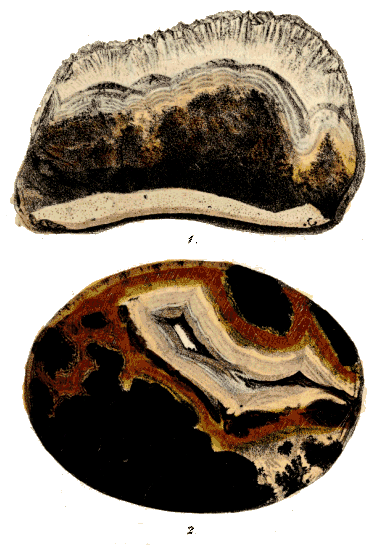
Polished sections of Pebbles.
Page 86.
ZOOPHYTES OF THE CHALK.
On the shores of the Isle of Wight, pebbles of jasper, resembling those from Egypt, and of banded quartz, with arborescent markings, or with zones of rich brown, are also met with; these do not appear to have originated from the chalk strata.
Pebbles of silicified wood have been collected in Sandown bay by Mr. Fowlstone; and water-worn boulders and pebbles of petrified wood, bones, &c., are common in Brook bay; rolled masses of the fresh-water shelly limestones (Sussex and Purbeck marbles) are also abundant in the same localities.[AO]