Part 2 — Note VI. Page 38. Rotaliæ in Chalk and Flint.
Reading edition
Note VI. Page 38. Rotaliæ in Chalk and Flint.
FOSSIL FORAMINIFERA.
The shells called Rotaliæ (see Lign. 5 and 6, p. 14 and 16) belong to a group of marine animals of very simple organization, and which present great variety in the form and markings of their testaceous coverings; but they all agree in having the sides of the shell pierced by numerous holes or foramina; whence the scientific term of the Order, Foraminifera, is derived: these openings are for the egress of delicate filaments, which appear to be organs of progression and respiration.
The Foraminifera are, with but few exceptions, exceedingly minute; in an ounce of sea-sand, between three and four millions have been detected. The body of these animalcules consists of uniform granules enclosed in a skin or integument, having one or more digestive sacs or cavities; these creatures appear, in fact, to be mere polypes, protected by testaceous coverings. Some have but a single cell; others have many, disposed in a conical or cylindrical form; many kinds, of which the Rotaliæ are examples, are discoidal involutes, and divided internally by septa into distinct chambers:[AH] they resemble in this respect the shell of the Nautilus, but are readily distinguished by the perforations.
All the various kinds of Foraminifera swarm in the present seas, and were not less numerous in the ancient ocean. We have seen that the white chalk almost wholly consists of a few genera of these animalcules; and in many strata of sand they are so abundant, that a cubic inch of the mass contains upwards of sixty thousand. In the Rotalia, the body is entirely enclosed within the shell, and occupies all the cells; and long, soft, tentacula are sent off through the foramina. The shell, therefore, though resembling in form that of the Nautilus, is essentially different; for in the latter, the outer chamber only is occupied by the body of the animal, the internal ones being successively quitted empty dwellings; whereas, in the Rotaliæ and analogous Polythalamia,[AI] all the cells are contemporaneously filled by the soft parts of the animalcule.
RECENT FORAMINIFERA.
When the shell is removed, which is readily effected by immersion in diluted hydrochloric acid, the body is exposed, and found to consist of a series of lobes or sacs, united by a tube corresponding somewhat in its position with the siphuncle of the Nautilus, but which is the digestive canal. The body of a recent animalcule of this kind, deprived of the shell, is figured in Lign. 23.
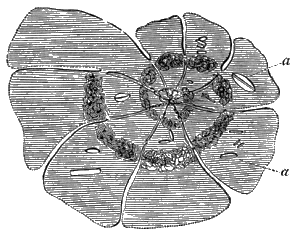
Lign. 23:—The body of a recent animalcule allied to the Rotalia, deprived of its shell; highly magnified.
Not only the characters of fossil shells of such infinite minuteness can be revealed by the microscope, but even the soft parts of the animalcules which inhabited them; for these are occasionally preserved, and may be demonstrated with as much distinctness as the recent examples.[AJ] In flint the soft parts of Rotaliæ, Textulariæ, &c., are abundant, and may be seen, with but little preparation, like insects in amber: the specimen figured in Lign. 12, p. 39, shews the body of a Rotalia well defined; the only preparation this atom of flint has undergone, is immersion in Canada balsam. To detect such delicate structures in chalk requires, however, some experience in microscopic manipulation, as the calcareous matter must be dissolved in hydrochloric acid, and the animal substance separated from the residuum.[AK]