Part 2 — Note IX. Page 50. Minute Corals from Chalk.
Reading edition
Note IX. Page 50. Minute Corals from Chalk.
Some layers of chalk are composed of an aggregation of many kinds of delicate corals, the interstices being filled up with Rotaliæ and other foraminiferous shells. In the cliffs near Dover there are several beds of this nature, well known to collectors for the profusion of exquisite specimens they yield to the experienced investigator. Lign. 17, p. 50, represents several varieties from different localities; the small figures shew the natural size, and the enlarged ones their appearance when magnified. Attached to the surface of shells, and sometimes standing erect in crannies of flint nodules, beautiful corals may often be detected by the aid of a lens of moderate power. By brushing chalk in water, and examining the deposit, delicate fossils of this kind may also be obtained.[AR]
NATURE OF CORALS.
From the close analogy of the fossil corals to existing forms, it would not be difficult to give restored figures of the originals. Every little branch might be represented fraught with living polypes: in some cells the agile inmates might be shown with the mouth expanded, and the tentacula in rapid motion; in others withdrawn into their stony recesses, and devouring the infinitesimal atoms that constitute their food: even their varied hues might be introduced, and thus a vivid picture be presented of the microscopic beings which peopled the waters of the ancient chalk ocean.
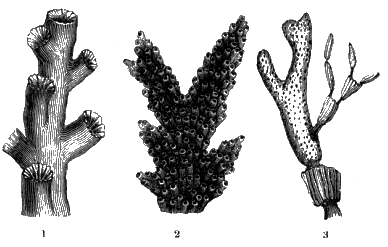
That the Corals, which from their elegance and beauty are preserved in almost every cabinet, have been fabricated—or, in other words, built up—by polypes, in the same manner as the honey-comb of the bee and wasp, is so prevalent yet erroneous an opinion, that I am induced to point out its fallacy, by giving a brief account of the formation of these substances. The three recent specimens represented in Lign. 27 will serve to illustrate my remarks.
Lign. 27
:—Recent Corals.
1. Oculina ramea.
2. Madrepora muricata.
3. Isis hippuris.
The coral, fig. 1, was an internal axis or skeleton, deposited by the soft fleshy integument with which, when living, it was wholly invested; in the same manner as are the bones of animals, by the special membrane (periosteum) that secretes them. This integument lined every cell, and the polypes were permanently united to it. When the live coral is taken out of the water, the animalcules shrink up and quickly perish; their soft parts and the external investing substance putrefy, and the stony axis beset with the radiated cells alone remains.
RECENT CORALS.
In the example of Oculina ramea, or May-blossom Coral, fig. 1, from the Mediterranean, the cells are large and distinct; in the Madrepore from the West Indies, fig. 2, they are small and very closely aggregated.
The specimen of Isis (fig. 3) belongs to a group of coral-zoophytes in which the polype-cells consist of a substance that is durable, but not so hard as coral, and invests an axis composed of a tough flexible material, which is exposed at the base of fig 3, by the removal of the external or cortical part in which the polypes were situated. The Gorgonia, or Venus's fan, has a similar structure and composition.[AS]
In the Red Coral, so largely employed in the manufacture of beads, brooches, and other ornaments, not only the animalcules, but also their receptacles, are composed of a soft perishable substance. When alive, the polypes, as well as the investing fleshy integument, are of a delicate bluish tint; the internal calcareous axis alone possesses the peculiar red colour. Upon being taken out of the sea, vitality quickly ceases, the soft parts decompose, and the beautiful crimson stone commonly known as the true coral, is obtained free from all traces of the soft mass by which it was secreted. Although an actual investigation of the facts described can only be instituted near the seas of warm climates, yet our coasts abound in certain coral-zoophytes in which similar phenomena may readily be observed. Most persons in their rambles by the sea-side must have noticed on the fuci, algæ, shells, pebbles, &c., patches of a white earthy substance, which when closely examined resemble delicate lace-work. These apparently calcareous incrustations are clusters of the zoophytes termed the Flustra, or sea-mat.[AT] When removed from the water, this aggregation of polypes seems coated over with a glossy film or varnish; and with a lens of moderate power the surface is seen to be full of pores, disposed with much regularity. If viewed under the microscope while immersed in sea-water, a very different appearance is presented. Every pore is found to be the opening of a cell whence issues a tube fringed with several long feelers or arms; these expand, then suddenly contract and withdraw into the cell, and again issue forth; the whole surface of the Flustra being covered with these hydra-like animalcules. The Flustra, therefore, like the corals, constitutes an assemblage of polypes, each individual being permanently fixed in a durable cell, and the whole attached to a common integument by which the calcareous frame-work was secreted and maintained.[AU]