Part 2 — Note III. Page 20. Whitby Ammonites.>
Reading edition
Note III. Page 20. Whitby Ammonites.>
AMMONITES.
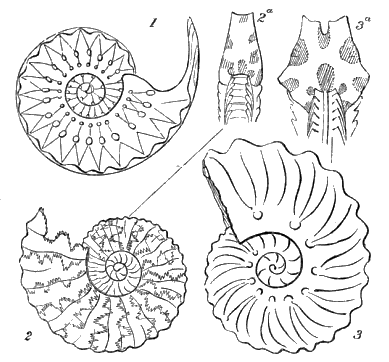
Lign. 22:—Ammonites from the cretaceous formation.
1. Ammonites varians, from Hamsey.
2. A. Dufresnoyi: 2a, part of the same.
3. A. lautus: 3a, keel and septum of the same.
The Ammonites differ from the Nautili in having the margins of the septa or internal shelly partitions (which in the latter are smooth), foliated or wrinkled; and the siphunculus or tube placed along the back of the shell, whereas in the Nautilus it is central. The sides of the shell in the Ammonites are very generally more or less ornamented with arched elevations and depressions, and studded with spines and tubercles, as in the specimens above figured.
There are several kinds of Ammonites found in the Lias at Whitby and other places in Yorkshire; the most common species is figured in Lign. 7. p. 20; the dark colour of this fossil is produced by the argillaceous stone with which it is now filled. The internal structure of these Ammonites is generally well preserved, the chambers being lined with spar or other mineral matter; transverse polished sections are often very beautiful from the several cells being occupied by variously coloured marble, susceptible of a high polish. (Pl. III.) In some examples the entire shell is transmuted into brilliant pyrites (sulphuret of iron), and the chambers are filled with white spar; a specimen of this kind in my possession, collected by Lady Murchison, is the most elegant fossil imaginable.
Plate III.
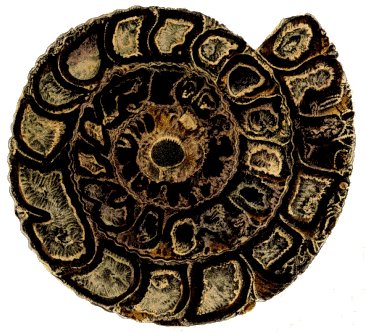
Polished section of an Ammonite.
Page 70.
AMMONITE-MARBLE.
It is not unusual for the visitors at Whitby to inquire of the collectors how it is that the head of the animal is never found? and the crafty dealers, willing to accommodate the taste of their customers, carve the extremity of an Ammonite into the semblance of a serpent's head, and affix two red eyes; thus producing a veritable proof of the truth of the legend of St. Hilda! My young readers will not be duped by this trick-of-trade, if they reflect but a moment on the real nature of a fossil Ammonite: they will remember that it is a shell which, when empty, became filled with what was then soft mud, but is now stone; in like manner as if liquid plaster of Paris were poured into an empty snail-shell and consolidated.
In some parts of Somersetshire, a beautiful marble composed of an aggregation of two or three small species of Ammonites, is used for sideboards and other ornamental purposes: the polished slabs are diversified by the numerous sections of the shells.
Some of the clays of the Lias abound in a species of Ammonite of extraordinary beauty from the iridescent lustre of the pearly coat of the shell: a slab of stone from Watchett, on which a hundred or more Ammonites of this kind are displayed, may be seen in the British Museum.