“They’re a Multitoode”
Reading edition
“We ain’t expected to do only our part.”
Christopher Morton, Jr., was looking through the morning mail in the office when there came a knock at the door. He glanced at the clock and frowned. It was too early for visitors by five minutes, and this vigilant young man of business was very careful of his minutes.
While he hesitated, the door opened without ceremony and admitted a gaunt, unfashionable figure, hollow-chested and sallow-faced.
“Hello, Christy, old chap!” cried the intruder, stretching out a hearty hand and feeling apparently no doubt of a welcome. “How are you?”
For an instant the other looked at him vaguely, the crease still showing in his forehead. Then his eyes lit.
“Why, Jim Perry, is it you!” he shouted, getting around the table with a bound.
“Part of me,” said Jim, sinking into a chair. He panted a little, but he smiled yet.
Christy looked him over discontentedly.
“What have you been doing to yourself?” he asked.
“Caught a fever,” explained Jim, with a nod. “The missionaries sent me home. I might better have stuck it out there, but I had no breath to argue with them, so they packed me off. I am to go back in September.”
“I have always believed in foreign missions,” said Christy, “but when they took you out of the country I found it hard to keep my faith. And now—” he stopped abruptly.
“It was a mighty good day for me when I went,” said Jim Perry. “I have got a good deal out of living these past three years.”
There was no mistaking the ring in his voice.
“You have snug quarters here,” said Perry. “They tell me that you are a prosperous man of affairs.”
“I am getting on,” said Christy, modestly, “I have some turn, I think, for making money.”
“We out in China,” said Jim, with a chuckle, “haven’t any; it is the last thing we can do. Our strong point is spending. We claim that nobody on earth can surpass us in that. We will invest for you if you like. By the way—” He plunged his hand into his pocket and brought out a flat strip of cardboard which he proceeded to fit together into a money box.
“There!” he said, setting it up gravely on the corner of the mantelpiece. “You will kindly contribute.”
“What is it?” asked Christy, regarding the small object distrustfully, very much as if it were a dynamite bomb.
“We are trying,” explained Jim, “to raise a special Christmas offering for missions. Along with the rest of her Christmas giving, the church is asked to give to those who have never learned what Christmas is.”
There was a slight pause.
“Could anything,” Jim asked, “be more acceptable to Him in whose name our festival is kept?”
“The original meaning of Christmas has been overlaid in a good many minds,” commented Christy, briefly.
“To their loss,” said Jim, “and to the bitter loss of many besides.”
He rose from his seat and began to pace back and forth over Christy’s thick carpet. But he was weak; he soon came back to his old place.
“I have walked,” he said musingly, “the swarming streets of heathen cities, I have gone into heathen homes, I have stood face to face with weary, heavy-laden, heathen souls, and I have been taught what Darkness is. But then, thank God, I have time and again seen the Star of Bethlehem break in the black sky and stand still over some place where the Christ was born, and I know, yes, I know, the brightness of its rising!”
There was another silence.
Again Jim was the first to speak. “No doubt,” he said, “you give a number of Christmas presents.”
“I don’t think of them in September,” said Christy.
“That is fortunate,” responded Jim, tranquilly. “It will give you more leisure to think of this betimes.”
He looked at his watch and said that he must go.
They walked together to the corner where he took the car, and then Christy hurried back to his work.
“That man will never go to China next September,” he muttered to himself, as he rang up the elevator. “It will be another Celestial Kingdom for which he will start, unless the signs are wrong.”
For the rest of the morning, Mr. Morton was not so undivided in his attention to business as was customary with him. Many times his mind wandered to the face that was like, and so unlike, the face of his old college mate. It was aged. It was lined. It was tired.
“But you could trust it,” Christy concluded, “to the uttermost.”
“Jim Perry,” he said, facing at last the crucial idea which he had sought to evade, “has got much out of life. What am I getting?”
The roar of the city came in at the open windows. Christy did not hear.
“If I should die to-night—that is too trite a supposition. If I should have softening of the brain to-night, or advancing paralysis, what satisfaction would there be to which I could hold fast, as I sat with my face to the wall while life passed me by?”
The breeze fluttered the papers on his desk.
“If my plans stopped now, nothing would be left from the failure. They need the future in order to amount to anything. If Jim Perry never gets back to China, why”—he leaned his head on his hand and thought came slowly—“he has lived for an object and attained it as he went along.”
Christy was still thinking of the look in Jim’s eyes and the sound of his voice when footfalls along the corridor foretold an interruption.
Several men followed on the heels of one another. When they were all gone, Christy’s mind had largely recovered its ordinary temper.
“Jim Perry is an awfully decent chap; it was upsetting to see him looking so done. If he had stayed in this country, three-quarters of a lifetime of work would probably be before him. One can’t help remembering it. But—I can accept the logic of missions.”
He took the little cardboard box from the drawer into which he had thrust it and read every Scripture verse on all its sides.
“Yes, the arguments are strong. I don’t pretend to gainsay foreign missions. But yet it can’t be denied that thousands of the holiest of saints have lived their lives out within the limits of Christendom and found more than their hands could do with their might. However, that sort of incompatibility between the two sides of a truth is the commonest thing in the world. It does not shake the claim of the missionaries.”
“I wonder,” he meditated, “how much genuine missionary spirit there is in the church of to-day. I don’t mean among the specialists, the experts, like Jim (and me)”—Christy had the grace to laugh a little—“but in the rank and file.”
He lifted the contribution box and regarded it with a new expression. By-and-bye he smiled broadly.
“It will be an interesting experiment,” said Christy. “Let us try it.”
He put the box up again on the mantelpiece, where Jim had first set it, clearing a space about it that it might stand unshadowed in a small rim of black marble.
Another hour of the afternoon passed as many other hours had done. Christy had returned to his habit of absorption in what was in hand.
An old woman, rich and “crotchety,” had been talking business with him for the last fifteen minutes.
“The old dame is as keen as a weasel,” thought Christy, as he listened with bowed head, deferentially. “Not many men could fool her on a deal. She is honest herself, and she doesn’t mean to be cheated. The most of her time is given to padlocking and double-barring her money chest.”
Finally she came to a pause. She pointed across the room.
“You have something new there. What is it?”
“A collection box,” answered Christy, accepting his cue, promptly. “A college classmate of mine, a missionary to China, left it. The missionaries are calling for a special offering at Christmas.”
The old lady heard him out patiently. When he had finished, she began to speak of further precautions and provisos that had occurred to her as to her affairs. Then she arose stiffly to go.
At the mantelpiece she stopped, took a bill from her full purse and slipped it into the narrow opening of the missionary box. She had given the first contribution to Jim’s heathen.
“Of her abundance,” quoth Christy, as he shut the door behind her.
Miss Craig, his stenographer, was moving at the other end of the office. She shut up her typewriter; it was the hour for her to leave.
A little time before Christy had felt a sensation in regard to Miss Craig. He did not often do this, which was one of his chief virtues.
But, just now, in the midst of his discourse on foreign missions, he had been arrested for an instant by meeting the straight, intent gaze of the young woman who always, unless directly addressed, kept her discreet eyes upon her work.
Miss Craig put on her hat and gathered up her handkerchief and purse.
“May I trouble you to post these, Miss Craig?” said Christy, giving her a handful of letters. “Thank you. Good afternoon.”
She laid the letters down on the mantelpiece while she opened her purse, which was shapely but thin. Out of it she took a dollar bill, leaving some silver, and put it in the money box.
Christy had started up to expostulate. He sat down to recover.
“She was as calm and matter-of-course about it,” he gasped, “as if it were only natural for poor working girls to help evangelize China out of their slim wages.”
During the next two or three days much notice was taken of the missionary box.
The notice was diverse in kind. The curiosity of some was quickly satisfied. Some stared politely. Others openly scoffed.
One fashionable club man put in a penny.
“To see how it feels,” he said.
“The shock can’t be very great,” observed Christy, “even to so new a subject as yourself.”
“But you know,” said the club man with a grin, “it comes on top of finding you running the machine. My nerves are all gone.”
A clergyman who coughed gave liberally.
“If I could have guessed that he was coming,” said Christy, with chagrin, “I would have covered the thing up. Some men can no more pass a collection basket than a drunkard can a corner saloon. But they are few.”
A hard-headed merchant furtively dropped in a gold piece.
“I got it in change,” he apologized, when he met Christy’s gaze. “It is as well to make some special use of it before I pay it out for a quarter.”
A circuit judge lifted the box in his hand and read the verses as Christy had done. When he set it down again he stood before it in silence while Christy looked up, wondering, and did not disturb him.
At last the judge aroused himself. He made a large donation.
“My daughter was interested in all these things,” he said. Christy remembered then the young girl who had died the year before.
In one way and another, Jim Perry’s missionary box grew heavy. Then it was full.
Christy took it apart, put the money in a pigeon-hole in his desk and set it back into place. He did not allow himself to comment.
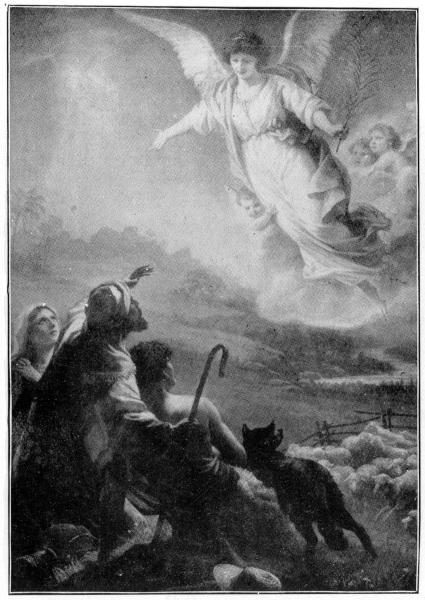
“Behold, I bring you good tidings of great joy which shall be to all people.”
On the same afternoon, Chippy Black, the errand boy, was waiting in the office for a note. Chippy was a new boy; Christy did not feel sure of him. Lifting his head now to give directions, Chippy was caught in the act of “hefting” the missionary box.
“Ah,” said Christy to himself, with vexed enlightenment. Hunting office boys was a bore.
“Why, this is empty!” said Chippy, facing round on him and holding out the box. “Did you send it off?”
“No,” answered Christy, uncertainly. “It was full. I took the money out.”
“I see,” said Chippy. There was relief in his voice and in the clever, dark, little face.
He plunged his hand into his jacket and brought out a small newspaper parcel tied with twine.
“I promised Lin to bring it to you,” he said. “It would have been too bad if I’d been too late.”
“What is it?” asked Christy, receiving the packet with no show of distrust in its dinginess. And he was fastidious. “Who is Lin?”
“It’s money. She’s my sister,” answered Chippy. “She wants it to go with the rest.”
Christy pushed a chair towards him. “Sit down,” he said. “Tell me all about it. Take your time.”
Chippy crossed his knickerbockered legs, and by tilting forward a little managed to keep one toe on the carpet.
“There’s two of us boys home,” he began. “And there’s Lin. My brother Bob and me are like lots of other fellows. But Lin is extry. I’d call her quite extry myself. She’s like—well, she’s like Lin. That’s all I can say.”
“I have seen one or two such persons,” said Christy.
“One Sunday night one of those foreign preachers was talking about the heathen. If it hadn’t been for Lin,” said Chippy, “we’d have forgotten all about them inside of a week. But Lin was bound that something had got to be done. ‘There’s so many of them, Lin,’ says Miss Loretta Pease. (Miss Loretta lives on the next floor to us; she’s educated.) ‘They’re a multitoode,’ she says. ‘You can’t never reach ’em.’ ‘Not all of them at once,’ says Lin to her. ‘Not just us alone by ourselves. We ain’t expected to do only our part.’”
“Miss Lin is sagacious,” said Christy.
“‘It isn’t any more than right for us to do our part,’ she told Miss Loretta. ‘And for one I won’t back out of it,’ Nor, you may be sure, she wouldn’t. Lin is the sort that wouldn’t.”
“An uncommonly good sort,” said Christy.
“You are like that, too, ain’t you!” said Chippy, looking over at him kindly.
“Miss Loretta came round all right after Lin had worked over her a while. She ain’t obstinate. She’s genteel. So Lin fixed it up that we was all to chip in together and make up a purse for the heathen. So we did it. And there it is.”
He nodded proudly toward the newspaper parcel.
“You must have worked hard,” said Christy.
“It’s savings, mostly. I mean our part of it is, Lin’s and my brother’s and mine. Lin got off the neighbors, too, you know; it’s all there together.”
“You saved yours?” questioned Christy.
“Yes, sir. Lin is grand on saving. She scatters it. She don’t bunch it all on one thing till it appears as nothing else but just that was worth eating. First it’s sugar, and then it’s sausage, and then it’s something different again. And sometimes it ain’t anything at all. You don’t hardly miss it that way.”
Chippy slipped still farther forward on his seat and felt for his cap. He glanced at Christy’s unfolded note.
Christy got out an envelope and dipped his pen in the ink. Then he let it rest over the edge of the desk, where it dried.
He picked up the roll of money.
“You must have been collecting this for some time.”
“All summer,” said Chippy. “There’s a good deal of it. Lin and Miss Loretta had just begun to talk about where they would carry it when you first began to take up money here. I told them about it and I told them that, so long as this was where I worked, I thought you’d ought to get it. So after a bit they decided on that.”
Chippy plainly felt that the bestowal of Lin’s patronage was no light thing.
Christy agreed with him.
“I’m very much obliged to you,” he said heartily. “This will help me along splendidly. Let’s put it in at once.”
He pulled at the twine string, which was tied in a very secure knot, and laid open the hoard.
It was made up of all the original pennies and nickels; there was also one dime among them. The sum total was $2.11.
Christy handed Chippy a nickel and held one himself. He brought the missionary box.
“Now, drop yours in,” he directed. “Then I will drop mine. We’ll take turn about.”
Chippy was eager. His interest grew with every rattling coin until the last was safely inside. Then he straightened himself with a long breath.
“Lin said she was going to do it, and she’s done it,” he said.
“And she doesn’t know how much she has done,” said Christy, soberly.
“That’s so,” answered Chippy, with quick perception. “That’s the best of it, I suppose. The best of everything, Lin says, is what the Lord can make out of it. Anything will go twice as far with Him, she says. You talk a great deal like her.”
Christy lifted the box.
“It’s about full,” he said. “It’s just about ready to empty again. But there is a little space yet. We will leave it. I shall be glad to see what gift will be put in on top of this.”
The weeks passed. Several times over the missionary box was emptied into the pigeon-hole. On a foggy December afternoon a Mr. Richards was alone with Christy in the office. He had brought the young man a windfall of $1,000.
“It is by happy strokes like these,” said Mr. Richards, “that a man grows rich.”
Many such strokes of various kinds had come in the way of Mr. Richards during a long life.
“I have built up my own fortunes,” he continued, “from the stub. From what I see of you, Mr. Morton, I predict you success.”
He regarded Christy with a glint of favor in his iron-gray face as he added in climax, “You are very much like I was at your age. You are like myself.”
Christy was rather silent. When he was left alone he thought of Jim Perry. He often thought of Jim now. His late visitor and his classmate stood side by side before his mind.
“There is wealth and wealth,” he mused. “Mr. Richards has one kind, Jim has another. I am not so awfully pleased,” he thought resentfully, “with my likeness to Richards. I don’t fancy being a cash register. All the man’s fortunes are in money.”
Christy looked down at the cheque in his hands; he looked at Jim’s box.
“I said the real Christmas was forgotten. I said that all the missionary spirit of the present resided in the missionaries and me. I doubt whether Mr. Richards at my age was such a fool. Poor Richards! He is old. I shall have a good part of my life yet, I trust.”
He wrote on the back of the cheque and folded it small.
“Richards, and Jim, and Lin, and the others have spoiled my taste a little for happy strokes, however innocently come by. The mission shall enjoy this one.”
He pushed the cheque through the slit in the money box, which was getting frayed and worn.
Christy met Mr. Richards on the street soon afterwards.
“I hope,” said Mr. Richards, “that you have found a good investment for your money.”
“I have,” said Christy.
“Is it reasonably sure?”
“Perfectly.”
“Nothing in this world can be perfectly sure, Mr. Morton.”
“But there is another world,” said Christy.
“It may be,” he said.
As the man of millions passed on, Christy heard a faint sigh. Three days later the office door burst open and in walked Jim Perry, broad and brown.
Christy stared at him speechlessly.
“I’m well again,” announced Jim, superfluously.
Christy shook him by the hand, clapped him on the shoulder and thumped him on the chest.
“Providence knows how to give to missions!” he said.
Jim turned to the mantelpiece and shook his money box. It was empty. He was openly disappointed.
“You lazy beggar,” he cried. “Are you leaving all the giving to Providence?”
“I am not a lazy beggar,” said Christy. “I am a very industrious one. Look at this.”
He put the contents of the pigeon-hole in front of Jim and watched him fall upon them, and enjoyed tremendously his blank delight.
“Why,” stammered Jim, “what does it mean? Is it all for us?”
“It means,” said Christy, “that a week from to-day will be Christmas.”—Y. P. M. M.