Christmas in Our Boys’ School, Junghsien, West China
Reading edition
By Edward Wilson Wallace, B.A., B.D.
If you were a Chinese, and every day ate two meals of rice and some vegetables, with meat only twice a month, if as often; if you worked from daylight to dark seven days in the week, and had no summer vacation or Christmas holidays; if you had no books to read except possibly (if you were lucky) one or two greasy and tattered volumes of ancient philosophy, not one word of which you understood; in other words, if you were an average Chinese boy or girl, don’t you think that you would look forward even more eagerly than you did this year to Christmas? I think you would. At any rate the boys and girls connected with the church in Junghsien were expecting a great treat, and we were planning to give them all that they expected, and more.
Then suddenly, unexpectedly, a terrible thing happened that put an end to all these hopes and plans. Can you guess what it was? It was not a fire, or an earthquake, or a riot on the mission. But one morning there came word that the Emperor of China and his step-mother had suddenly died, and that everyone must go into mourning. And that was the end of the two Christmas concerts, the Christmas tree, and the feast. For the rules for mourning for a dead Emperor in China are quite strict. No one could marry for a month—that rule did not affect us, for the only wedding arranged for by anyone connected with the church, that of Mr. McAmmond’s teacher, took place a few days before. No one was to be allowed to have his head shaved for a hundred days. Every Chinese boy and man allows just enough hair to grow on the top of his head to form his “pig-tail”; all the rest of his head is shaved clean. But imagine what a messy effect it is to have the head covered with a couple of months’ growth around the long cue, as there is now. It is the Chinese way of going into black; for, of course, every man’s hair is as black as pitch. Another rule was that no one could wear satin clothes for a hundred days, and the little red knobs on the top of the caps had to be changed to blue, which is the second degree mourning color in China, white being the first. So far the rules did not interfere with our Christmas entertainment. But now we come to the fatal order, “There must be no music and no celebrations for a month.” Alas! for our Chinese boys and girls. Christmas fell within the month.
It is true that we might have got around the trouble by claiming that ours was a foreign church, and so did not fall within the common rules. This, I believe, was done in other places. But our church here is a large one, and we are constantly trying to make the members understand that it is a Chinese church, not a foreign one, and we decided that this was a splendid opportunity to impress on the people the fact that when a man joins the Christian Church he does not in any way become less of a Chinese, and that our Church believes in honoring the rulers of the country. As soon as it was finally decided that we should follow the regulations the members agreed that we had done the correct thing.
In one way it was rather fortunate for the boys in the school that we had no entertainment to prepare for. Just at Christmas last year came the examinations, and some of the boys were working very hard to prepare for the entrance examination. So it gave them a better chance to study. And during Christmas week they had four examinations.
We did not intend, however, that Christmas should pass without something to make the boys remember the day and what it means. If they could not have a Christmas tree, I determined to give them the next best thing—in fact, when I was a boy a year or two ago, I thought it was away ahead of a mere tree—that is hanging up the stockings. The boys had never even heard of such a custom, so it was great fun for them. One morning in school, after prayers, I solemnly asked the boarders, “How many of you have two pairs of socks?” There was blank amazement. Why did I wish to know that? I only smiled, as I began with the boy in the front, little “Georgie Bond.” “Have you two pairs of socks?” “Yes, but the extra pair have holes.” Then to the next boy, “Have you a second pair?” “I have three pair, but they all have holes, some of them as big as this,” and he made a circle with his thumb and finger. “Have them mended,” I replied, and passed on down the line. I found that all the nine boys had extra pairs and all of them, as is the case with the stockings of every decent fellow I ever knew, had holes. I maintain that in China, as at home, it is a sign that a boy is a real boy when he wears holes in his stockings. So I advised them to have one pair mended and washed before Christmas Eve, and bring it to me. And then—well, we should see what we should see.
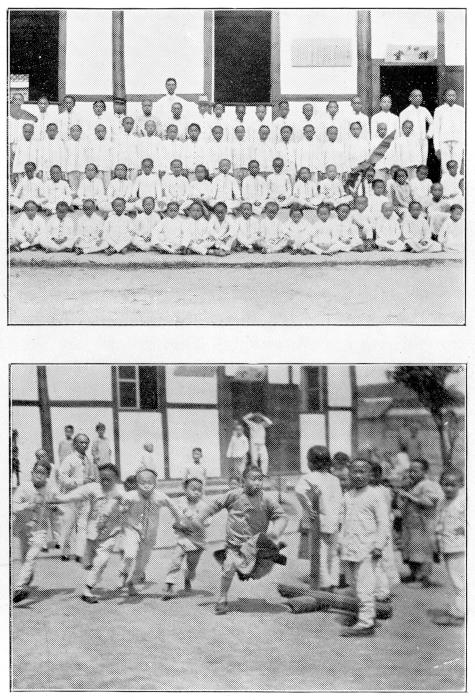
The boys of the Junghsien School who had a good time at Christmas.
Great was the excitement among the boys, and not a sock was missing when the great night arrived. I did not let the boys hang up their own socks, but packed them all off to the school study-room upstairs, while one of the teachers and I pinned the socks up in a row in the class-room under the blackboard. You know we have no fires in the schools here, and so there are no chimneys. All the same Santa Claus found a way, for next morning—but wait a bit.
When I got down to the school on Christmas morning at half-past seven I found the boys already at breakfast. They were casting anxious eyes in the direction of the room with the closed door, and like other boys I have known they did not take long to eat their Christmas-morning breakfast. When they were all ready they filed into the room. I am not going to tell you how those stockings were filled. You may decide for yourselves how, and by whom it was done. I don’t think the boys stopped to think anything about “how.” They were too much interested in the sight of twelve white Chinese socks in a row, all bulging out in a knobby fashion, with things sticking out of them, and a flat, red parcel behind every sock. On the blackboard was written in Chinese, “Jesus’ Holy Birthday.” After they had looked for a minute I suggested that they take down their socks and see what was in them. Then for the first time in their lives they had the joy of exploring the mysteries of a Christmas stocking. Their presents were not very much, you would say, perhaps. Each boy found a story-book and a photograph of the school, and then down in the sock were nuts and candies, and right in the toe an orange. The two teachers each got a New Testament with the Chinese and English on the same page.
They did not say much, and I wondered if they were disappointed, until one of the teachers, Mr. Jang, came up to me with tears in his eyes, saying, “You say we must not thank you, so I think we ought to thank God. Can’t we do it just now?” It touched me deeply. “Yes,” I said, and we all went up to the study-room and, standing there about the long table, one after another of the boys made a short, simple prayer of thanks to God, not only for the gifts of the morning, but especially for the greatest Gift of all, Jesus Christ.
At nine o’clock we had our regular morning prayers, and then I gave to the day-boys their presents, a New Testament and a bag of nuts and candy to each one. We had a nice little service in the church for all the church people, but our real Christmas service was held the next Sunday. On that day we had a special musical service, led by the boys, who had been practising for months under Mr. and Mrs. McAmmond. It would have done you good to hear them open the service with “Come, Thou Almighty King,” with Georgie Bond singing one verse as a solo. The anthem was “Hark, the Herald Angels Sing,” and our Chinese angels sang splendidly.
On Christmas morning the church members gave away free rice to five hundred poor people. So that altogether the boys, even if their Christmas was quieter than usual, have had something to remind them of the joy of this beautiful season.