Rue’s Heathen
Reading edition
The long line of blue check aprons followed the other line of small blue jackets through the wide hall, up the bare, polished stairs, and into the clean, airy chapel. Then, at a signal, every apron and jacket was still. Little Rue’s apron had been about midway in the procession, and so she found a seat near the middle of the chapel, where, swinging the small feet that could not quite touch the floor, she looked listlessly out through the window opposite, over a beautiful view of grove and meadow, and then up at the white ceiling, where a great fly buzzed at his pleasure, without having to walk in line.
On the platform a man in fine broadcloth and gold spectacles was beginning to talk; but Rue only listened dreamily.
“My dear children, I am delighted to visit this grand institution—to see so many of you in this beautiful home, so well cared for, so well instructed, and so happy.”
Rue wondered why all the men who talked there said that. She wondered if he really would like to eat and sleep and walk in a row and always wear a blue check apron. Then she forgot all about him, in watching the sunlight play on the small head immediately in front of her. What a brilliant red head it was! And then a bright thought occurred to Rue. A few of those hairs, twisted together, would make a beautiful chain for the neck of her china doll, her one treasure; and, of course, Mary Jane Sullivan would never miss them, if she only pulled out one here and there.
Forward crept Rue’s eager little fingers; but they were too nervous in their haste to be sure that they held but a single coarse hair before they twitched, and the result was a sudden explosive “Ow!” from Mary Jane, the turning of a battery of eyes in that direction, and an immediate investigation by the authorities into the cause of the disturbance. Poor little Rue was marched off in disgrace; but, as she reached the door, she heard the speaker say:—
“I am sorry this has happened; sorry that any one should miss what I am going to say; for I hoped to interest all these dear children in the work of sending the gospel to the heathen.”
It was kind of him to call them all dear children after that dreadful event, Rue reflected, as, with burning cheeks and tearful eyes, she stood, with a number of other little culprits, in one of the wide halls, for even punishment was in rows at the Home. Shifting her weight from one restless foot to the other, yet trying to stand sufficiently upright to answer the requirements of the penance, Rue did sincerely wish that she had been a good girl and remained quietly in the chapel, partly because of the humiliation that had befallen her, but also because she wanted to hear what he had to say on the particular subject he had named.
“Why didn’t he begin with that, and then I’d have listened!” she thought, rather resentfully. For back among Rue’s shadowy memories of the past, of love, and mother, and a home that was not the Home, was a dim recollection of some curious articles which her baby hands had only been allowed to touch carefully, because they were mementoes of an uncle who had died far away on a mission field. “So it would have been most like hearing about my relations; only I haven’t got any,” mused Rue. “Oh, dear! I wish I’d stayed good and hadn’t pulled Mary Jane’s hair. I didn’t mean to, anyway.”
She tried to find out about it afterwards by inquiring of one of the other girls.
“Oh! he wanted the children to try and save up something, so they could help send Bibles to the heathen. Guess, if he lived here long, he’d find we hadn’t anything to save,” was the hurried reply.
Bibles! That was where Rue was rich. She actually had two that had been brought from that faintly remembered home.
“I don’t suppose I’ll read one of ’em to pieces; not if I used it till I’m a big woman,” she said to herself. “I might give the other one. I ought to help, ’count of being a relation, somehow, and I want to be good. I just do.”
Later in the day she ventured another inquiry:
“How will he get those to the heathen?”
“I don’t know. Why, yes, he’ll send ’em through the post-office, of course. What do you care so much about it for?”
That was what Rue did not mean to tell. She chose her prettiest Bible, spent the play-hours of two days in writing an epistle on the fly-leaves, and tied it up in a piece of brown paper. Her knowledge of the post-office and its requirements was exceedingly limited, but she supposed it would be necessary to put something on the outside of the packet, to tell for whom it was intended. She wanted it to go where it was needed most, and of course the post-office people would know where that was, she reflected; so she carefully printed, in very uneven letters, “For the greatest heathen,” and then laid the precious package away to await a future opportunity. She would trust her secret to no one, lest some unforeseen interference might result, and she cautiously sought information.
“How do you do when you put anything into the post-office?” she demanded of Mary Jane Sullivan.
“Why, you just put ’em in. You go in the door, and there’s an open place where you drop ’em right down,” exclaimed Mary Jane, lucidly.
How good Rue was for days after that. How she washed dishes in the kitchen, under the care of Miss Dorothy, and made beds in the dormitories, under the supervision of Mrs. Mehitable, and so at last earned the privilege of being the one sent to town on some trifling errand for the matron.
Thus it happened that one bright morning the clerks in the post-office were surprised by a little packet tossed in upon the floor, and a glimpse of a blue check apron vanishing hurriedly through the door. Unstamped, and with its odd address, it created a ripple of amusement.
“‘For the greatest heathen.’ That must be you, Captain,” declared one; and the postmaster laughingly took charge of it, and then forgot it until, at home that evening, he found it in his pocket.
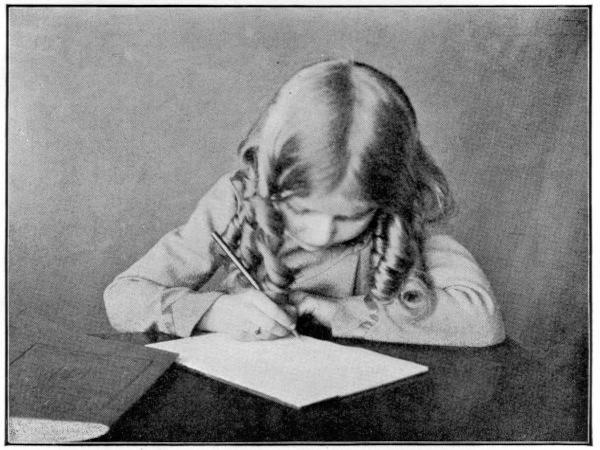
Rue writing the letter to “The Greatest Heathen.”
“What is it?” asked his wife, presently, as she saw him silent and absorbed, and, looking over his shoulder, she read the little letter with him. Original in spelling and peculiar in chirography it certainly was, but they slowly deciphered it:
“I haven’t any money to give ’cause I’m one of the little girls at the Home. Some of them have relations to send them things sometimes; but I haven’t. I have two Bibles; but I wouldn’t give this to any one but the heathen ’cause my own mamma gave it to me. It’s nice to have a mamma to cuddle you up and love you just by your own self, and tuck you into bed at night, and not have to be in a row all the time. It makes a lump all swell up in my throat when I think of it, and my eyes get so hot and wet I can hardly see. I wish God did have homes enough, so He could give every little boy and girl a real one, and we needn’t be all crowded up in one big place, that’s just called so. Sometimes, when I see all the houses it ’most seems as if there must be enough to go ’round; but I suppose there isn’t. I guess it’ll be the real kind we’ll have up in heaven, and I want to go there; and that’s why I send you this Bible, so you can learn about it. You must read it and be good. Oh, dear! it’s dreadfully hard to be good when you haven’t any mamma. I hope you’ve got one, if she is a heathen, for I’m most sure that’s better than no kind. Good-bye.
“Rue Lindsay.”
“Poor little thing!” exclaimed the lady, half laughing, but with a sudden moisture in her brown eyes.
Captain Grey looked around the beautiful room.
“I’m inclined to believe that letter was properly directed, and has reached its rightful destination,” he said, thoughtfully. “Think of it, Mary—all these cosy, pretty rooms, and no one to occupy them but you and me, while there are so many little home-sick souls in the world! You have spoken of it before; but I was too selfishly contented to care about it. If I’m not ‘the greatest heathen’ I have certainly been far enough from the sort of Christianity this book requires.”
“Well?” questioned Mrs. Grey, with shining eyes, waiting for the conclusion of the matter.
“Shall I go to-morrow and bring this little midget home with me—for a visit, say—and see what will come of it?”
It did not occur to little Rue that the stranger she met in the hall the next day, and who had a long interview with the matron, could be of any possible interest to her small self, until she was summoned down stairs to see him.
“Would you like to go home with this gentleman, for a visit of a week or two, Rue? He has come to ask you,” said the matron.
“Me?” questioned Rue, oblivious of grammar lessons, and with a dozen exclamation points in her voice. There was no danger of her declining. The prospect of a visit anywhere was delightful, and the possibility of such a thing almost as wonderful as a fairy tale. So it was a very bright little face that Captain Grey found beside him in the carriage, and Rue looked up at him shyly through her rings of sunny hair, to ask, as the only imaginable solution of the happy problem: “Are you one of my relations?”
“Yes, but I didn’t remember it until last night,” he answered gravely.
The weeks that followed were brimful of joy to Rue, and she won her way straight into the home and the hearts that had opened to receive her.
“And so you think I may tell the matron that you do not care to go back, but are willing to stay here?” questioned the Captain, when the allotted time had expired.
“I guess,” replied Rue, looking down at her dainty dress, and suddenly flinging her arms around Mrs. Grey’s neck, “that you didn’t ever live there, and eat soup, and wear check aprons, and have nobody like this to love, ’r else you’d know.”
But she has not learned yet that it was her own missionary effort that brought so great reward.