Liu Tsi Chuin Rioter and Evangelist.
Reading edition
Rev. J. L. Stewart, M.A., B.D.
“Ninety-five” is a date of dates among the pioneer workers in West China. All winter rumors of the doings of foreigners had been floating about the city of Chengtu, old stories of suspicion and superstition scarce heard to-day: “Foreigners ate children.” “Doctors pulverized eyes for medicines, hence their wonderful cures.” “Bodies were buried beneath the church floors.” “Foreigners having, many of them, blue eyes, could see into soil and discover hidden treasure as the dark-eyed people of China might see stones on the bottom of streams.” “Foreigners were there to seek treasure or territory.” Even high officials, ’tis said, fed the flame with the hope that it would soon become so hot the “foreign devils” would flee.
There were, however, few open acts of hostility during these days. Then suddenly, like a bolt from the blue, it came. It was the fifth of the fifth month feast. According to time-honored custom, the crowds assembled on the great east parade ground, scarce a stone’s throw from the Mission compound, for the throwing of plums. Vendors, their big baskets well filled with the fruit still green, had booths, or pushed through the people everywhere. Everyone bought, sowed his plums broadcast in the air, then scrambled with the rest, for, aside from the sport, the plums so obtained were said to ward off sickness, demons, disaster, and brought good luck for the year to come. As the day grew, masses of roughs and toughs, many from the yamen, some say, mingled with the thoughtless, and jammed and jostled together till the air was filled with the hum and hue of voices, and hearts and heads were half-hysterical for mischief and riot.
Already as evening came, the crowd had overflowed past the gateway of the mission premises.
“Here’s where the foreign devils live,” said one.
“Let’s hurl a stone at the gate,” said another.
“Who dares?”
Soon one stone by stealth, then a volley, rattled against the big black doors. The gateman’s rebuke only made the ringleaders more bold. They fell back when the foreigner appeared; but were at his heels, a howling mob, when the gates again closed behind him. The rabble rushed to the point, restraint was thrown to the winds. A riot was on in earnest.
Into the blackness of the night, two men, strangers, homeless in a strange, inhospitable land, fled with their heroic wives and hushed little ones. Then and for hours afterwards, as hiding from street to street they sought their way to our W.M.S. home, they heard afar the frenzied shouting, and saw the flames pierce high into the darkness as church, and hospital, and homes, and goods, and gifts, and many a treasured heirloom from half round the world became fuel for the fires. Next day saw the mob’s return to its work of destruction till every building of every mission in the city, Protestant and Catholic alike, was in ruins, and the foreigners, irrespective of sex or creed, huddled together in a few low outer rooms of one of the official yamens.
Such was Liu Tsi Chuin’s first introduction to the foreigner, for he was in the thick of the fray on the first night, and followed on next day as one by one the missionary families fled, and the buildings were looted and burned. It was a full decade before he came in touch with them again and then—how changed the circumstances!
Liu Tsi Chuin was of good family. His name, Tsi Chuin, “Be princely,” would give a hint, at least, of his parents’ goodness of heart. His father was the trusted treasurer of a district magistrate not far from Chengtu. Alas, when Liu was but a child of three the father died. Shortly after, his little sister also died, and Liu and the little widowed mother were left alone. His father, however, had been a man of thrift, so that even after the exorbitant funeral ceremonies were over, enough was left to buy a neat little home on the Great Well Corner in the provincial capital, and even some over to be invested for interest. Little Liu was sent to school. He had friends of his father in official circles. That would mean influence in the days to come, and that position, promotion, power, so hope was high in the little household.
At the age of thirteen a change came in Liu’s life. A relative, of whom there are ever plenty in Chinese families, had persuaded the little widow that mints of money might be made by embarking in business. After much persuasion, she yielded. Was not the interest small? And would not her boy need more as he grew older? And was she not ambitious for him? The sums loaned were called in, and the little home mortgaged.
Soon a great double shop displayed a new and euphonious name. Big lanterns swung below the eaves. Long boards with letters of gold told of the virtues of the place, while within hams swung from the ceilings, various confections covered the counters and long strings of tobacco lined the shop front close by the street. For five years business went on briskly. By degrees, however, other relatives and friends attached themselves till “the money failed to fill the mouths,” and, in brief, business failed and had to be abandoned. Another venture was made in the then flourishing opium trade, but their capital was limited and larger firms outsold them.
Liu was now a youth of twenty. With the little capital left he tried running a sox shop. Alas, in his last venture he had lost more than money. He had lost manhood as well. His countrymen have a proverb, “You can’t work in a dye shop and keep your clothes unstained.” Liu had himself fallen a victim to the opium he sold to others.
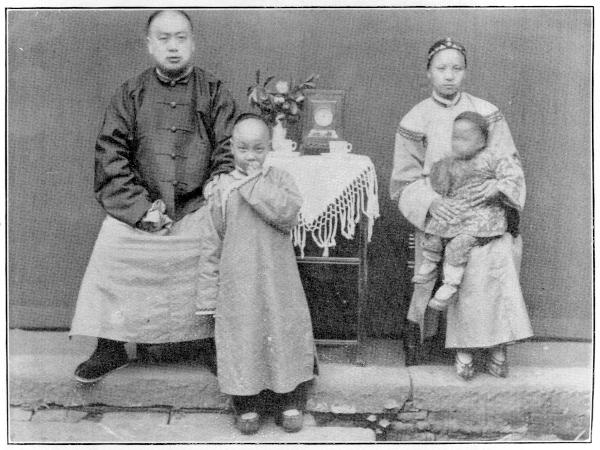
The evangelist and his family.
The record of his ruin is the old story of China’s sorrow after that. Sucking his pipe, sleeping, sliding about stealthily from spot to spot, seeking relief from the fiend which haunted him by day and by night, he had little time for business, his thoughts were busy with baubles, trade fell off, goods disappeared, his last cash left him, and despair and destruction followed fast. It was during those days that he found himself one of the throng of thoughtless and rowdies, assembled for plum throwing. The sacking of the missions was but a new excitement with a possible gain to all, and what could it matter anyhow to frighten away a few foreigners whom nobody wanted? But that story we have told.
Liu had married meantime. A little daughter had come to his home. Then later his wife died. He left the city and sought employment with his father’s former official friend. The latter gave him a small position as messenger. But official life is precarious. His benefactor lost his position, and Liu was once more down and out. He wandered back to the capital and to his child.
No one visits Chengtu who does not find his way some time or many times, if he has the opportunity, to the Great East Street at night. By day it is filled with busy buyers at the great silk, tea and porcelain shops, but by night it is more animated still. When the great shops close their shutters at sundown, the curbstones are immediately pre-empted by swarms of junk dealers, curio sellers, vendors of fans, needles, chopsticks, pictures, rare old bronzes, ink slabs and vases. Here, too, are diviners, fortune-tellers and fakirs. It is the bazaar of the capital, once seen not to be forgotten, with its twinkling candles stretching far away, its lines of squatting vendors, its hum of busy voices, its clattering, chattering, crowding thousands who throng the thoroughfare. There with his little store of stuff about him, Liu might be found each night. The day he spent picking up a few curios from house to house, when not too busy with his pipe.
One day he rambled again along the street where in former days he, with the rabble, had wrought such ruin to the cause of missions. The church, a new and larger one since those days, stood open. Numbers of people were crowding in, so he, with an uncle and two friends, sons of his former official patron, joined the stream. They listened half curiously, half carelessly, to the prayers and singing, all so strange to them. Something in the sermon, however, brought Liu to attention. The speaker said that this God of love could so fill and thrill a man with His Spirit that even the passion for opium could no longer hold him. Could it be possible?
Liu was no willing victim to the habit. He had tried all kinds of pills and strange concoctions guaranteed to cure, or recommended by friends. He had fought by his own will power till that became so weak he scarce struggled longer. But here was a new thought from the truth-telling foreigner, and a new hope. Perhaps this foreign God could help. So at invitation he, with his companions, waited for the after meeting, where all are welcomed who have questions or seek further light.
He became even more interested and came again and again, bringing his friends with him. Then the ancestral tablet fell down in the official home one night. The two sons took it as a sign that their ancestors were angry with their worship of the foreign God, so they came no more. A month later a storm burst over the city. The thunder, a somewhat rare thing on the Chengtu plain, so frightened the uncle that he, too, never returned to the church.
But Liu was not to be balked in his search. He met others among the members who had been helped by the foreign pastors and doctors, and he was determined to be free. The rest of the story is readily told. It is the story of an ever-increasing number of New China’s sons. Foreign medicine, earnest counsel from his pastor, daily reading of the Word which is Spirit and which is Life, prayer and service and the inflooding of the Spirit of God brought a new power and peace to a life which for long had struggled and suffered, and been all but slain through sin.
With health and hope and freedom came also a great longing that others might know the glad Gospel message. He took to selling books up and down the very streets where men knew him best. As he went he told his story in shops, at corners and in the homes of friends. Seeing his sincerity and ability, our mission soon sent him farther afield, till he traversed much of the northern district. Then he served for a time faithfully and effectively in Kiating and Chin Ien. He has now been a year at college as a probationer. His little daughter is a promising pupil in our girls’ school. He himself married recently a beautiful young woman, rescued and reared by our Chengtu orphanage, and they to-day are together laboring earnestly for the coming of His Kingdom. Thus Liu Tsi Chuin is realizing in a way his father never dreamed the hope of the “Princely man,” for the greater Father had need of him.