THE CONTINUATION OF Miraculum Mundi.
Christopher Packe translation
In which Nature is clearly laid open to the Eyes of the whole World; demonstrating, that the chief Medicine of Vegetables, Animals, and Minerals, may be prepared of Salt-petre, and that Salt-petre truly merits the Name of an Universal Menstruum.
The PREFACE, to the READER.
This Treatise, to which I have given the Title of the Continuation of Miraculum Mundi, containeth four excellent Arcanums, which I doubt not, but will prove very profitable to the publick. The first of these I offer to Country-men, as Husbandmen, Vine-dressers, Gardiners, and all such who are occupied in Tilling and manuring the Earth, that they may learn a new Method of fattening and enriching their Fields and Gardens, without the usual and customary way of dunging, and thence yearly acquire a greater profit.
The Second, I give to all Citizens, Merchants and others who have time and leasure, and abounding in riches, know not by what means to augment or improve their Gold and Silver. Which way I will shew them, and how to effect it after a much better and honester manner than putting it to Usury, or incommoding or oppressing their Neighbours.
The Third, I present to all Conscientious Physicians that they may learn to prepare Salutiferous and Efficacious Medicines with small charge, little labour, and in a short time; that (as becomes Christians) they may help and succour the Miseries of the sick, and acquire to themselves an honest livelihood.
The Fourth, I dedicate to all persons of great Name and Authority, by the benefit of which, they may preserve their Health entire, and recover it when lost.
The Omnipotent God give us his Divine Grace, that we may make such use of his fatherly bounty, as may tend to the promoting of his Honour, and the Love of our Neighbour. Amen.
Arcanum I.
Being a Gift given to Husbandmen, keepers of Vineyards, Gardeners, &c.
Although I had determined with my self to reserve the Press, mentioned in the first part of The Prosperity of Germany, (by which the juice might be pressed out of great Trees, the searching after which hath wearied many Mens Brains) for the third part of the same work; nevertheless, it seems good to me to describe it in this Treatise for the good of the publick. And that chiefly for this reason, because the Omnipotent God hath now revealed to me other manners of extracting Salt-petre, in plenty, out of all Wood, and that without a Press; and not only from Wood, but also from all Vegetables, Animals, and Minerals, so that by an easie business, and in a short time, without a Press and putrefaction, Wood, and Salt may be converted into Salt-petre: Yea, in the space of three or four hours, every Vegetable, or Animal, as also Salts of every kind, may be so transmuted, as that they pass into a Fatt, fervid and sulphureous Salt, which afterwards by the benefit of the Air is animated, and converted into Salt-petre. Such a Salt, although it doth not presently conceive flame, and burn like Salt-petre, yet it is now brought to that pass, that in the manuring or dunging of poor and barren ground, it doth the same thing as the dung of any Cattel is wont to effect. Hence by the same Salt every pure Sand destitute of all fatness, is quickly so fatted, that it is rendered fit for the sowing and bringing forth Corn. Few will believe what Salt can perform, when spoiled of its Corrosive force. Therefore Christ saith not in vain to his Disciples, Ye are the Salt of the Earth. That Earth which wanteth Salt is dead; nor can it bring forth Fruit: For this inverted Salt serveth not only for sandy and plainly barren Fields, but also for those which are fruitful, that they may be sowed every year, and bring forth Fruit. Truly it is a great Gift of GOD, of which this ungrateful World is not worthy. It often happens, that a Husbandman, through want of Dung, is forced to let his Fields lie unsown, till he can have an opportunity to sow them; but what a loss is this to those who in the mean time must pay the Magistrates, Taxes, or Duties, for them, and yet make no benefit of them. Were it not better for such to possess only the Third or Fourth part of what they have of such Land as would yield him every year an encrease. Certainly by this means, that Land which otherwise is scarce able to maintain one Country-man, would be sufficient for the keeping of ten, if it were fatened after this manner by an inverted wood or salt. In like manner also Vineyards [and Hopyards] might be so fattened, that the Labour bestowed upon them might not be in vain, but they might abound in Fruits.
So also Fruit-trees, and Meadows, and Pastures, which bear but little Grass, may by the same Salt be so amended, as to bring forth better FruitVid. Prosp. Germ. p. 3. and richer Crops of Grass. But let this suffice, concerning those things in this place, more shall follow (God willing) in the Third Part of The Prosperity of Germany. In the mean time the Plenty of Corn and Wine will be in part consumed. But I doubt not but that this excellent Gift of God will be sought into by good Masters of Families, be had in esteem, and even from this time to the World’s end, be put to use for the promoting of the Divine Honour, and the well being of many Thousands of men.
But the manner of expressing of Wood by its proper Fire, and again of coagulating this acid juice, by the benefit of the fixed Salt remaining in the burnt Coals or Ashes, into a Salt fattening of barren ground, or of reducing it into Salt-Petre by the benefit of the Air, is indeed an excellent and singular Artifice, which rendereth all unprofitable Wood highly profitable and beneficial; yea, these are Inventions so profitable, as the like hath been yet published by no man. And this Invention is much better than that of reducing Wood into Pot-ashes, in which all the acid juice passing away in smoak, wholly perisheth, and is lost, and from a great quantity of Wood a very few ashes remain, and out of them there is found but a little Salt (scarcely the Tenth Part) fit for the fattening of ground, or to be turned into Salt-Petre. For it is not the ashes, but the salt contained in them, that serves to both those purposes. Therefore this my method of extracting the juice of wood, and converting it into a good salt, is far to be preferred to the making of Pot-ashes of Wood. Nor doth this press serve only for the pressing out the juice of Wood, where Wood is plenty, but it may be also used with great profit in Moorish places where Wood is wanting, and which abound with Turf, which may be used instead of Wood. For the juice of Turf is equally fit with the juice of Wood for enriching of Land; so that no Country hath cause to complain that the Creator of all things hath not plentifully provided it with some part of that mundane Treasure. Countries that lie high abound with Wood, and the low afford abundance of Turf. Therefore, as in Regions of an higher scituation, an unspeakable quantity of Wood perisheth by putrefaction, and growing, and again rotting, serveth for no use or benefit; so also it is in places lower scituated, with Turf, in which very often vast Tracts yield not the least profit to any man, although in their inward Penetrals are hidden great Treasures. Seeing that it is so in Moorish and Marshy places, if they are overgrown with Grass, and Beasts should be sent to feed upon that Grass, what profit will thence accrue to men? But if they shall be invironed with too much wet or plashiness, (too boggy) so that they are impassible by men, they are of no utility at all.
There are Marshy tracts which are covered over (or swerded only with Moss) which neither afford Turf, or nourishment for Cattel, inasmuch as the growth of Grass, and Turf fit for burning, is hindred, either by too much Sand, or large Moss. And yet those very tracts being pressed by Fire, yield a fertile juice, by which the neighbouring Fields (especially the Sandy) may be rendered fruitful. For those Moors or Marshes contain nothing but that fatness which the Rain-water hath collected from the neighbouring, high, and sandy grounds, and washed down with it self into the Valleys, where it concreteth into Moss; whence of right it should be restored to those barren sandy grounds, to fatten them. And by this means it may be brought to pass, that great fruitfulness may be conferred on much desert and waste Land, which brings no profit at all to Mankind. What I say, is agreeable to the Truth it self, and perhaps in Process of time, will be found most true, and come into use in very many places. But at this time, these things seem to Country-men, meer Dreams, and far exceed the Capacity of their maulted Brains. But as every fat Marsh is able to fatten the adjacent, barren, high, sandy grounds; so the Ocean is the Universal Medicine, and nutriment of all high and barren Regions, through which it passeth, and by the salt contained in it, bestows upon them fruitfulness. [Vid. Nat. Salium.] Whence the incredible Providence of the Divine Goodness manifestly appeareth, for which uncessant Thanks are to be given to the Almighty by all men, for His Fatherly Care, and great benefits never to be forgotten. But how the Sea-salt fatteneth, and maketh fruitful sandy-ground, which is destitute of all fatness, shall afterwards be exactly demonstrated. Here, by the way, in the Description of my Press, for the pressing of wood, I was willing to mention this thing. How much better therefore is this my Art and Invention of preserving the juice, and almost the whole pondus or weight of the wood (the unprofitable Phlegm only excepted) in that transmutation, than the invention of reducing it to Pot-ashes? For any man of Understanding may easily see, That in that open burning of the wood the noble Sulphur is consumed by the Fire, and can be of no benefit. But if the business may be so ordered, that the wood shall burn, and not consume it self in burning, but be converted into a sulphureous Salt, it will be a thing of great moment. He that knoweth how to perform this, hath indeed attained the scope, and arrived to the desired end. Although a Coal be deprived of its juice, nevertheless it retains almost the same quantity that the wood had, whereof it was made. One pound of such Coals being burnt, scarce yields an ounce and an half of ashes, which ashes afford but a third or fourth part of Salt, fit to be changed into Salt-Petre, or to fatten the Earth. Therefore it is no small Art to preserve the Sulphur of the Coals (whose Virtues are great) and to convert it into so noble a Salt.
For the acid juice of wood being pressed out, and reduced to sweetness, will effect far more in the manuring and fattening of Fields, than any one can easily believe. Hereafter, if I shall see it necessary, I shall publish yet more and greater things; but I shall yet for some time suspend the publication of the Third Part of The Prosperity of Germany, till I see how things will prove; being assured that my Writings for time to come will be more grateful, than to this present Age. I will now enter upon the description and use of the Press so often mentioned, for the expressing and again coagulating the juice of Wood.
Of the Figure, Use, and Utility of the Press, by whose help the Juice is plentifully pressed out of Wood, without great labour, fit for the making of Salt-Petre.
The Form or Figure.
First, Let a round Furnace be built with Bricks of the same form with that in the first Figure, noted with the Letter A. It must be like a Glassmaker’s Furnace, large at the bottom, and rising round by degrees to a small point at the top; in the top must be a round hole, opening about a foot broad, by which the Wood may be put into the Furnace. To the hole is to be fitted a Cover or Stopper, made of the same matter, with the Bricks, and burnt as they are, to shut up the hole. On one side of the lower part of the Furnace, is to be a door, by which the Coals may be taken out. On the other side is to be a little hole, to which an earthen Channel or Pipe of about three or four cubits long, is to be fitted, in which the smoak or fume of the wood, forced out by the fire, may be condensed into an acid juice, and may destil into a wooden Vessel or Barrel, which is to be fitted to the Pipe, to receive the destilling acid juice. See the first Figure noted with pag. 13. at the beginning of this Treatise.
A is the Furnace or Oven wherein the Wood is char’d.
B, The Cover of the Furnace.
C, The Door at which the Coals are taken out.
D, The Canes or Pipes wherein the sap or juice of the Wood is condensed, and from thence runs into the Receiver.
E is the Vessel or Receiver into which the Vinegar of Wood runs.
All things being prepared in the manner aforesaid, let the Furnace be filled with wood up to the top, and if the wood be not dry enough, intermix with it, in the putting in from the bottom to the top, some dry Shrubs or Bushes, or small Faggot-sticks, by whose help the wood may be the more easily kindled. After the wood is kindled, and burns well, the hole in the top of the Furnace is to be close shut with its Stopper, that there may be no exit for the smoak, but that it may be forced to descend and seek its passage through the lower hole, by the Channel or Pipe. Therefore when the wood begins to burn, and yet can emit no flame, the heat presseth out all the juice, and forceth it into the pipe, in which, from the smoak, it is changed into an acid Juice or Liquor, which destilleth by the Pipe into the appointed receiving Barrel. All the wood being turned into Coals, and emitting no more fume, the whole Furnace, wheresoever it may admit the air; and also the hole to which the Pipe is fitted, is to be smeared over with wet ashes, that the Coals in the Furnace being suffocated or choaked, may remain entire. The Coals being taken out, may be put to necessary uses, being equal in goodness to other Charcoal which Colliers make in Woods. NB. I would have this understood, of such wood as is of a pretty good thickness, and suffers its self to be reduced into Coals; for if you cast into the Furnace Bushes or small Brushy wood, to press out the juice, you will obtain only a Powder of Coals, which after the juice is pressed out, is to be left in the Furnace open (not smeared over, as we taught above) till it pass into ashes, which is required for the coagulating the expressed juice; as shall appear by and by, when we come to speak of its coagulation. NB. When you have no occasion for Coals, or cannot sell them, it is necessary, that letting the Furnace be open, you suffer them to burn to ashes. If this operation be instituted in a place where there are stones fit to make Lime of, it would be worth the while to fill the Furnace with a layer of Wood, and another of Stones, from the bottom to the top, which Chymists call Stratum super Stratum, and after the juice is pressed out to open the Furnace, that the wood may be turned into ashes, by doing of which at the same time the stones will be calcined, and changed into Lime, which being exposed to the air, (yet so that the Rain cannot come to it) will fall to pieces into a fine powder. To this Powder, being mixed with wood ashes, the acid juice is to be poured, which was pressed out of the wood, that those two contrary natures may mutually work upon each other, and well unite: in which operation the sharp spirit of the wood loseth its Acrimony, and the fixed Salt of the wood and stones is altered, so that from both there proceedeth a contrary middle nature, and a sweeter salt; which being long exposed to the air, draweth from thence a Life, and is transmuted into the best Salt-Petre. NB. This mixture is so to be exposed to the air, that lying under a Covering or Roof, and being open on the sides, it may be defended from the Rain, and nevertheless attract the air. If it shall be dried by the air, it must be moistened again with the Urine of Men or Beasts, that it may never be throughly dry. If these things be rightly performed, you shall have plenty of the best Salt-petre, from this matter, in the space of a year and an half, or two years at the most; which being extracted, purified, and boiled up, shooteth into very pure Crystals. The rest of the matter being again laid in its former place, under the covering or shed, and being ordered in the same manner, as before, will in the space of two years produce new Salt-Petre, which may be extracted and boiled up as before; for that mixture still remaineth good, provided it be moistened with Urine when dry, as was said. NB. He that desireth to acquire Salt-petre sooner, after the conjunction of the acid spirit with the ashes, and the precipitation and mortification of both, from that conjoined matter, by the pouring on of water, he may extract and boil up the Salt, and then dissolve the Salt in Urine, and digest it by Circulatory Vessels; by which means he may obtain the best Salt-petre in the space of one year. This labour of pressing the juice out of Wood, and at the same time of making Stones into Lime, may be used in all those Cities and Places where wood and stones are plenty. But if this operation were to be instituted in a Wood, there would be no need of a Furnace built with stone, seeing that the Pile of Wood might be covered all over with green Turfs, after the same manner which Colliers use in making their Charcoal, only with this difference, that here must be a hole in the side, to which the duct or pipe is to be adjoined. The juice being pressed out, the pile or stack is to be every where well closed, that the Air may have no passage, if you would preserve the Coals. All being cooled, the Coals may be taken out and sold, or put to necessary uses, so that the expressed juice, which being received in no Vessel, would have vanished in smoke, plainly costs nothing; but if you do not desire Coals, let them be burnt into ashes, that they may serve for the coagulating the spirit into salt, and afterwards by the help of the air, in a certain space of time transmute it into good Salt-Petre.
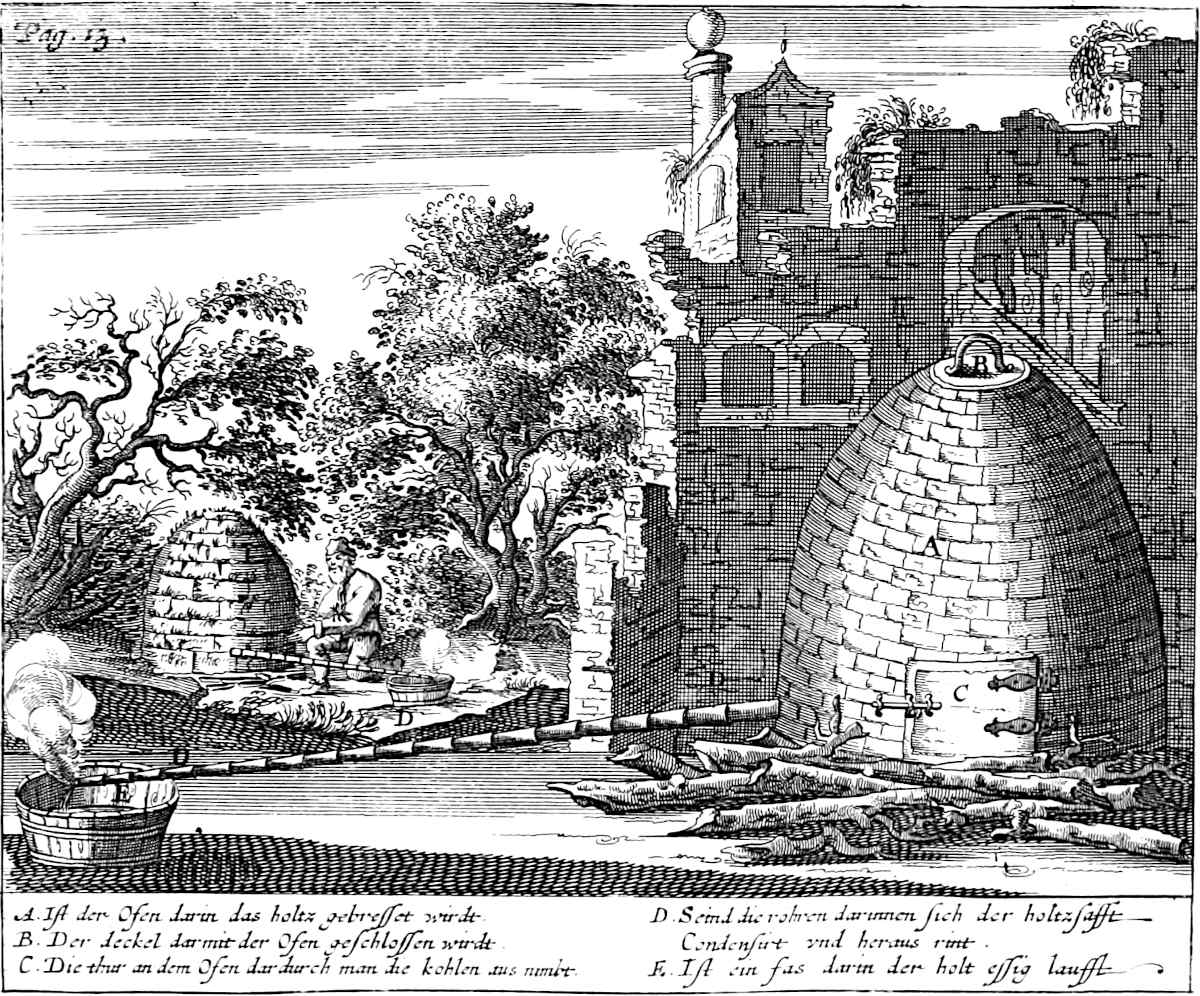
Ist der Ofen darin das holtz gebresset wirdt.
Der deckel darmit der Ofen geschlossen wirdt.
Die thur an dem Ofen dardurch man die kohlen aus nimbt.
Seind die röhren darinnen sich der holtzsafft Condensirt vnd heraus rinnt.
Ist ein fas darin der holt essig laufft.
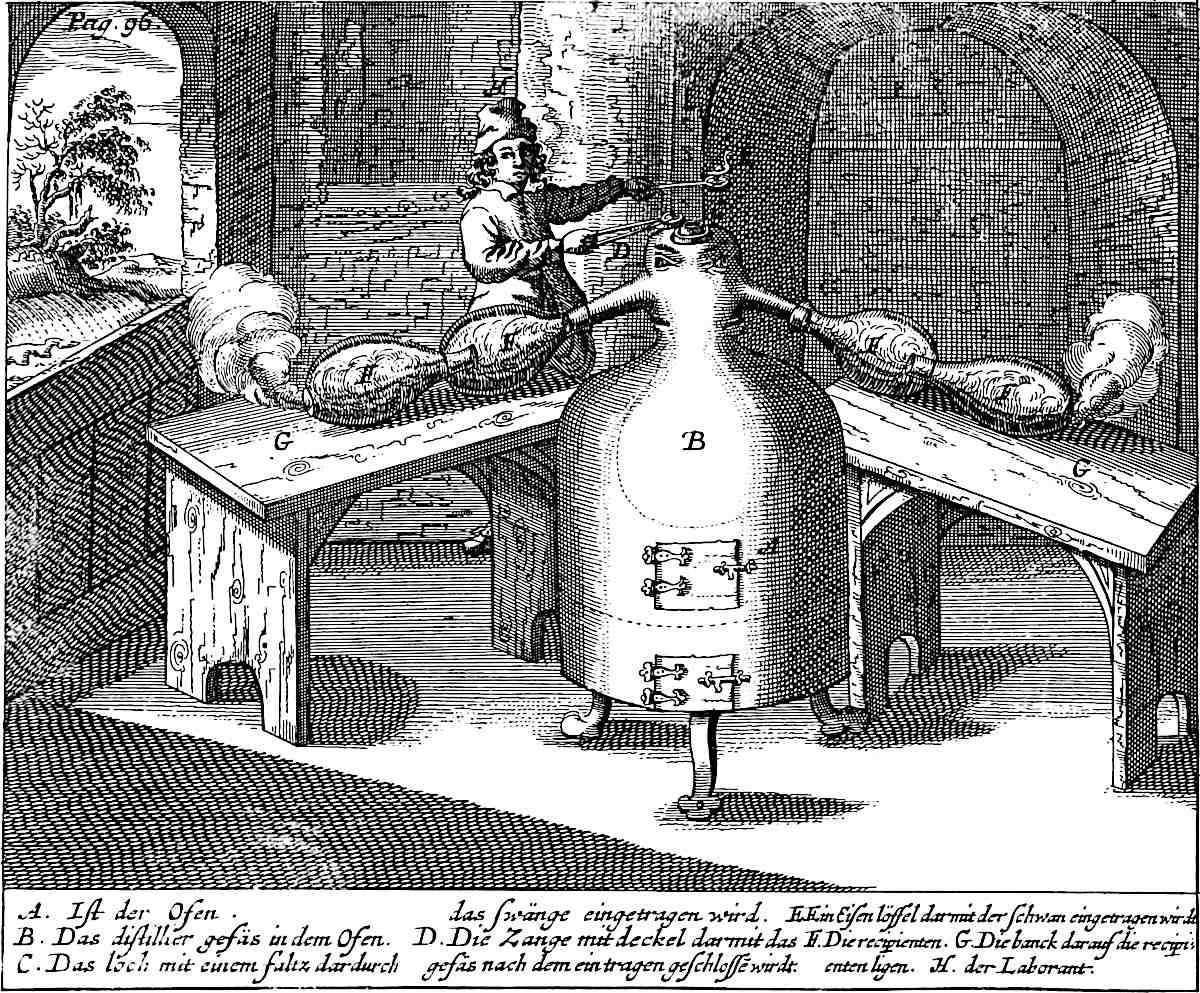
Ist der Ofen.
Das distillier gefäs in dem Ofen.
Das loch mit einem faltz dardurch das swänge eingetragen wird.
Die Zange mit deckel darmit das gefäs nach dem eintragen geschlossë wirdt.
Ein Eisen löffel darmit der schwan eingetragen wirdt.
Die recipienten.
Die banck darauf die recipienten ligen.
der Laborant.
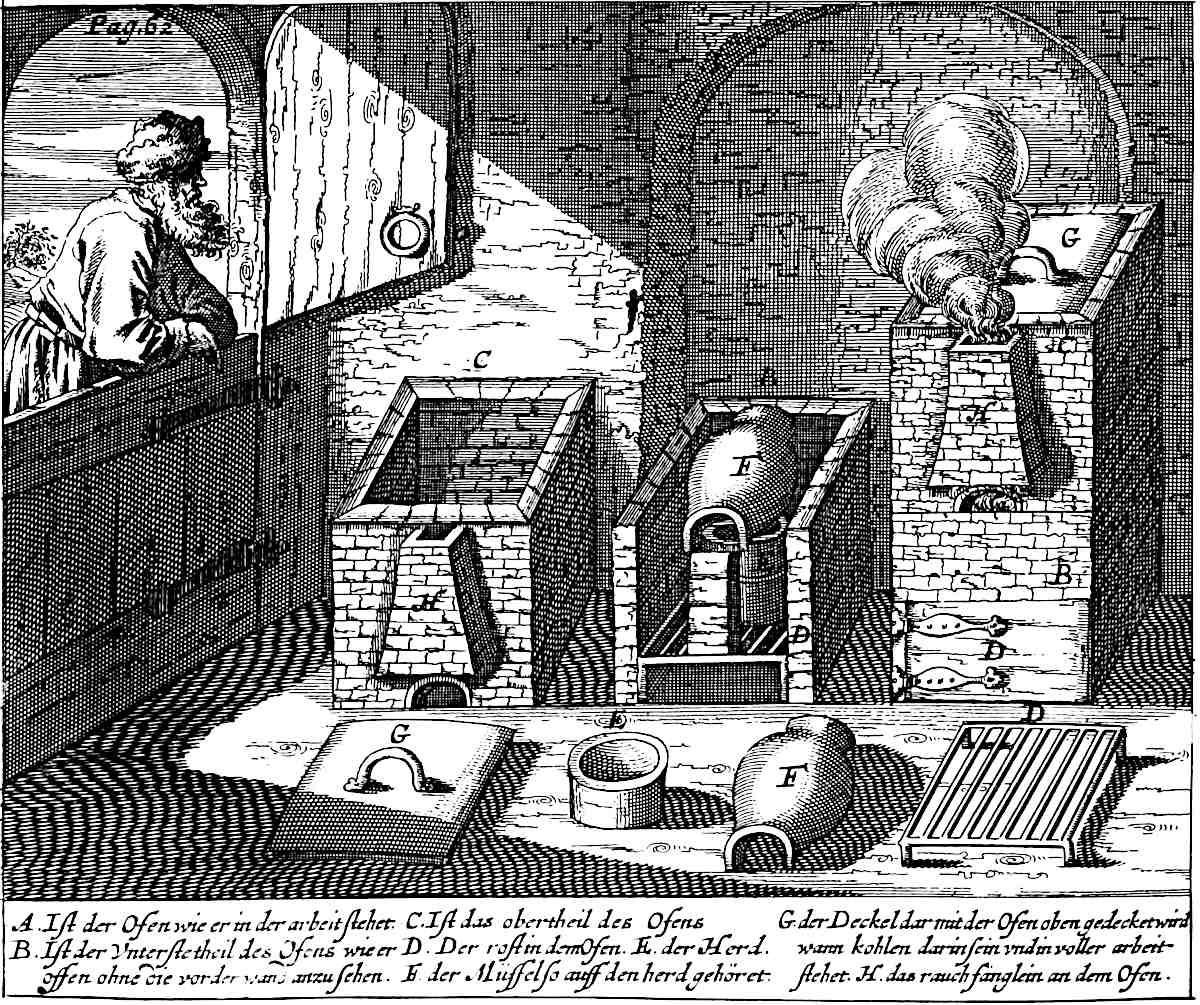
Ist der Ofen wie er in der arbeit stehet.
Ist der Vnterste theil des Ofens wie er offen ohne die vorder wand anzusehen.
Ist das obertheil des Ofens.
Der rost in dem Ofen.
der Herd.
der Müffel so auff den herd gehöret.
der Deckel dar mit der Ofen oben gedecket wird wann kohlen darin sein vnd in voller arbeitstehet.
das rauch fanglein an dem Ofen.
NB. It is here also to be noted, that the expressed juice carries along with it a sharp hot Oyl of a dark reddish colour, which is not to be cast away, but is to be poured upon the Ashes together with the acid Spirit, that putrefying with the Salts, it may with the rest put on the nature of Salt-petre. But he that will may apply the same to other uses; forasmuch as it is profitable for other things. Any Wood exposed to the Rain, or standing in the Water, easily rotting, being anointed with this Oyl, will be preserved, so that it will not so easily rot, seeing that the water cannot adhere to the Wood, but is forced to slide off, or is hindered from penetrating the Wood. Carters, or Waggoners may use the same instead of Grease to their Wheels and Axle-trees, especially when it is a little thickened with Suet or Rosin. But the best use of it that I yet know (if you except Salt-petre) is to dissolve and boil it with a sharp Lixivium made of Lime and Ashes, by which it becometh a very hot and penetrant Soap, procuring fertility; if a poor sandy ground be sprinkled with the same and moistened: For it rendereth it very fruitful; which thing it doth not only in Fields, but also in Trees and Vines, insomuch, that one Tun of it avails more in the fatening of Fields, than ten Cart Loads of Horse-dung or Cow-dung: And a Hogshead, or Tun of this Soap may be carried into Fields and Vineyards, far remote, more easily than ten Loads of Dung, which is carried to Vineyards situate in Rocky places with great labour, and no small charge.
NB. If this Soap be used for the fattening of Vines, too much of it is not to be used at a time, least the Vines grow too fat and luxuriant; therefore its moderate use is required, which needs not that exactness in the dunging of Arable Land: Although in that an excess brings damage, and indeed it is the excess of good things that doth harm. A Tree, or Vine being made too fat by dunging, grows luxuriant, and putteth forth more fruit than it can bear and bring to Maturity. The Wood it self becomes too fat and soft, so that in the Winter it is easily injured by the cold. Whence in all things a Mediocrity ought to be observed. This Black Soap made of the Oyl of Wood, is truly a very great gift of God, in those places where Sand renders the ground barren. Hence the admirable Wisdom of our Creator appeareth, as it were thus speaking to us: Ye rude, and unskilful men, wherefore do you leave this place uncultivated? Because you cannot sow it with any kind of Grain, I will that it shall produce wood, and afford you a matter, with which, if you will, you may render it fat. For it is sufficiently known, that Animals, and Vegetables rotting, dung the earth, and render it fat; which thing even the Rusticks have now learned, that they do the same without putrefying or rotting, when they cut down, and burn the Trees and Bushes, which had grown up in the Fields, during the long time of the War, and spread the Ashes on the ground, by which it is fatned. But that they know not how to save, invert, and use with the Ashes for dunging, the acid Spirit, and hot Oyl, which vanish in the burning, ought to seem strange to none, seeing that no man hath hitherto declared it to them. Nevertheless, I perswade my self that this way of dunging of Land, will come into use, in process of time, but I believe not quickly [here in Germany] by reason of that great quantity of grain which every place affordeth in this time of Peace. But if hereafter, a new War should happen (which God avert) and the Fields should lie many years untilled, through the want of Men, Horses, and other necessaries, then I believe, and not before, this necessary Art will be sought after.
But what other things the said juice of Wood is able to effect, we cannot here declare, by reason of our intended brevity: Yet this I will add, that if this acid Spirit be rectified, it may be used in the preparation of good Medicines, in Mechanick Arts, in the making of many fair Colours, from the extraction of Metals, Minerals, and Stones, and for all things for which common Vinegar is used; yea, far more commodiously, because it much exceedeth the common Wine, and Beer Vinegar in sharpness. And even it self alone is a Medicine which cureth many incurable Diseases; being mixed with warm water, and used in a Bath for washing the Body, is far more efficacious than those Baths which issue out of the Earth; especially in all Scabs, in Members relaxed by the French Palsie, Paralysis Gallica [I suppose he means the Venereal Lues] in Fistulous and stinking Ulcers in the Legs and other parts of the Body. Also in the Gout, Stone, Cramp, Sciatica, Palsie, Diseases of the Womb, and all sorts of sickness otherwise to be cured by the help of Baths, which this Vinegar pressed out of Wood, far exceedeth in Salubrious Vertues.
The same also doth the hot Oyl which is expelled by expression with the Spirit, which exerteth wonderful Virtues in curing those Ulcers and external affects. For which certainly, as a great gift, and to be easily found in all places, none of those who are burdened with grievous Diseases, can render sufficient thanks to the Almighty: But especially the Poor, who have not Money to buy Physick.
NB. Here also it ought to be observed, that those who use the Bath tempered with the juice of Wood, should before they enter into it drink some spoonfuls of this Vinegar. For this Vinegar by penetrating the whole Body, casteth out all things superfluous and noxious to nature by sweat, and openeth all Obstructions of the Liver, Spleen, and Lungs: And especially when the Vinegar is elicited from a Wood, or Herb, which is endowed with peculiar Virtues for the eradicating of those Diseases. As for Example: The acid Spirit of the Vine, Beech, Birch, and the like, taketh away the Obstructions of the Internal Bowels. That of the Oak, and other hard Woods, cureth the Corruption of the Blood, and all Diseases proceeding thence, as the Pox, Leprosie, external Ulcers of all sorts, Scabs, Fistula, and all open Sores. Also all Contractures or Cramps, Falling-sickness, Apoplexy, and Palsie. So the Vinegar of Ash, Cherry-tree, Plumb-tree, Sloe, or Bullace-tree, Medlar-tree, Arbute-tree, and the like Trees, which bear Fruits having Stones or Kernels, cure the Gout, and the Stone of the Reins and Bladder. That of Balsamick Herbs, as St. John’s Wort, Sage, Paul’s Betony, or Fleuellin, Sanicle, Betony, Lung-wort, Liver-wort, Saxifrage, and other like, taketh away the internal Hurts of the Liver and Lungs, and all inward affects arising from Blows, Falls, &c. So efficacious a Medicine is this juice of Wood, that the most costly Galenical Compositions are forced to give it place. In making the Bath one Pound of the acid Spirit is to be added to ten pints of water, and this quantity to be augmented, or diminished, according to the condition of the Patient and the Disease.
Before the use of the Bath, some drops of the Oyl may be adjoined to the spoonfulls of Spirit, which so fortifieth the Spirit, that it more readily penetrateth the body, more forcibly accosteth the Disease, and the sooner expelleth it. In Gouty Pains, and in the stone of the Kidneys, the same Oyl being rubbed upon the part with the Spirit, gives a relief not to be contemned. In brief, this juice of Woods and Herbs, if it be duly prepared and used, is able to shame and confound all the Apothecaries Shops of Galenical Medicines, notwithstanding their proud Furniture of Painted and Gilded Glasses and Boxes.
And I do not doubt but in process of time, that Physicians out of a good Conscience, will explode those unprofitable Coctions, and in their room institute better preparations, that God may have his due praise, and the miseries of the sick receive succour.
For although this acid water doth not contain the Virtues of the whole Herb, nevertheless it is to be reputed and used as an efficacious water of Herbs, in Medicine, seeing that that which is used in the Shops hath very little virtue, as daily experience witnesseth: It being nothing but the pure Phlegm of the Herb, the chief Virtues and Essence of the Herb remaining in the supposed fœces, although the water hath carried along with it something of the Smell and Taste. Look upon any dry Herb, which the heat of the Sun or Air hath deprived of all its Phlegm and Humidity, and see whether it be also deprived of its Smell, Taste, and Efficacy. And although in length of time it will lose all its Taste and Smell, nevertheless its chief Virtues yet lie hid in it. Yea, although its acetum be drawn from it by distillation, that an unskilful man would think that there remained no virtue at all in the remaining black Coals of Wood or Herbs, yet the most efficacious Virtues yet lie hid in the best Sulphur and Salt. And that great Virtue doth yet remain in the Coals, is not unknown to Rusticks, who in the Winter burn them to warm themselves, and boil their food, which thing they could never do by the Phlegm separated by distillation. Those black and contemptible Coals are of so great vertue, that they emulate the powers and properties of the most Noble Creature the Sun, for which cause they merit the name of Terrestrial Suns. For whatsoever the Astral and Sydereal Sun effecteth in the superiour Firmament, the same doth the Terrestrial Suns, viz. Coals, which are its Vicars, also effect. The superiour rendereth all things partakers of Life and Growth, the same doth also the inferiour Suns. In the Winter time when the Sun is far distant from us, all the Vegetables of the Earth are as it were dead: In the Spring upon his return, all things revive, grow, move, increase, and are nourished.
Insects themselves which have hid themselves in Holes and Caverns of the Earth to fly from Cold, and have lain as dead, do again come forth into the light. All which effects are produced by the superiour Sun. The same things also the inferiour Sun can effect. For when Flies, Spiders, and other like Insects in any Parlour or Chamber, to shun the cold, betake themselves to Holes and Chinks, and there lie as it were dead; the first heat they perceive by the making of a fire in that room, recover their former life, and again creep out of their hiding places, as upon the Suns approaching us in the Spring. Yea, if in such a Room made hot, there had been before reposited great Insects, as Frogs, Snakes, Lizards, and the like, as also Herbs killed by the cold, they would revive, recover strength and grow equally as if they had been illustrated by the Rays of the great Elementary Sun. Therefore if this Contemptible Coal, which in the judgment of the unskilful is deprived of all its Juice and Virtue, can perform these things; what a Medicine think you may be prepared by the help of Art of such a Coal?
But some Putatious Physician may here ask; who can prepare any Medicine from so dry and insipid a Coal? It can neither be dissolved by the strongest Corrosive Liquor, nor by the most intense fire, if no air come to it: of which, if the least Portion shall touch it, it presently conceiveth flame, and is consumed, so that nothing of it remains but a few ashes mixt with a little Salt. And those Virtues which refresh all things living, and revive the dead, all perish by Combustion, and vanish in smoak, which could they be taken and preserved, might doubtless afford a Medicine of great moment. To this I answer: wherefore cannot so great an efficacy be preserved, and used for the making of a good Medicine, before that it vanisheth by burning, and flieth into the air? Whatsoever Philosopher is ignorant of the manner of effecting this, truly he is a weak Philosopher, who ought to blush in that he setteth himself before others, and contemneth them who exceed himself in Learning and Science. He that knoweth not how to use any palpable and coagulated matter, before it be consumed by burning, and vanisheth away, by what means will he elicit the same out of its Chaos, and concentrate it? But that the way of freeing this Noble Sulphur from its Bonds and Keepers, is not known to everyone, is no wonder. For it will not come at every call. Of all the Philosophers, there is none who more clearly and openly teacheth by what means it may be delivered from its Bonds, than Sandivogius, who expresly saith, That this Sulphur lies hid and is held Captive in an obscure or dark prison, and kept by very strong keepers. But that Salt only in the conflict or fight, gave him a deadly wound. No Man hath spoken more clearly than this worthy Author. Therefore he that knoweth not how to extricate that Vital virtue from its bonds, and how to use it in Medicine, let him read the above cited Sandivogius, who will clearly instruct him. If he cannot learn of him, there is no reason why any one should labour to help him.
I will propose the matter by a similitude; a Man is compounded of three things, viz. Body, Soul, and Spirit; The Body is visible, immoveable, gross, earthy, and corruptible: The Spirit is invisible, movable, living, and nevertheless mortal; But the Soul of Man, which is his most noble part, is immortal.
In like manner, there is also a certain Anima or Vital Principle in Vegetables and Minerals, although there are few who know how to extract it. Therefore as in Man the Soul is the most noble part; to which the Spirit is inferiour, and the Body the lowest or vilest; so it is also with Vegetables and Minerals. To acquire the Anima or Vital Principle of any Vegetable or Mineral, that fixed and constant Anima is to be separated by the help of Art, from the gross, unprofitable, and dead body. For as long as the gross body adhereth to this noble Principle, so long it cannot move it self in a due manner, nor demonstrate its nobility, but is held Captive by its gross body, till it be set at liberty, by some body who knows how to dissolve its bonds. Being freed from its bonds, and the gross body laid aside, it can presently exert its power. Therefore let this be the principal care of Physicians, that instead of a body dead, and destitute of Virtue, they labour to attain the fixed and living Anima of Vegetables, that using that in the cure of diseases they may perform far greater things than now they do.
I have here inserted this discourse, only for this cause, that I might shew that a whole or intire body is of very little moment, and that that thing whereby any Good is to be effected in Medicine, is to be found only in the most noble part, to wit, the Anima.
And even, as in Minerals, besides a fixed and incombustible Sulphur, there is also found another, combustible and fugacious: so also there is found a twofold Sulphur in Vegetables, in the destilling of which, by a Retort, an Oil is expelled, together with the acid Spirit and Phlegm, which indeed hath its virtues, but can in no wise perform those things which that part remaining in the black Coals is wont to effect. For by how much a Medicine shall be more fixed and constant, by so much the more do they enter and encounter long and fixed diseases; so on the contrary, fugacious medicines are found less efficacious in eradicating the same.
What I have said concerning Vegetables, viz. That there is in them a volatile and fugacious spirit, and a constant fixed Anima; the same is also to be understood of Minerals, which besides a combustible Sulphur, possess also a fixed and constant Anima.
But whosoever knoweth how to conjoin the Anima of Vegetables with the Anima of Minerals, hath obtained a Medicine which is able, after a wonderful manner, to corroborate the Vital Spirit in Man. For the Animæ of Vegetables and Minerals, are the Rays of the Sun coagulated, which necessarily contain a vivifying or enlivening power, seeing that the sun maketh all things partakers of Life.
And a man, if he only beholds the sun, or its Vicar the fire, the earthly sun, although he be in some very deep and cold place under ground, where he cannot feel its warming and enlivening power; yet he shall perceive his Heart to be recreated and strengthened by the bare aspect of it: But how much greater a recreation and corroboration would he perceive, if he should take the Anima of Wine, or of some other Herb conjoined with the Anima of Gold, for the curing of his body, with both which it hath a great familiarity; for like rejoiceth in like, and desireth to be joined to it: And therefore it ought to seem strange to no man, that I assert, the humidum radicale of the humane body may be augmented by the Animæ of Vegetables and of Gold: For the Anima of Vegetables is nothing else but an essential universal salt, which is found in all things.
Seeing therefore that Philosophers confess, that the redness of gold and whiteness of silver may be encreased by its own universal salt, it is reasonable for us to acquiess in the same opinion, and to maintain it against those that erre. A visible and palpable demonstration is to be credited. Nevertheless I easily perswade my self, that this discourse of mine will not be credited by many, which I cannot help. It contenteth me, that I have written the Truth, and lighted a Candle to my Neighbour.
After one and the same manner, of Wood of little or no worth, I have shewed the making of Salt-petre, for Souldiers, Gardeners, Vintners, and Husband-men, fit for the dunging of Orchards, Vineyards, Fields, and Meadows; of commodious Baths, for the Sick; of a good Vinegar for Chymists and Apothecaries, necessary for many extractions. It now remains, that I also offer a Gift to the Owners of Metallick Mines. If they shall humect or moisten the Calx viva, or Lime made of stones, in the Press, as we have taught, with the Acetum or Vinegar of Wood, they shall obtain a cheap Flux, by which those hard and untractable stones digged out of metallick Veins, may easily be melted; for the acid spirit of Wood is fixed by the Lime, and converted into a salt, causing an easie Flux. Nevertheless, this salt will be of greater profit to Husband-men, for the dunging and fattening their Fields (for whose sake I also describe it) than in the melting of Mineral bodies. Physicians may use the noble and efficacious juice of Wood, for the happy cure of many incurable diseases, and to their own honour and profit. This Vinegar of Wood being exposed in Hogsheads to the cold in Winter, that it may be frozen to Ice, the Phlegm only freezeth, but the sharp spirit, with the Oil, is not turned into Ice, but remaineth in the middle of the Hogshead so sharp, that it corrodeth metals like Aqua-fortis. If Princes and Great men would be pleased to take care that the Wood in their Dominions (otherwise rotting in the Woods) might be turned into Salt-Petre, they would do well, and it would not repent them of their labour, seeing there is a time at hand, in which Salt-Petre will be much wanted.
There is yet another secret, which for the sake of Country-men I ought to discover, which will yield them no small profit; which is this: If Hop-poles be burnt at the ends which are to go into the Earth, and those burnt ends dipt in the Oil of Wood, that they may imbibe or suck in that fatness, and afterwards set into the earth, they admit no humidity or moisture, which otherwise they are wont to do, being every year diminished in that part which standeth in the earth. It also cometh to pass, that they communicate their fatness to the vines and stalks of the Hops to which they are joined, and render them more fat and fruitful, by this means affording a twofold profit, first in preserving the Hop-poles from rotting a longer time than they are wont to last. The other is, That the Roots of the Vines and Hops, drawing fatness and nourishment from the bottoms of the poles grow the faster, and are more fruitful. Moreover, those ends of the poles, in length of time growing rotten, yet there is no loss of the Oil, but still the same profit remaineth, seeing that those rotten ends of the poles being taken up and planted again in the earth with the Roots of Hops, they will afford them nourishment for some years, better than if they had been dunged with dung. In like manner, by the help of this Oil of Wood, strong and durable quick-hedges may be made for the fencing in of Vineyards, Orchards, Gardens, and Hop-yards, by which Beasts and Thieves may be kept out. For this purpose the sharp end of the stakes fit for the Hedges, are to be put into the Fire till they grow black, and then whilst they are hot, be dipped into the Oil, that they may well imbibe the same.
With these, being drove into the ground after the usual manner, an Hedge may be made by planting a young shoot or set of Thorn, Crab-tree, &c. all along between the Stakes. Those sets or sprigs, which otherwise, growing but slowly, are many years before they come to a requisite height and thickness, their roots now obtaining fatness and nourishment from this Oil, arrive to maturity in less than half the usual time, and become a thick and strong Quick-hedge before the Stakes are rotten. Moreover, there is no danger of wild Beasts coming into those places where the Hedge stakes are imbrewed with this Oil, seeing that wild Beasts shun all strong odours, and dare not approach them. If you shall imbibe Hempen-Cords, or such as are made of the Bark of Trees twisted together with Grass, with the said Oil, and then bind them about Fruit-trees, it will hinder the creeping up of Spiders, Ants, or Pismires, Palmer or Canker-Worms, and other the like Insects, which are wont to damnifie Fruit; inasmuch as those Insects plainly abhor such hot Oils. By this means also may Rats and Mice be hindered from creeping up Hovel-posts, and devouring the Grain.
There is yet another manner of promoting the dunging of Fields, and the happy growth of Seeds, and not only those Fields which are lean and sandy, to which Cow-dung may be used, but also those which are hard and craggy, in which neither sand nor any dust of Earth is found.
But in making manifest this Artifice to the whole World, my intention is not that the World should thereby be inriched with great profit, as I have endeavoured by describing the manner of Dunging poor Sandy Land, by the acid juice of Wood. My Scope or end is only this, That every man may see and consider how many wonderful things may be effected with wood and shrubs, which are every where found in great quantity, and nevertheless are of no use or profit.
Who would credit any man, affirming, that it might be effected, that not only Grain, but all sorts of Trees, and excellent Vines should grow in any hard and naked Rock, without the addition of any Earth or Dung? Truly, I believe that there is no man in the World, to whom this will seem likely. This will more amaze Farnner, with his whole Crew, than my Miraculum Mundi did. Yet because the thing may be done, I cannot forbear to divulge the Artifice, only to this end, that I may subject the Divine Wonders to the eyes of the blinded World. But yet it cannot be, but that it will be profitable in many places, in those especially which lie near Rivers, and afford Wine; such are those which lie upon the Mœne, Mosell, Necker, Rhine, Danube, and other the like Rivers, where great and craggy Mountains frequently occurr; in which having the heat of the Sun all the day, Vines might be commodiously planted, if Earth and Dung could be carried thither. Certainly Vines grow no where better than in Rocks and Craggs, into whose clefts and cracks they insinuate their roots, that they may thence attract to themselves nourishment, which few other Plants are wont to do: And because for the most part much Wood grows about such Rocks, it would be worth while to press out its juice, by which the hard Rocks might be reduced into a soft Dust, fit for the Reception of Vines, which might be performed by this operation; which nevertheless would not be necessary to undertake, but for the manifesting of the wonders of God to the unskilful, and shewing that such things may be done. If any desireth to plant in a place of this sort, in which Vines or Trees growing freely in rocky and stony places, as Cherry-trees, Plumb-trees, Service-trees, and others, bearing Fruits which have Stones; at the beginning, a little hole is to be cut in the Rock by the help of Masons Tools, which is to be filled with the Vinegar of Wood; which being done, the hole is to be covered to keep off the Rain. After some daies, let him see whether the Vinegar hath insinuated it self into the Rock, and again fill up the hole with fresh Vinegar, and cover it with a Stone, as before. And this Labour is to be repeated in the Summer time so often, till the Rock hath drunk up much Vinegar, and be thereby so softned for the space of an Ell in length, breadth, and depth, that it may be easily dug up with a sharp Instrument, and become a great hole; the matter digged out is again to be cast into the hole, and to be again filled with the Vinegar of Wood, and covered with stones, and so left till all the matter grows so soft, that it may be crumbled to pieces with the fingers. And in the Autumn, when Trees have lost their Leaves, or in the Spring, before the Leaves come forth, viz. in the Month of March, Vines or Trees are to be planted in the matter contained in the hole, and the matter to be trampled close down about their Roots, then all to be wetted by the pouring on of Water, and the event to be committed to God. So the Vines or Trees grow as well as if they had been planted in other manured ground. The reason is this; Because the Rocks consisting not of Sand, but of stones, fit for the making of Lime, do contain much Salt-Petre, as also the acid juice of Wood, partaketh of the same nature, this, by corroding the Rock, dissolveth the Salt-Petre in the stone, and setteth it free, and at the same time loseth its own corrosive Acrimony, so that it cannot hurt the Roots of Vegetables, but is like to Cow-dung or rather better, for it fatteneth and nourisheth the Roots better. Therefore a Tree or Vine planted after this manner in a Rock, if it shall once put forth, afterwards dieth not, but the Roots insinuating themselves into the Clefts of the Rock, seek their own nourishment. Nevertheless every Winter when the Leaves are fallen off, some of that acid juice is to be poured to the Trunk of the Tree or Vine, that during the Winter, it may again soften some Portion of the stone, which will afford new matter of nourishment to the Roots. And by thus affusing of fresh juice every year, there will be no need of Earth or Dung, seeing that the Stone is changed into earth and dung by the juice of the wood.
Although this Arcanum will seem a thing impossible to many, yet it is most true, of which, if any will make trial, he may easily do it in this manner: Let him get a stone which doth not consist of sand, but of such of which Lime is made, which being exposed to the Sun, let him pour upon it the acid Liquor of Wood; which when the stone shall have well imbibed or drank in, let him pour on more, and repeat this labour so often, till the stone be rendered so soft, as it may be rubbed to powder between the fingers. In this matter, rubbed or ground small, let him sow any Seed, which will sprout forth thence, as if it had been sowed in any good earth: The reason we have already declared, viz. because the stone is converted into earth, having its own Salt-Petre, or proper Dung in it self, and moreover, changing the juice of wood into Salt-Petre. He who rightly understandeth and followeth my Doctrine, and shall set about the Work with diligence, will without doubt attain his end. But if he tries with a Sandy stone, he will effect nothing. For stones of this sort want a nourishing Salt, and they wholly refuse solution by the Liquor of Wood, so far are they from imbibing, coagulating, and changing it into a Dungy Salt. But after the following manner any one may prove, that natural Salt-Petre may be made of the stones of which Lime is made, and the juice of Wood. Let him take some pieces of this sort of Lime-stone, not yet burnt (for when burnt, it is much more facile, as I have taught) and immerge or dip them all over in the Vinegar of Wood, and dry them in the heat of the Sun, or some other warm place, and let him repeat this labour so often until they be so soft that they may be rubbed or ground to pieces like Earth. From this ground matter extract the Salt with Rain-water, which will be plainly like to Salt-Petre. So of the Stone is made Earth; of the Salt of that Stone, and the Vinegar of Wood, Salt-Petre; or a salt equally Serving with the Dung of Cows or Sheep, for the dunging of all Vegetables.
Nevertheless we have not written these things to that end, as if it were necessary to plant Rocks with Vines, by the help of the Vinegar of Wood. Our purpose is only to set forth how the great efficacy of the juice of Wood may be known, and how by its help, fertility may be procured even to the hardest Rocks, which being hitherto unknown and unheard of, my diligent search and enquiry hath now brought to light. Let it not seem absurd to any, that I ascribe so great power to the Vinegar of Wood; for common Vinegar doth the same thing in softening of hard Rocks: Why then should not this acid juice of Wood do it, which far exceeds the common in strength and sharpness? It is said, that Hannibal made a passage through the Alps, for himself and his Army, softening the Rocks by the benefit of Vinegar; what Vinegar that was, Histories do not mention. Perhaps it was the Vinegar of Wine; but if he had had the Vinegar of Wood, he might sooner have attained his desire.
This Arcanum, without doubt, will give occasion of finding out many other profitable things, by the help of this Vinegar. I have opened the way, let another come, who by searching further may enlarge it, that thereby some perfection may the sooner be acquired. There are many things lie hidden in Nature, which through our sloth and negligence not being sought after, yield no profit to Mankind. But I doubt not but time will produce sedulous men, who will make a further progress in this Vinegar, so that much profit may redound from it.
There is found another kind of stones, which for the most part is used for the building of Houses, which being soft, is easily cut, so that steps or stairs, and Window-frames are made of it. It is to be reduced by the help of Fire into a Calx of a white, ashy, and reddish colour; it also refuseth to be melted; nor is it like to Sandy stones, but is Partaker of both natures, and contains much Salt-Petre. But neither by its reduction into a Calx, nor by the pouring on of water, can it be extorted from them, except it be first prepared after a singular manner, for then it yields to water; concerning which thing I have written a peculiar Treatise, which God willing shall shortly come forth. There are whole Mountains of this sort of stone, containing a great Treasure of Salt-Petre, which hath hitherto been known to none.
These few things I was willing to offer to Country-men, concerning the pressing of wood, and the utility thereof. The Circulatory Vessels in which the juice of the wood, and all the salts of the Air are animated by an uncessant motion, and converted into Salt-Petre, I will not divulge at this time, but reserve them for my self and my Friends. [These are described in the Third Part of The Prosperity of Germany.]
In the mean time this excellent Art will not sleep, but will be exercised in many places. Now whosoever shall need the same, he will know what is to be done. For I have determined to bestow the same for the good of my Neighbour, lest it should be buried with me in oblivion.
I have also an Artificial Invention (which is taught in The Prosperity of Germany) of turning common salt in the space of a few hours, so that it shall be plainly like Salt-Petre, for the enriching of poor, lean fields; and yet an hundred weight of it will scarce cost a Doller (which is about 4 s. 6 d.) Which is indeed a singular Gift of God in these last times, which will be highly profitable both to the Rich and Poor, in all places of the World. For if the Culture of Wine and Corn shall every where become better, and more profitable, by the help of this Art, it cannot be, but that all men will receive profit, and obtain a more commodious way of living.
For by this Art, not only all Fields, whether they have lately brought forth Fruit, or whether they have lain fallow, and for some time brought forth nothing, are brought to that condition, that they may bear Fruit every year: but also barren places, which would never bring forth any Fruit, are rendered fertile, and fit to bear Fruit; so that no place can be found in the world, how barren soever it be, which by this medium may not be rendered fertile. Moreover, this Art is to be greatly esteemed, because by it ground may be fattened in those places where no Cattel are found, and therefore afford no dung; seeing that hitherto no other than the ordinary way of dunging hath been known.
So also in places far remote from the Dwellings of men, to which Dung cannot be carried, this Art may be exercised with great profit; especially when Dung is difficult to be procured, or costs dear, and is not carried to those remote places without great charge, for which reason they cannot be tilled, but are forced to lie uncultivated.
Seeing that one Hogshead of my fattening Salt can effect more than some Cart-loads of common Dung. Nevertheless this is to be noted, That when any Field dunged with the said salt, is to be sowed with Corn, the seed is first to be macerated or steeped for one night in water, in which that salt is dissolved. For being so prepared, it will grow faster than if it had been committed to the Earth, without any foregoing maceration.
Consider, when the Souldiers have taken away the Horses and Carts, carried away the Oxen, devoured the Cows and Sheep, and wasted the whole Country, by what means shall the wasted Fields be dunged and restored to the Husband-man, that returning to their former fruitfulness, he may reap from them the expected Fruit.
Indeed, in time of Peace, when Horses and Oxen abound both for the ploughing of the ground, and making of Dung, Dung is alwaies of worth, there never being too much of it, and therefore this my Invention may bring not a little profit. Whence it may be of a far greater advantage in those places, where (by the Divine permission) those Locusts have eaten up all things. Ought we not then to receive so excellent a Gift of God with all Thankfulness?
The Omnipotent GOD give to us all His Grace, that we may shun all temporal and carnal Security, as the deceitful snare of the Devil, and seek after that which is eternal, constant, and perpetual. Amen.
Arcanum II.
Being a Gift presented to rich Merchants, &c. that they may improve their Money and Estates without Usury.
Although I had determined to treat of this Arcanum, with other excellent uses of Salt-Petre in the emendation of Metals, in the Third Part of The Prosperity of Germany; yet for certain reasons I have deferred the publishing of that Book for some time; but considering my profitable Inventions of making Salt-Petre, and not doubting but that there will be found men who will put Salt-Petre to better uses than that of making Gun-powder, I could not forbear here to describe one good and profitable use of the said salt in the emendation of Metals, which is free for any boldly to experience, seeing that I have written the very Truth. He that shall follow the sence of my words, and hath some skill in metallick Labours, will not lose his pains, but will thence reap no contemptible profit. But if any man would perswade himself that such a work is to be done without labour and trouble, and great Masses of Gold to be obtained with idleness, he will be greatly deceived, not considering that this requires his putting his hand to the plough, and using great diligence.
I have described the following Operation openly and clearly; affirming, that it will succeed to the Operator, according to my description. If any shall erre in the performance, let him blame himself and his own ignorance, and not me. For in this process all things are plain, and to be understood according to the Letter, and may also be performed by an easie imitation.
The manner of the Operation.
R. of Copper one part, of Gold or Silver two parts, and of Regulus Martis three parts, all which melt together in a good and well-covered Crucible, taking great heed that no Coals fall into the Crucible and corrupt the Work. All being melted, and the cover taken off, yet warily that no Coals fall into the Crucible, cast in as much Salt-Petre, well dried and powdered, as there is of Copper and Regulus in the Crucible, to the melted matter, and again cover the Crucible, with the same caution about the Coals, which so put about the Crucible, that they may not lie upon its Cover, but it may be at liberty, to be commodiously lifted up with the Tongs for the inspecting the Mass in the Crucible. For if the Fire should be too great, the Salt-Petre would boil over the Crucible, and inferr loss. And this may easily happen, seeing that the Salt-Petre entring and working upon the Regulus and Copper, swelleth and riseth up. Wherefore it is necessary, that this Work should be done in such a Furnace, as I have described in the Fourth Part of my Furnaces, having its doors, by which the Fire may be governed, and rendered stronger or weaker.
After that the Salt-Petre hath imbibed the Regulus and Copper, and turned them into a reddish Scoria, which is wont to be done in the space of a quarter or half an hour, the lower door being opened, the upper one must be shut, that the Fire becoming stronger, may melt the Scoria, till they flow like water; which when you see, by lifting up the Cover a little, remove the Coals about the upper part of the Crucible, and take off the Cover, and having taken good hold of the Crucible with your Tongs, lift it out of the Furnace, and pour out the melted matter into a melting Cup or Cone, [Such a one is described by its Figure in the Fourth Part of Furnaces.] being first heat, and well smeared within with Wax; in the bottom of which, when cold, there will be a Regulus of pure Gold, which being freed from the Scoria, will be so much encreased in weight, as it hath attracted from the Copper and Regulus Martis, which will be the fiftieth part of the weight of the Gold.
The red Scoria, which have a fiery taste upon the Tongue, contain the Salt-Petre, Copper, and Regulus reduced into a Scoria; which if you would separate from the Salt-petre, as soon as you have parted it from the Regulus, put it again into the Crucible in the Furnace, put a Coal to it in the Crucible, which being well covered, let it again flow well for a quarter of an hour. In this Operation, the Coal or Coals put to the Metals, viz. the Copper and Regulus of Antimony, will separate them by precipitation from the Salt-Petre, so that they will become a Regulus together, and the fixed Salt-Petre will be separated, and rest upon the Regulus, from which being cooled, it may be removed by knocking it off. If the operation be rightly performed, you will recover almost all the Regulus and Copper: but little also of the Salt-Petre is lost, which hath now put on another nature, becomes fixt, and answereth in virtue to the salt of Tartar. NB. Because those Scoria cannot be so perfectly removed from the Salt-Petre by the Coals, but it still retaineth somewhat of the Copper and Regulus, which the Coals could not precipitate; they may be kept in some warm place, lest they be dissolved by the air, till you have a quantity of them; which being reduced by burning Coals, may yield their Metal. Of which more shall be said anon.
This Labour, although it squares not with the capacity of the rude and unskilful, nevertheless it is easie to be done by those who have any knowledge in the melting of Metals. But all the manners of operating cannot be so accurately delivered, that every unskilful man should presently be rendered capable of understanding them; I write the Truth openly, and he that well understandeth me, may rejoice with profit. I write not to unskilful Tyro’s, but only to those who know how to handle Metals in the Fire. It may be here asked, Whether this augmentation of the Gold, ariseth from the Copper, or from the Regulus of Antimony? I answer, from both, but more from the Copper than from the Regulus. For there is no Copper or Antimony found, from which Gold is not elicited after the aforesaid manner, seeing that there is in both an invisible and spiritual Gold, nevertheless one containeth more than another; and being melted with Gold, give it forth to the same, which also attracteth it. Therefore as often as Copper, and Regulus of Antimony, and Salt-petre shall be melted together with Gold, so often will the Gold receive an encrease; so that this Labour being repeated eight or ten times every day, there will be an augmentation of the Gold not to be contemned, for besides all the Cost, it will afford the daily Gain of one Floren out of an hundred. (A Floren is 2 s. in Germany, about two and twenty pence value in our Money.) This is certainly a profit to those who will put their Money to Usury, much more honourable and safe than their trusting it in the hands of others.
But seeing that this Labour is to be performed in Crucibles, (and that too in large ones, if the gain aforesaid be expected) it doth not want its trouble and difficulties; for if a man will use great Crucibles, he can hardly perform the Operation above three or four times in a day; and if he use small ones, although it be ten or eleven times repeated in a day, yet the profit will be very small. I will therefore here appoint a way to do it without Crucibles, upon Hearths instead of Crucibles, which neither let out the melted matter by running over, or by their cracking or breaking, as Crucibles are wont to do, but alwaies remaining in the Oven or Furnace, save the trouble of putting in and taking out of the Fire. For Crucibles, how good soever they be, being exposed to the cold Air, by taking out, and thence being suddenly again put into a great heat, are very easily broken. From whence it is manifest, that great danger of losing some of the Gold attends the use of great Crucibles, so that their use is to be abstained from, altho’ the Work it self be of great profit. But good strong Hearths may be used for this Labour, without all danger; for as long as they are left in the Furnace, so long they are good, and the melted Mass doth not flow out. If I had not found out this way of working with Hearths, I should not have divulged this operation, which is as followeth.
The manner of preparing the Hearths or Tests.
An Iron Ring or Hoop is to be made, either square or round, of the thickness of one finger, and four fingers high (or deep) one side being a little narrower or lesser in compass than the other; being well smoothed or polished on its inside, having two ears or handles, whose magnitude and space will be known by the quantity of the matter which is to be daily handled. To prepare the Focus or Hearth, place your Ring or Hoop upon some smooth stone, and then put into it, so standing, your Earth, being first rightly prepared, (for this purpose our Stafford-shire Clay is excellent, as also for making of Crucibles to abide the Fire) so that it may a little exceed the upper superficies of your Hoop, force it down strongly with a broad Iron Hammer, by beating or knocking it in, and what riseth above the top of the Hoop, cut off with a Knife, that it may be even with the Ring; then remove it with the Ring, and strew upon the stone some fine sand, or rather the fine powder of broken Crucibles, upon which set the Ring, with the bottom upwards, that the other side, which before lay upon the stone, may be wrought in with the Hammer, as the first, so that the Ring or Mould may be exactly filled with the Earth. The Focus or Hearth being prepared in this manner, the larger side thereof is to be so excavated or hollowed away by a bowed or crooked Knife, having two handles, so that the rotundity declining from the Superfices of the Ring, even to its middle, where inclining it self, it may keep the thickness almost of a finger at the top or superficities of the Ring, and so it will become like a Vessel or Pan, having a round or spherical Cavity, such Hearths or Tests are wont to be prepared of Ashes, for the bringing of Gold and Silver to a purity in Metallick Mines, Mints, &c. at length that hollowed roundness is every where to be smoothed with a smooth and round Hammer or Mallet, and after the smoothing, the whole Test being inverted with the Hoop, is to be set upon a Board, without stirring it; if the inside of the Hoop or Ring were before besmeared well with Oil, it will the easier come off of the Test, which being exposed to the Air, and dried a little, is then to be set in the heat of the Sun or warm Furnace, that all the humidity being taken away, it may obtain its requisite dryness, before it be put into the Furnace to endure the Fire; for except it be very well dried, it will crack or chap in the Furnace, and be wholly unprofitable for this Work.
The Test being taken out of the Ring, and set by, the inside of the Ring is again to be anointed with Oil or Grease, for the making of another Test, of which so many are to be made as need requires, or the quantity of the prepared Earth will allow. The earth that was left in the hollowing of the first being mixed with the rest, whilst it is yet moist, serveth again, so that there is no waste or loss of the Earth. The same earth also serves for the making of the Covers or arched Roofs with which the Tests are to be covered, to keep the Coals from falling into the melted matter. NB. There is no need of having two Hammers, seeing that one sufficeth, having one end of a hands breadth, and smooth, and the other end round.
The way of making the Covers of the Tests, which are called Muffles.
First, a Type or Mold is to be made of Wood, answering to the bigness of the Test, but not with one Handle, as those are made for the purifying of silver, but with two oblong Necks, and without Chaps or Chinks, which otherwise are wont to happen, that so the Cover may remain entire. Then to this wooden Mould the Earth is to be applied, and the Cover to be wrought in the usual manner.
Of the Figure of the Furnace.
The Furnace is so to be built, that it may have within-side the space of an hands breadth all round the Test from its Walls, for Coals, the Test standing in the middle; so that the magnitude of the Furnace is to be proportionable to that of the Test, and may be either round or square, provided it be built with good Bricks, or fit Stones, and Lute, or Earth rightly prepared. There ought to be at least a span between the bottom and the grate, which also ought not to be fastened to the Furnace, but standing upon four Feet, that it may be taken in and out by the foreside of the Furnace (when need requires) being alwaies open. Let the Furnace rise above the Grate the heighth of a span, being every way close, having no door. Upon this heighth of a span a hole is to be left of an hands breadth and heighth, by which the Test may be inspected, and the mixed Metals put in and taken out, and the Fire may have its passage. NB. But if the Test should be above a span over, which would also cause the Furnace to be the greater; then that hole being too little, would not allow a sufficient passage for the Fire; therefore the hole is to bear a due proportion to them. From this hole, nourishing the Fire by its ventilation, the Furnace is yet to be carried up the heighth of two spans, to its upper hole or top, where the Coals are to be put in. Moreover, an Iron Cover is to be made with hollow Superficies, with Iron Buttons, or little Knobs infixed, by which the Lute being put on, may stick fast; the Convex or upper part of the Cover must have a Handle, by which it may be lifted up when the Coals are to be put in, and afterwards put down again to shut the Furnace. See the Figure of this Furnace, in all its parts, at the beginning of this Continuation of Miraculum Mundi, noted at the top with Pag. 62.
A, The Furnace, as it is working.
B, The lower part of the Furnace open.
C, The upper part of the same.
D, The Grate.
E, The Hearth or Test.
F, The Muffle that belongs to the Hearth.
G, The Cover of the Furnace, with which it is to be covered when the Coals are in and at work.
H, The Vent for the Smoak.
When you will work with the Furnace, first put in the Grate, and upon it the foot or prop made of firm Lute, and upon it the prepared Test, and upon the Test its Cover or Muffle, the foremost neck of which ought to come close to the hole on the foreside of the Furnace, and the hindmost neck to touch the back of the same. The foot also which supports the Test, ought to touch the fore-part of the Furnace, that the space between the Test and the Wall of the Furnace, may be well stopt or closed. Also, if the neck of the Cover or Muffle doth not fit close enough to the foremost Wall, the joints are to be well closed with Lute mixed with Hair, that the Fire may have no passage by them, but may pass through the hindmost neck of the said Cover, and under the Cover it self into the Test, and thence out of the foremost neck. If the Fire shall have any other passage by the foremost neck, the heat will not be Sufficient to melt the Metal. Therefore the chief Artifice concerning this thing, is the building of the Furnace in due form and proportion. An Iron door is to be fitted to the Furnace under the Grate, for the governing the Fire, by which it may be encreased or diminished, as need shall require. And the other hole in the superiour and fore-part of the Furnace, by which the Metals are put in and taken out of the Test, is also to have a door, that necessity requiring, the fire may be governed, and if too great, it may be restrained. To this also a little Chimney or Funnel is to be fitted, which may receive and carry away the noxious fumes of the Metals and Coals, that they may not hurt the Operator. All these things being rightly prepared, the Furnace being well dried, is to be filled with Coals, and to be covered with its Cover, a lighted Coal or two being put next the Grate, the doors are to be shut, that the Fire may kindle by degrees, by which the danger of breaking the Test, and its Cover, the Muffle, by a sudden heat, may be avoided. The Furnace, Test, and Muffle, being all red hot, the Metals (viz. the Gold which is to be augmented, and the Copper and Regulus of Antimony, from which the augmentation is expected) are to be put upon the Test with an Iron Ladle, the great door below, and the little one above, are to be opened, that the Fire growing more powerful, may forthwith melt the Metals on the Test, which being rightly melted, a little dry Salt-petre in powder is to be cast in upon them with an Iron Ladle, which will presently change a portion of the melted matter into a Scoria: When it flows no longer, but ceaseth from operating on the Metals, lying upon them like Dross, a little more Salt-petre is to be cast upon the melted Metals, which will again change part of them into Scoria. This Injection of Salt-Petre is to be continued so long, until the Scoria shall be no longer hard, but remain liquid like Water, which is a sign that the Salt-petre hath abstracted the Copper and Regulus of Antimony from the Gold, and its operation to be finished. And so much Regulus of Antimony and Copper is not to be put upon the Test, [I believe the word not is an errour of the Printer, in the Copy, and ought to be left out] that it, when a due portion of Salt-Petre shall be added, may be full to the brim, and the Coals not be burnt out in vain, in the empty Test, which is well to be noted. The fluid Scoria of the Salt-Petre, Copper, and Regulus of Antimony, are so long to be kept in Flux upon the Gold, as you think the Test can suffer it; for by how much the longer the Gold shall remain in its Flux, under these Scoria, so much the more of spiritual Gold it will attract from them, and render it corporeal; and the Gain will be so much the greater. Nevertheless, for the greater certainty sake, after the Scoria have lain ten or twelve hours in Flux upon the Gold, they may be taken out of the Test, to see whether the Test be yet strong enough to sustain them longer in flux, because in a continual flux they are wont to attenuate and perforate the Test with holes, especially if they were not prepared of good Earth, which is able to endure the Fire. Therefore, if you find the test yet strong and thick, and not perforated with holes, you may again add the Scoria to the Gold lying in the test, and keep them so long in flux, as you think the test will hold good. When the Scoria condense themselves, and flow with difficulty, a little fresh Salt-petre is to be added, by which being reduced to a thinner flux, they may give nourishment and encrease to the Gold, which in this operation hath the place of a seed, as the Copper and Regulus of Antimony supply the place of the earth, by affording aliment and augmentation to the Gold; the Salt-petre is in the stead of Rain, which moisteneth the Earth, and rendereth it fruitful; therefore by how much the longer the Gold lieth and groweth in this Earth, so much the more encrease it obtaineth. After the test is no longer fit to bear the fire, or you would leave working, open the lower door of the Furnace, and take off the Cover from the top, that the heat of the fire may be diverted from the test, and the Scoria grow thick, and the Gold under them hard, draw out the Scoria by degrees with an Iron Hook, from the Gold, that it may remain in the test intire, and in one compact Mass, and not be mixed with the Scoria, like Grains, and occasion loss. All the Scoria being taken out, the Gold is to be freed from the test with a thin sharp-pointed Iron, then taken out with the tongs, and weighed, to see what encrease it hath got.
NB. That as long as the Test keeps firm and good, it were better not to take out the mass, but to be left upon the Gold in continual flux. This is a Labour not to be despised, seeing that the first Coals being burnt out, more are to be added only; so that this operation may be continued for some daies, without intermission, provided the Tests be well made, which also ought to be done if you expect any profit; of which you need in no wise doubt, if the operation be rightly instituted; especially if the Antimony and Iron, of which the Regulus is made, be good: For the more Gold the Antimony, Iron, and Copper shall contain, the more volatile Gold the fixed Gold which is melted under them, will attract to it self. But if you want such Metals as are rich in Gold, and are forced to be content with the common, the Gold will nevertheless get an encrease in the Operation. NB. When Metals containing Gold are to be had, there is no need to keep the first Scoria in so long a flux upon the Gold, seeing that presently after the Copper and Regulus of Antimony shall be turned into Scoria by the Salt-petre, they may be removed from the Gold with an Iron Hook, and new Metals forthwith added, and again reduced into Scoria by the Salt-petre. This labour of removing the Scoria, and adding fresh Metals, being long continued, will add the greater encrease to the Gold, because Copper, Iron, and Antimony contain much corporeal Gold, which in their reduction into Scoria, associateth it self with the Gold. Therefore when those Scoria are withdrawn, and new Metals added, it cannot be, but the encrease of the Gold must be greater than proceedeth from the first Scoria, in which only the spiritual Gold is rendered corporeal. The addition of fresh Metals, and the abstraction of the Scoria repeated 10, 15, yea 20 times a day, must necessarily give a great encrease to the Gold, if the Metals contain both corporeal and spiritual Gold. The abstracted Scoria may be reduced in a Test of the same Furnace (of which Tests there ought to be many in readiness) and the Copper and Regulus precipitated from them, and put to other uses, of which my other Writings every where make mention. And they are precipitated by the Powder of Coals, or Antimony. The way of precipitation is this; the Salt-petre hath absorbed the Sulphureous Metals, viz. the Copper and Regulus Martis, and changed them into Scoria. Now, if to these Scoria some other Sulphur be injected, which the Salt-petre coveteth more than the Copper and Regulus of Antimony, it layeth hold on that, by which those Metals which it had first absorbed, are dismissed, and fall to the bottom. But the Regulus and Copper cannot be so separated by precipitation, but that somewhat of them will yet adhere to the Salt-petre. These may be fixed together, that they may render Gold again in fusion, or the fixt Nitre may be extracted from the Scoria, with Rain-water, to be used for other Labours; as shall be taught hereafter. The residue of the Scoria will be yet of use to Potters, to glaze their Earthen Vessels. But if the Scoria and Salt-petre be not separated, but left together, they may be used with greater profit for the making of Salt-petre, or for the dunging of Land (of which we shall presently speak) than if they be separated. The manner of doing these things shall be described in their order. But first it seems good to me to exhibit a proof, by which every one may know the certainty of this matter, viz. that this work doth not only afford a profit to the Operator, not to be contemned, but also that the Gold doth obtain a true and certain encrease from the Copper and Regulus of Antimony, whereby the Work may be undertaken with the greater boldness and confidence; which I thus demonstrate. Take a small piece of silver, freed from its gold by Aqua fortis, that you may be sure there is no Gold in it: to which, in fusion, adjoin so much Copper and Antimonial Regulus, as being reduced into Scoria by Salt-petre, and again separated from the silver, may leave it malleable and ductile. This being dissolved in Aqua fortis, will leave at the bottom undissolved a reddish powder of gold, which it hath attracted to it self from the Copper and Regulus of Antimony. Now, so much as there shall be of this Gold, so much and no more corporeal Gold did the Copper and Regulus contain, which the Silver hath absorbed. The Scoria possess no more corporeal Gold, but yet abound with spiritual, which you may find by the following Experiment. Cover those Scoria put into a new Crucible with Powder of Coals, and set the Crucible into a small Wind-Furnace, that they may melt. In this melting, the Nitre will rather enter the Sulphur of the Coals, than that of the Metals; and associating it self to that, dismisseth the Copper and Regulus. Which being done, pour out the melted Mass into a Cone, and when it is cold, separate the Regulus separated to the bottom, which will be the same Copper and Regulus of Antimony which the silver hath deprived of their corporeal gold; which is demonstrated as followeth: Take a bit of Silver, cleared from its Gold, which join with the said Regulus by melting, and reduce the melted mass by Salt-petre into Scoria, as before, pour the mass into a Cone, and being cold, separate the Silver. This being dissolved in Aqua fortis, leaves at the bottom no reddish powder, as the first silver did. By which it clearly appears, that the Copper and Regulus of Antimony had yielded all their corporeal Gold to the Silver in fusion, which nevertheless can afford no gain, except the Labour be many times repeated with fresh Copper and Regulus. But because this repetition is wont to require no small quantity of Copper, Regulus of Antimony, and Salt-petre, to bring the silver to a golden nature; and moreover, every one knoweth not how to make profit of the Copper and Regulus, deprived of their Gold, or to put them to other uses, and that Salt-petre is not seldom sold at a great price, no great profit can accrue by this Labour to such. Nevertheless, they will obtain no small gain, who after the extraction of the gold, know how to use the Copper, Antimonial Regulus, and Salt-petre, which I have shewed in many places of my Writings. But those Metals being melted with Gold, and turned into Scoria by salt-petre, bring far greater profit than when wrought with silver. For somewhat of the silver is consumed, as well as somewhat acquired by it; but nothing of the gold is lost, if the Crucible be firm, that nothing run out. NB. If any gain be expected from silver, such Iron, Antimony, and Copper are to be used, as are pregnant with Gold, and to be often abstracted from the silver, and the metals themselves afterwards to be put to other uses, bringing profit, to say nothing of the Salt-petre, which may be made at a far cheaper rate (that it can be bought) by those who seek profit from Silver. I have instanced these Experiments, to demonstrate that every Copper, and every Regulus Martis contain somewhat of corporeal Gold, and being reduced into Scoria, do yield it to the adjoined Gold or Silver; and that nothing more can be extorted from them, except being reduced into Scoria by Nitre, they be for some time kept in Flux upon the silver, or Gold which is better, that their spiritual Gold may insinuate it self into the corporeal, and augment it, which the following Experiment sheweth.
Take of Copper, and Regulus of Antimony, deprived of all corporeal gold, by the addition of other gold, what quantity you will, melt them with gold, and convert the Copper and Regulus into Scoria, after the usual manner, with Salt-Petre, which keep in Flux upon the Gold for 6, 8, or 10 hours, and then pour all out into a Cone; the gold being separated from the scoria, and weighed, will shew what it hath gained in this operation. This encrease from the twofold matter added, viz. the Copper and Regulus Martis, is profit; which notwithstanding proceeds more from the one than the other, as this Experiment will prove. Take one part of silver, which holds no gold, and one part of Regulus Martis, being melted in a Crucible, reduce them, as hath been often said, by salt-petre, into scoria, and being well melted, pour them out into a small Ingot; which when cold, separate the scoria from the silver with a Hammer; the silver will be pure white, and of very easie fusion, but will contain nothing of gold. NB. If to the silver and Regulus of Antimony, you shall also add Copper, and then turn all into scoria by the help of salt-petre, and when well melted, pour them into an Ingot, so that the scoria flow upon the silver. This silver being separated from the scoria with a Hammer, or by lying a while in water, you shall find that part which was covered by the melted scoria, to be all over so gilt, that you can scarce rub it off with your fingers, which Gold hath adjoined it self to the Silver, chiefly from the Copper. For if more Gold had proceeded from the Regulus, the melted Silver would also necessarily have been gilded by that, which yet without the addition of Copper is not wont to be. Nevertheless, let no man perswade himself that the Regulus of Antimony being omitted, the same augmentation would happen, because the greatest part of the Gold proceeds from the Copper. For without the Regulus, the Copper would not suffer it self to be reduced into Scoria by the Salt-petre; so that necessity requireth, that all those matters should be conjoined in the said manner, to acquire any profit.
Here thou hast, benevolent Reader, Specimens sufficient for the trying the truth and certainty of this thing: It’s free for every man to enter upon the prescribed way with greater and longer Operations, that he may attain the desired profit.
What I have many times said, I say again, That this Operation is true, and brings great profit, provided it be instituted in a due manner. The Salt-Petre is the chief thing required in this Operation, which he that knows how to prepare with small cost, and understands what I have written, may boldly undertake the Work; but he that must buy it at a dear rate, I will not advise to meddle with it. He that cannot understand what I write, ’tis better for him to spare his labour and charge, and employ himself in those things which do not exceed his capacity.
It behoveth me now to shew the use and benefit which the scoria which are left in this Operation are of, that there may be no waste or loss. But the quantity of scoria in this Operation will be more or less, according as it shall be exercised. If good Antimony, Copper, and Iron, which contain corporeal Gold, may be had in plenty, and Salt-petre also cheap, the loss will not be great, if the scoria should not be altogether put to the best advantage. For if there be enough of the Copper, Regulus-Martis, and Salt-petre to be had, they are to be reduced into scoria, flowing upon the Gold, that with it they may leave the Gold contained in them. But here no regard is had to the spiritual or fugacious Gold which they contain, which is laid aside with the scoria, and new Copper and Regulus is put to the Gold, and the scoria again laid aside for other uses, so that in one and the same day, this labour of adding new matter, and as oft separating the scoria, may be repeated ten or twelve times. Whence it comes to pass, that the Gold is every time inriched, and attracteth more corporeal Gold from those matters in one day, than it could do in fourteen daies, if they contained only spiritual Gold. But on the contrary, a great quantity of Copper, Regulus, and Salt-petre are required for this labour, which if they cannot be had cheap, the charge will be the greater, seeing that those Metals which are pregnant with corporeal Gold, will abundantly compensate the charge, especially if benefit be made of the scoria, which we will presently shew. But if a quantity of the said matters be wanting, and vulgar Antimony and Copper be used for the extracting the spiritual Gold only, there will not be made so many Scoria; but it sufficeth, that the first scoria be left so long in flux upon the gold or silver, until they have yielded some augmentation to the same. And in the mean time, the addition of no other thing is required, but Salt-petre, of which a little is to be injected to the hardened scoria, to render them more fusile, and to cover the Gold the better with their flux. This way will not cost so much, besides a good quantity of Coals: Nor will the Work it self be so troublesome, seeing that it need be inspected only once in two or three hours, and any Boy may govern the fire. Or if the Furnace be so built, that (like a dull Henry) the Coals constantly sliding down, the fire may feed it self, the Operation may be continued night and day without any looking after. In the working the other way with Metals containing corporeal Gold, there is more labour and care, seeing that every hour the scoria ought to be removed, and new metals to be added. Therefore every man may chuse that which is most convenient for him.
Moreover, where neither Antimony, Copper, or Iron abounding with corporeal Gold, are to be had, the Operation may be instituted in another manner, and applied to the making of salt-petre in abundance, and with small costs. For after the Regulus and Copper, in flux upon the gold, are reduced to scoria, they are not to be removed, as otherwise they are wont, but the Copper with the Regulus must be precipitated from the Nitre, by the Powder of Coals, in which precipitation the gold taketh to it self the metal reduced into scoria, so that the fixt Nitre only is to be removed, which is afterwards to be put to other uses: And the Copper and Regulus, by the addition of new salt-petre, are again to be reduced to scoria, and to be precipitated from the Nitre by the Powder of Coals, and the Nitre again removed. So the Copper and Regulus will alwaies remain in flux upon the gold in the Test, and nothing but the added Nitre will be every time separated.