Volume 1 — CONTENTS OF VOLUME I (continued 9)
Reading edition
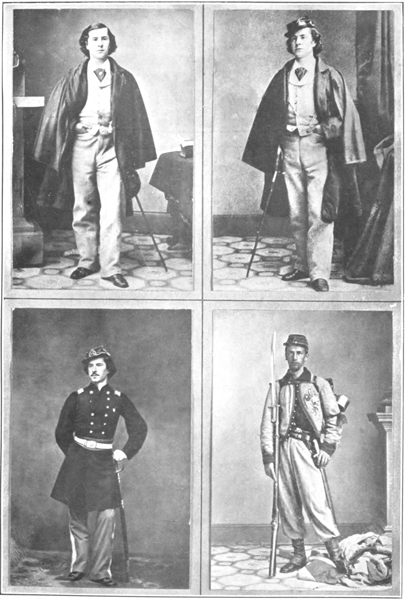
COLONEL ELLSWORTH AND FRANCIS E. BROWNELL (IN LOWER RIGHT-HAND CORNER) From original photographs in the collection of Frederick H. Meserve, New York
The discipline and drill, beginning early in February, became more exacting than ever, as it was felt by the company that in order to retain the colors the orders of the commandant must be scrupulously observed. Ellsworth told them that “everything except business and the company must be sacrificed” and that till the date set for the departure, drills must be held every evening, except Sunday, from seven to eleven o’clock. Associated with the drill, which was practiced with knapsacks weighing twenty-three pounds, were strenuous athletic exercises, while through the month of June the men slept on the floor of the armory wrapped in their blankets. The start was postponed from June 20 to July 2, owing to the death from smallpox of Ellsworth’s brother, who was a member of the company. This bereavement was a hard stroke for the commandant, who was already burdened with the care and discipline of the company and anxiety for the results. It was estimated that five weeks would be consumed in the tour and that the expenditures would approximate $7,000, but the funds were far from being raised when the day of departure arrived. Moreover, the company’s goods and chattels were attached by certain ex-members who had loaned it money and who were now smarting from the effects of Ellsworth’s severe discipline; but this difficulty was quickly relieved by the generosity of Chicago citizens.
The last reunion of Ellsworth’s Chicago Zouaves was held at the Wellington Hotel, Chicago, in November, 1910, at which eight members were present; five absentees were known to be living at that time. I have recently corresponded with Mr. J. M. DeWitt of New York, who is actively engaged in practical affairs, with Mr. Frank E. Yates of Chicago, and, through his family, with Mr. J. A. Clybourn, of the same city, who is in very poor health. This band of men, sifted out by Ellsworth and tried by the fire of his rigorous Pg 366 discipline and training, not only achieved the reputation of being perhaps the most perfectly drilled military company in history, but held important places in the army during the Civil War and multiplied the instructions and principles which they had derived from their commandant.
The Chicago Historical Society has in its Ellsworth collection a crayon sketch drawn by him and evidently designed to serve as copy for the printer in preparing memorials of the tour, to be presented to the members of the company. Upon it are inscribed in consecutive order the names of the cities visited and the military organizations by whom the Zouaves were escorted and entertained, though the dates do not appear in all cases. The itinerary follows:
Chicago, July 2, 1860; Adrian, Mich., July 3 and 4; Detroit, July 5; Cleveland, July 6 and 7; Niagara Falls, Sunday; Rochester, July —; Syracuse, July —; Utica, July —; Troy, July 12; Albany, July 13; New York, July 14, 15, 16, --, 18, 19, 20; Boston, July 21, 22, 23, 25; Charlestown, Mass., July 24; Salem, July —; West Point, July 26, 27; Philadelphia, July 28; Baltimore, Aug. —; Washington, D. C., Mount Vernon, Aug. —; Pittsburgh, Aug. —; Cincinnati, Aug. —; St. Louis, Aug. —; Springfield, Aug. —; Chicago, Aug. 15.
The Zouaves were accompanied throughout their tour by a band of eighteen pieces, the Light Guard Band of Chicago; but though the company went forth with fine melody and unique and brilliant uniforms, they were hardy soldiers with bronzed faces and wiry, agile frames, who lived abstemiously and slept each night on the floor of their quarters. Temptations to indulge in wines and liquors were before them daily, but they resolutely turned away to take up the arduous work of their program. They were very young and somewhat undersized; by no means a stalwart array, as might be expected; but the wonderful precision, celerity, and grace of their drill and evolutions astonished and thrilled every town Pg 367 they visited, and the accounts of their marvelous proficiency, telegraphed ahead, aroused widespread curiosity and brought great crowds to observe them wherever they went. Though the tour was made for the purpose of inviting competition, not a company ventured to face them, all cheerfully according them the palm of superiority.
The period in which the tour was made could not have been more opportune; a critical presidential election was on, with Abraham Lincoln heading the Republican party which stood for the nonextension of slavery, and with the avowal rife in the South that, should he be elected, war would ensue. Thus, the people were disposed to look with interest and enthusiasm upon military demonstrations. Ellsworth’s experience was not, however, entirely without anxiety, owing to the lack of funds, which, until New York City was reached, was a source of worry; but at this point and in Boston large amounts were derived from exhibition drills given before immense audiences, and henceforward no difficulty was experienced on this score. The company reached Chicago on Tuesday, August 15, was accorded an ovation irrespective of party affiliations, and escorted to the accompaniment of pyrotechnics and a torch-light procession, to the “Wigwam” where Lincoln had been nominated, which was filled with more than 10,000 people. Mayor Wentworth gave a congratulatory address which was briefly responded to by Captain Ellsworth, after which, it now being midnight, the company was banqueted at the Briggs House.
Not long after this triumphant return Ellsworth resigned his commission and the company disbanded. Its career having been brilliant, though brief, it was better, it seemed to him, that the organization should dissolve rather than deteriorate under less rigorous discipline. Ellsworth, without delay, seeming to realize that armed strife was at hand, organized a regiment of Zouaves in northern Illinois, officered it with men from his old company, and presented the force Pg 368 to Governor Yates to direct as he might deem expedient. Having become acquainted with Mr. Lincoln, he now entered his law office, not so much to pursue his somewhat neglected law studies as to promote a scheme which he was evolving of reorganizing the militia of Illinois and eventually of the whole country: to unify and bring the entire system more completely under the control of a central authority. Here begins to be manifest a wide grasp and a broad vision for which Ellsworth has never been given credit. To enjoy a reputation as a successful drillmaster and to control efficiently a company of fifty men was but the rudiment of his ambition and capacity; his mind went out firmly and sanely to broad fields, and he impressed his ideas upon Mr. Lincoln, who sought to give him an opportunity at the national capital to work out and put in operation these desirable measures. A start was attempted in a bill dictated by Ellsworth and introduced in the Illinois legislature while he was in Springfield, but though it was successful in the House, it failed in the Senate through causes other than a lack of merit.
During the autumn, Ellsworth employed himself on the stump, speaking for the Republican candidates, and exhibited decided gifts as an orator; a fine voice and presence, abundant humor and fluent expression gained him a ready hearing. In the meantime he had resumed his legal studies and later, passing a satisfactory examination, was admitted to the bar a few weeks before Mr. Lincoln started on his journey to Washington. The president-elect had invited Ellsworth to accompany him on the trip in the capacity of an officer to safeguard him by superintending the disposition of the crowds that everywhere met him. Arriving at the capital he was incapacitated with the measles, but when, on his twenty-fourth birthday, April 11, 1861, Fort Sumter was summoned to surrender, he soon shook off the lethargy of his convalescence, resigned his lieutenant’s commission, borrowed what money John Hay had at his disposal, and Pg 369 started for New York, resolved to raise a regiment for the service. In this he was promptly successful among the firemen of the city and in a remarkably brief space, at the head of the Eleventh New York Volunteer Infantry, was on May 7 mustered into the service in front of the Capitol at Washington and in the presence of President Lincoln. For a few days the regiment was quartered in the Capitol building, but as the command was acquiring a tendency to disregard the proprieties of the service, Colonel Ellsworth secured for it a camp on the south side of the east branch of the Potomac, on the high ground in the vicinity of the Insane Asylum, believing that here he would have the men under better control. An interesting, and to the Fire Zouaves a complimentary, event occurred while the regiment was in Washington. Willard’s Hotel having taken fire, Ellsworth and his men after vigorous efforts quenched the flames and saved the building, much to the gratification of Mr. Willard, who entertained them at breakfast and gave Colonel Ellsworth a purse of $500 to employ for the benefit of the regiment. This money the Colonel turned over to the committee that organized and equipped the Fire Zouaves, and it was eventually divided equally and applied toward the erection of monuments for Ellsworth and his successor, Colonel Farnham, who died of wounds sustained at the first battle of Bull Run.
On the evening of Thursday, May 23, the regiment was ordered to be ready to move at a moment’s notice, and at 2 o’clock A. M. of the twenty-fourth marched from its camp and boarded the steamers James Guy and Mount Vernon. In the bustle and stress incident to the departure, the busy Colonel found time to write two remarkable letters: one to his parents, the other to Miss Spafford, his fiancée. They breathe a presentiment of death and were found (at least the former, and I think the latter) upon his body. The letter addressed to Miss Spafford has not appeared before in print and has been read by but a limited number of persons. Colonel Pg 370 Ellsworth’s last act before leaving his tent was to look at her portrait and place it in his bosom.[130]
My dear Father and Mother: The Regiment is ordered to move across the river tonight. We have no means of knowing what reception we are to meet with. I am inclined to the opinion that our entrance to the City of Alexandria will be hotly contested, as I am just informed that a large force have arrived there today. Should this happen, my dear parents, it may be my lot to be injured in some manner. Whatever may happen, cherish the consolation that I was engaged in the performance of a sacred duty; and tonight, thinking over the probabilities of tomorrow, and the occurrences of the past, I am perfectly content to accept whatever my fortune may be, confident that He who noteth even the fall of a sparrow will have some purpose even in the fate of one like me.
My darling and ever-loved parents, good-bye. God bless, protect and care for you. Elmer.
* * * * *
My own darling Kitty. My Regiment is ordered to cross the river & move on Alexandria within six hours. We may meet with a warm reception & my darling among so many careless fellows one is somewhat likely to be hit.
If anything should happen—Darling just accept this assurance, the only thing I can leave you—The highest happiness I looked for on earth was a union with you—You have more than realised the hopes I formed regarding your advancement—And I believe I love you with all the ardor I am capable of—You know my darling any attempt of mine to convey an adequate expression of my feelings must be simply futile—God bless you, as you deserve and grant you a happy & usefull life & us a union hereafter. Truly your own, Elmer.
P. S.
Give my love to mother & father (such they truly were to me) and thank them again for all their kindness to me—I regret I can make no better return for it—Again Good bye. God bless you my own darling.
Elmer.
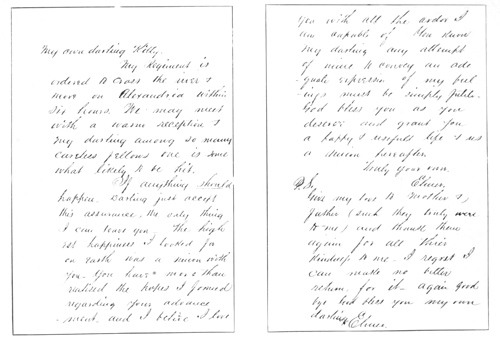
COLONEL ELLSWORTH’S LAST LETTER Reproduced by courtesy of Mrs. Charles H. Godfrey, Rockford, Illinois
It was a beautiful moonlight night and the bayonets of the troops could be seen glittering as they crossed the Long and Georgetown bridges for the invasion of Virginia. The Pg 371 regiment arrived at Alexandria, seven miles below, at sunrise, disembarked unopposed, formed near the wharf, and Colonel Ellsworth with a squad of men from Company “A” started at “double quick” into the city, intending to seize the telegraph office and dispatches. Observing the Confederate flag flying from the roof of the Marshall House, he sent a sergeant with an order for Company “A” to come up at once. It was evidently his purpose to detail the company to remove the flag, for he then passed on; but, as if reconsidering, turned and entered the hotel. It should be stated here that the regiment had come to Alexandria under embarrassing circumstances; for not only had certain of the citizens expressed a desire that they should not be sent to the town, but General Mansfield, commanding at Washington, had threatened to muster them out of the service should they not conduct themselves in an orderly manner. This partially explains Colonel Ellsworth’s desire to obtain the flag without delay, fearing that it might enrage the men and lead to acts of vandalism. On the other hand, it is affirmed that before he left New York with his regiment, he remarked that “he would bring to the city the first secession flag he might encounter,” and that “he would not order any of his men to go where he would not go himself.” Just what was in the young colonel’s mind will never be known; probably a variety of motives impelled him to the act. He knew that the city of Washington would be looking for the lowering of the “bastard flag,” which for days had been flaunted as an insult and challenge to the capital city. President Lincoln at that very moment might be looking anxiously from the windows of the White House for its disappearance!
The Marshall House is an old landmark of Alexandria, constructed of brick and three stories high; it was famous as having entertained Washington. The flag was flying from a staff about twenty-five feet in length, attached to the frame of a rear dormer window, and was reached by ascending to Pg 372 the attic by a stairway which had a landing and turn at the middle. Colonel Ellsworth and his party, having left guards at proper intervals, secured the flag, and were coming down from the attic, when Corporal Francis E. Brownell, who was ahead, observed a man with a gun, who proved to be James W. Jackson, proprietor of the house, standing at the foot of the stairs. He immediately sprang below, and struck down the weapon but before he could prevent him Jackson raised his gun, a double-barrel shotgun, and fired at Colonel Ellsworth, who had come onto the middle landing and taken a step or two down, the charge entering his left breast. The Colonel cried “My God!” and plunged headlong to the floor below, uttering soon after but a low moan. He fell near the room that had been occupied by Washington, and the medal he wore, inscribed, “Non nobis, sed pro patria,” was wet with his blood. Brownell with great coolness and rapidity of action took aim and firing struck Jackson in the middle of the face and as he reeled to fall plunged his sword bayonet through him, the assassin’s second shot flying harmlessly over Brownell’s head. A scene of confusion followed the double tragedy, heart-rending cries of agony, as Jackson’s wife bewailed her loss, resounded through the hotel, while the Zouaves, fearing that they were trapped in a nest of secessionists, posted themselves so as to command the corridors and ordered all guests into their rooms on peril of being shot down. Company “A” soon arrived on the ground, however, and on a litter improvised out of muskets, the body of Ellsworth was borne to the river, placed on the James Guy, and conveyed immediately to Washington.
Among the many tributes that were published in honor of Ellsworth, none were comparable to the beautiful words sent by President Lincoln to his parents. He wrote:[131]
Pg 373 “In the untimely loss of your noble son, our affliction here is scarcely less than your own. So much of promised usefulness to one’s country, and of bright hopes for one’s self and friends, have rarely been so suddenly darkened as in his fall. In size, in years, and in youthful appearance, a boy only, his power to command men, was surpassingly great. This power, combined with a fine intellect, and indomitable energy, and a taste altogether military, constituted in him, as seemed to me, the best natural talent, in that department, I ever knew. And yet he was singularly modest and deferential in social intercourse. My acquaintance with him began less than two years ago; yet through the latter half of the intervening period, it was as intimate as the disparity of our ages, and my engrossing engagements, would permit. To me, he appeared to have no indulgences or pastimes; and I never heard him utter a profane or an intemperate word. What was conclusive of his good heart, he never forgot his parents. The honors he labored for so laudably, and, in the sad end, so gallantly gave his life, he meant for them, no less than for himself.
“In the hope that it may be no intrusion upon the sacredness of your sorrow, I have ventured to address you this tribute to the memory of my young friend, and your brave and early fallen child.
“May God give you the consolation which is beyond all earthly power.
“Sincerely your friend in common affliction.
A. Lincoln.”
Importunate words throng me for expression, but they cannot be accommodated further; the rage and grief of the Fire Zouaves and their hardly-prevented purpose of burning the city of Alexandria; the universal sorrow and demonstrations of grief all along the funeral route from Washington to Mechanicsville. I would like to tell of my acquaintance with and reminiscences of Ellsworth’s parents, of how the government provided liberally for them, of how their son Elmer fulfilled in death the desire that he had been unable to accomplish in life: that his mother might “ride in a carriage.”
The fame of Ellsworth is destined to live on and to increase, for he individualized those elements of character which are loved and admired by the race universally. There was a deep well of patriotism in his romantic, generous nature, informed and directed by a keen and comprehensive intellect. Pg 374 Though his life is almost like a fairy tale, it is steadied and rationalized by deep thoughtfulness, filial affection, and unaffected piety. The far generations will linger reverently over that final word of love to his parents and will shed a tear as they read of his last look at the portrait of the bride of his heart and of his going out to die. Ellsworth will yet come to his own and be appreciated and valued and loved for what he was: one of the noblest, purest, and ablest patriots who ever died for his country.
Pg 375
WHERE IS THE GERMAN FATHERLAND?
Seventy years ago the people of Wisconsin were deeply stirred over the issues connected with the framing of a constitution and admission to statehood. In the Wisconsin Banner, the first German newspaper in the state, was printed on March 20, 1847, a metrical argument of 168 lines in favor of “Die Constitution.” The recent posture of public affairs seems to render apposite the reprinting of a portion of this poem, which affords a fair idea of the attitude of Wisconsin Germans of the forties toward certain questions which the whirligig of time has again brought to the fore. We print the selection in the original German and in English translation. For making the latter, acknowledgement is due Dr. Charles Giessing, of Princeton, formerly of the University of Wisconsin.
“Was ist des Deutschen Vaterland? Wo Eide schwört ein Druck der Hand! Wo Treue hell vom Auge blitzt, Und Liebe warm im Herzen sitzt!” So sang ein Mann im Hochgefühl der Kraft, Der hat kein Herz, den dieses Lügen straft. Was treibt den Deutschen über Land und Meere? Sagt, warum kämpft er für die Union? Stirbt auf dem Feld des Ruhmes und der Ehre, Für Freiheit und für diese Nation? Braust nicht der Rhein, der freie deutsche Rhein? Was treibt ihn fort vom heimathlichen Herde? Stösst man ihn aus dem Vaterlande?—Nein! Dort, dort geht er einher mit krummem Rücken. Der Deutsche ist zur Langmuth so geneigt: Wer leben will, so heisst es, muss sich bücken. Halt’s Maul, ich will Ihn lehren, dass er [Er] schweigt! In Fesseln wird der freie Geist gebunden, Er darf nicht reden, was er ausgedacht, Die Seele wird ihm aus dem Leib geschunden, Pg 376 Wenn sein beleidigtes Gefühl erwacht. Man betet in Egypten heut’ger Tage Die Kühe und die Zwiebeln an, Allein, bei Gott! den deutschen Mann, Den sehr Betrognen, treffe unsre Klage, Der sich so weit, so weit vergehen kann, Und stösst das Recht zurück, das ihm gegeben Zu einem freien, selbstbewussten Leben.
“Where is the German Fatherland? Where oaths are sworn by grasp of hand! Where loyalty gleams from the eye, And warm love makes the heart beat high.” Thus sang a man sure of his pow’r and youth, He has no heart who contradicts its truth. What drives the German over sea and land, What force is it that makes the Union dear, That on the battle-field he takes his stand To die for liberty, and for this nation here? Does not the Rhine, free German Rhine still roar, What drives him forth from hearth and home? Perchance he’s banished?—Nevermore! In yonder land stooped o’er a crutch they walk (The Germans are too supple in their will), “Who wants to live,” they’re told, “bend to the yoke! Shut up! We’ll teach you to be still!” Freedom of thought in chains is pent, One may not utter what he thinks,— His soul perforce is from his body rent, If pride, awakened, from oppression shrinks. In Egypt there are men so odd Who worship cows and onions—their belief. The German man, howe’er, stirs us to grief, (Deluded and deceived so oft, good God!) If he so far be blinded to relief As to reject this opportunity Of self-assertive life and free.
Pg 377
THE PAUL REVERE PRINT OF THE BOSTON MASSACRE
Louise Phelps Kellogg
The colony of Massachusetts had successfully resisted the enforcement of the Stamp Act, and had forced its repeal by the British Parliament. None the less its rebellious attitude brought a measure of punishment—the ministry decreed that four regiments should be quartered in Boston, which had hitherto been free from the obnoxious presence of a garrison. The coming of the troops was awaited with apprehension; the majority of the townspeople considered their presence as a personal affront. However, the soldiers were disembarked at the long wharf and marched to the Common without any hostile demonstration on the part of the populace. The soldiers soon settled in barracks and entered upon a period of dull inactivity, broken only by occasional clashes with the rougher elements of the town’s population. After a year had passed away two of the four regiments were withdrawn, leaving the Fourteenth and the Twenty-ninth, which, after the events of the massacre, were nicknamed the “Sam Adams regiments.”
In the strained relations between the colonial authorities and the home government, the presence of the troops in Boston acted as a constant irritant. The ruder class of the town’s population, sailors, ropemakers, and apprentice lads, were imbued with the sentiments of the patriotic party, but lacked the restraint and self-control that marked its leaders. The soldiers became a constant butt for the rough witticisms of the lower town element; they were taunted with the epithets of “bloody-backs” and “lobsters” in derision of their uniform. They were constantly dared to fight, and continually reminded of the restriction that forbade a movement of aggression without the orders of a civil magistrate. Several Pg 378 times individual soldiers were provoked into fisticuff contests, and frequently came off second best in such encounters with the town roughs. Upon the whole, the troops showed commendable restraint, and, in spite of the bad blood between them and the populace, for nearly two years no open clash took place.
On the night of March 5, 1770, an incident occurred which, trivial in itself, led to momentous consequences. A guard stationed at the Custom House in King’s Square was set upon by a crowd of roughs, and assaulted with a volley of snowballs. Summoning assistance, the single soldier was reënforced by a squad of six under command of Captain Thomas Preston. The town crowd, instead of dispersing, continued its insults, while its number was constantly swelled by fresh recruits. During the excitement someone rang the town fire bell, and the surrounding populace poured into the square to witness the nonexistent conflagration. The restraint of the troops reached the breaking point. In the mêlée an order to fire was believed to have been heard. The soldiers leveled their fusees and fired into the crowd, the first volley killing four bystanders and wounding several more. Aghast at the consequences of their act, the offending squad withdrew to the near-by barracks, leaving the “town-born” to bear away their dead and wounded.
The excitement in the city grew apace throughout the hours of the night. The townspeople gathered in the streets, while as the news spread abroad hundreds flocked in from the countryside. The town committee met at once, and demanded of the governor that the troops be removed to the castle in the harbor. After much hesitation and parleying on the part of the authorities, the request was granted, and orders were reluctantly given to evacuate the city barracks. Preston and his firing squad were arrested and placed in the town gaol. The exasperation and resentment of the populace threatened dire consequences.
Pg 379 On March 8 occurred the public funeral of the victims, and the passions of the townspeople were fanned to a still hotter flame; it was said that fifteen thousand people followed the four coffins to their last resting place, and that threats of vengeance were openly expressed. The trial for murder of Preston and the soldiers in the colony’s civil courts soon followed. Excitement against the accused ran high. Nevertheless, to the honor of Massachusetts the indicted were given a fair trial, while two of the colony’s ablest advocates, John Adams and Josiah Quincy, Jr., offered at the risk of their reputations and popularity to defend the accused. Under these circumstances Preston and all but two of the soldiers were acquitted. The latter received a light sentence for manslaughter.
In the meantime the town committee, fearing the adverse effect of this incident upon the British authorities, and dreading the probable misrepresentation of the facts before the British public, prepared a defense of the colony’s position which they published in a pamphlet entitled: A Short Narrative of the horrid Massacre in Boston, Perpetrated in the Evening of the Fifth Day of March, 1770. By Soldiers of the XXIXth Regiment; which with the XIVth Regiment Were then Quartered there: with some Observations on the state of things prior to that Catastrophe. Printed by Order of the Town of Boston, and Sold by Edes and Gill in Queen-Street And T. & J. Fleet in Cornhill, 1770.
Attached to this pamphlet was a folded plate, which, according to an inscription in the lower right-hand corner was “Engraved Printed & Sold by Paul Revere Boston.” Recently Mr. Frank J. Wilder, of Boston, a member of the State Historical Society, presented to its Library one of the early reproductions, now become rare, of this celebrated engraving. The receipt of this interesting gift, which now hangs in the military history room of the Museum, has Pg 380 directed attention to the history of the print, which proves to be of no less interest than is the print itself.
Paul Revere, later so prominently associated with the first struggle of the Revolutionary War, was of Huguenot descent, a native of Boston, and had for some time served the colony as a gold- and silversmith. His first efforts at engraving were confined to silver plate; later he began to produce engravings drawn on copper plates and printed on paper. One of the earliest of these productions was a view of Boston showing the disembarkation of the troops. Revere was an ardent patriot, and in all probability formed one of the crowd of spectators in King Street Square when the soldiers fired upon the populace. In the Boston Public Library is still preserved a sketch by his hand of the site of the massacre, with indications on the diagram showing where the victims fell. This drawing was no doubt used during the trial of Captain Preston and his soldiers.
Revere was likewise in close personal relations with Edes and Gill, the publishers of the exculpatory pamphlet, and he often prepared wood cuts for the paper they issued, the Boston Gazette and Country Journal. An interesting illustration of his work appears in the issue of this journal for March 12, 1770, where above the column devoted to an account of the public funeral of the victims appear four miniature black coffins. That these were the work of Revere we learn from an old account book, found among his papers, wherein, under the entry for March 9, is a charge to Edes and Gill of six shillings for “Engraving 5 Coffings for Massacre,” while pinned to the page is a paper pattern the size and shape of the tiny coffins appearing in the newspaper. The State Historical Society of Wisconsin possesses a copy of this old journal, and there may be seen the heavily black-leaded page, on which mourning is displayed for the Boston dead, and the prints of the “coffings” engraved by Revere, on each of which is cut a skull and crossbones over the initials Pg 381 of the victim. On that of the youngest of the four appear the words: “Ae. 17,” with a scythe and hourglass indicative of his having been cut off in the flower of youth. On the same page with the account of the tragedy and the funeral occurs the following interesting letter from Captain Preston:
Boston-Gaol, Monday, 12th March, 1770.
Messieurs Edes & Gill,
Permit me thro’ the Channel of your Paper, to return my Thanks in the most Publick Manner to the Inhabitants of this Town—who throwing aside all Party and Prejudice, have with the utmost Humanity and Freedom stept forth Advocates for Truth, in Defence of my injured Innocence, in the late unhappy Affair that happened on Monday Night last: And to assure them, that I shall ever have the highest Sense of the Justice they have done me, which will be ever gratefully remembered, by
Their much obliged and most obedient humble Servant,
Thomas Preston.
Let us now examine the picture which Paul Revere prepared to be presented, with the official pamphlet, to the view of the British public in order to affect its opinion of the action of the troops. The engraving is 8½ by 9¾ inches in size, and is colored by hand in red, blue, green, and brown. In the background is the Boston town hall, now known as the “Old State House,” with its graceful clock-tower rising into a pale blue sky. At the upper left hand is a chubby, cheerful-looking crescent moon. The public square is framed on both sides by its enclosing buildings, over the portal of one of which, at the right, is the inscription “G R (for Georgius Rex) Custom House.” Higher still, along the entire façade of the building stretches the imaginary and ironical designation “Butcher’s Hall.”
In the foreground of the picture, and in front of the Custom House stands in a menacing attitude the file of soldiers, very red of coats and black of boots. Each has his gun outstretched with its bayonet pointing to the crowd, while the clouds of smoke that roll around and behind the figures testify that the guns have just been discharged among the Pg 382 unhappy bystanders. At the extreme right of the line of soldiers stands Captain Preston with uplifted, menacing sword. Opposite the firing squad is the crowd of citizens, some of whom have fallen to the ground, or are being supported in the arms of their comrades. From the breasts and temples of the wounded streams of blood pour forth and dye the pavement roundabout. The crowd is in great agitation. One venturesome townsman lifts his hand as though he would push back an advancing bayonet. Another clasps his hands in horror to his breast. Some of the bystanders have turned as if to flee, but most of them are engaged in succoring their wounded comrades. One man in brown coat and green vest is being tenderly lifted by two friends; his head falls helplessly to one side while a bright red jet of blood pours from his breast over the green waistcoat. One of the victims lies on his back, his head drawn up as if he were in agony, one hand clasps his breast, from a wound in which a crimson stream flows forth. The boy victim lies motionless on the ground, a pool of blood from his forehead dyeing the pavement near his head. In front of this whole group stands a composed, indifferent-looking dog, quite unmoved by the tragic scene behind him. The quaint costumes and stiff attitudes of the actors in the picture, the shapeless, ill-drawn legs of the soldiers, and the stolid, expressionless faces of the participants indicate that the engraver was a tyro in his art. To the observer, however, these defects in some measure enhance the interest of the picture and give it the charm peculiar to primitive productions.
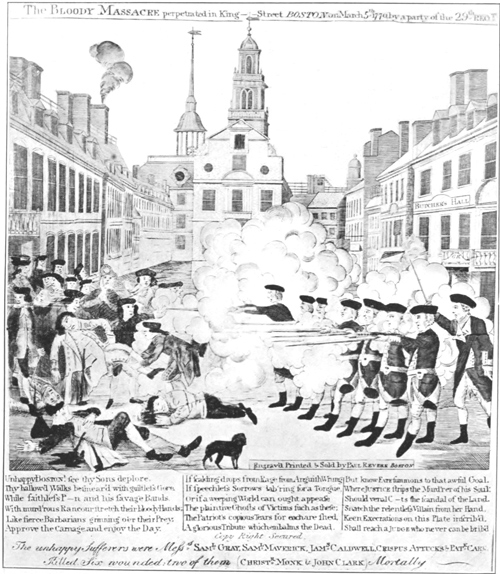
PAUL REVERE PRINT OF THE BOSTON MASSACRE
The inscriptions above and below the print add to its intrinsic interest. The passionate appeal for sympathy for the slain made by these inscriptions indicates the depths of feeling aroused by the massacre. Across the top is printed, “The Bloody Massacre perpetrated in King Street Boston on March 5th 1770 by a party of the 29th Regt.” Underneath the picture is the following remarkable effusion, probably Pg 383 from the pen of Paul Revere himself, who frequently indulged in such attempts at literary effort:
Unhappy Boston! See thy Sons deplore. Thy hallow’d Walks besmear’d with guiltless Gore. While faithless P——n [Preston] and his savage Bands, With murd’rous Rancour stretch their bloody Hands; Like fierce Barbarians grinning o’er their Prey, Approve the Carnage, and enjoy the Day. If scalding drops from Rage from Anguish Wrung If speechless Sorrows lab’ring for a Tongue, Or if a weeping World can aught appease The plaintive Ghosts of Victims such as these; The Patriot’s copious Tears for each are shed, A glorious Tribute which embalms the Dead. But know Fate summons to that awful Goal Where Justice strips the Murd’rer of his Soul; Should venal C——ts the scandal of the Land, Snatch the relentless Villain from her Hand, Keen Execrations on this Plate inscrib’d, Shall reach a Judge who never can be brib’d.
The unhappy Sufferers were Messs Saml Gray, Saml Maverick, Jams Caldwell, Crispus Attucks & Patk Carr killed. Six wounded; two of them (Christr Monk & John Clark) Mortally.
Two hundred copies of the pamphlet were issued in the first edition, and for his work upon the plate the Revere papers tell us that the engraver received five pounds. A number of variants of the original plate appeared within a few months of its production. One was reduced in size to accompany an octavo edition of the pamphlet. This latter engraving was 4½ by 6⅝ inches. It had no inscription at the top but underneath bore the following words: “The Massacre perpetrated in King Street on March 5th 1770, in which Messrs Saml Gray, Saml Maverick, James Caldwell, Crispus Attucks Patrick Carr were Killed, six others Wounded two of them Mortally.” The different proportions of this plate give to the picture more sky and foreground than the one we have described above. The second Pg 384 edition of the pamphlet with the smaller engraving was reprinted without change in London by E. & C. Dilly and J. Almon in the same year that the Short Narrative appeared in Boston.
Two other London editions of the pamphlet were issued the same year by the publishing firm of W. Bingley in Newgate Street. One of these has for its frontispiece an engraving 8½ by 12 inches in size, with the following inscription across the top: “The Fruits of Arbitrary Power; or the Bloody Massacre, Perpetrated in King Street, Boston by a Party of the XXIX Regt.” Underneath is printed Revere’s original poem, without the accompanying names of the victims. On the left of the poem the following verse is surmounted by a skull and crossbones within a wreath: “How long shall they utter and speak hard things? And all the workers of iniquity boast themselves? They break in pieces thy people, O Lord, and afflict thine heritage. Ps. XCIV, 4, 5.” On the right of the poem appears the design of a liberty cap in clouds from which issue forks of lightning and two broken swords. Underneath is printed, “They slay the widow and the stranger, and murder the fatherless. Yet they say, The Lord shall not see, neither shall the God of Jacob regard it. Ps. XCIV, 6, 7.” Some of these prints have been found with only the two devices and without the scriptural quotations.
Still one more print appeared in London in 1770 which shows marked variations from all those previously described. These were all variants of Revere’s original plate, and differ only in size, proportions, and inscriptions. The print which we now describe is so different in composition and so much better in execution that it would seem to be the work of another artist than Revere. Not only are the proportions of the picture changed, but the handling of the perspective is much better, the drawing of the figures, and the expression of the faces show the handiwork of a genuine artist. The Pg 385 arrangement of the figures is the same, but the soldiers’ legs become quite possible members of their bodies, able to bear a man’s weight. The fallen figures lie in better and easier attitudes. The grouping of the crowd is less confused, and in the background appear the heads of two women wearing bonnets, that are not seen in the original Revere prints. Moreover, there is no dog in the foreground and no moon in the sky of this latter print. The question arises whether some other artist adapted Revere’s composition, materially improving it in so doing, or whether Revere himself secured his suggestions for his work from the author of this latter print. This is answered by a letter found some years since among the Pelham-Copley papers in the British Public Record Office and printed by the Massachusetts Historical Society in one of its recent volumes of Collections.
Henry Pelham was a young half brother of the famous colonial artist Copley, and the original of the latter’s lovely picture, “The Boy with a Squirrel.” Young Pelham lived in a family of artists and himself early displayed considerable talent. He learned engraving from his father Peter Pelham, one of Boston’s earliest engravers. The following letter was written by the younger Pelham to Paul Revere:
Thursday Morng. Boston, March 29, 1770.
Sir,
When I heard that you was cutting a plate of the late Murder. I thought it impossible, as I knew you was not capable of doing it unless you coppied it from mine and as I thought I had entrusted it in the hands of a person who had more regard to the dictates of Honour and Justice than to take the undue advantage you have done of the confidence and Trust I reposed in you. But I find I was mistaken, and after being at the great Trouble and Expence of making a design paying for paper, printing &c, find myself in the most ungenerous Manner deprived, not only of any proposed Advantage, but even of the expence I have been at, as truly as if you had plundered me on the highway. It you are insensible of the Dishonour you have brought on yourself by this Act, the World will Pg 386 not be so. However, I leave you to reflect upon and consider of one of the most dishonorable Actions you could well be guilty of.
H. Pelham.
In the absence of any defense by Paul Revere, and in the presence of the better engraving made along the lines and with the same general arrangement as that claimed by Revere, it would seem that we must convict the latter of the plagiarism with which Pelham charged him. Some of the latter’s prints were issued, since among his papers is the charge in March, 1770, of three pounds nine shillings by one Daniel Rea “To printing 575 of your Prints @ 12| Pr. Hund.” Pelham was a much abler artist than Revere; moreover, it should be noted that the latter prints upon his engraving only the words, “engraved, printed, and sold by Paul Revere,” all of which might have been the literal truth, had he utilized the design of the younger artist. None the less his appropriation without compensation of his young neighbor’s design is much to his discredit, and detracts from the interest and enjoyment with which we examine this most famous and interesting of Paul Revere’s engravings.
The vogue for this picture of the massacre has been very great from the time of its first printing until the present. We have seen how many editions appeared in 1770. These spread rapidly throughout all the English colonies in America. So popular did the prints become that as early as 1785 a new edition became necessary, while the original prints were much in demand, and formed part of early collections of Americana. Originals of 1770 are now so highly prized that single copies sell for anywhere from $750 to $1,000. In 1832 an excellent reproduction was issued, which has in its turn become rare enough to command $50 upon the market.
How much the publication of the original prints had to do with the profound sensation that the “Boston Massacre” awakened everywhere among the American colonies we have no means of judging. Certainly the representation was calculated Pg 387 to arouse intense resentment against the British soldiery, and this feeling may have contributed to the alacrity with which the colonists took up arms in defense of their liberty. From a trivial encounter between imperial troops and the Boston mob, the incident arose to a position of international importance. Its pictorial presentation, therefore, has become a part of our national history.
Pg 388
DOCUMENTS
SOME LETTERS OF PAUL O. HUSTING CONCERNING THE PRESENT CRISIS
The advent of the world struggle which still rages between the forces of autocracy and democracy found our nation as a whole, and many of us as individuals, unprepared to meet the new conditions and to withstand the test of the new issues with which we were confronted. But it did not find the mind of Paul Husting wanting in the needful qualities of intellect, or his soul in those of courage.
In the brief period of service as senator from Wisconsin he revealed himself as one of Wisconsin’s greatest sons, and his untimely death in October, 1917, was a genuine calamity both to state and to nation in their hour of trial and danger. Not often does the opportunity occur to a historical journal to publish documents fraught at the same time with a high degree of historical value and of interest for their bearing on issues still current. Such an opportunity, we think, is afforded the Wisconsin Magazine of History in connection with the documents which follow. The letters speak for themselves and aside from certain minor typographical corrections we present them unedited. However, we cannot refrain, in concluding this introductory note, from calling the reader’s attention to the significance of the dates of the several letters: the first, following the sinking of the Lusitania; the second, at the time the embargo-on-munitions discussion was rife; the third, following our entrance into the world war.
Mayville, Wis., May 14, 1915.
—— ——, ——, Wis.
Dear Sir:
Your letter of May 10th, enclosing clipping from a Chilton newspaper, was duly received and read. The clipping Pg 389 which you have enclosed entitled “The United States, an Ally of England against Germany and Austria-Hungary” is a very coarse and vituperative and un-American attack on President Wilson and his administration. In this article, the President in substance and effect is portrayed as a weakling, a tool of England, a hypocrite, who pretends to be what he is not, and with sanctimonious phrase is trying to mislead the people. The administration is charged with being in a secret pact with England against Germany and winds up with asking the people of this country how long they are going to stand the disgrace of having such a government.
I do not believe that I have the honor of your acquaintance but, nevertheless, I feel that the article sent me and your letter should be replied to because there are other papers and other men engaged in carrying out this sort of propaganda.
There are, I know, a number of good and patriotic citizens of this country, who, because of lack of information, and because of their intense sympathy for relatives and friends now fighting in the old country, have permitted themselves to be misled in the belief that this country has unjustly, and, contrary to the laws of nations, permitted the shipment of munitions of war to European countries. There are, however, also, a number of men and newspapers who are merely repeating and spreading a propaganda originating in the old country with a design and purpose to weaken their own government and aid and strengthen one of the belligerent nations. I hope that I am addressing you as one who may be put in the first class mentioned.
Your criticism of President Wilson must be the result either of blind partisanship, of a lack of familiarity with the facts relating to our present foreign relations, of a failure to fully comprehend the exact meaning and difficulties of neutrality, or of a desire to plunge this country into [the] European embroglio without considering whether we have any cause or excuse for entering that awful conflict. Considerations of partisanship are so loathsome in times of great national crises that I believe you incapable of entertaining such and I freely acquit you of such base motives. The high-minded attitude of former President Taft ought to be sufficient to deter everyone from seeking to make political or Pg 390 partisan capital out of the present delicate situation. I cannot conceive that you feel yourself in closer allegiance to Germany than you do to this nation, for then your words would not be those of an American citizen but of one who is an alien, at least in thought, and not entitled to the protection or blessings of our free government. I assume that you are laboring under a misconception of the facts and upon the assumption that you have been misguided, I am writing you fully in reply to your letter.
I find no fault with American citizens or American newspapers (in this, of course, I include those printed in the German language) that sympathize with Germany as against England nor do I find any fault with the criticism directed against England’s war policy or methods. Our government has repeatedly remonstrated and protested to England against the interference with our commerce with neutral countries, in the shipment of non-contraband of war to belligerent countries, in the unlawful seizure of our vessels, and in the general interference with our rights as a neutral nation. I wish to add my objections and express my resentment against England for her studied and persistent violations of many provisions of the international law. We have protested and have done everything that we lawfully and justly could do to support and maintain our rights, short of going to war. Withal, however, no American ships or lives have been lost as a result of England’s operations upon the sea and no passenger boat carrying citizens of the United States has been sunk.
In the obstruction of our commerce and our dealings with foreign nations, Germany has gone as far as its ability permitted and is certainly subject, in this respect, to the same criticism and resentment that we have directed against England. It seems that England and Germany in the operation of the war in retaliation and in reprisal have set aside the international code and are justifying anything and everything upon the ground or plea of necessity. So long as this mode of warfare is directed against one another of the belligerent countries or their citizens, while we stand horrified and appalled, we may still have no just cause for interference. We have suffered these inconveniences and losses to Pg 391 our business because not only our government, but our people desire peace, and, furthermore, because we have no desire to interfere between the belligerent countries. Now, while at most, Germany can only claim that, in respect to the hindrance to our commerce, she has done no worse than England, yet, in addition to this, ships flying the American flag have been assailed and sunk by her and American lives taken without justification and now the world is appalled by the destruction of over 1,200 lives ruthlessly taken and men, women, and children have gone down to their death defenseless and undefended.
It is no defense or justification of this act as against our country that some other nation by its unlawful acts compelled the country at fault also to commit unlawful acts by way of reprisal.
It is no defense to say that American citizens who lost their lives were warned and that they lost their lives through their own contributory negligence. No warning to commit an unlawful act is a defense or justification of such unlawful act. Such warning, in fact, negatives the idea of accident and evidences premeditation and design to commit the unlawful act.
We know that the Lusitania was sunk, that more than 100 American lives were lost, and we must hold the country directly responsible for a deed which has shocked the civilized world and which appears to have been in violation of the law governing, and practices obtaining in, civilized warfare. Notwithstanding the horror and resentment aroused in the public mind, our President is still striving to avert war!
What would you now say if a German liner with Americans aboard had been sunk by an English torpedo under like circumstances and our President would not have counseled war against the offending country but would still have stood for peace? Would you not have said then that this country was favoring England and would you not have reiterated and repeated your slander that this country is an ally of England’s?
In the slanderous clipping sent me, it is charged that this country is pretending neutrality when in fact, by not forbidding the shipment of arms and munitions of war, we are violating the law of nations governing neutrals.
Pg 392 This slander against our country has been repeated over and over again by thoughtless men and by partisan newspapers. It originated across the sea with those who well know the falsity and hypocrisy of the charge and who have passed it on to a well-meaning and sympathetic, but over-zealous and mistaken, people and press for the purpose of accomplishing a selfish end. This slander has been fostered and given currency also by some designing men and by some designing newspapers who appear to have forgotten their duty to their country and who appear to be concerned more with the effect that the present war has upon some foreign country than with its effect upon our own country.
The laws of nations are the rules which determine the conduct of the general body of civilized states in their dealings with one another. Its doctrines are founded on legal, not simply on ethical ideas; since they purport to be rules of justice, not counsels of perfection, the foreign policies of a country are not founded upon feelings of moral rightness but upon precedents, treaties, and opinions of those recognized as authority.
International law is a part of the law of the land and, since the interest of the United States with foreign nations and the policies in regard to them are placed by the Constitution in the hands of the federal government, its decisions upon these subjects are obligatory upon every citizen.
The above are some of the elementary principles of international law. These nations which are protected by these provisions also are subject to corresponding duties and obligations. Those which invoke the law must obey the law. International law, being the joint product of civilized nations, adopted and made by the common and joint consent of nations, of course, can not be repealed or amended by any one nation but only by the mutual consent of all countries. If it were otherwise, each country would make its own international law to be amended or repealed at the will of such country and thus would have no effect either upon itself or any other nation.
Now we have an international law and its provisions are well defined and recognized. Now is there any provision in this law which forbids or makes unlawful the shipment of Pg 393 arms by citizens of a neutral country to a belligerent country or which gives a neutral country the privilege to forbid such shipment? No. Then why not? Because it has been the law since civilization began for citizens of neutral countries to engage in commerce as they chose and at their risk, subject only to the right of belligerents to intercept and seize contraband of war in transit to a belligerent enemy. In all the wars in which this country has been engaged, the citizens of the countries now warring in Europe have recognized and countenanced this practice of selling arms to our enemy while we were at war and we have neither protested nor complained against it, fully recognizing that the citizens of such countries were entirely within their rights, that we had no just cause for complaint. We recognized that it would have been a violation of international law if at that time the said countries had prohibited the shipment of munitions of war with a purpose clearly manifested to aid or benefit either ourselves or our enemy.
For scores of years those countries now engaged in the European war have been arming themselves and fortifying their country with the positive knowledge that sooner or later a conflict of the kind now raging would occur. England, France, and Russia did and so did Germany and Austria. They also well knew that, under the provisions of international law, the shipment of arms and munitions of war was permissible subject to the interception and seizure of them by belligerent enemies. Long before this war, which they knew was inevitable, started Germany and Austria had the opportunity and the influence to have changed the international law and there is no doubt that the United States would have joined them in this amendment. Far-seeing as its statesmen are and having well in mind the provisions of international law, yet, notwithstanding, Germany entered this war with the law as it now stands.
If international law had, at the beginning of the present war, prohibited the shipment of munitions of war from this country and the United States nevertheless had violated the rule and permitted the shipment of munitions of war, then it could be charged and convicted of a violation of the law and a breach of neutrality by the country adversely affected Pg 394 by such violation. Why? Because we would then have been guilty of an affirmative act unlawfully changing the established law to the injury and prejudice of a country with whom we are at peace without its consent. Such act would have been a breach of neutrality because, international law having been established by mutual consent, we would have no right to repeal and amend that law without the consent of those adversely affected by the change.
Now to prohibit and prevent the shipment of munitions of war by an affirmative act on our part, at the behest and for the exclusive benefit of one of the countries now at war, without the consent of the nations adversely affected thereby, would be a violation of international law and would constitute a breach of neutrality on our part which would be indefensible from the standpoint of good faith and good friendship to all on our part. Now it must be remembered that the United States government is not engaged in the shipment of munitions of war to other countries. A good many misguided and uninformed people have been led to believe that this country as a nation is thus engaged. It is true, that citizens of this country as a matter of business are engaged in manufacturing and selling to individuals, from whatever country they may come, munitions of war, as citizens of Germany, Austria, and other belligerent countries have done since time immemorial. President Wilson has not approved such shipments. It is entirely probable that, from a moral standpoint, he abhors the manufacture and sale of instruments and commodities to be used in the slaughter of human beings. He is a man of peace, and, if he had his way, wars in the future would be an impossibility.
But, as President of the United States,—a country which is in no sense responsible for this war—a country whose sole and passionate desire is to keep out of this conflict—Woodrow Wilson must execute the laws as he finds them and must maintain the neutrality of this country in accordance with the law of nations. This he has done patiently, persistently, and consistently, notwithstanding that blind and bitter partisanship, now on one side, now on the other, has done its best to shove him off his balance.
Pg 395 Permit me to say that you, and men like you, and newspapers publishing like articles commit a base and cruel slander on the President and on your country when you state otherwise. This country, of all the countries of the world, has kept its obligations and its poise.
In war-maddened Europe both England and Germany have attempted to annul the law to suit the exigencies of the moment. Our country, however, has contended, and, clearly within its rights, has demanded the observance of the law of nations and has refused to recognize the right of the warring nations to annul or to amend the same to our damage or in derogation of our rights.
How, then, in view of these facts, could we hold belligerents to their lawful duties if we were at the same time to violate the law and put ourselves in the same class with them. But this is what you and other critics ask this country to do. It is clear that you do not want this country to be neutral; you want it to take an affirmative and active part by governmental action to help one country and hurt another. Your and my government is endeavoring to maintain the status quo of a real neutrality. Those who are responsible for this movement which you approve of are endeavoring to shake and disturb it. Those who complain of our want of neutrality are complaining only because we have not become an ally of the country they favor.
If we listened to the insidious demands made by these countries that would have us violate our lawful obligation to respect the law of nations by affirmatively aiding and assisting their side, would we not be stopped from demanding reparation for the misconduct of the other countries who have been prejudiced by our unlawful and unneutral act? And would not such a flagrant breach of international obligation on our part justify reprisals against us, or worse than that, probably eventuate in a war with those countries who would thus be unlawfully and unfairly prejudiced by our act?
These countries who would have us place an embargo on arms and munitions with an eye solely to their advantage might well favor an act on our part which would plunge us into war with their enemies and thus make us their own ally. From the standpoint of their own material advantage, and Pg 396 owing this country no duty whatever, it is easy to understand the motive back of their wishes.
But what motive, I ask, prompts you or any other American citizen who, owing a duty only to this country, should have in mind at all times primarily the welfare of his own country, to aid and promote a foreign propaganda, which has for its object and end the plunging of this country into war with one side or the other.
I say I acquit you of any base motive and can only believe that your utterances and your actions are the result of a want of information and understanding and not a willful desire on your part to injure the country which you are bound to support.
You could not be either misguided or mistaken, however, if you had not blindly accepted as true the statement of facts and the statement of international law as promulgated by a foreign government and its emissaries rather than the statements of fact and the statements of law promulgated by your own government. What right have you to doubt the utterances of our President, who is serving this country with that singleness of purpose which has always distinguished the acts of our presidents?
What right have you to believe the utterances of emissaries, who have been sent from abroad with a singleness of purpose to serve their own government at whatever cost to ours by sowing discord and falsehood among our people and who are trespassing upon our forbearance and are violating obligations which we believe a visitor to our shores owes to our people?
To put it in another way, may I not ask you, as a citizen, what reason or right you have to believe or expect that a foreign country and its emissaries are safe advisers for the citizens of the United States to consult or follow? And may I not also ask you, what there is in the life of President Wilson as a man and his record as a president that warrants you or any American citizen or newspaper in believing or asserting that he is not a man to believe or a safe president and counselor to follow? These questions answer themselves.
This country is now confronted with a crisis. Notwithstanding the wave of popular indignation that has been Pg 397 aroused in this country, the President is straining every nerve to preserve peace and still maintain the honor and dignity of this country. You, and others that have been uttering the same charges that you have, have made the task more difficult than it otherwise would be. There appears to be a feeling in some foreign countries that our country is divided.
A short while ago, a prominent citizen of a foreign country, whose utterances are recognized as semi-official, stated in substance that, while his country was a unit, that that was more than could be said of the United States in all cases.
In the Milwaukee Journal of Wednesday, May 12th, a translated article from the Frankfurter Zeitung was quoted as stating “that because of the fact that we have naturalized German citizens and a number of natural-born Americans of German descent that a war between this country and Germany would be impossible because of the necessity of placing these citizens in the detention camp and that it would require our entire army to watch over them.”
These statements can only mean that the belief is entertained in that country that, in case of certain eventualities, this country would be divided and that certain of our citizens would side with Germany against our government. Such a belief if indeed prevalent in that country is a serious obstacle to a peaceful termination of our negotiations in the present crisis.
But to those of us who have read the history of the Revolutionary War, of the rebellion, and of every other war in which we have been engaged as a nation—those of us who love and admire our German friends and neighbors, who are familiar with their spirit of American citizenship and patriotism, who have lived amongst them and have felt and feel one with them, know that these statements are unfounded and we resent them as a base calumny upon some of our most respected citizens. It is an insult to American citizenship. It in effect amounts to a charge of disloyalty and treason against some of our best citizens. Such a statement should be publicly resented, however, first of all by those against whom this slander is directed, not because their loyalty and patriotism is doubted here, but because it is doubted elsewhere. It is necessary for the world to understand and know Pg 398 that America is united as one man. This will do more to keep us out of war than all the clamor and all the pressure that can be brought to bear upon our President to abandon our neutrality and to violate our international obligations.
Permit me to say that in a time like this it is your duty and the duty of every citizen of the United States to stand loyally and patriotically back of our government. Not only as a matter of law is it your duty but from a natural sense of obligation as a citizen of a great nation, whose benefits and blessings you enjoy, and whose existence you are at all hazards bound to preserve. We are fortunate indeed that we have a president like Woodrow Wilson at the head of our affairs at this time. A man less capable, less patriotic, less intelligent, less courageous might have precipitated us in the war before this. He is now standing four square to all the winds that blow, in an endeavor to preserve peace with honor, dignity, and safety to ourselves. Let all of us unite to do all we can to keep firm and [word illegible] any extreme and ill-considered speech.
In times like these, permit me to say that we should not only feel but act together. This is no time for petty partisanship or petty politics. This is a time for deliberation and moderation in thought, word, and deed. It is a time for the submersion of all our differences, sympathies, and feelings in a unity of purpose and desire for our country’s good.
In conclusion, permit me to say that all of us who may trace our ancestry across the sea no matter to what particular country, should be the first to speak out loudly and clearly that our undivided loyalty and allegiance is with America, always, no matter what may be our tie.
Yours very truly, Paul O. Husting.
Washington, D. C., Apr. 1, 1916.
Rev. —— ——,
————, Wis.
Dear Sir:
Your letter of some time ago, expressing the disapproval of the pastors of the Lutheran Conference of the Iowa Synod held in Beaver Dam, in January, of my attitude on the embargo on munitions question was duly received. The letter Pg 399 appeared in the Milwaukee papers on the Saturday before and therefore its contents were familiar to me before receiving the same by mail. The reason that this letter was not answered was because it seemed to me that it called for no reply but that it was merely intended to give public expression to your disapproval by your Conference of my attitude and vote on these questions.
Now in reply to yours of the 20th inst. and also to that above referred to let me first say that I regret very much that any act or attitude of mine as Senator from Wisconsin should meet with the disapproval of any number of my fellow citizens. I am not insensible of the support that I received from many citizens of German extraction in the last campaign nor do I think that there is anybody representing the state of Wisconsin who is more anxious to please and to retain the confidence, respect, and good will of his fellow citizens of German extraction or ancestry, for that matter, than I am, provided that I can do so without acting inconsistently with my oath of office or my sense of duty.
In justification of my attitude let me say then that my vote and my attitude on our foreign relations are the result of deep-seated convictions based upon study and a great deal of thought upon this subject and I am maintaining such attitude and convictions upon the subject (notwithstanding that some of my fellow citizens disagree with me) because I am convinced that if I did otherwise I would be committing my country to a wrong and dangerous policy—a policy which not only might, but which probably would, force us into war and this is a result which I understand neither you nor any other citizen desires, if it can honorably be avoided. Holding such convictions (at least honestly formed) I feel that would be violating my oath of office and my duty as a Senator if I voted contrary to my convictions in order to please you or others. This I manifestly cannot and of course will not do. I consider it my first duty as a Senator and as a citizen to support and sustain my government in a crisis like this.
The criticism expressed in your letter is confined to two matters only, namely: First—My attitude on the embargo question. Second—My vote on the Gore Resolution. And you tell me that my attitude on the one and my vote on the Pg 400 other is not in accordance with the wishes or sentiments of the people of Wisconsin.
The substance of your criticism is contained in the sentence which I quote from your letter: “We therefore have a perfect right to expect that those men, whom we sent to represent our interests, whom we sent to represent us before the President we have elected, should vote as we would vote, if we had an opportunity to cast our vote. We know full well that you are not an instructed delegate, this being impossible, and yet you ought to vote as you know that your constituents require you to vote.”
Now let me ask you upon what you base your assertion that I am not voting the way the majority of my constituents “require” me to vote? The people of the state of Wisconsin have never yet recorded or had an opportunity to record their sentiment or opinions on these questions, and consequently I have no means at my command that will enable me to inform myself as to how my constituents would “require” me to vote. I believe that you will admit that you have no means of ascertaining or knowing how the people of Wisconsin would “require” me to vote and that you are merely assuming that all the people of Wisconsin feel as you and your associates do upon these matters. I believe furthermore that you will admit that sympathizing with Germany as you do that you are not an impartial and unbiased judge of the facts involved in the issue. I am sure that there are thousands of others in this state who believe and claim that the people of Wisconsin are overwhelmingly supporting President Wilson’s attitude on both of these questions. Of course these expressions of opinion come from many who also are not impartial and unprejudiced or unbiased in the premises although I may add that I have received scores and scores of letters from men of German ancestry who hold a like opinion to mine. With such conflicting opinions as is perfectly natural to be the case in a state of mixed population like Wisconsin even you must admit that the sentiment of the people of our state is by no means unanimous on the subject matter. At the beginning of and so long as our country was not in danger of being drawn into this terrible war, I also indulged myself in sympathizing with a certain side in this world’s struggle. But for Pg 401 over a year this country has stood and now stands on the very verge of a volcano and no one could, nor now can, know when we will be drawn into its crater. Consequently, ever since this danger has arisen, I have tried to dismiss from mind all interest in connection with the war except in so far as it affects or might affect the interests or rights of our people and our country and I harbor no motive in my consciousness in connection with my office other than to protect and promote our own country’s rights and interests. With such motive and such thought, I feel that I ought to be able to vote upon this European situation fairly and impartially as between the belligerents. I am at least conscious of this: That whatever attitude I take and whatever vote I cast is cast with reference solely to its effect on this country and regardless of its effect upon the welfare of any other country in the world.
Now under such circumstances do you think that I should allow your sympathies or the sympathies of your associates or my sympathies to outweigh and overcome my settled convictions, and that I should violate my oath of office as United States Senator and act and vote in direct contradiction to what I conceive to be my duty as a Senator and as a citizen of the United States? I cannot think that you would have me do so. I cannot in a letter repeat my reasons, which I have so often stated in public speeches and interviews, why I am opposed to our government placing an embargo on munitions of war and, consequently, I must refer you to such speeches and interviews for such information. I can only state that such action on the part of our country would in my judgment be a gross breach of neutrality which not only might, but probably would, involve us in a war with those foreign countries adversely affected by such action on our part. I voted against the Gore Resolution because I am opposed, by governmental action, to curtailing or abandoning the rights of our citizens upon the high seas or wherever they have a right to be, as an act unworthy of a great nation and of a great people, and, furthermore, because I am sure that with the passage of such a resolution our troubles in that respect would not have been ended but would have only just begun. With the abandonment of one right, we would soon Pg 402 have been called upon to abandon another and still another, and, having said “A,” we would not only have had to say “B” but we would have had to continue clear down the alphabet to “Z,” and we would finally find ourselves bereft of all rights cravenly and uselessly abandoned by us to wrong-doing countries. Personally, I would not now travel on the high seas unless I was obliged thus to travel and I would not ask or in fact advise any friend of mine to travel upon the high seas under present conditions, but what I am opposed to is that our government by affirmative action should warn our citizens not to travel upon the high seas and in effect then to license the world to kill and slaughter our citizens in the act of exercising their God-given and lawful rights so to do. Such authoritative action would be a puerile abandonment of the rights of our citizens and of our country and a cowardly withdrawal of the protection which our flag owes to our people and would not only invite the contempt and aggression of the belligerent nations but would bring us into contempt in the eyes of our own citizens themselves.
Now, in the sentence quoted, you characterized me as one of those “* * * whom we sent to represent our interests * * * .” Now let me ask you whether you or your associates have any interest which I am representing other or different in any degree from that of any other citizen of Wisconsin? You surely can have no interest, which I represent, in the success of any foreign nation in this war. You may have wishes or hopes in regard to the outcome of the war in Europe but as an American citizen you certainly have no interest in the result. The interests of our country, your interests, my interests, are identical and are limited to this: That we keep our hands off and let the warring nations fight it out according to the rules of international law and, if we can, protect the lives of our people and maintain their rights and the rights of our country and preserve our national honor. While it is not my duty to represent your wishes (which may stand in direct contravention to the dictates of our own national welfare), it is my duty to represent (and it is my conviction that I am performing that duty and am properly representing) the interests of the country, your interests, my interests, and the interests of all the people of the United Pg 403 States, when I take the attitude I am taking and vote as I have voted.
Now while I have grown up among people of German ancestry and have grown to love and respect my German-American neighbors, among whom I count you and many others of your cloth, I cannot and will not forget that as Senator I represent all of the people of Wisconsin regardless of ancestry or accident of birth and as such Senator I represent not only the people of Wisconsin but the people of the United States as a whole, and I want to say further that as long as I remain in the Senate I shall count the interests of my country first, wholly without regard to its effect upon my political fortunes or upon the fortunes of any foreign country.
While I have no authority to talk for anyone but myself, I believe that President Wilson is actuated by the same motives as I am. Can any man doubt that the President of the United States is doing what he does and acting as he acts with any thought in his mind other than the welfare of his country and of our people? Now you say in your letter, “I admit that we have not the insight into the inner affairs and for that reason leave it to the discretion of our representatives to cast their vote to the best welfare of the State”; and further you say in substance that you have taken a vital interest in this matter and that the consensus of opinion of your associates, the majority of whom are university men, is that an embargo should be placed upon munitions of war. Now you admit that your opinion is based upon imperfect, incomplete, unreliable, and (what at times must be) false information. You also inferentially admit, as you must admit (indeed as everybody knows is the fact) that the President and his Cabinet are in possession of the most perfect, the most complete, most reliable and most trustworthy information obtainable. Moreover, the President is also a university man (if that has anything to do with it) and is he not also a citizen of the United States who loves his country? Is he not a man of intellect, of integrity, of patriotism, of ability, of courage, a man possessing all those attributes that go to make up our idea of a good American citizen? As President, in the handling of domestic affairs, has he not shown himself Pg 404 mindful of the welfare of the masses of the people? In this world’s crisis has he not kept us out of war during the most trying times—under the gravest difficulties—when there was not a Congress in session and when there were no warning resolutions; when newspapers, politicians, partisans, and sympathizers were trying to provoke him into the most drastic action against one or the other side of this controversy? And this at a time when scores of incidents have occurred, each one alone of sufficient importance to have provoked us into war against one side or the other side of the belligerents, had the President been so minded. When you and I and all of us during the summer of 1915 were pursuing our peaceful occupations in Wisconsin, the President was left alone to carry a load that would have staggered and borne down any ordinary man! During all this time, in waking or in sleeping, has he had anything in his mind but the peaceful solution of his monumental task without dishonor to our country?
And now let me ask whether you ought not to admit that it is a little presumptuous on your part to think or claim that you are more patriotic, more desirous of doing, and better able to do justice between the belligerents of Europe—more desirous and better able to safeguard and protect the national honor and the welfare and rights of our people than our president, Woodrow Wilson? In other words, are you not willing to concede that, under all the facts and circumstances surrounding this vital matter, Woodrow Wilson ought to be better qualified in all respects to properly pass upon these questions and to protect our rights than anyone else who neither has the responsibility or the opportunity nor has devoted the thought and time to this matter, that he has?
Now would you and your associates, with all due respect to your learning and information, which at best (as you admit is, and which necessarily can be, based only on imperfect and uncertain premises) have me accept your judgment in this matter in preference to that of the President of the United States? Not only that, but would you have me under such circumstances disregard the judgment of the President and his Cabinet who are lawfully invested with the authority and business of determining these questions Pg 405 which as a matter of law is and as a matter of common sense ought to be final and binding upon the people of the United States and with this also abandon my own judgment and accept yours in lieu thereof? If each citizen of the United States would set his judgment and opinion above that of the President of the United States in our foreign affairs and refuse to abide by his conclusions in time of acute crises such as these, could anything but national chaos be the result? In domestic affairs that do not concern the life of the country we all have a right to insist upon our opinions and, even then, we must bow when overruled by the majority. Then how much more in foreign affairs must we lodge somewhere authority for determining matters affecting our national life itself. And where else shall we lodge them than in the hands of our President and Secretary of State, at least until all diplomatic means shall have been exhausted? Now I do not say that citizens have no right to express their opinions even on foreign affairs; but what I do say is that they ought not to so exercise that right and so conduct themselves as to embarrass and hinder our government in its diplomatic negotiations with foreign countries at times like these, and thus imperil, if not absolutely prevent, a peaceful solution of our difficulties, great enough in themselves, but made still greater by the utterances of some papers and persons which give color and basis for the claim and impression abroad that we are a disunited and demoralized people, a people who have lost their faith and confidence in their own government, and who will not give it their loyal and undivided support in all eventualities. We can maintain peace best by presenting a solid front to all nations to the end that they may know and understand that we are one and indivisible no matter what may come!
Now you further say: “As to the notion that under all circumstances the opinions of the President must be upheld, in order to be loyal Americans, that is pure and simple 'rot.’” Let me say to you that supporting the President under present circumstances is not “rot” unless loyalty to one’s country is also “rot”! Upholding the President under present circumstances does not mean the upholding of an individual in his opinion or judgment. For a Senator or a citizen of Pg 406 the United States to back the President and to accept his conclusions based upon known facts in foreign matters of gravest importance at a time of the nation’s peril like this is not a servile following of an individual and is not “rot.” On the contrary such backing and such acceptance is only supporting and maintaining one’s government. It is evidence of loyalty to one’s country. Such action and such acceptance is not merely supporting President Wilson as a man, it is supporting the United States—our government—our country, which the President for the time being represents and for which he is authorized to act and must act.
I quote further from your letter: “Our slogan is 'America first, last, and all the time, regardless of party lines, President, or representatives.’” Our President for the time being within certain limitations is America and he acts for America. And in my judgment it is the first duty not only of Senators but of citizens who are for America first, last, and all the time, to be for our government first, last, and all the time that for the time being is our government. No citizen can be against our government and still at the same time justly claim that he is for America. One cannot be for and against the same thing at the same time.
Now there is another matter in relation to the Beaver Dam letter of Jan. 27 which was a communication entitled from the “pastors of the German Lutheran Church in Conference at Beaver Dam, Wis., Assembled.” It appears from this letter that you have assumed to put your church on record as opposed to the foreign policy of this government at a time when it was essential that the government should have the united support of its citizens and to make public your disapproval in your pastoral capacity, evidently for the purpose of bringing the President and the representative of your state into political disfavor with your church.
Now what I have to say in this connection is said in all friendliness to the members of the Conference, many of whom I personally know and respect. I acknowledge the right of any man, no matter what his profession or calling may be, to speak his mind freely on political matters and to vote as he pleases at elections and consequently every pastor has a right to express his own personal opinions on any subject that he Pg 407 may desire to speak upon and, furthermore, he has a right to express his own opinion without in any way injecting religion into politics so long as he merely expresses his own personal opinion and does not attempt to talk for his church or for the purpose, as pastor, of influencing the people of his church. I wish, however, to express my opinion that no matter what the merit or excellence of their motives or principles that may underlie such organizations or their actions, it will be an unhappy and unfortunate thing for the country and for the church when churches will be used as political organizations or utilities and when its pastors will become the heads of such organizations.
This country is and has been the refuge and the shield of all men who desire to worship God as they please. This is a country of freedom of religion as well as freedom of thought. We have been endeavoring for more than a century to keep our government and our politics divorced from religion. We have been endeavoring to permit these to run along parallel lines but at the same time to keep them separated and prevent them from impinging one upon the other. The separation of Church and State has been one of the keynotes in our arch and has thus far done much to strengthen and sustain our national structure. But in the last few years there has been a growing tendency to inject religion into politics. I have always steadfastly and consistently discouraged and criticized such tendency wherever I could. I consider it a most dangerous tendency—a tendency which bodes no good either to the nation or to the church. It is bad indeed to inject the Church into Politics. It is as bad or worse to inject Politics into the Church. If you inject the Church into Politics you will brush aside the traditions of our country since its existence and you will be laying the axe to the very roots of our government. And if you inject Politics into the Church you will also be laying the axe to the very roots of your religion. You cannot have politics in your church without having factions in your church and when you have factions in your church you will divide your church, which history shows has ever been the case when governments and churches mixed. Our Revolutionary fathers wisely profited by the experience of other nations and Pg 408 by the teachings of history when they provided that the State and Church should be forever kept separate. All good citizens will deplore anything that endangers our country; and all good people, regardless of religion, will deplore anything that will injure the Church—an institution [which] when properly separated from the government exercises an infinite influence for good in this country. For these reasons I hereby respectfully record my deep regret at the action of the Beaver Dam Conference because I fear that you may be setting an unwise precedent fraught with consequences of a dangerous character both to the Church and to the State in thus, as pastors, using the influence of your church in the manner attempted.
One thing to me seems certain; if we desire to continue the freedom of religion in our country, it can only be done by keeping it free from politics and if we are going to have freedom of politics it can only be done by keeping it free from religious interference. The one proposition is interdependent upon the other and the rule cannot be violated without lasting injury and damage to both Church and State. I trust that the great Lutheran Church and all of the other great churches of the country will never put themselves into the attitude of attempting to control the politics of the country. I most fervently hope that religious and racial influence and prejudices may never be permitted by any church or body of men to promote or prevent the election of any man to public office or to dictate to or to influence our government in its relations or negotiations with foreign nations.
Let me conclude by saying that in all of these troublous times we should remember that we are at peace—that we have been kept out of this war thus far by a president and an administration which have dedicated their efforts to promote the public welfare—that they are doing the very best they can to continue to keep us out of war if this can be done without loss of national honor or without surrendering or abandoning our national rights or the rights of our citizens. In this effort, the government should be sustained by all good citizens, regardless of race or religion. It is the duty of every citizen to sustain it! This is the country in which all our interests are centered—the only country to which we Pg 409 owe any loyalty or allegiance—the country which safeguards and protects us—the country which we in return are bound to protect and defend always. It is easy, of course, to be a good citizen in fair weather but it is in foul weather that the best citizenship is needed. It is in the storm and stress of national peril that loyalty and devotion to the public welfare is put to the acid test. Let us lay aside all of our differences, all of our sympathies, all of our prejudices, so far as they relate to other countries, and let us think and speak and act solely with regard to the good of our own country.
Very respectfully, Paul O. Husting.
May 19, 1917.
Mr. —— ——, ————, Wisconsin.
My dear Sir:
Yours of May 16th was duly received and contents noted. In reply I want to say that your letter bears evidence of conscientious thought and your conclusions are, no doubt, honest. I assume you have written me not only for the purpose of giving your own views but also are inviting mine in return. And inasmuch as you have volunteered a doubt as to whether or not your German ancestry has colored or biased your judgment in the premises, I take the liberty of giving you my judgment on that point as I gather it from the context of this and your previous letter.
I believe your reasonings and your conclusions are from the German, not the American, standpoint. In other words, you are holding a brief for Germany and not for the United States. “How important a part” your “German ancestry plays” in this, it may be difficult for you to apprehend but your bias will readily be apparent to anyone who reads your letter. Now, you are an American-born citizen, I take it. You are an attorney-at-law and a member of the bar of Wisconsin. You owe a duty to your country which sympathy for Germany, no matter how genuine it may be, cannot diminish, much less nullify. Now the premises from which you as an American must reason are these: This country is at war with Germany. Your President, my President, our President, backed by a declaration of your Congress, my Pg 410 Congress, our Congress, has proclaimed that war exists. This was done for reasons which appeared sufficient to the President and the Congress to make this declaration imperative. The loyalty and the fidelity of the President and of Congress to the people of the nation has never been questioned or challenged and I do not understand you to challenge or question them now. You are merely attempting in your letter to set your judgment against theirs. Germany is now an enemy of the United States which means that she is your enemy, my enemy, our enemy. Now, it is plain, as the Vice President remarked in a speech some time ago, that we cannot have a hundred million presidents or secretaries of state, meaning, of course, that we can only have one of each at a time and that when these officers, to whom this power has been delegated, have, with the aid of Congress, committed this government to a war, that question to all intents and purposes of the war is settled for all men who are citizens of the United States. And when the status of our relations with a foreign country is once fixed as that of war, then the time for argument has ceased and there is no longer any room for controversy between citizens upon that question. The question then, for the time being, that is to say, during the pendency of the war, is a closed and not an open one. And for the sake of your peace of mind as well as in justice to yourself as an American citizen who does not desire his loyalty questioned or to have his honorable reputation permanently impaired, you should respect, obey, and support the mandate of your country in the spirit of true and devoted American citizenship.