Volume 1 — CONTENTS OF VOLUME I (continued 3)
Reading edition
THE SERVICES OF THE MENOMINEE IN THE BLACK HAWK WAR
I wish to thank you very much for the information you gave me in your letter of October 30, 1916. I would have answered sooner than this but as you requested me to give you a list of my grandfather’s descendants I wanted first to find some one who knew how many children and grandchildren my grandfather, Osh-ka-he-nah-niew, had. I have not been able to get this information from the old members of the tribe, but as soon as I get it I will write you again and let you know.
The name Osh-ka-he-nah-niew in the Menominee Indian language means “young man.”
I received a letter from Mr. J. L. Baity, auditor of the Treasury Department, Washington, D. C., dated November 25, 1916, in which he says:
“With return of the letter from the Superintendent of the State Historical Society of Wisconsin, dated October 30, 1916, addressed to Mr. Mitchell Oshkenaniew, you are advised that the information set forth in said letter is too meager for the War Department to establish the service of 'Oshkenaniew’ Menominee Indian Warrior Black Hawk War 1832, and until sufficient information can be furnished setting forth the organization in which service was rendered together with the period of service and the names of some commanding officer, no further action will be taken on the claim.”
Mitchell Oshkenaniew, Neopit, Wisconsin.
Col. George Boyd was Indian agent at Green Bay in the summer of 1832; he replaced Col. Samuel C. Stambaugh early in June. Stambaugh, although superseded, did not immediately leave Green Pg 99 Bay and was very popular with the Menominee tribe. During the course of the war, when all trace of the whereabouts of the Sauk band had been lost, Gen. Henry Atkinson, encamped on Whitewater River in Wisconsin, sent Col. William S. Hamilton (son of Alexander Hamilton) to Colonel Boyd at Green Bay. Atkinson feared that Black Hawk and the Sauk hostiles would attempt to escape to the British at Malden, and he therefore ordered Boyd to enlist and equip as large a body of Menominee Indians as possible to try to intercept them. Boyd at once called the Menominee together. They were willing to go to war against the Sauk if they might have officers of their own choosing. Col. S. C. Stambaugh was thereupon made commander-in-chief. The second place was offered to Col. W. S. Hamilton, but he declined the honor. The Menominee turned out about three hundred warriors, who were organized into two companies commanded by the following officers: 1st Company; Augustin Grignon, captain, Charles A. Grignon Jr., first lieutenant; 2d. Company; George Johnston, captain, James M. Boyd, first lieutenant, William Powell, second lieutenant and interpreter. Alexander J. Irwin was charged with the commissariat with rank of first lieutenant.
There is every reason to suppose that Osh-ka-he-nah-niew was a member of the first company. Augustin Grignon told Doctor Draper that this Indian was in the war, and in all probability he named members of his own command. Robert Grignon of this company received a wound in action, and was in receipt of a pension until his death.
The documentary material in the Wisconsin Historical Library includes the official papers of Col. George Boyd, Indian agent. Those relating to the Menominee contingent under Stambaugh in the Black Hawk War are published in Wisconsin Historical Collections, XII, 270-98. It will be noticed that August 12, 1832, Boyd wrote that Stambaugh had informed him that he had arrived at Fort Winnebago with his command, three hundred Menominees, and was on his way to report to General Scott. September 2, 1832, Boyd wrote to G. B. Porter, governor of Michigan territory, enclosing Stambaugh’s report of the expedition and the Muster Rolls of the Menominee. These should be in the War Department at Washington.
Pg 100 The well-known fact that Osh-ka-he-nah-niew took part in the Black Hawk War, that he was part of Stambaugh’s band, probably under Capt. Augustin Grignon, seems to us established by the historical evidence. His name on a muster roll must be sought in the documentary material at Washington.
Pg 101
SURVEY OF HISTORICAL ACTIVITIES
THE SOCIETY AND THE STATE
Since the sixty-fourth meeting in October, 1916, four life and twenty-four annual members have been enrolled in the State Historical Society. The new life members are: R. C. Ballard-Thruston of Louisville, Kentucky, John Strange of Neenah, Chester Lloyd Jones of Madison, and Harry W. Bolens of Port Washington. The annual members are Dr. James S. Reeve and Henry L. Tinker of Appleton; John T. Durward of Baraboo; John J. Wood of Berlin; Leland S. Kemnitz of Detroit, Michigan; Amasa J. Edminster and R. C. Rodecker of Holcombe; Oscar G. Boisseau of Holden, Missouri; Walter M. Atwood, William H. Faust, Clarence B. Lester, Edwin C. Mason, Mary Oakley, Frederic A. Ogg, and Mrs. Jessie Russell Skinner of Madison; Clarence R. Falk and Arthur G. Santer of Milwaukee; Ruth Thompson of Minneapolis, Minnesota; Mrs. L. T. Hill of Sparta; Katherine A. Rood of Stevens Point; John S. Roeseler of Superior; Arthur T. Leith of Washington, D. C.; E. P. Winkelman of Waterloo; and Philip B. Gordon of White Earth, Minnesota.
In the same period the Society has lost by death five of its members: David J. Ryan of Appleton; William N. Merriam of Duluth, Minnesota; Hon. John A. Aylward, Gen. Benjamin F. Cram, and Justice William H. Timlin of Madison. Probably the list should include names of other members, of whose deaths the administration of the Society has not yet been apprised.
By the will of Hon. George B. Burrows of Madison, who died in 1909, his entire estate was bequeathed, subject to certain contingencies, to the State Historical Society. Through the death in October, 1916, of the testator’s only son and heir the estate at length comes to the Society. At the time of Mr. Burrows’ death in 1909 its appraised value was fixed at $219,000. It is the belief of those best informed in the premises that its present value is considerably in excess of that sum. The property will be available for the Society’s use when the usual court procedure shall have been gone through with.
By the death of Miss Genevieve Mills of Madison at the close of 1916 another important bequest to the Society became public knowledge. Miss Mills made a will by the terms of which the Society is ultimately to receive her half-interest in the old Mills homestead at Pg 102 the corner of Monona Avenue and Wilson Street, Madison. The will states that the property is given “as a tribute to the loyalty of my mother Maria L. Mills and my father Simeon Mills toward the State and the State Historical Society they loved and helped to found.” The sum realized from the property is to constitute a perpetual fund, named in honor of the giver’s parents the “Maria L. and Simeon Mills Editorial Fund”; the proceeds of the fund thus established are to be devoted to the editing of materials for middle-western history, preferably that of Wisconsin itself. The present value of this wise gift is supposed to be in the neighborhood of $25,000. How soon it will become available to the Society is still uncertain.
The last few months have witnessed an unusually large number of changes in the staff of the Wisconsin Historical Library. In September, 1916, Mr. Frederick Merk, for five years research assistant on the Society’s staff, began an indefinite leave of absence, with a view to prosecuting his graduate studies at Harvard University, where he had received a teaching-fellowship appointment. In January Miss Lydia Brauer of the editorial staff was compelled by illness to relinquish her position. In February Miss Alice Whitney, assistant in the museum, withdrew to accept a much better position in the Emporia Normal School. The close of the fiscal year in June witnessed several resignations of long-time members of the staff. Miss Eleanore Lothrop, for several years the superintendent’s secretary, withdrew in order to accept a position in the East. Mr. Lyell Deaner of the newspaper division answered the call of his country by enlisting in the army. Others whose resignations went into effect in June were Miss Pauline Buell of the reference division, and Miss Ora Smith of the order department.
To fill these and other gaps in the ranks of the Library staff the following appointments have been made: In September, 1916, Miss Ruth Hayward, for several years cataloguer in the Cincinnati Public Library, became a member of our cataloguing staff. In February, Miss Genevieve Deming and Miss Ruth Roberts, recent graduates of the University of Wisconsin, began work as assistants in the order department and museum, respectively. Mr. Gaige Roberts of Madison filled the vacant position in the newspaper division. In July Miss Marguerite Jenison of Fond du Lac, a recent graduate of the state university, began work as assistant to the superintendent and calendarer of the Draper manuscripts. Mr. Theodore Blegen, teacher of history in the Riverside High School, Milwaukee, spent the summer months as research worker on the Society’s staff. Finally, Dr. John W. Oliver, of the Indiana State Library, began work in September on an appointment as research assistant.
Pg 103 The current year of the Society (October, 1916-October, 1917) has been one of unusual activity in the field of research and publication. In the nine months ending July 1, 1917 three substantial volumes and two bulletins were issued, in addition to certain minor items. The volumes were: Frontier Advance on the Upper Ohio (Collections of the Society, Vol. XXIII), edited by Louise P. Kellogg; An Economic History of Wisconsin During the Civil War Decade (Studies of the Society, Vol. I), by Frederick Merk, and the Proceedings of the Society for 1916. Each of these volumes will receive fuller notice elsewhere. The two bulletins were a List of Portraits and Paintings in the Wisconsin Historical Museum and a checklist of Periodicals and Newspapers currently received by the library.
A new publication feature, begun in February, 1917, is a monthly Checklist of Wisconsin Public Documents. Each issue, appearing about the tenth of the month, lists the documents of the state issued during the preceding month. Of this publication the Mississippi Valley Historical Review for June, 1917 says: “This is a unique undertaking for a state historical agency. The value to historians, librarians, and state officials, of such a series of bulletins makes it a welcome bibliographical addition.” It may be added that, so far as the Society’s administration is aware, the undertaking is unique not simply for a “state historical agency,” but for any agency whatever. The Library of Congress attempts to do for the entire country what the Wisconsin Checklist does for our state alone. Useful as the Library of Congress list is, however, it cannot possibly cover the various states with the promptness and comprehensiveness which attaches to our own list for Wisconsin. The credit for the conception of this publication enterprise of the Society and for its execution belongs to Mrs. Anna W. Evans, chief of the public-documents division of the library.
Of research enterprises under way but not yet completed, or if completed not yet issued from the press, the following may be noted. A valuable account, as it is believed, of the public-documents division of the library, prepared by Mrs. Evans, has been long in the hands of the state printer. Material for a succeeding volume of the Draper Series (to be published as Vol. XXIV of the Society’s Collections, with the title Frontier Retreat on the Upper Ohio, 1779-1781) should, with reasonable promptness on the state printer’s part, be distributed to our members about the time they receive this magazine. Copy for Volume XXV of the Collections was given to the printer in the spring, and in the usual order of things it may be expected to be ready for distribution near the close of 1917. It consists of the letters of Edwin Bottomley, a pioneer Racine County Pg 104 farmer, written to his father in England in the years 1842-50. At the time of writing (July) the preparation for the printer of a second volume of the Draper Calendar Series, is approaching completion, and its publication may be expected to follow the usual interval of time required by the state printer. Dr. Edward Kremers of the University of Wisconsin has been engaged for many months in the editing of what will become the initial volume of the Society’s Hollister Pharmaceutical Series. More definite announcement concerning it may well be postponed for the present. It is believed, however, that the Society’s constituency may anticipate with pleasure the appearance of this initial volume of what will constitute a new and unique undertaking among American historical societies. Another, but minor, research enterprise under way is the preparation by Mr. Blegen of a comprehensive report on the Wisconsin archives situation—a subject, it may be noted, concerning which there is crying need of public enlightenment. To conclude this summary catalogue, in the Wisconsin Magazine of History the reader has before him the initial installment of the Society’s most recent publication enterprise.
A sum of money has been placed at the disposal of the National Board for Historical Service whereby it is enabled to announce a prize essay contest open to public school teachers in each of the several states of the Union on the subject “Why the United States is at War.” To teachers in the public high schools of Wisconsin five prizes ranging from $75 down to $10 are offered; for elementary public school teachers, three prizes ($75, $25, and $10) will be awarded. Essays must not exceed 3,000 words and must be in the hands of Waldo G. Leland, 1133 Woodward Building, Washington, D. C., not later than six o’clock P. M., November 15, 1917. The awards will be made by boards of Wisconsin judges appointed by the State Historical Society. The essays will not be signed and the committees of award will not be informed concerning the author’s names until after their decision shall have been rendered. In announcing the contest the National Board states that it is intended to lay stress, in making the awards, on intelligent use made of such materials as may be accessible to the competitor living in small communities with no large library at hand. It is to be hoped that a large number of Wisconsin teachers will enter this contest. Every participant in it will be a winner; this regardless of whether he gains one of the prizes awarded, since the intellectual and patriotic stimulus he will experience will in themselves more than repay the labor involved. For full particulars concerning the contest apply at your nearest normal school or college, or directly to the National Board for Historical Service, 1133 Woodward Bldg., Washington, D. C.
Pg 105 Dr. E. D. Pierce of Trempealeau, one of the Society’s curators, has been engaged the past year in editing a history of Trempealeau County, to be published shortly by the Cooper Company of Chicago and Winona. In this connection, the editor has been given the use of a short history of Wisconsin to 1848, prepared by Miss Kellogg for publication by the State Historical Society. Probably this narrative will appear shortly in this magazine. It was prepared with a view to placing it freely at the disposal of county historians and any others who may find it useful; this in the belief that since the subscription county history is often the only book of a historical character which comes into the homes of our citizens, the Society is acting in line with its ideal of serving the public as fully as possible by doing what it may to improve the quality of these volumes.
Another Wisconsin local history approaching completion at the hands of a curator of the Society is the history of Door County by Mr. Hjalmar R. Holand of Ephraim. It is understood that this is to be published by the Lewis Company of Chicago.
The eleventh annual meeting of the Waukesha County Historical Society was held at the Congregational Church in Waukesha on May 5, 1917. Aside from business reports and luncheon and other social features, the principal part of the program was devoted to two addresses: one by Judge C. E. Armin on “The Early Bar of Waukesha County”; the other by M. M. Quaife on Increase Allen Lapham. The Society voted at this meeting to send its secretary, Miss Julia A. Lapham of Oconomowoc, as a delegate to the annual meeting of the State Historical Society in October. This is an act which it is hoped will be widely imitated by the other local societies of the state, since mutual encouragement and profit will undoubtedly result from a greater participation by them in the affairs of the parent organization.
On June 16, 1917 under the auspices of the Waukesha County Historical Society, a bronze tablet in memory of Increase A. Lapham was unveiled on Lapham Peak. Lapham Peak, until recently known as Government Hill, is the highest point in Waukesha County. From an observation tower which formerly stood within a few feet of the tablet it is said that one could see, on a clear day, Lake Michigan on the east and as far as Madison on the west. No more appropriate spot for a memorial to Wisconsin’s first great naturalist could have been chosen than this, with its far-sweeping view of the beautiful lakes and valleys and hills of southern Wisconsin. The tablet was unveiled by Julia A. Lapham, daughter of Dr. Lapham. Present also were two sons and a granddaughter of the scholar in whose honor the assemblage had convened. Addresses were given by M. M. Pg 106 Quaife of the State Historical Society and John G. Gregory, editor of the Milwaukee Evening Wisconsin. The tablet, affixed to a large gray boulder, bears this inscription:
Lapham Peak Elevation 1233 Feet Named by the U. S. Geographic Board In Honor of
Increase A. Lapham Eminent Scientist and Useful Citizen MDCCCXI—MDCCCLXXV
Tribute of The Waukesha County Historical Society 1916
Mr. W. W. Bartlett of Eau Claire, an enthusiastic cultivator of the local historical field, has been running for many months a series of lumbering articles and reminiscences dealing particularly with the Chippewa Valley. He has recently given a lecture, illustrated with lantern slides, on the subject of logging in the Chippewa to an audience of Norwegian-Americans, most of whom were familiar with the industry before coming to America. Mr. Bartlett is chairman of the history section of the Eau Claire County Defense Council.
The Agricultural College of the University of Wisconsin has prepared a moving-picture film depicting the historical stages in the invention of the Babcock test. Fortunately it was possible to have as principal actors in the scenario the two men who played the principal rôles in the original discovery, Professor Babcock and Professor Henry.
The Wisconsin Archeological Society, which holds monthly meetings during the year in the Milwaukee Library-Museum, has been giving during the past year a series of lectures on American anthropology and archeology, the subjects ranging from descriptions of the Eskimo to the antiquities of Brazil. For the coming year President Barrett proposes a series of lectures which will constitute a course of study in American anthropology, with its relations to geology, zoölogy, ethnobotany, folk lore, and the fur trade.
The Milwaukee Museum is planning to install a replica of Solomon Juneau’s fur-trade post, in anticipation of next year’s centenary of Juneau’s first appearance on the site of Milwaukee.
On February 22 the Milwaukee Old Settlers’ Club, organized in 1869, held its annual banquet at the Pfister Hotel. During the year Pg 107 thirty-two of its members had been claimed by death. On May 17 many members of the club joined in celebrating the ninetieth birthday of Frederick Layton, the Milwaukee philanthropist.
The old settlers of Pierce and St. Croix counties held a “homecoming” at Ellsworth on June 20. The qualification for membership in the organization is forty years’ residence in the St. Croix Valley.
On January 17 the old settlers of De Pere met at the Presbyterian Church. Speeches relating to the early history of the Fox River Valley were delivered.
In connection with the summer session of the University of Wisconsin an archeological and local historical excursion was given July 7. This is the fourth time that Curator Charles E. Brown, assisted by local historians, has coöperated with the university in arranging such a field day. The number of excursionists is limited to one hundred, and admission to the privilege is eagerly sought by students from distant parts of the United States, who desire to learn of the first things in Madison’s environment.
Pageantry is proving one of the most attractive means of popularizing and visualizing history. At Milton College’s semi-centennial its history was vivified by a pageant written by the faculty and produced by the literary societies. West Allis, under the joint auspices of the schools and the library, enjoyed a pageant in the early summer, written by W. E. Jillson, city librarian.
At Monroe on June 7 the commencement exercises of the high school took the form of a historical pageant. The Mitchell Park Sane Fourth Committee provided a pageant for Milwaukee southsiders on our national holiday. A number of other pageants that had been planned have been postponed because of war conditions.
St. Gabriel’s Catholic Church at Prairie du Chien celebrated its one-hundredth anniversary June 10-12. Bishop Schweback was the guest of honor. To this church undoubtedly belongs the honor of being the oldest parish in the state, since the records preserved show that baptisms and marriages were performed, and a cemetery consecrated in the spring of 1817 by Father Joseph Dunand, a Trappist monk from the Illinois monastery opposite St. Louis.
The eightieth birthday of the Milwaukee Sentinel was celebrated June 27. This famous paper, whose editors have enjoyed national reputations, was first issued in the second year of Wisconsin’s territorial career, having been founded by Solomon Juneau to herald the fame of the east-side town whose interests he was promoting. The present publishers issued a memorial edition of the paper on June 24, giving a historical résumé of the Sentinel’s past.
Nashotah House, the mother seminary of the Episcopal Church in the Northwest, celebrated its seventy-fifth anniversary at the Pg 108 commencement in May. The historical address was delivered by Rev. T. M. McLean of Duluth. This seminary was the outgrowth of the efforts of Bishop Jackson Kemper, whose extensive private papers, fully illustrating his missionary career, are included in the State Historical Society’s manuscript collections.
The seventy-first anniversary of the inauguration of Solomon Juneau as first mayor of Milwaukee was noticed by the city press, which published an illustration of the First Spring Street Methodist Episcopal Church, within whose walls the ceremony occurred.
The fiftieth anniversary of Milton College was celebrated June 16-20. Six college presidents of the state and the dean of the University of Wisconsin participated in the exercises.
The Dania Society of Racine, one of the largest Danish-American organizations in the United States, commemorated its fiftieth anniversary on May 19.
The Seattle Post-Intelligencer of February 25 printed an interview with Edwin U. Judd, now living in his ninety-first year at Anacortes, Washington. Mr. Judd was a resident of Waupun during the fifties of the last century and was the chairman of the Free Soil party for his district when the Republican party was born in 1854 at Ripon. He is probably the last survivor of those who signed the call for a mass convention at Madison in July of that year. His recollections of Alvin A. Bovay and the motives for the caucus at Ripon, February 12, 1854, are interesting material for the historian of political parties.
Mrs. Louisa Sawin Brayton, first school teacher of Madison, died at her home in that city May 30, aged one hundred and one years. Mrs. Brayton came to Madison in 1838. She was a prophet not without honor in her home city; for many years her neighbors had delighted to celebrate her birthday and the Brayton public school is named for her.
Prof. Frederick J. Turner, in recent years of Harvard University, but Wisconsin born and bred, is a member of the National Board for Historical Service, recently organized at Washington to mobilize the historical scholarship of the country to serve it in its time of need. Prof. Carl R. Fish of the history department of the University of Wisconsin is also a member of this board.
Mrs. Lois Kimball Mathews, associate professor of history and dean of women at the University of Wisconsin, was elected in April president of the Association of Collegiate Alumnæ, the largest organization of college women in the United States.
Louis Sky, or Ossawah, of the Chippewa Bad River Reservation, was recently granted a pension for his services during the Civil War. Pg 109 This recalls the fact that numbers of Chippewa, Menominee, and Winnebago braves went from our state to serve their country in 1861-65. Their descendants are now offering themselves in considerable numbers to fight for Uncle Sam on the plains of France.
Through the generosity of Mrs. John H. Davidson, the Oshkosh chapter of the Daughters of the American Revolution has erected tablets on the Indian mounds at Oakwood, on the southern shore of Lake Butte des Morts.
Milwaukee’s Eintracht Gesellschaft was founded June 19, 1867. In honor of the fiftieth anniversary a banquet was given on June 19 of the present year.
On May 20, St. John’s Lutheran Church at Boscobel held a commemorative service in honor of its founding fifty years ago.
Rev. T. S. Johnson of the Presbyterian Church of Beaver Dam had the rare distinction of celebrating this spring a pastorate of fifty years’ duration.
A large number of interesting and valuable objects were given to the Historical Society for the museum during the first half of 1917. A few of the more important are noted below:
The four survivors of the volunteer fire company known as the Madison Engine Company No. 2, organized in 1856, have donated to the Society all their equipment and records, including a silk flag, silver trumpets, brass lanterns, helmets, and belts. The patriotic work of the pioneer volunteer fire-fighters constitutes an interesting chapter in the history of the state.
With the coöperation of various individuals and governmental agencies hundreds of war posters and other material pertaining to the great struggle on which the nation is embarked are coming to the museum. A number of special exhibits of this material were held during the summer in the museum halls. It is expected that in a future issue of this magazine will be presented an article by Mr. Brown on the collecting and the character of this contemporary historical material.
From Mr. Thomas Wilson of Black Earth, Civil War soldier in the Twelfth Wisconsin Regiment, a collection of sixty or more tintypes of members of his company taken at Memphis, has been received. Mr. Wilson also gave to the Society an army overcoat worn by himself and an officer’s sword and sash worn by his brother, Captain Francis Wilson.
Two Spanish War mementos have been deposited in the museum by Miss A. C. Anderson of Madison. One is a Spanish flag taken from the custom house at Santiago by members of Company A, Second U. S. Cavalry, when the city was captured in 1898. The other is a Moro flag captured in the Philippines by the same company.
Pg 110 The class of 1897, University of Wisconsin, has given a three-inch shrapnel shell, properly cross-sectioned, of the type now in use by the Allies in the European War.
By the will of the late W. W. Warner of Madison the Society has received a collection of Indian stone and other implements, and an elaborate Swiss music box. The latter is reputed to be the finest instrument of its kind in the Northwest.
During the current year especial efforts have been devoted to developing the Society’s collection of newspapers. As a result the list of papers currently received at the library covers in a general way every section of the United States and more intensively the middle-western section more immediately tributary to the library. If this policy can be adhered to permanently, future generations of students who come to consult the library will find a much more comprehensive and logically ordered collection of newspapers than do those of the present time.
Along with this reaching out for current issues, the library continues, slowly but persistently, to add to its files of old newspapers. The more important non-current newspaper accessions in the nine months ending July 1, 1917, are as follows:
Boston News Letter (photostat copies), 1719-25. Cherokee (Kans.) Sentinel of Liberty, 1879-80. Fishkill (N. Y.) Journal, 1865-89. Freeport (Ill.) Monitor, 1874-75. Freeport (Ill.) Bulletin, 1868-69. Freeport (Ill.) Journal, 1856-57, 1859-60, 1866-80, 1882-1913. La Crosse Tribune, 1904-06, 1908. Lexington (Ky.) Western Luminary, 1826-29. London (Eng.) Examiner, 1808-29. Milwaukee Freidenker, 1914-16. New York Citizen, 1854-55. New York Herald, 1849. New York Man, 1834-35. New York Nautical Gazette, 1874-75. New York Sentinel, 1830-32. New York Times, 1898. New York Workingman’s Advocate, 1834-35. Oconomowoc Free Press, 1858-60. Philadelphia Gazette of the United States, 1791-93. Portsmouth (N. H.) Journal, 1824, 1828, 1830, 1835-55, 1864. Richmond (Va.) State Journal, 1871. Racine Advocate (incomplete), 1842-48. Rising Sun (Ind.) Indiana Blade, 1843-48. Pg 111 Seneca Falls (N. Y.) Millenial Harbinger and Bible Expositor, 1860-62. Shanghai North China Herald, 1910, 1912-14. Skaneateles (N. Y.) Democrat, 1844-49. St. Paul (Minn.) Northwestern Chronicle, 1866-72.
The annual meeting of the Mississippi Valley Historical Association was held at Chicago, April 26-28, 1917. Prof. R. B. Way of Beloit was chairman of the program committee, while Prof. Frederic Logan Paxson of the University of Wisconsin, as president of the association, delivered the annual address. His subject was “The Rise of Sports, 1876-93.” Other Wisconsin men who delivered addresses during the sessions of the association were Prof. James A. James, now of Northwestern University, Theodore C. Blegen of Milwaukee, and Prof. Sherwood of La Crosse. M. M. Quaife of Madison was elected to the board of editors of the Mississippi Valley Historical Review for a three-year term, while all the newly-elected members of the executive committee of the association were educated at Wisconsin. These were Prof. O. G. Libby of the University of North Dakota, Homer C. Hockett of Ohio State University, and Albert H. Sanford of La Crosse.
The important Bancroft Manuscript Collection at Berkeley, California has been placed in charge of Prof. Herbert E. Bolton. Mr. Bolton is a native of Wisconsin and was graduated at the university in 1895.
The annual address before the State Historical Society at the coming October meeting will be given by Prof. Frederic Logan Paxson of the University of Wisconsin. Plans are being made for a more active participation on the part of local societies in the program of the annual meeting than has been the case in the past. With a reasonable degree of interest on the part of the members of the state and local societies it is believed that a better and more profitable annual meeting can be held than any in recent years.
SOME PUBLICATIONS
Volume XXII of the Society’s Collections, The Journals of Captain Meriwether Lewis and John Ordway, distributed in the summer of 1916, has attracted much attention at the hands of historical editors and others. Of it the Iowa Journal of History and Politics says: “It is perhaps not too much to say that, no publication of the State Historical Society of Wisconsin possesses a wider interest than this book.” The review in the Washington Historical Quarterly concludes: “Those who have collected the works of Lewis and Clark should certainly secure this book. It makes a rich supplement Pg 112 to any of the other editions.” In similar fashion the review of the book published in the American Historical Review closes with the statement, “The Historical Society of Wisconsin is to be congratulated on the publication of this volume.”
Volume XXIII of the Society’s Collections (Frontier Advance on the Upper Ohio, 1778-79) and Mr. Merk’s Economic History of Wisconsin During the Civil War Decade have been distributed too recently to have attracted much attention at the hands of the reviewers at the time of our going to press. On the part of the newspapers of Wisconsin, however, Mr. Merk’s volume has already evoked much notice and comment. The Milwaukee Sentinel and other papers of the state have republished numerous extracts from the book, while the Chippewa Falls Independent devoted special attention to the chapters on the history of the lumbering industry in Wisconsin. The expected comment of our historical neighbors on these two volumes will be noted in a future number of the Magazine.
The annual volume of Proceedings of the Society for the year 1916 came from the press and was distributed to our members and exchanges in July. The volume is longer than any of its predecessors, and the workmanship of the printer is probably the best of any in the long series of annual volumes put out by the Society. Aside from the business report and other routine proceedings, the book contains eight historical papers. The most interesting and valuable of these is Captain Arthur L. Conger’s study of “President Lincoln as War Statesman,” delivered as the annual address before the Society in 1916. Unless we mistake greatly, this paper will quickly gain recognition as one of the most trenchant studies yet made of Lincoln’s career. Four studies of a biographical character are the reminiscences of Father Chrysostom Verwyst of Bayfield and of Mary Elizabeth Mears, early Wisconsin authoress; “New Light on the Career of Nathaniel Pryor,” sergeant on the exploring expedition of Lewis and Clark; and an account of the military career of Major Earl, noted Wisconsin Civil War scout. A study of “The Beginnings of the Norwegian Press in America” reveals the fact, interesting to citizens of Wisconsin, that this state, rather than its western neighbor, was originally and for long the chief seat of Norwegian development in America. Hence the story of the beginnings of the Norwegian press in the United States is almost wholly a Wisconsin story. Another local study is that of the long-drawn-out “Watertown Railway Bond Fight,” one of the notable legal contests in American history. Finally, and of more general import, is “The Dream of a Northwestern Confederacy,” which recites the story of the rise and decline of the hopes of the Southern people to Pg 113 draw off the Northwest from the remainder of the Union and in so doing to win the struggle for its disruption.
By the will of Joseph Pulitzer, the noted New York journalist, provision is made for the establishment of an annual prize of $2,000 by the authorities of Columbia University for the best book of the year in American history. It is interesting to note that the first award, announced at the 1917 commencement of Columbia, was made, not to a professional historian but to a busy man of affairs, the French ambassador to the United States, Monsieur J. J. Jusserand, for his volume With Americans of Past and Present Days. The book includes four important and charming historical studies. The longest, “Rochambeau and the French in America,” presents a narrative, based largely on hitherto unused sources, of this able but neglected soldier in the war for our national independence. The other studies deal with “Washington and the French,” “Major L’Enfant in the Federal City,” and “Abraham Lincoln.” The latter paper is particularly interesting as showing the contemporary French estimate of President Lincoln and the popular sentiment in France in favor of the Union. Thoroughly scholarly and charmingly written, the volume is commended as an agreeable companion for a leisure evening.
A second annual prize established by Mr. Pulitzer is one of $1,000 awarded for the best American biography teaching patriotism and service. It was first awarded to Mrs. Laura E. Richards and Mrs. Maud Howe Elliott for their biography of their mother, Julia Ward Howe. The noble career of this talented woman should ever serve as an inspiration to her countrymen. Especially at this time of stress are we grateful for her immortal “Battle Hymn of the Republic.” Like M. Jusserand’s book, the work is unreservedly commended to our readers.
One of the most important and scholarly studies in the field of western history to appear in many years is Clarence W. Alvord’s The Mississippi Valley in British Politics: A Study of the Trade Speculation, and Experiments in Imperialism Culminating in the American Revolution. The book is beautifully printed in two volumes by Arthur H. Clark of Cleveland. It is Professor Alvord’s contention that the seeker after the causes leading to the American Revolution will find them chiefly in connection with the policies and efforts of the British ministers to organize the imperial American domain which came to it from France in the Seven Years’ War, rather than in the incidents and events along the Atlantic seaboard to which historians have paid chief attention hitherto.
Pg 114 Of particular interest to Wisconsin readers is the volume, Early Narratives of the Northwest, 1634-1699, edited by Louise P. Kellogg of the Society’s staff for the Original Narratives of American History series. In this volume have been gathered, with appropriate editing, the principal classics of northwestern exploration in the seventeenth century. Included are the narratives of (or concerning) Nicolet, Radisson, Perrot, Allouez, Dollier and Galinée, Jolliet and Marquette, La Salle, Duluth, and St. Cosme. Thus at length we have assembled in convenient form the more important sources for the earliest history of this region, so that anyone who will, may easily avail himself of them. With this volume the important series of Original Narratives of Early American History, sponsored by the American Historical Association and under the general editorship of Dr. J. Franklin Jameson of Washington, concludes. It is interesting to note that the series was begun and finished by Madison scholars, Prof. Julius Olson having edited (jointly with Professor Bourne) the first volume and Miss Kellogg the final one.
Mr. Lucius C. Colman of La Crosse has had reprinted by photomechanical process from the copy in the Wisconsin Historical Library the rare Brief Sketch of La Crosse Wisc’n published in 1854 by Rev. Spencer Carr. The work, a pamphlet of twenty-eight pages, may be regarded as a city history, directory, census, and promoting tract all in one. From it we learn that in January, 1854, La Crosse had a total population of 745. Indicative of the character of the place at this time is the further information that, among this population were 78 “single Gentlemen” and but 38 “single Ladies.” In view of the fact that less than three years earlier there were but five families in La Crosse, the author’s generally optimistic view of the town’s advantages and future prospects seems fairly justified. A further indication of the roseate future which the townsmen saw in prospect is afforded by the enumeration among the 745 persons in the community of 9 physicians and 12 lawyers.
Of Ulysses S. Grant, conqueror of the Confederacy, many biographies have been written. The recently published biography by Louis A. Coolidge is one of the best in the series, although it still remains to write an entirely satisfactory account of Grant’s career. Mr. Coolidge’s biography devotes a relatively large amount of space to Grant’s later civilian career (over three-fifths of the volume). The author believes and seeks to show that Grant was a greater statesman and more successful president than he is commonly believed to have been.
The Historical Department of Iowa has issued Downing’s Civil War Diary, edited by Prof. O. B. Clark of Des Moines. Pg 115 Alexander G. Downing was a sergeant in the Eleventh Iowa Infantry. He served from 1861 to 1865, a period during which he succeeded in participating in nearly forty battles and skirmishes. Like the Artilleryman’s Diary of Jenkin Lloyd Jones, published by the Wisconsin History Commission three years ago, Downing’s diary gives a valuable first-hand picture of the war as seen from the standpoint of the soldier in the ranks. Unlike the Artilleryman’s Diary, however, Downing’s diary, as printed, does not reproduce the original record. Instead, it is a composite made up by the editor from the original diary plus a revised version written out by Mr. Downing in old age, together with such alterations as the editor deemed desirable. The editor’s work seems to have been done skillfully on the whole, and author, editor, and historical department are to be congratulated on the publication of the book. As with the Artilleryman’s Diary, not much of commendation can be accorded the physical makeup of the book. So worthy a record was deserving of a better dress.
For several years the Lakeside Press of Chicago has published an annual Christmas volume of a historical character for complimentary distribution to patrons and friends. The volume published in 1916 was a reprint of the autobiography of Black Hawk, the famous Sauk chief, and was edited by M. M. Quaife of the State Historical Society of Wisconsin. So great was the demand for the book that although 3,500 copies were printed the edition was exhausted within a brief period. For the year 1917 the Indian-captivity narrative of Rev. O. M. Spencer is being edited by Mr. Quaife. The work was originally written for the Western Christian Advocate of Cincinnati, from whose files the numerous reprint editions in volume form of seventy years ago were taken. For the new edition under preparation, recourse has been had to the rare file of the Advocate preserved in the newspaper division of the Wisconsin Historical Library.
An elaborate report of Perry’s Victory Centennial has been issued by the Perry’s Victory Centennial Commission, State of New York. As usual with politico-historical publications of this character, the physiognomies of the several members of the commission are adequately presented to public gaze in a series of full-page half-tones. The numerous historical addresses delivered in connection with the celebration constitute the more interesting portion of the contents of the volume. Included is the address of Hon. John M. Whitehead of our Society at the laying of the cornerstone of the Perry Memorial at Put-in-Bay, Ohio, July 4, 1913.
Pg 116 One of the most laborious, and at the same time useful, pieces of historical workmanship of recent years is being prosecuted towards its conclusion by Mr. Clarence Brigham, secretary of the American Antiquarian Society of Worcester, Massachusetts. This is the compilation of a calendar of all American newspapers published down to (and including) the year 1820. Newspapers are as the breath of life to the serious student of American history, but with no comprehensive guide to enlighten him as to what papers were published and where files of these have been preserved, the individual student has been sadly handicapped heretofore in his efforts to avail himself of this source of historical information. Aside from its value to students of American history generally, there are at least two reasons why the progress of Mr. Brigham’s enterprise should afford peculiar interest to members of this Society; first, because our Society was a pioneer in the field of publishing newspaper catalogues, the last edition of our Annotated Catalogue got out by Doctor Thwaites a few years ago still standing as one of the two chief American publications of this character in print; and second, because of the creditable showing made by our Society’s collection of early American newspapers in Mr. Brigham’s calendar; this notwithstanding the fact that the major strength of our newspaper collection lies in a period more recent than that covered by Mr. Brigham.
Publication of The Louisiana Historical Quarterly was begun by the Louisiana Historical Society in January, 1917. The initial number contains 119 pages of material, bearing chiefly upon the history of the state. The Georgia Historical Society issued in March the first number of the Georgia Historical Quarterly. These two new publications afford gratifying evidence of renewed vigor on the part of their sponsors, each of which is upwards of eighty years of age.
To the October, 1916, number of the Missouri Historical Review Duane Mowry of Milwaukee contributes an interesting collection of letters of Carl Schurz, B. Gratz Brown, and other prominent Missourians, contained in the collection of papers of Senator James R. Doolittle of Wisconsin, now in Mr. Mowry’s custody. The January, 1917, number of the Review contains a further instalment of Senator Doolittle’s correspondence with leading citizens of Missouri.
The June number of the Mississippi Valley Historical Review contains as a leading article a valuable account of the Doukhobors in Canada. Other articles worthy of note are Professor Robertson’s “Sectionalism in Kentucky from 1855 to 1865,” and the annual survey of historical activities in the Old Northwest for the preceding year. Our Wisconsin readers will be gratified by the opening sentence Pg 117 of the survey: “The State Historical Society of Wisconsin continues to maintain its leading position among historical agencies of this region.” To those of our readers who are as yet unacquainted with the Review we are glad to commend it as the livest and best historical periodical in America, saving only the American Historical Review. Because it belongs to our own section of the country its contents are probably of greater interest and value to most middle-western readers than are those even of the American Historical Review. Membership in the association is open to all; members receive the quarterly Review together with the annual volume of Proceedings of the association.
The leading articles in the July number of the American Historical Review possess an unusual degree of timeliness. Prof. S. B. Fay writes on “The Beginnings of the Standing Army in Prussia.” Two Civil War articles are “The Northern Railroads, April, 1861,” and “The Confederate Government and the Railroads.” The former of these is by Prof. Carl R. Fish of the University of Wisconsin. Finally, James A. Robertson, who went from Wisconsin to the librarianship of the Manila Public Library, gives an account of “The Philippines since the Inauguration of the Philippine Assembly.” Included in the book reviews are full-page notices of the two recently issued volumes of this Society’s Collections, No. XXII and No. XXIII.
Of military history and principles most Americans are woefully ignorant. Those who would improve their knowledge of these things can hardly do better than to become readers of The Military Historian and Economist edited jointly by Capt. Arthur L. Conger, U. S. A., and Prof. R. M. Johnston of Harvard. Timely and stimulating articles in the July number of the magazine are Émile Laloy’s discussion of “French Military Theory” and an anonymous contributor’s “Estimate of the Situation.” The writer believes that the most effective military course for the United States to take is to keep at home the larger part of the army now in process of creation, and by so doing enable our navy to be sent into the Pacific to establish there a secure Anglo-American predominance. The considerations which lead to these conclusions cannot, of course, be set forth in this brief note.
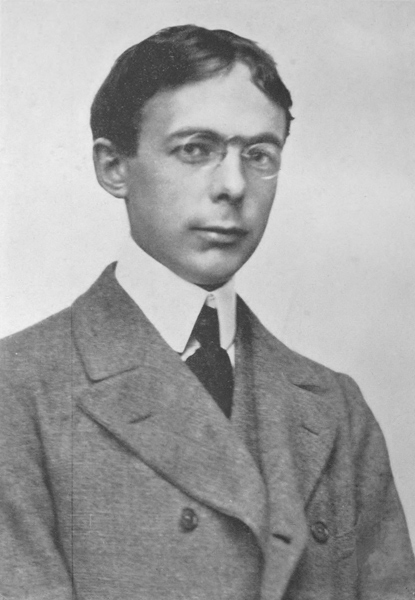
CARL RUSSELL FISH
Pg 119
VOL. I, NO. 2 DECEMBER, 1917
THE WISCONSIN MAGAZINE OF HISTORY

PUBLICATIONS OF THE STATE HISTORICAL SOCIETY OF WISCONSIN.
Edited by
MILO M. QUAIFE,
Superintendent
Pg 120
CONTENTS
Page
The Frontier a World Problem Carl Russell Fish 121
Early Recollections of Lake Geneva (Big Foot Lake), Wisconsin George Manierre 142
Description of a Journey to North America
Foreword Rasmus B. Anderson 149
Description of a Journey to North America Ole Knudsen Nattestad 167
Editorials:
History Repeats Itself; Our Military Record; What of the Future?; An Appreciation and a Suggestion; Cannon Fodder 187
Question Box:
Daniel Webster’s Wisconsin Investments; Names Proposed for a New Town; Origin of the Word “Winnequah”; The Discovery of Lake Superior; The Potawatomi during the Revolution; Father Allouez among the Kickapoo; The Indian Tribes of Iowa 193
Communications:
Old Copperheads and New; A Presbyterian Objects 202
Survey of Historical Activities:
The Society and the State; Some Wisconsin Public Documents; Some Publications 206
Copyright, 1917, by the State Historical Society of Wisconsin
Pg 121
THE FRONTIER A WORLD PROBLEM[82]
By Carl Russell Fish
Only by a study of local history can we hope really to understand the development of human society. The historian like the scientist must base his knowledge on what can be seen through a microscope. Wisconsin, from the time of its formation as a state, has realized this, and has steadily confirmed itself in the opinion. This institution, which it founded in the days of its youth and scant resources, it has supported with a liberality, public and private, growing as its wealth has grown. Of late years, a corps of local societies, city and county, have been forming about the central institution. The University has directed its students to the study of the localities from which they have come, and stores in its stacks the facts which they glean. No one of the newer states of the country knows itself so well as Wisconsin, and if, as is so often the case, acquired knowledge seems merely to reveal the knowledge still necessary for real understanding, we have carefully developed plans to extend it still more widely and intensively.
Yet how insignificant any locality seems today, when practically all are plunged into the same calamity, when the resources of all are concentrated in one struggle. Races and breeds, nationalities and castes are merged together on the same battle-field. Their similarities of plight and object dominate their differences, the protective barriers each erected to preserve that distinctiveness so dear to human nature seem leveled, and history has become world history. Men thrown thus physically into the maelstrom find themselves intellectually also torn from their safe anchorages and adrift they know not where. What does the individual count for, what Pg 122 the locality, what the past? What counts it to study the development of Rock County cheese-making, when its cheeses and cheese makers are tumbled promiscuously with those of all counties and nations, simply as units in a staggering sum total?
The world has changed, but that is not startling. The world is always changing. This change is greater, and for us in America more sudden and dramatic, than any which preceded, but everything has not changed. The relation of the past to the present and the future is permanent. The relations of the individual, the locality, and the whole, shift, but they are the permanent factors of which life consists. The world war has not changed these factors, but it should bring us up sharply to a realization of what they really mean. Socrates’ dictum “know thyself” was not given in any selfish spirit. He did not mean that we were to devote ourselves to ourselves, but that we could know ourselves more thoroughly than we could know others, that self-knowledge was the completest knowledge, and therefore the Archimedian lever to open up knowledge of others. Self-examination has often become an obsession excluding all else, the study of local history has often become antiquarianism. The real reason for the cultivating of both is the formation of known bases from which to calculate. The German historian, Lamprecht, became so familiar with the little city of Trêves that he could have conversed intimately with its inhabitants of any year during the Middle Ages if he might have been dropped into it, but this devotion was not for the sake of Trêves, it gave the understanding knowledge necessary for his great work on German civilization as a whole. We can know no generation unless we have delved deep into the souls of its greatest men, but such biographical studies are not for themselves alone, but to contribute to a sympathetic comprehension of their contemporaries.
Pg 123 Local history to justify itself must be as exact and absolute as studies dealing with human nature may be, but if no effort is made to utilize it for an understanding of national and world history, it has missed its mission. Local history is not an end in itself. Moreover, if it is written without a wide knowledge of outside conditions, conditions in other localities, and other times, it will be but a warped product, as useless to the community for which it is written as for the outside world. Such selfishness and egoism have never been profitable. The only difference today is that for the moment at least they have become impossible.
The most striking feature in the history of Wisconsin has been the transformation within a lifetime of a virgin forest into a civilized area, the drawing together of the sons and daughters of many widely differing localities and their welding into a commonwealth. This conquest of the frontier has been but a portion of that vast movement which in a period historically short has created the United States, and more particularly it has been an important and typical battle in the campaign for the Mississippi Valley, which has resulted in our sister states of the Middle West.
Different as has been the history of each, the history of the frontier movement is a whole; the study of any state contributes to an understanding of all. As the occupation of Wisconsin has been but a part of the American frontier movement, so that has not been unique, even in the nineteenth century. We have liked to think of ourselves as carrying on a special and distinct task; to its difficulties and inspiration we have attributed many of our virtues, and on them we have laid the burden of our defects. The task, however, has not been unique. The results have, indeed, had their distinctive differences, but these have come rather from the way the task has been performed than because we have had a different thing to do. We know our own frontier with scientific thoroughness, but we cannot understand it unless we contrast Pg 124 it with such other frontiers as Australia, Siberia, South America, and Africa.
One of the essential features of a frontier is that both labor and capital come from without, and much of the capital is contributed by people who do not come to the frontier. Exception must, indeed, be made to this statement. The Spaniards found labor in Peru and Mexico, and they found also capital, as did the miners of Australia and California, the lumber barons of Wisconsin, and the fur traders of Canada. In none of these instances, however, did either the local labor or local capital suffice, and in all the instances to be cited later the bulk of the labor came from away, and the owners of an important portion of the capital remained away; the frontier community, therefore, was a debtor community, and the debt was due to an outside community.
This common condition has in all cases had an important bearing not only on economic development, but on the whole texture of the social fabric which was created; it affected not only the frontier itself, but its reflex influence on the sections from which the labor and capital were drawn set at work influences which at times became leading factors in their existence. So important have their influences been, that where the study is confined to any one frontier, they seem to dominate development, and make history their creature. When we extend our study, however, we find that in spite of the fundamental resemblance, each has followed its separate course; that the different balance of other factors, and even such secondary considerations as laws and constitutions, have radically altered the actual operation of these powerful natural resemblances. The control of the frontier’s natural resources, the distribution of proceeds, the very content of politics have varied with every frontier. The problem has been one, the methods and results have been as varied as the fields in which it occurred.
Pg 125 In the United States the larger part of the capital came from or through another section of the same country. That is, the East furnished nearly all that was supplied, although to do so it had to borrow somewhat from Europe. The direct loans from Europe to the West were comparatively unimportant. Consequently the interests of the debtor and creditor sections conflicted in the arena of national politics. Two unique features made the working out of the problem different in this country from any other. The first was the division of the country into a large number of states, sovereign within a restricted range of powers, some controlled by the debtor element, some by the creditor. The other was that at one time, and that the most critical, the frontier was strong enough at least to veto the action of the national government.
The result of these conditions was a struggle unusually complex. The control of banking, of the currency, of natural resources, such as lands, minerals, and oil, and of transportation or, as it is phrased in our politics, internal improvements, were the bone of contention. The desire to have these controlled by national or state governments varied with the political situation. The frontier wished banks that would not be too particular, a currency that would be easy to get; it wished, and wishes, control of its own systems of transportation and its natural resources.
The sections furnishing the supplies were more interested in the capital to which strings were tied, than in the labor which cut its apron strings on leaving home. The struggle antedated the Revolution; the high points in its later history were the Shays Rebellion, the Jackson régime, the greenback movement, the Bryan campaign, and it finds present expression in the opposition in the Far West to the national conservation policy.
When the frontier secured the reins of power in the sinewy hands of Andrew Jackson, it was not in a position to impose its policy upon the nation, but it was powerful enough to wrest Pg 126 banking, the currency, and internal improvements from the control of the national government, and turn them over to the states. The frontier states, elate, started on a mad career of making their own internal improvements, by means of borrowed capital diluted by paper issues, till money ran like fairy gold into the pockets of the needy. For one golden moment the problem of the frontier seemed solved to the satisfaction of the frontier. Jackson himself caused the first crash. Unable to tell good paper from bad, he could at any rate tell paper from gold, and in the Specie Circular of 1836 he brought credit to the touchstone of real value and sent the house of cards toppling. Feverishly rebuilt within the next few years, it fell again in 1841, carrying with it the whole dream of its builders. So severe was the blow that numbers of the states took advantage of their sovereign rights, and repudiated a portion of their debts. Securely entrenched behind their sovereign inviolability to legal attack, they still enjoyed the inviolability to force which their position as part of a larger nation afforded. They snapped their fingers at their creditors; but they could borrow no more. The nation had left the task of national development to the states; the states, by impairing their credit, had rendered themselves incapable of handling it.
This situation left the field free for, in fact rendered necessary, the intervention of individuals or of individuals organized as corporations. The legal position of the latter had already been prepared. The decisions of Justice Marshall had given corporation charters an unusual degree of legal sanctity, which the state constitutions modified rather than reversed. The fears of the Jeffersonian democracy had incorporated into the national constitution itself special restrictions upon the government in dealing with the individual, which the decisions of the Supreme Court under Justice Taney went far in applying to the corporations. Corporations became so firmly entrenched in their position Pg 127 as the chief agency in national development, that even when, after the Civil War, the national government became more active and once more assumed control of banking and the currency, and the credit of the states was reëstablished, both agencies used their powers chiefly to assist corporations. When, in the present generation, the necessity of public control became obvious, it took the form, for the most part, of regulation of corporations, rather than that of absorbing or supplanting them.
The direction of the development of transportation and the exploitation of natural resources, therefore, was, for the most part, in the hands of individuals, and, in the case of large projects, of individuals organized as corporations, and, with the exception of farm land, of individuals and corporations representing nonresident capital. Many influences, of course, modified their activities, but these affected rather the security of their capital than the initiative of their plans. Many lost the capital which they poured into the new region, and the result was that the prospect of large returns was demanded by others before venturing; speculation, lost investments, and abnormally productive investments characterized the process as a whole. Politicians concerned themselves rather with the means, the questions of banking and currency, than with the end, the character of the development which should take place.
The other independent portions of the American continents, for the most part, resembled the United States in organization, but the distribution of the economic factors differed and produced different results. Except in the United States, the capital which has been necessary for the occupation of the wilderness has come, for the most part, not from other portions of the same country, but from foreign countries.
The most important of these frontiers during the nineteenth century has been that of Argentina. Here the established section was until recently comparatively unimportant, Pg 128 both labor and capital came in large measure from abroad; the greater portion of the labor from Italy, of the capital from Great Britain. The conflict between the debtor and creditor sections, therefore, was not one of politics, but of diplomacy. Argentina might have what system of banking and currency it wished, but most creditors had to be paid in an international standard of value. In a world state, doubtless, all the frontiers would unite to further their interests, as the frontier states have in the United States; in the world as at present unorganized the ultimate appeal is to force. A debtor country, and one relatively weak as compared with its creditor, Argentina has not been without its plans, conceived like those of the American frontiersman without moral dishonesty but with incapacity or unwillingness to think the thing through, for easing its burden. In the efforts of Calvo and Drago to incorporate into international law the principle that debts between nations and their citizens may not be collected by force, we see as surely the reflection of frontier views, as in the programs of Greenbacker and of Populist. In the greater interest in international affairs in Argentina than in the United States, we see a new illustration of the aphorism “For where your treasure is, there will your heart be also.”
In the long run, Argentina has had to pay up, and has had to pay also in high interest rates, for the lack of a feeling of absolute security on the part of the investor. Probably few countries have had more expensive statesmen than Drago and Calvo.
To attract capital, moreover, it has been necessary to offer it abundantly the undeveloped natural resources of the country. On the other hand, the logic of the situation has kept development in the hands of the nation to a greater degree than in the United States, for the nation has been able to borrow money more cheaply than individuals or domestic corporations, and public ownership has played an important part in her upbuilding.
Pg 129 Argentina has paid, and so we have a situation which has never culminated in a crisis. The republics of the Caribbean have not been so fortunate. Much of the money has been borrowed, not for the purposes of improvement, but to finance revolution and for personal expenditure. Frittered away instead of put at productive work, it has become an increasing burden, in many cases an unbearable burden, and countries like Hayti, San Domingo, Honduras, and at times Mexico, have become internationally bankrupt. Protected against legal action by their sovereignty, the creditor and the debtor stood in a situation where force alone could determine their relationship. What the result would normally have been, is clearly enough indicated by the intervention of France in Mexico in 1861, and of Germany in Venezuela in 1902. The subjugation of the weak debtor by the strong creditor has been prevented not by sovereignty, but by the interposition of a third force, the United States inspired by the Monroe Doctrine.
While, however, the Monroe Doctrine served to maintain the appearance of independence for the nations concerned, it produced an impasse in the development of the frontier. Capital did not have to go to countries which could not be relied upon to pay up and which were protected from foreclosure by an outside force. The United States served the republics in somewhat the same manner that it did its own repudiating states. It was, however, unable to do as much for them as it did for its own. The wayward republics found themselves debarred from directing their own development as did our states in the critical forties, and there was no domestic capital to undertake the task. The capital willing to engage in work under such circumstances was that of the most speculative sort. Some gamblers staked their money on presidential contenders, seeking to gain control of the government. Others, more powerful and trusting in their power, offered to embark huge sums on condition of receiving Pg 130 stupendous grants of the natural resources and practical control of the whole development to be made in certain regions. Such was the much-discussed Morgan syndicate proposal to Honduras, and that of the English Pearson syndicate to Columbia. In the latter instance, the United States again intervened, fearing the influence of such aggregations of foreign capital, and expressed its opinion that such special concessions violated the spirit of the Monroe Doctrine and could not be allowed.
From the tightening deadlock thus produced, Diaz extricated Mexico for a time, but it lapsed, and the others showed no signs of the power to emerge. Such European capital as had been loaned felt not unjustly angry, such as was for hire sought other avenues and frontiers less peculiarly hedged in. The situation shouted for action, and action could come only from the United States, which would not permit simple logic to work its own conclusion. It was under such circumstances that President Roosevelt assumed the financial administration of San Domingo and inaugurated a policy which has been followed and extended by his successors. Justice, or approximate justice, has been done between debtor and creditor, but the active development of these frontiers is still halted for lack of a machinery for the future.
In striking contrast with these American frontiers has been that of Siberia. Here has taken place one of the greatest frontier advances of history, here the same localization of creditor and debtor has existed, yet the conflict of classes and sections has led neither to politics as in the United States, nor to diplomacy as in Latin America. Much of the capital has been provided by France, but the money has, for the most part, been borrowed by the national Russian government, representing a strong nation and an essential ally. The security of the creditor has rested in the good faith, not of the frontier but of an established society, which has wished Pg 131 constantly more and more money and has realized that an atmosphere of credit must be preserved.
As the frontier has had nothing to say concerning its credit relationships, so it has been equally powerless in controlling the expenditures of the money borrowed and the disposition of its natural resources. The sole check upon the absolute will of the central government has been the desire to attract labor to the frontier. Few laborers, as few capitalists, seek the wild for the mere adventure of subduing it. The bids and rival bids for settlers by those controlling various sections of the world-frontier for the last three centuries have been to a large extent the basis for those more liberal institutions which have developed on the fringe of society. Their bids have been determined by the character of the settlers they desired or found available, and have in considerable measure determined the character of the communities built up. Force has played its part as well as lure, and has given incurious Africa a share in the development of the Americas that the most psychological advertiser would never have secured for it. In the nineteenth century, Russia has had more command of force to populate her waste spaces than any other country. Consequently the actual frontiersmen have had less to say about the development of their own region than elsewhere. Yet it is easily possible to exaggerate the coercive power of the central government, in popular estimation it is probably exaggerated; and the plans for the settlement of Siberia have been to no small degree influenced by consideration for the ideals of the typical Russian and the incentives which would coerce him to move his hearthstone. Yet on the whole, simplicity and the carrying out of preconceived plans have worked the opening of this great frontier. That the great release which has just occurred in Russia will reveal where these plans have bound, and that the politics of the new republic will be colored by frontier problems, is inevitable.
Pg 132 Australia and New Zealand have, to an even greater extent than the American frontier, secured their labor and capital from another section of the same empire. The relations between the sections, however, are quite different. The local organization of the debtor communities resembles that of the American states; in fact, the scope of their power is much broader, but they do not possess that inviolability to legal attack which sovereignty gives, and have not been represented in the central government. Credit, therefore, has been a matter of neither politics nor diplomacy, but has been as firmly controlled by the lending section, England, as that of Siberia has been by Russia. Judicial unity, which has been the only organic bond of empire, makes the sovereign, like the Crown, identical in Brisbane and in London. There is no chance of reducing debts save by a separation, which other considerations have rendered furthest from the wishes of the debtors.
General diplomacy also has been largely excluded from local consideration. The creditor-debtor relationship was almost exclusively one within the empire, and the handling of other diplomatic questions was in the hands of the British government in which the frontier sections were represented only by influence. The attempts to arouse an imperial, not to say international, mind found hard sledging during the real development period, and only partially succeeded just before the Great War.
On the other hand, the locality has been absolute master of the expenditure of its borrowings. No subordinate communities in the world, most decidedly not the states of our Union, have been left so entirely free to control their development, not only to plan their transportation and allot their natural resources, but even to regulate their tariffs. It is not surprising that these governments, with credit carefully maintained by outside and unquestionable forces, found their politics in the working out of such development, and that, Pg 133 in large measure, borrowing has been done by the local governments, which have themselves spent the money borrowed. There can be no better security than that of a government incapacitated from repudiation. Creditors have lost comparatively little money to these frontiers, and so Australia and New Zealand have received their needed capital upon better terms, perhaps, than any of the other regions treated. How wisely they have spent it, is a matter of the most violent dispute.
Politics in communities barred from the great questions of credit and diplomacy yet organized on the basis of the broadest democracy and local autonomy, have naturally had their strikingly significant characteristics. Everyone knows how rich their statute books have been in laws relating to the distribution of natural resources and of all kinds of wealth, and to conditions of living. Everyone knows the sharp antagonism between labor, in the narrower sense of wage earner, and employers. That these frontiers have been experiment grounds in social legislation has not been due to their being frontier communities but because they have been frontier communities freed from some of the most characteristic frontier problems.
Rhodesia resembles Australia and New Zealand in local autonomy and lack of representation in the national government. In other respects, however, it is widely different. Here capital came first, and labor afterward. The capital, moreover, was not of the timid sort seeking small return and security, such as invested in the securities of New Zealand, Victoria, and New South Wales, nor did it entirely resemble that of the United States during the development period, which sought returns both large and immediate. The capitalists of Rhodesia could wait, in fact, are still waiting. Alone among the frontiers, Rhodesia has not been under the strain of seeking to make returns on its invested capital before development has reached the stage where returns can Pg 134 properly be expected. It may well hope to be freed from those complications of individual indebtedness, which have filled our courts with business, and strewn our advance with such tragedies as are even today occurring in northern Wisconsin.
Upon the capitalists thus far-sighted and enduring rested the full burden of development. The region was autonomous in its relation to the British Empire, but its non-resident creditors mapped out its future, not its settlers as in Australia. Capital under such circumstances looks for large rewards, and in this case expects to secure them by control of the natural resources, when these have been made available by the incoming of settlers. Youngest of the frontiers, the working of the old factors in this new relationship remains a question. One would expect economy and efficiency in planning, but possible conflicts between the resident community and its creditors over the division of the proceeds. The settlers that it seeks are of the most independent type, men not with energy alone, but with some small capital of their own. It offers them not only economic opportunity but also political privileges. How such a population will react under a system which restricts politics one degree more than they are restricted in Australia, by excluding the larger lines of local development such as transportation, is one of the interesting questions of tomorrow. One might look for some clue in the history of the American colonial proprietorships, but how far the intelligent study of those experiments will have enabled the proprietors of Rhodesia to avoid their mistakes, and how far the changed conditions created by two centuries of the most rapid change the world has seen, will modify the interworking of similar forces, no one can tell.
In organization, Canada is today, of course, like Australia, but whereas the commonwealth of Australia is but recent and was formed only after the scaffolding of development had been created, the Dominion of Canada was created Pg 135 in season to direct the most active period of frontiering. During the most significant period, therefore, Canada has had an organization that resembled our federal states. The resemblance, however, is partly superficial; in Canada the specified powers belong to the provinces, the undefined powers to the Dominion. Neither provinces nor Dominion, moreover, have possessed the legal inviolability of absolute sovereignty. The credit of all has been protected by the judicial unity of the empire, and the stability of the currency has not been a subject for politics. Diplomacy, also, has belonged to the mother country, although the proximity of the United States has not allowed it to be the blank it was so long in its Australian sister-colonies.
Economically the development of the Canadian frontier has more resembled that of the United States, for the capital required has come most largely from or through other sections of the same colony. As compared with the United States, however, development has been, until quite lately, slow. Consequently those regions which have passed beyond the frontier stage have continuously controlled the central government. There has been no parallel to the Jackson régime. Credit, therefore, has been doubly guarded, by the majority in Canada, and by Canada’s position within the British Empire. With the credit of the Dominion and of the provinces intact, there have been no intrinsic obstacles to the development of transportation and the control of resources by the public, and public works have played an important part. At the same time the period of greatest need coincided with the high tide of the individualistic movement in the Anglo-Saxon world. The principles of John Stuart Mill, of Cobbett and Bright, of Gladstone, Carlyle, and Emerson, dominated a generation devoted to the task of breaking down time-worn systems of social control and releasing the individual. The period of new regulations dictated by rising democracy had not swung in. Therefore, a very considerable portion of the Pg 136 task was left to private corporations, to whom were granted very considerable proportions of the natural resources. Corporation control and public enterprise, therefore, combined with unusual harmony in developing and exploiting a frontier which was, indeed, represented, but which could control in neither a positive nor a negative sense.
The recent and sudden expansion of the Canadian frontier in the west and northwest has created a new balance. The situation in Canada today resembles that in the United States when the advance of population from the Alleghanies to beyond the Mississippi gave the frontier an unusual political weight, and elected Andrew Jackson. This region is just now in the position where it is so eager to get capital that it is ready to agree to almost any terms to secure its railroads and farm machinery. When pay time comes, its sentiments will change. It is difficult to see how it can upset credit, but that, in combination with the democracy of the older portions of Canada, it will make its voice felt and play a part in Canadian politics that the frontier has never played in the long course of Canadian history, no student of frontiers can doubt.
On the whole, Canada has secured its capital at low interest rates, lower probably than any other frontier except Australia and New Zealand. It has, however, sacrificed the control of its natural resources to a considerable degree. The direction of its development has attracted both public attention and the labor of its strongest men controlling private capital. In none of the frontiers have the two systems been so equally blended.
Most hapless of the frontiers is that of Manchuria. It is at present a represented province of an imperial republic, which furnishes most of the labor required, but can furnish neither capital nor protection. Its capital comes, for the most part, from two rival foreign powers, who are not really creditor nations, but who are so eager to invest in Manchuria that they borrow from still other countries for the purpose. The Pg 137 local community has no more to say in regard to its development or the partition of its resources than Siberia. It does not, indeed, rest under any such obligation of paying as does Australia, for power rather than money return is sought by Russia and Japan, who furnish it with money on their own security and, therefore, at reasonably low rates. Undoubtedly, however, the successful grasp of power will mean such a hold on natural resources as will give those countries, in return for their guarantee, rewards which will be more satisfactory to them than to the actual conquerors of the Manchurian wilds. It will be interesting to see whether sectional interests will unite the Russian and Japanese settlers with the Chinese majority against the foreign capitalists, or whether racial antagonism will prove stronger than economic. Countless cross currents already chop the surface, and conditions point rather to a problem than a state.
Wide as is the field covered by the frontiers discussed, the Mississippi Valley, Argentina, the wilds encircling the Caribbean, Siberia, Australia, Canada, and Manchuria, it covers barely half the area where since the year 1800 European civilization has been struggling to establish itself by the occupation of regions wholly or partly vacant. Different as have been the conditions classified under which the simple underlying factors universally involved have operated, more have been left undescribed. Algiers has had a frontier incorporated as an integral part of France, a centralized republic. In fact, practically every region of Africa has presented a frontier, and the handling of frontier conditions by English, French, and Belgians, Boers, Germans, Portuguese, Italians, Spaniards, and American negroes. The greatest frontier area today is Brazil, and every country of Latin America has a frontier and its own slightly varying organization and balance of forces, while the British, French, and Dutch are all severally trying their hand on the particular problem of a tropical American frontier. Some portions of India, Persia, Pg 138 Arabia, Indo-China, China, Korea, the Philippines, Formosa, and many South Sea Islands, present the problem under special guises. Sweden, Norway, Russia, Canada, and the United States are all dealing with the possibility of pressing civilization into the fastnesses of the Arctic.
When one considers the extent of the world frontier in process of occupation during the last century, the persuasive effect of its call upon the older world for labor and capital, the coloring of the whole world by the natural resources it has unearthed and the institutions it has developed, its conquest can hardly be considered as second in influence to any factor of the time. Naturally it is not intended to present here even a basis for its study. The fundamental factors and the different systems can be accurately enough described in general terms, but the differences in their operation are less precise than has been indicated; private corporations exist in Siberia, state public improvements in the United States. Many of the similarities produced everywhere by frontier conditions have been neglected. The attempt has been merely to indicate some of the tendencies fostered by different types of control. The differences between the various frontiers, resulting from race and geography, which in many cases explain the different types of organization or modify their working, have been left untouched. The problem is immense, its study is one for generations. Yet some things he who runs may read. Even a partial acquaintance with the main features of all cannot but render the work of each statesman and historian more effective in his own particular task.
Some things will be understood only when no frontier, as we know it, exists. Yet even while we are in the current, we have accumulated some material, and it would seem to be contributory negligence not to use it. It must be patent that one must be honest or must pay for it. Can we not secure some rough idea of which system of approach has resulted in the greater justice between the creditor and debtor section, Pg 139 and what is justice? Has community control of its development or creditor control been most economical and most effective? Has exploitation to produce local capital any justification? What system has called to the task the greater proportion of ability? Would the United States have fared better under a system by which Webster, Clay, and Calhoun would have devoted to moulding the transportation system the genius they spent in bolstering up public credit? Which system has been the most responsive to the needs of the situation, and which has stimulated the greatest amount of public virtue, and which has been most easily manipulated for selfish advantage?
I haven’t the slightest intention of answering these questions here; I freely admit that many of them leave me perplexed, but I dogmatically maintain that it is by pondering such questions, by studying the comparisons they suggest, that the frontier problem is to be understood by the historian and comprehended by the statesman. Without such comparisons the student of the problem in any one field is less apt to judge a particular episode rightly than a man with no knowledge and good intentions. The path to wisdom and sure-footed action must be founded on the rock of exact knowledge, but it must be platted on a wide-spread survey.
All life reveals the irony of wisdom attained only by the experience to deal with which it was needed. It is but today we have this rich storehouse of experimental frontier building, and tomorrow we will have no frontier. It might seem that we could let a dead past bury its dead, that the study of frontier episodes, however successful, has become sheer antiquarianism. Such a view, however, minimizes the world frontier that remains and the time and effort that will be required in its conquest. As in science, so with the material world, the nineteenth century made easy sweeping advances; it left much that was difficult for the slower and more laborious labors of the twentieth. It overlooks the facts that great masses of the world’s inhabitants today count the experience Pg 140 of meeting the wild first-hand among the most important of their nearby inheritances, that the frontier set its mark upon them or their parents, or grandparents, and that the present generation cannot be understood unless the frontier is understood. Still more important is the consideration that in many instances the frontier merely localizes problems that are general. The factors with which this paper has dealt are peculiar to the frontier only in that the creditors are assembled in one section, the debtors in another. This is an important peculiarity in large part because it isolates the characteristics of each, and makes them easier of study. When the world has been fully occupied, new frontiers will appear, are already appearing. Natural resources now undreamed of will need capital and labor for their exploitation, will be susceptible of development in more than one way, and will raise problems of control. Our experiences with the rude and simple problem of the first occupation of a waste area will seem as geometry to calculus compared with those raised by these new frontiers, but will be as essential to a wise handling of them as geometry is to calculus.
But the instances that we have reviewed seem to carry a simpler and more immediate moral. When we see in the United States people of all nations laboring for the conquest of the Mississippi Valley, and employing money saved by New England and the Middle States or borrowed by them from Europe, when we see Russia borrowing French money to make Siberia habitable for Russian peasants, when Japan borrows in England, and Russia in France to pay Chinese to develop transportation in Manchuria, when Argentina borrows English money to employ Italians in the pampas, and Transvaal gold passes through English banks to build Rhodesian railways, we get glimpses of a new world. Not that these things are absolutely novel, but that in variety and extent they are unparalleled, and these experiences on the frontiers but bring into clearer view general tendencies of the time. The German invasion of Belgium uncovered for Pg 141 most of us the tens of thousands of Russians working in the Liege factories, the hundreds of thousands of Russians working on German farms, of Italians on the Rhine, of Spaniards in France; the war itself has hastened the movement with its vast importations of Indo-Chinese and Arabs into France, with its tight-woven mesh of international credit. The frontier still reveals most clearly how in the nineteenth century the business of life became international and how poorly devised was the world organization for coping with it.
Again, the experience of the frontier in the nineteenth century exhibits one step in the process of readjustment. Can one review the instances which have been noted, without feeling the theory of absolute sovereignty crumbling beneath his feet? The United States has in practice divided the sovereignty, and as a result surrendered the actual control to corporations they themselves created. The British Empire preserved unity in theory, but actually divided it still more effectually. What can a practical man make of the sovereignty of Honduras, where the native government cannot control its own development, the British Empire cannot protect its citizens’ money, and the United States can veto the actions of both but cannot take positive action; or of Manchuria, which is an integral portion of a sovereign republic, but which is actually as to one-half controlled by Russia and the other by Japan, both of whom are somewhat curtailed in their actions by promises to the United States. However one may cling to the legal theory of the absolute and indivisible character of sovereignty in independent localities, a study of the world frontier brings out the fact that no localities are independent in fact, or absolutely sovereign. The inter-growth of the world, which the development of the world frontier has so much facilitated, has already weakened the bulwarks of local independence; let us hope that with its international character the frontier may facilitate the integration of a world organization better adapted to the conditions of today, such an organization as tomorrow will be a necessity.
Pg 142
EARLY RECOLLECTIONS OF LAKE GENEVA (BIG FOOT LAKE), WISCONSIN
By George Manierre[83]
My grandfather, William Reid, came to Chicago in 1840. At that time, although a mere village of 4,479 inhabitants, it was in the midst of a speculative fever and was even then speaking of its certain future greatness and of Lake Geneva (Big Foot Lake) as a probable summer resort for its citizens. My grandfather came of a well-known family whose ancestor with his tenants fought at the battle of Bothwell Bridge, June 22, 1679, under the flag “For God, King, and Covenant,” and who inherited through him the estate of Kilbryd, situated near Glasgow, Scotland. William Reid inherited wealth which he, as a barrister, increased, so that at about middle life he made up his mind to retire. Unfortunately for his family his investments proved unsuccessful, and after the loss of the greater part of his fortune he came to America and started anew. When he came to Chicago he had a relatively large sum of money, which, if invested in Chicago, might eventually have increased to great wealth; but he was stricken by the Lake Geneva fever and went there with his family, locating at the head of the lake. He invested largely in land by the lake and on Big Foot Prairie, buying a large tract of land on the higher ground and about seventy acres along the lake.
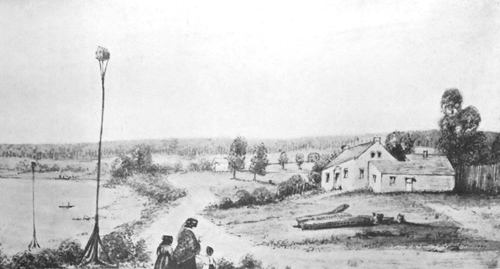
HOUSE OF WILLIAM REID AT THE HEAD OF LAKE GENEVA From a water color in the Wisconsin Historical Library painted in 1842 by Mrs. James Drew
My grandmother, Mary Drew, came of a cultivated family which was distantly related to the family of the Duke of Hamilton. Her niece was the first wife of William Gladstone, the English statesman. Mention is made of these things to show the change from the ease of their former mode Pg 143 of living to the vicissitudes which locating on the frontier entailed.
My grandparents had nine children, five boys and four girls, part of whom were born in the log house at the head of the lake. This house stood about two hundred feet from shore at the bottom of a rise of ground known as the Potawatomi Indian burial ground, upon which site the electric railway depot now stands. I remember as a boy digging Indian relics out of this hill. The house was neatly built of logs and had two large wings; in the center of one room was a fireplace suitable for burning large logs. Among the early settlers in the neighborhood at this time who had land and houses at the head of the lake were the Van Slykes,[84] the Mohrs,[85] the Russells,[86] and the Douglasses.[87]
Here the children grew up with the ordinary opportunities of farmers’ children and had no better advantages; and years later my cousin, Jessie (Reid) Donaldson, my brother, Will, and I used to come here to enjoy the beautiful surroundings of grandfather’s place. Will and I had a little pony called Jenny and a wagon which we used to drive to The Corners for mail. Whenever Jenny wanted to go into the barn or whenever we took her to the blacksmith’s to be shod, she had a funny trick of rapping on the door with her feet.
I remember the Baptist people used frequently to come down to the lake in front of my grandfather’s house, and that Pg 144 the minister would there duck the women under the water, according to their custom. My aunt, with great sympathy, would lead the women into the house, where they could change their clothes.
South of the house, where a stream ran through the inlet into the lake, was a marsh, in the center of which was an island. Here in those early days deer were often to be seen. Prairie chickens were plentiful on Big Foot Prairie, and in the spring wild pigeons, now extinct, flew over it in countless numbers. Woodcock, ruffed grouse, and squirrels were also numerous. In the lake there was a large quantity of game fish, among which were the cisco. These were seen only during the last days of May or the early days of June when they came from the depths of the lake to the shallow water to feed on the May flies and to spawn. Of the wild life existing at that time, only a fraction now remains.
Matthias Mohr owned the old sawmill on the rising ground at the south end of the marsh. The race was fed by a large brook that emptied into the marsh. This beautiful spot, surrounded by bushes and trees, was often visited by me. The old wheel was still, but it was pleasant to listen to the sound of the clear, cold water of the brook as it rushed over the dismantled wheel to its outlet in the marsh. This brook was afterward dammed up and used for raising brook trout.
Numerous beautiful springs were to be found running from the higher ground to the lake. About half a mile north of the house was a small schoolhouse where I remember being spelled down by a little girl. The house was afterward occupied by an English laborer by the name of Blackwell, and I have his son Bill in pleasant remembrance. The road past the schoolhouse at the foot of a high bluff ran south by Douglass’ Mill and north to the farm belonging to my grandfather. From Douglass’ Mill,[88] which was built by C. L. Pg 145 Douglass and first used as a sawmill and then as a gristmill, we used to go on up a very steep hill to the road going west to The Corners, about three miles from my grandfather’s house, where at that early day the mail was obtained. The village located where the mill once stood has since been called Fontana.[89]
Later we went to Walworth for the mail, taking the road running south. The town of Walworth was founded in 1836 by James Van Slyke who made his residence at the head of the lake. The only residents there about 1840 were Christopher Douglass and sons, Marcus Russell, James Van Slyke, Matthias Mohr, and William Reid. Matthias Mohr purchased 50 acres in the town of Walworth in 1840, and in 1843 he purchased 38 acres more. In 1840 William Reid purchased 960¼ acres, in 1840 Marcus Russell purchased 80 acres, and in 1841, Christopher Douglass purchased 480 acres, all in the town of Walworth.