Volume 1 — CONTENTS OF VOLUME I (continued 2)
Reading edition
Saturday 4. We all visited the camp this A. M. Saw the Belle City Rifles & was very much surprised at seeing Geo. Lincoln[36] in the ranks. He is the only acquaintance with them. Fat Sheldon,[37] whom I have often seen before, was with them however.
The Oshkosh Guards and the Citizens Guards of Fox Lake having arrived this P. M. went to the camp to see them. Staid till 8 O’Clock & had considerable difficulty in passing the guard.
Sunday, May 5, 1861. Attended church at the Methodists to day. Did not hear the name of the preacher. Text—Romans 14:7. Rained during the whole of the service & we had a fine run through the rain to the Cong. Church to attend Bible class. Visited the camp in the P. M. George Pg 51 had been on guard most of the day. Were kept there by the rain until nearly dark. & thereby were again made prisoners of war.
May 6th. Went down to camp again this P. M. Nothing of consequence occurred only that we were stopped by the guard again and had to be passed out by the corporal. They are very strict after 6 o’clock.
Tuesday 7. John and I went down town after school, & Will went to Camp Randall. When we came back we went down there too, but were refused admittance as they had made a rule that no one should be allowed in after 6 o’clock. While we were standing there, Will & George came to the gate and we shook hands with G. over the soldier’s bayonet.
Wednesday 8. The Trigonometry Class in which Will is, procured the instruments to day and were practicing surveying.
At 3 o’clock I went out with them and saw them take angles for measuring the height of University Hall. It proved to be 115.838 feet, if their work is correct.
Visited the camp again, Mr. Durand was there, and after the soldiers supper the Bible [Belle] City Rifles were marched to the Fine Arts Hall hill and drawn up in a line to hear a speech from him. He endeavored to persuade them all to remain with the Co. as an order has been recd that they must now enlist for 3 years or during the war, which many refuse to do.
Thursday, May 9, 1861. Will & I procured a boat after school and went out on the lake to try & get some fish. After being out two hours we speared one little bull head which we gave to the owner of the boat and agreed to go out with him to night and furnish light for him to fish. Started at 8, was out till 10 & caught two fish both of which we gave the boat owner.
Received a letter announcing the death of P. P. Taber.
Friday 10. Our fishing excursion caused us to oversleep ourselves, and when there was a loud rapping at our door about 15 minutes before 6, it did not wake me enough to comprehend what it was: but in about ½ an hour afterwards Pg 52 Mr. Wildish[38] again came to our room and brot a box which he said a gentleman had left for me. I saw by the name on the box it was Seth Rice who had brot it from home. Thus by my sleepiness I missed seeing an acquaintance from U. G. John & I took a walk in the N. E. part of the town, past Gov. Farwell’s Octagon house, & visited the Cemetery. Attended Society’s meetings.
Saturday 11. Nothing particular going on until evening when the Hesperian celebrated the anniversary of the Dedication of their new Hall. Ball read a humorous poem, Baker declaimed “The Gray Forest Eagle,” and Allen[39] delivered an oration. After these exercises, speeches were made by Profs. Butler, Sterling, Reed[40] & Parkinson, by a graduate, Hale, Hesperian, Ball, Vilas, Leahy, Tredway, Clawson, Stewart, & Athenean Hall.[41]
George Lincoln was present until about 9 O’Clock.
Monday, May 13, 1861. Attended Methodist Church yesterday. Was too late to hear the text. Mr Yokem preached. attended Bible Class. Wrote letter home—took it to P. O. in the evening & attended Baptist Church. Was again too late to hear the text but Mr. Brisbane preached a very fine sermon. His subject was the natural depravity of man.
Nothing happened on Monday worthy of note.
Tuesday 14. This is Library day. Took out Vols. 1st & 2nd of Smithsonian Cont. to Knowledge, treating of Indian Mounds & other American Antiquities. Had one of the same books last week which contained I. A. Lapham’s[42] account of the mounds in Wisconsin which was very interesting. Went to the P. O. but received nothing. Went into Pg 53 the Assembly Chamber to try & find out if Mr. Bradford had come but he had not. The Chamber is all ready to receive its occupants tomorrow.
Wednesday 15. Went to the Capitol at 3 O’Clk Assembly was in session, but almost immediately adjourned. Mr. Bradford has not arrived yet. As Will & I were Coming home again we were hailed from the opposite side of the street and looking up saw H. Foster, T. Graham & Alex. Adams[43] who have joined the B. C. Rifles in place of those who refused to enlist for three years. they told us that W. White was also with them & had [been] to the Univ. with G. L. to look for us. Went home & found them there. They left the Grove Sunday.
Had a fish for supper tonight & borrowed Holt & Black’s cooker.
Wrote a composition for Friday.
Thursday, May 16, 1861. Mr Bradford arrived on the 4 O’Clk train this morning. He came to the Univ. at 7 & brot letters for all of us & told [us] there were pkges at the depot for us. Went & got them at noon & found there were cakes, pies, butter & a chicken, & a dressing gown for me, which, however, proved too large. Went to camp after school, and found that I Martyne & H. Ginty[44] were with the new recruits. 2 Zouaves were on the grounds (one, dressed in full uniform) who entertained the regiment with specimens of their drill. Went down town about 5. & met Mr. Bradford there.
Friday 17. In the Rhetorical Exercises I read a composition—“Political Parties”—Will a composition—“A Great Discovery” John obtained an excuse, as he expected his mother on the cars. After school we washed out the floor of our rooms, which took so long that, as we had to go down town for victuals, I did not attend the Society’s meeting at all.
Saturday 18. Mrs. Goldsworthy arrived at 4 O’Clk this morning. Went to the Capitol at 11. Assembly had adjourned & most of the members were drilling on the park under command of Capt. Emery[45] of Portage City. Went Pg 54 into the Senate they were debating a Banking bill & one to provide for volunteer’s families. Heard Messrs Virgin, Hazleton, Quentin, Maxon, A. I. Bennett, Gill, Hutchinson, and Worthington[46] speak. Sen. Worthington was Chn. of Com of the Whole when I first went in. At 7½ attended their evening session, with G. L., T. G., & H. F., from camp Sen Cox Ch’n. of Com. Bill providing for Volunteer’s families & the 6 Rgt bill were up. Heard Gill, Hazelton, Joiner, Quentin,[47] & another one speak
Monday, May 20, 1861. Yesterday commenced with a heavy [rain] which continued till about 9 O’Clock when Billy White & Wm. Sheldon of Burlington came from Camp Randall. On account of the very wet weather and also because our visitors did not wish to go I did not go to church in the A. M. & as it rained all P. M. I could not go then. The boys staid till nearly evening. John was at Mr. White’s nearly all day with his mother. Wrote a letter home last night & sent it with Mrs. Goldsworthy today. Visited the Capitol in the P. M. but Legislature had adjourned
Tuesday 21. Visited the Assembly Chamber this P. M. Assembly were in session, discussing the Military Bill; more especially the provision for paying the soldiers, and requiring the war loan to be taken, in coin. Heard Judge Spooner, Messrs. Bradford, Warner Atwood, & Ramsey[48] speak.
Pg 55 After the adjournment went to the camp, & returning to the Univ. took a bathe in the lake.
Wednesday 22. The Sophs & Freshs got a rich joke on the Seniors this morning. They had bills printed last night composed in Artemus Ward style, purporting to be an advertisement for their lost cushions, and this morning they posted [them] in the most conspicuous places around the University & down town. Went to the Capitol immediately after school. The Assembly were engaged in a very animated discussion on a proposition that the enlistments should be divided proportionally among the Cong. dists. It was lost. I went with Mr. B. to Camp & witnessed the dress parade of the Regt. John & I subscribed for the State Journal for 3 mos.
Thursday, May 23, 1861. The Assembly this P. M. were discussing a banking law, but it not being interesting I did not stay long. Went to the Post Office & from there to the Journal to read the news. They keep there a file of all the City dailies free to the public.
Friday 24. Mr. Bradford visited us in our rooms at noon today. He said the Milwaukee Zouaves, having arrived at 7 O’Clock this morning would drill at 2½. and the Legislature had adjourned to witness it. He attended our Latin recitation & then we all went down to camp with him. The Zouave maneuvers proved very interesting & we staid till the troops went to supper at 5½ O’Clock, then went to the P. O. George was on guard at the gate. Judge Larrabee,[49] being on the grounds was pointed out to us by Mr. B.
Saturday 25. Went to the Capitol at 11 O’Clock. The Senate had under consideration the war loan bill, which originated in the Ass. 15 amendments adopted by Sen. 3 of them non-concurred by Assem. 2 receded from by Sen. & the 3d.. was that the loan should be taken & soldiers paid in Pg 56 coin. Sen. Gill moved that the Senate adhere to this amendment. A. I. Bennett said this was unusual & would be very discourteous to the Assem. as no Com. of Conference could be appointed if it were adopted. Sen. Hutchinson moved to amend that they insist instead of adhere. After warm discussion by Gill, Maxon, & Joiner, & Virgin, Hutchinson, A. I. Bennett & Hazelton it was carried that they adhere. On coming up in the Assem. this action of the Sen. was denounced by Frisby, Webb, Atwood, Spooner, D. H. Johnson & Hicks[50] & the Assem. insisted on their non-concurrence & asked a Com. of Conference, which was granted by the Senate & they proposed a bill which passed.
Monday, May 27, 1861. Attended the Cong. Church yesterday. Mr. Taylor’s Text was John III. 7 & I. 13., Also attended Prof. C’s Bible Class, Mr. Bradford was also there. In the P. M. the wind blew from the South a perfect gale. Wrote home & sent the letter with Mr. Bradford.
To-day went to the depot at noon to see Mr. Bradford off. After school went to the camp. The exercises on evening parade are changed today. Saw the maneuvers gone through with by Capts. Strong’s & Randolph’s Cos.[51] united but could not wait until the regular parade
Tuesday 28. Nothing worthy of note transpired to-day.
Wednesday 29. Seth Rice visited us today on his return from Richland Co. where he has been about three weeks. The train on which he came does not stop at the station (Stoughton) where he wishes to stop & he therefore lays over at Madison till the 4 o’clock train tomorrow morning.
He arrived about 4 o’clock & soon I went to the camp with him & we staid till after the evening parade. The exercise at this time now is—the companies form in line with their arms, come to parade rest. The band plays a tune & marches Pg 57 in front of the regiment the whole length of the line & back again—the gun is fired and the flag comes down—The Adj. announces to the Col. “the Parade is formed ” The Col put them through the Manual. The Sergeants report they are dismissed.
Thursday, May 30, 1861. Got up before 4 o’clock this morning to see Mr. Rice off. As we were sitting in our room at noon, the door opened and Charlie White entered without any previous announcement even the ceremony of knocking. After attending our Latin recitation we went with him to the camp. He had not previously heard that Billie was here. We staid till after parade & then John & I went down town purchased some meat, & when we got home borrowed a cooker & had a warm supper.
Friday 31. As we could not prevail on Charlie to stay here until Monday we obtained excuse from recitations today, hired a boat and went over to the Asylum with him. Visited all the places we had seen when there before and also were shown into the lower ward, and women’s ward. The wind having risen & blowing from the S. W.—“almost directly ahead—we concluded it would be impossible to row 4 back in the small boat which we had, so John & Charlie went round the lake afoot and Will & I rowed across. We went first to Sugar Bush point, where sheltered by the point, from the wind we tried to catch some fish but did not succeed. After starting for home the wind blew so hard that we could not make an inch headway but a rain coming up the wind ceased.
Saturday, June 1. Charlie went home at 10 o’clock last night, via Milwaukee.
John & I took our hooks & went on the R. R. bridge to fish but could catch nothing. But Will & I went out with a Dutchman in the evening and speared 7 in all—“1 pickerel, 1 sucker, 2 bass & 3 bull heads. We took the sucker and pickerel & had them for dinner the next day.
Sunday, June 2d Attended the Presbyterian Church today & Prof C’s Bible Class. Mr. Green had one of the most interesting sermons I ever listened to. He had four texts—Lev. X. 1. 2 & 3. The other three I have forgotten. Wrote a letter home in the P. M.
Pg 58 Monday, June 3, 1861. Going down town at noon today we learned by the dispatch on the Patriot bulletin board & by the crape hung around some of the stores, the sad intelligence of the death of Judge Douglas.[52] All of the flags in the city are at half mast and cannon are being fired every half hour till sundown at the Capitol & at Camp Randall. A meeting of the citizens was called for tonight, which we attended. Gov. Randall was appointed Ch’n & made a very affecting & pertinent speech. A committee was appointed to draft resolutions & speeches were made by E. A. Calkins, G. B. Smith, L. P. Harvey, M. H. Orton,—Gregory, & Col. Fairchild, & Chauncey Abbott.[53]
Tuesday 4. Went to the camp after school, to witness the parade. The boys say that a telegram was rec’d by Gov. Randall today from the Sec’y of War ordering the 2d.. & 3d. Regt’s. to Wash. as soon as they can be got ready, and they will probably go Monday. They have commenced having battalion drills today but, as they occur at three o’clock we can never see them. The flags are still flying at half mast and the com officers all wear crape on their left arms for 10 days.
Wednesday 5. An accident occurred on the R. R. last night. An axle of a freight car broke in crossing the bridge over the lake, threw the train off the track, and tore up the track and ties for some distance. It was a very dangerous accident as it occurred on the open bridge over quite deep water; but, fortunately, no one was injured. We finished the review of Geometry today, and now take propositions Pg 59 promi[s]cuously anywhere in the book so as to be more thoroughly prepared for examination. We also commence today to review Latin. Went to the P. O. after school.
Thursday, June 6, 1861. Visited the camp this evening during parade. Heard that they nearly had a mutiny last night. The sentry at the gun challenged the “grand rounds” when the officer not giving the countersign right he pricked him with his bayonet when his gun was snatched away from him and he “pitched in” to the officer with his fists for which he was put into the guard house, which the Capt. of his comp’y (La Crosse) having heard, he ordered him to be taken out; that not being done he ordered his company to charge bayonets & the whole reg’t being roused they broke into the g. house & released the man & also all other prisoners who were there.
Friday 7. There were no Rhetorical Exercises today, as in the two weeks before examination students are supposed to be preparing for that event and cannot perform this extra duty. “Got stuck” on a sum in Algebra today, but mean to stick to it till I get it out.
Went down to the P. O. after school
Saturday 8. The ladies of Madison gave the soldiers a picnic today. The tables in the “Operative Machinery” room were spread with bread, butter pies, cakes & sweatmeats, to which the boys did ample justice after which came speeches, music by the brass band, singing of Star Sp. Banner, and dispersion. The parade was formed almost immediately after the supper and all present witnessed it. Rec’d letter from home enclosing a “Programme of Commencement of Ind. Univ.” from Willie Reid.
Sunday, 9th—Rev. Mr. Britton (Epis.) held a service on the camp at 9½ A. M. He preached a patriotic sermon from the 12th chap of Kings. Attended Bible Class & Mason’s in evening.
Monday, June 10, 1861. Went to camp in the evening & there learned that Mrs. Graham & Mrs. St. George had been there today to see their sons; also while we were there Cap. Strong told his men that 50 of them could go home that night to see their friends before starting for “the wars.” Pg 60 T. G., T. St G.,[54] and W. White were among the no. who obtained permission to go. Geo. L. got out of the camp, & Will & I went with [him] to Father Norris’ to get the women to go home with their boys, but when we arrived at the depot we learned that an order had come from the Adj’t Gen. forbidding their going at this time.
Tuesday 11. Obtained excuse from Geom. recitation and went to the camp to see if the boys are going today. They cannot go as they are being mustered in to the U. S. service. Mrs. G. & St G. were there when we arrived at the camp & went home at 1 O’Clock. Staid at the camp till 5 o’clock to see the ceremony of mustering in the troops by Capt. McIntyre of the U. S. Infantry. 7 companies took the oath today.
Wednesday 12. We were all excused from Latin recitation, and visited Madison High School. The teacher, Miss Cowes,[55] seemed unprepared for visitors, and the afternoon session being a short one we heard but two recitations, (reading & Philos[o]phy) of which the Philosophy (not being a regular recitation at that hour) was rather poorly recited. There were but three boys in the room, the school consisting principally of girls.
Received a letter from Libbie
Thursday, June 13, 1861. Visited the camp in the P. M. Two squads (14 & 18) have gone home from the B. C. Co. but the U. G. boys were in neither of them. The parade tonight was drill & uninteresting, so many of them having gone home.
Finished review of Geometry today and take original propositions for remainder of the recitations.
Got the key from Dr. Carr & visited the Mineralogical, Geological & Natural History Cabinet, with Will & Holt.
Was much interested in some of the curiosities to be seen there.
Pg 61 Friday 14. By invitation of the boys we took supper at the camp this evening and were well pleased with the fare. There is some prospect of the boys going home to-morrow. The regiment will probably start for the east Tuesday.
Finished the review of Latin today, and now the class is going to try and get through Liber Tertius by Tuesday.
Attended the Society’s meetings. The Hesperian discussed the property qualification question, and the Ath’s “That the legal profession presents greater inducement than the others” The A’s elected officers for the ensuing term—Griswold, Presd. Silverthorne, V. P. Fallows,[56] Secy. Holt, Censor.
Saturday 15. On visiting the camp at 9 O’Clk found that another squad had been made up to go home, and Geo. L. & T. St G. were among them. Went back to our rooms and wrote letters to send by them.
At 4 O’Clk, Billy W. came to our rooms & said that he, T. Graham & Alec. Adams had also got furloughs and were going home on the 10 o’clk train, expecting to hire livery from Milwaukee. Went with Billy down town where he got his picture taken and the boys ate supper with us.
Sunday 16th.—Heard Mr. Green preach & attended Bible Class—Prof. C. was not there & Mr Dudley took charge, which made it very dull.
Monday, June 17, 1861. Went to G. B. Smith’s law office to see if he would deliver the address at U. G. on the 4th. He was not in; but his student (Mr. Bird) told me tha[t] his engagements would prevent his accepting the invitation. Then wrote a letter to “Pump Carpenter”[57] for the same purpose, as he is now living on his farm 6 miles from Pg 62 the city. Attended the panorama of Dr. Kane’s Arctic Expedition & was much pleased with it.
Tuesday 18. After school Will and I went with Frost across Lake Monona to his home, where we were treated to a warm supper, strawberry shortcake and strawberries & cream.
There is an encampment of Indians near by which we visited. There were two wigwams, in which or near by were 5 men, 4 squaws, & 7 children.
We also saw a young man & 2 boys in a canoe when coming down. There were two canoes in the river close by and Frost & Will got into one which came very [near] upsetting as it requires much practice to get used to them.
Picked up some clams in the lake & cooked them when we got home. The soup was very good but the clams were tough.
Wednesday 19. Examination commences today. At 9 O’clock & until 11, the Senior Class was examined by Prof. Read on International & Constitutional Law. This was by means of lectures by members of the class on different subjects connected with this study and proved very interesting From 11 to 12 Prof. Sterling’s class in Analytical Geometry was examined. This was “all Greek” to me, but the students seemed to understand the subject well especially as it was one of last term’s studies. Between 3 & 4 o’clock attended Prof. Butler’s class in Homer’s Iliad. McMynn[58] was present at this examination. From there we went into Prof. Read’s room where the Seniors were examined on Political Economy. Rec’d a letter from home.
Thursday, June 20, 1861. Went down to camp at 8 o’clock to see the boys off. The Belle City Co. (Co. F.) was in the “Operative Machinery” room, having just got there haversacks filled with provision. The regiment soon after formed on parade & were ordered by the Col. to repair to the pumps & fill their canteens; which being accomplished they formed in front of the speakers stand and were addressed by Gov. Randall. They then marched to the cars, Pg 63 which had been run down to the camp ground and filled two trains one of 11 & the other of 13 cars. We stood near the car which the Racine Co. entered and shook hands with all the boys as they passed.[59] Attended Prof. Carr’s examination of the Chemistry class from 2 to 5 P. M.
Friday 21. Went strawberrying nearly all forenoon, and in the afternoon attended Dr. Carr’s examination. This exercise like his recitation consists of lectures by the students on subjects which the Dr. himself has previously discussed before the class. This P. M. was devoted principally to Geology, and, although the boys had only since last night to prepare their subjects, they were well handled both as orations and as recitations Visited Camp in the evening. 1 Co. of the 5th. Regt. has arrived (from Waukesha). The men are rather small but the Co. is well officered and present a pretty good appearance. In the Ath. discussed whether the time devoted to the Classics in College could not be better employed—Decided affirmative
Saturday 22. Went to the depot at 1 o’clock to learn the arrangement of trains &c. preparatory to going home. From thence up town—we visited the Jail. There are only about a dozen prisoners there now, much less, they told us, than usual. One had his feet in irons having been attempting to break jail lately. Three of them were crazy.
Sunday 23d—Went to the Catholic Church this morning at 9, but the first mass was nearly over when we got there & as we did not know they would have another, we saw but little of their proceedings. Attended the Episcopal Church & Prof. C’s Bible Class. The Baccalaureate Sermon was preached by Prof. Butler in the Univ. Chapel at 4 P. M. His text was Sol. Song 4:4 & his sermon, or rather lecture, the finest I ever heard.
Pg 64
HISTORICAL FRAGMENTS
WISCONSIN’S FIRST VERSIFIERS
The first volume of verse printed in Wisconsin and written by a resident of that state, was long supposed to be a volume by Elizabeth Farnsworth Mears entitled, Voyage of Pere Marquette and the Romance of Charles de Langlade, or the Magic Queen. This book was published at Fond du Lac in 1860.[60] Recently, however, three different books of early Wisconsin verse have been discovered antedating Mrs. Mears’s work, and since they are without doubt the earliest attempts at versification made in the Badger State, it seems worth while to describe them.
The earliest is a hitherto unknown edition of a book which is humorously described by “Nym Krinkle” in his Chronicles of Milwaukee. Two editions of this book were published in New York in 1848 and 1849, but the edition recently discovered was issued in Milwaukee in 1846 and, though bearing no imprint, is without doubt the production of a western press.[61] Its title is as follows: “The History/ of/ Black Hawk,/ with which is interwoven/ a Description/ of the/ Black Hawk War/ and other/ Scenes in the West/ by E. H. Smith/ Milwaukee/ 1848./ 12mo. pp. 6† 120.” This title is somewhat shorter than those of the later editions and the text varies considerably from that of the later issues. This edition has no illustrations, but the New York editions have several. The only copy that can be traced of this firstling of the “Wisconsin Muse” is in the Harris Collection of American Poetry in the library of Brown University, Providence, Rhode Island.
The next in point of time is a curious book, or pamphlet, with title as follows: “The/ Poetical/ Geography, [cut of lyre]/ with the Rules of Arithmetic in Verse, &c. &C./ By George Van Waters/ Published for the Author by Sidney L. Rood,/ Bookseller,/ Milwaukee:/ Pg 65 Wilson & King,/ 1848,”/ This is a duodecimo of ninety-six pages, with green paper covers. The cover title is somewhat longer: “The/ Poetical Geography,/ made to accompany any of the/ Common School Atlases;/ to which is added/ The Rules of Arithmetic,/ and a sketch of English History,/ in Verse./ by George Van Waters./ This work is sold by subscription and cannot be obtained/ at any bookstore in the United States./ Milwaukee:/ Wilson & King./ 1848./ Price 25 cents.”/
The end cover contains an advertisement of a line of stage coaches: “To the Travelling Public/ Stage Routes from Milwaukee, Wisconsin.”/ Signed, “John Frink & Co., Proprietors,” The routes are to Galena, Green Bay, Janesville, Madison, Fort Winnebago, Dixon, Chicago, Sheboygan, and other places.
Mr. Legler informs me that he has another edition, which was published at Cincinnati. Several of the poems contain local allusions to Wisconsin.
The book begins with “Geographical Definitions,” and the first lines describe geography:
The surface of the Earth, with all its tribes Of sea and land Geography describes.
The divisions of water are next described, beginning with the following couplet:
An ocean is a vast extent of brine, Or salt sea water boundless and sublime.
Lakes are described as—“
Fresh water seas, by land surrounded; As Lake Champlain, whose waves by land are bounded.
Couplets similar to these follow on straits, channels, sounds, rivers, and other divisions of water. After explanation necessary to the use of maps, there follows a poetical chapter on North America. Its capes and rivers are poetically described and then, in turn, its towns, each state being separately mentioned. The author begins with Maine and ends with his own state, Wisconsin. A chapter on British America is next in order and this in turn is followed by chapters on Mexico, Guatamala, South America, Europe, Asia, and Africa. The book ends with rhymed delineations of islands, volcanoes, and “The Rules of Arithmetic” and a sketch of English Pg 66 history. A number of notes are interspersed throughout the work, and a prose preface follows the title. A rhymed introduction is also introduced.
This book and also the following are in the fine collection of Wisconsin poetry formed by Mr. Henry E. Legler, now in the possession of Mr. Henry C. Sturges of New York.[62]
Probably the earliest specimen of German verse written in Wisconsin, is that from the pen of one of the German immigrants of 1848. Its title is: “Lieder/ aus/ Wisconsin/ von/ Adolf Schults./ Elberfeld und Iserlohn./ Verlag von Julius Bädeker./ 1848.”/ This is a 16mo. pamphlet of forty-one pages followed by an unnumbered page.
The copy I have seen has blue paper covers, with the title on the cover the same as the foregoing. On the back cover are advertisements.
The pamphlet begins with a dedication to “Carl de Haas, Ph.D. The friend of my youth, later schoolmaster in Wupperthal [the author’s birthplace] and now farmer in Fond du Lac (Wis.).”
The first poem is entitled “Europa, alternde Königin.” The opening verse follows:
Europa, alternde Königin, Dein abend ist gekommen! Der fröhliche Morgen ist dahin, Der Mittagstrahl verglommen.
The fifth and last stanza runs:
Europa, sterbende Königin, Er wird die Herrschaft erben! Die Krone, die dunkt ihm kein Gewinn, Die lasst er Dir im Sterben.
Another poem is on the “Thal der Wupper, Mein Heimathland.” The eighth poem in the book is a stirring one on the Missouri River, “Missouri, Missouri, der mächtiger Strom,” while another is addressed to the author’s fatherland. In this he cries to the land of his birth, the land from which he has been exiled. The book contains altogether thirty-six different poems.
On the back cover is an advertisement of another book of verses by the same writer, “Märzlieder,” which is advertised “to appear shortly.” The publisher also advertises another book of interest Pg 67 to the Wisconsin collector,—“Nordamerika Wisconsin. Winke für auswanderer von Dr. Carl de Haas. Farmer in Wisconsin.” This is described as the second edition, with three views and a map of Wisconsin. The statement is made that the first edition of one thousand copies was sold within four weeks. “Gedichte von Henriette Davidis, second edition,” is also advertised. This book was printed by the Groteschen Buchdruckerei in Arnsberg.
These three books are probably the earliest volumes of verse written and published by Wisconsin poets. They are of interest not only because of this fact but because each one relates in some way to Wisconsin.
Oscar Wegelin
MEMORANDUM ON THE SPELLING OF “JOLLIET”[63]
Usage in spelling names was very irregular in the seventeenth century. People spelled a name (or a word) just as it came into their minds to do so, without fixed rules or custom. Thus the spelling of the name of the discoverer of the Mississippi was varied—all the following forms being used: Joliet, Jolliet, Jolyet, Jollyet. Sometimes all forms were employed in the same document. Marquette in writing an account of his explorations speaks of his companion as “Jolyet,” “Jollyet,” and “Jolliet” indifferently.[64]
Under such circumstances it remains to be decided what the present usage is, and on what facts it is based. Many, indeed most English writers, follow Parkman, the greatest of our historians who have written on this subject, and use the form with one “l”—“Joliet.” This has become a part of geographical usage, and we have, for instance, Joliet, Illinois and Indiana, and Mount Joliet. And Dr. R. G. Thwaites, in his Jesuit Relations,[65] uses the one “l” in his spelling of the name. Later, however, Doctor Thwaites became convinced that the double “l” was the better form and often so remarked to his assistants.
Pg 68 The change from “Joliet” to “Jolliet” is based first on the constant custom of French writers, both in the Old World and the New. Pierre Margry, the great French archivist, the most learned man of his time concerning New France documents, always speaks of Jolliet. Félix Martin of the Jesuit order, who wrote in 1861, uses Jolliet. Father Tailhan, the learned editor of Perrot’s Memoire, uses Jolliet. The same is true of John G. Shea, Henri Harrisse, Abbé Ferland, and Jolliet’s latest biographer, Ernest Gagnon, who in 1902 published a life of Jolliet derived from many newly discovered and hitherto unpublished manuscripts. All these authors were familiar with the seventeenth-century documents in the original form. They decided that “Jolliet” was used more often and more consistently than any other form, though all of them would admit that in many documents the spelling “Joliet” may be found. For example, the baptismal register[66] spells the name by which Jolliet was christened, “Joliet.” While still a boy in the convent at Quebec he was known as young Joliet.[67]
After Jolliet entered active life the name was usually spelled with two “l’s.” His earliest voyage is reported by the Sulpician, Galinée, who met him in 1669 at the head of Lake Erie and calls him “le sieur Jolliet.”[68] In 1671 he took part in the pageant of Sault Ste. Marie, when he was again spoken of as “le sieur Jolliet.”[69] Father Claude Dablon, who first reported the voyage of 1673, says, August 1, 1674, “le sieur Jolliet” has come back from the West.[70] Count de Frontenac, the governor-general of New France, in his first mention of the voyager, speaks of him as “Joliet”;[71] but thereafter in reporting his voyage and mentioning his maps he always writes the name “Jolliet.”[72] Several unsigned documents of the same period refer to him as “Jolliet.”[73] In 1677 a concession in Illinois Pg 69 was refused to “le sieur Jolliet.”[74] In 1680 a concession of the island of Anticosti was made to “Jolliet.”[75] Many more similar documents could be cited showing that the prevalent use in the seventeenth century was the form “Jolliet.”
Lastly, how did the man himself write his name? A map published in Dr. R. G. Thwaites’s Jesuit Relations,[76] gives in the cartouche a letter signed “Joliet.” This has usually been supposed to be the explorer’s writing. A glance, however, at two authentic signatures will convince that he never wrote the name on the map. The first signature is from a tracing secured by Henry Legler for an article in the Wisconsin Historical Society Proceedings, 1905, page 169. The second is the signature to the marriage contract of which a facsimile is given in Gagnon, page 122. A glance will show that these two names were written by the same hand, and both are spelled “Jolliet.”
In view, therefore, of first, the usage of the best French authors; second, the usage of the latter part of the seventeenth century, or contemporary usage; and third, the signature of the explorer himself, the spelling “Jolliet” is believed to be the proper one.
Louise P. Kellogg
THE FIRST EDITION OF THE ZENGER TRIAL, 1736[77]
The Wisconsin Historical Society recently purchased an important file of the New York Weekly Journal, consisting of 136 numbers, ranging from December 17, 1733 to July 11, 1737. Bound in the same volume with these issues of the second newspaper printed in New York is an imprint of excessive rarity—namely, the first edition of A Brief Narrative of the Case and Tryal of John Peter Zenger, 1736. Probably only one other copy—that in the New York Public Library—is extant. It is a folio of forty pages, printed by Zenger himself, without a separate title-page. At the head of the first page is this title: “A Brief Narrative of the Case and Try/al of John Peter Zenger, Printer of the/ New York weekly Journal.”/ The caption set between rows of printer’s ornaments, Pg 70 and the colophon reads: “New York, Printed and sold by John Peter Zenger. MDCCXXXVI.” There are two lines of errata above the colophon. The most striking peculiarity of the edition is to be found in the pagination, pages 15 to 40 being numbered 17 to 42. James Alexander prepared the narrative for publication.
There are numerous editions of the Trial, including four published in London in 1738. The present copy is in unusually fine condition and the Wisconsin Historical Society is to be congratulated upon the possession (acquired with little effort, it is whispered) of this superlatively rare colonial imprint. It was picked up, so to speak, in the East, almost at the threshold of several institutions that would give much to place it upon their shelves. If put upon the market, it is not unlikely that the pamphlet would realize several thousand dollars. But, of course, no library ever parts with such a treasure.
Of the life of John Peter Zenger little is known. He was born in Germany in 1697, but the name of his native place is not recorded. He is said to have been one of a large company of Palatines who were sent to America by Queen Anne in 1710. After serving an apprenticeship of eight years to William Bradford, the printer, dating from October 26, 1711, Zenger went to Maryland. Returning to New York, he there married Anna Catharina Maulin on September 11, 1722. This was his second marriage, the date of the first being unknown. For a short time he was Bradford’s partner. One book only is known to bear their joint imprint. In 1726 he started business on his own account, and it is interesting to note that he printed the first arithmetic issued in the colony—Vanema’s Arithmetica, 1730.
The administration of William Cosby as governor of New York, 1732-1736, was marked by many arbitrary acts, which aroused deep public indignation. “The oppressions,” writes Mr. Livingston Rutherfurd in his useful book,[78] “culminated in the trial of John Peter Zenger which was one of the most stirring incidents of colonial days. Its results were of greater magnitude than any of the participants could have imagined. It established the freedom of the press in Pg 71 North America, it wrought an important change in the law of libel, and marked the beginning of a new era in popular government.” Nor is this an overstatement of the case; for the trial of this humble printer constitutes an important episode in our colonial history.
The establishment of the New York Weekly Journal came as the result of a determination on the part of the popular leaders to show Governor Cosby to the people of the colony in his true colors. Zenger, its printer, was probably aided financially in the venture. The first number was issued November 5, 1733—a folio of four pages. The chief contributors were Lewis Morris, James Alexander, William Smith, Cadwallader Colden, and Lewis Morris Jr. Apparently, Alexander was the editor, for among his papers are many articles intended for publication in the Journal. Zenger had been indifferently educated, and his skill as a printer was not great. Moreover, he was very poor. He appears to have entered upon the project for commercial considerations only, and without any clear understanding of its political significance or of where it might lead him.
The Journal was the sensation of the hour; in fact, it was so popular that of some numbers three editions were required to satisfy the demand. Although it abounds in errors due to Zenger’s imperfect knowledge of English, it is in every way superior to its competitor, Bradford’s Gazette, the organ of the Governor. “The paper was sold for three shillings per quarter, and advertisements cost three shillings for the first insertion and one shilling for each insertion thereafter.” It contained many articles of merit—and was extremely outspoken!
With such an administration in power it is not surprising that all this resulted in the arrest of Zenger on November 17, 1734, “for printing and publishing several Seditious Libels dispersed throughout his Journals or News Papers, entitled, The New York Weekly Journal, containing the freshest Advices, foreign and domestick.” After many vicissitudes, including nine months of imprisonment, Zenger was defended by Andrew Hamilton, of Philadelphia, an eminent advocate nearly eighty years old, and acquitted. There was much rejoicing among the people, for the victory was indeed a notable one, full of meaning for future generations. Gouverneur Pg 72 Morris declared that “the trial of Zenger in 1735 was the germ of American freedom, the morning star of that liberty which subsequently revolutionized America.”
Johm Thomas Lee
A NOVEL TRANSPORTATION DEVICE
A recent request for information on the subject first brought to our attention the novel project of Norman Wiard for establishing a rapid-transit route between Prairie du Chien and St. Paul in 1859. A somewhat cursory examination of contemporary newspaper files revealed the notices of the project which follow. It seems probable that a more thorough search would disclose additional information concerning Wiard’s ingenious project.
The Ice Boat[79]
Prairie du Chien, Dec. 1, 1859.
Editor Courier. Dear Sir: As there have been many conjectures in regard to the Ice Boat published in the various newspapers of the Northwest, I thought that some definite and reliable information in regard to the invention would be of interest to the public.
Norman Wiard Esq., the inventor of the Ice Boat, is now constructing in New York City, an ice boat with a capacity for carrying twenty passengers, and will be here with it about the twentieth of December. He has proved to the satisfaction of some of the most scientific men of New York that his invention is a success.
It is intended by the parties having the route from here to Saint Paul to stock the line this winter, and to be prepared to do all business that may present itself.
The immense advantages arising to the Northwest from this invention must be apparent to all.
Yours truly, John Jay Chase
Pg 73 Ice Boats, Chariots, Cutter—Letter from Mr. Wiard[80]
New York, Nov. 22, 1859. 169 Broadway, Room 35.
J. H. Green, Editor of Leader:
Please say to all, or as much of what I have written as you please, in your own words, for I assure you I believe it all myself, and I believe that many of your readers will be glad to have the information.
Yours truly, Norman Wiard.
Accordingly, we say as requested, that Norman Wiard, inventor of the Ice Boat, will be in Prairie du Chien before long with a twenty-passenger steam ice boat, which he has now in process of construction at New York, and hopes by such means to keep open communication with St. Paul and Prairie du Chien, connecting, always up to time, with the Milwaukee & Mississippi Railroad.
He will also be prepared with a pioneer machine to level a track, when it is necessary, where the ice is rough. His twenty-passenger boat can be raised or lowered, while in motion or at rest, to enable it to pass through a uniform depth of snow of three feet. It has devices that are ample and practical, by which it can pass over or through snow banks and drifts; even if it should be run into a bank of snow twenty feet in depth and there stopped, it can immediately be passed through it or over it, or be backed out with the greatest facility. It is an amphibious machine, is this Ice Boat, as it can be run off the ice at a speed of twenty miles an hour into the water with safety; and it can propel itself across the water to contact with the ice on the other side, and get out upon the ice and be put again in operation without any material delay. It is, also, almost dangerproof; for, if it should be thrown into the water by accident, on its side, or even bottom up, it would right itself instantly; and about thirty holes would have to be broken in the hull before it could be sunk, even if it were full of water.
Mr. Wiard exhibited a model of his Ice Boat at the fair of the American Institute, N. Y., and received therefor the highest award; the operations of his model corroborate the statements made above; Pg 74 and the minutes of the Polytechnic Club, before whom he exhibited his plans at their request, says [sic] that the working of the model “proved his statements.” The practicability of the boat itself will soon be tested on the ice of the Mississippi, and the judgment which will then be pronounced [will be] a final one.
[Corner torn off] driver only, and can go up and down hill and into the water, safely! “Please to say all this,” says Mr. Wiard, “for I assure you, I believe it all!” So will we all, when we see it, and the sight is promised us.
Mr. John Cleveland, 35 Wall Street, N. Y., is now the trustee of the patent, and by the liberal subscription of a few intelligent and responsible gentlemen of that city Mr. Wiard is enabled to fully develop and test his plans. The machine he is now building is said to be beautiful as well as useful; and it seems likely to attract a number of New Yorkers to visit Prairie du Chien when Mr. Wiard brings it here.
Should this invention prove to be a practical one, Norman Wiard’s name will be ranked along with that of Fulton, Stephenson, and Morse. If his machine should prove valueless, the worst that can or will be said, will be that he deserved success.
The Ice Boat[81]
The Prairie du Chien Leader says it is not, and never has been, the intention of Mr. Wiard to test the practicability of his invention with the boat half built last winter, and which remains in statue [sic] quo yet, being too large, heavy, and unwieldy for the experiment.
Pg 75
EDITORIALS
INTRODUCING OURSELVES
The State Historical Society of Wisconsin is now in the sixty-eighth year of its existence. Quiescent during its first few years, with the coming of Lyman C. Draper to the secretaryship of the Society in 1854 it immediately entered upon a period of aggressive activity which has continued without interruption to the present moment. During the sixty years of the remarkable leadership of Dr. Draper and Dr. Thwaites the Society deservedly acquired the reputation of being one of the leading historical organizations of the country. Our library, if not the largest, is one of the best of its kind and in many respects its collections are unique. In other fields of activity, too, the Society’s achievements have been no less creditable to it and to the state it represents.
No sadder disaster could befall the Society, however, than the development on the part of its members of a feeling of serene satisfaction with the record of its achievements. As with all living organisms, we must go forward or retrograde. Only dead ones are static. The manifold life of our state and country is constantly changing. If our Society is to fulfil its proper function, it must constantly strive to adjust itself to the current developments of the world to which it belongs. With the passage of time the ancient good becomes uncouth and it behooves us to assume the new duties which new occasions teach.
In this spirit, after much thought and planning, we launch the Wisconsin Magazine of History. The problem of our historical society differs materially from that of many others, particularly those in the older-settled sections Pg 76 of the country. It must justify the support which the taxpayers so liberally accord by rendering to the public the fullest possible measure of service, and to this ideal it has long subscribed. Equally important is it, however, that the public should be aware of the facilities for service which the Society possesses in order that these may be utilized. It is believed that the publication of a quarterly magazine, devoted to the historical interests of the state will afford a better avenue of communication with the Society’s members and the general public than has been possessed heretofore. Without sacrificing in any way the scholarly ideals of the Society, it is hoped to make the magazine as interesting as may be to the ordinary reader. As our immediate constituency we have in mind the seven hundred members of the Society, whose tastes and interests, we have faith to believe, are shared by thousands of other citizens of Wisconsin. The historical interests of the professional scholars among our membership are catered to by numerous historical reviews, but no publication meets the needs of the far greater proportion of our members who are not included in this group. To this constituency, primarily, it is hoped the magazine will appeal. If this hope shall be realized we will account the magazine a success. If it shall be disappointed, on the contrary, the energies of the Society’s working force will be directed to more fruitful ends as soon as this fact shall have been established.
OUR STATE FLAG
How many, we wonder, of those into whose hands this magazine may come are aware that the beautiful banner represented on its cover is the official state flag of Wisconsin? That the number is much smaller than it should be is certain. When we set out in quest of an example of our state flag, our first application was at the nearby armory, but the officer in charge confidently assured us that Wisconsin has no state flag, and appealed to Webster’s New International to support Pg 77 his assertion. Notwithstanding the evidence of both soldier and dictionary, for over fifty years Wisconsin regiments have carried the state flag, although its legal definition and precise present design date back only to 1913. That our beautiful banner, hallowed on many a bloody battlefield, is so little known to our citizens is not at all to our credit. Nor is it creditable that the service flags in the hands of the custodian of public property at the capitol fail in almost every respect to conform to the official specifications for the state flag as set forth in the statutes.
THE SOCIETY AND THE LEGISLATURE
Members and friends of the Society may congratulate themselves, on the whole, on the treatment accorded it by the state legislature of 1917. In view of economic and political conditions generally, and of the local political situation in particular, it was to have been expected that the legislators would scrutinize our budget estimates with care, and that enthusiasm for new advances, whether in work or in appropriations, would be conspicuous by its absence. It is gratifying to record that the members of the joint finance committee of the two houses accorded the representatives of the Society an appreciative hearing and manifested a desire to provide for its activities during the coming biennium with enlightened, albeit prudent, liberality. Since the task of presenting the Society’s needs to the legislature devolves chiefly upon the writer of these lines, the occasion is gladly improved to acknowledge in particular the broad-minded attitude of Senator Platt Whitman of Highland, and Assemblyman E. A. Everett of Eagle River, chairmen of the joint finance committee.
From one point of view, however, the present financial situation of the Society is far from gratifying. It is running on substantially the same budget as was first laid down in 1912, and this will, of course, continue to be the case at least Pg 78 until July 1, 1919. No one who is mature enough to be reading these lines, need be told that the purchasing power of a given sum of money has shrunk alarmingly since 1912. In effect, therefore, the Society’s income has decreased in recent years in proportion as the cost of living generally has steadily increased. To take a single illustration, the cost of heating the library building in the year ending June 30, 1916, was (in round numbers) $5,500; for the succeeding fiscal year it was $7,400; while the estimates for the year just entered upon call for an expenditure of $11,000 for this purpose. Obviously the library building must continue to be heated. It follows, therefore, with the total income of the Society stationary from year to year, that the additional sum required for coal must be gained by curtailing other activities of the Society, which constitute its real excuse for existence. The importance of this subject is such that a suitable occasion will be sought later to lay it before our readers in fuller detail.
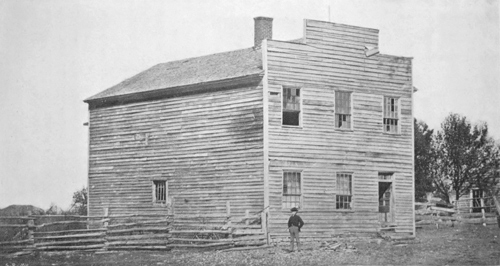
THE FIRST WISCONSIN CAPITOL AT BELMONT
NELSON DEWEY PARK AND THE FIRST WISCONSIN CAPITOL
Several other matters of peculiar interest to the historically-minded citizens of Wisconsin were acted upon by the recent legislature. We record with chief pleasure in this connection the provision made for the preservation of our first territorial capitol at Belmont (now Leslie). Eleven years ago the superintendent of the Society, Dr. Thwaites, made an effort to secure the restoration of this quondam statehouse for a region imperial in extent, and the story of his effort is told in the Proceedings of the Society for 1906. At that time the legislature failed to act upon his sensible advice, however, and the matter was allowed to drop. At the recent legislative session, Mr. M. P. Rindlaub of Platteville, veteran editor of southern Wisconsin, took up anew the agitation for the preservation of the capitol building. This time the advice was heeded and the sum of $3,000 was appropriated Pg 79 for the purpose in view. Mr. Rindlaub’s plan contemplated the removal and renovation of the capitol and the making of provision for a permanent caretaker who, under the control of the state conservation commission, should look after it. For these objects the sum of $10,000 was asked. The amount granted will suffice but partially to execute the entire project, but it will at least insure the permanent preservation of the building.
The action of the legislature in naming the state park at the mouth of the Wisconsin was, in our opinion, distinctly unwise. Citizens of Wisconsin do not need to be reminded that the historical association which provided the driving motive for securing this splendid tract for a state park preserve several years ago was the discovery of the Mississippi River at this point by the famous expedition of Jolliet and Marquette in 1673. Because of this fact, and of the additional one that the park was bought by and belongs to the entire state, the name either of Jolliet or Marquette should unquestionably have been given to the park. As between these two there would perhaps be little reason for preference were it not for the fact that Marquette has twice been signally honored by the state (by naming a county for him and by choosing him as one of the two Wisconsin characters whose statue is placed in the national capitol) while to Jolliet no recognition, official or otherwise, has ever been accorded in Wisconsin.
Curiously enough, the park has been allowed to exist for several years without a legal name. During this time residents of the vicinity developed the habit of calling it Glenn Park, after former Senator Glenn who sold the land to the state, while the conservation commission, as a matter of convenience, referred to it as Marquette Park. When a bill was introduced at the recent legislative session providing that the park be officially named after Senator Glenn, a number of officers and members of the Society bestirred themselves Pg 80 to defeat the measure through the process of enlightening the legislature with respect to the historical and other considerations involved. It is proper to record in this connection that Assembly Kurtenacker of La Crosse, on being apprised of the situation, cheerfully joined with the representatives of the Society in the effort to have the bill which he had himself introduced by request, killed in committee. This effort met with success, and the assembly committee on state affairs reported a bill to the lower chamber providing that the park be named in honor of Jolliet. The assembly passed the bill, but in the senate it was amended by substituting for Jolliet the name of Nelson Dewey, first governor of the state, and in this form it became a law.
We believe that the motive which prompted the senate amendment was laudable, but that the judgment displayed was weak. Apparently the impression that the park should be considered in some peculiar sense as a perquisite of the people of southwestern Wisconsin, as opposed to the state as a whole, could not be surmounted. With no remote desire to detract from the fame or merit of Governor Dewey, we do not think the mere circumstance of his residence having been at Cassville constitutes a pertinent reason for giving his name to this park, the very existence of which is due to the famous discovery of June 17, 1673. Incidentally, however, the entire discussion was productive of good, since it called the attention of the public anew to the value and significance of the factor of historical associations in the selection of place names.
PERROT STATE PARK AND JOHN A. LATSCH
Another park development of the past year which is peculiarly gratifying to the State Historical Society pertains to the new state park at Trempealeau. For many years the Society has been actively interested in this locality because of the richness of its historical associations. In particular, in recent years a series of historical articles pertaining to the Pg 81 locality written by Dr. Eben D. Pierce, member and curator of the Society, has been published in the volumes of Proceedings. Largely through these activities the interest of Mr. Latsch, a leading business man of Winona, was awakened to the desirability of securing historic Trempealeau Mountain and the adjoining river frontage as a permanent park preserve. To this end he purchased some 800 acres of land including the mountain and the adjoining river bluffs, and offered the whole as a gift to the State Historical Society. Because the Society lacks the facilities for administering such a trust, on the Superintendent’s recommendation the gift was diverted to the conservation commission, which is admirably qualified to administer it. At the time of writing these lines (July, 1917) it only remains to complete certain legal details when the formal transfer of the property to the state will be made. Thus the famous peak, noted by Pike and Schoolcraft and many another early explorer, together with the site of ancient Fort Perrot, one of the earliest establishments of civilized man in the upper Mississippi Valley, is added to our already splendid system of state parks. Aside from the historical associations of the place, the river scenery at this point is rarely impressive and beautiful; while Trempealeau Mountain itself is said to be peculiarly rich in botanical specimens.
But by what authority, it may be asked, have we headed this editorial “Perrot State Park.” Pressed for an answer, we must admit that the title expresses a hope merely, rather than a consummation already realized. One of the motives, we understand, responsible for the interest Mr. Latsch has shown in the matter was a feeling of veneration for his boyhood home and for his Swiss father who settled in Latsch Valley some two generations ago. Under the circumstances it would not be strange if the donor, following the example long since set by a notable giver of libraries to the American public, should impose as a condition of his gift to the state Pg 82 the requirement that the park be named in honor of his father. We understand, instead, that Mr. Latsch himself desires the park to be named in honor of Nicolas Perrot, the famous French explorer, who passed the winter of 1685-86 a short distance down the river from Trempealeau Mountain and within the confines of the new state park. The fine modesty and sense of historical appreciation displayed by Mr. Latsch in thus desiring to honor the intrepid explorer require no words of commendation at our hands. We may express the hope, however, that when a future state legislature shall come to the task of bestowing a legal name on the park, it will possess a like degree of judgment concerning the historical fitness of things. Perhaps Mr. Latsch might insure this in advance by making the gift of the land to the state dependent upon its acceptance of the name of Perrot for the park.
FOREST FIRES, GENERALLY AND IN PARTICULAR
From the beginning of Wisconsin’s development until the close of the nineteenth century, lumbering constituted one of the chief sources of the state’s wealth and business activity. In 1860 the lumber industry, still in its infancy in Wisconsin, ranked second only to agriculture in importance. The story of its rise and decline constitutes one of the most important and thrilling chapters in our history as a state. In this respect our history conforms to the general rule that in every new country the natural resources closest at hand are the first to be exploited. Well had it been for state and nation had our lumbermen, in their mad rush to transmute our magnificent forests into gold, paid more regard to the welfare of future generations and squandered less recklessly this splendid “gift of the ages.”
This statement of these reflections brings us to the point of suggesting the broader historical significance of Mr. Bracklin’s article in the present number of the Wisconsin Magazine of History. One of the prolific factors making Pg 83 for the waste of our lumbering resources was fire. In the words of a recent writer this was “the dread scourge of the lumber industry.” The sawmills and sawmill towns, flimsily constructed of inflammable pine, were periodically swept by the flames. Although the mills and mill towns were commonly rebuilt with characteristic American vigor, the forest fires were the source of appalling loss to the state. Yet the public mind was for many years indifferent to these losses, and the fires were commonly left to burn themselves out, with no human effort to impede or check the course of the flames. In 1864 one of the greatest conflagrations which had ever visited the state swept for weeks through the northern pinery regions, yet so indifferent were the people of southern Wisconsin to the matter that it received scarcely any notice in the newspapers of this section.
Our numerous forest fires, then, have possessed not only thrilling human interest but vast economic significance. Mr. Bracklin’s narrative describes a single personal experience with one small forest fire. What he experienced and here describes, however, applies with suitable variation of details to hundreds of similar events in Wisconsin. In this fact consists its broader significance.
CONSOLATION FOR THE PRESENT CRISIS
It seems evident, from the sources of information at our command, that the Imperial German Government counted largely on its ability to neutralize the national will of America by fostering among Americans of German descent a spirit of disloyalty to their country. That the citizens of the Badger State in particular could thus be cajoled into playing a traitor’s rôle was not only believed in Germany, but widely feared in our own country as well. That our citizens of German descent should be enthusiastic about going into the war was not reasonably to have been expected; that, faced with a hard duty, they should prefer to play the rôle of Pg 84 traitor is quite another matter. We do not believe, and from the beginning have not feared, that any considerable number will make such a choice.
In such a time of trial and stress as the present we are fairly entitled to gain what comfort we may from an examination of our past. The simple truth is that, with the possible exception of the Spanish War, we enter upon the present struggle with more of unanimity and resolution than has been the case with any other great war in our history. Of our unfortunate divisions and discords during the Revolution and the War of 1812 every schoolboy is informed. The North had little enthusiasm for the Mexican War and largely abstained from participation in it. The Civil War was a fratricidal contest, but the South eliminated from consideration, the people of the North were sadly divided in counsels and desires. That this was true of Wisconsin has been largely forgotten by our citizens. The present generation has forgotten, if indeed it was ever aware of, the fact that Wisconsin was the seat of a formidable copperhead sentiment during the war; that there was widespread opposition to the enforcement of the draft by the federal government; and that a largely attended mass meeting at the state capital in April, 1861, after the firing on Fort Sumter, laid on the table a resolution pledging support to President Lincoln. It is true the local paper declared, in the latter instance, that a majority of those present favored the resolution but were circumvented in their desire by the chairman of the meeting; but even so it is evident that there must have been a large element of opposition to have enabled him to carry through the maneuver. Notwithstanding the deliberation with which the recent legislature went about expressing its support of the national government, it requires no hardihood to affirm that no chairman of a public gathering, however traitorous his desire, could have prevented a Madison audience of 1917 from expressing its intention of standing behind the national government.
Pg 85 To touch for a moment upon another matter, the political ideals of the period preceding the Civil War were shockingly low in comparison with those of the present time. If there has been any graft in connection with the construction of our new $7,000,000 capitol, the public is as yet totally unconscious of the fact. Three-quarters of a century ago, on the contrary, we could not build even a forty-thousand-dollar capitol without a riot of mismanagement and dishonesty. The period of “Barstow and the balance,” and of the “forty thieves” signifies more than the addition of a picturesque phrase to our political annals. Instead of constituting a rare exception, the political morality which these phrases suggest was painfully commonplace in Wisconsin prior to the Civil War. It was only a few years before we entered upon that great struggle that a powerful corporation brazenly established a pay-counter at the capital and bought with paltry silver the entire state legislature, and even the governor himself. Idealists are by no means satisfied with the political standards and practices of our public men of the present day, but they are lily-white in comparison with the similar standards of the fifties in Wisconsin.
Or again, let us glance by way of comparison at the financial situation. The diary of Harvey Reid, published elsewhere in this magazine, affords an inkling, at least, of our deplorable financial condition in 1861. The national banking-system still lay in the womb of the future, while the treacherous “wild cats” flourished at the expense alike of private fortunes and public credit. With the first breath of war these institutions toppled in headlong ruin, notwithstanding that the state legislature, heedless of constitutional prohibitions, essayed vainly to prevent the crash. Within four days after the news of the firing on Fort Sumter, specie payments were suspended in Wisconsin; and the efforts of the government to float a war loan of $1,200,000 on the credit Pg 86 of the state of Wisconsin in the summer of 1861 met with dismal and inglorious failure.
We do not remind the present generation of these things in any pharisaical attitude, but for the encouragement they afford to us at this time. The outstanding fact is that in the very face of such conditions as we have adverted to, Wisconsin girded herself for the task and played a noble part in the Civil War. We enter the present struggle immeasurably better prepared from almost every viewpoint than we did the one of old. If, as we believe, our people still retain a fair measure of pluck and ability, the record we are about to make should be correspondingly better than that of fifty years ago.
Pg 87
THE QUESTION BOX
The Wisconsin Historical Library has long maintained a bureau of historical information for the benefit of those who care to avail themselves of the service it offers. In “The Question Box” will be printed from time to time such queries, with the answers made to them, as possess sufficient general interest to render their publication worth while.
THE OLDEST CHURCH IN WISCONSIN
You will recall the little church in Ephraim where you gave us your historical address a few years ago. This church was built in 1857, dedicated in 1859, and has been in continuous use ever since.
I have wondered if there is any older church still in use in Wisconsin. I have gone through the records of two-thirds of the counties of the state and, while I have found that many churches were erected prior to this, these have all been superseded by later structures. I wonder if your staff can give me any assistance in ascertaining the existence of any older house of worship?
H. R. Holand, Ephraim, Wisconsin.
One of the oldest church buildings in Wisconsin is undoubtedly that known as The Old Mission on Madelaine Island. This was built in 1839 and dedicated in 1840 for the American Board of Home Missions, now part of the Presbyterian denomination. This building is now used for worship at least during the summer season, but has not been so employed consecutively, as it was closed in the fifties and not reopened until 1892. In 1901 is was removed to its present location, and restored and redecorated in 1915.
The oldest frame church in Wisconsin was built in 1839 at Kellogg’s Corners, now Sylvania, in Racine County, for the use of the Methodist denomination. So far as we can ascertain, the old church is still standing, but whether or not it is now used for service we are not informed.
Pg 88 There is a country church near Waterford in Racine County which was built in 1846 and is still in excellent condition and in active use. Only last year it was thoroughly renovated at a cost of some $3,500—several times as much as the original cost of the building. This church stands in what is known as the English Settlement by reason of the fact that the community was largely settled by immigrants from England in the early forties. The church is unique both in its organization and in its history.
It is evident, therefore, that while your church at Ephraim may be among the older structures of the state still used for religious services, it cannot claim the honor of priority in this respect.
THE FIRST MILLS IN THE FOX RIVER VALLEY
I am preparing recollections of early days in the Fox River Valley and will be pleased to supply you with results of my efforts in this direction. I am somewhat confused on some of the items, especially the establishment of the first saw and grist mill on the south or east side (my old home), of the river and across from Kaukauna. My friend, Mr. John D. Lawe, son of the late George W. Lawe, writes me that James M. Boyd and Paul Hudon dit Beaulieu, my grandfather, “built a saw mill along the rapid,” etc. The date given by Mr. Lawe for the building of the saw mill is 1832. A few years later my father, Bazil H. Beaulieu, came in possession of both mills. I was told when I was a boy that the mills were originally built by the federal government for the use and purposes of the Menominee, as also of the Brothertown Indians, the latter being now scattered on farms on the east shore of Lake Winnebago, across from Oshkosh. Furthermore, I was told that the said mills were the second of the kind built in Wisconsin, then the territory of Michigan. Have you any facts or data at hand which might serve to verify or throw more light on the subject?
T. H. Beaulieu, White Earth, Minnesota.
With regard to the Fox River Valley mills, the earliest, both saw and grist, were built by Jacob Franks on Devil’s River some time shortly after 1800. They afterwards came into the possession of John Lawe, and were operated by him for many years. Pierre A. Grignon built a grist mill on Reaume or Glaize Creek in 1810. This was used to provide food for the war parties of Robert Dickson in Pg 89 the War of 1812. The miller was Grignon’s brother-in-law, Dominique Brunette usually called Masca.
Augustin Grignon built a grist mill at Kaukauna on the north side of the stream, about 1818. Two years later the United States government had a sawmill erected at Little Rapids to prepare material for Fort Howard and its outlying buildings.
In 1821-22 the Menominee, who had a village at South Kaukauna, sold a large tract to the New York Indians. In the latter year the Stockbridge began to move to their tract, which began just above the Menominee village. The government had built for the Stockbridge Indians a sawmill, which was finished some time before 1830. At that date a grist mill was proposed by the Stockbridge. Probably that was when your father took over the mills and repaired them, and perhaps enlarged them. The Brothertown Indians were settled with the Stockbridge, and removed with them to the east side of Lake Winnebago. The Menominee Indians had mills built for them by the government, but that was after the Treaty of 1846, and they were built much higher up the river, at or near Menasha.
COLONEL ELLSWORTH’S MADISON CAREER
I am collecting materials for a life of Col. E. E. Ellsworth and would ask if you have in your library anything concerning his drilling of the Governor’s Guard in your city in the space between 1858 and 1860. I understand that his stay was not very long, a few weeks probably, but I cannot state definitely the year. It would be a great help to me if you would look up this matter, and if you could send me full information and copies of important phases relating in any manner to his sojourn in your town, I would be greatly obliged. I am in this work simply to resurrect and save from oblivion the history of a great and martyred name of our country, one which has been strangely neglected. The more I study into his life and collect the materials from scattered and almost forgotten sources, the more I am convinced that he was a young man of remarkable genius, worthy of perpetuation in the annals of the nation.
From the success that has so far rewarded my search, I am encouraged to believe that ere long I will be in possession of everything of real importance that belonged to his career. I was well acquainted with his father and my home is within easy reach of his birthplace. Pg 90 and of Mechanicsville, New York, where he was buried and where a fine monument stands to his memory.
C. A. Ingraham, Cambridge, New York.
We find in our collections a few memorials of E. E. Ellsworth that we think would interest you. In an old book of autographs there is a tiny photograph that has been identified as that of Ellsworth. It is only about an inch long and yet it is perfectly clear and well-defined; the uniform shows to great advantage, and there are three medals on the breast of the coat. Among the other relics is a drawing about sixteen inches by twelve, the head of a fine-looking man with lifted eyes. This is signed “Ellsworth” and “EEE.” It was presented to the Society by N. B. Van Slyke, who gave the information that it was a “Sketch drawn by Col. E. E. Ellsworth in 1858 at Madison, Wisconsin, and presented to N. B. Van Slyke while the young man was at Madison.” Pasted upon this drawing are several newspaper slips giving Ellsworth’s biography, the last letter which he wrote to his parents from Washington, May 23, 1861, accounts of his death and funeral, and a poem in his honor.
Upon consulting the Madison newspapers for 1858 we secured the following items: The Governor’s Guard was organized February 18, 1858, with Julius P. Atwood as captain. April 20, the Guard appeared upon the street for the first time trained by Lieutenant C. W. Harris. The Guard was very prominent socially, and gave many balls and soirées. It took part in public celebrations on the Fourth of July, at the university commencement, and at the state fair. June 25, the Guard first appeared in uniform. No mention appears of Ellsworth until Oct. 15, 1858, when a Cadet Corps formed. Twenty-five Madison boys met at the Governor’s Guard Armory, and Maj. E. E. Ellsworth, who was unanimously elected commandant, immediately put the cadets to drill. October 18, the Governor’s Guard was summoned to drill three evenings in the week, no spectators allowed. October 20 the papers contain notices of the drilling of the cadets by their commandant, Maj. E. E. Ellsworth, who “Is an accomplished and thorough drill master.” Another paper says the cadets “are ambitious to become the best drilled company in the State and their aptness has called forth a high compliment from Major Ellsworth.”
Pg 91 An exhaustive search does not reveal his name again. On December 26, 1858, the Governor’s Guard “were out in full uniform for the first time since the State Fair and to us appear much improved in a military point.”
We have not been able to determine what brought Ellsworth to Madison. W. J. Ellsworth lived in the city at the time. Possibly they were kinsmen.
One other relic of Ellsworth’s activities among us is in the Keyes Papers. In 1910, Col. Elisha W. Keyes wrote an article for the Madison Democrat on the organization of the Governor’s Guard. In it he says “Soon after the organization of the guard he [Ellsworth] appeared in Madison and spent much time, without Compensation, in drilling the men. He was then a young man, not much over 30 years of age. He had been an apt student of military science and discipline. His heart and soul were in the work. His enthusiasm was boundless, although at the time of his work here no one hardly dreamed that the rebellion was possible. Before he left he contemplated the full organization of the eighteenth regiment State militia [of which Keyes was then Colonel]. I have in my possession now a roll of maps and instructions for regimental drill, which involved much labor, that he prepared for me, as colonel, without reward.” These drafts came to the Society with Judge Keyes’s other papers. They are large map-like drafts, colored, of the positions of the regiment, and fully written out directions in Ellsworth’s own hand for the various orders for military positions and movements.
Probably you know that Ellsworth’s diary was given to Frank Brownell, his avenger. We have two pamphlets giving liberal excerpts from the diary, but we find therein no mention of Madison. Probably the full text of this diary would show when and why he came to Madison.
Your letter of the nineteenth instant concerning Ellsworth is before me and I wish to thank you earnestly for the time and care which you have devoted to this subject; it illuminates a portion of his career with which I was entirely unacquainted and which to have searched out myself would have involved much expense and inconvenience. Your communication will be excellent to appear verbatim in the book.
Pg 92 I am unable to say as to the identity of W. J. Ellsworth, but I have written to an uncle of Colonel Ellsworth who may be able to shed light on the matter. Colonel Keyes, when he estimated Ellsworth’s age as “not over 30 years” when he was in Madison, was evidently deceived by his remarkable degree of development, which was in advance of his age: at that time he was but twenty-one, having been born April 11, 1837.
Ellsworth’s diary I have not yet unearthed. John Hay’s article published in McClure’s Magazine, VI, 354, has many citations from it, but nothing concerning Madison. Mr. Hay also contributed to the Atlantic, very soon after Ellsworth’s death, a fine article on him (VIII, 119), and the two comprise the best literature so far published on Ellsworth. These two young men were students in Lincoln’s law office, and Mr. Hay all his life down to his last years mourned for him, whom he estimated as a most wonderfully brilliant and patriotically devoted man whose future would have been exceedingly prominent and useful. My own investigations lead me to the same conclusion. Yet he had very few early advantages; practically none, except a limited district school education. His parents, whom I knew, were plain people, and others of the relations whom I have met or corresponded with exhibit nothing out of the common.
C. A. Ingraham, Cambridge, New York.
THE STORY OF “GLORY OF THE MORNING”
We are about to give the play Glory of the Morning. I am under the impression that there was such a character in Wisconsin as “Glory of the Morning,” and that she was married to a Frenchman, and deserted by him, as in the play.
Can you give me any information concerning her?
(Mrs.) F. H. Anderson, Brooklyn, Wisconsin.
“Glory of the Morning” was an historical character, and one of the staff on the Wisconsin Historical Society related to Professor Leonard the incident on which he founded the play. He has taken poet’s license with certain parts—with the names, for instance, of the son and daughter; but in Wisconsin Historical Collections, VII, 345, you can read the story as told by a French-Canadian trader. “Glory of the Morning” was a Winnebago chieftess, and Jonathan Carver, when very old, saw her at her village near Menasha, Wisconsin. The French officer whose name was Sabrevoir Decorah (also spelled Pg 93 DeCarrie, DesCarie, DeKaury, and other ways), came to Wisconsin probably during the Fox wars of the early eighteenth century. He married the daughter (“Glory of the Morning”) of the head chief of the tribe; resigned from the army, and became a trader. They had two sons and a daughter. When the French and Indian War began Decorah was summoned to become a soldier, and he took his daughter with him to be educated in Canada. The father was killed at the battle of Ste. Foye in 1760. The girl married a Montreal merchant and her son or grandson, Laurent Fily, came to Wisconsin as a trader and lived for many years with Augustin Grignon at Kaukauna. Many of his letters are in the Wisconsin Historical Library.
The two sons of the chieftess became chiefs of the tribe, and had many descendants. The Decorah family in the nineteenth century was the most powerful of the Winnebago families. Several of its members still live in Nebraska. Two years ago an educated Indian girl, teacher of art at Carlisle Indian School, visited Madison. Her maiden name was Angel Decorah, and she traced her lineage directly to “Glory of the Morning.” The Winnebago name of the chieftess was Hopokoékaw.
THE ODANAH INDIAN RESERVATION
Will you please give me some information concerning the reservation near Odanah, Wisconsin? I desire to learn the names of the chiefs who ceded the reservation and also the terms of the cession; what each member of the tribe is entitled to receive, and the address of the agent. I am entitled to the same per-capita allotment as other members of the tribe and this fact accounts for my interest in the matter. Please give me, therefore, a history of the reservation.
George Allen, Bay Shore, Michigan.
The Chippewa of Lake Superior made a final cession of all their lands at a treaty held at La Pointe, September 30, 1844. In return for the cession, the government provided several reservations for the tribesmen. That at Bad River, of which the chief town is Odanah, comprises 124,333 acres of land. This land, at the time the reservation was set aside, was heavily timbered. The Indians were entitled to annuities for twenty years, and each head of a family or single person over twenty-one years of age had the right to eighty acres Pg 94 of land. The chiefs who signed the treaty were members of the La Pointe band.
In 1875 the annuities were paid for the last time, according to the treaty stipulations. Congress, however, in consideration of the Indians’ need, made appropriations to continue the payments for several years. After 1882 the Indian Department permitted the sale of timber from the reservation; logging operations furnished wages for the working Indians, and the sale of the timber placed a considerable sum to their credit. The Chippewa claimed additional sums on treaty stipulations. Whether these claims have ever been settled or not can be ascertained from the Indian Department at Washington. As for the land, by 1913, 83,871 acres had been allotted in eighty-acre tracts to genuine claimants. Enough of the reservation remains for more eighty-acre tracts to be assigned to those who can prove their rights to claims. Timber is still being taken from the reservation.
For further information write to R. S. Buckland, special agent for the Chippewa Indians, Baraga, Michigan; or to Philip S. Everest, superintendent, Ashland, Wisconsin.
FIRST EXPLORATION OF EASTERN WISCONSIN
I should be pleased to ascertain who was the first white man to pass or voyage past the shores of Sheboygan County, Jolliet and Marquette or Father Claude Allouez? Allouez is said to have been the first to explore the west shore of Lake Michigan, but I have not been able to find out whether he reached Sheboygan County.
Alfonse Gerend, Cato, Wisconsin.
We dislike very much to say dogmatically who was the first Frenchman to skirt the coast of Lake Michigan south of Sturgeon Bay portage. The more we study the subject the more we are inclined to believe that the records we possess reveal but a fragment of the activities of the French explorers, traders, and missionaries around Green Bay during the seventeenth century. We do not know but that Jean Nicolet may have coasted south in 1634; on the other hand, we do not know that he did. No one has yet been wise enough to lay out the course of the wanderings of Radisson and Groseilliers. For my own part, it seems probable that one of the first, if not Pg 95 the first, white Frenchman who visited all the villages between Green Bay and Chicago was Nicolas Perrot, who between 1665-70 spent five years in the country, much of the time with the Potawatomi tribesmen. Benjamin Sulte, a very careful Canadian investigator, asserts categorically that Perrot was the first white man at Chicago. (Sulte’s articles in French in the Canada Royal Society Proceedings, 1903-13, throw much light on early seventeenth century conditions. They have never been translated, and are known only to a few scholars.) So far as I am able to judge, however, Sulte’s statement is based purely upon inference and is not backed by a written account. Therefore, it is certainly fair to say that the first definite written record of white men skirting the coast of the western shore of Lake Michigan is found in the journal of Father Jacques Marquette, who in September, 1673 came back to Green Bay via the Chicago and Sturgeon Bay portages.
With regard to Father Claude Allouez, I think we can speak with more certainty. He did not go to the Illinois mission until after the death of Marquette. He set out in the autumn of 1676 and wintered among the Potawatomi near Sturgeon Bay. You will find a synopsis of his voyage in Wisconsin Historical Collections, XVI, 96.
You may be interested in seeing a copy of Early Narratives of the Northwest just published by Scribner & Co. This volume contains most of the journals of these early explorers.
A COMMUNITY CHANGES ITS NAME
Some twenty-five years ago there was a place in Wisconsin called North Greenfield. Evidently the name has been changed for the reason that letters addressed to individuals at that place are returned, with the information that there is no such place in the state.
What is the present name of the locality formerly known as North Greenfield?
Seymour Morris, Chicago, Illinois.
The post office, situated in Milwaukee County, and known as North Greenfield, changed its name about 1903, when it became West Allis.
Pg 96 HOW THE APOSTLE ISLANDS WERE NAMED
If such record exists, I should like to obtain from it a statement of how the individual islands of the Apostle group received their names, and how the group came to be named Apostle Islands.
H. E. Hale, Minneapolis, Minnesota.
The collective name of Apostle Islands for the group off the coast of Chequamegon Bay is nearly two centuries old. The first map on which it appears is that of Bellin in 1744. This was founded on the information given by Father Pierre François Xavier de Charlevoix, a noted Jesuit missionary, who in 1721 visited the western country as an agent for the French government. Charlevoix did not go into Lake Superior in person, but at Sault Ste. Marie and Mackinac he made extensive inquiries of competent observers, and noted down the information given him by traders and officers from that region. Thus he, no doubt, learned that the islands were known to the French who frequented that place as “The Twelve Apostles,” and as such they appear on the map of Bellin that was issued in Charlevoix’s book published in Paris in 1744.
The first English traveler to note these islands was Jonathan Carver, who coasted the shore of Lake Superior in 1767 and on the map published in his volume of Travels (London, 1778) repeats the name “Twelve Apostle Is.”
The first American travelers in that region were those who accompanied Lewis Cass, who in 1820 made an official voyage along the southern shore of Lake Superior. One of the members of this party was James D. Doty, who was afterwards territorial governor of Wisconsin. In Doty’s journal, published in Wisconsin Historical Collections, XIII, 201, he says: “The Islands, called by Charlevoix 'the 12 Apostles,’ extend about 20 miles from point Chegoiamegon.” Another member of the same party was Henry Rowe Schoolcraft, who later became Indian agent at Sault Ste. Marie, and married a half-breed Indian girl descended from the Chequamegon chiefs. Schoolcraft proposed to change the name of the Twelve Apostle Islands to Federation Islands. He assigned to the several islands the names of states of the Union, giving that of Virginia to Madelaine, the largest of the group. Schoolcraft’s proposal was not followed, but the Pg 97 present names of York and Michigan Islands seem to remain as part of Schoolcraft’s proposal. Apparently the early traders, counting the islands loosely, thought there were twelve in all, and since the mission was named Mission du Saint Esprit (or Holy Ghost Mission) the name of Twelve Apostles Islands seemed appropriate. There are (we believe) in reality nineteen, nevertheless the name, Apostle Islands, has persisted.
With regard to the several names of the separate islands: We have above accounted for York and Michigan. Outer Island explains itself, as do Ironwood, Oak, Basswood, Sand, Rocky, North and South Twin, Bear, Cat (Wild Cat, no doubt), and Otter. Raspberry Island takes its name from Raspberry River. This name was used in its French form Rivière à la Framboise as early as 1804 (probably earlier). See Wisconsin Historical Collections, XIX, 174. Devil Island and Manitou Island are both the same name. That is, the Indians called all supernatural beings “manitous.” Hermit Island and Stockton Island have probably some local significance from dwellers upon their area. We are not informed concerning them. Madelaine Island has been known by many names. Its present name is that of the wife of an early trader, Michel Cadotte. She was an Indian woman whose father was a local chief. Madelaine was the name she received when baptized. The island was frequently known as St. Michel, or St. Michael’s, from the given name of Cadotte, who was the principal trader on the island for many years. Its Indian name was Moningwanekaning, supposed to mean the Place of the Golden-breasted Woodpecker (hence, sometimes, Woodpecker Island). However, Father Chrysostom Verwyst, a Catholic missionary, now our best authority on Chippewa place names, defines it recently in Acta et Dicta (July, 1916), published by the Catholic Historical Society of St. Paul, as “the place where there are many lapwings.” This island has also been called La Ronde, for a French commandant of the eighteenth century; La Pointe Island, from the name of the region La Pointe du Chequamegon; and Saint Esprit Island from the early Mission du St. Esprit mentioned above. It was also sometimes called Middle Island as lying midway between Sault Ste. Marie and Fort William, the fur-trade post on the northwest of Lake Superior. Sometimes it appears on maps as Montreal Pg 98 Island; the reason for this we do not know; perhaps it was the terminus of the trip from Montreal, Canada, or was so named because some of its inhabitants had been educated at Montreal.
To recapitulate: the largest island of the Apostle Group was first known as Moningwanekaning or Woodpecker or Lapwing; in the eighteenth century as La Ronde, La Pointe, and St. Esprit; was known to the fur traders as Middle and Montreal; was christened by Schoolcraft, Virginia; has been known since about 1800 as Cadotte’s, St. Michael’s, or Madelaine from its early inhabitants, and the baptismal name of the Indian woman has persisted.