Volume 1 — CONTENTS OF VOLUME I (continued 8)
Reading edition
Al J. Hartley, Cornell, Wisconsin.
Probably the first white person to pass the mouth of the Chippewa was Father Louis Hennepin, who ascended the Mississippi in 1630. He describes the Chippewa under the name of Rivière des Boeufs (Buffalo). It is probable that in his time the Beef Slough was part of the Chippewa channel, and the present Buffalo River an affluent of the Chippewa proper. In 1682 La Salle wrote a description of the rivers of Wisconsin in a letter, the translation of which is found in volume sixteen of the Collections of the Wisconsin Historical Society. He says “About thirty leagues, ascending always in the same direction [above Black River], one comes to the Rivière des Boeufs which is as wide at its mouth as that of the Islinois. It is called by that name owing to the great number of those animals found there; it is followed from ten to twelve leagues, the water being smooth and without rapids, bordered by mountains which widen out from time to time, forming meadows. There are several islands at its mouth, which is bordered by woods on both sides.” La Salle’s description was without doubt taken from the account of Hennepin.
The next visitor to this region was Duluth, who in 1680 rescued Father Hennepin from his captors, the Sioux Indians, and brought him down the Mississippi and by the Wisconsin-Fox route to Green Bay. Duluth has not left any description of the Chippewa.
In 1685 Nicolas Perrot was governor of all of this region. In the Proceedings of this Society for 1915 you will find an account of Perrot’s experiences and of the Fort Antoine that he built at the mouth of the Chippewa. Perrot called the stream River of the Sauteurs, which was the French name for the Chippewa tribe, whom they first met at the Sault, hence Saulteurs or Sauters. Perrot seems to have been the first person to use the name Sauteur or Chippewa for the river. It so appears on a very remarkable map drawn in 1688, Pg 323 and now in Paris. A facsimile of this is in the Wisconsin Historical Library, at Madison, and a photograph appears in L. P. Kellogg’s, Early Narratives of the Northwest (New York, 1917), 342. At Fort St. Antoine, Perrot in 1689 held a great ceremony, taking possession of all the Sioux country for the King of France. A translation of this document is found in volume eleven of the Wisconsin Historical Collections, 35-36.
The name of the river indicates that the Chippewa was the home of some portion of the Chippewa tribe. In the early eighteenth century this valley became the battle ground of the great feud between the Sioux and Chippewa Indians, which lasted nearly one hundred and fifty years. Much interesting material on this subject may be found in Minnesota Historical Collections, volume five, which is a history of the Chippewa tribe by a half-breed, W. W. Warren.
In the year 1766, three years after the French had ceded all this territory to the British crown, the noted explorer, Jonathan Carver, ascended the Mississippi and attempted to bring about a peace between the warring Sioux and Chippewa. The next year he returned from Mackinac, and with a stock of goods ascended the Chippewa River, at whose headwaters he found a Chippewa village of one hundred fine stout warriors. Their customs, however, were very filthy. This is, so far as we know, the first recorded voyage through the Chippewa valley. No doubt, however, many fur traders had preceded Carver, for he speaks of engaging a pilot to accompany him.
In the last years of the French régime there was reported a copper mine on this river, which was then called for a time “Bon Secours” or Good Help River. Carver calls it the Chippewa River. About six years after Carver’s visit a British trader named Hugh Boyle was killed at this river. See Wisconsin Historical Collections, XVIII, 312-13. According to the court of inquiry ordered by the British officials, the affair was his own fault.
The British traders continued to trade on this river, notwithstanding the danger caused by the fierce intertribal wars. In 1805 the United States government sent Zebulon M. Pike, a young army lieutenant, to ascend the Mississippi and warn British traders that this was then American territory. It became so by the treaty of 1783, but the British kept the forts on the Great Lakes until 1796, Pg 324 and all had continued to act until Pike’s visit as if the upper Mississippi region belonged to the British. Pike found that the traders avoided the Chippewa River because of the danger of falling in with war parties of contesting Indians. He passed the river’s mouth about dusk.
In 1820 an American expedition headed by Lewis Cass descended the Mississippi, and from that time on there were numerous boats going up and down. The first steamboat ascended to the Falls of St. Anthony in 1823. Some very early logging expeditions in 1822 and 1829 are described in the Wisconsin Historical Collections, II, 132-41, and V, 244-54.
The earliest permanent settlers were the Cadottes. See Wisconsin Historical Collections, XIX, 171, and Minnesota Historical Collections, volume five.
THE CAREER OF COLONEL G. W. MANYPENNY
Can you give me any reference to any publication or record in your library relating to G. W. Manypenny, who was Indian commissioner in 1855 and in that year made a treaty with the Chippewa Indians of Wisconsin?
E. S. Gaylord, Minneapolis, Minnesota.
Colonel George W. Manypenny, who was Indian commissioner in President Pierce’s administration, was not a Wisconsin man. He was born in Pennsylvania, and appointed from Ohio. His home was in Columbus, Ohio, and as early as 1835 he was editor of a prominent Democratic paper at that place. His appointment was no doubt a reward for journalistic services during the campaign; but he seems to have taken his duties seriously and to have undertaken the rôle of a defender of the red men against the extortions of unscrupulous speculators. In doing this he incurred the enmity of a powerful political clique among whom was Senator Benton.
Manypenny went west in August, 1853, and made the series of treaties that opened up the territories of Kansas and Nebraska for settlement. It is claimed that he acted in the interests of the South with regard to the Pacific railroad. See Wisconsin Historical Society Proceedings, 1912, 80. In 1855 Manypenny made the treaty Pg 325 with the Mississippi bands of Chippewa at Washington, whither their chiefs had been conducted by Henry M. Rice.
Manypenny retired from office in March, 1857, and returned to Columbus where, in 1859, he purchased a half interest in the Ohio Statesman and was its editor for three years. In 1862 he retired to become manager of the state public works, of which he was one of the lessees. His interest in the Indians continued, and in 1876 he was appointed a chairman of the commission to investigate the troubles that had led to the Sioux outbreak of that year. In 1880 he published a book entitled Our Indian Wards (Cincinnati, Robert Clark & Co.), which is a plea for more fairness in the management of Indian affairs, and a recital of many of their wrongs.
The date of his death we have not ascertained, nor whether he left descendants. An inquiry of E. W. Randall, secretary of the Ohio Archaeological and Historical Society, at Columbus, would doubtless put you in possession of these facts.
TREATY HALL AND OLD LA POINTE
Will you kindly advise me what “Treaty Hall,” La Pointe, Madeline Island, stands for historically? When and by whom was it built? Some say it was erected in 1836 and others say 1857 or 1858. The treaties were signed before the latter date, so why call it “Treaty Hall”? Any information you can give on the subject will be greatly appreciated.
Mrs. Frank H. Jerrard, Representative St. Paul Chapter, D. A. R., St. Paul, Minnesota.
The information we have obtained concerning the building on Madeline Island now called “Treaty Hall” does not give conclusive proof of the origin of the building. One fact seems clear—the name “Treaty Hall” was not applied to it until the eighties of the last century, and the building was not put up to accommodate the negotiating of a treaty. Whether a treaty was negotiated in this building or not is another question. As a rule Indian treaty proceedings were held in the open air; if any covering was desired, a kind of shade was built of boughs, or a circle was temporarily enclosed with poles, boughs, and mats. Nevertheless it is not improbable that in Pg 326 the northern region of Madeline Island, with the cold winds from the lake blowing in, a treaty might have been held under shelter, and that some appropriate building might have been thus used.
There were only two treaties held on Madeline Island, that of 1842 and that of 1854. The former was concluded October 4, 1842, and the commissioner was Robert Stuart, who had been for many years the representative of the American Fur Company at Mackinac. He was at the time of this treaty Indian superintendent at Detroit. The inference is strong that Stuart was on terms of friendship, even intimacy, with the American Fur Company’s agents at La Pointe. These were at the time of the treaty of 1842 Charles H. Oakes and Dr. Charles W. Borup, both of whom were present at the treaty. Moreover, Rev. Alfred Brunson of Prairie du Chien, a prominent Methodist missionary in early-day Wisconsin, was appointed Indian agent at La Pointe in the autumn of 1842. He reached his post of duty very late in the year and says both in his printed reminiscences and in unpublished manuscripts in our Society’s possession that there were no agency buildings, but that Dr. Borup had a large storehouse prepared for a council.
With regard to the Treaty of 1854, it was signed September 30 of that year. The commissioners were Henry C. Gilbert and Daniel B. Herriman. Among the witnesses was L. H. Wheeler, whose sons are among our correspondents. H. M. Rice was likewise present. We believe the Minnesota Historical Society is in possession of the latter’s papers. If so, something might be gleaned from them.
Pg 327
COMMUNICATIONS
MORE LIGHT ON THE ORIGINATOR OF “WINNEQUAH”
As a medieval Madisonian, I protest against your summary termination of the activities of “Cap” Barnes at “1873 or 1874, perhaps later.”[127] He was positively an institution in and of Madison, and I positively remember him and his steamboat line at least as late as 1889. His steamboats, the Scutenaubequon and the Waubishnepawau, lent new terrors to the aboriginal tongues. His later divergence to Silenzioso bore witness to the liveliness, if not the expertness, of his linguistic imagination. No Madisonian of the Victorian age, so to speak, will recall “Angleworm Station” without a warming of the heart to the memory of “Cap” Barnes. His midwinter straw hat and his irrepressible gaiety are intimately associated with our tenderest Madison memories. Picnics? Madison was the home of them, and “Cap” Barnes and his steamboat, in combination, were preëssential to them. It was “Cap” Barnes who hit upon the first discovered practical use of the abortive capitol park driven well: “Pull it up, saw it into lengths, and sell it to the farmers for post holes.”
Statesmen, prophets, and nabobs, Mr. Editor, may pass into oblivion—but touch reverently on the memory of “Cap” Barnes. Madison would never have been the Madison of its golden age without him.
Charles M. Morris.
Milwaukee, January 7, 1918.
A HISTORY OF OUR STATE FLAG
I have just received the first copy of the new Wisconsin Magazine of History, and think it a splendid idea. Of course, I have not had time to examine it carefully, but I did run across the short article with reference to the state flag, which seems rather to carry the idea that Wisconsin had no state flag at any time prior to 1913.
Pg 328 I call your attention to a letter written by me to H. W. Rood, Custodian of Memorial Hall, under date of January 5, 1911, in which I said:
In response to your verbal request of a few days since, I have investigated the matter of the state flag of Wisconsin.
Chapter 215 of the Laws of 1863, published April 10th 1863, provided in part as follows:
“Whenever the state flags of the regiments in the service of the United States, from this state, shall have become so far worn and damaged by service that it is deemed necessary to replace them, and the officers commanding any of the said regiments shall inform the governor of such fact, and make requisition for new flags, the governor is hereby authorized to cause to be furnished to such regiments new flags; the state flag to be of the design, plan and material as adopted by this legislature, by joint resolution No. 44, Senate; and one of the said flags shall be inscribed with the names of the battles in which such regiments shall have taken an honorable part.”
I do not find that there was a joint resolution No. 44 of that year. Resolution No. 4, however, is evidently the one referred to and that provides as follows:
“Resolved, by the senate, the assembly concurring, that the following be and is hereby adopted as the design for a state flag for the state of Wisconsin:
“State Flag.—To be of dark blue silk, with the arms of the State of Wisconsin painted or embroidered in silk on the obverse side, and the arms of the United States, as prescribed in paragraph 1435 of 'new army regulations,’ painted or embroidered in silk on the reverse side; the name of the regiment, when used as a regimental flag, to be in a scroll beneath the state arms.
“The size of the regiment colors to be six feet, six inches fly, and six feet deep on the pike; the length of pike for said colors, including spear and ferrule, to be nine feet, ten inches; the fringe yellow, cords and tassels blue and white silk intermixed.”
This resolution was approved March 25, 1863.
Chapter 248 of the laws of 1864, published April 15, 1864, repealed chapter 215 of the laws of 1863, but provided in part as follows:
“The state flag to be of the design, plan and material as adopted by the legislature of this state by joint resolution No. 44, senate, at the session of 1863, and one of said flags shall be inscribed with the names of the battles in which such regiment or battery shall have taken an honorable part.”
Joint Resolution No. 6, approved March 3, 1863, read as follows:
“Resolved, that the superintendent of public property be and he is hereby authorized to purchase two national flags and two state flags, one each of which he shall place over the president’s chair in the senate chamber, and one each over the speaker’s chair in the assembly chamber, where they shall remain during each session of the legislature.”
Pg 329 I do not find any other laws or resolutions relating to this flag until the adoption of the revised statutes of 1878, section 4978 of which provides in part that
“The following acts of the legislature, passed in the several years hereinafter enumerated, shall be repealed, that is to say:”
Then follows a table of the laws thus repealed and among them I find chapter 248 of the laws of 1864. I believe that this ends the legislation in relation to a state flag and that the State of Wisconsin no longer has such a flag.
In the pamphlet published by Doctor Thwaites entitled Wisconsin’s Emblems and Sobriquet he refers to chapter 167 of the laws of Wisconsin of 1907 (section 633m of the Wisconsin statutes), which provides:
“The organization, armament and discipline of the Wisconsin national guard shall be the same as that which is now, or may hereafter be prescribed for the regular and volunteer armies of the United States.”
He seems to think that the state flag is now as provided in paragraph 222 of the United States army regulations for 1904—the colors to be of silk, five feet, six inches fly, and four feet, four inches on the pike, which shall be nine feet long, including spear head and ferrule. From this article I should assume that he considers that chapter 167 of the laws of 1907 is the law that repealed the prior law providing for a state flag. As will be seen from the references herein given, this law was repealed upon the adoption of the revised statutes of 1878.
This may not be of any particular importance, except that as a matter of historical accuracy, it should be noted that Wisconsin, in fact, did for several years have a State Flag.
Very truly yours, Winfield W. Gilman.
Madison, October 24, 1917.
Pg 330
SURVEY OF HISTORICAL ACTIVITIES
THE SOCIETY AND THE STATE
During the quarter ending December 31, 1917, five new life and twenty-four annual members were added to the State Historical Society. The new life members are: Henry F. De Puy, of New York City; Walter S. Lacher, of La Grange, Illinois; Thomas E. Lyons, of Madison; Chester H. Thordarson, of Chicago; and J. Russell Wheeler, of Columbus, Wisconsin. The list of new annual members is as follows: Rev. A. S. Badger, Waukesha; George Banta, Menasha; George Banta, Jr., Menasha; Dr. Robert C. Brown, Milwaukee; Arthur J. Dopp, Waukesha; Emerson Ela, Madison; Judge Oscar M. Fritz, Milwaukee; Professor J. L. Gillen, Madison; L. H. Gingles, Waukesha; George Bird Grinnell, New York City; William G. Hanson, Milwaukee; George C. Holmes, Madison; John T. Kenney, Madison; Professor A. C. Kingsford, Baraboo; Gilbert L. Lacher, Chicago; Judge David W. Maloney, Ladysmith; Dean Lois K. Mathews, Madison; Carl E. Nord, Sioux City; Cyril A. Peerenboom, Appleton; A. L. Saltzstein, Milwaukee; Judge James E. Thomas, Waukesha; Frank J. Wilder, Boston; Edwin E. Witte, Madison; and Henry M. Youmans, Waukesha.
Dr. James W. Vance of Madison died October 31, 1917. Dr. Vance had been a member of the State Historical Society for thirty years. Mr. Walter P. Bishop, vice president of the E. P. Bacon Company of Milwaukee and since 1909 a member of the State Historical Society, died October 10, 1917. Mr. Michael A. Hurley of Wausau, a member of the Society since 1906, died September 25, 1917. Mr. Archie E. Wood, of Whitehall, died October 8, 1917.
Rev. Eugene G. Updike, of Madison, whose completion of a twenty-seven-year pastorate of the First Congregational Church was noted in a recent number of this magazine, died at the Madison General Hospital December 24, 1917. Dr. Updike was a life member of the State Historical Society, and throughout his long pastorate at Madison had taken an active part in civic and educational affairs generally.
Hon. Thomas E. Nash, of Grand Rapids, for sixteen years a life member of the State Historical Society, died at his home December 13, 1917. Mr. Nash was brought to Wisconsin in infancy by his parents. He had been engaged in railroad work for many years when in 1882 he was appointed by Postmaster General Vilas chief Pg 331 clerk of the post office department and the following year general superintendent of the railway mail service. In 1888 Mr. Nash organized the Nekoosa Pulp and Paper Company with which he continued to be prominently associated until ill health forced his retirement from active work a few years ago.
Volume XXIV of the Society’s Collections, entitled Frontier Retreat on the Upper Ohio, 1779-1781, copy for which was sent to the state printer in December, 1916, at length came from the press in December, 1917, and was distributed the first of the year to the Society’s members and exchanges. The reading of galley proof on Volume XXV of the Collections was completed early in December. The contents of this volume, entitled An English Settler in Pioneer Wisconsin: the Letters of Edwin Bottomley, 1842-1850, differ markedly from those of any preceding volume of the Collections. The papers printed present a rarely intimate picture of the life and problems of the pioneer Wisconsin farmer and constitute, it is believed, a valuable contribution of source material to the history of the territorial period of Wisconsin’s development.
With the establishment of the Wisconsin Magazine of History it is no longer necessary, as it has been for upwards of a generation, to print historical contributions and discussions in the annual volume known as the Proceedings of the Society. Shorn of this supplementary historical matter, the official report of the activities of the Society and its auxiliaries for 1917 shrinks to a document of less than 100 pages. Copy for this was sent to the state printer in January. Should the Magazine prove, on sufficient trial, to justify the continuance of its existence, the scope and character of the contents of the Proceedings for 1917 will set the standard, presumably, for the issues of succeeding years.
A brief statement concerning four important editorial enterprises now being prosecuted may be in order. Work on the series of volumes designed to constitute a documentary history of Wisconsin’s constitution, which has been prosecuted intermittently by the Superintendent for the past two years, has now reached a stage where it seems likely that copy for one volume can be sent to the printer before the close of the Society’s present fiscal year. Probably four volumes will be requisite to complete the series. After the editing of the first one shall have been completed, the remaining ones may be expected to follow in fairly rapid order. Work on the second volume of the Draper Calendar series, mention of which was made in the Magazine for September, 1917, has progressed haltingly, due to the war-time disruption of the office staff. It now seems safe to predict that the copy will be ready for the printer by the end of the month. The other enterprises alluded to were both Pg 332 initiated in the autumn of 1917. Dr. Kellogg began work at that time on the preparation of a volume of source material pertaining to the Indian treaties and land cessions which are of more particular interest to Wisconsin. This project has long been in mind, but its execution was necessarily deferred until the search for documents in the Indian Office Files, begun three years ago, should be completed. Dr. Oliver began in September the editing of a volume of source material in the Society’s manuscript collection pertaining to Wisconsin’s activities in the Civil War. With this volume will be initiated a Civil War series of the Collections which will in time, it is hoped, run to many volumes.
A note may be inserted here concerning three items of lesser scope and importance than the foregoing, all of them bibliographical in character. A trenchant and thoroughgoing report on the state archives situation in Wisconsin, prepared for the Society by Mr. Theodore Blegen in the summer of 1917, was sent to the printer early in the winter. Copy for a supplementary checklist of the collection of newspapers in the Historical Library to list the accessions from the time of publication in 1911 of the Society’s monumental Annotated Catalogue of Newspaper Files down to January 1, 1918, has been under preparation for more than a year. It has at length been sent to the printer, and will appear in due time as one of the Society’s Bulletins of Information. Taken in conjunction with the Annotated Catalogue, this bulletin will afford a complete index to the Society’s splendid collection of newspapers, the second largest, it is believed, in America. It is hoped that in the future, annual supplements of the previous year’s accumulations may be issued in connection with the annual checklist of Periodicals and Newspapers Currently Received by the Library. In February, 1917, the Society began the publication of a monthly Checklist of Wisconsin Public Documents the contents of each number pertaining to the state documents issued during the preceding month. This publication has proved of much usefulness, apparently, and is in widespread demand by librarians, students of the social sciences, and governmental departments. A cumulative checklist of all state documents issued during the year 1917 has been prepared and will be issued as soon as practicable.
The project for the initial volume of the Society’s Hollister Pharmaceutical Series, made possible by the bequest of the late Colonel and Mrs. Hollister of Madison, has at length assumed definite and, it is believed, interesting form. According to the original plan, Dr. Edward Kremers of the University Pharmacy Department undertook to translate and edit for the Society Pierre Jartu’s notable treatise on the ginseng plant. In the course of the work this project Pg 333 has gradually enlarged until now, with the coöperation of Dr. Richtmann, it is proposed to prepare a comprehensive treatise of the several aspects, pharmaceutical, commercial, and otherwise, of the history of ginseng. Such a volume should worthily initiate this unique scientific series for which the Society has long been planning.
Colonel John Hicks of Oshkosh, publisher of the Daily Northwestern and one of the best known newspaper men in Wisconsin, died suddenly at San Antonio, Texas, December 20, 1917. Colonel Hicks was much interested in Wisconsin history, in the making of which he had been for fifty years an active participant. At the time of his death, he was engaged in writing his reminiscences for publication in the Northwestern, and within a few days of his demise had taken up with the State Historical Society the question of possible publication by it of his reminiscences in book form. As a result of Colonel Hick’s public beneficence, statues of Chief Oshkosh and of Carl Schurz adorn his home city, while in several of the public schools are bronze busts of prominent Americans for whom the buildings are severally named.
Mr. William H. Ellsworth of Milwaukee, one of Wisconsin’s best known archeological collectors, died November 6, 1917. At the time of his death Mr. Ellsworth was vice president of the Wisconsin Archeological Society. To the work of that institution he had devoted a large part of his time and means. Valuable archeological collections made by him are found in the museums of Beloit College, in the Minnesota Historical Society, and in the Milwaukee Public Museum.
John F. Appleby, inventor of the Appleby twine binder, died at his home in Chicago, November 8, 1917. Mr. Appleby was one of the notable Wisconsin inventors who have contributed materially to the scientific and economic development of the country. During the decade of the fifties, when the great West was unfolding its agricultural riches, the farmers suddenly realized that the only limitation upon the amount of their wheat acreage was their ability to harvest the crop. The McCormick reaper had already made its appearance, but it served only to cut the grain, leaving it lying loose upon the ground to be bound by hand. Some device for holding the grain and binding it into sheaves was essential before the wheat acreage of the West could be materially increased. After years of experimentation in a little shop in Beloit, Appleby announced the construction of a mechanical twine binder. The original model of his invention, which is substantially identical with the device now in use on scores of thousands of farms in America and abroad, may be seen in the museum of the State Historical Society at Madison.
Pg 334 Mr. Christian Abrahamson, of Chicago, has recently painted a portrait of former Supreme Court Judge J. E. Dodge, of Milwaukee, for presentation to the State Historical Society. A replica of the portrait has also been prepared for the Supreme Court room in the Capitol.
Mr. C. E. Freeman, of Menomonie, Wisconsin, has presented to the Society an interesting document pertaining to the railroad farm-mortgage projects of the fifties in Wisconsin. Readers of Mr. Merk’s Economic History of Wisconsin During the Civil War Decade, published by the Society last year, need not be told how important was the rôle played by the railroad farm mortgage in the economic and political annals of early Wisconsin. The document presented by Mr. Freeman is a contract between the La Crosse and Milwaukee Railroad and a farmer, whereby the railroad company agrees to cancel the interest on the individual’s farm mortgage in return for the relinquishment by the latter of his prospective dividends on his railroad stock. This was a central feature of the farm mortgage scheme, yet at the time of writing his Economic History, Mr. Merk was unable to uncover any direct documentary evidence concerning it. This hiatus in the Society’s collection of historical material pertaining to the subject of railroad farm mortgages is now filled by the gift of Mr. Freeman.
A fine bronze bas relief of Mary Elizabeth Mears, better known, perhaps, by her pen name, Nellie Wildwood, has been received by the Society from her daughter in New York. The bas relief is the work of another daughter of Mrs. Mears, Helen Farnsworth Mears, who was for many years prior to her death in 1916 one of Wisconsin’s most notable artists. The “Recollections” of Mrs. Mears were published in the Proceedings of the Society for 1916. The Madison Art Association has secured for hanging in the State Historical Museum a copy of Miss Mears’s Augustus St. Gaudens.
Colonel Michael Frank, “father of the free public school system of Wisconsin,” was born in New York in 1804 and died in Kenosha in 1895. He came to Southport (now Kenosha) to reside in October, 1839. Three months later, on January 1, 1840, he began keeping a diary. Upon its conclusion, December 31, 1890, this work had continued half a century and filled thirty-nine bound manuscript volumes. Throughout this half-century Colonel Frank figured as one of the prominently useful citizens of the territory and state. His voluminous diary has now come to the State Historical Society from its possessor, Mr. F. H. Lyman, of Kenosha, an old neighbor and friend of Colonel Frank. The diary is well preserved and written in an excellent hand. Although only a cursory examination has as yet been made of its contents, it seems evident that the work will Pg 335 prove a valuable aid to students interested in this period of Wisconsin’s history.
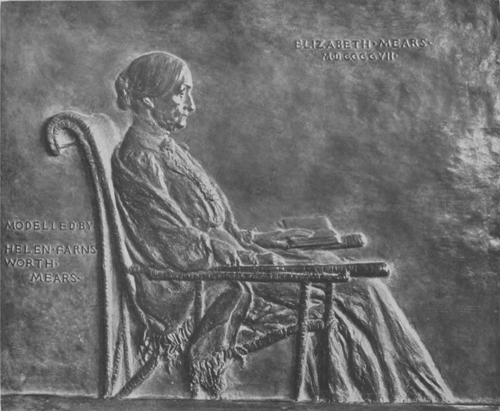
MARY ELIZABETH MEARS From a bas relief owned by the Wisconsin Historical Society
A collection of papers of Governor Nelson Dewey, consisting principally of a business account book and several annual volumes of his diary, has been presented to the Society by Mr. R. A. Watkins of Lancaster. The diary of Governor Dewey seems to have been widely scattered. Some volumes of it have long been in the Historical Library, and several more are in the possession of a resident of Cassville.
Several interesting additions of noncurrent newspaper files were made to the Library during the quarter ending December 31, 1917. Most interesting locally, perhaps, is a file of Lucifer, 1884-98, in fifteen bound volumes. Publication of Lucifer was begun at Madison in 1882; later it was continued at Milwaukee until the demise of the paper in 1898. Published in German, it was the organ of the Turner societies, and manifested a liberal and anti-Catholic viewpoint. To the Society’s slowly-growing file of photostatic copies of the Boston News Letter all known existing issues for the years 1726-29, inclusive, were acquired during the quarter. Other files of Massachusetts papers acquired are the Newburyport Evening Union (daily), January 1-September 18, 1851, and Russell’s Gazette (Boston, semi-weekly), January-July, 1800. Finally, two Ohio papers were added: the Cleveland Recorder, 1896-97, and July-December, 1899, in four volumes, and the Cincinnati Graphic, August, 1885-November, 1886, in two volumes.
From Captain George Jackson of Chicago the Society has received a rare volume possessed of much sentimental interest. It is “Dr. Mort. Luther’s Lesser Catechism,” published in New York in 1842. But one other copy of the book is known to be in existence and this is in private hands. The Lesser Catechism was the first book in the Norwegian language to be printed in America.
A scrapbook filled with clippings concerning the Kansas troubles and the Civil War has been presented to the State Historical Society by Louis W. Bridgman, son of Edward Bridgman, who died in Madison in August, 1915. Mr. Bridgman migrated to “Bleeding Kansas” from Massachusetts in the spring of 1856. Staking out a claim near Osawatomie, he soon took up living quarters with the brother of Susan B. Anthony, who was also a Massachusetts crusader in the cause of freedom. To their cabin one evening late in August, 1856, came John Brown with his band of tired followers. Here they spent the night and were having breakfast the next morning, when news arrived of the impending attack upon Osawatomie by a large band of proslavery Missourians. Leaving the unfinished meal, Brown and his men started to meet the invaders. Bridgman and Anthony Pg 336 followed as soon as they could pull their cooking utensils from the open fire. Thus Bridgman participated in Osawatomie, John Brown’s most notable battle, and lived to become probably the last survivor of Brown’s band of followers on that day.
A few years later, having returned to Massachusetts, he enlisted in the Thirty-seventh Infantry in which he served during the Civil War. A school teacher by profession, he wrote frequent letters to the press, both during his Civil War career and in later years, describing his experiences, and retailing his recollections. The scrapbook now presented by his son, and largely made up of such clippings, constitutes a valuable contribution to the Society’s collection of Civil War material.
The September number of the Magazine contained an account of the gift to the state of Perrot State Park, including in its limits Trempealeau Mountain and the site of Perrot’s “fort” or wintering place of 1689. It is gratifying to be able to record the gift at Christmas time of another splendid park site to the state. Mr. Martin Pattison of Superior is the donor whose enlightened generosity makes possible the preservation for public use and enjoyment of the Manitou Falls of Black River, some fifteen miles out of Superior. Mr. Pattison has been quietly at work for several years securing the title to some 600 acres of woodland around the falls, “Douglas County’s most cherished beauty spot,” in order to make this public disposition of it. Thus another bit of historic Wisconsin scenery gives promise of being permanently preserved in its virgin state for the enjoyment of future generations of Wisconsin citizens.
During the holiday season the State Historical Museum had on exhibit a small Christmas tree, decorated with patriotic emblems of all the allied countries. Diminutive flags representing the national colors, Red Cross flags, food conservation buttons, a miniature Red Cross service flag, tiny bundles of liberty bonds, diminutive airplanes, and machine guns were all displayed. Small gilt discs, representing each of the camps in which Wisconsin boys are training, were also displayed. All of the decorations were arranged so as to embody the red, white, and blue color scheme.
Mr. Charles E. Graves, formerly exchange librarian of the University of Illinois, became librarian of the Minnesota Historical Society at St. Paul, November 1, 1917.
During the closing months of 1917 the Minnesota Historical Society moved into its splendid new home which has been in the process of erection during the last two years. As the historical development of Wisconsin and of Minnesota has much in common, it is but natural that the relations between the historical societies of the two states should be cordial and intimate. That the further Pg 337 career of the Minnesota Historical Society shall be such that before many years the new home will prove to be as inadequate as the old one has long been, is the best wish we, in behalf of the State Historical Society of Wisconsin, can extend to it at this season of congratulation.
The Michigan Historical Commission is actively engaged in a campaign to save the important state documents and archives of the commonwealth. Recently the original copy of the first Michigan constitution (1835) was found in the state capitol hidden away in an old tin can, where it had been placed many years ago. The ends of the document were so badly mutilated that the names of some of the signers could no longer be read. Appropriate treatment to insure against further deterioration of this priceless manuscript was applied, and it is now suitably housed in the capitol building. The preliminary step looking to the establishment of an archival department for Michigan has already been taken by the historical commission. Messrs. F. B. Streeter and J. H. Russell have been engaged to collect, arrange, and classify the archives of the state, and have already entered upon this important work.
SOME WISCONSIN PUBLIC DOCUMENTS AUGUST-DECEMBER, 1917
In a bulletin published by the Wisconsin Highway Commission in September, 1917, on the state trunk highway law, the announcement is made that there is available from the federal government $128,361.07. During the next four years it is estimated there will be a total of $1,925,416.05 available for road construction in Wisconsin. The federal law provides that a state, in order to receive this appropriation, must set aside each year an amount at least equal to that provided by the national government. The money thus derived may be expended upon any public road over which the United States mails are now or may hereafter be transported. The State Highway Commission predicts that by the close of the year 1918 Wisconsin will have a system of travelable roads connecting all county seats and all the principal centers of population in the state. Wisconsin is already one of the leading good-roads states in the country; under the operation of the new law this position of leadership should easily be retained.
The Biennial Report of the State Superintendent of Public Instruction, issued in September, 1917, indicates that the two years just closed have been the most fruitful and active in the entire history of public education in Wisconsin. The state educational staff has been increased by the addition of a supervisor of manual training, Pg 338 a supervisor of tests and measurements, an editorial and statistical secretary, and an additional supervisor of city and village grades. The report is particularly valuable in that it includes not only a compilation of all the data dealing with the public schools, but also a system of graphs, diagrams, and charts which set forth in striking manner the educational facts of the state. By these illustrations the reader is able to see on a single page all the facts relating to any one phase of education.
A most suggestive pamphlet entitled Illiteracy and Americanization, prepared by Amy Bronsky, was issued from the office of the state superintendent of public instruction in October, 1917. The vital importance of educating and Americanizing every person within our borders is well set forth. According to the census of 1910, Wisconsin had 57,769 illiterates over ten years of age, and 120,665 non-English speaking residents over ten years of age. Miss Bronsky adds that, notwithstanding the efforts made to reduce this number, it is probable that it has been growing larger rather than smaller since the year 1910. Wisconsin’s percentage of illiteracy (3.2) is lower than that of the country at large, but not so low as in two of our neighboring states, Minnesota (3) and Iowa (1.7). By the establishment of the continuation schools, night sessions, reading circles, and other allied agencies, it is believed that the next decade will show a considerable decrease in the percentage of illiteracy.
The Proceedings of the Wisconsin State Conference of Charities and Corrections for 1916 deal almost exclusively with the one problem of feeble-mindedness. Never before has the importance of this subject been brought so strikingly to the attention of the social workers of Wisconsin. The first report ever submitted dealing with these unfortunates in our midst was made at this conference. It reveals the fact, surprising to most people, that there are over 13,000 of them in the state. Of this number only 5,000 can be accommodated in the institutions that are now provided. The imperative need of securing additional facilities for their care and instruction was the chief problem dealt with by the conference.
The 1917 Annual Report of the State Horticultural Society shows that field work is now being conducted at eleven different points throughout the state. At Polar, Maple, Whitehall, Manitowoc, Sparta, Baraboo, Holcombe, Pewaukee, Gays Mills, Lake Geneva, and Weston experiments are under way. The supervision of trial orchards at the stations constitutes the major part of the society’s activities, and absorbs the larger portion of its funds. The trial orchard at Gays Mills is regarded as the best of its age in the state.
That the reading-circle movement has made great progress in Wisconsin during the last two years is shown by the report issued Pg 339 for 1917-1918, which reveals an increase of over 175 per cent in the number of persons who are doing work under the auspices of this organization. An increase of more than 300 per cent in the number of boys and girls reading under the direction of the Young People’s Circles is reported. Upwards of 2,500 teachers and more than 24,000 pupils did the required reading in their respective circles during the last school year. Fifty-four counties took part in the Young People’s Reading Circle, and fifty in the Teachers’ Circle. Of the cities that have taken the lead in the number of members enrolled in the Young People’s Circle, Janesville heads the list with 507. Marinette County leads in the number of seals and diplomas granted to teachers with a total of 158.
That the town mutual fire insurance companies in Wisconsin experienced their usual increase in business during the last year is seen from their Forty-eighth Annual Report issued in 1917. The insurance in force at the close of the business year in December, 1916, was $28,943,362 more than at the close of the preceding year. Practically the entire agricultural interests of the state are protected by some one of these mutual companies. The prediction is made that the territory will remain about the same in the future as at the present. The only change in business to be looked for will be the gradual increase in the value of rural property and improved conditions making for increased insurance. Only one new company has entered the field—the North Wisconsin Finnish Farmers of Marengo.
The December (1917) number of the Wisconsin Library Bulletin presents what is practically a first report of the work done in this state in raising funds for camp libraries. Wisconsin’s contribution to the million dollar fund was approximately $41,000. Since our quota, according to the basis of population, was slightly over $25,000, it will be seen that the state not only did her share but greatly exceeded it.
The Wisconsin State Board of Health Bulletin for September, 1917, reports that during the preceding three months 6,230 deaths occurred in the state. This corresponds to an annual death rate of 9.9 a thousand of the population. This record shows a decline of 422 in the total number of deaths when compared to the report for the same three months in 1916. It is interesting to note that during the three months covered by this report—July, August, and September—the death rate in the northern part of the state was only 8.6 a thousand, in the central counties, 10 a thousand, and in the southern counties, 10.4 a thousand.
The Proceedings of the Fifty-first Annual Encampment of the Department of Wisconsin Grand Army of the Republic, 1917, shows that at the beginning of the year there were only 4,247 surviving Pg 340 members left. The highest membership ever reached by the Wisconsin organization was in 1899 when there were 13,944 enrolled. Death claimed 420 of the veterans during the year from December 31, 1915, to December 31, 1916.
The Opinions of the Attorney-General of Wisconsin issued for October, 1917, shows that his advice was sought upon thirty-seven different questions. The uncertainties attending the statutes relating to the construction of bridges and highways brought forth the largest number of inquiries. The duties of public officers, particularly county officials, and the interpretation of the fish and game laws also required a large number of opinions to be handed down at that time of the year.
The Consolidated Annual Reports of the Wisconsin Dairyman’s Association for the annual meetings of 1913, 1914, 1915, and 1916 was issued in July, 1917. The report shows that since the organization of the association in 1872, the dairy products of the state have increased from $1,000,000 to over $120,000,000. Wisconsin now stands first among the states both in the value of dairy products and in the number of dairy cows. In July, 1917, there were 81 cow-testing associations. The total membership was 2,417, while the number of cows under test exceeded 38,000. The average cow in Wisconsin produces 175 pounds of fat a year, although there was one herd reported where the average reached 564 pounds of fat.
Fuel Conservation by the Economical Combustion of Soft Coal by Gustus Ludwig Larson is the title of Bulletin No. 888 of the University of Wisconsin issued in December, 1917. The author declares that many plants waste through unscientific firing and inadequate equipment as much as fifty per cent of the coal they buy. The criminal waste in the burning of coal in which many firemen engage is regarded as the most serious problem facing our people during the winter season. The question of proper combustion, both in the firing power plants and in domestic heating, and a discussion of the different devices for burning soft coal without smoke are set forth in a practical manner by Professor Larson. A table showing the characteristic analyses of soft coal available to Wisconsin buyers is included in the bulletin.
SOME PUBLICATIONS
Professor F. A. Ogg of the University of Wisconsin, and a member of the State Historical Society, is the author of a new volume entitled National Progress, 1907 to 1917. All students of American history are familiar with the monumental coöperative history of our country edited by Professor Hart of Harvard, entitled The American Nation. This work in twenty-seven volumes was completed in 1907. Pg 341 Professor Ogg’s new book is designed to bring the work down to date by covering the history of the nation for the decade ending with 1917.
The recent volume by Dr. Kellogg, Research Associate in the State Historical Society, entitled Early Narratives of the Northwest 1634-1699, is reviewed in the American Historical Review in part as follows:
“If the early history of Wisconsin and neighboring regions is not adequately accessible to future generations, it will be through no fault of a group of zealous and competent students who, perhaps inspired by the examples of Draper, the collector, and Thwaites, editor and collector, continue the work in true historical spirit and scientific method. If Wisconsin is fortunate in her students, she is also abundantly rich in material for study. * * * For all of the journals Miss Kellogg’s abundant annotation is helpful. We wish she had added one more note, explaining Raddison’s wonderful word auxotacicae (p. 65). The clearly-penned introduction to each narrative not merely summarizes it, but informs the student of what printing it has already had, either in French or English, and makes plain the editor’s choice of text. Not the least interesting feature of the work is a facsimile of a contemporary map drawn to illustrate Marquette’s discoveries, here reproduced from the original in the Bibliothèque Nationale, Paris. A portion of Franquelin’s map of 1688 is also given. Few typographical slips are noted; even La Salle (Cavelier), recorded in more than one work as 'Chevalier,’ gets through safely here, with but one transformation into 'Cavalier’ (p. 164).
“The volume as a whole bespeaks scholarly care and regard for the needs of a large class of students to whom rare volumes or obscure texts may not be available; and admirably presents the essential original material of the first half-century and more, from the first known advent of the white man in the pays d’en haut.”
Wisconsin’s Social Democracy is a forty-six page pamphlet by Hon. Frederick W. von Cotzhausen, of Milwaukee, printed in advance from a projected volume containing the author’s “Historic Reminiscences and Reflections.” The pamphlet now issued consists of three parts written respectively in 1906, 1914, and 1917, and aims at “Sketching a few Episodes” in the history of Socialism in Wisconsin “which may be of future historical interest and of which I may speak from personal observation.” The tone and sentiments of the author are strongly antisocialistic in character.
Henry Baird Favill, A.B., M.D., LL.D., 1860-1916, is the title of a memorial volume, privately printed, to this noted son of Wisconsin. Wisconsin has produced many great physicians but Pg 342 of them all none has achieved worthier fame than did Doctor Favill. Born in Madison in 1860, the capital city continued to be his home until 1894. He then removed to Chicago where in a few years he gained recognition not only as one of the city’s leading physicians but also as one of the most industrious civic workers and useful citizens. The memorial volume, compiled by his son, contains two parts: one devoted to tributes and resolutions, the other to addresses and papers by Doctor Favill. The wide range of topics covered by the latter and the charm of style and breadth of vision manifested in their treatment afford a glimpse, at least, of the intellectual and human greatness of their author.
To the La Crosse Tribune for November 4, 1917, E. S. Hebberd contributes a proposal that the one-hundredth anniversary of the birth of Cadwalader C. Washburn, which occurs in 1918, be observed in fitting manner. The Washburn family is remarkable for the ability and the public careers of its members. All of the seven brothers achieved distinction. Four were members of Congress, each representing a different state. Two were governors of their respective states, and two, including one of the congressmen, were ministers of the United States to foreign countries. Wisconsin owes a debt of gratitude to C. C. Washburn, and it would seem fitting that appropriate recognition should be made of the centennial of his birth.
The Wisconsin Archeologist for July, 1917, has as its leading article a survey of Lake Shawano and the Wolf River, by George R. Fox and H. O. Younger. As a water route the Wolf River was long used by the American Trading Company in reaching its trading stations in northern Wisconsin. The survey here presented constitutes a valuable historical and archeological discussion of this region. The October number is chiefly devoted to a survey of Chetek and Rice lakes written by Charles E. Brown and Robert Becker.
Charles A. Eastman’s From the Deep Woods to Civilization, published by Little, Brown and Company, is a fascinating volume. The author, a full-blooded Sioux, began life as a barbarian of the plains, his family having fled to Canada after the Sioux outbreak of 1862 in Minnesota. The present volume tells the story of his life from the time when his father determined to dedicate him to a civilized career. It is interesting to note that from an enthusiastic believer in the superiority of civilized life as compared with savagery, the author has come gradually to doubt the correctness of his earlier view. Apparently the present world cataclysm, which has swept many another thinker from his accustomed moorings, has had some influence upon Mr. Eastman’s views concerning the respective merits of the civilized and the savage states. Wisconsin readers of the book will take special interest in the chapter “College Life in the West,” Pg 343 describing the author’s experiences at Beloit College, to which place the young neophyte in the arts of the paleface turned on leaving the Santee Agency Mission School.
Methodist Heroes of Other Days by Samuel Gardiner Ayer has been issued by the Methodist Book Concern. It is a slight volume containing some thirty-six short appreciative sketches of as many “heroes” of the Methodist Episcopal denomination. Wisconsin readers will be particularly interested in the short account of “Alfred Brunson, the Soldier Preacher,” one of the founders of the Methodist Episcopal church in Wisconsin. Readers of the Magazine will be interested still further, perhaps, to learn that a daughter of Reverend Brunson is at the present time engaged in writing a biography of her father for the State Historical Society.
The December, 1917, number of the Mississippi Valley Historical Review maintains the high standard of excellence which readers have been led, by the character of previous numbers, to expect in this periodical. The three leading articles are: “Howell Cobb and the Crisis of 1850,” by R. P. Brooks; “A Larger View of the Yellowstone Expedition, 1819-1820,” by Cardinal Goodwin; and “The Beginnings of British West Florida,” by C. E. Carter. Dan E. Clark contributes the annual review of historical activities in the trans-Mississippi Northwest, and to complete the number are departments devoted to “Notes and Documents,” “Book Reviews,” and “Notes and Comments.”
Announcement has recently been made of the resignation of Clarence W. Alvord as managing editor of the Mississippi Valley Historical Review, in which capacity he has acted since the founding of the magazine in 1914. The Review, largely because of the efforts of Mr. Alvord, now ranks among the best of American historical publications. Its readers will greatly regret Mr. Alvord’s resignation.
The leading article in the October, 1917, issue of the Iowa Journal of History and Politics, describes the Iowa war loan of 1861. By reason in part of a doubtful provision in the state constitution, in part of the concerted efforts of the southern sympathizers living in Iowa, the state administration encountered greater difficulty in floating a war loan than was the case in any other northern state. Through the columns of the distant New York Herald the enemies of the loan conducted their campaign to defeat it. The manner in which Governor Kirkwood and his assistants overbore the opposition and saved the reputation of the state is vividly described.
The life of Samuel J. Kirkwood, Iowa’s war governor, by D. E. Clark, has been issued as one of the Biographical Series of the Iowa Historical Society. The study of Governor Kirkwood’s life takes Pg 344 the reader into the history of three commonwealths, but it is with the development of Iowa that his name is inseparably associated. As Civil War governor, United States senator, and secretary of the interior under Garfield, his name is perhaps more widely known than that of any other person in Iowa history. In preparing the biography, Mr. Clark had access to seven Civil War Letter Books and three letter books for the period when Kirkwood was secretary of the interior. Use was also made of a large collection of letters, covering the period from 1850-1890. From these sources the author has given us a sketch of Iowa’s noted war governor which is both timely and valuable.
In a two-volume work on Burrows of Michigan and the Republican Party published by Longman, Green and Company, 1917, William Dana Orcott has presented a detailed career of one of Michigan’s most famous men. As lawyer, college professor, military hero, and United States senator, Burrows gained an acquaintance that was nation wide. In ability he ranked with Blaine, Garfield, Reed, and McKinley; and had he not been so blindly devoted to the partisan principles which he represented, in all probability he would have occupied a higher office.
The Michigan Historical Magazine for October, 1917, contains an interesting group of Civil War letters written by Hon. Washington Gardiner while serving as a volunteer in 1863-64. The letters were all written from the front, and depict the conditions observed by this youthful soldier of sixteen years.
Those who enjoy reading a frontier narrative will welcome a little volume recently published, entitled A Soldier Doctor of our Army: James P. Kimball. The book was written by Maria B. Kimball, wife of Dr. Kimball, and is published by the Houghton Mifflin Company. Dr. Kimball served in the Civil War and later for a number of years at Fort Buford and other places on the western frontier. He was an intimate friend of General Custer, by whom he was chosen to act as the chief medical officer on the campaign which ended in Custer’s death in 1876. But for his inability to meet the appointment, his career would doubtless have terminated at the same time as Custer’s in the disaster which overwhelmed his army.
The Myth Wawataw is the subject of a brief dissertation, beautifully printed, by H. Bedford Jones of Santa Barbara, on the unreliability of Alexander Henry’s account of the events in the Northwest connected with Pontiac’s war. A brief discussion is also included in the booklet on the historical remains at old Michilimackinac.
The October, 1917, number of the Ohio Archeological Historical Quarterly has an article on Muskingum River pilots by Irven Travis Pg 345 which many of our members would take pleasure in reading. The palmy days of small river transportation have long since become a part of history, and any information bearing upon the part they played in our social and economic development is treasured by all students of pioneer days.
Two articles comprise the contents of the Indiana Magazine of History for September, 1917. The first, “Lincoln in Indiana,” is the first installment of an interesting and suggestive account of the obscure period in the great Emancipator’s life of which it treats. The second article is the concluding section of a history of the origin and rise of the Republican Party in Indiana from 1854 to 1860.
A history of Western Influences on Political Parties to 1825, by Homer C. Hockett, formerly of the University of Wisconsin, is the title of Ohio State University Bulletin, vol. 22, number 3, issued in 1917. Dr. Hockett sketches the growth of political parties in this country from about the middle of the eighteenth century down to the close of the first quarter of the nineteenth. Chief emphasis is placed upon the new political issues that arose out of western conditions during this period, and the manner in which they affected national policies.
Among the important historical periodicals of the country is the Catholic Historical Review of Washington, now in its third year of publication. Its sponsors are valiantly sounding a clarion call to their fellow religionists to awake to the importance of their priceless historical heritage, and to put the preservation and study of its records on a thoroughly scholarly basis. That these matters have been all too little attended to heretofore can hardly be gainsaid. If the campaign waged by the Catholic Historical Review shall meet with a reasonable measure of success, however, we may expect to witness in the not distant future a radical change in the attitude and actions of the adherents of Catholicism in America with respect to the cultivation of their historical domain. For the most part the writing of sectarian religious histories in the United States has been (and now is) conducted on a regretably low plane of scholarship. Historians of all the denominations (and, indeed, of whatever other social groups) would do well to take to heart the principles of scholarly procedure which the Review advocates.
The broadly objective viewpoint of this church organ may be concretely illustrated by citing two or three items from a single issue (that for October, 1917). It is argued that the records of the several dioceses be administered on a scientific basis, and be “easily accessible to all qualified students whether Catholic or non-Catholic.” A generous tribute is paid to the work of the several state historical societies in conserving the Catholic history of the land, notwithstanding the Pg 346 membership rolls of these societies contain “very few Catholic names, and very little Catholic generosity finds its way into their treasury.” In passing it may be observed that our own Society may appropriate to itself a fair portion of this tribute, for much has been done, from its earliest days, to conserve the history of the oldest of Christian denominations in Wisconsin. Again, a recently published meretricious life of George Washington, written by a certain priest, meets with castigation as thorough at the hands of the reviewer as any historical periodical free from church connections could have administered. The example of the Review may well be emulated by the historians of all religious denominations.
The preliminary report of the California Historical Survey Commission, issued in February, 1917, sets forth one of the most ambitious undertakings in the field of local history that has ever been launched in this country. An act passed by the legislature of that state in June, 1915, provided for the appointment of a commission of three members to make a survey of all local historical material in California. An appropriation of ten thousand dollars was made to cover the expense of the work. The work mapped out by the commission in its preliminary report includes a careful survey of the several county archives in the state, of the state archives, and of those of the local federal offices. Reports are also being gathered from all the public libraries, from the collections of historical societies and other similar institutions. Manuscripts in the possession of private individuals are being listed and the files of early newspapers, records of the religious and social organizations and large business concerns of the state are all being examined. Already archival records antedating the organization of the state government have been found, the existence of which had been hitherto unsuspected, while records pertaining to land claims under the Spanish and Mexican governments have been brought to light.
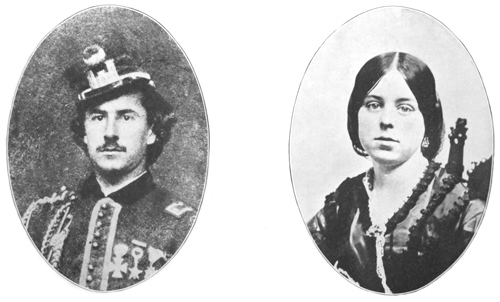
COLONEL ELLSWORTH AND MISS CARRIE SPAFFORD The picture of Colonel Ellsworth is reproduced from an original photograph in the Wisconsin Historical Library; that of Miss Spafford from a photograph supplied by Mrs. Charles H. Godfrey, Rockford, Illinois
Pg 347
VOL. I, NO. 4 JUNE, 1918
THE WISCONSIN MAGAZINE OF HISTORY

PUBLICATIONS OF THE STATE HISTORICAL SOCIETY OF WISCONSIN.
Edited by
MILO M. QUAIFE,
Superintendent
Pg 348
CONTENTS
Page
Colonel Elmer E. Ellsworth: First Hero of the Civil War Charles A. Ingraham 349
Where Is the German Fatherland? 375
The Paul Revere Print of the Boston Massacre Louise P. Kellogg 377
Documents:
Some Letters of Paul O. Husting Concerning the Present Crisis 388
Historical Fragments:
The Beginnings of Milwaukee; The Senatorial Election of 1869; “Koshkonong” and “Man Eater”; The Alien Suffrage Provision in the Constitution of Wisconsin 417
Editorial:
Increase A. Lapham and the German Air Raids; Save the Relics; The Newspapers; Removing the Papacy to Chicago 426
Communications:
“Camouflage” and “Eatless Days” Two Hundred Years Ago; Daniel Webster’s Wisconsin Investments 432
Survey of Historical Activities:
The Society and the State; Some Recent Publications; The Wider Field 435
The Society as a body is not responsible for statements or opinions advanced in the following pages by contributors.
COPYRIGHT, 1917, BY THE STATE HISTORICAL SOCIETY OF WISCONSIN
Pg 349
COLONEL ELMER E. ELLSWORTH: FIRST HERO OF THE CIVIL WAR[128]
Charles A. Ingraham
On Monday, the twenty-ninth of April, 1861, fourteen days after President Lincoln’s call for 75,000 troops, a regiment composed of 1,100 men, uniformed and equipped, marched the streets of New York en route to the national capital. Riding at the head of the column was the Colonel, a young man of twenty-four, small of stature, with flashing dark eyes and with a look of authority and power upon his handsome features. The crowds along the line of march cheered enthusiastically as the regiment passed—a magnificent body of men who at his call had rushed in the space of four days to the colors. It was Ellsworth’s regiment of Zouaves, recruited from the firemen of New York City, and afterwards mustered into the service as the Eleventh New York Volunteer Infantry.
But whence came this wonderful youth who, as if by magic, had called into being this stalwart array—bold and fearless men, resenting restraint, but submitting cheerfully now to his iron discipline? Not many years before, he had been but an obscure country boy of northern New York, remote from the places of advancement and culture, a son of worthy parents, unable, however, to contribute of their limited means to the furtherance of the ambitious desires of Pg 350 their offspring. In the brief space of a year he had achieved national prominence; having had up to the summer of 1860 but a local reputation, confined to Chicago and its vicinity, he became the popular idol of the entire northern country. At the head of his United States Zouave Cadets he had toured the leading eastern cities and won distinction for the extraordinary perfection of drill exhibited by his command. Shining through all this historic expedition appears preëminent the attractive personality of the young captain—knightly, magnetic, winning, lofty of character, able to control every one of his cadets under the imperious rule of his native authority and undeviating rectitude.
On the morning of the twenty-fourth of May, less than a month from the departure of the Fire Zouaves from New York, Ellsworth was killed at Alexandria. Not in vain was his fall, for it caused the hesitating northern people to reach firmly at last for the rifle. “Ellsworth’s Avengers,” the Forty-fourth New York Volunteer Infantry, recruited from every county of the Empire State, with unusual physical requirements and moral standards, marched from their encampment at Albany for the front on October 21, 1861. Well did they fulfill the name they bore, for on many a battle field this somewhat Puritanical regiment, remarkable for the scholarship and worth of its rank and file, never forgot the assassination of Ellsworth as they carried their rent colors against the foe. Still another regiment of New York City firemen, the Second Fire Zouaves, or the Seventy-third New York Volunteer Infantry, was recruited under the inspiration of Ellsworth’s name and was mustered into the service on July 10, 1861. Reënlisting in 1864, it had a continuous service to the close of the war and enjoys a magnificent history.
Thus Ellsworth had, to his immediate, demonstrable credit, the mustering in of three regiments, which constituted, however, but a small proportion of the multitude whose patriotic devotion was evoked by his death and who followed Pg 351 the flag into the service. Yet many believe him to have been but a rash and adventurous person, vain and superficial. My study of his life, however, convinces me of the error of such opinion and that he was a young man of extraordinary gifts, prudent thought, gentle, loving instincts, and one who had been baptized with a fervent spirit of patriotism. Abraham Lincoln recognized his wonderful abilities and admirable traits of character and loved him for them, had his stricken, cold body brought to the White House, and wept over his remains as he would have grieved over those of his own son. And John Hay, in two notable magazine articles, one written soon after Ellsworth’s fall, the other towards the close of Mr. Hay’s career, has nothing but eulogy for the noble youth whom he had intimately known and loved as a brother. Surely, young Ellsworth had in him the elements of greatness! Schooled in poverty, disciplined by hardship and disappointment, his life is yet a shining path of pure living, high purpose, devoted patriotism, and worthy fame.
The motorist who seeks the birthplace of Ellsworth leaves the city of Troy, crosses to the west side of the Hudson at the northern limits of the town, and follows the macadam road along the river northward fourteen miles to the city of Mechanicsville. Here he will leave the river and proceeding in a northwesterly direction over a fine state road will reach at a distance of nine miles the little village of Malta, Saratoga County, seven miles this side of the city of Saratoga Springs. At Malta, Elmer Ephraim Ellsworth was born on April 11, 1837. The hamlet is much like thousands of others scattered over our eastern states; it claims its four corners, church, schoolhouse, and general store, but, with its spacious square, shade trees, and pleasant dwellings, it is more attractive than the average small village. The house in which Ellsworth first saw the light is yet standing, a well preserved, small, story-and-a-half structure, looking cheerfully out on the great road where thousands pass, ignorant of the honor which Pg 352 it possesses. It has been called “the low-browed cottage,” a characterization which is appropriate, for two small, oblong windows are suggestive of eyes peering out from under the eaves. Ephraim D. Ellsworth, Elmer’s father, a worthy citizen and a tailor by trade, in 1836 married Phoebe Denton who resided here, and employed himself at this place in the business of his calling. He was of English extraction, born in the town of Halfmoon, Saratoga County, New York, and a man of bright intellect. His grandfather, George Ellsworth, as a boy of fifteen joined the American army operating against Burgoyne, fought in the battle of Saratoga, and was present at the subsequent surrender of the British army. George Ellsworth was thus a yet-living influence to develop the patriotic and martial spirit of his great-grandson, and, added to the special interest he took in the exciting story of the boy-soldier’s adventures, was the realizing assistance afforded by the proximity of the battle field, nine miles away. Phoebe Denton could no more trace a distinguished ancestry than could her husband, and all that is available concerning her is that on her father’s side she had an English lineage, and on her mother’s, a “Scotch Presbyterian.”
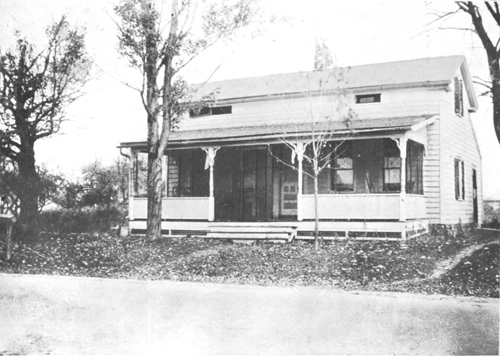
BIRTHPLACE OF ELMER E. ELLSWORTH, MALTA, NEW YORK
The boyhood life of Elmer in Malta was isolated enough but was relieved somewhat by the nearness of Saratoga Springs, which in those times was a leading watering-place of the country, where the wealth and fashion of the land disported itself. Many costly equipages every season would pass through the village, bound to and from Saratoga, not a few of them belonging to the southern aristocracy and having ebony coachmen on the box. Only two miles east is the beautiful Saratoga Lake, with the charms of which he was familiar. He was a good student in the district school, but not at all precocious or remarkable as a scholar. He was cheerful, fond of and a leader in all games and sports, but his greatest enjoyment was in reading; he would become lost for hours Pg 353 in a book, heedless of the lapse of time. His mother was a pious woman and from her and the services of the Presbyterian church he derived deep religious convictions which he maintained throughout his life. He became, also, at an early age, a pronounced temperance disciple and, having heard a lecturer say that the devil dwelt in a cider barrel, wanted to take a “gun and cussion cap” and shoot him. His mother has left on record many interesting instances of his philosophical character and original sayings, but there is not room here to give them place. I may, however, be permitted to mention his purchase of his brother Charlie, the one other child in the family. Charlie was three years younger than Elmer, and the older brother conceiving a great fondness for him while he was yet a babe, and desiring him for his own, bought him of his parents for six shillings. From that time forward Elmer assumed a sort of guardianship over him and maintained that sense of obligation up to the day of Charlie’s death. At an early age he began to evidence a proclivity for military studies and employments by exhibiting a preference for books dealing with war and battles; when but nine years of age he drew with wagon-paints on one side of a window shade a picture of General Washington and staff, and on the reverse side one of General Jackson and staff. A natural aptitude for sketching was further developed as he grew older and was of practical help to him in his military occupations. Many of his sketches are still preserved and cherished. After he had spent a year as a clerk in the employ of a Mr. DeGroff, who kept a general store at Malta, the family moved to Mechanicsville.
The ambition which Elmer had cherished of entering West Point Military Academy might have been realized had there been at Mechanicsville educational advantages whereby he could have gained the proper preparation, but the village, then a place of about 800 inhabitants, had nothing higher than district schools, and his father had not the means to send Pg 354 him to an academy. He attended the school located on North Main Street, a brick building still standing and converted into an attractive residence. Mr. Ellsworth’s trade seems not to have afforded him a sufficient income, for he adopted various makeshifts in order to provide for his family, such as peddling oysters, netting pigeons, and other like employments. Elmer was sometimes sneered at by his companions on account of his father’s poverty and one day he whipped a boy soundly who had called him, “oyster-keg.”
All this made a deep wound in the proud and sensitive heart of the boy, and throughout his career, in his letters and diary, may still be read the ever-recurring refrain of his desire to remove his parents from lives of grinding toil and carking care. This absorbing thought had been observed by President Lincoln and was mentioned in his letter to Colonel Ellsworth’s bereaved parents as “conclusive of his good heart.” But Elmer had the great privilege while living in Mechanicsville of organizing and having under him a military company: the Black Plumed Riflemen, of Stillwater, an historic village three miles above Mechanicsville. At this time, although but fifteen, short and slight of build, he would go through the manual of arms with the heavy muskets of those days with wonderful ease and rapidity. Throughout his life he was ever of a strong, virile constitution; quick, active, alert, he became in after years an accurate shot and a fine swordsman. Illustrative of his strength and agility and as exhibiting his qualification to lead others in performing startling feats, it is still told in Mechanicsville that one day a clerk in Hatfield’s store (now the Mead Building) having heard a commotion in the second story, upon investigation, found that Ellsworth and the Black Plumed Riflemen had ascended there on a “human ladder”; the last ones were pulled up through the doorway from the sidewalk. Though Mechanicsville has grown to be a place of more than 8,000 population, the older parts of the town remain very much as when Ellsworth paraded the streets Pg 355 with his riflemen. The old home, a pleasant dwelling on Ellsworth Street in the southern part of the place, still stands amid surroundings practically unchanged. The premises front on the embankment of the Delaware and Hudson Railroad; in the rear flows the now abandoned section of the Champlain Canal. Just south of the home and on the rise of ground is the residence of Robert Sears, deceased, who was an intimate friend of the family and who accompanied the stricken parents to New York to meet the remains of their son. Elmer was a welcome visitor here, where he and his companion, Charles Sears, had many a happy romp in the fields about the homestead. It is needless to say that the remembrance of Colonel Ellsworth is still a sacred one in the Sears family and that his memorials are cherished in the white mansion on the hill where he was gladly entertained and duly appreciated; for even at this early age it was evident that he was a lad of superior parts. Certain of the citizens have suggested changing the name of the place to “Ellsworth” and erecting a fitting monument in the midst of the city, a commendable proposal, though there are already nine villages named Ellsworth in as many states of the country, and notwithstanding that a noble granite memorial to his memory, unveiled with elaborate and impressive ceremonies on May 27, 1874, stands in the Mechanicsville cemetery.
Elmer’s stay in Mechanicsville did not embrace above a year or more, and after having had considerable success in selling papers on the railway trains, he secured the consent of his father to leave home and try to make his own way in the world. He, therefore, in 1852, secured employment as a clerk in the store of Corliss & House, Troy, dealers in linen goods, where he remained about a year. The career of Ellsworth from now on to 1858 is difficult to follow in detail on account of the as yet scarcity of data from which to construct a satisfactory narrative. It is known, however, that from the time he left Mechanicsville to the hour of his death, Pg 356 his life, though in its last two years astonishingly prominent and in point of honorable fame highly successful, was throughout an experience of almost unremitting hardship and poverty; a beating about from one employment to another; a weary history of uncongenial labor and foiled ambition. It is probable that he was, to use his own words, endeavoring to “make a bold push for fortune,” that he might quickly relieve his parents of that toil and privation, the remembrance of which seems to have burned into his soul to remain smarting there through the long years. Perhaps it would be charity to allow the mantle of forgetfulness to remain upon this period of unrequited effort, though from the glimpses we have in it of Ellsworth he is smiling and cheerful through it all, ever maintaining the most scrupulous honor and unblemished character. But the American people will desire the uncovering of every detail of the life of this remarkable young genius and martyr, whose very gifts of mind and heart, like those of many another, made him the prey of fortune.
On August 2, 1917, there appeared in the Telegraph-Courier of Kenosha, Wisconsin, a letter from Charles H. Goffe, a former resident of the city, and among his reminiscences of Kenosha is the following concerning Ellsworth in the summer of 1853, Elmer being then sixteen years old. I have nothing with which to corroborate Mr. Goffe’s statement, but as it has the impress of truth and corresponds, though in an exaggerated manner, with what I have learned of Ellsworth’s traits of character, I am disposed to give it acceptance. It is my opinion that, having saved a sum of money from his salary as a clerk in Troy, he resolved to “plod along” no further but to “make a bold push for fortune” in the West, and endeavor to find by prospecting a more promising field. Mr. Goffe writes:
“There was also boarding at Mrs. Bell’s at this time, a young man of handsome features and fastidious ways, accentuated by a repelling hauteur and exclusiveness, so often Pg 357 found peculiar to genius. His associates were few and his disposition was not calculated to make intimates of those he came in contact with. No one seemed able to penetrate the mystery of his personality and yet there was something about the youth which arrested the attention of all. But he was obsessed with a penchant or habit born perhaps of idle vanity of writing (or scribbling) his name in a bold, flowing, and not ungraceful hand, upon every scrap of paper, on the weatherboards of the house, and on gate and fence posts, a name which a few years later was on every tongue, flashed in the headlines of the daily press, and stamped in deathless lines upon the history of his country—the name of Elmer E. Ellsworth…. In the fall of 1853, when the Kenosha High School opened for the winter term under Professor DeWolff, Mr. Ellsworth attended for a while, but was not satisfied with school life, and suddenly dropped out of view and was for a time forgotten.”
Mr. Goffe says that when, two years later, he went to Muskegon, across the lake in Michigan, he learned that Ellsworth had associated with and been adopted by the Ottawa Indians who dwelt in those parts. After describing how he had been created a chief among them, made the recipient of high honors, and adorned with unique and gaudy apparel. Mr. Goffe continues:
“But, alas, when the novelty of barbaric glory and display had become stale, and the craving for other conquests and other scenes, and perhaps dreams of awaiting glories had disturbed his vision, this eccentric child of genius suddenly disappeared from his tribe and had gone no one could tell where. His people waited long, but he returned no more, and the red-skinned maidens of the tamarack swamps waited and sighed in vain for the handsome young chief on whom they had doted, and for whom they had hoped and dreamed. And the seasons came and passed, and the moons had filled Pg 358 their horns many times only to wane and the white chief came no more.”
As stated before, it is probable that Ellsworth visited Kenosha and it is likely, too, that on his way home he stopped at Muskegon and was with the Indians for a brief period, but that he remained there a year or more, as Mr. Goffe was told, or that he made any extended stay among the Redskins is highly improbable, though I realize that in expressing this opinion I am throwing ashes on what purports to be a romantic episode.
Returning to Mechanicsville and casting about for employment, Ellsworth recalled that in one of his trips between Troy and his home he had met on the train a gentleman from New York who, evidently attracted by his intelligent and prepossessing appearance, drew him into conversation and impressed himself favorably on the youth’s mind and memory. Thinking that this transient friend might help him, he inserted a “personal” in the New York Herald which in due time brought a letter from the gentleman, who proved to be a drygoods merchant, and after a preparatory correspondence Ellsworth was made a clerk in his store. This was in 1853, the year of his visit to the West and Kenosha.
DRAWING MADE BY COLONEL ELLSWORTH Reproduced from the original in the Wisconsin Historical Library
Concerning the two years that he spent in New York I have been able to secure but fragmentary and disconnected data. He remained but half of this period in the employ of the merchant referred to and when, in 1855, he went to Chicago, he did so in company with a party of engineers by whom he had been employed in improving the channel at Hellgate, not far from New York. This work was carried on by the aid of divers who deposited the explosive on the surface of the rock and this being fired by electricity and confined somewhat by the weight of water effected considerable execution. Just what part Ellsworth played in this work or how long he was engaged in it is not known. While in New York he was afforded an opportunity of Pg 359 acquiring a better knowledge of military tactics through the drills of the Seventh Regiment, which he attended on every available occasion.
He was eighteen years of age when, with his brother, he went to Chicago, hoping to make better progress in providing means for the ease, security, and happiness of their parents. For, while yet a little boy in Malta, having been pained by the cruel words of a companion who had sneeringly remarked that his mother wore “patched shoes,” he had told her that he would some day earn a lot of money so that she would be a lady as well as the best and “ride in a carriage.” This ambition for his mother, that she might “ride in a carriage,” was referred to hopefully in a letter dated Madison, Wisconsin, November 15, 1858. Though his brother, after remaining but a brief season in Chicago, seems to have given up the battle and returned home, Elmer held on and through the most discouraging experiences persevered and at last achieved a success which repaid him for all his suffering and humiliation.
Not long after his arrival in Chicago he engaged himself as a clerk to Arthur F. Devereux, of Salem, Massachusetts, who was in the patent soliciting business and who later became an officer in the Eighth Massachusetts Regiment. Ellsworth after a time became a partner with Mr. Devereux and the firm enjoyed prosperity when, through the defalcation of one whom they trusted, everything was lost and Elmer found himself without a dollar struggling again for the bare necessities of life. Three years had been passed in this business, as appears from Ellsworth’s own words. He writes: “In an evil hour I placed confidence in an infernal scoundrel, was robbed of everything in a moment, saw the reward of three years’ toil fade from my eyes when about to grasp it.”
The occurrence of this catastrophe brings Ellsworth’s career down to 1858, he then being of the age of twenty-one. Connected with the business of a patent solicitor are certain Pg 360 legal aspects that require attention, and having in this way in a manner been introduced to the law, he determined to prepare himself for the full practice of that profession. He therefore entered the law office of Mr. J. E. Cone as a student. The remuneration he received for copying legal papers was wholly inadequate; for a time he slept on the floor of the office, and suffered, not infrequently, the pangs of hunger. During these months of hard study, drudgery of copying, and abject poverty, he retained his interest in military affairs, though he had no active part in them for the reason that he could not afford the expense of belonging to a company. However, he joined a gymnasium and made the acquaintance of Dr. Charles A. DeVilliers, who was an instructor in fencing, evidently in that institution. Dr. DeVilliers was destined to play an important part in the military education and career of Ellsworth, for he revived in him his ardent martial spirit and encouraged him in his desire to acquire an intimate knowledge of the French Zouave system of tactics and uniform with a view to introducing them into this country. DeVilliers was competent for this purpose, having served with a French Zouave regiment in the Crimean War and was familiar with all the details of their drill and equipment. The name and system were derived by the French in 1830 from the members of a mountain tribe of Algeria, (Arab., Zwawá) who, arrayed in oriental costume, wide trousers, fez, and loose jacket, were in their rapidity of movement and ferocity of courage famed as fighters. Ellsworth, of a romantic nature and a lover of the novel and dramatic, was attracted by this now famous and spectacular system, and sent to France for books fully explaining it and set himself to acquire the language that he might read them. In the meantime, with Scott’s and Hardee’s books of tactics open before him, he perfected himself in the manual of arms, not hesitating to introduce improvements of his own where they seemed desirable, his endeavor being to bring ease, grace, and celerity into Pg 361 every movement. Under DeVillier’s instruction he became the best fencer in Chicago, while his “lightning drill” attracted attention as he exhibited it in the gymnasium.
His reputation having reached as far as Rockford, Illinois, he was engaged in the summer of 1858 to drill the Rockford City Grays, a company that had been organized two years earlier. The corps made good progress and in September went into camp on the fairgrounds, remaining four days, during which time military companies from Elgin, Freeport, and Chicago visited the encampment. During his stay at Rockford Ellsworth made the acquaintance of Miss Carrie Spafford, to whom he became engaged, and for whom to the day of his death he cherished the highest regard and the deepest affection. Her father, Mr. Charles H. Spafford, was one of the pioneers and a leading citizen of the place and with his family was attached to Ellsworth and befriended him more, perhaps, than any others outside of his immediate relatives. In his last letter to Miss Spafford he refers to her parents as “father and mother.” Mrs. Charles H. Godfrey, a sister of Miss Spafford, still resides at Rockford and occupies the dwelling where Colonel Ellsworth visited the family in 1858, and though she has no remembrance of him she cherishes the honor that her Christian name, Eugenia, was by him proposed for her to the family when he fondled her on his knee. Miss Carrie Spafford married Charles S. Brett, both of whom with their only son are deceased, Mrs. Brett having died in 1911 at the old home where the Colonel visited her. Not only did Ellsworth win the friendship and regard of the Spafford family, but his cordial manners and magnetic personality made him a marked individuality and a popular hero throughout the town.
In the following month of October Ellsworth went to Madison, Wisconsin, and was employed there in drilling the Governor’s Guard, a military company organized in February of that year and made up of the leading young Pg 362 men of the place. It is on record that on October 15, 1858, he was elected commandant of the Guard and began drilling the company, which at the beginning numbered twenty-five men, three evenings in each week. There is nothing to indicate how long he remained at Madison, though a letter to his mother, already referred to, bears date, “Capitol House, Madison, Wis., Nov. 15th, 1858,” and it is probable that he was with the Governor’s Guard in its parade of December 26 following, concerning which a Madison newspaper says, “They appear much improved in a military point.” The State Historical Society of Wisconsin has in its archives several interesting memorials of Ellsworth’s sojourn in Madison. There is some evidence that he drilled a company in Springfield, Illinois, at about this period, but the statements are so indefinite and inconclusive that I have refrained from giving them as facts. In a study of this kind it is necessary carefully to compare, weigh, and sift all the materials of information.
A definite landmark in the life of Ellsworth is his diary, commenced on his twenty-second birthday, April 11, 1859, and continued for a brief period.[129] This was in the spring following his agreeable and successful military employment at Rockford and Madison, but from which he seems to have derived no considerable emolument, for the entries in his diary relate experiences of his struggle with poverty. Concerning the purpose of the journal, he says: “I do this because it seems pleasant to be able to look back upon our past lives and note the gradual change in our sentiments and views of life; and because my life has been and bids fair to be such Pg 363 a jumble of strange incidents that, should I become anybody or anything, this will be useful as a means of showing how much suffering and temptation a man may undergo and still keep clear of despair and vice.” These pages afford an intimate view of his character and one which can be obtained from no other source; for they are even more personal and confidential than his letters to the members of his own family. They tell in easy, fluent style of his poverty, temptations, dawning success, meditations, and laborious study of the law in the office of Mr. Cone, to which he had returned after his engagement had expired in Madison.
Among the earlier entries in the diary is the account of his election on April 29, 1859, as commandant of the United States Zouave Cadets, of Chicago, a company superseding the National Guard Cadets, instituted three years previous, which company had become practically defunct. On abandoning the old name and armory the Zouaves made their quarters in the Garrett Block on ground now occupied by Central Music Hall. The drill and discipline of the corps grew to be more exacting and severe probably, than that to which any military company was ever subjected, for Ellsworth’s aim was to improve the men “morally as well as physically” and “to place the company in a position second to none in the United States.” The rules adopted and rigidly enforced proscribed drinking or even entering, without a valid excuse, a barroom, forbade visiting houses of vulgar resort, and gambling rooms, and prohibited the playing of billiards in public places. Ellsworth, himself, all his life was very abstemious; in a letter to his brother in 1858, he writes: “I don’t use tobacco in any shape whatever; I drink neither tea or coffee.” Running all through his career is the unmistakable evidence, especially visible in his private papers, that he was above all a moral champion: that his ethical principles overshadowed and governed his military ambitions. The proficiency of a cadet was no recommendation to his leniency: Pg 364 if he transgressed the rules, he must go: twelve of his best drilled men were expelled at one time for drinking; but such was his influence over his command that as they dwindled away there was never a stampede, even under the laborious drills and the prohibitory discipline.
On the Fourth of July Ellsworth, having had the cadets in training but little more than two months, gave a public drill in front of the Tremont House and at once won the admiration of hostile critics, who pronounced the exhibition unrivaled outside West Point. This success was all the more remarkable when it is considered that Ellsworth had acquired his military knowledge entirely from self-instruction, never having been a member of a company when he began the occupation of drillmaster. Moreover, he was still very poor, subsisting part of the time on nothing better than crackers; but he could write proudly in his diary on the night of the Fourth: “Victory, and thank God!”
At Chicago on September 15 of the same year, at the seventh annual fair of the National Agricultural Society, Ellsworth with his Zouaves won a stand of colors valued at $500, which had been offered as a prize in a competitive drill. Owing to the fact that only one other company drilled for the award, though the contest had been open to any militia company in the country, great dissatisfaction prevailed throughout the East and South that the Zouaves should under the circumstances be accorded such a distinction. The old military companies of the eastern cities scorned the pretentions of the “prairie boys,” and ridiculed the idea of their being able to compete successfully with themselves. For Ellsworth had added fuel to the fire by challenging any company in the United States or Canada to drill for the champion colors, offering to pay their expenses to and from Chicago and stating that, starting on the following twentieth of June, the Zouaves would visit the leading cities of the Pg 365 country for the purpose of meeting those companies which had not found it convenient to come to Chicago.