Volume 1 — CONTENTS OF VOLUME I (continued 7)
Reading edition
On Tuesday, the seventeenth, I embarked in our canoe with Mr. Goodhue and son George, Mr. Frink, and Mr. Eames for Rockford, leaving Mr. Blood there. We remained at Rockford over night at the log hotel of Mr. Miller. There were several families there. Mr. Goodhue’s son Charles met us there with his team and took us to Belvedere where he had a little store and where half a dozen families had settled. It was called Squaw Prairie and a Mr. Doty kept a hotel or tavern. We left our canoe to the citizens of Rockford. After a night’s rest at Belvidere, Frink, Eames, and I started on foot for Chicago, stopping the first night at Spencer’s Grove. The next day I was quite sick and reached Tyler & Raustead’s house, four miles west of Elgin, about six P. M., and Pg 276 was so sick that I felt that I could go no farther and proposed to stay over night, but they would not keep me, fearing that I should be too sick to leave in the morning. They reluctantly gave me a cup of tea and I moved on, being virtually dragged by the arms the four miles by Messrs. Frink and Doolittle.
Here let me correct a mistake in dates and facts. Cyrus Eames was not at Beloit at this time, and it was not Eames who left Beloit in the boat with us, but John Doolittle, who returned to Canada with Mr. Goodhue at this time. We reached Elgin after dark, where I learned that I had an aunt and her husband and three children living four miles above Elgin on Fox River, and in the morning I parted with Frink, who started for Ottawa, and I hired Mr. Kimball, the landlord, to take me in a wagon to my Aunt Tyler’s, I being yet a sick man. Elgin had about ten families. I found my aunt and husband with three sons on a farm of 400 acres which George Tyler had squatted upon in 1835 and before the government survey. Aunt Tyler was the youngest sister of my mother, and married Noah Tyler of Claremont, New Hampshire, about 1803 and by him had eight children, four sons and four daughters. The family became Catholics and the four daughters became abbesses or superiors. The oldest son, George, went in early life to Georgia and emigrated from the South to this state and sent for his father, mother, and two brothers, who came to him. He married here at the age of fifty and is now a resident of Texas. The second son, William, died Catholic bishop of Rhode Island and Connecticut, in 1854, I think. The third son died at Dundee and the youngest is living at Elgin and has a large family of nine children. His name is Calvin. He was educated for the Catholic priesthood. One daughter, Sallie, is living in Detroit at the head of a Catholic nunnery.
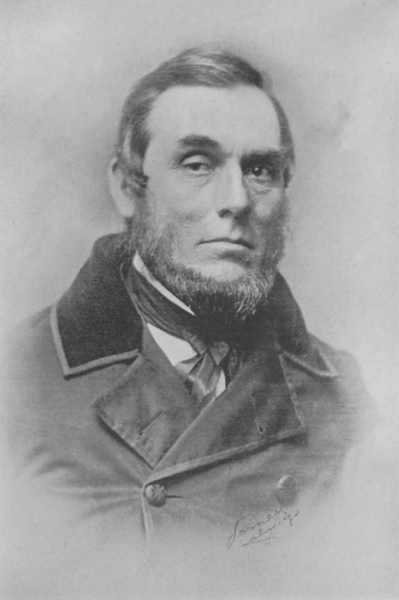
LUCIUS GEORGE FISHER From a daguerreotype in the possession of the Fisher family
My good aunt nursed me well and in three days I was quite well and was sent for by Mr. Goodhue to meet him at Elgin, which I did and he took me to Chicago with his team. Pg 277 For miles before we reached Chicago the prairie was on an average one foot under water. I remained but a day or two in Chicago, stopping at the Tremont House. I took an old steamer back to Milwaukee. I boarded at the Leland House on the west side until September, when I started again for Beloit by way of Watertown and was accompanied by a young man by the name of Sanborn, who was or had been a medical student but had come west to seek his fortune. (He afterwards returned to New England and finished his studies and became very eminent in his profession in Keene, New Hampshire.) We borrowed a horse or pony of Colonel Parks, receiver of the land office, and rode and tied to Watertown, and there we spanseled the pony and turned him out to grass. The next day the Indians had stolen him and he was found some weeks after at Green Bay. We stopped with a Mr. Johnson, the first settler there and then the only family there except one in Goodhue’s camp.[109] They gave us a bed separated from the bed of Mrs. Johnson and her daughter by a blanket hung between us. Mr. Johnson slept on the floor. The house was about 12 × 12 feet, in one room. We had for food salt pork, potatoes, and blackberries, and good appetites.
We remained one week and labored diligently with adz and axe in cutting down a basswood tree and fashioning a canoe from it, and at the end of a week we hired Mr. Johnson’s yoke of oxen and drew the canoe about a mile to the river. Neither of us were acquainted with the use of tools, and the canoe was not artistic. We launched it, and on entering it the first time it shot from under me and left me in the river. But we soon got the hang of it and we set sail. On Pg 278 entering Lake Koshkonong we found the wild rice so high and thick that we could not find a way out of it, and we returned to an Indian encampment on the river and hired two Indian boys to go before us and pilot us through the rice (about half a mile) to clear water. We reached the outlet about dark and it was then by the river about twenty miles to Janesville, and we knew there was a log hut with a man and wife in it somewhere before reaching Janesville.
We pulled on in a bright moonlight and reached the shanty about midnight, very tired and hungry. On landing we went to the house and found an opening with a quilt for a door, which I pushed aside and spoke to a woman whom I discovered in a bed with her head within a foot of the door. She answered with a scream and the husband enquired, “Who is there?” I replied, “A friend,” and made known our wants. He arose and struck a light and I found we were in a log room about 12 × 8 feet with no windows, door, or fireplace, the fire for cooking being made against the logs at one end and a hole in the roof for the escape of the smoke. The bedstead was made of two upright sticks with sticks, one end entering holes bored in the logs, the other entering holes in the standing pieces and slats on these supports. There were two berths of this kind, one over the other. We were given the upper one and slept until the party under us had breakfast ready. The man had been to the river and caught a fine catfish for breakfast and we had appetites that gave our food a fine relish. From there we went to Beloit in one day without accident. This was in September. Mr. Sanborn remained with me several days. He boarded with Mr. Blodgett in his log house, sleeping on the floor. Mr. Johnson, Alfred Field, and some others lived in the Thibault hut and the Bicknell family in a log hut near the paper mill or present dam, on the east side of the river. I remained about four weeks.
Pg 279 While there, a meeting of the settlers was called at the Beloit House, which was at that time enclosed and partly finished, to give a better name to the place. Major Johnson, Deacon Hobart, and myself were appointed a committee to report one and we proposed several and finally agreed to place the alphabet in a hat and see if we could not get a combination of letters that would give us a name that would be a new one. While proposing this, Mr. Johnson undertook to sound a French word for handsome ground and in trying he spoke “Bollotte,” and I said after him “Beloit,” like Detroit in sound and pretty and original I think. All sounded it and liked it and we reported it to the twenty or thirty who had sent us out and it was unanimously adopted; and it has ever since been Beloit and not New Albany.
While at Beloit Major Johnson and Cyrus Eames took the canoe that Sanborn and I made and floated down to Burlington where the first territorial legislature for the Wisconsin Territory was in session. The present states of Iowa and Wisconsin were called Wisconsin Territory then. At that session they obtained a charter for a female seminary in Beloit, it being the first charter for an institution of learning that was granted in the Territory.[110] While at Beloit in September, a Professor Whitney of Belvidere preached the first sermon in the Beloit House that was preached in the county of Rock. I remained into October and then returned to Milwaukee by the way of Watertown on horseback, riding one of George Goodhue’s horses in company with him and remaining over night in his shanty at Watertown. I remained in Milwaukee until February, 1838, having sprained my ankle in January, which confined me to crutches for three months.
Pg 280 My father and sisters, Jane and Amanda, reached Fox River in December, where my sisters remained with my Aunt Tyler until March. They left Vermont in October and came by land with a three-horse team. My father came on to Beloit, and learning there that I was confined in Milwaukee by lameness, he started for me with his team, expecting to find his goods shipped by water from Burlington, Vermont, but found that the vessel and goods had been sent near Mackinaw and that a friend of mine had started with me in a jumper for Beloit, where we met after three days. We rented one-half of the log house which Blodgett had just left to occupy a new frame house. We went to Dundee for my sisters in March and settled in our home with but little furniture. My father had brought with him two beds and bedding and clothing. Dr. White, father of Horace White of New York, occupied the other half of the house with his family. I met him in April and we soon became fast friends. He was a good physician and a man of great business capacity, one who had great command of language and would say more in the fewest words than any man that I have ever known. He was a man of sound judgment. He was a very [word illegible] and reserved man, making but few confidants. We were more intimate than brothers usually are. We had no secrets that were withheld by either from the other. He died in December, 1843, and I was left very sad.
In the summer of 1838 I bought four yoke of oxen and broke prairie for the crop of 1839 after seeding the 20 acres which was my share of the 320 acres, which was ploughed in two fields and paid for and owned in common by the colonists. My father and I harrowed in wheat and oats in March. Bread and meat were very scarce and dear, and some days we had nothing but suckers caught out of Turtle Creek. But most of the time we had meat and as soon as the vegetables grew we lived very well having plenty of hog product and bread. Our fall crop of wheat was good.
Pg 281 In the fall of 1838 I went to Milwaukee and arranged with a merchant for stoves, boots, and shoes to sell on commission, and with one team I drove them to Beloit and sold them at a good profit to the settlers who were coming in almost every day. In the winter of 1838-9 we lived in a part of Mr. Blodgett’s new frame house. In the summer of 1838 I made a claim of 160 acres on Rock River, two miles above Fort Atkinson, which was covered with timber, much of it basswood. In the winter of 1838-9 I hired four men to cut logs and rafted them in the spring to Beloit and had them cut on shares by Messrs. Goodhue and Moore. From the sales of this lumber I paid my men and from a part of it I built a comfortable house for my family. My sisters, Emeline and Rosetta, had been left behind, one in Montreal and Rosetta with an uncle in Burke, Vermont, under the care of a physician, having a sprained foot that she did not step upon for three years and which is not well yet. They came west in the fall of 1838, so in the new house we all gathered and were very happy.
In March, 1839, the first land sale took place in Milwaukee, and I was chosen bidder for all claimants in the south half of Rock County east of Rock River, the lands on the west side having been brought into market before at a land sale in Milwaukee. The claimants all secured their lands, they standing by me and permitting no one to bid but me on their lands, and I got all for them at the upset price of $1.25 per acre. Here I met the cousin and agent of Gen. Philip Kearney, and arranged with him to buy lands for the general and take the agency of the lands purchased. I made entries for him at Milwaukee and afterwards at Dixon land sale and subsequently entered some thousands of acres with Mexican soldiers’ land warrants on shares and managed his estate in the west for some years, and in 1856 I bought his remaining lands at $60,000 and closed my account with him. He visited me once in Beloit.
Pg 282 The first session of the territorial legislature was held at Belmont, Lafayette County, the second at Burlington, Iowa, and the third in Madison in November, 1838, after Iowa was organized as a separate territory. I attended that and succeeding sessions for several years as a lobby member. In 1839 I was appointed sheriff of Rock County by Governor Dodge and held the office six years, in one of which I took the census of the county and as sheriff collected the taxes of the county. I had my appointment from Governor Dodge two years, from Governor Doty three years, and the last year from the people, the office having been made elective. The statutes would not permit me to hold it again until after two years. My business was such that I could not afford to hold it longer, and I accepted the last election because the county was democratic and I was the only Whig that could defeat the nominee of that party. On the night of the election I went to Janesville to get the returns and found all but four towns reported and a tie. The next town came in a tie, also the next, and one more to be heard from and that a democratic one I knew. When I got the returns from that I had seven majority, and a great shout went up from my friends.
At the legislative session of 1840 I was appointed a commissioner to lay out three territorial roads—one from Beloit to Southport (now Kenosha), one from Beloit to Madison, the other to Milwaukee. Two others were appointed with me on each road. I spent much time on them and they are the roads of today with some slight changes. At the next session I was commissioned to lay a road from Beloit to Watertown.
In 1839 I met for the first time Miss Caroline Field, the daughter of Deacon Peter Field, who was at Beloit to visit her parents. We soon became engaged to marry and after a courtship of three years we married in June, 1842. I had built a house, into which we moved on the day of our marriage, where I lived until 1866 and where all my children were born.
Pg 283 In 1842 Horace White, Harvey Bundy, and myself formed a partnership in a general goods business and commenced building the stone flour mill on the Turtle Creek. We bought a stock of goods for another store, called the Mill Store. In December, 1843, Doctor White died and I was left with all the business and also his family to care for and his estate to settle, and my partner, Harvey Bundy, a worthless business man. All the wise ones prophesied that we should fail and White’s estate was or would be used up. We owed a large amount and the mill was about half finished. I felt that I might lose all—for I had not much to lose really beyond the land that I first purchased and a few hundred dollars earned. I settled the estate and saved it without loss, and kept the family together until Mrs. White married Deacon Samuel Hinman. Horace White of the Tribune once, and now the treasurer of the Oregon Steam Navigation Company, was the son of Doctor White.[111]
In 1852 a railroad charter had been obtained for building a road from Racine to Beloit. Also, one from Southport to Beloit. The incorporators of each road came to me to assist them to build, and I chose the road to Racine and made enemies of the incorporators of the Southport road for the time being. It was through my influence that it was built. Fisher, Keep & Tolcott contracted to build it from Fox River to Freeport, and built it from Fox River or Burlington to Durand, when the financial crisis of 1867 failed the company and the work was suspended one year. I was appointed a receiver by the court and ran it a short time when it was restored to the directors and I became a director and the company built it to the Mississippi and sold it out to the bondholders.
Pg 284 Before this, in 1848 the Chicago and Galena Railroad had been built to Elgin and the funds of the company were exhausted, and William B. Ogden and other directors came to Beloit and offered to build a branch of their road from Rockford to Beloit, when their road reached Rockford, if the people of Beloit would subscribe $75,000 to the main line. I was selected by our citizens to take the subscription and in one week I got it—part of it without conditions, and part with my guarantee that if they would subscribe and pay five per cent, that I would guarantee the stock to be par when the second installment was called for. The installments were to be five per cent each month. Mr. Keep, Mr. Cheney, and myself took $30,000 and I took $15,000 for General Kearney. When the second installment was called for I had to take several thousand more that was given me on my agreement to take it if not at par. Before the third installment was due the stock was at five per cent premium and I sold most of it. The company built the road from Belvidere instead of Rockford, which gave us a shorter line. The next year the Beloit and Madison Railroad was begun, and I was elected a director in that and remained on the board until it was sold to the Chicago & Galena Company, which company soon after sold out to the Northwestern Railroad Company. I was a contractor on the Chicago & Northwestern Air Line between the Rock and Mississippi rivers. In 1856 I was one of the contractors for building the railroad from Clinton, Iowa, to Council Bluffs. The contract was for grading, ironing, and ballasting the road and amounted to about $13,000,000. The pay was a land grant of every other section ten miles in width, some cash, and some bonds and some stock. When we had expended about $400,000 in grading, the company failed in 1857. We got the first 100 sections of land and the franchise of the road, which we sold to Mr. Blair of New Jersey and got even with the company. We took the land grant and built the road some years after; Morris K. Pg 285 Jessup, Dean Richmond, Charles Reed of Erie, and Messrs. Morris & Courtright of New York were partners, also H. S. Durand and Wm. Allen of Racine. I also had a partnership with the last two and Judge Green of Providence, Rhode Island, by which the latter gentleman was to furnish $100,000 cash to be used by Durand, Allan, and myself in the purchase of lands and town sites in Iowa on the line of the road, the profits to be divided equally between Durand, Allan, and myself, party of the first part, and Greene and his associates, party of the second part. The crisis of 1857 ended that project. In 1852 I prevailed upon a party in Pittsburgh, Pennsylvania, to open a bank in Beloit. In 1854 John M. Keep, A. L. Field, and myself bought the bank stock and elected Keep president and Field cashier. In 1856 I was elected president and Mr. Keep sold his stock. In the crisis of 1857 the bank failed and was closed and its charter sold to Davis & Martin. In 1856 I was elected to the legislature and served in 1856-7 and declined a reëlection, as at the time of election the next year, I had more business irons in the fire than I could attend to.
When the charter of the city of Beloit was obtained, I was elected an alderman from the second ward and served six years, and was two years county supervisor. I was a director in a gas company, also in a car company that went no further than organizing.
I was a partner of W. T. Goodhue in the purchase and ownership of considerable real estate. With Goodhue and R. H. Mills in the purchase and sale of real estate; also, with R. H. Mills in the purchase and sale of a large amount of real estate. In the settlement with Mr. Mills, he owed me over $15,000 which he could not pay, so I gave it to him. Mr. H. Cheney owed me as much more when he left for Colorado, where he died. Messrs. Mills, Brooks, and I purchased and sold much real estate. I was elected a trustee of Beloit College at its organization and have been to date, also one of Pg 286 the Executive Committee while I lived in Beloit, and gave much of the site or grounds. I have been a deacon in the Congregational church about thirty years. In 1861 I was appointed by President Lincoln postmaster at Beloit. He had been my attorney in defending the title to Beloit, which I did at my own expense mostly and won the suit, and saved the citizens from a heavy blackmail.
The president offered me any office that I thought myself competent to fill, through my friend, David Davis. I took the Beloit post office, as I could not leave my business interests in Beloit. At the end of four years I was commissioned again by Lincoln and was afterwards removed by Johnson for refusing to support his measures. In 1862 I was appointed by Secretary Chase to take subscriptions to the first or gold bonds issued to carry on the war, and was one of two appointed for Wisconsin and received subscriptions.
Pg 287
DOCUMENTS
THE CHICAGO TREATY OF 1833
With Introduction and Notes by Milo M. Quaife
The Chicago Treaty of 1833, with the negotiating of which the following documents deal, was an event of considerable importance, particularly in the history of Illinois and Wisconsin. From the first advent of the white man in this region the Potawatomi tribe of Indians had made its home in some portion of the territory adjacent to Lake Michigan. By the Chicago Treaty of 1833 the Potawatomi and allied tribes, the Chippewa and Ottawa, at length agreed definitely to leave this region and find a new home beyond the Mississippi. To the whites was surrendered their title to some 5,000,000 acres of fertile land in northern Illinois and southern Wisconsin, embracing the tract between Lake Michigan and Rock River and extending northward from an east and west line drawn through the southernmost point of Lake Michigan.
The circumstances attending the negotiation of the treaty were typical, probably, of those of Indian treaties generally in the first half of the nineteenth century. Yet two or three facts give to this treaty a somewhat special degree of interest. One is that we have left to us fuller and better descriptions of the negotiation of the treaty than is commonly the case. Another and more important one is that a larger sum of money was distributed in the form of gratuities more or less disguised, to facilitate the conduct of the negotiations. It is with this phase of the subject that the documents here presented deal. So far as known, no student of American history has ever seriously set himself the task of illuminating the subject of the process whereby the American government secured from the red man, in successive treaties, title Pg 288 to the greater portion of the land of continental United States.[112] A comprehensive study of this subject would reveal much of interest and value; it would be certain, too, to disclose much of a nature far from flattering to the American government and nation. That the Chicago Treaty of 1833 would afford some material of this sort for the construction of the narrative, it requires no hardihood to affirm. Charges of improper influences and conduct in connection with the framing of the treaty began to be made as soon as it was negotiated. Some of them, doubtless, were irresponsible and unfounded, but there is reason for supposing that this was far from being true with respect to all of them. The letter of Governor Porter is preserved in the Burton Library at Detroit, and acknowledgment is due to Mr. Burton for the copy we present. The charges against Porter are copied from a contemporary broadside preserved among the Martin manuscripts in the Wisconsin Historical Library. The two documents go hand in hand, for it is evident that the charges which Porter sought in his letter to Jackson to refute are identical with those stated in the broadside, although the latter seems not to contain all the material which had been submitted to Jackson and which was referred by him to Porter to answer. Readers who may be interested in pursuing the subject further may find a discussion of the Chicago Treaty of 1833 in the present editor’s Chicago and the Old Northwest 1673-1835, 353-66.
CHARGES PREFERRED AGAINST GEORGE B. PORTER
Detroit, December 12, 1833.
To Hon. the Chairman of the Committee on Indian Affairs in the U. S. Senate
The following are the charges and specifications preferred against George B. Porter, Governor of Michigan Territory, and Superintendent of Indian Affairs:
Pg 289
GOV. PORTER, Commissioners Chicago Indian Treaty, 1833.
COL. OWEN,
MR. WEATHERFORD,
* Robert A. Forsyth, $3000 out of the $100,000 appropriated in lieu of the reservations—Forsyth, of the U. S. Army, receiving his as Indian Chief.
† James Kinzie, 5000
* Robert A. Forsyth, $3000 To be allowed out of $175,000 appropriated for claims against the Indians. The names marked *, are the Children of Old Mr. Forsyth; those marked †, are the Children of Old Mr. Kinzie. The annexed claims are allowed to the heirs of Forsyth and Kinzie, for the destruction of property by the Indians during the late War. Mr. Forsyth died in 1814, and his claims against the Indians were never heard of till now.
* Marcia Kercheval, 3000
* Alice Hunt, 3000
* Jane Forsyth, 3000
† Jno. H. Kinzie, 5000
† Ellen Woolcott, 5000
† Maria Hunter, 5000
† Robert A. Kinzie, 5000
† do. do. do 1216
* Robert A. Forsyth, 1300
$42,516
Old Mr. Kinzie, whose claims are placed on the same ground, died a subject of the King of Great Britain—he fought against this country in the late war—his own family only escaping at the massacre of Chicago. The heirs of Forsyth and Kinzie, are cousins, consequently the above claims are all in one family. Major Robert A. Forsyth, a Paymaster in the U. S. Army, and the individual above named, was one of the committee on claims who allowed the above sum of $42,516 to himself, his sisters and cousins—one individual only being associated with him. The Major, and all of his sisters, were born in the province of Upper Canada, and he to this day has never been naturalized. He is, however, the especial protege of the Secretary of War, and Governor Porter. A large amount of just claims were rejected by the Committee, to make room for the claims allowed above.
* Robert A. Forsyth, $ 300 Said to be held in trust for certain Indians, and allowed by the Committee on Claims.
* do. do. do. 200
* do. do. do. 1000
* do. do. do. 800
* do. do. do. 200
* do. do. do. 400
Pg 290 Roberson and Caldwell, the principal Chiefs of the Potawatamie Nation, half whites, and persons whom Robert A. Forsyth can control as he pleases, received $10,000 each, as a bribe to induce them to influence the other Chiefs of the Nation. It is allowed out of the $100,000 appropriated in lieu of reservations. Caldwell was the principal Chief at the massacre of the River Raisin. A Frenchman called Loranger, an Indian trader, was allowed by the committee on claims $5000, by assigning his claim to Robert A. Forsyth, to whom he was indebted $3000. The goods furnished by John H. Kinzie, Aid-de-Camp to Governor Porter, (and the individual named in the list of claims,) and Mr. Kercheval, (the husband of Maria Kercheval, named in the list of claims,) under former treaties, amounted to $100,000. The practice of Gov. Cass has always been to give the furnishing of goods to be distributed among the Indians, under a regulation of a former treaty, to the Indian Agent at the Agency where the goods were to be distributed, as a perquisite of his office. Had the precedent been followed in the present case, the Indian Agents at Green Bay, Chicago and Logansport, would have had the distribution of the goods. But Gov. Porter assigned, over and over again, as a reason for taking this perquisite from the Agents, that he was desirous of saving the per centage usually allowed them, and that in lieu of this per centage, he had engaged Kinzie and Kercheval only as agents to purchase the goods in New-York, and was to give them a per diem allowance for this trouble. Yet, in express contradiction of this declaration, Governor Porter, as can be positively proved, has allowed to Kinzie and Kercheval, 50 per cent. on the whole amount of goods furnished, making to them a profit of $50,000.
Claims$42,516
Trust Fund3,200
Profit on Goods50,000
$95,716
This amount of public money is put into the pockets of one family in the short space of six weeks. Is it not reasonable to suppose, that Governor Porter finds a strong reason for confining the patronage of the Government to one family, in the fact that he comes in for a share of the “plunder?”
Pg 291 In addition to this, Kinzie and Kercheval have received from Governor Porter, the contract to furnish the Indians with horses, from which they will undoubtedly realize $10,000.
Kinzie also obtained the exclusive furnishing of the goods at the forks of the Wabash, amounting to $40,000, and Kercheval at Nottawassippie, to the amount of $20,000.
It is a fact notorious among all who attended the Chicago Treaty, that the goods furnished at that treaty, were afterwards taken from the Indians in large amounts, and furnished at other places. Kinzie himself, used the goods which he furnished the Indians as a gag to those who complained of his conduct, by making them presents of cloth, &c.
Lucius Lyon, our Delegate in Congress, is in possession of all the foregoing facts, and will vouch for their correctness; and for their further confirmation, I refer you to Geo. W. Ewing, Logansport, Ind.; Alexis Coquillard, South Bend, Ind.; Thos. J. V. Owen, Indian Agent, Chicago; Peter Godfroy, Teunis S. Wendell, Wm. Brewster, Edward Brooks, and S. T. Mason, of Detroit; and Robert Stewart, Mackinac; and Col. Ewing, Secretary of the Commissioners. Most respectfully submitted for your consideration.
Your Obedient Servt.
LETTER FROM GEORGE B. PORTER TO PRESIDENT ANDREW JACKSON
Detroit, December 15th, 1833.
Gen’l Andrew Jackson, President of the United States,
Sir,
After a fatiguing tour of more than three months, in performance of the several public duties assigned to me, I arrived here last evening, and have the honor to acknowledge the receipt, this morning, of your letter of the 2nd inst. with its inclosure.
Personal respect for you, Sir, restrains the expression of feelings, outraged and indignant at having been made the object of calumnies, so wantonly malicious and grossly untrue, as those contained in the paper laid before you, a copy of which you have transmitted.
Pg 292 I appreciate, with a proper sense of the obligation, the considerate justice which has offered me the means of confronting my accusers, whenever they shall declare themselves; and I thank you for the renewed mark of confidence in my integrity, thus indicated.
The statements contained in this tissue of fabrications, shall be met fully and fairly, by my own distinct declarations, which, if deemed insufficient, shall be sustained by ample testimony, incapable of refutation. And if in vindicating my honor from unmerited aspersion, the detail should prove tedious, I ask, not doubting it will be granted, your forbearance for a temper, smarting under a sense of undeserved injury.
I may be permitted to premise, that like other public men, I too, have my enemies. But for this peculiar and vindictive rancour that assails me, I cannot otherwise account, than by attributing it to that fruitful source of evil passions—disappointed expectations. If, in the endeavor faithfully to discharge my duties, it has not been in my power to accomplish all the wishes of all, it is but the common lesson which experience has taught, to others as well as to myself. The invidious feeling which these causes produce, seeks to gratify itself, by wresting from me the credit of having effected an important Treaty, and would willingly sacrifice to its object the best interests of the country.
To proceed then to the matters alleged against me.
The first proposition contains both an indirect and a direct falsehood. First, in stating, for the purpose of disparagement, that but three million acres of land are purchased, when in point of fact, there are nearly six millions; And Secondly, that the title not being in the Indians, “there was no necessity for a Treaty at all.” The declaration itself is utterly without foundation; but waiving this, I remark, that the province of determining this “necessity,” rested not with the Commissioners but with the President. In the present instance, it is well known that a cession of country along the Western shore of Lake Michigan was deemed of so much importance, that an appropriation for holding the Treaty was made at the last Session of Congress—Who could be ignorant of this fact? And yet, those who profess to understand Pg 293 this matter better than the President and Congress, and the Secretary of War, whose knowledge of these Indians and this region of country is minutely particular, assert that the land did not belong to the Indians ceding it, and that “a little investigation will satisfy any reasonable man that there was no necessity for a Treaty at all.”
It is stated also that to indulge my favoritism its objects always found it an easy matter to “persuade his Excellency to get up a Treaty.” The mendacity of the writer is equalled only by his ignorance. The power which assumes the ordering of Treaties does not lie with me. But without this, the charge is unfortunate in its application, for I appeal to my letters on file in the Department to show whether this appointment was eagerly coveted, or reluctantly accepted, by me. And the instructions of the Department under which the Commissioners acted, (an extract from which for your convenience I enclose), will show, that the Secretary was not only aware of the importance of the duty but directed us “not to abandon it till all hopes of success were exhausted.” That we succeeded in effecting all that was required of us and, in the opinion of every good and intelligent citizen with whom I have conversed, made a valuable Treaty, advantageous alike to the Government and the Indians, of importance to the surrounding country, and this in the most public and honorable manner, I had never heard doubted, until my return to this place. Since then, I have heard of boasts that I should be destroyed. And accordingly, during my absence, falsehood and aspersion were busy with my character and conduct. To destroy the confidence you repose in me, no means have been scruppled at.—First, it is boldly proclaimed that I cannot effect a Treaty—then it is denied that any credit is due to me, for having accomplished it:—and now, I am held exclusively answerable for the whole Treaty, and every circumstance attending it.
To my Co-Commissioners, and the gentleman selected by them as the Secretary of the Commission, who are all highly respectable Citizens of Illinois:—to the full Journal of all our proceedings:—to the many distinguished citizens of Illinois, Indiana and the surrounding country:—to every honourable man who was present during the Council, among Pg 294 whom are Mr. Daniel Jackson of New York—and Mr. Robert Stewart, the Agent of the American Fur Company at Michilimackinac, both of whom I understand to be now in Washington, and whose characters are known to you, I appeal with confidence, for a refutation of these slanders.[113]
The suggestion that extra allowances have been made to me for extra services is not disputed, being an usage of the Government from its first institution. The labors I have performed and the fatigues I have undergone, in this tour, over roads almost impassable, and during a continuation of the most unfavorable weather, teach me to believe that I have honestly earned all that the Rule of Department will allow: But the vile and mean insinuation appended, and which none but an utterly corrupt heart could generate, that I have sold my patronage, does not require an answer.
In reference to the claims or accounts contained in the Schedules annexed to the Treaty, to some of which particular exception has been taken, I proceed, in explanation, to state: That in furtherance of the policy of the Government to remove these Indians West of the Mississippi, the Commissioners refused to grant Reservations of land, although these were greatly preferred, but agreed, in lieu thereof, that a part of the consideration money should be apportioned among such individuals as the Indians chose to designate. In like manner another part of the consideration money, the amount of which was fixed, was to be applied in satisfaction of claims, which, on examination, should be admitted by the Indians to be justly divided. Who, so well as they, could tell whether they were indebted to an individual or not? But to protect themselves against unfounded claims, many of which were presented, the Chiefs and head men employed a gentleman of high standing and respectability, as their assistant, and asked permission that he might be present at the investigation of the claims. This gentleman was Richard E. Hamilton, Pg 295 Esq.,[114] of Chicago—in whom these Indians reposed unbounded confidence—They farther requested that Major Forsyth, for whom they professed a like regard, and who was familiarly known to them, should aid their friend Col. Hamilton in the duty confided to him. Impressed, as all were, with the character of the two gentlemen for integrity and honor, so reasonable a request was not denied.—In the presence of the Chiefs and those Assistants, the commissioners proceeded in the examination of the numerous claims, the decision on each claim being made by the commissioners; by all of them; and by them alone; and the amount allowed on each claim was then and there written down by the Secretary. So far as relates to the allowances, (so principal an object of animadversion), granted to the heirs of Forsyth & Kinzie, I aver, without fear of contradiction, that neither Major Forsyth nor any of the persons interested, had anything to do with the decision upon them; nor, to the best of my knowledge and recollection, were any of them present, when they were acted on—The Chiefs and Head men insisted upon these allowances, and the Commissioners, on hearing the representation of the Indians unanimously acquiesced in their justice. These with the several other claims allowed form, as I have stated, a part of the consideration money of the Treaty, and if it were possible, which it certainly is not, to preserve the Treaty, striking these out, the Individuals named would, I have not a doubt, suffer neither detriment nor loss—The whole Potawatamie Nation would, I am persuaded, restore the allowances at the Annuity table.
The name of Robert A. Forsyth, which occurs three times in the first statement of allowances, belongs to two different individuals, one of whom is a Merchant in Ohio,[115] and the other, the Paymaster. The extensive trade in which the Merchant of this name in Ohio is engaged will appear on reference to several Treaties lately made in Ohio and Indiana. Pg 296 Nor is this confusion of names mentioned in defence or extenuation—I am ignorant of any just ground of exception to my conduct, in the whole history of this transaction, but I note it, merely, as one of a series of deceptive statements. The jeering comment follows that “Major Forsyth of the United States Army, received his $3000 as an Indian Chief.” These falsehoods are almost too gross for refutation. The Treaty states the allowance. Does it say he received it as an Indian Chief? The Indians stated, themselves, and without any prompting on the part of the Commissioners, that there was due to Robert A. Forsyth a reservation, which had long since been promised by their nation, and which they had desired Governor Cass and Judge Sibley, Commissioners at the Treaty of Chicago in 1821, to grant him. This request has been reiterated at the Treaty of St. Joseph, in 1828, as can be attested by Gov. Cass and Mr. Menard, the Commissioners;—the land being then, and ever since, set apart for him by the Indians. It was not secured to him in either of these Treaties, because not included within the bounds of the lands then ceded. The Commissioners, in this, as in every other instance when it could be done compatibly with the policy of the Government, and with justice to Individuals and the Indians, conceived it their duty to obey their wishes.[116] The selection of persons to examine and adjust claims, as well for reservations as on account of losses, was made, not by the Commissioners, but by the Indians themselves. The claims were all subjected to the supervision of the Indians, or persons they themselves appointed to represent them;—It is notorious that they expressed at all times the most unhesitating confidence in their Indian Agent, Col. Owen, who was one of the Commissioners:—in Col. Hamilton, whom they specially deputed to act for them, and in the two persons Pg 297 scoffed at as “half whites,” Caldwell and Robinson.[117] With these was associated also Joseph, an influential Chief, who was present in every business transaction—Caldwell and Robinson have been nurtured with, and raised by, these Indians, one from childhood, and the other from his birth; they are identified with this tribe, and are Indians in character, in manners, in mode of life, in sentiments and conduct, and as such are regarded by them. By reference to the Treaty of 1829, it will be seen that they were then acknowledged as the principal men, and the Treaty was made with them. Whom could they trust if not these? After the assent to sell had been obtained, and the general preliminaries had been agreed upon, the Indians in open council, as will appear by the Journal, advised the Commissioners that they had confided the care of their interests, and all the details of the Treaty, to these, their principal chiefs; and the Commissioners, as I considered then and now, properly acquiesced. When these details were completed, and the Treaty reduced to form, it was read by Col. Hamilton in private Council to the Indians, and was again read before them in public Council, by myself, and unanimously approved. It is represented that old Mr. Forsyth never had $500 in property in his life. This can be disproved by a hundred witnesses, conversant with the fact, that he was extensively engaged in the Indian trade. So, too, the assertion that “old Mr. Kinzie died a subject of the King of Great Britain”, can be falsified by the records of the War Department, showing him to have been for many years after the war a Sub Agent of the Government. Equally and unqualifiedly false also is the declaration that “he fought against his country in the late war,” or “led the Indians in the Massacre of Chicago.” On the contrary he was a zealous and efficient partizan of the American party, and as the books of the American Fur Company will show, was their agent at his death.
Nor is the declaration that Major Robert A. Forsyth, a Paymaster in the United States Army, has never been “naturalized,” by which it is intended to be conveyed that he is an alien, less destitute of truth. The Father of Major Pg 298 Forsyth was an American Citizen, (born in Detroit), and has always resided in this country, and the accidental circumstance that Major F’s mother was, at his birth, among her friends across the narrow line which divided the Territory from Canada, did not, nor could, divest him of his national character. The law of nations recognize no such principle: Accordingly, the vote of Major Forsyth has never been challenged at an election; he bore a Commission, as a Cadet of the Military Academy, and subsequently as an officer in the Army of the United States. He has been elected to the Legislature of the Territory, and executed the trust; where the objection stated, if valid, would have been fatal. Finally, he has received from the President of United States, a Commission as Pay Master in the United States Army. Equally deceptive with every other feature of this malignant attempt to destroy me, is the perverse meaning significantly assigned to the trusts, confided to Major Forsyth and Mr. Kinzie. They are real, substantial trusts, created under circumstances of perfect notoreity at Chicago, and challenge scrutiny. In these, as in every other case, the appointment was made without consulting the individual, and in some instances against his inclination.
Major Forsyth is charged also with having bribed Caldwell and Robinson with $10,000 each, to influence the Chiefs of their Nation. This varies in nothing from the complexion of the other statements. It is a pure fiction. Major Forsyth had nothing to do with the matter. The Individuals cited, received, by the express direction of their people, the sum of $10,000 each, as the two head men of the nation, to whom the entire direction of their affairs had long before been committed,—on whom they not infrequently lived, and to whom they looked for relief in their necessities. A reference to the Journal will establish the fact of their appointment, because it is so declared in the speeches of the Indians, delivered in public Council. If the Indians, in open Council, declare what shall be done with a part of the consideration money of their land and, according to their custom, insist that their principal Chiefs shall be provided for out of it, why should it be objected to? As well might it be objected that $5000, a part of this consideration money, is appropriated at the request of the Pg 299 Chiefs to the students of the Choctaw Academy, of which sum the Honorable Richard M. Johnson is constituted Trustee.[118]
It is said also among other representations that a Frenchman called Loranger,[119] who never had goods in the Indian country, was allowed by the Commissioners on Claims $5000 by assigning his claim to Robt. A. Forsyth to whom he was indebted $3,000.
It is with difficulty Sir, that I can sufficiently command my feelings, or control the disgust with which I am affected, at these monstrous falsehoods, for while I would speak of them in the manner they merit, I would not forget the respect due to you. But in the above proposition of three lines, are stated three direct, unqualified untruths:—First—That he had had no goods in the Indian Country which could be refuted by a common clamor. Second—That he assigned his claim to Major Forsyth; and Third—That he was indebted to him for $3000.—I have already named Mr. Daniel Jackson, of the firm of Suydam, Jackson & Co., of N. Y. who are so extensively engaged in the sale of Indian Goods—Of him I would ask how long he has known Mr. Loranger to be in the Indian trade, and what has been the amount of goods sold yearly to Mr. Loranger—The claim of Mr. Loranger was much greater than the allowance—The balance is lost to him, because not presented at the Treaty in Indiana in October 1832, being due by that Band or Party of Potawatamie Indians—He has been in the Indian trade since 1804, and lives within sight of this town.
I had intended to close this communication here; but I cannot remain silent, while slanders are heaped upon the gallant dead. The characters and memories of John Kinzie and Robert A. Forsyth deceased have been wickedly assailed—and by whom? Their descendants would like to know—For the part each one of these individuals took, and the important services rendered by them to the American Government in the late war, reference is made to many of the Pg 300 first men in the country; Among those immediately around you is the Secretary of War, Major General Macomb, General Gratiot and Colonel Croghan.—Having considered it my duty to make inquiry I have obtained the following information and believing it to be strictly correct, I give it to you as such.—
Memoir of the late John Kinzie of Michigan.[120]
John Kinzie died at Chicago in 1828, aged 64 years; he came to this part of the Country when a boy and was in the Indian trade during the greater part of his life. He went to Chicago, Illinois, in 1803—was Sutler for the United States troops for several years, and was the first to take from Detroit the news of the declaration of War, to Captain Heald then commanding the Fort at that place.[121] On the eve of the massacre at Chicago, Mr. Kinzie with two friendly Indian Chiefs, called at Captain Heald’s quarters, and advised him not to abandon the Fort as was contemplated the next morning, but to remain as long as possible; for if he left it he would certainly be attacked by the Indians, who had collected to the number of five hundred warriors.—Captain Heald persisted in going—said he had orders from Genl. Hull to evacuate the post, and to proceed with his command to Fort Wayne. Captain Heald then requested Mr. Kinzie to accompany him, which he did, leaving his family with but three men to protect them on their way to St. Joseph (distant by water 100 miles). Mr. Kinzie’s family were taken prisoners a few hours previous to the massacre. Mr. Kinzie was in the battle, as well as one daughter, the wife of Lieutenant Helm, whose horse was shot from under her. She received a wound in the foot from the ball which killed her horse. Mr. Kinzie was taken prisoner with the surviving command of Captain Heald. Having been long a principal trader among these Indians, and much esteemed by them, he was next day by a Council held by the Chiefs, liberated, and his family restored to him.
Pg 301 He then prevailed upon the Indians to surrender to him Captain Heald and family, whom he furnished with conveyance to Mackinac.[122] Mrs. Heald now residing at St. Louis can prove all these facts.—Having lost all his property to a very considerable amount (it being a wholesale establishment) consisting of merchandise, furs and peltries and horses, etc., taken by the Indians, he went to Detroit. His influence while there was directed toward affecting a change in the views and feelings of the Indians at that time unfriendly to the American Government. This influence with the different tribes of Indians was very considerable and as a proof of it General Proctor commanding the British force in Detroit and its vicinity sent for Mr. Kinzie, and when he went to see him General Proctor immediately confined him as he said “for daring to prejudice the Indians against his Majesty’s subjects or forces, and would send him where he would not see an Indian in a hurry.”—Mr. Kinzie was twice rescued by several Indian Chiefs, and once in the presence of General Proctor himself. Mr. Kinzie was again taken by General Proctor and closely confined in irons at Fort Malden (as also a Mr. Jean Bte Chandonnois who subsequently made his escape and is now living in the St. Joseph country) and kept there for months. He was finally, to conceal him from the Indians, sent off in the night in irons—was treated in the most brutal manner by his guard, and was shipped for England for trial—Fortunately for him, the Ship lost her rudder, and she was obliged to put into Halifax, having on board a great number of American prisoners.—He thence made his escape in a crowd of paroled prisoners, and returned to his family in Detroit, after it had been taken possession of by General Harrison’s Army. Mr. Kinzie had not been long at home before he was called upon by Colonel Croghan, and accompaned the expedition under him to Mackinac, and was Captain of a party of Militia at the battle fought on the Island of Dousman’s Farm. Mr. Kinzie, after the close of the War, held the appointment of Sub Indian Agent for many years at Chicago.—He was well known to Generals Harrison, Macomb, Gratiot, and Col. Croghan.—During the Pg 302 time of hostilities, his energies were always devoted to the American cause.
Robert A. Forsyth was long and extensively engaged in the Indian trade.—His residence was at Detroit and his trading establishments in different places in the Indian Country. He not only enjoyed the confidence of the Indians but that of his fellow citizens. Every honest man then resident of Detroit can attest to his bravery during the late War. Such had been his conduct that, on the surrender of Detroit, he was marked as a fit subject for British vengeance.—He was torn from his family and with his only son, the present Major Forsyth, then a boy of about fourteen years, put on board the British vessels and carried off; his several infant daughters being left without a protector; their father’s house occupied by the British troops; and all his valuable property pillaged and carried away. Being landed on parol at Erie, Penn., the father and son soon afterwards found their way to General Harrison’s Army. This gentleman can attest to the many valuable services which they rendered. The father died in the year 1813, in the service of his country, without having been permitted to return to his family:—Being early enured to the hardships of trading among the Indians and being naturally active and brave the son frequently performed duties, from undertaking which others were deterred by their severity and danger. For the history of the son, the hardships he encountered, his important services before, and his gallant conduct during the war, I refer you to the Honourable Lewis Cass, who is familiar with its details.
I have now, Sir, I believe, with one exception, gone over the whole ground. That exception relates to the furnishing of goods by Mr. Kercheval and Mr. Kinzie, and as it has no connection with the Treaty of Chicago, being in fulfilment of the stipulations of previous treaties, and in the making of which I had no agency, and concerns myself exclusively, I shall make it the subject of a communication to accompany this.
The question so insidiously put, of whether “the Governor does not secretly reap a share of the plunder” I cannot, consistently with the respect due myself, answer.—Whether I have forgotten principle and character, and everything Pg 303 dear to an honourable mind, to defile my hands with the contamination of a bribe, is a question others must settle for me.—
In conclusion, I have only to add that, to the issue I have here made up, I commit without shadow of fear of the result, what is dearer to me than all else—my reputation and good name.
[G. B. Porter.]
Pg 304
HISTORICAL FRAGMENTS
THE DISPUTED MICHIGAN-WISCONSIN BOUNDARY
Boundary disputes have ever constituted a fruitful source of contention between men and nations. Probably no people has more frequently engaged in them than our own, although, contrary to Old-World precedent, we commonly wage our boundary contentions verbally rather than with arms. Wisconsin, like others of the sisterhood of states, was early in its history a party to a number of boundary disputes, the fruits of victory commonly going, at least in local contemporary judgment, to her opponents. Since Wisconsin has become a state, boundary disputes have until recent years ceased. Two such have, however, arisen within the twentieth century and are still pending, one with the state of Minnesota, the other with that of Michigan. The former is in process of settlement by due governmental procedure, and accordingly no discussion of it would now be useful. The latter is at present in a state of quiescence; yet the boundary paragraphs of the constitutions of Michigan and of Wisconsin contain mutually contradictory clauses with respect to a strip of territory over which Michigan claims and Wisconsin exercises jurisdiction. Moreover, the overtures of our northern neighbor a few years since looking to a determination of the question met on our part with rebuff. Sooner or later, the issue will have to be determined; pending this, an historical résumé of the points at issue may be of some interest, especially to Wisconsin readers.
The boundary between Michigan and Wisconsin was first determined in the act that in 1836 created Wisconsin Territory. In ignorance of the real geography of the region this act described a supposititious line, under the belief that the Montreal River had its source in Lake Vieux Desert. Two years later Congress appropriated $3,000 for the survey of the Michigan-Wisconsin boundary. The appropriation was considered insufficient and no attempt was made to run the line until 1841. Then, the matter having been transferred to the War Department, an army engineer, Lieutenant Thomas J. Cram, was detailed to undertake the survey. Cram spent Pg 305 the summer of 1841 in Wisconsin’s northern forests, ascertained many facts about the lakes and streams therein, and reported them to the department. Two years later Cram was again detailed to search for the true Wisconsin-Michigan boundary. He spent four months under conditions involving much hardship, in the attempt to determine the line as nearly as possible in accordance with official description. In the report which he made to the head of his department he recommended the abandonment of Lake Vieux Desert as a determinating factor in the interstate boundary line.[123]
The determination of the line rested until 1846, when, in the enabling act providing for the admission of Wisconsin, Congress established the line “to the mouth of the Menominee river; thence up the channel of the said river to the Brulé river; thence up said last mentioned river to Lake Brulé; thence along the southern shore of Lake Brulé in a direct line to the center of the channel between Middle and South Islands, in the Lake of the Desert [Vieux Desert]; thence in a direct line to the head waters of the Montreal river, as marked upon the survey made by Captain Cramm; thence down the main channel of the Montreal river to the middle of Lake Superior.” The constitution of Michigan, adopted in 1850, repeated the boundary article of Wisconsin’s enabling act with only slight verbal changes, including the omission of Captain Cram’s name. The fundamental laws of the two states were thus in accord concerning the line separating these states.
In the meanwhile, in 1847 a portion of the boundary was surveyed by William A. Burt, under the direction of Lucius Lyon.[124] Burt took the contract on April 27 and performed his work during the succeeding summer months. The field notes of his survey do not accompany his printed report, but Lyon stated that Burt’s notes would be forwarded later, and no doubt they are yet preserved in the General Land Office at Washington. From these field notes it might be ascertained why Surveyor Burt chose the eastern branch as the “main channel of the said Montreal river.” In so doing he assigned to Wisconsin 360 square miles of land that now include the towns of Pg 306 Hurley and Van Buskirk. Had he chosen the western branch, rising in the Island Lake as the Montreal’s headwaters, the jurisdiction of this strip would have rested in Michigan.
No one undertook to investigate the matter until quite recent years. Then Hon. Peter White of Marquette, Michigan, believing that his state was illegally deprived of the land between the two branches of the Montreal River, had a survey thereof made at his private expense. White’s surveyors ascertained, to their own and his satisfaction, that the western branch was the “main” channel of the Montreal River. Meanwhile Mr. White had interested in Michigan’s claims Clarence W. Burton of Detroit, the president of the State Historical Commission. Burton discovered that one of Burt’s surveyors, George H. Cannon, was still living, and arranged for the publication of an article from his pen supporting White’s contention that Michigan had been wrongfully deprived of a portion of her upper peninsula.[125]
Shortly after this, in 1907, Michigan held a convention to prepare a new constitution for the state. Burton was chosen a member of this body, and became chairman of the committee on boundaries. That committee, without discussion upon the floor of the convention, had the boundary article of the new constitution drawn to read: “thence in a direct line through Lake Superior to the mouth of the Montreal river; thence through the middle of the main channel of the westerly branch of the Montreal river to Island Lake, the head waters thereof, thence in a direct line to the center,” etc. This became part of Michigan’s fundamental law on February 21, 1908.
Meanwhile in 1907 two resolutions passed the Michigan legislature. The first, after reciting the mistakes in Captain “Cramm’s” surveys, authorized the governor to appoint a commissioner to visit Wisconsin in order to secure a joint commission for the adjudication of the boundary. In pursuance of this resolution the governor appointed Hon. Peter White to this office. He came to Madison twice, but could not interest the state’s officials in his enterprise, and was unable to secure any promise of participation in a joint commission. In June, 1908, Mr. White died, and so far as known no successor to him as boundary commissioner has ever been appointed.
Pg 307 The second Michigan resolution of 1907 authorized the attorney-general to direct a survey of the state’s northwest boundary, and also to institute proceedings in a court of competent jurisdiction to secure a rectification of the boundary line. Acting on this authorization the attorney-general employed Professor J. B. Davis, of the University of Michigan, to investigate the survey and prepare a brief of Michigan’s claims. The result of Professor Davis’ investigation has not yet been given to the world. A chronicler of Michigan wrote in 1908 that “in view of the political excitement of the presidential year no active measures [concerning the disputed territory] are likely to be taken this season.” On another page the author expresses a doubt “whether the state of Michigan can ever occupy the territory justly hers.” He concludes with the observation that it “is believed to be the only instance in this nation where two sovereign states are occupying a dividing line of doubtful legality, merely by common consent.”[126]
Louise P. Kellogg.
AN EARLY WISCONSIN PLAY
In the collection of Mr. Henry Cady Sturges, of New York, there is a copy (the only one the writer has seen) of a play which, while it may not be the earliest, is certainly one of the first printed in Milwaukee. While the plot of the production is laid in New York and is largely local in interest, yet the fact that it was printed in Wisconsin, and the further fact that no other edition seems to be known, makes it fairly certain that it is the offspring of a writer who lived in Wisconsin.
The piece bears title as follows: “The Drummer, / or / New York Clerks / and / Country Merchants. / A Local Play, / in two acts. / (2 lines of verse.). / Edited by Mrs. Partington. / Milwaukee:/ Job Press of Cary & Rounds. / Commercial Advertiser Office./ 1851./” It has 73 + 1 pages and paper covers, the front cover bearing the same title as above.
A curious coincidence regarding the characters in the play is that the father of the present owner, Jonathan Sturges, is among them, his part being that of “Mr. Sturges, a New York Merchant,” Pg 308 that really being his occupation. “Mrs. Partington” is also among the characters.
This curious production was written at the time of the Jenny Lind excitement, and that great singer is mentioned in a number of places throughout the play. Her manager, P. T. Barnum, is there also, while some of the localities noted are Coney Island, Niblo’s, The Bowery, and Castle Garden. The first act takes place, first in a saloon on Broadway, and afterwards in the office of a first class hotel, also on that well-known thoroughfare. The second act is staged in Mrs. Partington’s parlor in the same hotel.
Some of the popular books of the period are mentioned, among them New York in Slices, while among the names of well-known New Yorkers are Horace Greeley and James Gordon Bennett, editor of the Herald. Milwaukee is hinted at, and Mr. Sturges is made to say by the playwright as he addresses his clerks, “Fourteen hundred dollars from Wisconsin. Extremely good. Wisconsin crops are nearly all destroyed, still the money is sure to come from that state. More goods are ordered, they shall have them.”
The play is interspersed with songs that are saturated with the alleged humor of the period, and sad to relate, one of these songs has been torn from the copy before me, probably because of its facetious nature.
It is doubtful if the writer ever intended to have his production staged, although the copy now described has several corrections such as are found in prompt copies.
I am inclined to believe that the statement on the title that its editor was Mrs. Partington (Benj. P. Shillaber) was simply put on to add to the humor of the occasion, as I doubt if Shillaber had a hand in its composition.
On page 73 is the statement that copyright has been secured.
From a perusal of the piece it seems evident that its author knew the metropolis very well, but the misspelling of proper names and other evidence makes it seem almost certain that it was the work of some one, who, while well acquainted with New York, was not a permanent resident of that city. Was he a writer from Wisconsin? If so, who was he, and why was he writing a play of this character, a piece whose plot was taken from a place so far from home?
Oscar Wegelin.
Pg 309
EDITORIAL
THE PROFESSOR AND THE FINGER BOWL
To tell a new Lincoln story is something of an achievement. Colonel Tom Brown, a former citizen of Badgerdom, who now resides in Sioux Falls, South Dakota, has achieved this distinction, we believe, in relating the following incident. In view of the nature of our leading article, and of the local interest which attaches to Mr. Brown’s tale, we gladly give it such additional currency as lies within our power.
In some sections of southwestern Wisconsin during the Civil War, so the story runs, certain copperhead organizations, particularly the Knights of the Golden Circle, became decidedly outspoken in the expression of their sentiments—so much so that a group of loyal citizens decided to send a spokesman to Washington to acquaint the President with the threatening proceedings. The delegate chosen for this mission was a certain Professor Kilgore of Evansville Seminary. On his arrival at Washington he was invited to take lunch at the White House, where he was seated next to President Lincoln himself. At this time finger bowls were coming into fashion, but their advent had not as yet come within the ken of the simple western professor. Accordingly he was greatly perplexed by the little dish, containing a slice of lemon and some liquid, apparently lemonade, which appeared near the close of the meal. Observing his embarrassment, President Lincoln, leaning toward him, whispered, “Professor, don’t sip out of that bowl, watch me.”
Following this kindly instruction the pedagogue concluded the meal without disgracing himself. When, later, they found themselves alone together, President Lincoln confided to the visitor that he himself needed a servant to keep him informed about “those little things.”
Pg 310 We cannot vouch for the truth of the story, although it rests on better authority than most of the tales that are told about Lincoln. However authentic its details, it presents a trait of homely kindness, the possession of which constitutes one of the most attractive aspects of Lincoln’s personality.
THE PRINTING OF HISTORICAL PUBLICATIONS
The last day of the year brings to hand the January, 1917, number of the quarterly Journal of a neighboring state historical society. What the local conditions may be which render it necessary to be a year behind with the publication of this periodical, we are unaware. Reference is made to it by way of calling attention to a practice which is all too common with respect to the issuance of historical periodicals and other publications. If a quarterly must appear six months or a year late it would seem to be a fair question whether its appearance at all is worth while. If such delays are due to the slackness or incompetency of the editor, the proper authorities should apply a much needed stimulant. If they are due to conditions beyond the editor’s control, reform (in the quarter responsible for the delay) is still desirable. We suspect that commonly such delays are caused by the state printers, by whom, at least in the Middle West, historical publications are generally issued. We speak the more feelingly on the subject because our own Society is not immune from the criticism under discussion. The printer dallied for a year over our most recently issued volume, while it required six months to get a forty-page bulletin printed. It avails little for editors to be punctual and businesslike in turning out their work, if it may then be hung up indefinitely by the printer, with the editor deprived of any means of amending the situation. Quite possibly state printers are themselves the victims of a system the amendment of which is beyond their control. Of this we have no particular knowledge. Wherever the responsibility may justly be placed, the Pg 311 manner in which most public printing is done in this country offers a severe commentary upon our boasted American efficiency.
IS WAR BECOMING MORE HORRIBLE?
There is an ancient story concerning a grave debate indulged in by a group of English philosophers during the Stuart period over the question why a fish does not weigh anything when in the water. At length it occurred to one of them to weigh a vessel of water with a fish in it, and again with the fish removed. As a result of this simple test the philosophers were forced to seek a new subject upon which to exercise their wits. At the present time it seems to be generally assumed that with the invention of new implements of warfare and of improvements upon old ones the horrors of war have steadily increased; in particular, that the present war is far more horrible to those who participate in it than any of its predecessors in the history of the human race have been. Such a belief as this entails obvious consequences affecting not only the peace of mind of our people but, in the last analysis, the success of the cause to which our nation is committed. For if it is indeed true that our young manhood is going to certain death under circumstances more awful than the pages of military history have hitherto ever recorded, our willingness as individuals to send our loved ones to meet such a fate must be seriously shaken by the prospect; while, collectively, the will of the nation to persist in the war upon which we have embarked will be similarly affected. In a word, such an impression gravely threatens the morale of the nation, including both those who go to war and those who send them forth. That our Teutonic foemen have not been unmindful of this is amply evidenced by the new and hellish connotation which in recent years they have succeeded in attaching to the word shrecklichkeit. To German shrecklichkeit we will pay our respects presently. Meanwhile we Pg 312 desire to deal with the question whether under the influence of modern science and invention the conduct of warfare has in fact become increasingly horrible.
SOME LEAVES FROM THE PAST
We believe it can be shown, on the contrary, that the direct opposite is true; that the warfare waged by primitive peoples and in ancient times was a far more horrible procedure than is that waged by civilized nations today. It may be taken as axiomatic that the horrors of battle, like the transports of love, increase as the distance between the parties concerned diminishes. All savage warfare, and all civilized warfare as well, until a very recent date, was waged at close range. In ancient and in medieval times men battled hand to hand with spear and sword and ax. The vanquished found slight opportunity to escape and the hand of the conqueror was stayed by no considerations of twentieth century humanity. The chronicles of the Hebrews, the Lord’s anointed, and the narratives of Alexander the Great and Julius Cæsar tell alike the same general tale of slaughter of the opposing warriors and the slaughter, rapine, or enslavement, as the case might be, of their dependents. In medieval times, it is true, under the influence of the institution of knighthood, certain rules foreshadowing the modern rules of war were developed. But these more humane rules applied only to the aristocracy, the commoner being excluded from their operation and benefits.
With the fourteenth and sixteenth centuries came two developments of much importance for their bearing upon our subject. The one was the application of gunpowder to the art of war, as the result of which war was democratized; the business of knighthood soon became as dead as Cæsar’s ghost, and as firearms improved, the distances at which opposing armies fought slowly widened. The other was an indirect result of the Dutch war for independence. Meditating upon the terrible brutalities to which his people were Pg 313 subjected by it, Hugo Grotius evolved the treatise on the laws of war and peace which by common consent has ever since been regarded as the foundation of modern international law. Grotius sought, in a word, to humanize warfare by securing the establishment by common agreement of rules calculated to prohibit its more debasing and awful manifestations. In the three hundred years ending with August, 1914, much progress was made, both along the lines laid down by Grotius and in other ways, looking to the minimizing of the horrors of war. At the same time, ever more ingenious and powerful death-dealing appliances were being devised for the waging of such combat as the rules of international law still rendered permissible.
THE DEVELOPMENT OF HUMANITARIANISM
Notable progress, too, was being made along another line. Humanitarianism in its modern connotation is the child of the nineteenth century. To feel distress over the knowledge that famine or other ill afflicts a distant people is a purely modern accomplishment of which our forefathers of two or three centuries ago were wholly innocent. As applied to armies, the humanitarian impulse has worked a startling revolution. Organizations designed to care for the sick and the wounded have developed on an elaborate scale. The Red Cross was called into being only half a century ago as an indirect result of the horrors of the battlefield of Solferino. It was born too late to have any share in alleviating the miseries of our own Civil War but since that time it has constituted an ever increasing agency for the relief of human suffering, whether in peace or in war. Even the “unspeakable Turk” has been infected by the virus of humanitarianism and the Red Crescent plays for the Mohammedan world the rôle fulfilled by the Red Cross among the nations of Christendom.
Pg 314 OTHER AGENCIES
The progress made in recent years in the fields of medicine and surgery has been no less striking than in that of humanitarianism; while the development of a new social consciousness (a concomitant, of course, of the humanitarian movement) has resulted in throwing about the soldier who wars for America in 1918 a set of safeguards, and in providing him with a degree of comfort such as no other warriors in the history of the world ever enjoyed. Against drunkenness and vice, twin plagues of army life since the beginning of the world, he is at least as well protected as is the civilian at home. Libraries and clubhouses and games and lectures are provided with unstinted generosity for his recreation and instruction. That his mind may be free from incidental worry, a system of life insurance on a scale hitherto undreamed of has been evolved; while the wife or other dependents at home are insured by the largess of a parental government against coming to actual want during his absence.
SOME FACTS AND FIGURES
All these things will avail little to comfort the soldier or his loved ones if it is in fact true that he is being sent to a certain and awful death—if his span of life, after reaching France, is limited to a few weeks, and after reaching the front line trenches to a few hours or minutes. Let us proceed, then, to weigh this particular fish. We can do it only approximately, for it is inherent in the nature of warfare that accurate, dependable statistics are commonly lacking, or extremely difficult to obtain. The testimony of such as we have, however, is all in support of the view that never before in civilized warfare has the individual soldier had so good a prospect of surviving the term of his enlistment and returning once more to the homeland as now. It is not contended, of course, that modern war is simply a pleasant pastime from which all will return unscathed, but merely that the current impression concerning its having become Pg 315 more awful and more fatal than in times past is incorrect. According to respectable authority the casualties in the entire French army in proportion to mobilized strength amounted, for the first six months of 1915, to 2.39 per cent. Since then the ratio has steadily decreased, the figure for the last six months of 1916 being 1.28 per cent. At the beginning of the war, for the battles of Charleroi and the Marne, when the French suffered more heavily than at any time since, the casualties were 5.41 per cent of the mobilized strength of the army. In other words during the period of greatest danger in the entire war but five men in every hundred received wounds, while, of these five, it is a safe generalization to say that only one died as a result thereof.
In view of the enormous numbers of men in the present war, the absolute figures of losses are appalling enough. Relatively, however, the losses are lower than in many previous wars. In no great battle of the war, probably, has the individual soldier stood so good a chance of being wounded or killed as did those—to mention a few cases only—who fought at Fredericksburg or Gettysburg, at Stone River or Chickamauga, at Waterloo, at Aspern, at Borodino, or Leipsic. At Fredericksburg, Burnside lost, in a few hours, one-tenth of his army, the loss in that portion actively engaged amounting to 16 per cent; at Gettysburg, in three days, one-fifth of the Union army and almost one-third of the Confederate army were killed or wounded; at Chickamauga and at Stone River over one-fourth of the Confederate forces engaged were lost, while the casualties sustained by Grant’s army in the seven-days’ wilderness battles amounted to the same appalling proportion. As to the Napoleonic wars, at Waterloo 40 per cent of the French army—30,000 out of 74,000—were lost in a few hours’ time; at Austerlitz, the French, although overwhelmingly victorious, lost almost one-ninth of the army in one day’s fighting, while the allies lost nearly half of theirs; at Borodino, in a single day, the victorious French suffered casualties of 22½ per cent, the defeated Russians casualties Pg 316 of 50 per cent of the armies engaged; at Aspern, a drawn battle, both French and Austrians lost, in killed and wounded, over one-fourth of the total armies engaged; at Albuera over one-fourth of the French and one-fifth of the allied armies were lost, but the British force, which bore the brunt of the allied fighting, lost 4,100 men out of a total of 8,000 engaged. In the present war, because of an unrescinded order, we are told, a Canadian detachment of 800 left 600 men on the field. But this is more than matched on both sides at Gettysburg, where with no mistake in orders one Confederate regiment lost 720 men out of 800, while a Union regiment lost 82 per cent of the men engaged. Sixty-two Union regiments in this war sustained losses in some single battle in excess of 50 per cent, a record equalled on the southern side by forty-three regiments. Those killed in action today are as irrevocably dead as those killed in any former war; but of those merely wounded (about four-fifths of all battle casualties) the prospect of recovering is incomparably better than in any previous war, while the prospect of death from disease incurred in service is likewise vastly diminished.
BRAVERY THEN AND NOW
It is a foible of most peoples in all generations fondly to picture themselves as braver and hardier than those of other races and times. So, in the present war, it is commonly assumed that greater demands upon the soldier’s fortitude and courage are made than in times gone by. In fact, however, bravery has been throughout the ages probably the commonest attribute of mankind. Soldiers are as brave today as in former times, but no more so. To contemplate a modern bayonet charge or a fight at close grips with gun-butt and knife is far from pleasant. But whereas such fighting is the occasional or exceptional thing today, of old it was the normal mode of fighting. The idea that combat should be waged at a distance was born only with the development of smokeless powder and high-power rifles. As late as Cromwell’s time Pg 317 the pike was the main reliance of infantry in battle. The favorite tactics of Napoleon were based on the idea of overwhelming the opposing army by the shock of mass formations. At Waterloo, for hours his splendid cavalry broke against the British squares, riding round and round at bayonet’s length, seeking to break their outer line. From fighting in the open in mass formation, armies have now largely taken to cover, even as the American Indian did; partly because of this, partly for the other reasons noted, the dangers and the horrors of war today have greatly diminished as compared with former times. Our people should be made acquainted with this fact, and both those who go to war and those who send them forth are entitled to such comfort as may legitimately be derived from it.
SCHRECKLICHKEIT
One general exception, however, must be taken to the comforting conclusions which have been reached. Broadly speaking, warfare among savages knows no rules and recognizes no limitations of action or honor. Prisoners of war may be slaughtered at once or reserved for the refinements of torture. No distinction of treatment is made between warriors and noncombatants. The lives, the liberty, and the possessions of the conquered social group are subjected to such disposition as the caprice or self-interest of the conquerors may dictate. Following in the path marked out by Grotius, slowly and painfully yet none the less surely, civilized nations have humanized warfare to a marked degree. The rules of civilized war distinguish between soldiers and noncombatants. The rights of the latter, both of person and of property, have been clearly established; even as between contending armies numerous rules have been established, all based on the general idea of regulating and refining war in ways calculated to eliminate its most horrible and debasing manifestations. In this work our own nation has played a leading part and the rules for the guidance of the Union Pg 318 armies adopted by President Lincoln half a century ago, still largely guide the conduct of nations in the waging of war.
With one awful exception, however. Moved by what atavistic influence we know not, in striking contrast to the trend of world development during the last three hundred years, the German government and people in the last half century have evolved the doctrine and subscribed to the principles of shrecklichkeit. As briefly characterized by Bismarck, this policy, or principle of conduct, aims to leave to the enemy nothing except their eyes with which to weep. It lays the ax to the very foundation of the structure of international law, slowly reared through three hundred years of effort. For the rule of right and justice it substitutes the jungle law of tooth and fang. Under its malign influence the whole circuit of the earth is filled with spying and treason, with fraud and strife. On the foul results of this policy, as applied to the conduct of armies, it is superfluous to dwell when addressing readers of the present generation. No sharper commentary upon the sad reversion of modern Germany to the customs and practices of savagery can be afforded than the fact that the rules promulgated by Lincoln for the guidance of the Union armies were drafted by Francis Lieber, one of the most notable men ever driven from reactionary Prussia to seek refuge in the United States. Shrecklichkeit, like revolutionary France in 1792, throws down the gage of battle to the remainder of the civilized world. In 1792, however, revolutionary France voiced the aspirations of the future against the dead weight of the past. Today imperial Germany challenges the civilization of the present and the hopes of the future in the interest of resurgent savagery. The world is too small to contain two such antagonistic sets of ideals and of conduct. Either Prussian shrecklichkeit or the American ideal of order based on reason and justice must prevail.
May we acquit ourselves like men and carry the fight to the finish.
Pg 319
THE QUESTION BOX
The Wisconsin Historical Library has long maintained a bureau of historical information for the benefit of those who care to avail themselves of the service it offers. In “The Question Box” will be printed from time to time such queries, with the answers made to them, as possess sufficient general interest to render their publication worth while.
THE FIRST SETTLER OF BARABOO
I am not able to fix the exact date when Abraham Wood came to Baraboo. What is the opinion of the staff as to the time? He was supposed to be the first permanent settler. A line will be appreciated.
H. E. Cole, Baraboo, Wisconsin.
We appreciate your difficulty in determining the time of the advent of Abraham Wood on your river, because of the conflict in the authorities. So far as we can determine, the account in the Wisconsin Historical Atlas seems to be the most authoritative. The sketches in this volume were carefully written, and were obtained from survivors then alive. According to that statement the first man who attempted settlement at the Baraboo Rapids in 1837 was Archibald Barker, who then lived at Portage. He was driven off by the Indians. Meanwhile the treaty at Washington had been negotiated, and there seemed more hope that a settlement might be made. In the spring or early summer of 1839 a man named James Alban discovered Devil’s Lake, and he went back to Portage and told Eben Peck, first settler at Madison. Peck had just sold out at the latter place to Robert Ream, and he and Alban set out up the Baraboo and marked out a site at the Rapids, including the water power. As Peck was going back (after a stay of some weeks), apparently he met Wallace Rowan and Abraham Wood, whom he had known well at Madison, coming up from Portage. They staked out their claim at Lyons, where Wood spent the winter.
Pg 320 In the meanwhile James Van Slyke came up from Walworth County in the fall of 1839 and determined to jump Peck’s claim. Van Slyke had had his claim at Lake Geneva jumped by other parties, and was in a bitter and retaliatory frame of mind. After staking out his claim to the rapids of the Baraboo he went back to Walworth and interested James Maxwell in a plan for a mill and persuaded him to furnish the irons and equipment. Van Slyke went up in the spring of 1840 and built a dam which was carried out by the freshet of June. Meanwhile, Peck had brought his claim before the court at Madison and obtained judgment against Van Slyke. The latter had already abandoned the enterprise. Van Slyke sold his irons to Wood and Rowan, who during the summer started a sawmill at the upper rapids.
There seems to be every evidence that the source of this account was the Peck family, who were in a position to know the facts. If this account is true, we suppose Wood might be called the first settler, since he remained in the vicinity during the winter of 1839-40; but no doubt he lived as the Indians did, if not with them, since his wife was a squaw. He was thus not much more of a first settler than Barker, Alban, Rowan, Peck, or Van Slyke.
To return to Wood. We are unable to discover when or how he came to Wisconsin. He was probably a free trapper or trader, one of the rough frontiersmen of Scotch descent from the backwoods of Canada. In the course of trade he came in contact with the Decorah chiefs and took to wife one of the daughters of the tribe. He had probably been on the Baraboo often before 1839, since his squaw’s native village was near its mouth, and there her father died in 1836. Wood was not then at the Baraboo, since he was wintering near Madison. He was not at this site in 1832, so sometime between that date and 1836 he set up his wigwam at Squaw Point on Third Lake opposite the modern city of Madison.
His neighbor at this place was Wallace Rowan, a rough, good-hearted frontiersman from Indiana with a white wife. There is a good account of Rowan in History of Dane County (Chicago, 1880), 382-83. Rowan seems to have permitted Wood to place his wigwam, or whatever kind of dwelling he had, on his claim, which he entered with William B. Long in 1835.
Pg 321 Wood was on Third Lake during the winter of 1836-37, and during the summer of 1837 he aided in building Madison, being employed as a mechanic on Peck’s log house. It seems probable that Wood spent the winter of 1837-38 at the same place, as there is no record of him at Portage before the spring of 1838. Probably he moved away from Squaw Point because Rowan that spring sold his claim and improvements to William B. Slaughter. Rowan moved to Poynette and opened his noted tavern. Wood went to Portage, where, no doubt, he had often been before with the relatives of his squaw.
In 1838 work was begun on the Portage canal, and Wood opened a house of liquid refreshment just below Carpenter’s on the Wisconsin River. There, probably in the spring of 1839, Wood killed Pawnee Blanc, a noted Winnebago chief. Wood’s brother-in-law, John T. La Ronde, tells the sordid story in Wisconsin Historical Collections, VII, 360. He does not give the date of the murder; Moses Paquette says (idem, XII, 431) that it was in 1837. Paquette probably remembered that it was after his father’s death in 1836; but it could hardly have been in 1837 since Wood was then at Madison. Our inference is that the death of Pawnee Blanc occurred in 1838 or 1839. Wood was probably anxious to leave Portage at this time; moreover in 1839 Winfield Scott went to Portage and held a council with the Winnebago concerning their removal from Wisconsin. Wood knew the Baraboo Valley would soon be open for settlement. He persuaded his old friend, Rowan, to go prospecting with him. But on their way out they found Peck and Alban had been there before them. Wood, not wanting to go back to Portage, spent the winter in the Baraboo woods; and the next autumn (1840) with Wallace Rowan began a sawmill, as La Ronde states (Wis. Hist. Colls., VII, 360).
The foregoing hypothesis appears to reconcile all the accounts except Moses Paquette’s date of the killing of Pawnee Blanc. The record of Wood’s trial may sometime come to light. Possibly it may be preserved in the records of the court of Brown County, still kept at the courthouse at Green Bay.
Pg 322 THE CHIPPEWA RIVER DURING THE FRENCH AND BRITISH RÉGIMES
Within a short time we expect to issue a special edition of our local paper that will cover the development of the Chippewa Valley. It struck me that possibly you could furnish me considerable data covering the early history of this section of the valley.