TURTLE-FARMING. By H. J. Shepstone.
Reading edition
An interesting description of the way in which turtles are “farmed” in various parts of the world. The most up-to-date and scientifically-conducted of these curious establishments is that of Mr. Hattori, in Japan, where the snapping-turtle, the most vicious of his species, is bred and reared.

That strange creature, the turtle, is now receiving the attention of the farmer, and is being scientifically bred and reared in various parts of the world. Indeed, turtle-farming on a large scale is now carried on both in Japan and in America, while the great palisade enclosures on the shores in the West Indies, where turtles are confined until wanted for the London market, may well come under the same designation.
Curiously enough, the species of turtle favoured respectively by the Japanese, Americans, and by English people are totally different. For instance, the Japanese farmer gives his attention to the propagation of the snapping-turtle and American to the diamond-backed terrapin, while the turtle soup so much prized by the wealthy and sought after by the sick in this country is made from the green turtle of the West Indies.
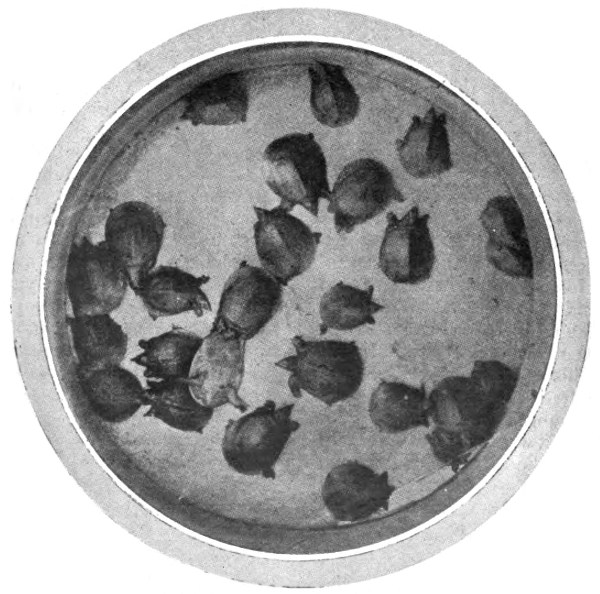
A GROUP OF YOUNG TURTLES JUST HATCHED. From a Photograph.
The terrapin is quite a small creature, rather flat-backed and rounded in outline, its scales being marked by independent black patterns composed of many geometric figures placed one within another. At one time it was found in large quantities in the shallow bays and salt marshes along the Atlantic coast from Massachusetts to Texas. The discovery that its flesh made a delicious stew and an ideal soup, however, resulted in the creature being hunted so vigorously that to-day it is exceedingly scarce. Indeed, whereas a terrapin, seven inches in length, could be picked up a few years ago for a few cents, it would be difficult to secure one to-day for a five-pound note. It was this scarcity of the terrapin, and the big demand for it among the hotels and restaurants, that have led not a few enterprising men to establish farms, where these much-sought-after creatures are bred and reared for the market in large numbers.
The terrapin being small, perfectly harmless, and requiring but a little pond of salt water to dwell in, there is nothing particularly exciting in farming it. Indeed, a terrapin “farm” consists merely of a number of small ponds or basins in which the creatures are confined according to their age and size. Thus, in the smaller ponds, we discover those just hatched from the eggs—curious little things not much bigger than a billiard ball. As they breed well, and it is not necessary to keep the creature long before it is ready for the chef, terrapin farming may be described as a fairly remunerative business.
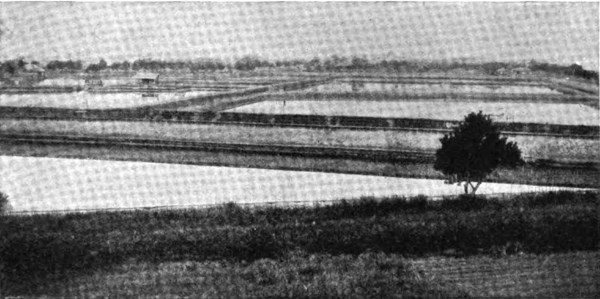
GENERAL VIEW OF MR. HATTORI’S TURTLE-FARM NEAR TOKIO, JAPAN. From a Photograph.
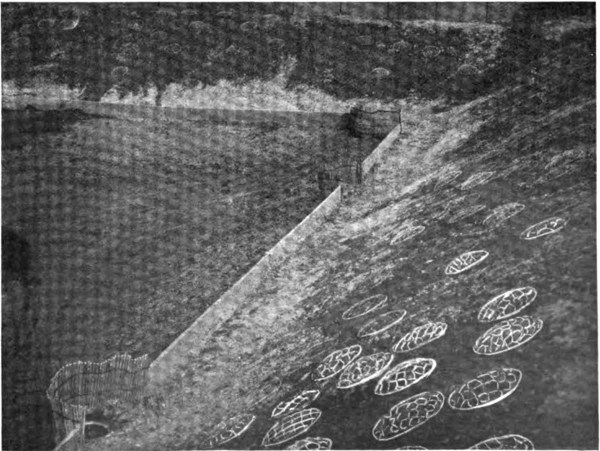
THE EMBANKMENT OF A “PARENTS’ POND”—EACH OF THE WIRE CIRCLETS HERE SHOWN COVERS A DEPOSIT OF EGGS. From a Photo. by M. Ichikawa, Japan.
Decidedly more up-to-date are the snapping-turtle farms of Mr. Hattori, situated just outside Tokio, the capital of Japan. The Japanese people will proudly tell you that they are the only turtle farms in the world, but, as I have already shown, this is hardly correct. These farms were established some few years ago now, and are, without question, a great success. On an average, Mr. Hattori supplies to the hotels and restaurants of Japan over sixteen thousand turtles a year, while another five thousand are shipped to China. So far as the farm itself is concerned, it consists of a number of rectangular ponds, large and small, the larger ones having an area of fifteen to twenty thousand square feet.
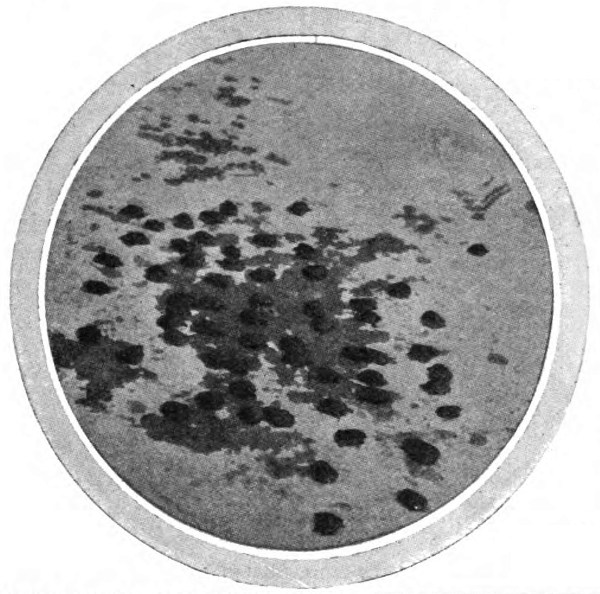
YOUNG SNAPPING-TURTLES A FEW DAYS OLD—THEY ARE KEPT IN A SEPARATE ENCLOSURE IN ORDER THAT THEIR CANNIBALISTIC ELDERS MAY NOT DEVOUR THEM. From a Photo. by M. Ichikawa, Japan.
One or more of the ponds is always reserved for large breeding individuals, or “parents,” as they are called, and one of the assistants visits this pond twice a day to look out for new deposits of eggs. Over these he places a wire basket, with the date marked upon it. In one of our photographs a number of these wire baskets may be seen, though unfortunately the eggs are not shown, being covered with a slight layer of sand, this work being done by the turtle itself. The covering serves a twofold purpose—the obvious one of marking the place, and, in addition, that of keeping other females from digging in the same spot. When hundreds, or even thousands, of these baskets are seen along the bank of a “parents’ pond,” the sight is one to gladden the heart of an embryologist, to say nothing of the proprietor.
The hatching of the eggs occupies, on an average, sixty days. The time, however, may be considerably shortened or lengthened, according to whether the summer is hot and the sun pours down its strong rays day after day, or whether there is much rain and the heat not great. As the turtles lay sixty eggs to the nest at two sittings, it will be seen that in a single season many thousands are added to this unique establishment, but at least five years must elapse before they are large enough for the chef.
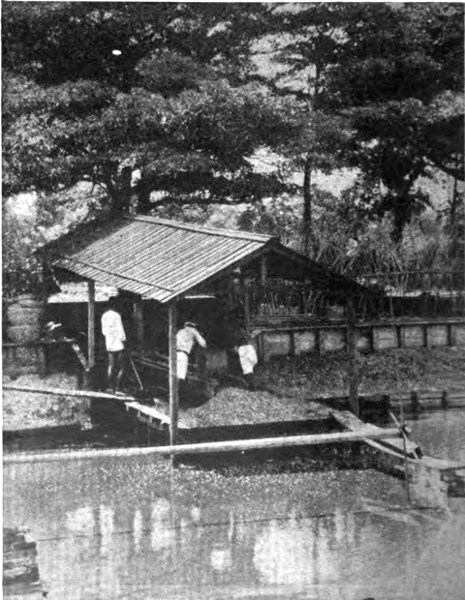
CHOPPING UP FOOD FOR THE BABY TURTLES. From a Photograph.
One would imagine, remembering the quantities of eggs laid by turtles, that they would be very plentiful, but there are few creatures that have more enemies. All that the mother turtle does is to deposit her eggs on the sand of some island and there leave them to be hatched out by the sun. Before this process is accomplished they are often destroyed by rats and birds, while very few of those that are hatched survive very long. The moment the young turtle emerges from its shell it seeks the water, and there crabs and various kinds of fish are ever ready to devour it. The young just hatched at the farm under notice are put in a pond or ponds by themselves and given finely-chopped meat of a fish like the pilchard, while the bigger ones are fed largely on live eels. This feeding continues to the end of September. In October the snapping-turtle ceases to take food, and finally burrows in the muddy bottom of the pond to hibernate, coming out only in April or May.
Snapping-turtle farming is much more exciting than raising the American terrapin. The former is a vicious creature and will snap at anything—hence its name. Indeed, in disposition it is the very opposite of its American brother. It believes most thoroughly in the survival of the fittest, and to it the fittest is number one. It is a chronic fighter, and inasmuch as its jaws are very strong and, like a bulldog, it never knows when to let go, it is a reptile to be either mastered or avoided. Indeed, the men at Mr. Hattori’s farm can tell many exciting little stories concerning the voracity of this strange creature. One farm hand, for instance, is minus a finger, the result of not using sufficient care when transferring one of the larger reptiles to a new pond.
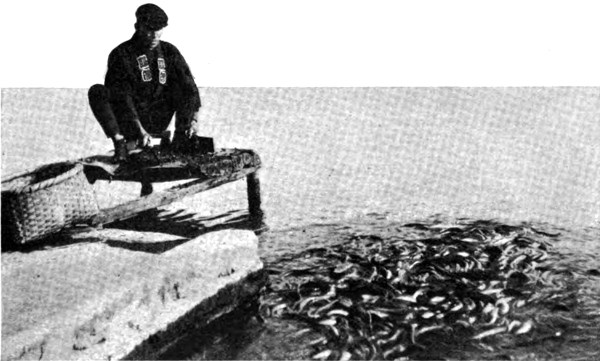
FEEDING THE EELS WHICH IN TURN PROVIDE FOOD FOR THE LARGER TURTLES. From a Photo. by M. Ichikawa, Japan.
Many naturalists have visited this unique farm and, after a close study of the turtle and its habits, have confirmed all the bad qualities that have been recorded concerning it. In securing its food it shows that it possesses no mean intelligence. At one time it crawls slowly and silently along with neck outstretched towards an unsuspecting fish, springs upon it by a powerful thrust of its hind legs, and snaps it up; at another time it drives the fish around the basin and terrifies it until it falls an unresisting victim. Again, the reptile may be observed buried in the sandy soil of its prison with only its bill and eyes protruding. On the approach of a fish the head and long neck dart forth from the sand with lightning speed and the prey is caught and instantly killed by a savage bite.
In its wild state the snapping-turtle is distinctly a nocturnal animal, and does its hunting after sunset, when it emerges from its muddy home to look for food. In the presence of danger it becomes bold, defiant, and even desperate. When driven to bay it retracts its neck, head, and widely-gaping jaws into its shell, awaiting a favourable opportunity to thrust them forth slyly and bite savagely. Anything which it has seized in its jaws it holds with wonderful tenacity, at the same time vigorously scratching the earth with its sharp claws. There is only one way to catch the snapping-turtle, and that is to secure it by the tail. Some of the men at Mr. Hattori’s farm are very dexterous in seizing their victims in this fashion.
A little time ago a Russian officer visited the establishment and listened, with some incredulity, to the stories of the voracity of the reptiles in the ponds before him. He carried in his hand a stout cane, and was told to place it near one of the bigger animals. He did so, and was surprised to find that in a few minutes it was bitten clean through. Before now the snapping-turtle has been known to bite through the flat of an oar. Not only will this turtle catch all kinds of fish and frogs and devour them greedily, but it is not averse to hunting waterfowl. Mr. Hattori declares that, in addition to raising turtles, he could rear ducks and geese as well, but dare not, as the reptiles would only kill them. When a snapping-turtle detects a duck it cunningly makes its way towards the creature, seizes it by its legs, pulls it down under water, and then drags it to the bottom of the pond. Here it tears the duck to pieces with the aid of the long claws of its fore paws and devours it.
It is this snapping propensity which makes it desirable to keep the reptiles in ponds according to their ages; it would not do to put those just hatched in the same basin as the bigger ones, as they would quickly be eaten. Until they reach their sixth year they are never “mixed.” When they reach this age, however, they are capable of taking care of themselves and are allowed access to the bigger ponds. By this time the turtle has reached maturity and may begin to deposit eggs, though it is not at its prime till two or three years later.
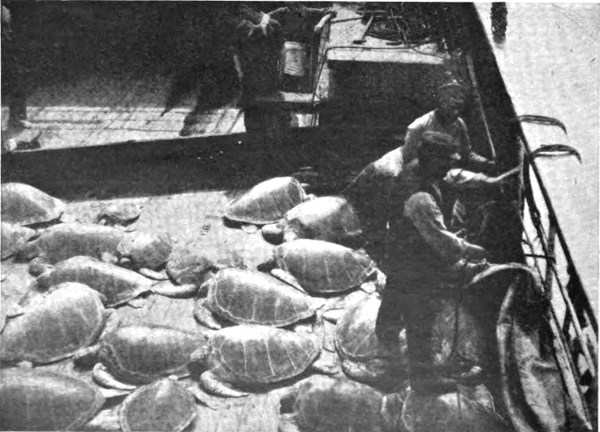
WEST INDIAN TURTLES ON BOARD A MAIL STEAMER BOUND FOR LONDON—IN SPITE OF EVERY CARE, THE MORTALITY AMONG THEM IS VERY HEAVY. [From a Photograph.]
What the Japanese epicure prefers are turtles not more than five years of age, when the flesh is soft and in desirable condition for the making of stews and soups. At this age the snapping-turtle weighs from sixty to eighty pounds. Those that are destined for the table are kept in a pond to themselves, and taken as required in nets or pulled out of the water by their tails. They are then placed in tin boxes or cases with air-holes, and sent by train to their destination.
The turtle that is consumed in this country is the green species, from the West Indies. The creatures are imported by Mr. T. K. Bellis, who will not hesitate to tell you that of edible turtles the green variety is the best. Mr. Bellis imports some three thousand turtles a year. They arrive in batches of one hundred or more every fortnight by the Royal Mail steamers from Kingston, Jamaica, and are obtained from the coral reefs lying to the north of the island of Jamaica. Twelve to fifteen small schooners are employed in the trade, and upwards of a hundred and twenty men.
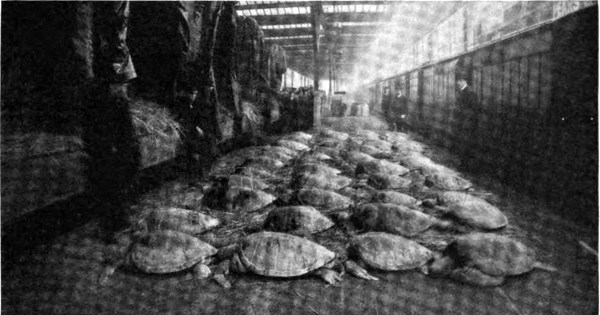
A CONSIGNMENT OF TURTLES AT A LONDON TERMINUS. [From a Photograph.]
These fishers of strange “fish” (the turtle’s technical name) stretch nets of twine from rock to rock, and the moment the turtle feels itself entangled it clings tenaciously to the meshes, and is then hauled to the surface. The schooners in due time return to Kingston with from eighty to a hundred and fifty of these remarkable creatures, which are promptly deposited in palisaded enclosures, flooded at every tide by the sea. Here they are fed upon a certain kind of herbage known as “turtle grass,” and taken as required. The bringing of these creatures overseas is a very delicate business, and frequently sixty out of a hundred perish en route, in spite of the most elaborate precautions, such as the constant spraying of salt water daily on board the mail steamer, and the use of foot warmers for the turtles in the railway vans from Southampton to Waterloo. Before now, Mr. Bellis has lost eighty-eight turtles out of a shipment of a hundred.
This susceptibility to travel is one of the most remarkable things about the turtle. If you are anxious to transport him alive it is a hundred to one he perishes of cold, but if you do succeed in getting him home the difficulty then is to kill him. The vitality of this strange sea creature after decapitation is almost beyond belief. Mr. Bellis once sent a large turtle to an hotel in Newcastle. The chef cut the turtle’s head off and hung the body upside down to bleed. Twenty-four hours after that turtle knocked down a man cook with one blow of its fin! The green turtle is not a vicious creature to handle, like its snapping Japanese brother, but its fins are very strong, and one blow from them is quite sufficient to break a man’s arm.
Mr. Frank T. Bullen gives a remarkable instance of the tenacious hold of the turtle upon life. “On one occasion,” he records, “our men cut all the flesh and entrails of a turtle away, leaving only the head and tail attached to the shell. Some time had elapsed since the meat had been scooped out of the carapace, and no one imagined that any life remained in the extremities. But a young Dane, noticing that the down-hanging head had its mouth wide open, very foolishly inserted two fingers between those horny mandibles. It closed, and our shipmate was two fingers short, the edges of the turtle’s jaws had taken them clean off, with only the muscular power remaining in the head. Then another man tried to cut the horny tail off, but as soon as his keen blade touched it on the underside it curled up and gripped his knife so firmly that it was nearly an hour before the blade could be withdrawn.” Signor Redi, the great zoologist, records how he once cut a turtle’s head off and noted that it lived for twenty-three days without a head, and another whose brains he removed lived for six months.
The green turtle, the species favoured in this country, is not a carnivorous creature, like the snapping-turtle, its food being a particular kind of sea grass found on the coral reefs in the West Indies. Some time ago Mr. Bellis brought a large quantity of this grass to London, with the idea of feeding the creatures in captivity, but they refused to take it. In his cellars in the City one can see any day a number of these turtles. Here they are kept until a telegram arrives from a distant hotel, when away goes the turtle to be turned into soup for the forthcoming banquet. Those hotels which do not care about the trouble of killing the creature can procure the soup in tins and bottles direct from the importer, and it is not surprising to learn that large quantities are sold. It requires eight pounds of the best turtle-flesh to make one quart of soup.
The green turtle grows to an immense size, but it has been found that specimens weighing more than a hundred and fifty pounds are not desirable, the flesh becoming coarse as the animal increases in weight. The shell of this variety is practically valueless, but the hawksbill turtle yields what is popularly known as “tortoiseshell,” and the armour covering of a good specimen may be worth eight pounds. Its flesh, however, is too coarse for consumption, though here it should be added that it is doubtful whether those who occasionally partake of green-turtle soup would relish that made from the flesh of the snapping-turtle.
It is a notorious fact that turtles grow very slowly and attain a great age. Curiously enough, neither Mr. Hattori nor Mr. Bellis can tell to what age a snapping or green turtle will live. Mr. Hattori has quite a number of turtles that are known to be from thirty to fifty years of age, while some of the bigger specimens that arrive at Waterloo for the Bellis cellars are, it is believed, twelve to fifteen years old.
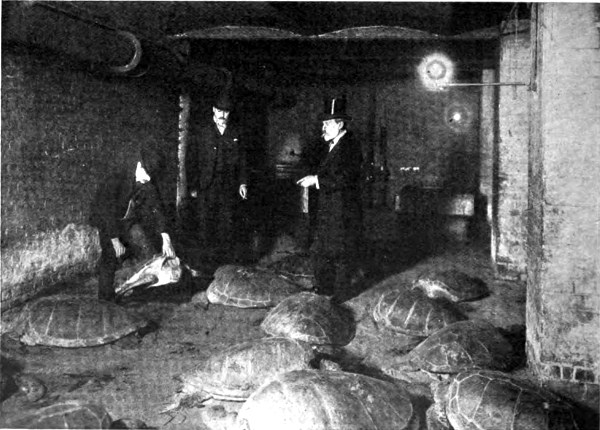
TURTLES IN MR. BELLIS’S CELLARS IN THE CITY OF LONDON. From a Photo. by Conolly & Goatam.

THE AMBASSADOR’S TRUNK. By E. A. Morphy, late Editor of the “Straits Times,” Singapore.
The circumstances of this little smuggling incident, though known to several persons in the Far East, have hitherto been hidden, so to speak, under a bushel. In bringing them to the light it should be stated that—for obvious reasons—fictitious names have been given to the individuals chiefly concerned, but the facts are just as stated.
Far and away the most distinguished passenger on the big German liner was the homeward bound Japanese Ambassador. He did not look the part, however. He was a squat, unobtrusive little man whose trousers fitted him badly, and whose carriage, when he was hampered by European clothes, suggested an insignificance that was only partially belied by the intelligence of his homely countenance. His appearance reflected no radiant blaze of glory, yet he was returning to his native land crowned with some of the finest diplomatic achievements of the century.
This statement is due to his Excellency, but it practically dismisses him from the story, which mainly concerns his trunk—his trunk No. 23, to be precise, for the Ambassador’s trunks were all numbered. There must have been half a hundred of them at least; all the same typical German steel trunks, but distinguished from other less important trunks of the same make insomuch that each one was adorned with two broad painted bands of scarlet, which showed out bravely and effectually prevented their being mixed up with any ordinary baggage. Apart from all other considerations, the wisdom of the Ambassador in thus distinctively marking his own trunks lay in the fact that the process insured their instant recognition by the Japanese Customs officials, by whom they were immune from examination.
This last fact was the one which counted for most with Fritz Vogel, steward and trombonist of the liner, as he daily contemplated the mountain of luggage and calculated how many Manila cigars one of those great red-striped trunks would hold.
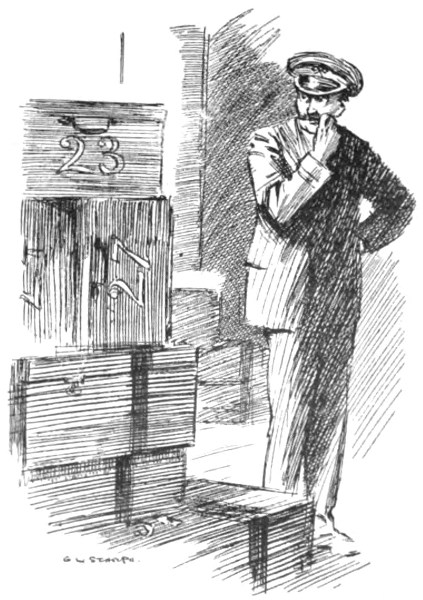
“HE DAILY CONTEMPLATED THE MOUNTAIN OF LUGGAGE AND CALCULATED HOW MANY MANILA CIGARS ONE OF THOSE GREAT RED-STRIPED TRUNKS WOULD HOLD.”
Carefully packed, he figured it, one might crowd ten thousand cigars into each trunk. Ten thousand cigars, at eighty Mexican dollars a thousand, meant eighty pounds. Duty at one hundred and fifty per cent. ad valorem on eighty pounds would mean a hundred and twenty pounds, or, as Fritz Vogel calculated, two thousand four hundred marks. Therefore, as the meditative trombonist further worked out the possibilities, his Excellency could, by simply loading up a few dozen more trunks with cigars at Hong-Kong and getting them passed free through the Customs at Yokohama—or at Nagasaki or Kobe for that matter—make more in a week than he could hope to earn in a month of Sundays by sticking to the thorny paths of diplomacy.
Born west of the Suez, the fertile idea germinated in Vogel’s brain all through the dreary wastes of the Canal, and sprouted up green and vigorous, despite the withering blasts that pursued the liner down the Red Sea and across the Indian Ocean to Colombo. At Singapore it had become an obsession. When steaming through the Narrows into the latter port, however, on the way to the German mail wharf, Vogel observed a red-funnelled Jardine liner at the Messageries wharf, with the blue-peter flying.
An hour later the Laisang left for China, carrying a hastily-written letter from Fritz Vogel to his friend Max Krebs at Hong-Kong. It contained a fair statement of the salient facts in the case, and a crude but lucid sketch of one of the pieces of baggage, together with a description of the scarlet bands and full measurements. It also stated what has not been set forth above—that each of his Excellency’s trunks was numbered in large white figures at each end and on the top, and it suggested that in the case of any person desiring to have access to those trunks whilst they were still on board the liner, Nos. 23, 24, 27, 32, etc., were the easiest to reach.
Mr. Krebs was a “runner” for a native compradoring firm. He went out to the ships to “drum up” business for his employers, who supplied anything and everything that a ship could require, from cigarettes to engine-oil. In the old days before the Russian War Mr. Vogel had done a good deal of trade with Mr. Krebs on the short run between Yokohama and Hong-Kong. But the stringent Customs regulations that had ensued upon the increased tariffs imposed after the war had practically killed the business, save so far as concerned a paltry bit of trading with passengers in faked curios, and the occasional disposal of a few imitation gems to homeward-bound tourists when the vessel was west of Colombo.
Opportunities like the return of an Ambassador to Japan did not occur once in a blue moon.
The liner tarried a day and a half over cargo at Singapore, and the Laisang got into Hong-Kong nearly twenty-four hours ahead of her. Mr. Vogel learned the fact the moment the German liner arrived at the big China port, and his heart was filled with sickening apprehension. He had been dreaming of trunks full of cigars—German steel trunks with red bands, and numbered with big white characters—ever since he left Singapore. He had marked off the state-room wherein, until the proper psychological moment, the extra trunks—if any—could be stored safely. He had mentally arranged every other detail in his projected bid for fortune, and had even marked down those of his comrades who should be selected as his accomplices. He had counted over, time and time again, the round thousand marks that would be his personal profit out of every trunk full of cigars he could pass through the Yokohama Customs as the baggage of the returning Ambassador. He did all this while still faithfully, if mechanically, discharging his onerous duties as steward and master of the trombone.
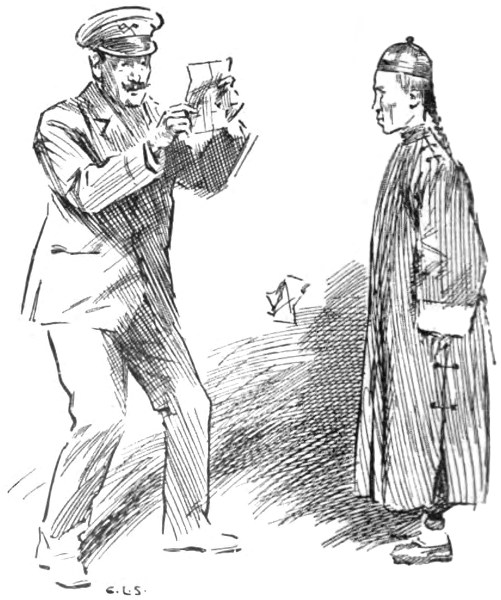
“A NOTE WAS HANDED TO HIM BY A CHINESE MESSENGER.”
It was not until a few hours after the arrival of the steamer in Hong-Kong—hours that felt like ages—that Vogel heard from Krebs. A note was handed to him by a Chinese messenger boy, and Vogel opened it with feverish impatience. Mr. Krebs wrote with that laconic brevity of diction which indicates the resourceful mind. “Will send you one trunk.—O. K.,” it read.
Mr. Vogel pondered for a moment whether “O. K.” meant Oscar Krebs or “All correct” (American fashion); then he heaved a great sigh of relief as he realized that it was all the same.
That evening Mr. Krebs came on board unostentatiously, and a big trunk wrapped in rough sacking came with him, and was temporarily stowed away by Mr. Vogel in one of the state-rooms which held some of the Ambassador’s spare boxes. Thence it was subsequently carried to another cabin, where there were some spare things of Mr. Vogel’s. Had a hypercritical observer subsequently studied all the trunks in the Ambassador’s collection he might have noticed that one of them appeared to be the least trifle newer than the rest, but it would have taken a Sherlock Holmes to detect the circumstance off-hand. The trunk in question was numbered “23.”
In due time the liner arrived at Yokohama, but the mails that had been forwarded overland from Nagasaki reached there a day before her. Thus it came about that when the Ambassador’s baggage was franked through the Custom House and sent up to the Imperial Hotel at Tokio, two friends of Messrs. Krebs and Vogel were installed as guests at the last-named establishment. Thus also it came about that, thanks to ten yen well spent on a porter, the Ambassador’s trunk, No. 23, was whisked away to the nether cellars of the hotel the moment it arrived there, and—as the Ambassador himself did at an earlier stage—it virtually passes out of this story. That is to say, what must have been the ghost of the Ambassador’s trunk vanishes from mortal view; but not so the real article. When the diplomat’s baggage was supposed to be all in, and a count was taken, trunk No. 23 was found to be missing.
The row that ensued was something awful. Telegraphs and telephones were called into requisition, and imperative, not to say drastic, orders were dispatched to the Customs authorities at Yokohama, to the railway authorities at Shimbashi, and to all other authorities everywhere, commanding them to instantly produce his Excellency’s missing trunk.
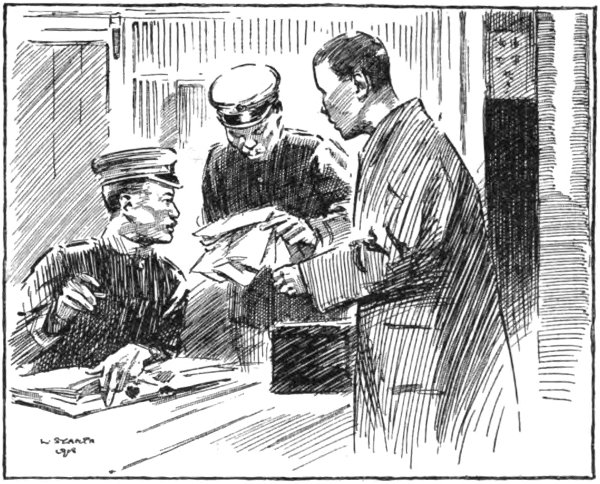
“THEY HAD PASSED IT AND FORWARDED IT, AND GOT A RECEIPT FOR IT.”
The Customs authorities declared they had not got the trunk; they had passed it and forwarded it, and got a receipt for it. There could be no doubt, from their point of view, that the Ambassador had taken delivery of his trunk No. 23. The railway authorities were equally agreed on the same point. The baggage was all in special carriages; not a pin could have been lost between Yokohama and the Shimbashi station at the capital, whence it had been handed over to his Excellency’s servants for removal to the hotel. The police authorities were equally certain that there had been no hanky-panky business of any kind. It would have been impossible for one of the Ambassador’s trunks to go astray or be stolen, either in the streets of the seaport or in the capital itself. The steamship authorities had a receipt for every article. They knew the Ambassador’s trunks, and especial care had been taken of them throughout the voyage. Nevertheless, they would again investigate.
Then, Banzai! there came a telegram from the chief purser of the liner:—
“Ambassador’s trunk No. 23 found on board. Must have been left behind inadvertently. Forwarding to Tokio at once.”
The little Custom House inspectors looked at the newly-found trunk in utter stupefaction.
“Truly,” said they, “we passed this identical trunk not three hours ago.”
“Hayako!” (Hurry, there!) shouted the head inspector, as they dallied over the mystery. “His Excellency waits!”
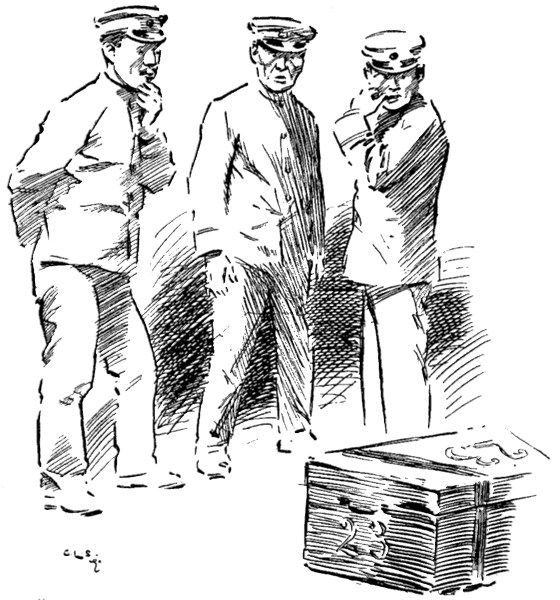
“THE LITTLE CUSTOM HOUSE INSPECTORS LOOKED AT THE NEWLY-FOUND TRUNK IN UTTER STUPEFACTION.”
The trunk was expressed up to the Imperial Hotel by special train.
Ten minutes later the Director of His Imperial Majesty’s Customs at Yokohama ordered a Commission of Inquiry into the matter of the registering as received and delivered of one Ambassador’s trunk, No. 23, when the same had never either been received from the liner or delivered to the railway or to any other authorities by His Imperial Majesty’s Customs. The matter was also taken in hand by the Imperial Railway and by the Tokio and Kanagawa police authorities.
Though a couple of years have passed since these investigations were inaugurated, no definite finding in the matter has yet been officially published. In certain quarters, however, there is a consensus of opinion that such a trunk did really pass through the Yokohama Customs, but that it was a phantom one.
Mr. Vogel took away two thousand two hundred yen (two hundred and twenty pounds) from Yokohama that trip. At Hong-Kong, nine days later, he settled up with Mr. Krebs.
The cigars and trunk had cost nine hundred dollars, while the expenses and “commissions” in Japan amounted to a trifle less than three hundred dollars. There was a balance of a thousand dollars to divide, and they duly divided it.
HALF AN HOUR IN A BLAZING FURNACE. By George S. Guy.
One of the most remarkable and appalling experiences possible to conceive recently befell a young man named Robert Perry, at Apedale, in Staffordshire. Tramping about the country in search of work, he arrived one night, utterly tired out, at an ironworks, and unwittingly took shelter in an “air furnace,” used for the purpose of reducing very large pieces of iron, too large to be dealt with in the ordinary way. As it happened, the fire-bars of this particular furnace had been taken out, and Perry had no difficulty in creeping through the opening and thus making his way inside. Here he had to mount a wall five feet in height, and eventually reached the melting chamber, which at the time contained about five tons of iron waiting to be smelted. Arrived at this point, in blissful ignorance of the dangerous character of the place he had selected to sleep in, and appreciating only its dryness and seclusion, he lay down to rest. Exactly why he should have selected such a strange bedchamber it is impossible to say, but tramps have been known to choose even stranger quarters—such as lime-kilns and brick-kilns. Anyhow, the fact remains that he went into the furnace to sleep. What happened afterwards is told below, from information gathered partly from the man himself and partly from other persons who figured in his terrible adventure.
After a long walk in the broiling sun Perry arrived at Apedale quite exhausted, and set about looking for a snug, dry place where he could lie down and have a sleep. During his weary tramp he had been no stranger to curious resting-places, and he had spent the previous night under a railway arch. Presently he came across the smelting works of the Midland Coal, Coke, and Iron Company, and, seeing a furnace which he took to be unused, examined it intently. The wide, open front of the contrivance looked tempting, and he decided to make its interior his abode for the night. Crawling into the opening for some little distance, he discovered that he had a wall five feet in height to climb over, but scaled it without much trouble. Beyond he found himself in pitch-darkness, but clambered cautiously onwards, trying to find a comfortable place to lie down. Proceeding up a slope, he reached a sort of chamber beyond, where a number of great pieces of iron were lying about. Here the weary man lay down, and, being very tired, it did not take him long to fall asleep. Let him tell the manner of his awakening in his own words.
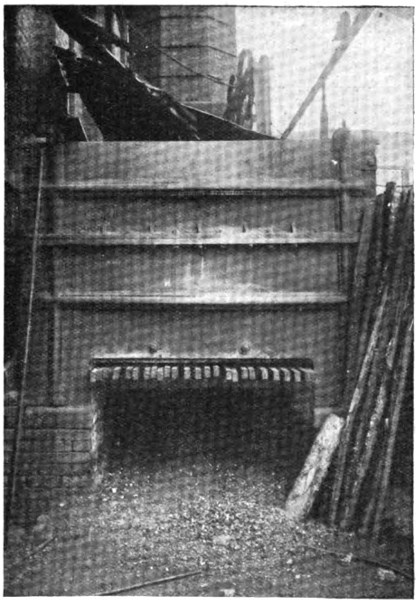
FIRE-GRATE WHERE PERRY CRAWLED IN. From a Photograph.
I do not exactly know what awoke me, but upon trying to raise myself a frightful choking feeling came over me, and I became conscious of great heat. Then, like a flash, I realized what a dreadful mistake I had made, and what a terrible situation I was in. The furnace was not disused, and now the workmen had lit it, and I was a prisoner inside! For a moment I felt sick with horror, but it did not take me long to pull myself together and try to find a way out.
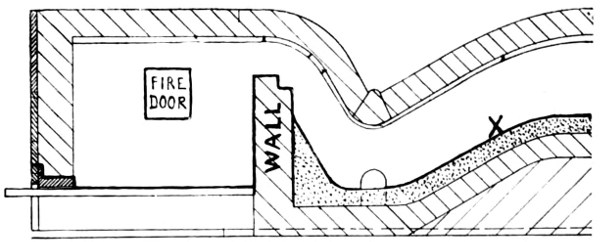
PLAN OF THE FURNACE—THE CROSS DENOTES WHERE PERRY SLEPT.
The whole place was in total darkness. Although I could hear a dull roaring somewhere, and feel the waves of heated air and fumes passing over me, I could not see the slightest sign of any light. Tremblingly I felt up and down the sides of my prison to see if I could find a door, but nothing of the kind could I discover. I tried to retreat farther into the furnace to get away from that awful heat, but had to return and face it again. Now, with a sickening heart, I saw that flames were approaching my position. Thinking my end was near at hand, I decided at all costs to go down the slope. This meant that I must face the fire, which was now licking up towards me, sucked inwards by the tremendous draught. Shivering with horror I made the attempt, but the heat and flames were unendurable, and beat me back. Then, crouching down, I worked myself along the side, thinking this my best plan. At last—Heaven alone knows how—I reached the foot of the wall. In a half-dazed, choking condition, I tried to climb up, but was met by a veritable hurricane of fierce flames, which knocked me down and burnt all the hair off my head. Half-blinded, scorched, and with my brain benumbed from the effects of the fumes, I still did not quite lose heart: something seemed to force me on to make a struggle for life. Suddenly, as I lay there gasping in that inferno of heat and flame, I heard voices outside, but I could not understand what was said. I wondered dully whether, if I called out, the men I could hear speaking would hear me, so, in my agony of physical suffering and mental distress, I shouted, “O Lord, save me! O Lord, save me!” The murmur of voices still went on, but presently one man evidently heard my cries, and called out to a “Mr. Phillips” that he thought he heard a shout for help. This, however, Mr. Phillips—who seemed to be the foreman—ridiculed, and they went on working as before.
I was now on the verge of giving up; my strength seemed to be failing me, but I decided to make one final attempt to get on the wall. I am glad to say that it was not in vain, and after a desperate struggle I succeeded in reaching the top. This seemed to renew my energy, and I braced myself for what I knew was my last hope. I gave one horrified glance at the furnace below, the flames roaring and leaping madly, and then, with all the strength of my fire-scorched lungs, I shrieked out once more, “O Lord, save me!”
The men outside stopped work at once.
“Did you hear that?” cried one, excitedly; “I heard it quite distinctly that time; someone is shouting out ‘Lord, save me’!” This time Mr. Phillips admitted that he did think he heard a noise as if someone was calling out, but where could it come from? It was impossible for anyone to be in the furnace alive, for the fire had been going for some time. Then someone else said, “Open the fire-door and see if you can see anything.”
The fire-door! Where was it, I wondered—far away or near at hand? Then, to my great joy, I heard them releasing a bolt just a few feet from where I was. At last it opened—a place about a foot square—and I saw daylight streaming in and then a man’s face. He peered in anxiously, but evidently he could not see me, for I was now as black as the furnace itself. Then he seemed to half-close the door and I nearly swooned away, for this was my last chance.
Desperately I strove to shout, but the heat, flames, and smoke prevented my uttering a sound save a choking gasp. Fortunately for myself, however, I moved, and the watcher happened to catch sight of something about me—probably the whites of my eyes shining in the reflected light. “Good God!” he cried. “There’s a man in the furnace! Pull the bars out as quickly as you can.”
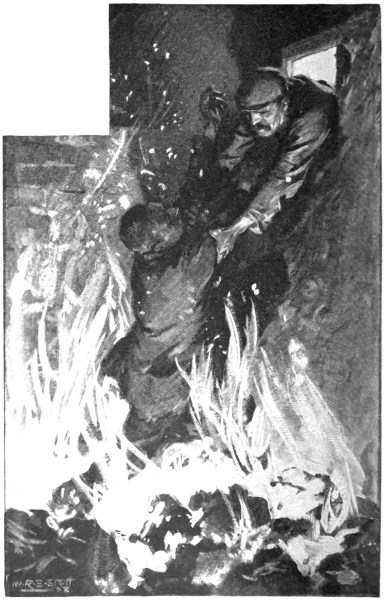
“I FOUND MYSELF FALLING—RIGHT ON TO THE HUGE FIRE.”
I did not trouble to think what or where the bars were; I knew only that the men had seen me and would do everything in their power to get me out. I heard them pulling the bars out in frantic haste, and saw Mr. Phillips trying to squeeze himself through the small fire-door.
With my flesh scorching and my breath rapidly failing me in that awful whirlwind of heat and flame, I put my arms down for him to catch hold of. He seized me by the elbows and told me to jump, but this I could not do, for I felt too far gone. With that he gave me a jerk, and I found myself falling—right on to the huge fire! The bars were out, and the fire was keeping itself together by the pressure of one block of coal on another; but when my weight came upon it, it collapsed, sending up a rush of flames all around me. To my intense horror, I felt the skin on my arms giving way, but the courageous Mr. Phillips did not release his hold. His hands were now on my wrists, and, exerting all his strength, he pulled me up towards the door.
The pain of my burns was simply fearful, and I could have shrieked with agony, but somehow, except for a few moans, I kept quiet.
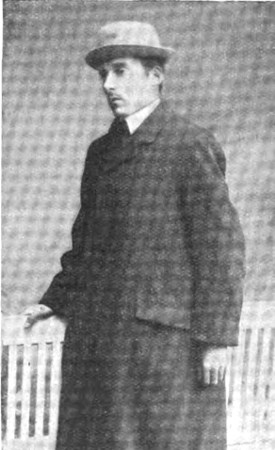
ROBERT PERRY AS HE APPEARED AFTER HIS DISCHARGE FROM THE INFIRMARY. [From a Photograph.]
Presently the foreman succeeded in pulling me out of the small door, but I felt as if dead, and as though I was shrivelling up and growing smaller. As I lay on the ground, in agonizing pain, I appealed to the men to strangle me. Again and again, in semi-delirium, I repeated the request: “I’m done for! Strangle me! strangle me!” My whole body seemed to be on fire, but my rescuers lost no time. Procuring some oil, they saturated me with it, thus, in a measure, soothing the pain. Then they got me on to an ambulance and rushed me off to the Chell Infirmary, where I received every care and attention.
Never, so long as I live, shall I forget the terrible time I endured in the furnace, and my unspeakable joy when I saw Mr. Phillips at the fire-door.
I am indebted to Mr. Hill, the general manager of the above-mentioned company, for a plan of the furnace. It may be interesting to add that, even had Perry contrived to shelter himself from the flames at the foot of the wall he mentions, he would very soon have met with a death too awful to contemplate, as the molten iron would have flowed down and overwhelmed him. The authorities inform me that Perry’s adventure is altogether unprecedented in the whole of their experience. At the moment when his first cry was heard the furnace had been alight for some considerable time, having been started with a large quantity of wood and many barrow-loads of hot coal in order to raise the heat quickly!
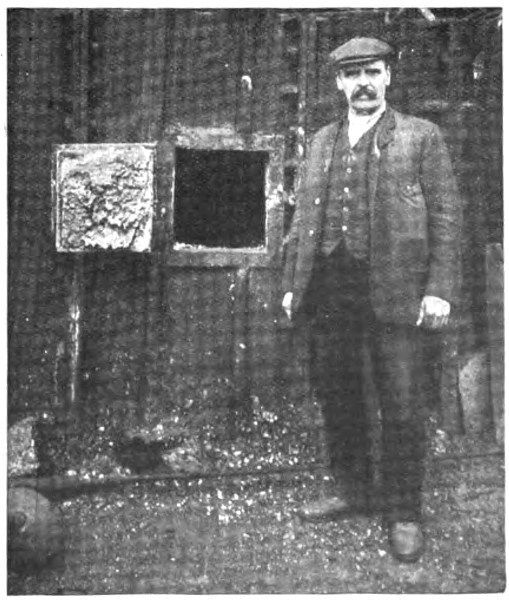
MR. PHILLIPS STANDING BY THE FIRE-DOOR THROUGH WHICH PERRY WAS DRAGGED. [From a Photograph.]
THE HEADLESS WOMAN. By Charles Needham.
I had just recovered from a troublesome throat affection, and under the doctor’s orders had moved out of town for a spell of fresh air and quieter surroundings, selecting the little village of Canewdon, in South-East Essex, as my retreat. I had always had an eye on the village, first making its acquaintance whilst yachting off the coast and in the River Crouch, where my boat had its permanent berth.
Canewdon is actually little more than a straggling hamlet four miles by road to the north of Rochford, and about nine from Southend-on-Sea. It required only a very short residence there for me to find that the secluded little place considered it had its own corner in history, and a very pretty turn in folk-lore and superstition as well. To begin with, Canewdon claims King Canute as one of its founders, and its domestic romances and tragedies would make a presentable volume in the hands of a scribbling antiquary. It had, however, something more than mere history, and far less to my liking, for me to feed my imagination upon, as I was soon to discover.
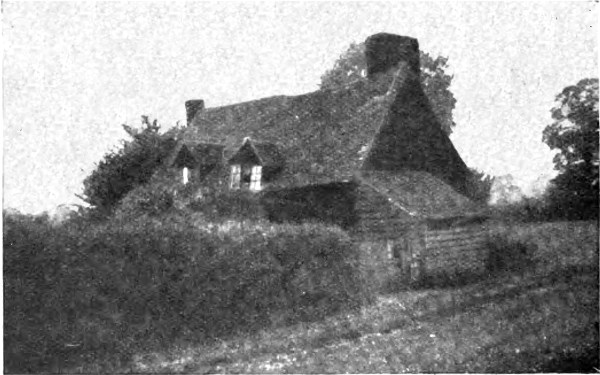
THE OLD COTTAGE AT CANEWDON IN WHICH THE AUTHOR RESIDED. From a Photograph.
After a good look round I settled upon a comfortable old cottage, with a small garden traversed by a brook, only a very short distance from the ancient, square-towered church. Into this, having taken it at a very moderate rental, I moved a small amount of furniture, my books, and other paraphernalia, and prepared to settle down to the life of a hermit for a time. The woman who came from close by to “do” for me looked upon me, I fancy, as something of a curiosity, but, for some reason I had not then discovered, she seemed a little uneasy at my solitary existence. She would remark that I must be lonely, or that it was unlikely that I should stop in the place very long. I put all this down to a friendly disposition, coupled with a desire to draw me out as to my place in the larger world I had dropped from so suddenly.
For the first day or two matters went smoothly enough, and I began to feel that my choice of locality had been a lucky and inexpensive one. Then something occurred which startled me sufficiently to make me alter my opinion.
I always used the little kitchen at meal-times for convenience’ sake, and one night I remained there reading until very late, the kitchen being lit only by one small lamp at my back. I had just closed my book—it was about one o’clock—and was summoning the effort required to take me bedwards, when I noticed a very slight movement of the iron latch upon the door leading into the back garden. My thoughts naturally flew to burglars. The locality was lonely, and no doubt my coming had been duly talked over in the village with all the exaggeration and surmise an out-of-the-way place is capable of.
I was, of course, considerably startled, and sat watching the latch slowly rise, evidently actuated by a very delicate and even pressure from without. The door itself was bolted at both top and bottom, and when the latch had risen clear of the hasp I fully expected to hear the bolts rattle as the person outside put his weight against the door to try it. But nothing of the sort happened; the latch, after remaining suspended for a moment, fell back again into place as slowly and evenly as it had risen.
Startled and puzzled as I was, I still held to my belief that this must be a timid attempt at robbery, and that, finding the back door locked, the intruder would try the front one also. Nor was I wrong, for I had scarcely slipped quietly into the sitting-room and taken up my position when the latch there began to rise in precisely the same manner. This door possessed only one bolt, and that at the bottom, so that the door, an old and ill-fitting one, would show the slightest pressure at once. But none was placed upon it, and the latch fell into place as evenly and noiselessly as before. By this time I must confess to being slightly scared, and when a chair banged heavily on the floor and a loud shout of “Who’s that?” brought no sound of a retreating shuffle on the cobble-stones outside, I had to summon all my remaining courage to unbar and fling open the door. Not a soul or a sound met me as I stepped outside. The night was a light one in early September, so that a retreating figure could have been followed by the eye for twenty or thirty yards. After a careful look round the garden I went to bed nonplussed at the weirdness of the whole affair.
The following day brought another intruder—a material one this time. I found that during the morning a travelling caravan had taken a pitch just outside my hedge; and its owner turned out to be an Oxford man, who, with his wife, was leading a vagabond life about the shires. He was an extremely well-read man, and we soon got on the best of terms, exchanging books and opinions, till he inspanned for pastures new a week later. The night before he left I was treated to another queer happening.
We had been talking and reading in my tiny sitting-room till about eleven o’clock, when my vagabond friend bade me a sleepy “Good night” and opened the front door. He had, however, only just put his foot on the cobbles when he stepped backwards with a sharp exclamation, and a scared look on his face.
“What’s up?” I asked.
“It’s awfully queer,” he replied; “I could have sworn I saw a face looking straight at me close to that bush”—he pointed to the privet hedge at the left of the door—“but there didn’t seem to be any body to it. I’m certainly not drunk, but I may have been dreaming.”
After my recent experience, which I had not thought it worth while to mention to such a hard-headed soul as my chance companion, I felt anything but comfortable. We were both rather ashamed of our brief lapse from common sense, and laughed the incident off as best we might.
The following day found me in all the doubtful glory of my solitude once more, and I must confess to having been thankful when an invitation reached me that same evening, from friends at Fambridge, for a few days’ fishing.
I have never suffered from that popular present-day malady known as “nerves,” possibly because of an open-air existence with plenty of exercise, but, though I had only been there a short time, the cottage and the locality now seemed to have become almost uncanny to me. Had I mixed more with the inhabitants, I should have discovered, as I did later, that this strange feeling was not without some foundation.
The few days I spent in Fambridge put all thought of the two queer incidents out of my mind, which will show that the subsequent events were not the outcome of an overtaxed imagination or a course of long brooding upon disquieting phenomena.
It must have been about nine o’clock in the evening that my Fambridge friend put a little Welsh pony into his governess-car to drive me back the four odd miles to my cottage. The night was fine, but there were clouds about and no moon, so that objects outside the radius of the lamps were hard to distinguish. The pony had already had a fairly hard day of it along the coast, but he was a sturdy little beast and pulled like a steam-engine, rattling us down to the outskirts of Canewdon in excellent time.
We had been bowling along, talking about the day’s sport, and were now rapidly nearing a stile leading to a footpath upon the left of the road, which takes one by a short cut across a field, over another stile, into the churchyard, and so into the village High Street. We had barely reached the stile when the pony pulled up short, reared, and refused to go another step in that direction. The pony, always a strong and willing little chap, had never done such a thing in his life before, and my friend was not only puzzled but annoyed. A sound beating had no more effect than words of encouragement; there the little beggar stuck, his four legs splayed out, the picture of all that was most stubborn in nature, whilst we two sat in the car trying to devise some plan by which to budge him.
My friend was at last obliged to ask me to take the short cut I have just spoken of instead of being driven round by the road the remaining mile and a half to my cottage. I was, of course, willing enough. The short cut would take me barely ten minutes, and I had very little to carry; so, bidding him “Good night,” I jumped out. As I came from behind the trap I noticed a tiny flickering light a few yards ahead, upon the left-hand side of the road, but it was very dim and did not arrest my attention sufficiently to make any impression on the mind. I was able to lead the pony round without any difficulty, and when his head faced Fambridge he seemed to recover his spirits at once, and the red points behind the lamps receded at a rattling pace up the road. When these had disappeared I turned again to climb the stile, but became at once uneasily conscious of something unusual a little way ahead of me.
The spot the pony had refused at was a good deal shadowed by large elms, and these, together with the cloudy sky, made the road still more obscure. The small light, which I had taken little notice of at first—thinking it probably one of the village lights showing through the trees—was still ahead; only, instead of being upon the left of the road, it was now upon the right. For a few seconds I stood looking at it, feeling very much like turning tail and bolting down the road. The flame, for it was no other, showed greeny—white against the black background and shivered in a strange, eerie way.
The most extraordinary part of the business was that it seemed to come from nothing visible, but to appear, as it were, burning in space three or four feet above the road.
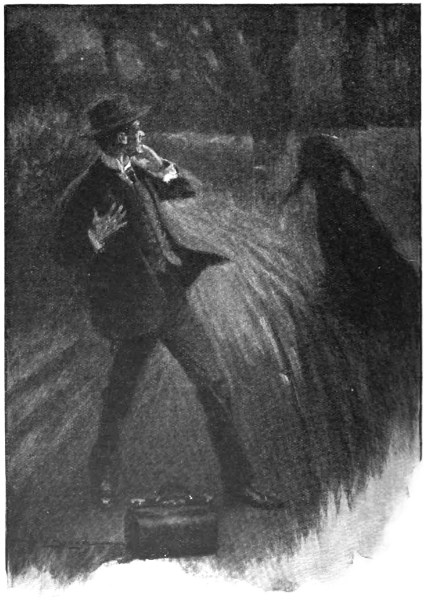
“THIS MYSTERIOUS SOMETHING TOOK THREE RAPID STRIDES ACROSS THE ROAD AND DISAPPEARED.”
I had, of course, read ghost stories in which “corpse candles” and ghostly lights of one sort and another figured largely, but I had never expected to come across one, and this could be translated in no other way.2 The close proximity of the churchyard, with the square tower of the church itself showing through the trees, added too much colour to the scene to my liking; but, scared though I was, a certain fascination took hold of me, and I advanced a step or two in order to examine the phenomenon at closer range. I had scarcely taken two paces, however, when the clouds parted a little, giving a better light beneath the trees, and at the same moment the weird flame flickered wildly and went out.
But this was not to be the end of my ghostly experience. The stronger light brought many roadside objects into prominence, and the moment the flame disappeared I became conscious of an indistinct black blotch against the lighter background of the hedge. It was, of course, too dark for me to be certain of its exact shape, even had I been in a calm enough state of mind to take in details; but in any case I was allowed only a momentary glimpse, for whilst I stood with the breath caught in my throat, this mysterious something took three rapid strides across the road and disappeared without a sound into the thick hawthorn hedge opposite.
At this stage I must confess to having lost all control of myself. Without another look I took to my heels and ran, as though all the powers of darkness were behind me.
The scare I had got made me quite oblivious of my direction, but I suppose natural instinct guided me, for I found myself at last, almost pumped out, trotting into the little High Street of Canewdon by the road along which I should have driven, and no doubt in far better time. I had no relish, in my then state of mind, for another lonely night in the cottage, although it stood only fifty yards away, so I made my way to the Chequers, the only inn the village possessed, and asked for a bed.
My recent arrival in the place had given me little time to become acquainted with the village notables, but I fancy the landlady knew me by sight, and no doubt thought the request strange. In any case her “Certainly, sir,” was followed by a close scrutiny. “You’re looking very queer, sir,” she added; “has anything happened?”
Surrounded by more human elements, I began to feel thoroughly ashamed of myself, and rather doubted the wisdom of giving the narrative away; but the thought that, perhaps, being a resident, she might be able to throw some light upon my weird experience finally decided me to make a clean breast of the whole affair; and I promptly did so in the little inn-parlour.
I had barely got half-way through the incident upon the road when she sat back in her chair, and said in a quiet, almost matter-of-fact tone:—
“You’ve seen the headless woman, sir.”
“The headless woman?” I asked, startled. “Who’s she?”
“I may as well tell you,” she replied, “though we don’t talk of it much here. Have you noticed a wooden house painted white, and standing alone about a hundred yards this way from the stile on the Fambridge road?”
I said that I had, and thought it was a farmhouse.
“Well, so it was till the murder happened,” replied the woman. “The story goes that somewhere about forty years ago a farmer there took to drink, went mad, and murdered his wife. He didn’t stop at that, either, for he cut off her head and buried it, and it wasn’t found till some time after the body had had decent burial.”
“So she’s supposed to haunt the place?” I asked.
“There’s no suppose about it, sir,” she replied, very quietly; “a tidy few people here have seen her, much the same as you did. My husband has, too, by the stile leading into the churchyard. It took him a week in bed to get over it. Sometimes it’s just a face, and sometimes just a black bundle like a body without a head; but always near one of them two stiles, and round about harvest time. Heaven send I never see the sight!” she concluded, devoutly.
“I’m not particularly anxious to renew the acquaintance myself,” I replied, “but how do you account for the lifting of my latch?”
“Well, I can’t say for certain, sir, but, if my memory serves me, there was a gaffer living in your cottage—he’s dead now many a year—who used to work at the White House and was there when the murder happened. He saw her pretty often in his garden, I’m told, but couldn’t be got to speak of it. It may be she walks there too.”
I spent a very mixed kind of night at the inn, and on the following day returned to Fambridge and less ghostly company. From here I made arrangements for a change of quarters, and from that day to this I have not set eyes upon Canewdon, nor have I any inclination to do so.
This strange happening is perhaps too strange for everybody’s belief. My “spirituous” state at the time is an opinion largely held by chaffing friends; but I ask that three points be taken into consideration. I am practically a teetotaller; my imagination is no more abnormal than that of most of my fellows; and, lastly, no whisper of ghostly visitations in the village had reached my ears prior to the narrative as told by the landlady.
The whole affair would make an interesting little piece of investigation for the Psychical Research Society.