A Perilous Mission. By S. F. Martin, late of the Royal Niger Company’s Service.
Reading edition
The modestly-told story of a daring deed. At a time of great anxiety, when England and France were on the verge of conflict in Africa and the powerful Mohammedan native States were watching for an opportunity of throwing off the yoke of both countries, Mr. Martin was District Agent of the Royal Niger Company at Borgu. He was instructed to secure reliable information as to what was happening in the turbulent robber kingdom of Kontogora, and he obtained it by the hazardous expedient of disguising himself as a Haussa and, taking his life in his hands, penetrating right into the enemy’s capital. His adventures during this journey are set forth below, though the narrative contains barely a hint of the strain of the ordeal or the awful fate that would have befallen the author had his real identity been suspected.

Towards the latter end of 1898, before the conquest of Nigeria, I was placed in charge of the interests of the Royal Niger Company, Chartered and Limited, in the Borgu district of the Niger Territories. My instructions, amongst other things, were to watch events, political and otherwise, and to report the same to head-quarters.
It was a time of great stress and no little peril to our West African Empire, for not only were the various races of the Territories in a state of unrest and hostility to the white man’s domination, but at that period we were also at loggerheads with the French, whose troops were encroaching on our frontiers from all sides, necessitating a special field force being formed, under Colonel (later General Sir Frederick) Lugard, to deal with the situation. The native Mohammedan States, seeing this, thought to take advantage of the crisis to the detriment of both nations.
The most turbulent of all these native States was Kontogora, a town lying to the eastward of the Niger River. At the time of which I write there were British troops at Jebba, Leabba, Boussa, Roffia, Gomba, Lafagon, and Illa, as well as smaller garrisons scattered about, all on the Niger. There was a strong force also at Zaria, a large town away to the east, some distance south of Kano. The French were prowling about in between.
It being reported that Kontogora was preparing to take up arms, I determined to find out the facts of the case for myself, as, if this State seriously intended causing trouble and gained any successes against us, the whole Mohammedan Empire was sure to rise to a man, and it would be difficult for us to hold our own, to say nothing of expelling the French. My orders were to remain in Boussa, but, having weighed the pros and cons very carefully, and decided that it would be well within the spirit, if not exactly the letter, of my instructions to take the action I intended, I determined to find out in person how far this rumour was true and how great the danger really was to our Imperial interests. I had mastered the Haussa tongue, the prevailing language of those regions, and could hold my own easily with the Haussas themselves, my natural aptitude for picking up tongues standing me in good stead. Consequently, without informing anyone where I was going, beyond leaving word that I was off on a shooting trip, on the night of the 17th of November, 1898, I dyed myself from head to foot a deep brown, arrayed myself in very shabby Haussa clothes, and set off, with my guide, Mama, for Kontogora. I took the name of “Abdu Maidowda”—Abdu the dirty. All carriers in Haussaland take nicknames, given them by their masters or companions. It is seldom that a white man ever knows the real names of his servants.
We tramped all that night, and next morning stopped at a small village in the midst of farmlands in the N’gaski Kingdom. The whole country hereabouts was bitterly hostile to the white man’s régime. The state of unrest was manifest everywhere; people went armed to their work in the fields, as raids from neighbouring towns seemed to be of frequent occurrence. Although the various native kingdoms were quite at one with regard to their hatred of the white man, yet amongst themselves they were always warring and raiding for slaves—the big towns bullying the smaller villages. The main cause of this was the heavy slave tribute levied by the Sultan of Sokoto—the great head of the Moslem Church in the Sudan—on all his vassal States.
Having rested for a few hours, we set out again about midday. It was fiercely hot as we trudged through the guinea-corn fields that stretched for miles all around us, and the heat, striking down from the fiery sun, that hung directly overhead, made me dizzy. I staggered along at times in a kind of hot, sweltering day-dream—seeing things that did not exist, and thinking the most absurd thoughts. Once I called a halt at a well of very dirty water, flung myself down on my hands and knees, and bathed my head and neck for several minutes, Mama looking on amused. The people in the fields were gathering in the corn in feverish haste, but every now and then they paused long enough to question us as to our destination and whence we came. We invariably told the same tale—we were travelling to Kontogora from Illorin.
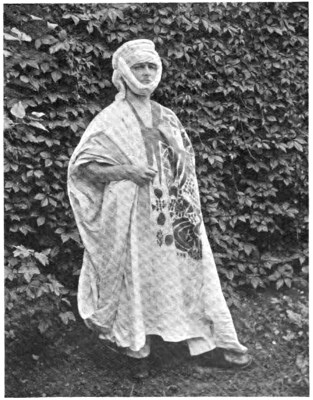
THE AUTHOR, MR. S. F. MARTIN, IN HAUSSA DRESS. From a Photograph.
It must have been about 4 p.m., judging by the sun, when, on that second day out, we topped a rise of rocky ground and came face to face with the head of a caravan of some thirty people, with a large number of goats, coming from the westward. There were several women on donkeys, ten armed men on horseback, and the balance consisted of carriers. As we stood watching them the caravan halted and one of the horsemen came prancing up to us with a great flourishing of his spear. He asked us, very roughly, whence we came and whither we were bound. Mama answered that we were from Illorin, whither we had taken loads for a rich merchant from Kano, and were now bound for Kontogora, where we hoped to obtain work, as we understood that the Emir was preparing for war on the white man. He then asked our questioner if we might not join his caravan, and if he would let us carry a load each in return for our food. At this we were taken before the head of the party, who proved to be an enormously fat woman. With a wave of the hand she gave her consent, and we were forthwith enlisted in the line of coolies.
We pushed on that afternoon to some farmhouses, where we halted for the night. The fat lady took up her abode in the headman’s hut, and we carriers wandered about to find quarters for ourselves. For the most part we slept in the open, beneath a great tree growing outside the entrance to the headman’s compound. Mama and I had no intention of losing sight of our companions, as we did not wish to let slip this excellent chance of getting in to Kontogora, which was also the destination of the caravan, without danger of possible discovery. The farm people were good enough to give us food and drink, and also supplied us with plenty of firewood.
After sitting around the fire for a short time, we coolies one by one curled up on our mats (each carried a small grass mat) and, with our feet to the fire, slept the dreamless sleep of the utterly weary.
Next morning I was awakened by Mama shaking me by the shoulder. My clothes were wet with dew, and I commenced to shiver with cold, cursing myself in my sleepy condition for being so foolish as to put myself in such a perilous predicament.
As I arose and stretched myself I beheld silent forms passing to and fro, and signs that the world was awakening became increasingly evident. Then fires were lit and breakfast cooked; but not before we had washed our eyes, mouth, and hands, uttering a few words from the Koran the while. After partaking of boiled guinea-corn and soup, we espied the fat lady preparing to mount her donkey, and, securing our loads, took our place in the column that began to form up. Soon we were once again trudging through the open country on our way to Kontogora.
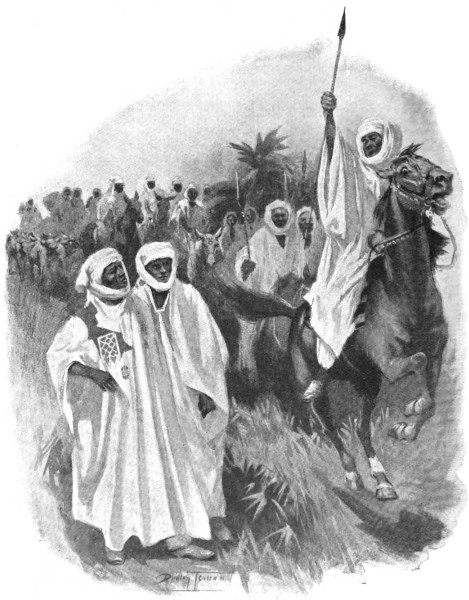
“ONE OF THE HORSEMEN CAME PRANCING UP TO US WITH A GREAT FLOURISHING OF HIS SPEAR.”
All along the route I was struck with the apparent haste with which the people were gathering in the corn. Our companions told us that the Seriki (King) of Kontogora was preparing to wage war on the white man, and had ordered his people to get in all their corn at once.
The day before we entered Kontogora we were overtaken by a raiding party, who were returning to that place with their spoil—about twenty young girls and women, as well as several little children—all tied together, each having one wrist made fast to the neck, across the chest.
Their captors were Fulehs and Haussas, on horseback, armed with swords and spears, and one or two with guns. Some of the poor captives looked terribly emaciated, and could hardly get along. I saw one woman get a slash of a hippo hide whip across the face, that sent her reeling to the ground, with a great gash on her forehead. The incident stopped the whole column for a few minutes, as the woman was fastened to her fellow-prisoners by the neck, and, when she fell, prevented them from advancing. The whip was then applied freely in all directions. The chief of the band ordered the wounded woman’s squirming comrades to pick her up and carry her, but they were unable to do so, being too utterly worn out, I could see. They were coated in dust from head to foot, and the perspiration trickling down their naked skins and mingling with the dust made the poor things appear a sorry sight. The band had, apparently, captured them at some far-distant spot, and must have brought them along at a great pace, judging by the rate they were going when they overtook us.
Furious at their inability to pick the woman up, the ruffian in command raised his spear and plunged it three times into the body of the prostrate woman. He followed this up by actually trampling her under his horse’s feet, while I groaned in an agony of horror and impotent rage at the ghastly spectacle.
The brute, having satisfied himself that his victim was dead, cut the grass rope that bound her to her fellows with a slash of his sword, and ordered the party to proceed. They left us at a quick walk—some of the poor captives even running in their terror—and were soon out of sight over a rise in the ground. Our party followed at a slower pace in dead silence, leaving the poor mangled thing by the roadside to provide a meal for the vultures and hyenas that would soon be on the scene. I for one, however, realized then that no wild beast of the desert could compare for utter brutality and lust for blood with the human satyrs who overran that land at the time of which I write. For miles around, between Kontogora and the Niger, and farther afield to the north, south, and east, the smoking ruins of raided villages told the ever-repeated tale of death and violence, robbery and rapine, and I knew full well what would happen to me should my disguise, by any mischance, be penetrated.
About five miles outside Kontogora our caravan was stopped by some horsemen who came galloping towards us and drew up across our path. They had a long parley with our chiefs before allowing us to proceed, and only did so on payment of a toll. These men were scouts, and I found out later that the whole country for five miles around the city was effectually patrolled, no one being allowed to enter or leave without permission. When we finally arrived outside the walls of Kontogora it was night, and in the moonlight the scene was beautiful and striking. The high castellated ramparts, with watch-towers over the gates, looked strange and fantastic in the soft, mysterious light.
As we approached the gate we mingled with the members of another caravan. Mama and I were at the tail of the line, about five or six from the end. We chose this position to minimize the possibility of trouble, although there really seemed little chance of that in such a deceptive light. Still, there was just the chance, as we soon found out when the head of the caravan reached the gate. Here it was abruptly ordered to halt, and the guards held quite a long palaver before it was allowed to proceed. At the same time a little incident occurred that made my blood run cold for a few minutes. There was a cry of “Abokai! Abokai! Kai!” (“Friends! Friends! Halloa, there!”) from the gate, and the whole column was soon calling “Aboki! Aboki!” (“Friend! Friend!”)—the Haussa manner of hailing anybody. They were shouting, it soon appeared, for myself and Mama, and we were speedily hustled forward by our companions. When we reached the gate our employer, the fat lady merchant who had engaged us, indicated us to the guards with a haughty wave of the hand. We could see a crowd of mounted and unmounted men in the darkness of the gateway, and one among these, who seemed gigantic in the moonlight as he rode forward on a horse equally gigantic, curveted up to us. Striking my turban from off my head with the tip of his spear, he loudly asked for our names. I answered that we were two poor travellers from Illorin, come to offer our services to the Emir. He asked us where our belongings were and the money that our master had paid us at Illorin. I told him that the white man had met us on the road and taken everything, as we were friends of Kontogora. At this the captain of the gate gave vent to some extremely sulphurous language. Then, with a slight movement of the reins, he caused his horse to rear up on his hind legs and, with pawing fore-feet, to burst furiously through the crowd of coolies round about us, trampling one or two badly. Finally, the caravan was allowed to move on under the gate into the town. As we entered, the mallams (priests) were calling to prayer, and the long-drawn cry, like an appeal for mercy, floated through the night, striking on the air with that strange, indefinable sense of mysticism that belongs to the East alone.
We wound in and out, out and in, through the moonlit streets with their black shadows, their mud walls, and conical, thatch-roofed houses. Then we emerged into the market-place, near which our employer resided. Entering her compound, we put down our loads, and, seating ourselves, awaited our wages. Mama and I were the first to be paid. We were handed one string apiece of cowrie shells—equivalent to one shilling each, at that time and place. We haggled over this like true-born carriers for fully half an hour, and, as the fat lady’s head slave refused to budge, accepted what we got with a blessing—and promptly received another five hundred cowries for our good nature. The Haussa will often do this, for, as much as he fears a curse, by so much does he value a blessing. A great many rogues take advantage of this trait in the native character.
Having been paid off, Mama and I left the compound rejoicing. Here we were, in the very heart of Kontogora—scatheless! We wandered into the market-place, where some people were still loitering, and decided to sleep in one of the stalls and begin our investigations in the morning.
It was many hours before I got to sleep, as my feet ached fearfully and were badly torn and blistered. During the march I had alternately gone barefoot and in sandals to rest them, and at times I got badly knocked about when carrying the leathers in my hand. Several times during the night bands of young Haussas passed through the market-place, shouting and laughing, boasting what they were going to do to the Turawa (white man).
Four batches of labourers passed through also, between the time we retired and dawn, dragging dead horses out of the town. Tom-toms were going all the night; at times the whole air quivered with the rhythmical sounds. The quaint tinkling of the Haussa guitar rose and fell at intervals, and from time to time the weird notes of the “ghoghie,” or native fiddle, could be heard from the compounds. A spirit of excitement and revel seemed to pervade the whole town.
Next morning we loitered about until the market began to fill, when we bought some food. We then repaired to the Galadima’s residence, and enlisted in the army of labourers that were employed in repairing the walls of the town. Many of these labourers were slaves, sent by the various chiefs and big men; others belonged to the Emir himself. About four hundred of us were dispatched to the north wall. Here some made bricks out of the soft clay; others, including myself, stood on the wall and laid them, and yet others passed those already dried up to us on the wall.
While working in this way I gathered a lot of information. Raiding parties had been out all the week, I learned, and spies and runners from Zaria brought in news every day concerning the movements of the white men in that city. Bands of armed men were continually bringing in slaves from the ruined villages in the surrounding country. It was said that N’gaski and Kontogora would join forces, attack the whites in Zaria, and drive them out. Dandugnsu and Ridjion, neighbouring towns, had promised their support in the campaign. I also learnt that orders had come in from the Sultan of Sokoto that the Emir was not to commence a war against the white man, but to remain on the defensive. The Emir of Kontogora had replied that he was quite prepared to meet all comers, from whatever direction—a pretty broad hint to Sokoto, I thought. One fellow laying bricks told Mama that the man who killed Lieutenant Thomson at Bida, in the late Niger Sudan campaign undertaken by the Chartered Company against the Fulehs of Bida and Illorin, was now in the town and was considered a very great hero.
About midday an order came for some twenty men to repair to the Emir’s compound. I was chosen as one of the gang, together with Mama. So off we marched. When we arrived we found that a horse and a cow had died, and were to be dragged out of the town and thrown into the moat under the walls. Tying up the hind legs with grass rope, we hauled the carcasses through the streets and out by one of the gates and dumped them into the ditch. Having finished our unpleasant task, we trudged back to the north wall and recommenced laying bricks.
One swaggering youngster had annoyed me very much all the morning. He was an overseer amongst the men, and apparently one of the wealthy young bloods of the town. Shortly after my return from removing the dead horse this youth strutted up to me and started cursing me roundly in Haussa, saying that I was more like a woman than a man and that my work was no good. Finally, raising his hand, he struck me in the mouth. Forgetting myself completely for the moment, I stepped up to the fellow, who promptly drew his sword. Without any trouble I disarmed him; then, catching him by the neck, I shook him like a rat and dropped him into the ditch on the far side of the wall.
For a moment there was dead silence; next a chorus of applause and laughter broke out. But Mama plucked me by the sleeve. “Go,” he said, in a low tone; “I will meet you to-night, an hour after sundown, at the place we slept in last night.”
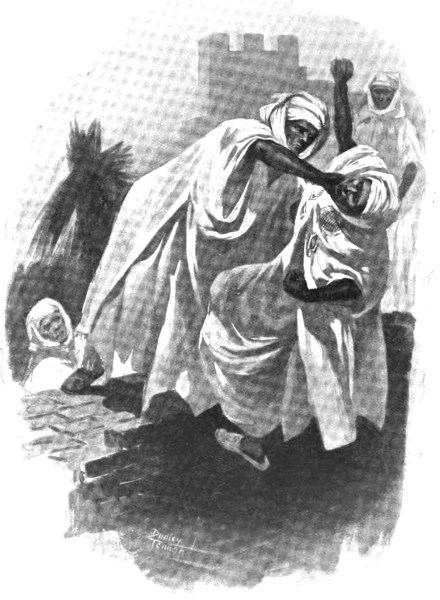
“I SHOOK HIM LIKE A RAT AND DROPPED HIM INTO THE DITCH.”
Divining my danger, I slipped away and mingled with the crowd, nobody venturing to interfere. I passed down some side streets that zigzagged about confusingly, wandered in the outskirts of the town for an hour or more, and then made my way to the market-place, which I found swarming with people.
Buying some boiled guinea-corn, I sat down outside a stall and munched my lunch. The woman who sold me the food was a garrulous old person, but perfectly good-natured. She asked me all about myself, and I told her that I had come from Zaria, where I had fled through fear of the white men. She informed me that I had nothing to fear from them; were it not for their guns they would be quite harmless. Then I asked her when it was that Kontogora intended setting out to drive the Turawa from Zaria. “Go round the blacksmiths’ shops and inquire at the smithies,” was all the answer I could get. I thought the idea a good one, and, bidding my new friend “Good day,” I sauntered through the crowded market-place, stopping at various booths. In one of these some blacksmiths were hard at work, making arrow and spear heads from bits of iron and tin. As I stood looking at them I gathered, from the conversation that was going on around, that some of the Emir’s sons were expected to arrive in Kontogora that day, and that they were bringing some of the white men’s guns with them that were taken at Hella, when Lieutenant Keating’s party was massacred. Here was a bit of news worth having! The conversation turning on matters that did not interest me, I strolled on until I arrived at the head blacksmith’s shop, near the Emir’s compound, where I watched the hammers pounding the red-hot metal. I could see that the whole town was busy making arms, which boded ill for the whites.
Suddenly I heard a shout of “Gashi! Gashi!” (“There he is! There he is!”). Then there was a rush of feet, and a flash of swords in upraised arms. Evidently my pursuers had found me out. I backed into the blacksmith’s shop, followed by a yelling crowd, and caught a momentary glimpse of my tormentor of the morning. Then, without warning, something was thrown over my head, and I was dragged violently backwards, flung to the ground, and stunned by a succession of heavy blows.
When I came to my senses I found myself being hauled unceremoniously to my feet, my arms bound firmly. In this ignominious state I was dragged amid curses and cuffs through the town, a yelling crowd of bloodthirsty ruffians surrounding me. They hauled me through a doorway into a compound surrounded with high walls, on into a big building, through many rooms and passages, and ultimately down some rough steps into a filthy, stinking dungeon, reeking of mould and damp. Here, with a violent push, I was flung headlong to the bottom, where I lay helpless in absolute darkness.
The air was damp and chill, and the place was infested with all manner of loathsome crawling things; I could hear them tick-ticking and scuffling along the floor and walls. Shortly after my entry some filthy thing touched my fingers, and I shook it off with a yell. It was a dread place, and drove all hope of saving my life clean out of me.
How long I lay there I do not know; it was long enough, at any rate, for a sharp attack of fever to seize me and run its course. It racked my bones; I tossed and turned on the slimy floor, groaning aloud in my discomfort. The hot fever-blood throbbed in my head; my eyes and face burned, and my body became parched and dry. I moaned for water—oh, for one drop of cool water! At one time I thought I saw the door open and Mama enter and loose my bonds, but it was only a vision of my disordered brain. Finally I sank into unconsciousness. I awoke—drenched in a profuse perspiration—with men’s voices sounding round about me. A figure was standing over me holding a lamp—an earthenware, ewer-shaped vessel with a cotton dip—which gave a wavering yellow radiance and cast grim dancing shadows on the walls. I could see that the door was ajar, and a pale light was stealing into the horrible place from outside. Roughly I was dragged to my feet. I staggered a bit, but soon steadied myself, and—pushed, cursed, and beaten—I accompanied my captors up the steps and out into the light of day again, or, rather, of evening. One glorious breath of the upper air repaid me for all that I had suffered in that black hole of Kontogora. I did not care now if they were leading me out to kill me; I was not going to die like a rat in that horrible pit.
As we emerged from the compound we were joined by a chattering, mocking, hostile crowd of men, women, and children. Every now and then one of the latter would strike me with a stick, my guards making no effort to protect me. At last we entered the Emir’s compound and I was taken into his presence. He was seated on a dais covered with mats and a leopard skin, and was talking in a low monotone to some men lying round about him on the floor of the chamber.
The young blood that I had flung over the wall, and who was the cause of all my troubles, stepped out and told the King what I had done, asking leave to kill me then and there. Next, to my astonishment, Mama stepped out of the crowd and told the Emir plainly that he and I had come all the way from Illorin to serve him, and had intended craving his permission that morning had not my tormentor interfered and sought a quarrel with me, in which he had got thrown over the wall for his pains. Subsequently, through treachery, continued my faithful guide, my enemy had had me taken and flung into prison without the Emir’s knowledge.
The Emir, who seemed a decent sort of old man, listened patiently to his two petitioners. Then, advising my enemy to calm himself, he told one of his retainers to question me. I thanked Heaven that the simpleness of my disguise and my grip of the Haussa tongue precluded any very great possibility of detection. The Emir, before my questioner started, informed the assembled crowd that, were I proved to be a rebel and a traitor, he would hand me over to my enemy to do what he wished with.
My inquisitor was a type of the grovelling bully. He tried to put one or two posers to me, but got more than he expected in return; and I actually got a smile out of the Emir, which elicited the loud and flattering applause of the retainers, when I suggested that my questioner was behaving very like a traitor himself in trying to cast a slur on the character of one of the Emir’s most faithful subjects. I told that monarch that I had come all the way from Illorin to serve him, and this was the way I was being treated—dragged, beaten and bleeding, before him from a dungeon, and bound like a common slave. Suddenly the Emir asked me how many white men there were in Borgu; I told him about one hundred thousand, and more to come. He seemed greatly impressed, as well he might be. I then craved permission to enter his service, and he inquired if I could ride. I told him to try me. This he agreed to do. If I could ride and prove myself worthy of entering his service he said he would pardon my imprudence of yesterday and make me a member of his bodyguard.
My bonds were cut, and as these fell from me the pain of the blood returning to my swollen, half-numbed hands was excruciating. I managed, however, to keep a brave face. We retired from the Emir’s presence and waited outside under a great shady tree, where, eventually, a fiercely-pawing stallion was brought up, and I was ordered to mount. This I did, the brute biting, kicking, and plunging all the time. I had to get into one of those horrible native saddles that box you up completely, fore and aft. Once mounted, I let the horse do as he pleased, and he led me a terrible dance, rearing and plunging about, dashing first to one side and then another. As he was in the midst of his attempts to buck me off, the Emir appeared and stood watching the tussle with interest. As a matter of fact, the horse had not much chance when once I was on his back, for I had had a great deal of experience of the Haussa beast, and knew his ways. He soon grew tired, and within half an hour was quite submissive. I used no stick, but just sat quietly in the saddle. To my surprise and delight the Emir told me that the horse was mine, and that I was to come to see him on the morrow, about noon. I thanked him gratefully and rode off, Mama walking by my stirrup.
After a consultation we agreed that it would be dangerous to remain in the town any longer, as our enemies were bound to try to get the better of us, sooner or later. We therefore arranged that Mama should leave the town at once, and make for Boussa as best he could, on foot; I would leave that night. We then parted, and I was left alone in the midst of the enemy.
At sundown I rode through the south gate, but was immediately stopped by the guard. I told them that I came by order of the Emir, but they demanded proof. This was distinctly awkward, for, of course, I had no proof to give. I therefore resolved upon a bold stroke. I requested the chief to ride with me, telling him I would give him in confidence all the proof he would require. Unsuspectingly he rode up alongside. Leaning over towards him, I suddenly gripped him by the throat with both hands, at the same time ramming my heels into my horse’s sides. The startled animal leapt forward, wrenching my opponent from the saddle with a jerk, and I swung him across my horse’s withers, where I held him—my right hand on his throat, my left gripping his left knee, bending him backwards like a bow. In this fashion we flew along the path by which two days before I had entered the robber city on foot.
A howl of execration and a clatter of hoofs followed us, and a shower of arrows and spears fell harmlessly on either side of me. When we had gone about a quarter of a mile I slid my hapless prisoner off on to his head, intending to stun him. My horse, feeling the relief, went away at renewed speed, and I had no difficulty in outdistancing my pursuers, especially as they stopped to see to their unconscious chief. I met one party of traders coming into the town, but they stood aside to let me thunder past, not doubting that I was an emissary of the Emir on some urgent business. The moon was just rising as I topped a low ridge, and all the world was soon bathed in a soft and silvery veil of light. Kontogora was far behind in the plain, the thousand conical roofs away in the distance looking strangely unreal.
As I drew near the five mile radius I began to wonder how I was going to get through the line of scouts. Capture now would mean death in some horrible form or other; at all costs I must not be taken alive. Suddenly I heard a shout far away on my right, and in the dim light saw a body of horsemen coming my way. Touching my mount with my heels I again gave him his head, and he flew like the wind, with ever-increasing speed. The pace was terrific and absolutely foolhardy in that light, although the road was fairly good. I expected every moment to be pitched head foremost to the ground, but the surefooted beast kept on without a stumble. The shouts and thunder of hoofs behind grew fainter and fainter, until at last, to my infinite relief, they entirely died away. Still, however, I kept on. Here and there, when the road passed through a village or beside a farm, frightened figures would slink away into the shadows and a startled cur would burst into a violent fit of barking, as I clattered by on my panting steed, now reeking and white with sweat.
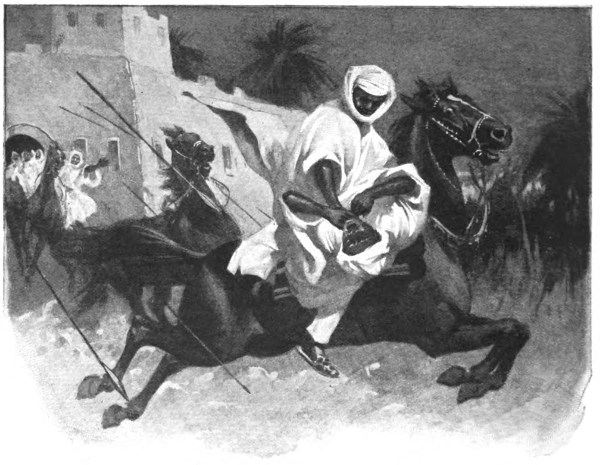
“IN THIS FASHION WE FLEW ALONG THE PATH.”
I rode fast all through the night, my horse showing splendid spirit and pluck, and at sunrise halted on the banks of a river. Leaving my hard-ridden beast to cool a little first, I then watered him and, cutting some guinea-corn stalks from a patch near by, gave him a good feed, munching some myself at the same time and quenching my thirst at the river. Then, after about two hours’ rest, I proceeded, but at a lesser speed.
I rode all that day and well into the night, finally resting by the pool where I had cooled my heated brow on the way to Kontogora. After some hours’ halt I pushed on again, obtaining food at farmhouses on the way, and next evening, utterly weary, arrived at the Niger opposite Boussa. My journey was over; I was safe at last! Arriving at my quarters in the Niger Company’s compound, I flung myself down on my camp bed just as I was and slept for sixteen hours.
The faithful Mama turned up four days later. He went to Yauri, a friendly State, coming down river by canoe. For his services I presented him with the Emir of Kontogora’s horse.
During all the years that have gone by since my secret trip to Kontogora and my subsequent escape I have never regretted having run the double risk of disobeying orders on the one hand and risking my life on the other. I had been instructed to get news and I got it—not the idle tales of paid spies, but a record of sights seen and things heard with my own eyes and ears.