My Experiences in Algeria. By the Baroness de Boerio.
Reading edition
The Baroness’s husband, an officer in the French army, was ordered to Algeria, and took his wife and children with him. There, located at a tiny post far from civilization, in the midst of fierce and unruly tribes, the authoress met with some very strange adventures, which she here sets forth in a chatty and amusing fashion.
II.

Some time after my arrival at Teniet-el-Haad my husband and I, together with our first lieutenant and his wife, were invited to a “diffa” given in our honour by a Caid named Si Benrajah.
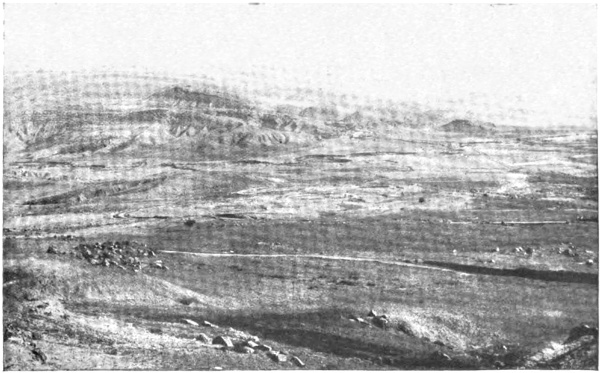
THE FRINGE OF THE DESERT. From a Photograph.
He most politely sent his wagonette to fetch us and was at the door of his house to receive us. He was a tall, good-looking man, and his costume was exquisite. His serronal, or wide trousers, were of pale-grey satin cloth, the large pockets on each side richly embroidered in silk braid of the same shade. Silver lace covered his short bolero, which opened over a shirt which was a mass of green and red silk, gold and silver embroidery. Over that again he wore a lovely white silk “haik,” which, covering his head-dress and kept in place by the “camel cords,” fell round his shoulders, and was then caught up in front from the knee to the gold waistbelt by a cerise coloured silk handkerchief. Over his shoulders hung his burnous, the outer one of fine grey cloth to match the costume, handsomely embroidered at the corners and round the hood, the under one of fine white flannel.
He led us majestically into his “drawing-room”—which, alas! bore unmistakable traces of the Caid’s various journeys to Paris. There was nothing Arab but the lovely carpets and the smell.
A rickety Louis XV. canapé, with chairs to match, stood stiffly against the walls; their coverings of chintz badly wanted washing. An oval table, a walnutwood wardrobe, a washing-stand without the accessories, and two big mirrors, whose frames had once been gilded, completed the furniture. We here partook of refreshments in the unromantic shape of absinthe and lemonade, accompanied by Huntley and Palmer’s biscuits and wafers. I was much disappointed, for I had hoped to see something more Arab and to eat and drink according to the customs of the land. I supposed this was “progress” in Benrajah’s idea; at any rate, he looked most satisfied with himself and his surroundings. He introduced another Caid to us—the Caid of Biskra, I think, who was passing through—a fine, handsome man, whose photograph is here reproduced.
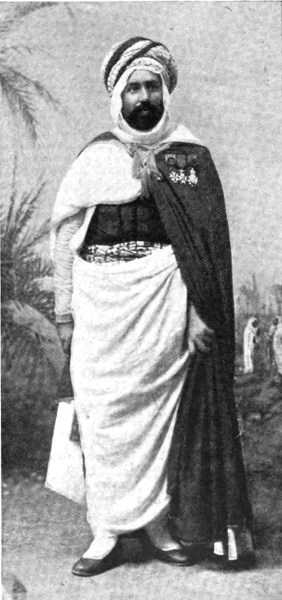
THE CAID OF BISKRA. [From a Photograph.]
We breakfasted in a large tent, as Benrajah said it was still too warm in the house. Remembering the close, “camelly” sort of smell, I quite agreed with him.
As we entered the tent Mme. G——, the lieutenant’s wife, whispered to me, “Now, mind you don’t refuse a single dish the Caid offers you. If you do you will mortally offend him, especially as it is the first time you break bread under his roof, and the ‘diffa’ is in your honour.”
“All right,” I answered, cheerily.
“Bon! bon! bon!” she cried. “Don’t forget, you must eat everything he offers you.” She skipped off roaring with laughter, which, at the time, I thought very silly of her.
I was again very disappointed by the civilized, European way in which we ate. Instead of squatting cross-legged on the ground, eating with brotherly love out of the same dish with a wooden spoon or our fingers, we sat round a well-laid table, with knives and forks, and dinner-napkins embroidered with the Caid’s initials. Everyone and everything is getting so horribly civilized nowadays, I reflected, sadly.
The repast began with a red-hot liquid in which vermicelli floated. It burnt my unaccustomed mouth and I did not fall in love with it, but as I had never tasted anything like it before I did not even want to refuse when the Caid offered me a second helping. After the soup came some boiled chicken, on which the red liquid had been poured. He helped me largely—twice. The third course was mutton, with prunes; the fourth mutton, with red liquid; the fifth a French ragoût, with an Arab taste; the sixth was chicken without the red liquid; the seventh an Irish stew gone wrong; the eighth—well, perhaps my readers are beginning to feel as tired as I did after having partaken twice of all these dishes. Indeed, I was beginning to feel very serious, and longed ardently for the end of this Gargantuan repast.
After about the twelfth course an Arab in waiting cleared a space on the table before the Caid. My hopes were raised to the heights, but, alas! only to fall to the lowest depths in a very short space of time. Suddenly something knocked my hat on one side, and everyone yelled at me. Dazed, I looked round and rubbed my nose into a sheep’s leg. Starting back, I met the convulsed and, as I imagined, reproachful eye of an enormous sheep lying in a contorted attitude on a big brass platter. Si Benrajah turned to me with a gracious smile. “I am much honoured, madam,” he said, in perfect French, “in being the first to offer you a ‘meshui’ on your arrival in Algeria.”
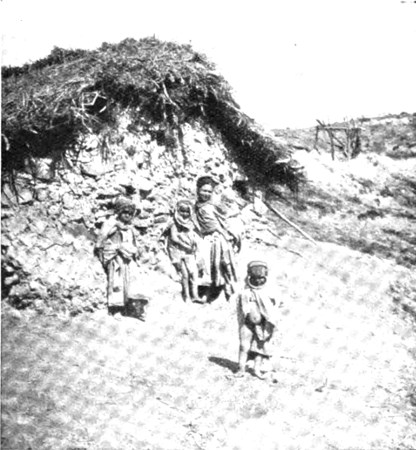
A TYPICAL ARAB HUT. [From a Photograph.]
A “meshui,” I learnt, is a royal dish, and is only offered to those the Arabs delight (or are compelled) to honour. It is simply a whole sheep roasted over wood embers, and served uncut on a brass or silver platter. It should not be cut with a knife, but torn off with the fingers and eaten. If you wish to be particularly polite to a friend who is present, you wrench off a piece of flesh and present it with your greasy fingers, and he receives it much flattered, returning the compliment with his greasy fingers. This style of eating was certainly not over-civilized, so I ought to have been better pleased than I was. As a matter of fact I felt very bad, and hoped against hope that the Caid would forget me.
“You are not yet accustomed to our habits,” he said, kindly. “Take a knife and fork and cut off the meat.”
So I cut off a few small bits in a dilatory way, secretly wondering if I could not surreptitiously throw them to some lean, hungry dogs who were peering into the tent door.
“What silly little bits!” cried Benrajah, laughingly. Then, after well licking his brown, henna-stained fingers, he tore off a huge piece and offered it to me! A cold perspiration broke out on my forehead, and I almost longed for death.
“Eat! eat!” he cried, gaily; and, choking down my despair, I ate.
How could I dare to do otherwise after Mme. G——’s warning? Are not the laws of hospitality sacred and to be observed throughout the world? But it was terrible tribute to pay to foreign customs, and I felt a lesser desire for originality.
“It is good?” inquired the Caid.
“Delicious! delicious!” I answered, with a ghastly green smile.
“Ah! Here is a comme il faut Roumia!” he cried, enchanted—and promptly tore me off a beautiful brown piece of meat, weighing, I should think, about three pounds! My cup of anguish was full, and I prayed—yes, actually prayed—to be delivered from that three pounds of meat.
And I was.
Crash! The table-cloth was half dragged off, and, amid a rain of knives and forks, plates and glasses, my little girl rolled on to the ground. I did not lose my presence of mind, but, seizing my pounds of meat, all unseen in the commotion I threw them to the lean dogs, who made very short work of them. Then my motherly feelings came to the fore, and I went to the rescue of my child. It was soon apparent what had happened—the poor mite had been given too much wine by the thoughtless Mme. G——, and was very seedy for some days afterwards.
It would be reasonable to suppose that the “meshui” was the last of the courses, but it disappeared only to give place to the Arab national dish, the “couscous.” At sight of the snowy pile of rolled semolina, surmounted by more mutton, a feeling of revolt took possession of me. I felt I could dare Lucifer himself; and so I refused the couscous, although in a cowardly way, by pretending that fresh air was necessary for my poor little Renée. Perhaps it was, but if it had not been I should have said the same.
I do not think I ever quite forgave Mme. G—— her two practical jokes, for practical jokes they were. When I described my sufferings at having to eat all the Caid gave me, she laughed herself ill and said, “What a ‘blue’ you are!” Which is the French military way of calling you a greenhorn.
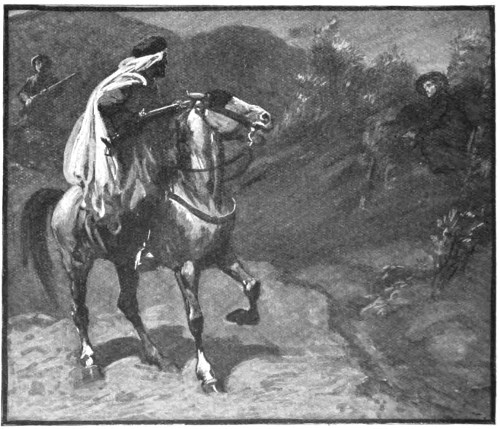
“I LOOKED ROUND JUST IN TIME TO SEE AN ARAB LOWERING HIS GUN.”
One of my husband’s great amusements in this out-of-the-way garrison was to construct a hiding-place, in front of which he fixed the carcass of some dead animal, and there, gun in hand, to await the wild beasts such as hyenas, jackals, lynxes, and golden foxes, who scented from afar the goodly supper awaiting them. On these occasions they generally found too much pepper, and often suffered from a mortal indigestion. I sometimes accompanied my husband on such expeditions, and greatly enjoyed crouching silently in some hidden corner, listening to the wailing of an approaching hyena, or the querulous squabbling and howling of the shrieking jackals. And then, when the dry sticks cracked and the dead leaves rustled quite close to me under their stealthy pads, my heart would leap into my mouth for fear they should mistake me for their supper. One night whilst thus listening to some approaching creature my husband, crouching about twenty yards from me, suddenly rose up and called out in Arabic, “Who goes there?” I looked round just in time to see an Arab huntsman lowering his gun, which was pointed full at me. He thought I was a hyena!
During the winter, when the snow lay thick on the ground, I preferred staying at home to keep up a huge fire and fabricate hot drinks in readiness for the frozen huntsman’s return; it seemed to me more a wife’s duty!
Another short incident of my life in Teniet-el-Haad may not be uninteresting. My husband had gone to the manœuvres with his Spahis, and our bordj was only guarded by about thirty “Tirailleurs Algerians.” Then, one day, a terrific storm burst over the land. The air was so thick with fine sand that I could not distinguish the trees before my windows, and the sun hung in the sky like a lurid orange ball, seemingly about to drop. The heat was stifling; one gasped for breath, and, although every door and window was hermetically closed, the rooms were full of sand.
Presently a terrible clamour arose from the village—shouts, cries, screams, gun-shots. Then from the bordj courtyard I heard sharp orders given, the clanking of weapons, and finally the sound of a body of infantry running. The wind howled and shrieked, the sand-storm grew denser and denser, and still the clamour continued in the village. I sat in the drawing-room with my little ones around me, wondering if it were a serious revolt, and what would happen to us if it were. For the district of Teniet-el-Haad was a large one, containing thirty thousand Arabs, and we were far from any important garrison, while our protectors, all Arab, consisted of thirty “tirailleurs,” and ten Spahis belonging to the “Commune Mixte.” Pensively I placed my revolver close to my hand, and waited anxiously.
After a few hours the sirocco cleared somewhat, the noise ceased, and the tirailleurs returned. The whole affair, they told me, had been got up by the mountain Arabs against the Jews, who had been “doing” them. So the Arabs had taken the law into their own hands and administered justice by repaying themselves a hundred-fold and making off with their booty up the mountains, well hidden by the sand-storm. In the scuffle a boy and two men were killed, all Jews—so it did not matter, so the folks said.
My husband was second captain at Teniet-el-Haad, having given up his rank as first captain in the Hussars in order to facilitate his return to a regiment. He was therefore the oldest in grade in the 1st Spahis, and the earliest vacancy as first captain fell to him. We had been at Teniet about ten months when he received orders to take command of the Laghouat squadron. It was the beginning of February; snow lay thick and deep on the ground up in this high altitude, and the great question arose how we were to get to Laghouat. Should we take the short cut by carriage across the mountains to Boghar, where the regimental brake would meet us and take us on, or go down to Affreville by the rickety diligence, train to Medeah, and continue by carriage?
Going by train was a difficulty and an extra expense on account of our dogs. We had four—three fox-terriers and a shooting dog. I do not know what he called himself, but he had a double-barrelled nose and an over-frank and exuberant nature. He and Charleston, the old fox, could not bear each other. It was quite impossible to put them together in the dog-box, and to pack them separately would have cost as much as four times as many children. So, in consideration of their feelings and our purse, we decided—oh, irony!—to take the short cut if the snow and slush would allow of a carriage travelling along the narrow mountain tracks.
We consulted the different French and native authorities, and finally decided, if the snow and slush would allow, to take the short cut over the mountains. We started off one fine morning at five, in a small brake lent by a Caid, who also promised to send us four strong mules to an inn some twenty miles off. The first twenty miles were soon done, and at half-past seven we were enjoying some good hot coffee, whilst our Spahi was unharnessing his team and making inquiries as to the whereabouts of the new relay and coachman. Ten minutes after he appeared, with a very concerned face. “Mon capitaine, Sidi Belgacun has sent two mules no bigger than donkeys, and the boy who drives them is a mere baby!”
This sounded cheerful, and with one accord we went out to inspect. The Spahi’s account was unfortunately but slightly exaggerated, and we stood staring at our tiny steeds with dismay. We had still fifty kilometres before us, and the roads for at least twenty-five were nothing but cross-country paths. Should we turn back, or try to find other horses and go on? I voted emphatically for going on. Aided by the Spahi, my husband finally unearthed a man and two horses, and at eight o’clock we set off once more.
Everything again went well for ten kilometres; then our misfortunes really began. When going up a hill the ground grew soft and the wheels of the brake sank in.
“The snow is melting farther on,” remarked the coachman, laconically; “the underground springs are overflowing.”
On we went laboriously, our Jehu yelling at the struggling horses, whilst the carriage wobbled to and fro in a most alarming fashion. “Don’t you think it would do us good to walk a bit?” I suggested. “It would make things easier for the horses.”
“It would be safer,” said my husband, who was looking anxious.
So out we got—and two minutes later the whole concern toppled over, our boxes, portmanteaux, and packets flying all over the place. The horses were plunging and kicking; the coachman, an Italian, and the Arab boy were yelling and swearing in their respective languages, whilst my husband exclaimed in French (he doesn’t swear, but I am sure he would have liked to on this occasion). The scene was so unutterably comic that I could not help myself; I laughed until the tears rolled down my cheeks. I draw a curtain over the face my better half turned on me—scowling was not in it—and although I assured him I was really quite as upset as the carriage he has not recovered from my frivolity to this day.
The men picked up the carriage and the baggage and put all in order and we thought we should get on again, but, alas! the wheels refused to move an inch; the more we tried the deeper they sank. After two hours of vain endeavour, Peppino, the coachman, suggested sending Ali to have a look round the country to see if he could find a village and get men with spades to come and dig us out. The boy set off, returning later with five stalwart men, who comparatively soon dug us out and accompanied us for a few kilometres on our way, pushing and yelling when necessary. Then they left us, saying the road was good right up to Boghar. It was now past two o’clock, and our lunch loomed very dimly in the far distance, having been ordered for twelve o’clock at Boghar.
About three o’clock we saw snow on the side of the road, which again grew slushy and soft. My husband and Peppino were obliged to run behind, pushing at the wheels at the difficult places, whilst the Arab boy cheered on his mules and Peppino’s horses.
The snow got deeper and deeper. Presently we passed a carriage abandoned on the side of the road, farther on a dead horse, and again a form, which looked terribly human, covered by a white pall.
After a while we came to a wider part. On the right was a sloping mountain-side half covered with snow, half with golden narcissus, and showing a dry watercourse, dotted about with huge stones. On the left was a smooth field of snow, across which wheel marks could be distinguished. “We must cross here,” said Peppino, “as someone has before us; the snow is doubtless hard, and by whipping up the horses I will get you over. The road is impossible.”
My husband was not of the same opinion. He considered the watercourse a better road than a snow-field, and the presence of stones made him surmise that the bottom was hard.
The matter was hotly discussed, but finally my husband gave in, seeing that Peppino knew the road and he did not.
Away we galloped—bump, bump, bump. Then, without warning, there came a tremendous crack, and, lo and behold! there we were, sitting in our carriage, whilst the horses and Peppino continued with the wheels! It was, of course, a terrible dilemma, but again I had to laugh; it was really too funny.
My husband and Peppino carried me and the children and perched each of us on a stone, where I stood on one leg and cawed like a crow. “One should always take misfortunes gaily,” I said. That was the last straw; my better half had to laugh, but the smile was rather sickly. Then we held a council of war.
Peppino, good man, saved the situation. “I will go back with the horses and fetch the carriage we saw abandoned at the side of the road,” he said. “I know the owner, and will take the responsibility for borrowing it on my own shoulders.”
So off he went, whilst we cawed to one another from stone to stone and ate snow, there being nothing else to do. Before long Peppino returned triumphantly with the borrowed carriage, the luggage was transferred, and we started off again, leaving our first equipage standing disconsolately in the snow.
All went well until eight o’clock, although my husband and Peppino had constantly to push at the wheels. They both looked ten years older than at the start, so lined and weary were their faces. At about eight we came to a narrow track, a real road winding round the mountain above a fathomless precipice. On each side the snow lay in drifts of five and six feet deep, and the centre track showed no sign of previous passage.
We had not gone fifty yards along this road when the horses stopped and the wheels disappeared in a drift. Yelling, pushing, and pulling had no effect whatever. The horses were then harnessed to the splash-board, but their strenuous efforts only resulted in tearing it from the body of the carriage.
All this time I was sitting in the snow trying to keep the little one warm, and hopefully encouraging the two elder ones, Charlie and Renée. From the mountain top came the discordant howling and barking of jackals; from the blackness below arose the sad wailing of a hyena. I very nearly became tearful.
Peppino again offered his services, and proposed riding off to fetch help at a sheikh’s some ten miles away.
“Get into the carriage, wrap yourselves up warmly with everything available, and wait,” he said. “In five or six hours I will bring assistance.”
There was nothing else to be done, so we made the best of a bad job, packed ourselves up, and tried to sleep. The children, of course, succeeded at once, as did my husband, worn out with the efforts of the day, but I could not. My hunger was great, and I do not think I have ever before or since imagined such cold. Talk of African heat; African cold has the first place in my memory.
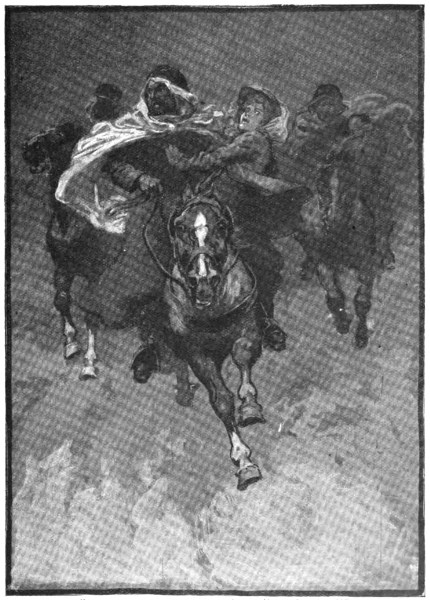
“I KICKED VIGOROUSLY, SHOUTING ‘HENRI!’ AND ‘PEPPINO!’”
The night was pitch-dark, and it was far from amusing to sit there listening to the animals prowling round. A hyena or so came very near to our mules, who shivered and snorted for a long time after.
Numbed with cold, I suppose I at last fell asleep. Suddenly I was awakened by a great commotion. Then came yelling, the sound of horses plunging, and I heard the children shrieking “Mother!” I rose precipitately, a light flashed in my face, baby was seized from me, and I myself was borne off like an infant by a man who appeared to be a giant. He hurried away up the mountain-side without a word, which did not at all seem to me the right behaviour of rescuers. Why thus seize us and bear us off into the mountains?
We must have been attacked by brigands, and my husband knifed as he slept! I kicked vigorously, shouting “Henri!” and “Peppino!” but received no answer, and my heart sank. Then I called “Charlie!” “Renée!” and to my great joy their voices answered quite close behind me. I therefore left off kicking—which, indeed, had no effect on my burly captor—and consoled myself with the thought that, though apparently a widow, I was not left childless.
After five minutes or so my giant began to shout. Other voices answered; then suddenly I was planted on my feet in the inky darkness, but almost at once a dozen matches were struck and held to a huge heap of dry brushwood. In two seconds we had a royal bonfire, which not only warmed us but lit up the country all round.
Brigands or no brigands, I thought, these Arabs were very thoughtful fellows.
I asked several times, “Where is my husband?” but they all raised their hands and shoulders in vague denial of any knowledge of his existence. I was beginning to be really alarmed when his welcome form loomed in view astride a mule. I do not think we have ever quite understood how he came to miss us in the confusion caused by the headlong arrival of our rescuers. He had galloped after us along a road where we had not been at all; but, not finding us, had come back, and had been guided by the firelight.
After a good warming at the fire we started for the sheikh’s house, ten miles off, the children being carried by Arabs on horseback, and I astride a mule on a “barda.” On our arrival we found couscous and sour milk awaiting us, and—what was far better—some good mattresses spread on the ground in a big, white-washed room. At ten next morning we left, the kindly sheikh having lent us his wagonette. Peppino had gone back with some Arabs to dig out and bring along Carriage Number Two.
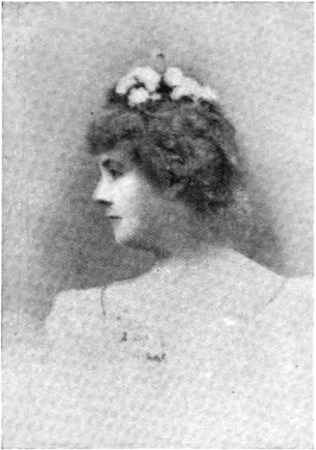
THE BARONESS DE BOERIO, WHO HERE DESCRIBES HER ADVENTURES IN ALGERIA. [From a Photograph.]
About half-way to Boghar we met the regimental brake coming spanking along. The soldier driving told us that at eight o’clock an Arab had come to him saying that he was to harness up at once and drive for eight miles along the Teniet road, when he would find the Spahis’ captain, who was stranded with his family at Sheikh ben Shinan’s.
This experience of Arab telegraphy rather astonished us, for we were still greenhorns in this respect. Since then nothing of the kind surprises us; I have often learnt of distant happenings from the Arabs long before our own civilized methods brought me the news. Arabs travel a great deal by night, passing on the tidings from one to another—they are terrible gossips—so that it is the case of the hare and the tortoise. Their signalling is done by movements of the burnous by day and fires by night. In each district certain heights are especially used for this purpose. Whilst travelling by road on one occasion I remember hearing a long hoot-like call, and on looking in the direction of the sound I saw an Arab on a hill, evidently signalling with his burnous, for he was making regular up-and-down and to-and-fro movements with it. Half an hour after we saw another Arab with a huge flock of sheep. In the evening, when we arrived at the place we meant to camp at, we found ourselves expected by the sheikh, and a hospitable couscous prepared. He bade us welcome, saying we were later than he had thought. When we inquired how it was he expected us at all, he only vouchsafed to say, with half-closed eyes, that he had known we were on the road some hours before, and had supposed we would stop the night there. Thereupon we remembered the white-robed Arab on the hill and the shepherd far away, and began to understand.
(To be concluded.)