Photographing a Volcano in Eruption. By Frank Davey.
Reading edition
A vivid description of a photographer’s adventures in securing pictures of the eruption of Makuaweoweo, in Hawaii. With pen and camera Mr. Davey depicts the awe inspiring grandeur of the lake of fire in the crater of Mauna Loa, the pyrotechnic display afforded by the active cone on the mountain-side, and the horrors of night amid the lava-wastes, where death menaced the party on every hand.

On Tuesday, July 1, 1899, reports reached Honolulu, Hawaiian Islands, that the volcano of Makuaweoweo, situated at the summit of Mauna Loa, thirteen thousand six hundred and seventy-five feet high, on the island of Hawaii, had burst forth with all the fury of years gone by. I was anxious to get some photographs of the eruption if possible, and so made all the haste I could to get my paraphernalia together and catch the steamer W. H. Hall, bound for Hawaii.
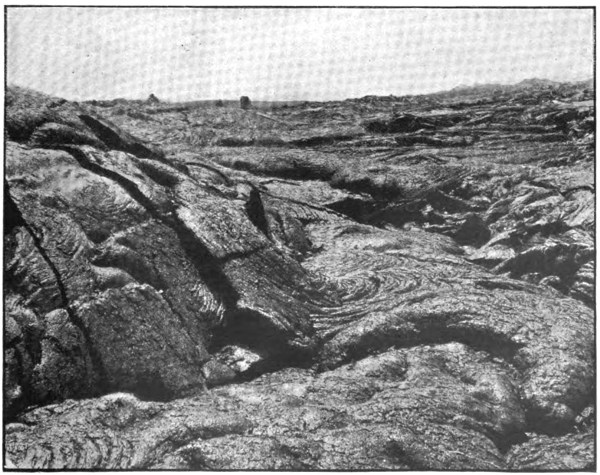
“PAHOEHOE” LAVA, WHICH APPEARS AS THOUGH IT HAD COOLED WHILE FLOWING QUIETLY. From a Photograph.
I left with the intention of reaching the scene of action from the Kau side of the island, but when, upon arriving at Kailua, Kona, I telegraphed to Mr. N. S. Monsarrat, at Kapapalu, I found that he had a house full of guests bent on the same journey, and that all his horses had been engaged. Rather than lose time, therefore, I decided to take the most difficult route of all—right over the great mountain from the Kona side. The obstacles to be overcome may perhaps be imagined when I state that Mauna Loa is a volcanic mountain, nearly fourteen thousand feet high, and that one has to make one’s way for the entire distance over every kind of lava formation.
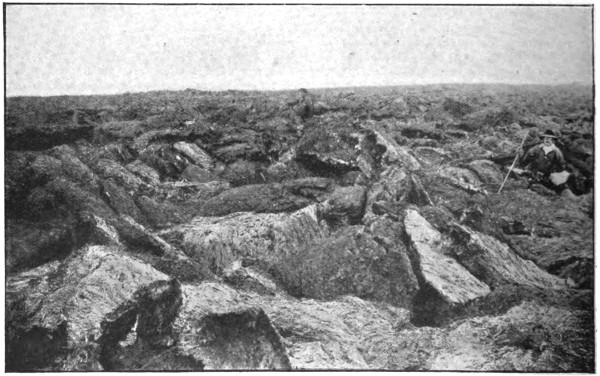
“A. A.” LAVA, WHICH LOOKS AS THOUGH IT HAD SOLIDIFIED WHILE TOSSING LIKE A SEA IN A STORM AND THEN BEEN BROKEN UP BY EARTHQUAKES. [From a Photograph.]
It was with great difficulty that I managed to get horses and mules from the natives, who knew the condition of the country, for the animals inevitably get badly knocked about, their legs being terribly cut by the lava, which is divided into two classes—“Pahoehoe” and “A. A.” The former term is applied to tracts of comparatively smooth lava, which appears as though it had cooled while flowing quietly; the latter is applied to stretches of broken lava which seem to have cooled when tossing like an ocean in a bad storm, and to have afterwards been broken up by earthquakes. No words of description can convey an idea of its roughness and hardness, which may be faintly realized from an inspection of the above photograph.
During the time I was hunting for horses a number of gentlemen arrived and expressed their desire to join me in the expedition. I was only too pleased to have their company, so five travellers threw in their lot with me: Professor Ingalls, Colonel McCarthy, and Messrs. Sterns Buck, J. Ballard, and H. C. Klugel. These, with three guides, completed our party.
We were up early the next morning. The first part of the journey was one of the most delightful rides I ever had. We rode for hours through magnificent tropical growths. There were giant ferns, some of which must have been thirty or forty feet high and three feet in diameter, groves of guavas, coco-nuts, and other fruits, miles of wild mint and bright-coloured flowers, and orchids of most delicate shapes.
At dusk we reached the edge of the timber-line, in a drenching rain, a downpour such as is experienced only in the tropics, where the rain descends in sheets. We ate our supper and then spent the night huddled miserably together, trying in vain to keep dry.
We resumed our journey at daybreak, over the most terrible country that can be imagined. The sharp edges of the lava cut through our stout boots like broken glass, and the poor animals suffered greatly. Still, however, we persevered, and finally reached the summit just as it was getting dark. Near the centre of the mountain-top an area of about four square miles sinks to a depth of one thousand feet. This is the great crater of Makuaweoweo, which we had endured so much to see.
As I stood there in the cold, in the midst of those cheerless and God-forsaken wastes, I gazed down with speechless awe upon the untrammelled frolics of the God of Fire. The tempest-tossed lake of molten lava below the rim of the great cauldron was a typical workshop of Vulcan. The face of the lake of liquid fire alternated continually between black and white, like molten iron in a furnace. Oxidation and cooling of the fiery fluid would blacken the surface with a pall that covered it in darkest gloom; then a trembling, caused by further subterranean outbursts of steam, would break this ice-like oxide into a fretwork of tens of thousands of incandescent cracks, lighting up the smoke-charged pit with a fierce glare. Another moment, and in different parts of the lake geysers of fire of every imaginable colour would rise like fountains in a public garden.
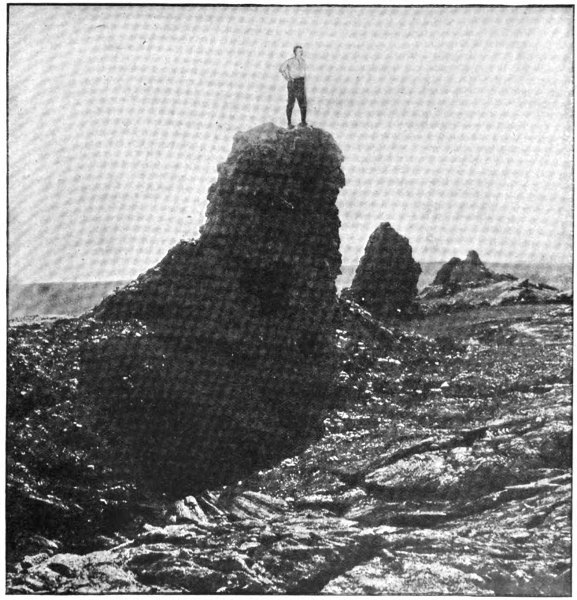
THE AUTHOR SURVEYING THE CRATER OF MAKUAWEOWEO FROM A PINNACLE OF LAVA. From a Photograph.
The great forbidding-looking walls of this “home of everlasting fire” sparkled with the unusual light, and then, as the spouts of flame died away, the surface would again turn black, leaving the whole mass to all appearances dead.
We found that the worst outbreak was about five thousand feet farther down the mountain-side. Some of our party were seized with such a sickness of horror at the crater’s edge that they rolled themselves up in their blankets and refused to look down upon this fiery maelstrom—and that after two days of arduous effort to reach a point of view!
When the time came for sleep, another man and I turned into a “blowhole” in the lava; it was an immense bubble that had cooled and left an opening so that we could crawl in. We little thought that there was another hole at the other end, and the piercing wind blew through this like a funnel; but we had to stay there, for it is dangerous to wander about over the rifts and chasms of jagged lava in the darkness. Here, in this strange bed-chamber, we slept, or tried to sleep—shivering and shuddering through the chilly solitude of the night in those desolate mountain wastes.
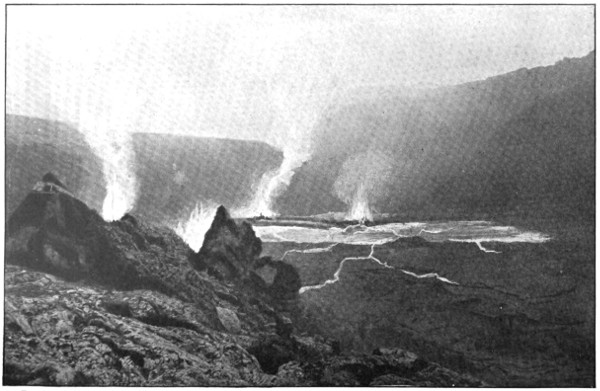
THE CRATER OF MAKUAWEOWEO, SHOWING THE AWFUL LAKE OF LIQUID FIRE. From a Photograph.
Walking across the congealed masses of lava next morning, one began to think that at any moment one was liable to drop through to the very gates of Hades and be precipitated to the most horrible of deaths. Underneath one was a bottomless abyss of mud, sulphur, and rock; and to contemplate being cast into that fearsome-looking lake of fire and brimstone was not at all comfortable. The Biblical description of hell does not convey even a faint idea of that terrible lake of fire below us, which appeared to be fretting and fuming as though anxious to get loose and destroy everything in its path. The crater of Makuaweoweo at that time, without doubt, afforded the spectator a more awe-inspiring display of the forces of Nature than has been granted to man elsewhere on earth without the sacrifice of life.
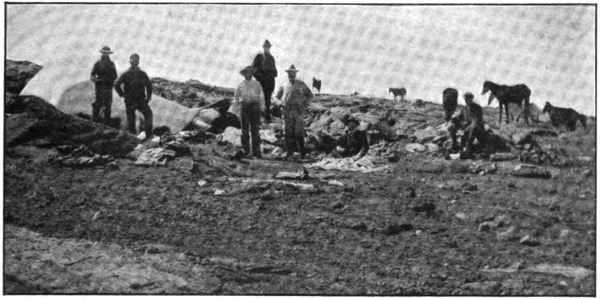
THE AUTHOR AND HIS COMPANIONS AS THEY APPEARED JUST BEFORE LEAVING THEIR HORSES TO VISIT THE WORST OUTBREAK. From a Photograph.
Soon after daylight we prepared for the descent to the point that was throwing out molten lava at a white heat. It was practically impossible to take the horses farther, so we tethered them to stones near the yawning depths of Makuaweoweo, and left one of the guides to look after them. We were very thirsty, but it was some time before we could find water, though snow and ice were plentiful. Farther down, however, we discovered water in a deep crack in the lava, filled the canteens, and started on our downward journey. I was suffering from mountain sickness; my head felt as if it would burst and my stomach was upside down. We stumbled along with difficulty for about two miles, when I had to get the assistance of Mr. Buck to carry my camera. Two of our party who had started out in advance gave it up and returned—they could not stand the strain of the rough travelling. This left but four of us, with two guides.
Presently we reached a cone where the lava had piled up to the height of about one hundred feet, then, bursting out at the side, disappeared into the ground, to reappear about a quarter of a mile farther down and repeat its action. These cones averaged two hundred feet in width at the base and one hundred feet in height, and we passed five “dead” ones. A sixth was still smoking, but was not active. Two of the party tried to climb to the top of this cone, but were unable to do so.
We then pushed on to cone number seven, which was belching forth huge volumes of steam and sulphur. The fumes, most fortunately, were being blown away from us. At this stage one of the guides refused to go any farther; it was too dangerous, he said, so he proceeded to retrace his steps, while we others continued our journey toward cone number eight. This was the last and largest, and was, I should estimate, about two hundred feet high; in fact, a veritable miniature volcano, spouting red-hot lava a hundred feet in the air with a ripping boom that could be heard for miles. Boulders that must have weighed a ton were being hurled high into the air as if shot from a cannon. Others followed to meet those coming down, and as they met they burst like explosive shells, scattering molten matter on all sides. This flowed down the incline in cascades like water, showing red, yellow, blue, and all the colours of the rainbow.
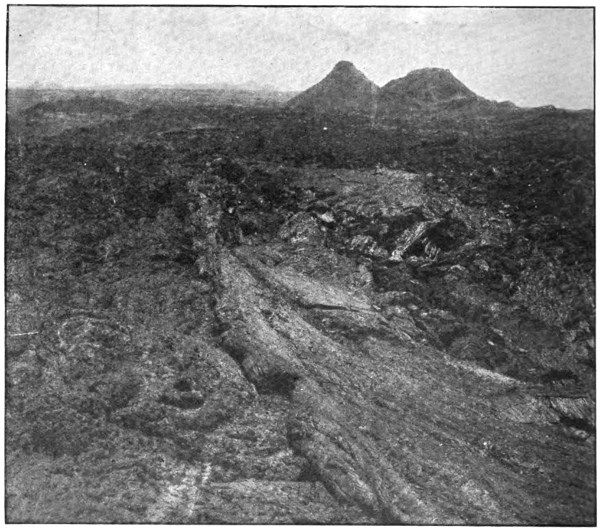
TWO OF THE “DEAD” CONES PASSED BY THE PARTY. From a Photograph.
It is impossible to describe the grandeur of the effect, and a knowledge of the force that was causing the display made one feel very small indeed. Some of the ejected masses were as large as a horse, and when they were belched forth were at a white heat. They went so high that they had time to cool and return to the vortex black.
It was three o’clock in the afternoon when we reached this wonderful display. It had taken us nine hours to reach the volcano, and we were thirsty and well-nigh exhausted. We could not approach very near on account of the heat, but I made some photographic exposures, and then sat for an hour watching the wonderful sight. As the sun went down the magnificence of the scene increased. The ground shook at each explosion to such an extent as to make us sick. We found quantities of what is known as “Pele’s hair.”1 It is caused by the wind blowing the liquid lava through the air, forming fine threads like human hair.
As we approached cone number seven on our return journey the wind changed, and to our consternation we saw a cloud of sulphur blowing right across our path. These masses of vapour are so impregnated with sulphur and poisonous gases that it is impossible for any living thing to exist among them, and to get caught in their midst means death. Alarmed, we started to go around the other side, but found the lava was too hot; the surface was cool, but there was living fire beneath, and we dared not proceed. We kept on until the lava began to move under our feet, and then beat a retreat to face the sulphur again, for it was better to be smothered to death than slowly roasted.
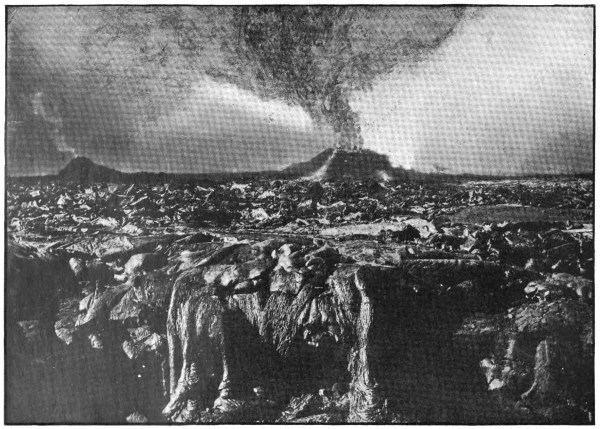
CONE “NUMBER SEVEN”—IT WAS ABOUT TWO HUNDRED FEET HIGH, A MINIATURE VOLCANO, SPOUTING RED-HOT LAVA AND GIANT BOULDERS WITH A ROAR THAT COULD BE HEARD FOR MILES. From a Photograph.
We made a number of attempts to pass that deadly barrier of vapour, but were forced to return each time, nearly suffocated. It looked as though we should soon be choked to death—the fire at the back of us, the sulphur in front. Professor Ingalls remarked that we had better make the best of our time by taking notes, and then prepare for the worst. Just at this critical moment I happened to turn round and saw an arch, as it were, in the sulphur smoke, where the wind was blowing it up from the ground.
“Look! look!” I shouted, in great excitement. “Run for it!” And how we ran! Providence gave us the chance and fear lent us strength, for under ordinary circumstances we could never have run as we did, owing to the condition of our feet. The danger, however, made us forget the pain, and we ran for dear life. We had scarcely got through that arch of clear air when down came the cloud again, as though lowered by some great power. The only guide who had stayed with us fell exhausted at the edge of the vapour-mass. How I managed to drag him along I do not know; I hardly realized what I was doing, but I managed to save him.
Once past the danger-point we crawled along at our best pace, for at any moment the wind might turn in our direction, when we should be again overtaken by that terrible death-cloud. I had left my camera behind in our wild flight, but fortunately I saved several plates.
It was now night, and the only light we had was the lurid glare from the volcano. Suddenly, as we stumbled painfully along, we came upon a man sitting by the side of a dead cone; it was the guide who had returned. He said he did not expect to see us alive again, for he had seen the deadly smoke blow across the mountain.
If it had not been for the light from the volcano we should undoubtedly have perished of cold and thirst, as we should have been compelled to stop walking. As it was, we dared not halt for any length of time, or we should not have had warmth enough to keep the blood circulating. All that night we crawled over that terrible lava. We fell down at intervals of about twenty feet, often breaking through the black crust, sometimes up to our waists, cutting ourselves on the sharp projections until our hands and legs were woefully lacerated. Almost as soon as we fell we dropped asleep; then, as we got colder, we would wake up and force ourselves on again for a few dozen yards or so, only to fall asleep, wake, and struggle up once more. The agony of the situation and the pain of our wounds were enough to make a man go insane.
At last it began to get light, but still we had come across no water, and that in our canteens had long since been exhausted. Very few people, fortunately, know what it means to have their throats and lips so swollen and cracked that they are bleeding for want of water. I could scarcely speak. We hunted the depths and crevices of the lava, sometimes going down ten or fifteen feet, looking for water, only to be disappointed again and again. At last I got so weak that Mr. Buck had to take my package of plates off my back, where I had tied them.
Suddenly I saw a break in the lava nearly full of beautiful water. I pulled Mr. Buck’s arm, pointing to it, and mumbled, “Water.” Slowly he pulled off his coat and started to climb down the crack. It was about eight feet wide, narrowing to three. I leaned over the side, holding the canteen for Mr. Buck to fill. He went down a few feet, and then stopped. I motioned to him to fill the bottle, croaking, “Water.” He did not look around, but mumbled, “I see no water,” as if in a dream. Picking up a piece of lava, I tossed it down and cried hoarsely, “There is the water.” But to my astonishment the pebble went down, down, down, out of sight, with no sound of a splash, into a fathomless abyss. The crevice was so deep that we could not see the bottom, and the shock of the discovery made me faint. How Sterns Buck managed to return he does not remember; it is a wonder he did not fall, to be mangled upon the sharp corners of lava.
I came to my senses dazed and almost bewildered, and Buck and I sat motionless for some time staring at each other. After a time we scrambled on again until we came upon the guide sitting upon the edge of a high crack, eating frozen snow, and tearing at it with his teeth like a hungry dog. We followed his example, not without pain, but the snow tasted good.
Some of the party who had previously returned met us near the summit with coffee. When they saw us coming they got things ready so as to make us as comfortable as possible. After washing our lacerated hands and feet we took a good sleep, and awoke much refreshed. The journey home was, comparatively speaking, easy, but the memory of that night amidst the lava will last me to my dying day.
By Thomas B. Marshall.
An exciting story told by a former official of the Gold Coast Government. With a friend and some natives he went out to shoot a marauding leopard. They accomplished their mission, but before the day was over one and all of the party had received a good deal more than they bargained for.

In 1899, while in the service of the Gold Coast Government, and stationed at Kumasi, I received orders “per bearer, who will accompany you,” to proceed to a point on Volta not far south of where it debouches from among the Saraga Hills. “The bearer,” a nice young fellow called Strange, was newly arrived in the colony, and his pleasant home gossip was not less welcome to me than my information about the country we were in was to him. Our rough forest journey, then, passed as pleasantly as such journeys can, and by the time we arrived at our destination we were the best of friends.
Akroful, a town of about seven hundred inhabitants, was the nearest place of any size to the spot where we pitched our camp, and we were soon on good terms with its headman, Otibu Daku, and his son, Dansani, both of whom put us in the way of some good shooting.
We had been in this place about a fortnight, when we began to be annoyed by the depredations of a marauding leopard, who took to visiting our live-stock pens, and at last we decided to lie in wait for him. I took the first watch until a snake crawled over my legs; then I went to bed. It was a harmless one, but it reminded me of the need of precaution, so next night found our lair surrounded by a very uninviting floor of cactus leaves.
The fourth night after our vigil commenced Strange succeeded in wounding our sell-invited guest, and we determined to track him down as soon as it was light. Otibu Daku and his son willingly agreed to help us; and I took, in addition, two of my own men who would, I knew, “stand fire”—Ashong Tawiah, an Accra man, and Nyato, my chief steward-boy, a Krooman.
The two Ashantis led the way, Otibu Daku carrying a “long Dane” gun; his son, a machete. Tawiah and Nyato also carried machetes, and the former, on leaving camp, had picked up a broad-bladed Hausa spear. Strange and I each had a repeating rifle and a revolver, for, as Nyato told me, “Dem headman, ’e say, plenty tiger lib dem part.”
The trail was easy to follow. There was not much blood, but the ground was soft from recent rain. It was rough going, however, and the machetes were constantly at work clearing a way. Up and down small watersheds, squelching through marshy bottoms, crossing streams on fallen trees, we frequently lost the track, but by some sort of instinct our guides always found it again.
At last, after descending a more than usually steep incline, we found ourselves in a valley of some size. The bush here was very thin, and we progressed without difficulty until we came in sight of the inevitable stream, the opposite bank of which, rising steeply, evidently formed the commencement of the next divide. I was about a dozen yards to Strange’s right; the ground was clear of bush between us and the stream; and on the nearer bank, his head overhanging the water, lay our quarry, clearly dying. But he was not alone. Stretched by his side, licking the wound that was letting out his life, lay a fine female leopard, evidently his consort. On seeing us she rose to her feet, snarling; she abandoned her ministrations and became militant—a defender-avenger. Strange fired hastily on sight, and a convulsive heave of the prostrate body showed where the bullet struck. With a light leap the leopardess cleared her mate, and with long, low springs raced down towards my friend. He fired again at thirty yards, wounding her, and she swerved slightly and came in my direction. We both fired together, whereupon she stopped suddenly, reared straight up, pawing the air—then fell backward, stone-dead.
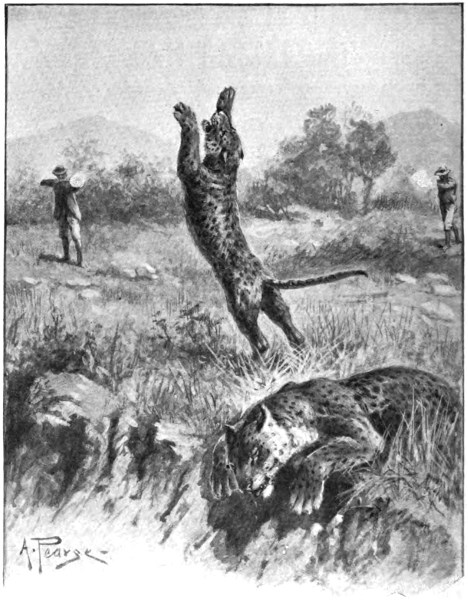
“SHE REARED STRAIGHT UP PAWING THE AIR—THEN FELL BACKWARD, STONE-DEAD.”
Hardly had the double report died away when our attention was attracted to a movement on the other side of the stream. Tawiah pointed.
“Oolah! tiger him piccin!” (“Master, the leopard’s cubs”), he cried. Slinking away downstream, with long, stealthy strides, their muzzles to the ground and tails trailing low, were two half-grown leopards, the head of one level with the other’s haunch.
“Tally-ho!” cried Strange, and let fly at them. His one fault as a sportsman was a too great eagerness to get the first shot in. The white splinters flew from the buttress of a great cotton-wood, and the nearer cub, startled as never before, leapt a man’s height from the ground, and, coming down, raced away downstream after its companion.
“Come on! We’ll bag the whole family,” said Strange, jumping into the stream. Otibu Daku was already across and I was about to follow, when I noticed, fluttering up the farther slope, one of those beautiful insects called the “dead leaf” butterfly. You will see one fluttering along like a fugitive piece of rainbow—then suddenly it will alight on a withered branch or heap of dead herbage and disappear, the underside of the wings being in shape, colour, and even veining an exact imitation of a withered leaf.
I was an enthusiastic collector, and never went out without a folding net that could be fixed to any fairly straight stick. Bidding Tawiah remain with me, then, I let the others go on after the cubs, and in a couple of minutes was in pursuit of my own particular quarry. The slope was nearly bare of bush, and I did not have much difficulty in making the capture. Placing it in a flat box containing some poison-wax, I took my rifle from Tawiah and went on up the hill, leaving him tying up a scratch on his leg.
I was not quite easy in my mind. We had been too hasty in concluding that the cubs we had seen belonged to the leopards we had shot. They had been driven away too easily, and most likely were heading straight for their own den, where, at that time of day, the old ones would certainly be at home.
I hurried on in the hope of getting some indication of my friend’s whereabouts. At the top of the ascent a soft breeze met me, it was pleasant and refreshing, but it brought that with it that made me drop flat behind a bush and throw my rifle forward. There is no mistaking the odour given off by the larger carnivora, and the strength of the smell that assailed my nostrils was such as to convince me that my first hasty thought—that I had headed off the cubs—was wrong. Such an effluvium could come only from a den, and an occupied one at that.
There were three possibilities. It might be the home of the dead leopards, of the strange cubs we had seen, or the lair of yet a third family. I looked back. Tawiah was not in sight, but I knew he would follow. In front, for a hundred yards, the level crest of the ridge was covered by a sparse, wand-like growth that was no impediment to the view. Beyond the ground fell away again, and just on the edge, and rather to my right, stood two enormous cotton-woods, the space between them being a labyrinth of roots standing thigh-high from the ground.
To this point, with what speed and silence I could command, I made my way. Midway I stopped abruptly to listen. A deep snarling, worrying sound filled the air, coming from straight ahead. Reaching the nearest root, I looked over. The rapidly falling ground beyond was hidden by a far-sweeping buttress from the tree on my left, which, running parallel with the one I stood against, made a passage about four feet wide and two high. Stealing away to the left, where the nearer root sank below the surface, I entered the passage, and, on all fours, reached a point midway between the two trees. The noise I had before heard was now very distinct, and, blending with it, yet dominating it, came a continuous buzzing sound like the far-away roll of a drum. I knew it for the purring of a full-grown leopard.
Looking back, I was glad enough to see Tawiah reaching the level. I raised a warning hand, and, waiting only to see that he observed me, turned, and very cautiously looked over the root in front. From where I crouched the ground fell away very steeply and was bare and stony. Then began a gentler slope covered with a low scrub and running down into a valley similar to, but larger than, the one we had just left. Down the centre flowed a stream, the same on whose banks, higher up, we had left the dead leopards. I was on a kind of spur, round which the stream made a bend away to my right. To my left it lost itself in an expanse of shallow water covered with great water-lilies, which merged in its turn into the stream of the Volta, half a mile away.
Just where the change of slope began was a great outcrop of rock. About a foot above the base, and facing me, was a ragged opening, and in this, with both paws hanging over the edge, lounged a fine she-leopard. The air hummed with her complacent purr, as, with blinking eyes, she watched the rough play of two well-grown cubs. Presently she rolled over on her back, and, with downward-hanging head, struck idly with a mighty paw at a white butterfly flitting above her. She was the personification of soft and sinuous strength.
Suddenly, away to the right, a shot rang out. The purring ceased, and instantly the great cat was couched, rigid as a bronze casting. Except for the tip of her tail, not a muscle moved. Presently the tense expression relaxed, and with a guttural sort of sigh her head dropped on to her paws. But only for an instant. The stealthy rustling of something approaching reached her ears, and she resumed her alert attitude. Then her eyes half closed again, and she seemed to go smooth all over. A suave, fawning expression came into her face; her purring redoubled; she rolled softly on to her side and gazed intently in the direction of the sound. The noise came nearer, and presently, as I expected, her mate appeared. He paused for an instant to look back, and at that moment Strange’s rifle spoke again, and the leopard sank down, biting savagely at his hind-quarters. With one movement as it seemed, and with a sort of deep-throated cough, his consort was by his side, and then began an awful duet of snarls and growls, rumblings and snufflings, with the cubs for chorus.
It was high time for me to take action; a wounded leopard and a leopardess with young can make themselves pretty awkward. I aimed at the female as being the more dangerous, and was about to pull the trigger, when a movement in the valley attracted my attention. One of the cubs we had first seen was tearing across the open, making for the stream. Some distance behind followed the other, evidently wounded. Close upon him ran Dansani, machete in hand. As I looked the cub turned and Dansani struck. Nyato was close behind, and level with him, but farther out, Otibu Daku stole swiftly with long, bent-kneed strides, his “long Dane” gun held across his body. Strange was not in sight.
The foremost cub was nearly at the stream when he raised a howl of fear or of warning, I do not know which. On the instant, from a clump of bushes on the farther side, there leapt two greyish-white forms. Clearing the stream, they charged straight down on the young Ashanti.
All this was photographed on my brain while my finger was on the trigger. The scene was blotted out as I fired, and from that moment I had enough on my hands to occupy my undivided attention. The leopardess was killed outright. The next instant I fired at the male, but one of the cubs gave a jump and received the bullet meant for his sire. How the brute did it I do not know—for he had a broken thigh-bone—but next moment the old leopard was tearing up the slope towards me, and very business-like he looked. I fired again and clipped his ear; then his claws were hooked on to the root in front of me, and all I could do was to smash the butt, pile-driver fashion, down upon his head. He seized it in his jaws, and the hard wood cracked like pitch-pine, while the wrench nearly tore the weapon from my grasp. He gave me no time to reverse it for another shot, or to draw my revolver. Four times did he struggle to draw himself up, and but for his broken leg I could not have prevented him. Four times, luckily for me, he allowed his fury to vent itself on the rifle-butt. The struggle only lasted seconds, but it seemed hours, and already the fury of it made my breath come short.
And then the cub decided to take a hand! It had been pacing to and fro, snuffing the blood and growling; it then suddenly turned, and dashed straight to the scene of combat. A leopard cub by itself is not more than a man can manage, but as a reinforcement to an infuriated parent it is a serious matter. I heard Tawiah behind me.
“Take the piccin,” I yelled, and put all my strength into an effort to thrust my foe back. Instinctively he tried to use his injured leg, and this time he lost grip altogether, and his claws scraped down the root, making great furrows in the wood. I let him have the gun, and seized my revolver in time to plant a couple of bullets in his head as he came up again.
Meanwhile Tawiah had accounted for the cub, but he was badly clawed down the leg. To my surprise—for I did not remember the brute using his claws at all except to hold on by—my coat was ripped, and I had several nasty, but not severe, scratches down chest and arms.
Our attention was now diverted to the scene below, and what we saw sent us both down the slope as fast as we could race—Tawiah ahead. One cub lay dead—Dansani’s victim—and a few paces from it stood the young Ashanti, preparing to dodge the foremost of the parent leopards I had seen break cover. He sprang aside as it reached him, but the brute wheeled as if on a pivot and reared. Then came the crashing report of the “long Dane,” a fearful yell, and Dansani reeled away with his hands to his head, and fell. The leopard, roaring horribly, rolled over and over, apparently broken in two. Its mate, swerving at the report, turned and raced straight for Tawiah, who had just reached the level ground. I shouted to him to come back to me, thinking that revolver and spear together would match the furious brute, but apparently he did not understand, for, waving me to follow, he tore off to where, midway between him and the advancing leopard, stood a small Dequa palm. His object, I learnt afterwards, was to hold the leopard at bay there till help arrived. It was a mad idea, for the savage brute was covering three yards to one of his.
Just at that moment I caught sight of Strange—hobbling along, supported by his rifle, five hundred yards away; there was no help to be expected from him. Nyato was rushing on to settle with the remaining cub, that, screaming, was alternately dashing towards its wounded dam and back to the stream. Otibu Daku was carrying Dansani to the water, and the female leopard, her hind quarters straddling like those of a frog, with the small of her back blown away and reared on her front legs, was rending the air with the most awful yells.
The male passed the tree, and only about forty yards separated him from my faithful follower. I ran on. Trusting to luck, I fired two chambers, but without success. The distance between them decreased rapidly, and Tawiah, seeing the hopelessness of his position, grounded his spear, and, gripping it by the middle, backed up the butt with his knee in the hope that the brute would impale himself. Then I saw that Strange was kneeling, taking aim. He could never hit a running leopard at that range, I told myself; it would appear no bigger than a cat to him.
I was twenty yards behind Tawiah, and barely ten separated him from the leopard, when a ball of smoke floated away from Strange’s rifle. I dared not hope, and Tawiah remained like a rock. Then, suddenly, the leopard halted, and—for all the world like a kitten chasing its own tail—spun round and round till we could hardly tell one end from the other. I sent two bullets as near the centre as I could, and Tawiah, charging in, drove his spear in at one side and out at the other. The battle was over.
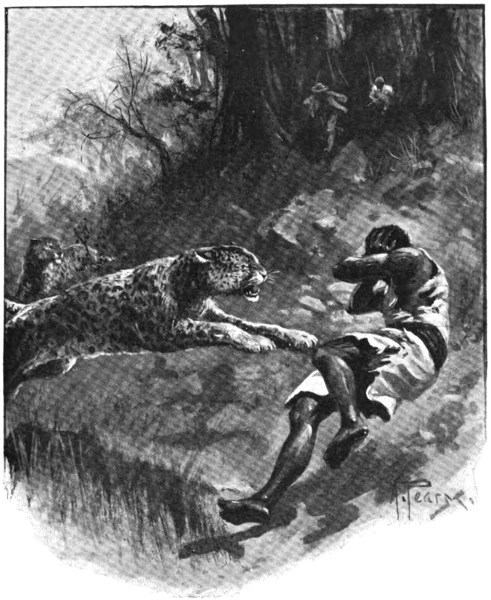
“DANSANI REELED AWAY WITH HIS HANDS TO HIS HEAD, AND FELL.”
We found that Strange’s bullet had pierced the skin of the neck just where it joins the head, and had half stunned the animal. But what a glorious shot! I paced the distance to him; it was four hundred and sixty odd yards! He had made just a little too much allowance for speed, but what of that?
Strange, it appeared, had stepped on a loose stone and strained his ankle badly. Poor Dansani was horribly mauled. The beast had clawed him from the crown of his head to the knee in one awful sweep. Half the scalp overhung his face, one eye was destroyed, the muscle of the upper arm was in ribbons, and the stroke, glancing from the elbow, had laid open his thigh to the knee. A revolver-shot finished his assailant. We did what we could for Dansani on the spot, and Nyato and his father carried him home on a hastily-constructed litter. Later he recovered, but was terribly disfigured.
Tawiah and I took it in turns to help Strange along, and when we reached the spot where our first victims lay we found their young ones mewling over them. They slunk away, and we did not molest them. The cub Nyato had chased allowed self-preservation to triumph over filial affection, and got away also. My rifle was utterly ruined. And so ended our leopard hunt.