“Shot-Gun Jim.” By Edward Franklin Campbell.
Reading edition
It is safe to say that few commercial travellers meet with such exciting experiences as befell the three “drummers” who figure in this narrative. A business trip into the wilds of Arizona landed them into as fierce a skirmish with Indian outlaws as could well be imagined.

Take a young fellow just raw from city life, throw him into the wilds of Arizona, and arrange for him to tumble head-first, so to speak, into a brisk skirmish with Indians, and he will have something to remember. Such was the experience which befell me about 1890.
For some years I had been travelling through California, visiting the largest cities and towns, introducing a “line” of goods for a large San Francisco importing concern. Such had been my success that nothing would suit my firm but to add Arizona to my territory, a proposition I made no objection to.
Of late years Arizona has vastly improved, and trouble with the Indians has become almost unknown, especially since that notorious warrior, Geronimo, was deported to the State of Florida, but up to the ‘nineties there was still an occasional flare-up.
Both Geronimo and the villainous “Apache Kid,” a bloodthirsty red-skin brigand, figure in this story, the first indirectly and the second very prominently.
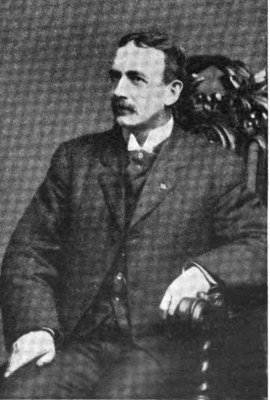
THE AUTHOR, MR. EDWARD FRANKLIN CAMPBELL. From a Photograph.
Having reached the town of Wilson, in the southern part of the territory, I fell in with two fellow-commercial salesmen—Levy, representing a large dry-goods concern, and Bates, handling a line of boots for a St. Louis house.
Levy imparted the fact that he was going to visit a large mining camp, called World City, located some hundred and sixty miles to the north and as many miles distant from the railway. Bates said he would join Levy provided I would make one of the party.
Although my route did not include this side-trip, I became convinced that it would pay me well to visit World City. By sharing expenses with Levy and Bates, the trip could be made most reasonably, so I wired my house accordingly, and Levy hastened to make arrangements with a local celebrity, a Scotchman named McGill, for transportation.
An agreement having been made with McGill, the balance of the day was consumed in making preparations for our departure on the following morning. There were blankets to buy, for one is never safe without them. No matter how hot and burning the day may be, the nights are always crisp and chill on the Arizona plains, and one never knows while making such a trip when he will land at his destination. Nine chances out of ten he will be hours late. Our journey was no exception to the rule.
On the following morning I was aroused by McGill. On the wagon, which was a heavy four-wheel affair, he had loaded three shoe-sample trunks, the property of Bates, and two immense square trunks carried by Levy. Beside this there were sundry boxes and bundles of blankets, as well as our heavy overcoats and small personal luggage.
After a hasty breakfast of ham and eggs—I generally ordered ham and eggs in Arizona because other meats were far from tender in those days—we took our places on the wagon. Levy occupied the front seat with McGill, while Bates and I sat on top of a huge trunk, slippery and uncertain.
Although the animals seemed good and hardy, they were small, and I do not think we realized the great weight of the combined load. At the wheels we had a pair of small and nimble mules, and as leaders a pair of small bay horses, whose looks did not recommend them.
The first day out all went well, and we reached the little town of Bonita, a most desolate-looking place. We had travelled less than thirty miles.
We drove up to the door of a little adobe building with a thatched roof. On the front a crude sign informed the public that it was a “General Store.” Another placard indicated that it was also a public-house, or “saloon,” as they are called in America.
On entering we found ourselves in a small room with a rough counter running down one side, behind which was the smiling face of the proprietor, who lived with his wife and two beautiful daughters in the one adjoining room—these two rooms constituting the entire building.
We spent the night on the floor of the store, in front of the counter, and next morning resumed our journey, hoping to reach the little group of buildings known as Standard before night. In my own mind—and I think the others believed the same—I did not really expect to reach Standard that night, for it was nearly fifty miles distant and our animals were far from fresh.
I think it was about ten o’clock in the morning that we saw a cloud of dust several miles ahead. In time it proved to be a company of negro soldiers, marching to a neighbouring military post.
As they came alongside we could see a number of rifles sticking out of the canvas of the great covered wagons which accompanied them. They halted, and an officer, whom McGill said was a colonel, came over. He saluted us pleasantly and asked laughingly:—
“Are you not afraid to travel in this direction?”
McGill inquired why, whereupon the officer explained that “Apache Kid” was out with a small band of warriors, that Geronimo had disappeared from the Indian Reservation, and that serious trouble was brewing. The troops, he added, were being moved for the purpose of heading off “Apache Kid” and his crowd.
The smiling face of the colonel rather misled me. He did not seem really serious, and, as I sized up the situation, I believed it quite possible that he recognised our party as “tenderfeet,” and desired to frighten us.
After the soldiers had become a mere blur in the distance we resumed our journey. We had gone but a few miles farther, however, when an accident occurred to our wagon. Something gave way—I don’t remember what—and it became impossible to proceed. Levy took a look at the wagon and declared it was “no good, anyway”; Bates joined in the abuse, and McGill lost his temper. Finally, I acted as peacemaker, and suggested that something would have to be done as the afternoon was advancing. Either we must return to Bonita on foot, abandoning the wagon and contents, or McGill would have to take the team back and secure another conveyance.
The last alternative being accepted, we drew lots, and it fell to Levy to return to Bonita with McGill, while Bates and I remained to look after the property.
McGill insisted that with the load off he would be able to haul the wagon back to Bonita for repairs, so we set to work and, after a struggle with the trunks, got the vehicle in shape to be drawn.
It was with great misgivings that I saw my companions depart. It was not to my liking to remain as a guardian of that mass of luggage. Bates did not seem to mind it. He simply offered me his last cigar, then lighted it himself and sat down on the bare ground.
I think we could see in every direction for twenty miles and more, except toward the mountains, which were to the east, some five miles distant.
“Well, Bates,” I said, “what are we going to do? It’s getting mighty cold. The wind sweeps down from that mountain as if we might get a little of the storm brewing up there.”
“That’s no mistake, my boy, and if I am not in error we are going to get snow inside of two hours. Most extraordinary for Arizona.”
“Don’t you think we could arrange some shelter with these trunks and roll of canvas?”
“Just the thing, my boy. Glad you suggested it.”
So we set to work and built our house, forming our walls by arranging the trunks in a square, leaving a small opening to be used as a door. On this we spread the great piece of canvas which had been brought along to cover the wagon in case of storm, thus making a roof. That it might not be carried away by the wind, which was now howling like a hurricane, we weighted it with small boulders. With other rocks we built a small fireplace and chimney, without and facing our door. With the limited supply of wood, which was very scarce—sagebrush and gnarled mesquite—we built a small fire in our fireplace, much to our joy, for we were now actually blue with the cold.
The sky was now thoroughly overcast with snow-clouds and the snow was beginning to fall, settling in miniature drifts beneath the sage bushes.
In removing the trunks from the wagon our labours had been heavy, and we realized, as Bates expressed it, “we were twenty miles from nowhere, and not a drop of water nearer than Bonita.”
Bates rummaged through the kit for a drink of any kind, but was only able to produce a diminutive flask with about one swallow of whisky in it. After offering this to me he took it down with a cheering “Here’s to you!”
“Don’t throw away that flask, Bates,” I called to him as I saw him taking aim at a near-by sage bush. “I may be able to collect a drink with that.”
I filled the little flask as full as I could pack it with snow which I collected under the bushes, then held it carefully over the fire, reducing the snow to water. This barely gave us enough to moisten our lips, and I gave it up.
Then we wrapped ourselves up in our blankets and reclined inside our improvised house and discussed matters.
“I say, Bates, what did you think of the colonel’s story about Apaches being out?” I asked.
“Can’t say. I know if I were an Apache and had a warm wigwam to crawl into, the warpath could go to perdition. I’m sure I wouldn’t bother with it this kind of weather. You won’t have the pleasure of meeting Geronimo, ’Apache Kid,’ nor any other human—and, I might add, inhuman—being till the weather lets up.”
“What have you got for protection in case we do run across them?” I asked.
“Well, the only protection I have is a pair of boots made by the Sun Shoe Company, which I represent. With these on, and a fair start, I might outrun them. That’s all I’ve got for protection. What have you got?”
“Well,” I said, rather apologetically, “I have a revolver here, but it isn’t much good. It might do to fire salutes with, but I’m afraid it would not do much execution. The fact is, I’ve not fired the thing for some years.”
“Now, look here, my boy. If you should ever shoot me with that thing, and I should find it out, I should be quite put out about it,” said Bates, with a laugh. “We might as well quit worrying. If the wild and woolly Apaches get us, it’s fate. They’ll get us, that’s all. I’m going to sleep.”
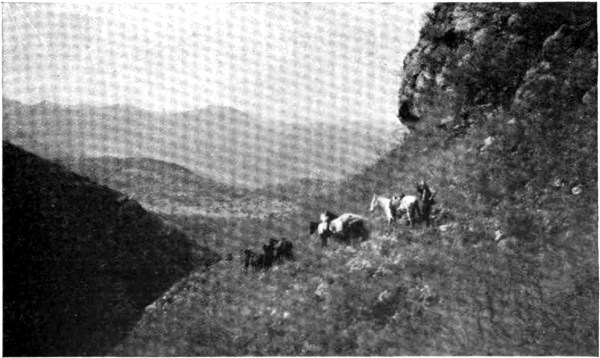
LOOKING OUT OF BRICK DUST CANYON. [From a Photograph.]
Suiting the action to the word, he rolled over and left me to my dreary thoughts. I tried to sleep and did drop into a light slumber, from which I was suddenly awakened by a startled exclamation from Bates.
As I opened my eyes he was just going through the doorway on all fours.
“Bring that revolver here,” he called to me.
As quickly as possible I was out after him. He was gazing towards the mountains in the distance.
“What has happened?” I asked, in some alarm at the sudden call to arms.
He explained that something had come to the door of our house. He could hear it, but only caught a slight glimpse of it as he raised his head, for it dashed out of sight immediately. It was evidently an animal of some sort, for we found the marks of its feet and claws in the soft earth. Whatever it was we never caught sight of it.
We were now thoroughly awake. The weather had cleared, the sun was shining warmly and my spirits were beginning to rise.
Far off, down the incline of the plain, we could see the spot known as Bonita. Between us and the town all was open, save for some sage bushes here and there dotting the view.
Surely McGill should now be on his way back, but not a sign of him could we see.
We recalled the fact that we were hungry. Bates rummaged in the kit. The net results were a small paper of biscuits and a tin of beef—nothing else.
We ate all the biscuits and half of the beef, collected more firewood, and, at about six o’clock, discovered the team slowly wending its way from Bonita. It was more than an hour before it arrived at our camp.
Another serious matter now confronted us. Either we must stay with our improvised camp or, as McGill suggested, make for Brick Dust Canyon, in the mountain, where lived a frontiersman named James W. Smith, who had a little farm situated on an oasis of productive earth in the midst of this vast wilderness of alkali and sand.
Eventually we decided upon the latter alternative, and succeeded in loading up and making a start.
For a long time we crept upward, no one riding except McGill, in order to relieve the tired animals.
Reaching the summit of the ascent at last, McGill stopped, for we had now to descend into a deep canyon.
Daylight had by this time given way to deepest night, and ahead all looked black and forbidding. Our driver could not even see the road, which was, moreover, obscured by a growth of trees in the canyon.
“Gentlemen,” said McGill, “this rig has no brake to hold it. There is a big down-grade here and a sharp turn at the bottom. From there to Jim’s house is about a mile. We must manage to stop one of the hind wheels, for these mules will never be able to hold the load in check; besides, I can’t see the road, and must let the animals take their course.”
We tied the right rear wheel with a stout bit of rope and started again, but with this difference—Levy, Bates, and I each lighted cigars, which Levy had brought from Bonita, and, puffing vigorously at these, walked ahead of the load, endeavouring to pilot McGill by the glow of the lighted “stogies.”
There were times when the mules and the locked wheel were insufficient to check the wagon to any great extent, on account of the steepness of the grade, but at first all went well. It was not long before we reached the sharp turn at the bottom. We were greatly in advance of McGill now, and, indeed, we could hear nothing of him, so Levy went back to investigate and to warn him of the danger ahead. He found the wagon halted at a fairly level spot to recuperate the exhausted animals. Levy told the Scotsman that he was about to plunge down the last and most precipitous piece of road, and urged him to give it up.
McGill was headstrong, however, and insisted upon going ahead, so we took up our stand with our cigars, to mark the turn at the bottom, and the big vehicle started.
We could hear it gaining speed every moment. Mingled with the rumbling of the wagon and the clatter of the animals’ hoofs we heard the shouts of McGill, who had now lost all control over his team.
On they came with a rush and a roar, and we, who were lighting the way, discovered we were in some danger. At the last moment we sprang back into the rocks and brush at the side as the team swept irresistibly on.
The leaders took the turn all right, but the next instant there was a crash and a yell from McGill. The wagon had left the road and plunged into a tree, the harness gave way, and Bedlam broke loose.
The Scotsman saved his skin by jumping fairly into a bush, while we sprang to the animals’ heads to check them. They showed, however, no disposition on their part to run away; they knew when they had had enough.
Away down in the distance we could see a light, which McGill said was at Jim’s house. He would leave us with the animals and seek assistance from the house, he told us.
“I shall go across-lots,” he shouted back to us, “by a trail which will save a lot of walking.”
For hours Bates, Levy, and I awaited his return in vain. We exhausted every topic of conversation we could think of, and at last, tired, disgusted, and feeling thoroughly out of sorts, we set off down the road, taking the animals with us.
Although we could still see the light, we walked for a long time before we actually arrived before a small adobe house, which was surrounded by a thick wall some eight feet high. The road led us to a pair of huge solid gates, which, being closed, prevented us seeing within. We called out, and in a few seconds a voice answered us, and we were conscious of someone approaching the gates with a lantern.
This proved to be Jim Smith himself. He seemed to be in a very merry mood, for, although we were total strangers, he almost laughed in our faces. He had a story to tell, it soon appeared, of a misfortune which had befallen our friend McGill.
It seemed that in attempting to take his short cut “across-lots,” the Scotsman had struck a cattle trail, which led to a watering-trough set beside a newly-dug well, the existence of which he knew nothing of.
By a curious accident, he walked straight into this well and plunged into eight feet of water.
It happened that Smith was at that moment bringing some young cattle into his walled enclosure, and, hearing the muffled cries of McGill in the well, believed they proceeded from a cow in difficulties.
Lantern in hand, he made his way to the well and called out. Judge of his surprise when he heard a voice, as from the tomb, growl:—
“I’ve lost my bloomin’ pipe!”
Looking into the well, he discovered McGill clinging to the sides as best he could with fingers and nails. It was but a moment’s work to throw him a line and bring him out, as sorry and dejected-looking a scarecrow as one could imagine. Strange to relate, it was all that Jim could do to keep McGill from going back into the well for his cherished briar, the loss of which seemed to worry him greatly.
We found the Scotsman in a very bad temper, complaining bitterly of the loss of his pipe, which he told us he was smoking at the time of his misfortune.
We received a hearty welcome from Jim and his wife. The latter was busy soothing their ten-months-old baby to sleep. There they lived, in that little one-room house, eating, sleeping, and cooking in the same apartment.
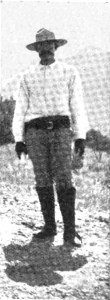
“SHOT-GUN JIM.” From a Photograph.
I began to speculate as to where we tired travellers would find a place to lay our heads. The house was a solid adobe, without windows. In the doorway hung a frame, on which was fastened a strip of canvas in lieu of a door.
A hearty meal was prepared by Mrs. Smith, after which we were invited to go out and bring in our beds.
On our return we found that Mrs. Smith and the babe were already in the huge bed in the corner. Jim was preparing to follow, and we were invited to spread our blankets on the floor, which, like the Bonita store, was mother earth.
Our sleep was far more restful than on the previous night. At an early hour we were awakened by Smith, who seemed to be worried about something. I followed him to the door of the house and discovered that he was holding a whispered conversation with a stranger, a young fellow of about eighteen years. As soon as I approached they stopped speaking and I was introduced to the young man, whose name was given as “Hank.”
Suddenly Smith spoke:—
“We might as well tell ’em about it, Hank,” he said. “They’ve got to know it sooner or later. Tain’t safe to get out of this place now. Besides, your horse is used up.”
I glanced in the direction indicated, and saw a horse covered in lather, with drooping head and general dejected appearance. I knew he must have had fearful riding to be in this condition.
“Well, you tell ’em, Jim,” replied Hank. “I reckon we’re here, all of us, to stay awhile.”
“I can’t afford to remain, Mr. Smith,” I said, thinking that the wrecked wagon might be the reason for the conversation. “If the outfit will hold together I think we had better go on as soon as possible.”
Smith looked at me with pitying eyes.
“You may never leave this place at all,” he returned, gravely. “This young man is the only survivor of a massacre, about ten miles from here. ‘Apache Kid’ and his band are, perhaps, at this very moment close to our gates.”
Instinctively I glanced at the gates, and noticed for the first time that heavy timbers were propped against them.
“Not only that, but McGill has disappeared,” continued Smith. “I think he may have gone in search of his pipe. We dare not risk going outside the enclosure, and he must get back as best he can.”
Just then the others of our party and Mrs. Smith, with the babe in her arms, joined us, having begun to realize that something was amiss.
Then Jim began to organize his forces. First he took an inventory of the available arms and ammunition, calling on our party to exhibit such weapons as we had about us.
Next Jim brought out a number of guns. There were three excellent repeating rifles, with several hundred rounds of ammunition, and an old shot-gun, which proved of no value. Next came Jim’s own pet—a beautiful double-barrelled shot-gun. With these were several boxes of ammunition. Last came a motley array of “six-shooters,” a part of which were serviceable and for which there was a limited amount of ammunition. Two hand-axes and a small affair for chopping firewood were counted as weapons for close quarters.
The whole lot was delivered into the care of Mrs. Smith, who was instructed to load the guns and arrange the ammunition conveniently on a table brought from the house.
At odd moments the good woman was assembling quantities of food, so that, in case of an attack, prolonged or otherwise, we might have her services at the ammunition.
Meanwhile Hank had been sent to the top of the house, which had a low, flat roof, where he was keeping close watch with a pair of field-glasses. He called to Jim that he believed he had discovered McGill in the topmost branches of a tree, a long distance up the canyon. It appeared that he was making signals, for we soon discovered that he occasionally waved a white handkerchief, and he appeared to be trying to draw our attention to something to the south.
Presently Hank reported that McGill was climbing down the tree, and in a moment he was running down the road towards the house as fast as his long legs would carry him. Jim prepared to open one of the gates.
Just then a shot rang out, followed by others. We could hear McGill coming full tilt. Jim opened the gate a little way and reported that a band of Indians were in close pursuit of the Scotsman.
A moment later, breathless and exhausted, McGill flung himself through the open gate, which was speedily secured behind him.
As quickly as possible Jim ran a rough wagon out of a shed and placed it alongside of the wall. It was evident now why this latter had been built high and strong; the reason for placing the wagon beside it, however, was not yet evident to us.
Soon we heard the rush of a score of Indian horses, the whoops and yells of their savage riders, and the crack of their rifles.
Their shots did no damage, however, but were sufficiently accurate to cause Hank to dodge behind the stone chimney, whence he dropped over the edge to the ground.
There was a savage onslaught upon the immense heavy gates, but they held firm, being well braced by the timbers. So far not a sound had escaped us, and it was evident that the Indians were chagrined that they had not made a greater impression.
For a few moments we could hear them in consultation before the gates, and presently a voice called out in broken English.
To this no reply was made, nor was any evidence of life vouchsafed from our side.
“Now, boys,” whispered Jim, “get ready. They’re going to show their heads in a minute—just over there, near the wagon. That is the easiest place for them to look over, and I have tried to make it look more inviting. So look alive and each pick his game. Don’t miss, or there’ll be trouble.”
Next moment five ugly Apache heads bobbed up over the wall simultaneously. They were evidently so sure that the place was unprotected that four of them, in their enthusiasm, clambered half-way on top of the wall before they became aware of the reception that had been planned for them.
The volley that followed their appearance was almost like one shot, and the four most daring red-skins received the bullets intended for them. Two were killed instantly, and partly hung over the wall as they doubled up; two others, mortally wounded, slid off the wall and were dragged away by their companions. The less venturesome got away with a whole skin.
With our volley pandemonium seemed to break loose; the red-skins let out a yell that fairly chilled us to the bone. Jim called us to seek shelter at the rear of the house.
We were none too soon, for a terrific fire was poured into the enclosure by the Indians, who were taking haphazard shots towards us, without putting their heads into jeopardy.
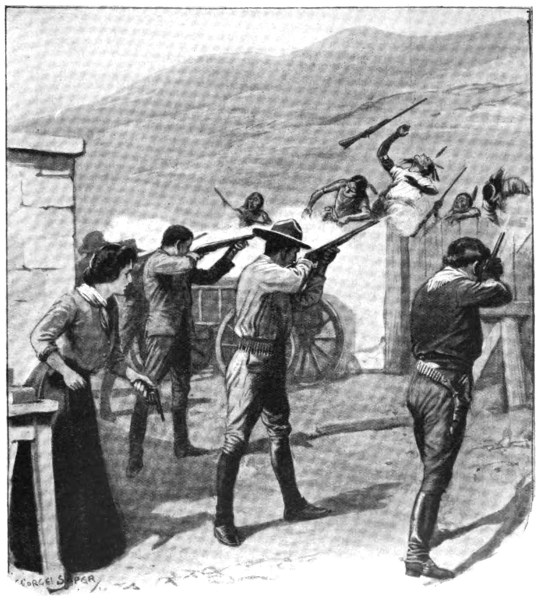
“THE VOLLEY FOLLOWING THEIR APPEARANCE WAS ALMOST LIKE ONE SHOT.”
Presently we discovered that one lot of the savages were trying to burrow under the gates, and were indeed making some headway. Jim seemed to be everywhere at once, using his shot-gun as his sole means of defence. The moment a hand was seen in the growing excavation under the gate he let drive with his shot-gun, and another Indian was out of commission.
I remember I kept a sort of mental tally of the fallen. Hank had told me that there were about twenty-three in the band, so I calculated: “Four dead on the first attack on the wall; one shot through the hand, under the gate. Balance to their credit—eighteen.”
Just then we received an unexpected shock. We saw a curl of smoke rising above the gates; the savages were piling brush against them, to which they had already set fire. This was a serious matter, which even Jim had not calculated upon. He ordered us to lie low while he took a look round.
I was so interested to know what he would do that I could not resist the temptation to put my head around the corner of the house, and this is what I saw.
Jim crept on hands and knees towards the wagon which we had placed against the wall. In a moment he had reached it, shot-gun in hand, and silently and slowly raised himself into it, gradually straightening out with his head and arms just above the wall. Then, quick as a flash, he took aim. There was a crash—or rather a double crash, for he had fired both barrels—an awful yell from the Indians, and he was speeding back to safety.
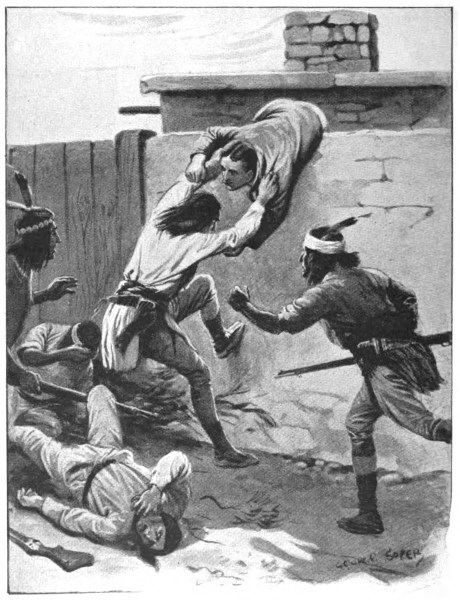
“I FELT MYSELF BEING DRAGGED OVER.”
One savage, braver than the rest, took a quick shot at him. The bullet did no harm to Jim, but came near being fatal to me, for I had been so intent on watching him that I now found that I had unconsciously stepped into the open.
Instead of bolting for shelter, I had but one thing in mind—to check up the account and see how many “good” Indians there were and how many bad ones.
Consequently, in a moment—foolhardy as it may seem—I was on the wagon, peering over the wall, taking account of the dead and wounded at the gates.
Although Jim’s shot-gun had done fearful execution, there were but two who appeared to be actually dead.
Just then something struck me in the face, a hand grasped me from over the wall, and I felt myself being dragged over, into the arms of the “Apache Kid” himself! Several other savages were running to his assistance. All that I can recall is that I thought my last hour had come, and struck out blindly with my fists, clinging, as best I could, to the wall with my legs.
I am not an experienced boxer, but I had the advantage over my assailant, for I was uppermost.
Things seemed to be going badly with me, however, for I felt my hold on the wall gradually weakening.
Just at that instant I heard a rush behind me. I was so done up that I could only think of more Indians, but in reality it was Levy, Hank, and Jim coming to the rescue.
I was grasped from behind and felt that I should be pulled to pieces. I let out with my fists with renewed vigour, and landed such a fierce tattoo on the face of my captor that he involuntarily sought to protect his face with his hands, whereupon Levy, Hank, Jim, and I fell into a confused heap over the side of the wagon.
It was a few minutes before they restored me to my senses, and I found myself with clothing half torn off, covered with dust, and generally bruised.
My first words were:—
“Two killed, three wounded badly; net balance thirteen. That number is unlucky. We’ll win!”
“What in the name of common sense are you talking about?” asked Bates, who was bending over me.
“Well, there were twenty-three Indians when we started; we killed four at first shot, three at the second, and two at the third, besides wounding three beyond present help. That leaves thirteen, doesn’t it?”
We were recalled to a sense of our peril by the sound of breaking timbers. The gates were being forced!
Through the chinks we could see the Indians working industriously with a battering-ram, improvised from the trunk of a tree. At any moment the gates might fall, and we knew there would be little hope for us once the red-skins gained an entrance.
Jim now sent his wife inside the house for better protection. The little babe had, up to this time, been peacefully sleeping on the bed, which must now be used to barricade the door of the house. Consequently, the little fellow was disturbed as his mother moved the huge affair against the opening, and he, too, added to the din of the engagement.
“Now, gentlemen,” said Jim, “we’ve got to make a last stand. The gates will be down in a minute; they have been greatly weakened by the fire. Every one of you to the roof!”
Up to the roof we climbed as a last resort. I think we all realized the gravity of the situation.
We stretched ourselves flat, weapons in hand, and waited. It seemed ages. We could hear the cries of the infant mingled with the sobs of the distracted mother. Bates, who had an abominable voice, tried to sing a hymn. Smith told him to be quiet—the situation was trying enough without his music.
Presently there came a crash—the gates were down. In rushed the red-skins, a fearless crowd. There were just thirteen; I counted them.
“Now, gentlemen, let ’em have it,” called Jim, in a low tone.
Well, we did let them have it; there was no mistake about that. There was a blaze from the rifles, Jim’s shot-gun, and the revolvers, and we all pumped lead as fast as we could.
When the smoke cleared a little we looked below. There were eight red-skins as dead as ever they could be. Three more were crawling away on all fours, seriously wounded.
This left two on my record unaccounted for. We soon spied them making off over the little hills towards Brick Dust Canyon as fast as their legs could carry them.
One of them was “Apache Kid,” the leader. He got off with a whole skin, but I’ll wager that he had some marks about his face.
When we got down from the roof we could no longer hear Mrs. Smith or the babe, and feared they had been killed by stray bullets. Repeated calls failed to bring response.
When we forced an entrance we found her in a dead faint, lying on the bed beside the infant, who was chewing his fist and chuckling as if in great glee.
Woman-like, Mrs. Smith deferred her swoon till all danger was past.
To the delight of McGill, his miserable briar was recovered that day by Jim, who said he did not want the well spoiled, otherwise he would have left it there.
“Shot-gun Jim”—for that is how he is always known now, on account of his fearful execution with his shot-gun, for it was he who really saved the day—has never been troubled by Apaches since. He still insists on living in that forsaken spot, forgetful of the terrible scenes of carnage and danger he has passed through, working at a copper mine which he discovered up beyond Brick Dust Canyon.