Volume 1 — CHAPTER XVI. GLASS.
Reading edition
Vessels with painted figures—Vessels with Greek letters—Drinking-horns of glass—Cut glass.
Nothing perhaps can give us a better idea of the refined taste of some of the Northmen than the beautiful glass objects which have been found in different parts of the country. Many of these are evidently of Greek, some perhaps of Roman, origin. In the museums of Italy, Greece, or Russia no such exquisite bowls are found, which after having been painted they seem to have been baked or subjected to heat in order that they might retain their colour.
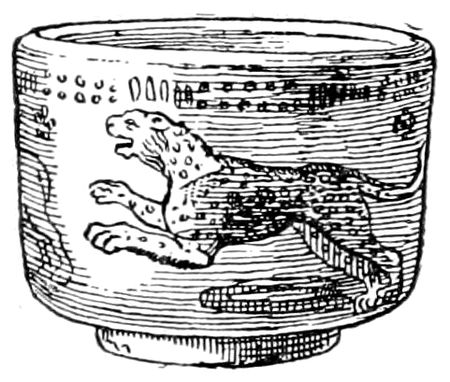
Fig. 628.—2½ inches high; diameter across top, 3 inches; across bottom, 17 10ths of an inch. A blue panther, with grey or brown contours and dots, attacks a brown stag; on the other side of which is a brown lioness. Between the animals are circles of dots, brown and yellow by turns, with a brown spot in their middle.
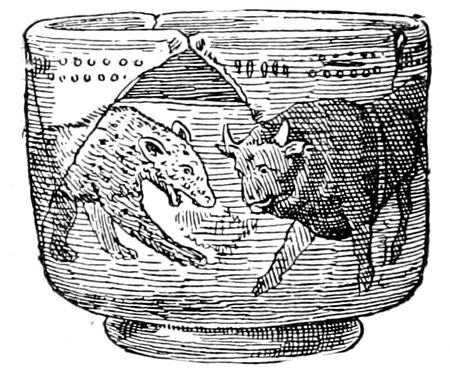
Fig. 629.—3½ inches high; 39 10th inches diameter. A brown bull, with a blue band with brown dots, attacks a brown bear. To the left a man in yellow coat and green breeches, holding a whip in one hand, in the other a blue shield; to the right a stag, being torn by a lion, both brown. These two vessels were found in a field, Nordrup, Zeeland, in a grave 3 feet 4 inches under the ground. It contained a skeleton, and, besides the two vessels, a Roman bronze vessel and bronze sieve, a gold finger-ring, a silver fibula, forty-one beads of glass and glass mosaic, a clay vessel, and fragments of two clay vessels.
277
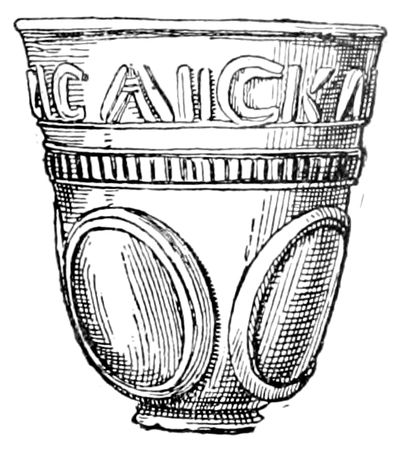
Fig. 630.—4 inches high, 3¾ inches in diameter across top. In a mound, Viborg amt, Jutland.
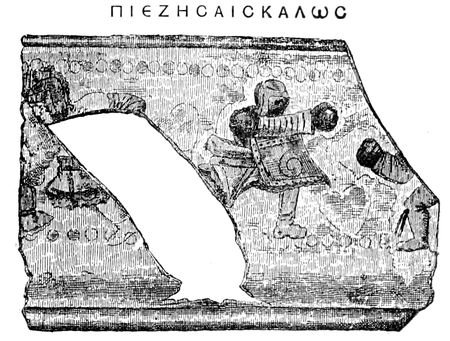
Fig. 631.—Fragment of glass vessel, with gladiator and shield of blue tint, the gloves and shoulders are brown. Arm and legs of the other gladiator flesh colour. Thorslunde.
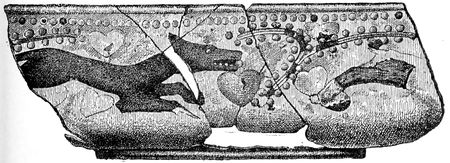
Fig. 632.—Fragments of glass bowl found in a grave by Thorslunde, Fyen. ⅗ real size. The wolf is greyish upon light yellow ground. The arm and legs are of a brown tint, the dots yellow and brown. These lay alongside remains of skeletons which seem to have been buried in sitting posture; some of the designs are raised.
Glass, as we have seen, has been found in the later bronze 278age: the ancient name for amber in the North was gler,[176] which was well known by the stone age people; but we are aware that glass was unknown to them.
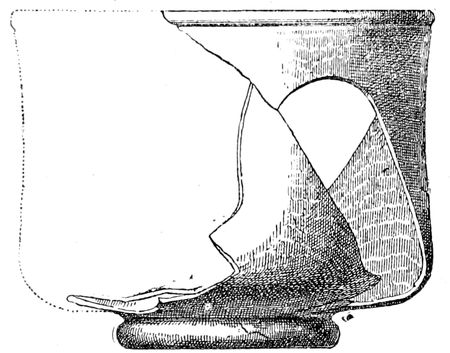
Fig. 633.—Fragment of a glass bowl of a green tint, ⅗ real size, found in a grave mound by Thorslunde.
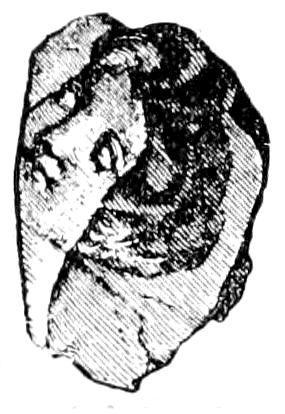
Fig. 634.
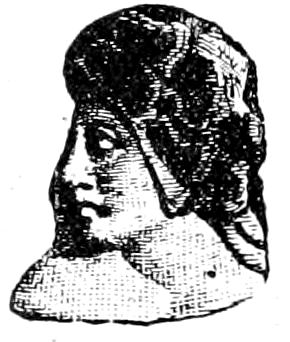
Fig. 635.
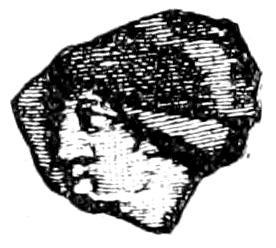
Fig. 636.
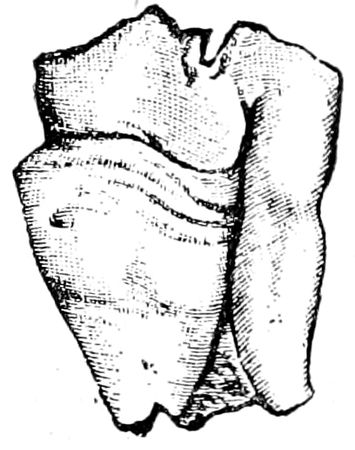
Fig. 637.
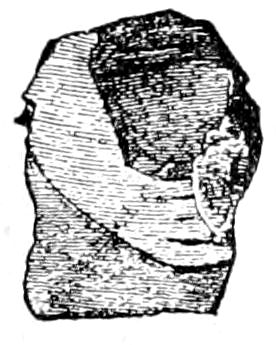
Fig. 638.
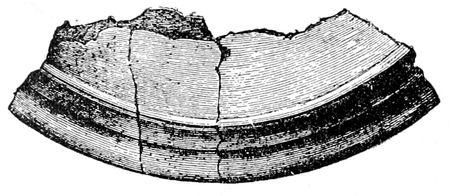
Fig. 639.
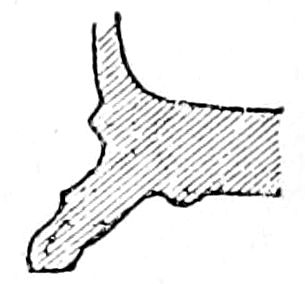
Fig. 640. Border of the vase.
Besides the glass vessels of Roman or Greek workmanship 279others of inferior quality, as is the case in every country, have been found; some of these, which are generally of a bluish green, yellow or white tint, are cut, some ornamented with thread patterns in relief.
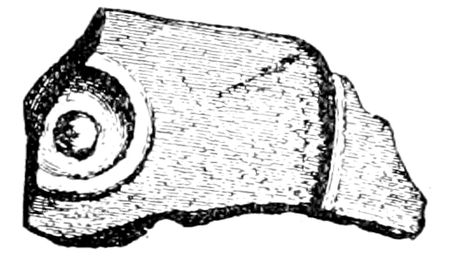
Fig. 641.
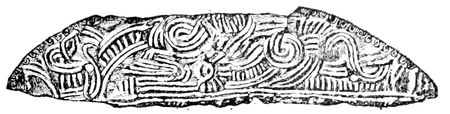
Fig. 642. Fragments of what must have been a magnificent glass vase of a dark blue colour; the figures in relief are of an opaque white and represented most probably some mythological subject. Sölberg, Lower Eker, Norway.
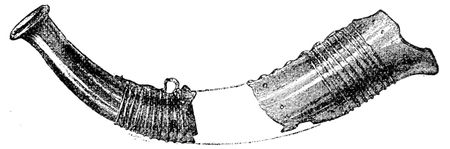
Fig. 643.—Glass drinking-horn. Norway.
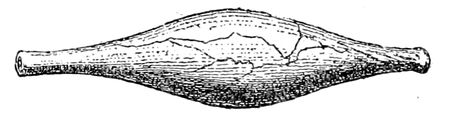
Fig. 644.—Thin greenish glass vessel, open at both ends. ¼ real size. Varpelev.
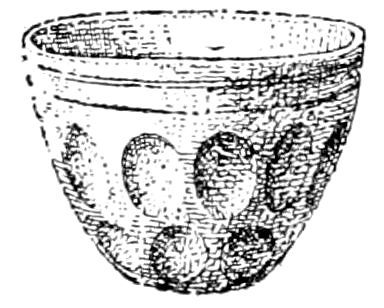
Fig. 645.—Amethyst-coloured glass bowl. ¼ real size. Varpelev.
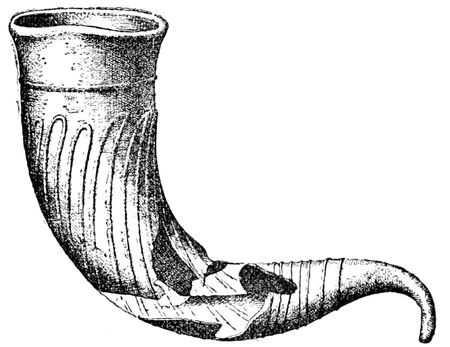
Fig. 646.—Glass drinking-horn, length 8 inches, diameter of mouth 2½ inches; very rare in the North. ¼ real size. Bavenhöi.
280
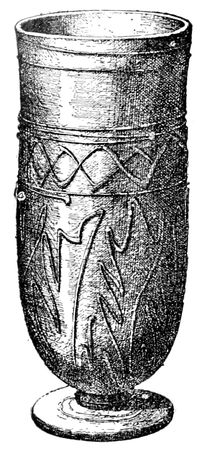
Fig. 647.—Vessel or goblet of greenish glass, ornamented with fillets. ¼ real size. Bavenhöi.
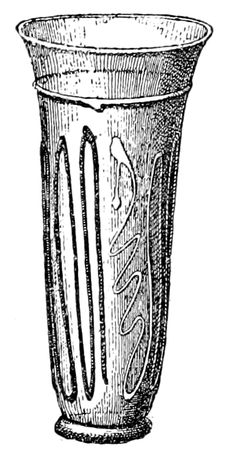
Fig. 648.—Glass vessel. ⅓ real size. With white and blue ornamented threads, found with beads, and bronze pans and sieves, in a woman’s skeleton grave. Ringsted, Zeeland. Glass with thread-like lines have been found in a stone coffin, Roman, near Dusseldorf.
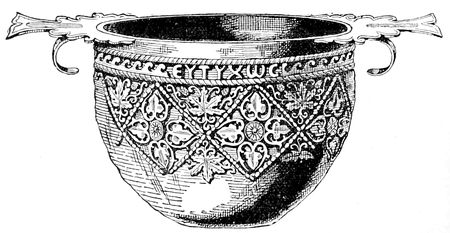
Fig. 649.—Dark blue glass bowl mounted with silver, on which was inscription in Greek letters, ΕΥΤΥΧΩΣ (with good luck). ½ real size. Above the head of the skeleton in the grave, but more or less damaged by the large stone, were at least six glass vessels and fragments of clay urns. Varpelev.
281
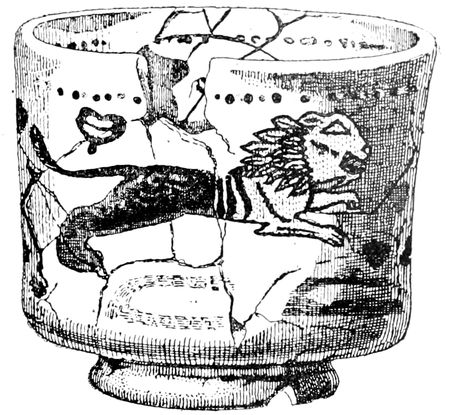
Fig. 650.—Vessel of greenish white glass with representations of various animals, found broken in many pieces. ⅔ real size. Bavenhöi.
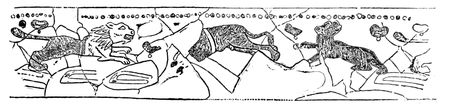
Fig. 651.—Animals represented on this glass vessel. Lion, yellow and brown; bear, dark brown with light yellow outlines; animal with fore part of body missing, probably an ox. ⅓ real size. Bavenhöi.
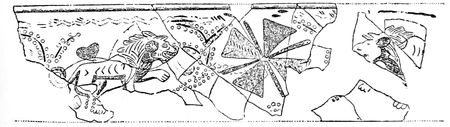
Fig. 652.—Portion of glass vessel, much damaged. ½ real size. Two lions, light yellow, blue outlines, a double cross in the middle. Bavenhöi.[177]
282
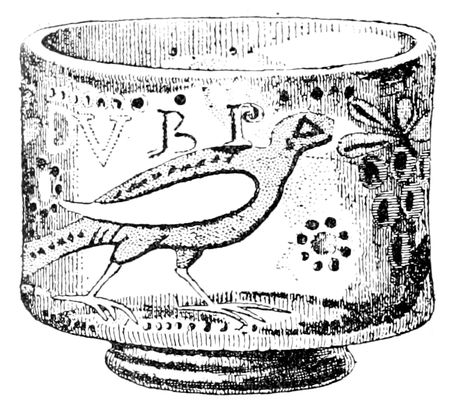
Fig. 653.—Vessel of whitish green glass, ornamented in various colours which have been burnt on the vessel itself. The colour of the four letters D.V.B.P. represented on the cup has been destroyed by the effects of time, as has also that of the beak, wings and legs of the bird. This, however, perfectly resembles the bird on the opposite side of the cup, which is better preserved, and on which the wing is light yellow with dark brownish outlines, the beak and legs red. ⅔ real size. Varpelev.[178]
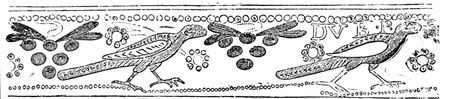
Fig. 654.—General design of vase. ⅖ real size.
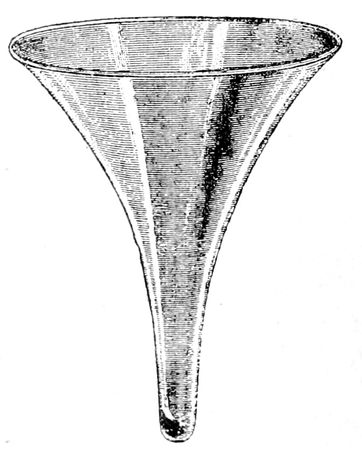
Fig. 655.—Glass cup, funnel shape. Bjorko, Södermanland.
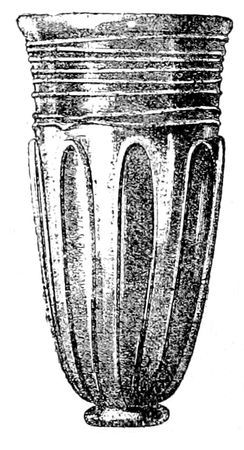
Fig. 656.—Glass cup, ¼ real size, found in a round tumulus, with a large bronze vase with two arms, the bronze ornamentation of a wooden bucket, &c., &c. Norway.
283
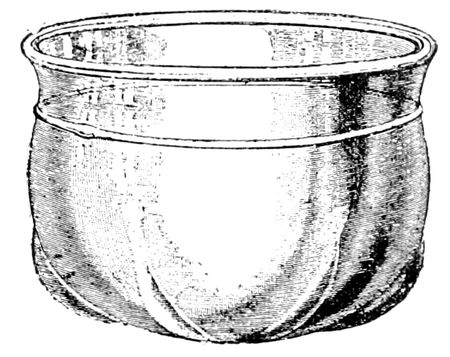
Fig. 657.—Glass vessel. ½ real size. Norway.
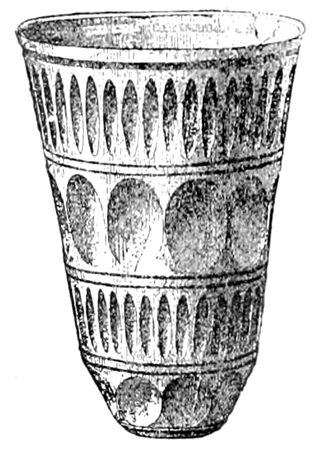
Fig. 658.—Glass vessel. ¼ real size. Norway.
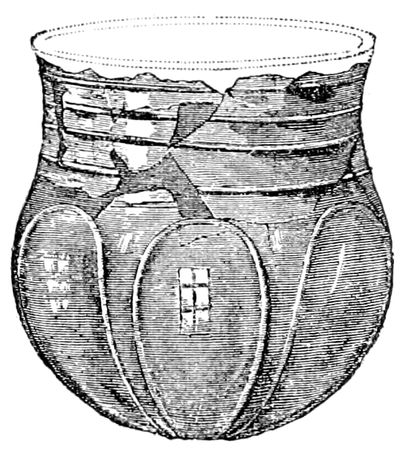
Fig. 659.—Found deep in a stone circle. The cup or glass covered an urn of clay with burnt bones and some glass beads, etc. ½ real size. Upland.
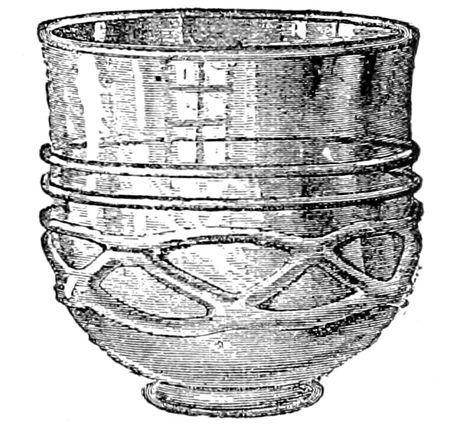
Fig. 660.—In a stone cist, with a skeleton, some arrow-heads of bone, and a clay urn, etc., etc. ¼ real size. Oland.
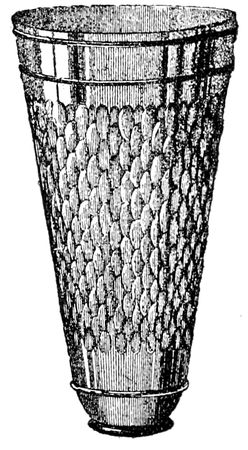
Fig. 661.—Glass vessel found in a stone cist containing a skeleton, with a clay vessel, an iron knife, and bronze mounting for two drinking-horns. ⅓ real size. Gotland.
284
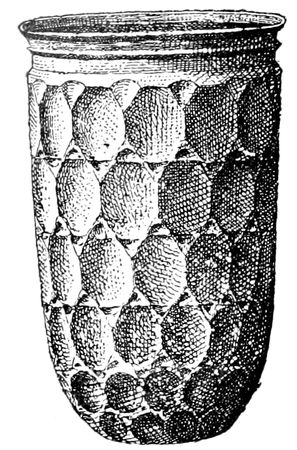
Fig. 662.—Tumbler of thick green glass. ½ real size. Varpelev.
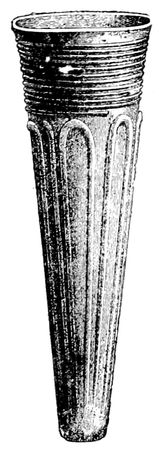
Fig. 663.—Glass vessel found in a mound with unburnt skeleton. Norway.
285