Volume 1 — CHAPTER XIV. DESCRIPTION OF SOME REMARKABLE GRAVES AND THEIR CONTENTS.
Reading edition
Sepulchral chambers containing skeletons—The objects in these graves not destroyed—Numerous Roman and Greek objects—The Vallöby grave—The Bavenhöi grave—The Varpelev graveyard.
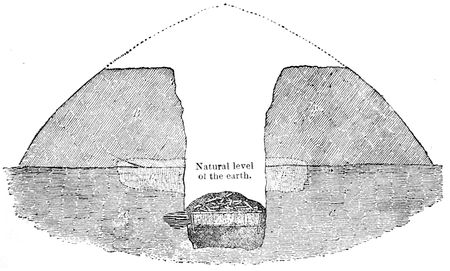
Fig. 528.—Mound, about 13 feet above the ground, showing sepulchral chamber five feet below the surface. The body had been placed upon woollen pillows filled with down. Six oak logs supported the side planks forming the sepulchral chamber, which had an oak floor. The space between the timbers had been filled with tresses of wool and other hair of animals. The chamber had been carefully covered with clay.—Bjerring, near Viborg, Northern Jutland.
To return to the subject of graves, we will now speak of the sepulchral chambers containing skeletons. They generally vary in size, from the length of a man upwards, being about four feet wide and two or three feet high. Sometimes the corpse had been laid upon woollen stuff, cattle-hair, or birch-bark, the head turned southwards, and the feet towards the north. The inside lining is often of planks, between which 248and the outer stone wall bark has been placed, the seams between the timber being filled with pitch. Above the burial-chamber, which was sometimes below the level of the ground, a mound or cairn was often raised.
The objects found in these graves have not been destroyed, and the weapons, which are few, have not been made useless.
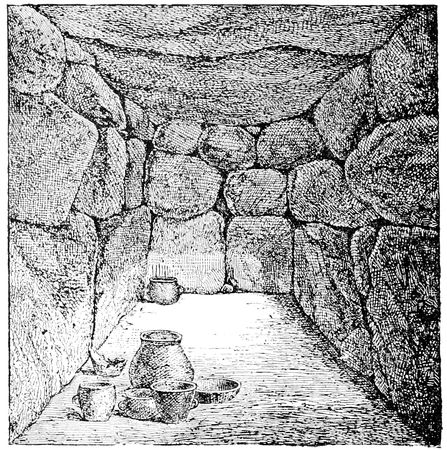
Fig. 529.—Burial Chamber, Nörrevingstrup, near Hjörring, Jutland. Inside measurement—height, 4 feet; length, 5½ feet; breadth, 3½ feet.
In the graves containing skeletons are found costly silver and glass cups, pottery, wooden pails with metal mountings, drinking-horns or their fragments; gold, silver, bronze, or silver-gilt jewelry; great masses of glass, amber, gold and mosaic beads; metal mirrors (these are scarce), bone combs, riding and driving harness, &c. The damaged weapons are often richly ornamented, and of exquisite workmanship.
A remarkable fact is the number of unmistakable Roman 249and Greek objects, and sometimes coins, which occur in the finds. In the graves of women the objects chiefly found are pins, needles, buttons, jewels, ornaments, combs, knives, &c.
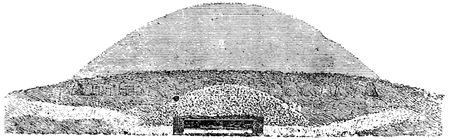
Fig. 530.—Vallöby Grave; showing the natural eminence, with arrangement of stones, cist, and mound.
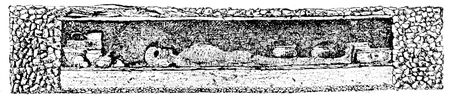
Fig. 531.—Horizontal view; showing how the objects were placed. Coffin proper, 9 feet long, 2 feet deep.
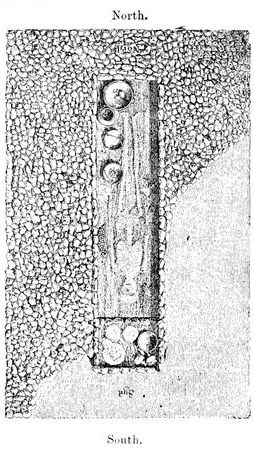
Fig. 532.—Bird’s-eye view of grave, seen from above. Length of outer inclosure between 11 and 12 feet; height about 2 feet; width about 2½ feet.
Vallöby Grave.—The antiquities in this grave plainly show two civilisations: the Roman or Greek, as represented by the bronze vessels; and the Northern, by the silver cups and black clay vessels, &c., &c.
250The grave was made with especial care, and was sunk about six feet below the natural surface of the bank; the stone inclosure was built of rounded stones, of the size of a man’s fist, placed together with great regularity.[167]
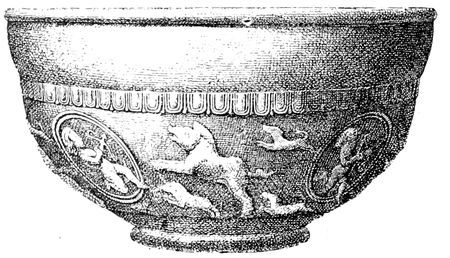
Fig. 533.—Samian Clay Bowl. Hunting scenes in bas-relief. Inscription (“Cos. L. Viri—”) partially defaced. ⅖ real size.
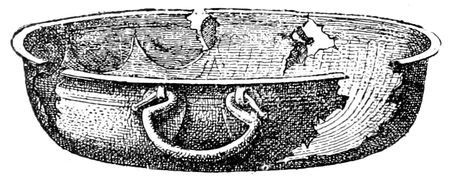
Fig. 534.—One of two flat bronze bowls. In the earth above were two small silver knobs, one covering the other, the use of which is unknown. ⅕ real size.
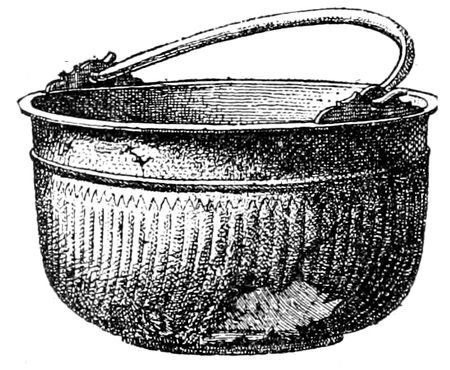
Fig. 535.—Fluted bowl of bronze. ⅕ real size.
251
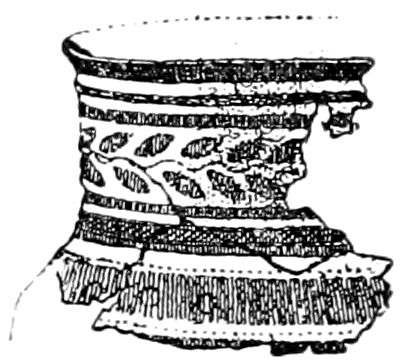
Fig. 536.—⅕ real size.
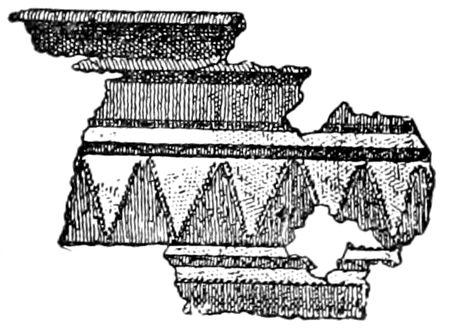
Fig. 537.—⅖ real size. Fragments of bronze kettle.
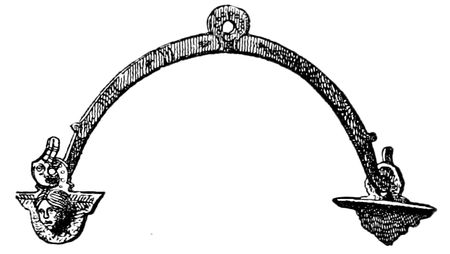
Fig. 538.—Kettle handle. ⅕ real size.
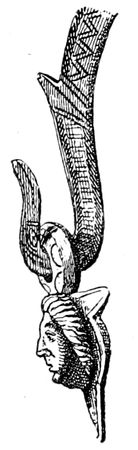
Fig. 539.—Side view.
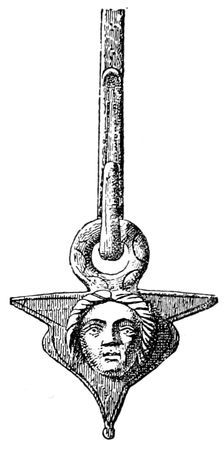
Fig. 540.—Front view. Handle of kettle. ⅖ real size.
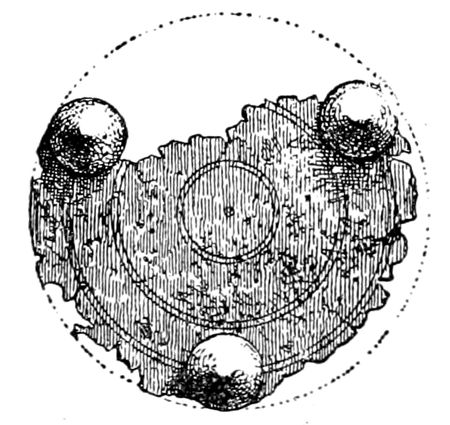
Fig. 541.—Bottom of bronze kettle. ⅕ real size.
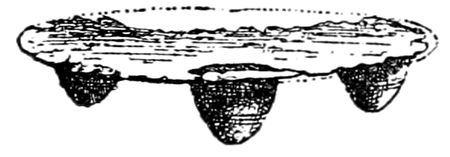
Fig. 542.—Side view of bottom of kettle. ⅕ real size.
Bavenhöi Grave Find—At Bavenhöi, in Himlingöi, Zeeland, is a large bank of gravel, of slight elevation, only about 200 to 230 feet in length. This had evidently been used as 252a common cemetery, as the bodies were found deposited in the earth without a coffin, though partly surrounded by stone settings. The antiquities found at various times with the skeletons seem to belong to the latter part, or perhaps the middle, of the early iron age.
BAVENHÖI GRAVE FIND.
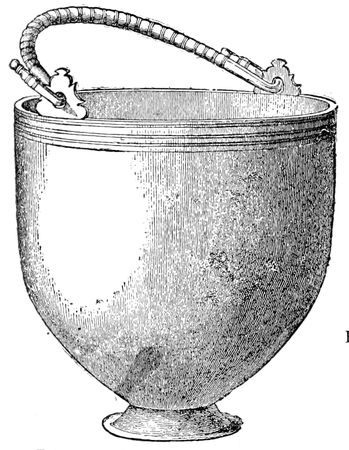
Fig. 543.—Bronze vase. ¼ real size.
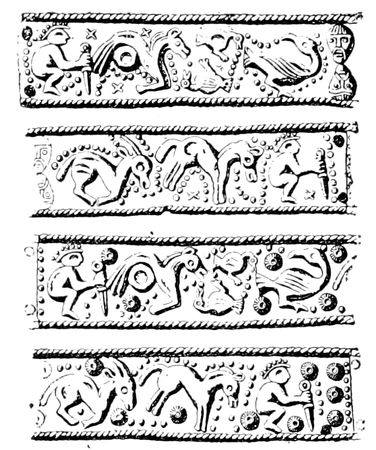
Fig. 544.—Border of silver goblet; plaqué with gold and ornamented with figures in relief—viz., a double head with moustaches and helmets; a helmeted man crouching, with a dagger in his hand; two quadrupeds with manes; a horned animal; and three birds. Between the figures are dots, circles, and crosses.
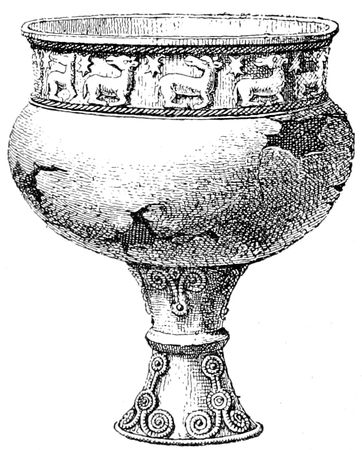
Fig. 545.—Silver cup. ½ real size.
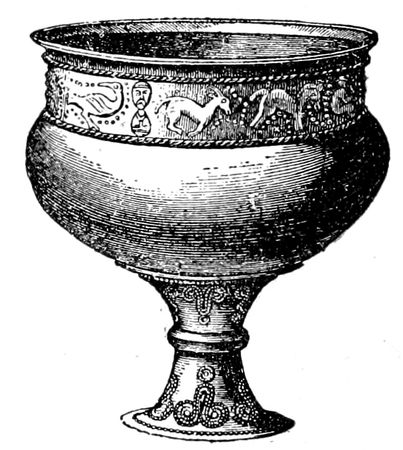
Fig. 546.—Silver goblet, with repoussé work of silver plated with gold; similar to the Vallöby one. ⅓ real size.
253
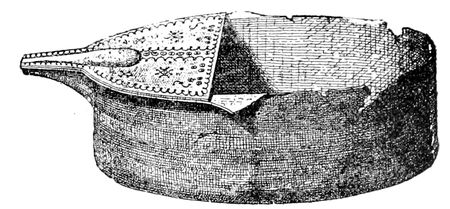
Fig. 547.—Flat basin or stewpan of bronze, containing two goblets of silver, &c. ⅙ real size.
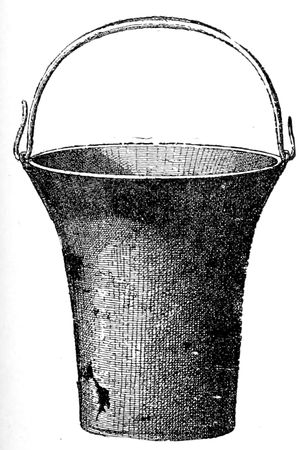
Fig. 548.—Bronze pail. ⅙ real size.
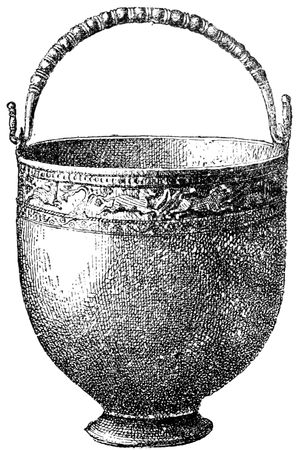
Fig. 549.—Bronze vase, ¼ real size, with border upon which are engraved hunting scenes, a lion, two horses, a tiger or leopard, and two bucks, a dog and two deer; these animals are separated by trees and plants, the leaves of which, to judge from some traces, must have been silvered over.
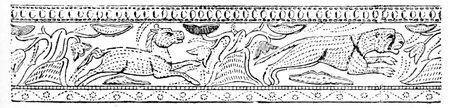
Fig. 550.—Part of the design round the border of vase, representing hunting scene. ½ real size.
254
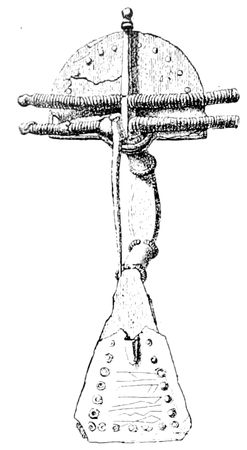
Fig. 551.—Bronze fibula covered with gold, with an inscription scratched in earlier runes. ⅔ real size.
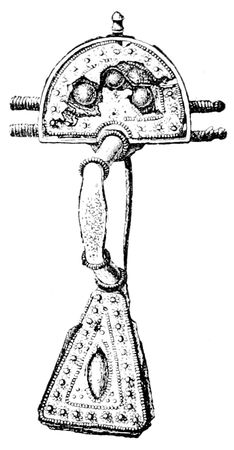
Fig. 552.—Bronze fibula plated with embossed gold ornamented with 3 blue glass knobs and an oval piece of glass of the same colour. ⅔ real size.
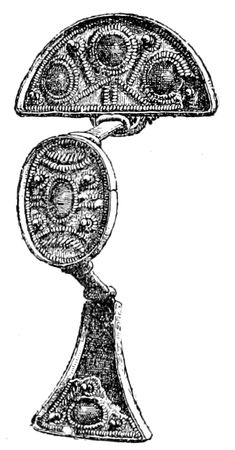
Fig. 553.—Fibula from Storeheddinge, Zeeland, showing the part missing in the one above. ⅔ real size.
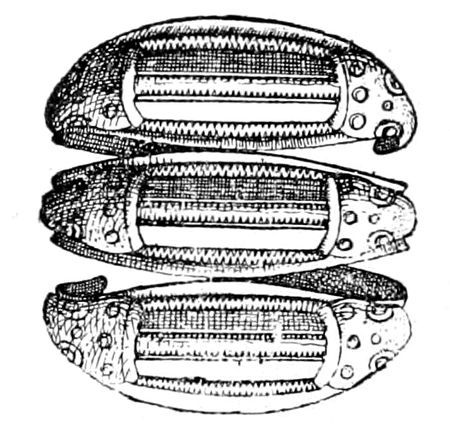
Fig. 554.—Gold ring of three spirals flattened and ornamented with heads of animals, found still adhering to the bone of the hand. Real size.
255
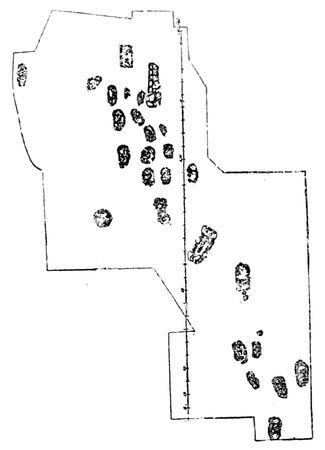
Fig. 555.—Ground plan of the Graveyard at Varpelev.
At Varpelev, Zeeland, a grave was found covered by several slabs; it is nearly 4 yards long, 1¾ yard broad, the bottom being about 3 yards under the surface of the earth. Within lay the skeleton of a full-grown man, with its head to the S.S.W., and its feet to the N.N.E.; alongside of it were numerous objects, the most interesting of which are those of glass.[168]
The graveyard at Varpelev is a low bank 200 feet long, 125 feet wide. The bodies were laid down, generally, in a bent position in the sand or gravel, in their clothes or grave-dress, but without a coffin. Old and young men, women and children lay buried here, and one corpse bears the mark of a heavy sword-cut. In the centre of this skeleton graveyard stood a single clay urn, containing burnt bones. At one place there was a bed made of paved stones burnt and smoked, which had evidently been used as a pyre.
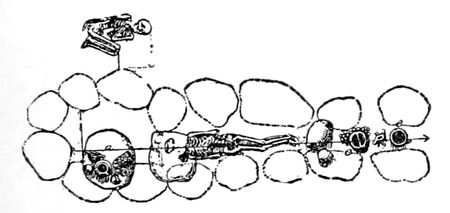
Fig. 556.
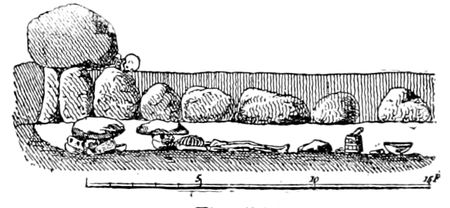
Fig. 557. Grave at Varpelev.
The richest grave was situated under the highest point of the bank, at a depth of 9 feet under the surface; it was made in the gravel, and was surrounded by sixteen rough stones of different size and shape. The majority were 2 feet 256in diameter; the large stone at the head measured 3 feet in length and width, and was 2 feet thick. The interstices were filled up with blue clay. A large slab, 2 feet long, 1½ feet broad, and 8 inches thick, was laid on the head, which like the rest of the bones was much decomposed, and proved to be that of a heavy-built man. The corpse lay on its back, nearly straight, with its head to the south-west; it had originally had over it some kind of covering, as there are remains of clothes or a grave-dress.
VARPELEV GRAVE FIND.
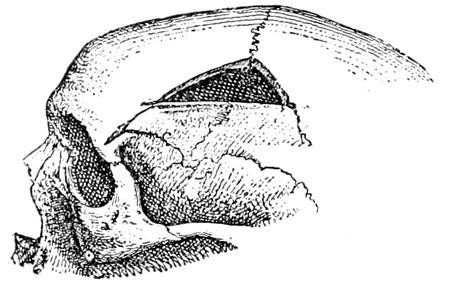
Fig. 558.—Skull (with sword-cut?). Varpelev Grave. 2 9 real size.
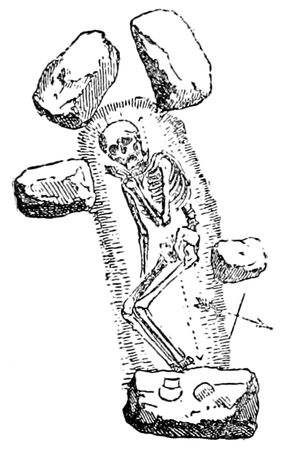
Fig. 559.—Skeleton of man; above the head two large stones. Varpelev. 1877.
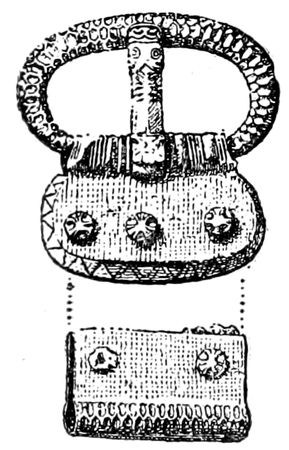
Fig. 560.—½ real size.
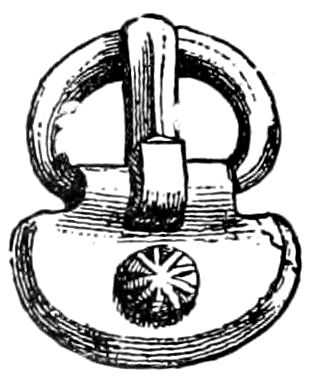
Fig. 561.—Real size. Two silver buckles: one found near the middle of the corpse, one near the head.
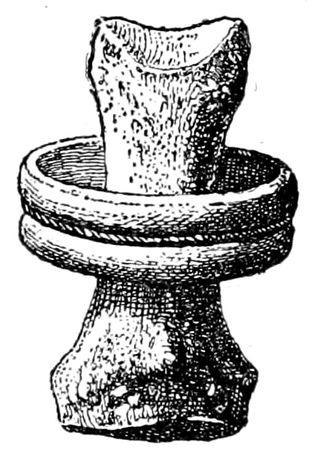
Fig. 562.—Real size.
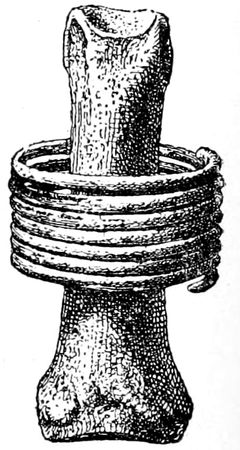
Fig. 563.—Real size. Gold rings found on finger bones.
257
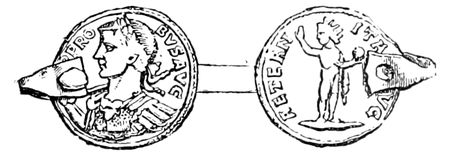
Fig. 564. Fig. 565. Roman Coin of Probus, 276–82; found lying by right ear of corpse. Real size.
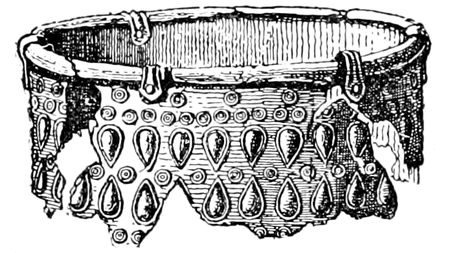
Fig. 566.—Fragment of thin ornamented silver plating, probably the mounting of a drinking-horn. ½ real size.
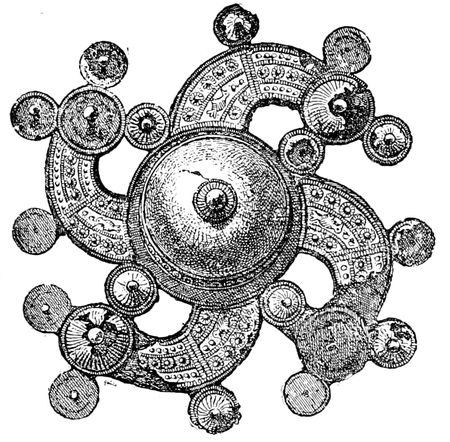
Fig. 567.—Fibula of silver, svastica shape, plated with gold, with amber knob in the centre; beautiful small birds may be noticed on each arm; found in a woman’s grave. ½ real size.
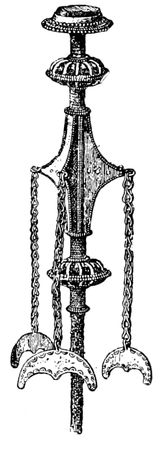
Fig. 568.—Hair-pin of gold, top ornamented with garnet; found in a woman’s grave. ⅔ real size.
258
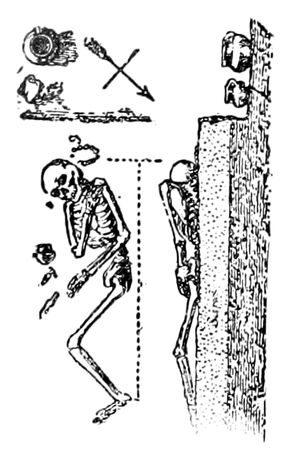
Fig. 569.—Skeleton of woman.
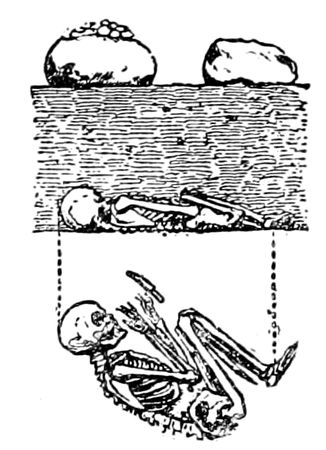
Fig. 570.—Skeleton lying on its left side, with an iron knife near the hands.
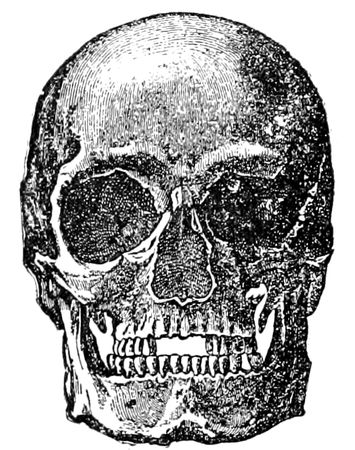
Fig. 571.
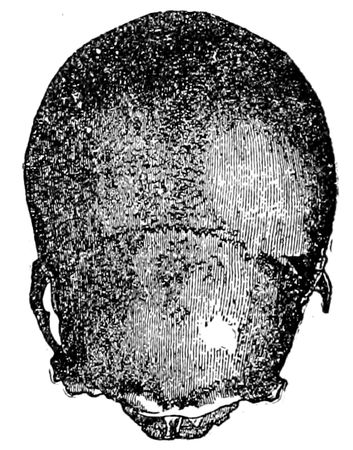
Fig. 572.
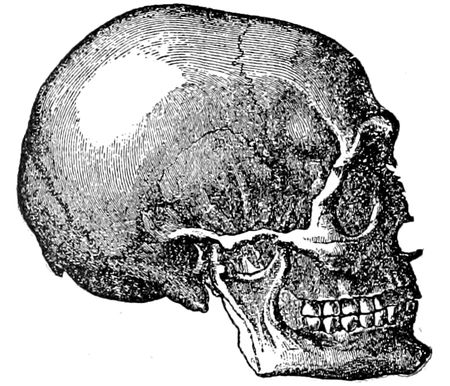
Fig. 573. Skull, seen from three sides.
259