Front matter
Reading edition
Cover
Gordon Marriott Page 38
THE TURN OF THE BALANCE
By
BRAND WHITLOCK
Author of The Happy Average Her Infinite Variety The 13th District
With Illustrations by JAY HAMBIDGE
INDIANAPOLIS THE BOBBS-MERRILL COMPANY PUBLISHERS
COPYRIGHT 1907 THE BOBBS-MERRILL COMPANY
MARCH
TO THE MEMORY OF SAMUEL M. JONES Died July 12, 1904
On the other hand, a boy was bound to defend them against anything that he thought slighting or insulting; and you did not have to verify the fact that anything had been said or done; you merely had to hear that it had. It once fell to my boy to avenge such a reported wrong from a boy who had not many friends in school, a timid creature whom the mere accusation frightened half out of his wits, and who wildly protested his innocence. He ran, and my boy followed with the other boys after him, till they overtook the culprit and brought him to bay against a high board fence; and there my boy struck him in his imploring face. He tried to feel like a righteous champion, but he felt like a brutal ruffian. He long had the sight of that terrified, weeping face, and with shame and sickness of heart he cowered before it. It was pretty nearly the last of his fighting; and though he came off victor, he felt that he would rather be beaten himself than do another such act of justice. In fact, it seems best to be very careful how we try to do justice in this world, and mostly to leave retribution of all kinds to God, who really knows about things; and content ourselves as much as possible with mercy, whose mistakes are not so irreparable.
From "A BOY'S TOWN"
By WILLIAM DEAN HOWELLS
THE TURN OF THE BALANCE
BOOK I
THE TURN OF THE BALANCE
I
As Elizabeth Ward stood that morning before the wide hearth in the dining-room, she was glad that she still could find, in this first snow of the season, the simple wonder and delight of that childhood she had left not so very far behind. Her last glimpse of the world the night before had been of trees lashed by a cold rain, of arc-lamps with globes of fog, of wet asphalt pavements reflecting the lights of Claybourne Avenue. But now, everywhere, there was snow, heaped in exquisite drifts about the trees, and clinging in soft masses to the rough bark of their trunks. The iron fence about the great yard was half buried in it, the houses along the avenue seemed far away and strange in the white transfiguration, and the roofs lost their familiar outlines against the low gray sky that hung over them.
"Hurry, Gusta!" said Elizabeth. "This is splendid! I must go right out!"
The maid who was laying the breakfast smiled; "It was a regular blizzard, Miss Elizabeth."
"Was it?" Elizabeth lifted her skirt a little, and rested the toe of her slipper on the low brass fender. The wood was crackling cheerfully. "Has mama gone out?"
"Oh, yes, Miss Elizabeth, an hour ago."
"Of course," Elizabeth said, glancing at the little clock on the mantelpiece, ticking in its refined way. Its hands pointed to half-past ten. "I quite forgot the dinner." Her brow clouded. "What a bore!" she thought. Then she said aloud: "Didn't mama leave any word?"
"She said not to disturb you, Miss Elizabeth."
Gusta had served the breakfast, and now, surveying her work with an expression of pleasure, poured the coffee.
Beside Elizabeth's plate lay the mail and a morning newspaper. The newspaper had evidently been read at some earlier breakfast, and because it was rumpled Elizabeth pushed it aside. She read her letters while she ate her breakfast, and then, when she laid her napkin aside, she looked out of the windows again.
"I must go out for a long walk," she said, speaking as much to herself as to the maid, though not in the same eager tone she had found for her resolution a while before. "It must have snowed very hard. It wasn't snowing when I came home."
"It began at midnight, Miss Elizabeth," said Gusta, "and it snowed so hard I had an awful time getting here this morning. I could hardly find my way, it fell so thick and fast."
Elizabeth did not reply, and Gusta went on: "I stayed home last night--my brother just got back yesterday; I stayed to see him."
"Your brother?"
"Yes; Archie. He's been in the army. He got home yesterday from the Phil'pines."
"How interesting!" said Elizabeth indifferently.
"Yes, he's been there three years; his time was out and he came home. Oh, you should see him, Miss Elizabeth. He looks so fine!"
"Does he look as fine as you, Gusta?"
Elizabeth smiled affectionately, and Gusta's fair German skin flushed to her yellow hair.
"Now, Miss Elizabeth," she said in an embarrassment that could not hide her pleasure, "Archie's really handsome--he put on his soldier clothes and let us see him. He's a fine soldier, Miss Elizabeth. He was the best shooter in his regiment; he has a medal. He said it was a sharp-shooter's medal."
"Oh, indeed!" said Elizabeth, her already slight interest flagging. "Then he must be a fine shot."
Though Elizabeth in a flash of imagination had the scene in Gusta's home the night before--the brother displaying himself in his uniform, his old German father and mother glowing with pride, the children gathered around in awe and wonder--she was really thinking of the snow, and speculating as to what new pleasure it would bring, and with this she rose from the table and went into the drawing-room. There she stood in the deep window a moment, and looked out. The Maceys' man, clearing the walk over the way, had paused in his labor to lean with a discouraged air on his wooden shovel. A man was trudging by, his coat collar turned up, his shoulders hunched disconsolately, the snow clinging tenaciously to his feet as he plowed his way along. At the sight, Elizabeth shrugged her shoulders, gave a little sympathetic shiver, turned from her contemplation of the avenue that stretched away white and still, and went to the library. Here she got down a book and curled herself up on a divan near the fireplace. Far away she heard the tinkle of some solitary sleigh-bell.
When the maid came into the adjoining room a few moments later, Elizabeth said: "Gusta, please hand me that box of candy."
Elizabeth arranged herself in still greater comfort, put a bit of the chocolate in her mouth, and opened her book. "Gusta, you're a comfort," she said. "Catch me going out on a day like this!"
Mrs. Ward came home at noon, and when she learned that Elizabeth had spent the morning in the library, she took on an air of such superiority as was justified only in one who had not allowed even a blizzard to interfere with the serious duties of life. She had learned several new signals at the whist club and, as she told Elizabeth with a reproach for her neglect of the game, she had mastered at last Elwood's new system. But Elizabeth, when she had had her luncheon, returned to the library and her book. She stayed there an hour, then suddenly startled her mother by flinging the volume to the floor in disgust and running from the room and up the stairs. She came down presently dressed for the street.
"Don't be put long, dear; remember the dinner," Mrs. Ward called after her.
As she turned in between the high banks of snow piled along either side of the walk, Elizabeth felt the fine quality of the air that sparkled with a cold vitality, as pure as the snow that seemed to exhale it. She tossed her head as if to rid it of all the disordered fancies she had gathered in the unreal world of the romance with which she had spent the day. Then for the first time she realized how gigantic the storm had been. Long processions of men armed with shovels, happy in the temporary prosperity this chance for work had brought, had cleared the sidewalks. On the avenue the snow had been beaten into a hard yellow track by the horses and sleighs that coursed so gaily over it. The cross-town trolley-cars glided along between the windrows of the snow the big plow had whirled from the tracks. Little children, in bright caps and leggings, were playing in the yards, testing new sleds, tumbling about in the white drifts, flinging snowballs at one another, their laughter and screams harmonizing with the bells. Claybourne Avenue was alive; the solitary bell that Elizabeth had heard jingling in the still air that morning had been joined by countless strings of other bells, until now the air vibrated with their musical clamor. Great Russian sledges with scarlet plumes shaking at their high-curved dashboards swept by, and the cutters sped along in their impromptu races, the happy faces of their occupants ruddy in their furs, the bells on the excited horses chiming in the keen air. At the corner of Twenty-fifth Street, a park policeman, sitting his magnificent bay horse, reviewed the swiftly passing parade. The pedestrians along the sidewalk shouted the racers on; as the cutters, side by side, rose and fell over the street-crossing a party of school-boys assailed them with a shower of snowballs.
Elizabeth knew many of the people in the passing sleighs; she knew all of those in the more imposing turnouts. She bowed to her acquaintances with a smile that came from the exhilaration of the sharp winter air, more than from any joy she had in the recognition. But from one of the cutters Gordon Marriott waved his whip at her, and she returned his salute with a little shake of her big muff. Her gray eyes sparkled and her cheeks against her furs were pink. Every one was nervously exalted by the snow-storm that afternoon, and Elizabeth, full of health and youthful spirit, tingled with the joy the snow seemed to have brought to the world.
II
His house was all illumined; the light streaming from its windows glistened on the polished crust of the frozen snow, and as Stephen Ward drove up that evening, he sighed, remembering the dinner. He sprang out, slammed the door of his brougham and dashed indoors, the wheels of his retreating carriage giving out again their frosty falsetto. The breath of cold air Ward inhaled as he ran into the house was grateful to him, and he would have liked more of it; it would have refreshed and calmed him after his hard day on the Board.
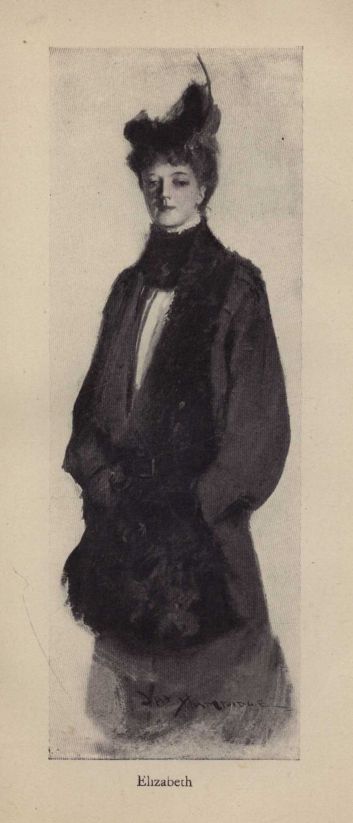
As he entered the wide hall, Elizabeth was just descending the stairs. She came fresh from her toilet, clothed in a dinner gown of white, her round arms bare to the elbow, her young throat just revealed, her dark hair done low on her neck, and the smile that lighted her gray eyes pleased Ward.
As she went for her father's kiss Elizabeth noted the cool outdoor atmosphere, and the odor of cigar smoke and Russia leather that always hung about his person.
"You are refreshing!" she said. "The frost clings to you."
He smiled as she helped him with his overcoat, and then he backed up to the great fire, and stood there shrugging his shoulders and rubbing his hands in the warmth. His face was fresh and ruddy, his white hair was rumpled, his stubbed mustache, which ordinarily gave an effect of saving his youth in his middle years, seemed to bristle aggressively, and his eyes still burned from the excitement of the day.
"What have you been doing all day?" Elizabeth asked, standing before him, her hands on his shoulders. "Battling hard for life in the wheat pit?" Her eyes sparkled with good humor.
Ward took Elizabeth's face between his palms as he said jubilantly:
"No, but I've been making old Macey battle for his life--and I've won."
His gray eyes flashed with the sense of victory, he drew himself erect, tilted back on his heels. He did not often speak of his business affairs at home, and when he did, no one understood him. During the weeks indeed, in which the soft moist weather and constant rains had prevented the rise in the wheat market on which he had so confidently gambled, he had resolutely and unselfishly kept his fear and his suspense to himself, and now even though at last he could indulge his exultation, he drew a long, deep breath.
"By Jove!" he exclaimed. "The snow came just in the nick of time for me!"
"Well, you march right up-stairs and get your clothes on," said Elizabeth as she took her father by the arm, gathering up the train of her white gown, heavy with its sequins and gracefully impeding her progress, and led him to the stairs. She smiled up into his face as she did so, and, as he turned the corner of the wide staircase, he bent and kissed her again.
Though the guests whom Mrs. Ward had asked to her dinner that night all came in closed carriages, bundled in warm and elegant furs, and though they stepped from their own doors into their carriages and then alighted from them at the door of the Wards', they all, when they arrived, talked excitedly of the storm and adjured one another to confess that they had never known such cold. The women, who came down from the dressing-room in bare arms and bare shoulders, seemed to think less of the cold than the men, who were, doubtless, not so inured to exposure; but they were more excited over it and looked on the phenomenon in its romantic light, and began to celebrate the poetic aspects of the winter scene. But the men laughed at this.
"There isn't much poetry about it down town," said Dick Ward. "No poet would have called that snow beautiful if he'd seen it piled so high as to blockade the street-cars and interrupt business generally." He spoke with the young pride he was finding in himself as a business man, though it would have been hard to tell just what his business was.
"Oh, but Dick," said Miss Bonnell, her dark face lighting with a fine smile, "the poet wouldn't have thought of business!"
"No, I suppose not," admitted Dick with the contempt a business man should feel for a poet.
"He might have found a theme in the immense damage the storm has done--telegraph wires all down, trains all late, the whole country in the grip of the blizzard, and a cold wave sweeping down from Medicine Hat."
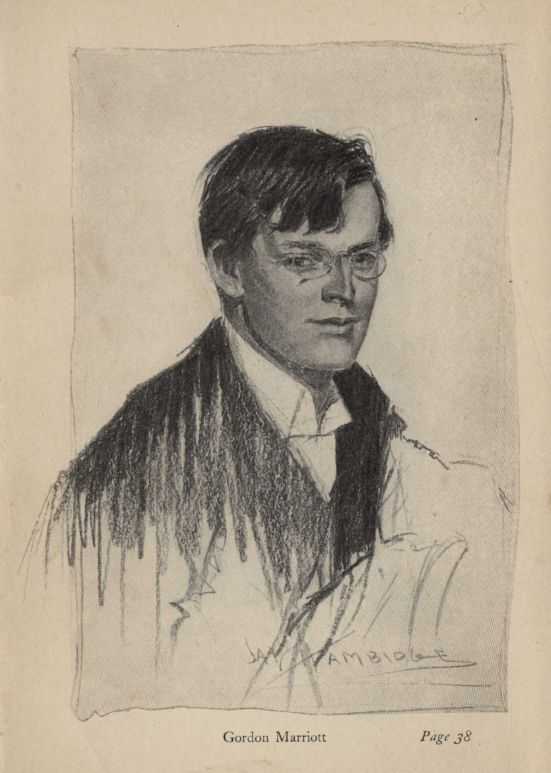
The slender young man who spoke was Gordon Marriott, and he made his observation in a way that was almost too serious to be conventional or even desirable in a society where seriousness was not encouraged. He looked dreamily into the fire, as if he had merely spoken a thought aloud rather than addressed any one; but the company standing about the fireplace, trying to make the talk last for the few moments before dinner was announced, looked up suddenly, and seemed to be puzzled by the expression on his smooth-shaven delicate face.
"Oh, a theme for an epic!" exclaimed Mrs. Modderwell, the wife of the rector. Her pale face was glowing with unusual color, and her great dark eyes were lighting with enthusiasm. As she spoke, she glanced at her husband, and seemed to shrink in her black gown.
"But we have no poet to do it," said Elizabeth.
"Oh, I say," interrupted Modderwell, speaking in the upper key he employed in addressing women, and then, quickly changing to the deep, almost gruff tone which, with his affected English accent, he used when he spoke to men, "our friend Marriott here could do it; he's dreamer enough for it--eh, Marriott?" He gave his words the effect of a joke, and Marriott smiled at them, while the rest laughed in their readiness to laugh at anything.
"No," said Marriott, "I couldn't do it, though I wish I could. Walt Whitman might have done it; he could have begun with the cattle on the plains, freezing, with their tails to the wind, and catalogued everything on the way till he came to the stock quotations and--"
"The people sleighing on Claybourne Avenue," said Elizabeth, remembering her walk of the afternoon. "And he would have gone on tracing the more subtle and sinister effects--perhaps suggesting something tragic."
"Well, now, really, when I was in Canada, you know--" began Modderwell. Though he had been born in Canada and had lived most of his life there, he always referred to the experience as if it had been a mere visit; he wished every one to consider him an Englishman. And nearly every one did, except Marriott, who looked at Modderwell in his most innocent manner and began:
"Oh, you Canadians--"
But just then dinner was announced, and though Elizabeth smiled at Marriott with sympathy, she was glad to have him interrupted in his philosophizing, or poetizing, or whatever it was, to take her out to the dining-room, where the great round table, with its mound of scarlet roses and tiny glasses of sherry glowing ruddy in the soft light of the shaded candelabra, awaited them. And there they passed through the long courses, at first talking lightly, but excitedly, of the snow, mentioning the pleasure and the new sensations it would afford them; then of their acquaintances; of a new burlesque that had run for a year in a New York theater; then of a new romance in which a great many people were killed and imprisoned, though not in a disagreeable manner, and, in short, talked of a great many unimportant things, but talked of them as if they were, in reality, of the utmost importance.
The butler had taken off the salad; they were waiting for the dessert. Suddenly from the direction of the kitchen came a piercing scream, evidently a woman's scream; all the swinging doors between the dining-room and the distant kitchen could not muffle it. Mrs. Modderwell started nervously, then, at a look from her husband, composed herself and hung her head with embarrassment. The others at the table started, though not so visibly, and then tried to appear as if they had not done so. Mrs. Ward looked up in alarm, first at Ward, who hastily gulped some wine, and then at Elizabeth. Wonder and curiosity were in all the faces about the board--wonder and curiosity that no sophistication could conceal. They waited; the time grew long; Mrs. Ward, who always suffered through her dinners, suffered more than ever now. Her guests tried bravely to sit as if nothing were wrong, but at last their little attempts at conversation failed, and they sat in painful silence. The moments passed; Ward and his wife exchanged glances; Elizabeth looked at her mother sympathetically. At last the door swung and the butler entered; the guests could not help glancing at him. But in his face there was a blank and tutored passivity that was admirable, almost heroic.
When the women were in the drawing-room, Mrs. Ward excused herself for a moment and went to the kitchen. She returned presently, and Elizabeth voiced the question the others were too polite to ask.
"What on earth's the matter?"
"Matter!" exclaimed Mrs. Ward. "Gusta's going, that's all." She said it with the feeling such a calamity merited.
"When?"
"Now."
"But the scream--what was it?"
"Well, word came about her father; he's been hurt, or killed, or something, in the railroad yards."
"Oh, how dreadful!" the women politely chorused.
"Yes, I should think so," said Mrs. Ward. "To be left like this without a moment's warning! And then that awful contretemps at dinner!" Mrs. Ward looked all the anguish and shame she felt.
"But Gusta couldn't help that," said Elizabeth.
"No," said Mrs. Ward, lapsing from her mood of exaggeration, "I know that, of course. The poor girl is quite broken up. I hope it is nothing really serious. And yet," she went on, her mind turning again to her own domestic misfortunes, "people of her class seem to have the most unerring faculty for calamity. They're always getting hurt, or sick, or dying, or something. The servants in my house suffer more bereavement in the course of a month than all the rest of my acquaintance in a lifetime."
And then the ladies took up the servant-girl problem, and canvassed it hopelessly until the men were heard entering the library.
III
While Mrs. Ward was discussing her maid with her guests, Gusta was hurrying homeward alone, the prey of fears, omens and forebodings. There was the shock of this sudden news from home, and her horror of what awaited her there; besides she had a strange feeling about leaving the Wards in this way. The night had grown bitterly cold. The frozen snow crunched with a whining noise under her heels as she passed swiftly along. In the light of the arc-lamps that swung at the street crossings, the trees along the curb cast their long shadows before her, falling obliquely across the sidewalk and stretching off into the yard; as she passed on, they wheeled, lost themselves in gloom, then appeared again, stretching the other way. The shadows confused and frightened her. She thought of Elizabeth and all her kindness; when would she see Elizabeth again? With this horrible thing at home all had changed; her mother would need her now. She thought of the hard work, with the children crying about, and the ugly kitchen, with none of the things there were at the Wards' to make the work easy. She would have to lug the water in from the cistern; the pump would be frozen, and the water would splash on her hands and make them red and raw and sore; they could never be white and soft like Elizabeth's. She would have to shovel the snow, and make paths, and split kindlings, and carry wood and coal, and make fires. And then the house would never be warm like the Wards'; they would eat in the kitchen and sit there all day long. The storm, which had made no change at all at the Wards', would make it all so much harder at home. Her father would be sick a long time; and, of course, he would lose his job; the house would be gloomy and sad; it would be worse than the winter he had been on strike.
The keen wind that was blowing from the northwest stung Gusta's face; she felt the tears in her eyes, and when they ran on to her cheeks they froze at once and made her miserable. She shuddered with the cold, her fingers were numb, her feet seemed to be bare on the snow, her ears were burning. The wind blew against her forehead and seemed as if it would cut the top of her head off as with a cold blade. She tried to pull her little jacket about her; the jacket was one Elizabeth had given her, and she had always been proud of it and thought that it made her look like Elizabeth, but it could not keep her warm now. She ran a few steps, partly to get warm, partly to make swifter progress homeward, partly for no reason at all. She thought of her comfortable room at the Wards' and the little colored pictures Elizabeth had given her to hang about the walls. An hour before she had expected to go to that room and rest there,--and now she was going home to sickness and sorrow and ugly work. She gave a little sob and tried to brush away her tears, but they were frozen to her eye-lashes, and it gave her a sharp pain above her eyes when she put her hand up to her face.
Gusta had now reached the poorer quarter of the town, which was not far from Claybourne Avenue, though hidden from it. The houses were huddled closely together, and their little window-panes were frosty against the light that shone through the holes in their shades. There were many saloons, as many as three on a corner; the ice was frozen about their entrances, but she could see the light behind the screens. They seemed to be warm--the only places in that neighborhood that were warm. She passed one of them just as the latch clicked and the door opened, and three young men came out, laughing loud, rough, brutal laughs. Gusta shrank to the edge of the sidewalk; when she got into the black shadow of the low frame building, she ran, and as she ran she could hear the young men laughing loudly behind her. She plunged on into the shadows that lay so thick and black ahead.
But as she drew near her home, all of Gusta's other thoughts were swallowed up in the thought of her father. She forgot how cold she was; her fingers were numb, but they no longer ached; a kind of physical insensibility stole through her, but she was more than ever alive mentally to the anguish that was on her. She thought of her father, and she remembered a thousand little things about him,--all his ways, all his sayings, little incidents of her childhood; and the tears blinded her, because now he probably would never speak to her again, never open his eyes to look on her again. She pictured him lying on his bed, broken and maimed, probably covered with blood, gasping his few last breaths. She broke into a little run, the clumsy trot of a woman, her skirts beating heavily and with dull noises against her legs, her shoes crunching, crunching, on the frozen snow. At last she turned another corner, and entered a street that was even narrower and darker than the others. Its surface, though hidden by the snow, was billowy where the ash piles lay; there was no light, but the snow seemed to give a gray effect to the darkness. This was Bolt Street, in which Gusta's family, the Koerners, lived.
The thin crackled shade was down at the front window, but the light shone behind it. Gusta pushed open the front door and rushed in. She took in the front room at a glance, seeking the evidence of change; but all was unchanged, familiar--the strips of rag carpet on the floor, the cheap oak furniture upholstered in green and red plush, the rough, coarse-grained surface of the wood varnished highly; the photograph of herself in the white dress and veil she had worn to her first communion, the picture of Archie sent from the Presidio, the colored prints of Bismarck and the battle of Sedan--all were there. The room was just as it had always been, clean, orderly, unused--save that some trinkets Archie had brought from Manila were on the center-table beside the lamp, which, with its round globe painted with brown flowers, gave the room its light.
Gusta had taken all this in with a little shock of surprise, and in the same instant the children, Katie and little Jakie, sprang forth to meet her. They stood now, clutching at her skirts; they held up their little red, chapped faces, all dirty and streaked with tears; their lips quivered, and they began to whimper. But Gusta, with her wild eyes staring above their little flaxen heads, pressed on in, and the children, hanging on to her and impeding her progress, began to cry peevishly.
Gusta saw her mother sitting in the kitchen. Two women of the neighborhood sat near her, dull, silent, stupid, their chins on their huge breasts, as if in melancholia. Though the room was stiflingly warm with the heat from the kitchen stove, the women kept their shawls over their heads, like peasants. Mrs. Koerner sat in a rocking-chair in the middle of her clean white kitchen floor. As she lifted her dry eyes and saw Gusta, her brows contracted under her thin, carefully-parted hair, and she lifted her brawny arms, bare to the elbows, and rocked backward, her feet swinging heavily off the floor.
"Where's father?" Gusta demanded, starting toward her mother.
Mrs. Koerner's lips opened and she drew a long breath, then exhaled it in a heavy sigh.
"Where is he?" Gusta demanded again. She spoke so fiercely that the children suddenly became silent, their pale blue eyes wide. One of the neighbors looked up, unwrapped her bare arms from her gingham apron and began to poke the kitchen fire. Mrs. Koerner suddenly bent forward, her elbows on her knees, her chin in her hands, and began to cry, and to mumble in German. At this, the two neighbor women began to speak to each other in German. It always irritated Gusta to have her mother speak in German. She had learned the language in her infancy, but she grew ashamed of it when she was sent to the public schools, and never spoke it when she could help it. And now in her resentment of the whole tragic situation, she flew into a rage. Her mother threw her apron over her face, and rocked back and forth.
"Aw, quit, ma!" cried Gusta; "quit, now, can't you?"
Mrs. Koerner took her apron from her face and looked at Gusta. Her expression was one of mute appealing pain. Gusta, softened, put her hand on her mother's head.
"Tell me, ma," she said softly, "where is he?"
Mrs. Koerner rocked again, back and forth, flinging up her arms and shaking her head from side to side. A fear seized Gusta.
"Where is he?" she demanded.
"He goes on der hospital," said one of the women. "He's bad hurt."
The word "hospital" seemed to have a profound and sinister meaning for Mrs. Koerner, and she began to wail aloud. Gusta feared to ask more. The children were still clinging to her. They hung to her skirts, tried to grasp her legs, almost toppling her over.
"Want our supper!" Jakie cried; "want our supper!"
"Gusta," said Katie, "did the pretty lady send me something good?"
Gusta still stood there; her cheeks were glowing red from their exposure to the wind that howled outside and rattled the loose sash in the window. But about her bluish lips the skin was white, her blue eyes were tired and frightened. She dropped a hand to each of the children, her knees trembled, and she gave little lurches from side to side as she stood there, with the children tugging at her, in their fear and hunger.
"Where's Archie?" she asked.
"He's gone for his beer," said one of the neighbors, the one who had not spoken. As she spoke she revealed her loose teeth, standing wide apart in her gums. "Maybe he goes on der hospital yet."
Every time they spoke the word "hospital," Mrs. Koerner flung up her arms, and Gusta herself winced. But she saw that neither her mother nor these women who had come in to sit with her could tell her anything; to learn the details she would have to wait until Archie came. She had been drawing off her gloves as she stood there, and now she laid aside her hat and her jacket, and tied on one of her mother's aprons. Then silently she went to work, opened the stove door, shook the ashes down, threw in coal, and got out a skillet. The table spread with its red cloth stood against the window-sill, bearing cream pitcher and sugar bowl, and a cheap glass urn filled with metal spoons. She went to the pantry, brought out a crock of butter and put it on the table, then cut pieces of side-meat and put them in a skillet, where they began to swim about and sizzle in the sputtering grease. Then she set the coffee to boil, cut some bread, and, finding some cold potatoes left over from dinner, she set these on the table for the supper. It grew still, quiet, commonplace. Gusta bustled about, her mother sat there quietly, the neighbors looked on stolidly, the children snuffled now and then. The tragedy seemed remote and unreal.
Gusta took a pail and whisked out of the kitchen door; the wind rushed in, icy cold; she was back in a moment, her golden hair blowing. She poured some of the water into a pan, and called the children to her. They stood as stolidly as the women sat, their hands rigid by their sides, their chins elevated, gasping now and then as Gusta washed their dirty faces with the rag she had wrung out in the icy water. The odor of frying pork was now filling the room, and the children's red, burnished faces were gleaming with smiles, and their blue eyes danced as they stood looking at the hot stove. When the pork was fried, Gusta, using her apron to protect her hand, seized the skillet from the stove, scraped the spluttering contents into a dish and set it on the table. Then the children climbed into chairs, side by side, clutching the edge of the table with their little fingers. Mrs. Koerner let Gusta draw up her rocking-chair, leaned over, resting her fat forearms on the table, holding her fork in her fist, and ate, using her elbow as a fulcrum.
When the meal was done, Mrs. Koerner began to rock again, the children stood about and watched Gusta pile the dishes on the table and cover them with the red cloth, and then, when she told them they must go to bed, they protested, crying that father had not come home yet. Their eyes were heavy and their flaxen heads were nodding, and Gusta dragged them into a room that opened off the kitchen, and out of the dark could be heard their small voices, protesting sleepily that they were not sleepy.
After a while a quick, regular step was heard outside, some one stamped the snow from his boots, the door opened, and Archie entered. His face was drawn and flaming from the cold, and there was shrinking in his broad military shoulders; a shiver ran through his well-set-up figure; he wore no overcoat; he keenly felt the exposure to weather he was so unused to. He flung aside his gray felt soldier's hat--the same he had worn in the Philippines--strode across the room, bent over the stove and warmed his red fingers.
"It's a long hike over to the hospital this cold night," he said, turning to Gusta and smiling. His white teeth showed in his smile, and the skin of his face was red and parched. He flung a chair before the stove, sat down, hooked one heel on its rung, and taking some little slips of rice paper from his pocket, and a bag of tobacco, began rolling himself a cigarette. He rolled the cigarette swiftly and deftly, lighted it, and inhaled the smoke eagerly. Gusta, meanwhile, sat looking at him in a sort of suppressed impatience. Then, the smoke stealing from his mouth with each word he uttered, he said:
"Well, they've cut the old man's leg off."
Gusta and the neighbor women looked at Archie in silence. Mrs. Koerner seemed unable to grasp the full meaning of what he had said.
"Was sagst du?" she asked, leaning forward anxiously.
"Sie haben sein Bein amputiert," replied Archie.
"Sein Bein--was?" inquired Mrs. Koerner.
"What the devil's 'cut off'?" asked Archie, turning to Gusta.
She thought a moment.
"Why," she said, "let's see. Abgeschnitten, I guess."
"Je's," said Archie impatiently, "I wish she'd cut out the Dutch!"
Then he turned toward his mother and speaking loudly, as if she were deaf, as one always speaks who tries to make himself understood in a strange tongue:
"Sie haben sein Bein abgeschnitten--die Doctoren im Hospital."
Mrs. Koerner stared at her son, and Archie and Gusta and the two women sat and stared at her, then suddenly Mrs. Koerner's expression became set, meaningless and blank, her eyes slowly closed and her body slid off the chair to the floor. Archie sprang toward her and tried to lift her. She was heavy even for his strong arms, and he straightened an instant, and shouted out commands:
"Open the door, you! Gusta, get some water!"
One of the women lumbered across the kitchen and flung wide the door, Gusta got a dipper of water and splashed it in her mother's face. The cold air rushing into the overheated kitchen and the cool water revived the prostrate woman; she opened her eyes and looked up, sick and appealing. Archie helped her to her chair and stood leaning over her. Gusta, too, bent above her, and the two women pressed close.
"Stand back!" shouted Archie peremptorily. "Give her some air, can't you?"
The two women slunk back--not without glances of reproach at Archie. He stood looking at his mother a moment, his hands resting on his hips. He was still smoking his cigarette, tilting back his head and squinting his eyes to escape the smoke. Gusta was fanning her mother.
"Do you feel better?" she asked solicitously.
"Ja," said Mrs. Koerner, but she began to shake her head.
"Oh, it's all right, ma," Archie assured her. "It's the best place for him. Why, they'll give him good care there. I was in the hospital a month already in Luzon."
The old woman was unconvinced and shook her head. Then Archie stepped close to her side.
"Poor old mother!" he said, and he touched her brow lightly, caressingly. She looked at him an instant, then turned her head against him and cried. The tears began to roll down Gusta's cheeks, and Archie squinted his eyes more and more.
"We'd better get her to bed," he said softly, and glanced at the two women with a look of dismissal. They still sat looking on at this effect of the disaster, not altogether curiously nor without sympathy, yet claiming all the sensation they could get out of the situation. When Archie and Gusta led Mrs. Koerner to her bed, the two women began talking rapidly to each other in German, criticizing Archie and the action of the authorities in taking Koerner to the hospital.
IV
Gusta cherished a hope of going back to the Wards', but as the days went by this hope declined. Mrs. Koerner was mentally prostrated and Gusta was needed now at home, and there she took up her duties, attending the children, getting the meals, caring for the house, filling her mother's place. After a few days she reluctantly decided to go back for her clothes. The weather had moderated, the snow still lay on the ground, but grimy, soft and disintegrating. The sky was gray and cold, the mean east wind was blowing in from the lake, and yet Gusta liked its cool touch on her face, and was glad to be out again after all those days she had been shut in the little home. It was good to feel herself among other people, to get back to normal life, and though Gusta did not analyze her sensations thus closely, or, for that matter, analyze them at all, she was all the more happy.
Before Nussbaum's saloon she saw the long beer wagon; its splendid Norman horses tossing their heads playfully, the stout driver in his leathern apron lugging in the kegs of beer. The sight pleased her; and when Nussbaum, in white shirt-sleeves and apron, stepped to the door for his breath of morning air, she smiled and nodded to him. His round ruddy face beamed pleasantly.
"Hello, Gustie," he called. "How are you this morning? How's your father?"
"Oh, he's better, thank you, Mr. Nussbaum," replied Gusta, and she hastened on. As she went, she heard the driver of the brewery wagon ask:
"Who's that?"
And Nussbaum replied:
"Reinhold Koerner's girl, what got hurt on the railroad the other day."
"She's a good-looker, hain't she?" said the driver.
And Gusta colored and felt proud and happier than before.
She was not long in reaching Claybourne Avenue, and it was good to see the big houses again, and the sleighs coursing by, and the carriages, and the drivers and footmen, some of whom she knew, sitting so stiffly in their liveries on the boxes. At sight of the familiar roof and chimneys of the Wards' house, her heart leaped; she felt now as if she were getting back home.
It was Gusta's notion that as soon as she had greeted her old friend Mollie, the cook, she would rush on into the dining-room; but no sooner was she in the kitchen than she felt a constraint, and sank down weakly on a chair. Molly was busy with luncheon; things were going on in the Ward household, going on just as well without her as with her, just as the car shops were going on without her father, the whistle blowing night and morning. It gave Gusta a little pang. This feeling was intensified when, a little later, a girl entered the kitchen, a thin girl, with black hair and blue eyes with long Irish lashes. She would have been called pretty by anybody but Gusta, and Gusta herself must have allowed her prettiness in any moment less sharp than this. The new maid inspected Gusta coldly, but none of the glances from her eyes could hurt Gusta half as much as her presence there hurt her; and the hurt was so deep that she felt no personal resentment; she regarded the maid merely as a situation, an unconscious and irresponsible symbol of certain untoward events.
"Want to see Mrs. Ward?" the maid inquired.
"Yes, and Miss Elizabeth, too," said Gusta.
"Mrs. Ward's out and Miss Ward's busy just now."
Mollie, whose broad back was bent over her table, knew how the words hurt Gusta, and, without turning, she said:
"You go tell her Gusta's here, Nora; she'll want to see her."
"Oh, sure," said Nora, yielding to a superior. "I'll tell her."
Almost before Nora could return, Elizabeth stood in the swinging door, beaming her surprise and pleasure. And Gusta burst into tears.
"Why Gusta," exclaimed Elizabeth, "come right in here!"
She held the door, and Gusta, with a glance at Nora, went in. Seated by the window in the old familiar dining-room, with Elizabeth before her, Gusta glanced about, the pain came back, and the tears rolled down her cheeks.
"You mustn't cry, Gusta," said Elizabeth.
Gusta sat twisting her fingers together, in and out, while the tears fell. She could not speak for a moment, and then she looked up and tried to smile.
"You mustn't cry," Elizabeth repeated. "You aren't half so pretty when you cry."
Gusta's wet lashes were winking rapidly, and she took out her handkerchief and wiped her face and her eyes, and Elizabeth looked at her intently.
"Poor child!" she said presently. "What a time you've had!"
"Oh, Miss Elizabeth!" said Gusta, the tears starting afresh at this expression of sympathy, "we've had a dreadful time!"
"And we've missed you awfully," said Elizabeth. "When are you coming back to us?"
Gusta looked up gratefully. "I don't know, Miss Elizabeth; I wish I did. But you see my mother is sick ever since father--"
"And how is your father? We saw in the newspaper how badly he had been hurt."
"Was it in the paper?" said Gusta eagerly, leaning forward a little.
"Yes, didn't you see it? It was just a little item; it gave few of the details, and it must have misspelled--" But Elizabeth stopped.
"I didn't see it," said Gusta. "He was hurt dreadfully, Miss Elizabeth; they cut his leg off at the hospital."
"Oh, Gusta! And he's there still, of course?"
"Yes, and we don't know how long he'll have to stay. Maybe he'll have to go under another operation."
"Oh, I hope not!" said Elizabeth. "Tell me how he was hurt."
"Well, Miss Elizabeth, we don't just know--not just exactly. He had knocked off work and left the shops and was coming across the yards--he always comes home that way, you know--but it was dark, and the snow was all over everything, and the ice, and somehow he slipped and caught his foot in a frog, and just then a switch-engine came along and ran over his leg."
"Oh, horrible!" Elizabeth's brows contracted in pain.
"The ambulance took him right away to the Hospital. Ma felt awful bad 'cause they wouldn't let him be fetched home. She didn't want him taken to the hospital."
"But that was the best place for him, Gusta; the very best place in the world."
"That's what Archie says," said Gusta, "but ma doesn't like it; she can't get used to it, and she says--" Gusta hesitated,--"she says we can't afford to keep him there."
"But the railroad will pay for that, won't it?"
"Oh, do you think it will, Miss Elizabeth? It had ought to, hadn't it? He's worked there thirty-seven years."
"Why, surely it will," said Elizabeth. "I wouldn't worry about that a minute if I were you. You must make the best of it. And is there anything I can do for you, Gusta?"
"No, thank you, Miss Elizabeth. I just came around to see you,"--she looked up with a fond smile,--"and to get my clothes. Then I must go. I want to go see father before I go back home. I guess I'll pack my things now, and then Archie'll come for my trunk this afternoon."
"Oh, I'll have Barker haul it over; he can just as well as not. And, Gusta,"--Elizabeth rose on the impulse--"I'll drive you to the hospital. I was just going out. You wait here till I get my things."
Gusta's face flushed with pleasure; she poured out her thanks, and then she waited while Elizabeth rang for the carriage, and ran out to prepare for the street, just as she used to.
It was a fine thing for Gusta to ride with Elizabeth in her brougham. She had often imagined how it would be, sitting there in the exclusion of the brougham's upholstered interior, with the little clock, and the mirror and the bottle of salts before her, and the woven silk tube through which Elizabeth spoke to Barker when she wished to give him directions. The drive to the hospital was all too short for Gusta, even though Elizabeth prolonged it by another impulse which led her to drive out of their way to get some fruit and some flowers.
In the street before the hospital, and along the driveway that led to the suggestively wide side door, carriages were being slowly driven up and down, denoting that the social leaders who were patronesses of the hospital were now inside, patronizing the superintendent and the head nurse. Besides these there were the high, hooded phaetons of the fashionable physicians. It was the busy hour at the hospital. The nurses had done their morning work, made their entries on their charts, and were now standing in little groups about the hall, waiting for their "cases" to come back from the operating-rooms. There was the odor of anesthetics in the air, and the atmosphere of the place, professional and institutional though it was, was surcharged with a heavy human suspense--the suspense that hung over the silent, heavily breathing, anesthetized human forms that were stretched on glass tables in the hot operating-rooms up-stairs, some of them doomed to die, others to live and prolong existence yet a while. The wide slow elevators were waiting at the top floor; at the doors of the operating-rooms stood the white-padded rubber-tired carts, the orderlies sitting on them swinging their legs off the floor, and gossiping about the world outside, where life did not hover, but throbbed on, intent, preoccupied. In private rooms, in vacant rooms, in the office down-stairs, men and women, the relatives of those on the glass tables above, waited with white, haggard, frightened faces.
As Elizabeth and Gusta entered the hospital they shuddered, and drew close to each other like sisters. Koerner was in the marine ward, and Gusta dreaded the place. On her previous visits there, the nurses had been sharp and severe with her, but this morning, when the nurses saw Elizabeth bearing her basket of fruit and her flowers--which she would not let Gusta carry, feeling that would rob her offering of the personal quality she wished it to assume--they ran forward, their starched, striped blue skirts rustling, and greeted her with smiles.
"Why, Miss Ward!" they cried.
"Good morning," said Elizabeth, "we've come to see Mr. Koerner."
"Oh, yes," said Koerner's nurse, a tall, spare young woman with a large nose, eye-glasses, and a flat chest. "He's so much better this morning." She said this with a patronizing glance aside at Gusta, who tried to smile; the nurse had not spoken so pleasantly to her before.
The nurse led the girls into the ward, and they passed down between the rows of white cots. Some of the cots were empty, their white sheets folded severely, back, awaiting the return of their occupants from the rooms up-stairs. In the others men sprawled, with pallid, haggard faces, and watched the young women as they passed along, following them with large, brilliant, sick eyes. But Elizabeth and Gusta did not look at them; they kept their eyes before them. One bed had a white screen about it; candles glowed through the screen, silhouetting the bending forms of a priest, a doctor and a nurse.
Koerner was at the end of the ward. His great, gaunt, heavy figure was supine on the bed; the bandaged stump of his leg made a heavy bulk under the counterpane; his broad shoulders mashed down the pillow; his enormous hands, still showing in their cracks and crevices and around the cuticle of his broken nails the grime that all the antiseptic scrubbings of a hospital could not remove, lay outside the coverlid, idle for the first time in half a century. His white hair was combed, its ragged edges showing more obviously, and his gaunt cheeks were covered by a stubble of frosty beard. His blue eyes were unnaturally bright.
Elizabeth fell back a little that Gusta might greet him first, and the strong, lusty, healthy girl bent over her father and laid one hand on his.
"Well, pa, how're you feeling to-day?"
"Hullo, Gustie," said the old man, "you gom' again, huh? Vell, der oldt man's pretty bad, I tel' you."
"Why, the nurse said you were better."
"Why, yes," said the nurse, stepping forward with a professional smile, "he's lots better this morning; he just won't admit it, that's all. But we know him here, we do!"
She said this playfully, with a lateral addition to her smile, and she bent over and passed her hand under the bed-clothes and touched his bandages here and there. Elizabeth and Gusta stood looking on.
"Isn't the pain any better?" asked the nurse, still smilingly, coaxingly.
"Naw," growled the old German, stubbornly refusing to smile. "I toldt you it was no besser, don't I?"
The nurse drew out her hand. The smile left her face and she stood looking down on him with a helpless expression that spread to the faces of Elizabeth and Gusta. Koerner turned his head uneasily on the pillow and groaned.
"What is it, pa?" asked Gusta.
"Der rheumatiz'."
"Where?"
"In my leg. In der same oldt blace. Ach!"
An expression of puzzled pain came to Gusta's face.
"Why," she said half-fearfully, "how can it--now?" She looked at the nurse. The nurse smiled again, this time with an air of superior knowledge.
"They often have those sensations," she said, laughing. "It's quite natural." Then she bent over Koerner and said cheerily: "I'm going now, and leave you with your daughter and Miss Ward."
"Yes, pa," said Gusta, "Miss Elizabeth's here to see you."
She put into her tone all the appreciation of the honor she wished her father to feel. Elizabeth came forward, her gloved hands folded before her, and stood carefully away from the bed so that even her skirts should not touch it.
"How do you do, Mr. Koerner?" she said in her soft voice--so different from the voices of the nurse and Gusta.
Koerner turned and looked at her an instant, his mouth open, his tongue playing over his discolored teeth.
"Hullo," he said, "you gom' to see der oldt man, huh?"
Elizabeth smiled.
"Yes, I came to see how you were, and to know if there is anything I could do for you."
"Ach," he said, "I'm all right. Dot leg he hurts yust der same efery day. Kesterday der's somet'ing between der toes; dis time he's got der damned oldt rheumatiz', yust der same he used to ven he's on dere all right."
The old man then entered into a long description of his symptoms, and Elizabeth tried hard to smile and to sympathize. She succeeded in turning him from his subject presently, and then she said:
"Is there anything you want, Mr. Koerner? I'd be so glad to get you anything, you know."
"Vell, I like a schmoke alreadty, but she won't let me. You know my oldt pipe, Gusta? Vell, I lose him by der accident dot night. He's on der railroadt, I bet you."
"Oh, we'll get you another pipe, Mr. Koerner," said Elizabeth, laughing. "Isn't there anything else?"
"Naw," he said, "der railroadt gets me eferyt'ing. I work on dot roadt t'irty-seven year now a'readty. Dot man, dot--vat you call him?--dot glaim agent, he kum here kesterday, undt he say he get me eferyt'ing. He's a fine man, dot glaim agent. He laugh undt choke mit me; he saidt der roadt gif me chob flaggin' der grossing. All I yust do is to sign der baper--"
"Oh, Mr. Koerner," cried Elizabeth in alarm, and Gusta, at her expression, started forward, and Koerner himself became all attention, "you did not sign any paper, did you?"
The old man looked at her an instant, and then a soft shadowy smile touched his lips.
"Don't you vorry," he said; "der oldt man only got von leg, but he don't sign no damned oldt baper." He shook his head on the pillow sagely, and then added: "You bet!"
"That's splendid!" said Elizabeth. "You're very wise, Mr. Koerner." She paused and thought a moment, her brows knit. Then her expression cleared and she said:
"You must let me send a lawyer."
"Oh, der been blenty of lawyers," said Koerner.
"Yes," laughed Elizabeth, "there are plenty of lawyers, to be sure, but I mean--"
"Der been more as a dozen here alreadty," he went on, "but dey don't let 'em see me."
"I don't think a lawyer who would come to see you would be the kind you want, Mr. Koerner."
"Dot's all right. Der been blenty of time for der lawyers."
"Oh, pa," Gusta put in, "you must take Miss Elizabeth's advice. She knows best. She'll send you a good lawyer."
"Vell, ve see about dot," said Koerner.
"I presume, Mr. Koerner," said Elizabeth, "they wouldn't let a lawyer see you, but I'll bring one with me the next time I come--a very good one, one that I know well, and he'll advise you what to do; shall I?"
"Vell, ve see," said Koerner.
"Now, pa, you must let Miss Elizabeth bring a lawyer," and then she whispered to Elizabeth: "You bring one anyway, Miss Elizabeth. Don't mind what he says. He's always that way."
Elizabeth brought out her flowers and fruit then, and Koerner glanced at them without a word, or without a look of gratitude, and when she had arranged the flowers on his little table, she bade him good-by and took Gusta with her and went.
As they passed out, the white rubber-tired carts were being wheeled down the halls, the patients they bore still breathing profoundly under the anesthetics, from which it was hoped they would awaken in their clean, smooth beds. The young women hurried out, and Elizabeth drank in the cool wintry air eagerly.
"Oh, Gusta!" she said, "this air is delicious after that air in there! I shall have the taste of it for days."
"Miss Elizabeth, that place is sickening!"--and Elizabeth laughed at the solemn deliberation with which Gusta lengthened out the word.
Elizabeth
V
"Come in, old man." Marriott glanced up at Dick Ward, who stood smiling in the doorway of his private office.
"Don't let me interrupt you, my boy," said Dick as he entered.
"Just a minute," said Marriott, "and then I'm with you." Dick dropped into the big leather chair, unbuttoned his tan overcoat, arranged its skirts, drew off his gloves, and took a silver cigarette-case from his pocket. Marriott, swinging about in his chair, asked his stenographer to repeat the last line, picked up the thread, went on:
"And these answering defendants further say that heretofore, to wit, on or about--"
Dick, leaning back in his chair, inhaling the smoke of his cigarette, looked at the girl who sat beside Marriott's desk, one leg crossed over the other, the tip of her patent-leather boot showing beneath her skirt, on her knee the pad on which she wrote in shorthand. The girl's eyelashes trembled presently and a flush showed in her cheeks, spreading to her white throat and neck. Dick did not take his eyes from her. When Marriott finished, the girl left the room hurriedly.
"Well, what's the news?" asked Marriott.
"Devilish fine-looking girl you've got there, old man!" said Dick, whose eyes had followed the stenographer.
"She's a good girl," said Marriott simply.
Dick glanced again at the girl. Through the open door he could see her seating herself at her machine. Then he recalled himself and turned to Marriott.
"Say, Bess was trying to get you by 'phone this morning."
"Is that so?" said Marriott in a disappointed tone. "I was in court all morning."
"Well, she said she'd give it up. She said that old man Koerner had left the hospital and gone home. He sent word to her that he wanted to see you."
"Oh, yes," said Marriott, "about that case of his. I must attend to that, but I've been so busy." He glanced at his disordered desk, with its hopeless litter of papers. "Let's see," he went on meditatively, "I guess"--he thought a moment, "I guess I might as well go out there this afternoon as any time. How far is it?"
"Oh, it's 'way out on Bolt Street."
"What car do I take?"
"Colorado Avenue, I think. I'll go 'long, if you want me."
"I'll be delighted," said Marriott. He thought a moment longer, then closed his desk, and said, "We'll go now."
When they got off the elevator twelve floors below, Dick said:
"I've got to have a drink before I start. Will you join me?"
"I just had luncheon a while ago," said Marriott; "I don't really--"
"I never got to bed till morning," said Dick. "I sat in a little game at the club last night, and I'm all in."
Marriott, amused by the youth's pride in his dissipation, went with him to the café in the basement. Standing before the polished bar, with one foot on the brass rail, Dick said to the white-jacketed bartender:
"I want a high-ball; you know my brand, George. What's yours, Gordon?"
"Oh, I'll take the same." Marriott watched Dick pour a generous libation over the ice in the glass.
"Don't forget the imported soda," added Dick with an air of the utmost seriousness and importance, and the bartender, swiftly pulling the corks, said:
"I wouldn't forget you, Mr. Ward."
The car for which they waited in the drifting crowd at the corner was half an hour in getting them out to the neighborhood in which the Koerners lived. They stood on the rear platform all the way, because, as Dick said, he had to smoke, and as he consumed his cigarettes, he discoursed to Marriott of the things that filled his life--his card games and his drinking at the club, his constant attendance at theaters and cafés. His cheeks were fresh and rosy as a girl's, and smooth from the razor they did not need. Marriott, as he looked at him, saw a resemblance to Elizabeth, and this gave the boy an additional charm for him. He studied this resemblance, but he could not analyze it. Dick had neither his sister's features nor her complexion; and yet the resemblance was there, flitting, remote, revealing itself one instant to disappear the next, evading and eluding him. He could not account for it, yet its effect was to make his heart warm toward the boy, to make him love him.
Marriott let Dick go on in his talk, but he scarcely heard what the boy said; it was the spirit that held him and charmed him, the spirit of youth launching with sublime courage into life, not yet aware of its significance or its purpose. He thought of the danger the boy was in and longed to help him. How was he to do this? Should he admonish him? No,--instantly he recognized the fact that he could not do this; he shrank from preaching; he could take no priggish or Pharisaical attitude; he had too much culture, too much imagination for that; besides, he reflected with a shade of guilt, he had just now encouraged Dick by drinking with him. He flung away his cigarette as if it symbolized the problem, and sighed when he thought that Dick, after all, would have to make his way alone and fight his own battles, that the soul can emerge into real life only through the pains and dangers that accompany all birth.
Marriott's knock at the Koerners' door produced the sensation visits make where they are infrequent, but he and Dick had to wait before the vague noises died away and the door opened to them. Mrs. Koerner led them through the parlor--which no occasion seemed ever to merit--to the kitchen at the other end of the house. The odor of carbolic acid which the two men had detected the moment they entered, grew stronger as they approached the kitchen, and there they beheld Koerner, the stump of his leg bundled in surgical bandages, resting on a pillow in a chair before him. His position constrained him not to move, and he made no attempt to turn his head; but when the young men stood before him, he raised to them a bronzed and wrinkled face. His white hair was rumpled, and he wore a cross and dissatisfied expression; he held by its bowl the new meerschaum pipe Elizabeth had sent him, and waved its long stem at Marriott and Dick, as he waved it scepter-like in ruling his household.
"My name is Marriott, Mr. Koerner, and this is Mr. Ward, Miss Elizabeth's brother. She said you wished to see me."
"You gom', huh?" said Koerner, fixing Marriott with his little blue eyes.
"Yes, I'm here at last," said Marriott. "Did you think I was never going to get here?" He drew up a chair and sat down. Dick took another chair, but leaned back and glanced about the room, as if to testify to his capacity of mere spectator. Mrs. Koerner stood beside her husband and folded her arms. The two children, hidden in their mother's skirts, cautiously emerged, a bit at a time, as it were, until they stood staring with wide, curious blue eyes at Marriott.
"You bin a lawyer, yet, huh?" asked Koerner severely.
"Yes, I'm a lawyer. Miss Ward said you wished to see a lawyer."
"I've blenty lawyers alreadty," said Koerner. "Der bin more as a dozen hier." He waved his pipe at the clock-shelf, where a little stack of professional cards told how many lawyers had solicited Koerner as a client. Marriott could have told the names of the lawyers without looking at their cards.
"Have you retained any of them?" asked Marriott.
"Huh?" asked Koerner, scowling.
"Did you hire any of them?"
"No, I tell 'em all to go to hell."
"That's where most of them are going," said Marriott.
But Koerner did not see the joke.
"How's your injury?" asked Marriott.
Koerner winced perceptibly at Marriott's mere glance at his amputated leg, and stretched the pipe-stem over it as if in protection.
"He's hurt like hell," he said.
"Why, hasn't the pain left yet?" asked Marriott in surprise.
"No, I got der rheumatiz' in dot foot," he pointed with his pipe-stem at the vacancy where the foot used to be.
"That foot!" exclaimed Marriott.
"Bess told us of that," Dick put in. "It gave her the willies."
"Well, I should think so," said Marriott.
Koerner looked from one to the other of the two young men.
"That's funny, Mr. Koerner," said Marriott, "that foot's cut off."
"I wish der tamn doctors cut off der rheumatiz' der same time! Dey cut off der foot all right, but dey leave der rheumatiz'." He turned the long stem of his pipe to his lips and puffed at it, and looked at the leg as if he were taking up a problem he was working on daily.
"Well, now, Mr. Koerner," said Marriott presently, "tell me how it happened and I'll see if I can help you."
Koerner, just on the point of placing his pipe-stem between his long, loose, yellow teeth, stopped and looked intently at Marriott. Marriott saw at once from his expression that he had once more to contend with the suspicion the poor always feel when dealing with a lawyer.
"So you been Mr. Marriott, huh?" asked Koerner.
"Yes, I'm Marriott."
"Der lawyer?"
"Yes, the lawyer."
"You der one vot Miss Ward sent alreadty, aind't it?"
"Yes, I'm the one." Marriott smiled, and then, thinking suddenly of an incontrovertible argument, he waved his hand at Dick. "This is her brother. She sent him to bring me here."
The old man looked at Dick, and then turned to Marriott again.
"How much you goin' charge me, huh?" His little hard blue eyes were almost closed.
"Oh, if I don't get any damages for you, I won't charge you anything."
The old man made him repeat this several times, and when at last he understood, he seemed relieved and pleased. And then he wished to know what the fee would be in the event of success.
"Oh," said Marriott, "how would one-fifth do?"
Koerner, when he grasped the idea of the percentage, was satisfied; the other lawyers who had come to see him had all demanded a contingent fee of one-third or one-half. When the long bargaining was done and explained to Mrs. Koerner, who sat watchfully by trying to follow the conversation, and when Marriott had said that he would draw up a contract for them to sign and bring it when he came again, the old man was ready to go on with his story. But before he did so he paused with his immeasurable German patience to fill his pipe, and, when he had lighted it, he began.
"Vell, Mr. Marriott, ven I gom' on dis gountry, I go to vork for dot railroadt; I vork dere ever since--dot's t'irty-seven year now alreadty." He paused and puffed, and slowly winked his eyes as he contemplated those thirty-seven years of toil. "I vork at first for t'irty tollar a month, den von day Mister Greene, dot's der suberintendent in dose tays, he call me in, undt he say, 'Koerner, you can read?' I say I read English some, undt he say, 'Vell, read dot,' undt he handt me a telegram. Vell I read him--it say dot Greene can raise der vages of his vatchman to forty tollar a month. Vell, I handt him der telegram back undt I say, 'I could read two t'ree more like dot, Mister Greene.' He laugh den undt he say, 'Vell, you read dot von twicet.' Vell, I got forty tollar a month den; undt in ten year dey raise me oncet again to forty-five. That's purty goodt, I t'ink." The old man paused in this retrospect of good fortune. "Vell," he went on, "I vork along, undt dey buildt der new shops, undt I vork like a dog getting dose t'ings moved, but after dey get all moved, he calls me in von tay, undt he say my vages vould be reduced to forty tollar a month. Vell, I gan't help dot--I haind't got no other chob. Den, vell, I vork along all right, but der town get bigger, an' der roadt got bigger, an' dere's so many men dere at night dey don't need me much longer. Undt Mr. Greene--he's lost his chob, too, undt Mr. Churchill--he's der new suberintendent--he's cut ever't'ing down, undt after he gom' eferbody vork longer undt get hell besides. He cut me down to vere I vas at der first blace--t'irty tollar a month. So!"
The old man turned out his palms; and his face wrinkled into a strange grimace that expressed his enforced submission to this fate. And he smoked on until Marriott roused him.
"Vell," he said, "dot night it snows, undt I start home again at five o'clock. It's dark undt the snow fly so I gan't hardly see der svitch lights. But I gom' across der tracks yust like I always do goming home--dot's the shortest way I gom', you know--undt I ben purty tired, undt my tamned old rheumatiz' he's raisin' hell for t'ree days because dot storm's comin'--vell, I gom' along beside dere segond track over dere, undt I see an engine, but he's goin' on dot main track, so I gets over--vell, de snow's fallin' undt I gan't see very well, undt somehow dot svitch-engine gom' over on der segond track, undt I chump to get away, but my foot he's caught in der frog--vell, I gan't move, but I bent vay over to one side--so"--the old man strained himself over the arm of his chair to illustrate--"undt der svitch-engine yust cut off my foot nice undt glean. Vell, dot's all der was aboudt it."
Marriott gave a little shudder; in a flash he had a vision of Koerner there in the wide switch-yard with its bewildering red and green lights, the snow filling the air, the gloom of the winter twilight, his foot fast in the frog, bending far over to save his body, awaiting the switch-engine as it came stealing swiftly down on him.
"Did the engine whistle or ring its bell?"
"No," said the old man.
"And the frog--that was unblocked?"
Koerner leaned toward Marriott with a cunning smile.
"Dot's vere I got 'em, aind't it? Dot frog he's not blocked dere dot time; der law say dey block dose frog all der time, huh?"
"Yes, the frog must be blocked. But how did your foot get caught in the frog?"
"Vell, I shlipped, dot's it. I gan't see dot frog. You ask Charlie Drake; he's dere--he seen it."
"What does he do?" asked Marriott as he scribbled the name on an old envelope.
"He's a svitchman in der yard; he tol' you all aboudt it; he seen it--he knows. He say to me, 'Reinhold, you get damage all right; dot frog haind't blocked dot time.'"
Just then the kitchen door opened and Gusta came in. When she saw Marriott and Ward, she stopped and leaned against the door; her face, ruddy from the cool air, suddenly turned a deeper red.
"Oh, Mr. Dick!" she said, and then she looked at Marriott, whom she had seen and served so often at the Wards'.
"How do you do, Gusta?" said Marriott, getting up and taking her hand. She flushed deeper than ever as she came forward, and her blue eyes sparkled with pleasure. Dick, too, rose and took her hand.
"Hello, Gusta," he said, "how are you?"
"Oh, pretty well, Mr. Dick," she answered. She stood a moment, and then quietly began to unbutton her jacket and to draw the pins from her hat. Marriott, who had seen her so often at the Wards', concluded as she stood there before him that he had never realized how beautiful she was. She removed her wraps, then drew up a chair by her father and sat down, lifting her hands and smoothing the coils of her golden hair, touching them gently.
"You've come to talk over pa's case, haven't you, Mr. Marriott?"
"Yes," said Marriott.
"I'm glad of that," the girl said. "He has a good case, hasn't he?"
"I think so," said Marriott, and then he hastened to add the qualification that is always necessary in so unexact and whimsical a science as the law, "that is, it seems so now; I'll have to study it somewhat before I can give you a definite opinion."
"I think he ought to have big damages," said Gusta. "Why, just think! He's worked for that railroad all his life, and now to lose his foot!"
She looked at her father, her affection and sympathy showing in her expression. Marriott glanced at Dick, whose eyes were fixed on the girl. His lips were slightly parted; he gazed at her boldly, his eyes following every curve of her figure. Her yellow hair was bright in the light, and the flush of her cheeks spread to her white neck. And Marriott, in the one moment he glanced at Dick, saw in his face another expression--an expression that displeased him; and as he recalled the resemblance to Elizabeth he thought he had noted, he impatiently put it away, and became angry with himself for ever imagining such a resemblance; he felt as if he had somehow done Elizabeth a wrong. All the while they were there Dick kept his bold gaze on Gusta, and presently Gusta seemed to feel it; the flush of her face and neck deepened, she grew ill at ease, and presently she rose and left the room.
When they were in the street Marriott said to Dick:
"I don't know about that poor old fellow's case--I'm afraid--"
"Gad!" said Dick. "Isn't Gusta a corker! I never saw a prettier girl."
"And you never noticed it before?" said Marriott.
"Why, I always knew she was good-looking, yes," said Dick; "but I never paid much attention to her when she worked for us. I suppose it was because she was a servant, don't you know? A man never notices the servants, someway."
VI
Ward had not been in the court-house for years, and, as he entered the building that morning, he hoped he might never be called there again if his mission were to be as sad as the one on which he then was bent. Eades had asked him to be there at ten o'clock; it was now within a quarter of the hour. With a layman's difficulty he found the criminal court, and as he glanced about the high-ceiled room, and saw that the boy had not yet been brought in, he felt the relief that comes from the postponement of an ordeal. With an effect of effacing himself, he shrank into one of the seats behind the bar, and as he waited his mind ran back over the events of the past four weeks. He calculated--yes, the flurry in the market had occurred on the day of the big snow-storm; and now, so soon, it had come to this! Ward marveled; he had always heard that the courts were slow, but this--this was quick work indeed! The court-room was almost empty. The judge's chair, cushioned in leather, was standing empty behind the high oaken desk. The two trial tables, across which day after day lawyers bandied the fate of human beings, were set with geometric exactness side by side, as if the janitors had fixed them with an eye to the impartiality of the law, resolved to give the next comers an even start. A clerk was writing in a big journal; the bailiff had taken a chair in the fading light of one of the tall southern windows, and in the leisure he could so well afford in a life that was all leisure, was reading a newspaper. His spectacles failed to lend any glisten of interest to his eyes; he read impersonally, almost officially; all interest seemed to have died out of his life, and he could be stirred to physical, though never to mental activity, only by the judge himself, to whom he owed his sinecure. The life had long ago died out of this man, and he had a mild, passive interest in but one or two things, like the Civil War, and the judge's thirst, which he regularly slaked with drafts of ice-water.
Presently two or three young men entered briskly, importantly, and went at once unhesitatingly within the bar. They entered with an assertive air that marked them indubitably as young lawyers still conscious of the privileges so lately conferred. Then some of the loafers came in from the corridor and sidled into the benches behind the bar. Their conversation in low tones, and that of the young lawyers in the higher tones their official quality permitted them, filled the room with a busy interest. From time to time the loafers were joined by other loafers, and they all patiently waited for the sensation the criminal court could dependably provide.
It was not long before there was a scrape and shuffle of feet and a rattle of steel, and then a broad-shouldered man edged through the door. With his right hand he seized a Scotch cap from a head that bristled with a stubble of red hair. His left hand hung by his side, and when he had got into the court-room, Ward saw, that a white-haired man walked close beside him, his right hand manacled to the left hand of the red-haired man. The red-haired man was Danner, the jailer. Behind him in sets of twos marched half a dozen other men, each set chained together. The rear of the little procession was brought up by Utter, a stalwart young man who was one of Danner's assistants.
The scrape of the feet that were so soon to shuffle into the penitentiary, and leave scarce an echo of their hopeless fall behind, roused every one in the court-room. Even the bailiff got to his rheumatic feet and hastily arranged a row of chairs in front of the trial tables. The prisoners sat down and tried to hide their manacles by dropping their hands between their chairs.
There were seven of these prisoners, the oldest the man whom Danner had conducted. He sat with his white head cast down, but his blue eyes roamed here and there, taking in the whole court-room. The other prisoners were young men, one of them a negro; and in the appearance of all there was some pathetic suggestion of a toilet. All of them had their hair combed carefully, except the negro, whose hair could give no perceptible evidence of the comb, unless it were the slight, almost invisible part that bisected his head. But he gave the same air of trying somehow to make the best appearance he was capable of on this eventful day.
Ward's eyes ran rapidly along the row, and rested on the brown-haired, well-formed head of the youngest of the group. He was scarcely more than a boy indeed, and he alone, of all the line, was well dressed. His linen was white, and he wore his well-fitting clothes with a certain vanity and air of style that even his predicament could not divest him of. As Ward glanced at him, an expression of pain came to his face; the color left it for an instant, and then it grew redder than it had been before.
These prisoners were about to be sentenced for various felonies. Two of them, the old man with the white hair and the negro, had been tried, the one for pocket-picking, the other for burglary. The others were to change their pleas from not guilty to guilty and throw themselves on the mercy of the court. They sat there, whispering with one another, gazing about the room, and speculating on what fate awaited them, or, as they would have phrased it, what sentences they would draw. Like most prisoners they were what the laws define as "indigent," that is, so poor that they could not employ lawyers. The court in consequence had appointed counsel, and the young lawyers who now stood and joked about the fates that were presently to issue from the judge's chambers, were the counsel thus appointed. Now and then the prisoners looked at the lawyers, and some of them may have indulged speculations as to how that fate might have been changed--perhaps altogether avoided--had they been able to employ more capable attorneys. Those among them who had been induced by their young attorneys to plead guilty--under assurances that they would thus fare better than they would if they resisted the law by insisting on their rights under it--probably had not the imagination to divine that they might have fared otherwise at the hands of the law if these lawyers had not dreaded the trial as an ordeal almost as great to them as to their appointed clients, or if they had not been so indigent themselves as to desire speedily to draw the fee the State would allow them for their services. Most of the prisoners, indeed, treated these young lawyers with a certain patience, if not forbearance, and now they relied on them for such mercy as the law might find in its heart to bestow. Most of them might have reflected, had they been given to the practice, that on former experiences they had found the breast of the law, as to this divine quality, withered and dry. They sat and glanced about, and now and then whispered, but for the most part they were still and dumb and hopeless. Meanwhile their lawyers discussed and compared them, declaring their faces to be hard and criminal; one of the young men thought a certain face showed particularly the marks of crime, and when his fellows discovered that he meant the face of Danner, they laughed aloud and had a good joke on the young man. The young man became very red, almost as red as Danner himself, whom, he begged, they would not tell of his mistake.
At that moment the door of the judge's chambers opened, and instant silence fell. McWhorter, the judge, appeared. He was a man of middle size, with black curly hair, smooth-shaven face, and black eyes that caught in the swiftest glance the row of prisoners, who now straightened and fixed their eyes on him. McWhorter advanced with a brisk step to the bench, mounted it, and nodding, said:
"You may open court, Mr. Bailiff."
The bailiff let his gavel fall on the marble slab, and then with his head hanging, his eyes roving in a self-conscious, almost silly way, he said:
"Hear ye, hear ye, hear ye, this honorable court is now in session."
The bailiff sat down as in relief, but immediately got up again when the judge said:
"Bring me the criminal docket, Mr. Bailiff."
The bailiff's bent figure tottered out of the court-room. The court-room was very still; the ticking of the clock on the wall could be heard. The judge swung his chair about and glanced out of the windows. Never once did he permit his eyes to rest on the prisoners.
There was silence and waiting, and after a while the bailiff came with the docket. The judge opened the book, put on a pair of gold glasses, and, after a time, reading slowly, said:
"The State versus Patrick Delaney."
The white-haired prisoner patiently held out two hands, marvelously tatooed, and Danner unlocked the handcuffs. At the same moment one of the young lawyers stood forth from the rest, and Lamborn, an assistant prosecutor, rose.
McWhorter was studying the docket. Presently he said:
"Stand up, Delaney."
Delaney rose, kept his eyes on the floor, clasped a hand about his red wrist. Then, for the first time, the judge looked at him.
"Delaney," he said, "have you anything to say why the sentence of this court should not be passed upon you?"
Delaney looked uneasily at the judge and then let his eyes fall.
"No, Judge, yer Honor," he said, "nothing but that I'm an innocent man. I didn't do it, yer Honor."
The remark did not seem to impress the judge, who turned toward the lawyer. This young man, with a venturesome air, stepped a little farther from the sheltering company of his associates and, with a face that was very white and lips that faltered, said in a confused, hurried way:
"Your Honor, we hope your Honor'll be as lenient as possible with this man; we hope your Honor will be as--lenient as possible." The youth's voice died away and he faded back, as it were, into the shelter of his companions. The judge did not seem to be more impressed with what the lawyer had said than he had with what the client had said, and twirling his glasses by their cord, he turned toward the assistant prosecutor.
Lamborn, with an affectation of great ease, with one hand in the pocket of his creased trousers, the other supporting a book of memoranda, advanced and said:
"May it please the Court, this man is an habitual criminal; he has already served a term in the penitentiary for this same offense, and we understand that he is wanted in New York State at this present time. We consider him a dangerous criminal, and the State feels that he should be severely punished."
McWhorter studied the ceiling of the court-room a moment, still swinging his eye-glasses by their cord, and then, fixing them on his nose, looked wisely down at Delaney. Presently he spoke:
"It is always an unpleasant duty to sentence a man to prison, no matter how much he may deserve punishment." McWhorter paused as if to let every one realize his pain in this exigency, and then went on: "But it is our duty, and we can not shirk it. A jury, Delaney, after a fair trial, has found you guilty of burglary. It appears from what the prosecutor says that this is not the first time you have been found guilty of this offense; the experience does not seem to have done you any good. You impress the Court as a man who has abandoned himself to a life of crime, and the Court feels that you should receive a sentence in this instance that will serve as a warning to you and to others. The sentence of the Court is--" McWhorter paused as if to balance the scales of justice with all nicety, and then he looked away. He did not know exactly how many years in prison would expiate Delaney's crime; there was, of course, no way for him to tell. He thought first of the number ten, then of the number five; then, as the saying is, he split the difference, inclined the fraction to the prisoner and said:
"The sentence of the Court is that you be confined in the penitentiary at hard labor for the period of seven years, no part of your sentence to be in solitary confinement, and that you pay the costs of this prosecution."
Delaney sat down without changing expression and held out his hands for the handcuffs. The steel clicked, and the scratch of the judge's pen could be heard as he entered the judgment in the docket.
These proceedings were repeated again and again. McWhorter read the title of the case, Danner unshackled the prisoner, who stood up, gazing dumbly at the floor, his lawyer asked the Court to be lenient, Lamborn asked the Court to be severe, McWhorter twirled his gold glasses, looked out of the window, made his little speech, guessed, and pronounced sentence. The culprit sat down, held out his hands for the manacles, then the click of the steel and the scratch of the judicial pen. It grew monotonous.
But just before the last man was called to book, John Eades, the prosecutor, entered the court-room. At sight of him the young lawyers, the loafers on the benches, even the judge looked up.
Eades's tall figure had not yet lost the grace of youth, though it was giving the first evidence that he had reached that period of life when it would begin to gather weight. He was well dressed in the blue clothes of a business man, and he was young enough at thirty-five to belong to what may not too accurately be called the new school of lawyers, growing up in a day when the law is changing from a profession to a business, in distinction from the passing day of long coats of professional black, of a gravity that frequently concealed a certain profligacy, and, wherever it was successful, of native brilliancy that could ignore application. Eades's dark hair was carefully parted above his smooth brow; he had rather heavy eyebrows, a large nose, and thin, tightly-set lips that gave strength and firmness to a clean-shaven face. He whispered a word to his assistant, and then said:
"May it please the Court, when the case of the State versus Henry C. Graves is reached, I should like to be heard."
"The Court was about to dispose of that case, Mr. Eades," said the judge, looking over his docket and fixing his glasses on his nose.
"Very well," said Eades, glancing at the group of young attorneys. "Mr. Metcalf, I believe, represents the defendant."
The young lawyer thus indicated emerged from the group that seemed to keep so closely together, and said:
"Yes, your Honor, we'd like to be heard also."
"Graves may stand up," said the judge, removing his glasses and tilting back in his chair as if to listen to long arguments.
Danner had been unlocking the handcuffs again, and the young man who had been so frequently remarked in the line rose. His youthful face flushed scarlet; he glanced about the court-room, saw Ward, drew a heavy breath, and then fixed his eyes on the floor.
Eades looked at Metcalf, who stepped forward and began:
"In this case, your Honor, we desire to withdraw the plea of not guilty and substitute a plea of guilty. And I should like to say a few words for my client."
"Proceed," said McWhorter.
Metcalf, looking at his feet, took two or three steps forward, and then, lifting his head, suddenly began:
"Your Honor, this is the first time this young man has ever committed any crime. He is but twenty-three years old, and he has always borne a good reputation in this community. He is the sole support of a widowed mother, and--yes, he is the sole support of a widowed mother. He--a--has been for three years employed in the firm of Stephen Ward and Company, and has always until--a--this unfortunate affair enjoyed the confidence and esteem of his employers. He stands here now charged in the indictment with embezzlement; he admits his guilt. He has, as I say, never done wrong before--and I believe that this will be a lesson to him which he will not forget. He desires to throw himself on the mercy of the Court, and I ask the Court--to--a--be as lenient as possible."
"Has the State anything to say?" asked the judge.
"May it please the Court," said Eades, speaking in his low, studied tone, "we acquiesce in all that counsel for defense has said. This young man, so far as the State knows, has never before committed a crime. And yet, he has had the advantages of a good home, of an excellent mother, and he had the best prospects in life that a young man could wish. He was, as counsel has said, employed by Mr. Ward--who is here--" Eades turned half-way around and indicated Ward, who rose and felt that the time had come when he should go forward. "He was one of Mr. Ward's trusted employees. Unfortunately, he began to speculate on the Board himself, and it seems, in the stir of the recent excitement in wheat, appropriated some nine hundred dollars of his employer's money. Mr. Ward is not disposed to ideal harshly or in any vengeful spirit with this young man; he has shown, indeed, the utmost forbearance. Nor is the State disposed to deal in any such spirit with him; he, and especially his mother, have my sympathy. But we feel that the law must be vindicated and upheld, and while the State is disposed to leave with the Court the fixing of such punishment as may be appropriate, and has no thought of suggesting what the Court's duty shall be, still the State feels that the punishment should be substantial."
Eades finished and seated himself at the counsel table. The young lawyers looked at him, and, whispering among themselves, said that they considered the speech to have been very fitting and appropriate under the circumstances.
McWhorter deliberated a moment, and then, glancing toward the young man, suddenly saw Ward, and, thinking that if Ward would speak he would have more time to guess what punishment to give the boy, he said:
"Mr. Ward, do you care to be heard?"
Ward hesitated, changed color, and slowly advanced. He was not accustomed to speaking in public, and this was an ordeal for him. He came forward, halted, and then, clearing his throat, said:
"I don't know that I have anything much to say, only this--that this is a very painful experience to me. I"--he looked toward the youthful culprit--"I was always fond of Henry; he was a good boy, and we all liked him." The brown head seemed to sink between its shoulders. "Yes, we all liked him, and I don't know that anything ever surprised me so much as this thing did, or hurt me more. I didn't think it of him. I feel sorry for his mother, too. I--" Ward hesitated and looked down at the floor.
The situation suddenly became distressing to every one in the court-room. And then, with new effort, Ward went on: "I didn't like to have him prosecuted, but we employ a great many men, many of them young men, and it seemed to be my duty. I don't know; I've had my doubts. It isn't the money--I don't care about that; I'd be willing, so far as I'm concerned, to have him go free now. I hope, Judge, that you'll be as easy on him, as merciful as possible. That's about all I can say."
Ward sat down in the nearest chair, and the judge, knitting his brows, glanced out of the window. Nearly every one glanced out of the window, save Graves, who stood rigid, his eyes staring at the floor. Presently McWhorter turned and said:
"Graves, have you anything to say why the sentence of this court should not be passed on you?"
The youth raised his head, looked into McWhorter's eyes, and said:
"No, sir."
McWhorter turned suddenly and looked away.
"The Court does not remember in all his career a more painful case than this," he began. "That a young man of your training and connections, of your advantages and prospects, should be standing here at the bar of justice, a self-confessed embezzler, is sad, inexpressibly sad. The Court realizes that you have done a manly thing in pleading guilty; it speaks well for you that you were unwilling to add perjury to your other crime. The Court will take that into consideration." McWhorter nodded decisively.