Front matter (continued 2)
Reading edition
"The Court will also take into consideration your youth, and the fact that this is your first offense. Your looks are in your favor. You are a young man who, by proper, sober, industrious application, might easily become a successful, honest, worthy citizen. Your employer speaks well of you, and shows great patience, great forbearance; he is ready to forgive you, and he even asks the Court to be merciful. The Court will take that fact into consideration as well."
Again McWhorter nodded decisively, and then, feeling that much was due to a man of Ward's position, went on:
"The Court wishes to say that you, Mr. Ward," he gave one of his nods in that gentleman's direction, "have acted the part of a good citizen in this affair. You have done your duty, as every citizen should, painful as it was. The Court congratulates you."
And then, having thought again of the painfulness of this duty, McWhorter went on to tell how painful his own duty was; but he said it would not do to allow sympathy to obscure judgment in such cases. He talked at length on this theme, still unable to end, because he did not know what sort of guess to make. And then he began to discuss the evils of speculation, and when he saw that the reporters were scribbling desperately to put down all he was saying, he extended his remarks and delivered a long homily on speculation in certain of its forms, characterizing it as one of the worst and most prevalent vices of the day. After he had said all he could think of on this topic, he spoke to Graves again, and explained to him the advantages of being in the penitentiary, how by his behavior he might shorten his sentence by several months, and how much time he would have for reflection and for the formation of good resolutions. It seemed, indeed, before he had done, that it was almost a deprivation not to be able to go to a penitentiary. But finally he came to an end. Then he looked once more out of the window, once more twirled his eye-glasses on their cord, and then, turning about, came to the reserved climax of his long address.
"The sentence of the Court, Mr. Graves, is that you be confined in the penitentiary at hard labor for the term of one year, no part of said sentence to consist of solitary confinement, and that you pay the costs of this prosecution."
The boy sat down, held out his wrists for the handcuffs, the steel clicked, the pen scratched in the silence.
Danner got up, marshaled his prisoners, and they marched out. The eyes of every one in the court-room followed them, the eyes of Ward fixed on Graves. As he looked, he saw a woman sitting on the last one of the benches near the door. Her head was bowed on her hand, but as the procession passed she raised her face, all red and swollen with weeping, and, with a look of love and tenderness and despair, fixed her eyes on Graves. The boy did not look at her, but marched by, his head resolutely erect.
VII
Ward returned to his office and to his work, but all that day, in the excitement on the floor of the exchange, during luncheon at the club, at his desk, in his carriage going home at evening, he saw before him that row of heads--the white poll of old Delaney, the woolly pate of the negro, but, more than all, the brown head of Harry Graves. And when he entered his home at evening the sadness of his reflections was still in his face.
"What's the matter this evening?" asked Elizabeth. "Nerves?"
"Yes."
"Been on the wrong side to-day?"
"Yes, decidedly, I fear," said Ward.
"What do you mean?"
"I've sent a boy to the penitentiary." Ward felt a kind of relief, the first he had felt all that day, in dealing thus bluntly, thus brutally, with himself. Elizabeth knit her brows, and her eyes winked rapidly in the puzzled expression that came to them.
"You remember Harry Graves?" asked her father.
"Oh, that young man?"
"Yes, that young man. Well, I've sent him to the penitentiary."
"What is that you say, Stephen?" asked Mrs. Ward, coming just then into the room. She had heard his words, but she wished to hear them again.
"I just said I'd sent Harry Graves to the penitentiary."
"For how long?" asked Mrs. Ward, with a judicial desire for all the facts, usually unnecessary in her judgments.
"For one year."
"Why, how easily he got off!" said Mrs. Ward. "And do hurry now, Stephen. You're late."
Elizabeth saw the pain her mother had been so unconscious of in her father's face, and she gave Ward a little pat on the shoulder.
"You dear old goose," she said, "to feel that way about it. Of course, you didn't send him--it was John Eades. That's his business."
But Ward shook his head, unconvinced.
"Doubtless it will be a good thing for the young man," said Mrs. Ward. "He has only himself to blame, anyway."
But still Ward shook his head, and his wife looked at him with an expression that showed her desire to help him out of his gloomy mood.
"You know you could have done nothing else than what you did do," she said. "Criminals must be punished; there is no way out of it. You're morbid--you shouldn't feel so."
But once more Ward gave that unconvinced shake of the head, and sighed.
"See here," said Elizabeth, with the sternness her father liked to have her employ with him, "you stop this right away." She shook him by the shoulder. "You make me feel as if I had done something wrong myself; you'll have us all feeling that we belong to the criminal classes ourselves."
"I've succeeded in making myself feel like a dog," Ward replied.
VIII
The county jail was in commotion. In the street outside a patrol wagon was backed against the curb. The sleek coats of its bay horses were moist with mist; and as the horses stamped fretfully in the slush, the driver, muffled in his policeman's overcoat, spoke to them, begging them to be patient, and each time looked back with a clouded face toward the outer door of the jail. This door, innocent enough with its bright oak panels and ground glass, was open. Inside, beyond the vestibule, beyond another oaken door, stood Danner. He was in black, evidently his dress for such occasions. He wore new, squeaking shoes, and his red face showed the powder a barber had put on it half an hour before. On his desk lay his overcoat, umbrella, and a small valise. The door of the glass case on the wall, wherein were displayed all kinds of handcuffs, nippers, squeezers, come-alongs and leather strait-jackets, together with an impressive exhibit of monstrous steel keys, was open, and several of its brass hooks were empty. Danner, as he stood in the middle of the room, looked about as if to assure himself that he had forgotten nothing, and then went to the window, drew out a revolver, broke it at the breach, and carefully inspected its loads. That done, he snapped the revolver together and slipped it into the holster that was slung to a belt about his waist. He did not button the coat that concealed this weapon. Then he looked through the window, saw the patrol wagon, took out his watch and shouted angrily:
"For God's sake, Hal, hurry up!"
Danner's impatient admonition seemed to be directed through the great barred door that opened off the other side of the office into the prison, and from within there came the prompt and propitiatory reply of the underling:
"All right, Jim, in a minute."
The open door, the evident preparation, the spirit of impending change, the welcome break in the monotony of the jail's diurnal routine, all were evidenced in the tumult that was going on beyond that huge gate of thick steel bars. The voice of the under-turnkey had risen above the din of other voices proceeding from the depths of hidden cells; there was a constant shuffle of feet on cement floors, the rattle of keys, the heavy tumbling of bolts, the clang and grating of steel as the shifting of a lever opened and closed simultaneously all the doors of an entire tier of cells. These noises seemed to excite the inmates, but presently above the discord arose human cries, a chorus of good-bys, followed in a moment by those messages that conventionally accompany all departures, though these were delivered in all the various shades of sarcasm and bitter irony.
"Good-by!"
"Remember us to the main screw!"
"Think of us when you get to the big house!"
Thus the voices called.
And then suddenly, one voice rose above the rest, a fine barytone voice that would have been beautiful had not it taken on a tone of mockery as it sang:
"We're going home! We're going home!
No more to sin and sorrow."
Then other voices took up the lines they had heard at the Sunday services, and bawled the hymn in a horrible chorus. The sound infuriated Danner, and he rushed to the barred door and shouted:
"Shut up! Shut up!" and he poured out a volume of obscene oaths. From inside came yells, derisive in the safety of anonymity.
"You'll get nothing but bread and water for supper after that!" Danner shouted back. He began to unlock the door, but, glancing at the desk, changed his mind and turned and paced the floor.
But now the noise of the talking, the shuffle of feet on the concrete floors, came nearer. The door of the prison was unlocked; it swung back, and there marched forth, walking sidewise, with difficulty, because they were all chained together, thirteen men. Two of the thirteen, the first and last, were Gregg and Poole, under-turnkeys. Utter, Danner's first assistant, came last, carefully locking the door behind him.
"Line up here," said Danner angrily, "we haven't got all night!"
The men stood in a row, and Danner, leaning over his desk, began to check off their names. There was the white-haired Delaney, who had seven years for burglary; Johnson, a negro who had been given fifteen years for cutting with intent to kill; Simmons, five years for grand larceny; Gunning, four years for housebreaking; Schypalski, a Pole, three years for arson; Graves, the employee of Ward, one year for embezzlement; McCarthy, and Hayes his partner, five years each for burglary and larceny; "Deacon" Samuel, an old thief, and "New York Willie," alias "The Kid," a pickpocket, who had each seven years for larceny from the person; and Brice, who had eight years for robbery. These men were to be taken to the penitentiary. Nearly all of them were guilty of the crimes of which they had been convicted.
The sheriff had detailed Danner to escort these prisoners to the penitentiary, as he sometimes did when he did not care to make the trip himself. Gregg would accompany Danner, while Poole would go only as far as the railway station. Danner was anxious to be off; these trips to the state capital were a great pleasure to him, and he had that nervous dread of missing the train which comes over most people as they are about to start away for a holiday. He was anxious to get away from the jail before anything happened to stay him; he was anxious to be on the moving train, for until then he could not feel himself safe from some sudden recall. He had been thinking all day of the black-eyed girl in a brothel not three blocks from the penitentiary, whom he expected to see that night after he had turned the prisoners over to the warden. He could scarcely keep his mind off her long enough to make his entries in the jail record and to see that he had all his mittimuses in proper order.
The prisoners, standing there in a haggard row, wore the same clothes they had had on when they appeared in court for sentence a few weeks before; the same clothes they had had on when arrested. None of them, of course, had any baggage. The little trinkets they had somehow accumulated while in jail they had distributed that afternoon among their friends who remained behind in the steel cages; all they had in the world they had on their backs. Most of them were dressed miserably. Gunning, indeed, who had been lying in jail since the previous June, wore a straw hat, which made him so absurd that the Kid laughed when he saw him, and said:
"That's a swell lid you've got on there, Gunny, my boy. I'm proud to fill in with your mob."
Gunning tried to smile, and his face, already white with the prison pallor, seemed to be made more ghastly by the mockery of mirth.
The Kid was well dressed, as well dressed as Graves, who still wore the good clothes he had always loved. Graves was white, too, but not as yet with the prison pallor. He tried to bear himself bravely; he did not wish to break down before his companions, all of whom had longer sentences to serve than he. He dreaded the ride through the familiar streets where a short time before he had walked in careless liberty, full of the joy and hope and ambition of youth. He knew that countless memories would stalk those streets, rising up unexpectedly at every corner, following him to the station with mows and jeers; he tried to bear himself bravely, and he did succeed in bearing himself grimly, but he had an aching lump in his throat that would not let him speak. It had been there ever since that hour in the afternoon when his mother had squeezed her face between the bars of his cell to kiss him good-by again and again. The prison had been strangely still while she was there, and for a long time after she went even the Kid had been quiet and had forgotten his joshing and his ribaldry. Graves had tried to be brave for his mother's sake, and now he tried to be brave for appearances' sake. He envied Delaney and the negro, who took it all stolidly, and he might have envied the Kid, who took it all humorously, if it had not been for what the Kid had said to him that afternoon about his own mother. But now the Kid was cheerful again, and kept up the spirits of all of them. To Graves it was like some horrible dream; everything in the room--Danner, the turnkeys, the exhibit of jailer's instruments on the wall--was unreal to him--everything save the hat-band that hurt his temples, and the aching lump in his throat. His eyes began to smart, his vision was blurred; instinctively he started to lift his hand to draw his hat farther down on his forehead, but something jerked, and Schypalski moved suddenly; then he remembered the handcuffs. The Pole was dumb under it all, but Graves knew how Schypalski had felt that afternoon when the young wife whom he had married but six months before was there; he had wept and grown mad until he clawed at the bars that separated them, and then he had mutely pressed his face against them and kissed the young wife's lips, just as Graves's mother had kissed him. And then the young wife would not leave, and Danner had to come and drag her away across the cement floor.
Johnson was stupefied; he had not known until that afternoon that he was to be taken away so soon, and his wife had not known; she was to bring the children on the next day to see him. For an hour Johnson had been on the point of saying something; his lips would move, and he would lift his eyes to Danner, but he seemed afraid to speak.
Meanwhile, Danner was making his entries and looking over his commitment papers. The Kid had begun to talk with Deacon Samuel. He and the Deacon had been working together and had been arrested for the same crime, but Danner had separated them in the jail so they could not converse, and they were together now for the first time since their arrest. The Kid bent his body forward and leaned out of the line to look down at the Deacon. The old thief was smooth-faced and wore gold-rimmed spectacles. When the Kid caught his mild, solemn eye, looking out benignly from behind his glasses, a smile spread over his face, and he said:
"Well, old pard, we're fixed for the next five-spot."
"Yes," said the Deacon.
"How was it pulled off for you?" asked the Kid.
"Oh, it was the same old thing over again," replied the Deacon. "They had us lagged before the trial, but they had to make a flash of some kind, so they put up twelve suckers and then they put a rapper up, and that settled it."
"There was nothing to it," said the Kid, in a tone that acquiesced in all the Deacon had been saying. "It was that way with me. They were out chewing the rag for five minutes, then they comes in, hands the stiff to the old bloke in the rock, and he hands it to quills, who reads it to me, and then the old punk-hunter made his spiel."
"Did he?" said the Deacon, interested. "He didn't to me; he just slung it at me in a lump."
"Did Snaggles plant the slum?"
"Naw," said the Deacon, "the poke was cold and the thimble was a phoney."
"Je's," exclaimed the Kid. "I never got wise! Well, then there was no chance for him to spring us."
"No."
"It's tough to fall for a dead one," mused the Kid.
The other prisoners had been respectfully silent while these two thieves compared notes, but their conversation annoyed Danner. He could not understand what they were saying, and this angered him, and besides, their talking interfered with his entries, for he was excessively stupid.
"They gave me a young mouthpiece," the Kid was beginning, when Danner raised his head and said:
"Now you fellows cut that out, do you hear? I want to get my work done and start."
"I beg your pardon, papa," said the Kid; "we're anxious to start, too. Did you engage a lower berth for me?"
The line of miserable men laughed, not with mirth so much as for the sake of any diversion, and at the laugh Danner's face and neck colored a deeper red. The Kid saw this change in color and went on:
"Please don't laugh, gentlemen; you're disturbing the main screw." And then, lifting his eyebrows, he leaned forward a little and said: "Can't I help you, papa?"
Danner paid no attention, but he was rapidly growing angry.
"I'd be glad to sling your ink for you, papa," the Kid went on, "and anyway you'd better splice yourself in the middle of the line before we start, or you might get lost. You know you're not used to traveling or to the ways of the world--"
"Cheese it, Kid," said the Deacon warningly. But the spirit of deviltry which he had never been able to resist, and indeed had never tried very hard to resist, was upon the Kid, and he went on:
"Deac, pipe the preacher clothes! And the brand new kicks, and the mush! They must have put him on the nut for ten ninety-eight."
"He'll soak you with a sap if you don't cheese it," said the Deacon.
"Oh, no, a nice old pappy guy like him wouldn't, would you?" the Kid persisted. "He knows I'm speaking for his good. I want him to chain himself to us so's he won't get lost; if he'd get away and fall off the rattler, he'd never catch us again."
"Well, I could catch you all right," said Danner, stopping and looking up.
"Why, my dear boy," said the Kid, "you couldn't track an elephant through the snow."
The line laughed again, even the under-turnkeys could not repress their smiles. But Danner made a great effort that showed in the changing hues of scarlet that swept over his face, and he choked down his anger. He put on his overcoat and picked up his satchel, and said:
"Come on, now."
Utter unlocked the outer doors, and the line of men filed out.
"Good-by, Bud," the Kid called to Utter. "If you ever get down to the dump, look me up."
The others bade Utter good-by, for they all liked him, and as the line shuffled down the stone steps the men eagerly inhaled the fresh air they had not breathed for weeks, save for the few minutes consumed in going over to the court-house and back, and a thrill of gladness momentarily ran through the line. Then the Kid called out:
"Hold on, Danner!"
He halted suddenly, and so jerked the whole line to an abrupt standstill. "I've left my mackintosh in my room!"
"If you don't shut up, I'll smash your jaw!"
The Kid's laugh rang out in the air.
"Yes, that'd be just about your size!" he said.
Danner turned quickly toward the Kid, but just at that instant a dark fluttering form flew out of the misty gloom and enveloped Schypalski; it was his wife, who had been waiting all the afternoon outside the jail. She clung to the Pole, who was as surprised as any of them, and she wept and kissed him in her Slavonic fashion,--wept and kissed as only the Slavs can weep and kiss. Then Danner, when he realized what had occurred, seized her and flung her aside.
"You damn bitch!" he said. "I'll show you!"
"That's right, Danner," said the Kid. "You've got some one your size now! Soak her again."
Danner whirled, his anger loose now, and struck the Kid savagely in the face. The line thrilled through its entire length; wild, vague hopes of freedom suddenly blazed within the breasts of these men, and they tugged at the chains that bound them. Utter, watching from the door, ran down the walk, and Danner drew his revolver.
"Get into that wagon!" he shouted, and then he hurled after them another mouthful of the oaths he always had ready. The little sensation ended, the hope fell dead, and the prisoners moved doggedly on. In a second the Kid had recovered himself, and then, speaking thickly, for the blood in his mouth, he said in a low voice:
"Danner, you coward, I'll serve you out for that, if I get the chair for it!"
It was all still there in the gloom and the misty rain, save for the shuffle of the feet, the occasional click of a handcuff chain, and presently the sobbing of the Polish woman rising from the wet ground. Danner hustled his line along, and a moment later they were clambering up the steps of the patrol wagon.
"Well, for God's sake!" exclaimed the driver, "I thought you'd never get here! Did you want to keep these horses standing out all night in the wet?"
The men took their seats inside, those at the far end having to hold their hands across the wagon because they were chained together, and the wagon jolted and lurched as the driver started his team and went bowling away for the station. The Pole was weeping.
"The poor devil!" said the pickpocket. "That's a pretty little broad he has. Can't you fellows do something for him? Give him a cigarette--or--a chew--or--something." Their resources of comfort were so few that the Kid could think of nothing more likely.
Just behind the patrol wagon came a handsome brougham, whose progress for an instant through the street which saw so few equipages of its rank had been stayed by the patrol wagon, moving heavily about before it started. The occupants of the brougham had seen the line come out of the jail, had seen it halt, had seen Danner fling the Polish woman aside and strike the pickpocket in the face; they had seen the men hustled into the patrol wagon, and now, as it followed after, Elizabeth Ward heard a voice call impudently:
"All aboard for the stir!"
IX
The patrol wagon bowled rapidly onward, and the brougham followed rapidly behind. The early darkness of the winter afternoon was enveloping the world, and in the damp and heavy air the roar of the city was intensified. The patrol wagon turned into Franklin Street and disappeared in the confusion of vehicles. The street was crowded; enormous trucks clung obstinately to the car tracks and only wrenched themselves away when the clamor of the gongs became desperate, their drivers swearing at the motormen, flinging angry glances at them. The trolley-cars swept by, filled with shop-girls, clerks, working-men, business men hanging to straps, reading evening papers in the brilliant electric lights; men clung to the broad rear platforms; at every crossing others attached themselves to these dark masses of humanity, swarming like insects. The sidewalks were crowded, and, as far as one could see, umbrellas balanced in the glistening mist.
The brougham of the Wards succeeded presently in crossing Franklin Street.
"They were taking them to the penitentiary!" said Elizabeth, speaking for the first time.
"I presume they were," said her mother.
"Harry Graves was among them," Elizabeth went on, staring widely before her, her tone low and level.
Mrs. Ward turned her head.
"I saw his face--it stood out among the rest. I can never forget it!"
She sat with her gloved hands in her lap. Her mother did not speak, but she looked at her.
"And that man--that big, brutal man, throwing that woman down, and then striking that man in the face!"
Mrs. Ward, not liking to encourage her daughter's mood, did not speak.
"Oh, it makes me sick!"
Elizabeth stretched forth her hand, drew a cut-glass bottle from its case beside the little carriage clock and mirror, and, sinking back in her cushioned corner, inhaled the stimulating odor of the salts. Then her mother stiffened and said:
"I don't know what Barker means, driving us down this way where we have to endure such sights. You must control yourself, dear, and not allow disagreeable things to get on your nerves."
"But think of that poor boy, and the man who was struck, and that woman!"
"Probably they can not feel as keenly as--"
"And think of all those men! Oh, their faces! Their faces! I can never forget them!"
Elizabeth continued to inhale the salts, her mind deeply intent on the scene she had just witnessed. They were drawing near to Claybourne Avenue now, and Mrs. Ward's spirits visibly improved at the sight of its handsome lamp posts and the carriages flashing by, their rubber tires rolling softly on the wet asphalt.
"Well," she exclaimed, settling back on the cushions, "this is better! I don't know what Barker was thinking of! He's very stupid at times!"
The carriage joined the procession of other equipages of its kind. They had left the street at the end of which could be seen the court-house and the jail. The jail was blazing now with light, its iron bars showing black across its illumined windows. And beyond the jail, as if kept at bay by it, a huddle of low buildings stretched crazily along Mosher's Lane, a squalid street that preserved in irony the name of one of the city's earliest, richest and most respectable citizens, long since deceased. The Lane twinkled with the bright lights of saloons, the dim lights of pawnshops, the red lights of brothels--the slums, dark, foul, full of disease and want and crime. Along the streets passed and repassed shadowy, fugitive forms, negroes, Jews, men, and women, and children, ragged, unkempt, pinched by cold and hunger. But above all this, above the turmoil of Franklin Street and the reeking life of the slums behind it, above the brilliantly lighted jail, stood the court-house, gray in the dusk, its four corners shouldering out the sky, its low dome calmly poised above the town.
X
"And how is your dear mother?" Miss Masters turned to Eades and wrought her wry face into a smile. Her black eyes, which she seemed able to make sparkle at will, were fixed on him; her black-gloved hands were crossed primly in her lap, as she sat erect on the stiff chair Elizabeth Ward had given her.
"She's pretty well, thanks," said Eades. He had always disliked Miss Masters, but he disliked her more than ever this Sunday afternoon in April when he found her at the Wards'. It was a very inauspicious beginning of his spring vacation, to which, after his hard work of the winter term, he had looked forward with sentiments as tender as the spring itself, just beginning to show in the sprightly green that dotted the maple trees along Claybourne Avenue.
"And your sister?"
"She is very well, too."
"Dear me!" the ugly little woman ran on, speaking with the affectation she had cultivated for years enough to make it natural at last to her. "It has been so long since I've seen either of them! I told mama to-day that I didn't go to see even my old friends any more. Of course," she added, lowering her already low tone to a level of hushed deprecation, "we never go to see any of the new-comers; and lately there are so many, one hardly knows the old town. Still, I feel that we of the old families understand each other and are sufficient unto ourselves, as it were, even if we allow years to elapse without seeing each other--don't you, dear?" She turned briskly toward Elizabeth.
Eades had hoped to find Elizabeth alone, and he felt it to be peculiarly annoying that Miss Masters, whose exclusiveness kept her from visiting even her friends of the older families, should have chosen for her exception this particular Sunday afternoon out of all the other Sunday afternoons at her command. He had found it impossible to talk with Elizabeth in the way he had expected to talk to her, and he was so out of sorts that he could not talk to Miss Masters, though that maiden aristocrat of advancing years, strangely stimulated by his presence, seemed efficient enough to do all the talking herself.
Elizabeth was trying to find a position that would give her comfort, without denoting any lapse from the dignity of posture due a family that had been known in that city for nearly fifty years. But repose was impossible to her that afternoon, and she nervously kept her hands in motion, now grasping the back of her chair, now knitting them in her lap, now raising one to her brow; once she was on the point of clasping her knee, but this impulse frightened her so that she quickly pressed her belt down, drew a deep breath, resolutely sat erect, crossed her hands unnaturally in her lap, and smiled courageously at her visitors. Eades noted how firm her hands were, and how white; they were indicative of strength and character. She held her head a little to one side, keeping up her pale smile of interest for Miss Masters, and Eades thought that he should always think of her as she sat thus, in her soft blue dress, her eyes winking rapidly, her dark hair parting of its own accord.
"And how do you like your new work, Mr. Eades?" Miss Masters was asking him, and then, without waiting for a reply, she went on: "Do you know, I believe I have not seen you since your election to congratulate you. But we've been keeping watch; we have seen what the papers said."
She smiled suggestively, and Eades inclined his head to acknowledge her tribute.
"I think we are to be congratulated on having you in that position. I think it is very encouraging to find some of our best people in public office."
There was a tribute surely in the emphasis she placed on the adjective, and Eades inclined his head again.
"I really think it was noble in you to accept. It must be very disagreeable to be brought in contact with--you know!" She smiled and nodded as if she could not speak the word. "And you have been so brave and courageous through it all--you are surely to be admired!"
Eades felt suddenly that Miss Masters was not so bad after all; he relished this appreciation, which he took as an evidence of the opinion prevailing in the best circles. He recalled a conversation he had lately had with Elizabeth on this very subject, and, with a sudden impulse to convict her, he said:
"I'm afraid Miss Ward will hardly agree with you."
Miss Masters turned to Elizabeth with an expression of incredulity and surprise.
"Oh, I am sure--" she began.
"I believe she considers me harsh and cruel," Eades went on, smiling, but looking intently at Elizabeth.
"Oh, Mr. Eades is mistaken," she said; "I'm sure I agree with all the nice things that are said of him."
She detested the weakness of her quick retreat; and she detested more the immediate conviction that it came from a certain fear of Eades. She was beginning to feel a kind of mastery in his mere presence, so that when she was near him she felt powerless to oppose him. The arguments she always had ready for others, or for him--when he was gone--seemed invariably to fail her when he was near; she had even gone to the length of preparing them in advance for him, but when he came, when she saw him, she could not even state them, and when she tried, they seemed so weak and puerile and ineffectual as to deserve nothing more serious than the tolerant smile with which he received and disposed of them. And now, as this weakness came over her, she felt a fear, not for any of her principles, which, after all, were but half-formed and superficial, but a fear for herself, for her own being, and she was suddenly grateful for Miss Masters's presence. Still, Eades and Miss Masters seemed to be waiting, and she must say something.
"It's only this," she said. "Not long ago I saw officers taking some prisoners to the penitentiary. I can never forget the faces of those men."
Over her sensitive countenance there swept the memory of a pain, and she had the effect of sinking in her straight chair. But Eades was gazing steadily at her, a smile on his strong face, and Miss Masters was saying:
"But, dear me! The penitentiary is the place for such people, isn't it, Mr. Eades?"
"I think so," said Eades. His eyes were still fixed on Elizabeth, and she looked away, groping in her mind for some other subject. Just then the hall bell rang.
Elizabeth was glad, for it was Marriott, and as she took his hand and said simply, "Ah, Gordon," the light faded from Eades's face.
Marriott's entrance dissolved the situation of a moment before. He brought into the drawing-room, dimming now in the fading light, a new atmosphere, something of the air of the spring. Miss Masters greeted him with a manner divided between a certain distance, because Marriott had not been born in that city, and a certain necessary approach to his mere deserts as a man. Marriott did not notice this, but dropped on to the divan. Elizabeth had taken a more comfortable chair. Marriott, plainly, was not in the formal Sunday mood, just as he was not in the formal Sunday dress. He had taken in Eades's frock-coat and white waistcoat at a glance, and then looked down at his own dusty boots.
"I've been hard at work to-day, Elizabeth," he said, turning to her with a smile.
"Working! You must remember the Sabbath day to keep it--"
"The law wasn't made for lawyers, was it, John?" He appealed suddenly to Eades, whose conventionality he always liked to shock, and Elizabeth smiled, and Eades became very dignified.
"I've been out to see our old friends, the Koerners," Marriott went on.
"Oh, tell me about them!" said Elizabeth, leaning forward with eager interest. "How is Gusta?"
"Gusta's well, and prettier than ever. Jove! What a beauty that girl is!"
"Isn't she pretty?" said Elizabeth. "She was a delight in the house for that very reason. And how is poor old Mr. Koerner--and all of them?"
"Well," said Marriott, "Koerner's amputated leg is all knotted up with rheumatism."
Miss Masters's dark face was pinched in a scowl.
"And Archie's in jail."
"In jail!" Elizabeth dropped back in her chair.
"Yes, in jail."
"Why! What for?"
"Well, he seems to belong to a gang that was arrested day before yesterday for something or other."
"There, Mr. Eades," said Elizabeth suddenly, "there now, you must let Archie Koerner go."
"Oh, I'll not let John get a chance at him," said Marriott. "He's charged with a misdemeanor only--he'll go to the workhouse, if he goes anywhere."
"And you'll defend him?"
"Oh, I suppose so," said Marriott wearily. "You've given me a whole family of clients, Elizabeth. I went out to see the old man about his case--I think we'll try it early this term."
"These Koerners are a family in whom I've been interested," Elizabeth suddenly thought to explain to Miss Masters, and then she told them of Gusta, of old Koerner's accident, and of Archie's career as a soldier.
"They've had a hard winter of it," said Marriott "The old man, of course, can't work, and Archie, by his experience as a soldier, seems to have been totally unfitted for everything--except shooting--and shooting is against the law."
Now that the conversation had taken this turn, Miss Masters moved to go. She bade Marriott farewell coldly, and Eades warmly, and Elizabeth went with her into the hall. Eades realized that all hope of a tête-à-tête with Elizabeth had departed, and he and Marriott not long afterward left to walk down town together. The sun was warm for the first time in months, and the hope of the spring had brought the people out of doors. Claybourne Avenue was crowded with carriages in which families solemnly enjoyed their Sunday afternoon drives, as they had enjoyed their stupefying dinners of roast beef four hours before. Electric automobiles purred past, and now and then a huge touring car, its driver in his goggles resembling some demon, plunged savagely along, its horn honking hoarsely at every street crossing. The sidewalks were thronged with pedestrians, young men whose lives had no other diversion than to parade in their best clothes or stand on dusty down-town corners, smoke cigars and watch the girls that tilted past.
"That Miss Masters is a fool," said Marriott, when they had got away from the house.
"Yes, she is," Eades assented. "She was boring Miss Ward to death."
"Poor Elizabeth!" said Marriott with a little laugh. "She is so patient, and people do afflict her so."
Eades did not like the way in which Marriott could speak of Elizabeth, any more than he liked to hear Elizabeth address Marriott as Gordon.
"I see the Courier gave you a fine send-off this morning," Marriott went on. "What a record you made! Not a single acquittal the whole term!"
Eades made no reply. He was wondering if Elizabeth had seen the Courier's editorial. In the morning he thought he would send her a bunch of violets, and Tuesday--
"Your course is most popular," Marriott went on. And Eades looked at him; he could not always understand Marriott, and he did not like to have him speak of his course as if he had deliberately chosen it as a mere matter of policy.
"It's the right course," he said significantly.
"Oh, I suppose so," Marriott replied. "Still--I really can't congratulate you when I think of those poor devils--"
"I haven't a bit of sympathy for them," said Eades coldly. This, he thought, was where Elizabeth got those strange, improper notions. Marriott should not be permitted--
Just then, in an automobile tearing by, they saw Dick Ward, and Eades suddenly recalled a scene he had witnessed in the club the day before.
"That young fellow's going an awful gait," he said suddenly.
"Who, Dick?"
"Yes, I saw him in the club yesterday--"
"I know," said Marriott. "It's a shame. He's a nice little chap."
"Can't you do something for him? He seems to like you."
"What can I do?"
"Well, can't you--speak to him?"
"I never could preach," said Marriott.
"Well," said Eades helplessly, "it's too bad."
"Yes," said Marriott; "it would break their hearts--Ward's and Elizabeth's."
XI
The Koerners, indeed, as Marriott said, had had a hard winter. The old man, sustained at first by a foolish optimism, had expected that his injury would be compensated immediately by heavy damages from the railroad he had served so long. Marriott had begun suit, and then the law began the slow and wearisome unfolding of its interminable delays. Weeks and months went by and nothing was done. Koerner sent for Marriott, and Marriott explained--the attorneys for the railroad company had filed a demurrer, the docket was full, the case would not be reached for a long time. Koerner could not understand; finally, he began to doubt Marriott; some of his neighbors, with the suspicion natural to the poor, hinted that Marriott might have been influenced by the company. Koerner's leg, too, gave him incessant pain. All winter long he was confined to the house, and the family grew tired of his monotonous complainings. To add to this, Koerner was now constantly dunned by the surgeon and by the authorities of the hospital; the railroad refused to pay these bills because Koerner had brought suit; the bills, to a frugal German like Koerner, were enormous, appalling.
The Koerners, a year before, had bought the house in which they lived, borrowing the money from a building and loan association. The agent of the association, who had been so kind and obliging before the mortgage was signed, was now sharp and severe; he had lately told Koerner that unless he met the next instalment of interest he would set the family out in the street.
Koerner had saved some money from his wages, small as they were; but this was going fast. During the winter Mrs. Koerner, though still depressed and ill, had begun to do washings; the water, splashing over her legs from the tubs in the cold wood-shed day after day, had given her rheumatism. Gusta helped, of course, but with all they could do it was hard to keep things going. Gusta tried to be cheerful, but this was the hardest work of all; she often thought of the pleasant home of the Wards, and wished she were back there. She would have gone back, indeed, and given her father her wages, but there was much to do at home--the children to look after, the house to keep, the meals to get, the washings to do, and her father's leg to dress. Several times she consulted Marriott about the legal entanglements into which the family was being drawn; Marriott was wearied with the complications--the damage suit, the mortgage, the threatened actions for the doctor's bills. The law seemed to be snarling the Koerners in every one of its meshes, and the family was settling under a Teutonic melancholia.
Just at this time the law touched the family at another point--Archie was arrested. For a while he had sought work, but his experience in the army had unfitted him for every normal calling; he had acquired a taste for excitement and adventure, and no peaceful pursuit could content him. He would not return to the army because he had too keen a memory of the indignities heaped on a common soldier by officers who had been trained from youth to an utter disregard of all human relations save those that were unreal and artificial. He had learned but one thing in the army, and that was to shoot, and he could shoot well. Somehow he had secured a revolver, a large one, thirty-eight caliber, and with this he was constantly practising.
Because Archie would not work, Koerner became angry with him; he was constantly remonstrating with him and urging him to get something to do. Archie took all his father's reproaches with his usual good nature, but as the winter wore slowly on and the shadow of poverty deepened in the home, the old man became more and more depressed, his treatment of his son became more and more bitter. Finally Archie stayed away from home to escape scolding. He spent his evenings in Nussbaum's saloon, where, because he had been a soldier in the Philippines and was attractive and good looking, he was a great favorite and presently a leader of the young men who spent their evenings there. These young men were workers in a machine shop; they had a baseball club called the "Vikings," and in summer played games in the parks on Sundays. In the winter they spent their evenings in the saloon, the only social center accessible to them; here, besides playing pool, they drank beer, talked loudly, laughed coarsely, sang, and now and then fought, very much like Vikings indeed.
Later, roaming down town to Market Place, Archie made other acquaintances, and these young men were even more like Vikings. They were known as the Market Place gang, and they made their headquarters in Billy Deno's saloon, though they were well known in all the little saloons around the four sides of the Market. They were known, too, at the police station, which stood grimly overlooking Market Place, for they had committed many petty raids, and most of them had served terms in the workhouse. One by one they were being sent to the penitentiary, a distinction they seemed to prize, or which their fellows seemed to prize in them when they got back. The gang had certain virtues,--it stuck together; if a member was in trouble, the other members were all willing to do anything to help him out. Usually this willingness took the form of appearing in police court and swearing to an alibi, but they had done this service so often that the police-court habitués and officials smiled whenever they appeared. Their testimonies never convinced the judge; but they were imperturbable and ever ready to commit perjury in the cause.
When Archie was out of money he could not buy cartridges for his revolver, and he discovered by chance one afternoon, when he had drifted into a little shooting gallery, that the proprietor was glad to give him cartridges in return for an exhibition with the revolver, for the exhibition drew a crowd, and the boozy sailors who lounged along the Market in the evening were fascinated by Archie's skill and forthwith emulated it. It was in this way that Archie met the members of the Market Place gang, and finding them stronger, braver, more enterprising spirits than the Vikings, he became one of them, spent his days and nights with them, and visited Nussbaum's no more. He became the fast friend of Spud Healy, the leader of the gang, and in this way he came to be arrested.
Besides Archie and Spud Healy, Red McGuire, Butch Corrigan, John Connor and Mike Nailor were arrested. A Market Place grocer had missed a box of dried herrings, reported it to the police, and the police, of course, had arrested on suspicion such of the gang as they could find.
Archie's arrest was a blow to Koerner. He viewed the matter from the German standpoint, just as he viewed everything, even after his thirty-seven years in America. It was a blow to his German reverence for law, a reverence which his own discouraging experience of American law could not impair, and it was a blow to his German conception of parental authority; he denounced Archie, declaring that he would do nothing for him even if he could.
Gusta, in the great love she had for Archie, felt an instant desire to go to him, but when she mentioned this, her father turned on her so fiercely that she did not dare mention it again. On Monday morning, when her work was done, Gusta, dressing herself in the clothes she had not often had occasion to wear during the winter, stole out of the house and went down town,--a disobedience in which she was abetted by her mother. Half an hour later Gusta was standing bewildered in the main entrance of the Market Place Police Station. The wide hall was vacant, the old and faded signs on the walls, bearing in English and in German instructions for police-court witnesses, could not aid her. From all over the building she heard noises of various activities,--the hum of the police court, the sound of voices, from some near-by room a laugh. She went on and presently found an open door, and within she saw several officers in uniform, with handsome badges on their breasts and stars on the velvet collars of their coats. As she hesitated before this door, a policeman noticed her, and his coarse face lighted up with a suggestive expression as he studied the curves of her figure. He planted himself directly in front of her, his big figure blocking the way.
"I'd like to speak to my brother, if I can," said Gusta. "He's arrested."
She colored and her eyes fell. The policeman's eyes gleamed.
"What's his name, Miss?" he asked.
"Archie Koerner."
"What's he in fer?"
"I can't tell you, sir."
The policeman looked at her boldly, and then he took her round arm in his big hand and turned her toward the open door.
"Inspector," he said, "this girl wants to see her brother. What's his name?" he asked again, turning to Gusta.
"Koerner, sir," said Gusta, speaking to the scowling inspector, "Archie Koerner."
Inspector McFee, an old officer who had been on the police force for twenty-five years, eyed her suspiciously. His short hair was dappled with gray, and his mustache was clipped squarely and severely on a level with his upper lip. Gusta had even greater fear of him than she had of the policeman, who now released his hold of her arm. Instinctively she drew away from him.
"Archie Koerner, eh?" said the inspector in a gruff voice.
At the name, a huge man, swart and hairy, in civilian's dress, standing by one of the big windows, turned suddenly and glowered at Gusta from under thick black eyebrows. His hair, black and coarse and closely clipped, bristled almost low enough on his narrow forehead to meet his heavy brows. He had a flat nose, and beneath, half encircling his broad, deep mouth, was a black mustache, stubbed and not much larger than his eyebrows. His jaw was square and heavy. A gleam showed in his small black eyes and gave a curiously sinister aspect to his black visage.
"What's that about Koerner?" he said, coming forward aggressively. Gusta shrank from him. She felt herself in the midst of powerful, angry foes.
"You say he's your brother?" asked the inspector.
"Yes, sir."
"What do you want of him?"
"Oh, I just want to see him, sir," Gusta said. "I just want to talk to him a minute--that's all, sir."
Her blue eyes were swimming with tears.
"Hold on a minute," said the man of the dark visage. He went up to the inspector, whispered to him a moment. The inspector listened, finally nodded, then took up a tube that hung by his desk and blew into it. Far away a whistle shrilled.
"Let this girl see Koerner," he said, speaking into the tube, "in Kouka's presence." Then, dropping the tube, he said to Gusta:
"Go down-stairs--you can see him."
The policeman took her by the arm again, and led her down the hall and down the stairs to the turnkey's room. The turnkey unlocked a heavy door and tugged it open; inside, in a little square vestibule, Gusta saw a dim gas-jet burning. The turnkey called:
"Koerner!"
Then he turned to Gusta and said:
"This way."
She went timidly into the vestibule and found herself facing a heavy door, crossed with iron bars. On the other side of the bars was the face of Archie.
"Hello, Gusta," he said.
She had lifted her skirts a little; the floor seemed to her unclean. The odor of disinfectants, which, strong as it was, could not overpower the other odors it was intended to annihilate, came strongly to her. Through the bars she had a glimpse of high whitewashed walls, pierced near the top with narrow windows dirty beyond all hope. On the other side was a row of cells, their barred doors now swinging open. Along the wall miserable figures were stretched on a bench. Far back, where the prison grew dark as night, other figures slouched, and she saw strange, haggard faces peering curiously at her out of the gloom.
"Hello, Gusta," Archie said.
She felt that she should take his hand, but she disliked to thrust it through the bars. Still she did so. In slipping her hand through to take Archie's hand it touched the iron, which was cold and soft as if with some foul grease.
"Oh, Archie," she said, "what has happened?"
"Search me," he said, "I don't know what I'm here for. Ask Detective Kouka there. He run me in."
Gusta turned. The black-visaged man was standing beside her. Archie glared at the detective in open hatred, and Kouka sneered but controlled himself, and looked away as if, after all, he were far above such things.
Then they were silent, for Gusta could not speak.
"How did you hear of the pinch?" asked Archie presently.
"Mrs. Schopfle was in--she told us," replied Gusta.
"What did the old man say?"
"Oh, Archie! He's awful mad!"
Archie hung his head and meditatively fitted the toe of his boot into one of the squares made by the crossed bars at the bottom of the door.
"Say, Gusta," he said, "you tell him I'm in wrong; will you? Honest to God, I am!"
He raised his face suddenly and held it close to the bars.
"I will, Archie," she said.
"And how's ma?"
"Oh, she's pretty well." Gusta could not say the things she wished; she felt the presence of Kouka.
"Say, Gusta," said Archie, "see Mr. Marriott; tell him to come down here; I want him to take my case. I'll work and pay him when I get out. Say, Gusta," he went on, "tell him to come down this afternoon. My God, I've got to get out of here! Will you? You know where his office is?"
"I'll find it," said Gusta.
"It's in the Wayne Building."
Gusta tried to look at Archie; she tried to keep her eyes on his face, on his tumbled yellow hair, on his broad shoulders, broader still because his coat and waistcoat were off, and his white throat was revealed by his open shirt. But she found it hard, because her eyes were constantly challenged by the sights beyond--the cell doors, the men sleeping off their liquor, the restless figures that haunted the shadows, the white faces peering out of the gloom. The smell that came from within was beginning to sicken her.
"Oh, Archie," she said, "it must be awful in there!"
Archie became suddenly enraged
"Awful?" he said. "It's hell! This place ain't fit for a dog to stay in. Why, Gusta, it's alive--it's crawlin'! That's what it is! I didn't sleep a wink last night! Not a wink! Say, Gusta," he grasped the bars, pressed his face against them, "see Mr. Marriott and tell him to get me out of here. Will you? See him, will you?"
"I will, Archie," she said. "Ill go right away."
She was eager now to leave, for she had already turned sick with loathing.
"And say, Gusta," Archie said, "get me some cigarettes and send 'em down by Marriott."
"All right," she said. She was backing away.
"Good-by," he called. The turnkey was locking the door on him.
Outside, Gusta leaned a moment against the wall of the building, breathing in the outdoor air; presently she went on, but it was long before she could cleanse her mouth of the taste or her nostrils of the odor of the foul air of that prison in which her brother was locked.
XII
Gusta hurried out of the alley as fast as she could go; she wished to get away from the police station, and to forget the faces of those men in prison. It was now nine o'clock and the activity of the Market was waning; the few gardener's wagons that lingered with the remnants of their loads were but a suggestion of the hundreds of wagons that had packed the square before the dawn. Under the shed, a block long, a constable was offering at public vendue the household goods of some widow who had been evicted; the torn and rusty mattresses, broken chairs and an old bed were going for scarcely enough to pay the costs; a little, blue-bearded man, who had forced the sale, stood by sharply watching, ready to bid the things in himself if the dealers in second-hand furniture should not offer enough. Gusta hurried on, past butcher-shops, past small saloons, and she hurried faster because every one--the policemen, the second-hand dealers, the drivers of the market-wagons, the butchers in their blood-stained smock frocks--turned to look at her. It was three blocks to the Wayne Building, rearing its fifteen stories aloft from the roaring tide of business at its feet, and Gusta was glad to lose herself in the crowds that swarmed along the street.
The waiting-room of Marriott's office was filled; the door which was lettered with his name was closed, and Gusta had to wait. She joined the group that sat silent in the chairs along the walls, and watched the girl with the yellow hair at the typewriter. The girl's white fingers twinkled over the keys; the little bell tinkled and the girl snatched back the carriage of the machine with a swift grating sound; she wrote furiously, and Gusta was fascinated. She wished she might be a typewriter; it must be so much easier to sit here in this pleasant, sunlit office, high above the cares and turmoil of the world, and write on that beautiful machine; so much easier than to toil in a poor, unhappy home with a mother ill, a father maimed and racked by pains so that he was always morose and cross, a brother in jail, and always work--the thankless task of washing at a tub, of getting meals when there was little food to get them with. Gusta thought she might master the machine, but no--her heart sank--she could not spell nor understand all the long words the lawyers used, so that was hopeless.
After a while the door marked "Mr. Marriott" opened, and a man stepped out, a well-dressed man, with an air of prosperousness; he glanced at the yellow-haired typewriter as he passed out of the office. Marriott was standing in his door, looking at the line of waiting clients; his face was worn and tired. He seemed to hesitate an instant, then he nodded to one of the waiting women, and she rose and entered the private office. Just as Marriott was closing the door, he saw Gusta and smiled, and Gusta was cheered; it was the first friendly smile she had seen that day.
She had to wait two hours. The men did not detain Marriott long, but the women remained in his private office an interminable time, and whenever he opened his door to dismiss one of them, he took out his watch and looked at it. At last, however, when all had gone, he said:
"Well, Gusta, what can I do for you?" He dropped into his chair, swung round to face her, rested one elbow on the top of the desk and leaned his head in his hand.
"I came to see about Archie."
Marriott felt the deadly ennui that came over him at the thought of these petty criminal cases. The crimes were so small, so stupid, and so squalid, they had nothing to excuse them, not even the picturesque quality of adventure that by some sophistry might extenuate crimes of a more enterprising and dangerous class. They were so hopeless, too, and Marriott could hardly keep a straight face while he defended the perpetrators, and yet he allowed himself to be drawn into them; he found himself constantly pleading for some poor devil who had neither money to pay him nor the decency to thank him. Sometimes he wondered why he did it, and whenever he wondered he decided that he would never take another such case. Then the telephone would ring, and before he knew it he would be in police court making another poor devil's cause his own, while more important litigation must wait--for the petty criminals were always in urgent need; the law would not stay for them nor abide their convenience; with them it was imperative, implacable, insistent, as if to dress the balance for its delay and complaisance with its larger criminals. Marriott often thought it over, and he had thought enough to recognize in these poor law-breakers a certain essential innocence; they were so sublimely foolish, so illogical, they made such lavish sacrifice of all that was best in their natures; they lived so hardly, so desperately; they paid such tremendous prices and got so little; they were so unobservant, they learned nothing by experience. And yet with one another they were so kind, so considerate, so loyal, that it seemed hard to realize that they could be so unkind and so disloyal to the rest of mankind. In his instinctive love of human nature, their very hopelessness and helplessness appealed to him.
"Mr. Marriott, do you think he is guilty?" Gusta was asking.
"Guilty?" said Marriott, automatically repeating the word. "Guilty? What difference does that make?"
"Oh, Mr. Marriott!" the girl exclaimed, her blue eyes widening. "Surely, it makes all the difference in the world!"
"To you?"
"Why--yes--shouldn't it?"
"No, it shouldn't, Gusta, and what's more, it doesn't. And it doesn't to me, either. You don't want him sent to prison even if he is guilty, do you?"
"N--no," Gusta hesitated as she assented to the heresy.
"No, of course you don't. Because, Gusta, we know him--we know he's all right, don't we, no matter what he has done? Just as we know that we ourselves are all right when we do bad things--isn't that it?"
The girl was sitting with her yellow head bent; she was trying to think.
"But father would say--"
"Oh, yes," Marriott laughed, "father would say and grandfather would say, too--that's just the trouble. Father got his notions from the Old World, but we--Gusta, we know more than father or grandfather in this country."
Marriott enjoyed the discomfiture that Gusta plainly showed in her inability to understand in the least what he was saying. He felt a little mean about it, for he recognized that he was speaking for his own benefit rather than for hers; he had wished Elizabeth might be there to hear him.
"I don't know much about it, Mr. Marriott," Gusta said presently, "but when will you go to see him?"
"Oh, I'll try to get down this afternoon."
"All right. He told me to ask you please to bring him some cigarettes. Of course," she was going on in an apologetic tone, but Marriott cut her short:
"Oh, he wants cigarettes? Well, I'll take them to him."
Then they talked the futilities which were all such a case could inspire, and Marriott, looking at his watch, made Gusta feel that she should go. But the world wore a new aspect for her when she left Marriott's office. The spring sun was warm now, and she felt that she had the right to glory in it. The crowds in the streets seemed human and near, not far away and strange as they had been before; she felt that she had somehow been restored to her own rights in life. She had not understood Marriott's philosophy in the least, but she went away with the memory of his face and the memory of his smile; she could not realize her thoughts; it was a feeling more than anything else, but she knew that here was one man, at least, who believed in her brother, and it seemed that he was determined to believe in him no matter what the brother did; and he believed in her, too, and this was everything--this made the whole world glad, just as the sun made the whole world glad that morning.
But Gusta's heart sank at the thought of going home; there was nothing there now but discord and toil. The excitement, the change of the morning, the little interview with Marriott, had served to divert her, and now the thought of returning to that dull and wearisome routine was more than ever distasteful. It was nearly noon, and she would be expected, but she did not like to lose these impressions, and she did not like to leave this warm sunshine, these busy, moving streets, this contact with active life, and so she wandered on out Claybourne Avenue. There was slowly taking form within her a notion of eking out her pleasure by going to see Elizabeth Ward, but she did not let the thought wholly take form; rather she let it lie dormant under her other thoughts. She walked along in the sunlight and looked at the automobiles that went trumpeting by, at the carriages rolling home with their aristocratic mistresses lolling on their cushions. Gusta found a pleasure in recognizing many of these women; she had opened the Wards' big front door to them, she had served them with tea, or at dinner; she had heard their subdued laughter; she had covertly inspected their toilets; some of them had glanced for an instant into her eyes and thanked her for some little service. And then she could recall things she had heard them say, bits of gossip, or scandal, some of which gave her pleasure, others feelings of hatred and disgust. A rosy young matron drove by in a phaeton, with her pretty children piled about her feet, and the sight pleased Gusta. She smiled and hurried on with quickened step.
At last she saw the familiar house, and then to her joy she saw Elizabeth on the veranda, leaning against one of the pillars, evidently taking the air, enjoying the sun and the spring. Elizabeth saw Gusta, too, and her eyes brightened.
"Why, Gusta!" she said. "Is that you?"
Gusta stood on the steps and looked up at Elizabeth. Her face was rosy with embarrassment and pleasure. Elizabeth perched on the rail of the veranda and examined the vine of Virginia roses that had not yet begun to put forth.
"And how are you getting along?" she said. "How are they all at home?"
Gusta told her of her father and of her mother and of the children.
Elizabeth tried to talk to her; she was fond of her, but there seemed to be nothing to talk about. She knew, too, how Gusta adored her, and she felt that she must always retain this adoration, and constantly prove her kindness to Gusta. But the conversation was nothing but a series of questions she extorted from herself by a continued effort that quickly wearied her, especially as Gusta's replies were delivered so promptly and so laconically that she could not think of other questions fast enough. At last she said:
"And how's Archie?"
And then instantly she remembered that Archie was in prison. Her heart smote her for her thoughtlessness. Gusta's head was hanging.
"I've just been to see him," she said.
"I wished to hear of him, Gusta," Elizabeth said, trying by her tone to destroy the quality of her first question. "I spoke to Mr. Marriott about him--I'm sure he'll get him off."
Gusta made no reply, and Elizabeth saw that her tears were falling.
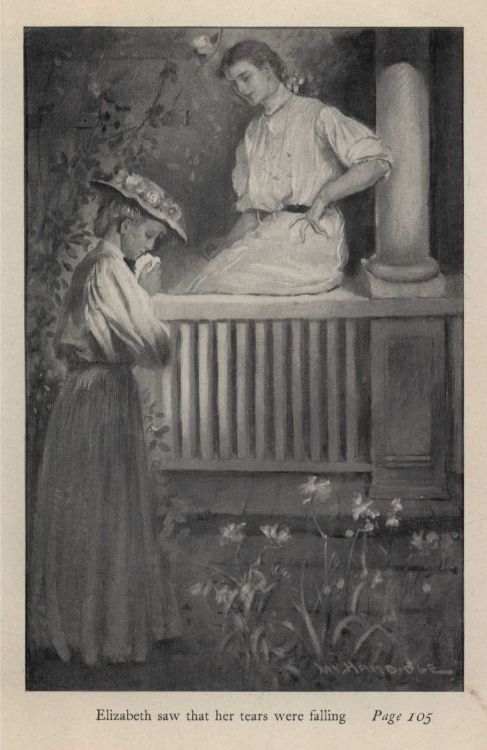
Elizabeth saw that her tears were falling
"Come, Gusta," she said sympathetically, "you mustn't feel bad."
The girl suddenly looked at her, her eyes full of tears.
"Oh, Miss Elizabeth," she said, "if you could only know! To see him down there--in that place! Such a thing never happened to us before!"
"But I'm sure it'll all come out right in the end--I'm sure of that. There must have been some mistake. Tell me all about it."
And then Gusta told her the whole story.
"You don't know how it feels, Miss Elizabeth," she said when she had done, "to have your own brother--such a thing couldn't happen to you--here." Gusta glanced about her, taking in at a glance, as it were, the large house, and all its luxury and refinement and riches, as if these things were insurmountable barriers to such misfortune and disgrace.
Elizabeth saw the glance, and some way, suddenly, the light and warmth went out of the spring day for her. The two girls looked at each other a moment, then they looked away, and there was silence. Elizabeth's brows were contracted; in her eyes there was a look of pain.
When Gusta had gone Elizabeth went indoors, but her heart was heavy. She tried to throw off the feeling, but could not. She told herself that it was her imagination, always half morbid, but this did not satisfy her. She was silent at the luncheon-table until her mother said:
"Elizabeth, what in the world ails you?"
"Oh; nothing."
"I know something does," insisted Mrs. Ward.
Elizabeth, with her head inclined, was outlining with the prong of a fork the pattern on the salad bowl.
"Gusta has been here, telling me her troubles."
"Oh, that's it, is it?" said Mrs. Ward.
"You know her brother has been arrested."
"What for?"
"Stealing."
"Indeed! Well! I do wish she'd keep away! I'm sure I don't know what we've done that we should have such things brought into our house!"
"But it's too bad," said Elizabeth. "The young man--"
"Yes, the young man! If he'd go to work and earn an honest living, he wouldn't be arrested for stealing!"
"I was just thinking--" Elizabeth finished the pattern on the salad bowl and inclined her head on the other side, as if she had really designed the pattern and were studying the effect of her finished work,--"that if Dick--"
"Why, Elizabeth!" Mrs. Ward cried. "How can you say such a thing?"
Elizabeth smiled, and the smile irritated her mother.
"I'm sure it's entirely different!" Mrs. Ward went on. "Dick does not belong to that class at all!"
XIII
The truth was that Elizabeth had been worried for days about Dick. A few evenings before, Ward, who took counsel of his daughter rather than of his wife in such affairs, had told her of his concern about his son.
"I don't know what to do with the boy," he had said. "He seems to have no interest in anything; he tired of school, and he tired of college; and now he is of age and--doing nothing."
She remembered how he had sat there, puffing at his cigar as if that could assist him to some conclusion.
"I tried him in the office for a while, you know, but he did not seem to take it seriously--of course, it wasn't really serious; the work went on as well without him as with him. I guess he knew that."
Elizabeth sat and thought, but the problem which her father had put to her immediately overpowered her; there seemed to be no solution at all--she could not even arrange its terms in her mind, and she was silent, yet her silence was charged with sympathy.
"I've talked to him, but that does no good. I've pleaded with him, but that does no good. I tried giving him unlimited money, then I put him on an allowance, then I cut him off altogether--it was just the same."
Ward smoked a moment in silence.
"I've thought of every known profession. He says he doesn't want to be a lawyer or a doctor; he has no taste for mechanics, and he seems to have no interest in business. I've thought of sending him abroad, or out West, but he doesn't want to do that."
And again the silence and the smoking and the pain.
"He's out to-night--where, I don't know. I don't want to know--I'm afraid to know!"
There was something wild, appealing and pathetic in this cry wrung from a father's heart. Elizabeth had looked up quickly, her own heart aching with pity. She recalled how he had said:
"Your mother--she doesn't understand; I don't know that I want her to; she idolizes the boy; she thinks he can't do wrong."
And then Elizabeth had slipped her arm about his neck, and, leaning over, had placed her cheek against his; her tears had come, and she had felt that his tears had come; he had patted her hand. They had sat thus for a long while.
"Poor boy!" Ward had said again. "He's only making trouble for himself. I'd like to help him, but somehow, Bess, I can't get next to him; when I try to talk to him, when I try to be confidential and all that--something comes between us, and I can't say it right. I can't talk to him as I could to any other man. I don't know why it is; I sometimes think that it's all my fault, that I haven't reared him right, that I haven't done my duty by him, and yet, God knows, I've tried!"
"Oh, papa," she had replied protestingly, "you mustn't blame yourself--you've done everything."
"He's really a good boy," Ward had gone on irrelevantly, ignoring himself in his large, unselfish thought for his son. "He's kind and generous, and he means well enough--and--and--I think he likes me."
This had touched her to the quick, and she had wept softly, stroking her father's cheek.
"Can't you--couldn't you--" he began. "Do you think you could talk to him, Bess?"
"I'll try," she said, and just then her brother had come into the room, rosy and happy and unsuspecting, and their confidences were at an end.
Ward did not realize, of course, that in asking Elizabeth to speak to Dick he was laying a heavy burden on her. She had promised her father in a kind of pity for him, a pity which sprang from her great love; but as she thought it over, wondering what she was to say, the ordeal grew greater and greater--greater than any she had ever had to encounter. For several days she was spared the necessity of redeeming her promise, for Dick was so little at home, and fortunately, as Elizabeth felt, when he was there the circumstances were not propitious. Then she kept putting it off, and putting it off; and the days went by. Her father had not recurred to the subject; having once opened his heart, he seemed suddenly to have closed it, even against her. His attitude was such that she felt she could not talk the matter over with him; if she could she might have asked him to give her back her promise. She could not talk it over with her mother, and she longed to talk it over with some one. One evening she had an impulse to tell Marriott about it. She knew that he could sympathize with her, and, what was more, she knew that he could sympathize with Dick, whereas she could not sympathize with Dick at all. Though she laughed, and sang, and read, and talked, and drove, and lived her customary life, the subject was always in her thoughts. Finally she discovered that she was adopting little subterfuges in order to evade it, and she became disgusted with herself. She had morbid fears that her character would give way under the strain. At night she lay awake waiting, as she knew her father must be waiting, for the ratchet of Dick's key in the night-latch.
In the many different ways she imagined herself approaching the subject with Dick, in the many different conversations she planned, she always found herself facing an impenetrable barrier--she did not know with what she was to reproach him, with what wrong she was to charge him. She conceived of the whole affair, as the Anglo-Saxon mind feels it must always deal with wrong, in the forensic form--indictment, trial, judgment, execution. But after all, what had Dick done? As she saw him coming and going through the house, at the table, or elsewhere, he was still the same Dick--and this perplexed her; for, looking at him through the medium of her talk with her father, Dick seemed to be something else than her brother; he seemed to have changed into something bad. Thus his misdeeds magnified themselves to her mind, and she thought of them instead of him, of the sin instead of the sinner.
That night Dick did not come at all. In the morning when her father appeared, Elizabeth saw that he was haggard and old. As he walked heavily toward his waiting carriage, her love and pity for him received a sudden impetus.
Dick did not return until the next evening, and the following morning he came down just as his father was leaving the house. If Ward heard his son's step on the stairs, he did not turn, but went on out, got into his brougham, and sank back wearily on its cushions. It happened that Elizabeth came into the hall at that moment; she saw her father, and she saw her brother coming down the stairs, dressed faultlessly in new clothes and smoking a cigarette. As Elizabeth saw him, so easy and unconcerned, her anger suddenly blazed out, her eyes flashed, and she took one quick step toward him. His fresh, ruddy face wore a smile, but as she confronted him and held out one arm in dramatic rigidity and pointed toward her father, Dick halted and his smile faded.
"Look at him!" Elizabeth said, pointing to her father. "Look at him! Do you know what you're doing?"
"Why, Bess"--Dick began, surprised.
"You're breaking his heart, that's what you're doing!"
She stood there, her eyes menacing, her face flushed, her arm extended. The carriage was rolling down the drive and her father had gone, but Elizabeth still had the vision of his bent frame as he got into his carriage.
"Did you see him?" she went on. "Did you see how he's aging, how much whiter his hair has grown in the last few weeks, how his figure has bent? You're killing him, that's what you're doing, killing him inch by inch. Why can't you do it quick, all at once, and be done with it? That would be kinder, more merciful!"
Her lip curled in sarcasm. Dick stood by the newel-post, his face white, his lips open as if to speak.
"You spend your days in idleness and your nights in dissipation. You won't work. You won't do anything. You are disgracing your family and your name. Can't you see it, or won't you?"
"Why, Bess," Dick began, "what's the--"
She looked at him a moment; he was like her mother, so good-natured, so slow to anger. His attitude, his expression, infuriated her; words seemed to have no effect, and in her fury she felt that she must make him see, that she must force him to realize what he was doing--force him to acknowledge his fault--force him to be good.
"Of course, you'd just stand there!" she said. "Why don't you say something? You know what you're doing--you know it better than I. I should think you'd be ashamed to look a sister in the face!"
Dick had seen Elizabeth angry before, but never quite like this. Slowly within him his own anger was mounting. What right, he thought, had she to take him thus to task--him, a man? He drew himself up, his face suddenly lost its pallor and a flush of scarlet mottled it. Strangely, in that same instant, Elizabeth's face became very white.
"Look here," he said, speaking in a heavy voice, "I don't want any more of this from you!"
For an instant there was something menacing in his manner, and then he walked away and left her.
Elizabeth stood a moment, trembling violently. He had gone into the dining-room; he was talking with his mother in low tones. Elizabeth went up the stairs to her room and closed the door, and then a great wave of moral sickness swept over her. She sat down, trying to compose herself, trying to still her nerves. The whole swift scene with her brother flashed before her in all its squalor. Had she acted well or rightly? Was her anger what is called a righteous indignation? She was sure that she had acted for the best, for her father in the first place, and for Dick more than all, but it was suddenly revealed to her that she had failed; she had not touched his heart at all; she had expended all her force, and it was utterly lost; she had failed--failed. This word repeated itself in her brain. She tried to think, but her brain was in turmoil; she could think but one thing--she had failed. She bent her head and wept.
XIV
Archie Koerner and Spud Healy and the others of the gang lay in prison for a week; each morning they were taken with other prisoners to the bull-pen, and there they would stand--for an hour, two hours, three hours--and look through the heavy wire screen at officers, lawyers, court attachés, witnesses and prosecutors who passed and repassed, peering at them as at caged animals, some curiously, some in hatred and revenge, some with fear, now and then one with pity. The session would end, they would be taken downstairs again--the police were not yet ready. But finally, one Saturday morning, they were taken into the court-room and arraigned. Bostwick, the judge, heard a part of the evidence; it was nearly noon, and court never sat on Saturday afternoons. Bostwick and the prosecutor both were very anxious to get away for their half-holiday. The session had been long and trying, the morning was sultry, a summer day had fallen unexpectedly in the midst of the spring. Bostwick was uncomfortable in his heavy clothes. He hurried the hearing and sent them all to the workhouse for thirty days, and fined them the costs. Marriott had realized the hopelessness of the case from the first; even he was glad the hearing was over, glad to have Archie off his mind.
The little trial was but a trivial incident in the life of the city; Bostwick and the prosecutor, to whom it was but a part of the day's work, forgot it in the zest of ordering a luncheon; the police forgot it, excepting Kouka, who boasted to the reporters and felt important for a day. Frisby, a little lawyer with a catarrhal voice, thought of it long enough to be thankful that he had demanded his fee in advance from the mother of the boy he had defended--it took her last cent and made her go hungry over Sunday. Back on the Flats, in the shadow of the beautiful spire of St. Francis, there were cries, Gaelic lamentations, keening, counting of beads and prayers to the Virgin. The reporters made paragraphs for their newspapers, writing in the flippant spirit with which they had been taught to treat the daily tragedies of the police court. Some people scanned the paragraphs, and life passed by on the other side; the crowds of the city surged and swayed, and Sunday dawned with the church-bells ringing peacefully.
The Koerner family had the news that evening from Jerry Crowley, the policeman who had recently been assigned to that beat, his predecessor, Miller, having been suspended for drunkenness. Crowley had had a hard time of it ever since he came on the beat. The vicinity was German and he was Irish, and race hatred pursued him daily with sneers, and jibes, and insults, now and then with stones and clods. The children took their cue from the gang at Nussbaum's; the gang made his life miserable. Yet Crowley was a kindly Irishman, with many a jest and joke, and a pleasant word for every one. Almost anybody he arrested could get Crowley to let him go by begging hard enough. On the warm evenings Koerner would sit on the stoop, and Crowley, coming by, would stop for a dish of gossip.
"Oh, come now, Mr. Koerner," he said that Saturday night, after he had crudely told the old German of his son's fate, "I wouldn't take it that hard; shure an' maybe it's good 'twill be doin' the lad an' him needin' it the way he does."
Officer Crowley was interrupted in his comforting by a racket at the corner--the warm, soft nights were bringing the gang out, and he went away to wage his hopeless battle with it. When he returned, old man Koerner had gone indoors.
Gusta shared all her father's humiliation and all her mother's grief at Archie's imprisonment. She felt that she should visit her brother in prison, but it was a whole week before she could get away, and then on a brilliant Sunday afternoon she went to the workhouse. The hideous prison buildings were surrounded by a high fence, ugly in its dull red paint; the office and the adjoining quarters where the superintendent lived had a grass plot in which some truckling trusty had made flower-beds to please the superintendent's wife. In the office an old clerk, in a long black coat, received Gusta solemnly. He was sitting, from the habit of many years, on the high stool at the desk where he worked; ordinarily he crouched over his books in the fear that political changes would take his job from him; now a Sunday paper, which the superintendent and his family had read and discarded, replaced the sad records, but he bent over this none the less timidly. After a long while an ill-natured guard, whose face had grown particularly sinister and vicious in the business, ordered Gusta to follow him, and led her back into the building. Reluctantly he unlocked doors and locked them behind her, and Gusta grew alarmed. Once, waiting for him to unlock what proved to be a final door, he waited while a line of women, fourteen or fifteen of them, in uniform of striped gingham, went clattering up a spiral iron stairway; two or three of the women were negresses. They had been down to the services some Christian people had been holding for the inmates, preaching to them that if they believed on Jesus they would find release, and peace, and happiness. These people, of course, did not mean release from the workhouse, and the peace and happiness, it seemed, could not come until the inmates died. So long as they lived, their only prospect seemed to be unpaid work by day, bread and molasses to eat, and a cell to sleep in at night, with iron bars locking them in and armed men to watch them. However, the inmates enjoyed the services because they were allowed to sing.
After the women disappeared, Gusta stood fearfully before a barred door and looked down into a cell-house. The walls were three stories high, and sheer from the floor upward, with narrow windows at the top. Inside this shell of brick the cells were banked tier on tier, with dizzy galleries along each tier. Though Gusta could see no one, she could hear a multitude of low voices, like the humming of a bee-hive--the prisoners, locked two in each little cell, were permitted to talk during this hour. The place was clean, but had, of course, the institutional odor. The guard called another guard, and between them they unlocked several locks and threw several levers; finally a cell-door opened--and Gusta saw Archie come forth. He wore a soiled ill-fitting suit of gray flannel with wide horizontal stripes, and his hair had been clipped close to his head. The sight so confused and appalled Gusta that she could not speak, and the guard, standing suspiciously by her side to hear all that was said, made it impossible for her to talk. The feeling was worse than that she had had at the police station when an iron door had thus similarly separated her from her brother.
Archie came close and took hold of the bars with both his hands and peered at her; he asked her a few questions about things at home, and charged her with a few unimportant messages and errands. But she could only stand there with the tears streaming down her face. Presently the guard ordered Archie back to his cell, and he went away, turning back wistfully and repeating his messages in a kind of desperate wish to connect himself with the world.
When Gusta got outside again, she determined that she would not go home, for there the long shadow of the prison lay. She did not know where to go or what to do, but while she was trying to decide she heard from afar the music of a band--surely there would be distraction. So she walked in the direction of the music. About the workhouse, as about all prisons, were the ramshackles of squalid poverty and worse; but little Flint Street, along which she took her way, began to pick up, and she passed cottages, painted and prim, where workmen lived, and the people she saw, and their many children playing in the street, were well dressed and happy. It seemed strange to Gusta that any one should be happy then. When suddenly she came into Eastend Avenue, she knew at last where she was and whence the music came; she remembered that Miami Park was not far away. The avenue was crowded with vehicles, not the stylish kind she had been accustomed to on Claybourne Avenue, but buggies from livery-stables, in which men drove to the road-houses up the river, surreys with whole families crowded in them, now and then some grocer's or butcher's delivery wagon furnished with seats and filled with women and children. The long yellow trolley-cars that went sliding by with incessant clangor of gongs were loaded; the only signs of the aristocracy Gusta once had known were the occasional automobiles, bound, like the Sunday afternoon buggy-riders, up the smooth white river road.
Eastend Avenue ran through the park, and just before it reached that playground of the people it was lined with all kinds of amusement pavilions, little vaudeville shows, merry-go-rounds, tintype studios, shooting galleries, pop-corn and lemonade stands, public dance halls where men and girls were whirling in the waltz. On one side was a beer-garden. All these places were going noisily, with men shouting out the attractions inside, hand-organs and drums making a wild, barbaric din, and in the beer-garden a German band braying out its meretricious tunes. But at the beginning of the park a dead-line was invisibly drawn--beyond that the city would not allow the catch-penny amusements to go. On one side of the avenue the park sloped down to the river, on the other it stretched into a deep grove. The glass roof of a botanical house gleamed in the sun, and beyond, hidden among the trees, were the zoölogical gardens, where a deer park, a bear-pit, a monkey house, and a yard in which foxes skulked and racoons slept, strove with their mild-mannered exhibits for the beginnings of a menagerie. And everywhere were people strolling along the walks, lounging under the trees, hundreds of them, thousands of them, dressed evidently in their best clothes, seeking relief from the constant toil that kept their lives on a monotonous level.
Gusta stood a while and gazed on the river. On the farther shore its green banks rose high and rolled away with the imagination into woods and fields and farms. Here and there little cat-boats moved swiftly along, their sails white in the sun; some couples were out in rowboats. But as Gusta looked she suddenly became self-conscious; she saw that, of all the hundreds, she was the only one alone. Girls moved about, or stood and talked and giggled in groups, and every girl seemed to have some fellow with her. Gusta felt strange and out of place, and a little bitterness rose in her heart. The band swelled into a livelier, more strident strain, and Gusta resented this sudden burst of joyousness. She turned to go away, but just then she saw that a young man had stopped and was looking at her. He was a well-built young fellow, as strong as Archie; he had dark hair and a small mustache curled upward at the corners in a foreign way. His cheeks were ruddy; he carried a light cane and smoked a cigar. When he saw that Gusta had noticed him he smiled and Gusta blushed. Then he came up to her and took off his hat.
"Are you taking a walk?" he asked.
"I was going home," Gusta replied. She wondered how she could get away without hurting the young man's feelings, for he seemed to be pleasant, harmless and well meaning.
"It's a fine day," he said. "There's lots o' people out."
"Yes," said Gusta.
"Where 'bouts do you live?"
"On Bolt Street."
"Oh, I live out that way myself!" said the young man. "It's quite a ways from here. Been out to see some friends?"
"Yes." Gusta hesitated. "I had an errand to do out this way."
"Don't you want to go in the park and see the zoo? There's lots of funny animals back there." The young man pointed with his little cane down one of the gravel walks that wound among the trees. Gusta looked, and saw the people--young couples, women with children, and groups of young men, sauntering that way. Then she looked at the street-cars, loaded heavily, with passengers clinging to the running-boards; she was tempted to go, but it was growing late.
"No, thanks," she said, "I must be going home now."
"Are you going to walk or take the car?" asked the young man.
"I'll walk, I guess," she said; and then, lest he think she had no car fare, she added: "the cars are so crowded."
She started then, and was surprised when the young man naturally walked along by her side, swinging his cane and talking idly to her. At first she was at a loss whether to let him walk with her or not; she had a natural fear, a modesty, the feminine instinct, but she did not know just how to dismiss him. She kept her face averted and her eyes downcast; but finally, when her fears had subsided a little, she glanced at him occasionally; she saw that he was good-looking, and she considered him very well dressed. He had a gold watch chain, and when she asked him what time it was he promptly drew out a watch. Their conversation, from being at the first quite general, soon became personal, and before they had gone far Gusta learned that the young man's name was Charlie Peltzer, that he was a plumber, and that sometimes he made as much as twenty dollars a week. By the time they parted at the corner near Gusta's home they felt very well acquainted and had agreed to meet again.