Front matter (continued 9)
Reading edition
"Tell me why--"
"I don't vant to have him killedt, I tol' you."
"But it isn't killing; it isn't the same."
"Bah! Nonsense!" roared Reder.
"It's the law."
"I don't gare for der law. We say he don't die--he don't die den, ain't it?"
"But it's the law!" protested Broadwell, thinking to add new stress to his argument by placing new stress on the word. "How can we do otherwise?"
"How? Chust by saying not guildy, dot's how."
"But how can we do that?"
"Chust do it, dot's how!"
"But it's the law,--the law!"
"Damn der law!" roared Reder, resuming his walk. And Broadwell stood looking at him, in horror, as if he had blasphemed.
There was silence again, save for Osgood's snoring. Then suddenly, no one knew how, the argument broke out anew.
"How do we know?" some one was saying. It was Grey; his conviction was shaken again.
"Know?" said Church. "Don't we know?"
"How do we?"
"Well--I don't know, only--"
"Yes, only."
"You ain't going back on us now, I hope?",
"No, but--" Grey shook his head.
"Well, you heard what the judge said."
They could always appeal to what the judge had said, as if he spoke with some authority that was above all others.
"What'd he say?" asked Grey.
"Why--he said--what was that there word now?"
"What word?"
"That word he used--refer--no that wasn't it, let's see."
"Infer?" suggested Broadwell.
"Sure! That's it! Infer! He said infer."
"By God! I guess that's right! He did say that."
"Course," Church went on triumphantly. "Infer! He said infer, and that means we can infer it, don't it?"
Just at that minute a pain, sharp and piercing, shot through Reder's back. He winced, made a wry face, stopped, stooped to a senile posture and clapped his hand to his back. His heart suddenly sank--there it was again, his old trouble. That meant bad things for him; now, as likely as not, he'd be laid up all winter; probably he couldn't sit on the jury any more; surely not if that old trouble came back on him. And how would he and his old wife get through the winter? Instantly he forgot everything else. What time was it, he wondered? This being up all night; he could not stand that.
As from a distance he heard the argument going on. At first he felt no relation to it, but this question must be settled some way. The pain had ceased, but it would come back again. He straightened up slowly, gradually, with extreme care, his hand poised in readiness to clap to his back again; He turned about by minute degrees and said:
"What's dot you saidt?"
"Why," began Church, but just then Reder winced again; clapped his hand to his back, doubled up, his face was contorted. He was evidently suffering tortures, but he made no outcry. Church sprang toward him.
"Get him some water,--here!"
Chisholm punched young Menard; he got up, and pushed the big white porcelain water pitcher across the table. But Reder waved it aside.
"Nefer mind," he said. "What was dot you vas sayin' a minute back?"
"Why, Mr. Reder, we said the judge said we could infer. Don't you remember?"
Church looked into his face hopefully, and waited.
Broadwell got slowly to his feet, and moved toward the little group deliberately, importantly, as if he alone could explain.
"Here, have my chair, Mr. Reder," said Broadwell with intense politeness.
"No, nefer mind," said Reder, afraid to move.
"What the judge said," Broadwell began, "was simply this. He said that if it was to be inferred from all the facts and circumstances adduced in evidence--"
"Besides," Church broke in, "that old woman said he was the fellow, down at the police station--it was in the paper, don't you remember?"
"Oh, but the judge said we wasn't to pay attention to anything like that," said Grey.
"Well, but he said we could infer, didn't he?"
"Just let me speak, please," insisted Broadwell, "His Honor went on to say--" he had just recalled that that was the proper way to speak of a judge, and then, the next instant, he remembered that it was also proper to call the judge "the Court," and he was anxious to use both of these phrases. "That is, the Court said--" And he explained the meaning of the word "infer."
Reder was listening attentively, his head bent, his hand resting on his hip. Broadwell talked on, in his low insinuating tone. Reder made no reply. After a while, Broadwell, his eyes narrowing, said softly, gently:
"Gentlemen, shall we not try another ballot?"
Menard got up wearily, his hat in readiness again. The jurors began rummaging among the scraps for ballots.
A street-car was just scraping around the curve at the corner, its wheels sending out a shrill, grinding noise.
"Great heavens!" exclaimed McCann, taking out his watch, "it's five thirty! Morning! We've been here all night!"
Outside the city was still wrapped in a soft thick darkness. Eades was sleeping soundly; his mother, when she kissed him good night, had patted his head, saying, "My dear, brave boy." Marriott had just sunk into a troubled doze. Glassford was snoring loudly in his warm chamber; Koerner and his wife were kneeling on their bed, their hands clasped, saying a prayer in German, and over in the jail, Archie was standing with his face pressed against the cold bars of his cell, looking out across the corridor, watching for the first streak of dawn.
XX
Marriott awoke with a start when the summons came. The jury had agreed; his heart leaped into his throat. What was the verdict? He had a confused sense of the time, the world outside was dark; he could have slept but a few minutes, surely it was not much later than midnight. He switched on the electric light, and looked at his watch. It was half-past six--morning. He dressed hurriedly, and went out.
The clammy air smote him coldly. The day was just breaking, a yellow haze above the roofs toward the east. He hurried along the damp pavement, an eager lonely figure in the silent streets; the light spread gradually, creeping as it were through the heavy air; a fog rolled over the pavements and the world was cold and gray. An early street-car went clanging past, filled with working-men. These working-men were happy; they smoked their pipes and joked--Marriott could hear them, and he thought it strange that men could be happy anywhere in the world that morning. But these fancies were not to be indulged with the leisurely sense in which he usually philosophized on that life of which he was so conscious; for the court-house loomed huge and portentous in the dawn. And suddenly the light that was slowly suffusing the ether seemed to pause; there was a hesitation almost perceptible to the eye in the descent of morning on the world; it was, to Marriott's imagination, exactly, as if the sun had suddenly concluded to shine no longer on the just and the unjust alike, but would await the issue then yeaning beneath that brooding dome, and see whether men would do justice in the world. Somewhere, Marriott knew, in that gray and smoky pile, the fate was waiting, biding its time. What would it be?
He had remained at the court-house the night before with Pennell and Lamborn, several of the court officials and attachés, and a dwindling group of the morbid and the curious. An immediate agreement had been expected, allowing, of course, for the delay necessary to a preservation of the decencies, but as the hours dragged by, Marriott's hopes had risen; each moment increased the chance of an acquittal, of a disagreement, or of some verdict not so tragic as the one the State had striven for. His heart had grown lighter. But by midnight he was wholly exhausted. Intelligence, which knows no walls, had somehow stolen out from the jury room; there was some eccentricity in this mighty machine of man, and no immediate agreement was to be expected. And then Marriott had left, trusting Pennell to remain and represent the defendant at the announcement of the verdict. It was about the only duty he felt he could trust to Pennell. And now, hurrying into the court-house, his hopes rose once more.
Something after all of the effect of custom was apparent in the atmosphere of the court-room, where the tribunal was convened thus so much earlier than its wonted hour. The room was strange and unreal, haunted in this early morning gloom by the ghosts of the protagonists who had stalked through it. Glassford was already on the bench, his eyes swollen, his cheeks puffed. Lamborn was there, in the same clothes he had worn the day before,--it was plain that he had not had them off at all. And there, already in the box, sat the jury, blear-eyed, unkempt, disheveled, demoralized, with traces yet of anger, hatred and the fury of their combat in their faces, a caricature of that majesty with which it is to be presumed this institution reaches the solemn conclusions of the law. And there, at the table, still strewn with the papers that were the debris of the conflict, sat Archie, the sorry subject over which men had been for days quarreling and haggling, harrying and worrying him like a hunted thing. He sat immobile, gazing through the eastern windows at the waiting and inscrutable dawn of a day swollen with such tragic possibilities for him.
Glassford looked sleepily at Marriott as he burst through the doors. His glance indicated relief; he was glad the conclusion had been reached at this early hour, even if it had haled him from his warm bed; he was glad to be able thus to trick the crowd and have the law discharge its solemn function before the crowd came to view it.
"Gentlemen of the jury," he said, "have you agreed upon a verdict?"
"We have, your Honor." Broadwell was rising in his place.
Glassford nodded to the clerk, who walked across the floor, his heels striking out sharp sounds. Marriott had paused at the little gate in the railing. He clutched at it, and supported himself in the weakness that suddenly overwhelmed him. It seemed to him that the clerk took a whole age in crossing that floor. He waited. Broadwell had handed the clerk a folded document. The clerk took it and opened it; it fluttered in his fingers. Now he hastily cast his eye over it, and Marriott thought: "There still is hope--hope in each infinitesimal portion of a second as he reads it--" for he was reading now:
"'We, the jury, impaneled and sworn well and truly to try and true deliverance make in the cause wherein the State is plaintiff and Archie Koerner is defendant, for verdict do find and say that we find the defendant--'" Marriott gasped. The clerk read on:
"'--guilty as charged in the indictment'."
"Gentlemen of the jury," said the clerk, folding the paper in his formal manner, "is this your verdict?"
"It is," said Broadwell.
"So say you all."
There was silence. After a while Marriott controlled himself and said:
"Your Honor, we demand a poll of the jury."
Slowly, one after another, the clerk called the names, and one after another the jurors rose.
"Is this your verdict?" asked the clerk.
"Perhaps," thought Marriott as each one rose, "perhaps even now, one will relent, one will change--one--"
"It is," each man answered.
Then Glassford was speaking again--the everlasting formalities, mocking the very sense of things, thanking the jury, congratulating them, discharging them.
And Archie Koerner sat there, never moving, looking through the eastern window--but now at the dawn no more, for the window was black to his eyes and the light had gone out of the world.
XXI
Archie sat by the trial table and looked out the window toward the east. The window from being black became gray again--gray clouds, a scumbled atmosphere of gray. When the jury came out of the box, after it was all over, a young clerk in the court-house rushed up to Menard and wrung his hand in enthusiastic, hysterical congratulation, as if Menard in the face of heavy opposition had done some brave and noble deed. And Archie wondered what he had ever done to this young clerk that he should so have it in for him. Then Marriott was at his side again, but he said nothing; he only took his hand.
"Well," thought Archie, "there is one man left in the world who hasn't got it in for me." And yet there actually seemed to be Danner. For Danner bent over and whispered:
"Whenever you're ready, Dutch, we'll go back. Of course--no particular hurry, but when you're ready."
Archie wondered what Danner was up to now; usually he ordered them about like brutes, with curses.
"You'll be wanting a bite of breakfast," Danner was saying.
Breakfast! The word was strange. Were people still eating breakfast in this world, just as if nothing had happened, just as if things were as they used to be--before--before--what? Before he shot Kouka? No, there was nothing unusual about that; he didn't care anything about Kouka. Before the penitentiary and the bull rings? Before the first time in the workhouse, when that break, that lapse, came into his life? But breakfast--they would be carrying the little pans about in the jail just now, and that brought the odor of coffee to his memory. Coffee would not be a bad thing.
"Any time," he said to Danner.
Then they got up and walked away, through the gray morning.
In the jail, Danner instantly unlocked the handcuffs, and as he jostled Archie a little in opening the door, he said:
"Oh, excuse me, Dutch."
What had got into Danner, anyway? Inside he wondered more. Danner said:
"You needn't lock this morning; you can stay in the corridor, and I'll have your breakfast sent in to you in a moment."
Then Danner put up his big hand and whispered in Archie's ear:
"I'll see the cook and get her to sneak in a little cream and sugar for your coffee."
Archie could not understand this, nor had he then time to wonder about it, for he was being turned into the prison, and there, he knew, his companions were waiting to know the news. Most of them were in their cells. Two of them, the English thief and Mosey--he could tell it was Mosey by the striped sweater--were standing in the far end of the corridor, but they did not even look. He caught a snatch of their conversation.
"What was the rap, the dip?"
"No, penny weightin'."
They appeared to be talking indifferently and were no more curious--so one would say--than they would have been if some dinge had been vagged. And yet Archie knew that every motion, every word, every gesture of his was important. He tried to walk just as he had always walked. They waited till Archie was at his cell door, and then some one called in a tone of suspense that could be withheld no longer:
"What's the word, Archie?"
"Touched off," he called, loud enough for them all to hear. He spoke the words carelessly, almost casually, with great nonchalance. There was silence, sinister and profound. Then gradually the conversation was resumed between cell and cell; they were all calling out to him, all straining to be cheerful and encouraging.
"That mouthpiece of yours 'll spring you yet," some one said, "down below."
Archie listened to their attempts to cheer him, all pathetic enough, until presently the English thief passed his door, and said in a low voice:
"Be gime, me boy."
That was it! Be game! From this on, that must be his ideal of conduct. He knew how they would inquire, how some day Mason and old Dillon, how Gibbs and all the guns and yeggs would ask about this, how the old gang would ask about it--he must be game. He had made, he thought, a fair beginning.
Danner brought the breakfast himself, and good as his word he had got the cook to put some cream and sugar in his coffee. Not only this, but the cook had boiled him two eggs--and he hadn't eaten eggs in months. The last time, he recalled, was when Curly had boiled some in a can--had Curly, over in another part of the prison, been told?
Archie thanked Danner and told him to thank the cook. And yet a wonder possessed him. He had never known kindness in a prison before, save among the prisoners themselves, and often they were cruel and mean to each other--like the rats and mission-stiffs who were always snitching and having them chalked and stood out. Here in this jail, he had never beheld any kindness, for notwithstanding the fact that nearly every one there was detained for a trial which was to establish his guilt or innocence, and the law had a theory that every one was to be presumed innocent until proved guilty, the sheriff and the jailers treated them all as if they were guilty, and as if it was their duty to assist in the punishment. But here was a man who had been declared guilty of a heinous crime, and was to receive the worst punishment man could bestow, and yet, suddenly, he was receiving every kindness, almost the first he had ever known, at least since he had grown up. Having done all they could to hurry him out of the world, men suddenly apologized by showering him with attention while he remained.
When he ate his breakfast Archie felt better,--Mr. Marriott would do something, he was sure; it was not possible that this thing could happen to him.
"Any of youse got the makin's?" he called.
Instantly, all down the corridor on both sides, the cells' voices rang:
"Here! Here! Archie! Here, have mine!"
"Mr. Marriott gave me a whole box yesterday, but I smoked 'em all up in the night!" he said.
XXII
Those persons in the community who called themselves the good were gratified by Archie's conviction, and there were at once editorials and even sermons to express this gratification. Lorenzo Edwards of the Courier, who hated Marriott because he had borrowed ten dollars of Marriott some years before and had never paid it back, wrote an unctuous and hypocritical editorial in which he condemned Marriott for carrying the case up, and deprecated the law's delay. The Post--although Archie had not talked to a reporter--printed interviews with him, and as a final stroke of enterprise, engaged Doctor Tyler Tilson, the specialist, to examine Archie for stigmata of degeneracy. Tilson went to jail, taking with him tape and calipers and other instruments, and after measuring Archie and percussing him, and lighting matches before his eyes, and having him walk blindfolded, and pricking him with pins, wrote a profound article for the Post from the standpoint of criminology, in which he repeated many scientific phrases, and used the word "environment," many times, and concluded that Archie had the homicidal tendency strongly developed.
The Reverend Doctor Hole, who had his degree from a small college in Dakota, had taken lessons of an elocutionist, and advertised the sensational sermons in which he preached against those vices the refinements and wealth of his own congregation did not tempt them to commit, spoke on "Crime"; even Modderwell referred to it with complacency.
In all of these expressions, of course, Eades was flattered, and this produced in him a sensation of the greatest comfort and justification. He felt repaid for all he had suffered in trying the case. But Marriott felt that an injustice had been done, and, such is the quality of injustice, that one suspicion of it may tincture every thought until the complexion of the world is changed and everything appears unjust. As Marriott read these editorials, the reports of these sermons, and the conclusions of a heartless science that had thumped Archie as if he were but a piece of rock for the geologist's hammer, he was filled with anger, and resolved that Archie should not be put to death until he had had the advantage of every technicality of the law. He determined to carry the case up at his own expense. Though he could not afford to do this, and was staggered when he ran over in his mind the cost of the transcript of evidence, the transcript of the record, the printing of the briefs, the railroad and hotel bills, and all that,--he felt it would be a satisfaction to see one poor man, at least, receive in the courts all that a rich man may demand.
Within the three days provided by law, Marriott filed his motion for a new trial and then he was content to wait, and let the proceedings drag along. But Eades insisted on an immediate hearing.
When Glassford had announced his decision denying a new trial, he hesitated a moment and then, with an effect of gathering himself for an ordeal, he dropped his judicial manner, called Eades and Marriott to the bench, leaned over informally, whispered with them, and finally, as if justifying a decision he had just communicated to them, observed:
"We might as well do it now and have it over with."
Then he sent the sheriff for Archie, and the bailiff for a calendar.
There were few persons in the court-room besides the clerk and the bailiff, Marriott and Pennell, Eades and Lamborn. It was a bleak day; outside a mean wind that had been blowing for three days off the lake swept the streets bare of their refuse and swirled it everywhere in clouds of filth. The sky was gray, and the cold penetrated to the marrow; men hurried along with their heads huddled in the collars of their overcoats--if they had overcoats; they winced and screwed their faces in the stinging cold, longing for sunshine, for snow, for rain, for anything to break the monotony of this weather. Within the court-room the gloom was intensified by the doom that was about to be pronounced. While they waited, Eades and Lamborn sat at a table, uneasily moving now and then; Marriott walked up and down; no one spoke. Glassford was scowling over his calendar, pausing now and then, lifting his eyes and looking off, evidently making a calculation.
When Bentley and Danner came at last with Archie, and unshackled him, Glassford did not look up. He kept his head bowed over his docket; now and then he looked at his calendar, the leaves of which rattled and trembled as he turned them over. Then they waited, every one there, in silence. After a while, Glassford spoke. He spoke in a low voice, into which at first he did not succeed in putting much strength:
"Koerner, you may stand up."
Archie rose promptly, his heels clicked together, his hands dropped stiffly to his side; he held his head erect, as he came to the military attitude of attention. But Glassford did not look at him. He was gazing out of the window again toward that mysterious window across the street.
"Have you anything to say why the sentence of this court should not be passed upon you?" he asked presently.
"No, sir," said Archie. He was looking directly at Glassford, but Glassford did not look at him. Glassford waited, studying how he should begin. The reporters were poising their pencils nervously.
"Koerner," Glassford began, still looking away, "after a fair and impartial trial before a jury of twelve sworn men you have been found guilty of the crime of murder in the first degree. The trial was conducted carefully and deliberately; the jury was composed of honest and representative men, and you were defended, and all your rights conserved by able counsel. You have had the benefit of every immunity known to our law, and yet, after calm deliberation, as the court has said, you have been found guilty. We have, in addition to that, here to-day heard a motion for a new trial; we have very carefully reviewed the evidence and the law in this case, and the court is convinced that no errors were committed on the trial detrimental to your rights in the premises or prejudicial to your interests. It now becomes the duty of the court to pass sentence upon you."
Glassford paused, removed his glasses, put them on again; and looked out of the window as before.
"Fortunately--I say fortunately, for so I feel about it"--he nodded--"fortunately for me, I have no discretion as to what your punishment shall be. The law has fixed that; it leaves nothing to me but to announce its determination. My duty is clear; in a measure, simple."
Glassford paused again, sighed faintly, and settled in his chair with some relief, as if he had succeeded in detaching himself personally from the situation, and remained now only in his representative judicial capacity.
"Still," he went on, speaking in an apologetic tone that betokened a lingering of his personal identity, "that duty, while clear, is none the less painful. I would that it had not fallen to my lot." He paused again, still looking away. "It is a sad and melancholy spectacle--a young man of your strength and native ability, with your opportunities for living a good and useful life, standing here to hear the extreme penalty of the law pronounced upon you. You might have been an honorable, upright man; you seem, so far as I am able to ascertain, to have come from a good home, and to have had honest, frugal, industrious parents. You have had the opportunity of serving your country, you have had the benefit of the training and discipline of the regular army. You might have put to some good use the lessons you learned in those places. And yet, you seem to have wilfully abandoned yourself to a life of crime. You have shown an utter disregard for the sacred right of property; you have been ready to steal, to live on the usufruct of the labor of others; and now, as is inevitable"--Glassford shook his head emphatically as he pronounced the word "inevitable"--"you have gone on until nothing is sacred in your eyes--not even human life itself."
Glassford, who found it easy to talk in this moral strain, especially when reporters were present to take down his words, went on repeating phrases he employed on the occasions when he pronounced sentence, until, as it seemed to him, having worked himself up to the proper pitch, he said, with one last tone of regret:
"It is a painful duty," and then feeling there was no way out of the duty, unless he resigned his position, which, of course, was out of the question, he straightened in his seat, turned, looked up at the ceiling and said, speaking more rapidly, "and yet I can not shirk a duty because it is disagreeable."
He clasped the desk before him tightly with his hands; his lips were pale. Then he said:
"The sentence of the court is that you be taken by the sheriff to the penitentiary, and there delivered over into the custody of the warden of the said penitentiary, by him to be guarded and safely kept until the fourteenth day of May next ensuing, on which day the said warden of the said penitentiary shall cause a current of electricity to be passed through your body, and to cause the said current to continue to be passed through your body--until you are dead."
Glassford paused; no one in the court-room moved. Archie still kept his eyes on Glassford, and Glassford kept his eyes on the wall. Glassford had remembered that in olden days the judge, when he donned the black cap, at some such time as this used to pray that God would have mercy on the soul of the man for whom he himself could find no mercy; but Glassford did not like to say this; it seemed too old-fashioned and he would have felt silly and self-conscious in it. And yet, he felt that the proprieties demanded that something be said in the tone of piety, and, thinking a moment, he added:
"And I hope, Koerner, that you will employ the few remaining days of life left to you in preparing your soul to meet its Maker."
With an air of relief, Glassford turned, and wrote in his docket. On his broad, shining forehead drops of perspiration were glistening.
"The prisoner will be remanded," he said.
Archie faced about and held out his left wrist toward Danner. The handcuffs clicked, Marriott turned, glanced at Archie, but he could not bear to look in his white face. Then he heard Danner's feet and Archie's feet falling in unison as they passed out of the courtroom.
XXIII
Danny Gibbs, having recovered from the debauch into which Archie's fate had plunged him, sat in his back room reading the evening paper. His spree had lasted for a week, and the whole tenderloin had seethed with the excitement of his escapades. Now that it was all over and reason had returned, he had made new resolutions, and a certain moral rehabilitation was expressed in his solemn demeanor and in the utter neatness of his attire. He was clean-shaven, his skin glowed pink from Turkish baths, his gray hair was closely trimmed and soberly parted, his linen was scrupulously clean; he wore new clothes of gray, his shoes were polished and without a fleck of dust. His meditations that evening might have been profoundly pious, or they might have been dim, foggy recollections of the satisfaction he had felt in heaping scathing curses on the head of Quinn, whom he had met in Eva Clason's while on his rampage. He had cursed the detective as a representative of the entire race of policemen, whom he hated, and Quinn had apparently taken it in this impersonal sense, for he had stood quietly by without resenting Gibbs's profane denunciation. But whatever Gibbs's meditations, they were broken by the entrance of a woman.
She was dressed just as she had always been in the long years Gibbs had known her, soberly and in taste; she wore a dark tailor suit, the jacket of which disclosed at her full bosom a fresh white waist. She was gloved and carried a small hand-bag; the bow of black ribbon on her hat trembled with her agitation; she was not tall, but she was heavy, with the tendency to the corpulence of middle years. Her reddish hair was touched with gray here and there, and, as Gibbs looked at her, he could see in her flushed face traces of the beauty that had been the fatal fortune of the girlhood of Jane the Gun.
"Howdy, Dan," she said, holding out her gloved hand.
"Hello, Jane," he said. "When'd you come?"
"I got in last night," she said, laying her hand-bag on the table. "Give me a little whisky, Dan." She tugged at her gloves, which came from her moist hands reluctantly. Gibbs was looking at her hands,--they were as white, as soft and as beautiful as they had ever been. One thing in the world, he reflected in the saddened philosophy that had come to him with sobriety, had held unchanged, anyway.
"I said a little whisky, Dan!" she spoke with some of her old imperiousness.
"No," he said resolutely, "you don't need any. There's nothing in it." He was speaking out of his moral rehabilitation. She glanced at him angrily; he saw that her brown eyes, the brown eyes that went with her reddish hair and her warm complexion, were flaming and almost red. He remembered to have seen them flame that dangerous red before. Still, it would be best to mollify her.
"There ain't any more whisky in town," he said, "I've drunk it all up."
She laughed as the second glove came off with a final jerk.
"I heard you'd been hitting the pots. Isn't it a shame! The poor kid! I heard it's a kangaroo."
Gibbs made no comment.
"He was a raw one, too, wasn't he?"
"Well, he's a young Dutchman--he filled in with the mob several moons back."
"What was the rap?"
"He boosted a rod, and they settled him for that; he got a stretch. Then he was in when they knocked off the peter in that P. O. down in Indiana."
"That's what I couldn't get hip to; Mason wasn't--"
"No, not that time; they had him wrong; but you know what them elbows are."
"They must have rapped hard."
"Yes, they gave them a five spot. But the Dutch wasn't in on that Flanagan job, neither was Curly. That was rough work--the cat, I s'pose."
Jane, her chin in her hands, suddenly became intent, looking straight into Gibbs's eyes.
"Dan, that's what I want to get wise to."
Her cheeks flamed to her white temples, her breast rose tumultuously, and as she looked at Gibbs her eyes contracted, the wrinkles about them became deeper and older, and they wore the hard ugly look of jealous suspicion. But presently her lip quivered, then slowly along the lower lashes of her eyes the tears gathered.
"What's the matter, Jane?"
"You don't know what I've stood for that man!" she blazed out. "I could settle him. I could send him to the stir. I could have him touched off!" She had clenched her fist, and, at these last words, with their horrible possibility, she smote it down on the table. "But he knew I wouldn't be a copper!" She ended with this, and fumbling among a woman's trinkets in her hand-bag, she snatched out a handkerchief and hastily brushed away the tears. Gibbs, appealed to in all sorts of exigencies, was at a loss when a woman wept. She shook with weeping, until her hatred was lost in the pity she felt for herself.
"I never said a word when you flew me the kite to keep under cover that time he plugged Moon."
"No, you were good then."
"Yes," she said, looking up for approval, "I was, wasn't I? But this time--I won't stand for it!"
"I'm out o' this," said Gibbs.
"Well," she went on, "his mouthpiece wrote me not to show here. But I was on at once. Curly knew I was hip from the start"--her anger was rising again. "It was all framed up; he got that mouthpiece to hand me that bull con, and he's even got McFee to--"
"McFee!" said Gibbs, starting at the name of the inspector. "McFee! Have you been to him?"
"Yes, I've been to him!" she said, repeating his words with a satirical curl of the lip. "I've been to him; the mouthpiece sent me word to lay low till he sprung him; Curly sent me word that McFee said I wasn't to come to this town. Think I couldn't see through all that? I was wise in a minute and I just come, that's what I did, right away. I did the grand over here."
"What was it you thought they had framed up?" asked Gibbs innocently. "I can't follow you."
"Aw, now, Dan," she said, drawing away from the table with a sneer, "don't you try to whip-saw me."
"No, on the dead!"
"What was it? Why, some moll, of course; some tommy."
Gibbs leaned back and laughed; he laughed because he saw that this was simply woman's jealousy.
"Look here, Jane," he said, "you know I don't like to referee these domestic scraps--I know I'll be the fall guy if I do--but you're wrong, that's all; you've got it wrong."
She looked at him, intently trying to prove his sincerity, and anxious to be convinced that her suspicions were unfounded, and yet by habit and by her long life of crime she was so suspicious and so distrustful--like all thieves, she thought there were no honest people in the world--that her suspicions soon gained their usual mastery over her, and she broke out:
"You know I'm not wrong. I went to see McFee."
"What did he say?" asked Gibbs, with the interest in anything this lord that stood between him and the upper world might say.
"Why, he said he wouldn't say nothing."
"Did he say you could stay?"
"Well," she hesitated an instant, "he said he didn't want me doing any work in town; he said he wouldn't stand for it."
"No, you mustn't do any work here." Gibbs spoke now with his own authority, reinforcing that of the detective.
"Oh, sin not leery!" she sneered at him. "I'm covered all right, and strong. You're missing the number, that's all. I'm going to camp here, and when I see her, I'll clout her on the kurb; I'll slam a rod to her nut, if I croak for it!"
"Jane," said Gibbs, when he had looked his stupefaction at her, "you've certainly gone off your nut. Who in hell's this woman you're talking about?"
"As if you don't know! What do you want to string me for?"
Gibbs looked at her with a perfectly blank face.
"All right, have it your way."
"Well," she said presently, with some doubt in her mind, "if you don't know and just to prove to you that I do know, it's the sister of that young Koerner!"
Gibbs looked at her a long time in a kind of silent contempt. Then he said in a tone that dismissed the subject as an absurdity:
"You've passed; the nut college for you."
Jane fingered the metal snake that made the handle of her bag; now and then she sighed, and after a while she was forced to speak--the silence oppressed her:
"Well, I'll stay and see, anyway."
"Jane, you're bug house," said Gibbs quietly.
Somehow, at the words, she bowed her head on her hands and wept; the black ribbon on her hat shook with her sobbing.
"Oh, Dan, I am bug house," she sobbed; "that's what I've been leery of. I haven't slept for a month; I've laid awake night after night; for four days now I've been going down the line--hunting her everywhere, and I can't find her!"
She gave way utterly and cried. And Gibbs waited with a certain aspect of stolid patience, but in reality with a distrust of himself; he was a sentimental man, who was moved by any suffering that revealed itself to him concretely, or any grief or hardship that lay before his own eyes, though he lacked the cultured imagination that could reveal the sorrows and the suffering that are hidden in the world beyond immediate vision. But she ceased her weeping as suddenly as she had begun it.
"Dan," she said, looking up, "you don't know what I've done for that man. I was getting along all right when I doubled with him; I was doing well--copping the cush right along. I was working under protection in Chi.; I gave it all up for him--"
She broke off suddenly and exclaimed irrelevantly:
"The tommy buster!"
Gibbs started.
"No," he protested, "not Curly!"
"Sure!" she sneered, turning away in disgust of his doubt.
"What made you stand for it?"
"Well," she temporized, forced to be just, "it was only once. I had rousted a goose for his poke--all alone too--" She spoke with the pride she had always had in her dexterity, and Gibbs suddenly recalled the fact that she had been the first person in all their traditions who could take a pocketbook from a man, "weed" and replace it without his being aware; the remembrance pleased him and his eyes lighted up.
"What's the matter?" she demanded suddenly.
"I was thinking of the time you turned the old trick, and at the come-back, when the bulls found the sucker's leather on him with the put-back, they booted him down the street; remember?"
Jane looked modest and smiled, but she was too full of her troubles now for compliments, though she had a woman's love for them.
"I saw the sucker was fanning and I--well, Curly comes up just then and he goes off his nut and he--gives me a beating--in the street."
She saw that the circumstances altered the case in Gibbs's eyes, and she rather repented having told.
"He said he didn't want me working; he said he could support me."
Gibbs plainly thought well of Curly's wish to be the sole head and support of his nomadic family, but he recognized certain disadvantages in Curly's attitude when he said:
"You could get more than he could."
"Course, that's what I told him, but he said no, he wouldn't let me, and, Dan, you know what I did? Why, I helped him; he used to bust tags on the rattlers, and he hoisted express-wagons--I knew where to dispose of the stuff--furs and that sort, and we did do pretty well. I used to fill out for him, and then I'd go with him to the plant at night and wait with the drag holding the horses--God! I've sat out in the jungle when it was freezing, sat out for hours; sometimes the plant had been sprung by the bulls or the hoosiers; it made no difference--that's how I spent my nights for two winters. I know every road and every field and every fence corner around that town. It gave me the rheumatism, and I hurt my back helping him load the swag. You see he didn't have a gager and didn't have to bit up with any one, but he never appreciated that! And now he's lammed, he's pigged, that's what he's done; he's thrown me down--but you bet I'll have my hunk!"
"That won't get you anything," Gibbs argued. "Anyway," he added, as if he had suddenly discovered a solution, "why don't you go back on the gun now?"
She was silent a moment, and, as she sat there, the tears that were constantly filling her eyes welled up again, and she said, though reluctantly and with a kind of self-consciousness:
"I don't want to, Dan. I'm getting old. To tell the truth, since I've been out of it, I'm sick of the business--I--I've got a notion to square it."
Gibbs was so used to this talk of reform that it passed him idly by, and he only laughed. She leaned her cheek against her hand; with the other hand she twisted and untwisted the metal snake. Presently she sighed unconsciously.
"What are you going to do now?" Gibbs asked presently.
"I'm going to stay here in town till I see this woman."
"But you can't do any work here."
"I don't want to do any work, I tell you."
"How'll you live?"
"Live!" she said scornfully. "I don't care how; I don't care if I have to carry the banner--I'll get a bowl of sky-blue once in a while--and I'll wash dishes--anything!" She struck the table, and Gibbs's eyes fastened on her white, plump little fist as it lay there; then he laughed, thinking of it in a dish-pan, where it had never been.
"Well, I'll do it!" she persisted, reading his thought and hastily withdrawing the fist. "I'm going to get him!" She looked at Gibbs for emphasis.
"Jane," he said quietly, "you want to cut that out. This is no place for you now--this town's getting on the bum; they've put it to the bad. It's time to rip it. This rapper--"
"Oh, yes, I've heard--what's this his name is now?"
"Eades."
"What kind is he?"
"Oh, he's a swell lobster."
"They tell me he's strong."
"He's the limit."
Her eyes lighted up suddenly and she sat upright.
"Then I'll go see him!"
"Jane!" Gibbs exclaimed with as much feeling as he ever showed. He saw by the flashes of her eyes that her mind was working rapidly, though he could not follow the quick and surprising turns her intentions would take. He had a sudden vision, however, of her sitting in Eades's office, talking to him, passing herself off, doubtless, for the respectable and devoted wife of Jackson; he knew how easily she could impose on Eades; he knew how Eades would be impressed by a woman who wore the good clothes Jane knew how to wear so well, and he felt, too, that in his utter ignorance of the world from which Jane came, in his utter ignorance of life in general, Eades would believe anything she told him; and becoming thus prejudiced in the very beginning, make untold work for him to do in order to save his friend.
"Jane," he said severely, "you let him alone; you hear?"
She had risen and was drawing on her gloves. She stood there an instant, smiling as if her new notion pleased her, while she pressed down the fingers of her glove on her left hand. Then she said pleasantly:
"Good-by, Dan. Give my love to Kate."
And she turned and was gone.
XXIV
Elizabeth had heard her father enter and she imagined him sitting in the library, musing by the fire, finding a tired man's comfort in that quiet little hour before dinner. Sensitive as ever to atmospheres, Elizabeth felt the coziness of the hour, and looked forward to dinner with pleasure. For days she had been under the gloom of Archie's conviction; she had never followed a murder case before, but she had special reason for an interest in this. She had helped Marriott all she could by wishing for his success; she had felt his failure as a blow, and this, with the thought of Gusta, had caused her inexpressible depression. But by an effort she had put these thoughts from her mind, and now in her youth, her health, her wholesomeness, the effect of so much sorrow and despair was leaving her. She had finished her toilet, which, answering her mood, was bright that evening, when she heard Dick enter. Half the time of late he had not come home at all, sometimes days went by without her seeing him. She glanced at the little watch on her dressing-table; it was not yet six and Dick was home in time for dinner; perhaps he would spend the evening at home. She hoped he had not come to dress for some engagement that would take him away. Her father, she knew, would be happy in the thought of the boy's spending an evening with him; almost pathetic in his happiness. Of late, more and more, as she noted, the father had yearned toward the son; the lightest word, a look, a smile from Dick was sufficient to make him glow with pleasure. It made Elizabeth sad to see it, and it made her angry to see how her mother fondled and caressed him, excusing him for, if not abetting him in, all his excesses. But these thoughts were interrupted just then by Dick's voice. He was in the hall outside, and he spoke her name:
"Bess!"
The tone of the voice struck her oddly. He had pushed open the door and hesitated on the threshold, peering in cautiously. Then he entered and carefully closed the door behind him. She scented the odor of Scotch whisky, of cigarettes, in short, the odor of the club man. His face, which she had thought ruddy with the health, the exuberance, the inexhaustible vitality of youth, she saw now to be really unhealthy, its ruddy tints but the flush of his dissipations. Now, his face went white suddenly, as if a mask had been snatched from it; she saw the weakness and sensuousness that marred it.
"Dick!" she said, for some reason speaking in a whisper. "What's the matter? Tell me!"
At first a great fear came to her, a fear that he was intoxicated. She knew by intuition that Dick must frequently have been intoxicated; but she had never seen him so, and she dreaded it; she could have borne anything better than that, she felt. He sank on to the edge of her bed and sat there, rocking miserably to and fro, his overcoat bundled about him, his hat toppling on the side of his head, a figure of utter demoralization.
"Dick!" she said, going to him, "what is it? Tell me!"
She took him by the shoulders and gave him a little shake. He continued to rock back and forth and to moan;
"Oh, my God!" he said presently. "What am I going to do!"
Elizabeth gathered herself for one of those ordeals which, in all families, there is one stronger than the rest to meet and deal with.
"Here, sit up." She shook him. "Sit up and tell me what ails you." The fear that he was intoxicated had left her, and there was relief in this. "And take off your hat." She seized the hat from his head and laid it on the little mahogany stand beside her bed. "If you knew how ridiculous you look!"
He sat up at this and weakly began drawing off his gloves. When he had them off, he drew them through his hand, slapped them in his palm, and then with a weary sigh, said:
"Well, I'm ruined!"
"Oh, don't be dramatic!" She was herself now. "Tell me what scrape you're in, and we'll see how to get you out of it." She was quite composed. She drew up a chair for him and one for herself. Some silly escapade, no doubt, she thought, which in his weakness he was half glad to make the most of. He had removed his overcoat and taken the chair she had placed for him. Then he raised his face, and when she saw the expression, she felt the blood leave her cheeks; she knew that the trouble was real. She struggled an instant against a sickness that assailed her, and then, calming herself, prepared to meet it.
"Well?" she said.
"Bess," he began fearfully, and his head dropped again. "Bess"--his voice was very strange--"it's--the--bank."
She shivered as if a dead cold blast had struck her. In the moment before there had swept through her mind a thousand possibilities, but never this one. She closed her eyes. There was a sharp pain in her heart, exactly as if she had suddenly crushed a finger.
"The bank!" she exclaimed in a whisper. "Oh, Dick!"
He hung his head and began to moan again, and to rock back and forth, and then suddenly he leaned over, seized his head in his two hands and began to weep violently, like a child. Strangely enough, to her own surprise, she found herself calmly and coolly watching him. She could see the convulsive movements of his back as he sobbed; she could see his fingers viciously tearing at the roots of his hair. She sat and watched him; how long she did not know. Then she said:
"Don't cry, Dick; they'll hear you down-stairs."
He made an effort to control himself, and Elizabeth suddenly remembered that he had told her nothing at all.
"What do you mean," she asked, "by the bank?"
"I mean," he said without uncovering his face, and his hands muffled his words, "that I'm--into it."
Ah, yes! This was the dim, unposited thought, the numb, aching dread, the half-formed, unnamed, unadmitted fear that had lurked beneath the thought of all these months--underneath the father's thought and hers; this was what they had meant when they exchanged glances, when now and then with dread they approached the subject in obscure, mystic words, meaningless of themselves, yet pregnant with a dreadful and terrible import. And now--it had come!
"How much?" she forced herself to ask.
He nodded.
"It's big. Several--"
"What?"
"Hundreds."
"Hundreds?"
He hesitated, and then,
"Thousands," he said, tearing the word from him.
"How many thousands?" she asked, when she could find the courage.
Again he cowered before the truth. She grew impatient.
"Tell me!" she commanded. "Don't be a coward." He winced. "Sit up and face this thing and tell me. How many thousands have you stolen?"
She said it in a hard, cold voice. He suddenly looked up, his eyes flashed an instant. He saw his sister sitting there, her hands held calmly in her lap, her head inclined a little, her chin thrust out, her lips tightly compressed, and he could not meet her; he collapsed again, and she heard him say pitifully, "Don't use that word." Then he began to weep, and as he sobbed, he repeated:
"Oh, they'll send me to the penitentiary--the penitentiary--the penitentiary!"
The word struck Elizabeth; her gray eyes began to fill.
"How much, Dick?" she asked gently.
"Five--a--"
"More?"
He nodded
"How much more?"
"Twice as much."
"Ten, then?"
He said nothing; he ceased sobbing. Then suddenly he looked up and met her glance.
"Bess," he said, "it's twenty-three thousand!"
She stared at him until her tears had dried. In the silence she could hear her little watch ticking away on the dressing-table. The lights in the room blazed with a fierce glare.
"Does Mr. Hunter know?"
"Yes."
"When did he find out?"
"This morning. He called me in this afternoon."
"Does any one else know?"
"Yes."
"Who?"
Dick hung his head and began to fumble his watch-chain.
"Who, Dick?"
"One other man."
"Who? Tell me."
"Eades."
She closed her eyes and leaned back; she dropped her arms to her sides and clutched her chair for support. For a long while they did not speak. It was Dick at last who spoke. He seemed to have regained his faculties and his command.
"Bess," he said, "Eades will have no mercy on me. You know that."
She admitted it with a slow nod of her head, her eyes still closed.
"Something must be done. Father--he must be told. Will--will you tell him?"
She sat a moment--it seemed a long moment--without moving, without opening her eyes; and Dick sat there and watched her. Some of the color had come to his face. His eyes were contracting; his face was lined with new scheming.
"Will you tell him, Bess?"
She moved, opened her eyes slowly, wearily, and sighed:
"Yes."
She got up.
"You're not going to tell him now?"
He stretched out a hand as if to detain her.
"Yes, now. Why not?" She rose with difficulty, paused, swayed a little and then went toward the door. Dick watched her without a word. His hand was in the pocket of his coat. He drew out a cigarette.
She went down the stairs holding the baluster tightly; her palm, moist from her nervousness, squeaked on the rail as she slid it along. She paused in the library door. Her father was lounging in his chair under the reading-lamp, his legs stretched toward the fire. She could just see the top of his head over the chair, the light falling on his gray hair.
"That you, Betsy?"
The cheer and warmth of his tone smote her; again her eyes closed in pain.
"Yes, it's I," she said, trying for a natural tone, and succeeding, at least, in putting into her voice a great love--and a great pity. She bent over the back of the chair, and laid her hands on his head, gazing into the fire. The touch of her hands sent a delicious thrill through Ward; he did not move or speak, wishing to prolong the sensation.
"Dear," she said, "I have something to tell you."
The delicious sensation left him instantly.
"Can you bear some bad news--some bad, bad news?"
His heart sank. He had expected something like this--the day would come, he knew, when she would leave him. But was it not unusual? Should not Eades have spoken--should not he have asked him first? Her arms were stealing about his neck.
"Some bad news--some evil news. Something very--"
She had slipped around beside him and leaned over as if to protect him from the blow she was about to deliver. Her voice suddenly grew unnatural, tragic, sending a shudder through him as she finished her sentence with the one word:
"Horrible!"
"What is it?" he whispered.
"Be strong, dear, and brave; it's going to hurt you."
"Tell me, Bess," he said, sitting up now, his man's armor on.
"It's about Dick."
"Dick!"
"Yes, Dick--and the bank!"
"Oh-h!" he groaned, and, in his knowledge of his own world, he knew it all.
XXV
"Ah, Mr. Ward, ah! Heh! Won't you sit down, sir, won't you sit down?"
Hunter had risen from his low hollow chair, and now stood bowing, or rather stooping automatically to a posture lower than was customary with him. The day before or that afternoon, Ward would have noticed Hunter's advancing senility. The old banker stood bent before his deep, well-worn green chair, its bottom sagging almost to the floor. He had on large, loose slippers and a long faded gown. The light glistened on his head, entirely bald, and fell in bright patches on the lean, yellow face that was wrinkled in a smile,--but a smile that expressed nothing, not even mirth. He stood there, uncertainly, almost apologetically, making some strange noise in his throat like a chuckle, or like a cough. His tongue moved restlessly along his thin lips. In his left hand he held a cigar, stuck on a toothpick.
"Won't you sit down, Mr. Ward, won't you sit down, sir?"
The old banker, after striving for this effect of hospitality, lowered himself carefully into his own deep chair. Ward seated himself across the hearth, and looked at the shabby figure, huddled in its shabby chair, in the midst of all the richness and luxury of that imposing library. About the walls were magnificent bookcases in mahogany, and behind their little leaded panes of glass were rows of morocco bindings. On the walls were paintings, and all about, in the furniture, the rugs, the bric-à-brac, was the display of wealth that had learned to refine itself. And yet, in the whole room nothing expressed the character of that aged and withered man, save the shabby green chair he sat in, the shabby gown and slippers he wore, and the economical toothpick to make his cigar last longer. Ward remembered to have heard Elizabeth and her mother--in some far removed and happy day before this thing had come upon him--speak of the difficulty Mrs. Hunter and Agnes Hunter had with the old man; he must have been intractable, he had resisted to the end and evidently come off victorious, for here he sat with the trophies of his victory, determined to have his own way. And yet Ward, who was not given to speculations of the mental kind, did not think of these things. At another time Hunter might have impressed him sadly as an old man; but not now; this night he was feeling very old himself.
"I presume, Mr. Hunter," Ward began, "that you imagined the object of my visit when I telephoned you an hour ago."
"Oh, yes, sir, yes, Mr. Ward. You came to see me about that boy of yours!"
"Exactly," said Ward, and he felt his cheek flush.
"Bad boy, that, Mr. Ward," said Hunter in his squeaking voice, grinning toothlessly.
"We needn't discuss that," said Ward, lifting his hand. "The situation is already sufficiently embarrassing. I came to talk the matter over as a simple business proposition."
"Yes?" squeaked Hunter with a rising inflection.
"What does the shortage amount to?" Ward leaned toward him.
"In round numbers?"
"No," Ward was abrupt. "In dollars and cents."
Hunter pursed his lips. Ward's last words seemed to stimulate his thought.
"Let us see," he said, "let us see. If I remember rightly"--and Ward knew that he remembered it to the last decimal point--"it amounts to twenty-four thousand, six hundred and seventy-eight dollars and twenty-nine cents."
Ward made no reply; he was leaning forward, his elbows on his knees, gazing into the fire. He did not move, and yet he knew that the old banker was shrewdly eying him.
"That, of course," said Hunter with the effect of an afterthought, "is the principal sum. The interest--"
"Yes, that's all right," said Ward. Hunter's last words, which at any other time would have infuriated him, in this instance made him happy; they reassured him, gave him hope. He knew now that the old banker was ready to compromise. Then suddenly he remembered that he had not smoked that evening, and he drew his cigar-case from his pocket.
"Do you mind, sir, if I smoke?"
"Not in the least, Mr. Ward, not in the least, sir; delighted to have you. Make yourself perfectly at home, sir."
He waved his long, thin, transparent hand grandly and hospitably at Ward, and smiled his toothless smile.
"Perhaps you'd smoke, Mr. Hunter."
Ward proffered him the case and reflected instantly with delight that the cigar was a large, strong Havana, rich and heavy, much heavier than the old man was accustomed to, for from its odor Ward knew that the cigar Hunter was consuming to the last whiff was of cheap domestic tobacco, if it was of tobacco at all.
"Thank you, sir," said Hunter, delighted, leaning out of his chair and selecting a cigar with care. "I usually limit myself to one cigar of an evening--but with you--"
"Yes," thought Ward, "I know why you limit yourself to one, and I hope this one will make you sick."
When Ward had smoked a moment, he said:
"Mr. Hunter, if I reimburse you, what assurance can I have that there will be no prosecution?"
"Heh, heh." The old man made that queer noise in his throat again. "Heh, heh. Well, Mr. Ward, you know you are already on your son's bond."
"For ten thousand, yes--not for twenty-four."
"Quite right!" said Hunter, taken somewhat aback. Then they were silent.
"What assurance can you give me, Mr. Hunter?" He took the cigar from his lips and looked directly at Hunter.
"Well, I'm afraid, Mr. Ward, that that has passed out of my hands. You see--"
"You told Eades; yes, I know!" Ward was angry, but he realized the necessity for holding his temper.
"Why did you do that, Mr. Hunter, if I may ask? What did you expect to gain?"
Hunter made the queer noise in his throat and then he stammered:
"Well, Mr. Ward, you must understand that--heh--our Trust Company is a state institution--and I felt it to be my duty, as a citizen, you know, to report any irregularities to the proper official. Merely my duty, as a citizen, Mr. Ward, you understand, as a citizen. Painful, to be sure, but my duty."
Ward might not have been able to conceal the disgust he felt for this old man if he had not, for the first time that evening, been reminded by Hunter's own words that the affair was not one to come within the federal statutes. What Hunter's motive had been in reporting the matter to Eades so promptly, he could not imagine. It would seem that he could have dealt better by keeping the situation in his own hands; that he could have held the threat of prosecution over his head as a weapon quite as menacing as this, and certainly one he could more easily control. But Hunter was mysterious; he waded in the water, and Ward could not follow his tracks. He was sure of but one thing, and that was that the reason Hunter had given was not the real reason.
"You might have waited, it seems to me, Mr. Hunter," he said. "You might have had some mercy on the boy."
Ward did not see the peculiar smile that played on Hunter's face.
"If I remember, Mr. Ward, you had a young man in your employ once, who--"
Ward could scarcely repress a groan.
"I know, I know," he hastened to confess.
"Yes, exactly," said Hunter, his chuckle now indicating a dry satisfaction. "You did it as a duty--as I did--our duties as citizens, Mr. Ward, our duties as citizens, and our duties to the others in our employ--we must make examples for them."
"Yes. Well, it's different when your own boy is selected to afford the example," Ward said this with a touch of his humor, but became serious and sober again as he added:
"And I hope, Mr. Hunter, that this affair will never cause you the sorrow and regret--yes, the remorse--that that has caused me."
Hunter looked at Ward furtively, as if he could not understand how such things could cause any one regret. Out of this want of understanding, however, he could but repeat his former observation:
"But our duty, Mr. Ward. We must do our duty--heh--heh--as citizens, remember."
He was examining the little gilt-and-red band on the cigar Ward had given him. He had left it on the cigar, and now picked at it with a long, corrugated finger-nail, as if he found a pleasure and a novelty in it. Ward was willing to let the subject drop. He knew that Hunter had been moved by no civic impulse in reporting the fact to Eades; he did not know what his motive had been; perhaps he never would know. It was enough now that the harm had been done, and in his practical way he was wondering what could be done next. He suddenly made a movement as if he would go, a movement that caused Hunter to glance at him in some concern.
"Well," said Ward, "of course, if it has gone that far, if it is really out of your hands, I presume the only thing is to let matters take their course. To be sure, I had hoped--"
"Keep your seat, Mr. Ward, keep your seat. It is a long time since I have had the pleasure of entertaining you in my home."
Entertaining! Ward could have seized the wizened pipe of the old man and throttled him there in his shabby green-baize chair.
"Have you anything to suggest?" asked Ward.
"Would not the suggestion better emanate from you?" The old banker waved a withered hand toward Ward with a gesture of invitation. Ward remembered that gesture and understood it. He knew that now they were getting down to business.
"I have no proposition," said Ward. "I am anxious to save my son--and my family." A shade of pain darkened his countenance. "I am willing to make good the--er--shortage." How all such words hurt and stung just now! "Provided, of course, the matter could be dropped there."
The old banker pondered.
"I should like to help you in your difficulty, Mr. Ward," he said. "I--"
Ward waited.
"I should be willing to recommend to Mr. Eades a discontinuance of any action. What his attitude would be, I am not, of course, able to say. You understand my position."
"Very well," said Ward in the brisk business way habitual with him. "You see Eades, have him agree to drop the whole thing, and I'll give you my check to cover the--deficiency."
The banker thought a moment and said finally:
"I shall have an interview with Mr. Eades in the morning, communicating the result to you at eleven o'clock."
Ward rose.
"Must you go?" asked Hunter in surprise, as if the visit had been but a social one. He rose tremblingly, and stood looking about him with his mirthless grin, and Ward departed without ceremony.
XXVI
All the way to the court-house Elizabeth's heart failed her more and more. She had often been in fear of Eades, but never had she so feared him as she did to-day; the fear became almost an acute terror. And, once in the big building, the fear increased. Though the court-house, doubtless, was meant for her as much as for any one, she felt that alien sense that women still must feel in public places. Curiosity and incredulity were shown in the glances the loafers of the corridors bestowed on this young woman, who, in her suit of dark green, with gray furs and muff, attracted such unusual attention. Elizabeth detected the looks that were exchanged, and, because of her sensitiveness, imagined them to be of more significance than they were. She saw the sign "Marriage Licenses" down one gloomy hallway; then in some way she thought of the divorce court; then she thought of the criminal court, with its shadow now creeping toward her own home, and when she reflected how much cause for this staring curiosity there might be if the curious ones but knew all she knew, her heart grew heavier. But she hurried along, found Eades's office, and, sending in her card, sat down in the outer room to wait.
She had chosen the most obscure corner and she sat there, hoping that no one would recognize her, filled with confusion whenever any one looked at her, or she suspected any one of looking at her, and imagining all the dreadful significances that might attach to her visit. While she waited, she had time to think over the last eighteen hours. They had found it necessary to tell her mother, and that lady had spent the whole morning in hysteria, alternately wondering what people would say when the disgrace became known, and caressing and leaning on Dick, who bravely remained at home and assumed the manly task of comforting and reassuring his mother. Elizabeth had awaited in suspense the conclusion of Hunter's visit to Eades, and she had gone down town to hear from her father the result of Hunter's effort. She was not surprised when her father told her that Hunter reported failure; neither of them had had much faith in Hunter and less in Eades. But when they had discussed it at the luncheon they had in a private room at the club, and after the discussion had proved so inconclusive, she broached the plan that had come to her in the wakeful night,--the plan she had been revolving in her mind all the morning.
"My lawyer?" her father had said. "He could do nothing--in a case like this."
"I suppose not," Elizabeth had said. "Besides, it would only place the facts in the possession of one more person."
"Yes."
"We might consult Gordon Marriott. He would sympathize--and help."
"Yes, that might do."
"But not yet," she had said, "Not till I've tried my plan."
"Your plan? What is it?"
"To see John Eades--for me to see John Eades."
She had hung her head--she could not help it, and her father had shown some indignation.
"Not for worlds!" he had said. "Not for worlds!"
"But I'm going."
"No! It wouldn't be fitting!"
"But I'm going."
"Then I'll go along."
"No, I'll go alone."
He had protested, of course, but his very next words showed that he was ready to give in.
"When shall you go?" he asked.
"Now. There isn't much time. The grand jury--what is it the grand jury does?"
"It sits next week, and Eades will lay the case before it then--unless--"
"Unless I can stop him."
There had been a little intense, dramatic moment when the waiter was out of the room and she had risen, buttoning her jacket and drawing on her gloves, and her father had stood before her.
"Bess," he said, "tell me, are you contemplating some--horrible sacrifice?" He had put his finger under her chin and elevated it, in the effort to make her look him in the eyes. She had paled slightly and then smiled--and kissed him.
"Never mind about me, papa."
And then she had hastened away--and here she was.
The tall door lettered "The Prosecuting Attorney" was closed, but she did not have to wait long before it opened and three men came out, evidently hurried away by Eades, who hastened to Elizabeth's side and said:
"Pardon me if I kept you waiting,"
They entered the private office, and, at her sign, he closed the door. She took the chair beside his desk, and he sat down and looked at her expectantly. He was plainly ill at ease, and this encouraged her. She was alive to the strangeness of this visit, to the strangeness of the place and the situation; her heart was in her throat; she feared she could not speak, but she made a great effort and plunged at once into the subject.
"You know what brings me here."
"I presume--"
"Yes," she said before he could finish. He inclined his head in an understanding that would spare painful explanation. His heart was going rapidly. He would have gloried in having her near him in any other place; but here in this place, on this subject! He must not forget his position; he must assume his official personality; the separation of his relations had become a veritable passion with him.
"I came," she said, "to ask a favor--a very great favor. Will you grant it?"
She leaned forward slightly, but with a latent intensity that showed all her eagerness and concern. He was deeply troubled.
"You know I would do anything in my power for you," he said. His heart was sincere and glowing--but his mind instantly noted the qualification implied in the words, "my power."
And Elizabeth, with her quick intelligence, caught the significance of those words. She closed her eyes an instant. How hard he made it! Still, he was certainly within his rights.
"I want you to let my brother go," she said,
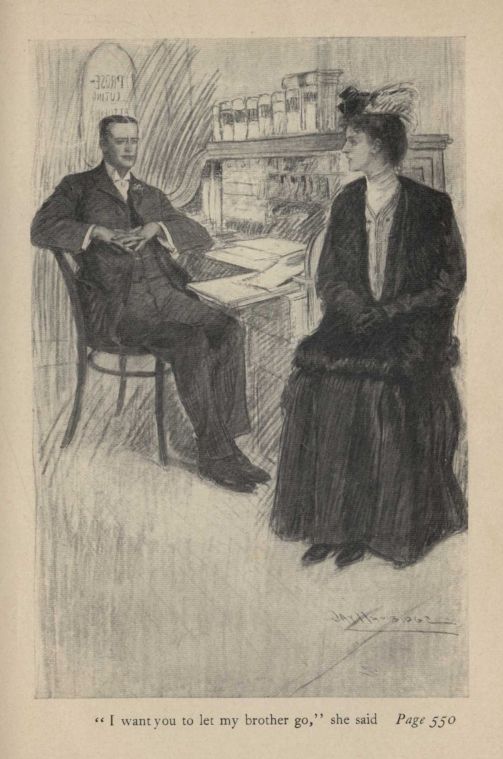
"I want you to let my brother go," she said
He compressed his lips, and she noted how very thin, how resolute they were.
"It does not altogether rest with me."
"You evade," she said. "Don't treat me--as if I were some politician." She was surprised at her own temerity. With some little fear that he might mistake her meaning, she, nevertheless, kept her gray eyes fixed on him, and went on:
"I came to ask you not to lay his case before the grand jury. I believe that is the extent of your power. I really don't know about such things." Her eyes fell, and she gently stroked the soft gray fur of her muff, as she permitted herself this woman's privilege of pleading weakness. "No one need be the loser--my father will make good the--shortage. All will be as if it never had been--all save this horrible thing that has come to us--that must remain, of course, for ever."
Then she let the silence fall between them.
"You are asking me to do a great deal."
"It seems a very little thing to me, so far as you are concerned; to us--to me--of course, it is a great thing; it means our family, our name, my father, my mother, myself--leaving Dick out of it altogether."
Eades turned away in pain. It was evident that she had said her all, and that he must speak.
"You forget one other thing," he said presently.
"What?"
"The rights of society." He was conscious of a certain inadequacy in his words; they sounded to him weak, and not at all as it seemed they should have sounded. She did not reply at once, but he knew that she was looking at him. Was that look of hers a look of scorn?
"I do not care one bit for the rights of society," she said. He knew that she spoke with all her spirit. But she softened almost instantly and added, "I do care, of course, for its opinion."
Eades was not introspective enough to realize his own superlative regard for society's opinion; it was easier to cover this regard with words about its rights.
"But society has rights," he said, "and society has placed me here to see those rights conserved."
"What rights?" she asked.
"To have the wrong-doer punished."
"And the innocent as well? You would punish my mother, my father and me, although, of course, we already have our punishment." She waited a moment and then the cry was torn from her.
"Can't you see that merely having to come here on such an errand is punishment enough for me?"
She was bending forward, and her eyes blinked back the tears. He had never loved her so; he could not bear to look at her sitting there in such anguish.
"My God, yes!" he exclaimed. He got up hastily, plunging his hands in his pockets, and walking away to his window, looked out a moment, then turned; and as he spoke his voice vibrated:
"Don't you know how this makes me suffer? Don't you know that nothing I ever had to face troubles me as this does?"
She did not reply.
"If you don't," he added, coming near and speaking in a low, guarded tone, "you don't know how--I love you."
She raised her hand to protest, but she did not look up. He checked himself. She lowered her gloved hand, and he wondered in a second of great agitation if that gesture meant the withdrawal of the protest.
"Then--then," she said very deliberately, "do this for me."
She raised her muff to hide the face that flamed scarlet. He took one step toward her, paused, struggled for mastery of himself. He remembered now that the principle--the principle that had guided him in the conduct of his office, required that he must make his decisions slowly, calmly, impersonally, with the cold deliberation of the law he was there to impersonate. And here was the woman he loved, the woman whom he had longed to make his wife, the wife who could crown his success--here, at last, ready to say the word she had so long refused to say--the word he had so long wished to hear.
"Elizabeth," he said simply, "you know how I have loved you, how I love you now. This may not be the time or the place for that--I do not wish to take an advantage of you--but you do not know some other things. I have never felt at all worthy of you. I do not now, but I have felt that I could at least offer you a clean hand and a clean heart. I have tried in this office, with all its responsibilities, to do my duty without fear or favor; thus far I have done so. It has been my pride that nothing has swerved me from the path of that plain duty. I have consoled myself ever since I knew I loved you--and that was long before I dared to tell you--that I could at least go to you with that record. And now you ask me to stultify myself, to give all that up! It is hard--too hard!" He turned away. "I don't suppose I make it clear. Perhaps it seems a little thing to you. To me it is a big thing; it is all I have."
Elizabeth was conscious for an instant of nothing but a gratitude to him for turning away. She pressed her muff against her face; the soft fur, a little cold, was comforting to her hot cheeks. She felt a humiliation now that she feared she never could survive; she felt a regret, too, that she had ever let the situation take this personal and intimate turn. For an instant she was disposed to blame Eades, but she was too just for that; she knew that she alone was to blame; she remembered that it was this very appeal she had come to make, and she contemned herself--despised herself. And then in a desperate effort to regain her self-respect, she tried to change the trend of the argument, to restore it to the academic, the impersonal, to struggle back to the other plane with him, and she said:
"If it could do any good! If I could see what good it does!"
"What!" he exclaimed, turning to her. "What good? What good does any of my work do?"
"I'm sure I don't know." As she said this, she looked up at him, met his eye with a boldness she despised in herself. Down in her heart she was conscious of a self-abasement that was almost complete; she realized the histrionic in her attitude, and in this feeling, determined now to brave it out; she added bitterly: "None, I should say."
"None!" He repeated the word, aghast. "None! Do you say that all this work I have been doing for the betterment, the purification of society does no good?"
"No good," she said; "it does no good; it only makes more suffering in the world." And she thought of all she was just then suffering.
"Where--" he could not catch his breath--"where did you get that idea?"
"In the night--in the long, horrible night." Though she was alive to the dramatic import of her words and this scene, she was speaking with sincerity, and she shuddered.
Eades stood and looked at her. He could do nothing else; he could say nothing, think nothing.
In Elizabeth's heart there was now but one desire, and that was to get away, to bring this horror to an end. She had come to save her brother; now she was conscious that she must save herself; she felt that she had hopelessly involved the situation; it was beyond remedy now, and she must get away. She rose.
"I have come here, I have humiliated myself to ask you to do a favor for me," she said. "You are not ready to do it, I see." She was glad; she felt now the dreadful anxiety of one who is about to escape an awful dilemma. "To me it seems a very simple little thing, but--"
She was going.
"Elizabeth!" he said, "let me think it over. I can not think straight just now. You know how I want to help you. You know I would do anything--anything for you!"
"Anything but this," she said. "This little thing that hurts no one, a thing that can bring nothing but happiness to the world, that can save my father and my mother and me--a thing, perhaps the only thing that can save my poor, weak, erring brother--who knows?"
"Let me think it over," he pleaded. "I'll think it over to-night--I'll send you word in the morning."
She turned then and went away.
XXVII
Elizabeth let the note fall in her lap. A new happiness suddenly enveloped her. She felt the relief of an escape. The note ran:
DEAR ELIZABETH:
I have thought it all over. I did not sleep all night, thinking of it, and of you. But--I can not do what you ask; I could not love you as I do if I were false to my duty. You know how hard it is for me to come to this conclusion, how hard it is for me to write thus. It sounds harsh and brutal and cold, I know. It is not meant to be. I know how you have suffered; I wish you could know how I have suffered and how I shall suffer. I can promise you one thing, however: that I shall do only my duty, my plain, simple duty, as lightly as I can, and nothing now can give me such joy as to find the outcome one perhaps I ought not to wish--one which in any other case would be considered a defeat for me. But I ask you to think of me, whatever may come to pass, as
Your sincere
JOHN EADES.
She leaned back in her chair, and closed her eyes; a sense of rest and comfort came to her. She was content for a while simply to realize that rest and comfort. She opened her eyes and looked out of the window over the little triangular park with its bare trees; the sky was solid gray; there was a gray tone in the atmosphere, and the soft light was grateful and restful to her eyes, tired and sensitive as they were from the loss of so much sleep. She felt that she could lie back then and sleep profoundly. Yet she did not wish to sleep--she wished to be awake and enjoy this sensation of relief, of escape. After that night and that day and this last night of suspense, it was like a reprieve--she started and her face darkened,--the thought of reprieve made her somehow think of Archie Koerner. This event had quite driven him out of her mind, coming as it had just at the climax. She had not thought of him for--how long? And Gusta! It brought the thought of her, too. Suddenly she remembered, with a dim sense of confusion that, at some time long ago, she and Gusta had talked of Archie's first trouble. Had they mentioned Dick? No, but she had thought of him! How strange! And then her thoughts returned to Eades, and she lifted the note, and glanced at it. She recalled the night at the Fords', and his proposal, her hesitation and his waiting. She let the note fall again and sighed audibly--a sigh that expressed her content. Then suddenly she started up! She had forgotten Dick--the trouble--her father!
Marriott knew what she had to say almost before the first sentence had fallen from her lips.
"I'll not pretend to be surprised, Elizabeth," he said. "I haven't expected it, but now I can see that it was inevitable."
He looked away from her.
"Poor boy!" he said. "How I pity him! He has done nothing more than to adopt the common standard; he has accepted the common ideal. He has believed them when they told him by word and deed that possession--money--could bring happiness and that nothing else can! Well--it's too bad."
Elizabeth's head was drooping and the tears were streaming down her cheeks. He pretended not to see.
"Poor boy!" he went on. "Well, we must save him, that's all."
She looked up at him, her gray eyes wide and their lashes drenched in their tears.
"How, Gordon?"
"Well, I don't know, but some way." He studied a moment. "Eades--well, of course, he's hopeless."
She could never tell him of her visit to Eades; she had told him merely of Hunter's interview with the prosecutor. But she was surprised to see how Marriott, instantly, could tell just what Eades would do.
"Eades is just a prosecutor, that's all," Marriott went on. "Heavens! How the business has hardened him! How it does pull character to shreds! And yet--he's like Dick--he's pursuing another ideal that's very popular. They'll elect Eades congressman or governor or something for his severity. But let's not waste time on him. Let's think." He sat there, his brows knit, and Elizabeth watched him.
"I wish I could fathom old Hunter. He had some motive in reporting it to Eades so soon. Of course, if it wasn't for that it would be easy. Hm--" He thought. "We'll have to work through Hunter. He's our only chance. I must find out all there is to know about Hunter. Now, Elizabeth, I'll have to shut myself up and do some thinking. The grand jury doesn't meet for ten days--we have time--"
"They won't arrest Dick?"
"Oh, it's not likely now. Tell him to stay close at home--don't let him skip out, whatever he does. That would be fatal. And one thing more--let me do the worrying." He smiled.
Marriott had hoped, when the murder trial was over, that he could rest; he had set in motion the machinery that was to take the case up on error; he had ordered his transcripts and prepared the petition in error and the motions, and he was going to have them all ready and file them at the last moment, so that he might be sure of delay. Archie had been taken to the penitentiary, and Marriott was glad of that, for it relieved him of the necessity of going to the jail so often; that was always an ordeal. He had but one more visit to make there,--Curly had sent for him; but Curly never demanded much. But now--here was a task more difficult than ever. It provoked him almost to anger; he resented it. It was always so, he told himself; everything comes at once--and then he thought of Elizabeth. It was for her!
He thought of nothing else all that day. He inquired about Hunter of every one he met. He went to his friends, trying to learn all he could. He picked up much, of course, for there was much to be told of such a wealthy and prominent man as Amos Hunter, especially one with such striking personal characteristics. But he found no clue, no hint that he felt was promising. Then he suddenly remembered Curly.
He found him in another part of the jail, where he had been immured away from Archie in order that they might not communicate with each other. With his wide knowledge and deeper nature Curly was a more interesting personality than Archie. He took his predicament with that philosophy Marriott had observed and was beginning to admire in these fellows; he had no complaints to make.
"I'm not worried," he said. "I'll come out all right. Eades has nothing on me, and he knows it. They're holding me for a bluff. They'll keep me, of course, until they get Archie out of the way, then they'll put me on the street. It wouldn't do to drop my case now. They'll just stall along with it until then. Of course--there's one danger--" he looked up and smiled curiously, and to the question in Marriott's eyes, he answered:
"You see they can't settle me for this; but they might dig up something somewhere else and put me away on that. You see the danger."
Marriott nodded, not knowing just what to say.
"But we must take the bitter with the sweet, as Eddie Dean used to say." Curly spoke as if the observation were original with Dean. "But, Mr. Marriott, there's one or two things I want you to attend to for me."
"Well," consented Marriott helplessly, already overburdened with others' cares.
"I don't like to trouble you, but there's no one I like to trust, and they won't let me see any one."
He hesitated a moment.
"It's this way," he presently went on. "I've got a woman--Jane, they call her. She's a good woman, you see, though she has some bad tricks. She's sore now, and hanging around here, and I want her to leave. She's even threatened to see Eades, but she wouldn't do that; she's too square. But she has a stand-in with McFee, and while he's all right in his way, still he's a copper, and you can't be sure of a copper. She can't help me any here, and she might queer me; the flatties might pry something out of her that could hurt me--they'll do anything. If you'll see Danny Gibbs and have him ship her, I'll be much obliged. And say, Mr. Marriott, when you're seeing him, tell him to get that thing fixed up and send me my bit. He'll understand. I don't mind telling you, at that. There's a man here, a swell guy, a banker, who does business with Dan. He's handled some of our paper--and that sort of thing, you know, and I've got a draw coming there. It ain't much, about twenty-five case, I guess, but it'd come in handy. Tell Dan to give the woman a piece of it and send the rest to me here. I can use it just now buying tobacco and milk and some little things I need. Dan'll understand all about it."
"Who is this swell guy you speak of--this banker?"
Curly looked at Marriott with the suspicion that was necessarily habitual with him, but his glance softened and he said:
"I don't know him myself. I never saw him--his name's Hunt, no, Hunter, or some such thing. Know him?"
Marriott's heart leaped; he struggled to control himself.
"Course, you understand, Mr. Marriott," said Curly, fearing he had been indiscreet, "this is all between ourselves."
"Oh, of course, you can depend on me."
He was anxious now to get away; he could scarcely observe the few decencies of decorum that the place demanded. And when he was once out of the prison, he called a cab and drove with all speed to Gibbs's place. On the way his mind worked rapidly, splendidly, under its concentration. When he reached the well-known quiet little saloon in Kentucky Street, Gibbs took him into the back room, and there, where Gibbs had been told of the desperate plights of so many men, Marriott told him of the plight of Dick Ward. When he had done, he leaned across the table and said:
"And you'll help me, Dan?"
Gibbs made no reply, but instead smoked and blinked at Marriott curiously. Just as Marriott's hopes were falling, Gibbs broke the silence:
"It's the girl you're interested in," he said gruffly, "not the kid." He looked at Marriott shrewdly, and when Marriott saw that he looked not at all unkindly or in any sense with that cynical contempt of the sentimental that might have been expected of such a man, Marriott smiled.
"Well, yes, you're right. I am interested in her."
Gibbs threw him one look and then tilted back, gazed upward to the ceiling, puffed meditatively at his cigar, and presently said, as if throwing out a mere tentative suggestion:
"I wonder if it wouldn't do that old geezer good to take a sea-voyage?"
Marriott's heart came into his throat with a little impulse of fear. He felt uneasy--this was dangerous ground for a lawyer who respected the ethics of his profession, and here he was, plotting with this go-between of criminals. Criminals--and yet who were the criminals he went between? These relations, after all, seemed to have a high as well as a low range--was there any so-called class of society whom Gibbs could not, at times, serve?
"Let's see," Gibbs was saying, "where is this now? Canada used to do, but that's been put on the bum. Mexico ain't so bad, they say, and some of them South American countries does pretty well, though they complain of the eatin', and there's nothing doing anyway. A couple of friends of mine down in New York went to a place somewhere called--let's see--called Algiers, ain't it?"
Marriott did not like to speak, but he nodded.
"Is that a warm country?"
"Yes."
"Where is it?"
"It's on the shores of the Mediterranean."
"Now that don't tell me any more than I knew before," said Gibbs, "but if the climate's good for old guys with the coin, that's about all we want. It'll make the front all right, especially at this time o' year."
Marriott nodded again.
"All right, that'll do. An old banker goes there for his health--just as if it was Hot Springs."
Gibbs thought a moment longer.
"Now, of course, the kid's father'll make it good, won't he? He'll put up?"
"Yes," said Marriott. He was rather faint and sick about it all--and yet it was working beautifully, and it must be done. Even then Ward was pacing the floor somewhere--and Elizabeth, she was waiting and depending on him. "Shall I bring you his check?"
"Hell, no!" exclaimed Gibbs. "We'll want the cash. I'll get it of him. The fewer hands, the better."
Marriott was wild to get away; he could scarcely wait, but he remembered suddenly Curly's commissions, and he must attend to them, of course. He felt a great gratitude just now to Curly.
When Marriott told Gibbs of Curly's request, Gibbs shook his head decidedly and said:
"No, I draw the line at refereeing domestic scraps. If Curly wants to go frame in with a moll, it's his business; I can't do anything." And then he dryly added: "Nobody can, with Jane; she's hell!"