Front matter (continued 7)
Reading edition
"It's none of your business what we want with him," Kouka replied with an oath. "Where is he? Hurry up!"
"You bin a detective, huh? Dot's it, a detective?"
"Yes."
"You got some bapers for him?"
"That's my business," said Kouka, advancing menacingly toward Koerner. "You tell where he is or I'll run the whole family in. Here," he said suddenly, a thought having occurred to him, "put 'em under arrest, both of 'em!"
The old man shuffled backward, leaned against the table for support and raised his crutch for protection.
"You better look oudt, Mis'er Detective," said Koerner. "You'd better look oudt. Py Gott--"
Kouka stopped, considered, then changed his mind.
"Look here, Mr. Koerner," he said. "It's no use. We know Archie's here and we want him."
"He's not here," suddenly spoke Mrs. Koerner beside him. "He's not here!"
"The hell he ain't!" said Kouka. "I saw him come in--ten minutes ago. Search the house, men." And the rummaging began again.
The men were about to enter the little room where Koerner slept: it was dark in there and one of them took the lamp.
"Look oudt!" Koerner said suddenly. "Look oudt! You go in dere if you vant to, but, py Gott, don't blame me if--"
The men suddenly halted and stepped back.
"Go on in!" commanded Kouka. "What do you want to stand there for? Are you afraid?"
Then they went, ransacked that room, threw everything into disorder and came out.
"No one there," they reported in relief.
They searched the whole house over again, and old man Koerner stood by on one leg and his crutch, with a strange, amused smile on his yellow face. At last, Kouka, lifting his black visage, looked at the ceiling, sought some way as if to an upper story, found none, and then began to swear again, cursing the old man and his wife. Finally he said to the officers:
"He's been kidding us."
Then he called his men, dashed out of the house, and with a dark lantern began seeking signs in the back yard. Near the rear fence he discovered footprints in the soft earth; they climbed over and found other footprints in the mud of the alley.
"Here they went!" cried Kouka.
V
Archie had stood for a moment in his mother's embrace; he had felt her cheek against his; he had heard her voice again. He was forgetful of everything--of Curly's presence, of all he had ever been made to suffer by himself and by others. He knew that his mother's eyes were closed and that tears were squeezing through the lids; he felt his own tears coming, but it did not matter--in that moment he could cry without being made ashamed. It was a supreme moment for him, a moment when all he had been, all he had done, all he had not done, made no difference; no questions now, no reproaches, no accusations, not even forgiveness, for there was no need of forgiveness; a moment merely of love, an incredible moment, working a miracle in which men would not believe, having lost belief in Love. It was a moment that suffused his whole being with a new, surging life, out of which--
But it was only a moment. Curly had turned away, effacing himself. Presently he started, and cast about him that habitual backward glance; he had heard a step. It was Koerner. The old man in his shirt-sleeves, swinging heavily between his crutches, paused in the doorway, and then seeing his boy, his face softened, and, balanced on his crutches, he held out his arms and Archie strode toward him.
Curly waited another moment like the first, taking the chances, almost cynically wondering how far he could brave this fate. It was still in the little room. The words were few. The moment brought memories to him as well,--but he could endure it no longer; the risk was enormous already; they were losing time. For, just as they had entered the house, in that habitual glance over the shoulder, Curly had seen the figure in the dark doorway across the street--and he knew.
"Come on, Archie," he said.
Archie turned in surprise.
"It's all off," Curly said. "We're dogged."
"Why?"
"The bulls--"
"Where?"
"Across the street--an elbow."
"Him?"
"Yes."
"The hell!"
Curly glanced toward the back room. But Archie suddenly grew stubborn.
"No," he said. "Let's stick and slug."
"Don't be a chump," said Curly.
"We're heeled."
"Well, they'd settle you in a minute."
"They can't. We can bust the bulls."
"All right," said Curly. "Be the wise guy if you want to. I'll take it on the lam for mine; they ain't going to bury me. Can I get out that way?"
He brushed past them in the doorway, and called from the kitchen:
"Besides, you've got orders."
Then Archie remembered; he looked at his mother, at his father, glanced about the little room, barren in the poverty that had entered the home, hesitated, then turned and left them standing there. As he passed through the kitchen he heard little Katie and little Jake breathing in their sleep, and the sound tore his heart.
He was over the fence and in the alley just behind Curly. They ran for a block, darted across a lighted street, then into the black alley again. For several blocks they dashed along, getting on as fast as they could. Then at length Archie, soft from his imprisonment, stopped in the utter abandon of physical exhaustion and stood leaning against a barn.
"God!" he said, "I hain't going another step! I'm all in!"
Curly had been leading the way in the tireless energy of the health his out-of-door life gave him, but when Archie stopped, he paused and stood attent, inclining his head and listening.
The night, almost half gone, was still; sounds that in the daytime and in the earlier evening had been lost in the roar of the city became distinct, trolley-cars sweeping along some distant street, the long and lonesome whistles of railroad engines, now and then the ringing of a bell; close by, the nocturnal movements of animals in the barns that staggered grotesquely along the alley.
"It's all right," said Curly; "we've made a getaway."
He relaxed and slouched over to where Archie stood.
"Where are we, do you know?" he asked.
Archie thought. "That must be Fifteenth Street down there. Yes, there's the gas house." He pointed to a dark mass looming in the night. "And the canal--and yes, Maynard's lumber-yard's right beyond."
"How far from the spill?"
"About three blocks."
"Come on, we must get out on the main stem."
They went on, but in the security they felt at not being followed, they ran no more, but paced rapidly along, side by side. They had not had the time nor the breath for talk, but now suddenly, Archie, in a tone that paid tribute to Curly's powers, expressed the subliminal surprise he had had.
"How did you know the bulls was there?"
"I piked off the elbow just as we went in."
"I didn't see him," said Archie. "Where was he?"
"Right across the street, planted in a doorway."
"How do you suppose he'd spotted us?"
"Oh, he was layin' for you, that's all. He had it all framed up. He thought he'd job you and swell himself."
"What do you think of that now!"
They reached the yard where the black shadows cast by the tall leaning piles of lumber welcomed them like friends, and through this they passed, coming out at length on the railroad. They reconnoitered. The sky of the October night was overcast by thin clouds which, gray at first, turned bright silver as they flew beneath the risen moon.
"The dog's out," said Curly, who had almost as many names for the moon as a poet.
Before them the rails gleamed and glinted; over the yards myriads of switch-lights glowed red and green, sinister and confusing. Not far away a switch-engine stood, leisurely working the pump of its air-brake, emitting steamy sighs, as if it were snatching a moment's rest from its labors. On the damp and heavy air the voices of the engineer and fireman were borne to them. At times other switch-engines slid up and down the tracks. Curly and Archie sat down in the shadow of the lumber and waited. After a while, down the rails a white light swung in an arc, the resting switch-engine moved and began to make up a freight-train.
"Now's our chance," said Curly.
The switch-engine went to and fro and up and down, whistling now and then, ringing its bell constantly, drawing cars back and forth interminably, pulling strings of them here and there, adding to and taking from its train, stopping finally for a few minutes while a heavy passenger-train swept by, its sleeping-cars all dark, rolling heavily, mysteriously, their solid wheels clicking delicately over the joints of the rails.
"I wish we were on that rattler," said Archie, with the longing a departing train inspires, and more than the normal longing. Curly laughed.
"The John O'Brien's good enough for us," he said.
The passenger-train, shrinking in size by swift perceptible degrees as it lost itself in the darkness, soon was gone. The white lantern swung again, and the switch-engine resumed its monotonous labors, confined to the tedious limits of that yard, never allowed to go out into the larger world. Gradually it worked the train it was patiently piecing together over to the side of the yard where Archie and Curly waited. Then, at last, watching their chance, they slipped out, found an open car, sprang into it, slunk out of possible sight of conductor or switchman, and were happy.
The car was bumped and buffeted up and down the yard for an hour; but Archie and Curly within were laughing at having thus eluded the officers. They sat against the wall of the car, their knees to their chins, talking under cover of the noise the cars made. After a while the engine whistled and the train moved.
When they awoke, the car was standing still and a gray light came through the cracks of the door.
"I wonder where we are," said Archie, rubbing his eyes.
Curly got up, stretched, crept to the middle of the car and looked out. Presently Archie heard him say:
"By God!"
He joined him. And there were the lumber piles. It was morning, the city was awake, the grinding of its weary mills had begun. They were just where they had been the night before.
"Marooned!" said Curly, and he laughed.
They decided, or Curly decided, that they must wait. Some of those restless switch-engines would make up another train before long, and in it they might leave the town, in which there was now no place of safety for them. The morning was cold; the chill of the damp atmosphere stiffened them. Just outside, in the lumber-yard, several men were working, and the fugitives must not be seen by them, for they would be as hostile as the whole world had suddenly become. They waited, but the men did not leave. Their task seemed to be as endless as that of the switch-engine. For a long while the railroad yards were strangely still. Now and then Curly crept to the door and peeped out; the lumber-shovers were not twenty feet away. The door on the opposite side of the car was locked. Finally, they grew restless; they decided to go out anyhow.
"Hell!" said Archie. "There's nothing to it. Let's mope."
Something of Archie's recklessness and disregard of consequences affected Curly.
"Well, all right," he said; "come on."
They went to the door of the car. And there, looking full in their faces, was a switchman with a red, rough face and a stubble of reddish beard. The switchman drew back with a curse to express his astonishment, his surprise, the sudden fright that confused and angered him.
"Come out o' that, you hobos," he called, stepping back. The men in the lumber-yard heard his sudden cry, stopped and looked up. The switchman cursed and called again.
Curly and Archie shrank into the darkness of the car. Archie had drawn his revolver.
"Put it up," said Curly, with the anger of his disappointment.
They waited and listened; the switchman's voice was heard no more; he must have gone away.
"He'll blow us to the railroad coppers. Now's our only chance!"
They went to the door, leaped out, bent their heads and ran. And instantly, with the howl of the hunter, the men in the lumber-yard, not knowing Archie or Curly or what they had done, or whether they had done anything, left their work and ran after them, raising the old hue and cry of English justice. Even the engines in the yards joined by sounding sharp, angry blasts on their whistles, and behind the little group that was rapidly becoming a mob, raced the switchman with two of the railroad's detectives.
As swiftly as they could, in their stiffness and their hunger and their cold, Archie and Curly ran down the long yards, over cinders and uneven ties. They ran for a quarter of a mile and the yard narrowed, the tracks began to converge, to unite, marking the beginning of the main line. On either side rose the clayey banks, ahead there was a narrow cut with an elevated crossing; near this was a switchman's shanty. Just then something sang over their heads, a musical humming sound. They knew the sound a bullet makes and dodged into the switchman's shanty, slammed the door behind them, locked it and, a moment later, were at bay with the mob. The crowd surged up to the very door, flung itself against the shanty. Then Curly called:
"Stand back!"
The cry of the crowd was given in a lower, angrier tone; again it hurled itself against the door, and the little shanty, painted in the yellow and white of the railroad, rocked. Another shot pierced the shanty, splintering the boards above their heads. Then Archie stepped to the little window, thrust out his revolver. There was an angry cry outside, then stillness; the crowd gave way, withdrew, and kept its distance.
"Don't push the rod!" Curly commanded. "What in hell ails you?"
"Oh, sin not leery! I'll plug 'em for keeps!"
Curly looked into Archie's white face.
"Are the bulls tailing on?" he asked.
"They're coming strong! Listen!"
"We'd better cave!" urged Curly.
"Like hell!" Archie replied. "They don't drop me without a muss now. If you want to flunk--"
Curly's face flamed and his little eyes pierced Archie.
"Look out, young fellow!" he said, taking a sudden step toward him. Archie looked at him with a sneer. Then Curly stopped.
"Look here, Dutch," he said. "Don't be a fool. We're--"
"I've told you what I'll do," said Archie, all the dogged stubbornness of his nature aroused. Then Curly seemed to lose interest. Outside they could hear the crowd again.
Half an hour passed. They heard the clang of a gong in the near-by street.
"The pie wagon," said Curly.
Archie was quiet. There was a cheer, then a voice, deep, commanding and official:
"Surrender in the name of the law!"
Curly looked a question at Archie.
"What ails you to-day?" asked Archie. "Lost your nerve?"
"I haven't lost my nut."
"We'll give you three minutes," said the voice, "then if you don't come out, holding up your hands, we'll fire."
For what seemed a long time there was utter quiet, then bullets tore through the pine boards of the little shanty and Archie sprang to the window and fired. Curly was squatting on the floor. Archie fired again, and again, and yet again.
"I've only got one left," he said, turning from the window.
"All right, then we'll cave."
Curly got up, went to the door, flung it open and held up his hands. The mob cheered.
But Archie stayed. The officer called again, Curly called, the crowd called; then the shooting began again. Presently Archie appeared in the doorway and looked about with a white, defiant face. And there, before him, a rod away, stood Kouka, revolver in hand. He saw Archie, his brow wrinkled, and he smiled darkly.
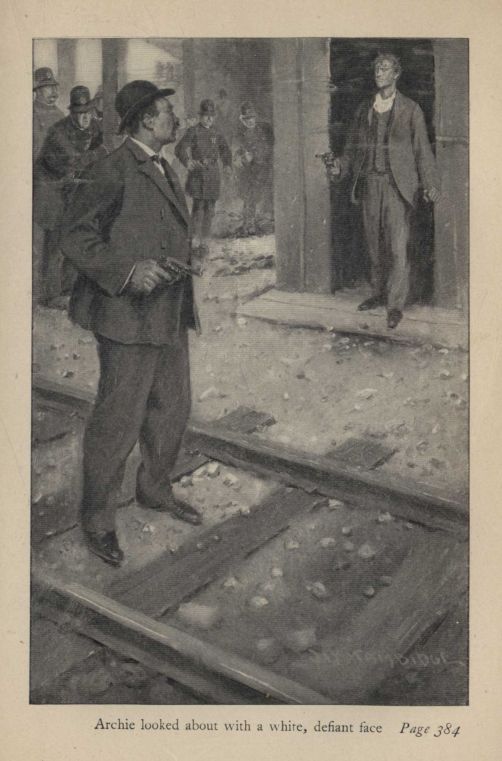
Archie looked about with a white, defiant face
"You might as well--" he began.
Archie looked at him an instant, slowly raised his revolver above his head, lowered it in deliberate aim, fired, and Kouka fell to his knees, toppled forward with a groan and collapsed in a heap on the ground, dead.
The crowd was stricken still. Archie stood looking at Kouka, his eyes burning, his face white, his smoking revolver lowered in his hand. A smile came to his pale, tense lips. Then the crowd closed in on him; the policemen, angry and ferocious, caught and pinioned him, began to club him. The crowd pressed closer, growing savage, shaking fists at him, trying to strike him. Suddenly some one began to call for a rope.
Then the policemen, so eager a moment before to wreak their own vengeance on him, were now concerned for his safety. A sergeant gave a command; they dragged Archie toward the patrol wagon. The crowd surged that way, and Archie, bareheaded, his yellow hair disordered, his eyes flashing, his white brow stained with blood, stared about on the policemen and on the crowd with a look of hatred. Then he glanced back to where some men were bending over Kouka, and he smiled again.
"Well, I croaked him all right," he said.
A patrolman struck him with a club; and he staggered as the blow fell with a sharp crash on his head.
"Get on there!" said the sergeant, cursing him. He was thrown into the patrol wagon beside Curly, and he sat there, white, with the blood trickling in two streams from his forehead, his eyes flashing, and the strange smile on his lips whenever he looked back where Kouka lay. The patrol wagon dashed away.
VI
Marriott was sensible of a hostile atmosphere the moment he entered the police station. The desk sergeant glanced at him with disapproval, kept him waiting, finally consulted an inspector, blew savagely into a speaking tube, and said:
"Here's a young lawyer to see Koerner."
The contemptuous description, the tone, the attitude, all expressed the hatred the police had for Archie, a hatred that Marriott realized would extend itself to him for taking sides with Archie. The turnkey, a thin German with cheek-bones that seemed about to perforate his sallow skin, a black mustache, and two black, glossy curls plastered on his low forehead, likewise scowled and showed reluctance.
"How many damned lawyers," he said, taking a corn-cob pipe from his mouth, "is that feller going to have, anyway?"
"Why," asked Marriott in a sudden hope that ignored the man's insolence, "have there been others?"
"Humph!" said the turnkey, jangling his heavy keys. "Only about a dozen."
"Well, I'll see him anyway."
Marriott had waited thus for Archie and for other men who had done crimes; but never for one who had killed a man. He felt a new, unpleasant sensation, a nervous apprehension, just a faint sickness, and then--Archie came.
The boy stepped into the turnkey's room with a certain air of relief; he straightened himself, stretched, and within the flannel undershirt that showed his white, muscular neck to its base, his chest expanded as he filled his lungs with the welcome air. He threw away his cigarette, came forward and pressed Marriott's hand, strongly, with hearty gratitude.
The turnkey led them to a dingy room, and locked them in a closet used as a consulting cabinet by those few prisoners who could secure lawyers. The gloom was almost as thick as the dust in the closet. Marriott thought of all the tragedies the black hole had known; and wondered if Archie had any such thoughts. He could not see Archie's face clearly, but it seemed to be clouded by too many realities to be conscious of the romantic or the tragic side of things. It was essential to talk in low tones, for they knew that the turnkey was listening through the thin, wooden partition. Marriott waited for Archie to begin.
"Well?" he said presently.
"Got a match, Mr. Marriott?" Archie asked.
Marriott drew out his silver match-box, and then looked at Archie's face glowing red in the tiny flame of the light he made for his cigarette. The action calmed and reassured Marriott Archie's face wore no unwonted or tragic expression; if his experience had changed him, it had not as yet set its mark on him. Marriott lighted a cigarette himself.
"I was afraid you wouldn't come," said Archie, dropping to the floor the match he economically shared with Marriott, and then solicitously pressing out its little embers with his foot.
"I got your message only this morning."
"Humph!" sneered Archie. "That's the way of them coppers. I asked 'em to 'phone you the morning they made the pinch."
"Well, they didn't."
"No, they've got it in for me, Mr. Marriott; they'll job me if they can. I was worried and 'fraid I'd have to take some other lawyer."
"They told me you had seen others."
"Oh, some of them guys was here tryin' to tout out a case; you know the kind. Frisby and Pennell, some of them dead ones. I s'pose they were lookin' for a little notoriety."
The unpleasant sensation Marriott felt at Archie's recognition of his own notoriety was lost in the greater disgust that he had for the lawyers who were so anxious to share that notoriety. He knew how Frisby solicited such cases, how the poor and friendless prisoners eagerly grasped at the hopes he could so shamelessly hold out to them, how their friends and relatives mortgaged their homes, when they had them, or their furniture, or their labor in the future, to pay the fees he extorted. And he knew Pennell, the youth just out of law-school, who had the gift of the gab, and was an incorrigible spouter, having had the misfortune while in college to win a debate and to obtain a prize for oratory. His boundless conceit and assurance made up for his utter lack of knowledge of law, or of human nature, his utter lack of experience, or of sympathy. He had no principles, either, but merely a determination to get on in the world; he was ever for sale, and Marriott knew how his charlatanism would win, how soon he would be among the successful of the city.
"I tell you, Archie," he was saying, "I can't consent to represent you if either of these fellows is in the case."
"Who? Them guys? Not much!" Archie puffed at his cigarette. "Not for me. I'm up against the real thing this time." He gave a little sardonic laugh.
It was difficult to discuss the case to any purpose in that little closet with its dirt and darkness, and the repressing knowledge that some one was straining to hear what they would say. Marriott watched the spark of Archie's cigarette glow and fade and glow and fade again.
"We can't talk here," said Archie. "You pull off my hearing as soon as possible, and get me out of here. When I get over to the pogey I'll have a chance to turn around, and we can talk. Bring it on as soon's you can, Mr. Marriott. Won't you? God! It's hell in that crum box, and those drunks snoring and snorting and havin' the willies all night. Can't you get it on to-morrow morning?"
"Can we be ready by then?"
"Oh, there's nothin' to it down here. We'll waive."
"We'll see," said Marriott, with the professional dislike of permitting clients to dictate how their desperate affairs should be managed. "You see I don't know the circumstances of the affair yet. All I know is what I've read in the papers."
"Oh, well, to hell with them," said Archie. "Never mind what they say. They're tryin' to stick me for that Flanagan job. You know, Mr. Marriott, I didn't have nothin' to do with that, don't you?"
Archie leaned forward in an appeal that was irresistible, convincing.
"Yes, I know that."
"All right, I want you to know that. I ain't that kind, you know. But Kouka--well, I got him, but I had to, Mr. Marriott; I had to. You see that, don't you? He agitated me to it; he agitated me to it."
He repeated the word thus strangely employed a number of times, as if it gave him relief and comfort.
"Yes, sir, he agitated me to it. I had to; that's all. It was a case of self-defense."
Marriott was silent for a few moments. Then he asked:
"Have you talked to the police?"
Archie laughed.
"They give me the third degree, but--there was nothin' doin'."
Marriott was relieved to find that he did not have to face the usual admission the police wring from their subjects, but Archie went on:
"Of course, that don't make no difference. They can frame up a confession all right."
"They'd hardly do anything that desperate," said Marriott, though not with the greatest assurance.
"Well," said Archie, "I wouldn't put it past 'em."
Marriott finished his cigarette in a reflective silence, dropped it to the floor and imitated Archie in the care with which he extinguished it. Then he sighed, straightened up and said:
"Well, Archie, let's get down to business; tell me the particulars."
And Archie narrated the events that led up to the tragedy.
"I wanted to see the old people--and the kids--and Gus." He was silent then, and Marriott did not break the silence.
"Say, Mr. Marriott," the boy suddenly asked, "where is Gus?"
"I don't know."
"What's become of her? Do you know that?"
"N-no--," said Marriott. He felt that Archie was eying him shrewdly.
"You know," said Archie in the lowest tone, "I'm afraid, I've got a kind of hunch--that she's--gone wrong."
Marriott feared his own silence, but he could not speak.
"Hell!" Archie exclaimed, in a tone that dismissed the question. "Well, I wanted to go home, and I goes, Curly and me. Kouka followed; he plants himself across the street, gets the harness bulls, and they goes gunning. Curly, he sees him--Curly can see anything. We lammed. The coppers misses us; and we gets on a freight-car. They cuts that car out, and we stays in it all night. Damn it! Did you ever hear o' such luck? Now did you, Mr. Marriott?"
Marriott owned that he had not.
"In the morning," Archie went on, "they lagged us and we ran--they began to shoot, and--"
He stopped.
"Well," he said very quietly. "I had my rod, and barked at Kouka. I got him."
Marriott wished that he could see Archie's face. It was not so dim in there as it had been, or so it seemed to Marriott, for his eyes had accommodated themselves to the gloom, but he could not read Archie's expression. He waited for him to go on. He was intensely interested now in the human side of the question; the legal side might wait. He longed to put a dozen questions to Archie, but he dared not; he felt that he could not profane this soul that had erred and gone astray, by prying out its secrets; he was conscious only of a great pity. He thought he might ask Archie if he had shot, aimed, intentionally; he wished to know just what had been in the boy's heart at that moment: then he had a great fear that Archie might tell him. But Archie was speaking again.
"Say, Mr. Marriott," he said, "could you go out to my home and get me some clothes? I want to make as good a front as I can when I go into court."
"Your clothes seem pretty good; they look new. They gave them to you, I suppose, at the penitentiary?"
Archie laughed.
"I'd look like a jay in them stir clothes," he said. "These--well, these ain't mine," he added simply. "But get me a shirt, if you can, and a collar and--a tie--a blue one. And say, if you can, get word to the folks--tell 'em not to worry. And if you can find Gus, tell her to come down. You know."
Marriott went out into the street, glad of the sunlight, the air, the bustle of normal life. And yet, as he analyzed his sensations, he was surprised to note that the whole affair had lacked the sense of tragedy he had expected; it all seemed natural and commonplace enough. Archie was the same boy he had known before. The murder was but an incident in Archie's life, that was all, just as his own sins and follies and mistakes were incidents that usually appeared to be necessary and unavoidable--incidents he could always abundantly account for and palliate and excuse and justify. Sometimes it seemed that even good grew out of them. Sometimes! Yes, always, he felt, else were the universe wrong. And after all--where was the difference between sins? What made one greater than another? Wherein was the murder Archie had done worse than the unkind word he, Gordon Marriott, had spoken that morning? But Marriott put this phase of the question aside, and tried to trace Archie's deed back to its first cause. As he did this, he became fascinated with the speculation, and his heart beat fast as he thought that if he could present the case to a jury in all its clarity and truth--perhaps--perhaps--
VII
Archie did not have his hearing the next morning. The newspapers said "the State" was not ready, which meant that Allen, the prosecutor, and the police were not ready. Quinn and Allen had conferences. They felt it to be their duty to have Archie put to death if possible, and they were undecided as to which case would the better insure this result. Allen found legal difficulties; there was a question whether or not the murder of Kouka had been murder in the first degree. Hence he wished to have Bridget Flanagan identify Archie.
Several days elapsed, and then one morning, Bentley, the sheriff, brought Bridget Flanagan to the Central Police Station in a carriage. Allen and Cleary and Quinn, with several officers and reporters, were waiting to witness her confrontation of Archie.
The old woman was dressed in black; she wore a black shawl and a black bonnet, but these had faded independently of each other, so that each was now of its own dingy shade. The dress had a brown cast, the shawl a tone of green, the bonnet was dusty and graying, and the black veil that was tightly bound about her brow, like the band of a nun, had been empurpled in the process of decay. She leaned heavily on Bentley, tottering in her weakness, now and then lifting her arms with a wild, nervous gesture. Bentley's huge, disproportionate bulk moved uncertainly beside her, lurching this way and that, as if he feared to step on her feet or her ancient gown, finding it difficult, at arm's length, to support and guide her. But at last he got her to a chair. At the edge of the purplish veil bound across the hairless brows, a strip of adhesive plaster showed. The old woman wearily closed the eyes that had gazed on the horrors of the tragedy; her mouth moved in senile spasms. Now and then she mumbled little prayers that sounded like oaths; and raised to her lips the little ball into which she had wadded her handkerchief. And she sat there, her palsied head shaking disparaging negatives. The police, the detectives, the prosecutor, the reporters looked on. They said nothing for a long time.
Cleary, trying to speak with an exaggerated tenderness, finally said:
"Miss Flanagan, we hate to trouble you, but we won't keep you long. We think we have the man who killed your dear sister--we'd like to have you see him--"
The old woman started, tried to get up, sank back, made a strange noise in her throat, pushed out her hands toward Cleary as if to repulse him and his suggestion, then clasped her hands, wrung them, closed her eyes, swayed to and fro in her chair and moaned, ejaculating the little prayers that sounded like oaths. Cleary waited. Quinn brought a glass of water. Presently the old woman grew calm again; after a while Cleary renewed his suggestion. The old woman continued to moan. Cleary whispered to two policemen and they left the room. The policemen were gone what seemed a long time, but at last they appeared in the doorway, and between them, looking expectantly about him, was Archie Koerner. The policemen led him into the room, the group made way, they halted before the old woman. Cleary advanced.
"Miss Flanagan," he said very gently, standing beside her, and bending assiduously, "Miss Flanagan, will you please take a look now, and tell us--if you ever saw this man before, if he is the man who--"
Wearily, slowly, the old woman raised her blue eyelids; and then she shuddered, started, seemed to have a sudden access of strength, got to her feet and cried out:
"Oh, my poor sister! my poor sister! You kilt her! You kilt her!"
Then she sank to her knees and collapsed on the floor. Bentley ran across the room, brought a glass of water, and stood uncertainly, awkwardly about, while the others bore the old woman to a couch, stretched her out, threw up a window, began to fan her with newspapers, with hats, anything. Some one took the water from the sheriff, pressed the glass to the old woman's lips; it clicked against her teeth.
Then Cleary, Quinn, Bentley, the policemen, the detectives, the reporters, looked at one another and smiled, Cleary bent over the old woman.
"That's all, Miss Flanagan. You needn't worry any more. We're sorry we had to trouble you, but the law, you know, and our duty--"
He repeated the words "law" and "duty" several times. Meanwhile Archie stood there, between the two policemen. He looked about him, at the men in the room, at the old woman stretched on the lounge; finally his gaze fastened on Cleary, and his lips slowly curled in a sneer, and his face hardened into an expression of utter scorn.
"Take him down!" shouted Cleary angrily.
The reporters rushed out. An hour later the extras were on the streets, announcing the complete and positive identification of Archie Koerner by Bridget Flanagan.
"The hardened prisoner," the reports said, "stood and sneered while the old woman confronted him. The police have not known so desperate a character in years."
VIII
Marriott had attended to all of Archie's commissions, save one--that of telling Gusta to go to him. He had not done this because he did not know where to find her. But Gusta went herself, just as she seemed to do most things in life, because she could not help doing them, because something impelled, forced her to do them,--some power that made sport of her, using a dozen agencies, forces hereditary, economic, social, moral, all sorts--driving her this way and that. She had read of the murder, and then, with horror, of Archie's arrest. She did not know he was out of prison until she heard that he was in prison again. She began to calculate the time that had flowed by so swiftly, making such changes in her life. Her first impulse was to go to him, but now she feared the police. She recalled her former visits, that first Sunday at the workhouse, on which she had thought herself so sad, whereas she had not begun to learn what sorrow was. She recalled the day in the police station a year before, and remembered the policeman who had held her arm so suggestively. She read the newspapers eagerly, absorbed every detail, her heart sinking lower than it had ever gone before. When she read that Marriott was to defend Archie, she allowed herself to hope. The next day she read an account of the identification of Archie by the surviving Flanagan sister, and then, when hope was gone, she could resist no longer the impulse to go to him.
She paused again at the door of the sergeant's room, her heart beating painfully with the fear that showed itself in little white spots on each side of her nostrils; then the timid parleying with the officers, the delay, the suspicion, the opposition, the reluctance, until an officer in uniform took her in charge, led her down the iron stairway to the basement, and had the turnkey open the prison doors. Archie came to the bars, and peered purblindly into the gloom. And Gusta went close now, closer than she had ever gone before; the bars had no longer the old meaning for her, they had no longer their old repulsion, and she looked at Archie no more with the old feeling of reproach and moral superiority. In fact, she judged no more; sin had healed her of such faults as self-satisfaction and moral complacency; it had softened and instructed her, and in its great kindness revealed to her her own relation to all who sin, so that she came now with nothing but compassion, sympathy and love. Tears were streaming down her cheeks.
"Oh, Archie!" she said. "Oh, Archie!"
Archie looked at her and at the officers. Gusta was oblivious; she put her face to the greasy bars, and pressed her lips mutely between them. Archie, who did not like to cry before an officer and before the other prisoners, struggled hard. Then he kissed her, coldly.
"Oh, Archie, Archie!" was all she could say, putting all her anguish, her distress, her sorrow, her impotent desire to help into the varying inflections of her tone.
"Oh, Archie! Archie! Archie!"
She spoke his name this last time as if she must find relief by wringing her whole soul into it. Then she stood, biting her lip as if to stop its quivering. Archie, on his part, looked at her a moment, then at the floor.
"Say you didn't do it, Archie."
"Do what?"
"You know--"
"You mean Kouka?"
"Oh, no," she said, impatient with the question.
"That Flanagan job?"
She nodded rapidly.
"Of course not; you ought to know that. Every one knows that--even the coppers." His sentence ended with a sneer cast in the officer's direction. And Gusta sighed.
"I'm so glad!" she said, her bosom rising and falling in relief. "They all said--"
"Oh, that's just the frame-up," said Archie. "They'd job me for it quick enough." He was sneering again at the officer, as incarnating the whole police system, and his face was darkened by a look of all hatred and malignity. The officer smiled calmly.
"I'm so glad," Gusta was smiling now. "But--" she began. Her lip quivered; the tears started afresh. "What about the other?"
"That was self-defense; he agitated me to it. But don't let's talk before that copper there--" He could not avert his look of hatred from the officer, whose face was darkening, as he plucked nervously at his mustache.
"He'd say anything--that's his business," Archie went on, unable to restrain himself.
"Sh! Don't, Archie!" Gusta said. "Don't!"
Archie drew in full breaths, inflating his white chest. The officer returned his look of hatred, his bronzed face had taken on a shade of green; the two men struggled silently, then controlled themselves. Gusta was trying again to choke down her sobs.
"How's father?" Archie asked, after a silence, striving for a commonplace tone.
"He's well,--I guess."
"He knows, does he?"
"I--don't know."
"What! Why--can't you tell him? He could get down here, couldn't he? He had a crutch when I was there."
She was silent, her head drooped, the flowers in her hat brushed the bars at Archie's face. She thrust the toe of a patent-leather boot between the bars at the bottom of the door. The tips of her gloved fingers touched the bars lightly; there was a slight odor of perfume in the entry-way.
"You see," she said, "I--I can't go out there--any more." Her tears were falling on the cement floor, falling beside the iron bucket in which was kept the water for the prisoners to drink.
"Oh!" said Archie coldly.
She looked up suddenly, read the meaning of his changed expression, and then she pressed her face against the bars tightly, and cried out:
"Oh, Archie! Don't! Don't!"
He was hard with her.
"By God!" he said. "I don't know why you should have--oh, hell!"
He whirled on his heel, as if he would go away.
She clung to the bars, pressing her face against them, trying, as it were, to thrust her lips through them.
"Oh, Archie!" she said. "Archie! Don't do that--don't go that way! Listen--listen--listen to your sister! I'm the same old Gus--honest, honest, Archie! Listen! Look at me!"
He had thrust his hands into his pockets and walked to the end of the corridor. He paused there a moment, then turned and came back.
"Say, Gus," he said, "I wish you'd go tell Mr. Marriott I want to see him again. And say, if you go out to the house, see if you can't find that shirt of mine with the white and pink stripes--you know. I guess mother knows where it is. Do that now. And--"
"Time's up," said the officer. "I've got to go."
"And come down to-morrow, Gus," said Archie. She scarcely heard him as she turned to go.
"Hold on!" he called, pressing his face to the bars. "Say! Gus! Come here a minute."
She returned. She lifted her face, and he kissed her through the bars. And she went away, with sobs that racked her whole form.
As she started out by the convenient side door into the alley, the officer laid a hand on her shoulder.
"This way, young woman."
She looked at him a moment.
"You'd better go out the other door," he said.
She climbed the steps behind him, wondering why one door would not do as well as another. She had always gone out that side door before. When they were up-stairs, passing the sergeant's room, he touched her again.
"Hold on," he said.
"What do you want?" she asked in surprise,
"I guess you'd better stay here."
"Why?" she exclaimed. Her surprise had become a great fear. He made no reply, and pushed her into the sergeant's room. Then he whistled into a tube--some one answered. "Come down," he commanded. Presently a woman appeared, a woman with gray hair, in a blue gingham gown something like a nurse's uniform, with a metal badge on her full breast.
"Matron," said the officer, "take this girl in charge."
"Why! What do you mean?" Gusta exclaimed, her eyes wide, her lips parted. "What do you mean? What have I done? What do you--am I--arrested?"
"That's what they call it," said the officer.
"But what for?"
"You'll find out in time. Take her up-stairs, Matron."
Gusta looked at the officer, then at the matron. Her face was perfectly white.
The matron drew near, put her arm about her, and said:
"Come with me."
Gusta swayed uncertainly, tottered, then dragged herself off, leaning against the matron, walking as if in a daze.
IX
It had been months since Marriott had gone up those steps at the Wards', and he mounted them that November evening with a regret at the loss of the old footing, and an impatience with the events that had kept him away. He had waited for some such excuse as Gusta's commission now gave him, and the indignation he felt at the girl's arrest was not strong enough to suppress his gratitude for the opportunity the injustice opened to him. He was sure that Elizabeth knew he was to defend Archie; she must know how sensitive he was to the criticism that was implied in the tone with which the newspapers announced the fact. The newspapers, indeed, had shown feeling that Archie should be represented at all. They had published warnings against the law's delays, of which, they said, there had already been too many in that county, forgetting how they had celebrated the success and promptness, the industry and enterprise of John Eades. They had spoken of Archie as if he were a millionaire, about to evade and confound law and justice by the use of money. Marriott told himself, bitterly, that Elizabeth's circle would discuss the tragedy in this same tone, and speak of him with disappointment and distrust; that was the attitude his own friends had adopted; that was the way the lawyers and judges even had spoken to him of it; he recalled how cold and disapproving Eades had been. This recollection gave Marriott pause; would it not now be natural for Elizabeth to take Eades's attitude? He shrank from the thought and wished he had not come, but he was at the door and he had Gusta's message--impossible as it seemed after all these thoughts had crossed his mind.
She received him in her old manner, without any of the stiffness he had feared the months might have made.
"Ah, Gordon," she said. "I'm so glad you came."
She led the way swiftly into the library. A little wood fire, against the chill of the autumn evening, was blazing in the wide fireplace; under the lamp on the broad table lay a book she must have put down a moment before.
"What have you been reading? Oh, Walden!" And he turned to her with the smile of their old comradeship in such things.
"I've been reading it again, yes," she said, "and I've wished to talk it over again with you. So you see I'm glad you came."
"I came with a message from--"
"Oh!" The bright look faded from her eyes. "Well, I'm glad, then, that some one sent you to me."
He saw his mistake, and grieved for it.
"I wanted to come," he stammered. "I've been intending to come, Elizabeth, anyway, and--"
He felt he was only making the matter worse, and he hated himself for his awkwardness.
"Well," she was saying, "sit down then, and tell me whom this fortunate message is from."
She leaned back in her chair, rather grandly, he felt. He regretted the touch of formality that was almost an irony in her speech. But he thought it best to let it pass,--they could get back to the old footing more quickly if they did it that way.
"You'd never guess," he said.
"I'll not try. Tell me."
"Gusta."
"Gusta!" Elizabeth leaned forward eagerly, and Marriott thought that he had never before seen her so good to look upon; she was so virile, so alive. He noted her gray eyes, bright with interest and surprise, her brown hair, too soft to be confined in any conventional way, and worn as ever with a characteristic independence that recognized without succumbing to fashion. He fixed his eyes on her hands, white, strong, full of character. And he bemoaned the loss of those months; why, he wondered, had he been so absurd?
"Gusta!" she repeated. "Where did you see Gusta?"
"In prison."
"What! No! Oh, Gordon!" she started with the shock, and Marriott found this attitude even more fascinating than the last; her various expressions changing swiftly, responding with instant sensitiveness to every new influence or suggestion, were all delightful.
"What for? Tell me! Why don't you tell me, Gordon? Why do you sit there?"
Her eyes flashed a reproach at him--and he smiled. He was wholly at ease now.
"For nothing. She's done nothing. She went to see Archie, and the police, stupid and brutal as usual, detained her. That's all; they placed the charge of suspicion against her to satisfy the law. The law!"
He sneered out the word.
Elizabeth had fallen back in her chair with an expression of pain.
"Oh, Gordon!" she said with a shudder. "Isn't it horrible, horrible!"
"Horrible!" he echoed.
"That poor Koerner family! What can the fates be about? You know--you know it all seems to come so near. Such things happen in the world, of course, every day the newspapers, the dreadful newspapers, are filled with them. But they never were real at all, because they never happened to people I knew. But this comes so near. Just think. I've seen that Archie Koerner, and he has spoken to me, and to think of him now, a murderer! Will--they hang him?"
She leaned forward earnestly.
"No," he said slowly. "They may electrocute him though--to use their barbarous word."
"And now Gusta's in prison!" Elizabeth went on, forgetting Archie. "But her message! You haven't given me her message!"
Marriott waited a moment, perhaps in his inability to forego the theatrical possibilities of the situation.
"She wants you--to come to her."
Elizabeth stared at him blankly.
"To come to her?"
"Yes."
"In prison?"
"Yes."
Her brows contracted, her eyes winked rapidly.
"But Gordon, how--how can I?"
"I don't know." He sat at his ease in the great chair, enjoying the meaning, the whole significance of her predicament. He had already appreciated its difficulties, its impossibilities, and he was prepared now to wring from every one of them its last sensation. Elizabeth, with her elbow on the arm of her chair, her laces falling away from her white forearm, bit her lip delicately. She seemed to be looking at the toe of her suede shoe.
"Poor little thing!" She spoke abstractedly, as if she were oblivious to Marriott's presence. He was satisfied; it was good just then to sit, merely, and look at her. "I must go to her." And then suddenly she looked up and said in another tone:
"But how am I to do it, Gordon?"
He did not answer at once and she did not wait for a reply, but went on, speaking rapidly, her eyes in a dark glow as her interest was intensified.
"Isn't it a peculiar situation? I don't know how to deal with it. I never was so placed before. You must see the difficulties, Gordon. People, well, people don't go to such places, don't you know? I really don't see how it is possible; it makes me shudder to think of it! Ugh!" She shrugged her shoulders. "What shall you say to her, Gordon?" She said this as if the problem were his, not hers, and showed a relief in this transfer of the responsibility.
"I don't know yet," he said. "Whatever you tell me."
"But you must tell her something; you must make her understand. It won't do for you to hurt the poor girl's feelings."
"Well, I'll just say that I delivered her message and that you wouldn't come."
"Oh, Gordon! How could you be so cruel? You certainly would not be so heartless as to say I wouldn't!"
"Well, then, that you couldn't."
"But she would want a reason, and she'd be entitled to one. What one could you give her? You must think, Gordon, we must both think, and decide on something that will help you out. What are you laughing at?"
"Why, Elizabeth," he said, "it isn't my predicament. It's your predicament."
He leaned back in his chair comfortably, in an attitude of irresponsibility.
"How can you sit there," Elizabeth said, "and leave it all to me?"
And then she laughed,--and was grave again.
"Of course," she said. "Well--I'm sure I can't solve it. Poor little Gusta! She was so pretty and so good, and so--comfortable to have around--don't you know? Really, we've never had a maid like her. She was ideal. And now to think of her--in prison! Isn't it awful?"
Marriott sat with half-closed eyes and looked at her through the haze of his lashes. The room was still; the fire burned slowly in the black chimney; now and then the oil gurgled cozily in the lamp.
"What is a prison like, Gordon? Is it really such an awful place?"
Marriott thought of the miserable room in the women's quarters, with its iron wainscoting, the narrow iron bed; the wooden table and chair, and he contrasted it with this luxurious library of the Wards.
"Well," he said, turning rather lazily toward the fire, "it's nothing like this."
"But,"--Elizabeth looked up suddenly with the eagerness of a new idea,--"can't you get her out on bail--isn't that what it's called? Can't you get some kind of document, some writ?--yes, that's it." She spoke with pleasure because she had found a word with a legal sound. "Get a writ. Surely you are a lawyer clever enough to get her out. I always thought that any one could get out of prison if he had a good lawyer. The papers all say so."
"You get in prison once and see," said Marriott.
"Mercy, I expect to be in prison next!" Elizabeth exclaimed. "Prisons! We seem to have had nothing but prisons for a year or more. I don't know what started it--first it was that poor Harry Graves, then Archie, and now it's Gusta. And you talk of them and John Eades talks of them--and I had to see them one night taking some prisoners to the penitentiary. I'd never even thought of prisons before, but since then I've thought of nothing else; I've lived in an atmosphere of prisons. It's just like a new word, one you never heard before,--you see it some day, and then you're constantly running across it. Don't you know? It's the same way with history--I never knew who Pestalozzi was until the other day; never had heard of him. But I saw his name in Emerson, then looked him up--now everything I read mentions him. And oh! the memory of those men they were taking to the penitentiary! I'll never escape it! I see their faces always!"
"Were they such bad faces?"
"Oh, no! such poor, pale, pathetic faces! Just like a page from a Russian novel!"
The memory brought pain to her eyes, and she suffered a moment. Then she sat erect and folded her hands with determination.
"We might as well face it, Gordon, of course. I just can't go; you see that, don't you? What shall we do?"
"You might try your Organized Charities." His eyes twinkled.
"Don't ever mention that to me," she commanded. "I never want to hear the word. That's a page from my past that I'm ashamed of."
"Ashamed! Of the Organized Charities?"
"Oh, Gordon, I needn't tell you what a farce that is--you know it is organized not to help the poor, but to help the rich to forget the poor, to keep the poor at a distance, where they can't reproach you and prick your conscience. The Organized Charities is an institution for the benefit of the unworthy rich." Her eyes showed her pleasure in her epigram, and they both laughed. But the pleasure could not last long; in another instant Elizabeth's hands fell to her lap, and she looked at Marriott soberly. Then she said, with hopeless conviction:
"I just can't go, Gordon."
Before Marriott could reply there was a sense of interruption; he heard doors softly open and close, the muffled and proper step of a maid, the well-known sounds that told him that somewhere in the house a bell had rung. In another moment he heard voices in the hall; a laugh of familiarity, more steps,--and then Eades and Modderwell and Mrs. Ward entered the room. Elizabeth cast at Marriott a quick glance of disappointment and displeasure; his heart leaped, he wondered if it were because of Eades's coming. Then he decided, against his will, that it was because of Modderwell. A constraint came over him, he suddenly felt it impossible that he should speak, he withdrew wholly within himself, and sat with an air of detachment.
The clergyman, stooping an instant to chafe his palms before the fire, had taken a chair close to Elizabeth, and he now began making remarks about nothing, his clean, ruddy face smiling constantly, showing his perfect teeth, his eyes roving over Elizabeth's figure.
"Well! Well! Well!" he cried. "What grave questions have you two been deciding this time?"
Elizabeth glanced at Marriott, whose face was drawn, then at Eades, who sat there in the full propriety of his evening clothes, then at her mother, seated in what was considered the correct attitude for a lady on whom her rector had called.
"I think it's good we came, eh, Eades?" the clergyman went on, without waiting for an answer. "It is not good for you to be too serious, Miss Elizabeth,--my pastoral calls are meant as much as anything to take people out of themselves." He laughed again in his abundant self-satisfaction and reclined comfortably in his chair. And he rolled his head in his clerical collar, with a smile to show Elizabeth how he regarded duties that in all propriety must not be considered too seriously or too sincerely. But Elizabeth did not smile. She met his eyes calmly.
"Dear me," he said, mocking her gravity. "It must have been serious."
"It was," said Elizabeth soberly. "It was--the murder!"
"The murder! Shocking!" said Modderwell. "I've read something about it. The newspapers say the identification of Koerner by that poor old woman was complete and positive; they say the shock was such that she fainted, and that he stood there all the time and sneered. I hope, Eades, you will see that the wretch gets his deserts promptly, and send him to the gallows, where he belongs!"
"Marriott here doesn't join you in that wish, I know," said Eades.
"No? Why not?" asked Modderwell. "Surely he--"
"He's going to defend the murderer." Eades spoke in a tone that had a sting for Marriott.
"Oh!" said Modderwell rather coldly. "I don't see how you can do such a thing, Marriott. For your own sake, as much as anybody's, I'm sorry I can't wish you success."
"I wish he hadn't undertaken the task," said Eades.
"I'm sure it must be most disagreeable," said Mrs. Ward, feeling that she must say something.
"Why do you wish it?" said Marriott, suddenly turning almost savagely on Eades.
"Why," said Eades, elevating his brows in a superior way, "I don't like to see you in such work. A criminal practice is the disreputable part of the profession."
"But you have a criminal practice."
"Oh, but on the other side!" said Modderwell. "And we all expect so much better things of Mr. Marriott."
"Oh, don't trouble yourselves about me!" said Marriott. "I'm sure I prefer my side of the case to Eades's."
The atmosphere was surcharged with bitterness. Mrs. Ward gave a sidelong glance of pain, deprecating such a contretemps.
"And I'm going to try to save him," Marriott was forging on.
"Well," said Eades, looking down on his large oval polished nails, and speaking in a tone that would finally dispose of the problem, "for my part, I revere the law and I want to see it enforced."
"Exactly!" Modderwell agreed. "And if there were fewer delays in bringing these criminals to justice, there would be fewer lynchings and more respect for the law."
Marriott did not even try to conceal the disgust with which he received this hackneyed and conventional formula of thoughtless respectability. He felt that it was useless to argue with Eades or Modderwell; it seemed to him that they had never thought seriously of such questions, and would not do so, but that they were merely echoing speeches they had heard all their lives, inherited speeches that had been in vogue for generations, ages, one might say.
"I am sure it must be a most disagreeable task," Mrs. Ward was saying, looking at her daughter in the hope that Elizabeth might relieve a situation with which she felt herself powerless to deal. Marriott seemed always to be introducing such topics, and she had the distaste of her class for the real vital questions of life. But Elizabeth was speaking.
"I'm sure that Gordon's task isn't more disagreeable than mine."
"Yours?" Mrs. Ward turned toward her daughter, dreading things even worse now.
"Yes," replied Elizabeth, looking about in pleasure at the surprise she had created.
"Why, what problem have you?" asked Modderwell.
"I've been sent for--to come to the prison to see--"
"Not him!" said Modderwell.
Eades started suddenly forward.
"No," said Elizabeth calmly, enjoying the situation, "his sister."
"His sister!"
"Yes," she turned to her mother. "You know, dear; Gusta. She's been arrested."
"Oh!" exclaimed Mrs. Ward. "Elizabeth! The idea! What impertinence! Who could have brought such an insolent message!" She looked at Marriott, as did the others.
"The idea!" Mrs. Ward went on. "Why, I had no notion he was her brother. To think of our harboring such people!"
Mrs. Ward stiffened in her chair, with glances from time to time for Marriott and Elizabeth, in an attitude of chilling and austere social disapproval; then, as if she had forgotten to claim the reassurance she felt to be certain, she leaned forward, out of the attitude as it were, to say:
"Of course you sent the reply her assurance deserved."
"No," said Elizabeth in a bird-like tone, "I didn't. What would you do, Mr. Eades?"
"Why, of course you could not go to a prison," replied Eades.
"But you could, couldn't you? And you do?"
"Only when necessary."
"But you do, Mr. Modderwell?"
"Only professionally," said Modderwell solemnly, for once remembering his clerical dignity.
"Oh, professionally!" said Elizabeth with a meaning. "You go professionally, too, Gordon, don't you? And I--I can't go that way. I can go only--what shall I say?--humanly? So I suppose I can't go at all!"
"Certainly not," said Mrs. Ward. "How can you ask such a question?" She was now too disapproving for words. "I can not consent to your going at all, so let that end it."
"But, Mr. Modderwell," said Elizabeth, with a smile for her mother, "we pray, don't we, every Sunday for 'pity upon all prisoners and captives'?"
"That's entirely different," said Modderwell.
"What does it mean,--'I was in prison and ye visited me'?" She sat with her hands folded in humility, as if seeking wisdom and instruction.
"That was in another day," said Modderwell. "Society was not organized then as it is now; it was--all different, of course." Modderwell went on groping for justification. "If these people are repentant--are seeking to turn from their wickedness, the church has appointed the clergy to visit them and give them instruction."
"Then perhaps you'd better go!" Elizabeth's eyes sparkled, and she looked at Modderwell, who feared a joke or a trap; then at Eades, who was almost as deeply distressed as Mrs. Ward, and then at Marriott, whose eyes showed the relish with which he enjoyed the situation.
"I don't think she wishes to see me," said Modderwell, with a significance that did not have a tribute for Gusta. No one disputed him, and there was silence, in which Eades looked intently at Elizabeth, and then, just as he seemed on the point of speaking to her, he turned to Marriott and said:
"You certainly don't think that a proper place for her to go?"
"Oh," said Marriott, "don't refer to me; I'm out of it. I've been, I brought the message--it's--it's up to Elizabeth."
"Well," said Eades, turning to Elizabeth, "you surely can't be seriously considering such a thing. You don't know, of course, what kind of place that is, or what kind of people you would be going among, or what risks you would be exposing yourself to."
"There would be no danger, would there?" said Elizabeth in her most innocent manner. "There would be plenty of policemen at hand, wouldn't there,--in case of need?"
"Well, I don't think you'd willingly elect to go among policemen," said Eades.
"Perhaps you three would go with me?" suggested Elizabeth. "I'd be safe then--all I'd lack would be a physician to make my escort completely representative of the learned professions."
"The newspaper men would be there," said Eades, "you may be sure of that, and the publicity--"
At the word "publicity" Mrs. Ward cringed with genuine alarm.
"Do you find publicity so annoying?" asked Elizabeth, smiling on the three men.
"Elizabeth!" said Mrs. Ward, "I do wish you'd stop this nonsense! It may seem very amusing to you, but I assure you it is not amusing to me; I find it very distressing." She looked her distress, and then turned away in the disgust that was a part of her distress. "It would be shocking!" she said, when she seemed to them all to have had her say.
"I'm sorry to shock you all," said Elizabeth meekly. "It's very kind of you, I'm sure, to act as mentors and censors of my conduct. I feel sufficiently put down; you have helped me to a decision. I have decided, after hearing your arguments, and out of deference to your sentiments and opinions, to--"
They all looked up expectantly.
"--to go," she concluded.
She smiled on them all with serenity; and they looked at her with that blank helplessness that came over them whenever they tried to understand her.
X
Though Elizabeth, as long as Eades and Modderwell were there, had chosen to satirize her predicament, and had experienced the pleasure of shocking them by the decision she reached, she found when they had gone that night, and she was alone in her room, that it was no decision at all. The situation presented itself in all seriousness, and she found that she must deal with it, not in any whimsical spirit, but in sober earnestness. She found it to be a real problem, incapable of isolation from those artificialities which were all that made it a problem. She had found it easy and simple enough, and even proper and respectable to visit the poor in their homes, but when she contemplated visiting them in the prisons which seemed made for them alone, and were too often so much better than their homes, obstacles at once arose. As she more accurately imagined these obstacles, they became formidable. She sat by the table in her room, under the reading-lamp that stood among the books she kept beside her, and determined to think it out. She made elaborate preparations, deciding to marshal all the arguments and then make deductions and comparisons, and thus, by a process almost mathematical, determine what to do. But she never got beyond the preparations; her mind worked, after all, intuitively, she felt rather than thought; she imagined herself, in the morning, going to the police station, confronting the officers, finally, perhaps, seeing Gusta. She saw clearly what her family, her friends, her set, the people she knew, would say--how horrified they would be, how they would judge and condemn her. Her mother, Eades and Modderwell accurately represented the world she knew. And the newspapers, in their eagerness for every detail touching the tragedy, however remotely, would publish the fact! "This morning Miss Elizabeth Ward, daughter of Stephen Ward, the broker, called on the Koerner girl. Fashionably dressed--" She could already see the cold black types! It was impossible, unheard of. Gusta had no right--ah, Gusta! She saw the girl's face, pretty as ever, but sad now, and stained by tears, pleading for human companionship and sympathy. She remembered how Gusta had served her almost slavishly, how she had sat up at night for her, and helped her at her toilet, sending delicious little thrills through her by the magnetic touch of her soft fingers. If she should send for Gusta, how quickly she would come, though she had to crawl!
And what, after all, was it that made it hard? What had decreed that she, one girl, should not go to see another girl who was in trouble? Such a natural human action was dictated by the ethics and by the religion of her kind and by all the teachings of her church, and yet, when it was proposed to practise these precepts, she found them treated cynically, as if they were of no worth or meaning. That very evening the representatives of the law and of theology had urged against it!
At breakfast her mother sat at table with her. Mrs. Ward had breakfasted an hour earlier with her husband, but she had a kindly way of following the members of her family one after another to the table, and of entertaining them while they ate. She had told her husband of Elizabeth's contemplated visit to the prison, and then had decided to say nothing of it to Elizabeth, in the hope that the whim would have passed with the night. But Mrs. Ward could not long keep anything in her heart, and she was presently saying:
"I hope, dear, that you have given up that notion of going to see Gusta. I hope," she quickly added, putting it in the way she wished she had put it at first, "that you see your duty more clearly this morning."
"No," said Elizabeth, idly tilting a china cup in her fingers, and allowing the light that came through the tall, broad windows to fill it with the golden luminosity of the sun, "I don't see it clearly at all. I wish I did."
"Don't you think, dear, that you allow yourself to grow morbid, pondering over your duty so much?"
"I don't think I'm morbid." She would as readily have admitted that she was superstitious as that she was morbid.
"You have--what kind of conscience was it that Mr. Parrish was talking about the other night?" Mrs. Ward knitted the brows that life had marked so lightly.
"New England, I suppose," Elizabeth answered wearily. "But I have no New England conscience, mama. I have very little conscience at all, and as for my duty, I almost never do it. I am perfectly aware that if I did my duty I should lead an entirely different life; but I don't; I go on weakly, day after day, year after year, leading a perfectly useless existence, surrounded by wholly artificial duties, and now these same artificial duties keep me from performing my real duty--which, just now, seems to me to go and see poor little Gusta."
Mrs. Ward was more disturbed, now that her daughter saw her duty, than she had been a moment before, when she had declared she could not see it.
"I do wish you could be like other girls," she said, speaking her thought as her habit was.
"I am," said Elizabeth, "am I not?"
"Well," Mrs. Ward qualified.
"In all except one thing."
Mrs. Ward looked her question.
"I'm not getting married very fast."
"No," said Mrs. Ward.
Elizabeth laughed for the first time that morning.
"You dear little mother, I really believe you're anxious to get rid of me!"
"Why, Elizabeth!" said Mrs. Ward, lifting her eyes and then lowering them suddenly, in her reproach. "How can you say such a thing!"
"But never mind," Elizabeth went on:
"'If no one ever marries me I sha'n't mind very much;
I shall buy a squirrel in a cage and a little rabbit hutch.
I shall have a cottage in a wood, and a pony all my own,
And a little lamb quite clean and tame that I can take to town.
And when I'm getting really old--at twenty-eight or nine--
I shall buy a little orphan girl and bring her up as mine."
She smiled as she finished her quotation, and then suddenly sobered as she said:
"I'm twenty-seven already!"
"Who wrote that?" asked Mrs. Ward.
"Alma-Tadema."
"Oh! I thought Mr. Marriott might have done it. It's certainly very silly."
Nora had brought her breakfast, and the action recalled Gusta to Elizabeth.
"What did papa say--about my going to the prison?"
"He said," Mrs. Ward began gladly, "that, of course, we all felt very sorry for Gusta, but that you couldn't go there. He said it would be absurd; that you don't understand." Mrs. Ward was silent for a moment, knowing how much greater the father's influence was than her own. She was glad that Elizabeth seemed altogether docile and practicable this morning.
"There's a good girl now," Mrs. Ward added in the hope of pressing her advantage home.
Elizabeth gave a little start of irritability.
"I wish you wouldn't talk to me in that way, mama. I'm not a child."
"But surely your father knows best, dear," the mother insisted, "more than--we do."
"Not necessarily," said Elizabeth.
"Why! How can you say so!" exclaimed Mrs. Ward, who bowed to all authority as a part of her religion.
"Papa takes merely the conventional view," Elizabeth went on, "and the conventional view is taken without thought."
"But--surely--" Mrs. Ward stammered, in the impotence of one who, easily convinced without reasons, has no reasons at command--"surely--you heard what Mr. Modderwell and Mr. Eades said."
"Their view is conventional," said Elizabeth, "and proper." She gave a little curl of her lip as she spoke this last word.
"Well, I'm sure, dear, that we all wish to be proper, and Mr. Modderwell and Mr. Eades--"
"Oh! Don't quote those two men to me! Two such prigs, such Pharisees, I never saw!"
Mrs. Ward looked at her daughter in a new horror. "Why, Elizabeth! I'm surprised--I thought that Mr. Eades especially--"
"Well, don't you think Mr. Eades especially at all! He's not especially; he thinks he is, no doubt, and so does everybody else, but they have no right to, and hereafter Mr. Eades can't come here--that's all!" Her eyes were flashing.
Mrs. Ward ventured no further just then, but presently resumed:
"Think what people would say!"
"Oh, mother! Please don't use that argument. I have often told you that I don't care at all what people say."
"I only wish you cared more." She looked at Elizabeth helplessly a moment and then broke out with what she had been tempted all along to say.
"It's that Gordon Marriott! That's what it is! He has such strange, wild notions. He defends these criminals, it seems. I don't see how he can approve their actions the way he does."
"Why, mother!" said Elizabeth. "How you talk! You might think I was a little child with no mind of my own. And besides, Gordon does not approve of their actions, he disapproves of their actions, but he recognizes them as people, as human beings, just like us--"
"Just like us!" exclaimed Mrs. Ward, withdrawing herself wholly from any contact with the mere suggestion. "Just like us, indeed! Well, I'd have him know they're not like us, at all!"
Elizabeth saw how hopeless it was to try to make her mother understand Marriott's attitude, especially when she found it difficult to understand it herself.
"Just like us, indeed!" Mrs. Ward repeated. "You are certainly the most astonishing girl."
"What's the excitement?"
It was Dick, just entering the room. He was clean-shaved, and glowing from his plunge, his face ruddy and his eyes bright. He was good-humored that morning, for he had had nearly five hours of sleep. His mother poured his coffee and he began eating his breakfast.
"What's the matter, Bess?" he asked, seizing the paper his father had laid aside, and glancing at it in a man's ability to read and converse with women at the same time.
"Why, she threatens to go to the jail," Mrs. Ward hastened to reply, in her eagerness for a partizan in her cause. "And her father and Mr. Modderwell and Mr. Eades have all advised her that it would be improper--to say nothing of my own wishes in the matter."
Dick, to his mother's disappointment, only laughed.
"What do you want to go there for? Some of your friends been run in?"
"Yes," said Elizabeth calmly.
"That's too bad! Why don't you have Eades let 'em out,--you certainly have a swell pull with him."
"You have just had Mr. Eades's opinion from mama."
"Who is your friend?"
"Gusta."
Dick's face was suddenly swept with scarlet, and he started--looked up, then hastily raised his coffee-cup, drained its last drop, flung his napkin on his plate, and said:
"Oh, that girl that used to work for us?"
"Yes."
"Well, mother's right."
Mrs. Ward looked her gratitude.
"Of course, you can't go."
"I can't?"
He had risen from the table, and Elizabeth's tone impressed him.
"Look here," he said peremptorily. "You just can't go there, that's all there is about it!"
"Why not?"
"Because you can't. It wouldn't do, it wouldn't be the thing; you ought to know that."
"But why?" Elizabeth persisted. "I want a reason."
"You don't mean to say you seriously consider it?" asked Dick in real alarm.
"Yes, I do."
Dick suddenly grew excited, his eyes flamed, and he was very red.
"Look here, Bess," he said. "You just can't, that's all."
"Can't I?" she said, and she gave a little laugh. It was not her usual pleasant laugh.
"No, you can't." He spoke more than insistently, he spoke angrily. He snatched out his thin gold watch and glanced at it. "I've not got time to discuss this thing. You just can't go--that's all there is to it."
Elizabeth rose from the table calmly, went out of the room, and Dick, after a hesitant moment, ran after her.
"Bess! Bess!"
She stopped.
"See here, Bess, you must not go there to see that girl. I'm surprised! She isn't the sort, you understand! You don't know what you're doing. Now look here--wait a minute!" He caught her by the arm. "I tell you it's not the thing, you mustn't!"
He was quite beside himself.
"You seem greatly excited," she said.
He made a great effort, controlled himself, and, still holding her, began to plead.
"Please don't go, Bess!" he said. "Please don't!"
"But why--why?" she insisted.
"Because I say so."
"Humph!"
"Because I ask it. Please don't; do it for me, this once. You'll be sorry if you do. Please don't go!"
His eyes were full of the plea he was incoherently stammering. He was greatly moved, greatly agitated.
"Why, Dick," she said, "what is the matter with you? You seem to take this trifle very much to heart. You seem to have some special interest, some deep reason. I wish you'd tell me what it is. Why shouldn't I go to see poor Gusta? She's in trouble--she was always good to me."
There was a sudden strange wild expression in his face, his lips were slightly parted. The moments were flying, and he must be off.
"Oh, Bess," he said, "for God's sake, don't go!"
He implored her in his look, then snatching out his watch ran to the hall, seized his hat and top-coat, and went out, flinging on his coat as he ran, and leaving the door flying wide behind him. Elizabeth stood looking after him. When she turned, her mother was in the room.
"What can be the matter with Dick?" said Elizabeth. "I never saw him so excited before. He seemed--" She paused, and bit her lip.
"Well, my dear," said Mrs. Ward calmly, "you see now, I hope, just how the world regards such a wild action. It was his love and respect for his sister, of course."
XI
"No, don't say anything more. I've thought it all out; my duty's clear now, I must go." Elizabeth laid her hand on her father's shoulder, and though he turned from the great desk at which he sat in his private office, he hesitated. "Come on."
"That conscience of yours, Bess--" he began, drawing down the lid of his desk.
"Yes, I know, but I can't help it."
"How did you decide at last to go?" asked Ward, as they walked rapidly along in the crowded street.
"Well, it tortured me--I couldn't decide. It seemed so difficult,--every one--mama, our dear Modderwell, Mr. Eades, Dick--he nearly lost his reason, and he did lose his temper--thought it impossible. But at last I decided--"
"Yes?"
"--just to go."
Elizabeth gave a little laugh at this not very illuminating explanation.
"I didn't know what the proprieties were," she went on. "Our little code had not provided rules--what to wear, the chaperonage, and all that, you know. And then,"--she abandoned her irony,--"I thought of you."
"As a last resort, eh?" said Ward, looking fondly into her face, flushing behind her veil in the keen November air. She drew close to him, put her hand on his arm.
"Yes," she said, "and as a first resort, as a constant, never-failing resort."
She gave his arm a little squeeze, and he pressed her hand to his side in silence.
"Do you know where it is?" Elizabeth asked presently.
"Oh, yes, I was there once."
"When?"
"When that boy of mine was arrested--Graves."
"Yes, I remember."
"I wonder," he said after a pause, and he paused again at the question he seemed to fear--"whatever became of him!"
She had never told him of that day at the charity bureau; she wondered if she should do so now, but she heard him sigh, and she let it pass.
"Yes," he went on as if she had been privy to his rapid train of thought, "I suppose such things must be; something must be done with them, of course. I hope I did right."
At the Central Station they encountered a young policeman, who, when he saw Ward, evidently recognized him as a man of affairs, for he came forward with flattering alacrity, touching his helmet in the respect which authority always has ready for the rich, as perhaps the real source of its privilege and its strength. The young policeman, with a smile on his pleasant Irish face, took Ward and Elizabeth in charge.
"I'll take yez to the front office," he said, "and let yez speak to the inspector himself."
When McFee understood who Ward was, he came out instantly, with an unofficial readiness to make a difficult experience easy for them; he implied an instant and delicate recognition of the patronage he saw, or thought it proper to see, in this visit, and he even expressed a sympathy for Gusta herself.
"I'm glad you came, Mr. Ward," he said. "We had to hold the poor girl, of course, for a few days, until we could finish our investigation of the case. Will you go up--or shall I have her brought down?"
"Oh, we'll go up," said Ward, wondering where that was, and discovering suddenly in himself the usual morbid desire to look at the inmates of a prison. The sergeant detailed to conduct them led them up two broad flights of stairs, and down a long hall, where, at his step, a matron appeared, with a bunch of keys hanging at her white apron. Elizabeth went with none of the sensations she had expected. She had been surprised to find the police station a quiet place, and the policemen themselves had been very polite, obliging and disinterested. But when the matron unlocked one of the doors, and stood aside, Elizabeth felt her breast flutter with fear.
The sergeant stood in the hall, silent and unconcerned, and when the matron asked him if he would be present at the interview he shook his head in a way that indicated the occasion as one of those when rules and regulations may be suspended. Ward, though he would have liked to go in, elected to remain outside with the sergeant, and as he did this he smiled reassuringly at Elizabeth, just then hesitating on the threshold.
"Oh, just step right in," said the matron, standing politely aside. And Elizabeth drew a deep breath and took the step.
She entered a small vestibule formed of high partitions of flanged boards that were painted drab; and she waited another moment, with its gathering anxiety and apprehension, for the matron to unlock a second door. The door opened with a whine and there, at the other end of the room in the morning light that struggled through the dirty glass of the grated window, she saw Gusta. The girl sat on a common wooden chair that had once been yellow, her hat on, her hands gloved and folded in her lap, as if in another instant she were to leave the room she somehow had an air of refusing to identify herself with.
"She's sat that way ever since she came," the matron whispered. "She hasn't slep' a wink, nor e't a mouthful."
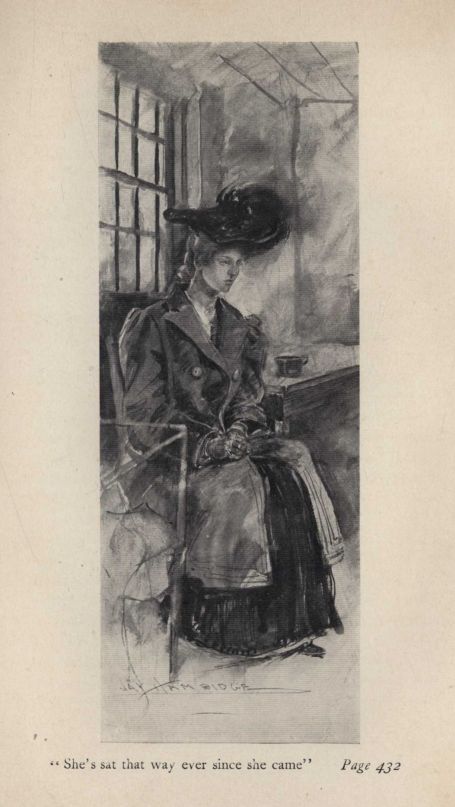
"She's sat that way ever since she came"
Elizabeth's glance swept the room which was Gusta's prison, its walls lined higher than her head with sheet-iron; on one side a narrow cot, frowsy, filthy, that looked as if it were never made, though the dirty pillow told how many persons had slept in it--or tried to sleep in it. There was a wooden table, with a battered tin cup, a few crusts and crumbs of rye bread, and cockroaches that raced energetically about, pausing now and then to wave their inquisitive antennæ, and, besides, a cheap, small edition of the Bible, adding with a kind of brutal mockery the final touch of squalor to the room.
Gusta moved, looked up, made sure, and then suddenly rose and came toward her.
"I knew you'd come, Miss Elizabeth," the girl said, with a relief that compromised the certainty she had just expressed.
"I came as soon as I could, Gusta," said Elizabeth, with an amused conjecture as to what Gusta might think had the girl known what difficulties she had had in getting there at all.
"Yes," said Gusta, "thank you, I--"
She blushed to her throat. They stood there in the middle of that common prison; a sudden constraint lay on them. Elizabeth, conscious of the difficulty of the whole situation, and with a little palpitating fear at being in a prison at all--a haunting apprehension of some mistake, some oversight, some sudden slip or sliding of a bolt--did not know what to say to Gusta now that she was there. She felt helpless, there was not even a chair to sit in; she shuddered at the thought of contact with any of the mean articles of furniture, and stood rigidly in the middle of the room. She looked at Gusta closely; already, of course, with her feminine instinct, she had taken in Gusta's dress--the clothes that she instantly recognized as being better than Gusta had ever before worn--a hat heavy with plumes, a tan coat, long and of that extreme mode which foretold its early passing from the fashion, the high-heeled boots. Her coat was open and revealed a thin bodice with a lace yoke, and a chain of some sort. An odor of perfume enveloped her. The whole costume was distasteful to Elizabeth, it was something too much, and had an indefinable quality of tawdriness that was hard to confirm, until she saw in it, somehow, the first signs of moral disintegration. And this showed in Gusta's face, fuller--as was her whole figure--than Elizabeth remembered it, and in a certain coarseness of expression that had scarcely as yet gone the length of fixing itself in lines. Elizabeth felt something that she recoiled from, and her attitude stiffened imperceptibly. But not imperceptibly to Gusta, who was a woman, too, and had an instant sense of the woman in Elizabeth shrinking from what the woman in her no longer had to protect itself with, and she felt the woman's rush of anger and rebellion in such a relation. But then, she softened, and looked up with big tears. She had a sudden yearning to fling herself on Elizabeth's breast, but leave was wanting, and then, almost desperately, for she must assert her sisterhood, must touch and cling to her, she seized Elizabeth's hand and held it.
"Oh, Miss Elizabeth," she said, "I oughtn't to 'av' sent for you. I know I had no right; but you was always good to me, and I had no one. I've done nothing. I've done nothing, honest, honest, Miss Elizabeth, I've done nothing. I don't know what I'm here for at all; they won't tell me. And Archie, too, it must have something to do with him, but he's innocent, too. He hasn't done nothing either. Won't you believe me? Oh, say you will!"
She still clung to Elizabeth's hand, and now she pressed it in both her own, and raised it, and came closer, and looked into Elizabeth's face.
"Say you believe me!" she insisted, and Elizabeth, half in fear, as though to pacify a maniac, nodded.
"Of course, of course, Gusta."
"You mean it?"
"Surely I do."
"And you know I'm just as good as I ever was, don't you?"
"Why--of course, I do, Gusta." It is so hard to lie; the truth, in its divine persistence, springs so incautiously to the eyes before it can be checked at the lips.
The tears dried suddenly in Gusta's blue eyes. She spoke fiercely.
"You don't mean it! No, you don't mean it! I see you don't--you needn't say you do! Oh, you needn't say you do!"
She squeezed Elizabeth's hand almost maliciously and Elizabeth winced with pain.
"You--you don't know!" Gusta went on. And then she hesitated, seemed to deliberate on the verge of a certain desperation, to pause for an instant before a temptation to which she longed to yield.
"I could tell you something," she said significantly.
A wonder gathered in Elizabeth's eyes. Her heart was beating rapidly, she could feel it throbbing.
"Do you know why I sent for you--what I had to tell you?"
She was looking directly in Elizabeth's eyes; the faces of both girls became pale. And Elizabeth groped in her startled mind for some clear recognition, some postulation of a fact, a horrible, blasting certitude that was beginning to formulate itself, a certitude that would have swept away in an instant all those formal barriers that had stood in the way of her coming to this haggard prison. She shuddered, and closed her mind, as she closed her eyes just then, to shut out the look in the eyes of this imprisoned girl.
But the moment was too tense to last. Some mercy was in the breast of the girl to whom life had shown so little mercy. Voluntarily, she released Elizabeth, and put up her hands to her face, and shook with sobs.
"Don't, don't, Gusta," Elizabeth pleaded, "don't cry, dear."
The endearment made Gusta cry the harder. And then Elizabeth, who had shrunk from her and from everything in the room, put her arms about her, and supported her, and patted her shoulder and repeated:
"There, dear, there, you mustn't cry."
And then presently:
"Tell me what I can do to help you. I want to help you."
Gusta sobbed a moment longer.
"Nothing, there is nothing," she said. "I just wanted you. I wanted some one--"
"Yes, I understand," said Elizabeth. She did understand many things now that made life clearer, if sadder.
"I wanted you to tell my poor old mother," said Gusta. "That's all--that's what I had to tell you."
She said it so unconvincingly, and looked up suddenly with a wan smile that begged forgiveness, and then Elizabeth did what a while before would have been impossible--she kissed the girl's cheek. And Gusta cuddled close to her in a peace that almost purred, and was contented.
Gusta was held for a week; then released.
XII
Archie was looking well that Monday morning in January on which his trial was to begin. He had slept soundly in his canvas hammock; not even the whimpering of Reinhart, the young sneak thief whom every one in the jail detested, nor the strange noises and startled outcries he made in his sleep--when he did sleep--had disturbed him. The night before, Utter had allowed Archie a bath, though he had broken a rule in doing so, and that morning Archie had borrowed a whisk from Utter, brushed his old clothes industriously, and then he had put on the underwear his mother had washed and patched and mended, and the shirt of blue and white stripes Marriott had provided. Then with scrupulous care he set his cell in order, arranged his few things on the little table--the deck of cards, the yellow-covered dog's-eared novel and a broken comb. Beside these, lay his fresh collar and his beloved blue cravat with the white polka dots; his coat and waistcoat hung over the back of his chair. At seven o'clock Willie Kirkpatrick, alias "Toughie," a boy who, after two terms in the Reform School, was now going to the Intermediate Prison, had brought in the bread and coffee. At eight o'clock Archie was turned into the corridor, and with him Blanco, the bigamist, whose two young wives were being held as witnesses in the women's quarter. Blanco was a barber, and he made himself useful by shaving the other prisoners. This morning, with scissors, razor, lather-brush and cup, he took especial pains with Archie. Now and then he paused, cocked his little head with its plume of black hair, and surveyed his handiwork with honest pride.
"I'll fix you up swell, Dutch, so's they'll have to acquit you."
From the cells came laughter. The prisoners began to josh Blanco--it was one of their few pastimes.
"Don't stand for one of them gilly hair-cuts, Dutch," cried Billy Whee, a porch-climber. "It'll be a fritzer, sure."
"Yes, he'll make your knob look like a mop."
"When I was doing my bit at the Pork Dump," began O'Grady, in the tone that portends a story; the cell doors began to rattle.
"Cheese it," cried the voices. They had grown tired of O'Grady's boasting.
After Archie had returned to his cell, an English thief whom they called the Duke, began to sing in a clear tenor voice, to the tune of Dixie:
"I wish there were no prisons,
I do, I does--'cause why?--
This old treadmill makes me feel ill,
I only pinch my belly for to fill,
Wi' me 'ands,
Wi' me dukes,
Wi' me clawrs,
Me mud hooks."
Archie scowled; he wished, for once, the Duke would keep still. He was trying to think, trying to assure himself that his trial would turn out well. Day after day, Marriott had come, and for hours he and Archie had sat in the long gray corridor, in the dry atmosphere of the overheated jail, conferring in whispers, because Archie knew Danner was listening at the peep-hole in the wall. Marriott was perplexed; how could he get Archie's true story before the jury? He had even consulted Elizabeth, told her the story.
"Oh, horrible!" she exclaimed. "But surely, you can tell the jury--surely they will sympathize."
He had shaken his head.
"Why not?"
"Because," said Marriott, "the rules of evidence are designed to keep out the truth."
"But can't Archie tell it?"
"I don't dare to let him take the stand."
"Why?"
"Because he'll be convicted if he does."
"And if he doesn't?"
"The same result--he'll be convicted. He's convicted now--the mob has already done that; the trial is only a conventional formality."
"What mob?"
"The newspapers, the preachers, the great moral, respectable mob that holds a man guilty until he proves himself innocent, and, if he asserts his innocence, looks even on that as a proof of his guilt."
Eades had announced that Archie would be tried for the murder of Kouka, and Elizabeth had been impressed.
"Wasn't that rather fine in him?" she asked.