Front matter (continued 4)
Reading edition
Yours in durance vile,
SLIM.
Mason had not answered the letter, and only the day before Dillon had appeared, bringing with him a youth called Squeak. And now this night, as Mason sat there, he did not like to think of Dillon. Dillon had traveled hundreds of miles by freight-trains to be with Mason, to give him part in his enterprise; he had been to the little town and examined the bank; he had even entered it by night alone. He had laid his plans, and, like all his kind, could not conceive of their miscarrying. He had estimated the amount they would procure; he considered five thousand dollars a conservative estimate. It was the big touch, of which they were always dreaming as a means of reformation. But Mason had refused. Then Dillon asked Curly, and Curly refused. Mason gave Dillon no reason for his refusal, but Curly contended that summer was not the time for such a big job; the nights were short and people slept lightly, with open windows, even if the old stool-pigeon was not up. Dillon had taunted him and hinted contemptuously at a broad. They had almost come to blows. Finally Dillon had left, taking with him Mandell and Squeak and Archie--all eager to go.
Mason sat there and thought of Dillon and his companions. He could imagine them on the John O'Brien, jolting on through the rain, maybe dropping off when the train stopped, to hide under some water-tank, or behind some freight-shed--he had done it all so many, many times himself. Still he tried not to think of Dillon, for he could not do so without a shade of self-reproach; it seemed like pigging to refuse Dillon as he had; they had worked so long together. Dillon's long, gaunt figure presented itself to his memory as crouching before some old rope mold, a bit of candle in his left hand, getting ready to pour the soup, and then memory would usually revert to that night when Dillon had suddenly doused the candle--but not before Mason had caught the gleam in his eyes and the setting of his jaw--and, pulling his rod, had barked suddenly into the darkness. Then the flight outside, the rose-colored flashes from their revolvers in the night, the race down the silent street--white snow in the fields across the railroad tracks, and the bitter cold in the woods.
He shook his head as if to fling the memories from him. But Dillon's figure came back, now in the front rank of his company, marching across the hideous prison yard, his long legs breaking at the middle as he leaned back in the lock-step. Mason tried to escape these thoughts, but they persisted. He got a newspaper, but understood little of what he read, except one brief despatch, which told of a tramp found cut in two beside the tracks, five hundred dollars sewed in his coat. The despatch wondered how a hobo could have so much money, and this amused Mason; he would tell Gibbs, and they would have a laugh--their old laugh at the world above them. Then they themselves would wonder--wonder which one of the boys it was; it might be weeks before the news would reach them in an authoritative form. He enjoyed for a moment his laugh at the stupid world, the world which could not understand them in the least, the world which shuddered in its ignorance of them. Then he thought of Dillon again. Dillon had never refused him; he had not refused him that evening in northern Indiana, when the sheriff and the posse of farmers, armed with pitchforks and shot-guns and old army muskets, had brought them to bay in the wheat stubble; his ammunition had given out, but old Dillon, with only three cartridges left, had stood cursing and covering his retreat. Mason was beginning to feel small about it, and yet--Dillon did not understand; when he came back he would explain it all to him. This notion gave him some comfort, and he lighted his cigar, turned to his newspaper again, and listened for the rain falling outside. Suddenly there was a noise, and Mason started. Was that old Dillon crouching there beside him, his face gleaming in the flicker of the dripping candle? He put his hand to his head in a kind of daze.
"Je's!" he exclaimed. "I'm getting nutty."
He was troubled, for his head had now and then gone off that way in prison--they called it stir simple. Mason sat down again, but no longer tried to read. He heard the noise in the bar-room, the noise of high excitement, and he wondered. His curiosity was great, but he had learned to control his curiosity. He could hear talking, laughing, cursing, the shuffle of feet, the clink of glasses--some sports out for a time, no doubt. In a moment the door opened and Gibbs appeared.
"Where's Kate?" he demanded.
"She went to bed half an hour ago," said Mason. "Why--what's the excitement?"
"Eddie Dean's here--come on out." Gibbs disappeared; the door closed.
Mason understood; no wonder the place thrilled with excitement. He had heard of Eddie Dean. Down into his world had come stories of this man, of his amazing skill and cleverness, of the enormous sums he made every year--made and spent. Dean had the fascination for Mason that is born of mystery; he had had Dean's methods and the methods of other big-mitt men described to him; he had heard long discussions in sand-house hang-outs and beside camp-fires in the woods, but the descriptions never described; he could never grasp the details. He could understand the common, ordinary thefts; he could see how a pickpocket by long practice learned his art, but the kind of work that Dean did had something occult in it. How a man could go out, wearing good clothes, and, without soiling his fingers, merely by talking and playing cards, make such sums of money--Mason simply could not realize it. Surely it was worth while to have a look at him. He started out, then he remembered; he passed his hand over the stubble of hair that had been growing after the shaving at the workhouse, and he picked up his low-crowned, narrow-brimmed felt hat--the kind worn by the brakemen he now and then wished to be taken for--pulled it down to his eyebrows, and went out.
Eddie Dean, who stood at the bar in the blue clothes that perfectly exemplified the fashion of that summer, was described in the police identification records as a man somewhat above medium size, and now, at forty, he was beginning to take on fat. His face was heavy, and despite the fact that his nose was twisted slightly to one side, and his upper lip depressed where it met his nose, the women whom Dean knew considered him handsome. His face was smooth-shaven and blue, like an actor's, from his heavy beard. His mouth was large, and his lips thin; he could close them and look serious and profound; and when he smiled and disclosed the gold fillings in his teeth, he seemed youthful and gay. His face showed vanity, a love of pleasure, vulgarity, selfishness, sensuality accentuated by dissipation, and the black eyes that were so sharp and bright and penetrating were cruel. Mason, however, could not analyze; he only knew that he did not like this fellow, and merely grunted when Gibbs introduced him, and Dean patronizingly said, without looking at him:
"Just in time, my good fellow."
Then he motioned imperiously to the bartender, who took down another wine-glass, wiped it dexterously, and set it out with an elegant flourish and filled it. Mason watched the golden bubbles spring from the hollow stem to the seething surface. He did not care much for champagne, but he lifted his glass and looked at Dean, who was saying:
"Here's to the suckers--may they never grow less."
The others in the party laughed. Besides Gibbs, who was standing outside his own bar like a visitor, there were Nate Rosen, a gambler, dressed more conspicuously than Dean; a small man in gray, with strange pale eyes fastened always on Dean; and a third man in tweeds, larger than either, with broad shoulders, heavy jaw and an habitual scowl. Beyond him, apart, with the truckling leer of the parasite, stood a man in seedy livery, evidently the driver of the carriage that was waiting outside in the rain.
Dean's history was the monotonous one of most men of his kind. Having a boy's natural dislike for school, he had run away from home and joined a circus. At first he led the sick horses, then he was hired by one of the candy butchers and finally allowed to peddle on the seats; there he learned the art of short change, and when he had mastered this he sold tickets from a little satchel outside the tents; by the time he was twenty-five he knew most of the schemes by which the foolish, seeking to get something for nothing, are despoiled of their money. He was an adept at cards; he knew monte and he could work the shells; later he traveled about, cheating men by all kinds of devices, aided by an intuitive knowledge of human nature. He could go through a passenger train from coach to coach and pick out his victims by their backs. As he went through he would suddenly lose his balance, as if by the lurching of the train, and steady himself by the arm of the seat in which his intended victim sat. His confederate, following behind, would note and remember. Later, he would return and invite him to make a fourth hand at whist or pedro or some other game. Dean would do the rest. He went to all large gatherings--political conventions, especially national conventions, conclaves, celebrations, world's fairs, the opening of any new strip of land in the West, the gold-fields of Alaska, and so on. He had roamed all over the United States; he had been to Europe, and Cuba, and Jamaica, and Old Mexico; he had visited Hawaii; he boasted that he had traveled the whole world over--"from St. Petersburg to Cape Breton" was the way he put it, and it impressed his hearers all the more because most of them had none but the most confused notion of where either place was. He boasted, too, that United States senators, cabinet officers, congressmen, governors, financiers and other prominent men had been among his victims, and many of these boasts were justified--by the facts, at least.
The atmosphere of the bar-room had been changed by the arrival of Dean. It lost its usual serenity and quivered with excitement. The deference shown to Dean was marked in the attitude of the men in his suite; it was marked, too, by the bartender's attitude, and even in that of Gibbs, though Gibbs was more quiet and self-contained, bearing himself, indeed, quite as Dean's equal. He did not look at Dean often, but stood at his bar with his head lowered, gazing thoughtfully at the glass of mineral water he was drinking, turning it round and round in his fingers, with a faint smile on his lips. But no one could tell whether the amusement came from his own thoughts or the little adventures Dean was relating.
"No, I'm going out in the morning," Dean was saying, the diamond on his white, delicate hand flashing as he lifted his glass.
"Which way?" asked Gibbs.
"I'm working eastward," said Dean. "Here!" he turned to the bartender, "let's have another--and get another barrel of water for Dan."
He smiled with what tolerance he could find for a man who did not drink.
"How much of that stuff do you lap up in a week, Dan?"
"Oh, I don't know," Gibbs said. He was not quick at repartee.
"Well, slush up, but don't make yourself sick," Dean went on.
The bartender, moving briskly about, pressed the cork from a bottle, poured a few drops into Dean's glass, and then proceeded to fill the other glasses.
"Well, how's the graft?" Gibbs asked presently.
"Oh, fairly good," said Dean. "A couple of bucks yesterday." He switched his leg with the slender stick he carried.
Gibbs's eyes lighted with humorous interest and pleasure.
"They were coming out of St. Louis," Dean went on, and then, as if he had perhaps given an exaggerated impression of the transaction, he went on in a quick, explicatory way: "Oh, it didn't amount to much--just for the fun of the thing, you know. But say, who do you think I saw in St. Louis?"
"Don't know," said Gibbs, shaking his head.
"Why, old Tom Young."
"No!" exclaimed Gibbs, looking up in genuine interest and surprise.
"Sure," said Dean.
"What's he doing?"
"He made the big touch, quit the business, got a farm in Illinois, and settled down with Lou. The girl's grown up, just out of a seminary, and the boy's in college. He said he'd like me to see the place, but he wouldn't take me out 'cause the girl was home then. Remember the old joint in the alley?"
Gibbs's eyes kindled with lively memories.
"Remember that afternoon Bob's man came down for the brace-box? I can see Tom now--he gets the box and says, 'Tell Bob not to frisk him.' God! They sent that mark through the alley that afternoon to a fare-you-well. And they had hell's own time keepin' the box in advance of 'em--it was the only one in the alley. Remember?"
Gibbs remembered, but that did not keep Dean from relating the whole story.
"What became of Steve Harris?" Dean asked.
"He's out with the rag, I guess," Gibbs replied.
"I heard Winnie sold her place."
"Oh, yes," said Gibbs; "bought a little home in the swell part--quiet street and all that--and they're living there happy as you please."
"Well, that's good," said Dean. "Steve and me was with the John Robinson show in the old days. He was holdin' a board for the monte tickets, and old Pappy King was cappin' for the game. I remember one night in Danville, Kentucky"--and Dean told another story. The stories were all alike, having for their theme the despoilment of some simpleton who had tried to beat Dean or his confederates at one of their own numerous games.
"I was holding the shingle for Jim Steele when he was playing the broads, you understand. He was the greatest spieler ever. I can see him now, taking up the tickets, looking around and saying: 'Is there a speculator in the party?'"
Dean's face was alight with the excitement of dramatizing the long-past scene. He laid his stick on the bar and bent over, with his white fingers held as if they poised cards. He was a good mimic. One could easily imagine the scene on the trampled grass, with the white canvas tents of the circus for a background.
"Dick Nolan and Joe Hipp were capping, and Dick would come up--he had the best gilly make-up in the world, you understand, a paper collar, a long linen duster and big green mush--he'd look over the cards--see?"--Dean leaned over awkwardly like a country-man, pointing with a crooked forefinger--"and then he'd say, 'I think it's that one.'"
His voice had changed; he spoke in the cracked tone of the farmer, and his little audience laughed.
"Well, the guy hollers, you understand, but at the come-back they're all swipes--working in the horse tents; you'd never know 'em. And then," Dean went on, with the exquisite pleasure of remembering, "old Ben Mellott was there working the send--you remember Ben, Dan?"
Gibbs nodded.
"Jake Rend was running the side-show, and old Jew Cohen had a dollar store--a drop-case, you know."
Gibbs nodded again. Dean grew meditative, and a silence fell on the group.
"We had a great crowd of knucks, too; the guns to-day are nothing to them. Those were the days, Dan. Course, there wasn't much in it at that."
Dean meditated over the lost days a moment, and then he grew cheerful again.
"I met Luke Evans last fall, Dan," he began again. "In England. The major and I were running between London and Liverpool, working the steamer trains, and him and me--"
And he was off into another story. Having taken up his English experience, Dean now told a number of vulgar stories, using the English accent, which he could imitate perfectly. While in the midst of one of them, he suddenly started at a footfall, and looked hastily over his shoulder. A man came in, glanced about, and came confidently forward.
"Good morning, Danny," he said, in a tone of the greatest familiarity.
Gibbs answered the greeting soberly, and then, at a sign from the man, stepped aside rather reluctantly and whispered with him. Dean eyed them narrowly, took in the fellow's attire from his straw hat to his damp shoes, and, when he could catch Gibbs's eye, he crooked his left arm, touched it significantly, and lifted his eyebrows in sign of question. Gibbs shook his head in a negative that had a touch of contempt for the implication, and then drew the man toward the bar. Without the man's seeing him or hearing him, Dean touched his arm again and said to Gibbs softly:
"Elbow?"
"No," said Gibbs, "reporter."
Then he turned and, speaking to the new-comer, he presented him to Dean, saying:
"Mr. Jordon, make you acquainted with Mr. Wales, of the Courier."
"Glad to meet you, Mr. Jordon," said the newspaper man.
"Ah, chawmed, I'm suah," said Dean, keeping to the English accent he had just been using. "I say, won't you join us?"
The bartender, at a glance from Dean, produced another bottle of champagne; the newspaper man's eyes glistened with pleasure, Dean was taking out his cigarette case. Wales glanced at the cigarettes, and Dean hastened to proffer them. In conversation with the reporter Dean impersonated an English follower of the turf who had brought some horses to America. As he did this, actor that he was, he became more and more interested in his impromptu monologue, assumed the character perfectly and lived into it, and the others there who knew of the deceit he was practising on the reporter--he was nearly always practising some sort of deceit, but seldom so innocently as now--were utterly delighted; they listened to his guying until nearly midnight, when Dean, having sustained the character of the Englishman for more than two hours, grew weary and said he must go. As he was leaving he said to the reporter:
"You've been across, of course? No? Well, really now, that's quite too bad, don't you know! But I say, whenever you come, you must look me up, if you don't mind, at Tarlingham Towers. I've a bit of a place down in the Surrey country; I've a beast there that's just about up to your weight. Have you ever ridden to the hounds?"
The reporter was delighted; he felt that a distinction had been conferred upon him. Wishing to show his appreciation, he asked Dean, or Jordan, as he was to him, if he might print an interview. Dean graciously consented, and the reporter left for his office, glad of a story with which to justify to his city editor, at least partly, his wasted evening.
When Dean had gone, taking his three companions with him, Gibbs and Mason sat for a long while in the back room.
"So that's Eddie Dean!" said Mason.
"Yes," said Gibbs, "that's him."
"And what's his graft?"
"Oh," said Gibbs, "the send, the bull con, the big mitt, the cross lift--anything in that line."
"And those two other guys with him?" asked Mason.
"That little one is Willie the Rat, the other is Gaffney."
"Sure-thing men, too?"
"Yes, they're in Ed's mob."
Mason was still for a while, then he observed:
"Je's! He did make a monkey of that cove!"
Gibbs laughed. "Oh, he's a great cod! Why, do you know what he did once? Well, he went to Lord Paisley's ball in Quebec, impersonating Sir Charles Jordon--that's why I introduced him as Mr. Jordon to-night." Gibbs's eyes twinkled. "He went in to look for a rummy, but the flatties got on and tipped him off."
"He's smart."
"Yes, the smartest in the business. He's made several ten-century touches."
Gibbs thought seriously a moment and then said:
"No, he isn't smart; he's a damn fool, like all of them."
"Fall?"
"Yes, settled twice; done a two-spot at Joliet and a finiff at Ionia."
Mason knit his brows and thought a long time, while Gibbs smoked. Finally Mason shook his head.
"No," he said, "no, Dan, I don't get it. I can understand knocking off a peter--the stuff's right there. All you do is to go take it. I can understand a hold-up, or a heel, or a prowl; I can see how a gun reefs a britch kick and gets a poke--though I couldn't put my hand in a barrel myself and get it out again--without breaking the barrel. I haven't any use for that kind, which you know--but these sure-thing games, the big mitt and the bull con--no, Dan, I can't get hip."
Gibbs laughed.
"Well, I can't explain it, Joe. You heard him string that chump to-night."
Mason dropped that phase of the question and promptly said:
"Dan, I suppose there's games higher up, ain't they?"
Gibbs laughed a superior laugh.
"Higher up? Joe, there's games that beat his just as much as his beats yours. I could name you men--" Then he paused.
Mason had grown very solemn. He was not listening at all to Gibbs, and, after a moment or two, he looked up and said earnestly:
"Dan, what you said a while back is dead right. I'm a damn fool. Look at me now--I've done twenty years, and in all my time I've had less than two thousand bucks."
Gibbs was about to speak, but Mason was too serious to let himself be interrupted.
"I was thinking it all over to-night, and I decided--know what I decided?"
Gibbs shook his head.
"I decided," Mason went on, "to square it without waiting for the big touch." Gibbs was not impressed; the good thieves were always considering reformation. "I know I can't get anything to do--I'm too old, and besides--well, you know." Mason let the situation speak for itself. "I'm about all in, but I was thinking, Dan, this here place you've got in the country, can't you--" Mason hesitated a little--"can't you let me work around there? Just my board and a few clothes?" Mason leaned forward eagerly.
"You know, Joe," said Gibbs, seeing that Mason was serious, "that as long as I've got a place you can have a home with me. I'm going to take Kate out there and live. I've got the place almost paid for."
Mason leaned back, tried to speak, paused, swallowed, and moistened his lips.
"I worried about Slim to-night," he managed to say presently. It was hard for him to give utterance to thoughts that he considered sentimental. "My treating him so, you see--that I decided; I want to try it. That's why I wouldn't go with him; he didn't understand, but maybe I can explain. As I was thinking to-night, my head went off again--that stir simple, you know."
He raised his hand to his head and Gibbs was concerned.
"You'd better take a little drink, Joe," he said.
After Gibbs had brought the whisky, they sat there and discussed the future until the early summer dawn was red.
V
Dillon, Archie, Mandell and Squeak had left the city that morning. Dillon was gloomy and morose because Mason had refused to join him. He had been disappointed, too, in Curly, but not so much surprised, for Curly was so strange and mysterious that nothing he might do could surprise his friends. Cedarville was far away, in Illinois, and long before daylight the four men had started on their journey in a freight-train. Dillon's plan was to rob the bank that night. He had chosen Saturday night because a Sunday would probably intervene before discovery, and thus give them time to escape. But the journey was beset by difficulties; the train spent long hours in switching, in cutting out and putting in cars, and at such times the four men had been compelled to get off and hide, lest the trainmen detect them. Besides, the train made long inexplicable stops, standing on a siding, with nothing to mar the stillness but the tired exhaust of the engine and the drone of the wide country-side. At noon the empty box-car in which the men had been riding was cut out and left stranded at a village; after that, unable to find another empty car, they rode on a car that was laden with lumber, but this, too, was cut out and left behind. Then they rode in most uncomfortable and dangerous positions on the timber-heads over the couplings. Half-way to Cedarville they met the storm. It had been gathering all the morning, and now it broke suddenly; the rain came down in torrents, and they were drenched to the skin. Mandell, who was intensely afraid of lightning, suffered agonies, and threatened to abandon the mob at the first opportunity. Late in the afternoon, just as the train was pulling into the village of Romeo, the rear brakeman discovered them, called the conductor and the front brakeman, and ordered the men to leave the train.
"Stick and slug!" cried Mandell, made irritable by the storm. But Dillon repressed him.
"Unload!" he commanded. "Don't goat 'em."
Archie, on the other side of the car, had not been seen clearly by the trainmen, but the others had, and though Dillon made them all get off, he could not keep Squeak from stopping long enough to curse the train-men with horrible oaths. Then the train went on and left them.
At evening they went into the woods and built a fire. There were discouragements as to the fire; the wood was wet, but finally they achieved a blaze, and Dillon went into the village after food. When he returned the fire was going well, the men had dried their clothes, and their habitual spirits had returned. In the water of a creek Dillon washed the can he had found, and made tea; they cooked bacon on pointed sticks, broke the bread and cheese, and ate their supper. Then, in the comfort that came of dry clothes and warmth and the first meal they had eaten that day, they sat about, rolled cigarettes, and waited for the night. Then darkness fell, Dillon made them put out the fire, and they tramped across the fields to the railroad.
"We'll wait here for the John O'Brien," said Dillon, when they came to the water-tank. "We must get the jug to-night--that'll give us all day to-morrow for the get-away."
They waited then, and waited, while the summer night deepened to silence; once, the headlight of an engine sent its long light streaming down the track; they made ready; the train came swaying toward them.
"Hell!" exclaimed Mandell, in the disappointment that was common to all of them. "It's a rattler!" And the lighted windows of a passenger-train swept by.
They waited and waited, and no freight-train came. At midnight, when they were all stiff and cold, Dillon ordered them into the village. They were glad enough to go. In the one business street of the town they found a building in which a light gleamed. They glanced through a window; it was the post-office. Then Dillon changed his plan in that ease with which he could change any plan, and forgot the little bank at Cedarville. He placed Squeak at the rear of the building, Mandell in the front.
"Come on, Dutch," he said.
He took Archie with him because he was not so sure of him as he was of the two other men, though Archie felt that he had been honored above them. He followed Dillon into the deep shadows that lay between the post-office and the building next door. He kept close behind Dillon, and watched with excitement while Dillon's tall form bent before one of the windows. Dillon was groping; presently he stood upright, his back bowed, he strained and grunted and swore, then the screws gave, and Dillon wrenched the little iron bars from the windows.
"Come on," he said.
He was crawling through the window; Archie followed.
Inside, Dillon stood upright, holding Archie behind him, and peered about in the dim light from the oil lamp that burned before a tin reflector on the wall. The safe was in the light. Dillon looked back, made a mental note of the window's location, and put out the lamp. Then he lighted a candle and knelt before the safe.
Archie stood with his revolver in his hand; Dillon laid his on the floor beside him. Then from the pocket of his coat he drew out some soap; a moment more and Archie could see him plastering up the crevices about the door of the safe, leaving but one opening, in the middle of the top of the door. Then out of the soap he fashioned about this opening a crude little cup. Archie watched intently. Dillon worked rapidly, expertly, and yet, as Archie noted, not so rapidly nor so expertly as Curly had worked. Curly was considered one of the most skilful men in the business, but Dillon was older and could tell famous tales of the old days when they had blown gophers--the days when they used to drill the safes and pour in powder. Dillon's age was telling; his fingers were clumsy and knotted with rheumatism, and now and then they trembled.
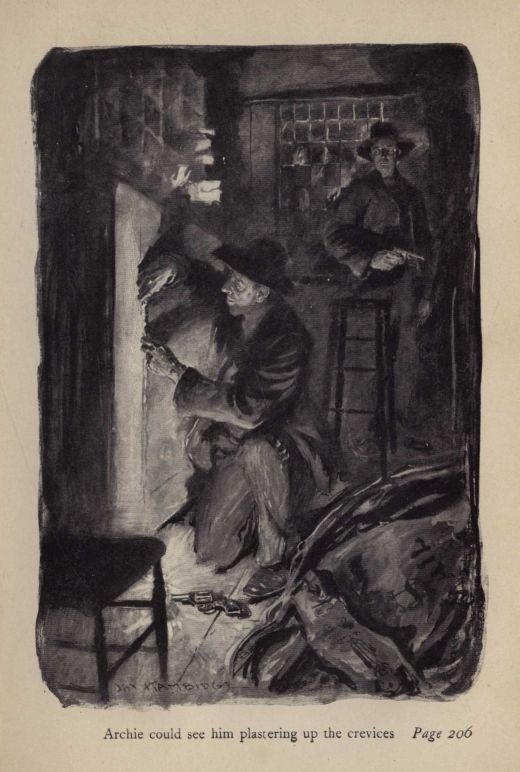
Archie could see him plastering up the crevices
"Now the soup," Dillon was saying, quite to himself, and he poured the nitroglycerin from a bottle into the little cup he had made of soap.
"And the string," said Archie, anxious to display his knowledge.
"Cheese it!" Dillon commanded.
He was fixing a fulminating cap to the end of a fuse, and he inserted this into the cup. Then he plastered it all over with soap, picked up his revolver, lighted the slow fuse from the candle, and, rising quickly, he stepped back, drawing Archie with him. They stood in a corner of the room watching the creeping spark; a moment more and there was the thud of an explosion, and Dillon was springing toward the safe; he seized the handle, opened the heavy door, and was down with his candle peering into its dark interior. He went through it rapidly, drew out the stamps and the currency and the coin. Another moment and they were outside. Mandell and Squeak were where Dillon had left them.
"All right," Dillon said. "Lam!"
VI
A week later, returning by a roundabout way, Dillon and his companions came back to town. That night Dillon, Archie, Squeak, Mandell and Mason were arrested. When Archie was taken up to the detectives' office and found himself facing Kouka, his heart sank.
"Couldn't take a little friendly advice, could you?" said Kouka, thrusting forward his black face.
Archie was dumb.
"Where'd you get that gat?" Kouka demanded.
Still Archie was dumb.
"You might as well tell," Kouka said. "Your pals have split on you."
Archie had heard of that ruse; he did not think any of them would confess, and he was certain they had not done so when Kouka referred to his revolver, for no one but Jackson knew where he had got the weapon. After an hour Kouka gave it up, temporarily at least, and sent Archie back to the prison.
The next morning all five men were taken to the office of the detectives. Besides Kouka, Quinn and Inspector McFee, there were two others, one of whom the prisoners instantly recognized as Detective Carney. Dillon and Mason had long known Carney, and respected him; he was the only detective in the city whom they did respect, for this silent, undemonstrative man, with the weather-beaten face, white hair and shrewd blue eyes, had a profound knowledge of all classes of thieves and their ways. Indeed, this knowledge, which made Carney the most efficient detective in the city, militated against him with his superiors; he knew too much for their comfort. As for Kouka and the other detectives, they were jealous of him, though he never interfered in their work nor offered suggestion or criticism; but they all felt instinctively that he contemned them. When Dillon saw Carney his heart sank; Mason's, on the contrary, rose. Carney gave no sign of recognition; it was plain that he was a mere spectator. But when Dillon saw the other man he whispered to Mason out of the corner of his mouth:
"It's all off."
This man was a tall, well-built fellow, with iron-gray hair, a ruddy face and a small black mustache above full red lips; he was dressed in gray, and he bore himself as something above the other officers present because he was an United States inspector. His name was Fallen. He glanced at the five men, and smiled and nodded complacently.
"I thought it looked like one of your jobs," he said, addressing Dillon and Mason jointly. Dillon could not refrain from nudging Mason, and in the same instant he caught Carney's eye. Carney winked quietly, and Dillon smiled, and to hide the smile, self-consciously ducked his head and spat out his tobacco.
"Well," said Fallen, "I'm much obliged to you men." He included McFee officially, and Kouka and Quinn personally in this acknowledgment. "I'll have the marshal come for them after dinner. I want Mason there and Dillon"--he pointed fiercely and menacingly--"and Mandell and that kid." He was indicating Squeak. "What's your name?" he demanded.
Squeak hesitated, then said: "Davis."
Fallen laughed in his superior, federal way, and said:
"That'll do as well as any."
Then he looked at Archie.
"I don't want him," he said. "He doesn't belong to this gang; he wasn't there. There were only four of them. You can cut him out."
Kouka and Quinn looked at each other in surprise; they were about to protest. In Archie's heart, as he watched this little drama, a wild hope flamed. Carney, too, looked up, showing the first interest he had evinced. Something in his look deterred Fallen, held his eye. He knew Carney and his reputation; his glance plainly implied a question.
"You're wrong on that fellow Mason," said Carney.
Fallen looked at him, then at Mason; then he smiled his superior smile.
"Oh, I guess not," he said lightly. He turned away with his complacent, insulting smile.
"All right," said Carney. "You've got him wrong, that's all. He's been here in town for three weeks. Of course, it's nothing to me--'tain't my business." He plunged his hands in his trousers pockets and walked over to the window.
The men in the chained line shuffled uneasily.
"Do I get out now?" Archie asked.
Kouka laughed.
"Yes--when I'm through with you."
That afternoon Dillon, Mason, Mandell and Squeak were taken to the county jail on warrants charging them with the robbery of the post-office at Romeo.
Gibbs appeared at the jail early that evening, his blue eyes filled with a distress that made them almost as innocent as they must have been when he was a little child.
"I just heard of the pinch," he said apologetically.
"Didn't they send you word last night?" asked Dillon.
Gibbs shook his head impatiently, as if it were useless to waste time in discussing such improbabilities.
"Never mind," he said. "I'll send a mouthpiece."
"Yes, do, Dan," said Mason. "We want a hearing."
"Well, now, leave all that to me, Joe," said Gibbs. "I'll send you some tobacco and have John fetch in some chuck."
Gibbs attended to their little wants, but he had difficulty as to the lawyer. He had, from time to time, employed various lawyers in the city, being guided in his selections, not by the reputed abilities of the lawyers, but by his notions of their pull with the authorities. Formerly he had employed Frisby on the recommendation of Cleary, the chief of police, with whom Frisby divided such fees, but Frisby's charges were extortionate, and lately, Gibbs understood, his influence was waning. In thinking over the other lawyers, he recalled Shelley Thomas, but Thomas, he found, was on a drunk. At last he decided on Marriott.
"There's nothing to it," he said to Marriott, "especially so far as Mason's concerned; he's a friend of mine. He's in wrong, but these United States inspectors will job him if they get a chance."
Marriott wished that Gibbs had retained some other lawyer. The plight of the men seemed desperate enough. He thought them guilty, and, besides, he wished to go away on his vacation. But his interest deepened; he found that he was dealing with a greater power than he encountered in the ordinary state case; the power, indeed, of the United States. The officials in the government building were unobliging; Fallen was positively insulting; from none of them could he receive any satisfaction. The hearing was not set, and then one evening Fallen mysteriously disappeared. Marriott was enraged, Gibbs was desperate, and Marriott found himself sharing Gibbs's concern.
Dillon and Mandell and Squeak spoke only of proving an alibi; they said that Gibbs would arrange this for them. This disheartened Marriott, confirmed his belief in their guilt, and he shrank from placing on the stand the witnesses Gibbs would supply. And then, one afternoon at the jail, a strange experience befell him. Mason was looking at him, his face pressed against the bars; he fixed his eyes on him, and, speaking slowly, with his peculiar habit of moistening his lips and swallowing between his words, he said:
"You think I'm guilty of this, Mr. Marriott."
Marriott tried to smile, and tried to protest, but his looks must have belied him.
"I know you do," Mason went on, "but I'm not, Mr. Marriott. I've done time--lots of it, but they've got me wrong now. These inspectors will lie, of course, but I can prove an alibi. What night was the job done?"
"The twelfth," said Marriott.
"That was Saturday, wasn't it?"
"Yes."
"Well, that night I was in Gibbs's. There was a mob of sure-thing men in there that night--Ed Dean and the Rat and some others--Gibbs will tell you. I can't subpoena them--they couldn't help; nobody would believe them, and they dassen't show, anyway."
"Are they--" Marriott felt a delicacy in saying the word.
"Thieves?" said Mason. "Yes--you see how it is."
"Of course," said Marriott.
"But," Mason went on, "there was a fellow in there--I don't know his name--a reporter; he put a piece in his paper the next day about Dean. Dean was kidding him--Gibbs can tell you. I wish you'd see him--he'll remember me, and he can fix the time by that piece he wrote."
Mason paused.
"I've done nearly twenty years, Mr. Marriott," he said presently. "That was all right; they done that on the square; this is the first time they ever had me in wrong. Dillon was with me every time--we worked together--that'll go against me. And them inspectors don't care--they'd just as soon job a fellow as not. All I ask now is a fair show. But those United States courts are a fierce game to put a man up against."
While Mason was talking a great wave of sympathy swept over Marriott; a conviction came to him that Mason was telling the truth.
"But," he said as the thought came to him, "can't Dillon and the others help you?"
"Well," Mason hesitated. "They've got themselves to look after. I'd rather fall myself than to throw them down. You see Gibbs about that reporter."
Marriott was convinced that Mason was not deceiving him; he felt a reproach at his own original lack of faith in the man. As he waited for the turnkey to unlock the door and let him out, a sickness came over him. The jail was new; there were many boasts about its modern construction, its sanitary conditions, and all that, but when he went out, he was glad of the cool air of the evening--it was wholly different from the atmosphere inside, however scientifically pure that may have been. He stopped a moment and looked back at the jail. It lifted its stone walls high above him; it was all clean, orderly, and architecturally not bad to look on. The handsome residence of the sheriff was brilliantly lighted; there were lace curtains at the windows, and within, doubtless, all the comforts, and yet--the building depressed Marriott. It struck him, though he could not then tell why, as a hideous anachronism. He thought of the men mewed within its stone walls; he could see Dillon's long eager face, ugly with its stubble of beard; he could see the reproach in Mason's eyes; he could see the shadowy forms of the other prisoners, walking rapidly up and down the corridors in their cramped exercises--how many were guilty? how many innocent? He could not tell; none could tell; they perhaps could not tell themselves. A great pity for them all filled his breast; he longed to set them all free. He wished this burden were lifted from him; he wished Gibbs had never come to him; he wished he could forget Mason--but he could not, and a great determination seized him to liberate this man, to prevent this great injustice which was gathering ominously in the world, drawing within its coils not only Mason, but all those who, like Fallen and the other officials, were concerned in the business, even though they remained free in the outer world. And Marriott had one more thought: if he could not prevent the injustice, would it taint him, too, as it must taint all who came in contact with it? He shuddered with a vague, superstitious fear.
Marriott found Wales, who recalled the evening at Gibbs's, consulted the files of his newspaper, made sure of the date, and then went with Marriott to the jail and looked through the bars into Mason's expectant eyes. He prolonged his inspection, plainly for the effect. Presently he said:
"Yes, he was there."
"You'll swear to it?" asked Marriott.
"Sure," said Wales, "with pleasure."
There was relief in Mason's eyes and in his manner, as there was relief in Marriott's mind.
"That makes it all right, Joe," he said, and Mason smiled gratefully. Marriott left the jail happy. His faith was restored. The universe resumed its order and its reason. After all, he said to himself, justice will triumph. He felt now that he could await the preliminary hearing with calmness. Wales's identification of Mason made it certain that he could establish an alibi for him; he must depend on Gibbs for the others, but somehow he did not care so much for them; they had not appealed to him as Mason had, whether because of his conviction that they were guilty or not, he could not say. The hearing was set for Thursday at two o'clock, but Marriott looked forward to it with the assurance that as to Mason, at least, there was no doubt of the outcome.
VII
Although Fallen had told the police they could set Archie free, the police did not set him free.
"It's that fellow Kouka," Archie explained to Marriott. "He's got it in for me; he wants to see me get the gaff."
That afternoon Archie was legally charged with being a "suspicious person." The penalty for being thus suspected by the police was a fine of fifty dollars and imprisonment in the workhouse for sixty days. Marriott was angry; the business was growing complicated. He began to fear that he would never get away on his vacation; he was filled with hatred for Fallen, for Kouka, because just now they personified a system against which he felt himself powerless; finally, he was angry with Archie, with Dillon, even with Mason, for their stupidity in getting into such desperate scrapes.
"They're fools--that's what they are," he said to himself; "they're crazy men." But at this thought he softened. When he recalled Mason in his cell at the jail, and Archie in the old prison at the Central Station, his anger gave way to pity. He resolved to give up his vacation, if necessary, and fight for their release. He determined to demand a jury to try Archie on this charge of suspicion; he knew how Bostwick and all the attachés of the police court disliked to have a jury demanded, because it made them trouble. As he walked up the street he began to arrange the speech he would make in Archie's defense; presently, he noticed that persons turned and looked at him; he knew he had been talking to himself, and he felt silly; these people would think him crazy. This dampened his ardor, crushed his imagination and ruined his speech. He began to think of Mason again; he would have to let Archie's case go until after Mason had had a hearing; he must do one thing at a time.
Archie had been able to endure the confinement as long as Mason and Dillon and Mandell and Squeak were there; the five men had formed a class by themselves; they had a certain superiority in the eyes of the other prisoners, who were confined for drunkenness, for disturbance, for fighting, for petty thefts and other insignificant offenses. But when his companions were taken away, when his own hope of liberty failed, he grew morose. The city prison was an incredibly filthy place. The walls dripped always with dampness. High up, a single gas-jet burned economically in its mantle, giving the place the only light it ever knew. A bench ran along the wall below it, and on this bench the prisoners sat all day and talked, or stretched themselves and slept; now and then, for exercise, they tried chinning themselves from the little iron gallery that ran around the cells of the upper tier. Twice a day they were fed on bologna and coffee and bread. At night they were locked in cells, the lights were put out, and the place became a hideous bedlam. Men snored from gross dissipations, vermin crawled, rats raced about, and the drunken men, whose bodies from time to time were thrown into the place, went mad with terror when they awoke from their stupors, and cursed and blasphemed. The crawling vermin and the scuttling rats, the noises that suggested monsters, made their delirium real. The atmosphere of the prison was foul, compounded of the fumes of alcohol exhaled by all those gaping mouths, of the feculence of all those filthy bodies, of the foul odors of the slop-pails, of the germs of all the diseases that had been brought to the place in forty years. Archie could not sleep; no one could sleep except those who were overcome by liquor, and they had awful nightmares.
His few moments of relief came when the turnkey, a man who had been embruted by long years of locking other men in the prison, opened the door, called him with a curse and turned him over to Kouka. Then the respite ended. He was subjected to new terrors, to fresh horrors, surpassing those physical terrors of the night by infinity. For Kouka and Quinn took him into a little room off the detectives' office, closed and locked the door, and then for two hours questioned him about the robbery of the post-office at Romeo, about countless other robberies in the city and out of it; they accused him of a hundred crimes, pressed him to tell where he had stolen the revolver. They bent their wills against his, they shook their fingers under his nose, their fists in his face; they told him they knew where he had got the revolver; they told him that his companions had confessed. He was borne down and beaten; he felt himself grow weak and faint; at times a nausea overcame him--he was wringing with perspiration.
The first day of this ordeal he sat in utter silence, sustained by dogged Teutonic stubbornness. That afternoon they renewed the torture; still he did not reply.
The morning of the second day, though weakened in body and mind, he still maintained his stubbornness; that afternoon they had brought McFee with a fresh will to bear on him. By evening he told them he had stolen the revolver in Chicago. He did this in the hope of peace. It did gain him a respite, but not for long. The next morning they told him he had lied and he admitted it; then he gave them a dozen explanations of his possession of the revolver, all different and all false. Then, toward evening, Kouka suddenly fell upon him, knocked him from his chair with a blow, and then, as he lay on the floor, beat him with his enormous hairy fists. Quinn, the only other person in the room, stood by and looked on. Finally, Quinn grew alarmed and said:
"Cheese it, Ike! Cheese it!"
Kouka stopped and got up.
Archie was weeping, his whole body trembling, his nerves gone. That night he lay moaning in his hammock, and the man in the cell under him and the man in the cell next him, cursed him. In the morning they took him again up to the detective's office; this was the morning of the third day. Archie was in a daze, his mind was no longer clear, and he wondered vaguely, but with scarcely any interest, why it was that Kouka looked so smiling and pleasant.
"Set down, Arch, old boy," Kouka said, "and let me tell you all about it."
And then Kouka told him just where he had stolen the revolver, and when, and how--told him, indeed, more about the hardware store and the owners of it than Archie had ever known. And yet Archie did not seem surprised at this. He felt numbly that it was no longer worth while to deny it--he wondered why he ever had denied it in the first place. It did not matter; nothing mattered; there was no difference between things--they were all the same. But presently his mind became suddenly clear; he was conscious that there was one unanswered question in the world.
"Say, Kouka," he said, "how did you tumble?"
Kouka laughed. He was in fine humor that morning.
"Oh, it's no use, my boy," he said; "it's no use; you can't fool your Uncle Isaac. You'd better 'ave taken his advice long ago--and been a good boy."
"That's all right," said Archie, a strange calm having come to him because of the change in the world, "but who put you wise?"
Kouka looked at Quinn and smiled, and then he said to Archie:
"Oh, what you don't know won't hurt you."
Then he had Archie taken back to the prison, but before they locked him up Kouka gave him a box of cigarettes he had taken from a prostitute whom he had arrested the night before, and he left Archie leaning against the door of the prison smoking one of the cigarettes.
"What have they been doing to you?" asked a prisoner.
"The third degree," said Archie laconically.
The knowledge which Kouka preferred to shroud in mystery had been obtained in a simple way. Glancing over the records in the detective's office, he had by chance come across an old report of the robbery of a hardware store. Kouka had taken the revolver found on Archie to the merchant, and the merchant had identified it. That evening Marriott read in the newspapers conspicuous accounts of the brilliant work of Detective Kouka in solving the mystery that had surrounded a desperate burglary. The articles gave Kouka the greatest praise.
VIII
The United States court-room had been closed ever since court adjourned in May, but when it was thrown open for the hearing of the case against Dillon and Mason and the rest, it was immediately imbued with the atmosphere of federal authority. This atmosphere, cold, austere and formal, smote Marriott like a blast the moment he pushed through the green baize doors.
The great court-room was furnished in black walnut; the dark walls immediately absorbed the light that came through the tall windows. On the wall behind the bench was an oil portrait of a former judge; Marriott could see it now in the slanting light--the grave and solemn face, smooth-shaven, with the fine white hair above it, expressing somehow the older ideals of the republic. On the wall, laureled Roman fasces were painted in gilt. The whole room was somber and gloomy, suggesting the power of a mighty government poised menacingly above its people; there were hints of authority and old precedents in that atmosphere.
The reason the room held this atmosphere was that the judge who ordinarily sat on the bench had been appointed to his position for life, and there were no real checks on his power. For twenty years before he had been appointed this man had been the attorney for great corporations, had amassed a fortune in their promotion and defense, and, as a result, his sympathies and prejudices were with the rich and powerful. He knew nothing of the common currents and impulses of humanity, having never been brought in contact with the people; the almost unlimited power he wielded, and was to wield until he died, made him, quite naturally, autocratic, and he had impressed his character on the room and on all who held official positions there. The clerks, commissioners and assistant prosecutors whom he appointed imitated him and acquired his habits of thought, for they received his opinions just as they received his orders.
Marriott sat at the table and waited, and while he waited looked about. He looked at Wilkison, the commissioner; the judge had appointed him to his place; the amount of fees he received depended entirely on the number of cases the district attorney and his assistants brought before him; consequently, there being two commissioners, he wished to have the good will of the district attorney, and always reached decisions that would please him.
Dalrymple, the assistant district attorney, was a good-looking young man with a smooth-shaven, regular face that might have been pleasant, but, because of his new importance, it now wore a stern and forbidding aspect. He was dressed in new spring clothes; the trousers were rolled up at the bottoms, showing the low tan shoes which just then had come again into vogue. He wore a pink flannel shirt of exquisite texture; on this flannel shirt was a white linen collar. This combination produced an effect which was thought to give him the final touch of aristocracy and refinement. When he was not talking to Wilkison or to Fallen, he was striding about the court-room with his hands in his trousers pockets. Once he stopped, drew a silver case from his pocket and lighted a cigarette made with his monogram on the paper.
Marriott turned from Dalrymple with disgust; he looked beyond the railing, and there, on the walnut benches, sat Gibbs, with a retinue that made Marriott smile. They must have come in when Marriott was preoccupied, for he was surprised to see them. Gibbs sat on the end of one bench, as uncomfortable and ill at ease as he would have been in a pew at church. He was shaved to a pinkness, his hair was combed smooth, and he was very solemn. Marriott could easily see that the atmosphere of the court-room oppressed and cowed him; he had lost his native bearing, and had suddenly grown meek, humble and afraid. Marriott knew none of the others; there were half a dozen men, none of them dressed as well as Gibbs, with strange visages, marked by crime and suffering, all the more touching because they were so evidently unconscious of these effects. The heads ranged along the bench were of strange shapes, startlingly individual in one sense, very much alike in another. They were all solemn, afraid to speak, bearing themselves self-consciously, like children suddenly set out before the public. On one bench sat a young girl, and something unmistakable in her eyes, in her mouth, in the clothes she wore--she had piled on herself all the finery she had--told what she was. Her toilet, on which she had spent such enormous pains, produced the very effect the womanhood left in her had striven to avoid.
Marriott smiled, until he detected the deep concern which Gibbs was trying to hide; then his heart was touched, as the toilet of the girl had touched it. Marriott knew that these people were the witnesses by whom Gibbs expected to establish an alibi for Dillon and Squeak and Mandell; the sight of them did not reassure him; he had again that disheartening conviction of the utter lack of weight their appearance would carry with any court; he did not credit them himself, and he began to feel a shame for offering such witnesses. He was half decided, indeed, not to put them forward. But his greater concern came with the thought of Mason, whom he believed to be innocent; where, he suddenly wondered, was the reporter Wales?
But just at this moment the green baize doors of the court-room swung inward and suddenly all the people in the court-room--Dalrymple, Fallen, Wilkison, Marriott, Gibbs, the clerks and the reporters, the bailiff and the group Gibbs had brought up with him from the under world--forgot the distinctions and prejudices and hatreds that separated them, yielded to the claims of their common humanity and became as one in the eager curiosity which concentrated all their interest on the entering prisoners.
They came in a row, chained together by handcuffs, in charge of deputy marshals. They were marched within the bar, still wearing the hats they could not remove. The United States marshal himself and another deputy came forward and joined the deputies in charge of the prisoners. The officers took off their hats for them, and when they took chairs at the table, stood close beside them, as if to give the impression that the prisoners were most dangerous and desperate characters, and that they themselves were officials with the highest regard for their duty.
Wilkison, with great deliberation, was seating himself at the clerk's desk. Ordinarily he held hearings in an anteroom, but as this hearing would be reported in the newspapers he felt justified in using the court-room; besides, he could then test some of the sensations of a judge.
"Aren't you going to unhandcuff these men?" said Marriott to the marshal.
The marshal merely smiled in a superior official way, and the smile completed the rage that had seized on Marriott when the deputies stationed themselves behind the prisoners. Marriott felt in himself all the evil and all the hatred that were in the hearts of these officers; he felt all the hatred that was gathering about these prisoners; it seemed that every one there wished to revenge himself personally on them. Fallen, sitting beside Dalrymple, had an air of directing the whole proceeding, as if his duties did not end with the apprehension of his prisoners, but required him to see that the assistant district attorney, the commissioner and the rest did their whole duty. He sat there with the two rosy spots on his plump cheeks glowing a deeper red, his blue eyes gloating. Marriott restrained himself by an effort; he needed all his faculties now.
"The case of the United States versus Dillon and others." Wilkison was officially fingering the papers on his desk. "Are the defendants ready for hearing?"
"We're ready, yes," said Marriott, plainly excluding from his words and manner any of the respect for the court ordinarily simulated by lawyers. Mason, sitting beside him, and Dillon and the rest followed with eager glances every movement, listened to every word. They forgot the handcuffs, and fastened their eyes on Fallen standing up to be sworn. When the oath had been administered, Dalrymple put the stereotyped preliminary questions and then asked him who the defendants were. Fallen pointed to them one after another and pronounced their names as he did so. When he had done this Dalrymple turned, looked at Marriott with his chin in the air, and said pertly:
"Take the witness."
Marriott was surprised and puzzled; the suspicions that he had all along held were increased.
"How many witnesses will you have?" he asked.
"This is all," said Dalrymple with an impertinent movement of the lip, "except this." He held up a legal document. "This certified copy of an indictment--"
At the word "indictment" the truth flashed on Marriott. He understood now; this explained the delay, the stealth, the subterfuge of which he had been dimly conscious for days; this explained the conduct of the officials; this explained Fallen's absence--he had gone to Illinois, secured the indictment of the four men, and returned. And this was not a preliminary hearing at all; it was a mere formality for the purpose of removing the prisoners to the jurisdiction in which the crime had been committed. He saw now that he would not be allowed to offer any testimony; nothing could be done. The men would be tried in Illinois, where they could have no witnesses, for the law, as he remembered, provided that process for witnesses to testify on behalf of defendant could not be issued beyond a radius of one hundred miles of the court where they were tried; they were poor, they could not pay to transport witnesses, and now the alibis for Dillon and Squeak and Mandell could not be established, and Mason could not have the benefit of Wales's testimony, unless depositions were used, and he knew what a farce depositions are. He had been tricked. It was all legal, of course, but he had been tricked, that was all, and he was filled with mortification and shame and rage.
"Mr. Marriott," Wilkison was saying in his most impartial tone, "do you wish to examine this witness?"
Marriott was recalled. He looked at Fallen, waiting there in the witness-chair, pulling at his little mustache, the pink spots in his cheeks glowing, and his eyes striving for an expression of official unconcern. Marriott questioned Fallen, but without heart. He tried to break the force of his identification, but Fallen was positive. They were Joseph Mason, James Dillon, Louis Skinner, alias Squeak, and Stephen Mandell. When Marriott had finished, Dalrymple rose and said:
"Your Honor, we offer as evidence a certified copy of an indictment returned by the grand jury at this present term, and the government rests."
He looked in triumph at Marriott.
The prisoners were leaning eagerly over the table under which they hid their shackled hands, not understanding in the least the forces that were playing with them. Dillon's long, unshaven face was suspended above the green felt, his eyes, bright with excitement and deepest interest, shifting quickly from Dalrymple to Marriott and then back again to Dalrymple. Mason's eyes went from one to the other of the lawyers, but his gaze was easier, not so swift, hardly so interested. A slight smile lurked beneath the mask he wore, and the commissioner decided with pleasure that this smile proved Mason's guilt, a conclusion which he found it helpful to communicate to Dalrymple after the hearing. Mandell and Squeak wore heavy expressions; the realization of their fate had not yet struggled to consciousness. In fact, they did not know what had happened, and they were trying to learn from a study of the expressions of Dalrymple and Marriott.
Dalrymple continued to look at Marriott in the pride he felt at having beaten him. Because he had really been unfair and had practised a sharp trick on Marriott, he disliked him. This dislike showed now in Dalrymple's glance, as it had been expressed in the sharp, important voice in which he had put his questions during the hearing. He had spoken with an affected accent, and had objected to every question that Marriott asked on cross-examination. He had learned to speak in this affected accent at college, where he had spent four years, after which he had spent three other years at a law school; consequently, he knew little of that life from which he had been withdrawn for those seven years, knew nothing of its significance, or meaning, or purpose, and, of course, nothing of human nature. The stern and forbidding aspect in which he tried to mask a countenance that might have been good-looking and pleasing, had it worn a natural and simple expression, was amusing to those who, like Dillon and Mason, were older and wiser men. Dalrymple had no views or opinions or principles of his own; those he had, like his clothes and his accent, had been given him by his parents or the teachers his parents had hired; he had accepted all the ideas and prejudices of his own class as if they were axioms. He felt it a fine thing to be there in the United States court in an official capacity that made every one look at him, and, as he supposed, envy him; that gave an authority to anything he said. He thought it an especially fine thing to represent the government. He used this word frequently, saying "the government feels," or "the government wishes," or "the government understands," speaking, indeed, as if he were the government himself. The power behind him was tremendous; an army stood ready at the last to back up his sayings, his opinions, and his mistakes. Against such a power, of course, Dillon and Mason, who were poor, shabby men, had no chance. Dalrymple, to be sure, had no notion of what he was doing to these men; no notion of how he was affecting their lives, their futures, perhaps their souls. He was totally devoid of imagination and incapable of putting himself in the place of them or of any other men, except possibly those who were dressed as he was dressed and spoke with similar affectation. He did not consider Dillon and Mason men, or human beings at all, but another kind of organism or animate life, expressed to him by the word "criminal." He did not consider what happened to them as important; the only things that were important to him were, first, to be dressed in a correct fashion, and modestly, that is, to be dressed like a gentleman; secondly, to see to it that his sympathies and influence were always on the side of the rich, the well-dressed, the respectable and the strong, and to maintain a wide distinction between himself and the poor, disreputable and ill-clad, and, thirdly, to bear always, especially when in court or about the government building, an important and wise demeanor. He felt, indeed, that in becoming an assistant United States district attorney, he had become something more than a mere man; that because a paper had been given him with an eagle printed on it and a gilt seal, a paper on which his name and the words by which he was designated had been written, he had become something more than a mere human being. The effect of all this was revealed in the look with which he now regarded Marriott.
Marriott, however, did not look at Dalrymple; he wished Dalrymple to feel the contempt he had for him, and after a moment he rose and addressed the commissioner.
The commissioner straightened himself in his chair; his face was very long and very solemn. He did not listen to what Marriott was saying; having conferred with Dalrymple before the hearing and read a decision which Dalrymple had pointed out to him in a calf-bound report, he was now arranging in his mind the decision he intended to give presently.
Marriott, of course, realized the hopelessness of his case, but he did not think it becoming to give in so easily, or, at least, without making a speech. He began to argue, but Wilkison interrupted him and said:
"This whole question is fully discussed in the Yarborough case, where the court held that in a removal proceeding no testimony can be presented in behalf of the defense."
Then Wilkison announced his decision, saying that Marriott's witnesses could be heard at the proper time and place, that is, on the trial, where he said the rights of the defendants would be fully conserved. Feeling that his use of this word "conserved" was happy and appropriate and had a legal sound, he repeated it several times, and concluded by saying:
"The defendants will be remanded to the custody of the marshal for removal."
The marshal and his deputies tapped the prisoners on the shoulders. Just then there was a slight commotion; Gibbs had pushed by the bailiff and was coming forward. He came straight up to the men. The marshal put out a hand to press him back, but Marriott said:
"Oh, let him talk to them a minute. Good God--!"
The marshal glared at Marriott, and then gave way.
"But he wants to be quick about it," he threatened.
Gibbs leaned over Mason's shoulder.
"Well, Joe," he said.
"I'm kangarooed, Dan," said Mason.
"It looks that way," said Gibbs.
"Dan, I want you to do something for me--I want you to send me some tobacco. You know you can get those clippings in pound packages; they only cost a quarter."
Gibbs looked hurt.
"Joe," he said, "I've known you for forty years, and that's the only mean thing you ever said to me."
"Well, don't get sore, Dan," Mason said. "I knew you would--only--"
The marshal cut them short and marched the prisoners out of the court-room. Outside in the street the prison-van was waiting, the van that had been ordered before the hearing, to take the prisoners to the station.
IX
It was several days before Marriott saw Gibbs again, and then he appeared at Marriott's office with a companion and leaned for an instant unsteadily against the door he had carefully closed. Marriott saw that he was changed, and that it was the change drink makes in a man. Gibbs sank helplessly into a chair, and stared at Marriott blankly. He was not the clean, well-dressed man Marriott had beheld in him before. He was unshaven, and the stubble of his beard betrayed his age by its whiteness; the pupils of his eyes were dilated, his lips stained with tobacco. His shoes were muddy, one leg of his trousers was turned up; and his lack of a collar seemed the final proof of that moral disintegration he could not now conceal. When he had been there a moment the atmosphere was saturated with the odor of alcohol.
"My friend, Mr. McDougall," said Gibbs, toppling unsteadily in his chair, as he waved one fat hand at his companion, a heavy blond fellow, six feet tall, well dressed and dignified.
"I've gone to the bad," said Gibbs. Marriott looked at him in silence. The fact needed no comment.
"The way those coppers jobbed Mason was too much for me," Gibbs went on. "Worst I ever seen. I couldn't stand for it, it put me to the bad."
"Well, you won't do him any good, at that--" McDougall began.
"Aw, to hell with you!" said Gibbs, waving McDougall aside with a sweep of his arm. The movement unsettled him in his chair, and he steadied himself by digging his heels into the rug. Then he drew a broken cigar from his coat pocket, struck a match, and held it close to his nose; it took him a long time to light his cigar; he puffed hurriedly, but could not keep the cigar in the flame; before he finished he had burned his fingers, and Marriott felt a pain as Gibbs shook the match to the floor.
"He hasn't touched a drop for five years," said McDougall indulgently. "But when they kangarooed Mason--"
McDougall looked at Gibbs, not in regret or pity, nor with disapproval, but as one might look at a woman stricken with some recent grief. To him, getting drunk seemed to be as natural a way of expressing emotion as weeping or wringing the hands. Marriott gazed on the squalid little tragedy of a long friendship, gazed a moment, then turned away, and looked out of his window. Above the hideous roofs he could see the topmasts of schooners, and presently a great white propeller going down the river. It was going north, to Mackinac, to the Soo, to Duluth, and the sight of it filled Marriott with a longing for the cold blue waters and the sparkling air of the north.
Gibbs evidently had come to talk about Mason's case, but when he began to speak his voice was lost somewhere in his throat; his head sank, he appeared to sink into sleep. McDougall glanced at him and laughed. Then he turned seriously to Marriott.
"It was an outrage," he said. "Mason has been right here in town--I saw him that day. He ought to be alibied."
"Couldn't you testify?" asked Marriott.
McDougall looked at Marriott with suspicion, and hesitated. But suddenly Gibbs, whom they had supposed to be asleep, said impatiently, without opening his eyes:
"Oh, hell!--go on and tell him. He's a right guy, I tell you. He's wise to the gun." And Gibbs slumbered again.
"Well," said McDougall with a queer expression, "my business is unfortunately of such a nature that it can't stand much investigation, and I don't make the best witness in the world."
Gibbs suddenly sat up, opened his eyes, and drew an enormous roll of money from his pocket.
"How much do I owe you?" he asked, unrolling the bills. "It comes out of me," he said. Marriott was disappointed in this haggling appeal, not for his own sake, but for Gibbs's; it detracted from the romantic figure he had idealized for the man, just as Gibbs's intoxication had done. Marriott hesitated in the usual difficulty of appraising professional services, but when, presently, he rather uncertainly fixed his fee, Gibbs counted out the amount and gave it to him. Marriott took the money, with a wonder as to where it had come from, what its history was; he imagined in a flash a long train of such transactions as McDougall must be too familiar with, of such deeds as had been involved in the hearing before the commissioner, of other transactions, intricate, remote, involved, confused in morals--and he thrust the bills into his pocket.
"It comes out of me," Gibbs explained again. "They hadn't any fall money."
"Have you heard from them?" asked Marriott, who did not know what fall money was, and wished to change the subject.
"No," said Gibbs, shaking his head. "I'm going out to the trial. I'll take along that newspaper guy and some witnesses for the others. I'll get 'em a mouthpiece. Maybe we can spring 'em."
But, as Marriott learned several days later, Gibbs could not spring them. He went to the trial with an entourage of miserable witnesses, but he did not take Wales, for Wales's newspaper would not give him leave of absence, and there was no process to compel his attendance. But Kouka and Quinn went, and they gave Gibbs such a reputation that his testimony was impeached. He could not, of course, take Dean. Dean's business, like McDougall's, was unfortunately of such a nature that it did not stand investigation, and he did not make the best witness in the world. Mason and Dillon and Mandell and Squeak were sentenced to the penitentiary at Fort Leavenworth for five years. At about the same time Archie Koerner pleaded guilty to stealing the revolver and was sentenced to prison for a year.
Marriott left at last for his vacation, but he could not forget Mason taking his unjust fate so calmly and philosophically. He had great pity for him, just as he had for Archie, though one was innocent and the other guilty. He had pity for Dillon, too, and, yes, for Mandell and Squeak. He thought of it all, trying to find some solution, but there was no solution. It was but one more knot in the tangle of injustice man has made of his attempts to do justice; a tangle that Marriott could not unravel, nor any one, then or ever.
X
Like most of the great houses along Claybourne Avenue, the dwelling of the Wards wore an air of loneliness and desolation all that summer. With Mrs. Ward and Elizabeth in Europe, the reason for maintaining the establishment ceased to be; and the servants were given holidays. Barker was about for a while each day looking after things, and Gusta came to set the house in order. But these transient presences could not give the place its wonted life; the curtains were down, the furniture stood about in linen covers, the pictures were draped in white cloth. At evening a light showed in the library, where Ward sat alone, smoking, trying to read, and, as midnight drew on, starting now and then at the strange, unaccountable sounds that are a part of the phenomena of the stillness of an empty house. He would look up from his book, listen, wait, sigh, listen again, finally give up, go to bed, worry a while, fall asleep, be glad when morning came and he could lose himself for another day in work. Dick never came in till long after midnight, and Ward seldom saw him, save on those few mornings when the boy was up early enough to take breakfast with him at the club. Such mornings made the whole day happy for Ward.
But the few hours she spent each day in the empty house were happy hours for Gusta Koerner. She was not, of course, a girl in whom feeling could become thought, or sensation find the relief of expression; she belonged to the class that because it is dumb seems not to suffer, but she had a sense of change in the atmosphere. She missed Elizabeth, she missed the others, she missed the familiar figures that once had made the place all it had been to her. But she loved it, nevertheless, and if it seemed to hold no new experiences for her, there were old experiences to be lived over again.
At first the loneliness and the emptiness frightened her, but she grew accustomed; she no longer started at the mysterious creakings and tappings in the untenanted rooms, and each morning, after her work was done, she lingered, and wandered idly about, looked at herself in the mirrors, gazed out of the windows into Claybourne Avenue, sometimes peeped into the books she could so little understand.
Occasionally she would have chats with Barker, but she did not often see him; he was always busy in the stables. Ward and Dick were gone before she got there. But the peace and quiet of the deserted mansion were grateful, and Gusta found there a sense of rest and escape that for a long time she had not known. She found this sense of escape all the more grateful after Archie's trouble. He had not been at home in a long time, and they had heard nothing of him; then, one evening she learned of his latest trouble in those avid chroniclers of trouble, the newspapers. Her father, who would not permit the mention of his son's name, nevertheless plainly had him on his mind, for he grew more than ever gloomy, morose and irritable. And then, to make matters worse, one Saturday evening Charlie Peltzer threw it up to Gusta, and they parted in anger. On Sunday afternoon she went to see Archie at the jail, and stayed so late that it was twilight before she got to the Wards'. She had never had the blues so badly before; her quarrel with Peltzer, her father's scolding, her mother's sighs and furtive tears, her own visit to the prison, all combined to depress her, and now, in the late and lonesome Sunday afternoon she did her work hurriedly, and was just about to let herself out of the door when it opened suddenly, and Dick Ward, bolting in, ran directly against her.
"Hello! Beg pardon--is that you, 'Gusta?" he said.
"Oh!" she exclaimed, leaning against the wall, "you scared me!"
Dick laughed.
"Well, that's too bad; I had no idea," he said.
She had raised her clasped hands to her chin, and still kept the shrinking attitude of her fright. Dick looked at her, prettier than ever in her sudden alarm, and on an impulse he seized her hands.
"Don't be scared," he said. "I wouldn't frighten you for the world."
She was overwhelmed with weakness and confusion. She shrank against the wall and turned her head aside; her heart was beating rapidly.
"I--I'm late to-day," she said. "I ought to have been here this morning."
"I'm glad you weren't," said Dick, looking at her with glowing eyes.
"I must hurry"---she tried to slip away. "I--must be going home, it's getting late; you--you must let me go."
She scarcely knew what she was saying; she spoke with averted face, her cheeks hot and flaming. He gazed at her steadily a moment; then he said:
"Never mind. I'll take you home in my machine. May I?"
She looked at him in wonderment. What did he mean? Was he in earnest?
"May I?" he pressed her hands for emphasis, and gazed into her eyes irresistibly.
"Yes," she said, "if you'll--let me--go now."
Suddenly he kissed her on the lips; there was a rustle, a struggle, he kissed her again, then released her, left her trembling there in the hall, and bounded up the stairs.
"Wait a minute!" he called. "I came home to get something. You'll wait?"
Gusta was dazed, her mind was in a whirl, she felt utterly powerless; but instinctively she slipped through the door and out on to the veranda. The air reassured and restored her. She felt that she should run away, and yet, there was Dick's automobile in the driveway; she had never been in an automobile, and-- She thought of Charlie Peltzer--well, it would serve him right. And then, before she could decide, Dick was beside her.
"Jump in," he said, glancing up and down the avenue, now dusky in the twilight. They went swiftly away in the automobile, but they did not go straight to Bolt Street--they took a long, roundabout course that ended, after all, too suddenly. The night was warm and Gusta was lifted above all her cares; she had a sensation as of flying through the soft air. Dick stopped the machine half a block from the house, and Gusta got out, excited from her swift, reckless ride. But, troubled as she was, she felt that she ought to thank Dick. He only laughed and said:
"We'll go again for a longer ride. What do you say to to-morrow night?"
She hesitated, tried to decide against him, and before she could decide, consented.
"Don't forget," he said, "to-morrow evening." He leaned over and whispered to her. He was shoving a lever forward and the automobile was starting.
"Don't forget," he said, and then he was gone and Gusta stood looking at the vanishing lights of the machine. Just then Charlie Peltzer stepped out of the shadows.
"So!" he said, looking angrily into her face. "So that's it, is it? Oh--I saw you!"
"Go away!" she said.
He snatched at her, caught her by the wrist.
"Go away, is it?" he exclaimed fiercely. "I've caught you this time!"
"Let me alone!"
"Yes, I will! Oh, yes, I'll let you alone! And him, too; I'll fix him!"
"Let me go, I tell you!" she cried, trying to escape. "Let me go!" She succeeded presently in wrenching her wrist out of his grasp. "You hurt me!" She clasped the wrist he had almost crushed. "I hate you! I don't want anything more to do with you!"
She left him standing there in the gloom. She hurried on; it was but a few steps to the door.
"Gusta!" he called. "Gusta! Wait!"
But she hurried on.
"Gusta! Wait a minute!"
She hesitated. There was something appealing in his voice.
"Oh, Gusta!" he repeated. "Won't you wait?"
She felt that he was coming after her. Then something, she knew not what, got into her, she felt ugly and hateful, and hardened her heart. She cast a glance back over her shoulder and had a glimpse of Peltzer's face, a pale, troubled blur in the darkness. She ran into the house, utterly miserable and sick at heart.
Gusta could not thereafter escape this misery; it was with her all the time, and her only respite was found in the joy that came to her at evening, when regularly, at the same hour, under the same tree, at the same dark spot in Congress Street, she met Dick Ward. And so it began between them.
XI
The way from the station to the penitentiary was long, but Sheriff Bentley, being a man of small economies, had decided to walk, and after the long journey in the smoking-car, Archie had been glad to stretch his legs. The sun lay hot on the capital city; it was nearly noon, and workmen, tired from their morning's toil, were thinking now of dinner-buckets and pipes in the shade. They glanced at Archie and the sheriff as they passed, but with small interest. They saw such sights every day and had long ago grown used to them, as the world had; besides, they had no way of telling which was the criminal and which the custodian.
Archie walked rapidly along, his head down, and a little careless smile on his face, chatting with the sheriff. On the way to the capital, Bentley had given him cigars, let him read the newspapers, and told him a number of vulgar stories. He was laughing then at one; the sheriff had leaned over to tell him the point of it, though he had difficulty in doing so, because he could not repress his own mirth. They were passing under a viaduct on which a railroad ran over the street. A switch-engine was going slowly along, and the fireman leaned out of the cab window. He wore, oddly enough, a battered old silk hat; he wore it in some humorous conceit that caricatured the grandeur and dignity the hat in its day had given some other man, whose face was not begrimed as was the comical face of this fireman, whose hands were not calloused as was the hand that slowly, almost automatically, pulled the bell-cord. That old plug hat gave the fireman unlimited amusement and consolation, as he thrust it from his cab window while he rode up and down the railroad yards. Archie looked up and caught the fireman's eye; the fireman winked drolly, confidentially, and waved his free arm with a graceful, abandoned gesture that conveyed a salutation of brotherliness and comradeship; Archie smiled and waved his free arm in recognition.
And then they stepped out of the shade of the viaduct into the sun again, and Archie's smile went suddenly from his face. They were at the penitentiary. The long wall stretched away, lifting its gray old stones twelve feet above their heads. Along its coping of broad overhanging flags was an iron railing; coming to the middle of a man, and at every corner, and here and there along the wall, were the sentry-boxes, black and weather-beaten, and sinister because no sentry was anywhere in sight. Archie looked, and he did not hear the dénouement of the sheriff's story, which, after all, was just as well.
Midway of the block the wall jutted in abruptly and joined itself to a long building of gray stone, with three tiers of barred windows, but an ivy vine had climbed over the stones and hidden the bars as much as it could. A second building lifted its Gothic towers above the center of the grim facade, and beyond was another building like the first, wherein the motive of iron bars was repeated; then the climbing ivy and the gray wall again, stretching away until it narrowed in the perspective. Before the central building were green lawns and flower-beds, delightful to the eyes of the warden's family, whose quarters looked on the free world outside; delightful, too, to the eyes of the legislative committees and distinguished visitors who came to preach and give advice to the men within the walls, who never saw the flowers.
Archie and the sheriff turned into the portico. In the shade, several men were lounging about. They wore the gray prison garb, but their clothes had somehow the effect of uniforms; they were clean, neatly brushed, and well fitted. They glanced up as Archie and the sheriff entered, and one of them sprang to his feet. On his cap Archie saw the words, "Warden's Runner." He was young, with a bright though pale face, and he stepped forward expectantly, thinking of a tip. He was about to speak, but suddenly his face fell, and he did not say what had been on his lips. He uttered, instead, a short, mistaken,
"Oh!"
The sheriff laughed, and then with the knowledge and familiarity men love so much to display, he went on:
"Thought we wanted to see the prison, eh? Well, I've seen it, and the boy here'll see more'n he wants."
The warden's runner smiled perfunctorily and was about to turn away, when Bentley spoke again:
"How long you in for?" he asked.
"Life," said the youth, and then went back to his bench. He did not look up again, though Archie glanced back at him over his shoulder.
"Trusties," Bentley explained. "They've got a snap."
In the office, where many clerks were busy, they waited; presently a sallow young man came out from behind a railing. The sheriff unlocked his handcuffs and blew on the red bracelet the steel had left about his wrist.
"Hot day," said the sheriff, wiping his brow. The sallow clerk, on whom the official air sat heavily, ignored this and said:
"Let's have your papers."
He looked over the commitments with a critical legal scowl that seemed to pass finally on all that the courts had done, and signaled to a receiving guard.
"Good-by, Archie." Bentley held out his hand.
"Good-by," said Archie.
"Come on," said the receiving guard, tossing his long club to his shoulder in a military way. The great steel door in the guard-room swung open; the guard sitting lazily in a worn chair at the double inner gates threw back the lever, and the receiving guard and Archie entered the yard.
It was a large quadrangle, surrounded by the ugly prison houses, with the chapel and the administration building in the center. Archie glanced about, and presently he discerned in the openings between the buildings companies of men, standing at ease. A whistle blew heavily, the companies came to attention, and then began to march across the yard. They marched in sets of twos, with a military scrape and shuffle, halted now and then to dress their intervals, marked time, then went on, massed together in the lock-step. As they passed, the men looked at Archie, some of them with strange smiles. But Archie knew none of them; not Delaney, with the white hair; not the Pole, who had been convicted of arson; not the Kid, nor old Deacon Sammy, who still wore his gold-rimmed glasses, nor Harry Graves. Their identity was submerged, like that of all the convicts in that prison, like that of all the forgotten prisoners in the world. The men marched by, company after company, until enough to make a regiment, two regiments, had passed them. A guard led Archie across the yard to the administration building. As they entered, a long, lean man, whose lank legs stretched from his easy chair half-way across the room, it seemed, to cock their heels on a desk, turned and looked at them. He was smoking a cigar very slowly, and he lifted his eyelids heavily. His eyes were pale blue--for some reason Archie shuddered.
"Here's a fresh fish, Deputy," said the guard.
The deputy warden of the prison, Ball, flecked the ashes from his cigar.
"Back again, eh?" he said.
Archie stared, and then he said:
"I've never stirred before."
"The hell you haven't," said the deputy. "The bull con don't go in this dump! I know you all!" The receiving guard looked Archie over, trying to recall him.
The deputy warden let his heavy feet fall to the floor, leaned forward, took a cane from his desk, got up, hooked the cane into the awkward angle of his left elbow, and shambled into the rear office, his long legs unhinging with a strange suggestion of the lock-step he was so proud of being able to retain in the prison by an evasion of the law. A convict clerk heaved an enormous record on to his high desk, then in a mechanical way he dipped a pen into the ink, and stood waiting.
"What's your name?" asked the deputy.
Archie told him.
"Age?"
"Twenty-three."
"Father and mother living?"
"Yes."
"Who shall we notify if you die while you're with us?"
Archie started; and the deputy laughed.
"Notify them."
"Ever convicted before? No? Why, Koerner, you really must not lie to me like that!"
When the statistical questions were finished the deputy said:
"Now, Koerner, you got a stretch in the sentence; you'll gain a month's good time if you behave yourself; don't talk; be respectful to your superiors; mind the rules; you can write one letter a month, have visitors once a month, receive all letters of proper character addressed to you. Your number is 48963. Take him and frisk him, Jimmy."
The deputy warden hooked his cane over his arm and shambled out. Archie watched him, strangely fascinated. Then the guard touched him on the shoulder, tossed a bundle of old clothing over his arm, and said:
"This way."
They made him bathe, then the barber shaved him, and he donned his prison clothes, which were of gray like those worn by the trusties he had seen at the gate of the prison. But the clothes did not fit him; the trousers were too tight at the waist and far too long, and they took a strange and unaccountable shape on him, the shape, indeed, of the wasted figure of an old convict who had died of consumption in the hospital two days before.
The guard took Archie to the dining-room, deserted now, and he sat down at one of the long tables and ate his watery soup and drank the coffee made of toasted bread--his first taste of the "boot-leg" he had heard his late companions talk about.
And then the idle house, stark and gloomy, with silent convicts ranged around the wall. On an elevated chair at one end, where he might have the scant light that fell through the one high window, an old convict, who once had been a preacher, read aloud. He read as if he enjoyed the sound of his own voice, but few of the prisoners listened. They sat there stolidly, with heavy, hardened faces. Some dozed, others whispered, others, whom the prison had almost bereft of reason, simply stared. The idle house was still, save for the voice of the reader and the constant coughing of a convict in a corner. Archie, incapable, like most of them, of concentrated attention, sat and looked about. He was dazed, the prison stupor was already falling heavily on his mind, and he was passing into that state of mental numbness that made the blank in his life when he was in the workhouse with Mason. He thought of Mason for a while, and wondered what his fate and that of Dillon had been; he thought of Gusta, and of his mother and father, of Gibbs and Curly, wondering about them all; wondered about that strange life, already dim and incredible, he had so lately left in what to convicts is represented by the word "outside." He wished that he had been taken with Mason and Dillon. Then he thought of Kouka--thought of everything but the theft of the revolver, which bore so small a relation to his real life.