Chapter VIII · COVENT GARDEN CONTINUED AND LEICESTER SQUARE. (continued 2)
Reading edition
"The body of the unhappy lady was carried into the Shakspeare Tavern for the inspection of the coroner."[303]
The whole of the circumstances connected with this catastrophe are painfully dramatic.
"The next morning," says Mr. Cradock, "I made several efforts before I had resolution enough to see any one of the Admiralty; at last old James, the black, overwhelmed with grief, came down to me, and endeavoured to inform me, that when he had mentioned what had occurred, Lord Sandwich hastily replied, 'You know that I forbad you to plague me any more about those ballads: let them sing or say whatever they please about me!' 'Indeed, my lord,' I said, 'I am not speaking of any ballads; it is all too true.' Others then came in, and all was a scene of the utmost horror and distress. His lordship for a while stood, as it were, petrified, till, suddenly seizing a candle, he ran up-stairs and threw himself on the bed; and in an agony exclaimed, 'Leave me for a while to myself—I could have borne anything but this!' The attendants remained for a considerable time at the top of the staircase, till his lordship rang the bell and ordered that they should all go to bed. They assured me that at that time they believed fewer particulars were known at the Admiralty than over half the town besides; indeed all was confusion and astonishment; and even now I am doubtful whether Lord Sandwich was ever aware that there was any connection between Mr. Hackman and Miss Ray. His lordship continued for a day or two at the Admiralty, till, at the earnest request of those about him, he at last retired for a short time to a friend's house in the neighbourhood of Richmond."[304]
Hackman was executed at Tyburn. He confessed at the bar that he had intended to kill himself, but he protested that but for a momentary frenzy he should not have destroyed her, "who was more dear to him than life." It appears, however, that he was furnished with two pistols; which told against him on that point.
"On Friday," says Boswell, "I had been present at the trial of the unfortunate Mr. Hackman, who, in a fit of frantic jealous love, had shot Miss Ray, the favourite of a nobleman. Johnson, in whose company I dined to-day, with some other friends, was much interested by my account of what passed, and particularly with his prayer for mercy of heaven. He said in a solemn, fervent tone, 'I hope he shall find mercy.' In talking of Hackman, Johnson argued as Judge Blackstone had done, that his being furnished with two pistols was a proof that he meant to shoot two persons. Mr. Beauclerk said, 'No; for that every wise man who intended to shoot himself, took two pistols, that he might be sure of doing it at once. Lord ——'s cook shot himself with one pistol, and lived ten days in great agony. Mr. ——, who loved buttered muffins, but durst not eat them because they disagreed with his stomach, resolved to shoot himself, and then he ate three buttered muffins for breakfast before shooting himself, knowing that he should not be troubled with indigestion; he had two charged pistols: one was found lying charged upon the table by him, after he had shot himself with the other.' 'Well (said Johnson with an air of triumph), you see here one pistol was sufficient.' Beauclerk replied smartly, 'Because it happened to kill him.'"[305]
It is impossible to settle this point. The general impression will be against Hackman; but, perhaps, the second pistol, though not designed for himself, might have been for Miss Ray. His victim was buried at Elstree, where she had been a lowly and happy child, running about with her blooming face, and little thinking what trouble it was to cost her.
In Mr. Cradock's book we hear again of Lord Sandwich on whom this story has thrown an interest. On his return from Richmond, Mr. Cradock went to see him, and was admitted into the study where the portrait of Miss Ray, an exact resemblance, still hung over the chimney-piece. "I fear," says Mr. Cradock, "I rather started on seeing it, which Lord Sandwich perceiving, he instantly endeavoured to speak of some unconnected subject; but he looked so ill, and I felt so much embarrassed, that as soon as I possibly could, I most respectfully took my leave."
"His lordship rarely dined out anywhere; but after a great length of time he was persuaded by our open-hearted friend, Lord Walsingham, to meet a select party at his house. All passed off exceedingly well for a while, and his lordship appeared more cheerful than could have been expected; but after coffee, as Mr. and Mrs. Bates were present, something was mentioned about music, and one of the company requested that Mrs. Bates would favour them with, 'Shepherds, I have lost my love.' This was, unfortunately, the very air that had been introduced by Miss Ray at Hinchinbrook, and had been always called for by Lord Sandwich. Mr. Bates immediately endeavoured to prevent its being sung, and by his anxiety increased the distress, but it was too late to pause. Lord Sandwich for a while struggled to overcome his feelings, but they were so apparent that at last he went up Mrs. Walsingham, and in a very confused manner said, he hoped she would excuse his not staying longer at that time; but that he had just recollected some pressing business, which required his return to the Admiralty, and bowing to all the company, rather hastily left the room. Some other endeavours to amuse him afterwards did not prove much more successful."[306]
His lordship afterwards lived in retirement, and died in 1792.
It does not appear that Lord Sandwich's disinclination to be amused arose from excessive sensibility. Mr. Cradock represents him in his political character as bearing "daily insults and misrepresentations as a stoic rather than an injured and feeling man," and he describes his calmness of mind in retirement, and his enjoyment of solitude. The same writer who calls him "a steady friend," speaks highly of his classical attainments, and his accomplishments as a modern linguist and an amateur, to which he added great caution (as the Bishop said), a love of "badgering," and an incompetency for the personal graces. When he played his part in the oratorios, it was on the kettle-drum. He related the following anecdote of himself.
"When I was in Paris, I had a dancing-master; the man was very civil, and on taking leave of him, I offered him any service in London. 'Then,' said the man, bowing, 'I should take it as a particular favour, if your lordship would never tell any one of whom you have learned to dance.'"
"Hurd once said to me," adds Mr. Cradock, "there is a line in the Heroic Epistle that I do not at all comprehend the meaning of; but you can, perhaps, acquaint me. It alludes to Lord Sandwich, I suppose; but one word, shambles, I cannot guess at,—
'See Jemmy Twitcher shambles—stop, stop, thief.'
'That, sir,' said I, 'alludes to his lordship's shambling gait.'"[307]
Upon the whole we have no doubt that he was a cold and superficial person, and that Miss Ray would not have been sorry had Hackman succeeded in retaining her heart; for, as to Hackman, the great cause of his mischance, according to the passage in Boswell, appears to have been the violence of his temper,—the common secret of most of these outrageous love stories. He was not a bad-hearted man, merely selfish and passionate, otherwise he would have meditated no mischief against himself.
"He that beats or knocks out brains, The devil's in him, if he feigns,"
says the poet. But he was weak, wilful, and, by his readiness to become a clergyman from a Captain, perhaps not very principled. The truest love is the truest benevolence; it acquires an infinite patience out of the very excess of its suffering, and is content to merge its egotism in the idea of the beloved object. He that does not know this, does not know what love is, whatever he may know of passion.
In Henrietta Street Mrs. Clive once resided. She was the favourite Nell of the stage in the "Devil to Pay," and similar characters; and, according to Garrick, there was something of the Devil to Pay in all her stage life. She might have been Macklin's sister for humour, judgment, and a sturdiness of purpose amounting to violence, not unmixed with generosity. The latter part of her life she spent in retirement at Strawberry Hill, where she was a neighbour and friend to Horace Walpole, whose effeminacy she helped to keep on the alert. It always seems to us, as if she had been the man of the two, and he the woman.
Henrietta Street was most probably named after the queen of Charles I., and James Street after her father-in-law. In both these streets lived the egregious almanack-maker, and quack doctor, the butt of the wits of his time. He died in Salisbury Street, Strand, which is the scene of his posthumous behaviour,—his pretending to be alive, when Bickerstaff had declared him dead. Partridge had foretold the death of the French king. Swift, under the name of Bickerstaff, foretold Partridge's, and, when the time came, insisted he was dead. Partridge gravely insisted that he was alive. The wits, the friends of Swift, maintained the contrary, wondering at the dead man's impudence and the whole affair was hawked about the streets, to the ludicrous distress of poor Partridge, who not only highly resented it, and repeatedly advertised his existence, but was fairly obliged to give up almanack-making. "He persisted, indeed, sturdily in his refusal to be buried till 1715: but he actually died as an almanack-maker in 1709, his almanack for that year being the last, and the only one he wrote after this odd misfortune befell him."[308]
The following are specimens of the way in which Partridge resisted his death and burial. In the almanack for 1709, he says,
"You may remember there was a paper published predicting my death on the 29th of March at night, 1708, and after that day was passed the same villain told the world I was dead, and how I died, and that he was with me at the time of my death. I thank God, by whose mercy I have my being, that I am still alive, and, excepting my age, as well as ever I was in my life, as I was on that 29th of March. And that paper was said to be done by one Bickerstaff, Esq., but that was a sham name, it was done by an impudent lying fellow. But his prediction did not prove true. What will he say to excuse that? for the fool had considered the star of my nativity, as he said. Why, the truth is, he will be hard put to it to find a salvo for his honour. It was a bold touch, and he did not know but it might prove true.
"Feb. 1709. Much lying news dispersed about this time, and also scandalous pamphlets; perhaps we may have some knavish scribbler, a second Bickerstaff, or a rascal under that name for that villain, &c. It is a cheat, and he a knave that did it, &c.
"Whereas, it has been industriously given out by Bickerstaff, Esq., and others, to prevent the sale of this year's almanack, that John Partridge is dead; this may inform all his loving countrymen, that, blessed be God, he is still living in health, and they are knaves who reported otherwise. 'Merlinus Liberatus, with an almanack [printed by allowance for 1710]. By John Partridge, student in Physic and Astrology.'"
In James Street, towards the beginning of the last century, lived a mysterious lady, who will remind the reader of the Catholic lady in the "Fortunes of Nigel."
"In the month of March 1720," says Mr. Malcolm, "an unknown lady died at her lodgings in James Street, Covent Garden. She is represented to have been a middle-sized person, with dark-brown hair, and very beautiful features, and mistress of every accomplishment peculiar to ladies of the first fashion and respectability. Her age appeared to be between thirty and forty. Her circumstances were affluent, and she possessed the richest trinkets of her sex, generally set with diamonds. A John Ward, Esq., of Hackney, published many particulars relating to her in the papers; and amongst others, that a servant had been directed by her to deliver him a letter after her death; but as no servant appeared, he felt himself required to notice those circumstances, in order to acquaint her relations of her decease, which occurred suddenly after a masquerade, where she declared she had conversed with the King, and it was remembered that she had been seen in the private apartments of Queen Anne; though after the Queen's demise she had lived in obscurity. This unknown arrived in London from Mansfield, in 1714, drawn by six horses. She frequently said that her father was a nobleman, but that, her elder brother dying unmarried, the title was extinct; adding, that she had an uncle then living, whose title was his least recommendation.
"It was conjectured that she might be the daughter of a Roman Catholic, who had consigned her to a convent, whence a brother had released her and supported her in privacy. She was buried at St. Paul's, Covent Garden."[309]
Perhaps she had some connection with Queen Anne's brother, the Pretender.
In King Street lived the father of Arne and Mrs. Cibber. He was an upholsterer, and is said to have been the original of the Quid-nunc in the Tatler, and the hero of Murphy's farce of the Upholsterer, or, What News? His name is connected also with that of the four "Indian Kings," as they were called, who came into this country in Queen Anne's time, to ask her assistance against the French in Canada.
"They were clothed and entertained," says a note in the 'Tatler', "at the public expense, being lodged, while they continued in London, in an handsome apartment," perhaps in the house of Mr. Arne, as may be inferred from 'Tatler,' 155, and note. Certainly their landlord was an upholsterer in Covent Garden, in a new street, which seems at that time to have received the name of King Street, which it retains to this day, in common with many other streets so called, in honour of Charles II. The figures of these four Indian kings or chiefs are still preserved in the British Museum. The names and titles of their Majesties are recorded there and in the 'Annals of Queen Anne,' but with the following differences from the account of them in this paper: Tee Yee Neen Ho Ga Prow, and Sa Ga Yean Qua Prah Ion, of the Maquas;—Elow Oh Kaom, and Oh Nee Yeath Ion No Prow, of the river Sachem, and the Ganajoh-hore Sachem. On the 18th of April 1710, according to Salmon, on the 19th according to Boyer, these four illustrious personages were conveyed in two of the Queen's coaches to St. James's, by Sir Charles Cotterel, master of the ceremonies, and introduced to their public audience by the Duke of Shrewsbury, then Lord Chamberlain. They made a speech by an interpreter, which Major Pidgeon, an officer who came over with them from America, read in English to her Majesty. "They had (they said) with one consent hung up the kettle and taken up the hatchet, in token of their friendship to their great queen and her children, and had been, on the other side of the great water, a strong wall of security to their great queen's children, even to the loss of their best men. For the truth of what they affirmed, and their written proposals, they referred to Colonel Scuyder and Colonel Nicholson, whom they called, in their language, Brother Queder, and Anadgargaux, and, speaking of Colonel Vetch, they named him Anadiasia. They said they always considered the French as men of falsehood, and rejoiced in the prospect of the reduction of Canada; after which they should have free hunting, and a great trade with their great queen's children, and as a token of the sincerity of the six nations, in the name of all, they presented their great queen with the belts of wampum. They concluded their speech with recommending their very hard case to their great queen's gracious consideration, expressing their hopes of her favour, and requesting the mission of more of her children to reinforce and to instruct, for they had got, as they said, since their alliance with her children, some knowledge of the Saviour of the world. The curious may see this speech at full length in the 'Annals of Queen Anne,' year 9th, p. 191, et seq., 8vo. On the same day, according to Boyer, a royal messenger of the Emperor of Morocco, Elhadge Guzman, was likewise introduced by the Duke of Shrewsbury to a private audience, and delivered letters to the Queen from Mula Ishmael, his master; the same emperor, probably, who sent an ambassador to our court in 1706, mentioned in the 'Tatler,' No. 130, and note, vol. iii., p. 44. The Indian Kings continued about a fortnight longer in London, during which time they were hospitably entertained by some of the lords commissioners of the Admiralty, by the Duke of Ormond, and several persons of distinction. They were carried to see Dr. Flamstead's house and the mathematical instruments in Greenwich Park, and entertained with the sight of the principal curiosities in and about the metropolis; then conveyed to Portsmouth through Hampton Court and Windsor, and embarked with Colonel Frances Nicholson, commander-in-chief of the forces appointed to the American service, on board the Dragon, Captain Martin, Commodore, who, with about eighteen sail under his convoy, sailed from Spithead on the 18th of May, and landed their Majesties safe at Boston, in New England, July 15th, 1710."[310]
Their names are like a set of yawns and sneezes.
Young Arne, who was born in King Street, was a musician against his father's will, and practised in the garret, on a muffled spinnet, when the family had gone to bed. He was sent to Eton, which was probably of use to him in confirming his natural refinement, but nothing could hinder his devoting himself to the art. It is said the old man had no suspicion of his advancement in it, till, going to a concert one evening, he was astonished to see his son exalted, bow in hand, as the leader. Seeing the praises bestowed on him, he suffered him to become what nature designed him for. Arne was the most flowing, Italian-like musician of any we have had in England; not capable of the grandeur and profound style of Purcell, but more sustained, continuous, and seductive. His "Water parted" is a stream of sweetness; his song, "When Daisies pied" is truly Shaksperian, full of archness and originality. Like many of his profession, who feel much more than they reflect, he became, in some measure, the victim of his sense of beauty, being excessively addicted to women. His sister, Mrs. Cibber, whose charming performances on the stage we have before noticed, did not escape without the reputation of a like tendency; but she had a bad husband (the notorious Theophilus Cibber); and on the occasion that gave rise to it, is understood to have been the victim of his mercenary designs.
Southampton Street we have noticed in speaking of the Strand. Godfrey's, the chemist's, in this street, is an establishment of old standing, as may be seen by the inscription over the door. A hundred years ago, Mr. Ambrose Godfrey, who lived here, proposed to extinguish fire by a new method of "explosion and suffocation;" that is to say, a mixture of water and gunpowder. Tavistock Street (where Lord Sandwich first saw Miss Ray) was once the great emporium of millinery and mantua-making. Macklin died there. He lived many years in Wyld Street. In Maiden Lane, Voltaire lodged, when in England, at the sign of the White Peruke, probably the house of a fashionable French peruquier. In "Swift's Works" (vol. xx. of the duodecimo edition, p. 294), there is a letter to him, in English, by Voltaire, and dated from this house. The English seems a little too perfect. There is another following it which looks more authentic. But there is no doubt that Voltaire, while in England, made himself such a master of the language, as to be able to write in it with singular correctness for a foreigner. He was then young. He had been imprisoned in the Bastile for a libel; came over here, on his release; procured many subscriptions for the "Henriade;" published in English "An Essay on Epic Poetry," and remained some years, during which he became acquainted with the principal men of letters—Pope, Congreve, and Young. He is said to have talked so indecently at Pope's table (probably no more than was thought decent by the belles in France), that the good old lady, the poet's mother, was obliged to retire. Objecting, at Lord Chesterfield's table, to the allegories of Milton, Young is said to have accosted him in the well-known couplet:—
Thou art so witty, profligate, and thin, Thou seem'st a Milton, with his Death and Sin.
But this story has been doubted. Young, though not so thin, was as witty and profligate in his way as Voltaire: for, even when affecting a hermit-like sense of religion, he was a servile flatterer and preferment-hunter. The secret of the gloomy tone in his "Night-Thoughts" was his not having too much, and his missing a bishopric. This is the reason why the "Night-Thoughts" are overdone, and have not stood their ground. Voltaire left England with such a mass of subscriptions for his "Henriade" as laid the foundation of his fortunes, and with great admiration of English talent and genius, particularly that of Newton and Locke, which, with all his insinuations against our poetry, he took warm pains to extend, and never gave up. He was fond to the last of showing he had not forgotten his English. Somebody telling him that Johnson had spoken well of his talents, he said, in English, "He is a clever fellow;" but the gentleman observing that the doctor did not think well of his religion, he added, "a superstitious dog."
During his residence in Maiden Lane, there is a story of Voltaire's having been beset, in one of his walks, by the people, who ridiculed him as a Frenchman. He got upon the steps of a door-way and harangued them in their own language in praise of English liberty and the nation; upon which, the story adds, they hailed him as a fine fellow, and carried him to his lodgings on their shoulders. The treatment of foreigners at this time in the streets of London (and every foreigner was a Frenchman) was very much the reverse of what the inhabitants took it for. Thanks to the progress of knowledge, nations have learnt to understand one another's common cause better, and to suspect that the most ridiculous thing they could do is to forget it.
Long Acre is a portion of the seven acres before mentioned. The great plague of London began there in some goods brought over from Holland; but as that calamity made its principal ravages in the city, we shall speak of it under another head. During the battles of the Whigs and Tories, Long Acre was famous for its Mug-houses, where beer-drinking clubs were held, and politics "sung or said." Cheapside was another place of celebrity for these meetings. There is a description of them in a Journey through England in 1724, quoted by Mr. Malcolm in his "Manners and Customs of London during the Eighteenth Century." "Gentlemen, lawyers, and tradesmen," says the account, "used to meet in a great room, seldom under a hundred."
"They had a president, who sat in an arm-chair some steps higher than the rest of the company, to keep the whole room in order. A harp played all the time at the lower end of the room, and every now and then one or other of the company rose and entertained the rest with a song, and (by the by) some were good masters. Here was nothing drank but ale, and every gentleman had his separate mug, which he chalked on the table where he sat as it was brought in; and every one retired when he pleased, as from a coffee-house.
"The rooms were always so diverted with songs, and drinking from one table to another one another's healths, that there was no room for anything that could sour conversation.
"One was obliged to be there by seven to get room, and after ten the company were for the most part gone.
"This was a winter's amusement, agreeable enough to a stranger for once or twice, and he was well diverted with the different humours when the mugs overflow.
"On King George's accession to the throne, the Tories had so much the better of the friends to the Protestant succession, that they gained the mobs on all public days to their side. This induced this set of gentlemen to establish mug-houses in all the corners of this great city, for well-affected tradesmen to meet and keep up the spirit of loyalty to the Protestant succession, and to be ready upon all tumults to join their forces for the suppression of the Tory mobs. Many an encounter they had, and many were the riots, till at last the Parliament was obliged by law to put an end to this city strife, which had this good effect, that, on pulling down the mug-houses in Salisbury Court, for which some boys were hanged on this Act, the city has not been troubled with them since."[311]
One of the mistresses whom Prior celebrates, under the name of Chloe, and compares to Venus and Diana, lived in Long Acre, and was the wife, some say, of a common soldier, others of a cobbler, others of the keeper of an ale-house. Perhaps she was all these, or there were three mistresses whose alliances were confounded. Spence says that the ale-house keeper was the first husband, and the cobbler the second. "Everybody knows," says Pope, "what a wretch she was." And again:—"Prior was not a right good man. He used to bury himself, for whole days and nights together, with a poor mean creature, and often drank hard. He turned from a strong Whig (which he had been when most with Lord Halifax) to a violent Tory; and did not care to converse with any Whigs after, any more than Rowe did with Tories."[312] "I have been assured," says Pope's friend, Richardson, the painter, "that Prior, after having spent the evening with Oxford, Bolingbroke, Pope, and Swift, would go and smoke a pipe, and drink a bottle of ale, with a common soldier and his wife, in Long Acre, before he went to bed."[313] After the poet's death, Arbuthnot says something to the same effect; but we forget what.
None of the wits of that time seem to have known much about love as a sentiment. There is no end of the misconceptions of what is called love. Prior would probably have retorted upon Pope, that his own taste was not very delicate; and upon Arbuthnot, that the doctor was a sensualist in his way, and of a lower order.[314] He would have quoted Propertius, Raphael, and others, for the impartiality of his taste; and the woman, though in low life, might have had wit and beauty. The secret of these inequalities has been explained by Fielding.[315]
Sir Joshua Reynolds lived successively in St. Martin's Lane, and on the north side of Great Newport Street, before he settled finally in Leicester Square. In Newport Street was born the celebrated Horne Tooke, the son of a poulterer in the adjoining market; which made him say, that his father was a "Turkey merchant." He was, perhaps, the hardest-headed man that ever figured in the union of literature and politics; meaning, by that epithet, the power to discuss, and impenetrability to objection. He died at his house at Wimbledon, and was buried at Ealing. His history trenches too closely on the politics of our own day, to allow us to expatiate upon it in a work expressly devoted to the past.
St. Martin's Lane (see Charing Cross, for a notice of the church,) was once as famous for artists as Newman Street has been since. In Salisbury Court and in St. Martin's Lane the Royal Academy may be said to have originated, for in those places successively its original members first came together as a society established by themselves. Perhaps there was not a single artist, contemporary with Sir Joshua, who was unconnected with St. Martin's Lane, either as a lodger, student, or visitor. Old Slaughter's coffee-house, in the same lane, became celebrated on the same account, and as a resort of the contemporary wits, especially Hogarth, who may be said to have amalgamated in his works the wit and the painter. St. Martin's Lane and Leicester Square are the head-quarters of the memory of English art. In the annals of the former we meet with the names of Wilson and Gainsborough: in the latter flourished and died Hogarth and Sir Joshua Reynolds.
Sir Joshua's house in Leicester Square was on the eastern side, four doors from Sydney's Alley.[316] It was there he kept a handsome table, and was visited by Johnson and Goldsmith, and had the whole round of the fashionable world fluttering before him, and steadying itself to become immortal in his pictures: if, indeed, immortal they are to be, in the ordinary meaning of that word; for, out of certain misgivings, which perhaps argued a want of perfect claim to that destiny, he dabbled in experiments upon colours which have failed; and his pictures, though but of yesterday, already look old and worn out, while Titian's are as blooming as Apollo.
Hogarth, the greatest name in English art, lived in one of the two houses which now form Sabloniere's hotel. It was the one to the north. He was a little bustling man, with a face more lively than refined, a sort of knowing jockey look; and was irritable and egotistical, but not ungenerous. As a painter, he did what no man ever did before or since—brought out the absurdities of artificial life,
"Showed vice her own features, scorn her own image,"
and fairly painted even goods and chattels with a meaning! His intentions were less profound than his impulses; that is to say, he sometimes had an avowed common-place in view, as in the instance of the Industrious and Idle Apprentice, while the execution of it was full of much higher things and profounder humanities. As to the rest, if ever there was a wit on canvass, it was he. To take one instance alone, his spider's web over the poor's box is a union of remote ideas, coalescing but too perfectly.[317]
Leicester Square, formerly Leicester Fields, was not built upon till towards the restoration of Charles II. It took its name from a family mansion of the Sydneys, Earls of Leicester, which stood on the north side, on the site of the present houses and of Leicester Place.
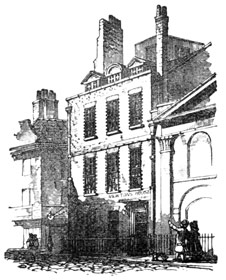
RESIDENCE OF SIR ISAAC NEWTON.
"It was for a short time," says Pennant, "the residence of Elizabeth, daughter of James I., the titular Queen of Bohemia, who, on February 13th, 1661, here ended her unfortunate life. It has been tenanted for a great number of years. It was successively the pounting-place of princes. The late King [George II.], when Prince of Wales, after he had quarrelled with his father, lived here several years. His son Frederic followed his example, succeeded him in his house, and in it finished his days."
"Behind Leicester House," the same author informs us, "stood, in 1658, the Military-yard, founded by Henry Prince of Wales, the spirited son of our peaceful James. M. Faubert afterwards kept here his academy for riding and other gentlemanlike exercises, in the reign of Charles II., which, in later years, was removed to Swallow Street, opposite the end of Conduit Street. Part is retained for the purpose of a riding-house; the rest is converted into a workhouse for the parish of St. James's."[318]
But the glory of the neighbourhood of Leicester Fields is in St. Martin's Street, where the house is still remaining which was occupied by the great Newton.