Chapter IV · THE STRAND.
Reading edition
Ancient State of the Strand—Butcher Row—Death of Lee, the dramatic Poet—Johnson at an Eating-House—Essex Street—House and History of the favourite Earl of Essex—Spenser's Visit there—Essex, General of the Parliament—Essex Head Club—Devereux Court—Grecian Coffee-House—Twining, the accomplished Scholar—St. Clement Danes—Clement's Inn—Falstaff and Shallow—Norfolk, Arundel, Surrey, and Howard Streets—Norfolk House—Essex's Ring and the Countess of Nottingham—William Penn—Birch—Dr. Brocklesby—Congreve, and his Will—Voltaire's Visit to him—Mrs. Bracegirdle—Tragical End of Mountford the Player—Ancient Cross—Maypole—New Church of St. Mary-le-Strand—Old Somerset House—Henrietta Maria and her French Household—Waller's Mishap at Somerset Stairs—New Somerset House—Royal Society, Antiquarian Society, and Royal Academy—Death of Dr. King—Exeter Street—Johnson's first Lodging in London—Art of living in London—Catherine Street—Unfortunate Women—Wimbledon House—Lyceum and Beef-steak Club—Exeter Change—Bed and Baltimore—The Savoy—Anecdotes of the Duchess of Albemarle—Beaufort Buildings—Lillie, the Perfumer—Aaron Hill—Fielding—Southampton Street—Cecil and Salisbury Streets—Durham House—Raleigh—Pennant on the Word Place or Palace—New Exchange—Don Pantaleon Sa—The White Milliner—Adelphi—Garrick and his Wife—Beauclerc—Society of Arts, and Mr. Barry—Bedford Street—George, Villiers, and Buckingham Streets—York House and Buildings—Squabble between the Spanish and French Ambassadors—Hungerford Market—Craven Street—Franklin—Northumberland House—Duplicity of Henry, Earl of Northampton—Violence of Lord Herbert of Cherbury—Percy, Bishop of Dromore—Pleasant mistake of Goldsmith.
In going through Fleet Street and the Strand, we seldom think that the one is named after a rivulet, now running under ground, and the other from its being on the banks of the river Thames. As little do most of us fancy that there was once a line of noblemen's houses on the one side, and that, at the same time, all beyond the other side, to Hampstead or Highgate, was open country, with the little hamlet of St. Giles's in a copse. So late as the reign of Henry VIII. we have a print containing the vill a of Charing. Citizens used to take an evening stroll to the well now in St. Clement's Inn.
In the reign of Edward III. the Strand was an open country road, with a mansion here and there, on the banks of the river Thames, most probably a castle or stronghold. In this state it no doubt remained during the greater part of the York and Lancaster period. From Henry VII.'s time the castles most likely began to be exchanged for mansions of a more peaceful character. These gradually increased; and in the reign of Edward VI. the Strand consisted, on the south side, of a line of mansions with garden walls; and on the north, of a single row of houses, behind which all was field. The reader is to imagine wall all the way from Temple Bar to Whitehall, on his left hand, like that of Kew Palace, or a succession of Burlington Gardens; while the line of humbler habitations stood on the other side, like a row of servants in waiting.
As wealth increased, not only the importance of rank diminished, and the nobles were more content to recollect James's advice of living in the country (where, he said, they looked like ships in a river, instead of ships at sea), but the value of ground about London, especially on the river side, was so much augmented, that the proprietors of these princely mansions were not unwilling to turn the premises into money. The civil wars had given another jar to the stability of their abodes in the metropolis; and in Charles the Second's time the great houses finally gave way, and were exchanged for streets and wharfs. An agreeable poet of the last century lets us know that he used to think of this great change in going up the Strand.
"Come, Fortescue, sincere, experienc'd friend, Thy briefs, thy deeds, and e'en thy fees suspend; Come, let us leave the Temple's silent walls; Me, business to my distant lodging calls; Through the long Strand together let us stray; With thee conversing, I forget the way. Behold that narrow street which steep descends, Whose building to the slimy shore extends; Here Arundel's fam'd structure rear'd its fame: The street alone retains the empty name. Where Titian's glowing paint the canvass warmed, And Raphael's fair design with judgment charmed, Now hangs the bellman's song; and pasted here The coloured prints of Overton appear. Where statues breathed, the works of Phidias' hands, A wooden pump, or lonely watch-house stands. There Essex's stately pile adorned the shore, There Cecil's, Bedford's, Villiers',—now no more."[127]
As the aspect in this quarter is so different from what it was, and the quarter is one of the most important in the metropolis, we may add what Pennant has written on the subject:—
"In the year 1353, that fine street the Strand was an open highway, with here and there a great man's house, with gardens to the water's side. In that year it was so ruinous, that Edward III., by an ordinance, directed a tax to be raised upon wool, leather, wine, and all goods carried to the staple at Westminster, from Temple Bar to Westminster Abbey, for the repair of the road; and that all owners of houses adjacent to the highway should repair as much as lay before their doors. Mention is also made of a bridge to be erected near the royal palace at Westminster, for the conveniency of the said staple; but the last probably meant no more than stairs for the landing of the goods, which I find sometimes went by the name of a bridge.
"There was no continued street here till about the year 1533; before that it entirely cut off Westminster from London, and nothing intervened except the scattered houses, and a village, which afterwards gave name to the whole. St. Martin's stood literally in the fields. But about the year 1560 a street was formed, loosely built, for all the houses on the south side had great gardens to the river, were called by their owners' names, and in after times gave name to the several streets that succeeded them, pointing down to the Thames; each of them had stairs for the conveniency of taking boat, of which many to this day bear the names of the houses. As the court was for centuries either at the palace at Westminster, or Whitehall, a boat was the customary conveyance of the great to the presence of their sovereign. The north side was a mere line of houses from Charing-cross to Temple Bar; all beyond was country. The gardens which occupied part of the site of Covent Garden were bounded by fields, and St. Giles's was a distant country village. These are circumstances proper to point out, to show the vast increase of our capital in little more than two centuries."[128]
The aspect of the Strand, on emerging through Temple Bar, is very different from what it was forty years ago. "A stranger who had visited London in 1790, would on his return in 1804," says Mr. Malcolm, "be astonished to find a spacious area (with the church nearly in the centre) on the site of Butcher Row, and some other passages undeserving of the name of streets, which were composed of those wretched fabrics, overhanging their foundations, the receptacles of dirt in every corner of their projecting stories, the bane of ancient London, where the plague, with all its attendant horrors, frowned destruction on the miserable inhabitants, reserving its forces for the attacks of each returning summer."[129]
The site of Butcher Row, thus advantageously thrown open, is called Pickett Street, after the alderman who projected the improvements. Unfortunately they turned out to be on too large a scale; that is to say, the houses were found to be too large and expensive for the right side of the Strand in this quarter; the tide of traffic between the city and Westminster flowing the other side of the way. The consequence is, that the houses are under-let, and that something of the old squalid look remains in the turning towards Clement's Inn, in spite of the pillared entrance.
Butcher Row, however squalid, contained houses worth eating and drinking in. Johnson frequented an eating-house there; and, according to Oldys, it was "in returning from the Bear and Harrow in Butcher Row, through Clare Market, to his lodgings in Duke Street, that Lee, the dramatic poet, overladen with wine, fell down (on the ground, as some say—according to others, on a bulk), and was killed, or stifled in the snow. He was buried in the parish church of St. Clement Danes, aged about thirty-five years."[130] "He was a very handsome as well as ingenious man," says Oldys, "but given to debauchery, which necessitated a milk diet. When some of his university comrades visited him, he fell to drinking out of all measure, which, flying up into his head, caused his face to break out into those carbuncles which were afterwards observed there; and also touched his brain, occasioning that madness so much lamented in so rare a genius. Tom Brown says, he wrote, while he was in Bedlam, a play of twenty-five acts; and Mr. Bowman tells me that, going once to visit him there, Lee showed him a scene, 'in which,' says he, 'I have done a miracle for you.' 'What's that?' said Bowman. 'I have made you a good priest.'"
Oldys mentions another of his mad sayings, but does not tell us with whom it passed.
"I've seen an unscrewed spider spin a thought, And walk away upon the wings of angels!"
"What say you to that, doctor?" "Ah, marry, Mr. Lee, that's superfine indeed. The thought of a winged spider may catch sublime readers of poetry sooner than his web, but it will need a commentary in prose to render it intelligible to the vulgar."[131]
Lee's madness does not appear to have been melancholy, otherwise these anecdotes would not bear repeating. There are various stories of the origin of it; but, most probably, he had an over-sanguine constitution, which he exasperated by intemperance. Though he died so young, the author of A Satyr on the Poets gives us to understand that he was corpulent.
"Pembroke loved tragedy, and did provide For the butchers' dogs, and for the whole Bank-side: The bear was fed; but dedicating Lee Was thought to have a greater paunch than he."[132]
This Pembroke, who loved a bear-garden, was the seventh earl of that title. His daughter married the son of Jefferies. Lee, on a visit to the earl at Wilton, is said to have drunk so hard, that "the butler feared he would empty the cellar." The madness of Lee is almost visible in his swelling and overladen dramas; in which, however, there is a good deal of true poetic fire, and a vein of tenderness that makes us heartily pity the author.
The social Boswell, in speaking of Johnson's eating-house in Butcher Row, does not approve of establishments of that sort. We shall see, by and by, that he was wrong.
"Happening to dine," says he, "at Clifton's eating-house in Butcher Row, I was surprised to see Johnson come in and take his seat at another table. The mode of dining, or rather being fed, at such houses in London, is well known to many to be peculiarly unsocial, as there is no ordinary or united company, but each person has his own mess, and is under no obligation to hold any intercourse with any one. A liberal and full-minded man, however, who loves to talk, will break through this churlish and unsocial restraint. Johnson and an Irish gentleman got into a dispute concerning the cause of some part of mankind being black. 'Why, sir (said Johnson), it has been accounted for in three ways: either by supposing that they are the posterity of Ham, who was cursed; or that God at first created two kinds of men, one black and another white; or that, by the heat of the sun, the skin is scorched, and so acquires a sooty hue. This matter has been much canvassed among naturalists, but has never been brought to any certain issue.' What the Irishman said is totally obliterated from my mind; but I remember that he became very warm and intemperate in his expressions; upon which Johnson rose, and quietly walked away. When he had retired, his antagonist took his revenge, as he thought, by saying, 'He has a most ungainly figure, and an affectation of pomposity unworthy of a man of genius.'"[133]
The ungainly figure might have been pardoned by the Irishman; who, we suppose, was equally fiery and elegant. As to Johnson's pompous manner, the most excusable part of it originated, doubtless, in his having decided opinions. The rest may have been an instinct of self-defence, arising from the "ungainly figure," not without a sense of the dignity of his calling. He certainly lost nothing by it, upon the whole. At all events, one is willing to think the best of what was accompanied by so much excellence. Affectation it was not; for nobody despised pretension of any kind more than he did. Johnson was a sort of born bishop in his way, with high judgments and cathedral notions lording it in his mind; and ex cathedrâ he accordingly spoke.
In Butcher Row, one day, Johnson met, in advanced life, a fellow-collegian, of the name of Edwards, whom he had not seen since they were at the university. Edwards annoyed him by talking of their age. "Don't let us discourage one another," said Johnson. It was this Edwards, a dull but good man, who made that naïve remark, which was pronounced by Burke and others to be an excellent trait of character:—"You are a philosopher, Dr. Johnson," said he: "I have tried in my time to be a philosopher; but, I don't know how, cheerfulness was always breaking in."[134]
Before we come to St. Clement's, we arrive, on the left-hand side of the way, at Essex Street; a spot once famous for the residence of the favourite Earl of Essex. We have mentioned an Outer Temple, which originally formed a companion to the Inner and Middle Temples, the whole constituting the tenements of the knights. This Outer Temple stretched beyond Temple Bar into the ground now occupied by Essex Street and Devereux Court; and after being possessed (Dugdale supposes) by the Prior and Canons of the Holy Sepulchre, was transferred by them, in the time of Edward III., to the Bishops of Exeter, who occupied it till the reign of Henry VI., and called it Exeter House. Sir William Paget (afterwards Lord Paget) then had it, and did "re-edify the same," calling it Paget Place. After this it was occupied by the Duke of Norfolk, who was executed for his dealings with Mary, Queen of Scots; then by Dudley, Earl of Leicester, the favourite, who called it Leicester House, and bequeathed it to his "son, Sir Robert;" and then by the other favourite, Leicester's son-in-law, Essex, from whom it retained the name of Essex House. It was occasionally tenanted by men of rank till some time after the Restoration, when it was pulled down, and the site converted into the present street and court. The only remnant of it supposed to exist is the present Unitarian Chapel, which, before it became such, was called Essex House, and latterly contained an auction room.[135]
The repose enjoyed in this precinct since the Restoration has been like silence after a succession of storms, for the house was of a turbulent reputation. The first bishop who had it after the Templars, being a favourite of Edward II., was seized by the mob, hurried to Cheapside, where they beheaded him, and then carried back a corpse, and buried in a heap of sand at his door. Lord Paget got into trouble, together with his friend the Duke of Somerset, who was accused of intending to assassinate Northumberland and others at this house. Norfolk possessed it while he formed his designs on Mary, Queen of Scots, for which he was brought to the scaffold; Leicester was always having some ill design or other—perhaps poisoned a visitor or so occasionally (for he is said to have thought nothing of that gentle expediency); and Essex made the house famous by standing a siege in it against the troops of his mistress. The siege was not long, nor any of his actions in the business very wise, though he was a man of an exalted nature. Essex got into his troubles partly from heat and ambition, partly from the inferior and more cunning nature of some of his rivals at court. There is no doubt that all these causes, together with his confidence in Elizabeth's inability to proceed to extremities, conspired to lead him into rebellion. His first offence that we hear of, next to a general petulance of manner, which the Queen's own mixture of fondness and petulance was calculated enough to provoke, was a quarrel with some young lords for her favour; the second, his joining the expedition to Cadiz without leave; and the third, his marriage with the daughter of Sir Francis Walsingham: for Elizabeth never thought it proper that her favourites should be married to any thing but her "fair idea."
His next dispute with her, which was on the subject of an assistant in the affairs of Ireland, to which he was going as lord deputy, terminated in the singular catastrophe of his receiving from her a box on the ear, with the encouraging addition of bidding him "Go, and be hanged." It is said to have been occasioned by his turning his back upon her. He clapped his hand to his sword, and swore he would not have put up with such an insult from her father. His fall is generally dated from this circumstance, and it is thought he never forgave it. But surely this is not a correct judgment: for the blow which might have been intolerable from the hand of a king, implied, in its very extravagance, something not without flattery and self-abasement from that of a princess. It was as if Elizabeth had put herself into the situation of a termagant wife. The quarrel preceded the violence. Essex went to Ireland against the rebels, but apparently with great unwillingness, calling it, in a letter to the Queen, the "cursedest of all islands," and insinuating that the best thing that could happen both to please her and himself was the loss of his life in battle. The conclusion of this letter is a remarkable instance of the mixture of romance with real life in those days. It is in verse, terminating with the following pastoral sentiment. Essex wishes he could live like a hermit, "in some unhaunted desert most obscure"—
"From all society, from love and hate Of worldly folk; then should he sleep secure, Then wake again, and yield God every praise, Content with hips and hawes, and bramble-berry; In contemplation parting out his days, And change of holy thoughts to make him merry. Who when he dies, his tomb may be a bush, Where harmless robin dwells with gentle thrush. Your Majesty's exiled servant, "Robert Essex."
Think of this being a letter from a lord lieutenant of Ireland to his sovereign! Warton says, from the evidence of some sonnets preserved in the British Museum, that although Essex was "an ingenious and elegant writer of prose," he was no poet. There is an ungainliness in the lines we have just quoted, and he was probably too much given to action to be a poet; but there is something in him that relished of the truth and directness of poetry, when he had to touch upon any actual emotion. Poetry is nothing but the voluntary power to get at the inner spirit of what is felt, with imagination to embody it. It was supposed that Essex's enemies first got him into the office of lord lieutenant, and then took advantage of his impatience under it to ruin him. He was accused of tampering with the rebels, and meditating his return into England with the troops under his charge; with a view to which object he is said to have described his army as a force with which he "would make the earth to tremble as he went." He came over, with the passion of an injured man, and presented himself before the Queen, who gave him a tolerable reception, but afterwards confined him to the house of the lord keeper. It was then, according to his confession before his death, that he first contemplated violent measures against the throne, though always short of treason. Before his liberation, he was soured by his ineffectual attempts to renew his facility of admission to the presence chamber; and he let fall an expression which his enemies greedily seized at, to wit, that the "Queen grew old and cankered, and that her mind was become as crooked as her carcase." This was exactly in his style, which was off-hand and energetic, with a gusto of truth in it. Meantime he began to have his friends about him more than ever, and to affect a necessity for it; and a summons being sent him to attend the council, he was driven by anger and fear to decline it, and to fortify himself in his house. His chief and most generous companion on this occasion was Henry, Earl of Southampton, the friend of Shakspeare. There was some little resistance; and the Lord Keeper, with the Lord Chief Justice and the Earl of Worcester, coming to summon him to his allegiance, he locked them up in a room, on pretence of taking care of their persons, and then sallied through Fleet Street into the city, where he expected a rising in his favour; for he was the most popular noble, perhaps, that England had ever seen, and the city had been disgusted by repeated levies on its purse, under pretence of invasions from Spain: though, according to Essex, Spain had never been so much in favour. The levies, in truth, were made against himself. He was disappointed: heard himself proclaimed a traitor by sound of trumpet in Gracechurch Street, and after a little more scuffling on the part of his adherents, returned by water from Queenhithe, and surrendered himself; being partly moved, he said, by the "cries of ladies." It is clear that he did not know what to be at. He expected, most likely, every moment, that the Queen's tenderness would interfere, fearful of seeing her once beloved favourite in danger. But the Cecils and others aided her good sense in keeping her quiet. Essex had certainly acted in a way incompatible with the duty of a subject, and such as no sovereign could tolerate. He was tried in Westminster Hall, and convicted of an intention to seize the court and the Tower, to surprise the Queen in her apartments, and then to summon a parliament for a "redress of grievances;" which, he said, should give his enemies "a fair trial." Southampton was acquitted, no doubt from a sense that he intended nothing but a romantic adherence to his friend.
How a man of Essex's understanding could give into these preposterous attempts, it would be difficult to conceive, if every day's experience did not show how powerful a succession of little circumstances is to bring people into situations which themselves might have least looked for. Essex evidently expected pardon to the last. When Lord Grey's name was read over among the peers who were to try him, he smiled and jogged the elbow of Southampton, for offending whom Grey had been punished. He was at his ease throughout the trial. He said to the Attorney-General (Coke), who had told him in the course of his speech that he should be "Robert the Last" of an earldom, instead of "Robert the First" of a kingdom—"Well, Mr. Attorney, I thank God you are not my judge this day, you are so uncharitable."
"Coke. Well, my lord, we shall prove you anon, what you are; which your pride of heart, and aspiring mind, hath brought you unto.
Essex. Ah, Mr. Attorney, lay your hand upon your heart, and pray to God to forgive us both."[136]
And when sentence was passed, though it is not true that he refused to ask for mercy, for he did it after the best fashion of his style, "kneeling (he said) upon the very knees of his heart," yet he seemed to threaten Elizabeth, in a tender way, with his resolution to die. She left him, like a politic sovereign, to his fate; but is thought never to have recovered it, as a friend. The romantic story of her visiting the Countess of Nottingham, who had kept back a ring which Essex sent her after his condemnation, of her shaking her on her deathbed, and crying out that "God might forgive, but she could not," is more and more credited as documents transpire. The ring, it is said, had been given to Essex, with a promise that it should serve him in need under any circumstances, if he did but send it. It is supposed that the non-appearance of it hurt the proud heart of Elizabeth, and finally allowed her to let him die. Yet she was a great sovereign, and might have suffered the law to take its course, with whatever sorrow. She was jealous of her reputation with the old and cool-headed lords about her. When the death, however, had taken place, she might have fancied otherwise. Something preyed strongly on her mind towards her decease, which happened within two years after his execution. She refused to go to bed for ten days and nights before her death, lying upon the carpet with cushions about her, and absorbed in the profoundest melancholy. To be sure, this may have been disease. A princess like Elizabeth, possessed of sovereign power, which had been sharply exercised on some doubtful occasions, might have had misgivings when going to die. Two certain causes of regret she must have had for Essex. She must have been well aware that she had alternately encouraged and irritated him over much; and she must have known that he was a better man than many who assisted in his overthrow, and that if he had been less worthy of regard, he probably would have survived her, as they did.
It may easily be imagined that Essex was a man for whom a strong affection might be entertained. He excited interest by his character, and could maintain it by his language. In everything he did there was a certain excess, but on the liberal side. When a youth, he plunged into the depths of rural pleasures and books; he was lavish of his money and good words for his friends; he said everything that came uppermost, but then it was worth saying, only his enemies were not as well pleased with it as his friends, and they never forgot it: in fine, he was romantic, brave, and impassioned. He is so like a preux chevalier, that till we call to mind other gallant knights who have not been handsome, we are somewhat surprised to hear that he was not well made, and that nothing is said of his face but that it looked reserved—a seeming anomaly, which deep thought sometimes produces in the countenances of open-hearted men. These were no hindrances, however, to the admiration entertained of him by the ladies; and he was so popular with authors and with the public, that Warton says he could bring evidence of his scarcely ever quitting England or even the metropolis, on the most frivolous enterprise, without a pastoral or other poetical praise of him, which was sold and sung in the streets. He was the friend of Spenser, most likely of Shakspeare too. being the friend of Southampton. Spenser was well acquainted with Essex House. In his 'Prothalamion,' published in 1596, he has left interesting evidence of his having visited Leicester there; and he follows up the record with a panegyric on Leicester's successor, which was probably his first hint to Essex that he was still in want of such assistance as he had received from his father-in-law. The two passages taken together render the hint rather broad, and such as would make one a little jealous for the dignity of the great poet, were not the manners of that time different in this respect from what they are now. Speaking of the Temple, in the lines quoted in our last chapter, he goes on to say—
"Next whereunto there stands a stately place, Where oft I gayned giftes and goodly grace Of that great lord, which therein wont to dwell. Whose want too well now feels my friendless case: But, ah! here fits not well Olde woes, but ioyes, to tell Against the bridale daye, which is not long: Sweet Themmes! runne softly till I end my song. Yet therein now doth lodge a noble peer, Great England's glory, and the world's wide wonder, Whose dreadful name late through all Spaine did thunder, And Hercules' two pillars standing near Did make to quake and feare: Faire branch of honour, flower of chevalrie; That fillest England with thy triumph's fame, Joy have thou of thy noble victorie."
Essex no doubt took the poet at his word, both for his panegyric and his hint: for it was he that gave Spenser his funeral in Westminster, and he was not of a spirit to treat a great poet, as poets have sometimes been treated—with neglect in their lifetime, and self-complacent monuments to them after their death.
We shall close this notice (in which we have endeavoured to concentrate all the interest we could) of the once great and applauded Essex, whose memory long retained its popularity, and gave rise to several tragedies, with a letter of his to the Lord Keeper Egerton, in which there is one of his finest sentiments expressed with his most passionate felicity. Egerton's eldest son had accompanied Essex into Ireland, and died there, which is the subject of the letter. As Spenser's death also happened just before the earl set out for that country, at a moment when he might have been of political as well as poetical use to him (for Spenser was a politician, and had been employed in the affairs of Ireland), Mr. Todd thinks, that among the friends alluded to, part of the regret may have been for him:
"Whatt can you receave from a cursed country butt vnfortunate newes? whatt can be my stile (whom heaven and earth are agreed to make a martyr) butt a stile of mourning? nott for myself thatt I smart, for I wold I had in my hart the sorow of all my frends, but I mourn that my destiny is to overlive my deerest frendes. Of yr losse yt is neither good for me to write nor you to reade. But I protest I felt myself sensibly dismembered, when I lost my frend. Shew yr strength in lyfe. Lett me, yf yt be God's will, shew yt in taking leave of the world, and hasting after my frends. Butt I will live and dy
"More yr lp's then any "man's living, "Essex.
"Arbrachan, this last day of August" [1599].
"Little,"[137] says Mr. Todd, "did the generous but unfortunate Essex then imagine, that the learned statesman, to whom this letter of condolence was addressed, would be directed very soon afterwards to issue an order for his execution. The original warrant, to which the name of Elizabeth is prefixed, is now in the possession of the Marquis of Stafford; and the queen has written her name, not with the firmness observable in numerous documents existing in the same and other collections, but with apparent tremor and hesitation."
In Essex House was born another Robert, Earl of Essex, son of the preceding, well known in history as general of the Parliament. He was a child when his father died; and was in the hands, first, of his grandmother, Lady Walsingham, and, secondly, of Henry Saville (afterwards Sir Henry), under whose severe discipline he was educated at Eton. We mention these circumstances, because they tended to keep him in that Presbyterian interest, which his father patronised out of a love of toleration and popularity. Perhaps, also, they did him no good with his wives; for he married two, and was singularly unfortunate in both. To the first, Lady Frances Howard, he was betrothed when a boy. He travelled, returned, and married her, with little love on his own side, and none on hers. Her connection with Car, Earl of Somerset, and all the infamy, crime, and wretchedness it brought upon her, are well known. Her best excuse, which is the ordinary one in cases of great wickedness (and it is a comfort to human nature that it is so), is, that she was a great fool. Her dislike of her first husband was not, perhaps, the least excusable part of her conduct, first, because she was a child like himself when they were betrothed; and secondly, because his second wife appears to have liked him no better. The latter was divorced also. After this, Essex took to a country retirement, and subsequently to an active part in the Civil Wars, during which his love of justice and affability to his inferiors rendered him extremely popular. He was of equivocal service, however, to the Parliament. He was a better general than politician, not of a commanding genius in any respect, and was suspected, not without reason, of an overweening desire to accommodate matters too much, partly out of ignorance of what the nature of the quarrel demanded, and partly from an affectation of playing the part of an amicable dictator for his own aggrandisement. So the Parliament got rid of him by the famous self-denying ordinance. Clarendon says, that when he resigned his commission, the whole Parliament went the day following to Essex House, to return him thanks for his great services; but a late historian of the commonwealth says, there is no trace of this compliment on the journals.[138] Next year they attended him to his grave. Essex's character was a prose-copy of his father's, with the love and romance left out.
Dr. Johnson, the year before he died, founded in Essex Street one of his minor clubs. The Literary Club did not meet often enough for his want of society, was too distant, and perhaps had now become too much for his conversational ambition. He wanted a mixture of inferior intellects to be at ease with. Accordingly, this club, which was held at the Essex Head, then kept by a servant of Mr. Thrale, was of a more miscellaneous nature than the other, and made no pretension to expense. One cannot help smiling at the modest and pensive tone of the letter which Johnson sent to Sir Joshua, inviting him to join it. "The terms are lax, and the expenses light. We meet thrice a-week; and he who misses, forfeits two-pence."[139] This stretch of philosophy seems to have startled the fashionable painter, who declined to become a member. When we find, however, in the list the names of Brocklesby, Horsley, Daines Barrington, and Windham, Boswell has reason to say that Sir John Hawkins's charge of its being a "low ale-house association" appears to be sufficiently obviated. But the names might have been subscribed out of civility without any further intention. The club, nevertheless, was in existence when Boswell wrote, and went on, he says, happily. Johnson said of him, when he was proposed, "Boswell is a very clubable man."
In Devereux Court, through which there is a passage round into the Temple, is the Grecian Coffee House, supposed to be the oldest in London. We should rather say the revival of the oldest, for the premises were burnt down and rebuilt. The Grecian was the house from which Steele proposed to date his learned articles in the Tatler.
In this court are the premises of the eminent tea-dealers, Messrs. Twining, the front of which, surmounted with its stone figures of Chinese, has an elegant appearance in the Strand. We notice the house, not only on this account, but because the family have to boast of a very accomplished scholar, the translator of the Poetics of Aristotle. Mr. Twining was contemporary with Gray and Mason at Cambridge; and besides his acquirements as a linguist (for, in addition to his knowledge of Greek and Latin, he wrote French and Italian with idiomatic accuracy), was a musician so accomplished as to lead the concerts and oratorios that were performed during term-time, when Bate played the organ and harpsichord. He was also a lively companion, full of wit and playfulness, yet so able to content himself with country privacy, and so exemplary a clergyman, that for the last forty years of his life he scarcely allowed himself to be absent from his parishioners more than a fortnight in a year.
The church of St. Clement Danes, which unworthily occupies the open part of the Strand, to the west of Essex Street, was the one most frequented by Dr. Johnson. It is not known why this church was called St. Clement Danes. Some think because there was a massacre of the Danes thereabouts; others because Harold Harefoot was buried there; and others, because the Danes had the quarter given them to live in, when Alfred the Great drove them out of London, the monarch at the same time building the church, in order to assist their conversion to Christianity. The name St. Clement has been derived with probability from the patron saint of Pope Clement III., a great friend of the Templars, to whom the church at one time belonged. St. Clement's was rebuilt towards the end of the century before last by Edward Pierce, under the direction of Sir Christopher Wren, but is a very incongruous ungainly edifice. Its best aspect is at night-time in winter, when the deformities of its body are not seen, and the pale steeple rises with a sort of ghastliness of grandeur through the cloudy atmosphere. The chimes may still be heard at midnight, as Falstaff describes having heard them with Justice Shallow. If they did not execute one of Handel's psalm-tunes, we should take them to be the very same he speaks of, and conclude that they had grown hoarse with age and sitting-up; for to our knowledge they have lost some of their notes these twenty years, and the rest are falling away. A steeple should set a better example.
A few years back, when the improvements on the north side, in this quarter, had not been followed by those on the south, Gay's picture of the avenue between the church and the houses was true in all its parts. We remember the "combs dangling in our faces," and almost mourned their loss for the sake of the poet.
"Where the fair columns of St. Clement stand, Whose straiten'd bounds encroach upon the Strand; Where the low penthouse bows the walker's head, And the rough pavement wounds the yielding tread; Where not a post protects the narrow space, And, strung in twines, combs dangle in thy face; Summon at once thy courage, rouse thy care, Stand firm, look back, be resolute, beware. Forth issuing from steep lanes, the collier's steeds Drag the black load; another cart succeeds; Team follows team, crowds heap'd on crowds appear, And wait impatient till the road grow clear."
Everybody can testify to the truth of this description. A little patience, however, is well repaid by the sight of the noble creatures dragging up the loads. The horses of the colliers and brewers of London are worth notice at all times for the magnificence of their build. Gay proceeds to other particulars, now no longer to be encountered. He cautions you how you lose your sword; and adds a pleasant mode of theft, practised in those times:—
"Nor is the flaxen wig with safety worn: High on the shoulder, in a basket borne, Lurks the sly boy, whose hands, to rapine bred, Plucks off the curling honours of thy head."[140]
Clement's Inn is named from the church. The device over the gate, of an anchor and the letter C, is supposed to allude to the martyrdom of St. Clement, who is said to have been tied to an anchor and thrown into the sea, by order of the Emperor Trajan.
"The hall is situated on the south side of a neat but small quadrangle. It is a Tuscan diminutive building, with a very large Corinthian door, and arched windows, erected in 1715. Another irregular area is surrounded by convenient houses, in which are the possessor's chambers. Part of this is a pretty garden, with a kneeling African, of considerable merit, supporting a dial, on the eastern side."[141]
In Knox's Elegant Extracts are some lines on this negro, which have often been repeated:—
"In vain, poor sable son of woe, Thou seek'st the tender tear; For thee in vain with pangs they flow; For mercy dwells not here. From cannibals thou fledst in vain; Lawyers less quarter give; The first won't eat you till you're slain, The last will do't alive."
This inn, like all the other inns of court, is of great antiquity. Dugdale states it to have been an inn of Chancery in the reign of Edward II. Some have conjectured, according to Mr. Moser, "that near this spot stood an inn, as far back as the time of King Ethelred, for the reception of penitents who came to St. Clement's Well; that a religious house was in process of time established, and that the church rose in consequence." Be this as it may, the holy brotherhood was probably removed to some other institution; the Holy Lamb, an inn on the west side of the lane, received the guests; and the monastery was converted, or rather perverted, from the purposes of the gospel to those of the law, and was probably, in this profession, considered as a house of considerable antiquity in the days of Shakspeare; for he, who with respect to this kind of chronology may be safely quoted, makes in the second act of Henry IV. one of his justices a member of that society:—
"He must to the Inns of Court. I was of Clement's once myself, where they talk of Mad Shallow still."
A pump now covers St. Clement's Well. Fitzstephen, in his description of London, in the reign of Henry II., speaks of certain "excellent springs at a small distance" from the city, "whose waters are sweet, salubrious, and clear, and whose runnels murmur o'er the shining stones: among these," he continues, "Holywell, Clerkenwell, and St. Clement's Well may be esteemed the principal, as being much the most frequented, both by the scholars from the school (Westminster) and the youth from the city, when on a summer's evening they are disposed to take an airing."
Six hundred years and upwards have elapsed since Fitzstephen wrote. It is pleasant to think that the well has lasted so long, and that the place is still quiet.
The Clare family, who have left their name to Clare Market, appear to have occupied Clement's Inn during part of the reign of the Tudors. From their hands it reverted to those of the law. It is an appendage to the Inner Temple. We are not aware of any greater legal personage having been bred there, than the one just mentioned. Shallow takes delight in his local recollections, particularly of this inn. In one of the masterly scenes of this kind, Falstaff's corroboration of a less pleasant recollection, and Shallow's anger against the cause of it, after such a lapse of time, are very ludicrous.
"Shallow. Oh, Sir John, do you remember since we lay all night in the windmill in St. George's Fields?
"Fals. No more of that, good Master Shallow, no more of that.
"Shal. Ha, it was a merry night. And is Jane Nightwork alive?
"Fals. She lives, Master Shallow.
"Shal. She never could away with me.
"Fals. Never, never; she would always say she could not abide Master Shallow.
"Shal. By the mass. I could anger her to the heart. She was then a bonaroba. Doth she hold her own well?—and had Robin Nightwork by old Nightwork, before I came to Clement's Inn.
"Silence. That's fifty-five years ago.
"Shal. Ha, Cousin Silence, that thou hadst seen that that this knight and I have seen! Ah, Sir John, said I well?
"Fals. We have heard the chimes at midnight, Master Shallow.
"Shal. That we have, that we have, that we have; in faith, Sir John, we have; our watchword was, Hem, boys! Come, let's to dinner: come, let's to dinner: Oh, the days that we have seen! Come, come."[142]
The sites of Arundel, Norfolk, Surrey, and Howard Streets (the last of which crosses the others), were formerly occupied by the house and grounds originally constituting the town residence of the Bishop of Bath and Wells, then of the Lord High Admiral Seymour, and afterwards of the Howards Earls of Arundel, from whom it came into possession of the Duke of Norfolk. It was successively called Bath's Inn (Hampton Place, according to some, but we know not why), Seymour Place, Arundel House, and Norfolk House. It was a wide low house, but according to Sully, who lodged in it when he was ambassador to James I., very convenient, on account of the multitude of rooms on the same floor.
In this house the Lord High Admiral, Thomas Seymour, brother of the Protector Somerset, in the reign of Edward VI., contrived to place the Princess (afterwards Queen) Elizabeth, with a design of possessing her person, and sharing her succession to the Crown. No doubt is entertained of these views by the historians. Elizabeth was not averse to him, though he had lately married the Queen Dowager (Catherine Parr); and some gossipping stories transpired of the evidences of their good-will. Catherine's death increased the suspicion, and she herself expressed it on her death-bed. Seymour's ambition, however, shortly brought him to the scaffold, and saved us from a King Thomas I., who would probably, as Pennant thinks, have been a very bad one.
We have mentioned the Countess of Nottingham who withheld from Elizabeth the ring sent her by Essex. It was in this house she died. Her husband was a Howard, and, probably, she was on a visit there. We take an opportunity, therefore, of relating the particulars of that romantic story, as collected by the accurate Dr. Birch, and repeated in the Memoirs of the Peers of England during the reign of James I. "The following curious story," says the compiler of this work, "was frequently told by Lady Elizabeth Spelman, great grand-daughter of Sir Robert Carey, brother of Lady Nottingham, and afterwards Earl of Monmouth, whose curious memoirs of himself were published a few years ago by Lord Corke."
"When Catherine, Countess of Nottingham, was dying (as she did, according to his lordship's own account, about a fortnight before Queen Elizabeth), she sent to her Majesty to desire that she might see her, in order to reveal something to her Majesty without the discovery of which she could not die in peace. Upon the Queen's coming, Lady Nottingham told her, that, while the Earl of Essex lay under sentence of death, he was desirous of asking her Majesty's mercy, in the manner prescribed by herself, during the height of his favour; the Queen having given him a ring, which being sent to her as a token of his distress, might entitle him to her protection. But the earl, jealous of those about him, and not caring to trust any of them with it, as he was looking out of his window one morning, saw a boy, with whose appearance he was pleased; and engaging him by money and promises, directed him to carry the ring, which he took from his finger and threw down, to Lady Scroope, a sister of the Countess of Nottingham, and a friend of his lordship, who attended upon the Queen; and to beg of her that she would present it to her Majesty. The boy, by mistake, carried it to Lady Nottingham, who showed it to her husband, the admiral, an enemy of Lord Essex, in order to take his advice. The admiral forbid her to carry it, or return any answer to the message; but insisted upon her keeping the ring.
"The Countess of Nottingham, having made this discovery, begged the Queen's forgiveness; but her Majesty answered, 'God may forgive you, but I never can,' and left the room with great emotion. Her mind was so struck with the story that she never went into bed, nor took any sustenance from that instant, for Camden is of opinion, that her chief reason for suffering the earl to be executed, was his supposed obstinacy in not applying to her for mercy."[143]
"In confirmation of the time of the countess's death," continues the compiler, "it now appears from the parish register of Chelsea, extracted by Mr. Lysons (Environs of London, vol. ii., p. 120), that she died at Arundel House, London, February 25, and was buried the 28th, 1603. Her funeral was kept at Chelsea, March 21st; and Queen Elizabeth died three days afterwards."
Clarendon gives a singular character of this house and its master when it was in possession of Thomas Howard, Earl of Arundel. He says that the earl
"Seemed to live, as it were, in another nation, his house being a place to which all people resorted, who resorted to no other place; strangers, or such as affected to look like strangers, and dressed themselves accordingly. He was willing to be thought a scholar, and to understand the most mysterious parts of antiquity, because he made a wonderful and costly purchase of excellent statues whilst in Italy and in Rome (some whereof he could never obtain permission to remove out of Rome, though he had paid for them), and had a rare collection of medals. As to all parts of learning, he was almost illiterate, and thought no other part of history so considerable as what related to his own family, in which, no doubt, there had been some very memorable persons. It cannot be denied that he had in his own person, in his aspect and countenance, the appearance of a great man, which he preserved in his gait and motion. He wore and affected a habit very different from that of the time, such as men had only beheld in pictures of the most considerable men; all which drew the eyes of most, and the reverence of many, towards him, as the image and representative of the ancient nobility, and native gravity of the nobles, when they had been most venerable; but this was only his outside, his nature and true humour being much disposed to levity and delights, which indeed were very despicable and childish."
The marbles here mentioned, now at Oxford, were collected at Arundel House. This character from the pen of Clarendon has been thought too severe. Perhaps the earl had given the noble historian a repulse when he was nothing but plain Mr. Hyde; for personal resentments of this sort are apparent in his writings. The last Duke of Norfolk but one, who wrote anecdotes on the Howard family, asks how the man who collected the Oxford marbles could be the slave of such family self-love as Clarendon describes, and how it was that he held the first places in the state, and the most important commissions abroad. It is well-known, however, that a man may do all this, and yet be more fortunate than wise. Arundel was certainly proud, if not dull; and the proudest men are not apt to be the brightest. It was he that, in a dispute with Lord Spenser, in the Upper House, when the latter spoke of the treason of the earl's ancestors, said, "My lord, my lord, while my ancestors were plotting treason, yours were keeping sheep." He little thought that his marbles would help to bring about a time, when an historian, by no means indifferent to rank and title, should regard a romantic poem as the "brightest jewel" in a ducal coronet, and that coronet be a Spenser's.[144]
At the south-west corner of Norfolk Street lived at one time the famous Penn, who from being a coxcomb in his youth became a Quaker and a founder of a state. However, his coxcombry was a falling-off from early seriousness. His father was a rough admiral, who could not for the life of him conceive why his son should relapse into a preciseness so unlike the rest of the world, and so unfitted to succeed at court. Voltaire says,[145] that young Penn (for he was little more than twenty years of age) appeared suddenly before his father in a Quaker dress, and to the old man's astonishment and indignation said, without moving his hat, "Friend Penn, how dost thee do?" But, according to more serious biographers, the change was not so sudden. The hat, however, was a great matter of contention between them, the admiral wishing to stipulate that his son should uncover to the King (Charles II.), the King's brother, and himself; but Penn having recourse to "fasting and supplication," found that his hat was not to be moved. These were the weaknesses of a young enthusiast. His enthusiasm remained for greater purposes; but he is understood to have grown wiser with regard to the rest, though he continued a Quaker for life. Penn, though a legislator, never seems to have given up a taste for good living. His appearance in the portraits of him, notwithstanding his garb, is fat and festive; and he died of apoplexy.
In the same house, we believe, that had been occupied by Penn[146], resided an author who must not be passed over in a work of this kind; to wit, the indefatigable and honest antiquary, Dr. Birch. He came of a Quaker stock. Birch astonished his friends by going a great deal into company; but the secret of his uniting sociality with labour, was his early rising. This, which appears to be one of the main secrets of longevity, ought to have kept him older, for he died at the age of sixty-one: but he was probably festive as well social, and should have taken more exercise. Being a bad horseman, he was thrown on the Hampstead road, and killed on the spot; but the doctors were uncertain whether apoplexy had not a hand in the disaster. In speaking of Birch, nobody should omit a charming billet, written to him by his first wife, almost in the article of death. The death took place within a year after their marriage, and was accelerated by childbed.
"This day I return you, my dearest life, my sincere hearty thanks for every favour bestowed on your most faithful and obedient wife.
"July 31, 1729."
"Hannah Birch."[147]
In Norfolk Street, for upwards of thirty years, lived Dr. Brocklesby, the friend and physician of Dr. Johnson. Physicians of this class may, par excellence, be styled the friends of men of letters. They partake of their accomplishments, understand their infirmities, sympathise with their zeal to do good, and prolong their lives by the most delicate and disinterested attentions. Between no two professions has a more liberal and cordial intimacy been maintained than between literature and medicine. Brocklesby was an honour to the highest of his calling.
"In the course of his practice," we are told that "his advice, as well as his purse, was ever accessible to the poor, as well as to men of merit who stood in need of either. Besides giving his advice to the poor of all descriptions, which he did with an active and unwearied benevolence, he had always upon his list two or three poor widows, to whom he granted small annuities; and who, on the quarter-day of receiving their stipends, always partook of the hospitalities of his table. To his relations, who wanted his assistance in their business or professions, he was not only liberal, but so judicious in his liberalities as to supersede the necessity of a repetition of them. To his friend Dr Johnson (when it was in agitation amongst his friends to procure an enlargement of his pension, the better to enable him to travel for the benefit of his health), he offered an establishment of one hundred pounds per year during his life; and upon Dr. Johnson's declining it (which he did in the most affectionate terms of gratitude and friendship), he made him a second offer of apartments in his own house, for the more immediate benefit of medical advice. To his old and intimate friend Edmund Burke, he had many years back bequeathed by will the sum of one thousand pounds; but recollecting that this event might take place (which it afterwards did) when such a legacy could be of no service to him, he, with that judicious liberality for which he was always distinguished, gave it to him in advance, 'ut pignus amicitæ:' it was accepted as such by Mr. Burke, accompanied with a letter, which none but a man feeling the grandeur and purity of friendship like him could dictate."[148]
If it be dangerous in the present condition of society, to incur pecuniary obligations, particularly for those who are more qualified to think than to act, and who may ultimately startle to find themselves in positions in which they can neither prove the benefit done them, nor the good feelings which allowed them to receive it, nobody can doubt the generosity of such a man as Brocklesby; who, so far from being a mere patron, jealous of being obliged himself, was equally as prepared to receive kindness as to show it. Proposing just before he died to go down to Burke's house at Beaconsfield, and somebody hinting to him the danger of being fatigued, and of lying out of his own bed, he replied with his usual calmness, "My good friend, I perfectly understand your hint, and am thankful to you for it; but where's the difference, whether I die at a friend's house, at an inn, or in a postchaise? I hope I am every way prepared for such an event, and perhaps it is as well to elude the expectation of it." This was said like a man, and a friend. Brocklesby was not one who would cant about giving trouble at such a moment—the screen of those who hate to be troubled; neither would he grudge a friend the melancholy satisfaction of giving him a bed to die in. He better understood the first principles which give light and life to the world, and left jealousy and misgiving to the vulgar.
Dr. Brocklesby died at his house in the street above mentioned, and was buried in the churchyard. Lee was buried, "at St. Clement Danes;" probably, therefore, in the churchyard also. There are now in that spot some trees, by far the best things about the church. The reader may imagine them to shade the places where the poet and the physician lie.
Arundel or Norfolk House, after the great fire, became the temporary place of meeting for the Royal Society, previously to its return to Gresham College. It was pulled down on their leaving it, the century before last, and the streets before mentioned built in its room. They appear to have been favourite places of residence with persons connected with the drama. Congreve lived in Surrey Street, Mountford the player in Norfolk Street, Mrs. Bracegirdle in Howard Street, and Mrs. Barry somewhere near her.
Congreve died where he had lived (Jan. 29, 1728-9), after having been for several years afflicted with blindness and gout; of which, however, he seems to have made the best he could, by the help of good sense and naturally good spirits. If his wits ever failed him, it was in the propensity to a love of rank and fashion, which, in spite of all that he had seen in the world, never forsook him. It originated probably in the need he thought he had of them, when he first set out in life. The finest sense of men of his cast does not rise above a graceful selfishness. It was most probably in Surrey Street (for he had come to the "verge of life"), that he had a visit paid him by Voltaire, who has recorded the disgust given him by an ebullition of his foppery: for the Frenchman had a great admiration of him as a writer. "Congreve spoke of his works," says Voltaire, "as of trifles that were beneath him; and hinted to me, in our first conversation, that I should visit him upon no other foot than upon that of a gentleman, who led a life of plainness and simplicity. I answered, that had he been so unfortunate as to be a mere gentleman, I should never have come to see him; and I was very much disgusted at so unseasonable a piece of vanity."[149] Our readers will admire the fineness of this rebuke.
But the most glaring instance of this propensity was his leaving the bulk of his fortune to a duchess, when he had poor relations in want of it.
"Having lain in state," says Johnson, "in the Jerusalem Chamber, he was buried in Westminster Abbey, where a monument is erected to his memory by Henrietta, Duchess of Marlborough, to whom, for reasons either not known or not mentioned, he bequeathed a legacy of about ten thousand pounds, the accumulation of attentive parsimony, which, though to her superfluous and useless, might have given great assistance to the ancient family from which he descended; at that time, by the imprudence of his relation, reduced to difficulties and distress."[150]
"Congreve," says Dr. Young, "was very intimate for years with Mrs. Bracegirdle, who lived in the same street—his house very near hers; until his acquaintance with the young Duchess of Marlborough. He then quitted that house. The duchess showed me a diamond necklace (which Lady Di. used afterwards to wear), that cost seven thousand pounds, and was purchased with the money Congreve left her. How much better would it have been to have given it to poor Mrs. Bracegirdle!"[151]
Yet this dramatist, throughout his life, had had the good word of everybody. All parties praised him: all parties kept him in office (he had some places that are said to have produced him twelve hundred a year): Pope dedicated his Iliad to him; called him, after his death, Ultimus Romanorum; and added that "Garth, Vanbrugh, and he were the three most honest-hearted, real good men of the Kit-Kat Club!"[152]
The secret of this is, that Congreve loved above all things to be at ease, and spoke politicly of everybody. He had a bad opinion of mankind, as we may see by his comedies; and he made the best of it, by conversing with them as if he took heed of their claws. The only person, we believe, that he ever opposed, was Collier, who attacked the stage with more spirit than elegance, and who was at enmity with the whole world of wit and fashion. We are far from thinking with Collier, that the abuses of the stage outweigh the benefit it does to the world; nor do we think the world by any means so bad as Congreve supposed it, nor himself either: but it is useful to know the tendencies of those who have a habit of thinking otherwise.
Congreve's bequest created a good deal of gossip. Curll, the principal scandal-monger of those times, got up a catch-penny life of him, professing to be written by "Charles Wilson, Esq.," but supposed to be the work of Oldmixon. There is no relying upon Charles Wilson; but, from internal evidence, we may take his word occasionally; and we may believe him when he says that the duchess and her friends were alarmed at the threatened book. The picture which he draws of her manner has also an air like a woman of quality. She had demanded a sight of the documents on which the book was founded; and being refused, asked what authority they had, and what pieces contained in it were genuine. "Upon being civilly told there would be found several essays, letters, and characters of that gentleman's writing," says Mr. Wilson, "she, with a most affected, extraordinary, dramatic drawl, cried out, 'Not one single sheet of paper, I dare to swear.'"[153] Mr. Wilson's own grand air in return is very amusing. He speaks of Arbuthnot's coming with "expresses," probably to Curll's; and adds, that if he be despatched with any more, "he may, if he please, come to me, who am as easily to be found in Great Russell Street, Bloomsbury, when in town, as he is in Burlington Gardens.—Cha. Wilson."
Mr. Wilson's book opens with a copy of the will, in which 500l. are left among the Congreves; about 500l. more to friends and domestics, &c. (not omitting 200l. to Mrs. Bracegirdle); and all the rest (with power to annul or increase the complimentary part of the legacies) to the Duchess of Marlborough. We know not that anybody could have brought forward grounds for objecting to this will, had the duchess been poor herself; for his relations may or may not have had claims upon him—relations, as such, not being of necessity friends, though it is generally fit that they should partake of the family prosperity. We except, of course, a man's immediate kindred, particularly those whom he has brought into the world. But here was a woman, rolling in wealth, and relatives neither entirely forgotten, nor yet, it seems, properly assisted. The bequest must, therefore, either have been a mere piece of vanity, or the consequence of habitual subjection to a woman's humours. The duchess was not ungrateful to his memory. She raised him, as we have seen, a monument; and it is related in Cibber's Lives of the the Poets,[154] we know not on what authority, that she missed his company so much, as to cause "an image of him to be placed every day on her toilet-table, to which she would talk as to the living Mr. Congreve, with all the freedom of the most polite and unreserved conversation." There is something very ludicrous in this way of putting a case, which might otherwise be affecting. It is as if there had been a sort of polite mania on both sides.
Congreve's plays are exquisite of their kind, and the excessive heartlessness and duplicity of some of his characters are not to be taken without allowance for the ugly ideal. There is something not natural, both in his characters and wit; and we read him rather to see how entertaining he can make his superfine ladies and gentlemen, and what a pack of sensual busybodies they are, like insects over a pool, than from any true sense of them as "men and women." As a companion he must have been exquisite to a woman of fashion. We can believe that the duchess, in ignorance of any tragic emotion but what was mixed with his loss, would really talk with a waxen image of him in a peruke, and think the universe contained nothing better. It was carrying wit and politeness beyond the grave. Queen Constance in Shakspeare makes grief put on the pretty looks of her lost child: the Duchess of Marlborough made it put on a wig and jaunty air, such as she had given her friend in his monument in Westminster Abbey. No criticism on his plays could be more perfect. Congreve's serious poetry is a refreshment, from its extreme insipidity and common-place. Everybody is innocent in some corner of the mind, and has faith in something. Congreve had no faith in his fellow-creatures, but he had a scholar's (not a poet's) belief in nymphs and weeping fauns; and he wrote elegies full of them, upon queens and marquisses. If it be true that he wrote the character of Aspasia (Lady Elizabeth Hastings), in the Tatler (No. 42), he had indeed faith in something better; for in that paper is not only given an admiring account of a person of very exalted excellence, but the author has said of her one of the finest things that a sincere heart could utter; namely, that "to love her was a liberal education." We cannot help thinking, however, that the generous and trusting hand of Steele is very visible throughout this portrait; and in the touch just mentioned, in particular.
The engaging manners of Mrs. Bracegirdle gave rise to a tragical circumstance in Howard Street—the death of Mountford her fellow-player. Mrs. Bracegirdle, one of the most popular actresses of that time, was a brunette, not remarkable for her beauty, but so much so for the attractiveness superior to beauty, that Cibber calls her the "darling of the stage," and says it was a kind of fashion for the young men about town to have a tenderness for her. This general regard she preserved by setting a value on herself, not so common with actresses at that time as it has been since. Accordingly, some made honourable proposals, which were then still more remarkable. In Rowe's poems, there is a bantering epistle to an Earl of S——, advising him not to care for what people might think, but to pursue his inclinations to that effect. Among others a Captain Hill made desperate love, professing the same intentions; but he was a man of bad character, and the lady would have nothing to say to him. The captain, like a proper coxcomb, took it into his head that nothing could have prevented his success, but some other person; and he fixed upon Mountford as the happy man. Mountford was the best lover and finest gentleman then on the stage, as Mrs. Bracegirdle was the most charming heroine; but it does not appear that Hill had any greater ground for his suspicion than their frequent performance in the same play, which, however, to a jealous man, must have been extremely provoking. They used to act Alexander and Statira together. In Mountford's Alexander, according to Cibber, there were seen "the great, the tender, the penitent, the despairing, the transported, and the amiable, in the highest perfection;" and "if anything," he said, "could excuse that desperate extravagance of love, that almost frantic passion," it was when Mrs. Bracegirdle was the Statira. Imagine a dark-souled fellow in the pit thinking himself in love with this Statira, and that the passion between her and the Alexander was real. This play was acted a few nights before the catastrophe which we are about to relate.
Hill was intimate with another man of bad character, Lord Mohun; who agreed to assist him in carrying off Mrs. Bracegirdle. The captain had often said that he would be "revenged" upon Mountford; and dining with Lord Mohun on the day when they attempted the execution of their plot, he said, further, that he would "stab" him "if he resisted;" upon which Mohun said that he would "stand by his friend."
Mohun and Hill met at the playhouse at six o'clock, changed clothes there, and waited some time for Mrs. Bracegirdle; but not finding her come, they took a coach which they had ordered to be ready, drove towards her lodgings in Howard Street, and then back to Drury Lane, where they directed the coach to stop near Lord Clare's house (by the present Craven Buildings). Mrs. Bracegirdle had been supping at a Mr. Page's, in Princess Street, Drury Lane. She came out, accompanied by her mother, brother, and Mr. Page, and was seized by Hill, who, with the aid of a number of soldiers, endeavoured to force her into the coach. In the coach was Lord Mohun, with seven or eight pistols. Old Mrs. Bracegirdle threw her arms round her daughter's waist; her other friends, and at length the passengers, interfered; and our heroine succeeded in getting into her lodgings in Howard Street, Hill and Mohun following them on foot. When they all came to the door, Hill would have spoken with Page, but the latter refused; and the door was shut. A witness, at the trial of Lord Mohun, deposed, that they knocked several times at the door, and then the captain entreated to beg pardon of Mrs. Bracegirdle for having affronted her, but in vain.
Hill and Mohun remained in the street. They sent to a tavern for a bottle of wine, and perambulated before the door with drawn swords. Mrs. Browne, the mistress of the house, came out to know what they did there; upon which Hill said that he would light upon Mountford some day or other, and that he would be revenged on him. The people in-doors, upon this, sent to Mountford's house in Norfolk Street, to inform his wife; and she despatched messengers to all the places where he was likely to be found, to warn him of his danger, but they could not meet with him. Meanwhile the constables and watchmen come up and ask the strangers what they mean. They say they are drinking a bottle of wine. Lord Mohun adds that he is ready to put up his sword, remarking, withal, that he is a "peer of the realm." Upon asking why the other gentleman did not put up his, his lordship tells them, that his friend had lost the scabbard. The watchmen, like "ancient and quiet watchmen," go away to the tavern to "examine who they are;" and in the meantime Mountford makes his appearance coming up the street. Mountford lived in Norfolk Street, but he turned out of the path that led to his own house, and was coming towards Mrs. Bracegirdle's—whether to her house, or to any other, does not appear. By this time two hours had elapsed. Mrs. Browne, who seems to have remained watching at the door, caught sight of Mountford, and hastened to warn him how he advanced. She was either not quick enough, or Mountford (which appears most likely) pressed on in spite of what she said, and, according to her statement, the following dialogue took place between him and Lord Mohun:—
"Your humble servant, my lord."
"Your servant, Mr. Mountford. I have a great respect for you, Mr. Mountford, and would have no difference between us; but there is a thing fallen out between Mr. Hill and Mrs. Bracegirdle."
"My lord, has my wife disobliged your lordship? if she has, she shall ask your pardon. But Mrs. Bracegirdle is no concern of mine: I know nothing of this matter; I come here by accident. But I hope your lordship will not vindicate Hill in such actions as these are."
Upon this, according to Mrs. Browne's statement, Hill bade Mountford draw; which the other said he would; but whether he received his wound before or after she could not tell, owing to its being night-time.
Another female witness, who lived next door, gives the dialogue as follows. Lord Mohun begins:—
"Mr. Mountford, your humble servant. I am glad to see you" (embracing him).
"Who is this? my Lord Mohun?"
"Yes, it is."
"What bringeth your lordship here at this time of night?"
"I suppose you were sent for, Mr. Mountford?"
"No, indeed; I came by chance."
"You have heard of the business of Mrs. Bracegirdle?"
Hill (interfering). "Pray, my lord, hold your tongue, This is not a convenient time to discuss this business." (On saying which, the witness adds, that he would have drawn Mohun away.)
Mountford. "I am very sorry, my lord, to see that your lordship should assist Captain Hill in so ill an action as this: pray let me desire your lordship to forbear."
As soon as he had uttered these words Hill, according to the witness, came up and struck Mountford a box on the ear; upon which the latter demanded with an oath, "what that was for;" and then she gives a confused account of the result, which was the receipt of a mortal wound by the poor actor. It was agreed that Mountford's sword was not drawn in the first instance, and that Hill's was; and the question was settled by the dying deposition of Mountford, who stated several times over, that Lord Mohun offered him no violence, but that Hill struck him with his left hand, and then ran him through the body, before he had time to draw in defence.
Mountford died next day. Hill fled at the time, and we hear no more of him. Mohun was tried for his life, but acquitted, for want of evidence, of malice prepense. The truth is, he was a great fool, and Hill appears to have been another. The captain himself, probably, did not know what he intended, though his words would have hung him had he been caught. They were a couple of box-lobby swaggerers, who had heated themselves with wine; and Hill, who told the constables "they might knock him down if they liked," and was for drawing Mohun away on Mountford's appearance, was most likely overcome with rage and jealousy at hearing the latter speak of him with rebuke. Mohun was at that time very young. He never ceased, however, hankering after this sort of excitement to his dulness, till he got killed in a duel about an estate with the Duke of Hamilton, who was at the same time mortally wounded. Swift, in a letter about it, calls Mohun a "dog." Pennant says, that when his body was taken home bleeding (to his house in Gerrard Street), "Lady Mohun was very angry at its being flung upon the best bed."[155]
In front of the spot now occupied by St. Mary-le-Strand, commonly called the New Church, anciently stood a cross, at which, says Stowe, "in the year 1294, and other times, the justices itinerant sat without London." In the place of this cross was set up a May-pole, by a blacksmith named John Clarges, whose daughter Ann became the wife of Monk, Duke of Albemarle. It was for a long time in a state of decay, and having been taken down in 1713, a new one was erected opposite Somerset House. This second May-pole had two gilt balls and a vane on the summit, and was decorated on holidays with flags and garlands. The races in the "Dunciad" take place
"Where the tall May-pole overlook'd the Strand."
It was removed in 1718, probably being thought in the way of the new church, which was then being finished. Sir Isaac Newton begged it of the parish, and afterwards sent it to the Rector of Wanstead, who set it up in Wanstead Park to support the then largest telescope in Europe. The gift of John Clarges came a day too late. In old times, May had been a great holiday in the streets of London. We shall speak further of it when we come to the parish of St. Andrew Undershaft, so called from a May-pole higher than the church. But though the holiday returned with the Restoration, it never properly recovered the disuse occasioned by the civil wars, and the contempt thrown on it by the spirit of puritanism. We gained too many advantages by the thoughtfulness generated in those times to quarrel with their mistakes; and have no doubt that the progress of knowledge to which they gave an impulse, will bring back the advantages they omitted by the way.[156]
The New Church, or, more properly, the Church of St. Mary-le-Strand, was built by Gibbs, the architect of St. Martin-in-the-Fields. It was one of the "fifty," improperly so called, that are said to have been built in the reign of Queen Anne; for though fifty were ordered, the number was not completed. The old church in this quarter, which stood at a little distance to the south, was removed by the Protector Somerset, to make way for Somerset House, and has never been restored. The parishioners went to the neighbouring churches. The New Church is in the pretty, over-ornamented style, very different from that of St. Martin's with its noble front: and though far better than St. Clement's, and as superior to many places of worship built lately[157] as art is superior to ignorance, yet it surely is not worthy of its advantageous situation. It is one of those toys of architecture which have been said to require glass cases. For the superfluous height of the steeple, Gibbs offered an excuse. A column was to have been erected near the church in honour of Queen Anne, but, as the Queen died, she was no longer thought deserving the column, and the architect was ordered to make a steeple with the materials, whereas he had intended only a belfry. Now, to render the steeple fitting, the church should have had a wider base; but the structure was already begun, and there was no changing the plan of it. It might be still argued, that the steeple should not have been made so high: but then, what was to be done with the stones? This, in the mouth of parish virtù, was a triumphant reply. After all, however, the artist need not have spoilt his church with ornament. He said, that being situated in a very public place, "the parishioners" spared no cost to beautify it; but to beautify a church is not to make it a piece of confectionery.[158]
Somerset House occupies the site of a princely mansion built by Somerset the Protector, brother of Lady Jane Seymour, and uncle to King Edward VI. His character is not sufficiently marked to give any additional interest to the spot. He was great by accident; lost and gained his greatness, according as others acted upon it; and ultimately resigned it on the scaffold. The house he left became the property of the Crown, and was successively in possession of Queen Elizabeth and of the queens of James I., Charles I., and Charles II.
The rooms in this house witnessed many joyous scenes and many anxious ones. Somerset had not long inhabited it when he was taken to the scaffold. Elizabeth, in her wise economy, lent it to her cousin Lord Hunsdon, whom she frequently visited within its walls.
During its occupation by James's queen, Anne of Denmark (from whose family it was called Denmark House), Wilson says, that a constant masquerade was going on, the Queen and her ladies, "like so many sea-nymphs, or nereids," appearing in various dresses, "to the ravishment of the beholders."[159]
Here began the struggle for mastery between Charles I. and Henrietta Maria, which terminated in favour of the latter, though the King behaved himself manfully at first. Henrietta had brought over with her a meddling French household which, after repeated grievances, his Majesty was obliged to send "packing." He summoned them all together one evening in the house, and addressed them as follows:—
"Gentlemen and ladies,
"I am driven to that extremity, as I am personally come to acquaint you, that I very earnestly desire your return into France. True it is, the deportment of some amongst you hath been very inoffensive to me; but others again have so dallied with my patience, and so highly affronted me, as I cannot, and will not, longer endure it."[160]
"The King's address, implicating no one, was immediately followed by a volley of protestations of innocence. An hour after he had delivered his commands, Lord Conway announced to the foreigners, that early in the morning carriages and carts and horses would be ready for them and their baggage. Amidst a scene of confusion, the young Bishop (he was scarcely of age) protested that this was impossible; that they owed debts in London, and that much was due to them. On the following day, the procureur-general of the Queen flew to the keeper of the great seal at the privy council, requiring an admission to address his Majesty, then present at his council, on matters important to himself and the Queen. This being denied, he exhorted them to maintain the Queen in all her royal prerogatives; and he was answered, 'So we do.'
"Their prayers and disputes served to postpone their departure. Their conduct during this time was not very decorous. It appears, by a contemporary letter-writer, that they flew to take possession of the Queen's wardrobe and jewels. They did not leave her a change of linen, since it was with difficulty her Majesty procured one. Everyone now looked to lay his hand on what he might call his own. Everything he could touch was a perquisite. One extraordinary expedient was that of inventing bills to the amount of ten thousand pounds, for articles and other engagements in which they had entered for the service of the Queen, which her Majesty acknowledged, but afterwards confessed that the debts were fictitious."[161]
"In truth," continues the writer, "the breaking up of this French establishment was ruinous to the individuals who had purchased their places at the rate of life annuities." Charles now grew indignant, and sent the following letter to Buckingham:—
"Steenie,[162]
"I have receaved your letter by Dic Greame (Sir Richard Grahame). This is my answer: I command you to send all the French away to-morrow out of the towne, if you can by fair meanes (but stike not long in disputing), otherways force them away, dryving them away lyke so manie wilde beastes, until ye have shipped them, and so the devil goe with them. Let me heare no answer, but of the performance of my command. So I rest,
"Your faithful, constant, loving friend, "C. R."
"Oaking, "The seventh of August, 1626."
"This order put an end to the delay, but the King paid the debts, the fictitious ones and all—at the cost, as it appears, of fifty thousand pounds. Even the haughty beauty, Madame St. George, was presented by the king on her dismission with several thousand pounds and jewels."
Still the French could not go quietly. "The French bishop," says D'Israeli, "and the whole party having contrived all sorts of delays to avoid the expulsion, the yeomen of the guard were sent to turn them out of Somerset House, whence the juvenile prelate, at the same time making his protest and mounting the steps of the coach, took his departure 'head and shoulders.' In a long procession of near forty coaches, after four days' tedious travelling, they reached Dover; but the spectacle of these impatient foreigners so reluctantly quitting England, gesticulating their sorrows or their quarrels, exposed them to the derision, and stirred up the prejudices, of the common people. As Madame St. George, whose vivacity is always described as extremely French, was stepping into the boat, one of the mob could not resist the satisfaction of flinging a stone at her French cap. An English courtier who was conducting her, instantly quitted his charge, ran the fellow through the body, and quietly returned to the boat. The man died on the spot, but no further notice appears to have been taken of the inconsiderate gallantry of the English courtier."
Henrietta had a magnificent Catholic chapel in Somerset House, and a cloister of Capuchins. The former has given occasion to some interesting descriptions of papal show and spectacle in the commentaries just quoted.[163]
Cromwell's body lay in state at Somerset House, as Monk's did afterwards, probably on that account.
Pepys, the prince of gossips, gives an edifying picture of the presence chamber in this palace, when the queens of the two Charleses were there together, a little after the Restoration:
"Meeting Mr. Pierce the chyrurgeon," says he, "he took me into Somerset House, and there carried me into the Queene-mother's presence chamber, where she was with our own queene sitting on her left hand, whom I did never see before, and though she be not very charming, yet she hath a good, modest, and innocent look, which is pleasing. Here I also saw Madame Castlemaine; and, which pleased me most, Mr. Crofts, the King's bastard, a most pretty sparke of about fifteen years old, who, I perceive, do hang much upon my Lady Castlemaine, and is always with her; and, I hear, the queenes both are mighty kind to him. By and by, in comes the King, and anon the duke and his duchesse; so that they being all together, was such a sight, as I never could almost have happened to see, with so much ease and leisure. They staid till it was dark and then went away; the King and his Queene, and my Lady Castlemaine and young Crofts, in one coach, and the rest in other coaches. Here were great stores of great ladies, but very few handsome. The King and Queene were very merry; and he would have made the Queene-mother believe that his Queene was with child, and said that she said so, and the young Queene answered, 'You lye;' which was the first English word that I ever heard her say: which made the King good sport."[164]
After this we shall not wonder at the following:—
"30th (Dec., 1662). Visited Mrs. Ferrer and staid talking with her a good while, there being a little proud, ugly, talking little lady there, that was much crying up the Queene-mother's court at Somerset House above our own Queene's; there being before her no allowance of laughing and the mirth that is at others; and, indeed, it is observed that the greatest court now-a-days is there."[165]
The following print represents Old Somerset House, as it appeared in the reign of Charles II. We have seen, but in vain endeavoured to procure for this book, a scarce one by Hollar, in which the towers in the back ground mark out the front in the Strand, and a tall May-pole to the right was the May-pole of John Clarges. The front, looking on the river, was added by Charles II. Inigo Jones was the architect. In Hollar's print it gives us a taste of the banqueting room at Whitehall in its elevation, and in the harmonies of the windows and pilasters. Below is a portico; and there is another to the right. The chapel, with an enclosure to the left, was the Catholic one; the houses by it, the cloisters of the Capuchins. There was a figure walking in the chapel garden, whom, by his gesticulating arm, we might imagine to be the queen's confessor, studying his to-morrow's sermon, or thinking how he shall get the start of the king's chaplain in saying grace. A curious scene of this kind is worth extracting. "Once," Mr. D'Israeli informs us, "when the king and queen were dining together in the presence, Hacket being to say grace, the queen's confessor would have anticipated him, and an indecorous race was run between the Catholic priest and the Protestant chaplain, till the latter shoved him aside, and the king pulling the dishes to him, the carvers performed their office. Still the confessor, standing by the queen, was on the watch to be before Hacket for the after-grace, but Hacket again got the start. The confessor, however, resounded the grace louder than the chaplain, and the king, in great passion, instantly rose, taking the queen by the hand." The bowling-green that we read of is probably between the two rows of trees to the right, in front of the right portico (the left, if considered from the house). The garden is in the most formal style of the parterre, where
—— "each alley has its brother, And half the platform just reflects the other;"
a style, however, not without its merits, particularly in admitting so many walks among the flowers, and inviting a pace up and down between the trees. Milton, though he made a different garden for his Eden, spoke of "trim gardens," as enjoyed by "retired leisure." In this back front were the apartments of the court. The scene we have just been reading in Pepys must have passed in one of them. Here Charles the First's widow lived with her supposed husband, the Earl of St. Albans; though she was not so constant to the place as Waller prophesied she would be. She had been used to too much power as a queen, and found she had too little as a dowager. Poor Catherine remained as long as she could. She lived here till she returned to Portugal, in the reign of William III. Speaking of Waller, we must not quit the premises without noticing a catastrophe that befel him at the water-gate, or Somerset-stairs (also, by the way, the work of Inigo Jones). Waller, according to Aubrey, had but "a tender weak body, but was always very temperate." —— (we know not who this is) "made him damnable drunk at Somerset House, where, at the water stayres, he fell down, and had a cruel fall. 'Twas a pity to use such a sweet swan so inhumanly."[166] Waller, who, notwithstanding his weak body, lived to be old, was a water-drinker; but he had a poet's wine in his veins, and was excellent company. Saville said, "that nobody should keep him company without drinking, but Ned Waller."
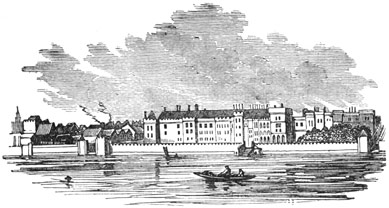
Subsequently to Catherine's departure, old Somerset House was chiefly used as a residence for princes from other countries when on a visit. It was pulled down towards the end of the last century, and the present structure erected by Sir William Chambers, but left unfinished. The unfinished part, which is towards the east, is now in a state of completion, as the King's College. The only memorial remaining of the old palace and its outhouses is in the wall of a house in the Strand, where the sign of a lion still survives a number of other signs, noticed in a list made at the time, and common at that period to houses of all descriptions.
The area of New Somerset House occupies a large space of ground, the basement of the back-front being in the river. Three sides of it are appropriated to a variety of public offices, connected with trade, commerce, and civil economy; and the front was lately dignified by the occupancy of the Royal and Antiquarian Societies and the Royal Academy of Painting. The structure was an ambitious one on the part of the architect, and upon the whole is elegant but timid. There is a look of fragility in it. It has the extent, but not the majesty, of a national emporium. Rules are violated in some instances for the sake of trifles, as is the case of pillars "standing on nothing and supporting nothing;" and in others, it would seem out of a dread of the result, as in the instance of the huge basement over the water, supporting a cupola, which is petty in the comparison. Sir William did well in wishing to have an imposing front towards the river; but he might have had another towards the Strand, nobler than the present one. The lower part is nothing better than a pillared coachway. However, the front of the story is, perhaps, the best part of the whole building. It present a graceful harmony in the proportions.
The Royal Society, which originated in the college rooms of Dr. Wilkins, afterwards bishop of Chester, met, when it was incorporated, at Old Gresham College in Aldersgate Street; then at Arundel House (on account of the fire); then returned to Gresham College; and, after a variety of other experiments upon lodging, was settled by the late king in New Somerset House. This society, on its foundation, was much ridiculed by the wits. Though its ends were great, it naturally busied itself with little things; pragmatical and pedantic persons naturally enough got mixed up with it; some of its members had foibles of enthusiasm and pedantry, which were easily confounded with their capacities; and the jokes were most likely encouraged by the king (Charles II.), who, though fond of scientific experiments, and wearing a grave face in presence of the learned body (of which he declared himself a member), was not a man to forego such an opportunity of jesting. Wilkins wrote a book to show that a man might go to the moon; and the ethical common-places of Boyle (who was as great a natural philosopher as he was a poor moralist) were the origin of Swift's Essays on the Tritical Faculties of the Mind. Then there was the good Evelyn with his hard words, wondering sentimentally at every thing; and jolly Pepys marvelling like Sancho Panza. The readers of Pepys' Diary have been surprised at his not liking Hudibras. Perhaps one reason was, that Butler was the greatest of the jesters against the society. It was impossible not to laugh at the jokes, in which he charges them with attempting to