Chapter III · FLEET STREET. (continued 2)
Reading edition
"He frequently gave all the silver in his pocket to the poor, who watched him between his house and the tavern where he dined. He walked the streets at all hours, and said he was never robbed, for the rogues knew he had little money, nor had the appearance of having much.
"Though the most accessible and communicative man alive, yet when he suspected that he was invited to be exhibited, he constantly spurned the invitation.
"Two young women from Staffordshire visited him when I was present, to consult him on the subject of Methodism, to which they were inclined. 'Come (said he), you pretty fools, dine with Maxwell and me at the Mitre, and we will talk over that subject'; which they did, and after dinner he took one of them on his knees, and fondled them for half an hour together."[115]
This anecdote is exquisite. It shows, that however impatient he was of having his own superstitions canvassed, he was loth to see them inflicted on others. He is here a harmless Falstaff, with two innocent damsels on his knees, in lieu of Mesdames Ford and Page.
In Gough Square, Johnson wrote part of his Dictionary. He had written the Rambler and taken his high stand with the public before. "At this time," says Barber, his servant, "he had little for himself, but frequently sent money to Mr. Shiels when in distress." (Shiels was one of his amanuenses in the dictionary.) His friends and visitors in Gough Square are a good specimen of what they always were—a miscellany creditable to the largeness of his humanity. There was Cave, Dr. Hawkesworth, Miss Carter, Mrs. Macauley (two ladies who must have looked strangely at one another), Mr. (afterwards Sir Joshua) Reynolds, Langton, Mrs. Williams (a poor poetess whom he maintained in his house), Mr. Levett (an apothecary on the same footing), Garrick, Lord Orrery, Lord Southwell, and Mrs. Gardiner, wife of a tallow chandler on Snow-hill—"not in the learned way," said Mr. Barber, "but a worthy good woman." With all his respect for rank, which doubtless he regarded as a special dispensation of Providence, his friend Beauclerk's notwithstanding,[116] Johnson never lost sight of the dignity of goodness. He did not, however, confine his attentions to those who were noble or amiable; though we are to suppose, that everybody with whom he chose to be conversant had some good quality or other; unless, indeed, he patronised them as the Duke of Montague did his ugly dogs, because nobody would if he did not. The great secret, no doubt, was, that he was glad of the company of any of his fellow-creatures who would bear and forbear with him, and for whose tempers he did not care as much as he did for their welfare. And he was giving alms; which was a catholic part of religion, in the proper sense of the word.
"He nursed," says Mrs. Thrale, in her superfluous style, "whole nests of people in his house, where the lame, the blind, the sick, and the sorrowful found a sure retreat from all the evils whence his little income could secure them, and commonly spending the middle of the week at our house, he kept his numerous family in Fleet Street upon a settled allowance; but returned to them every Saturday to give them three good dinners and his company, before he came back to us on the Monday night, treating them with the same, or perhaps more, ceremonious civility, than he would have done by as many people of fashion, making the Holy Scripture thus the rule of his conduct, and only expecting salvation as he was able to obey its precepts."[117]
Johnson's female inmates were not like the romantic ones of Richardson.
"We surely cannot but admire," says Boswell, "the benevolent exertions of this great and good man, especially when we consider how grievously he was afflicted with bad health, and how uncomfortable his home was made by the perpetual jarring of those whom he charitably accommodated under his roof. He has sometimes suffered me to talk jocularly of his group of females, and call them his seraglio. He thus mentions them, together with honest Levitt, in one of his letters to Mrs. Thrale: 'Williams hates everybody; Levett hates Desmoulins, and does not love Williams; Desmoulins hates them both; Poll loves none of them.'"[118]
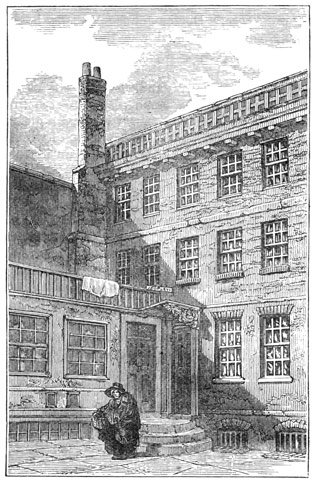
JOHNSON'S HOUSE IN BOLT COURT.
Of his residence in Inner Temple Lane we have spoken before. He lived there six or seven years, and then removed to Johnson's Court, No. 7, where he resided for ten. Johnson's Court is in the neighbourhood of Gough Square. It was during this period that he accompanied his friend Boswell to Scotland, where he sometimes humorously styled himself "Johnson of that ilk" (that same, or Johnson of Johnson), in imitation of the local designations of the Scottish chiefs. In 1776, in his sixty-seventh year, still adhering to the neighbourhood, he removed into Bolt Court, No. 8, where he died eight years after, on the 13th December, 1784. In Bolt Court he had a garden, and perhaps in Johnson's Court and Gough Square: which we mention to show how tranquil and removed these places were, and convenient for a student who wished, nevertheless, to have the bustle of London at hand. Maitland (one of the compilers upon Stow), who published his history of London in 1739, describes Johnson and Bolt Courts as having "good houses, well inhabited;" and Gough Square he calls fashionable.[119]
Johnson was probably in every tavern and coffee-house in Fleet Street. There is one which has taken his name, being styled, par excellence, "Doctor Johnson's Coffee-house." But the house he most frequented was the Mitre tavern, on the other side of the street, in a passage leading to the Temple. It was here, as we have seen, that he took his two innocent theologians, and paternally dandled them out of their misgivings on his knee. The same place was the first of the kind in which Boswell met him. "We had a good supper," says the happy biographer, "and port wine, of which he then sometimes drank a bottle." (At intervals he abstained from all fermented liquors for a long time.) "The orthodox, high-church sound of the Mitre, the figure and manner of the celebrated Samuel Johnson, the extraordinary power and precision of his conversation, and the pride arising from finding myself admitted as his companion, produced a variety of sensations, and a pleasing elevation of mind beyond what I had before experienced."[120] They sat till between one and two in the morning. He told Boswell at that period that "he generally went abroad at about four in the afternoon, and seldom came home till two in the morning. I took the liberty to ask if he did not think it wrong to live thus, and not to make more use of his great talents. He owned it was a bad habit."
The next time, Goldsmith was with them, when Johnson made a remark which comes home to everybody, namely, that granting knowledge in some cases to produce unhappiness, "knowledge per se was an object which every one would wish to attain, though, perhaps, he might not take the trouble necessary for attaining it." One of his most curious remarks followed, occasioned by the mention of Campbell, the author of the Hermippus Redivivus, on which Boswell makes a no less curious comment. "Campbell," said Johnson, "is a good man, a pious man. I am afraid he has not been in the inside of a church for many years; but he never passes a church without pulling off his hat. This shows that he has good principles." On which, says Boswell in a note, "I am inclined to think he was misinformed as to this circumstance. I own I am jealous for my worthy friend Dr. John Campbell. For though Milton could without remorse absent himself from public worship, I cannot."[121]
It was at their next sitting in this house, at which the Rev. Dr. Ogilvie, a Scotch writer, was present, that Johnson made his famous joke, in answer to that gentleman's remark, that Scotland has a great many "noble wild prospects." Johnson. "I believe, sir, you have a great many. Norway, too, has noble, wild prospects; and Lapland is remarkable for prodigious, noble, wild prospects. But, sir, let me tell you, the noblest prospect which a Scotchman ever sees is the high road that leads him to England!" "This unexpected and pointed sally," says Boswell, "produced a roar of applause. After all, however" (he adds), "those who admire the rude grandeur of nature, cannot deny it to Caledonia."[122]
Johnson had the highest opinion of a tavern, as a place in which a man might be comfortable, if he could anywhere. Indeed, he said that the man who could not enjoy himself in a tavern, could be comfortable nowhere. This, however, is not to be taken to the letter. Extremes meet; and Johnson's uneasiness of temper led him into the gayer necessities of Falstaff. However, it is assuredly no honour to a man, not to be able to "take his ease at his inn." "There is no private house," said Johnson, talking on this subject, "in which people can enjoy themselves so well as at a capital tavern. Let there be ever so great a plenty of good things, ever so much grandeur, ever so much elegance, ever so much desire that everybody should be easy, in the nature of things it cannot be: there must always be some degree of care and anxiety. The master of the house is anxious to entertain his guests; the guests are anxious to be agreeable to him; and no man, but a very impudent dog indeed, can as freely command what is in another man's house as if it were his own. Whereas, at a tavern, there is a general freedom from anxiety. You are sure you are welcome; and the more noise you make, the more trouble you give, the more good things you call for, the welcomer you are. No servants will attend you with the alacrity which waiters do, who are incited by the prospect of an immediate reward in proportion as they please. No, sir, there is nothing which has yet been contrived by man, by which so much happiness is produced, as by a good tavern or inn." He then repeated with great emotion Shenstone's lines:—
"Whoe'er has travelled life's dull round, Where'er his stages may have been, May sigh to think he still has found The warmest welcome at an inn."[123]
"Sir John Hawkins," says Boswell in a note on this passage, "has preserved very few memorabilia of Johnson." There is, however, to be found in his bulky tome, a very excellent one upon this subject. "In contradiction to those who, having a wife and children, prefer domestic enjoyments to those which a tavern affords, I have heard him assert, that a tavern chair was the throne of human felicity. 'As soon' (said he), 'as I enter the door of a tavern, I experience an oblivion of care, and a freedom from solicitude: when I am seated, I find the master courteous, and the servants obsequious to my call, anxious to know and ready to supply my wants: wine there exhilarates my spirits, and prompts me to free conversation, and an interchange of discourse with those whom I most love; I dogmatise, and am contradicted; and in this conflict of opinion and sentiments I find delight.'"
The following anecdote is highly to Johnson's credit, and equally worthy of every one's attention. "Johnson was known to be so rigidly attentive to the truth," says Boswell, "that even in his common conversation the slightest circumstance was mentioned with exact precision. The knowledge of his having such a principle and habit made his friends have a perfect reliance on the truth of everything that he told, however it might have been doubted if told by many others. As an instance of this I may mention an odd incident, which he related as having happened to him one night in Fleet Street. 'A gentlewoman' (said he) 'begged I would give her my arm to assist her in crossing the street, which I accordingly did; upon which she offered me a shilling, supposing me to be the watchman. I perceived that she was somewhat in liquor.' This, if told by most people, would have been thought an invention; when told by Johnson, it was believed by his friends, as much as if they had seen what passed."[124]
The gentlewoman, however, might have taken him for the watchman without being in liquor, if she had no eye to discern a great man through his uncouthness. Davies, the bookseller, said, that he "laughed like a rhinoceros." It may be added he walked like a whale; for it was rolling rather than walking. "I met him in Fleet Street," says Boswell, "walking, or rather, indeed, moving along; for his peculiar march is thus described in a very just and picturesque manner, in a short life of him published very soon after his death:—'When he walked the streets, what with the constant roll of his head, and the concomitant motion of his body, he appeared to make his way by that motion independent of his feet.' That he was often much stared at," continues Boswell, "while he advanced in this manner, may be easily believed; but it was not safe to make sport of one so robust as he was. Mr. Langton saw him one day, in a fit of absence, by a sudden start, drive the load off a porter's back, and walk forwards briskly, without being conscious of what he had done. The porter was very angry, but stood still, and eyed the huge figure with much earnestness, till he was satisfied that his wisest course was to be satisfied and take up his burden again."[125]
There is another remark on Fleet Street and its superiority to the country, which must not be passed over. Boswell, not having Johnson's reasons for wanting society, was a little over-weening and gratuitous on this subject; and on such occasions the doctor would give him a knock. "It was a delightful day," says the biographer; "as we walked to St. Clement's Church, I again remarked that Fleet Street was the most cheerful scene in the world; 'Fleet Street,' said I, 'is in my mind more delightful than Tempè.' Johnson.—'Ay, sir, but let it be compared with Mull.'"[126]
The progress of knowledge, even since Johnson's time, has enabled us to say, without presumption, that we differ with this extraordinary person on many important points, without ceasing to have the highest regard for his character. His faults were the result of temperament; perhaps his good qualities and his powers of reflection were, in some measure, so too; but this must be the case with all men. Intellect and beneficence, from whatever causes, will always command respect; and we may gladly compound, for their sakes, with foibles which belong to the common chances of humanity. If Johnson has added nothing very new to the general stock, he has contributed (especially by the help of his biographer) a great deal that is striking and entertaining. He was an admirable critic, if not of the highest things, yet of such as could be determined by the exercise of a masculine good sense; and one thing he did, perhaps beyond any man in England, before or since—he advanced, by the powers of his conversation, the strictness of his veracity, and the respect he exacted towards his presence, what may be called the personal dignity of literature. The consequence has been, not exactly what he expected, but certainly what the great interests of knowledge require; and Johnson has assisted men, with whom he little thought of co-operating, in setting the claims of truth and beneficence above all others.
East from Fetter Lane, on the same side of the street, is Crane Court—the principal house in which, facing the entry, was that in which the Royal Society used to meet, and where they kept their museum and library before they removed to their late apartments in Somerset House. The society met in Crane Court up to a period late enough to allow us to present to our imaginations Boyle and his contemporaries prosecuting their eager inquiries and curious experiments in the early dawn of physical science, and afterwards Newton presiding in the noontide glory of the light which he had shed over nature.