Chapter VII · DRURY LANE, AND THE TWO THEATRES IN DRURY LANE AND COVENT GARDEN. (continued 2)
Reading edition
"Odious! in wollen! 'twould a saint provoke, (Were the last words that poor Narcissa spoke); No, let a charming chintz and Brussels lace Wrap my cold limbs and shade my lifeless face: One would not sure be frightful when one's dead— And, Betty, give this cheek a little red."
But it does not appear that there is any authority for this speech, except the poet's. A letter written to her first biographer by an attendant during her last illness says, that "although she had no priest," she "prayed without ceasing," which does not look like an attention to dress; but the biographer adds, that "as the nicety of dress was her delight when living, she was as nicely dressed after her decease; being, by Mrs. Saunders' direction, thus laid in her coffin." The nicety here mentioned was, to be sure, "mortal fine."—"She had on," says the writer, "a very fine Brussels lace-head, a Holland shift with tucker, and double ruffles of the same lace; a pair of new kid gloves, and her body wrapt up in a winding sheet."[266] Yet we are of Montaigne's opinion, and know not why death should be rendered more melancholy than it is. When a tomb was opened in Greece, supposed to be that of Aspasia, there was found in it a sprig of myrtle in gold.
The next batch of players, with Garrick at their head, are Quin, Macklin, Barry, King, Woodward, Gentleman Smith, and others; with Mrs. Clive, Pritchard, Cibber, and Woffington. Garrick's later contemporaries are Parsons, Dodd, Quick, the Palmers, Miss Pope, Mrs. Abingdon, and others, who bring us down to Mrs. Siddons, Miss Farren, &c., the commencers of our own time. Of Steele and the sentimental comedy we need say no more. Goldsmith belongs to Covent Garden; Foote to the Haymarket; and Cumberland, though an elegant writer, does not call for any particular mention in an abstract like this.
When Garrick first appeared, a declamatory grandeur prevailed in tragedy, which we conceive to have arisen in the time of Charles II. It was probably handed down by Booth; and imitated, with the usual deterioration, from Betterton, who, though a true genius and a universal one, may not have been uncorrupted by the taste of the times; not to mention that it is doubtful, till Garrick appeared, whether the art of acting was not identified with something too much of an art, and the delicacy of verses expected to partake more of recitation and musical accompaniment than we now look for. Our suspicion to this effect arises from the traditional habits of the stage, one generation handing down the manner of another, and Betterton himself having been educated in the school of those who were bred up in the recollection of Burbage and Condell. Shakspeare himself, from custom, or even from some subtlety of reason, might have approved of something of this kind; though, on the other hand, in the celebrated directions of Hamlet to the players, there appears to be a secret dissatisfaction with the most applauded actors of that time, as not being exactly what was desirable. If this notion is just, and the great poet of nature was as much advanced beyond his time in this as in other respects, he might indeed have hailed such an actor as Garrick, however hyperbolically they have been sometimes put together. The best performers whom Garrick found in possession of public applause, though some of them are described as excelling in all the varieties of passion (as Mrs. Cibber, for instance, notwithstanding the different impression given of her in the following quotation), appear to have been more or less of the old declamatory school. Quin in particular, then at the head of the profession, was an avowed declaimer, having the same notions of tragedy in the delivery which his friend Thomson had in the composition. Posterity respects Quin as the friend of Thomson, and laughs with him as an epicure and a wit. Garrick and he ultimately became friends. Of the first reception of the new style introduced by Garrick, its electrical effects upon some, and the natural hesitation of others to give up their old favourites, a lively picture has been left us by Cumberland.
Speaking of himself, who was then at Westminster school, he says,—
"I was once or twice allowed to go, under proper convoy, to the play, where, for the first time in my life, I was treated by the sight of Garrick in the character of Lothario. Quin played Horatio; Ryan, Altamont; Mrs. Cibber, Calista; and Mrs. Pritchard condescended to the humble part of Lavinia. I enjoyed a good view of the stage from the front row of the gallery, and my attention was rivetted to the scene. I have the spectacle even now, as it were, before my eyes. Quin presented himself, upon the rising of the curtain, in a green velvet coat, embroidered down the seams, an enormous full-bottomed periwig, rolled stockings, and high-heeled, square-toed shoes. With very little variation of cadence, and in a deep, full tone, accompanied by a sawing kind of action, which had more of the senate than of the stage in it, he rolled out his heroics with an air of dignified indifference, that seemed to disdain the plaudits that were bestowed upon him. Mrs. Cibber, in a key high pitched, but sweet withal, sung, or rather recitatived, Rowe's harmonious strain, something in the manner of the improvisatore's; it was so extremely wanting in contrast, that, though it did not wound the ear, it wearied it; when she had once recited two or three speeches, I could anticipate the manner of every succeeding one; it was like a long, old, legendary ballad of innumerable stanzas, every one of which is sung to the same tune, eternally chiming in the ear without variation or relief. Mrs. Pritchard was an actress of a different cast, had more nature, and, of course, more change of tone, and variety both of action and expression: in my opinion the comparison was decidedly in her favour; but when, after long and eager expectation, I first beheld little Garrick, then young and light and alive in every muscle and in every feature, come bounding on the stage, and pointing at the wittol Altamont and heavy-paced Horatio—heavens, what a transition!—it seemed as if a whole century had been swept over in the transition of a single scene; old things were done away and a new order at once brought forward, bright and luminous, and clearly destined to dispel the barbarisms and bigotry of a tasteless age, too long attached to the prejudices of custom, and superstitiously devoted to the illusions of imposing declamation. This heaven-born actor was then struggling to emancipate his audience from the slavery they were resigned to; and though, at times, he succeeded in throwing in some gleams of newborn light upon them, yet, in general they seemed to love darkness better than light, and, in the dialogue of altercation between Horatio and Lothario, bestowed far the greater show of hands upon the master of the old school than upon the founder of the new. I thank my stars, my feelings in those moments led me right; they were those of nature, and therefore could not err."[267]
It is needless to add that Garrick excelled in comedy as well as tragedy, and in the lowest comedy too—in Abel Drugger as well as Hamlet. He was first at Goodman's Fields; then appeared both at Covent Garden and Drury Lane; but in a short time settled for life at Drury Lane as actor, manager, and author. He was a sprightly dramatist, a man of wit, and no doubt a generous man, though the endless matters of business in which he was concerned, and the refusals of all kinds which he must have been often forced into, got him, with many, a character for the reverse. Johnson, who did not spare him, pronounced him generous. Fine as his tragedy must have been, we suspect his comedy must have been finer; because his own nature was one of greater sprightliness than sentiment. We hear nothing serious of him throughout his life; and his face, with a great deal of acuteness, has nothing in it profound or romantic.
Garrick has the reputation of improving the stage costume: but it was Macklin that did it. The late Mr. West, who was the first (in his picture of the "Death of Wolfe") to omit the absurdity of putting a piece of armour instead of a waistcoat upon a general officer, told us, that he himself once asked Garrick why he did not reform the stage in that particular. Garrick said the spectators would not allow it; "they would throw a bottle at his head." Macklin, however, persevered, and the thing was done. The other, with all his nature, seems to have had a hankering after the old dresses. He had first triumphed in them, and they suited his propensity to the airy and popular. Garrick had a particular dislike to appearing in the Roman costume. Probably in this there was a consciousness of his small person. There are many engravings of him extant, in which his tragic characters are seen in coats and toupees. His appearance as Hotspur, in a laced frock and Ramillie wig, was objected to, not as being unsuitable to the time, but as "too insignificant for the character."[268]
Of Barry, the most celebrated antagonist of Garrick, we shall speak at Covent Garden. King, according to Churchill, by the force of natural impudence as well as genius, excelled in "Brass;" and Churchill's opinions are worth attending to, though he expresses them with vehemence, and by wholesale. Gentleman Smith explains his character by his title. We should entertain a very high opinion of Mrs. Pritchard, even had she left us nothing but the face in her portraits. She seems to have been a really great genius, equally capable of the highest and lowest parts. The fault objected to her was, that her figure was not genteel; and we can imagine this well enough in an actress who could pass from Lady Macbeth to Doll Common. She seems to have thrown herself into the arms of sincerity and passion, not, perhaps, the most refined, but as tragic and comic as need be. As Churchill says,
"Before such merits all objections fly, Pritchard's genteel, and Garrick six feet high."
Clive was an admirable comic actress, of the wilful and fantastic order, and a wit and virago in private life. She became the neighbour and intimate of Horace Walpole, and always seems to us to have been the man of the two. Mrs. Woffington was an actress of all work, but of greater talents than the phrase generally implies. Davies says she was the handsomest woman that ever appeared on the stage, and that Garrick was at one time in doubt whether he should not marry her. She was famous for performing in male attire, and openly preferred the conversation of men to women—the latter she said, talking of "nothing but silks and scandal." She was the only woman admitted into one of the beef-steak clubs, and is said to have been president of it. These humours, perhaps, though Davies praises her for feminine manners, as contrasted with her antagonist Mrs. Clive, frightened Garrick out of his matrimony.
We now pass at once to Covent Garden Theatre, which lies close by. Many old play-goers who are in the habit of associating the two theatres in their fancy, like twins, will be surprised to hear that the Covent Garden establishment is very young, compared with her sister, being little more than a hundred years old. It was first built by Rich, the harlequin, and opened in 1733 under the patent granted to the Duke's company. The Covent Garden company may therefore be considered as the representatives of the old companies of Davenant and Betterton; while those at Drury Lane are the successors of Killigrew, and more emphatically the King's actors. Indeed, they exclusively designate themselves as "his Majesty's servants;" and, we believe, claim some privileges on that account. Covent Garden theatre was partly rebuilt in 1772, and wholly so in 1809, having undergone the usual death by conflagration. The new edifice was a structure in classical taste, by Mr. Smirke, the portico being a copy from the Parthenon of Athens.[269]
Actors have seldom been confined to any one house; and those whom we are about to mention performed at Drury Lane as well as Covent Garden; but as they were rivals or opponents of Garrick, and may be supposed to have made the greatest efforts when they acted on a different stage, we shall speak of them apart under the present head. The first of them is Barry, who at one time almost divided the favour of of the town with Garrick, and in some characters is said to have excelled him, especially in love parts. How far this was owing to superiority of figure, and to a reputation for gallantry, it is impossible to say; and never were judgments more discordant than those which have been left us on the subject of Barry's merits. For instance, his character is thus summed up by Davies:—
"Of all the tragic actors who have trod the English stage for these last fifty years, Mr. Barry was unquestionably the most pleasing. Since Booth and Wilks, no actor had shown the public a just idea of the hero or the lover; Barry gave dignity to the one and passion to the other: in his person he was tall without awkwardness; in his countenance, handsome without effeminacy; in his uttering of passion, the language of nature alone was communicated to the feelings of an audience."
Davies proceeds to tell us, that Barry could not perform such characters as Richard and Macbeth, though he made a capital Alexander. "He charmed the ladies by the soft melody of his love-complaints, and the noble ardour of his courtship. There was no passion of the tender kind so truly pathetic and forcible in any actor as in Barry, except in Mrs. Cibber, who, indeed, excelled, in the expression of love, grief, tenderness, and jealous rage, all I ever knew. Happy it was for the frequenters of the theatre, when these two genuine children of nature united their efforts to charm an attentive audience. Mrs. Cibber, indeed, might be styled the daughter or sister of Mr. Garrick, but could be only the mistress or wife of Barry."[270] Our author afterwards calls him the "Mark Antony of the stage," whether his amorous disposition was considered, or his love of expense. He delighted in giving magnificent entertainments, and treated Mr. Pelham, who once invited himself to sup with him, in a style so princely, that the Minister rebuked him for it; which was not very civil. An actor has surely as much right to do absurd things as a statesman.
Now, as a contrast to this romantic portrait by Davies, take the following from the severer but masterly hand of Churchill:—
"In person taller than the common size, Behold where Barry draws admiring eyes; When lab'ring passions in his bosom pent, Convulsive rage, and struggling heave for vent, Spectators, with imagined terrors warm, Anxious expect the bursting of the storm: But, all unfit in such a pile to dwell, His voice comes forth like Echo from her cell; To swell the tempest needful aid denies, And all a-down the stage in feeble murmur dies. What man, like Barry, with such pains, can err In elocution, action, character? What man could give, if Barry was not here, Such well-applauded tenderness to Lear? Who else can speak so very, very fine, That sense may kindly end with every line? Some dozen lines, before the ghost is there, Behold him for the solemn scene prepare. See how he frames his eyes, poises each limb, Puts the whole body into proper trim,— From whence we learn, with no great stretch of art, Five lines hence comes a ghost, and lo! a start. When he appears most perfect, still we find Something which jars upon and hurts the mind. Whatever lights upon a part are thrown, We see too plainly they are not his own: No flame from nature ever yet he caught, Nor knew a feeling which he was not taught; He raised his trophies on the base of art, And conn'd his passions, as he conn'd his part."[271]
The probability, we fear, is that Barry was one of the old artificial school, who made his way more by person than by genius. Davies, who was a better gossip than critic, though he affected literature, was an actor himself of the mouthing order, if we are to believe Churchill; and his criticisms show him enough inclined to lean favourably to that side.
We have spoken of Quin, who acted much at this house in opposition to Garrick. It was here that he delivered the prologue to the memory of his friend Thomson; and affected the audience by shedding real tears.[272]
Macklin was celebrated in Shylock; and in some other sarcastic parts, particularly that of Sir Archy, in his comedy of "Love-à-la-Mode." We take him to have been one of those actors whose performances are confined to the reflection of their own personal peculiarities. The merits of Shuter, Edwin, Quick, and others who succeeded one another as buffoons, were perhaps a good deal of this sort; but pleasant humours are rare and acceptable. Macklin was a clever satirist in his writing, and embroiled himself, not so cleverly, with a variety of his acquaintances. He foolishly attempted to run down Garrick; and once, in a sudden quarrel, poked out a man's eye with his stick and killed him; for which he narrowly escaped hanging. However, he was sorry for it; and he is spoken of, by the stage historians, as kind in his private relations, and liberal of his purse. A curious specimen of his latter moments we reserve for our mention of the house where he died.
Woodward seems to have been a caricature anticipation of Lewis, and was a capital harlequin. But nobody in harlequins beat Rich, the manager of this theatre. His pantomimes and spectacles produced a re-action against Garrick, when nothing else could; and Covent Garden ever since has been reckoned the superior house in that kind of merit,—"the wit," as Mr. Ludlow Holt called it, "of goods and chattels." However, a considerable degree of fancy and observation may be developed in pantomime: it is the triumph of animal spirits at Christmas, for the little children; and for the men there is occasionally some excellent satire on the times, reminding one, in its spirit, of what we read of the comic buffoonery of the ancients. Grimaldi, in his broad and fugitive sketches, often showed himself a shrewder observer than many a comic actor who can repeat only what is set down for him. Covent Garden has, perhaps, been superior also in music, at least since the existence of the two houses together: for Purcell was before its time. Many of Arne's pieces came out here; and the famous Beard, a singer as manly as his name, the delight both of public and private life, was one of the managers.
Among the Covent Garden actors must not be forgotten Cooke, who came out there in Richard III. For some time he was the greatest performer of this and a few other characters. He was a new kind of Macklin, and like him, excelled in Shylock and Sir Archy M'Sarcasm; a confined actor, and a wayward man, but highly impressive in what he could do. His artful villains have been found fault with for looking too artful and villanous; but men of that stamp are apt to look so. The art of hiding is a considerable one; but habit will betray it after all, and stand foremost in the countenance. They who think otherwise are only too dull to see it. Besides, Cooke had generally to represent bold-faced, aspiring art; and to hug himself in its triumph. This he did with such a gloating countenance, as if villany was pure luxury in him, and with such a soft inward retreating of his voice—a wrapping up of himself, as it were, in velvet—so different from his ordinary rough way, that sometimes one could almost have wished to abuse him.
John Kemble, who, like the whole respectable family of that name, contributed much to maintain the rising character of the profession, may be considered the last popular actor of the declamatory school. His sister was a far greater performer, a true theatrical genius, especially for the stately and dominant; and had a great effect in raising the character of the profession. The growth of liberal opinion is nowhere more visible than in the different estimation in which actors and actresses are now held, compared with what it was. Individuals, it is true, always made their way into society by dint of the interest they excited; but still they were upon sufferance. Anybody could insult an actor, could even beat him, without its being dreamt that he had a right to retaliate; and the most amiable and lady-like actresses were thought unfit for wives, as we have seen in the case of Mrs. Oldfield. Things are now upon a different footing. Talent is allowed its just pretensions, whether coming from author or performer, and actresses have taken such a step, in ascension, that nobility almost seems to look out for a wife among them, as in a school that will inevitably furnish it with some kind of grace and intellect. The famous Lord Peterborough, who was the first nobleman that married an actress, kept the union concealed as long as he could, and only owned it just before his death. The Duke of Bolton, who married Miss Fenton, the Polly of Gay's opera, had first had several children by her as his mistress; so that this is hardly a case in point; and the marriage of Beard, the singer, with a lady of the Waldegrave family, though he was one of the most excellent of men, was looked upon as such a degradation, that they have contrived to omit the circumstance in the peerage-books to this day! Martin Folkes's marriage with Mrs. Bradshaw probably made the world consider the case a little more rationally, as he was a clever man; but Lord Derby's marriage with Miss Farren, who was eminently the gentlewoman, as well as of spotless character, seems to have been the first that rendered such unions compatible with public opinion. Lord Craven's with Miss Brunton followed, though at a considerable interval; and since that time, the town are so far from being surprised at the marriages of actresses with people of rank or fashion, that they seem to look for them. Lord Thurlow, not long afterwards, married Miss Bolton; another noble lord was lately the husband of an eminent singer; and several other favourites of the town, Miss Tree, Miss O'Neill, &c., have become the wives of men of fortune. We remember even a dancer, Miss Searle (but she was of great elegance, and had an air of delicate self-possession), who married into a family of rank.
The whole entertainment of a theatre has been rising in point of accommodation and propriety for the last fifty years. The scenery is better, the music better—we mean the orchestra—and last, not least, the audiences are better. They are better behaved. Garrick put an end to one great nuisance—the occupation, by the audience, of part of the stage. Till his time, people often sat about a stage as at the sides of a room, and the actor had to make his way among them, sometimes with the chance of being insulted; and scuffles took place among themselves. Dr. Johnson, at Lichfield, is said to have pushed a man into the orchestra who had taken possession of his chair. The pit, also, from about Garrick's time, seems to have left to the galleries the vulgarity attributed to it by Pope. There still remains, says he—
—— "to mortify a wit, The many-headed monster of the pit, A senseless, worthless, and unhonoured crowd, Who, to disturb their betters mighty proud, Clattering their sticks before ten lines are spoke, Call for the farce, the bear, or the black-joke."
This would now be hardly a fair description of the galleries; and yet modern audiences are not reckoned to be of quite so high a cast as they used, in point of rank and wealth; so that this is another evidence of the general improvement of manners. Boswell, in an ebullition of vivacity, while sitting one night in the pit by his friend Dr. Blair, gave an extempore imitation of a cow! The house applauded, and he ventured upon some attempts of the same kind which did not succeed. Blair advised him in future to "stick to the cow." No gentleman now-a-days would think of a freak like this. There is one thing, however, in which the pit have much to amend. Their destitution of gallantry is extraordinary, especially for a body so ready to accept the clap-traps of the stage, in praise of their "manly hearts," and their "guardianship of the fair." Nothing is more common than to see women standing at the sides of the pit benches, while no one thinks of offering them a seat. Room even is not made, though it often might be. Nay, we have heard women rebuked for coming without securing a seat, while the reprover complimented himself on his better wisdom, and the hearers laughed. On the other hand, a considerate gentleman one night, who went out to stretch his legs, told a lady in our hearing that she might occupy his seat "till he returned!"
A friend of ours knew a lady who remembered Dr. Johnson in the pit taking snuff out of his waistcoat pocket. He used to go into the green-room to his friend Garrick, till he honestly confessed that the actresses excited too much of his admiration. Garrick did not much like to be seen by him when playing any buffoonery. It is said that the actor once complained to his friend that he talked too loud in the stage box, and interrupted his feelings: upon which the doctor said, "Feelings! Punch has no feelings." It was Johnson's opinion (speaking of a common cant of critics), that an actor who really "took himself" for Richard III., deserved to be hanged; and it is easy enough to agree with him; except that an actor who did so would be out of his senses. Too great a sensibility seems almost as hurtful to acting as too little. It would soon wear out the performer. There must be a quickness of conception, sufficient to seize the truth of the character, with a coolness of judgment to take all advantages; but as the actor is to represent as well as conceive, and to be the character in his own person, he could not with impunity give way to his emotions in any degree equal to what the spectators suppose. At least, if he did, he would fall into fits, or run his head against the wall. As to the amount of talent requisite to make a great actor, we must not enter upon a discussion which would lead us too far from our main object; but we shall merely express our opinion, that there is a great deal more of it among the community than they are aware.
Goldsmith was a frequenter of the theatre: Fielding and Smollett, Sterne, but particularly Churchill. "His observatory," says Davies, "was generally the first row of the pit, next the orchestra." His "Rosciad," a criticism on the most known performers of the day, made a great sensation among a body of persons who, as they are in the habit of receiving applause to their faces, and in the most victorious manner, may be allowed a greater stock of self-love than most people—a circumstance which renders an unexacting member of their profession doubly delightful. "The writer," says Davies, "very warmly, as well as justly, celebrated the various and peculiar excellencies of Mrs. Pritchard, Mrs. Cibber, and Clive; but no one has, except Garrick, escaped his satirical lash." Poor Davies is glad to say this, because of the well-known passage in which he himself is mentioned:—
"With him came mighty Davies! On my life That Davies hath a very pretty wife."
We will make one more quotation from this poem, because it describes a class of actors, who are now extinct, and who carried the artificial school to its height:—
"Mossop, attached to military plan, Still kept his eye fixed on his right-hand man. Whilst the mouth measures words with seeming skill, The right hand labours, and the left lies still; For he resolved on scripture grounds to go, What the right doth, the left hand shall not know. With studied impropriety of speech, He soars beyond the hackney critic's reach; To epithets allots emphatic state, Whilst principals, ungraced, like lackeys, wait; In ways first trodden by himself excels, And stands alone in indeclinables; Conjunction, preposition, adverb join, To stamp new vigour on the nervous line: In monosyllables his thunders roll; He, she, it, and we, ye, they, fright the soul."
Mr. Barrymore (of whom we have no unpleasing recollection) had something of this manner with him; but the extremity of the style is now quite gone out.
The only capital performers we remember, that are now dead and gone, with the exception of two or three already mentioned, were Mrs. Jordan, a charming cordial actress, on the homely side of the agreeable, with a delightful voice; and Suett, who was the very personification of weak whimsicality, with a laugh like a peal of giggles. Mathews gives him to the life.
We shall conclude this chapter with some delightful play-going recollections of the best theatrical critic now living[273]—the best, indeed, as far as we know, that this country ever saw. He is one who does not respect criticism a jot too much, nor any of the feelings connected with humanity, or the imitation of it, too little. We here have him giving us an account of the impression made upon him by the first sight of a play, and concluding with a good hint to those older children, who, because they have cut their drums open, think nothing remains in life to be pleased with. A child may like a theatre, because he is not thoroughly acquainted with it; but if he become a wise man, he will find reason to like it, because he is.
Life always flows with a certain freshness in these quarters; nor, with all their drawbacks, have we more agreeable impressions from any neighbourhood in London, than what we receive from the district containing the great theatres. It is one of the most social and the least sordid.
"At the north end of Cross Court," says Mr. Lamb, "there yet stands a portal, of some architectural pretensions, though reduced to humble use, serving at present for an entrance to a printing-office. This old door-way, if you are young, reader, you may not know was the identical pit entrance to old Drury—Garrick's Drury—all of it that is left. I never pass it without shaking some forty years from off my shoulders, recurring to the evening when I passed through it to see my first play. The afternoon had been wet, and the condition of our going (the elder folks and myself) was, that the rain should cease. With what a beating heart did I watch from the window the puddles, from the stillness of which I was taught to prognosticate the desired cessation. I seem to remember the last spurt, and the glee with which I ran to announce it.
"In those days were pit orders. Beshrew the uncomfortable manager who abolished them!—with one of these we went. I remember the waiting at the door—not that which is left—but between that and an inner door, in shelter. Oh, when shall I be such an expectant again!—with the cry of nonpareils, an indispensable playhouse accompaniment in those days. As near as I can recollect, the fashionable pronunciation of the theatrical fruiteresses was, 'chase some oranges, chase some nonpareils, chase a bill of the play:' chase pro chuse. But when we got in and I beheld the green curtain that veiled a heaven to my imagination, which was soon to be disclosed—the breathless anticipations I endured! I had seen something like it in the plate prefixed to 'Troilus and Cressida,' in Rowe's 'Shakspeare,'—the tent scene with Diomede; and a sight of that plate can always bring back, in a measure, the feeling of that evening. The boxes at that time full of well-dressed women of quality, projected over the pit; and the pilasters, reaching down, were adorned with a glittering substance (I know not what) under glass (as it seemed), resembling—a homely fancy—but I judged it to be sugar-candy—yet, to my raised imagination, divested of its homelier qualities, it appeared a glorified candy! The orchestra lights at length arose, those 'fair Auroras!' Once the bell sounded. It was to ring out yet once again; and, incapable of the anticipation, I reposed my shut eyes in a sort of resignation upon the maternal lap. It rang the second time. The curtain drew up—I was not past six years old—and the play was 'Artaxerxes!'
"I had dabbled a little in the 'Universal History'-the ancient part of it—and here was the court of Persia. It was being admitted to a sight of the past. I took no proper interest in the action going on, for I understood not its import; but I heard the word Darius, and I was in the midst of Daniel. All feeling was absorbed in vision. Gorgeous vests, gardens, palaces, princes, passed before me—I knew not players. I was in Persepolis for the time, and the burning idol of their devotion almost converted me into a worshipper. I was awe-struck, and believed those significations to be something more than elemental fires. It was all enchantment and a dream. No such pleasure has ever since visited me but in dreams. Harlequin's invasion followed; where, I remember, the transformation of the magistrates into reverend beldames seemed to me a piece of grave historic justice, and the tailor carrying his own head to be as sober a verity as the legend of St. Denys.
"The next play to which I was taken, was the 'Lady of the Manor,' of which, with the exception of some scenery, very faint traces are left in my memory. It was followed by a pantomime called 'Lun's Ghost'—a satiric touch, I apprehend, upon Rich, not long since dead—but to my apprehension (too sincere for satire) Lun was as remote a piece of antiquity as Lud—the father of a line of harlequins—transmitting his dagger of lath (the wooden sceptre) through countless ages. I saw the primeval Motley come from his silent tomb in a ghastly vest of white patch-work, like the apparition of a dead rainbow. So harlequins (thought I) look when they are dead.
"My third play followed in quick succession. It was 'The Way of the World.' I think I must have sat at it as grave as a judge; for, I remember, the hysteric affectations of good Lady Wishfort affected me like some solemn tragic passion. 'Robinson Crusoe' followed, in which Crusoe, Man Friday, and the Parrot were as good and authentic as in the story. The clownery and pantaloonery of these pantomimes have clean passed out of my head. I believe I no more laughed at them, than at the same age I should have been disposed to laugh at the grotesque gothic heads (seeming to me then replete with devout meaning) that gape and grin, in stone, around the inside of the old round church (my church) of the Templars.
"I saw these plays in the season of 1781-2, when I was from six to seven years old. After the intervention of six or seven years (for at school all play-going was inhibited) I again entered the doors of a theatre. That old Artaxerxes' evening had never done ringing in my fancy. I expected the same feelings to come again with the same occasion. But we differ from ourselves less at sixty and sixteen, than the latter does from six. In that interval what had I not lost! At the first period I knew nothing, understood nothing, discriminated nothing. I felt all, loved all, wondered all—
'Was nourished I could not tell how.'
I had left the temple a devotee, and was returned a rationalist. The same things were there materially; but the emblem, the reverence was gone! The green curtain was no longer a veil drawn between two worlds, the unfolding of which was to bring back past ages, to present a 'royal ghost,' but a certain quantity of green baize, which was to separate the audience for a given time from certain of their fellow-men who were to come forward and pretend those parts. The lights—the orchestra lights—came up, a clumsy machinery. The first ring, and the second ring, was now but a trick of the prompter's bell, which had been like the note of the cuckoo, a phantom of a voice, no hand seen or guessed at, which ministered to its warning. The actors were men and women painted. I thought the fault was in them; but it was in myself, and the alteration which those many centuries—of six short twelvemonths—had wrought in me. Perhaps it was fortunate for me that the play of the evening was but an indifferent comedy, as it gave me time to crop some unreasonable expectations, which might have interfered with the genuine emotions with which I was soon after enabled to enter upon the first appearance, to me, of Mrs. Siddons in Isabella. Comparison and retrospection soon yielded to the present attraction of the scene; and the theatre became to me, upon a new stock, the most delightful of recreations."—Elia, p. 221.
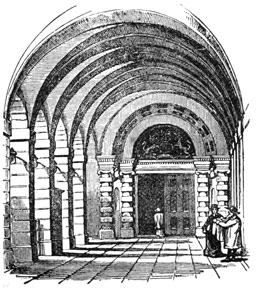
ENTRANCE DOOR, OLD COVENT GARDEN.