Chapter IV · THE STRAND. (continued 2)
Reading edition
"Search the moon by her own light; To take an inventory of all Her real estate and personal;— To measure wind, and weigh the air, And turn a circle to a square; And in the braying of an ass, Find out the treble and the bass; If mares neigh alto, and a cow In double diapason low."[167]
Evelyn got angry, and pretended to be calm. Cowley expressed his anger with a generous indignation. The following passage in his Ode to the Society concludes with a fine, appropriate simile. "Mischief and true dishonour," says he,
—— "fall on those Who would to laughter and to scorn expose So virtuous and so noble a design, So human for its use, for knowledge so divine. The things which these proud men despise and call Impertinent, and vain, and small, Those smallest things of Nature let me know, Rather than all their greatest actions do! Whoever would deposed Truth advance Into the throne usurped from it, Must feel at first the blows of Ignorance, And the sharp points of envious Wit. So, when, by various turns of the celestial dance In many thousand years A star, so long unknown, appears, Though Heaven itself more beauteous by it grow, It troubles and alarms the world below, Does to the wise a star, to fools a meteor, show."[168]
Perhaps a part of the jealousy against the Royal Society arose from a notion which has since become not uncommon, that bodies of this nature, incorporated by kings, are calculated rather to limit inquiry, than to enlarge it. Without stopping to discuss this point, we shall merely observe, that the real greatness of all such bodies, like those of nations themselves, must arise from the greatness of individuals; and that whether the bodies give any lustre to them or not, there is no denying that the individuals give lustre to the bodies. When Sir Isaac Newton became president, jesting ceased.
It is pleasant to think, while passing Somerset House, in the midst of the noise of a great thoroughfare, that philosophical speculation is, perhaps, going on within those graceful walls; that in the midst of all sorts of new things, sight is not lost of the venerable beauties of old; and that art, as well as philosophy, is considering what it shall do for our use and entertainment. The Antiquarian Society originated as far back as the sixteenth century (about the year 1580), and held its first sittings in a room in the Herald's College; but it did not receive a charter till the year 1751. Neither Elizabeth nor James would give it one, fearful, perhaps, of bringing up discussions on matters connected with politics and religion. Elizabeth has now become one of the most interesting of its heroines. There is no society, we think, more likely to increase with age, and to outgrow half-witted objection. The growth of time adds daily to its stock; and as reflecting men become interested in behalf of ages to come, they naturally turn with double sympathy towards the periods that have gone by, and to the multitudes of beating hearts that have become dust. We should like to see the society in a venerable building of its own, raised in some quiet spot, with trees about it, and with painted windows reflecting light through old heraldry.
The Royal Academy of Painters, now removed to Trafalgar Square, first met in Saint Martin's Lane, under the title of the Society of Artists of Great Britain. They had a division among them, which gave rise to the establishment as it now stands; and are a flourishing body, we believe, in point of funds. Of the deceased members who have done them honour, we shall speak when we come to their abodes.
The Turk's Head Coffeehouse, near Somerset House, was frequented by Dr. Johnson.
In a lodging opposite Somerset House, died the facetious Dr. King, whom we have mentioned in speaking of Doctors' Commons. He had been residing in the house of a friend in the garden-grounds between Lambeth and Vauxhall, where he stuck so close to his books and bottle, that he began to decline with the autumn, and shut himself up from his friends. Lord Clarendon, who resided in Somerset House, and was his relation, sent his sister to fetch him to a lodging he had prepared for him over the way, where he died before the lapse of many hours, while all the world were busy with the meats and mince-pies he had so often celebrated; for it was Christmas-day. Dr. King was the author of an Art of Cookery, in which he pleasantly bantered a learned Kitchener of his time; though no man had a livelier relish of their subjects than he. But he wished the relish to be lively in others. At least, he wished them to be leviter in modo, if graviter in re. Though occasionally coarse, he had the right style of banter, and was of use to the Tories. In return, they would have been of use to him, if his habits would have let them. Swift procured him the place of Gazetteer; but he soon got rid of it.
The precinct called the Savoy was anciently the seat of Peter, Earl of Savoy, who came into England to visit his niece Eleanor, Queen to Henry III. It is not known whether the house was built or appointed for him, but on his death it became the property of the queen, who gave it to her second son Edmund, afterwards Earl of Lancaster; and from his time the Savoy was reckoned part and parcel of the earldom and honour of Lancaster, afterwards the duchy. Henry VII. converted the palace into an hospital for the poor; and it remained so till the time of Charles II.; though the master and other officers, by an abuse which grew into a custom, appear to have had no regular inmates, except themselves. The poor were to apply, as it might happen; and what they got depended on the generosity of the master. In answer to a question put by Government in the reign of Queen Anne, it was stated by the lawyer and four chaplains, that "the statutes relating to the reception of the poor had not been observed within the memory of man."[169] Charles II. put wounded soldiers and sailors into the hospital; and since his time it appears to have been used for the reception of soldiers and prisoners. Latterly, it was a prison for deserters.
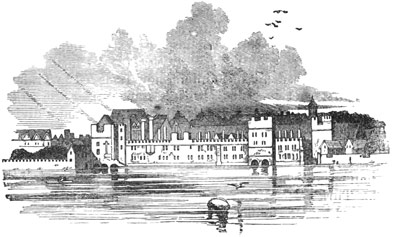
The Savoy was the scene of a conference in Charles II.'s reign, between the Church and the Presbyterians, in which possession was proved to be nine points of the Gospel, as well as law. The Presbyterians thought so when it was their turn to rule, and would have thought so again; and the progress of genuine Christianity has been a gainer by the mild sway of the Church of England.
In the chapel was buried old Gawen Douglas, the Chaucer of Scotland; and Anne Killegrew, celebrated by Dryden's ode for her poetry and painting. She was the daughter of one of the masters, Dr. Henry Killegrew, brother of the famous jester, and himself a man of talent.
Mrs. Anne Killegrew,
A grace for beauty, and a muse for wit,
had probably the honour, some day, of dining with her washerwoman's daughter, in the guise of Duchess of Albemarle; for John Clarges, the blacksmith, who lived in the Savoy, had a wife who was a washerwoman, and the washerwoman had a daughter, who took linen to Monk, when he was in the Tower, and married him. It is not commonly known that the validity of this marriage was contested. Upon the trial of an action at law between the representatives of Monk and Clarges, some curious particulars, says an article in the Gentleman's Magazine, came out respecting the family of the duchess.
"It appeared that she was the daughter of John Clarges, a farrier, in the Savoy, and farrier to Colonel Monk, in 1632. She was married in the church of St. Lawrence Pountney, to Thomas Ratford, son of Thomas Ratford, late a farrier, servant to Prince Charles, and resident in the Mews. She had a daughter who was born in 1634, and died in 1638. Her husband and she 'lived at the Three Spanish Gypsies, in the New Exchange, and sold wash-balls, powder, gloves, and such things, and she taught girls plain work. About 1647, she, being a sempstress to Colonel Monk, used to carry him linen.' In 1648 her father and mother died. In 1649, she and her husband 'fell out and parted.' But no certificate from any parish register appears, reciting his burial. In 1652, she was married in the church of St. George, Southwark, to 'General George Monk;' and in the following year was delivered of a son, Christopher, (afterwards the second and last Duke of Albemarle), who was suckled by Honour Mills, who sold apples, herbs, oysters, &c. One of the plaintiff's witnesses swore, 'that a little before the sickness, Thomas Ratford demanded and received of him the sum of twenty shillings; that his wife saw Ratford again after the sickness, and a second time after the Duke and Duchess of Albemarle were dead.' A woman swore, 'she saw him on the day his wife (then called Duchess of Albemarle) was put into her coffin, which was after the death of the duke her second husband, who died the 3rd of January, 1669-70.' And a third witness swore, that he saw Ratford about July, 1660.' In opposition to this evidence, it was alleged, that 'all along, during the lives of Duke George and Duke Christopher, this matter was never questioned,' that the latter was universally received as only son of the former, and that 'this matter had been thrice before tried at the bar of the King's Bench, and the defendant had three verdicts.' A witness swore that he owed Ratford five or six pounds, which he had never demanded. And a man, who had married a cousin to the Duke of Albemarle, had been told by his wife, that Ratford died five or six years before the duke married. Lord Chief Justice Holt told the jury, 'If you are certain that Duke Christopher was born while Thomas Ratford was living, you must find for the plaintiff. If you believe he was born after Ratford was dead, or that nothing appears what became of him after Duke George married his wife, you must find for the defendant.' A verdict was given for the defendant, who was only son to Sir Thomas Clarges, knight, brother to the illustrious duchess in question, who was created a baronet October 30, 1674, and was ancestor to the baronets of his name."[170]
It does not appear on which of these accounts the jury found a verdict for the defendant—whether because Ratford was dead, or because nothing had been heard of him; so that the duchess, after all, might have been no duchess. However, she carried it with as high a hand as if she had never been anything else, and Monk had been a blacksmith. There are some amusing notices of her in Pepys.
"8th (March, 1661-2). At noon, Sir W. Batten, Col. Slingsby, and I, by coach to the Tower, to Sir John Robinson's, to dinner, where great good cheer. High company, and among others the Duchess of Albemarle, who is ever a plain homely dowdy."[171]
"9th (Dec. 1665). My Lord Brouncker and I dined with the Duke of Albemarle. At table, the duchess, a very ill-looked woman, complaining of her lord's going to sea next year, said these cursed words:—'If my lord had been a coward, he had gone to sea no more; it may be then he might have been excused, and made an ambassador,' (meaning my Lord Sandwich). This made me mad, and I believe she perceived my countenance change, and blushed herself very much. I was in hopes others had not minded it, but my Lord Brouncker, after we came away, took notice of the words to me with displeasure."[172]
Lord Sandwich, the famous admiral, who has such light repute with posterity, was a relation of Pepys, and much connected with him in affairs. There does not appear to have been the least foundation for the duchess's charge; except, perhaps, that Sandwich had brains enough to know the danger which he braved, while Monk knew nothing but how to fight and lie.
"4th (Nov. 1666)." Pepys says that Mr. Cooling tells him, "the Duke of Albemarle is grown a drunken sot, and drinks with nobody but Troutbecke, whom nobody else will keep company with. Of whom he told me this story; that once the Duke of Albemarle in his drink taking notice, as of a wonder, that Nan Hide should ever come to be Duchess of York: 'Nay,' says Troutbecke, 'ne'er wonder at that, for if you will give me another bottle of wine, I will tell you as great, if not greater, miracle.' And what was that, but that our dirty Besse (meaning his duchess) should come to be Duchess of Albemarle."[173]
"4th (April, 1667). I find the Duke of Albemarle at dinner with sorry company, some of his officers of the army; dirty dishes and a nasty wife at table, and bad meat, of which I made but an ill dinner. Colonel Howard asking how the Prince (Rupert) did (in the last fight); the Duke of Albemarle answering, 'Pretty well,' the other replied, 'but not so well as to go to sea again.'—'How!' says the duchess, 'what should he go for, if he were well, for there are no ships for him to command? And so you have brought your hogs to a fair market,' said she."[174]
"29th (March 1667-8). I do hear by several, that Sir W. Pen's going to sea do dislike the Parliament mightily, and that they have revived the Committee of Miscarriages, to find something to prevent it; and that he being the other day with the Duke of Albemarle, to ask his opinion touching his going to sea, the duchess overheard and came into him; and asked W. Pen how he durst have the confidence to go to sea again to the endangering of the nation, when he knew himself such a coward as he was; which, if true, is very severe."[175]
The habit of charging cowardice against the first officers of the time, which was not confined to the Duchess, is characteristic of the grossness of that period, the refinements of which were entirely artificial and modish. No people talked or acted more grossly than the finest gentlemen of the day, or believed more ill of one another; and it was not to be expected that the uneducated should be behindhand with them.
The Duchess of Albemarle is supposed to have had a considerable hand in the Restoration. She was a great loyalist, and Monk was afraid of her; so that it is likely enough she influenced his gross understanding, when it did not exactly know what to be at. Aubrey says, that her mother was one of the "five women barbers." How these awful personages came up we know not—but he has quoted a ballad upon them:—
"Did you ever hear the like, Or ever hear the fame, Of five women barbers, That lived in Drury Lane?"[176]
After all, the father, John Clarges, must have been a man of substance in his trade, to be enabled to set up the enormous May-pole which we see in the picture. But this did not prevent the daughter from growing up vulgar and foul-mouthed, and a very different person from the Belles Ferronières of old.
The Savoy, on the one side, with its Gothic gate and flint wall, and the splendid mansion called Exeter House on the other, appear in former times to have narrowed the highway hereabouts, as much as Exeter 'Change did lately.
At the corner of Beaufort Buildings flourished Mr. Lillie, the perfumer so often mentioned in the Tatler. He was secretary to Mr. Bickerstaff's Court of Honour, in Shire Lane, where people had actions brought against them for pulling out their watches while their superiors were talking; and for brushing feathers off a gentleman's coat, with a cane "value fivepence." Lillie published two volumes of Contributions, of which the Tatler had made no use. We believe they had no merit. In Beaufort Buildings lived Aaron Hill, and at one time Fielding.
Southampton Street, a little to the west, on the other side of the way, has been much inhabited by wits and theatrical people. Congreve once lived there, Mrs. Bracegirdle, and Garrick. It was called Southampton Street from the noble family of that title, who are allied to the Bedford family, the proprietors.
On the ground of Cecil and Salisbury Streets, opposite Southampton Street, stood the mansion of Robert Cecil, first Earl of Salisbury, the cunning son of a wise father. It was he who, contriving to keep up to the last his interest with the queen Elizabeth, and to oust his rivals, Essex and others, was the first to make secret terms with her successor James, and to prepare the way for his reception in England: of which, perhaps, Elizabeth was aware, when she lay moaning on the ground.
Where the Adelphi now stands, was Durham Place, originally a palace of the Bishops of Durham, who resigned it to Henry VIII. Henry made it the scene of magnificent tournaments. The Lord High Admiral Seymour caused the Mint to be established in this house, with a view to coin money for his designs on the throne. It was afterwards inhabited by Dudley, Earl of Northumberland, who here married his son to Lady Jane Grey. But its most illustrious tenant was Raleigh, to whom it was lent by Queen Elizabeth, and who lived in it during the attempt made at Essex House. The four turrets of the mansion, under the roof of which lived and speculated that romantic but equivocal person, have been marked out in an engraving from Hollar. Durham Place, though it got into royal hands during the fluctuation of religious opinions, never seems to have been reckoned out of the pale of the bishopric of Durham; for Lord Pembroke bought it of that see in 1640, and pulled it down for the erection of houses on its site.
"Be it known," says the lively Pennant, speaking of the word 'place,' as applied to great mansions, and interpreted by him to mean palace, "that the word is only applicable to the habitations of princes, or princely persons, and that it is with all the impropriety of vanity bestowed on the houses of those who have luckily acquired money enough to pile on one another a greater quantity of stones or bricks than their neighbours. How many imaginary parks have been formed within precincts where deer were never seen! And how many houses misnamed halls, which never had attached to them the privilege of a manor."[177]
This is true; but unless the words palazzo and piazza are traceable to the same root, palatium (as perhaps they are), place does not of necessity mean palace; and palace certainly does not mean exclusively the habitation of princes or princely persons (that is to say, supposing princeliness to exclude riches,) for in Italy, whence it comes, any large mansion may be called a palace; and many old palaces there were built by merchants. Palatium, it is true, with the old Romans, though it may have originally meant any house on Mount Palatine, yet in consequence of that place becoming the court end of the city, and containing the imperial palace, may have come ultimately to mean only a princely residence. Ovid uses it in that sense in his Metamorphoses.[178] But custom is everything in these matters. Place is now used as a variety of term, either for a large house or street. Perhaps in both cases it ought to imply something of the look of a palace, or at least an openness of aspect analogous to that of a square—square in England, corresponding with place, piazza, and plaça on the Continent. The Piazza in Covent Garden, properly means the place itself, and not the portico.
"To the north of Durham Place, fronting the street," says Pennant, "stood the New Exchange, which was built under the auspices of our monarch in 1608, out of the rubbish of the old stables of Durham House. The King, Queen, and Royal Family, honoured the opening with their presence, and named it Britaine's Burse. It was built somewhat on the model of the Royal Exchange, with cellars beneath, a walk above, and rows of shops over that, filled chiefly with milliners, sempstresses, and the like. This was a fashionable place of resort. In 1654, a fatal affair happened here. Mr. Gerard, a young gentleman, at that time engaged in a plot against Cromwell, was amusing himself in a walk beneath, when he was insulted by Don Pantaleon de Saa, brother to the Ambassador of Portugal, who, disliking the return he met with, determined on revenge. He came there the next day with a set of bravoes, who, mistaking another gentleman for Mr. Gerard, instantly put him to death, as he was walking with his sister in one hand and his mistress in the other. Don Pantaleon was tried, and with impartial justice condemned to the axe. Mr. Gerard, who about the same time was detected in the conspiracy, was likewise condemned to die. By singular chance, both the rivals suffered on the scaffold, within a few hours of each other: Mr. Gerard with intrepid dignity; the Portuguese with all the pusillanimity of an assassin.
"Above stairs," continues Pennant, "sat, in the character of a milliner, the reduced Duchess of Tyrconnel, wife to Richard Talbot, Lord Deputy of Ireland, under James II.; a bigoted Papist, and fit instrument of the designs of the infatuated prince, who had created him Earl before his abdication, and after that, Duke of Tyrconnel. A female, suspected to have been his duchess, after his death, supported herself for a few days (till she was known and otherwise provided for) by the little trade of this place; but had delicacy enough to wish not to be detected. She sat in a white mask, and a white dress, and was known by the name of the White Widow. This Exchange has long since given way to a row of good houses, with uniform front, engraved in Mr. Nichols's Progresses of Queen Elizabeth, which form a part of the street."[179]
The houses in the quarter behind these, built by the Earl of Pembroke, made way, sixty years back, for the present handsome set of buildings called the Adelphi, from the Messrs. Adam, brothers, who built it.[180] The principal front faces the Thames, and is almost the only public walk left for the inhabitants of London on the river side. The centre house was purchased when new, by Garrick in 1771, and was his town house for the rest of his life. He died there about nine years after; but Mrs. Garrick possessed it till a late period. Mrs. Garrick had been a dancer in her youth, with a name as vernal as need be—Mademoiselle Violette: she died a venerable old lady, at the age of ninety odd. Boswell has recorded a delightful day spent with Johnson and others at her house, the first time she re-opened it after Garrick's death. Sir Joshua Reynolds was there, Mrs. Carter, Mrs. Boscawen, and others. "She looked well," says Boswell; "talked of her husband with complacency; and while she cast her eyes at his portrait, which was hung over the chimney-piece, said, that 'death was now the most agreeable object to her.'"[181] It is no dishonour to her, that her constitution was too good for her melancholy. She spoke enthusiastically of her husband to the last, and used to decide on theatrical subjects, by right of being his representative.
On the same terrace had lived their common friend Beauclerc. On coming away after the party just mentioned, Boswell tells us that Johnson and he stopped a little while by the rails of the Adelphi, looking on the Thames; "and I said to him," says Boswell, "with some emotion, that I was now thinking of two friends we had lost, who once lived in the buildings behind us, Beauclerc and Garrick." "Ay, sir," said he tenderly, "and two such friends as cannot be supplied."[182]
When Beauclerc was labouring under the illness that carried him off, Johnson said to Boswell, in a faltering voice, that he "would walk to the extent of the diameter of the earth to save him." It does not appear what Beauclerc had in his nature to excite this tenderness; but it is observable, that Johnson had a kind of speculative regard for rakes and men of the town, if he thought them not essentially vicious. He seemed willing to regard them as evidences of the natural virtue of all men, bad as well as good, and of the excuse furnished for irregularity by animal spirits. It is not impossible even that he might have thought them rather conventionally than abstractedly vicious. He had a similar regard for Hervey, a great rake, who was very kind to him. "Sir," said he, "if you call a dog 'Hervey,' I shall love him." At the same time it is not to be forgotten, that these rakes were fine gentlemen and men of birth; representatives, in some respect, of the license assumed by authority. Beauclerc, however, like Hervey, had a taste for better things than he practised, and could love scrupulous men. Boswell has given an interesting account of his first intimacy with Johnson. Langton and Beauclerc had become intimate at Oxford. "Their opinions and mode of life," we are told, "were so different, that it seemed utterly impossible they should at all agree;" but Beauclerc "had so ardent a love of literature, so acute an understanding, such elegance of manners, and so well discerned the excellent qualities of Mr. Langton, a gentleman eminent not only for worth and learning, but for an inexhaustible fund of entertaining conversation, that they became intimate friends."
"Johnson, soon after this acquaintance began, passed a considerable time at Oxford. He at first thought it strange that Langton should associate so much with one who had the character of being loose, both in his principles and practice, but by degrees, he himself was fascinated. Mr. Beauclerc's being of the St. Albans family, and having, in some particulars, a resemblance to Charles the Second, contributed, in Johnson's imagination, to throw a lustre upon his other qualities; and, in a short time, the moral, pious Johnson, and the gay, dissipated Beauclerc were companions. 'What a coalition!' said Garrick, when he heard of this: 'I shall have my old friend to bail out of the round-house.' But I can bear testimony that it was a very agreeable association. Beauclerc was too polite, and valued learning and wit too much, to offend Johnson by sallies of infidelity or licentiousness; and Johnson delighted in the good qualities of Beauclerc, and hoped to correct the evil. Innumerable were the scenes in which Johnson was amused by these young men. Beauclerc could take more liberty with him than any body with whom I ever saw him; but, on the other hand, Beauclerc was not spared by his respectable companion, when reproof was proper. Beauclerc had such a propensity to satire, that at one time, Johnson said to him, 'You never open your mouth but with intention to give pain, and you have often given me pain, not from the power of what you said, but from seeing your intention.' At another time, applying to him, with a slight alteration, a line of Pope, he said—
'Thy love of folly, and thy scorn of fools'—
Every thing thou dost shows the one, and every thing thou say'st the other.' At another time he said to him, 'Thy body is all vice, and thy mind all virtue.' Beauclerc not seeming to relish the compliment, Johnson said, 'Nay, sir, Alexander the Great, marching in triumph into Babylon, could not have desired to have had more said to him.'"[183]
The streets in the Adelphi—John, Robert, Adam, &c.—are named from the builders. In this instance, the names are well bestowed; but the "fond attempt," on the part of bricklayers and builders in general to give a "deathless lot" to their names in the same way, is very idle. Wherever we go now-a-days, among the new buildings, especially in the suburbs, we meet with names that nobody knows anything about, nor ever will know. Probably, as knowledge increases, this custom will go out. With this exception, streets in the British metropolis have hitherto been named after royalty or nobility, or from local circumstances, or from saints. Saints went out with popery. The reader of the Spectator will recollect the dilemma which Sir Roger de Coverley underwent in his youth, from not knowing whether to ask for Marylebone or Saint Marylebone. In Paris they have streets named after men of letters. There is the Quai de Voltaire; and one of the most frequented thoroughfares in that metropolis, for it contains the Post-Office, is Jean Jacques Rousseau Street. It is not unlikely that a similar custom will take place in England before long. A nobleman, eminent for his zeal in behalf of the advancement of society, has called a road in his neighbourhood, Addison Road.[184]
In John Street, Adelphi, are the rooms of the Society for the Encouragement of Arts, Manufactures, and Commerce. This society originated in 1753, at the suggestion of Mr. Shipley, an artist, and, as the title implies, is very miscellaneous in its object; perhaps too much so to make sufficient impression. It gives rewards for discoveries of all sorts, and for performances of youth in the fine arts. It is, however, one of those combinations of zealous and intelligent men, which have marked the progress of latter times, and which will have an incalculable effect on posterity. Its great room is adorned with the celebrated pictures of Mr. Barry, which he painted in order to refute the opinion that Englishmen had no genius for the higher department of art, no love of music, &c., nor a proper relish of anything, "even life itself." The statement of these positions was not so discreet as the paintings were clever. Mr. Barry was one of those impatient, self-willed men who, with a portion of genuine power, think it greater than it is, and will not take the pains to make themselves masters of their own weapons. His pictures in the Adelphi, which are illustrations of the progress of society, are striking, ingenious, with great elegance here and there, and now and then an evidence of the highest feeling; as in the awful pity of the retributive angel who presides over the downfall of the wicked and tyrannical. But the colouring is bad and "foxy;" his Elysium is deformed with the heterogeneous dresses of all ages, William Penn talking in a wig and hat with Lycurgus, &c. (which, however philosophically such things might be regarded in another world, are not fitly presented to the eye in this); and by way of disproving the bad taste of the English in music, he has put Dr. Burney in a coat and toupee, floating among the water nymphs! The consequence is, that although these pictures are, perhaps, the best ever exhibited together in England by one artist, they fall short of what he intended to establish by them, as far as England is concerned.
Between Adam Street and George Street, on the other side of the Strand, is Bedford Street, the site of an old mansion of the Earls and Dukes of Bedford.
With George Street commence the precincts of an ancient "Inn," or palace, originally belonging to the Bishops of Norwich; then to Charles Brandon, Duke of Suffolk; then to the Archbishops of York, from whom it was called York House; then to the Crown, who let it to Lord Chancellor Egerton and to Bacon; then to the Duke of Buckingham, the favourite, who rebuilt it with great magnificence, and at whose death it was let to the Earl of Northumberland; and finally to the second Duke of Buckingham, who pulled it down and converted it into the present streets and alleys, the names of which contain his designation at full length, even to the sign of the genitive case, for there is an "Of Alley:" so that we have George, Villiers, Duke, Of, Buckingham.
Brandon, Duke of Suffolk, was the man who, on his marriage with Henry VIII.'s sister, appeared at a tournament on a horse that had a cloth half frieze and half gold, with that touching motto—
Cloth of gold, do not thou despise, Though thou be matched with cloth of frize: Cloth of frize, be not thou too bold, Though thou be matched with cloth of gold.
Bacon belongs to Gray's Inn, and the second Duke of Buckingham to Wallingford House, where he chiefly resided (on the site of the present Admiralty): but the reader, who should go down Buckingham Street, and contemplate the spot which Inigo Jones and the trees have beautified, will not fail to be struck with the many different spirits that have passed through this spot—the romantic Suffolk; the correct Egerton; the earth-moving Bacon; the first Buckingham with a spirit equal to his fortunes; the second, witty but selfish, who lavished them away; and all the visitors, of so many different qualities, which these men must have had, crowding or calmly moving to the gate across the water, in quiet or in jollity, clients, philosophers, poets, courtiers, mistresses, gallant masques, the romance of Charles the First's reign, and the gaudy revelry of Charles II. A little spot remains, with a few trees, and a graceful piece of art, and the river flowing as calmly as meditation.
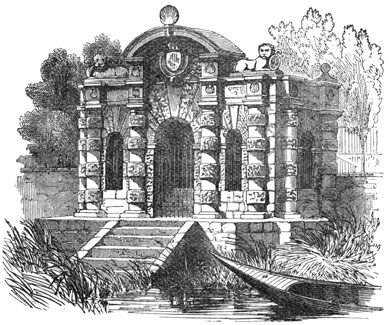
WATER-GATE OF YORK HOUSE.
The only vestige now remaining of the splendid mansion of the Buckinghams is the Water-Gate at the end of Buckingham Street, called York Stairs,[185] and built by Inigo Jones. It has been much admired, and must have admitted, in its time, the entrance of many extraordinary persons.
York Buildings affords us another name, not unworthy to be added to the most useful and delightful of these, Richard Steele, who lived here just before he retired into Wales. The place in his time was celebrated for a concert-room. We must not omit the termination of a curious dispute at the gate of York House, to which Pepys was a witness.
"30th (September 1661). This morning up by moonshine, at five o'clock," (here was one of the great secrets of the animal spirits of those times), "to Whitehall, to meet Mr. More at the Privy Seale, and there I heard of a fray between the two embassadors of Spaine and France, and that this day being the day of the entrance of an embassador from Sweeden, they intended to fight for the precedence. Our King, I heard, ordered that no Englishman should meddle in the business, but let them do what they would. And to that end, all the soldiers in town were in arms all the day long, and some of the train bands in the city, and a great bustle through the city all the day. Then we took coach (which was the business I came for) to Chelsey, to my Lord Privy Seale, and there got him to seal the business. Here I saw by daylight two very fine pictures in the gallery, that a little while ago I saw by night; and did also go all over the house, and found it to be the prettiest contrived house that ever I saw in my life. So back again; and at Whitehall light, and saw the soldiers and people running up and down the streets. So I went to the Spanish embassador's and the French, and there saw great preparations on both sides; but the French made the most noise and ranted most, but the other made no stir almost at all; so that I was afraid the other would have too great a conquest over them. Then to the wardrobe and dined there; and then abroad, and in Cheapside hear, that the Spanish hath got the best of it, and killed three of the French coach-horses and several men, and is gone through the city next to our King's coach; at which, it is strange to see how all the city did rejoice. And, indeed, we do naturally all love the Spanish and hate the French. But I, as I am in all things curious, presently got to the water side, and there took oars to Westminster Palace, and ran after them through all the dirt, and the streets full of people; till at last, in the Mews, I saw the Spanish coach go with fifty drawn swords at least to guard it, and our soldiers shouting for joy. And so I followed the coach, and then met it at York House, where the embassador lies; and there it went in with great state. So then I went to the French house, where I observe still, that there is no men in the world of a more insolent spirit where they do well, nor before they begin a matter, and more abject if they do miscarry, than these people are; for they all look like dead men, and not a word among them, but shake their heads. The truth is, the Spaniards were not only observed to fight more desperately, but also they did outwitt them; first in lining their own harnesse with chains of iron that they could not be cut, then in setting their coach in the most advantageous place, and to appoint men to guard every one of their horses, and others for to guard the coach, and others the coachman. And, above all, in setting upon the French horses and killing them, for by that means the French were not able to stir. There were several men slaine of the French, and one or two of the Spaniards, and one Englishman by a bullet. Which is very observable, the French were at least four to one in number, and had near one hundred cases of pistols among them, and the Spaniards had not one gun among them, which is for their honour for ever, and the others' disgrace. So having been very much daubed with dirt, I got a coach and home; where I vexed my wife in telling her of this story, and pleading for the Spaniards against the French."[186]
In James the Second's time, the French embassy had the house of their rival, and drew the town to see Popish devices in wax-work.
"The fourth of April," says Evelyn (1672), "I went to see the fopperies of the Papists at Somerset House and York House, where now the French ambassador had caused to be represented our Blessed Saviour at the Pascal Supper with his disciples, in figures and puppets made as big as the life, of wax-work, curiously clad and sitting round a large table, the room nobly hung, and shining with innumerable lamps and candles; this was exposed to all the world; all the city came to see it: such liberty had the Roman Catholicks at this time obtained."[187]
They have obtained more liberty since, and can dispense with these "fopperies." At least they would do well to think so.
Hungerford Market takes its name from an old Wiltshire family, who had a mansion here in the time of Charles II., which they parted with, like others, to the encroachments of trade. It used to be an inconvenient and disagreeable place, little frequented, but has lately been converted into a handsome market, and put an end to the monopoly of Billingsgate.
No. 7 in Craven Street is celebrated as having been, at one time, the residence of Franklin. What a change along the shore of the Thames in a few years (for two centuries are less than a few in the lapse of time), from the residence of a set of haughty nobles, who never dreamt that a tradesman could be anything but a tradesman, to that of a yeoman's son, and a printer, who was one of the founders of a great state!
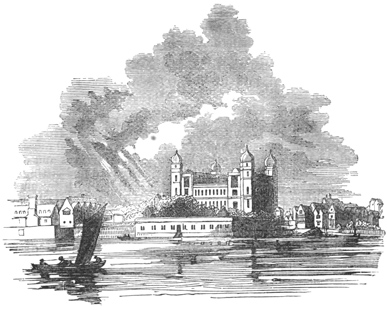
OLD NORTHUMBERLAND HOUSE.
Northumberland House is the only one remaining of all the great mansions which lorded it on the river side. It was built by Henry Howard, Earl of Northampton, son of the famous Henry Howard, Earl of Surrey, the poet; but a very unworthy son, except in point of capacity. He was one of those men, who, wanting a sense of moral beauty, are in every other respect wise in vain, and succeed only to become despised and unhappy. He was the grossest of flatterers; paid court to the most opposite rivals, in the worst manner; and seems to have stuck at nothing to obtain his ends. His perception of what was great, extrinsically, led him to build this princely abode; and his worship of success and court favour degraded him into an accomplice of Carr, Earl of Somerset. It is thought by the historians, that he died just in time to save him from the disgraceful consequences of the murder of Sir Thomas Overbury.[188]
Northumberland House was built upon the site of the old hospital of St. Mary Roncesvaux—Osborne says, with Spanish gold. "Part of the present mansion," says the Londinium Redivivum, "is from the designs of Bernard Jansen, and the frontispiece or gateway from those of Gerard Christmas. This gateway cannot possibly be described correctly, as the ornaments are scattered in the utmost profusion, from the base to the attic, which supports a copy of Michael Angelo's celebrated lion. Double ranges of grotesque pilasters inclose eight niches on the sides, and there are a bow window and an open arch above the gate. The basement of the whole front contains fourteen niches, with ancient weapons crossed within them; and the upper stories have twenty-four windows, in two ranges, with pierce battlements. Each wing terminates in a cupola, and the angles have rustic quoins. The quadrangle within the gate is in a better style of building, but rather distinguished by simplicity than grandeur; and the garden next the Thames, with many trees, serves to screen the mansion from those disagreeable objects which generally bound the shores of the river in this vast trading city."
"Northumberland House was discovered to be on fire, March 18, 1780, at five o'clock in the morning, which raged from that hour till eight, when the whole front next the Strand was completely destroyed. Dr. Percy's apartments were consumed; but great part of his library escaped the general ruin."[189]
We have been the more particular in laying this extract before our readers, because, though the house still exists, the public see little of it. All they behold, indeed, is the screen or advanced guard, which is no very fine sight, and only serves to narrow the way. Of the quadrangle inside the public know nothing; and thousands pass every day without suspecting that there is such a thing as a tree on the premises.
The Percys had this house in consequence of a marriage with the daughter of the Earl of Suffolk, who was Northampton's nephew. During the Earl's possession it was called Suffolk House, and furnished an escape to a person of the name of Emerson from one of the mad pranks of Lord Herbert of Cherbury, who was for fighting everybody. His lordship had had sundry fits of ague, which brought him at last to be "so lean and yellow, that scarce any man," he says, "did know him."
"It happened," he continues, "during this sickness, that I walked abroad one day towards Whitehall, where, meeting with one Emerson, who spoke very disgraceful words of Sir Robert Harley, being then my dear friend, my weakness could not hinder me to be sensible of my friend's dishonour; shaking him, therefore, by a long beard he wore, I stept a little aside, and drew my sword in the street; Captain Thomas Scrivan, a friend of mine, not being far off on one side, and divers friends of his on the other side. All that saw me wondered how I could go, being so weak and consumed as I was, but much more that I would offer to fight; howsoever, Emerson, instead of drawing his sword, ran away into Suffolk House, and afterwards informed the Lords of the Council of what I had done; who, not long after sending for me, did not so much reprehend my taking part with my friend, as that I would adventure to fight, being in such a bad condition of health."[190]
The disgraceful words spoken by Emerson were very likely nothing at all, except to his lordship's ultra-chivalrous fancy; but this is a curious scene to imagine at the entrance of the present quiet Northumberland House—Emerson slipping into the gate with horror in his looks, and the lean and yellow ghost of the knight-errant behind him, sword in hand.
Mr. Malcolm has spoken of the apartments of Dr. Percy. This was Dr. Percy, Bishop of Dromore, who gave an impulse to the spirit of the modern muse by his Reliques of Ancient English Poetry. He was a kinsman of the Northumberland family. We believe it was in Northumberland House that his friend Goldsmith, stammering out a fine speech of thanks to a personage in a splendid dress whom he took for the Duke, was informed, when he had done, that it was his Grace's "gentleman."
A little way up Catherine Street is Exeter Street, where Johnson first lodged when he came to town. His lodgings were at the house of Mr. Morris, a stay-maker. He dined at the Pine-apple in New Street, "for eightpence, with very good company." Several of them, he told Boswell, had travelled. "They expected to meet every day; but did not know one another's names." The rest of his information is a curious and interesting specimen of his disposition. "It used," said he, "to cost the rest a shilling, for they drank wine: but I had a cut of meat for sixpence, and bread for a penny, and gave the waiter a penny; so that I was quite as well served, nay, better than the rest, for they gave the waiter nothing." Johnson drank at this time no fermented liquors. Boswell supposes that he had gained a knowledge of the art of living in London from an Irish painter, whom he knew at Birmingham, and of whom he gave this account.
"Thirty pounds a year," according to this economical philosopher, "was enough to enable a man to live there without being contemptible. He allowed ten pounds for clothes and linen. He said a man might live in a garret at eighteen pence a week; few people would inquire where he lodged: and if they did, it was easy to say, 'Sir, I am to be found at such a place.' By spending three pence at a coffee-house, he might be for some hours every day in very good company; he might dine for sixpence, breakfast on bread and milk for a penny, and do without supper. On clean shirt day he went abroad and paid visits."[191]
The Strand end of Catherine Street is mentioned in Gay's "Trivia" for a notoriety which it now unfortunately shares with too many places to render it remarkable. His picture of one of the women he speaks of possesses a literal truth, the characteristic of the whole of this curious poem.
"'Tis she who nightly strolls with sauntering pace; No stubborn stays her yielding shape embrace; Beneath the lamp her tawdry ribands glare, The new scower'd manteau, and the slattern air; High draggled petticoats her travels show, And hollow cheeks with artful blushes glow. In riding-hood, near tavern door she plies, Or muffled pinners hide her livid eyes. With empty band-box she delights to range, And feigns a distant errand from the 'Change."
Gay contents himself with a picture, and a warning. In our times, we have learnt to pity the human beings, and to think what can be done to remedy the first causes of the evil.
The houses between Catherine Street and Burleigh Street stand upon ground formerly occupied by Wimbledon House, a mansion built by Sir Edward Cecil, whom Charles I. created Viscount Wimbledon. It was burnt down; and Stow says, that the day before, his lordship's country house at Wimbledon was blown up.
The late Lyceum was built about the year 1765, as an academy and exhibition-room, in anticipation of the royal one then contemplated. It did not succeed; and part of it was converted into a theatre for musical performances. It then became a place of exhibition for large panoramic pictures, among which we remember with pleasure the battle pieces of Robert Ker Porter (Seringapatam, Acre, &c.) A species of entertainment then took place in it, which has justly been called "useful and liberal," presenting, on a regular stage, pictures or scenes of famous places, while a person read accounts of them from a desk. We remember the Ægyptiana, or description of Ægypt, and, if we mistake not, an attempt, not quite so well founded, to illustrate the scenes of Milton's Allegro and Penseroso. Neither of the attempts met with success; but the former, perhaps, might be tried again with advantage, now that information and the thirst for it have so wonderfully increased. The panorama, however, may have realised all that can be done in this way. Visitors to those admirable contrivances may be almost said to become travellers; and a reader at hand might disturb them, like an impertinence. We recollect being so early one morning at a panorama, that we had the place to ourselves. The room was without a sound, and the scene Florence; and when we came out, the noise and crowd of the streets had an effect on us, as if we had been suddenly transported out of an Italian solitude. The Lyceum has since been handsomely rebuilt as a new English Opera House, under the management of Mr. Arnold, who has done much to cultivate a love of music in this country. Over the former theatre, we believe, was a room built by him for the members of the famous Beef-Steak Club, equally celebrated for loving their steaks and roasting one another.[192]
The little crowded nest of shop-counters and wild beasts, called Exeter Change, which has lately been pulled down, took its name from a mansion belonging to the Bishop of Exeter, whether on the south or north side of the street does not appear. It is not necessary that the spot should have been the same. Any connection with a large mansion, or its neighbourhood, is sufficient to give name to a new house. Pennant thinks, we know not on what authority, that the great Lord Burleigh had a mansion on the spot; and he adds, that he died here. Exeter Change was supposed to have been built in the reign of William and Mary, as a speculation. The lower story, at the beginning of the last century, was appropriated to the shops of milliners; and upholsterers had the upper. In the year 1721, the town were invited to this place to look at a bed.
"Mr. Normond Cony," saith the historian, "exhibited a singular bed for two shillings and sixpence each person, the product of his own ingenuity; the curtains of which were woven in the most ingenious manner, with feathers of the greatest variety and beauty he could procure; the ground represented white damask, mixed with silver and ornaments of various descriptions, supporting vases of flowers and fruits. Each curtain had a purple border a foot in breadth, branched with flowers shaded with scarlet, the valence and bases the same. The bed was eighteen feet in height; and from the description must have been a superior effort of genius, equally original with the works of the South Sea Islanders, whose cloaks, mantles, and caps, grace the collection formed by Captain Cook, now preserved in the British Museum."[193]
This was a gentle exhibition enough. Sixty years ago, instead of the bed, was presented the right honourable body of Lord Baltimore, a personage who ran away with young ladies against their will. The body lay "in state," previously to its interment at Epsom. Lord Baltimore was succeeded by the wild beasts, who kept possession in their narrow unhealthy cages till the death of the poor elephant in 1826, which conspiring with the new spirit of improvement to call final attention to this excresence in the Strand, it was adjudged to be rooted out. The death of this unfortunate animal, who seems to have had just reason enough to grow mad, had its proper effect, in exciting the public to guard against similar evils; nor is it likely that these intelligent and noble creatures, nor indeed any others, will undergo such a monstrous state of existence again.
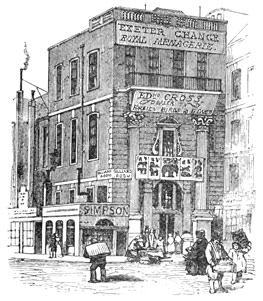
Passing one day by Exeter Change, we beheld a sight strange enough to witness in a great thoroughfare—a fine horse startled, and pawing the ground, at the roar of lions and tigers. It was at the time, we suppose, when the beasts were being fed.