Wonders of the World.
Reading edition
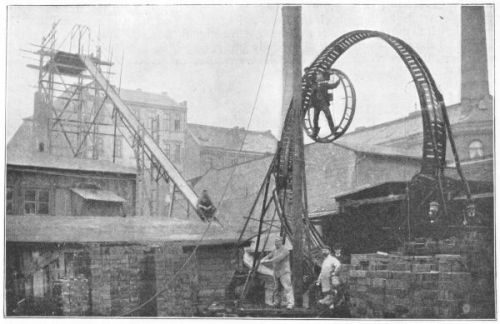
A GENERAL VIEW OF THE SALTO MONOCYCLE TRACK.
From a Photo. by Rochlitz.
LXIX.—A NEW "LOOPING THE LOOP."
There seems to be no finality in the art of invention, whether it be in commerce, technology, science, art, or even in connection with the variety-stage. In the last-named case the struggle for supremacy is exceedingly keen, and requires, more than in other professions, untiring perseverance, courage, and intelligence if one wishes to obtain a place on the "roll of fame."
In the theatre or in the music-hall the public only see the glittering outside appearance, and applaud the attractive items of an artist without thinking of how much work and trouble it has cost him to be able to execute his performance without apparent effort and with extreme perfection. Such a sensational performance will soon be seen in a Berlin circus—a new kind of "Looping the Loop"—"The ride on the Salto Monocycle Track," as the audacious artist calls it, and with whom we are going to make our readers acquainted.
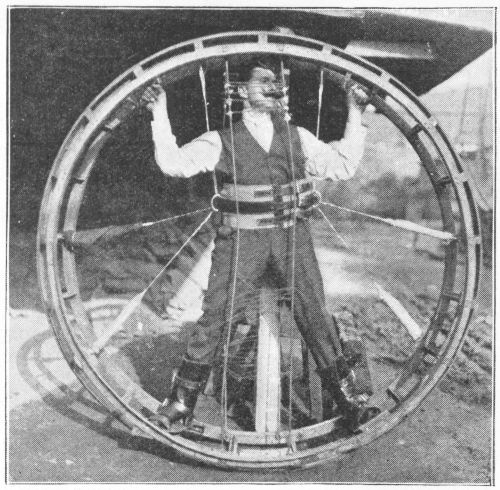
MR. ECLAIR FASTENED BY THE WAIST, ANKLES, AND HEAD INSIDE THE WHEEL WHICH LOOPS THE LOOP.
From a Photo. by Rochlitz.
This sensational act consists in the artist being rolled in a wheel, measuring six and a half feet in diameter and eighteen inches wide, along a track in the form of a loop. Our first two illustrations give a clearer idea than can be given in words.
Mr. Eclair—the artist's name—has had his track made by Mr. A. Klose, Schiffbauerdamm, and practised in the so-called training-wheel for the past fifteen weeks before he undertook his first journey. In this training-wheel he accustomed himself to the revolutions of the wheel. This was all the more necessary, as he found on practising that, in consequence of the rapid revolutions, the small veins and other blood-vessels in the neck and head became swollen—so much so that a journey in the "loop" without previous experience would certainly, in his opinion, have been fatal.
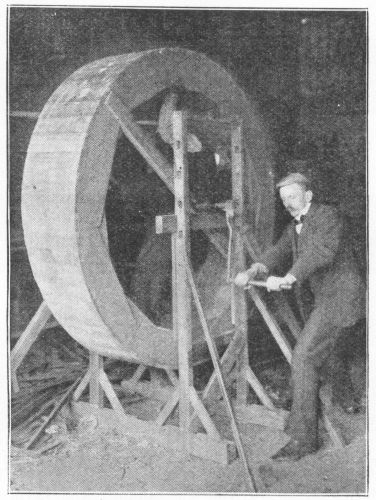
PRACTISING IN THE TRAINING-WHEEL.
From a Photo. by Rochlitz.
After the perfect construction of the track had been ascertained by thorough tests—amongst which heavy waggon-wheels were caused to be rolled along the track—Mr. Eclair at length took his first ride. It was a ride for life or death. Nobody could foresee what the result would be. Luck favoured the venturesome artist, and his success was acclaimed with joy and satisfaction by all the interested beholders, so smoothly and faultlessly did the performance end. Such was the birth of a new sensational circus feat! And a second ride which Mr. Eclair soon afterwards took turned out equally successful.
The track slopes from a platform about fifteen yards high down into the "loop." It must be understood that this is not a real loop, such as, for example, Mündner uses, but is so constructed that the fearless rider rushes in his wheel down the slope, entering the ring by a trap-door, so that the wheel rolls round it. This heavy wheel, which weighs five hundredweight, flies up the track with a terrific momentum, and, in consequence of its centrifugal force, presses against the track with a force of seventeen times its own weight.
When the wheel has passed the highest point of the loop it flies down the other side, and leaves the loop again by another trap-door which has in the meantime been opened. The downward movement, being still very rapid at the point of exit, is then retarded by means of outlet-rails which adjust themselves exactly to the wheel, and the mad ride ends at length in a net.
The track has a total length of about sixty-five yards, inclusive of loop and exit. The loop is about twenty-four feet high. The wheel rolls in a mould-shaped groove. The slightest mistake in the construction of the track, which is an extremely ingenious one, would result in an unsuccessful performance and a dangerous, if not deadly, fall. Especially ingenious is the mechanism of the trap-doors at the entrance and exit. These are in charge of the artist's colleague, and form the most important part of the track, as any failure in this part would end in dire catastrophe.
LXX.—A BONFIRE OF GAMBLING APPARATUS.
The Anti-Gambling Leagues of British cities have their counterpart in the various Law and Order Societies of American municipalities, and their labours are much the same. Just as the societies in England attempt to protect the poor and middle-class people from the encroachments of vice by initiating prosecutions against wrong-doers, so do these Law and Order Societies fight in the interests of the American public. They go to excesses sometimes, it is true, but their labours have a positive value for good. In England they keep an eye upon the book-maker in the street, upon the sporting tipster with his betting circulars and notices, and upon gambling in general. They prosecute where prosecution is needed, and carry on in Parliament a fight for virtue.
Never, however, have they prepared a fire for the benefit of their supporters such as the Law and Order Society of Philadelphia got up last May. It is, perhaps, not wholly correct to say that when the Philadelphia Society seized and burned over thirteen hundred gambling machines in a public place it did so merely for the benefit of its followers, but that was practically the case, and among those who saw this unique conflagration there were none more interested than the crusaders against vice. It was an actual destruction of valuable property, but not a wanton one, and when the fire was over the charred metal and molten tin represented a sum of not less than one hundred and thirty thousand dollars. We doubt if England has ever had the privilege of witnessing such a sight, for the vested right of the Briton is too sacred to permit of his property being done away with in such brilliant manner.
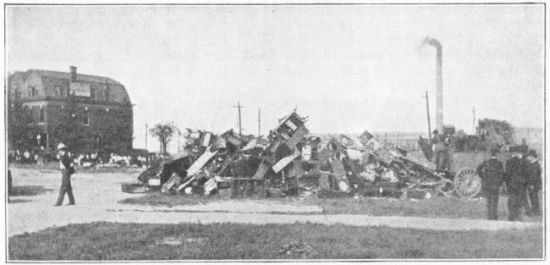
WAGGONS UNLOADING GAMBLING MACHINES TO FORM THE BONFIRE.
From a Photo.
The reason for the fire was the abnormal growth in Philadelphia of the penny-in-the-slot gambling machine, owing to its fascination for the young and its asserted protection by careless or corrupt municipal government. The machines—some of them very elaborate, costing from three hundred to six hundred dollars each—were nothing but "money-machines," automatic gamblers of the most hardened sort. If the player dropped any sum, from five cents to twenty-five cents, into the slot, he stood a chance to win about ten times as much as he put in, and the prospect of such a huge percentage upon a small investment fascinated poor people and boys and girls alike. One boy was known to have lost as much as three hundred and fifty dollars in a week through this form of gambling, having resorted to theft in order to obtain the wherewithal to gamble.
"For four years," writes Mr. D. Clarence Gibboney, the secretary of the Law and Order Society of Philadelphia, "our city was cursed with thousands of these conscienceless gambling devices. The authorities protected them, and our citizens were almost helpless. Fathers and mothers stood by, unable to do much more than make a feeble protest, while their sons and daughters were turned into gamblers.
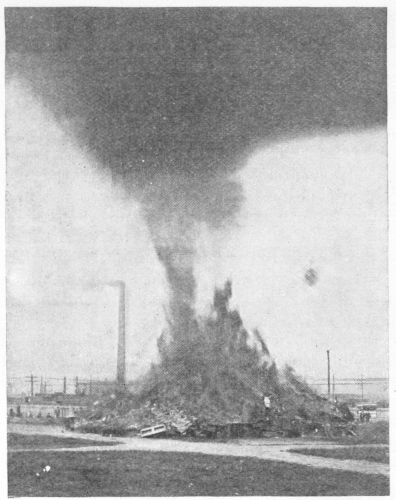
THE FIRE IN FULL BLAZE.
From a Photo.
"This society took hold of the situation and, in face of very determined opposition, arrested many of the owners and keepers of the machines in 1902, and in December burned a hundred and ninety-six machines, valued at about twenty thousand dollars. The police, however, supported the gambling people, and it was not until after January 1st, 1903, that we were able to wipe the entire business out of the city.
"A new mayor was elected, and he immediately forced the police to aid us. The police seized five hundred machines and we, through our own constables, seized over eight hundred others between January 1st and May 10th, 1903. On May 19th the entire lot was burned, the police and the Law and Order Society joining in the work of destruction. Not a machine that we know of exists in this city to-day."
LXXI.—A BANQUET IN A WATER-PIPE.
In the middle of October last a banquet was served to the League of Iowa Municipalities, at Waterloo, Iowa, which, so far as we know, has no duplicate in the history of gastronomy. It was in every way the most successful gathering of the sort that ever took place in this enterprising city of the West, and the novelty of the affair drew public notice from near and far.
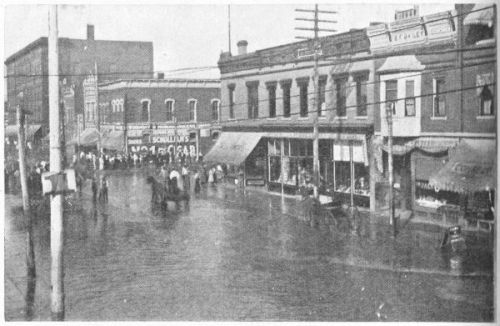
A FLOODED STREET IN WATERLOO, IOWA, WHERE THE GREAT DRAIN WAS CONSTRUCTED.
From a Photo.
The table was spread in a sewer constructed by the city to carry off the surplus water which at different periods of heavy rains had threatened the existence of the place with damaging floods. The name by which this work of engineering is known—the Dry Run Sewer—recalls to many the story of an innocent little stream running through the principal business and residence section of the city, a stream which in its driest day would attract little attention from a passer-by. Unfortunately, however, for the inhabitants the Dry Run has frequently become very wet. Within the past seven years, on three different occasions it has flooded the entire western portion of the city, causing a property loss of many thousands and endangering the lives of the inhabitants. In 1902 it was flooded twice within twenty days. It rose on July 3rd at the rate of ten feet within five minutes, and on July 23rd ambitiously repeated the same perilous feat.
The citizens of Waterloo, at the head of whom stood Mr. P. J. Martin, the mayor, now concluded that this recurring danger should be met by heroic measures, and a flood-sewer, twelve feet by twelve feet in width and height, and three thousand four hundred feet long, was planned at a cost of about one hundred thousand dollars. To many the project appeared impossible of completion, owing to the peculiar situation of Dry Run, but the difficulties in the way did not daunt the Iowa engineers. Hundreds of men were put upon the work of excavation and construction, under the charge of contractor William Horrabin, of Iowa City, and the giant structure rapidly took the permanent form which we see in our photographs. Our illustration of the entrance to the sewer unfortunately does not suggest the size of it, but when we say that a man could walk through this sewer easily carrying another upright on his head, we may fairly suggest the height of the arch. Some thirteen thousand barrels of cement and over thirty-two million pounds of sand and rock were used in the construction, and nearly one million cubic feet of dirt were excavated. The side walls of the sewer are vertical for six feet, and the base is at present about fifteen feet below the level of the street.
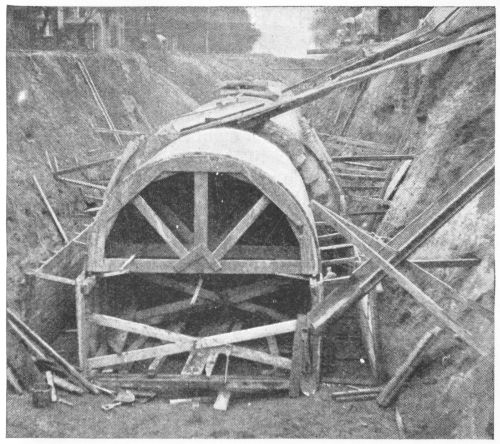
A SECTION OF THE DRAIN-PIPE.
From a Photo.
With the completion of the largest work of the kind ever undertaken by an Iowa municipality, satisfaction took the place of unrest in the feelings of the citizens. The manufacturers were able to leave their places of business without fear of catastrophe behind them, and the residents could now go to bed at night without dread of a flood-warning from the fire bell. In fact, the relief was so widespread that it was deemed fitting by the mayor and aldermen that the completion of the sewer should be signalized by a great banquet, to which the mayors and representative citizens of other towns should be invited.
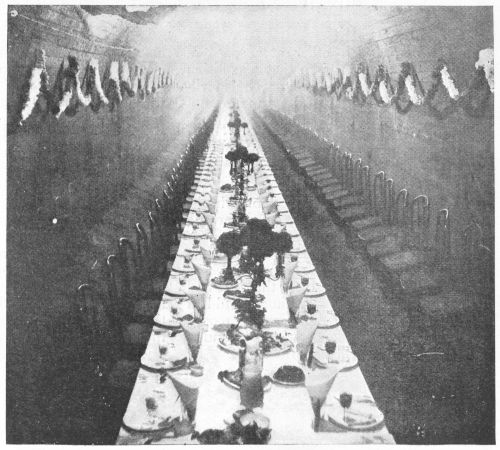
THE TABLE LAID FOR THE BANQUET INSIDE THE DRAIN-PIPE.
From a Photo.
The happy thought now occurred to the Waterloo Times and Tribune of holding this banquet, not in an hotel, but in the sewer itself, and the project was carried out with enthusiasm. This meant, of course, unusual effort on the part of those in charge, but all obstacles were easily surmounted, and on the night of October 16th that part of the city which, little more than a year before, had been the bed of a raging torrent was turned by engineering and culinary magic into a banqueting-hall of security and light. The tables were laid along the floor of the sewer over four hundred feet of its length, and on both sides of this table, with plenty of room in which to move, sat the best-known citizens of the State. Simple but pretty decorations hung in festoons from the archway and on the side walls gleamed rows of electric lights. Mayor Martin acted as toast-master, and the programme of toasts lasted an hour and a half. As if to suggest a danger happily past the rain was falling outside, but no fear of flood troubled the gathering. The banquet was as successful as the construction of the sewer itself, and those who were privileged on this memorable occasion to partake of Dry Run punch drank it with a special gusto. This little joke of the caterer was duly appreciated. The dessert was as happily chosen, for it ended with Roquefort and "water crackers."
LXXII.—AN ANTI-COLLISION TRAIN.
Even in this age of wonders no one would have expected to experience a railway collision without the usual horrors of a smash-up, yet that is the feature of one of the latest wonders of inventive genius. An electrical engineer of New York, Mr. P. K. Stern, has just come forward with such a contrivance.
His system is remarkable chiefly for the daring conception which it expresses and for the exceptional skill shown in devising mechanism absolutely safe in its operation.
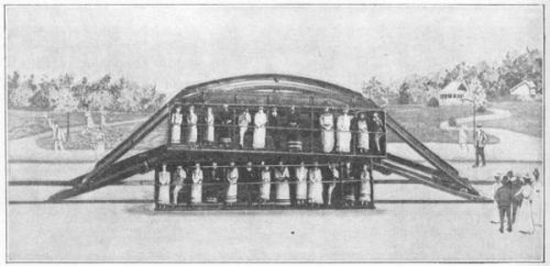
A CAR PASSING OVER ANOTHER ON THE ANTI-COLLISION RAILWAY.
From a Photo.
A single track is used, on which railway-cars are caused to travel. Two cars are rushing towards each other at a speed of twenty-five miles an hour, so that a collision would, under ordinary conditions, be inevitable, when suddenly one of the cars runs, not into, but over the top of the other and lands on the track on the other side, where it continues in perfect safety to its destination. The underneath car has proceeded as if nothing had happened.
The cars, although they run upon wheels, are really travelling bridges, with overhanging compartments for the accommodation of passengers. Over the framed structure of the cars thus constituted an arched track is carried, securely fastened to the car and serving the purpose of providing a road-bed for the colliding car. This superimposed track is built in accordance with well-understood principles of bridge construction.
The passengers find accommodation in the cars arranged along each side of the travelling structure. The cars run at a speed of about ten to fifteen miles an hour, and are caused to collide at about eight miles an hour, which is quite sufficient for amusement purposes. The principle upon which these cars are constructed renders it impossible for one to crush the other while going over it.
In this device the speed of the cars is immaterial. One car may be moving very slowly—such as is the case sometimes in crowded streets—and the overtaking car, when meeting with obstructions, though it may be in close proximity, can go straight ahead just as though nothing had happened. In fact, automobiles and carts can go over the cars just as though they were mounting a gradual incline or small hill.
In cases of street locomotion there is a fender effect for the safety of people crossing the streets, which picks the person up and lands him down on the other side unhurt.
A great deal might be done with a system of this character, and Mr. Stern's next work will be a careful study on the lines of carrying freight, as he believes that a single line of railway may be duplexed in this manner, and thus enable more business to be carried on than by the ordinary railroad having two tracks.
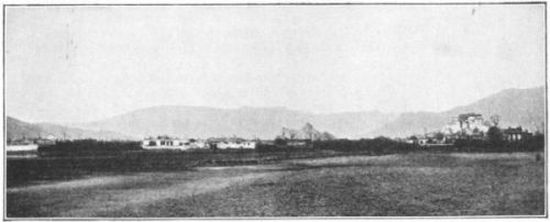
A GENERAL VIEW OF LHASSA FROM THE EAST.
From a Photo.