THE RETURN OF SHERLOCK HOLMES. (continued 2)
Reading edition
Now, the mind of a child is a peculiar thing—having a tendency, by some strange gift of the gods, to retain the true and to cast aside the worthless. So it happened that the mind of little Teddy Kershaw, by some subtle process, eliminated from his father's speech all that was mere verbiage, and began to construct for itself a glorious fabric called Universal Brotherhood. Setting aside those who were well fed and prosperous, the child came to see in every houseless wanderer of the streets—in every toil-worn, white-faced man or woman—some being who had a right, not only to his pity, but to every luxury which he himself enjoyed. And the idea grew and grew until it filled his childish mind, and until—like a small and gallant Crusader—he began to feel that he must do something, more than mere thoughts and words, to carry the thing into effect. He began for the first time to notice, with a sort of pained wonder, that little children, smaller and weaker even than himself, shivered in the streets while he rolled along in his father's carriage; that women carried heavy baskets, while his own mother would scarce put her delicate feet to the ground and was buried in furs and wraps. The incongruity of it came full upon him; and he determined at last, in an inspired moment, to do something to remedy the matter.
To carry out his desires in the presence of those who were responsible for him was, of course, out of the question; instead, he watched his opportunity, and slipped out of the house one day unobserved.
The town house of Sir Leopold Kershaw was in a very fine and extremely aristocratic square; but quite near to it—crouching and hiding under the wing of its grandeur—was a terrible nest of slums. And into this, by some natural instinct, drifted Master Teddy Kershaw.
With that newly-kindled love of humanity fairly bursting out of him he was prepared to seize the first likely wastrel by the hand and give instant effect to his father's many speeches; and he had not far to seek.
Just on the borderland, where the genteel streets began to grow more shabby and where untidy women and children seemed to be overflowing out of every house, stood a costermonger's barrow, the proprietor of which was leaning, in a dejected attitude, against it. It was the poorest barrow imaginable, with one of its shafts mended with string, and with a few sorry-looking vegetables, which never by any chance could have grown in any imaginable garden, displayed upon it.
The costermonger himself had evidently come to the conclusion that it was quite useless to attempt to impose his wares, at any price, even in that most poverty-stricken market; despair sat heavily upon him, and lurked even in the empty bowl of his cold pipe. Yet he was comparatively a young man, and not ill-looking; and the woman who leaned near him, with her elbows on the barrow and her chin propped in her hands, had once, and not so long ago, been quite pretty, despite the gaudy hat which drooped disconsolately over her eyes.
Here, surely, was a forlorn brother indeed! Teddy hesitated for but an instant, and then advanced towards the man. He felt that it would be wiser not to shake hands with him at once, as that smacked too much of familiarity; so he merely bowed and put a casual question—suggested by the barrow—as to the state of trade.
"Can't you sell anything?" he asked.
The costermonger looked Teddy up and down in astonishment, and then looked round at the woman and jerked his head sideways in a very curious fashion; drew the back of his hand slowly and elaborately across his mouth, and looked at Teddy again.
"No, yer 'Ighness, I can't," he replied, slowly and emphatically. Turning to the woman, with another jerk of the head, he muttered something about a "rum start."
"But wouldn't people buy the things if you shouted?" asked the boy. "Other people shout what they have to sell." Which was evident by the babel of noise about them.
The costermonger, who appeared to have got over his surprise, and who seemed to be rather a friendly sort of fellow, proceeded to explanations. "You see, yer 'Ighness, it's this 'ere way," he began. "I've 'ollered an' 'ollered till there ain't a puff of bref left in me; an' it's me private opinion that if yer was to bring sparrergrass tied up wiv pink ribbin into this 'ere street an' chuck it at 'em, they'd chuck it back agin. As fer this little lot"—he indicated the contents of the barrow with a backward jerk of his thumb—"they'll see me blue-mouldy afore they'll lay out a bloomin' farden on 'em."
Having so far relieved his mind, the man looked into the bowl of his pipe and, finding nothing there, returned the pipe to his pocket; then took up the handles of the barrow and prepared to move away.
Now it happened that Master Teddy knew that his father and mother were out and were not expected to return until late; it was probably owing to that circumstance that he had escaped from durance so easily. Further, the boy knew that, in a household where he ruled supreme as the only child of a rich man, he could practically do as he liked. True, he had never attempted so bold a scheme as that which was at the present moment seething in his small brain; but he felt not the slightest doubt that he could carry it through successfully and without opposition. Accordingly, in the most casual fashion possible, he asked the costermonger if he would come and have some lunch.
The unfortunate man almost upset the barrow in the shock of the moment; but, recovering himself, began to perform the most extraordinary antics Teddy had ever seen. First he straightened himself from the hips and gave a sudden tilt to his hat with both hands, which threw it dexterously over one eye; next he twisted up the collar of his coat and stuck his thumbs in the arm-holes of his waistcoat; then took a little skip backwards and a little skip forwards; put his tongue into his cheek and ejaculated the single word: "Walker!"
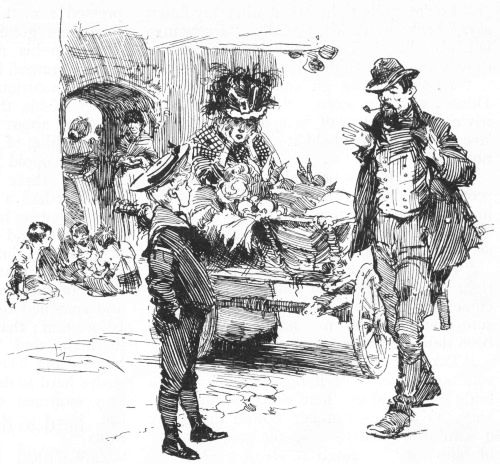
"WALKER!"
Perceiving from these signs, in a dim fashion, that the man doubted the honesty of his intentions, Teddy became more emphatic, assuring the man that he lived quite near at hand, and that lunch would be just about ready; that he would be quite alone with them; even going so far as to enumerate some of the dishes which might be expected. But the costermonger evidently still had his doubts.
The woman, however, with the keenness of her sex, saw farther into the matter than the man. She spoke in a lower voice.
"Sam, there may be summink in it, arter all. 'E's a little swell, by the looks of 'im, an' 'e don't look 'ard-'earted enough to go for to guy us, do 'e?"
The man, who appeared, even under the most distressing circumstances, to have some latent spark of humour about him, scratched his head for a moment, and then addressed the boy with extreme politeness.
"Seein' as 'ow you're so pressin', yer nibs, I dunno but what we won't take a snack wiv yer—me an' me Donah"—he indicated the woman with one hand. "Do yer fink I might leave the barrer in yer front garding?"
Teddy was wise enough to see that the carrying out of the latter suggestion might cause tongues to wag in the aristocratic square, so it was finally decided that the barrow should be left in the care of a worthy man, of disreputable appearance, who lived in a yard near at hand, and who, for its better protection, agreed to sleep in it until their return.
It is probable that, had Master Teddy Kershaw brought in a travelling menagerie with him—including the elephant—to lunch, Wilkins the butler would scarcely have expressed surprise, whatever his private feelings might have been. Therefore, when the boy introduced his two new friends into the house, gravely referring to them as "Mr. and Mrs. Donah," and announcing that they would partake of lunch with him, Wilkins merely bowed and murmured "Very good, Master Edwin"; discreetly waiting until he had gained the seclusion of his pantry before exploding.
Mrs. Donah was very much subdued and decidedly ill at ease; but Mr. Donah, on the other hand, made himself quite at home with much rapidity. He addressed the appallingly stiff footman pleasantly as "Calves," and taunted him with the suggestion that he was quite big enough to be "put into trahsis." Finally, having appeased his appetite, he lounged easily about the room and admired its appointments.
"I say, yer nibs, is this 'ere yer guv'nor's chivvy?" he asked presently, stopping in front of a full-length portrait of Sir Leopold Kershaw—a portrait which, by the way, appeared to frown down upon him with anything but a brotherly expression.
"I beg your pardon?" said Teddy.
"I sed: 'Is this yer guv'nor's chivvy?' 'Chivvy' bein' parlyvoo for face," replied Mr. Donah.
"Oh, I see," said the boy. "Yes, that's my father."
Mr. Donah surveyed the portrait for some moments, with his head on one side; finally turning to Mrs. Donah, with that curious sideways jerk of the head.
"Twig 'is dial, ole gal? Lor' luv us—'e's a 'ot 'un—I giv' yer my word. 'Eard 'im spout once, abaht every bloke bein' 'is bruvver. That was abaht 'lection time las' year. Ain't 'eard nuffink from 'im since, an' I don't fink 'e's bin ter tea dahn our court, 'as 'e?"
"You're quite right about what my father says," broke in Teddy, proudly. "Every man is his brother, and everyone has the right to exactly the same things that he enjoys."
"Yuss; if 'e can git 'em," responded Mr. Donah, with fine scorn. "But if I 'ooked it wiv a dozen or two of 'is spoons 'e wouldn't 'ave nuffink to say abaht it—bless yer eyes—not 'e!"
Mr. Donah was becoming so particularly scornful, and he jerked his head so threateningly in the direction of the portrait, that Teddy deemed it wise to change the subject; accordingly he said:—
"It's because I believe that my father is right that I asked you and Mrs. Donah to come in to lunch to-day. I'm not quite sure—but I think my father would have been delighted to welcome you."
"Take yer oaf of it!" replied Mr. Donah, with a chuckle. "'E'll be that upset w'en 'e finds 'e's missed us, there won't be no 'oldin' 'im. As to me—I'm fair bowed down wiv it—an' the missis—w'y, ole gal, wot yer blubbin' for?"
Mrs. Donah, who had really eaten very sparingly of everything put before her, had suddenly begun to dab her eyes in a most suspicious manner with the corner of her shawl. Mr. Donah's question, however, appeared at once to rouse her; she got up hurriedly and jerked her hat straight with some fierceness, and told him angrily to—"Come aht of it!"
"'Ere we've bin a-settin' and shovin' grub into ourselves, like beasts, and that poor little nipper at 'ome wivaht so much as a bite!"
Mr. Donah, appeared instantly to droop; his fine spirits were gone in a moment. Indeed, Teddy had a suspicion that he saw the man draw his sleeve hurriedly across his eyes. Curiously, too, there was a sort of dull, heavy anger upon him as he made for the door.
"Come back ter the barrer, ole gal," he said, in a voice more husky even than usual. "An' don't fink that I was fergettin' the nipper—'cos I wasn't." Stopping awkwardly at the door, he came back to the boy. "As fer you, my nibs—you're a nobleman—that's wot you are. There ain't no flam abaht you, an' no partic'ler gas-works. It's a deal pleasanter ter fill a man's stummick than to fill 'is bloomin' 'ed. If yer don't mind, I'd be prahd ter shake a fin wiv yer."
Understanding by this that Mr. Donah desired to shake hands, Teddy promptly responded. He had but dimly understood the half of what they said, or he might have pressed something further upon them; but they were gone before he had had time to make up his mind what to do; and the house returned to its normal condition.
With a curious distrust of that loud-voiced father of his, the boy refrained from saying anything about his extraordinary guests; so that nothing of the matter came to the ears of Sir Leopold Kershaw.
Some three nights later little Teddy Kershaw had a dream. He thought in his dream that he had just sat down comfortably to dinner, and that in some extraordinary fashion the dining-room was open to the street; and that first one hungry child and then another crept in upon him unawares, and snatched desperately the very food from before him; that although Thomas, the large footman, and Wilkins, the equally large butler, and even his father, Sir Leopold, strove hard to drive the famished mites away, they swarmed thicker and faster—until at last, by some subtle dream-change not to be explained in waking hours, his seat at the table was usurped and he had taken the place of a shivering street-boy, who seemed the hungriest of them all; so that he stood outside the house, among the ragged ones, shivering with cold and hunger. Waking suddenly he still seemed to shiver, and found, to his astonishment, that the window of his room was wide open.
While he was meditating sleepily upon this circumstance a stranger thing happened—the head and shoulders of a man appeared against the light of the sky, and the man himself dropped, with a soft thud, into the room.
Teddy started up in bed and opened his mouth with the full intention of giving vocal effect to his alarm; but in an instant a hand—rough, and not particularly sweet-smelling—had closed over it, and a gruff voice, which seemed in the darkness curiously familiar, whispered huskily in his ear:
"Lie dahn, will yer! If yer so much as breave I'll be the death of yer!"
Teddy Kershaw could see nothing distinctly in the darkness; only the dim form of the man seemed to hover above him. On the man releasing his grip Teddy lay down passively, and tried to breathe as little as possible.
"'Oller, an' I'll be back afore yer can say 'knife' an' do fer yer," whispered the man again. Then, quite noiselessly, he crept to the door and opened it, and glided out into the house.
Master Teddy Kershaw, consumed by curiosity, waited for a few moments and then slipped out of bed and went through the door also. Outside on the stair-case a dim light was burning; and, leaning over the stair-head, Teddy could see the man gliding down and keeping as much as possible within the shadow of the wall. A door creaked on its hinges and the man disappeared.
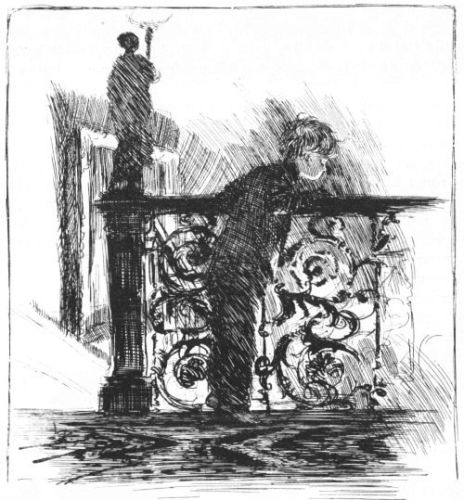
"LEANING OVER THE STAIR-HEAD, TEDDY COULD SEE THE MAN GLIDING DOWN."
Teddy, mindful of the threat which had been breathed into his ear, was just about to creep back again when he heard another door open more noisily than the first, and then a quick challenging voice; the sound of running feet—a scuffle—and a fall: then other doors opening and more running feet; and lights seemed to flash up all over the house. Unable to restrain himself any longer, Teddy scuttled downstairs in his small pyjamas and headed straight for the fray.
In the dining-room he burst in upon a curious group. In the centre was Mr. Donah, struggling feebly and ineffectually between the grasp of two of the footmen; standing by the fireplace, looking at Mr. Donah sternly, was Sir Leopold Kershaw, appearing dignified even in a dressing-gown and with his hair rumpled; while the room was half-filled by a crowd of semi-clad, startled servants.
"Yer 'Ighness," exclaimed Mr. Donah, with some poor show of cheerfulness, as the boy appeared, "yer 'umble is a fair gorner!"
Sir Leopold, apparently not hearing the remark or not understanding, proceeded to improve the occasion.
"You have been caught, my fine fellow, in the perpetration of one of the most heinous crimes possible to imagine—that of purloining, after forcible entry, goods to which you have no right. Now, sir, I am a Justice of the Peace, and, while I must warn you not to say anything which will tend to incriminate you at your public trial, I am willing to hear any remarks you may make with reference to your purpose in being here or your reason for selecting my abode for your nefarious practices."
Mr. Donah looked all round him, somewhat helplessly; fixed his eye on Teddy, and winked with some cheerfulness; gave that peculiar jerk to his head which seemed to express any emotion of the moment; and spoke.
"Guv'nor, and yer 'Ighness, it's a thousand to one in canary birds that I'm up the wust gum-tree as ever you see! Fair nabbed, wiv me dukes on the bloomin' 'all-marked ladles and corfee-pots, I am, an' don't yer fergit it! As fer alibis an' sich-like fings, yer won't find one abaht me, if yer search me till Easter Monday. It's a fair cop, an' no error. Same time I should jist like to say as 'ow this is the fust time I've been on the rails in all my natural, an' it ain't exactly my fault."
"Pray explain yourself," said Sir Leopold, loftily.
"Righto, ole Poker-back, just 'arf a shake! I'm a-comin' to it. I've got a little nipper at 'ome, wot's wasted away to a mere shadder—yer might let go a bloke's arm an' let him rub 'is dial-plate, Calves—'an 'e's a-lyin' in one room, an' most of the bed-clothes is up the spout. I've 'ollered 'Fine 'earty cabbage!' till I've got it on my brain, an' 'tain't no good. Then, comin' in 'ere wiv the missis t'other day ter lunch (leastways they called it lunch, but it was abaht a full week's grub fer us) wiv 'is 'Ighness——"
"To lunch? What is the man talking about?" broke in Sir Leopold Kershaw, sternly.
"W'y, 'is nibs comes aht w'en me and the ole gal was a-standin' by the barrer, and ses 'e, quite friendly-like, 'Come in an' 'ave lunch alonger me,' ses 'e. Not 'avin' me party frock on, in consequence of it bein' kep' at the wash, I 'ung back; but 'is nibs was that pressin' there was no gettin' over 'im, an' very 'andsome 'e done us, I mus' say." Thus Mr. Donah, with much emphasis.
"It is perfectly right," said Teddy, coming a little farther into the room. "I had heard what you said, father, about every man being my brother, except Wilkins" (the unfortunate butler blushed hotly on finding himself brought into such prominent notice), "and Mr. Donah, as well as Mrs. Donah, looked so miserable and so hungry that I thought you wouldn't mind. So I brought them in here, and we had quite a good time."
"You brought them in here?" ejaculated the master of the house, in amazement.
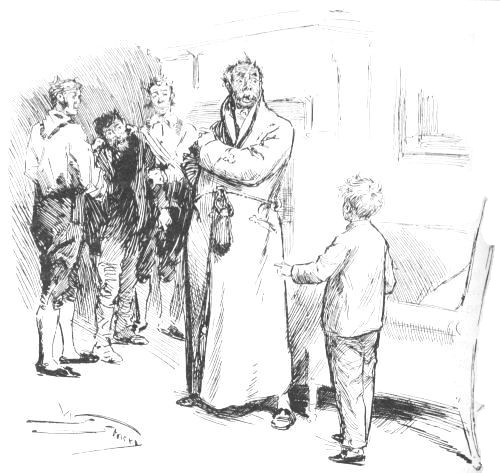
"'YOU BROUGHT THEM IN HERE?' EJACULATED THE MASTER OF THE HOUSE."
"Yes," said Teddy, boldly. Then, beginning to feel dimly and miserably that Mr. Donah was in a very tight place, Teddy, for the first time in his brief career, began to lie. "In fact, I told Mr. Donah that I thought he had a perfect right to everything which we had, and I'm afraid I even suggested that it wouldn't matter very much if he just helped himself to——"
"'Ere, stow it, yer 'Ighness; no perjury," exclaimed Mr. Donah. "Yer won't never sing wiv the angels if yer go on in that way." He turned suddenly towards Sir Leopold, and spoke with a certain despairing fierceness upon him: "Look 'ere, guv'nor—I don't want 'is nibs to be tellin' no crams abaht it. I come in 'ere, an' I 'as a jolly good feed—fair wallers in it, I does—till the ole gal breaks dahn, an' reminds me abaht our little nipper at 'ome, wivaht a crust. I goes 'ome that night an' meets the parish doctor on the stairs. 'Dockery'—that's me name w'en I goes a-ridin' in the park—'Dockery,' ses 'e, 'that kid o' yourn wants nourishment—beef tea—good eggs; and you did ought ter get 'im away into the country.' Lor' luv us—w'y didn't 'e tell me to take 'im to 'ave tea alonger the Queen at Buckingham Pallis while 'e was abaht it?"
"You were not able to provide these necessaries for your child?" said Sir Leopold, somewhat unnecessarily.
"I were not," responded Mr. Donah, doggedly. "So that night I sits a-thinkin', an' a-thinkin', till me head fair buzzes, an' all next day I thinks a bit 'arder, till at last it comes over me that it ain't right, arter wot you've said abaht me bein' yer bruvver, that 'is nibs 'ere should be 'avin' roas' duck an' tomater sauce, so ter speak, an' my pore kid a-chewin' 'is fingers fer comfort. An' this mornin', seein' 'im look a bit finner than usual, I got fair desp'rit', an' couldn't stan' it no longer. So I made up me min' as 'ow I'd 'elp meself to a bit of me bruvver's silver stuff."
"To use one of the vulgarisms familiar to your class, my friend," interposed Sir Leopold, "I am afraid that your statement won't wash."
"It'll wash a lump better than some er yer spoutings," retorted Mr. Donah, with some indignation. "Wot's the good er tellin' a man one minute 'e's yer bruvver an' 'as a right ter share everyfink wiv yer, an' lockin' 'im up the nex' fer 'elpin' 'isself? There, I've 'ad me little jaw; now send fer the bloomin amberlance."
Sir Leopold Kershaw was thinking very hard indeed. It would be too much to say that he was in any sense converted; such sudden conversions are rare. But he had a wholesome dread of seeing his principles derided or himself made a laughing-stock; and Mr. Donah's remarkably caustic mode of speech would, he felt, suit the humour of the evening papers to a nicety. Sir Leopold had a mental vision of himself prosecuting in a police-court, and writhing under Mr. Donah's remarks in defence of his crime—the while busy reporters scribbled as if for their lives. Moreover, the man, to do him justice, had a certain honesty of purpose beneath all his ponderous phrases; his only fault lay in the fact that he did not, in any sense, understand the class about whom he talked so much. After a moment or two of thought he sternly dismissed the whole of the servants, cautioning them against chattering about the matter for the present; and was left alone in the room with his little son and Mr. Donah.
"Now, Dockery: I think you said that was your name——"
"C'ristened Sam, at Sin George's in the Borough, on a Toosday—wiv me a 'owlin' proper an' bitin' the parson's little finger," broke in Mr. Dockery.
"Well, Dockery, the circumstances attending your offence are somewhat peculiar, and I am disposed to take a lenient view of the matter. I am impelled to this course by the remembrance that my son is, to an extent, concerned in the affair"—Sir Leopold Kershaw felt that he must really make an excuse of some kind or other—"and I am unwilling that he should imagine that the principles I have so strongly laid down in his hearing are sentiments merely, and that I am not prepared to carry them out when opportunity occurs. I deny your right to purloin my property, but I will have inquiry made into your case, and if I find that you are really deserving I will carry my principles into effect. Leave me your name and address—and then go."
Sam Dockery looked all about him for a moment in sheer amazement, put his hat on, and then took it off in a great hurry; took those queer little dancing steps of his, first backwards and then forwards, made a feint of squaring up to Teddy, and finally put his arm before his eyes and broke into unmistakable tears.
"Yer 'Ighness," he observed, in a shaky voice, when he had somewhat recovered, "parss no rude remarks! This is me one an' only; I was thinkin' of the nipper an' of 'ow 'e might 'ave bin wivaht 'is daddy fer a munf er two. Guv'nor"—he turned to Sir Leopold—"I've sed a few fings wot I didn't orter; let it parss. Yer ain't sich a bad sort as yer look—an' Gawd knows yer didn't make yer own chivvy! Ask for Sam Dockery dahn in Dock's Buildings, an' anyone will direck yer to me 'umble cot. An' I'll interdooce yer to the missis an' the nipper."
Despite his levity Mr. Dockery appeared to find some difficulty in getting out of the door. Sir Leopold—amazing man!—opened the hall-door himself, and Teddy fancied he heard the quick chink of money. Curiously, too, Sir Leopold, when he came back into the dining-room, wore a smile on his usually stern face, and told Teddy, in quite a pleasant tone of voice, to "cut away to bed."
Nor did Sir Leopold Kershaw forget his promise. Sam Dockery and his wife were startled the very next day by a visit from the great man himself, accompanied by "'is Ighness" and by a footman bearing a hamper. Nor was this all: for, a lodge-keepership falling vacant on Sir Leopold's country estate, Sam and his wife and the "nipper" were installed in it in comfort; on which occasion Mr. Dockery gave himself airs in Duke's Buildings, before his departure, and informed all and sundry that he was going down to his country house "ter pot the bloomin' dicky-birds."
Sir Leopold Kershaw is as great a man as ever; but he talks less about the equality and brotherhood of man.