What Is a Good Advertisement?
Reading edition
What is a good advertisement? The question was recently asked of the readers of Tit-Bits, who were desired to select the best twelve advertisements which appeared in this magazine during six months—the competitor selecting the greatest number of advertisements which corresponded to the choice of the majority being rewarded with a substantial prize. The grounds on which the competitors based their opinions were probably, consciously or unconsciously, very much alike in most instances. It is interesting to consider what these grounds were. We reproduce on this and following pages reduced facsimiles of the twelve winning advertisements, which will serve to illustrate the several points which go to make up a good advertisement.

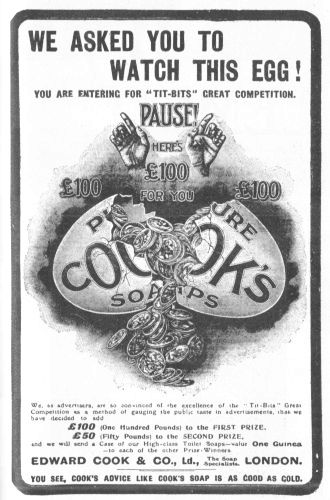
THIS ADVERTISEMENT SECURED THE FIRST PLACE ON THE VOTING LIST.
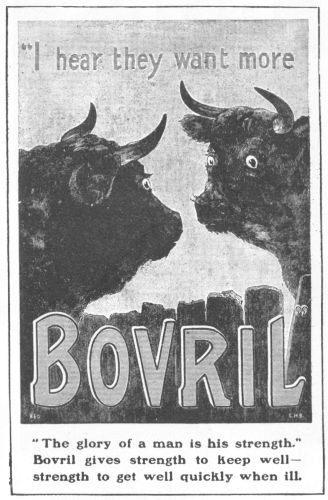
THIS SECURED THE SECOND PLACE.
We, as advertisers, are so convinced of the excellence of the "Tit-Bits" Great Competition as a method of gauging the public taste in advertisements, that we have decided to add
Moreover, the question is of interest to a greater number of persons than may appear at first sight. To every advertiser, of course—that is, to every man who has anything to sell, from the big firms who spend colossal sums in making known the merits of their productions down to the smallest village tradesman who puts his "ad" into the local paper—the question of how to make the most efficient use of the means at his disposal is of the greatest moment. But the general public, who have no occasion to use advertisements for the purpose of business, have also a direct interest in the question, for the simple reason that striking advertisements are entertaining to read, while commonplace advertisements are dull. From the same point of view the proprietors of periodical publications are concerned, for it is clearly to their advantage to interest the readers of their advertisements rather than to bore them.
An advertisement has three things to accomplish before it can be called good. First, it must attract attention; secondly, it must arouse interest; and thirdly, it must leave an impression on the brain—the message must have struck home. It may in some cases make you want a particular article, but in ninety-nine cases out of a hundred its seed lies dormant until the moment arrives for you to make your purchase; and then, if the advertisement has done its work as a good advertisement should do, your brain couples the article with a certain name, and that particular brand stands a very big chance of finding you a purchaser.
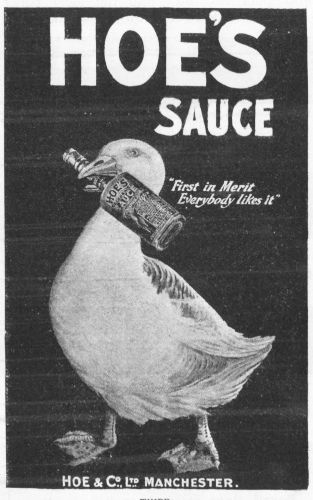
THIRD.
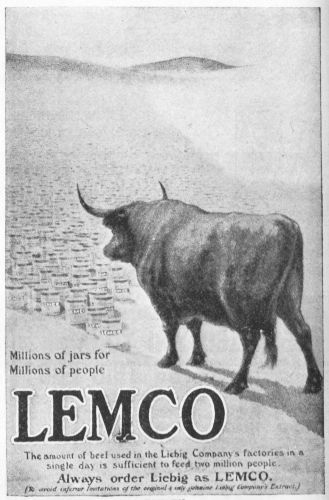
FOURTH.
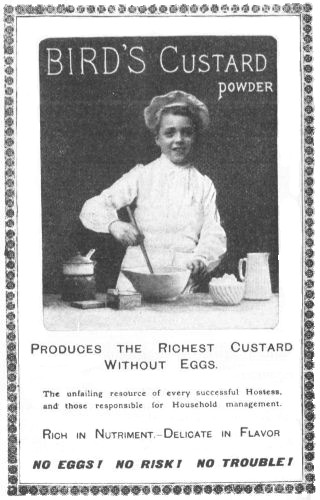
FIFTH.
To catch the eye is the first essential of a good advertisement; the first sense to which it appeals is that of sight. The object of the skilful advertiser is to make the space he occupies—whether a page or a portion of a page—the most conspicuous in the publication. Turn for a moment to any page of advertisements you please, open and shut it quickly, and you will generally find that there is one advertisement which has immediately attracted your eye. Let two persons try at the same time, and on comparing notes it will generally be found that the same advertisement has been spotted by both. That one possesses the first essential of a good advertisement more conspicuously than its fellows.
Try again, and this time run through the pages rapidly, so that every leaf of the journal falls quickly from your thumb. There are certain to be one or two pages which will stand out conspicuously and leave their impression on your eye beyond all the rest, and you will turn back to see what it is all about.
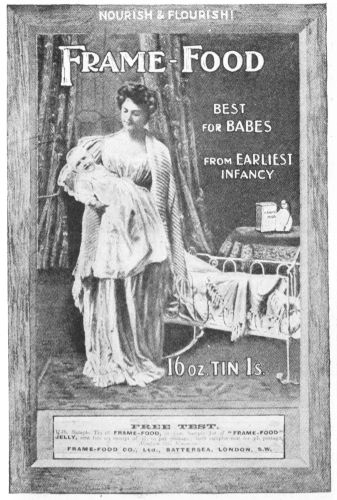
SIXTH.
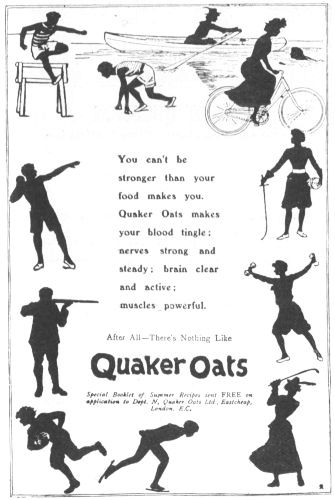
SEVENTH.
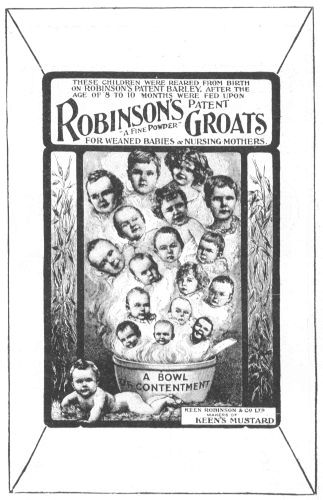
EIGHTH.
The cunning advertiser has thus obtained his audience—it is now his aim to keep it, Here he has to introduce some connecting link to hold the attention until his message has been duly delivered. Where the original design has nothing particular about it to hold the attention, there is no better method than the insertion of some catch sentence, generally a question, which you are compelled to read, and, of course, to investigate further.
It may be said that the language of a good advertisement should resemble that of a telegram—straight to the point; the information is to be given in the most concise, clear, and complete form possible, confined to the main feature or features of the article advertised, so as to convince the prospective buyer of the excellence of the goods in a short, logical manner, and to do this so that fact and not fiction is apparent to the reader.
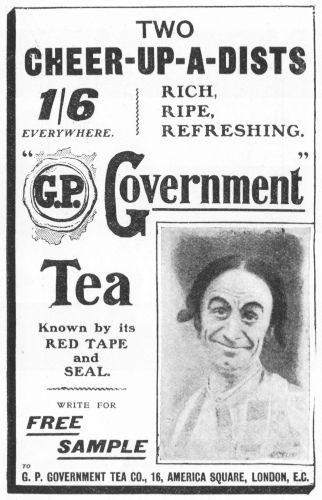
NINTH.
In drawing up an advertisement there are many ways of incurring failure, and one very sure method is the abuse of one's rivals. An advertisement which is meant to be taken too seriously is rarely a success. Let the reader's eye catch any of the hackneyed phrases, "Beware of Imitations," "Thousands of Testimonials," "Is the Best," and such like, and it will immediately pass on to something else. Such well-worn and unconvincing statements excite in him no interest, but rather a feeling of distrust.
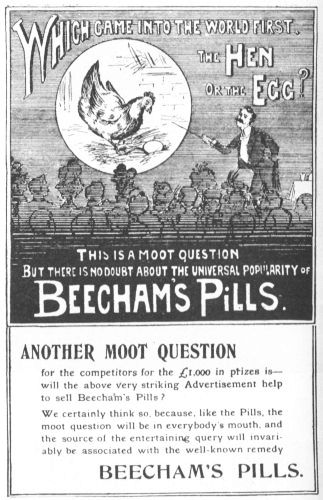
TENTH.
It has been said that a magazine advertisement has three things to accomplish before it can be called good, but in judging the quality of the complete article two more things should be added, of less importance, and really subdivisions of the striking home of the message.
The points one might apportion for each feature might be as follows:—
Points.
1. Power to attract attention40
2. Power to hold attention20
3. Prominence of the article advertised 20
4. Brevity of necessary information10
5. Composition10
And now, how do we stand in comparison with other nations in this matter of effective advertising? It is universally admitted that advertisement is the soul of business. How, then, does the business man of this country compare with the business man of America. Some of our great advertising firms certainly display no very marked inferiority, but as a rule it is unfortunately true that to glance through the announcements in an American magazine is to be brought face to face with the enormously superior ability in design of the American over the Englishman. Here you have, as it were, your finger on the pulse of a country's commerce; you can feel the vigorous beats, or the languid and anæmic current. And the main reason is just this: that the American never loses sight of the fact that the first three essentials in attracting and keeping attention are novelty, novelty, novelty. Their skill in attracting attention in new ways is always a matter of admiration.
The question altogether is one of far more importance than it may seem on first consideration; it is hardly too much to say that the prosperity of a nation's trade depends upon its ability in attractive advertising.
Advertisement is an art of its own, and if you are going to advertise to any considerable extent and do it yourself, either your business must suffer to allow you time to do your advertising well, or your advertising must suffer so that you may properly attend to your business.
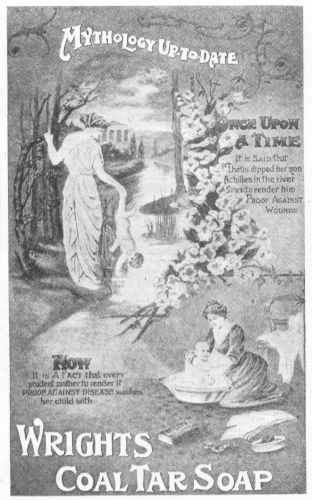
ELEVENTH.
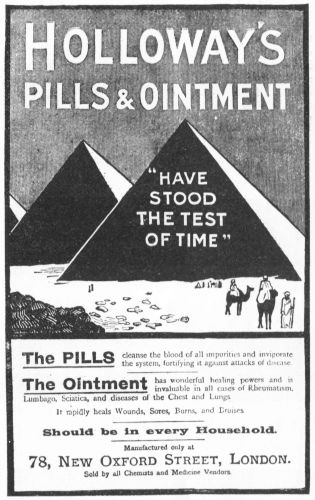
TWELFTH.
Of course, it is the advertising that suffers. If you do it yourself, sooner or later it becomes a worry, and when a reminder arrives that your copy is due very likely your instructions will be to repeat the last, or possibly, if you have a minute or two to spare, you will sit down and grind out a lot of nonsense which no one cares to read. If you wish to make any genuine effort properly to employ the most important factor in commerce, get someone who understands the art to do it for you; engage a good man, and do not expect to get the same for five pounds as you would for ten pounds.