Our Grandmothers' Fashion-Plates.
Reading edition
By Arabella Drysdale-Davis.
What philosopher being propounded the query, "Which are the most popular pictures in the world?" could reply other than "Fashion-plates"? Are they not rapturously studied and admired weekly by millions of women? Do they not elicit the furtive interest—not unmingled, perhaps, with astonishment—of millions of men?
"Grotesque forecasts of ephemeral plumes and deciduous fig-leaves," as a famous novelist, Kingsley, called fashion-plates, are only an invention of less than a century and a quarter ago. A lady of the olden time, who wished to learn the very latest mode in skirts, bodices, hats, bonnets, or shoes, betook herself at certain seasons to her dressmaker, where dressed poupées straight from Paris were on view. The making and dressing of these dolls was quite a business in the French capital before coloured fashion-plates came to oust them from favour in the closing years of Louis XVI.'s reign. Prior to this period drawings of fashionably-attired ladies had appeared from time to time in the magazines and periodicals devoted to the interests of the fair sex—such as the first in the present series, showing a lady in full dress for 1770—and these may have imparted to country cousins an idea of what was being worn in the Faubourg St. Germain and Mayfair—but the beau monde never relied on these.
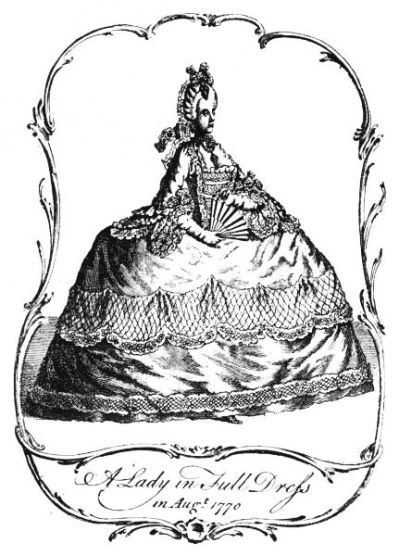
A Lady in Full Dress in Aug. 1770
It is probable that the earliest coloured examples were produced in 1784-85. In the latter year the Cabinet des Modes appeared in Paris, consisting of twenty-four parts annually, three coloured designs with each part. In England many years before we had had the Lady's Magazine, which had devoted much space to dress, but seems to have just missed the idea of fashion-plates, although its descriptions of current modes are often most diverting. "Dress," it says, in its very first number, "is like the sunshine introduced into the designs of Titian: it animates the figures and gives them all their embellishment."
"The hoop or circumference of charms," we read in 1785, "is a most essential part of contemporary costume. The magnificence of the full-dress hoop carries with it a most noble and majestic appearance, and I hope will never be given up or hors de la mode as long as England can boast of such fine women as appear within the circle of a Drawing Room."
But the French Revolution burst into boudoirs and salons and "the hoop or circumference of charms" disappeared, and in the next few years was witnessed an entire change of style.
Here is a simple little afternoon dress for 1796: "The hair dressed in light curls and ringlets; Armenian turban, made of white and York flame-coloured satin, crossed in the front with two strings of pearls, and the ends trimmed with gold fringe; a white ostrich and a blue esprit feather on the left side; Armenian robe of embroidered muslin, the train with a broad hem; full short sleeves; trimming of blond round the neck and at the top of the sleeves; tucker of blond; gold cord with two large tassels round the waist, tied at the left side; two strings of pearls, and a festoon gold chain with a medallion round the neck; diamond earrings; white shoes and gloves."
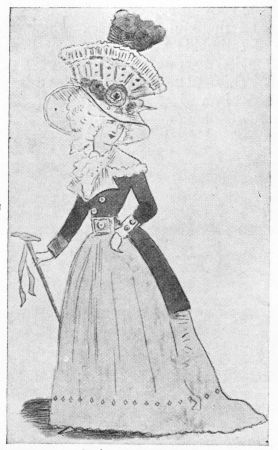
FASHIONS FOR 1785 (THE EARLIEST COLOURED PLATE).
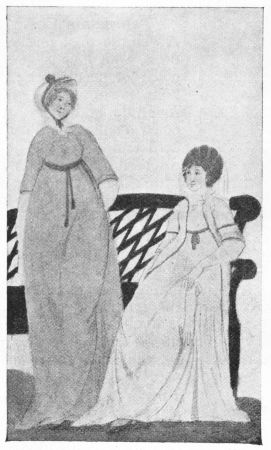
A RETURN TO SPARTAN SIMPLICITY, 1800.
In 1800 we read that the newest fashion is "a simple blue tunic, bound by tassels at the waist." "Nothing is now so elegant as a straw hat: they are worn either ornamented with the flower called convolvulus or coloured like a shell." "Ribbons are worn either clouded or striped; the latter are nankeen."
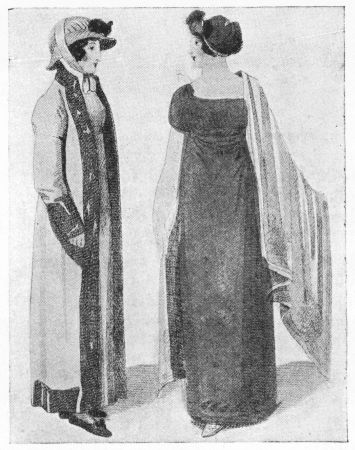
LATEST PARIS MODES, 1802.
It is strange that, notwithstanding the horror which the conduct of the French had excited throughout Europe, and especially in England, there should be found any votaries of French fashions. It is even stranger that, while French modes were still worn with us, in France there was a general adoption, in 1802, of English fashions such as are shown herewith for that year. "The head-dress for undress," we read, "is frequently only a piece of muslin, sometimes enlivened with pearls. In full dress turbans are principally worn."
Our next illustration forecasts the fashions for 1806. "Never was there a period that exhibited a greater variety of female decorations than the present; and it is as difficult to find a costume to condemn as to describe one that has a decided preference." Nevertheless we find men's large beaver hats already in vogue. What will ladies of 1904 think of the following: "Morning Walking Dress.—A plain muslin dress, walking length, made high in front and forms a shirt collar, richly embroidered; long sleeves, also embroidered round the wrists and at the bottom of the dress; a pelisse opera coat without any seam in back, composed of orange blossom tinged with brown, made of Angola cloth or sarsnet, trimmed with rich Chincheally fur, tipped with gold. The pelisse sets close to the form on one side, fastened on the right shoulder with a brooch."
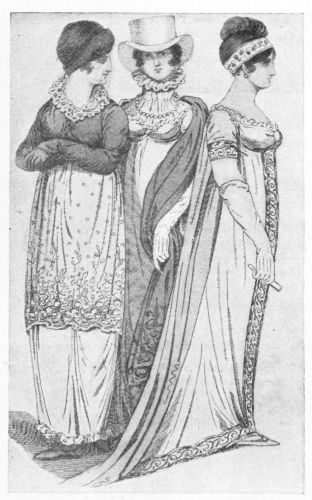
EMPIRE GOWNS AND GEORGIAN BEAVER, 1806.
It seems odd that there was ever a time when there were public defenders of false complexions for ladies; yet we find in La Belle Assemblée for March, 1806, a writer pleading in favour of rouge, "which may be rendered extremely innocent, and may be applied with such art as sometimes to give an expression to the figure which it would never have without that auxiliary. The colour of modesty has many charms; and in an age when women blush so little ought we not to value this innocent artifice, which is capable at least of exhibiting to us the picture of modesty? We ought to be thankful to the sex which, in the absence of estimable virtue, knows at least how to preserve its portrait."
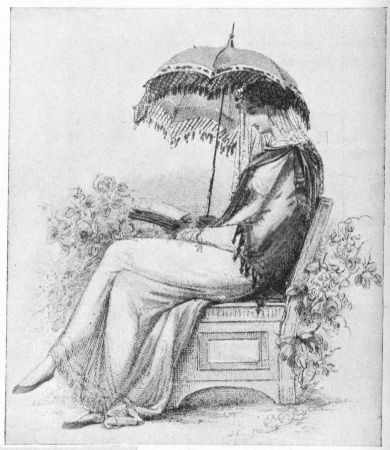
A VIEW OF DIAPHANOUS DRAPERIES, 1809.
In this fashion-plate for 1809 we see a lady very coolly attired in a white jaconot frock—somewhat scanty and diaphanous—and rejoicing in a gorgeous parasol. Here is the exact description:—
"Promenade Costume.—A white jaconot muslin high dress, with long sleeves and collar of needlework; treble flounces of plaited muslin round the bottom; wrist and collar confined with a silk cord and tassel. The hair disposed in the Eastern style, with a fancy flower in front or on one side. A Vittoria cloak, or Pyrennean mantle, of pomona-green sarsnet, trimmed with Spanish fringe of a correspondent shade, and confined in graceful folds on the left shoulder. A white lace veil thrown over the head-dress. A large Eastern parasol, the colour of the mantle, with deep Chinese awning. Roman shoe, or Spanish slipper, of pomona-green kid, or jean. Gloves of primrose or amber-coloured kid."
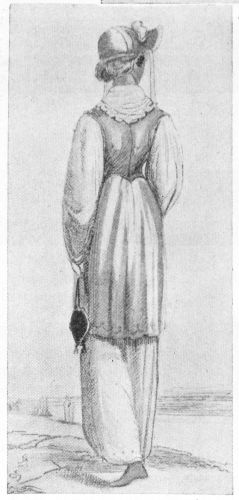
SOMEWHAT SCANTY ATTIRE, 1809.
One is perpetually surprised at the scantiness of the attire of those days. It offers such a contrast to the rotundity of the hoop or "circumference of fashion," or to the later crinoline. For 1809 bonnets have suddenly assumed gigantic dimensions—as in the picture herewith—but the question amongst the fair sex doubtless was, Will they last?
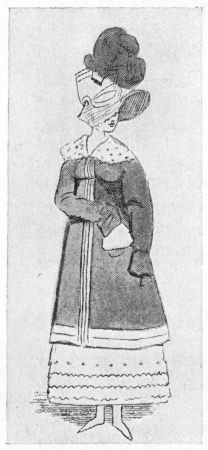
A DAINTY LITTLE BONNET, 1809.
In turning over the thousands of fashion-plates of the first quarter of the last century one is constantly confronted by designs bearing such titles as "Costume for the Seaside," "Toilette for the Seaside," "Dress for the Seashore." Seaside in those days meant Margate, Weymouth, and Scarborough; and we naturally expect to find trim little frocks, accompanied by tight sailor hats, capable of withstanding the stiffest breeze. But instead of this we find transparent, flowing gossamers and top-lofty turbans, which would never weather the mildest gale.
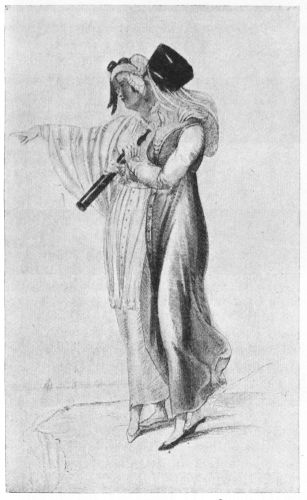
AT FASHIONABLE MARGATE, 1810.
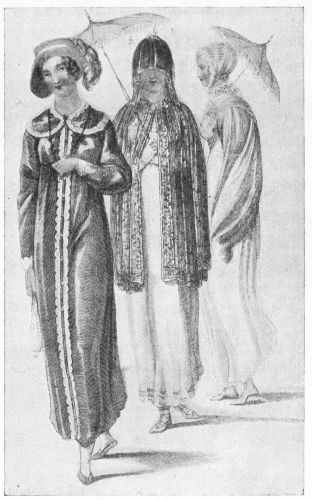
A BOND STREET PROMENADE, 1810.
About the same time we read: "As our families of rank are fast migrating either to their country seats or some fashionable watering-place, and as the Metropolis at this season offers little of novel elegance save an occasional display at Vauxhall, we shall follow the varying goddess to all her favourite haunts, and contemplate her fair votaries as they ramble on the sea-shore, saunter on the lawns, or lounge at the libraries, as they grace the déjeuné, animate the social party, or illume the theatre and ballroom."
Of our next illustration (1810) we may glean a notion from the following extract from a contemporary fashion letter:—
"Mantles and coats of green vigonia or merino cloth of various shades, from the sober hue of the Spanish fly to the more lively pea-green, have succeeded to the purple, which, though a colour most pleasing in itself, is now become too general to find a place in a select wardrobe. Scarlet cloaks are no longer seen on genteel women, except as wraps for the theatres; the satiated eye turns, overpowered by their universal glare, to rest on more chaste and more refreshing shades. Mantles and pelisses are now considered more elegant when trimmed with gold or silver lace, or binding; or with black velvet, bound or laid flat, and which is sometimes finished at its terminations with a narrow gold edging of flat braid. Some are decorated with borders of coloured chenille."
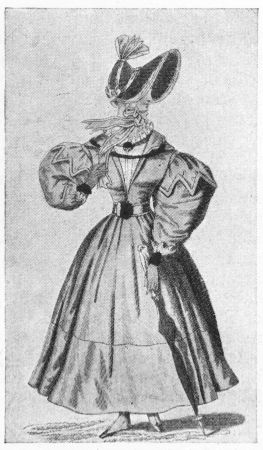
BALLOON SLEEVES, 1811.
Albeit every year sees the attire growing less scanty—even the fashions for 1811 display more generous draperies; besides which the latter are flanked and reinforced by huge muffs now coming into vogue and recently made familiar to us in Mr. Barrie's play of "Quality Street." Accompanied, as they occasionally were, by huge beaver hats, these Gargantuan muffs—which must surely have required the pelts of more than one fox to produce, if not of an entire bear—demanded all the attention from their fair wearers, as well as from the gallants of the day. The next illustration shows a carriage dress, conveniently short, for 1811.
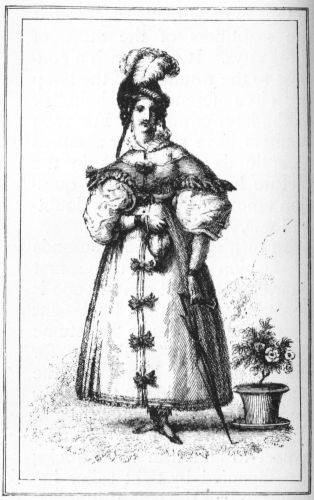
A SIMPLE CARRIAGE DRESS, 1811.
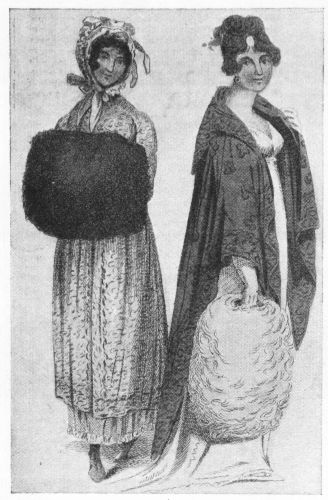
GIGANTIC MUFFS À LA MODE, 1811.
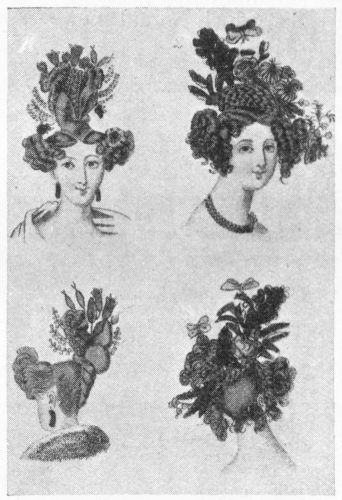
VARIEGATED STYLES OF COIFFURE, 1816.
Coal-scuttle bonnets are likewise growing in favour, as may be seen by the picture at the top of this page. Still more interesting is the style of coiffure of the period. Nothing more fantastic, we venture to say, ever came out of the brain of the most imaginative coiffeur. We especially call the attention of those readers who inveigh against the over-elaboration of twentieth-century head-dressing to the rear view of the bottom right-hand elegant cranium. It resembles nothing more closely than a bouquet of turnips, carrots, and other homely vegetables.
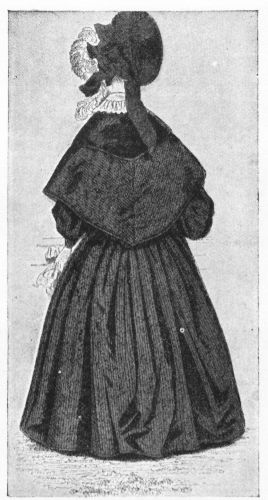
A CHARMING BACK VIEW, 1820.
When we approach the "twenties" we are fain to perceive more gravity in the fashions of the day. Indeed, nothing could well be more grave—we might even say more awkward—than the back view of the (doubtless) charming lady of the above illustration. It certainly does not suggest the lightness and lissom grace of the earlier designs. What a great change the fashions have undergone since 1809 may be seen by the plate for 1829.
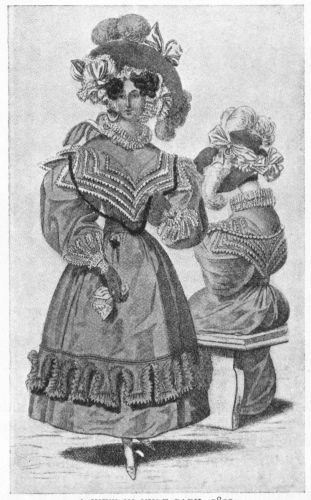
A VIEW IN HYDE PARK, 1829.
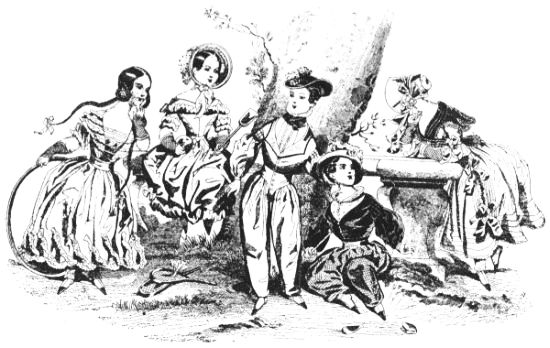
CHILDREN À LA MODE, 1829.
Here we doubtless confront just such a pair of fashionable ladies as are described in the pages of Dickens, Bulwer, and Disraeli, with their Liliputian ruffs—which fortunately did not become a permanent fashion—their leg-of-mutton sleeves, and quintuple rows of lace "insertion." We are fain to speculate upon the countenance of one of these pre-Victorian young ladies, for it is wholly obscured by a magnificently-plumed "blush-concealer," as the coal-scuttle bonnets were facetiously called.
In order that our fair readers may have a peep at the dress of the juvenile portion of the community in that same year, we give a spirited drawing from a French fashion journal. The costume may perhaps hardly commend itself to the children of 1904, but it doubtless appeared quite appropriate to the mammas of the time, as well as to the artist. As to the artists of these fashion-plates, it must be remembered that they were usually struggling young painters and draughtsmen, who were glad to get work of this kind, and many of them afterwards became famous. Both Doré and Meisonier drew fashions for the magazines and Cabinets des Modes of their day. Moreover, our own Hablot K. Browne ("Phiz") was responsible for many such, the accompanying plate for 1837 being attributed to him; while there is no doubt of John Leech's authorship of the fashion-plate for 1851, which we also reproduce.
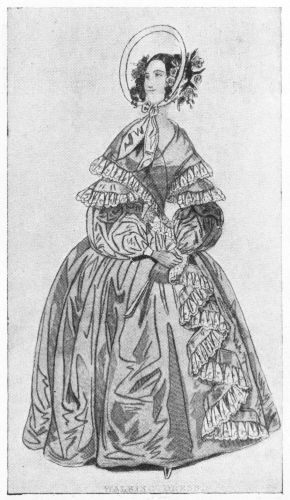
FASHION-PLATE FOR 1837. ATTRIBUTED TO "PHIZ."
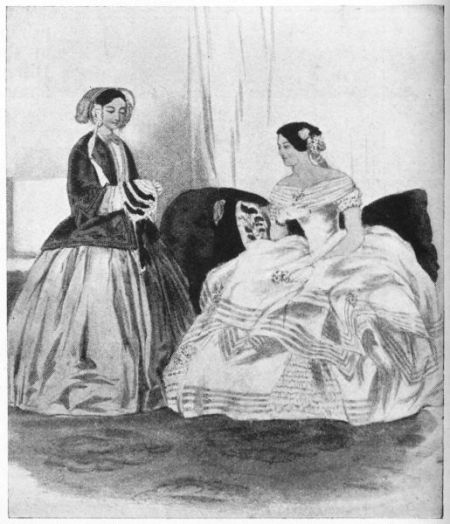
FASHION PLATE FOR 1851. DRAWN BY JOHN LEECH.
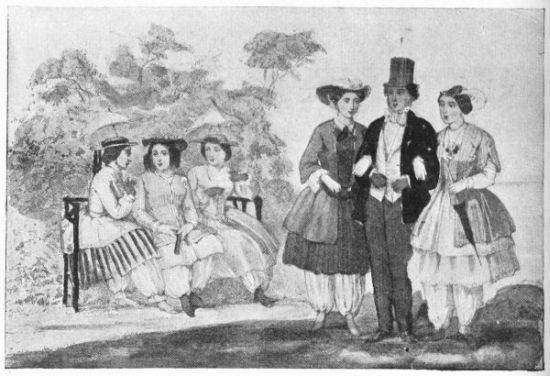
LADIES' FASHIONS, 1854 (THE BLOOMER PERIOD).
Before we approach the "sixties," with their extraordinary revival of the hoop or crinoline fashion, we must remark on the extraordinary fashion-plate promulgated for the year 1854. What would the ladies say to such a tyrannical dictate of fashion to-day? It is inconceivable now; but many a fair dame and damsel seeing it in that year must inwardly have quaked with terror at the prospect of facing her beloved Adolphus in Bloomerian garb. Happily, the prophets proved false for once, and the fashion passed away, just as a year or two ago the threatened crinoline scare passed away with us. Crinoline had to run its course although not before it had been guilty of many enormities, as will be seen by the appended plate. The ladies' heads herein appear but as the apexes of pyramids; and the singular cut of the bodices and the rotundity of the young ladies' skirts appear to us, in this age, ludicrous.
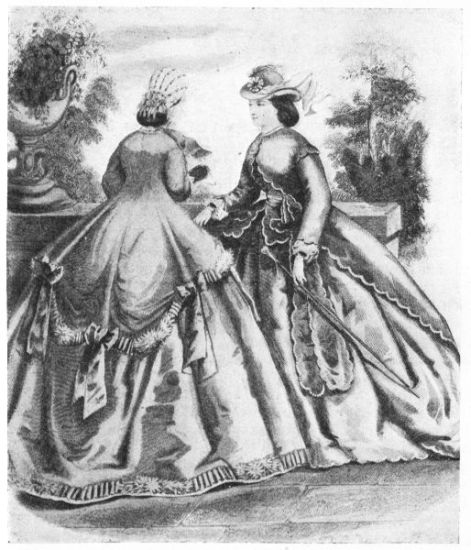
CRINOLINE AT ITS ZENITH. 1865.
On the whole, it may be our vanity and self-sufficiency, or it may be our superior taste; but to us it seems (and we trust the reader, on comparing these fashion-plates of our grandmothers with the last of our series that for 1904—will agree with us) that however our past generations dressed, and whatever Worth and Paquin have in store for the future, our English girl of the present has decidedly the best of the sartorial bargain.
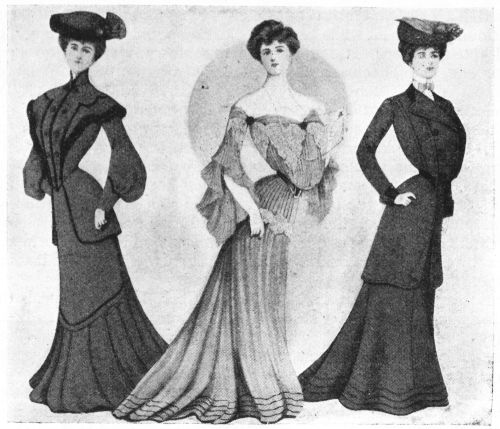
SOMEWHAT NEATER THAN OUR GRANDMOTHERS (LADIES' FASHIONS FOR 1904).
(By courtesy of Messrs. Weldons, Ltd.)