A Willing Scape-Goat.
Reading edition
By S. B. Robinson.
Jack Selden only half suppressed an exclamation of angry despair by a simulated fit of coughing, as he read at breakfast the solitary letter that had fallen to his share from the mail-bag. It was not pleasant reading: it was a thinly-veiled command to pay, within three days, a card and betting debt to the tune of two hundred pounds.

He raised his face, from which the colour had fled, and glanced furtively round at the other occupants of the table, as he crushed the letter into his pocket.
His father, Dr. Selden, a tall, grey, ascetic-looking man—blind for some years through a disease of the optic nerve—had not noticed the exclamation; neither had Madge Westbrook, his fiancée, a handsome girl, who chanced to be too deeply occupied with her duties of hostess, in the absence of Miss Selden, the doctor's sister. Cyril Wayne, a fair, resolute-looking young fellow of Jack's age, the doctor's amanuensis, was the only one of the trio who had perceived the trouble.
Jack dropped his eyes guiltily, and made a show of continuing his meal while he mentally reviewed the situation. It seemed to be a desperate one, and he cursed his fate. He could expect no assistance from his father. A college career that had resulted in nothing but heavy debts was too fresh in his memory for that. Jack had been told by his exasperated parent that never again would he receive assistance beyond his ample allowance; and, further, that the bulk of the property would go to Madge, the doctor's niece. Jack could only, in a sense, become his father's heir by marrying his cousin when she came of age.
At the time this arrangement had been made Madge had acquiesced to her share in it without any effort and, indeed, without much thought. It pleased her uncle, and that had been enough to decide her. As for Jack, he would have preferred a free hand; but since he was not to have it he consoled himself with the thought that Madge was a very presentable encumbrance.
But the arrival of Cyril Wayne at Highbank—the country residence which the doctor had occupied since his blindness—had opened a new chapter in Madge's uneventful life. The new-comer, intelligent, accomplished, masterful, made a startling contrast to the weak-willed, illiterate Jack, who was intellectually lost when he ventured outside the precincts of the stable.
The result of the companionship into which Madge and Cyril insensibly drifted was as inevitable as the course of time. There was no one to warn them of the danger. The doctor could not see it; Miss Selden was too deeply engrossed in her charities, and Jack in his own affairs. There came a moment then when the pair found out for themselves how imperceptible is the boundary sometimes that separates friendship and love. Madge discovered with horror that her thoughtless promise was repugnant to her, and Cyril that he was in love with another man's betrothed! The pleasant intercourse was broken from that moment, without a word of explanation on either side.
With Cyril Wayne this discovery could only have one result: he immediately commenced his preparations for leaving Highbank, sore in heart and self-respect.
This morning at breakfast Jack's stifled exclamation had warned him that some mischief was afoot, and he was anxious to know what it was. What concerned Jack concerned Madge, alas! When the meal was concluded, instead of at once following the doctor to his study he stepped through the open French window on to the terrace, where the enfant prodigue had already preceded him.
He was standing at the stone balustrade reperusing his letter. When he heard Cyril's footsteps on the flags behind him he started, crushed the paper in his hand, and turned round.
"Jack, I want to speak to you for a few moments," said Cyril, as he advanced.
"What's up?" asked Jack, shortly. He thrust the letter into his pocket and took out his pipe.
"Well——" Cyril hesitated a moment to ransack his brain for some reasonable pretext; then it occurred to him that it was nearly a certainty his listener's trouble was a pecuniary one. To feign a like predicament for himself might evoke Jack's confidence.
"Well," said he, "I want you to lend me twenty-five pounds. I'm hard pressed for it at this moment."
Madge had approached the window to speak to Jack. She caught Cyril Wayne's remark, and, drawing back at once, turned away unperceived by both of the young men.
Jack fell an easy prey to the trap that had been laid for him. He gazed at Cyril in astonishment and let the match he had lighted die out in his hand.
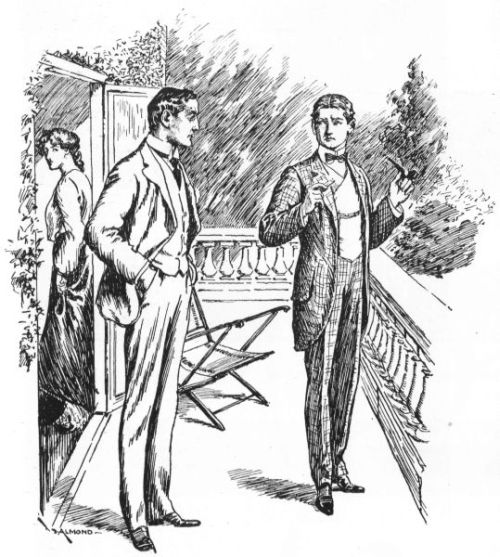
"HE GAZED AT CYRIL IN ASTONISHMENT."
"Lend you twenty-five pounds? Great Scot!" he exclaimed.
"Yes."
"Twenty-five pounds! You've come to the wrong shop this time, old man!" Then he suddenly lowered his voice and bent his head forward, anxiously. "Can you tell me where I can get just eight times that amount?" he asked. "I want it badly."
"Oh! So that is the reason for the letter you received just now?"
Jack nodded his head and flushed.
"Two hundred pounds!" exclaimed Cyril, aghast. "Let me hear the whole business," he continued. "I can't lend you the money, but I may be able to suggest something."
It was the same old story of betting and cards. Cyril had heard it all before, in the same stumbling phraseology of contrition. "And the brute gives me only three days—three days, or he will write to the governor," concluded Jack, turning suddenly savage.
"Then forestall him," replied Cyril, "for as far as I can see there is no remedy but to ask your father to help you out of the mire once more."
"Ask the governor? You can just bet I sha'n't do that," said Jack, sullenly. He thrust his hands deep into his pockets and stared hard at the ground.
"Then, no money-lenders," replied Cyril. "It will only make bad worse. Come!" He caught Jack by the arm. "Make a clean breast of it to your father. He has much more than the sum you require in the house at present, and you may not find him so difficult as you imagine."
Jack started. More money than he required for his wants in the house! So near him! Oh, if he only had it! He shook his arm free with impatience.
"No, no, I sha'n't do that," said he.
"Very well," said Cyril. "But you will do nothing without consulting me? Is that understood?"
Jack nodded his head and, turning quickly, stared blindly across the fields that sloped and stretched from the terrace. He didn't see them. His brain was working just then as it had never worked before. Cyril's words about the money had raised a sudden storm of temptation in him which seemed to carry him out of himself. He must try to think—to decide.
At midnight Cyril turned in, but could not sleep; his thoughts were too busily occupied with Madge, Jack, and the present uncertainty of his own future. He had heard the clock in the little sitting-room adjoining chime every hour from midnight to three. Then a strange thing happened. As he lay broad awake in the dark, a slender pencil of yellow light stole across the carpet from his door. Jack's room was next to his. He heard no sound in the corridor, though he sat up in his bed and listened intently. The pencil of light remained stationary a few moments, then wavered, and finally, sweeping slowly round the room, disappeared.
Something prompted Cyril to rise and investigate. Putting on his dressing-gown and slippers, he noiselessly crossed his room and looked out. The feeble yellow light was dancing on the ceiling of the corridor, but the bearer of it, unseen, was already descending the broad oak staircase.
Cyril hurried quietly along the corridor and, looking over the balustrade, saw Jack. He was at the foot of the stairs, and about to enter the lower corridor.
Cyril remained where he was in the darkness a few moments, when the light began to reappear and a cool breath of air swept up the stair.
Jack must have opened the French window which gave access to the garden. He now approached the foot of the stair with stealthy tread; but, instead of mounting it, he passed on in the direction of the other wing.
Cyril felt instinctively that something was wrong, and descending the stairs he followed in Jack's wake. Turning the corner of the corridor he was just in time to see the young man insert a key in the lock of the study door, and then enter.
By the time Cyril had arrived Jack had placed his candle on the writing-table and was stooping, with his back to the door, in front of his lather's safe, which he had just opened.
This safe was of peculiar construction. For the convenience of the doctor it opened by means of the simple pressure of a small button in the wainscot. But the room in itself was a safe, for the door was of steel with a powerful lock, and the one window was heavily shuttered within and barred without.
All unconscious of a watcher, Jack was cautiously engaged in disconnecting the wires switched on to an alarm in the doctor's room above, when Cyril, unable to contain his feelings any longer, stepped forward.
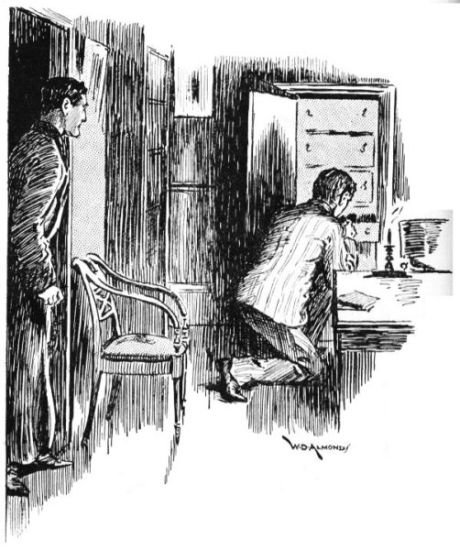
"JACK WAS CAUTIOUSLY ENGAGED IN DISCONNECTING THE WIRES."
"Jack!" he exclaimed, sternly, "what is the meaning of this?"
Jack bounded to his feet in horror. His hand fell nervelessly from the stud he had been manipulating, and, catching in one of the drawers, drew it partially open. It was sufficient to actuate the mechanism. A faint whirr in the room above responded to the movement of the drawer; and at the same time the study door, as if impelled by an invisible hand, swung quickly to and closed with a faint click.
The two young men were prisoners. There was no means of egress except by the door, and that could only be opened now from the outside. The doctor's burglar trap had fulfilled its purpose admirably.
For the space of two or three moments the pair stood motionless facing each other, Jack had gripped the back of the doctor's study chair and was staring with haggard eyes at the door. Then suddenly, with a half-frenzied exclamation, he threw himself at it and tore desperately with his fingers at its smooth, hard surface. It was of no use. He fell back with a groan of despair and, dropping heavily into a chair, covered his face with his hands.
"Good Heaven! My father!—Madge! What will they think of me?" said he, hoarsely, as he passed his hand over his damp forehead. "Oh, I must have been mad—mad!"
Cyril Wayne looked down at the wretched Jack, half pitying, half despising him. Was this crouching, would-be thief to become Madge's husband? What a match! Was it not for the best that the innocent girl should be undeceived before it was too late? But the cruelty of it! He shrank involuntarily from the idea of witnessing the death-blow that was to be dealt at her affection. He pictured to himself a misery, an anguish, a hundred-fold greater than this cowering wretch was capable of feeling. Oh, it was impossible!
"Jack!" said he, stooping suddenly and shaking the abject figure by the shoulder. "Look up, man! Do you hear?"
Jack lifted his head and stared at Cyril stupidly.
"Just collect your wits and listen to me," said Cyril, imperiously, as he fixed Jack's gaze with his own. "If you get out of this scrape scot-free—you understand?"—Jack nodded hungrily—"will you swear never to touch a card or back a horse again?"
"Get out of it? Oh, Wayne—Cyril, old man, how? How?" implored Jack, with trembling lips, half rising from his seat.
Cyril pushed him back impatiently. "That is not the answer I want," said he. He repeated his question. "Do you swear?" he asked. "Quick! Quick, man! I can hear footsteps. A moment more and it won't matter what you say."
"Yes, yes, I swear, I swear!" repeated Jack, fervently, as he gulped down something that had risen in his throat.
"Very good!" Cyril's grasp closed like a steel vice on his shoulder. "Jack Selden," continued the young man, sternly, "what I am going to do I shall do for Madge's—your cousin's—sake; but if you fail to keep that oath you have just made, do you know that you will be the meanest, pitifullest hound that ever walked God's earth? If you do fail—" he paused, "well, never cross my path, that's all. Now rouse up. Look like yourself, man; they are here."
It was true. There was a sound of slippered feet outside the study door. Jack rose from his chair and stood behind it, his face drawn, his eyes roving. He felt sick with the fear clutching at his heart.
"Not a word from you," whispered Cyril, rapidly; "leave everything to me."
There was the sharp click of a pistol-trigger outside; a pause; and then the study door was flung wide open. In the corridor stood the doctor and Madge alone. The latter was holding a candle above her head in her left hand; with her right she pointed a revolver.
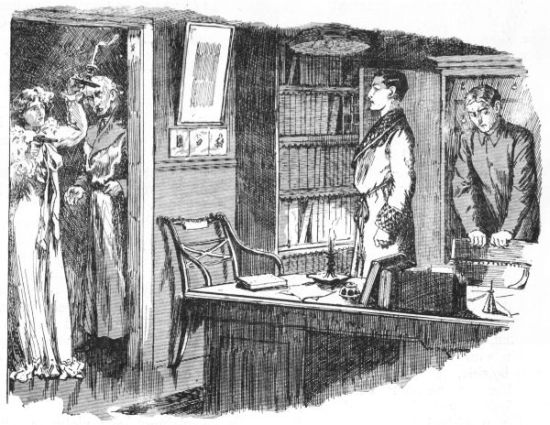
"IN THE CORRIDOR STOOD THE DOCTOR AND MADGE ALONE."
"You may give up. There is no escape. If you move you will be shot down without mercy," said the doctor, rapidly. "How many, Madge?"' he added, in a lower tone.
Madge had with great difficulty checked the exclamation that had risen to her lips as her glance fell on Cyril and Jack. Both arms dropped to her side. What did this mean? Her startled, questioning glance dwelt on each of the young men alternately, but no explanation came. They stood before her like two statues. Jack hung his head; he could not even face his father's sightless eyes. Cyril looked at her, silent, calm, and speechless.
"How many, Madge?" repeated the doctor, impatiently.
"Two," she gasped, with a great effort.
"Do you recognise them?"
There was a momentary pause. Jack trembled so violently that his grasp shook the chair he held. He felt that his fate hung on Madge's lips, and his torture was exquisite. Cyril did not blench.
Again Madge swept the faces of the two young men with her keen, questioning glance. Still no attempt at explanation! Oh, this obstinate silence! Jack's shrinking figure, Cyril's cool hardihood, were convincing proofs of guilt. Know them! Know them! The cowardly thieves! She coloured hotly; her eyes flashed, and her lips curled with the intensest scorn.
"No, I do not," she replied.
With a sudden and unexpected movement the doctor closed the door with a crash. He rubbed his hands excitedly.
"We have them, Madge; we have them safe, the scoundrels," said he. "Like rats in a trap! Now to get Wayne and Jack, at once, to secure them."
There was a choking sob at his side. Madge had turned and laid her forehead against the wall; the hot tears were coursing down her cheeks. The doctor heard her, and reaching forward caught a hand that was hanging limply down.
"Why, why, my dear!" said he, with sudden compunction, as he felt Madge's fingers trembling in his grasp. "It was too bad of me to put you to such a trial. I ought to have waited for Wayne and Jack. I didn't stop to think. Your nerves are shaken, and no wonder. There! there!"
No wonder, indeed! They went upstairs side by side, Madge scarcely hearing, and still less heeding, the doctor's flow of exculpation.
When they reached the doctor's room the old man wished Madge to rest there while he went to call his son and secretary and alarm the house generally. But to this proposal Madge objected with astonishing energy. She herself would go and no one else. She was quite recovered now and did not feel the slightest fear. Would he promise her to remain quietly in his room until she returned with the others?
The doctor reluctantly yielded his consent, and then Madge slipped from the room with a wildly beating heart. Instead, however, of turning along the corridor towards the rooms occupied by Cyril, Wayne and Jack, she swiftly descended the stairs, and reaching the study door flung it wide open.
"Come!" said she, addressing Jack—she did not look at Cyril—"your father sent me to your room to call you—to your room!" She paused a moment, and then continued, with flashing eyes and a bitter emphasis: "Oh, deceive him still, if you can! If you can keep him from learning to what you have fallen, do so! You need expect no opposition from me—for his sake, but never, never, dare to speak to me again!"
"Jack is not to blame in the least," said Cyril, quietly. "I am the culprit; he is as innocent as you are, Miss Westbrook."
Madge started and blanched; that coolly-worded confession seemed to stab her like a knife. Then like lightning there flashed across her brain the request she had overheard for a loan of twenty-five pounds. Oh, this was all so horrible—so incomprehensible! Jack had lifted his head as Cyril spoke, but had quickly let it fall again.
"Jack followed me, only to watch me," continued Cyril, in the same even tones. "He was caught by the closing of the door when I opened the drawer—you know how it works—that is all as far as he is concerned. I throw myself on your mercy, Miss Westbrook. I offer no useless excuses. If I dared ask a favour of you I would say, keep my secret—at least until I am free of Highbank."
Madge paused a moment, overwhelmed; then she turned on him with passionate scorn. "Oh, how you have deceived us! Then all the time you have been here you were only a thief—a common thief, at heart. Oh!"—she waved her hand with a gesture of horror—"you acted well as a pretender, a masquerader, a specious, lying counterfeit of honesty." She turned to her cousin: "Jack! Jack! speak!"
"For Heaven's sake, Madge, don't go on so. I—I can't stand it, I tell you," exclaimed Jack, violently. "I—I——"
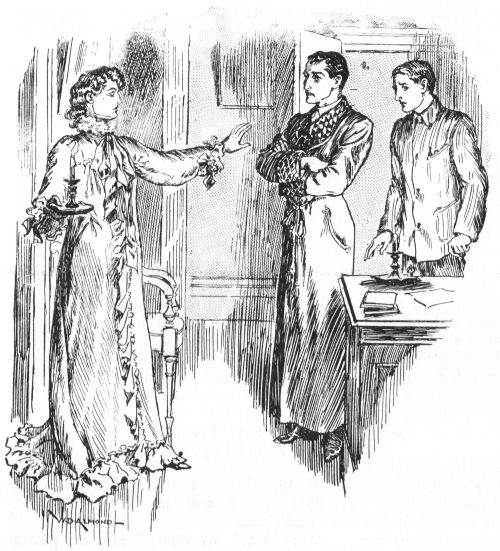
"SHE TURNED ON HIM WITH PASSIONATE SCORN."
"Hush! hush! There is no need to say anything further," broke in Cyril, hastily. "Miss Westbrook will keep silence, I am sure. I only ask for a few hours' grace."
Madge swept out of the study without another word. Cyril pushed the reluctant Jack and then followed him. At the doctor's door Madge left them and, her heart broken with passion, sought her room. The old man had been awaiting the arrival of the young men in a fever of impatience. The first excitement consequent on the capture of the burglars having subsided somewhat, he had had time to reflect. It had occurred to him then that the thieves must have effected their entrance by the study door; they could scarcely have done so by the window. In this case they had, he thought, probably entered by means of a skeleton key and had escaped in the same manner.
It was a pitiful, distasteful farce to Cyril, but it had to be acted through to the finale. The birds had flown, of course, and equally of course by the French window found open in the corridor.
Search parties were sent out, and Cyril wondered with a pang what could be Madge's feelings as the flickering lights wandered to and fro in the garden on their wild-goose chase.
The next day Madge did not leave her room, and Cyril Wayne, feeling that he was the cause, hastened his departure. One more lie, he bitterly told himself, and his career of deception was concluded. It was an intense relief, sore as his heart might be, to get away as far as possible from Highbank. He had spent there the happiest and the most painful hours of his existence.
In less than a fortnight after Cyril's departure Jack Selden was watching, with a feeling of considerable satisfaction, from the deck of a "liner," the English coast-line fading in the distance. His debts had been paid and a hardly-won consent obtained to try the experiment of sheep-farming in Australia. His father, aunt and Madge had accompanied him to Tilbury Docks; and Jack was wondering vaguely, as he puffed his cigar and the summer night gathered round, what Madge was at that precise moment thinking of him.
Before leaving he had written a letter for Madge, which she would have received on her return to the hotel from the docks. In it Jack had done full justice to Cyril Wayne. He had concealed nothing relating to the crime which he had so nearly committed, and which Cyril, to shield him, had so quixotically taken upon his own shoulders. In conclusion he had begged Madge to keep his secret from his father, and to consider that as far as he, Jack, was concerned she was free.
Madge had found Jack's letter on her dressing-table, and had read its frank out-pouring with quickened pulse, flushed cheeks, and sparkling eyes. What a dull, crushing weight it had suddenly lifted from her heart! She did not attempt to analyze her feelings, but the crime seemed nearly trivial now that she knew it was Jack's. And then an uncontrollable desire seized her to make amends to Cyril. Jack had evidently anticipated this; for, with wonderful thoughtfulness, he had supplied the address, and Madge recognised with a thrill that it was not distant more than five minutes' walk from the spot where she was at that moment standing.
Should she write to Cyril or should she go to him? A moment's thought decided that question. The cruel words she had used could only be withdrawn personally; so, without bestowing a moment's reflection on the proprieties, she crushed Jack's precious epistle in her hand and, hurrying down the stairs, left the hotel.
It was with a beating heart that she presently found herself at the house where Cyril was living. He was acting as locum tenens for a friend who was enjoying his holiday abroad. The servant, thinking she was a late patient, ushered her into a little waiting-room, and from there, a few moments later, into the consulting-room. Cyril, who was standing at the window, turned and started in astonishment as he recognised her.
"What! Miss Westbrook!" he exclaimed, as he hurried forward. "The doctor——?"
Madge held out her hand impulsively.
"No," said she; and then, without further preamble, she plunged tumultuously into the reason that had brought her there.
"I have come to beg your pardon. Oh, you must forgive me for what—what I said. I'm so sorry—oh, so sorry; but I couldn't help it. Please read this before you say anything."
She thrust Jack's letter into Cyril's hand. The young man took it, glanced at the super-scription, and flushed.
"Ah! so Jack has betrayed me!" said he, as he commenced to read. "And you are not angry at my deception?" He looked into her eager, appealing face. "It is I who must ask forgiveness, but——"
"But you hurt me very much indeed," broke in Madge. "You should not have done it; no, you should not. I said things—I misjudged you, because you—oh, you had disappointed me—wounded me so much." Her eyes grew humid and her last words faltered and fell almost to a whisper.
"I—I thought the end justified the means," stammered Cyril. He scarcely knew what to say. He turned to the letter again.
There followed a momentary silence while Cyril read on. Suddenly his heart bounded wildly, and the writing swam before his eyes as he came to Jack's declaration of freedom. He dropped the letter and turned to her.
"Miss Westbrook—Madge—tell me—you must! Did you love him?"
"I—I had promised," she whispered, with drooping eyelids.
"Promised! Promised! Only promised? I always thought you loved him," exclaimed Cyril.
Madge did not reply, but the colour surged sudden and warm into her half-averted cheek.
"My dear! my dear!" said he, passionately, as he caught both her hands in his. "It was I that loved you after all—not Jack. I deceived you for your sake, not for his. What could I do? Could I see you suffer? I have loved you from the first, but I never thought to tell you this. Is it useless for me to do so now? Madge, dear, is it? Is it?"
There was no reply, but as he drew her unresisting form towards him he read his answer in her uplifted, happy eyes.
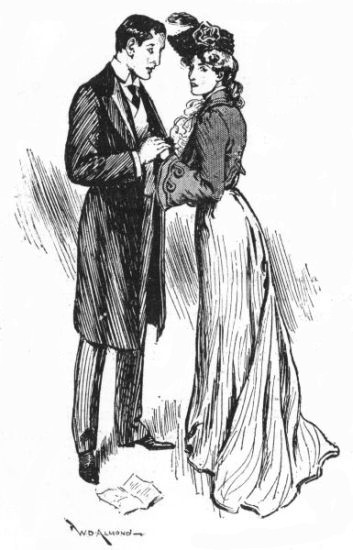
"HE CAUGHT BOTH HER HANDS IN HIS."
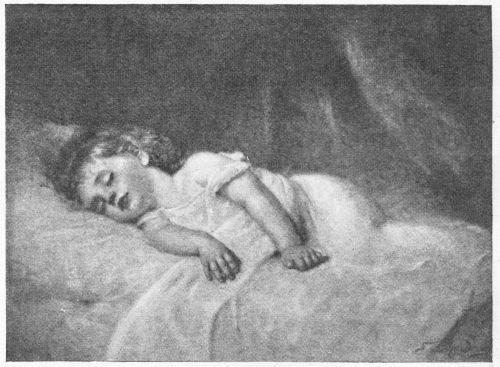
"ASLEEP."
From the Painting by F. Charderon.
By permission of Braun, Clément, & Co.
Childhood's joys and childhood's sorrows, its beauty, and even its little frailties—in fact, everything connected with the dawn of life, has its own especial charm. It is, perhaps, not given to all of us to detect with a sympathetic eye the picturesque in a very naughty young person, who hits at every moment on a fresh idea to make his fellow-creatures uncomfortable: nor is the spectacle of children in their best-loved state of dirty happiness too pleasing to the average observer. But the artist's eye sees things differently. Happily so; his imaginative brain sees the humour of the little self-assertions, and the pathetic side of the joy of living even in the gutter. Yet, after all is said, it remains, of course, a certain truth that there are many aspects of child-life which can only in reality be fully understood by mothers.
The subject of our first picture—"Asleep," by the French painter, F. Charderon—is a little masterpiece of its kind. There may be prettier children than this one, but the natural and unconscious grace of the little warm and rosy body is infinitely charming.
Charming, too, is the face in the medallion in the heading of this article—the face of a child-angel, which seems to watch over the figure of the human child asleep below. It is taken from a painting by Bernardo Strozzi.
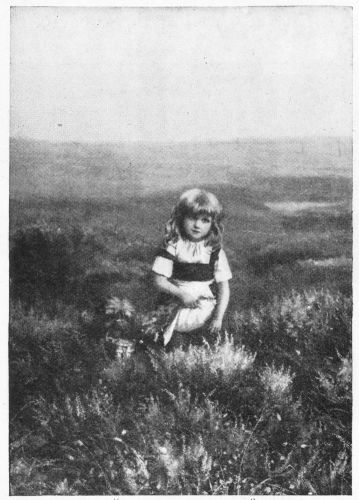
"FLOWER OF THE HEATH."
From the Painting by Schwentzen.
By permission of the Berlin Photographic Co.
The picture reproduced above, entitled "Flower of the Heath," by the German painter, Schwentzen, is another delightful study. It is that of a child wandering alone over a flowery plain—or not quite alone, for she is accompanied by a shaggy terrier, who carries in his mouth a basket, from which protrudes a bottle. That bottle, as often happens with accessories of a picture which may seem quite unimportant at first sight, is not there for nothing. It tells, or at least elucidates, the story of the picture. The little girl has been the bearer of her father's dinner, and is returning through the flowering heather, filling her apron with blossoms as she goes. The whole picture—sunny landscape, flowers, dog, and child—is full of delicate power and subtle charm.
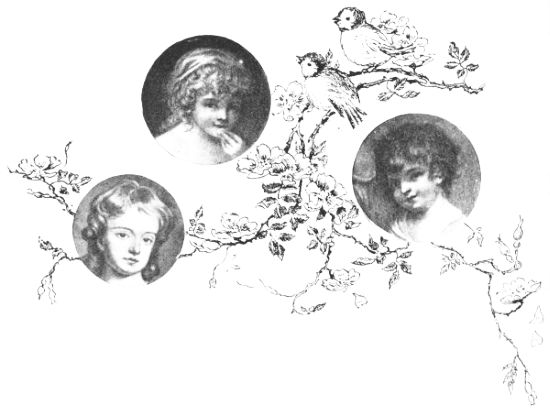
The three child-heads in the medallions above given must not be passed without a word of notice. The upper one is by Gainsborough, and a more winsome and delightful little face it is impossible to imagine. That on the right is from the same picture—the two children being named respectively Habbenal and Ganderetta. The head in the medallion on the left-hand side is from the portrait of James, the young Earl of Salisbury, by Kneller.
We come now to a picture full of pathetic meaning—"Tired Gleaners"—by our well-known English painter, Mr. Fred Morgan. They look so poor and sad, these pretty little girls, who have at the very outset of life already known so much of its hardship. The elder one has a mother's instinct of kindly care for the weaker little sister; her face expresses the self-forgetting resignation of a life filled with love for others. The little one, more beautiful than the elder sister, is one of those beings who are in all stations of life predestined to be loved and cared for. A whole touching life-story is in these two children's faces—beautiful but sad.
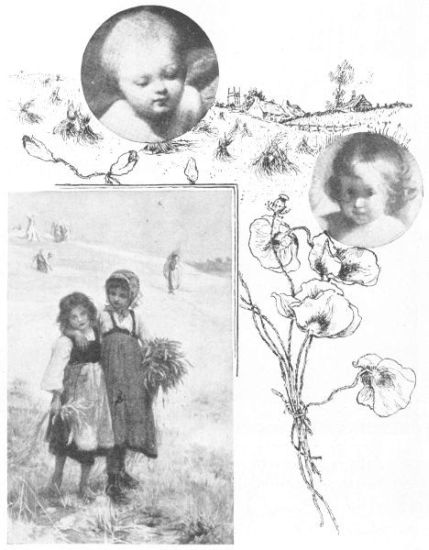
"TIRED GLEANERS."
From the Painting by Fred Morgan.
By permission of the Berlin Photographic Co.
[See larger version]
The examples which have been selected to fill the medallions given in this article comprise illustrations of children's heads contained in some of the most celebrated pictures in the world. It is impossible in a limited space to give an adequate idea of the beauty and charm with which the old masters have immortalized childhood—or perhaps it would be more accurate to say babyhood, since the great majority are representations of the Child with the Madonna, and, though varying in age from a few weeks upwards, the infant is seldom shown as older than a year or two at most. These studies of what may, in a double sense, be called the divinity of childhood differ widely according to the nationality of the painter. As we shall see presently, in some of the examples given in these pages farther on, we can enumerate among the artists of this country certain painters, such as Gainsborough and Reynolds, who as delineators of child-life and character are not easily excelled. There are those, however, who would say that in this respect the Italian masters have never been surpassed. Raphael's child-head of Christ from the painting entitled the "Madonna Aldobrandini," which is reproduced in the first medallion above, will through all ages illustrate, perhaps without a rival, the mission of the eternally beautiful—the dignity of innocence, the holiness of love. Bernardo Strozzi, later than Raphael, painted a human child in the arms of the Holy Virgin. It is reproduced in the right-hand medallion above. The childish charm and smile are most alluring. Here we find an allegory of Christianity; but it is not, like the child's head in Raphael's "Madonna Aldobrandini," an allegory of the divinity.
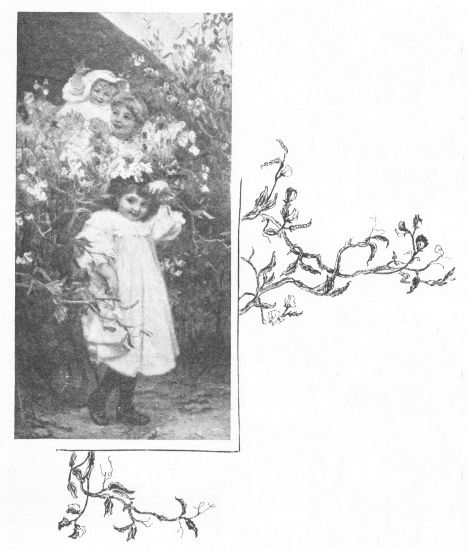
"HIDE-AND-SEEK."
By Fred Morgan.
By permission of the Berlin Photographic Co.
[See larger version]
Here is another of Mr. Fred Morgan's studies of child-life—a study notable for its expression of unreflecting and unconscious happiness. To be five years old and to play hide-and-seek among the blossoms, to feel them closing you in entirely, so that you can only just peep through and see with joy the others pass your hiding-place, to hold back the flowery branches and save with the other hand the little frock from the thorns—what pleasure! And there, right over head, is baby heard crowing; she comes nearer and nearer, held high above the flowers and thorns by her strong elder sister. She is sure to catch you! Can one ever feel in after years such delight, excitement, and suspense?
In the picture entitled "For Mother's Birthday," by Louise Jopling, a large-eyed little maiden is seen carrying so huge a jar of flowers that she can scarcely hold it. The painter of this picture must be a lover of children; only those who are sensitive to the charm of children can observe their characteristics with so much acuteness. The little girl is so prim and tidy, her best frock and hair-ribbon have been put on with such care, the suppressed excitement and the consciousness of the great importance of the event are so well expressed in her closed mouth, in the fixed gaze of the eyes, that we feel that the painter has caught the fleeting moment to perfection. The next instant that spell of solemnity will be broken, when her mother will have received her birthday present and will have taken her in her arms and kissed her: and the child's expression, as she goes dancing back to the nursery, no longer with the measured steps with which she left it, will be, though not less child-like, the opposite in kind.
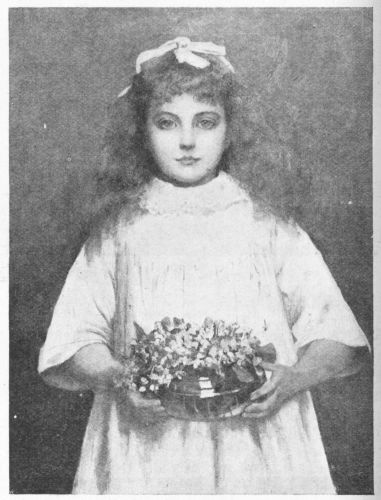
"FOR MOTHER'S BIRTHDAY."
By Louise Jopling. From a Photo. by H. Dixon.
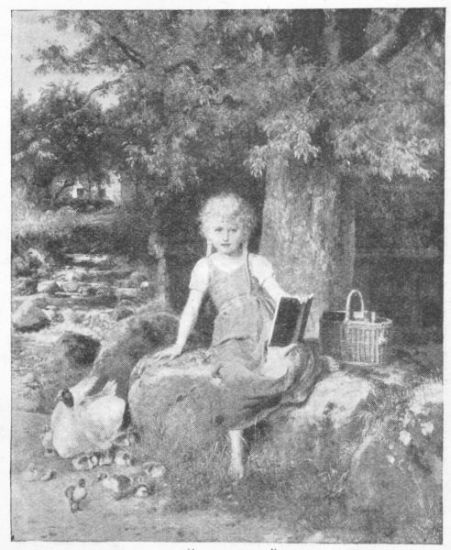
From the Painting by] "DILIGENCE." [A. Dieffenbach.
By permission of the Berlin Photographic Co.
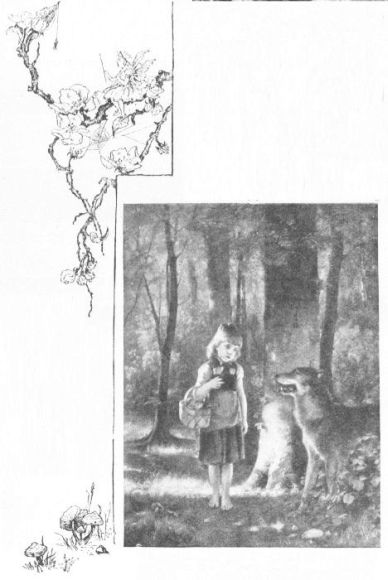
"LITTLE RED RIDING-HOOD."
From the Painting by Hiddeman.
By permission of the Berlin Photographic Co.
Let us turn again to the realm of fancy, to fairyland, where we all once wandered. Who of us has not feared and trembled for Little Red Riding-Hood; who has not cordially detested the wolf, and wished to warn her against his wiles? The mixture of trust in the wolf and of doubt in her own judgment has in our picture been charmingly expressed by the painter. This is one of those pictures which have the merit of containing an idea which throws a new light on the story which it illustrates. Every child who has read the adventures of Little Red Riding-Hood has wondered why she felt no fear at the first appearance of the wolf. It was because he had the wit, as the picture clearly shows, to disguise his nature and, with all his cunning, to show nothing but his natural likeness to a big and friendly dog, in which it is quite easy for a child to trust, as in a playfellow rather than an enemy.
In the picture, "Diligence," by Dieffenbach, there is perhaps no idea except what appears at first glance. Whether the child is really absorbed in her lessons, or whether the title is ironical and she is in fact dreaming over a fairy tale while the school-books repose in the basket, does not much matter; the reader may take his choice. The picture is most probably one of those which are painted solely for delight in their subject. Is not the whole thing perfectly charming?
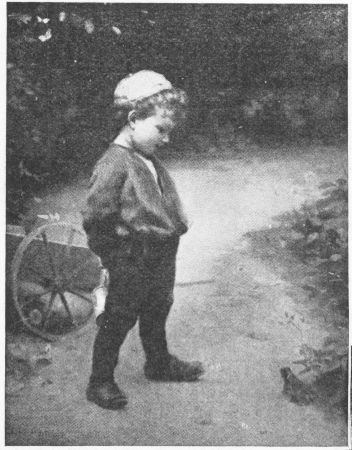
"AN UNEXPECTED MEETING."
From the Painting by Paul Peel.
By permission of Braun, Clément, & Co.
On this page we have two pictures which present as marked a contrast as may easily be conceived. "An Unexpected Meeting," by Paul Peel, depicting the sturdy little fellow with the irresistible air of manliness greeting the frog as a boon-companion, is as natural a study of boy-life as is that of the little girl of the characteristics of the opposite sex. "Little Caprice" stands before us in scanty attire which is not the beginning of her morning toilet, but is merely the result of her caprice. But what does it all mean? If she knew that, or you, or I, it would be no longer what it is—an inexplicable freak of the child's mind. She has been left unobserved for a moment whilst playing in a corner and found it amusing to take off her clothes, till she came to the critical point, which the painter has seized with so much humour and truth to life. Suddenly it strikes her that it is not very amusing to be without one's clothes, but she does not wish to put her things on by herself, partly for the simple reason that she does not know how to do it, and also because she does not know whether she really wishes to be dressed again. Oh, misery! oh, aggravation! she wants to do neither one thing nor the other. In fact, she does not know exactly what she wants—a state of mind which, when she grows to womanhood, will doubtless very often be repeated.
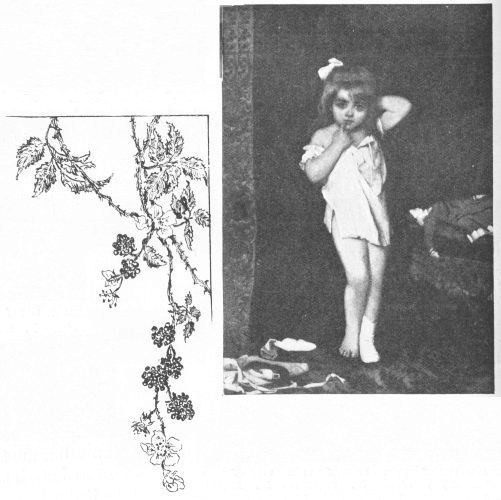
"LITTLE CAPRICE."
From the Painting by Elisa Koch.
By permission of Braun, Clément, & Co.
[See larger version]
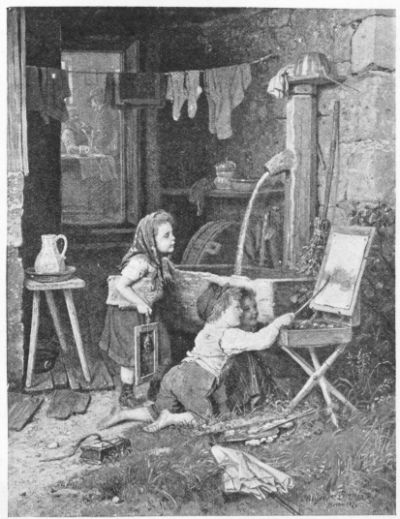
From the Painting by Meyer von Bremen.
By permission of the Berlin Photographic Co.
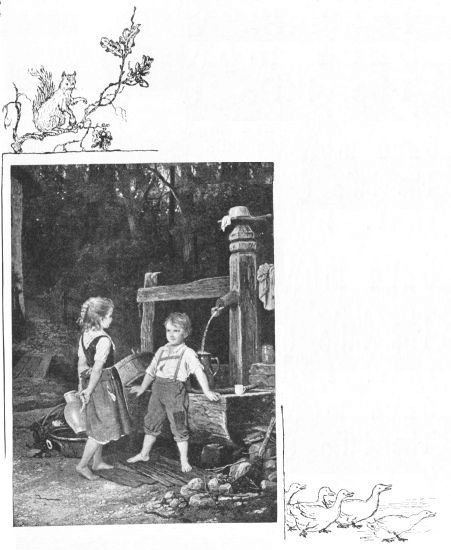
"A KISS FIRST." "IN DANGER."
From the Painting by Meyer von Bremen.
By permission of the Berlin Photographic Co
[See larger version]
"A Kiss First" is the name of a delightful picture by Meyer von Bremen. The boy stands in the full knowledge of his strength and manly superiority before the fountain and prevents the little girl from filling her jug. His eyes are sparkling with the conviction that he has her in his power. And she? She is but a woman in miniature. Let those who flatter themselves that they understand women decide whether he will get his kiss or not.
The next picture is most realistic and amusing, and there can hardly be two opinions as to its obvious meaning—or, rather, its double meaning. The painter has entered the house for a moment to chat with the pretty girl—so he is "in danger." In the meantime, the children coming home from school stop on their way to see the picture—and that is in danger also. The young genius gets hold of the brush and adds, with a few strokes, a little more colour to the landscape. The little sister kneeling by his side encourages the artistic performance, while the elder one probably passes judgment on the perspective.
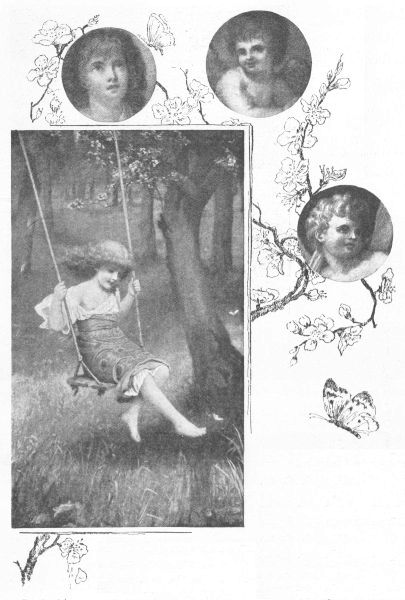
"BUTTERFLIES."
From the Painting by Kate Perugini.
By permission of the Berlin Photographic Co.
[See larger version]
In looking at the beautiful child on the swing in the picture entitled "Butterflies," by Kate Perugini, one at first receives the impression that the painter wanted to give us a "thing of beauty," without any other suggestion of childish amusement but the swing. Indeed, the title might well have been "Three Butterflies," for the child in the graceful dress, patterned as richly as the insects' wings, is as much a butterfly as the other two. But there is a further idea in the picture than that. Look once more. The little toe is aiming to touch the butterfly whilst it passes; the intent expression on the childish face shows that all her attention is concentrated on this one achievement. This is a very subtle illustration of the fact that children seldom enjoy a planless physical movement. Their little minds are constantly working for their own small aims and so developing for bigger ones.
Of the pictures in the medallions on this page, that on the left is from Sir Joshua Reynolds's painting entitled "The Angelic Child." It requires no saying that Sir Joshua's studies of children are among the most charming that ever came from the brush of a painter. The upper right-hand medallion is from Bartolozzi's picture called "Merit," while the remaining one is a painting named "A Boy with an Anchor," by the Italian artist, Cipriani.
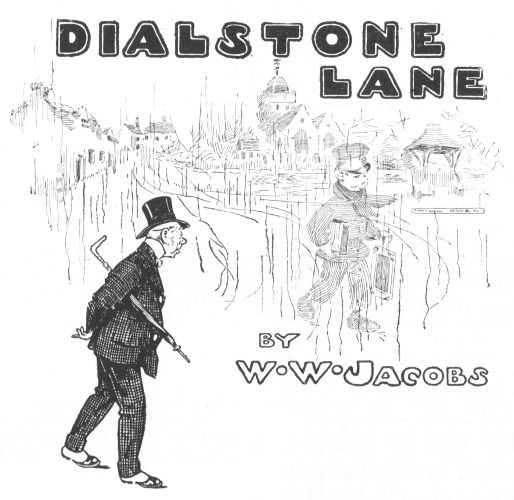
Copyright, 1904, by W. W. Jacobs, in the United States of America.
CHAPTER III.
Mr. Chalk, with his mind full of the story he had just heard, walked homewards like a man in a dream. The air was fragrant with spring and the scent of lilac revived memories almost forgotten. It took him back forty years, and showed him a small boy treading the same road, passing the same houses. Nothing had changed so much as the small boy himself; nothing had been so unlike the life he had pictured as the life he had led. Even the blamelessness of the latter yielded no comfort; it savoured of a lack of spirit.

His mind was still busy with the past when he reached home. Mrs. Chalk, a woman of imposing appearance, who sat by the window at needlework, looked up sharply at his entrance. Before she spoke he had a dim idea that she was excited about something.
"I've got her," she said, triumphantly.
"Oh!" said Mr. Chalk.
"She didn't want to come at first," said Mrs. Chalk: "she'd half promised to go to Mrs. Morris. Mrs. Morris had heard of her through Harris, the grocer, and he only knew she was out of a place by accident. He——"
Her words fell on deaf ears. Mr. Chalk, gazing through the window, heard without comprehending a long account of the capture of a new housemaid, which, slightly altered as to name and place, would have passed muster as an exciting contest between a skilful angler and a particularly sulky salmon. Mrs. Chalk, noticing his inattention at last, pulled up sharply.
"You're not listening!" she cried.
"Yes, I am; go on, my dear," said Mr. Chalk.
"What did I say she left her last place for, then?" demanded the lady.
Mr. Chalk started. He had been conscious of his wife's voice, and that was all. "You said you were not surprised at her leaving," he replied, slowly; "the only wonder to you was that a decent girl should have stayed there so long."
Mrs. Chalk started and bit her lip, "Yes," she said, slowly. "Ye—es. Go on; anything else?"
"You said the house wanted cleaning from top to bottom," said the painstaking Mr. Chalk.
"Go on," said his wife, in a smothered voice. "What else did I say?"
"Said you pitied the husband," continued Mr. Chalk, thoughtfully.
Mrs. Chalk rose suddenly and stood over him. Mr. Chalk tried desperately to collect his faculties.
"How dare you?" she gasped. "I've never said such things in my life. Never. And I said that she left because Mr. Wilson, her master, was dead and the family had gone to London. I've never been near the house; so how could I say such things?"
Mr. Chalk remained silent.
"What made you think of such things?" persisted Mrs. Chalk.
Mr. Chalk shook his head; no satisfactory reply was possible. "My thoughts were far away," he said, at last.
His wife bridled and said, "Oh, indeed!" Mr. Chalk's mother, dead some ten years before, had taken a strange pride—possibly as a protest against her only son's appearance—in hinting darkly at a stormy and chequered past. Pressed for details she became more mysterious still, and, saying that "she knew what she knew," declined to be deprived of the knowledge under any consideration. She also informed her daughter-in-law that "what the eye don't see the heart don't grieve," and that it was better to "let bygones be bygones," usually winding up with the advice to the younger woman to keep her eye on Mr. Chalk without letting him see it.
"Peckham Rye is a long way off, certainly," added the indignant Mrs. Chalk, after a pause. "It's a pity you haven't got something better to think of, at your time of life, too."
Mr. Chalk flushed. Peckham Rye was one of the nuisances bequeathed by his mother.
"I was thinking of the sea," he said, loftily.
Mrs. Chalk pounced. "Oh, Yarmouth," she said, with withering scorn.
Mr. Chalk flushed deeper than before. "I wasn't thinking of such things," he declared.
"What things?" said his wife, swiftly.
"The—the things you're alluding to," said the harassed Mr. Chalk.
"Ah!" said his wife, with a toss of her head. "Why you should get red in the face and confused when I say that Peckham Rye and Yarmouth are a long way off is best known to yourself. It's very funny that the moment either of these places is mentioned you get uncomfortable. People might read a geography-book out loud in my presence and it wouldn't affect me."
She swept out of the room, and Mr. Chalk's thoughts, excited by the magic word geography, went back to the island again. The half-forgotten dreams of his youth appeared to be materializing. Sleepy Binchester ended for him at Dialstone Lane, and once inside the captain's room the enchanted world beyond the seas was spread before his eager gaze. The captain, amused at first at his enthusiasm, began to get weary of the subject of the island, and so far the visitor had begged in vain for a glimpse of the map.
His enthusiasm became contagious. Prudence, entering one evening in the middle of a conversation, heard sufficient to induce her to ask for more, and the captain, not without some reluctance and several promptings from Mr. Chalk when he showed signs of omitting vital points, related the story. Edward Tredgold heard it, and, judging by the frequency of his visits, was almost as interested as Mr. Chalk.
"I can't see that there could be any harm in just looking at the map," said Mr. Chalk, one evening. "You could keep your thumb on any part you wanted to."
"Then we should know where to dig," urged Mr. Tredgold. "Properly managed there ought to be a fortune in your innocence, Chalk."
Mr. Chalk eyed him fixedly. "Seeing that the latitude and longitude and all the directions are written on the back," he observed, with cold dignity, "I don't see the force of your remarks."
"Well, in that case, why not show it to Mr. Chalk, uncle?" said Prudence, charitably.
Captain Bowers began to show signs of annoyance. "Well, my dear——," he began, slowly.
"Then Miss Drewitt could see it too," said Mr. Tredgold, blandly.
Miss Drewitt reddened with indignation, "I could see it any time I wished," she said, sharply.
"Well, wish now," entreated Mr. Tredgold. "As a matter of fact, I'm dying with curiosity myself. Bring it out and make it crackle, captain; it's a bank-note for half a million."
The captain shook his head and a slight frown marred his usually amiable features. He got up and, turning his back on them, filled his pipe from a jar on the mantelpiece.
"You never will see it, Chalk," said Edward Tredgold, in tones of much conviction. "I'll bet you two to one in golden sovereigns that you'll sink into your honoured family vault with your justifiable curiosity still unsatisfied. And I shouldn't wonder if your perturbed spirit walks the captain's bedroom afterwards."
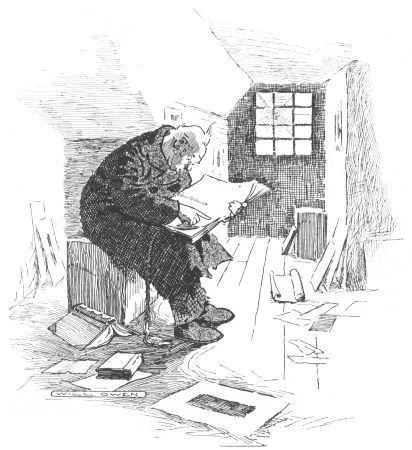
"HE RANSACKED AN OLD LUMBER-ROOM."
Miss Drewitt looked up and eyed the speaker with scornful comprehension. "Take the bet, Mr. Chalk," she said, slowly.
Mr. Chalk turned in hopeful amaze; then he leaned over and shook hands solemnly with Mr. Tredgold. "I'll take the bet," he said.
"Uncle will show it to you to please me," announced Prudence, in a clear voice. "Won't you, uncle?"
The captain turned and took the matches from the table. "Certainly, my dear, if I can find it," he said, in a hesitating fashion. "But I'm afraid I've mislaid it. I haven't seen it since I unpacked."
"Mislaid it!" ejaculated the startled Mr. Chalk. "Good heavens! Suppose somebody should find it? What about your word to Don Silvio then?"
"I've got it somewhere," said the captain, brusquely; "I'll have a hunt for it. All the same, I don't know that it's quite fair to interfere in a bet."
Miss Drewitt waved the objection away, remarking that people who made bets must risk losing their money.
"I'll begin to save up," said Mr. Tredgold, with a lightness which was not lost upon Miss Drewitt. "The captain has got to find it before you can see it, Chalk."
Mr. Chalk, with a satisfied smile, said that when the captain promised a thing it was as good as done.
For the next few days he waited patiently, and, ransacking an old lumber-room, divided his time pretty equally between a volume of "Captain Cook's Voyages" that he found there and "Famous Shipwrecks." By this means and the exercise of great self-control he ceased from troubling Dialstone Lane for a week. Even then it was Edward Tredgold who took him there. The latter was in high spirits, and in explanation informed the company, with a cheerful smile, that he had saved five and ninepence, and was forming habits which bade fair to make him a rich man in time.
"Don't you be in too much of a hurry to find that map, captain," he said.
"It's found," said Miss Drewitt, with a little note of triumph in her voice.
"Found it this morning," said Captain Bowers.
He crossed over to an oak bureau which stood in the corner by the fireplace, and taking a paper from a pigeon-hole slowly unfolded it and spread it on the table before the delighted Mr. Chalk. Miss Drewitt and Edward Tredgold advanced to the table and eyed it curiously.
The map, which was drawn in lead-pencil, was on a piece of ruled paper, yellow with age and cracked in the folds. The island was in shape a rough oval, the coast-line being broken by small bays and headlands. Mr. Chalk eyed it with all the fervour usually bestowed on a holy relic, and, breathlessly reading off such terms as "Cape Silvio," "Bowers Bay," and "Mount Lonesome," gazed with breathless interest at the discourser.
"And is that the grave?" he inquired, in a trembling voice, pointing to a mark in the north-east corner.
The captain removed it with his fingernail. "No," he said, briefly. "For full details see the other side."
For one moment Mr. Chalk hoped; then his face fell as Captain Bowers, displaying for a fraction of a second the writing on the other side, took up the map and, replacing it in the bureau, turned the key in the lock and with a low laugh resumed his seat. Miss Drewitt, glancing over at Edward Tredgold, saw that he looked very thoughtful.
"You've lost your bet," she said, pointedly.
"I know," was the reply.
His gaiety had vanished and he looked so dejected that Miss Drewitt was reminded of the ruined gambler in a celebrated picture. She tried to quiet her conscience by hoping that it would be a lesson to him. As she watched, Mr. Tredgold dived into his left trouser-pocket and counted out some coins, mostly brown. To these he added a few small pieces of silver gleaned from his waistcoat, and then after a few seconds' moody thought found a few more in the other trouser-pocket.
"Eleven and tenpence," he said, mechanically.
"Any time," said Mr. Chalk, regarding him with awkward surprise. "Any time."
"Give him an I O U," said Captain Bowers, fidgeting.
"Yes, any time," repeated Mr. Chalk; "I'm in no hurry."
"No; I'd sooner pay now and get it over," said the other, still fumbling in his pockets. "As Miss Drewitt says, people who make bets must be prepared to lose; I thought I had more than this."
There was an embarrassing silence, during which Miss Drewitt, who had turned very red, felt strangely uncomfortable. She felt more uncomfortable still when Mr. Tredgold, discovering a bank-note and a little collection of gold coins in another pocket, artlessly expressed his joy at the discovery. The simple-minded captain and Mr. Chalk both experienced a sense of relief; Miss Drewitt sat and simmered in helpless indignation.
"You're careless in money matters, my lad," said the captain, reprovingly.
"I couldn't understand him making all that fuss over a couple o' pounds," said Mr. Chalk, looking round. "He's very free, as a rule; too free."
Mr. Tredgold, sitting grave and silent, made no reply to these charges, and the girl was the only one to notice a faint twitching at the corners of his mouth. She saw it distinctly, despite the fact that her clear, grey eyes were fixed dreamily on a spot some distance above his head.
She sat in her room upstairs after the visitors had gone, thinking it over. The light was fading fast, and as she sat at the open window the remembrance of Mr. Tredgold's conduct helped to mar one of the most perfect evenings she had ever known.
Downstairs the captain was also thinking. Dialstone Lane was in shadow, and already one or two lamps were lit behind drawn blinds. A little chatter of voices at the end of the lane floated in at the open window, mellowed by distance. His pipe was out, and he rose to search in the gloom for a match, when another murmur of voices reached his ears from the kitchen. He stood still and listened intently. To put matters beyond all doubt, the shrill laugh of a girl was plainly audible. The captain's face hardened, and, crossing to the fireplace, he rang the bell.
"Yessir," said Joseph, as he appeared and closed the door carefully behind him.
"What are you talking to yourself in that absurd manner for?" inquired the captain, with great dignity.
"Me, sir?" said Mr. Tasker, feebly.
"Yes, you," repeated the captain, noticing with surprise that the door was slowly opening.
Mr. Tasker gazed at him in a troubled fashion, but made no reply.
"I won't have it," said the captain, sternly, with a side glance at the door. "If you want to talk to yourself go outside and do it. I never heard such a laugh. What did you do it for? It was like an old woman with a bad cold."
He smiled grimly in the darkness, and then started slightly as a cough, a hostile, challenging cough, sounded from the kitchen. Before he could speak the cough ceased and a thin voice broke carelessly into song.
"What!" roared the captain, in well-feigned astonishment. "Do you mean to tell me you've got somebody in my pantry? Go and get me those rules and regulations."
Mr. Tasker backed out, and the captain smiled again as he heard a whispered discussion. Then a voice clear and distinct took command. "I'll take 'em in myself, I tell you," it said. "I'll rules and regulations him."
The smile faded from the captain's face, and he gazed in perplexity at the door as a strange young woman bounced into the room.
"Here's your rules and regulations," said the intruder, in a somewhat shrewish voice. "You'd better light the lamp if you want to see 'em; though the spelling ain't so noticeable in the dark."
The impressiveness of the captain's gaze was wasted in the darkness. For a moment he hesitated, and then, with the dignity of a man whose spelling has nothing to conceal, struck a match and lit the lamp. The lamp lighted, he lowered the blind, and then seating himself by the window turned with a majestic air to a thin slip of a girl with tow-coloured hair, who stood by the door.
"Who are you?" he demanded, gruffly.
"My name's Vickers," said the young lady. "Selina Vickers. I heard all what you've been saying to my Joseph, but, thank goodness, I can take my own part. I don't want nobody to fight my battles for me. If you've got anything to say about my voice you can say it to my face."
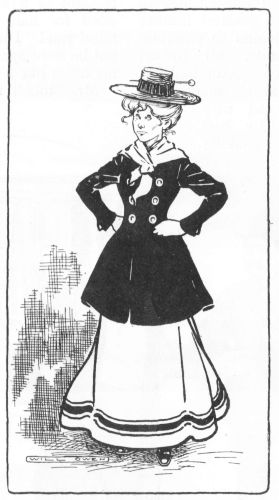
"SELINA VICKERS."
Captain Bowers sat back and regarded her with impressive dignity. Miss Vickers met his gaze calmly and, with a pair of unwinking green eyes, stared him down.
"What were you doing in my pantry?" demanded the captain, at last.
"I was in your kitchen" replied Miss Vickers, with scornful emphasis on the last word, "to see my young man."
"Well, I can't have you there," said the captain, with a mildness that surprised himself. "One of my rules——"
Miss Vickers interposed. "I've read 'em all over and over again," she said, impatiently.
"If it occurs again," said the other, "I shall have to speak to Joseph very seriously about it."
"Talk to me," said Miss Vickers, sharply; "that's what I come in for. I can talk to you better than what Joseph can, I know. What harm do you think I was doing your old kitchen? Don't you try and interfere between me and my Joseph, because I won't have it. You're not married yourself, and you don't want other people to be. How do you suppose the world would get on if everybody was like you?"
Captain Bowers regarded her in open-eyed perplexity. The door leading to the garden had just closed behind the valiant Joseph, and he stared with growing uneasiness at the slight figure of Miss Vickers as it stood poised for further oratorical efforts. Before he could speak she gave her lips a rapid lick and started again.
"You're one of those people that don't like to see others happy, that's what you are," she said, rapidly. "I wasn't hurting your kitchen, and as to talking and laughing there—what do you think my tongue was given to me for? Show? P'r'aps if you'd been doing a day's hard work you'd——"
"Look here, my girl——" began the captain, desperately.
"Don't you my girl me, please," interrupted Miss Vickers. "I'm not your girl, thank goodness. If I was you'd be a bit different, I can tell you. If you had any girls you'd know better than to try and come between them and their young men. Besides, they wouldn't let you. When a girl's got a young man——"
The captain rose and went through the form of ringing the bell. Miss Vickers watched him calmly.
"I thought I'd just have it out with you for once and for all," she continued. "I told Joseph that I'd no doubt your bark was worse than your bite. And what he can see to be afraid of in you I can't think. Nervous disposition, I s'pose. Good evening."
She gave her head a little toss and, returning to the pantry, closed the door after her. Captain Bowers, still somewhat dazed, returned to his chair and, gazing at the "Rules," which still lay on the table, grinned feebly in his beard.
CHAPTER IV.
To keep such a romance to himself was beyond the powers of Mr. Chalk. The captain had made no conditions as to secrecy, and he therefore considered himself free to indulge in hints to his two greatest friends, which caused those gentlemen to entertain some doubts as to his sanity. Mr. Robert Stobell, whose work as a contractor had left a permanent and unmistakable mark upon Binchester, became imbued with a hazy idea that Mr. Chalk had invented a new process of making large diamonds. Mr. Jasper Tredgold, on the other hand, arrived at the conclusion that a highly respectable burglar was offering for some reason to share his loot with him. A conversation between Messrs. Stobell and Tredgold in the High Street only made matters more complicated.
"Chalk always was fond of making mysteries of things," complained Mr. Tredgold.
Mr. Stobell, whose habit was taciturn and ruminative, fixed his dull brown eyes on the ground and thought it over. "I believe it's all my eye and Betty Martin," he said, at length, quoting a saying which had been used in his family as an expression of disbelief since the time of his great-grandmother.
"He comes in to see me when I'm hard at work and drops hints," pursued his friend. "When I stop to pick 'em up, out he goes. Yesterday he came in and asked me what I thought of a man who wouldn't break his word for half a million. Half a million, mind you! I just asked him who it was, and out he went again. He pops in and out of my office like a figure on a cuckoo-clock."
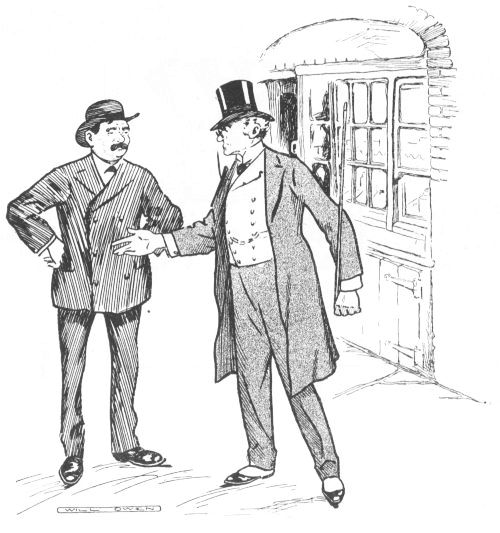
"HE POPS IN AND OUT OF MY OFFICE LIKE A FIGURE ON A CUCKOO-CLOCK."
Mr. Stobell relapsed into thought again, but no gleam of expression disturbed the lines of his heavy face; Mr. Tredgold, whose sharp, alert features bred more confidence in his own clients than those of other people, waited impatiently.
"He knows something that we don't," said Mr. Stobell, at last; "that's what it is."
Mr. Tredgold, who was too used to his friend's mental processes to quarrel with them, assented.
"He's coming round to smoke a pipe with me to-morrow night," he said, briskly, as he turned to cross the road to his office. "You come too, and we'll get it out of him. If Chalk can keep a secret he has altered, that's all I can say."
His estimate of Mr. Chalk proved correct. With Mr. Tredgold acting as cross-examining counsel and Mr. Stobell enacting the part of a partial and overbearing judge, Mr. Chalk, after a display of fortitude which surprised himself almost as much as it irritated his friends, parted with his news and sat smiling with gratification at their growing excitement.
"Half a million, and he won't go for it?" ejaculated Mr. Tredgold. "The man must be mad."
"No; he passed his word and he won't break it," said Mr. Chalk. "The captain's word is his bond, and I honour him for it. I can quite understand it."
Mr. Tredgold shrugged his shoulders and glanced at Mr. Stobell, that gentleman, after due deliberation, gave an assenting nod.
"He can't get at it, that's the long and short of it," said Mr. Tredgold, after a pause. "He had to leave it behind when he was rescued, or else risk losing it by telling the men who rescued him about it, and he's had no opportunity since. It wants money to take a ship out there and get it, and he doesn't see his way quite clear. He'll have it fast enough when he gets a chance. If not, why did he make that map?"
Mr. Chalk shook his head, and remarked mysteriously that the captain had his reasons. Mr. Tredgold relapsed into silence, and for some time the only sound audible came from a briar-pipe which Mr. Stobell ought to have thrown away some years before.
"Have you given up that idea of a yachting cruise of yours, Chalk?" demanded Mr. Tredgold, turning on him suddenly.
"No," was the reply. "I was talking about it to Captain Bowers only the other day. That's how I got to hear of the treasure."
Mr. Tredgold started and gave a significant glance at Mr. Stobell. In return he got a wink which that gentleman kept for moments of mental confusion.
"What did the captain tell you for?" pursued Mr. Tredgold, returning to Mr. Chalk. "He wanted you to make an offer. He hasn't got the money for such an expedition; you have. The yarn about passing his word was so that you shouldn't open your mouth too wide. You were to do the persuading, and then he could make his own terms. Do you see? Why, it's as plain as A B C."
"Plain as the alphabet," said Mr. Stobell, almost chidingly.
Mr. Chalk gasped and looked from one to the other.
"I should like to have a chat with the captain about it," continued Mr. Tredgold, slowly and impressively. "I'm a business man and I could put it on a business footing. It's a big risk, of course; all those things are ... but if we went shares ... if we found the money——"
He broke off and, filling his pipe slowly, gazed in deep thought at the wall. His friends waited expectantly.
"Combine business with pleasure," resumed Mr. Tredgold, lighting his pipe; "sea air ... change ... blow away the cobwebs ... experience for Edward to be left alone. What do you think, Stobell?" he added, turning suddenly.
Mr. Stobell gripped the arms of his chair in his huge hands and drew his bulky figure to a more upright position.
"What do you mean by combining business with pleasure?" he said, eyeing him with dull suspicion.
"Chalk is set on a trip for the love of it," explained Mr. Tredgold.
"If we take on the contract, he ought to pay a bigger share, then," said the other, firmly.
"Perhaps he will," said Tredgold, hastily.
Mr. Stobell pondered again and, slightly raising one hand, indicated that he was in the throes of another idea and did not wish to be disturbed.
"You said it would be experience for Edward to be left alone," he said, accusingly.
"I did," was the reply.
"You ought to pay more, too, then," declared the contractor, "because it's serving of your ends as well."
"We can't split straws," exclaimed Tredgold, impatiently. "If the captain consents we three will find the money and divide our portion, whatever it is, equally."
Mr. Chalk, who had been in the clouds during this discussion, came back to earth again. "If he consents," he said, sadly; "but he won't."
"Well, he can only refuse," said Mr. Tredgold; "and, anyway, we'll have the first refusal. Things like that soon get about. What do you say to a stroll? I can think better while I'm walking."
His friends assenting, they put on their hats and sallied forth. That they should stroll in the direction of Dialstone Lane surprised neither of them. Mr. Tredgold leading, they went round by the church, and that gentleman paused so long to admire the architecture that Mr. Stobell got restless.
"You've seen it before, Tredgold," he said, shortly.
"It's a fine old building," said the other. "Binchester ought to be proud of it. Why, here we are at Captain Bowers's!"
"The house has been next to the church for a couple o' hundred years," retorted his friend.
"Let's go in," said Mr. Tredgold. "Strike while the iron's hot. At any rate," he concluded, as Mr. Chalk voiced feeble objections, "we can see how the land lies."
He knocked at the door and then, stepping aside, left Mr. Chalk to lead the way in. Captain Bowers, who was sitting with Prudence, looked up at their entrance, and putting down his newspaper extended a hearty welcome.
"Chalk didn't like to pass without looking in," said Mr. Tredgold, "and I haven't seen you for some time. You know Stobell?"
The captain nodded, and Mr. Chalk, pale with excitement, accepted his accustomed pipe from the hands of Miss Drewitt and sat nervously awaiting events. Mr. Tasker set out the whisky, and, Miss Drewitt avowing a fondness for smoke in other people, a comfortable haze soon filled the room. Mr. Tredgold, with a significant glance at Mr. Chalk, said that it reminded him of a sea-fog.
It only reminded Mr. Chalk, however, of a smoky chimney from which he had once suffered, and he at once entered into minute details. The theme was an inspiriting one, and before Mr. Tredgold could hark back to the sea again Mr. Stobell was discoursing, almost eloquently for him, upon drains. From drains to the shortcomings of the district council they progressed by natural and easy stages, and it was not until Miss Drewitt had withdrawn to the clearer atmosphere above that a sudden ominous silence ensued, which Mr. Chalk saw clearly he was expected to break.
"I—I've been telling them some of your adventures," he said, desperately, as he glanced at the captain; "they're both interested in such things."
The latter gave a slight start and glanced shrewdly at his visitors. "Aye, aye," he said, composedly.
"Very interesting, some of them," murmured Mr. Tredgold. "I suppose you'll have another voyage or two before you've done? One, at any rate."
"No," said the captain, "I've had my share of the sea; other men may have a turn now. There's nothing to take me out again—nothing."
Mr. Tredgold coughed and murmured something about breaking off old habits too suddenly.
"It's a fine career," sighed Mr. Chalk.
"A manly life," said Mr. Tredgold, emphatically.
"It's like every other profession, it has two sides to it," said the captain.
"It is not so well paid as it should be," said the wily Tredgold, "but I suppose one gets chances of making money in outside ways sometimes."
The captain assented, and told of a steward of his who had made a small fortune by selling Japanese curios to people who didn't understand them.
The conversation was interesting, but extremely distasteful to a business man intent upon business. Mr. Stobell took his pipe out of his mouth and cleared his throat. "Why, you might build a hospital with it," he burst out, impatiently.
"Build a hospital!" repeated the astonished captain, as Mr. Chalk bent suddenly to do up his shoe-lace.
"Think of the orphans you could be a father to!" added Mr. Stobell, making the most of an unwonted fit of altruism.
The captain looked inquiringly at Mr. Tredgold.
"And widows," said Mr. Stobell, and, putting his pipe in his mouth as a sign that he had finished his remarks, gazed stolidly at the company.
"Stobell must be referring to a story Chalk told us of some precious stones you buried, I think," said Mr. Tredgold, reddening. "Aren't you, Stobell?"
"Of course I am," said his friend. "You know that."
Captain Bowers glanced at Mr. Chalk, but that gentleman was still busy with his shoe-lace, only looking up when Mr. Tredgold, taking the bull by the horns, made the captain a plain, straightforward offer to fit out and give him the command of an expedition to recover the treasure. In a speech which included the benevolent Mr. Stobell's hospitals, widows, and orphans, he pointed out a score of reasons why the captain should consent, and wound up with a glowing picture of Miss Drewitt as the heiress of the wealthiest man in Binchester. The captain heard him patiently to an end and then shook his head.
"I passed my word," he said, stiffly.
Mr. Stobell took his pipe out of his mouth again to offer a little encouragement. "Tredgold has broke his word before now," he observed; "he's got quite a name for it."
"But you would go out if it were not for that?" inquired Tredgold, turning a deaf ear to this remark.
"Naturally," said the captain, smiling; "but, then, you see I did."
Mr. Tredgold drummed with his fingers on the arms of his chair, and after a little hesitation asked as a great favour to be permitted to see the map. As an estate agent, he said, he took a professional interest in plans of all kinds.
Captain Bowers rose, and in the midst of an expectant silence took the map from the bureau, and placing it on the table kept it down with his fist. The others drew near and inspected it.
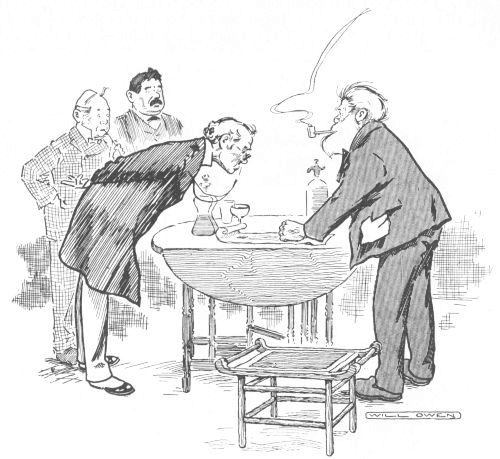
"THE OTHERS DREW NEAR AND INSPECTED IT."
"Nobody but Captain Bowers has ever seen the other side," said Mr. Chalk, impressively.
"Except my niece," interposed the captain. "She wanted to see it, and I trust her as I would trust myself. She thinks the same as I do about it."
His stubby forefinger travelled slowly round the coast-line until, coming to the extreme south-west corner, it stopped, and a mischievous smile creased his beard.
"It's buried here," he observed. "All you've got to do is to find the island and dig in that spot."
Mr. Chalk laughed and shook his head as at a choice piece of waggishness.
"Suppose," said Mr. Tredgold, slowly—"suppose anybody found it without your connivance, would you take your share?"
"Let 'em find it first," said the captain.
"Yes, but would you?" inquired Mr. Chalk.
Captain Bowers took up the map and returned it to its place in the bureau. "You go and find it," he said, with a genial smile.
"You give us permission?" demanded Tredgold.
"Certainly," grinned the captain. "I give you permission to go and dig over all the islands in the Pacific; there's a goodish number of them, and it's a fairly common shape."
"It seems to me it's nobody's property," said Tredgold, slowly. "That is to say, it's anybody's that finds it. It isn't your property, Captain Bowers? You lay no claim to it?"
"No, no," said the captain. "It's nothing to do with me. You go and find it," he repeated, with enjoyment.
Mr. Tredgold laughed too, and his eye travelled mechanically towards the bureau. "If we do," he said, cordially, "you shall have your share."
The captain thanked him and, taking up the bottle, refilled their glasses. Then, catching the dull, brooding eye of Mr. Stobell as that plain-spoken man sat in a brown study trying to separate the serious from the jocular, he drank success to their search. He was about to give vent to further pleasantries when he was stopped by the mysterious behaviour of Mr. Chalk, who, first laying a finger on his lip to ensure silence, frowned severely and nodded at the door leading to the kitchen.
The other three looked in the direction indicated. The door stood half open, and the silhouette of a young woman in a large hat put the upper panels in shadow. The captain rose and, with a vigorous thrust of his foot, closed the door with a bang.
"Eavesdropping," said Mr. Chalk, in a tense whisper.
"There'll be a rival expedition," said the captain, falling in with his mood. "I've already warned that young woman off once. You'd better start to-night."
He leaned back in his chair and surveyed the company pleasantly. Somewhat to Mr. Chalk's disappointment Mr. Tredgold began to discuss agriculture, and they were still on that theme when they rose to depart some time later. Tredgold and Chalk bade the captain a cordial good-night; but Stobell, a creature of primitive impulses, found it difficult to shake hands with him. On the way home he expressed an ardent desire to tell the captain what men of sense thought of him.
The captain lit another pipe after they had gone, and for some time sat smoking and thinking over the events of the evening. Then Mr. Tasker's second infringement of discipline occurred to him, and, stretching out his hand, he rang the bell.
"Has that young woman gone?" he inquired, cautiously, as Mr. Tasker appeared.
"Yessir," was the reply.
"What about your articles?" demanded the captain, with sudden loudness. "What do you mean by it?"
Mr. Tasker eyed him forlornly. "It ain't my fault," he said, at last. "I don't want her."
"Eh?" said the other, sternly. "Don't talk nonsense. What do you have her here for, then?"
"Because I can't help myself," said Mr. Tasker, desperately; "that's why. She's took a fancy to me, and, that being so, it would take more than you and me to keep 'er away."
"Rubbish," said his master.
Mr. Tasker smiled wanly. "That's my reward for being steady," he said, with some bitterness; "that's what comes of having a good name in the place. I get Selina Vickers after me."
"You—you must have asked her to come here in the first place," said the astonished captain.
"Ask her?" repeated Mr. Tasker, with respectful scorn. "Ask her? She don't want no asking."
"What does she come for, then?" inquired the other.
"Me," said Mr. Tasker, brokenly. "I never dreamt o' such a thing. I was going 'er way one night—about three weeks ago, it was—and I walked with her as far as her road—Mint Street. Somehow it got put about that we were walking out. A week afterwards she saw me in Harris's, the grocer's, and waited outside for me till I come out and walked 'ome with me. After she came in the other night I found we was keeping company. To-night—to-night she got a ring out o' me, and now we're engaged."
"What on earth did you give her the ring for if you don't want her?" inquired the captain, eyeing him with genuine concern.
"Ah, it seems easy, sir," said the unfortunate; "but you don't know Selina. She bought the ring and said I was to pay it off a shilling a week. She took the first shilling to-night."
His master sat back and regarded him in amazement.
"You don't know Selina, sir," repeated Mr. Tasker, in reply to this manifestation. "She always gets her own way. Her father ain't 'it 'er mother not since Selina was seventeen. He dursent. The last time Selina went for him tooth and nail; smashed all the plates off the dresser throwing 'em at him, and ended by chasing of him up the road in his shirt-sleeves."
The captain grunted.
"That was two years ago," continued Mr. Tasker; "and his spirit's quite broke. He 'as to give all his money except a shilling a week to his wife, and he's not allowed to go into pubs. If he does it's no good, because they won't serve 'im. If they do Selina goes in next morning and gives them a piece of 'er mind. She don't care who's there or what she says, and the consequence is Mr. Vickers can't get served in Binchester for love or money. That'll show you what she is."
"Well, tell her I won't have her here," said the captain, rising. "Good-night."
"I've told her over and over again, sir," was the reply, "and all she says is she's not afraid of you, nor six like you."
The captain fell back silent, and Mr. Tasker, pausing in a respectful attitude, watched him wistfully. The captain's brows were bent in thought, and Mr. Tasker, reminding himself that crews had trembled at his nod and that all were silent when he spoke, felt a flutter of hope.
"Well," said the captain, sharply, as he turned and caught sight of him, "what are you waiting there for?"
Mr. Tasker drifted towards the door which led upstairs.
"I—I thought you were thinking of something we could do to prevent her coming, sir," he said, slowly. "It's hard on me, because as a matter of fact——"
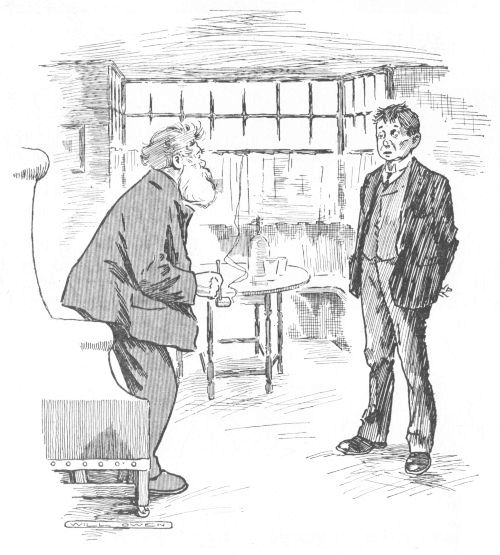
"ALL SHE SAYS IS SHE'S NOT AFRAID OF YOU, NOR SIX LIKE YOU."
"Well?" said the captain.
"I—I've 'ad my eye on another young lady for some time," concluded Mr. Tasker.
He was standing on the bottom stair as he spoke, with his hand on the latch. Under the baleful stare with which the indignant captain favoured him, he closed it softly and mounted heavily to bed.
(To be continued.)
Illustrated By J. A. Shepherd.
Like other peoples the world over, the Afghans use the beast fable to point morals and illustrate rules of conduct. Perhaps the moral is not invariably such as commends itself to Western standards, and the methods applauded are sometimes not such as would make for popularity in more civilized circles. But what would you? The characteristics of a race colour its literature, and the more homely the literature the clearer the colouring. Hence the Afghan beast fable more frequently than not reflects the respectful admiration accorded the successful exercise of craft and cunning, for which self-helpful qualities the dwellers on the other side of the North-Western Frontier of India are famed.
Soldiers who are acquainted with Afghan usages in warfare will appreciate the truth of the maxim which furnishes the text for the story of the Camel-rider, the Snake, and the Fox. A man riding on his camel happened to pass a place where a jungle fire was raging, and a snake, calling from the midst of the flames, begged his aid. The man, ignoring the snake's enmity to the human race and considering only his present danger, consented to save him: he lowered his saddle-bag to the ground, and the snake, having coiled himself up in it, was carried by his rescuer to a place of safety. Then the man opened his bag and bade the snake go, with an admonition to behave better towards mankind for the future. The snake made answer, "Until I have stung thee and this camel of thine I will not depart!"
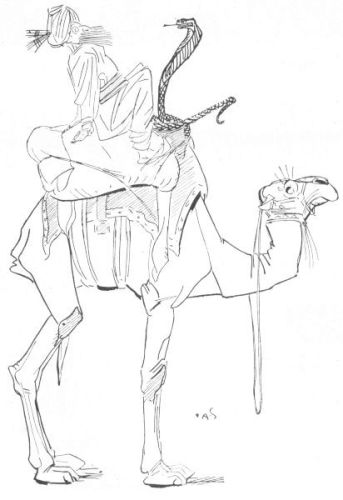
"UNTIL I HAVE STUNG THEE AND THIS CAMEL OF THINE I WILL NOT DEPART."
The man, hurt by this black ingratitude, drew the snake's attention to the service he had just rendered. The snake admitted his debt, but pointed out that his rescuer had acted injudiciously, in view of the hereditary enmity existing between snakes and men. The two proceeded to argue the point in commendably temperate spirit, the snake laying stress on the circumstance that mankind "always return evil for good"; and the man, denying it, eventually agreed that if the snake could find a witness to the truth of his assertion he would submit to be stung.
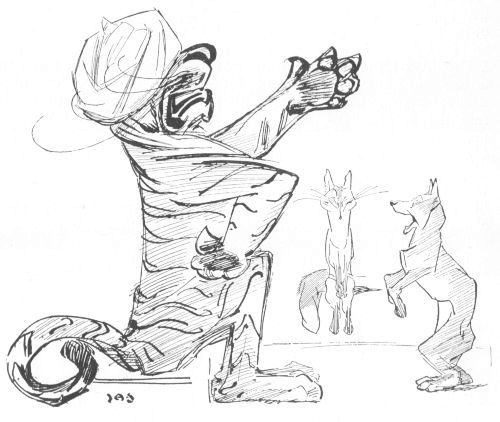
"'IT IS STRANGE THAT THOU IN MY VERY PRESENCE TALKEST OF "I" AND "MINE,"' SAID THE TIGER."
The witness was found in the person of an elderly cow-buffalo. Examined by the snake, she succinctly reviewed her career, and gave it as her opinion that man's creed was to return evil for good, inasmuch as her owner, when she ceased to give milk, turned her out to graze till she should be fat enough to kill. Upon this testimony the snake claimed fulfilment of the bargain. The man, however, urged that two witnesses were necessary, and, the snake consenting, a tree was called upon for his opinion. The tree, in a few well-chosen sentences, recalled the fact that for years he had granted shade to all men who sought his protection in the heat of day; but, he complained, when they had rested they always looked him over and, if they happened to have tools, lopped off a branch to make a spade-handle or axe-haft. They went even further, reckoning up the use they could make of their protector from the scorching sun if they reduced him to planks. In short, the tree was distinctly of the cow-buffalo's way of thinking. The camel-man, sorely perplexed, was wondering how he could gain time when a fox came by and asked, in his sarcastic way, "What kindness hast thou shown this snake, that he desires to do thee harm?"
Having heard the story the fox refused to believe it; the bag was small, and he was sure so large a snake could not get into it. Of course, the snake had no alternative but to show that he could; so the fox obligingly held the bag open for him, and when he was fairly entrapped handed him over to the man to kill. "A wise man should not be gulled by the cries for mercy of his foes; otherwise he will fall into misfortune," is the suggestive moral. It does not say much for Afghan principle, does it?
The fox, as ever, serves the Afghan fabulist for the personification of cunning and ingenuity. The tale of the Tiger, the Wolf, and the Fox exhibits the last-named in the character of the discreet and sagacious courtier. These three animals one day went hunting together, and having killed a wild hill-goat, a deer, and a hare, took them home to the tiger's den to eat. Having settled themselves comfortably, the tiger requested the wolf to divide the game as he thought fit; whereupon the wolf allotted the hill-goat as the biggest to the tiger, the deer to himself, and the hare to the fox. "It is strange that thou in my very presence talkest of 'I' and 'mine,'" said the tiger. "Who and what art thou, and what opinion hast thou of me?" and raising his paw he struck the wolf dead on the spot. Then he turned to the fox and requested him to divide the spoil. The fox instantly replied that the hill-goat would do for his Majesty's breakfast, the deer would serve for his Majesty's dinner at noon, and, of course, the hare must be reserved for his Majesty's supper. "And from whom," said the tiger, with well-feigned curiosity, "didst thou learn this mode of distribution and this sagacity?"
The fox replied that he was one who took warning from the fate of others. The tiger (who could not have been very hungry) expounded his own idea of justice, which was that the sagacious fox should have the whole bag of game while the tiger got more for himself; "and after this I will do whatever thou tellest me." A significant hint that physical strength does wisely to profit by the craft of the weaker. A fable closely resembling this, but in which, of course, the lion takes the part here played by the tiger, is current among some North African tribes.
One of the cleverest tales is that of the Merchant and his Parrot, which illustrates the great Afghan maxim that you can procure by craft what you can procure by no other means. A certain merchant, says the fable, was about to make a journey south into India. Before setting out he assembled his family and requested each member to name the gift he or she would like brought home. Last of all he asked the parrot, who was a native of Hindustan, what he could do for him in that country. The parrot at once begged him to visit a certain forest, where some more parrots would probably be found. "Give them my compliments and tell them that such and such a parrot, who is a friend of theirs, is confined in a cage in your house and says, 'This is a strange friendship, that I should be in bondage while you, quite unconcerned for my fate, flit hither and thither.' Now, whatever reply they give," said the parrot, "deliver it to me." The merchant punctually fulfilled his promise. He found the forest and the parrots and gave his parrot's message; and having done so was distressed to observe that one of the birds was so profoundly affected that, after a spasm of trembling and fluttering, he fell lifeless to the ground.
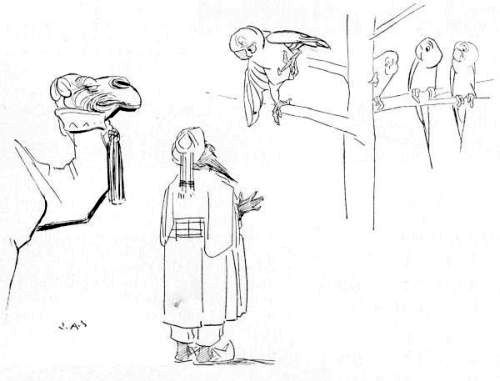
"AFTER A SPASM OF TREMBLING AND FLUTTERING, HE FELL LIFELESS TO THE GROUND."
On his return home, after he had distributed the presents he had brought among his family, his parrot inquired whether he had not something to say to him. The merchant, fearful of grieving the bird, fenced with the question, but when the parrot grew huffy and told him he need not speak if he did not choose he relented, and with many expressions of regret told the fatal consequences of delivering the message. When the parrot heard of the death of his friend he, too, was seized with flutterings and shiverings, and then and there fell dead from his perch. The merchant shed tears over him and, after great lamentation, threw the body out of the cage. No sooner did the parrot touch the ground, however, than he came to life again and flew on to the top of the house; and the merchant, staring in amazement, asked for explanations. The parrot thereupon explained that his friend had sent this message: "Pretend to be dead and thou wilt get free."
"Now I, of course, understood his meaning from what thou saidst," added the parrot, "so I gained my freedom. I now ask thee, as I have eaten thy salt"—mark the punctilious courtesy of parrots educated in Afghan homes—"to forgive me. Good-bye."
"I forgive thee," said the crestfallen merchant. "God preserve thee." And the parrot went his way, saying, "Peace be with thee."
As we might expect of an animal so feared and hated, the tiger never figures in fable as heroic, but always as a stupid, blustering bully, to be outwitted by any creature, however weak, who has a little cunning. The tale of the Tiger and the Jackal is a good example. A tiger who, exercising a liberty of choice unknown to natural history, had engaged a female monkey as his companion and housekeeper, went out one day on business, enjoining the monkey to stay at home and let nobody enter the house.
By-and-by there came a jackal with his wife and family, house-hunting. Mr. Jackal, impressed at first sight with the eligibility of the tiger's premises, forthwith entered and took possession, ignoring the protests and warnings of the monkey housekeeper. Mrs. Jackal would have had her husband leave, but he refused; and while they argued the tiger was heard approaching. The monkey hastened to meet him and tell what had happened; but the tiger could not bring himself to believe that a jackal would be so reckless and insolent as to take possession of his house. "It must be some other horrid creature," he said. And though the monkey protested that she knew a jackal when she saw one, the tiger could not credit her story. Meantime the jackal had arranged his plans. When the tiger drew near his house he heard the little jackals crying and Mrs. Jackal say to her husband, "They want tiger's meat," and Mr. Jackal's reply: "It was only yesterday I killed an enormous tiger. Has the meat been finished already? Nonsense!"
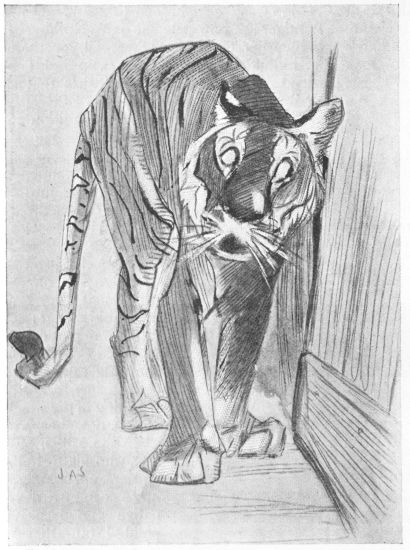
"ONCE MORE THE TIGER VENTURED NEAR ENOUGH TO HEAR THE YOUNG JACKALS CRYING."
Mrs. Jackal explained that her children wanted fresh meat, and Mr. Jackal then told the cubs to wait a little. "A great big tiger will come presently, and I will kill him, and you shall have fresh meat."
When the tiger overheard this he was terrified and ran away, but the monkey, following him, contrived to allay his fears, explaining that the jackals were fooling him, and persuaded him to come back. Once more the tiger ventured near enough to hear the young jackals crying, but this time he also hears their father say to them, soothingly:—
"That monkey, who is a great friend of mine, has told me that she would, without fail, bring me a tiger to-day."
Whereupon the tiger, only pausing to strike the unfortunate monkey dead, fled without once looking behind him.
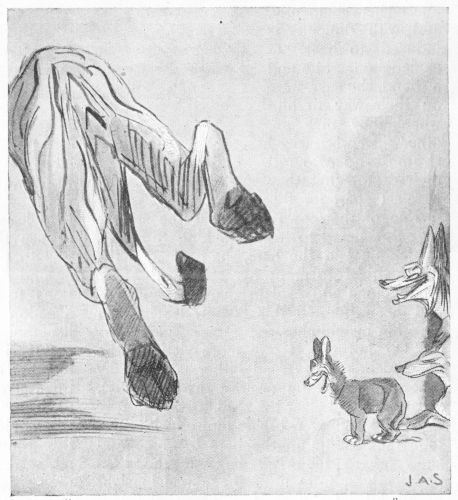
"THE TIGER FLED WITHOUT ONCE LOOKING BEHIND HIM."
Another tale shows the tiger victimized by the cunning of the hare. In this fable the tiger discovers quite remarkable skill in debate; he discourses eloquently on the dignity of labour to justify his depredations in the jungle, and only after prolonged discussion with the beasts does he consent to their proposal that he shall stay at home and they provide him with a daily victim. For a time all goes smoothly; then the hare's turn comes and she objects, saying, "How long is this oppression to last?" The other beasts cry out upon her for wishing to break the agreement, and are only half satisfied when the hare hints that she has a plan for making an end of the tiger. They wish to know what it is; but the hare in reply quotes a saying which, by the way, sheds significant light on the insecurity of travellers' lives and property in Afghanistan. "Three matters," she reminds them, "are best concealed: first, one's money; second, the time one intends to start on a journey; third, the road one intends to take."
In a word, she keeps her own counsel and starts so late for the tiger's den that that animal grows hungry and—there is a good deal of human nature in tigers—very angry at the delay of his dinner. When the hare, apparently in a great hurry, arrived the tiger abused her vehemently, and with difficulty is induced to hear her explanation. She and a friend, she says, were on their way to him when they met another tiger who seized them; she warned their captor that they were set apart for the service of their own king, but the strange tiger threatened to tear their king to pieces. At length, said the hare, she persuaded the strange tiger to grant her respite that she might come and explain matters; and she had been granted this favour, leaving her friend in his clutches.
"Do not expect any more victims," she concluded. "The road hither is closed by that tiger. If thou desirest thy daily food, go at once and clear the road."
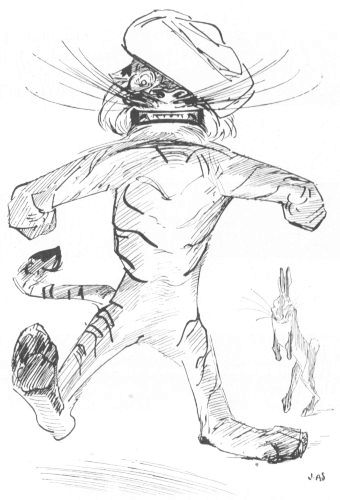
"THE TIGER BESIDE HIMSELF WITH RAGE."
At this the tiger, beside himself with rage, jumps up, calling on the hare to come and show where his rival is, and the hare obediently follows, until they come in sight of a well by the road. There she lags behind; she is frightened to death. Cannot the tiger see how pale she is? Nothing will induce her to go near that well, for therein is hiding the other tiger, who holds her friend captive. The tiger insists that she shall come and point out the other tiger. Well, the hare will do so on condition that his Majesty holds her in his arms. He does so, and, peeping into the water, sees their reflection in the water below; whereupon he sets the hare down, and springing into the well to fall upon his enemy is drowned.
A story that seems familiar is that of the friendship of the frog and the rat. These two conceived so deep a regard for one another that they were miserable apart: the rat, more particularly, bewailed the facts that she only saw the frog once a day, and that he, being in the stream, could not hear her when she called. The frog, whose attachment appears not wholly to have obscured his native good sense, pointed out that "if friends see each other occasionally only their affection is the greater," to which argument, albeit undeniable, the rat objected that in their case some means of establishing closer communication were indispensable.
The frog gave way, and the two agreed to tie the ends of a string to a leg of each, so that when one wanted to see the other all he or she need do was to pull the string. Other frogs came around and pointed out the obvious objections to supplementing the bonds of their affection with string, but neither would listen.
"It is all right," they said; "if we die together, so much the better"; and so they tied themselves as they had arranged. And one day came a kite, who pounced upon the rat, who could not escape because he tripped in the string; and the kite, carrying away the rat, carried away the frog at the other end of the string. And the dying moments of the frog were embittered by hearing the villagers applaud the cleverness of a kite who could catch frogs; whereas he knew the kite had done nothing clever, but that he himself had done something very foolish.
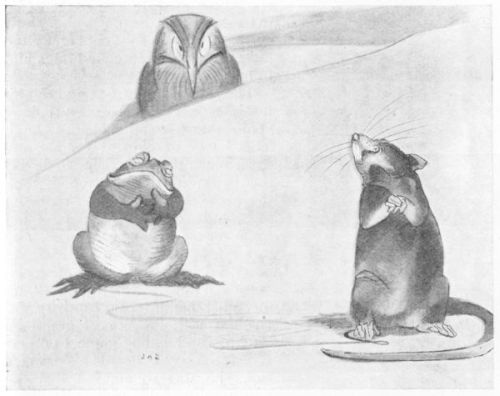
"IF WE DIE TOGETHER, SO MUCH THE BETTER."
Another tale exhibits the helpless old tiger dependent for his daily fare on the cunning of his humble follower the fox, and insists upon the stupidity of the ass. The tiger was so old and decrepit that he could not hunt for himself, and he appealed to an elderly vixen, who was also hungry, to lure an ox or some other beast within his reach. The vixen willingly assents, and searching the country finds an ass feeding. Him she accosts with respectful sympathy, asking why he grazes on such poor pasture. The ass, who, by the way, is deplorably long-winded, replies by giving the vixen a lecture on the propriety of contentment with one's lot.
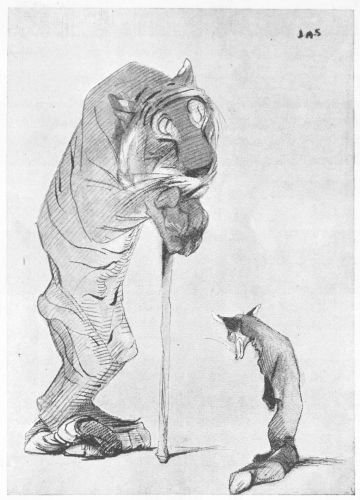
"HE APPEALED TO AN ELDERLY VIXEN."
The vixen listens patiently and replies, Eastern fashion, with a brief parable, whose moral is that those who can help themselves to the good things of life should do so. The vixen's parable reminds the ass of another rather like it, but very much longer and pointing a different moral; he relates it with circumstance and detail. After much argument the vixen loses patience, and upbraiding the ass for his want of enterprise describes in graphic language the attractions of certain pasture known to her; and the ass, his hopes getting the better of his discretion, follows, till they come within eye range of the tiger.
The tiger, being very hungry, cannot wait till the ass comes within reach; he rushes out prematurely and frightens the ass away. This precipitation on the tiger's part gives rise to unpleasantness. The vixen, naturally enough, is furiously angry at the way her scheme has been upset after all the trouble she has had with the argumentative ass, and she speaks her mind freely to the tiger. He apologizes, and the vixen consents to try and bring the prey within reach again. In fine, she out-argues the foolish ass and eventually brings him to her patron.
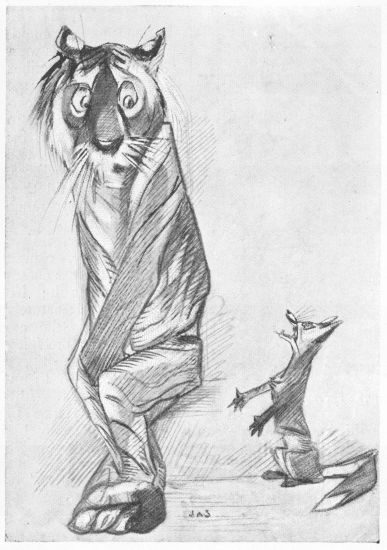
"SHE SPEAKS HER MIND FREELY TO THE TIGER."
The story of the Cock and Hawk furnishes a caution against talking about things we don't understand. These two were great friends and spent much time together. One day the hawk, in didactic mood, took the cock to task for the shameful ingratitude of his race; men fed fowls on all kinds of luxuries, and cared for them carefully, and yet never did fowl see a man approach but it ran away. Now the hawk, on the other hand, repaid captivity and cruelties with the utmost gratitude, catching and killing game to order. When the cock heard his friend's views he was so amused that he nearly dropped with laughing. The hawk, rather stiffly, inquires what he has said that the cock should be so overcome with amusement; and, being reminded that men only feed fowls in order to kill and eat them, confesses that this most important detail had never struck him.