THE THREE GOLD HAIRS OF OLD VSEVEDE
Reading edition
A Story for Children From the SERVIAN
It is related that there was once a King who was passionately fond of hunting the wild beasts of his forests. On one occasion he chased a stag so far and so long that he lost his way. Finding himself quite alone and night coming on, he was glad to fall in with the hut of a charcoal-burner.
"Will you be so good as to conduct me to the nearest highway? I will generously reward you for the service."
"I would do it with pleasure," replied the charcoal-burner, "but I have a wife who is about to become a mother, and I cannot leave her alone. On the other hand, why cannot you pass the night with me? Go up into our hay-loft, and rest yourself upon a truss of sweet-smelling hay which you will find there, and to-morrow I will guide you on your way."
A few minutes later the charcoal-burner's wife brought into the world an infant son.
The King was unable to sleep. At midnight he noticed lights moving in the chamber beneath, and, applying his eye to a crack in the floor, he perceived the charcoal-burner sleeping; his wife lying in a half-fainting condition; and, lastly, standing by the new-born child, three old women, dressed in white and holding each a lighted wax candle, who were conversing.
The first said:—
"To this boy I give courage to dare all dangers."
The second said:—
"I will endow him with the faculty of being able to escape all dangers and to be long-lived."
The third said:—
"As for me, I will give him the hand of the daughter just born to the King who is sleeping in the hay-loft over our heads."
With the utterance of the last words, the lights went out and all was silent again.
The King was as much stunned with sorrow and surprise as if he had received a sword's point in his breast. Until dawn, without closing an eye, he lay thinking of how he might prevent the realization of the witch's prediction.
With the first beams of morning light, the infant began to cry. The charcoal-burner rose and, going to his wife's side, found that she was dead.
"Poor little orphan!" he cried, sadly; "what will become of you, bereft of a mother's care?"
"Confide this child to me," said the King; "I will take care of it, and it will find itself well off. As to yourself, I will give you so much money that you shall have no further need to tire yourself by burning charcoal."
The charcoal-burner gave his consent with pleasure, and the King departed, promising to send somebody for the infant. The Queen and the courtiers had, meanwhile, arranged to give the King an agreeable surprise, by announcing to him the birth of a charming little Princess, who had come into the world on the night when the King, her father, saw the three witches. Knitting his brow, the King called one of his attendants to him and said:—
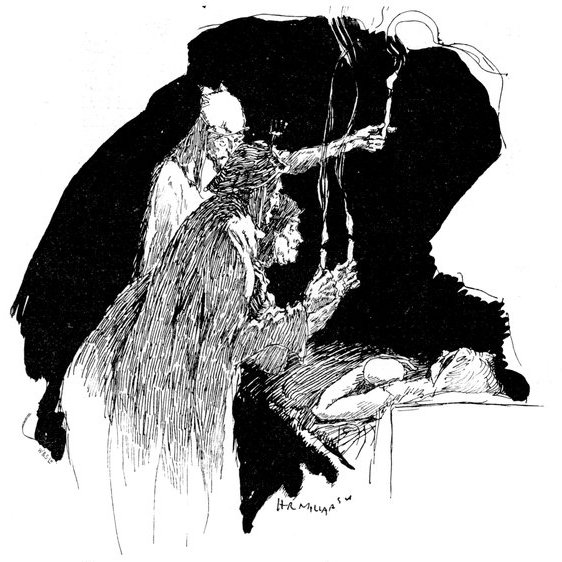
"HOLDING EACH A LIGHTED WAX CANDLE."
"Go to such and such a place in the forest, to the hut of a charcoal-burner, to whom you will give this money in exchange for a new-born child. Take the brat and, somewhere on your way, drown it. Only remember that if it be not thoroughly done away with, you yourself shall take its place."
The servant received the infant in a basket, and, having reached a footbridge over a wide and deep river, he threw the basket and the infant into the stream.
"A good journey to you, son-in-law!" cried the King, on hearing the servant's report of his mission.
The King believed that the child was drowned, but it was neither drowned nor dead; on the contrary, supported by the basket in which it was inclosed, the little one floated gently down the river, as in a cradle, and slept as sweetly as if its mother had sung it to rest.
After awhile the basket came near the hut of a fisherman who, while busy repairing his nets, caught sight of something floating in the water in mid-stream. Quickly jumping into his boat, he rowed out to the object and, having secured it, ran to tell his wife what he had found.
"You have always desired to have a son," he cried; "here is a handsome one brought to us by the river."
The fisherman's wife received the infant with great joy, and tended it as if it were her own. They called it Plavacete (the Swimmer), because it came to them floating on the waters. Years sped, the little foundling grew up to be a man, and in none of the neighbouring villages was there a youth to compare with him.
Now, it happened one day, in the summer time, that the King rode out unattended. The heat was excessive, and he reined in his steed in front of the fisherman's hut to ask for a glass of cold water. Plavacete brought it out to him; the King looked at him intently, then, turning to the fisherman, said:—
"You have a handsome youth there: is he your son?"
"Yes and no," replied the fisherman. "Twenty years ago, I found a tiny child in a basket floating down the river; I and my wife adopted him."
The King turned pale as death, for he guessed that it was the same infant that he had condemned to be drowned. Collecting himself, he dismounted and said:—
"I want to send a message to the castle, and I have nobody with me; can this youth deliver it?"
"Certainly," replied the fisherman; "your Majesty may rely on his intelligence."
Thereupon the King sat down and wrote to the Queen these words:—
"The young man who brings you this message is the most dangerous of all my enemies. As soon as he arrives, have his head chopped off. Do not delay one moment and have no pity; let him be executed before I return to the castle."
After carefully folding the letter, he fastened it with the Royal seal.
Plavacete took the letter and set off with it through the forest, which was so wide and dense that he lost his way in it. Overtaken by night in the midst of his adventurous journey, he met an old woman.
"Where are you going, Plavacete, where are you going?" she asked.
"I am intrusted with a letter for the Royal castle, but I have lost my way; can you not, good mother, set me on my right road?"
"To-day, my child, that is impossible. Darkness has come, and you would not have time to reach the Royal castle," replied the old woman. "Rest in my dwelling-place to-night—you will not be with a stranger there, for I am your god-mother."
The young man obeyed, and they entered a charming cottage which seemed suddenly to rise out of the ground. Now, while Plavacete was sleeping, the old woman changed his letter for another, running thus:—
"Immediately upon receiving this letter, conduct the bearer to the Princess, our daughter. This young man is our son-in-law, and I wish them to be married before my return to the castle. Such is my will."
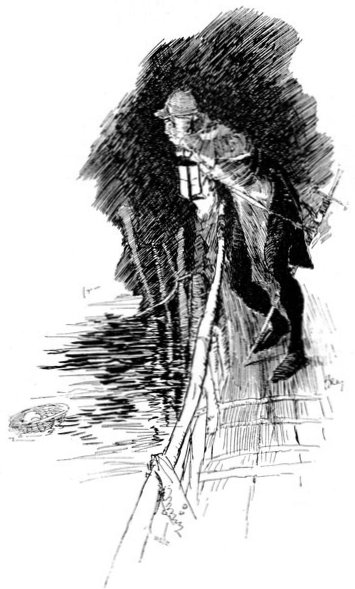
"HE THREW THE BASKET AND THE INFANT INTO THE STREAM."
After reading the letter, the Queen gave orders for the preparation of all that was needed for the celebration of the wedding. Both she and her daughter were greatly pleased with the behaviour of the young man, and nothing troubled the happiness of the newly-married pair.
A few days afterwards the King returned to his castle and, having previously learned what had taken place, began to scold the Queen.
"But you expressly ordered me to have them married before your return: here is your letter—read it again," replied the Queen.
He carefully examined the epistle, and was obliged to admit that the paper, the writing, and the seal were all unquestionably authentic. He thereupon called for his son-in-law, and interrogated him as to the details of his journey.
Plavacete withheld nothing from his father-in-law, and related how he had lost his way in the forest and had passed the night there in a cottage.
"What is this old woman like?" asked the King.
On hearing the description given him by Plavacete, the King was convinced that it was the identical old woman who, twenty years previously, had predicted the marriage of the Princess with the charcoal-burner's son.
After reflecting for awhile, the King went on:—
"What is done is done: only you cannot be my son-in-law on such slight grounds. For a wedding present, you must bring me three hairs plucked from the head of Dede-Vsevede, the old man who knows all and sees all."
He thought by this means to get rid of his son-in-law, whose presence embarrassed him.
Plavecete took leave of his wife departed, saying to himself:—
"I do not know which way to turn my steps; but no matter, my god-mother will direct them."
He was not deceived. Without difficulty he found the right road, and pressed forward for a long time over hill and dale and river, until he reached the shore of the Black Sea, and observed a boat with its one boatman, to whom he said:—
"Heaven bless you, old boatman!"
"The same to you, young traveller. Where do you want to go?"
"To the castle of Dede-Vsevede, to get three hairs from his head."
"If that is so, welcome! I have long awaited the arrival of such an envoy as you. For twenty years I have been rowing passengers across, and not one of them has done anything to deliver me. If you promise me to ask Dede-Vsevede when I am to have a substitute to free me from my troubles, I will row you over in my boat."
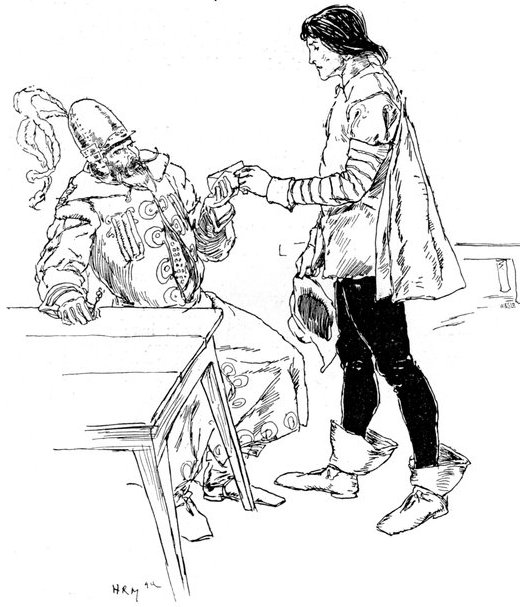
"PLAVACETE TOOK THE LETTER."
Plavacete promised, and the boatman rowed him to the opposite shore. He thence continued his journey, and approached a great city, which was partially in ruins. Not far from it he saw a funeral procession; the King of the country followed the coffin of his father, and tears as big as peas rolled down his cheeks.
"Heaven console you in your distress," said Plavacete.
"Thanks, good traveller. Whither are you going?"
"To the castle of Dede-Vsevede, in search of three hairs from his head."
"You are really going to the castle of Dede-Vsevede? What a pity you did not come some weeks ago! We have long been waiting such an envoy as you."
Plavacete was introduced to the Court of the King, who said to him:—
"We have learned that you are bound on a mission to the castle of Dede-Vsevede: alas! we had here an apple-tree which produced youth-giving fruit; one only of its apples, as soon as it was eaten, even by a person at the point of death, instantly cured and rejuvenated him. But for the last twenty years this tree has not borne either flower or fruit. Will you promise me to ask the cause of Dede-Vsevede?"
"I promise you."
After that, Plavacete came to a large, beautiful, but silent city. Near the gate he met an old man, who, staff in hand, was hobbling along with great difficulty.
"Heaven bless you, good old man!"
"Heaven bless you! Whither are you going, handsome traveller?"
"To the castle of Dede-Vsevede, in search of three hairs from his head."
"Ah! you are the very envoy I have so long been expecting. I must conduct you to my master, the King. Follow me."
As soon as they arrived, the King said to him:—
"I hear that you have come on an embassy to Dede-Vsevede. We had here a well which used to fill itself, and which was so marvellous in its effects that sick people were immediately cured on drinking of its water. A few drops sprinkled upon a corpse sufficed to resuscitate it. Well, for twenty years past, this well has been dried up. If you promise to ask Dede-Vsevede how we can re-fill our well, I will reward you royally."
Plavacete promised, and the King dismissed him graciously.
Continuing his journey, he had to pass through a wide forest, in the midst of which he perceived a broad, grassy plain, full of beautiful flowers, in the centre of which stood a castle built of gold.
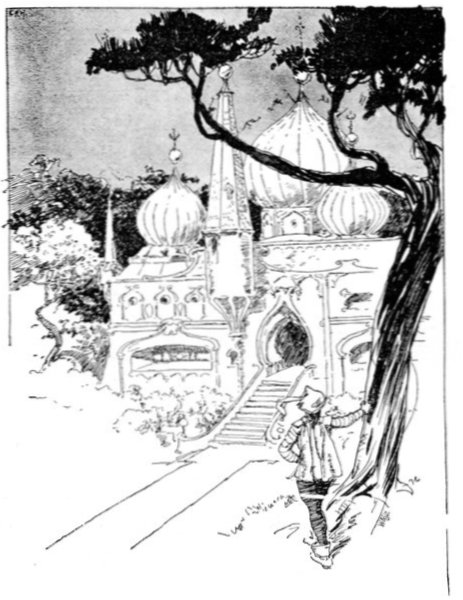
"THE PALACE OF DEDE-VSEVEDE."
It was the palace of Dede-Vsevede, radiant with splendour, looking as if it were made of fire. Plavacete entered it without encountering a single moving creature, except an old woman, half-hidden in a corner spinning.
"Welcome, Plavacete! I am glad to see you here."
It was, once more, his god-mother, the same who had offered him shelter in her forest cottage when he was carrying the King's treacherous message.
"Tell me what brings you here, from so far off?"
"The King will not have me for his son-in-law without being paid for it; so he has sent me here to fetch for him three gold hairs from the head of Dede-Vsevede."
His god-mother burst into laughter, saying:—
"The Dede-Vsevede? Why, I am his mother—he is the shining Sun in person! Every morning he is a child; at noon he becomes a man; at evening he withers to the likeness of a decrepit, hundred-year-old man. But I will contrive to get you three gold hairs from his head, so that you may know that I am not your god-mother for nothing. For all that, however, you cannot remain here any longer as you are. My son, the Sun, is endowed with a charitable soul; but, on returning home, he is always hungry, and it would not astonish me if, as soon as he comes back, he ordered you to be roasted for his supper. To hide you I will overturn this empty box, under which you must creep."
Before obeying, Plavacete begged his god-mother to obtain from Dede-Vsevede answers to the three questions which he had promised to get from him.
"I will put the questions to him, but you must carefully listen to the answers he returns."
Suddenly the wind was unchained without, and, through a window on the western side of the castle, arrived the Sun—an old man with a head of gold.
The old man sat down to supper. After the meal was finished, he placed his head of gold upon his mother's knees and fell asleep.
As soon as she saw that he was sleeping soundly, she plucked from his head one of his gold hairs and threw it upon the floor: in falling the hair made a metallic sound, like the string of a guitar when struck.
"What do you want of me, mother?" asked the old man.
"Nothing, my son; I was sleeping and dreaming a strange dream."
"What was it about, mother?"
"I thought I saw a place—I don't know where—where there was a well supplied with water from a spring, by which sick people were cured, and even dying persons, after drinking a single mouthful of it; and more than that, corpses even were resuscitated after having been sprinkled with a few drops of this marvellous water. But for twenty years this well has remained dry: what should be done to fill it as of old?"
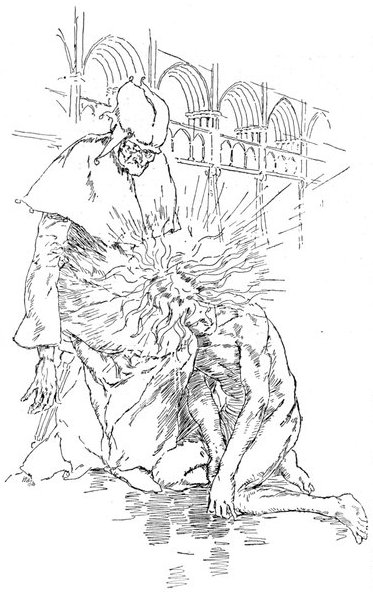
HE PLACED HIS HEAD OF GOLD UPON HIS MOTHER'S KNEES."
"The remedy is simple enough: a frog has lodged itself in the opening, and so prevents the water of the spring entering the well. Let them kill the frog, and their well will be as full of water as it used to be."
When the old man was again soundly sleeping, the old woman plucked another gold hair from his head and threw it upon the floor.
"What do you want of me, mother?"
"Nothing, my son, nothing. While sleeping I had a strange vision. It seemed to me that the inhabitants of a city—what city I do not know—had in their garden an apple-tree, the apples of which possessed the virtue of renewing the youth of whomsoever ate of them. A single apple eaten by an old man sufficed to give back to him the strength and freshness of youth. Now, for twenty years, that tree has borne neither flower nor fruit. By what means can they bring back to it its former power?"
"The means are not difficult. A viper has hidden itself amongst the roots of their tree and feeds on its sap; let them kill the viper and transplant the tree, and they will soon see it covered with fruit as it used to be."
Thereupon the old man once more went off to sleep soundly. The old woman plucked from his head the third gold hair.
"Why do you not let me sleep in peace, mother?" cried the old man, angrily, and trying to rise.
"Lie still, my beloved son, and do not disturb yourself. I am sorry for having waked you. I was having a strange dream. Fancy! I seemed to see a boatman, on the shore of the Black Sea, complaining to a traveller that, for twenty years, nobody had come to replace him: when will that poor old man be relieved of his task?"
"He is an imbecile, that is all! He has only to put his oar into the hand of the first person who wants to be rowed and jump ashore. Whoever receives the oar will replace him as boatman. But leave me in peace, mother, and do not wake me any more; for I have to be up early, first to dry the tears of the Princess, the wife of a charcoal-burner's son. The young creature passes her nights in weeping for her husband, who has been sent by the King, her father, to fetch him three gold hairs from my head."
Next morning the winds were heard howling around the palace of Dede-Vsevede, and instead of an old man, a beautiful child, with hair of gold, awoke on the old woman's knees: it was the divine Sun, who, after taking leave of his mother, flew out of the eastern window of his palace.
The old woman hastened to turn over the box, and said to Plavacete:—
"See! here are the three gold hairs, and you already know the three answers given by Dede-Vsevede. Now hasten away, and Heaven be with you on your way. You will never see me again, for you will never again have need of me."
Plavacete gratefully thanked her and departed.
On reaching the city of the dried-up well, and questioned by the King as to what good news he was the bearer of, he replied:—
"Have your well carefully cleared out; then kill the frog which obstructs the incoming of the marvellous water from the spring, and you will see it flow as freely as ever."
The King followed the direction of Plavacete, and, delighted to see his well once more filled, made him a present of twelve horses as white as swans, to which he added as much gold and silver as they could carry.
On arriving at the second city and questioned by the King as to the news he brought, he replied:—
"The news I bring you is excellent; none could be better, in fact. You have but to dig up your apple-tree and transplant it, after killing the reptile which has been living amongst its roots; that done, your tree will produce you apples as it formerly did."
Indeed, no sooner was the tree transplanted than it became covered with flowers, as if a shower of roses had fallen upon it. The King, filled with joy, made him a present of twelve horses as black as ravens, and loaded them with as much riches as they could bear.
Continuing his journey to the shore of the Black Sea, he found the boatman, who inquired whether he had learnt for him when the time of his deliverance would come. Plavacete first made him convey him and his horses on to the opposite shore: that done, he advised the boatman to hand his oar to the first traveller who required his services, so that he might be definitely released from his duty.
The King, Plavacete's father-in-law, could not at first believe his eyes on seeing him the possessor of the three gold hairs plucked from the head of Dede-Vsevede. As to the young wife, she shed hot tears, not of sadness, but of joy, at seeing her beloved back again in safety, and she said to him:—
"How were you able, dear husband, to acquire so many magnificent horses laden with riches?"
He replied:—
"All has been purchased with heaviness of heart, with the ready money of pains and labours, and services rendered by me. For example, to one King I pointed out the means by which he was able to repossess himself of the Apples of Youth; to another, I showed the secret of re-opening the spring whence flows the water which gives health and life."
"Apples of Youth! Water of Life!" interrupted the King, addressing Plavacete. "I will go in search of those treasures myself! What happiness! After eating one of those rejuvenating apples, I shall return restored to youth! Then I will drink a few drops of the water of immortality—and I shall live for ever!"
Without delaying a moment, the King set off in search of those two objects—and down to the present day has never been heard of again.