A Bohemian Artists' Club.
Reading edition
By Alfred T. Story.
London numbers many societies for artists; but there is not another so quaint in its style and so characteristic in all its methods as the Langham Sketching Club, or, as it is called in brief parlance, and, in fact, more correctly, "The Langham," for the Sketching Club is in reality only a part of the whole. It is a very modest and retiring body, and does not make much ado, or call public attention to itself by the usual and popular methods of gaining notoriety.
These have always been its leading characteristics. It thought so little of itself, indeed, in the first instance that it allowed itself to be ushered into existence in a lowly shed at the bottom of a mews, or in a stonemason's yard, as some say. This humble abode was situated in Clipstone Street, Fitzroy Square, and the society's nativity took place what time the Sailor King ruled the land, some eight years before Her present Gracious Majesty ascended the throne.
It was started by eight men, who wished by co-operation and emulation to improve themselves and each other in the art which they had adopted as their profession; and it is significant of the oddity which has ever characterized the society and its proceedings that, no sooner had the resolution been carried confining its membership to the eight founders, than it admitted a ninth. These nine original members were: W. Kidd, F. Gary, J. C. Zeitter, A. M. Huffam, John Knight, William Purser, William Derby, J. Mimpriss, and William Brough, the latter being the honorary secretary.
According to the rules they framed for their governance, the society was to be "for the study of artistic human figures." It was to meet three times a week, in the evening, and work for a couple of hours. Each member on joining was called upon to subscribe ten shillings; after which, his contribution consisted in paying his share of the expenses. These were totted up at the end of the week, and then and there settled. Fines were imposed for non-attendance, unless the absentee were able to produce good and sufficient reason for his non-appearance; and for a long time to come the chief business of the committee appears to have been to impose these fines, then remit them, or discuss the means of enforcing their payment upon men who were generally light-hearted, except when weighed down by the lightness of their pockets. Peace be to their souls! If there were not many Michael Angelos among them, there was an infinite amount of good-fellowship.
The actual date of this simple and democratic constitution was March 9, 1830; but it had no sooner been framed than—as in the case of another and more famous constitution—it was found necessary to go to work and tinker it into shape and usability. Hence, between then and now, it has undergone many changes, albeit nothing has been done to detract from its broad fundamental characteristics. The club (for such, in fact, it is) may be said to combine the greatest amount of good-fellowship with the least possible restraint by rule and regulation.
A year after the society's foundation a somewhat radical change took place. It had quickly been found impossible to confine its membership to the original nine founders, and the number was gradually increased to fifteen. Now it was decided to divide the society into members and subscribers; the former paying a pound a quarter and constituting the governing body; while the latter paid twenty-seven shillings and had no part whatever in the management—in this also following the example of our national Constitution as it then was.
At first members and subscribers were alike ten in number; but in course of time the members were increased to fifteen, and a larger proportion of subscribers admitted. This rule still obtains. A still further development took place a month or two later, when it was decided to elect a president, the first gentleman to be accorded the honour being Mr. Knight.
Curiously enough, until this time it had never occurred to the members that their society was without a name. The fact having been accidentally discovered, it was resolved to adopt as style and title, "The Artists' Society for the Study of Historical, Poetic, and Rustic Figures."
From time to time the number of evenings devoted to study was gradually increased, until every week-day evening was occupied. Further developments had in the meantime taken place. In 1841, on the suggestion of William J. Müller, the study of the antique was included in what we may call the curriculum. This involved the renting of another room (the society was still in its mews) at a cost of £25 a year. About the same time the study of the nude was introduced, and became henceforth a leading feature of the society. In 1838 an attempt had been made to form a society for ladies, in conjunction with the Artists' Society, "for the study of costume and the draped figure," but although started with some éclat, it appears before long to have ended without regret a brief and forlorn existence.
We soon begin to come across historical names. In 1835 Haydon presents the society with a drawing of "The Gate Beautiful," by Raphael, made by his pupil, C. Landseer. Mr. D. V. Riviere is elected, also a Mr. F. Cruikshank, though he appears never to have attended. Two years later Mr. E. Corbould becomes a subscriber, and in the year following, the well-known watercolourist, Frank W. Topham, and Mr. W. Riviere. In 1839 Dodgson and Lee were elected subscribers; and the same year the veteran Louis Haghe, still living, was made president.
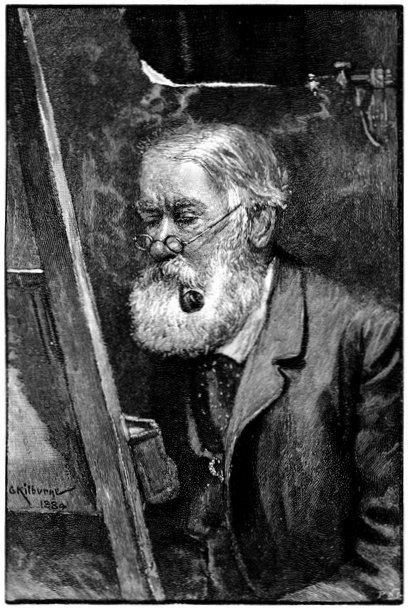
JOHN ABSOLON.
From the Picture by G. G. Kilbourne
During these early years courses of lectures on various subjects connected with art were given by competent gentlemen. Mr. W. R. Toase, F.L.S., discoursed on "Anatomy," illustrated by living models; Mr. Benjamin R. Green lectured on "Perspective"; Mr. C. H. Smith, on the "Importance of Trifles in Historical Design"; Mr. George Foggo, on "Pictorial Composition"; and last, though not least, a Mr. R. Cull (one fancies there should have been an "s" to this name), on "Phrenology as Applicable to Art." At that time phrenology was in high favour, was patronized by the great and the learned, and generally regarded as going to do wonders. Many artists in those days, Blake and Linnell among the number, devoted some attention to it; but now, with the exception of one leading Academician, it would be difficult to find any artist who had given so much as a passing glance at the science: if they had, we should at least have been spared the sight of such monstrosities of heads as we now see.
In 1841, under the presidency of John Absolon, another veteran member who is still amongst us, it was decided to elect a certain number of honorary members, and Mr. James R. Planché, the dramatist and authority on costume and heraldry, was the first gentleman chosen. In honour of this election a conversazione was held, to which a number of distinguished guests were invited. This was the first entertainment of the kind given by the society. Since then it has become noted for its gatherings of a similar nature.
At one time the rule was to hold one every quarter. This was when the treasury was in good order. When funds were low it was necessary to be satisfied with two, or even one, a year. They were—and are still—the very simplest of affairs, and Bohemian to the last degree. For this reason it is that they are so much enjoyed by those who have the luck to get an invitation. The invariable fare is bread and cheese and salad—au naturel—with ale and stout ad lib., or, as a facetious member once put it, ad lip. Anything of the nature of ceremony is altogether dispensed with; and as there is always a crush, the feast generally assumes the form of a scramble. City magnates have been known to take part in these sans façon regales, and to confess afterwards that they found them more amusing and enjoyable than a Guildhall banquet; while fashionable R. A.'s and A. R. A.'s have been seen to retire into a corner with a hunk of bread and cheese in one hand and a pot of porter in the other, and set to like costers—showing that we are all built much on the same mould, under the clothes.
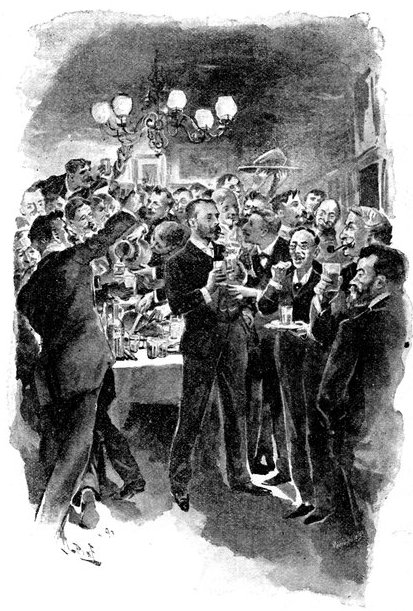
A CONVERSAZIONE SUPPER.
Drawn by W. H. Pike.
On these occasions the members exhibit their works—sketches that have been done in the classroom, or pictures destined for one or other of the exhibitions—and receive the useful, and generally very generous, criticisms of their friends. Then, to round off the evening, there are singing, music, and recitations, or it may be a bit of character acting. Once we had the pleasure of seeing a well-known A. R. A. and another equally clever artist dress up from the club wardrobe (which is a rich and varied one) as "Black Sall" and "Dusty Jim," and give an improvised dance, to the infinite delight alike of members and guests.
But—to go back a little—in 1842 the most characteristic feature of all in connection with the society had its beginning, namely, the Sketching Club. This is, in reality, quite distinct from the society, although members may belong to it; but its membership is recruited chiefly from outside, and is practically unlimited. The club meets every Friday evening, a subject—or, perhaps, two—is given, and each artist realizes it as best he can. The sketch has to be completed in two hours, and when the time is up, there is a general examination of work, with free criticism, suggestion, and so forth. They may be done in any manner—in oil, water-colours, black and white, or modelled in clay. It is a capital school; every man is put on his mettle, and, of course, does his best. Not a few pictures, now celebrated, had their beginnings on these evenings.
Work being done, supper is discussed; the fare consisting of a cold joint, bread and cheese, with, of course, ale and stout to wash them down. It is at this time that new members are elected. Before a candidate can be chosen he has to submit a sketch. This is carried round by the honorary secretary and shown to each member in turn, his vote for or against the candidate being thus taken.
These suppers are always interesting, and sometimes very amusing, as they can hardly help being when so many men of varied talent, and some of absolute genius, are constantly meeting together and exchanging views. Sometimes, while the others are talking, or "chaffing," one member will be quietly jotting down some characteristic faces in his sketch-book, or taking a sly note on his cuff. At other times the fun becomes a little uproarious, and the wildest pranks are indulged in.
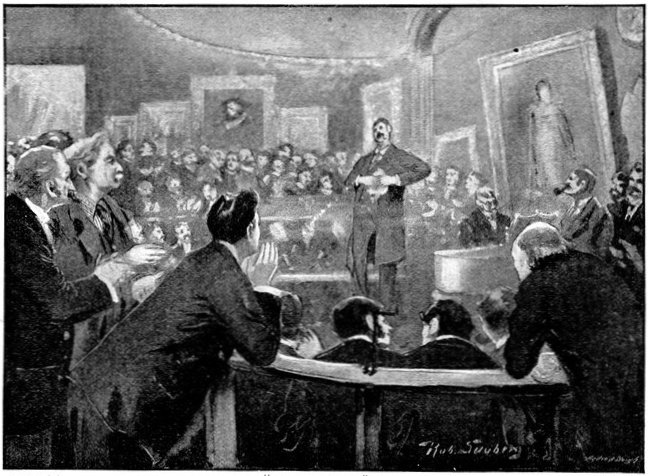
"MUSIC AND SONG."
Drawn by Robt. Sauber.
On one occasion the late Charles Keene and Mr. Stacy Marks, both of whom were members for many years, had a jumping match. A rod was laid lightly from the rail round which the members work to a box at a height of about three and a half feet from the ground. Marks cleared the rod with ease at a standing jump. Keene, though he tried several times, could not quite accomplish the feat. When he seemed to be on the point of giving up the contest an artist named Wingfield, "a fellow of infinite jest," and a great character to boot, said, very quietly, "Take a pinch of snuff, Mr. Keene; that will enable you to do it." The suggestion was given with such placid sangfroid that it convulsed the room. Keene, however, did not take the hint.
Keene was elected a full member of the society in 1853, though he had already been a subscribing member for several years. He was one of the quietest of men, and seldom had much to say for himself; howbeit, he did occasionally come out with a dry, caustic remark, that told like one of the sly, humorous touches of his pencil; as, for instance, when he bade an old woman who was castigating her ill-mannered donkey, hired for the evening as a model, that she might spare the rod there, as none of them minded his behaviour, because they were not any more thin-skinned than her "moke."
Tenniel, Keene's coadjutor on Punch, was president of the society so far back as 1849.
Among other distinguished or notable men who have been, or still are, members, may be mentioned Mr. Poole, R.A., some of whose sketches are as grand as many of his finished pictures are weak. He was a fellow-member with H. B. Pyne and James Müller. The latter was president in 1844, and died during his year of office, killed, as it was thought at the time, by the scant justice done to him by the Academy; his works, now so highly esteemed, being invariably "skied." While his pictures now fetch thousands, he died in debt to the society. Alfred Fripp, the watercolour painter, and Fred Goodall became members about the same time. Between 1846 and 1848, Stanfield, junr., W. Goodall, W. Dyce, H. J. Boddington, and A. J. Lewis joined the society, and J. P. Knight, R.A., was elected an honorary member. A little while previously the same honour had been conferred upon Mr. G. Field, the colour manufacturer, and Mr. J. H. Rogers, lecturer on anatomy.
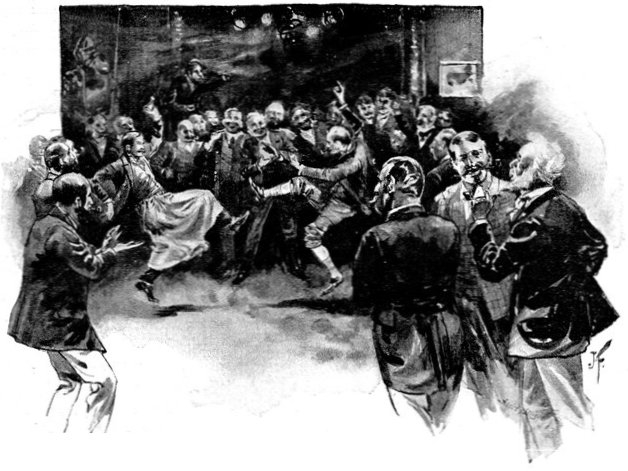
CHARACTER DANCE BY ARTISTS.
Drawn by J. Finnemore.
In 1860 the society removed from the quarters it occupied in Clipstone Street to its present abode in the Langham Chambers, Portland Place. Of the men who were then members not many are left, but we may name Charles Cattermole, nephew of the famous George Cattermole, and for many years hon. secretary of the society, and J. A. Fitzgerald, son of Byron's "hoarse" Fitzgerald,[1] and almost as noted as his father for his histrionic gifts. Several who were then members have since left, notably Mr. Lawlor, the sculptor, the late Vicat Cole, R.A., and F. Weekes. A. J. Stark also was a member at that time. G. Kilburne joined the society shortly after it removed to Langham Chambers; B. W. Leader, R.A., Henry Telbin, the scene painter, and C. Armitage joined a year later; while between then and 1865, Robert Landells, a man of great ability, who went through the Franco-German War as artist for the Illustrated London News, E. T. Coleman, J. T. Watson, F. Lawson, W. M. Wyllie, G. G. Kilburne, E. Law, the engraver, James Gow, and Fred Barnard became members or subscribers. Later, Sir James Linton joined the society, the late Mr. C. B. Birch, A.R.A., and William Linnell, son of the famous Linnell, and himself a distinguished painter.
There is generally, just before "sending-in day," a special conversazione, at which members exhibit their pictures before forwarding them to the Academy to be accepted or rejected. In many cases, of course, this is the only "show" they get; but not a few famous pictures have there been submitted to public criticism for the first time. At one such conversazione Mr. Stacy Marks exhibited his famous "Gargoyle" before it went to the Royal Academy. Mr. Calderon, R.A., thus exhibited his "Coming of Age," and Fred Walker his celebrated "Philip in Church," the picture which was the beginning of his fame. Calderon was a member of the Sketching Club; as was also Mr. Poynter, R.A. Fred Walker was a regular member of the society. At one time Mr. W. Gilbert, since become famous in another line of art, was a member, though not for long. He had not yet found his true forte, and so was trying his hand with the brush. What he did was chiefly in the comic vein. He was an amusing companion, however, and noted as a raconteur.
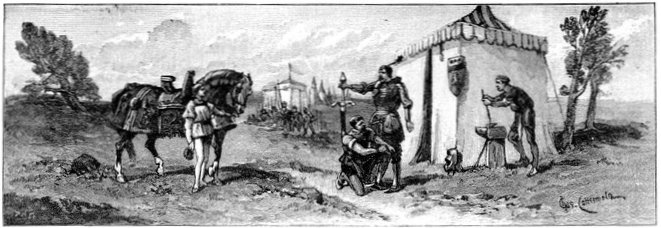
A TWO-HOURS' SKETCH BY CHAS. CATTERMOLE.
An amusing story is told in this connection, albeit not of Mr. Gilbert: At one of the Friday night suppers there was present an artist who had been abroad for some time in connection with one of the illustrated papers. He had been half round the world, and was, naturally, expected to have much to say about his travels. But, no; not a word. "What did you see in China, Mr. Ixe? What in Japan? Did you like the Assyrian maidens, or the Vrows of Batavia?" Thus was he questioned on every side. But, like the needy knife-grinder, he had no story to tell. Meanwhile, at the other end of the table was an artist who had that afternoon been as far as Bedford Park, and was bursting with adventures. "Fitz could make a better book of travels out of a walk up Hammersmith Broadway than Ixe from a tour round the world," remarked one of the wits of the club.
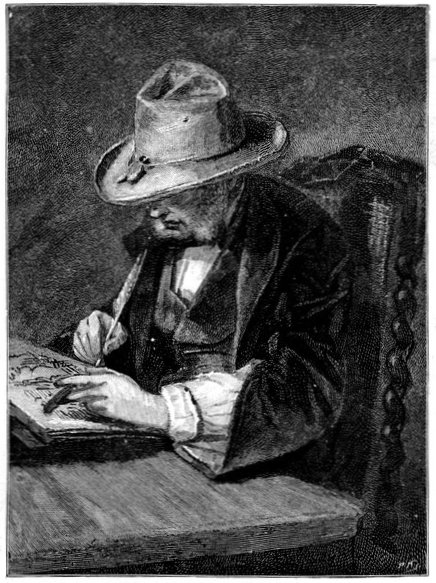
PORTRAIT OF J. D. WINGFIELD.
From the Picture by Carl Haug.
This is the time to hear from the artists' own lips their varied experiences—often highly amusing—in the pursuit of their profession. One, who has a supreme hatred of dealers, tells how he once had one delivered completely into his hands, and he did not drown him. He and three others had taken a walk up the Wharfe to enjoy its beauties, one of them being a dealer. The dealer and another eventually found themselves on the wrong side of the stream, far from a bridge, and it was necessary, in order to avoid a long détour, to wade across. The dealer was no longer young, was unused to the water, except as a beverage, being a teetotaler, and feared all sorts of evils as the result of wetting his feet. He managed to get across in safety, however.
"He reached our side of the river all right," continued the narrator; "but as the bank was steep, he had to appeal to me to give him a hand up; and I weakly did so, instead of putting a mop on him. I could easily have done so, the water being quite deep enough to put him out of his misery. But I didn't do it. Of course, I felt considerable chagrin when I had let him escape. Then, to make matters worse, he asked me for some of my whisky: he knew I carried a little in a bottle—'for my stomach's sake.' Naturally, having been so weak as to let him get out of the water, I could not refuse the whisky. And what do you think he did? He washed his feet with it to prevent him catching cold! I implore of you, should it fall to the lot of any of you to have your enemy delivered into your hands in that way, do not do as I did, but put a mop on him."
It is only needful to begin storytelling in this way to bring out an endless variety. The mention of the Wharfe reminded one man of a deep pool below a waterfall on a northern stream, where he had a most gruesome experience. He had planted his easel, and was beginning to work upon the scene—the waterfall, the black pool, dark surrounding trees, and a blurred and reddening evening sky—when suddenly he perceived a dark object bobbing up and down just in front of the fall. Up and down it danced with the motion of the water, gyrating slowly at the same time. At first he thought it must be a dead dog; then it dawned upon him—and the thought produced an uncanny feeling—that it might be a man's head. Suddenly a stronger wave, a more violent gyration, and there was no longer any doubt. A man's face, with its dead, glassy eyes and streaming hair, was presented to his gaze—and he instantly sprang to his feet and ran, leaving easel, canvas, palette, and brushes to take care of themselves.
Another man tells how, when he was busy upon a choice bit of landscape, a couple of yokels approached, and, after watching for a short time, moved off, remarking that it was a pity such a broad-shouldered fellow could not find something better to do than waste his time like that.
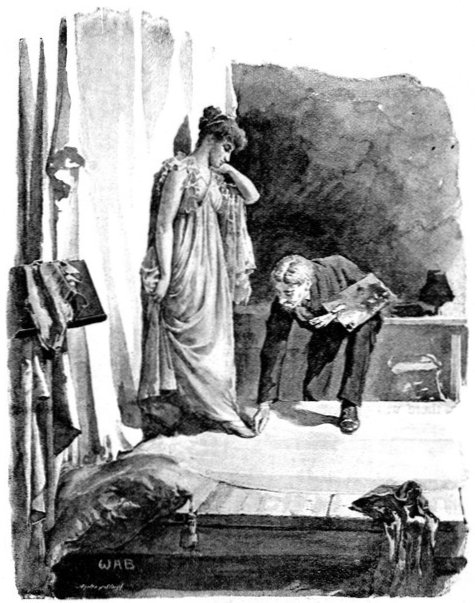
POSING THE MODEL.
Drawn by W. A. Breakspear.
Naturally, there are some stock anecdotes told of fellow-members, which never cease to create a laugh. One hears of the sculptor who, having been too deep in his potations, made his way home late at night with a large codfish under one arm and a lobster under the other, and who found them lying in bed beside him when he awoke in the morning.
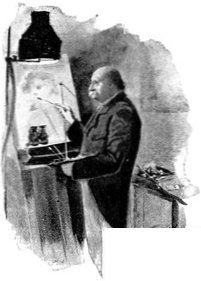
J. A. FITZGERALD.
Drawn by Robert Sauber.
Another artist, presumably in a similar condition of benignity, arriving home very late, softly unlocks the street door, goes up stairs, very softly enters his bedroom, and undresses—very softly, so as not to disturb his wife, and finally creeps into bed—likewise very softly and gently; to be startled by his better half asking him—very softly and gently, no doubt—if he is aware that he has got into bed with his top-hat on!
One member always raises a hearty laugh by his imitation of a brother member—a man of the greatest good humour, but of third-rate ability—who, debating with another artist on the great Whistler question, thus sums the matter up: "If Whistler is right, then you, and me, and Michael Angelo are all wrong."
Sometimes in this way one may pick up some interesting anecdotes of the men of a past generation. Holland, the famous landscape painter, who was once a member, used to have many anecdotes about Turner. On one occasion he was sitting near to him at dinner, when a lady observed to him that she admired his pictures very much, although she could not say that she understood them. "Don't you wish you had the brains to do so?" replied Turner—a little rudely, it must be confessed.
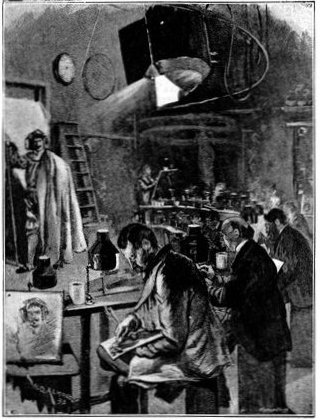
THE LIFE CLASS.
Drawn by W. Douglas Almond.
Members take it in turns to "set" the models, who generally pose for an hour, then take a short rest, and afterwards sit for another hour. They are placed on a raised platform under a top light, the artists being ranged in a semicircle facing them. No one is allowed to speak to the model except the member whose duty it is to set him or her, and the utmost silence is enjoined. Some of the models take great interest in the work of the artists, and like to see what they have made them look like. Many curious characters are found amongst them, and the stories of their humours and oddities are endless and infinitely diverting.
Not the least amusing is that of the man who had posed for apostles and saints so long that he could not be induced to sit for a common coster.
"It would be such a come-down, sir," he said, with a rueful countenance. There is also a story—possibly apocryphal—of a model who had got beyond sitting deploring his changed estate, in that he who had sat for "lords and cardinals" was reduced to "wet-nursing a kangaroo" (having obtained employment at the Zoo).
But perhaps the best story of a model is one that used to be told by Sir Edwin Landseer. It concerned a man named Bishop, a man who will be remembered by nearly all the older generation of artists. Bishop was a bit of a favourite with Landseer, and often sat for him. Once when so employed he thus addressed the famous animal painter: "Sir Ed'n," said he, "I sees from the papers as you of'n dines with Her Gracious Majesty at Buckingham Palace, and as you gets on very well wi' her. Now, Sir Ed'n, I've been a-thinking—if you wouldn't mind the trouble—you might do me and my misses a very good turn—a very good turn, you might. You know, Sir Ed'n, my misses is a rare good washer, and if, next time you dines with Her Majesty—just when you gets cosy like, arter dinner—if you would just pervail on her to give my misses her washing, it would set us up, it would. Now, Sir Ed'n, you'll pard'n me for a-mentionin' of it, but if you could do that for us, we'd take it very kind like."
It is not stated whether the request was ever put to Her Majesty.
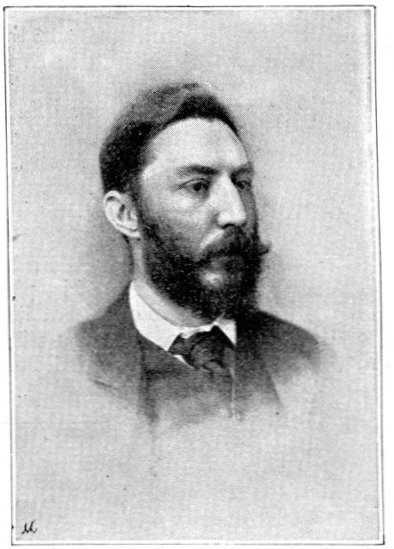
E. C. CLIFFORD (SECRETARY AND LIBRARIAN).
From a Photo by Scott & Sons, Exeter.
It would be unpardonable to conclude without making mention of some of the artists who are at present members, many of whose names are doubtless familiar to readers of the illustrated papers and periodicals, or from their pictures in the exhibitions. Among the number may be noted W. Breakspear, Dudley Hardy, Robert Sauber, George C. Haité (president of the Sketching Club), Bernard Evans, J. Finnemore, W. Pike, Edward C. Clifford, and W. Douglas Almond—the last two holding the positions respectively of honorary secretary and curator of the society.
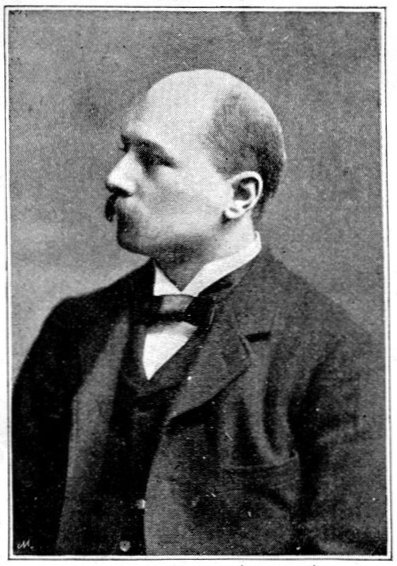
W. DOUGLAS ALMOND (CURATOR).
From a Photo by Russell & Sons.
All the artists whose drawings have been used to illustrate the above article are members of the Society or of the Sketching Club, or both.