Löie Fuller—The Inventor of the Serpentine Dance.
Reading edition
By Mrs. M. Griffith.
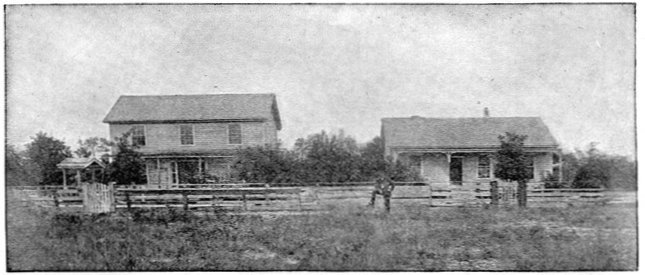
LÖIE FULLER'S BIRTHPLACE.
From a Photograph.
La Reine Löie does not claim for herself the distinction of being the inventor of the graceful evolutions which have made her name famous all over Europe and America. She says: "I have only revived a forgotten art, for I have been able to trace some of my dances back to four thousand years ago: to the time when Miriam and the women of Israel—filled with religious fervour and rapture—celebrated their release from Egyptian captivity with 'timbrels and with dances.'"
This is true; but as "there is nothing new under the sun," I contend that Miss Fuller deserves her title, and also all the tribute and admiration which those who have seen her dance long to lay at her feet. For not even the most realistic description, or the most earnest study of the illustrations which still exist of the girl-dancers of Herculaneum and Pompeii, who, in mist-like robes, with un-girdled waists and sandalled feet, with languorous movements and rapturous uplifted faces, entranced even the most besotted among the revellers at the notorious bacchanalian orgies of those cities of the past—not these, not even the most brilliant pen-painting can convey any idea of La Löie's exquisite dancing. With continuous but gentle movements of arms, feet, and shapely form, the outline of which is sometimes veiled, and at other times revealed amid the folds of her gauzy garments of ever-changing rainbow-like tints, she appears like a supernatural being sent to teach us the poetry of motion.
Suddenly the scene changes; the dancer, with joyous face, parted lips, and floating tresses of red gold, to the accompaniment of weird music, flits here and there: now dreamily floating along the stage, then rapidly whirling round and round; one moment appearing a blaze of fire, the next with sombre draperies, every fold seeming incrusted with jewels, the little feet hardly touching the ground, the pliant form bending and swaying in the constantly-changing light, like some gay-plumaged tropical bird, until her audience hold their breath with admiration.
What a treasure she would have been to the Egyptian and Roman priests of old, in their temple mysteries and religious festivals. And what trouble she would have caused in the last century; indeed, in all probability she would have been burned as a witch; for our ancestors did not waste time in wondering at or admiring things they did not understand, but resorted to fire or water to solve their difficulties.
La Löie's early history is as remarkable as her dances: she has been a reciter, actress, singer, and play-writer, and finally, by a mere accidental circumstance, success has been thrust upon her as a dancer. With that delicate sister-feeling which makes us—providing there is no rivalry—so wondrous kind, I was not curious about Miss Fuller's present age; for, after all, paltry years count not with us, providing the heart keeps young; but I felt I could with discretion inquire at what age she made her first appearance, and learnt to my great surprise that she made her début, at the early age of two, at a Sunday-school entertainment at Chicago; where, unheralded and unannounced, she toddled on to the platform and recited "Mary had a little lamb," in a sweet, shrill treble which was distinctly audible throughout the hall. The wee, quaint little maiden who so gravely contributed her share to the evening's amusement succeeded in charming the audience, and her services were often in request after this.
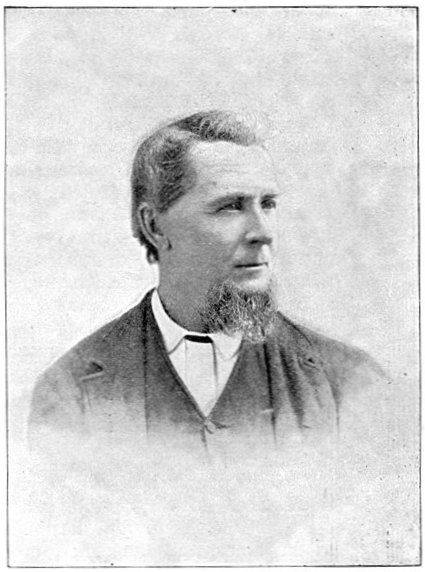
LÖIE FULLER'S FATHER.
From a Photo by Mora, Broadway, New York.
Two years later she was engaged to play the little boy's part with Mrs. Chanfrau in "Was She Right?" and astonished everyone with her self-possession and ability; but she unfortunately had to give up her part before many months were over, as her parents removed to Monmouth, Illinois. Little Löie then set up as a temperance lecturer, and her first attempt brought her in a profit of twenty dollars. Her little lectures were, of course, taken out of books and newspapers, and committed to memory, but delivered with such excellent elocutionary effect and earnestness, that she was soon in great demand all over the State, and known as the "Western Temperance Prodigy." Only eleven years of age! yet earning her own living, and doing good work—at least, doing what she was able and that which was nearest her hand!
She longed for a chance to return to the stage, and before long got her opportunity, for her parents returned to Chicago to live, and she found no difficulty in again obtaining engagements. She worked unceasingly, was gifted with an excellent memory, was always ready and willing to play any rôle, big or little, that was allotted to her, devoting herself with ardour to the study of every detail of her work; thus, before she had reached the age of sixteen, she had won for herself a reputation that many an experienced actress of twice that age would have been proud of.
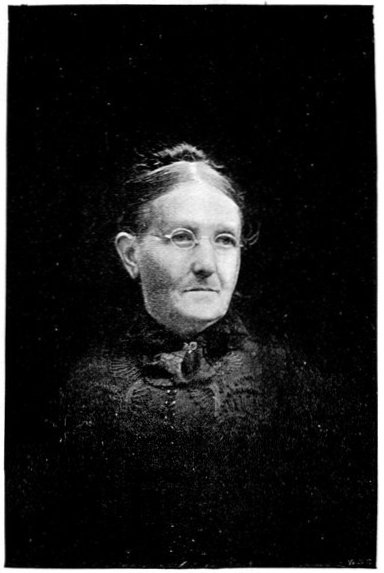
LÖIE FULLER'S MOTHER.
From a Photo by Elder, Iowa.
A pianist in Chicago, having heard Miss Fuller sing, was so enraptured with her beautiful voice, that he offered to give her free tuition for two years. The offer was accepted, and at the end of that period she had made such good progress that she was engaged by Mr. J. M. Hill to go on tour, and later on made her appearance in New York as Jack Sheppard, with a salary of seventy-five dollars a week. Her path was not always strewn with roses. She climbed her way steadily up the ladder of fame through many difficulties and discouragements, never ceased working, hardly ever had a penny to spare, but was always the same bright, cheery little woman that she now is at the zenith of her success, and loved as well as admired by all who know her.
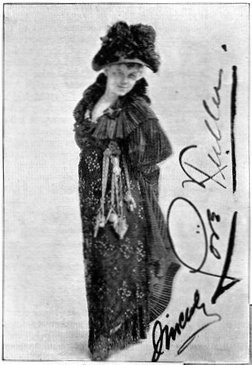
MISS LÖIE FULLER.
From a Photo by Sarony, New York.
Löie Fuller made a great hit as Ustane in "She," at Niblo's Theatre, and was also in the cast of "Caprice," in London. After which she returned to America to take part in "Quack, M.D.," which was being produced at the Harlem Opera House, and it was while rehearsing her part for this play that the tide rose which was to bear her to fame and fortune. It came in the shape of a box sent by a young Indian officer whom Miss Fuller had only met once when she was in London. With eager fingers she removed the many wrappers, and found the contents consisted of a beautiful Eastern gown of soft white silk; the sort of material that would pass uncreased through a ring, and for texture and exquisite whiteness might have formed a fitting garment for Titania herself.
Great was her delight at this unexpected gift, and she wore it in the hypnotic scene in "Quack, M.D." The dainty robe adapted itself admirably to her supple form, which had never been incased in a corset; and after the play was over, she tried the effects of it, by dancing a few steps in front of her cheval glass. The long, sweeping folds lent themselves to every movement. Hours passed, yet still she flung the snowy fabric round her, and pirouetted about, registering in her mind for future reference, the effect of each position and step.
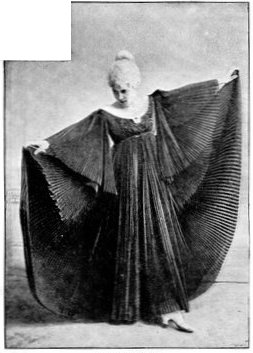
THE WIDOW DANCE.
From a Photograph.
That night was born the Serpentine Dance. Much practising added grace to the figure and flexibility to the limbs, and the dance, even in its initial stage, took everyone by storm, and La Löie's name became famous throughout America. Hungering for "other worlds to conquer," she came to Europe, the first place she visited being Germany, where she was very well received. Her next move was to Paris, where she gave a private rehearsal before the manager of the Folies Bergère, who instantly engaged her.
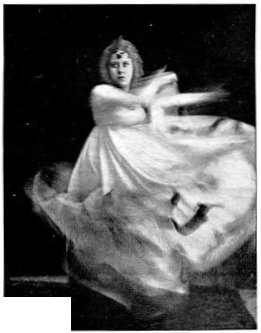
GOOD NIGHT.
From a Photo by Reutlinger, Paris.
All Paris went mad over her dancing, and the management of the Folies Bergère, anxious to secure their prize, concluded a three years' engagement with her, at the largest salary ever paid to a dancer, or indeed to an actress, namely, £200 a week, and a suite of rooms in the theatre. This seems enormous, but unfortunately for the present it does not go into Miss Fuller's pocket—for the year previous to her Parisian engagement she had signed a contract to go to Russia, but when on her way there, she received a telegram stating that her mother was dangerously ill, and, without an instant's delay, she returned and cancelled her engagement. Her heavy luggage having preceded her to Russia, it was seized, her dresses confiscated, and an action brought against her, which she had the misfortune to lose, and was compelled to pay a heavy indemnity.
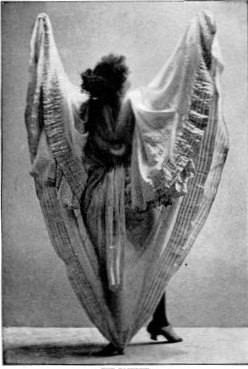
THE RAINBOW.
From a Photo by Sarony, New York.
The dancing of La Löie has so raised the reputation of the Folies Bergère that now the most particular Parisian has no hesitation about taking his wife or lady friends there, and although it was her 300th appearance on January 6th, her popularity is as great if not greater than it has ever been.
"La Belle Americaine" has been invited to dance at the smartest houses in Paris, though for this privilege the Folies Bergère charged £40 for every performance, while the preparatory expenses and light cost an additional £100. The wife of the American Minister invited her to give a private performance at her residence in Paris: the necessary stage and other arrangements took forty men two days and two nights to complete. La Löie on that occasion surpassed herself, and caused a perfect furore among the guests.
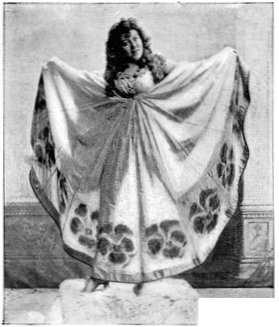
THE FLOWER DANCE.
From a Photograph.
The one dance has become many, among which the principal favourites are the "Widow Dance"—in black robe and with powdered hair and patches; the "Rainbow," "Mirror," "Flower," "Butterfly," and "Good Night" dances, and the dresses for each she has designed herself; their shape is kept a secret. One of the most beautiful of her gowns—if I may so designate these mysteriously lovely draperies—was painted on thin silk in sections, and then the artists engaged on it had no idea what their work was intended for. Her first dress—the present sent her by the young Indian—is, although much the worse for wear, her favourite. As the artiste comes off the stage she is completely enveloped in a huge cloak by her mother, who is always with her, and I have never met anyone who has the slightest idea of what her dress is like off the stage; though, whatever it may be, its effect is bewilderingly beautiful.
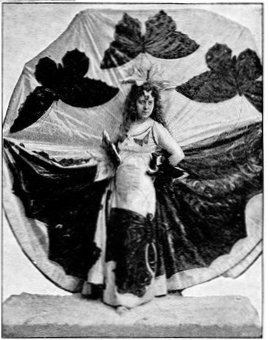
THE BUTTERFLY DANCE.
From a Photograph.
The dancer in private is simply a bonnie, blue-eyed little woman, plain in her dress, and with a sweet frankness of manner and speech which render her eminently attractive. Her rooms boast of no costly luxuries, bric-à-brac, or the thousand and one costly trifles which artistes usually surround themselves with. One thing attracts you as you enter the little sitting-room, and that is a bust of her, by the great sculptor Hussin; in her boudoir are also several miniature models of stages, and it is by all sorts of experiments on these that Miss Fuller is enabled to judge of the effect of any new dance and lighting. At the conclusion of your visit you could not help feeling that you had been privileged to meet not only a great artiste, but also a good woman, against whose reputation a censorious and jealous world has never dared to breathe a word.
Needless to say, a host of imitators has arisen, some of whom, not content with pirating her dances, have tried to copy her dresses and even to use her name. The complicated lighting apparatus which attracts so much admiration is managed by the dancer's brothers, who practise every day with her, and as she is always inventing new dances, their work is no sinecure.
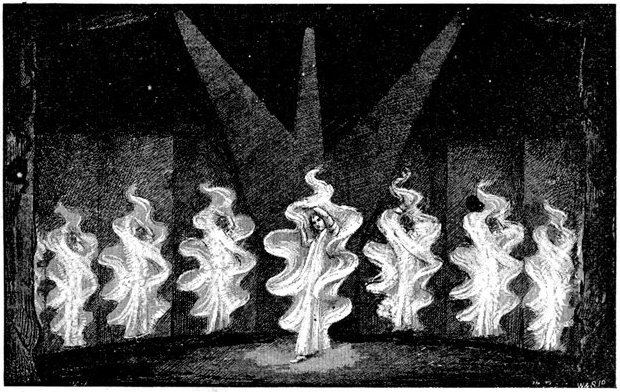
THE MIRROR DANCE.
From a Drawing.
One of her greatest successes has been the "Mirror Dance," in which, by some mysterious arrangement, eight Löie Fullers appear to be dancing at the same time, and the whole stage is bathed in a flood of glorious tints, in which may be seen aerial forms, in cloudlike vestures, whirling and dancing as if they were the fabled victims of the Tarantula; the whole forming an artistic spectacular effect that the world has never seen equalled.
There is only one sad note in the whole history of the clever little dancer—that is, her delicate health, and more especially the paralysis of the arms with which she once or twice has been threatened. She works very hard, and has to train as severely as any jockey. Short as her performances are, they are very fatiguing and a great physical strain.
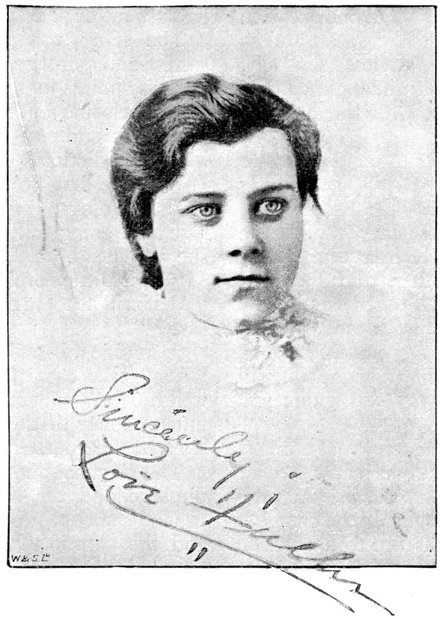
From a Photo by Riders, Chicago.
A great compliment is now being paid her, the result of which the next Salon will show, for a clever young American artist has selected "Löie's Dance" as his subject. It is a large picture and vigorously treated: only half the dancer is shown, and she appears as if dancing out of the canvas. Miss Fuller has done wonders in improving the public taste, and proving that dancing is not an art that degrades, but, with modestly-draped figure and graceful movements, an educator, as everything that is beautiful ought to be. Let us hope that the craze for high kicking, unnatural straining of the muscles, and the hideous short skirts and scanty bodice will become a thing of the past, and that a mere display of skill and agility without the elegance or grace which ought to characterize the Terpsichorean art will die a natural death. La Belle Löie will visit England about May, and it is to be hoped that she will be accorded such a welcome as will induce her to prolong her stay among us. For it may truly be said there is not a discordant note in her whole performance, or a gesture or movement which would wound the susceptibilities of the most modest-minded of British matrons or maidens.