The Oxford and Cambridge Union Societies.
Reading edition
I.—OXFORD.
By J. B. Harris-Burland.
The Oxford Union Society is one of the two most important debating clubs in England, the other being the sister Society at Cambridge. It has been estimated that nearly a fifth of the present House of Commons, and a very considerable number of the House of Lords, have aired their early efforts in the great debating hall in New Inn Hall Street. It might not be uninteresting to our readers to know something of the school in which so many distinguished speakers have been trained.
As the United Debating Society, its foundation dates from 1823; but in 1825 it was broken up to exclude turbulent members, and reconstituted under its present name. It is nominally a social club, with reading, writing, billiard, dining, and smoking rooms, and a good library of 25,000 volumes. But its true importance lies in the debates which are held once a week in term time.
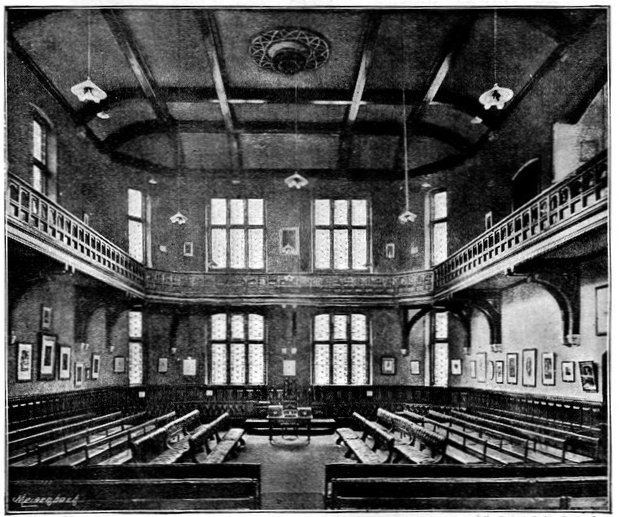
THE DEBATING HALL—OXFORD UNION.
From a Photo by C. Court Cole, Oxford.
The new debating hall is an exceedingly fine room, lit with the electric light, and decorated with the portraits of the distinguished men who have filled the President's chair, and presented by themselves. There are two of Mr. Gladstone, one as the "rising hope of those stern and unbending Tories," and one as the great leader of the Liberals of England.
At one end of the hall three chairs of carved oak are raised on a daïs, the central one higher than either of the others. Here sits the President, with the Treasurer and Librarian on either side of him, and the Secretary at a table at his feet. An electric bell is fixed to the President's chair, with which he warns speakers that their allotted time is drawing to a close. Members have been known to speak for twenty minutes without launching into their subject, so the bell is not without its use.
The gallery is reserved for visitors, chiefly ladies, and is crowded on the night of an important debate. It has a reputation of being unsafe, and whenever it is unusually full, someone is sure to rise in private business and ask if any steps have been taken to strengthen it. The alarm of the fair occupants is only allayed by the assurance of its complete stability.
The Society consists of over 900 subscribing and 20,000 life members. Its officers are elected by ballot, and canvassing is strictly forbidden on pain of a heavy fine. It seems, however, to be a disputed point as to what constitutes canvassing. There is considerable keenness at election time, which occurs every term. The Librarian and Junior Treasurer hold office for a year; the President, Secretary, and members of Standing and Library Committees, for a term only.
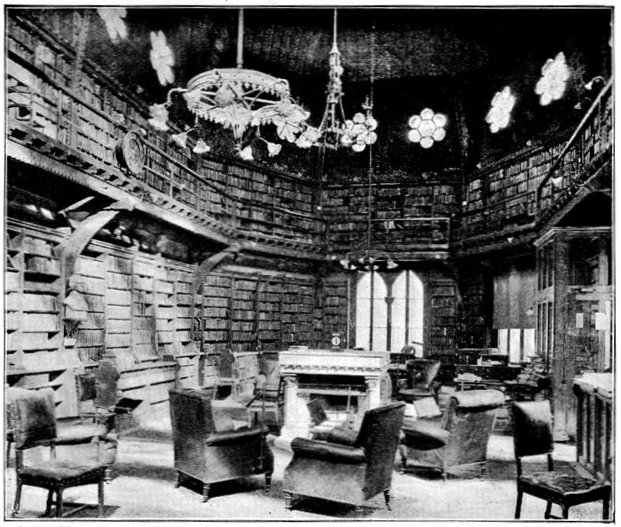
THE LARGE LIBRARY—OXFORD UNION.
From a Photo by C. Court Cole, Oxford.
As the money which the Society receives and spends is no small sum, it has been thought advisable to have as a permanent Senior Treasurer one who does not come and go as undergraduates do. So the £3,000 odd, which comes in yearly to the funds, is watched over by a Don. He is, however, only a servant of the Society, and has no power of himself. Nominally politics have nothing to do with the voting, and the officers are often men of different views, but in reality the political clubs of the 'Varsity exercise no mean influence on the ballot. However, popularity and distinction are still of the most weight, though it was said that one club "ran" the elections for several years, and it is curious to note that the last-elected President, Librarian, and Junior Treasurer all belong to the same club.
The conduct of debates is as follows: The names of four members, generally speakers who are known to have some ability, are printed on the bills that are posted throughout the 'Varsity. It is etiquette for these four and also for the officers of the Society to wear evening dress. Only these four have a certainty of a place in the debate. The first two may speak for twenty-five minutes, and the other two for twenty minutes apiece. Those who follow have only fifteen minutes, and have to jump to their feet to catch the President's eye. Some who have prepared speeches never get a chance of firing them off.
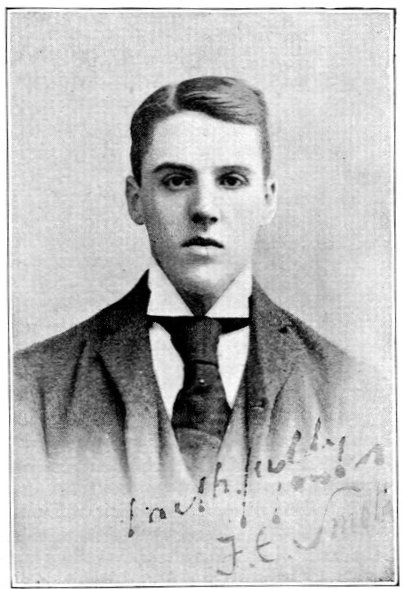
MR. F. E. SMITH, President Lent Term, 1894.
From a Photo, by Gillman, Oxford.
Before the true work of the evening begins, private business is discussed. This is the recognised hour of amusement, and members can achieve no small reputation by excellence in the asking of ridiculous questions. Many of these are personal. A young earl, who occupies the President's throne, is chaffed about a certain celebrated pill because the maker's name resembles his own. The Treasurer is worried about new billiard balls, accommodation for dogs, and his portrait in the Lady's Pictorial when he came of age; the Librarian about the contents of some strange book; the Secretary about his handwriting. Lately the World's Fair at Chicago asked the Union to send two of its members to the Show, but stipulated that they must be of the "highest moral and social standing." The discussion lasted several evenings as to who was fit, what the delegates would be required to do, and what they would be paid. It was finally decided that no one person could combine the two qualities. Such discussions as these occupy the lighter moments of the Society.
Then the debate of the evening begins: sometimes it is good, sometimes bad—more often indifferent. Occasionally there is an orator of unusual brilliance and power, and then the hall is crowded; but as the evening wears on members drop out one by one, and someone moves that the question be now put.
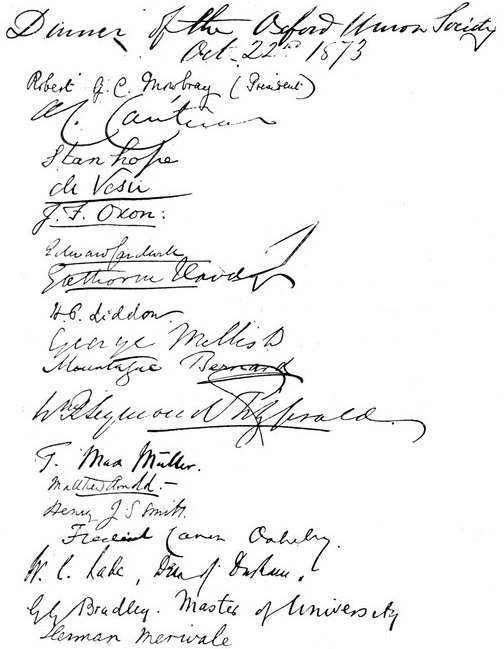
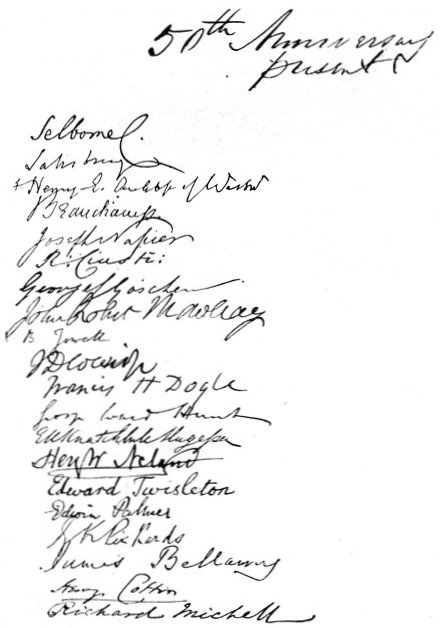
Occasionally distinguished visitors are asked to speak, and then more than ordinary interest is shown. Last year, Lord Winchilsea joined in a debate on the state of agriculture, and spoke for over an hour. He met with hearty support, but also candid criticism, and he defended his scheme with great good humour and ability. Thus the undergraduates have all the advantage of discussing leading questions with recognised authorities on the subject, and the speaker has the opportunity of influencing an audience that is larger than it looks, and which is certainly one of more than average intellect. It is, moreover, considered to be no small honour to be invited to speak at the Oxford Union. And politicians find it a profitable way of spreading their views. The undergraduates disperse and influence many districts, and many, in a few years, will be themselves members of Parliament. We are able to give a reduced facsimile of two pages of signatures of old members who met for the 50th Anniversary Dinner, among which we find many of the most famous men now living.
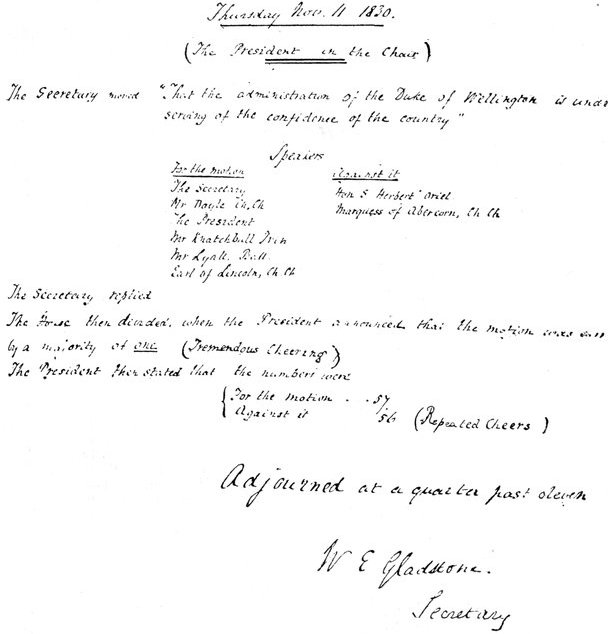
PAGE FROM THE MINUTE-BOOK, IN THE HANDWRITING OF MR. GLADSTONE.
Almost every subject under the sun has been dissected in this Society. The Home Rule Bill met with the fate it was afterwards destined to receive at the hands of the Lords. In some ways the result of the voting in the Union is not entirely without importance. It shows the current of thought among the future politicians of England.
The style of oratory has been condemned by outsiders as unsound. Great importance is attached to brilliant epigrams and incisive phraseology. Mere solidity and strength of argument produce more yawns than applause. So it is said that the real object of debate is lost sight of, and that flashy oratory takes the place of sound reasoning. There is some truth in this, and probably the most popular speakers at the Union will not become the leaders of Parliament. But, after all, it is in speaking and not in thinking that young men need practice. When they are older they will think more and speak less.
The Presidency is one of the most highly-prized distinctions at the 'Varsity, and one which a man may well be proud of in after life. And this is not to be wondered at when we find among the list of those who have held the office the names of Mr. Gladstone, Cardinal Manning, Archbishop Tait, Lord Selborne, the Marquis of Dufferin and Ava, the late Dukes of Cleveland and Newcastle, the late Earl Beauchamp, Viscount Sherbrooke, Lord Coleridge, Mr. Goschen, the Right Hon. H. Asquith, Samuel Wilberforce, the late Bishop of Durham, the Bishops of Peterborough and Chichester, and a host of lesser celebrities, such as deans, Under Secretaries of State, heads of colleges and public schools, judges, etc. Such a list of ex-Presidents could hardly be found in any debating society in the world. The Oxford Union Society is justly proud of them.

The preceding page from the minute-book kept by Mr. Gladstone when Secretary is extremely interesting. It will be noted that the motion was introduced by Mr. Gladstone himself and carried by a majority of one vote, Mr. Gladstone being careful to note that the circumstance was greeted with "tremendous cheering" and "repeated cheers."
II.—CAMBRIDGE.
By St. J. Basil Wynne Willson, M.A.
In 1886, in a speech made at the opening of the new buildings, the late Duke of Clarence said: "The Union affords, not only opportunities for social intercourse, but it is of great service for reading and study, and in many cases has given the first lessons to men who have afterwards ranked among our greatest orators." It is largely a comfortable club, but primarily it is a debating society, and it is as such that its history is of interest.
To discover the origin of the institution we must go far back to the year 1815, when, in the big room of the Lion Hotel in Petty Cury, three earlier societies combined in one Union. The large, bare room, with its tables dinted by the "firing" of glasses at many a Masonic dinner, forms a striking contrast to the fine buildings with handsome apartments and club-land luxuries in which the present generation revels. Founded by men known afterwards as Lord Langdale, the Hon. Sir E. Hall Alderson, the Right Hon. Sir F. Pollock, and the Hon. and Very Rev. H. Pakenham, the Society was happy in its early auspices, and often since in the Presidential chair have sat men who shed on it such lustre that they now draw some light therefrom.
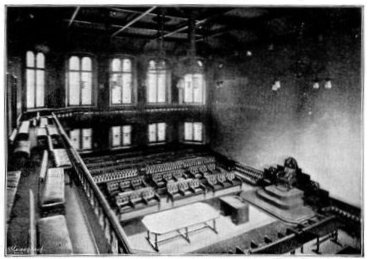
THE DEBATING HALL—CAMBRIDGE UNION.
From a Photo by Messrs. Stearn, Cambridge.
After a short sojourn at the Lion, the Society moved to the present A. D. C. Theatre, and in 1850 migrated again to a disused Wesleyan chapel in Green Street, where now is heard the click of billiard balls instead of the voice of preacher or orator. In thrifty years a Building Fund was amassed, and in 1866, Charles W. Dilke being President, the bulk of the present buildings was erected at a cost of £10,700. Since that time there have been added the laboratory block in 1882, and the north wing, containing the library, in 1885. The illustrations must be left to describe the appearance and size of the chief rooms, of which successive Vice-Presidents have increased the comfort and splendour, electric light and a luncheon-room being amongst the latest additions.
The library contains 25,000 volumes, covering a large range of literature, but omitting three of Zola's works. However, "to provide a library and reading-room" is only the secondary object of the Union: its chief design always has been and is "to hold debates," and it is for oratorical merit that the President, Vice-President, Secretary, and Committee of six are terminally elected. It is as a debating society that it has a claim to fame. That the elect of the Union are often also the elect of the outer world, the following account will, I think, show.
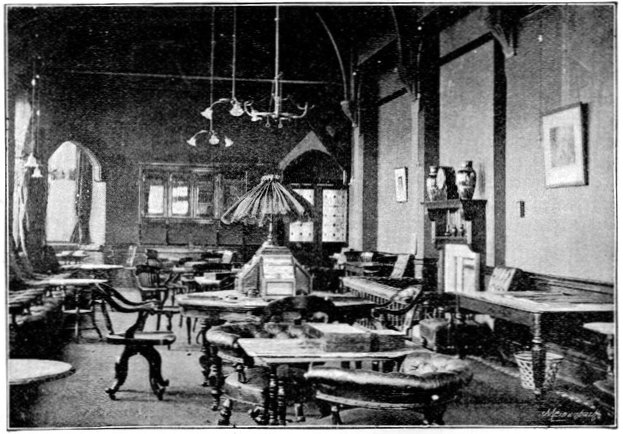
THE SMOKING ROOM—CAMBRIDGE UNION.
From a Photo, by Messrs. Stearn, Cambridge.
In 1816 W. Whewell, a late Master of Trinity, was President. His was a stirring reign on account of the strained relations between the Union and the University authorities, who seem to have maintained a paternal government in those days, looking with suspicious eyes on the young innovators who met once a week to discuss men and manners. During a debate, on March 24th, 1817, on the condition of the Army, a dramatic and almost tragic event took place. Enter on a sudden the Proctors, attended by bull-dogs: dim light, slow music and many excursions and alarums, whilst the President in a stern voice bids strangers withdraw. The intruders demand the dispersion of the meeting and the termination of discussions. The result was that a deputation was sent to the Vice-Chancellor to bear him a remonstrance, "consistently with perfect obedience to University discipline." The deputation "believed that the Vice-Chancellor interfered, owing to the circumstance of having received a letter from one of the members, stating that the studies of himself and of his friends had been checked and their prospects blighted by attention to the Society." The Vice-Chancellor curtly replied: "I do not think it necessary or, perhaps, proper to return any answer to this statement. I had considered the matter fully in my own mind."
Thus the Society was crushed for a time, but in 1821 re-asserted itself, on the understanding that no questions of theology or of politics except of a date previous to 1800 should be discussed. The result was that contemporary politics were debated under a thin disguise of similar circumstances in the past.
Macaulay and Praed were frequent speakers. The former upheld Hampden, Burke, and the study of fiction; whilst the latter opposed him on the subject of Burke, but showed admiration for the conduct of Napoleon—of course, "previous to 1800." They both declared against armed interference in France in 1792, Charles Austin and Alex. Cockburn being on the other side. On this occasion Macaulay made a speech, of which the late Lord Lytton wrote:—
"The greatest display of eloquence that I ever witnessed at that club was made by a man some years our senior, the now renowned Lord Macaulay, and it still lingers in my recollection as the most heart-stirring effort of that true oratory that it has ever been my lot to hear, saving perhaps a speech delivered by Mr. O'Connell to an immense crowd in the open air. Macaulay, in point of power, passion, and effect, never equalled that speech in his best days in the House of Commons."
E. Strutt (Lord Belper), Macaulay, and Cockburn all supported the reform of the Commons at the end of the last century. Cockburn and Lytton prevailed on the House to carry a motion "that a systematic opposition to the measures of an administration is beneficial to the country." A great debate of this period had for its subject "that the Constitution of America is more favourable to the liberties of the people than that of England." Macaulay, Praed, and Cockburn approved, and were carrying the House with them, when up rose Lytton so eloquent and persuasive that he won his case for England by 109 votes to 37. In Mr. Skipper's pamphlet may be found the following interesting description of the Society in "an unpublished squib," written at this time by Praed:—
The Union Club, of rhetorical fame, Was held at the Red Lion Inn; And there never was lion so perfectly tame, Or who made such a musical din. 'Tis pleasant to snore, at a quarter before, When the Chairman does nothing in state; But 'tis Heaven, 'tis Heaven, to waken at seven, And pray for a noisy debate.
The question is Reform, and after the opener has addressed the House, Lytton's rising is thus described:—
Then the Church shakes her rattle and sends forth to battle The terror of Papist and sinner, Who loves to be seen as the modern Mæcenas, And asks all the poets to dinner.
After one speaker has intervened, Macaulay rises:—
But the favourite comes with his trumpet and drums And his arms and his metaphors crossed, And the audience, O dear! vociferate Hear! Till they're half of them deaf as a post.
Macaulay's speech is thus summarized:—
Oratoric, Metaphoric Similes of wondrous length. Illustration—conflagration, Ancient Romans, House of Commons, Clever Uriel and Ithuriel, Good old king, everything.
And Charles Austin rises:—
Then up gets the glory of us and our story, Who does all by logic and rule, Who can tell the true difference 'twixt twopence and threepence, And prove Adam Smith quite a fool.
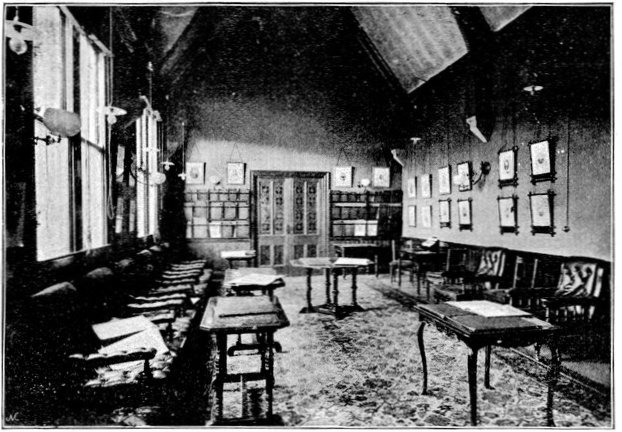
THE MAGAZINE ROOM—CAMBRIDGE UNION.
From a Photo by Messrs. Stearn, Cambridge.
Passing on, we come to the era of Trench, Sunderland, Monckton Milnes (late Lord Houghton), S. Walpole, and Arthur Hallam. This is mainly a literary period. Although Tennyson was a member of the club, he does not seem to have taken part with his friend in any debates.
Milnes and Hallam both spoke in contention of Wordsworth's superiority to Byron, but a majority of twenty-seven gave the palm to "Childe Harold's" author. Trench (Archbishop) propounded the original question: "Will Mr. Coleridge's Poem of the 'Ancient Mariner' or Mr. Martin's Act tend most to prevent cruelty to animals?"
There is an episode of this time that has a peculiar interest. It was, as the late Cardinal Manning described it, "a passage of arms got up by the Eton men of the two Unions."
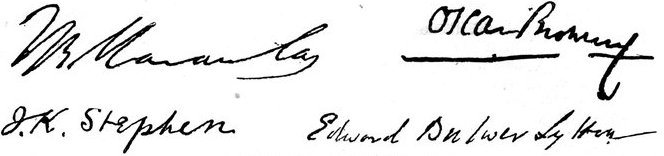
SIGNATURES FROM THE MEMBERS' BOOK.
On March 26th, 1829, Cambridge sent to Oxford a deputation consisting of Monckton Milnes, Arthur Hallam, and Sunderland, whom Milnes, when Lord Houghton, once declared to be "the greatest orator I think I ever heard, who only lives in the memory of his University." The relative merits of Byron and Shelley were the subject of discussion.
The Cambridge men were entertained by Sir Francis Doyle and "a young student named Gladstone." S. Wilberforce was in the chair. Our champions spoke for the claims of Shelley, and so telling was their oratory that Oxford sat silent and awestruck, until a young man with a slight, boyish figure arose and turned the whole tide of discussion by a speech of much grace and eloquence. His name was Manning. He has himself described the occasion: "I can, however, well remember the irruption of the three Cambridge orators. We Oxford men were precise, orderly, and morbidly afraid of excess in word or manner. The Cambridge oratory came in like a flood into a mill-pond. Both Monckton Milnes and Arthur Hallam took us aback by the boldness and freedom of their manner. But I remember the effect of Sunderland's declamation and action to this day. It had never been seen or heard before among us—we cowered like birds and ran like sheep. I acknowledge that we were utterly routed." "The Oxford men didn't seem to know who Shelley was; they thought he was Shenstone," was a remark that Lord Houghton once made to Mr. Oscar Browning, my informant.
In an interesting little book, called "Conversations in Cambridge," published in 1836, there are preserved some criticisms of the Union of the period.
"The Union—a word requiring no explanation to any member of the University—reached an elevation in those days which it is not likely soon to recover. Macaulay with his flashes of vigorous imagination; Praed with his graceful irony and poetical fancy; and many others whose names live in the memory of their companions, imparted an unusual charm to its meetings."
But, better still, there are some fragments of speeches made by Macaulay, in debates on Cromwell, Strafford, and Milton. The following is an extract from the speech on the Protector:—
"I stand not here, sir, to-night, as the advocate or panegyrist of that melancholy domestic tragedy, which was presented before this afflicted nation in that tempestuous season. But, sir, I would ask: was there no provocation, no exaction, no insult to the dignity of man; no invasion of the sanctity of a Briton's fireside? Sir, the grave of Hampden has a voice: let it answer for me! Tyranny had dashed its mailed hand upon the mouth of every freeman; the lifeblood of the laws was drained out by unnumbered wounds."
About 1848, Mr. Childers, Sir W. V. Harcourt, and Sir Fitzjames Stephen were contemporaries. The present Chancellor of the Exchequer spoke against the ballot, and with Sir Fitzjames Stephen opposed a motion that asked the House to declare that "Mr. Cobden and his party represent the rising good sense of the people." In 1855, H. Montague Butler and J. E. Gorst were respectively President and Treasurer. Gorst gained the chair in 1857. The next most interesting group of Union "lights" is that which includes George O. Trevelyan, H. C. Raikes, Oscar Browning, and H. and A. Sidgwick.
Mr. O. Browning says: "I remember in '56 sitting in the room in Green Street ('cavernous tavernous' as Lord Houghton called it), thinking of nothing in particular, when I suddenly awoke and heard a pleasing voice saying some of the cleverest things I ever heard. It was G. O. Trevelyan. When his speeches were prepared they were brilliant. He was the hero of the great 'smoking-room question,' and headed the opposition to the scheme. In an excited peroration he produced a black clay pipe in one hand and some red tape in the other, declaring them to be the symbols of the parties, and then proceeded dramatically to snip the red tape to pieces. It was Trevelyan who was compelled to move the suggestion-book temporarily, for at that time it was the receptacle of homeless jokes, doggerel verses, and scurrilous remarks, of which 'You rib-nosed baboon,' and 'Why not make Raikes Lord Mayor?' are examples."
In that brilliant periodical of one number, the Bear, Trevelyan has burlesqued one of his own speeches amongst others. The motion is to repair the Society's clock.
"This is no measure for the purpose of pampering an over-fed clerk, or stuffing our shelves with Puseyite novels. But let them not think they have gained the confidence of the House. Timeo Danaos et dona ferentes. (Loud cheers from a Freshman, who seems to recognise the quotation.) Shall we trust our clock to a committee reeking with Ruskin? To an embryo architectural society?... Whom shall we dare trust? There they will sit, grinning at their new clock—(a cry of 'Question'). Question?—(and the speaker turned to the Treasurer, who was lolling alone on the opposite sofa). There you sit compact, united—mouthing and blustering about Tennyson and Carlyle, and nobody cries 'Question'; and if he does, he is snubbed by a partial President. (Great confusion, and cries of 'Sit down,' 'Chair.')"
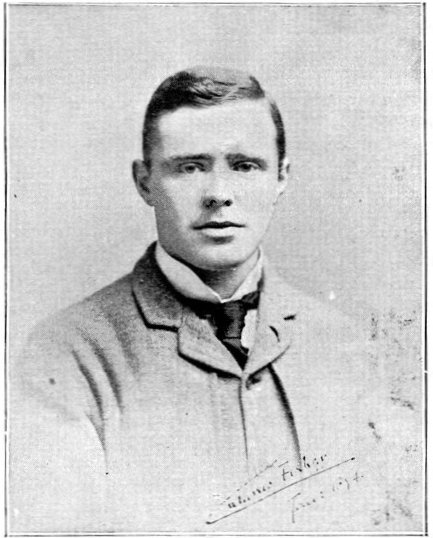
MR. CATHREW FISHER, President Lent Term, 1894.
From a Photo by the London Stereoscopic Co.
Passing reluctantly over Lord E. Fitzmaurice, A. S. Wilkins, A. W. Verrall, J. E. C. Welldon, R. C. Lehmann, we come, in 1880, to an interesting figure—J. K. Stephen, who re-appeared in Union life in recent years, and scribbled off some of his Calverleian lines whilst sitting on the Committee bench. On one occasion in his later years he came into the House when one of many brilliant sons of a brilliant ex-President had proposed nationalization of land. At the first opportunity he rose, exclaiming:—
"I have not heard the speech of the honourable proposer, and I am very glad I have not heard it. All I am come down here to do is to deny that there can be any connection between his premisses and his conclusions: conclusions which can only be reached by a total want of knowledge, based upon an absolute ignorance of facts."
J. K. Stephen made many great speeches shortly before his death, and an eminent M.P., Q.C., remarked, when he heard him, that after Gladstone he was the greatest orator in the country.
Another incident of late years is worth recording as evidence of the dangers of debate. During a big debate on the opium question, a prominent anti-opiumist was speaking against the traffic to a crowded House. Whilst discussing the treaties with China, he noticed a man opposite vehemently dissenting, and at last remarked, "I don't know who the hon. member is, but I can quote the authority of Sir Thomas Wade, who made the treaties." After him the "gentleman opposite" arose, and, revealing himself as Sir Thomas Wade, proceeded to make much mincemeat.
Owing to pressure of space, many well-known ex-Presidents and officers have been passed by unnoticed: C. Rann Kennedy (Pr. 1832), Lord Henniker (Pr. 1834), Sir W. F. Pollock (Pr. 1836), Bishop Ellicott (Pr. 1839), Prof. C. Babington (Pr. 1845), Lord R. A. Cross (Pr. 1845), Rev. Ll. Davies (Pr. 1847), Hon. A. Gordon (Lord Stanmore) (Pr. 1849), Henry Fawcett (Pr. 1855), Dr. Henry Jackson (Pr. 1864), and a long list of others, statesmen, clergy, scholars, lawyers, whose early development it would be interesting to trace.
It may not be out of place here to publish some reminiscences most kindly sent by a distinguished ex-President, Sir Charles Dilke:—
"If somebody of the time were to talk to me about it (the Union), I have no doubt my reminiscences would flow. At the present moment, with the exception of my own disrespectful allusions in Prince Florestan of Monaco.... I remember nothing except the terrible noises that my friends used to make over my head when I was President in the old room in Green Street. I often threatened to have the gallery cleared, but as I had not the physical force at my command to sweep them out, they used to sit on the ends of the tables with disastrous effect. The first speech in the Union which I remember was one when I was a Freshman, by Mr. George Trevelyan. He declared amid a tremendous storm of cheers, in reference to the Government of the United States: 'That Union, Mr. President—that Union has no Building Fund.' The Cambridge Union in those days possessed a handsome Building Fund, which I forthwith spent, and the result of the spending of which, and the borrowing of much more, is visible in the present building."
Another old President (who wishes to be anonymous) says:—
"In '57 or '58 Trevelyan began to make a reputation, and perhaps still more the American, Everett, with a really remarkable force which he has still.... Fawcett spoke often; harshly and loud, but very ably. Vernon Lushington was forcible, but not suave enough. Gorst (now Sir J.) spoke well, but without much power. Ernest Noel (late member for Dumfries) once or twice delighted us with a clear and cultured fluency that we were not accustomed to. It shows the alteration of the times that a sort of thrill of horror ran round the House when in one debate he actually mentioned that he was not a member of the Church of England.... We used not to imitate the ways of the House of Commons very closely, with the idea that it might be bad taste, and that we had traditions of our own to be proud of."
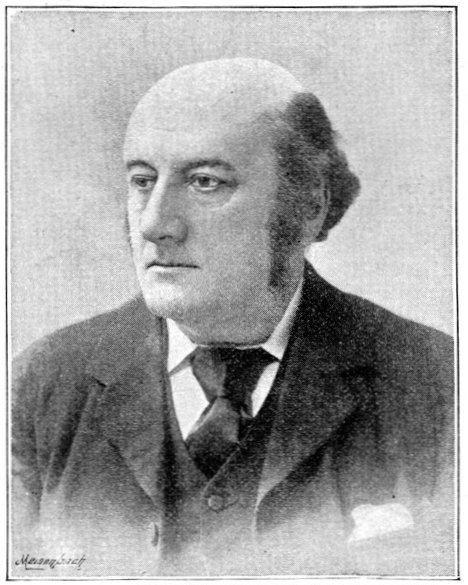
MR. OSCAR BROWNING, Treasurer of the Cambridge Union.
From a Photo by Branfort, Birmingham.
Forty-five members of the Society are in the House of Lords, including the Prince of Wales and the two Archbishops, and 58 in the Commons. Our present-day debates, held once a week, are dignified and orderly. They last for about two and a half hours, the proposer and opposer occupying usually an hour between them. The private-business meetings are generally more scenic, especially when we discuss Zola or finance. A noticeable feature is the number of Orientals who take part, and a very able, eloquent part too, in our debates. One has risen to the Chair. The future historian will be at little trouble for material, for the Cambridge Review and the Granta, in different styles, record each debate and change. Out of 237 Presidents, Trinity has provided 132 and St. John's 29.
The members of the Society are increasing, and between 400 and 500 new members are enrolled annually. There is no exclusiveness and all types of University life are represented.
Our relations with our younger Oxford sister are excellent. From term to term there is an interchange of speakers between the two clubs.
In conclusion it may be said that, great as the past has been, the future should be none the less brilliant. The usefulness of such an institution is obvious. In 1994 it may be that the names that will be honoured in an article in a flourishing Strand will be those of men whose promise is now so great, and whose friendship so many of us value now so highly.
[In compiling this Article I have drawn much information from "A Short History of the Union," by J. F. Skipper, Esq., B.A., ex-President. I would here acknowledge the great courtesy of those distinguished old members who have contributed reminiscences. Owing to the kind permission of the President, Vice-President, and Librarian, I have had access to all the documents of the Society. The Chief Clerk has also given me much valuable assistance.—St. J. B. W. W.]