From Behind the Speaker's Chair.
Reading edition
XIV.
(VIEWED BY HENRY W. LUCY.)
THE QUEEN'S SPEECH.
There is something gravely comical in the manner the London morning newspapers deal with the Queen's Speech on the morning preceding its communication to Parliament. They know all about it, and, as the event proves, are able to forecast it paragraph by paragraph. Yet, withal, they shrink from any assumption of positive knowledge, or even of attempt to foretell what will take place. "Her Majesty," they write, "must of necessity allude to the progress of events in Central Africa and on the East of that dark but interesting continent." You learn half a day in advance of the opening of Parliament exactly what Ministers have resolved to say on this particular topic. Other events of current interest at home and abroad are introduced in the same casual manner, and are dealt with in similar detail. Mr. Wemmick had carefully studied this style, and had successfully assimilated it with his ordinary conversation and methods of transacting business.
The general impression is that editors of the principal London papers receive a copy of the Queen's Speech on the night before the Session opens, with the understanding that they are to treat it gingerly, and, above all, to safeguard Ministers from suspicion of collusion in the premature publication. To adopt the consecrated style, I may observe that this will probably be found to be a misapprehension. Doubtless what happens is that the editor of the morning paper meets at his club a Cabinet Minister of his acquaintance, who, following immemorial usage, feels at liberty to give his friend a conversational summary of the points of the Speech. Or it may happen that an appointment is made with the Whip authorized to make such communication. Certainly it will, upon investigation, appear that there is no foundation for the fiction of a written copy of the Speech being supplied for editorial use. Years ago the editor, either of the Times or the Morning Chronicle, profiting by personal acquaintance, was able on the morning of the meeting of Parliament to forecast the Queen's Speech. He invented, as desirable in the circumstances, the roundabout style of communication alluded to. The following year other papers, working the oracle on the same lines, adopted the same primly mysterious style. There is no reason why this should now be done; but done it is, as the eve of the Session, still young, testified. New journalism has been a potent agency in varying Press usages. It has not yet ventured to attack this decrepit old farce.
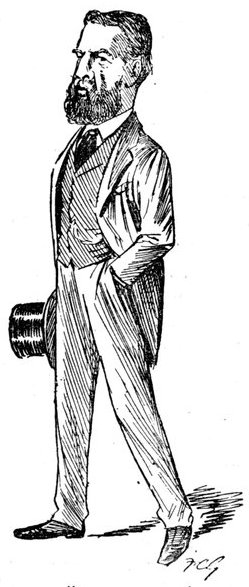
"LOUNGING IN."
BEFORE DINNER AND AFTER.
The only copy of the Queen's Speech which passes outside the Ministerial ken before the Session opens is that forwarded, with the compliments of the Leader of the House, to the Leader of the Opposition. This is an act of grace and courtesy, happily and accurately illustrating the spirit in which controversy is carried on in English politics. Mr. Disraeli and Mr. Gladstone maintained no social relations outside the House of Commons. But that was an exception to the ordinary course of things. At this day the stranger in the gallery hearing Mr. Chamberlain pouring contumely and scorn on Sir William Harcourt, and observing the Chancellor of the Exchequer almost savagely retorting, may be forgiven if he supposes the cleavage in political relations has severed personal friendships. That is certainly not the fact in respect of these two former colleagues, or of other more or less prominent combatants in the Parliamentary arena. It frequently happens, in the course of the Session, that two members who, between the hours of five and seven-thirty, have been engaged in fiercest controversy in the House of Commons, will be found at eight o'clock sitting at the same dinner-table, discussing the situation from quite another point of view. This is a condition of affairs which does not exist, certainly not to equal extent, in any other political battlefield, whether at home or abroad.
THE FOURTH PARTY AND THE QUEEN'S SPEECH.
When the Fourth Party was in the plenitude of its power, it pleased its members to assume all the customs of those larger political factions of which it was the microcosm. Since Ministers and the Leaders of the regular Opposition were in the habit of meeting together on the eve of a new Session, dining, and thereafter reviewing the situation and settling their policy, the Fourth Party had their pre-Sessional dinner. Lord Randolph Churchill tells me of a charming incident connected with this custom. Meeting on the eve of the Session of 1881, they solemnly agreed that they, as a Party, were at a disadvantage inasmuch as they had not before them a copy of the Queen's Speech. Lord Randolph accordingly wrote a formal letter, addressed to Lord Richard Grosvenor, then Ministerial Whip, asking him to be so good as to favour him and his colleagues with a copy of Her Majesty's gracious Speech, in accordance with custom when the Leaders of Her Majesty's Opposition were in conference on the eve of a Session. I do not know whether Lord Richard, in the fashion of his reply, rose to the sublime height of this joke. But the copy of the Speech was not forthcoming.
The Fourth Party at the beginning of their career went a step further than the regular Leaders of the Opposition whom they, only half in jest, affected to supersede. Her Majesty's Ministers, in accordance with custom, went down to Greenwich for a whitebait dinner at the end of the Session, the Leaders of the Opposition being content with a festive gathering on the eve of the opening of Parliament. The Fourth Party, equal to both occasions, not only convivially foregathered at the opening of the Session, but had their whitebait dinner at the end. In 1880, the year of their birth, they, never afraid of creating a precedent, invited an outsider to join the feast. This was Mr. Labouchere, Mr. Bradlaugh's standard-bearer, whom they had been fighting hand to hand all through the turbulent Session.
But it is a poor heart that never rejoices, and in their young days the Fourth Party were merry grigs.
COUNTY GUY.
Some time ago inquiry was made in the columns of a country paper as to the origin of the cognomen "County Guy," as attached to Lord Hartington. I happen to know that the phrase, much in vogue seventeen or eighteen years ago, appeared in the series of papers entitled "Under the Clock," published weekly in the World. It was suggested by Sir Walter Scott's well-known lines:—
Bird, breeze, and flower proclaim the hour: But where is County Guy?
Lord Hartington was at the time Leader of the Opposition, vice Mr. Gladstone, convinced that "at my time of life"—he was sixty-five when he wrote—his public work was finished, and he had earned the right to spend his declining years in the comparative leisure of his library. Even the eminence of the position, and the hitherto unbroken habit of the Leader of a party being in his place when questions began, did not overcome Lord Hartington's constitutional inability to come up to time. It was characteristic of him that he scorned the opportunity provided for quietly dropping into his place, without fixing attention upon his delayed arrival. He might have entered from behind the Speaker's Chair and taken his seat without any but those in the immediate neighbourhood noting the moment of his appearance on the scene. He always walked in from the doorway under the clock, in full view of the House, usually with one hand in his pocket, his hat swinging in the other hand, lounging towards his seat as if he were rather five minutes too soon than half an hour too late. When, in the last Parliament, he returned to the Front Opposition Bench as Leader of the Liberal Unionists, he observed precisely the same custom. He was invariably late, even at critical epochs, and always walked in by the front door.
On one occasion he arrived very early in the morning, but that was an accident due to misunderstanding. It was during the passage of the Coercion Act of the Salisbury Parliament. The Irish members had kept things going all night. At five o'clock in the morning, Lord Hartington, in common with other absentees of his party, received a telegram to the following effect:—
"Been on duty all night. Only us two here. Come down to relieve us.
(Signed) "Chamberlain, "Russell."
This was enough to make even Lord Hartington hurry up. The picture of Mr. Chamberlain standing by the Government all night, warring with the common enemy, whilst the Leader was comfortably in his bed, was a reflection not pleasant to dwell upon. Hurrying on his clothes he made his way down to the House, one of a steady stream of Liberal Unionists like himself, abashed to think they had left Mr. Chamberlain in the lurch. Entering the House, they came upon Mr. T. W. Russell and Mr. Richard Chamberlain, keeping guard on the heights where the Liberal Unionists encamp. It was all right, of course. But it was not Mr. Richard Chamberlain who was in their mind when they hurried down in obedience to the imperative command.
THE PRIVILEGES OF M.P.'S.
Apart from the question of wages members of the British House of Commons do not condescend to acceptance of the various smaller privileges which ameliorate the condition of legislators in other countries. In some of the Continental Legislatures, and in most of the Colonies, M. P.'s travel free on the railways. For the British member, more especially for the Irish representative, the cost of locomotion when going about the country's business is a serious item. Not to speak of the occasional discomforts of the voyage, it costs an Irish member over £5 to journey to and from Westminster. For many Dublin is merely the starting point for a more or less prolonged trip over the highly-priced and not conveniently-arranged home railways.
At Washington, members of the House of Representatives, in addition to a fixed salary and liberal allowance for railway fares, have various little pickings, in the way, for example, of stationery, which is supplied ad libitum for their private use. Another privilege, indispensable to the due performance of their labours, is a bath. Attached to the Legislative Chamber is one of the most luxurious bathing establishments in the world. Anything, from the ordinary cold tub to the most elaborate Turkish bath, is at the disposal of members. The prospect of being able to retire from a heated debate and enjoy the long luxury of a Turkish bath is sufficient to make a British M. P.'s mouth water. Of course, there is the difficulty about the imminence of divisions. The sound of the division bell, suddenly clanging through the various chambers of a Turkish bath, would cause dire consternation. But daily use would suggest a means of minimizing possible inconvenience. There might, for example, come into existence such a thing as a bath pair, corresponding with the present dinner pair.
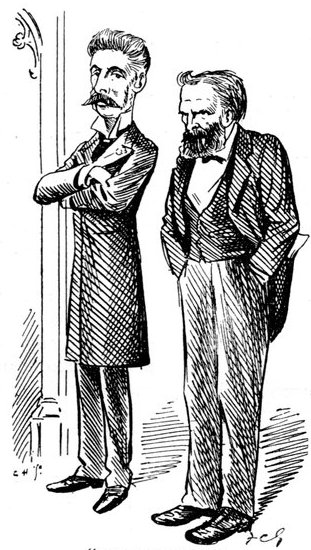
"KEEPING GUARD."
A DRESSING-ROOM TRAGEDY.
It will appear scarcely credible that the House of Commons, though widely known as the best club in the world, lacks the accommodation, common to an ordinary club, of dressing-rooms where members may change their clothes for dinner. The convenience of such an arrangement is particularly obvious in the case of a body of men, the majority of whom dine out during the Session, and are frequently, by the imminence of a division, kept waiting about to within a quarter of an hour of the time at which they are due for dinner. Ministers have their private room. But for this purpose it is of less use to them than to the private member. They are not supposed to dine out whilst the House is in Session, and if they, greatly daring, dine, they avail themselves of the privilege of presenting themselves in morning dress. Occasionally one lends his room to a private friend, hard pressed to keep a dinner engagement, possible only if he can save the time involved in going home to dress.
A few Sessions ago, a well-known Q.C. had an exciting adventure consequent upon changing his dress at the House. He had arranged with a friend in the Ministry, who had a chamber near the top of the staircase leading into Palace Yard, to use it as a dressing-room. He anxiously watched the course of the debate as it proceeded over seven o'clock, hoping it would conclude in time for him to run into his friend's room, and slip into his dinner-dress in time to keep his appointment. At half-past seven things began to look bad. A member, usually good for at least half an hour, had risen to continue the debate. On second thoughts, here was a chance. Suppose he were to retire now, change his clothes, and be ready to drive off as soon as the division lobby was cleared?
He acted on the idea with characteristic promptitude, and had reached an exceedingly critical stage in the change of raiment, when the division bell rang. The member in possession of the House when he left it had been unexpectedly merciful, had brought his remarks within the limits of ten minutes, and the division was called. Only three minutes elapse between the clearing of the House for a division and the putting of the question. Supposing the Q.C. to be fully dressed, there was only time comfortably to reach the House from the Minister's room. He was certainly not dressed, and it was a nice question whether it would be a shorter process to go back to the chrysalis state of morning dress, or proceed to complete the butterfly development upon which he had embarked when almost paralyzed by the sound of the division bell. One thing was clear, he must take part in the division. An issue depended on it which would not incline the Whips to accept frivolous excuse for abstention.
Again a happy thought occurred to him. Suppose he were to put on an overcoat and so hide his collarless condition? But his overcoat was in the cloak-room, a flight lower down. The spectacle of a learned and somewhat adipose Q.C. rushing downstairs in shirt and trousers might lead to misapprehension. There was, however, nothing else to be done, and the flight was successfully accomplished. The hon. member safely reached the cloak-room, was helped on with his coat, and, with collar turned up closely buttoned at the throat, he passed through the Division Lobby, an object of much sympathy to his friends, who thought his cold must be bad indeed to justify this extreme precaution on a summer night.
PRIVILEGE.
It is a well-known fact, much appreciated in quarters personally concerned, that no action for libel may be based upon words spoken in the House of Commons. This understanding has been confirmed by an action to which Mr. Arthur Balfour was an involuntary party. In the course of debate, in which he took part as Chief Secretary, he had spoken disrespectfully of a midwife in the south of Ireland. The lady's friends rallied round her, and guaranteed funds to cover the expenses of a civil action for damages brought against the Chief Secretary. Had the case come before a Cork jury, as was inevitable if it went to trial, it would doubtless have proved a profitable transaction for the plaintiff. Mr. Balfour appealed to a higher Court, on the ground that the words spoken in Parliamentary debate are privileged. The Court sustained this view, and the trial was set aside.
I have high judicial authority for the statement that in spite of this rule the position of a member of Parliament in the matter of libel is not impregnable. He is quite safe, not only as far as words spoken in the House are concerned, but is not responsible for their publication in the newspapers, or their subsequent appearance in "Hansard." "Hansard," however, is accustomed to send to each member a report of his speech, leaving to him the option of revision. If the proof be not returned within a few days it is assumed that no correction is desired, and the speech goes down to posterity in the form it was handed in by the reporter. When a member has revised his speech the fact is intimated by a star.
It is herein the distinction in the matter of legal liability is established. A member having voluntarily revised his speech is assumed, by the fresh and independent action taken outside the House of Commons, to have assumed a liability he would otherwise have escaped. An action would lie against him, not for the speech delivered in Parliament, but for the publication of the libel under his revision, and upon his authority, in a widely circulated periodical. Verb. sap.
A PRECIOUS VOLUME.
A glance over any volume of "Hansard" shows that it is only the new or inconsiderable member, whose speeches are not likely to become the texts of subsequent debate, who is at pains to revise reports of his Parliamentary utterances. Old Parliamentary hands like Mr. Gladstone, Mr. Balfour, and Mr. Chamberlain are, in the first place, too busy, and, in the second, too wise, to commit themselves to the task.
Mr. Chamberlain once suffered from yielding to the temptation to secure an accurate report of his deliverances on important political questions. In 1885, on the precipice below which unexpectedly lay the fissure in the Liberal Party, Messrs. Routledge brought out a series of volumes containing reports of the speeches of some six or eight statesmen on questions of the day. It was an "authorized" edition, the various contributors revising their speeches. At this epoch Mr. Chamberlain was the risen hope of the Radical Party. His vigorous argument and incisive invective were directed against the Conservative Party, its history, ancient and modern. It is from this little volume that Mr. Gladstone, in his speech at Edinburgh just before the Winter Session, drew the citation of Mr. Chamberlain's indictment of the House of Lords. It was not the first time it had been remembered. But Mr. Gladstone's joyous discovery sent it trumpet-tongued throughout the English-speaking world. It is this compilation that rescued from the obscurity of daily newspaper reports the happily conceived, perfectly phrased, and now classical similitude drawn between Mr. Gladstone and a mountain.
"Sometimes I think," Mr. Chamberlain said in a passage the perfect literary form of which tempts to quotation, "that great men are like mountains, and that we do not appreciate their magnitude while we are still close to them. You have to go to a distance to see which peak it is that towers above its fellows; and it may be that we shall have to put between us and Mr. Gladstone a space of time before we shall know how much greater he has been than any of his competitors for fame and power. I am certain that justice will be done to him in the future, and I am not less certain that there will be a signal condemnation of the men who, moved by motives of party spite, in their eagerness for office, have not hesitated to treat with insult and indignity the greatest statesman of our time—who have not allowed even his age, which entitles him to their respect, or his high personal character, or his long services to his Queen and his country, to shield him from the vulgar affronts and the lying accusations of which he has nightly been made the subject in the House of Commons. He, with his great magnanimity, can afford to forget and forgive these things. Those whom he has served so long it behoves to remember them, to resent them, and to punish them."
The speech in which this gem lies entombed was delivered at Birmingham, on the 4th June, 1885. In the intervening nine years Mr. Chamberlain has had opportunities of regarding the mountain from other points of view, and has discovered quite new aspects.
This volume of Mr. Chamberlain's speeches has long been out of print. The shilling edition and the half-crown edition command considerably enhanced prices on the rare occasions when they come upon the market. There is one precious copy in the Library in the House of Commons, the condition of which testifies to the frequency of reference. The existence of such a record may be occasionally embarrassing to the politician, but if Mr. Chamberlain were vain, it must be gratifying to the man. It is only a strong personality that could evoke such testimony of eager interest.
LORDS IN THE COMMONS.
It is pretty to note the deathless attraction the House of Commons has for members who have left it to take their seats in another place. They may be peers privileged to sit in the stately Chamber at the other side of the Octagon Hall. But their hearts, untravelled, fondly turn to the plainer Chamber in which is set the Speaker's Chair. Even the Duke of Devonshire has not been able wholly to resist the spell. Whilst he was still member for Rossendale, it was only a heroic, predominant sense of duty that brought him down to the Commons. Since he became a peer scarcely an evening passes in the Session that he does not look in, chatting with friends in the Lobby, sometimes sitting out an hour of debate, watched from the gallery over the clock. Lord Rowton never had a seat in the Commons other than that under the gallery allotted to the Private Secretary of the Leader of the House. But in earlier days he had much business in the Lobby of the House of Commons, and when in town and in attendance on the House of Lords, he rarely misses the opportunity of revisiting his old haunts.
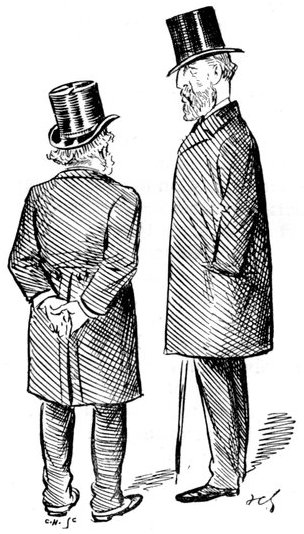
"A CHAT WITH SIR HENRY JAMES."
It is many years since Lord Morris was "the boy for Galway," representing the county through several Sessions. Through that avenue he joked his way, first to be Solicitor-General, then Attorney-General, next Lord Chief Justice of Ireland, and finally Lord of Appeal, with a life peerage. During the debates in the Commons last Session on the Home Rule Bill he was in constant attendance. Even when the subject-matter of debate is not one that touches the heart of a patriot, the ex-member for Galway is regularly seen in the Lobby of the House of Commons, his presence being indicated by a ripple of laughter in the group surrounding him.
For some Sessions after the House of Commons suffered the irreparable loss of the counsel of Sir Richard Cross, the Lobby was occasionally suffused by the air of wisdom and respectability inseparable from the presence of Lord Cross. Last Session he intermitted this habit, the Lobby becoming in his absence almost a resort for the frivolous. Lord Monk-Bretton is another old Commoner who has not entirely overcome the habit of strolling into the Lobby of the House in whose Chair of Committees he once sat. Lord Playfair, another ex-Chairman of Committees, is often seen there. The Earl of Aberdeen, before Canada claimed him, was almost nightly in the Lobby and corridors of the House of Commons, albeit he was not drawn thither by personal recollections of former memberships. Dukes, except his Grace of Devonshire, rarely descend on the level of the Lobby, and no Bishop has been seen there since the Bishop of London, looking in surplice and bands after debate in the House of Lords, was accosted by Mr. McClure and genially invited to take a glass of sherry and bitters.
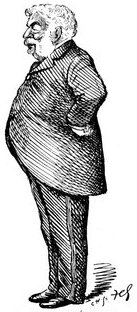
MR. JOHN M'CLURE.
OLD WHIPS AND NEW.
Lord Battersea has rather cut the place in which he long lingered as a Whip, and Lord Dartmouth is not often seen in the place where through many Sessions Lord Lewisham used to walk about, Whips' book in hand, endeavouring to keep a House through the dinner hour. Lord Kensington is a regular frequenter of the Lobby, and instinctively takes his stand near the door leading to the staircase where through many Sessions he kept guard, barring the passage of unpaired members. Lord Kensington is not a man of supercilious manner, but there was something of unmistakable scorn in his eyes when they first alighted on the screen which his successors in the Ministerial Whips' seat last Session introduced. Certainly a searching wind creeps up the staircase from Palace Yard when it is wintry weather. But Lord Kensington sat there from 1880 to 1885 without so much as a rug on his knees. A more degenerate race are inconsolable without some contrivance for warding off the draught. In ordinary circumstances this object might easily be attained. A screen of fair proportions flanking the bench by the Whips' side would be fully effective. But this is the main entrance to the Lobby. A full-sized screen would be impossible. Accordingly, a something has been made considerably too tall for the base upon which it stands. The consequence is embarrassing, sometimes appalling. Either the Thing falls outward when the glass door is opened, scaring the new arrival, or it flops inward, threatening to crush Mr. Causton, and cut off, in its flower, a useful life.
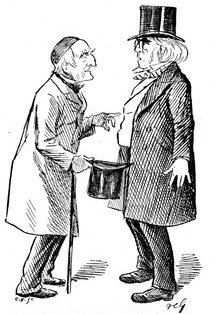
LORD DENMAN AND MR. FARMER-ATKINSON.
LORD DENMAN AND MR. ATKINSON.
Lord Cranbrook has long got over the habit once dominant of revisiting the scenes in which his political fortunes were established. Lord Denman never had a seat in the Commons, but his sad, grey figure, crowned with the purple smoking cap, was familiar in the Lobby in the last Parliament. The attraction for him was removed when Mr. Farmer-Atkinson retired from the political stage. In the former member for Boston, Lord Denman found a kindred spirit. They made a pact together whereby the peer was to take charge of the Commoner's Bills when they reached the Upper House, Mr. Atkinson performing a kindred service for his noble friend when his Woman's Suffrage Bill had run the gauntlet of the Lords. It came to pass that opportunity was not forthcoming on either side for fulfilment of this pledge. The Peers would not pass Lord Denman's Bill, nor did the Commons encourage Mr. Atkinson's legislative efforts. Still, they took counsel together, prepared for emergencies. Sometimes they would be found in consultation by the big brass gates that shut off the House of Lords from common people. Oftener Lord Denman, having fuller leisure, sought Mr. Atkinson in the Lobby of the Commons. Beyond particular measures for the good of the country in which they were interested, they cherished a dream of a combination between really sensible men of both Houses, who, rising above party purposes and prejudices, should devote themselves heart and soul to placing the empire on a sounder foundation.
The development of this plan was interrupted by officious friends placing some restraint on the movements of Mr. Farmer-Atkinson, and his (only temporary it is to be hoped) withdrawal from public life.
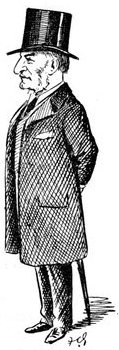
LORD HERSCHELL.
TWO UMBRELLAS.
Lord Herschell, once a regular frequenter of the Lobby, does not often find time to look in now that he is Lord Chancellor, and in addition to the ordinary weighty calls of his office, has in hand the revision of the Commission of the Peace. Another peer, once a constant visitor, who has abandoned the place, is the Earl of Ravensworth. He was long known in the House of Commons as Lord Eslington, a representative of the highest type of county member. When he succeeded to the peerage he spent more time in the Lobby of the Commons than on the red benches of the House of Lords. Whatever the season of the year or the prospect of the weather, he brought his umbrella with him, a heavily constructed article, capable of sustaining the weight of a properly tall man when he leaned upon it, whilst he conversed with a circle of friends.
The only member whose faithful attachment to his umbrella equalled Lord Ravensworth's was the late Mr. Tom Collins. Judging from the shade of the gingham, the determination of the bulge in the middle where it was tied round with a piece of tape, and the worn condition of the ferrule, the umbrella dated back to the epoch of the Great Exhibition. So dear was it to the heart of its owner that he would not risk accident or loss by leaving it to take its chance with the miscellaneous multitude in the cloak-room. Like Lord Ravensworth, he carried it with him in all weathers, and before entering the House to take part in the solemn institution of prayers, he reverently deposited it behind the chair of the principal doorkeeper. Mr. Collins was not a man of abnormally suspicious nature. All his colleagues in the House of Commons were honourable men. Still, human nature is weak. To see an umbrella like that hanging loosely on a peg, or to find it ready to hand mixed up with a lot of ordinary articles, might prove too strong a temptation for a weak brother. Mr. Collins spared many a possible pang by placing his umbrella out of range of casual sight in personal charge of the doorkeeper.
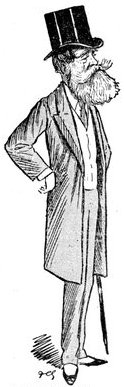
LORD SPENCER.
SOME OTHER PEERS.
I never saw Lord Salisbury in the Lobby, and do not recall any time when his burly figure was seen looking down from the gallery on the arena in which the first Lord Robert Cecil played a lively part. Earl Spencer comes over occasionally for consultation with his colleagues. Lord Rosebery, with the cares of the Empire on his shoulders, finds time occasionally to look in at the House, for a seat in which, as he has sometimes hinted, he would gladly barter his coronet.