Front matter
Reading edition
Cover art
"It is with history as with travelling through a great country. The by-ways are often the most pleasant."
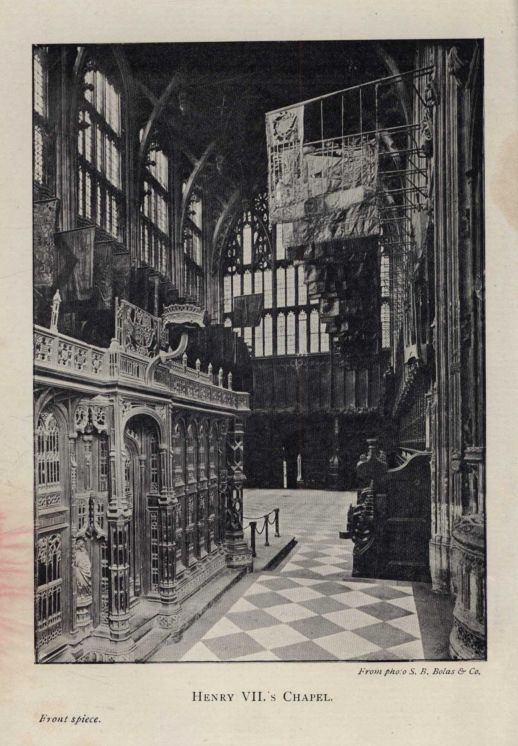
HENRY VII's CHAPEL.
The Story of Westminster Abbey
Being some Account of that Ancient Foundation, its Builders and those who Sleep therein.
BY
VIOLET BROOKE-HUNT
AUTHOR OF "PRISONERS IN THE TOWER OF LONDON," "LORD ROBERTS," ETC.
London JAMES NISBET & CO., LIMITED 21 BERNERS STREET 1902
INTRODUCTION
Geoffrey's father had gone to be the representative of the Mother Country in one of the distant Colonies, and as the boy had "more brains than body," to quote his house-master, his parents had taken him with them for a time, making a long journey first. When he came home to go to Eton, I found him a much-travelled person, brimming over with a host of new ideas and impressions, though otherwise the same original dreamy boy as ever. The inches he had added to his height and his chest testified to the success of the experiment on that score, while it was evident that his active little brain and his big eyes had made the most of their opportunities.
"I seemed to be doing lessons all day," he confided to me, "only they weren't lessons out of a book, and they seemed so much easier to remember. I wish I could always learn things by seeing them!" As the Christmas holidays had to be spent in London, I took Geoffrey at his word, and one morning we wandered down to Westminster Abbey for the ostensible purpose of seeing the Coronation Chair. Of course we saw a great deal more, and one visit led to another.
"It's not a bit like a churchyard, though it is full of monuments," was Geoffrey's criticism one morning. "It is just a book about English history right from the very beginning; and please I want you to write it all down; because now I've seen the places and the monuments and the figures, I shall understand reading about them."
I demurred, but Geoffrey had answers for most of my objections, and here is his view of the matter, imparted to me in fragments and at intervals during the day.
"It's not only what I want," he said, "but I know some of the boys and girls where father is would like it too, especially if you put in plenty of pictures. You see though lots of them have never been over here at all, they always call England home, and they all mean to come some day. And of course when they do come they will go to Westminster Abbey, because it partly belongs to them. I am afraid I can't explain it very well, but what I mean is that now I have learned so many new things about the Abbey, I feel as if I understood ever so much more about history; not the dates and the Acts of Parliament and the dull parts, but the kings and the queens, and the important men who really lived and did things. And all those people must belong to every one who is English, no matter where they live, mustn't they? So if you put them all into a book, every one who reads it will know what to go and look for in the Abbey, and they won't feel quite strange when they get inside the doors, because they will see old friends all around them."
Geoffrey's remarks were suggestive, to say the least of them, and as he spoke I could not help feeling that there were other boys and girls besides those across the seas, and possibly some grown-up people too, who would learn to better know and love the Abbey, with its eight hundred years of unbroken traditions, if they could read its story written in simple language and told in a simple way.
That is at once my excuse and my justification for a book which does not aspire to be technical, exhaustive, or very erudite. Critics will find plenty to criticise, especially in the latter part, for I am well aware that with such a mass of material to draw from, much has been left unsaid that is nevertheless full of interest. Many events have of necessity been crowded into a few lines, when a few chapters would not have done them justice, while I plead guilty to having dwelt at greater length on some names than is perhaps warranted by their actual position in history. Broadly speaking, my desire has been, firstly, to consider the Abbey as including the Palace of Westminster, and to weave men and events connected with both into the story; secondly, to try and make clear how wonderfully representative, how all-embracing, is this glorious old Church, with its continual reminder to us that though former things may pass away, new things for ever spring up to fill the empty places.
Then Geoffrey had his favourites and I had mine, for both of us in our different ways are hero-worshippers, and thus has our selection been made.
For the rest, I can only feel that, despite its shortcomings, the book will not altogether fail in its object if it makes the Abbey a more familiar place to the boys and girls of the Empire, if it helps, in the words of Matthew of Paris, "to keep alive the memory of the good in the past generations, for the which all sacred historians have striven, from Moses down to the deep-souled chroniclers of the years in which we ourselves are living."
Many are the books to which I am deeply indebted, but especially would I mention, among other works, Dart's "History of the Abbey Church" (1723), Widmore's "History of the Church of St. Peter" (1750), Neale and Brayley on "The History and Antiquities of the Abbey" (1818), and portions of the Chronicles, Matthew of Paris, Froissard, and Stowe. Among modern works Dean Stanley's "Memorials" easily takes the first place, as much for the charm of its style as for its general value and admirable classification; and I am especially obliged to Mr. John Murray, the publisher, for allowing me to use two of the copyright plans from this book. Stanley's "Sermons on Special Occasions" are also so closely connected with Westminster Abbey that I have found them very suggestive.
The Deanery Guide is invaluable, and contains a storehouse of information concisely and correctly tabulated. No one should go round the Abbey for the first time without this excellent little work, and I gratefully acknowledge the assistance it has been to me. I must also include the "Annals of Westminster Abbey," by Mrs. Murray Smith; "Westminster Abbey," by W. J. Loftie; "Westminster," by Sir Walter Besant, and "A Little Guide to Westminster," by E. M. Troutbeck.
For more general information and for biography I have turned to the standard histories, especially to Freeman's "Norman Conquest," and to those most useful lists of authorities given in the "Dictionary of National Biography."
VIOLET BROOKE-HUNT.
45 ALBERT GATE, S.W. February 1902.
CONTENTS
PART I
WITH KINGS AND QUEENS IN THE ABBEY
In the Misty Past
The Hallowing of the Abbey
Saxons and Normans at Westminster
Through Seven Reigns
With Kings and Queens in Edward's Shrine
Edward III. and Queen Philippa
Richard II. and Queen Anne
Henry V. and his Chantry
The Wars of the Roses and the Third Royal Builder
The Abbey and the Reformation
In the Chapel of Henry VII.
From the Stuarts to Our Own Times
PART II
AMONG THE MONUMENTS
Puritans and Cavaliers in the Abbey
Chaucer
Spenser, Addison, and the Poets' Corner
Garrick, Doctor Johnson, and Sheridan
The Musicians in the Abbey
Wilberforce and his Fellow-Workers
Pitt and the Statesmen's Corner
Lawrence and the Indian Heroes
Dickens, Browning, and Tennyson
A Last Wander Around
LIST OF ILLUSTRATIONS
Henry VII.'s Chapel . . . . . . Frontispiece
Vaulting in Henry VII.'s Chapel
The Confessor's Funeral, from the Bayeux Tapestry
St. Edmund's Chapel
Picture and Tapestry in the Sanctuary
The Confessor's Chapel
Tombs of Edward I. and Henry III.
Entrance to the Chapter House
The Coronation Chair
Pyx Chapel
Tombs of Richard II. and Edward III.
Henry of Lancaster Crowned at Westminster
Henry V.'s Tomb
Plan of Tombs in the Chapel of the Kings
Gates of Henry VII.'s Chapel
Plan of Chapel of Henry VII.
Tomb of Queen Elizabeth
Interior, Looking East
Jerusalem Chamber
Prince Rupert
Oliver Cromwell
Chaucer's Tomb
Poets' Corner
Dr. Samuel Johnson
George Frederick Handel
David Livingstone
Charles Darwin
William Pitt, First Earl of Chatham
Rt. Hon. Warren Hastings
West Transept
Lord Tennyson
The High Altar
ERRATUM.
Page 99, line 1, for 1388 read 1399.
[Transcriber's note: the above erratum has been applied to this text.]
PART I
WITH KINGS AND QUEENS IN THE ABBEY
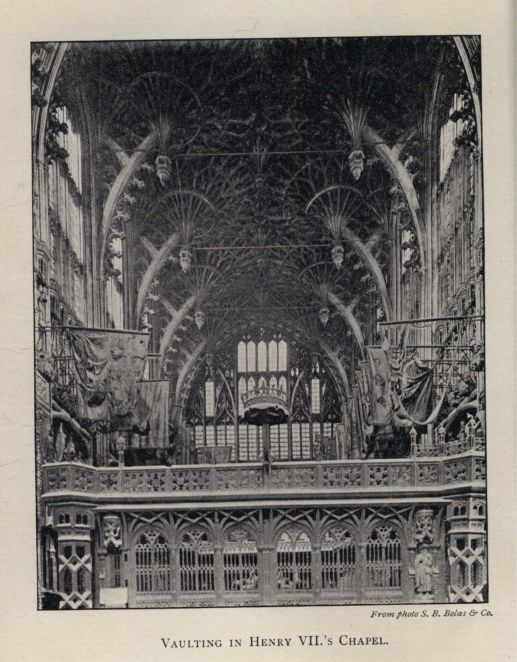
VAULTING IN HENRY VII.'s CHAPEL.
THE STORY OF WESTMINSTER ABBEY
CHAPTER I
IN THE MISTY PAST
"Without the walles of London, uppon the river Thames, there was in Times past, a little monasterie, builded to the honour of God and St. Peter, with a few Benedict monkes in it, under an Abbote serving Christe. Very poore they were, and little was given them for their reliefe. Here the king intended, for that it was near to the famous citie of London, and the river of Thames, that brought in all kinds of merchandizes, from all partes of the worlde, to make his sepulchre: he commanded that of the renters of all his rentes the work should be begunne, in such a sorte, as should become the Prince of the Apostles."
These are the words which gather up the early story of Westminster Abbey.
Try to forget for a few moments that pile of splendid and richly decorated buildings, majestic and dignified in its beauty, which to-day stands out so clearly against the grey of London skies as if conscious of its right to be regarded as the most wondrous treasure belonging to London City, and come back with me a journey of many hundred years, to make the acquaintance of the Abbey as it appeared to the boys and girls who lived under Saxon and Danish, English and Norman, Plantagenet and Tudor kings. For only so will you come to understand how the history of the Abbey has been interwoven with the history of England; how, in days gone by, kings and nobles, commons and people gathered beneath its shadow, making it not only the centre of the nation's life and activity, but also the starting-point from which set out every English sovereign called to the throne, the resting-place to which so many of them were borne back, when they had received their summons to the high court of the Great King.
Then you will feel something more than a sense of wonder as your eyes rest on its beauties. It will speak to you in a language of its own, as it tells you of that past which you must learn to know aright if you are to play your part nobly in present or in future days. It will open your ears so that you will catch echoes of the melodies which float down the ages. It will bring to your heart a thrill of reverence and a thrill of pride, as you realise that this treasure-house of memories is a national inheritance in which you have a share. It will make you familiar with that company of men and women who, by reason of their goodness or their greatness, or their many gifts, so won the respect of their fellows, that in death they were deemed worthy to lie within walls "paved with princes and a royal race." And it will teach you, as no book can teach you, the story of the land we love, the land which all the great men of history—kings, soldiers, statesmen, poets, workers, and thinkers have helped to build up, that it might be ours to inherit and then to pass on to coming generations in unsullied greatness.
Now if we wish to trace back to its first commencement that "little monasterie without the walles of London," we must frankly admit that concerning its earliest history any information we possess is of a very shadowy character. Certain it is that for some centuries a religious building had existed on Thorn-ea, one of those many little islands standing above the reach of the floods which rose at high tide in that part of the Thames where it broadened out into a great marsh. Possibly the Romans had a station at Thorn-ea, as Roman bricks and pieces of mosaic and such remains as a fine Roman coffin have been discovered from time to time, and Bede, our first English historian, states that Lucius, king of Britain, himself a Christian, built a church on Thorney Island about the year A.D. 178. For nearly four hundred years England had remained the conquered province of the Roman Empire. Then the greatness of that power began to wane; Rome was threatened at her own doors by the Goths, and to defend herself she had to call back her legions from Britain and leave the island to its fate. Picts, Scots, and Saxons bore down on it, and the Saxons, "fierce beyond other foes, cunning as they are fierce, the sea-wolves that live on the pillage of the world, to whom the sea is their school of war and the storm their friend," swept all before them. Wherever they went on their victorious way they slaughtered and shattered, and whatever Christian church existed on Thornea they razed to the ground. For awhile the curtain falls, then it rises to show us Sebert, a Christian king of the East Saxons, who lived at the beginning of the seventh century. He was converted and baptized by Mellitus, the Bishop of London, and founded the Minster of St. Paul on the east side of London. But in years to come, when Thornea was no longer a desolate "Isle of Thorns overrun and wild," but the spot above which there towered the Abbey, the Palace and the Monastery all grouped together under the name of the West Minster Foundation, the monks declared that King Sebert had raised a second church in this very place, dedicated to St. Peter, the Prince of the Apostles. Furthermore they told how one dark and stormy Sunday night, the eve of the day set apart by Bishop Mellitus for the consecration of the new church, Edric, a fisherman busy at his craft, heard a voice calling him from the opposite side of the river. He went across in his boat, and found there a stranger, who begged to be rowed over to the island. This Edric did with some difficulty, as the waters were rough, and raised with "prodigious rains," and the stranger, landed safely on the island, at once went towards the newly builded church. "Watch well this night, Edric," he said as he left the astonished fisherman. So Edric waited and watched, and in the space of a few moments he saw the empty church ablaze with light, standing out without darkness or shadow in the wild night. Voices, such as he had never heard before, sang chants and hymns:—
"Yonder swelled that strain,
And still the Bride of God, that Church late dark,
Glad of her saintly sponsors laughed and shone,
The radiance ever freshening....
The fisher knew that hour
That with vast concourse of the sons of God
That Church was thronged."—AUBREY DE VERE.
Then the lights faded, the music died away, and once more the stranger stood at Edric's side.
"Give me to eat," he asked of him.
But Edric had as yet caught nothing.
"Cast forth thy nets, for the Fisherman of Galilee hath blessed thee," said the stranger, and then he added, "Tell Mellitus on the morrow what you have seen, and show him the token that I, Peter, have consecrated mine own church at Westminster. For yourself, go out into the river; of fish you shall catch plenty, and many salmon. But the tenth of all you take, you shall pay to my church, and never again shall you seek to catch fish on any Sunday."
With these words the stranger vanished, leaving Edric to ponder on the wonderful things he had seen and heard.
On the morrow, when Bishop Mellitus, accompanied by his priests and singing-boys, arrived to dedicate with all such honour as he could the Minster of Thorney, he was met by Edric, who held in his hand a salmon, and gave the message which had been delivered to him. Furthermore, he pointed out to him the marks of the twelve crosses of consecration, in memory of the twelve Apostles, on the church within and without. And the Bishop believed his words, for he saw everywhere the signs; so he went from the church saying: "The dedication had been performed sufficiently, better and in a more saintly fashion than he could have done." So he held a service of thanksgiving for this token of heavenly favour, and then made his way back to London, to enjoy with a good conscience the fish which Edric had presented to him.
Quaint and picturesque as is the legend, it is clearly nothing but a legend, told by the monks of St. Peter's for various reasons, the most probable being that they were anxious to prove their superiority over the monks of St. Paul's. It is not even a certainty that King Sebert played any part at all in the history of Thorney Island, for in several of the oldest chronicles we are told about "a dweller or citizen of London by name Sebert who was excyted to make a church in the worship of St. Peter in the West End of London, which that time was foregrowen with bushes and bryeres exceedynglye." But, on the whole, I think we may allow the monks to keep King Sebert as their founder, and accept the story that he and his queen were buried in leaden coffins in this early church, that their bodies were removed to the restored church more than four hundred years later, and once again, in the reign of Henry III., were taken from their resting-place to be laid with great ceremony in the tomb which now you can see just inside the south ambulatory of the Abbey.
A century later we find something tangible concerning the Church and Monastery of St. Peter; for Offa, the wise and strong king of Mercia, made certain gifts to it, and in the charter of 785 A.D. confirming these, he spoke of Thorney Island as a "locus terribilis," by which he probably meant "a sacred spot." But after this again there is silence. Once more Britain lay at the mercy of the invaders, this time the fierce Danes, who, as the Saxons had done, swept ruthlessly over the land, devastating and destroying as they went. The church at Thorney was in far too conspicuous a position to escape their notice; they fell upon it in all their fury, and only a few of the monks managed to reach London alive. So were the buildings "reduced to a very mean and low condition."
In time, however, the hand of the Dane was stayed. For a hundred years indeed had they held their sway of terror, till at last they were decisively beaten by Alfred of Wessex, that ideal warrior-king, who first freed his people from their oppressors, and afterwards, laying aside all personal ambition, devoted himself to the task of ruling them wisely and well.
The Peace of Wedmore was signed in 875, and probably the church and monastery of St. Peter were rebuilt soon after, but we know nothing till we come to the days when Dunstan was made Bishop of London, and "prevailed easily with King Edgar (as indeed he did, and ordered all in Church matters during the reign of that Prince), to have the monastery, then in ruins, restored, and that too at the king's expense; that is, the walls and what else remained of the ruins repaired and the place made habitable. And he brought hither from Glastonbury twelve monks to make it a small monastery of the Benedictine Order." Dunstan had grown up from childhood under the shadow of that famous monastery at Glastonbury, where he had been the pupil of the well-learned and deeply religious men who had come over there from Ireland, and when at last, after many years of varied fortunes, he found himself all-powerful, he made it his first object to introduce the strict Benedictine rule wherever it was possible in religious houses. For during the time when the Danes held the upper hand the people had fallen back into many heathen ways, and the priests no longer held the torch of Christ's religion on high, or sought to lead men from darkness to light. Dunstan was full of zeal, and under his strong influence King Edgar made many grants of lands and provisions to the Abbey of St. Peter, in which place Wulsinus, also a monk from Glastonbury, reigned as Abbot.
But once again the monks of Thorney Island were driven forth from their cells and their cloisters, this time also at the hands of the Danes, who, led by Sweyn, "marched through the land, lighting war beacons" as they went on their way, avenging the treacherous massacre of their fellow-countrymen in Wessex.
King Ethelred, the Unready, offered no resistance to the Danes, but let every city save London fall into their hands, and then fled from his kingdom, leaving Sweyn on the throne. However, in Canute, the son of Sweyn, there arose a friend to what remained of the religious house on Thorney, for he, "of a usurper being none of the worst," as an old writer cautiously admits, conceived a great affection for a good monk, Wulnoth, who had been brought up in the monastery there. When he became king, Canute raised Wulnoth to the position of Abbot, granted many favours to him and his house, and there is little doubt that he built for himself a dwelling-place at Thorney so as to be near Wulnoth, whose conversation pleased him, the Abbot being a man of singular sincerity. It was a rest to him to turn from the cares and responsibilities of his kingdom to the peaceful simple life of the Benedictine house. God had called him to the camp and the court, and he had vowed never to spare himself in what was good or needful for his people. But in his latter days it was the calm of the cloister that he loved. Nothing remains of the palace he built there, save the record that it was burned down in a later reign, but it is probable that the well-known incident of the courtiers and the tide took place on Thorney Isle.
Canute was but forty when he died, and with him died the peace which had been such a blessing to his people while he reigned. For he left three sons, and between two of these, Harold and Hardicanute, there was sharp strife as to who should become king of England. First they divided the land, then Harold became sole king. But three years later he died, and was buried in the Church of St. Peter, under the shadow of the walls his father had loved so well. From thence, however, his fierce brother Hardicanute dragged forth his body and had it thrown into the Thames hard by.
Such a deed as this stamps the man, and shows him as he was, cruel, revengeful, and fierce. His people suffered many things at his hands, and when he died of hard drinking at the end of two years, there was a great longing throughout the land to shake off the last trace of a Danish yoke and to have for king one of their own race. Their hearts turned towards Edward, the younger son of Ethelred the Unready, whose life hitherto had been chiefly spent in Normandy, whither he with his mother, Emma of Normandy, afterwards the wife of Canute, had taken refuge when Sweyn had conquered England. Little did they know of him, save that he was of their blood, and had been exiled from his land and his birthright by a foreign foe. But his face was gentle, like that of a woman, with white skin, pink cheeks, blue eyes and golden hair; his voice was low, his manner serious and kind, his ways were simple and he had a reputation for great holiness.
Earl Godwine, the all-powerful noble who had served under Canute and had vainly endeavoured to restrain his sons, was at one with the people of England in this matter, and so it came to pass that "before King Hardicanute buried were, all folk chose Edward to king at London." For awhile Edward hesitated. A throne had no attractions for him, and he was almost a stranger to English manners and English life. But Godwine, who had gone out to Normandy as the bearer of the message from the people, over-persuaded him and brought him back. The Witan met at Gillingham in Dorset to confirm the choice of the citizens of London, and Edward was crowned in Winchester Cathedral on Easter Day with great ceremony, many foreign princes and ambassadors being present to do him honour.
Almost the first work of the new king was to build himself a palace, and the site he chose was one close to the little Benedictine monastery at Thorney Isle, which now was always called Westminster, a place no longer covered with brambles, but well cultivated by the monks, who were skilled tillers of the soil, and rendered green and fertile by the river which flowed hard by. Of the palace as he built it no traces are left to us, it having been all destroyed by fire, but we know it was made very strong, guarded by outer and inner walls fashioned after the manner of a Norman castle, probably nearly resembling the Council Chamber and Banqueting Hall which still remain in the Tower of London, little altered since the day when the early Norman builders completed their work. The Abbot of Westminster at this time was Eadwine, a very prudent man, and he soon attracted the notice of the king, who was by nature far more fit to rule a monastery than a kingdom. Edward was troubled somewhat in his mind, for when an exile in Normandy, he had taken a vow that should it ever please God to restore him to his rightful inheritance, he would go on a pilgrimage to Rome to do honour to St. Peter there; but now that he was safely established on the throne, his council made strong objections to his leaving the country, lest some evil should befall him or the Danes should take advantage of his absence to invade the land, while "the common people, publicly and with tears, showed their concern, entreating him to desist from so dangerous a voyage." Thus the king knew not how to act, desiring ardently to carry out his vow, and yet being unwilling to disregard the wishes of his people. Possibly it was Eadwine, living as he did so near to the king's new palace as to be often consulted by him, who proposed as a way out of the difficulty that a Bishop, with a fitting retinue, should be sent as an ambassador to Pope Leo, to explain to him how Edward was restrained from journeying thither himself, and to ask for a dispensation. This proposal was quickly carried into action.
Pope Leo readily absolved the king from his vow, desiring that instead he should build or restore some monastery to the honour of St. Peter, and make over to the relief of the poor such a sum of money as his journey would have cost him.
Edward was wonderfully pleased at the Pope's message, and resolved to begin at once a building worthy of the great Apostle. What more natural than that he should choose the little monastery at Westminster, which was very poor? It lay near to the city of London, and to that great river up and down which there was so much coming and going of ships. It lay near also to his own palace, and if the present humble buildings gave place to such an edifice as he intended to raise, where could a more suitable burying-place for himself be found when the time came for God to call him hence? Then, too, Abbot Eadwine found great favour in his eyes; and the monks there, under the strict rule of St. Benedict, had won for themselves a good report concerning the simplicity and holiness of their lives. So it seemed fitting that Westminster should be raised from its lowly state and be refashioned in a manner worthy of the saint whose name it bore.
Just at this time, too, Wulsinus, an aged and saintly monk at Worcester, had a wondrous story to tell of a sacred vision vouchsafed to him, in which St. Peter had appeared bidding him to deliver this message to the king. "There is," declared the Apostle, "a place of mine in the west of London, which I chose and love, the name of it being Thorney: which having for the sins of the people been given to the power of the barbarians, from rich is become poor, from stately low, and from honourable is made despicable. This let the king by my command restore and make a dwelling of monks, stately built and well endowed, for it shall be no less than the House of God and the Gate of Heaven."
The vision was made known to Edward, and shortly afterwards he commanded that a tenth of his entire substance, gold, silver, cattle, and all other possessions, should be set aside for the purpose of pulling down the old church and raising a new one from the very foundation.
So from this time the story of the Abbey passes from misty legend into proven history, and it is with Edward, named afterwards "the Confessor," that the glory must rest of having called into being that great religious house, destined in the future to be most closely linked with all that concerned alike the crown and the country.
CHAPTER II
THE HALLOWING OF THE ABBEY
King Edward had no sooner resolved on the site for his new Abbey Church, than he commenced the task of building it, pressing on the work with zealous eagerness, making it indeed the object of his life. In his character he lacked all those qualities which go to the making of a great king. His prayers and his visions so absorbed him, that in heart and mind he lived in the company of saints and angels, and the duties of government were altogether irksome to him. By birth partly Norman, by education and tastes entirely so, he knew but little of the people over whom he was called to rule, and wherever it was possible he willingly handed over all duties of government to others. Fortunately for himself and for England, there were two men ever at his side, who served both him and his people loyally and well, these being Earl Godwine and his second son, Harold, Earl of the East Saxons. Both were related to him, for Godwine was the father and Harold the brother of Lady Eadgytha, the beautiful and accomplished wife of the king, and both showed themselves to be rulers wise, just, and merciful.
Of the two, Harold was the more beloved by king and country alike; indeed, one chronicler of that time boldly says that Edward's greatest claim to glory lies in the fact that he called Harold to the government of his realm. Tall of stature, beautiful in form and face, he excelled in all things, whether in the battle-field or at the council, and to his many gifts was added a noble and upright character, strong when the need for strength arose, but ever inclined to show mercy and compassion. This was the man on whose shoulders Edward virtually laid all the responsibilities of his realm, while he spent most of his time in his palace at Westminster, so that he might be on the spot to superintend the progress of the building, which went on apace, and to consult with Abbot Edwy as to the form it should take. It was on the church itself, rather than on the buildings of the monastery, that the king lavished his especial care. He meant it to be in the "new style," which he had learnt to love during his exile in Normandy, that land from which came forth those master-builders, many of them priests and scholars, whose handiwork is still to be found alike in Norman and in English minsters, beautiful as ever in its strength, its simplicity, and its dignity. Many were the Norman customs and ideas which Edward brought over with his Norman friends, and some of them were vigorously opposed by Harold, who was passionately English.
But as we go through the country and find one after another of those majestic buildings in grey stone, made so perfect as to defy the centuries, we must gratefully remember that it was King Edward who first of all set up this "new style" as a model in our midst.
One characteristic was, that every great church should be built in the form of a cross; in the centre the nave, at the east end the High Altar, and where the nave merged into the choir cross arms on the right and on the left, and so it was that Westminster was the first cruciform church in England.
This is a description of Edward's building, given to us in a French Life of the king, written very shortly after his death:—
"Now he laid the foundations of the church
With large square blocks of grey stone.
Its foundations are deep,
The front, towards the east he makes round,
The stones are very strong and hard.
In the centre rises a tower
And two at the western front,
And fine and large bells he hangs there.
The pillars and mouldings
Are rich without and within.
At the basis and the capitals
The work rises grand and royal.
Sculptured are the stones
And storied the windows.
All are made with the skill
Of good and loyal workmanship.
And when he finished the work,
He covers the church with lead.
He makes then a Cloister, and Chapter-House in front,
Towards the east, vaulted and round,
Where his ordained ministers
May hold their secret Chapter,
Prater and dorter,
And the officers round about."
Considering the size of Edward's building, for it was very little if any smaller than the Abbey as we know it to-day, it is unlikely that all the parts described by the French chronicler were finished during the lifetime of the king. Indeed, the royal builder seems to have known that his eyes would never rest on his work, perfected as he dreamt of it. His longing therefore was that church and choir might be completed and dedicated, and for the rest he made such munificent gifts in land and money, plate and jewels to the Abbot, that he had no fear but that the building of the monastery with its cloisters and dormitories, infirmary and refectory, would be easily accomplished, even if he did not live to see it.
Signs were not wanting to warn him that the hour of his death was near at hand. He had ever firmly believed in dreams and visions, and of late these had been full of solemn meaning to him. He had seen the Seven Sleepers of Ephesus turning from their right sides to their left, and this he judged to be an omen which told of a great upheaval, of wars, pestilence, and famine, which should last for seventy years. Then, too, the Christ Child had appeared to him as he stood near the High Altar in the newly finished choir, and had told him how soon he was to be called hence. And, most wonderful of all, two pilgrims, just returned from the Holy Land, came to the king with a strange story.
Some time before, Edward was on his way to the dedication of a church he had built to St. John the Evangelist, when he passed a beggar who pleaded with him for his charity in the name of the Apostle of Love. The king carried no money with him, and his much-loved Chamberlain, Hugolin, was not at hand. Yet so tender-hearted was Edward that he could not pass the beggar by, and he took from his hand a ring, "large, royal, and beautiful." The beggar took it and vanished. But these two pilgrims told how while they were in Syria and in great straits, having wandered from their path, an old man with a long, white beard, carrying two lighted tapers, stood in their pathway and questioned them. When they spoke of their country and their king, he became very joyous, and declared how great a love he bore to Edward. Furthermore he led them to a hostel hard by, told them that lie was none other than St. John the Evangelist, and gave them the ring, bidding them to take it back to the king with the assurance that in half a year he should stand at his side in Paradise.
Edward accepted the story with childlike simplicity. He fasted more rigorously, he prayed more earnestly, and he decided to hasten on the hallowing of his church.
The Feast of Christmas was at hand, and the king summoned the Witan for the first time to Westminster, that they might take part in the great ceremony. Little did he dream how through the centuries to come Abbey and Parliament would be welded together.
On Christmas Day, though ill, he, wearing his crown, took part in the services, and was present at the Christmas banquet in the palace. He conversed with the bishops and the nobles, and appointed the feast of the Holy Innocents as the day on which the great event for which he had so longed should take place.
But his strength began to rapidly ebb away, and all who saw him knew him to be a dying man. Too weak to do more than set his signature to the charter of the foundation, he still insisted that the hallowing should take place. Death held no terrors for him; it was but the gate through which he must pass ere he could join that white-robed host of saints and martyrs whose presence he had felt so near to him through life. Only, like Simeon of old, there was one thing he desired before he could say, "Lord, now lettest Thou Thy servant depart in peace." Not till his church was consecrated would the desire of his heart be satisfied.
By his bedside stood his wife, the Lady Eadgytha, herself the founder of a convent church at Wilton. In life he had never loved her overmuch; like his kingdom, she occupied a very secondary place in his thoughts. But womanlike she forgot all that in this moment, and thought only how best she could help and comfort him. Calmly she carried out his every wish, and, acting as his representative, went, accompanied by her two brothers Harold and Garth, to the consecration of the Abbey Church by Stigand, Archbishop of Canterbury.
"Magnificently finished was the church," says an old writer, and it is not difficult for us to picture what took place there on this joyous festival. The walls, massive and stately in their simplicity, gleamed in their freshness, and formed a vivid contrast to the colours to be found in the vestments of the bishops and the priests, the robes of the acolytes and singing boys, the distinctive dress of the monks, and the varied costumes of nobles, both Norman and Saxon, who were assembled there. The lights shone on the High Altar, clouds of incense floated around it, and for the first time those walls resounded with chant and hymn and solemn antiphon.
"The work stands finished," murmured the king as the echoes of the music floated across to him.
When the queen returned to his bedside, he lay unconscious, and she, kneeling on the ground, tried to restore to him warmth and life. But for many days he made no sign. Then suddenly, on the last day of the old year, came the final flicker. In a voice clear and strong, he spoke of two holy monks, and all that they had prophesied to him concerning the disaster which would shortly overthrow the land. So earnest were his words that they struck terror into the hearts of all present; only Stigand, the Archbishop, dared declare that the king babbled in delirium. Yet other things did Edward bequeath in those last days. To his friend the Abbot Eadwine he gave his body with the command that it should be laid in the Abbey Church, and to Harold, his brother-in-law, he commended the Lady Eadgytha, who had never failed in her duty towards him, and to whom he desired all honour should be accorded. Neither did he forget his Norman favourites, who had, he declared, left their native land for love of him.
Still there was one all-important bequest to be made, and in that moment Edward seemed to have understood, as he had never understood before, the hopes and longings of his people.
"To thee, Harold, my brother, I commit my kingdom," he said solemnly.
Then once more he became silent till near the end, when he turned to the weeping queen.
"Mourn not, my daughter," he said. "I shall not die, but live. For passing from the country of the dead, I verily hope to behold the good things of the Lord in the land of the living."
So he fell asleep; and to him St. Peter opened the gate of Paradise, and St. John, his own dear one, led him before the Divine Majesty.
The grief of the people was intense, and to it was added a wild terror as to what might now befall the land. Hurriedly, as if in a panic, the royal funeral took place on the Feast of the Epiphany, but one day after the king had breathed his last, and the Abbey became the scene of the deepest mourning. Dirges and penitential psalms filled its walls instead of joyful hymns of praise and thanksgiving.
Edward, wrapped around in beautiful robes embroidered by Eadgytha and her maidens, and wearing the pilgrim's ring, was laid in royal state on a bier, and carried by eight men to the Abbey, there to be placed before the high altar.
"Bishops, and a multitude of abbots, priests, and ecclesiastics, with dukes and earls assembled together. A crowd of monks went thither, and innumerable bodies of people. Here psalms resound, the sighs and tears burst out, and in that temple of chastity, that dwelling of virtue, the king is honourably interred in the place appointed by himself."
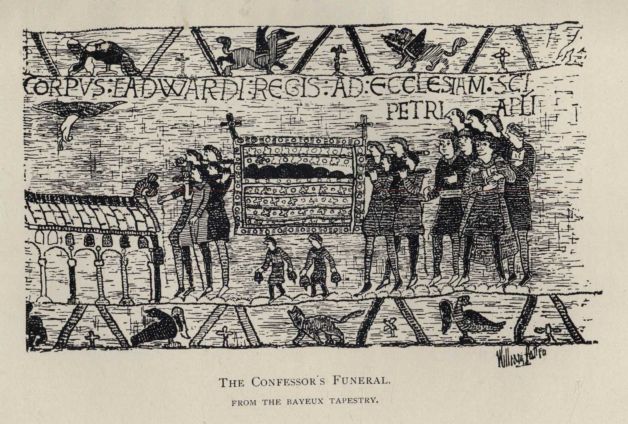
THE CONFESSOR'S FUNERAL. FROM THE BAYEUX TAPESTRY.
So, in a halo of sanctity, ended the life and reign of Edward; and remembering all his piety, his humility, the nights of contrition he spent on the cold stones in spite of his wearing sickness, his deep reverence for all things holy, and the noble gifts he made to the Church, men spoke of him rather as a saint than as a king. And indeed as a ruler he left but little mark on his times. Yet the Abbey Church of Westminster is no small memorial for this last king of the Saxons to have bequeathed to the English nation, and for that alone we owe him a debt of gratitude which lends an unfading glory to his name.
Now, you will be wondering how much of the Abbey Church as Edward built it, stands to-day. And alas! there is but little of it left. For when Henry III., who had a special love for the Confessor, resolved to set up some worthy memorial of this "glorious king," he pulled down the greater part of the simple, stately building Edward had so loved, and set up in its place a much more ornate and magnificent piece of work. Edward built to the honour of St. Peter; Henry, to the memory of St. Edward. But generous as was his motive in pulling down that solid Norman building, which otherwise would have been standing firm as ever to-day, we cannot help regretting those vanished Norman arches and massive pillars.
When you stand by the altar rails, you can remember that the bases of the pillars on either side of the altar are those belonging to Edward's church; or if you go from the cloisters, where the south and the east walks join, into the little cloisters, you will pass under an old archway over the entrance, always known as the Confessor's door. Underneath, too, what used to be the ancient dormitory, but is now the great schoolroom of Westminster School, some very massive and solid buildings remain which evidently date from Edward, and there is also again the Chapel of the Pyx, or Chapel of the Chest, where treasures belonging to the sovereign and the monastery were kept. Neither of these latter places are shown to the general public, but when you go to see the Chapter-House, the entrance to which is in the east cloister, you will see to the right of it the doorway of the Pyx Chapel, which is wonderfully strong, and is said to be lined with the skins of Danes. The interior of this, with its stone altar and its solid stone arches, can have undergone very little alteration since Edward's day. You will get, too, what is probably a correct general idea of the whole building as it looked from the outside in those early days if, when you are in the Chapter-House, you look carefully at the pictures which are copied from the Bayeux tapestries. This wonderful piece of work, which was prepared for the rebuilt Cathedral at Bayeux in Normandy, was certainly embroidered during the lifetime of William the Conqueror, and may even have been the work of his wife, Queen Matilda. Most probably it was made in England, and is in itself a valuable addition to the very fragmentary history of those times. All its details seem to be very accurate, copied from what the workers actually saw and knew about, so there is no reason why the picture of the Abbey in that part of the tapestry which shows the funeral of the Confessor should not as accurately represent the building exactly as it stood.
You must notice the part towards the east made round, and the stones which are "very strong and hard," with the main tower and the two smaller towers at the side. And notice too the figure of a man, who is standing on the roof of the Palace, and holding with one hand the weathercock on the east end of the Abbey.
May be the worker only sought to show the buildings of the Abbey and the Palace standing side by side, but all unconsciously that unknown hand prophesied what should be throughout the centuries to come, and told how Church and State should stand firmly linked together.
The members of the Witan had not departed to their homes on the conclusion of the festivities connected with Christmastide and the consecration of the Abbey. They knew the king was dying fast, and that before many days a great duty would rest on them. Rumours may have reached their ears that William of Normandy, cousin to Edward, meant to lay claim to the throne on his death, declaring that the king had promised to make him his heir, and that Harold himself had vowed to support him. But the sturdy Englishmen who formed that council were resolved that never with their consent should a Norman rule over them, and Edward knew full well the man of their choice when he pointed to Harold as their future king. There was an heir to the throne by right of birth, Edgar the Atheling. Still he lived far away unknown to them all, and the days had not yet come when men succeeded to the throne by right of birth alone. On the spot was Harold, the man they loved and trusted, "the shield of the kingdom, the shelter of the oppressed, the judge of the fatherless and the widow."
Edward had done his part. "Death snatched him from the earth, angels bore his white soul to heaven, and in his death he had been glorious, for he had made fast his realm to the noble earl."
The Witan did not hesitate so soon as the throne was theirs to fill, but of their number sent two, who sought out Harold where he stayed, comforting his widowed sister, and offered to him the throne as the man of their choice. Here again the copy of the Bayeux tapestry in the Chapter-House will help you to picture the scene. You will see the two nobles, one bearing the axe of office, the other holding a crown and pointing to the room in which lay Edward, from whence the crown had been borne. And you will see Harold—to quote the vivid words of Mr. Freeman, "at once wistfully and anxiously half drawing back the hand which was stretched forth to grasp the glittering gift. A path of danger lay open before him, and duty, no less than ambition, bade him enter upon the thorny road. And yet the risk had to be run. If he declined the crown, to whom should England offer it? Under him alone could there be the faintest hope that England would offer a united front to either of the invaders who were sure to attack her. The call of patriotism distinctly bade him not to shirk at the last moment from the post to which he had so long looked forward, and which had at last become his own. The first man in England, first in every gift of war and peace, first in the love of his countrymen, first in renown in other lands, was bound to be first alike in honour and in danger."
So Harold was virtually king of England, appointed by Edward, chosen by the Witan. Yet "full king" he was not until before the altar he and his people had given each other their solemn pledges, until "the blessing of the Church and the unction of her highest ministers had made the chosen of the people also the anointed of the Lord."
There was no time to lose. Already the members of the Witan had lingered for a much longer period than was their wont, and they were anxious to return to their homes. But to delay the coronation until their next meeting was too dangerous to be dreamed of. England could not be left without a king. The burial of Edward and the coronation of Harold must take place at once.
So it came to pass that amid unusual sorrow Edward was buried, as I have already described to you, in the dim light of the Epiphany morning, and a few hours later all was in readiness for the solemn coronation rite.
There can be but little doubt that it was in Westminster Abbey that the ceremony took place. Harold, led by two bishops, walked to the high altar followed by a long procession, the singers chanting the prayer that justice and judgment might be the foundations of his throne, that mercy and truth might go before his face. Then the king elect fell on his knees, and the grand strain of the Te Deum rose to the skies.
And now Eldred, Archbishop of Northumberland, turned to the crowd and demanded of the prelates, the Theyns, and the people of England whether it was their will that Harold should be crowned king?
Their answer was a mighty shout of assent, which came from their very hearts. Then Harold, on his oath, swore to protect the Church of God and all Christian people, to forbid wrong and robbery to men of every rank, to strive after justice and mercy in all his judgments; and first the Bishop and afterwards Eldred prayed that the God who had wrought such mighty works, would pour down His best gifts on him chosen to be king of the Angles and Saxons, that he might be faithful as Abraham, gentle as Moses, brave as Joshua, humble as David, wise as Solomon, so that he might protect both the Church and his nation from all visible and invisible foes.
So the oath was taken and the prayers were ended. But there was yet to follow that sacred rite of mystic meaning, which was enacted as Eldred poured the holy oil on the head of the king, beseeching God, that as of old, kings, priests, and prophets were anointed, so now the oil poured on the head of His servant might be a true sign of the sanctifying of his heart, a means of grace for His glory and the welcome of His people. The crown was placed on his head; the sword was handed to him; sceptre and rod were given one after the other into his hands; while with each act the solemn voice of the Archbishop rose in prayer that a yet brighter crown in the heavenly country might be his, that he might ever with the sword defend the Church and the people against all adversaries, that his sceptre might be a sceptre of righteousness, and that he who had been anointed with the holy oil might stand fast in the strength of God.
Thus was Harold set upon the royal throne; on his head was the crown, in his hand the sceptre, his sword was borne by two chiefs, "while all the people saw him with wonder and delight."
Directly the coronation ceremony was over, the Mass was celebrated. Then all adjourned to the Palace hard by, and a great banquet was held on this Twelfth Night, the last day of the Christmas festival, into which so many and varied scenes had been crowded.
Little had those members of the Witan dreamt when they set out from their homes, of all that would have have happened ere they returned—Christmas festivities and meetings of the Council; the consecration of the new church; the death of King Edward; the choosing of King Harold; the burying of the old king and the crowning of the new, all had followed one after the other in those short wintry days.
And the Abbey itself had been the centre round which all these events had taken place.
It could never sink back into being a mere Benedictine monastery of seventy monks, attached to the Church King Edward had built. A greater future lay before it, and I doubt not that the Abbot Eadwine, shrewd man that he was, conscious of the charter which gave him and his successors a peculiar independence, rested well satisfied on that old Christmas night.
CHAPTER III
SAXONS AND NORMANS AT WESTMINSTER
"Cynge Harold lytel stilnesse gehed."
King Harold, like King Edward, spent much more time in London, and consequently at Westminster, than any of his predecessors had done, though not for the same reason. Edward was reluctant to leave the building in which he took so deep an interest; Harold, knowing full well the unsettled state of the kingdom he had to defend, held that London, "guarded alike by strong walls and the strong hearts of its citizens," was the best starting-point for any expedition he might be called on to undertake. So instead of spending the Easter Feast at Winchester, as had been a long-established custom, he came to Westminster and there assembled the Witan Gemot. He had faithfully carried out every request made to him by the dying King Edward. In every way his position was stronger than it had been three months before, and this Easter festival saw him at the zenith of his power. Suddenly a sign appeared from Heaven, which brought terror and desolation to the hearts of men. The Easter hymns were still being sung in the Abbey, when "the sky became ablaze with a mighty mass of flame, which some called a comet." This appearance brought about a state of panic in those days of superstition. First one interpreter and then another stood up to declare what it might portend, and to prophesy of terrible events about to be accomplished. One and all said the same, the sword of the Lord was drawn by this token, and who should tell where it was destined to fall?
Over the seas in Normandy, William had heard in simple but sufficient language of all that had taken place at Westminster in those first days of the year 1066. A messenger, who had come on an English ship, brought the news, "King Edward has ended his days, and Earl Harold is raised to the kindom."
William's wrath was intense. "Oft times he laced, and as oft unlaced his mantle; he spake to no man, and no man dared speak to him." The crown of England he declared was his and his alone, promised to him by Edward years before, when he went on a visit to the English court, and Harold, shipwrecked on the coast of Normandy, had sworn to support his claim. At once he sent a message, or probably several messengers to Harold, demanding from him the crown. The Englishman's answer was given with no uncertain sound. Had William really been chosen king by Edward and the Witan, he would have supported him, but things were all changed now, and he, Harold, could not give up a crown set on his head by the will of the nation, except at the nation's will. William then decided on an appeal to force. His people, bold and adventurous, rallied to his side, and set about preparing a fleet in which to cross the seas, and his chief counsellor, the Abbot Lanfranc, obtained for him from Rome the sanction and blessing of the Church on his undertaking, representing that it would be for the spiritual welfare of England. For even in those early days England had shown an independence and a restiveness under Roman control which could not be allowed to continue unrebuked.
William was indeed a formidable foe, and he was not the worst or only foe, for Harold was suddenly called on to face his own brother, Tostig, who had turned against him, demanding half the kingdom, and who to enforce this claim had enlisted on his side Harald Hardrada, the warrior king of Norway, whose fame as a fighter was known from Iceland to Africa. With an army, these two landed in the North and moved on to York, fighting their way victoriously. But from London Harold was marching at the head of his house-carls, drawing into his train ready volunteers. As they came along the Roman road with a speed almost incredible, their hearts beating high at the thought of an encounter with traitors and a foreign foe, they told one another how King Edward had appeared to Harold on the night before their start, bidding him be strong and very courageous, for the victory would be surely his. On the 25th of September the armies faced each other, and there came a messenger from the enemy's camp offering terms. Harold's answer was characteristic. To his brother he promised peace and forgiveness, "for he is an Englishman. But to Harald Hardrada, who is a foreigner and an enemy, I will give him six feet of English ground; or, as I hear he is taller than most men, I will give him seven feet. But this is all the English ground he will get from me."
The battle was a fierce one and bravely fought, but the Norsemen were utterly vanquished, and Harald Hardrada was left sleeping on that seven feet of ground which the king had offered him. As was his wont, Harold of England showed nothing but generosity to those of the conquered Norsemen who remained, and sent them back in four-and-twenty ships to their own shores. Then with the remnants of his own army he set out by the way he had come to London, having first summoned a hasty Witan Gemot where he was, to tell them that the Normans had landed in the South. He told them of the work which lay before them, and they answered him with a shout, "The heart of Harold failed not, and the hearts of the Englishmen beat with their king."
October the 5th found him in London at his palace of Westminster, and here to his standard flocked brave and trusty men from the shires of the east, the south, and the west, impelled by a passionate patriotism. Even from the cloisters there came willing soldiers, for many of the monks refused to stay and pray in safety when they could strike a blow for England on the battle-field.
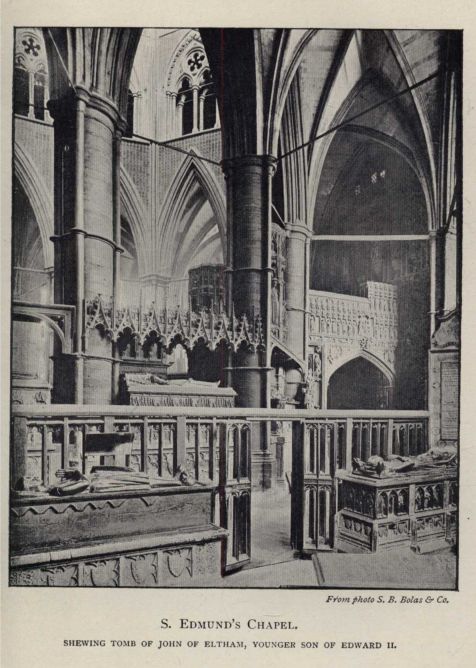
S. EDMUND'S CHAPEL. SHEWING TOMB OF JOHN OF ELTHAM, YOUNGER SON OF EDWARD II.
There was much coming and going of armed men round Westminster during those days of preparation, and it was to Westminster Palace that Huon Margot, a monk, came, bearing a message to the king from Duke William. The message was a demand for submission, a challenge, and Harold proudly sent back the answer, "Tell the Duke I will seek him out and do battle with him." Then Gurth, the brother of Harold, found him in the Palace, and thus besought him—
"Fair brother, remain here, but give me your troops; I will take the adventure upon me and will fight William. And while I fight the Normans, do you scour the country, burn the houses, destroy the villages, and carry away all the swine, goats, and cattle, that they may not find food or anything wherewith to subsist."
All the men who stood round in the chamber said—
"This is good counsel. Let the king follow it."
But Harold sturdily refused to hold back from danger which he was called upon to face, neither would he allow the country to be harried.
"Never," he declared, "will I burn an English village or an English house; never will I harm the lands or goods of any Englishman. How could I injure the people I should govern? How could I harass those I would fain see thrive under my rule?"
And a few hours later, the king at the head of his army marched through Kent and Sussex to the high ground of Senlac, where he pitched his camp, within seven miles of the Norman invaders.
I am trying to tell you of scenes in history which are linked with the Abbey or Palace of Westminster, so I must not dwell on the days that followed. Harold, the fearless soldier, lay dead beneath the standard he had so gallantly defended, and around him lay the flower of his race, faithful to the end. The men who remained were leaderless and hopeless; they could no more offer resistance to the ruthless Norman soldiers, and at last they gave way.
William did not immediately march on London. Tidings came that the citizens of London were eager to fight again. So he first subdued the country around, and forced Dover, Winchester, and Canterbury into submission. Then harrying and burning wherever he was opposed, he made his way through Surrey, Hampshire, and Berkshire, purposing to lay waste the north and east of London, as he had done the south and west. He did his work all too well; even the stout hearts of the Londoners quailed, and at Berkhamstead a deputation came to him owning him as conqueror, laying the crown at his feet. It was a bitter moment for the men who undertook this shameful errand, but no other way was open to them in that dark hour, and immediately arrangements were made for the coronation ceremony. William, who consistently professed the deepest respect for the memory of King Edward, his "predecessor," declared that he would only be crowned in Westminster, "which peculiar respect," says Dart, "seems not only to arise from the pretence of his title from him, but the better to ingratiate himself with the people, with whom he stood but indifferent, by expressing extraordinary reverence for their buried favourite."
On Christmas Day, in the year 1066, the Abbey once again saw a great gathering. A guard of Norman soldiers waited without; inside mingled together wise men of two races, Saxon and Norman. Before the high altar, on the gravestone of the Confessor, stood the Conqueror, on one side a Norman Bishop, on the other, Eldred, Archbishop of York. Once again the monks chanted the Te Deum, and then followed an innovation. For half that multitude assembled there knew not the English language, and the question as to whether they would have this man to be their king had to be twice asked, once in English, once in Norman.
"Yea, yea, King William," was the answer, given with a shout which so startled the Norman soldiers outside, that at once they imagined some disturbance was being made, or some insult was intended to their king. In their wild anger, they began to set fire to the buildings near at hand, and as the flames dashed upwards, the astonished people rushed out of the Abbey to see what all this might portend. So the body of the great church was empty, and in dramatic solitude the Archbishop went on with the service, surrounded only by the monks. William was greatly overcome as he stood thus alone before the altar; there was something terrible in the loneliness and the stillness of the deserted church. He trembled exceedingly, and could scarce command his voice. It seems as if he had shrunk from wearing the crown of Edward, or still older crown of Alfred, "made of gould wyer works, sett with slight stones and two little bells," for he had caused to be brought a new crown, very heavy with gems, and this was the diadem set on his head by Eldred, after he had made the usual vows, with one specially added, in which he solemnly undertook to rule his people as well as the best of the kings who had gone before him.
Still from without came the sounds of tumult and excitement, still within the gleaming choir the solemn service was continued to the end, and thus was William the Norman crowned and anointed, made king indeed of England, but never king of the English people.
Westminster did not fare ill under the new king. Abbot Eadwine was discreet and wise, with much of the courtier in him, and he managed to preserve himself and his house in the good graces of the Conqueror. The building went steadily on, for money was not wanting, it was no part of William's policy to hinder any of the work undertaken by the Confessor. On the contrary, he confirmed all the charters, and when Abbot Eadwine gracefully yielded to him the lands of Windsor, which the king desired to enjoy, it being very convenient; for his retirement to hunting, he gave in exchange many other lands, besides making rich offerings. Moreover William set a rich pall over Edward's grave, presented a cloth of great splendour with two caskets of gold for the altar, and attended Mass in the Abbey Church most diligently.
Eadwine, the last Saxon Abbot, died in 1071, and was buried in the cloisters; he lay near to the very centre of all the life in the monastery which had so developed under his wise rule. Here in the cloisters the monks walked and talked, studied and transcribed; here the novices and the boy scholars sought their recreation; here was the great refectory, and close by the infirmary and St. Catherine's Chapel; overhead was the long bare dormitory. Surely it was fitting that the Abbots of Westminster should be laid in the cloisters, and so they continued to be till the year 1222. You will find the names of many of them recut on the stone benches in the south cloister, if you look for them, only unfortunately this was very carelessly done, and in many cases the names are put over the wrong graves. It seems, too, that Eadwine's body was moved from the south cloister and laid in the passage leading to the Chapter-House, close to the faithful Hugolin, who was the Chamberlain and close friend of the Confessor.
William appointed in Eadwine's place Geoffrey, a Norman, but so evil were his ways that at the end of four years, "having been first admonished by the king and Archbishop Lanfranc, but not amending upon the admonition," he was deprived and sent back to Normandy in disgrace, where he died. He was followed by Vitelus, Abbot of Bernay, held by William to be wise and a man of business, as indeed it was necessary the ruler of a large monastery should be, and among other things "being a stirring man, he let the monk Sulcardus, the best pen they had belonging to the Abbey, draw up the history of the place to give it a figure in the world."
During the rule of Geoffrey, the Lady Eadgytha, widow of Harold, died at Winchester, and was buried with great honour in the tomb of her husband, a tomb which each year became more and more of a holy place to the people of England. Under the hard rule of William, who, in the words of that honest chronicler Master Richard Wuce, "was eke so stark a man and wroth that no man durst do anything against his will, beyond all metes stark to those who withstood his will," the hearts of the people turned to that tomb of an English king, as the source from which they might hope for deliverance, as the spot of comfort from whence came signs from heaven that the saintly king still watched over his sorely tried people.
On one day, a council of Norman clergy was assembled in St. Catherine's Chapel at Westminster, their object being to deprive the holy Wulstan, Bishop of Worcester, of his see, on the ground that "he was a very idiot, being unacquainted with the French language." Lanfranc ordered him to deliver up his staff and ring. But Wulstan was before all else an Englishman.
"Truly, my Lord Bishop," said he, "you claim from me the pastoral staff which it was not you who crave me. In deference to your judgment I resign it, though not to you, but to Saint Edward, by whose authority I received it."
Then he walked to the tomb of the glorious king.
"Thou knowest," he said in Saxon, "how reluctantly I undertook this burden. Only to thee can I resign the charge of those thou didst entrust to my care. Receive thou my staff; give it to whomsoever thou mayest choose."
Thus speaking, he struck his staff into the stone tomb, and behold it sank in and stood erect, so that they who stood by could not move it neither to the right nor the left. Word was sent to Lanfranc, who had remained with the council in St. Catherine's Chapel, and he indignantly sent Gundulph, Bishop of Rochester, to put an end to this foolish story and carry the staff away. But Gundulph was powerless to move it, and on his evidence Lanfranc himself came with the king. Still every effort was in vain, and at last Lanfranc commanded Wulstan to take back the staff.
"My Lord and king," entreated the Bishop, "I pray thee give now thy decision." And the staff yielded itself into his hands.
So the king and the Archbishop, frightened at what they had seen, ran up to Wulstan, begging his forgiveness, and he, having learned from the Lord to be meek and humble of heart, threw himself in his turn upon his knees.
I need not tell you that this is but a legend, and between legend and history there is a great gulf fixed. But it is through legends that we often learn the beliefs and ideas held by the mass of the people, and this story is one of many which explains how the tomb of Edward became a holy shrine.
William of Normandy was not buried in the Abbey; he did not even die in the country it had been his great ambition to conquer and possess. For in making war against the king of France, he set fire to the town of Nantes, and his horse, treading on a red ember, plunged violently, throwing him to the ground, with such injury to himself that he never recovered, but breathed his last in a monastery at Rouen.
A hard ruler, indeed, he had been, yet Master Wace, whom "himself looked on him and somewhile dwelt in his herd," bids us remember that he was "mild to good men that loved God, and made such good peace in the land that a man might travel over the kingdom with his bosom full of gold unhurt, and no man durst stay another man."
"Wa, la wa! May God Almighty have mild-heartedness on his soul, and give him forgiveness of his sins. And may men after their goodness choose the good in him withal fleeing from the evil, as they go on their way that leadeth to God's kingdom."
Such are the kindly words in which Master Wace ends his "Chronicle of the Conquest."
CHAPTER IV
THROUGH SEVEN REIGNS
I am going to take you along very quickly through the reigns of the Norman kings—William Rufus, Henry I, Stephen, Henry II., Richard Coeur de Lion, and John, and not make a long pause till we come to the year 1216, when Henry III., the royal builder of the Abbey as we know it, came to the throne. The Church of Westminster, from the days of the Norman Conquest onwards, became, as if by right, the coronation church, "the head, crown, and diadem of the kingdom;" and Oxford, Winchester, and St. Paul's, which had witnessed so many coronations in the time of the Saxon kings, were no more thought of for this purpose. But rather curiously none of the Norman kings were buried here. Of a foreign race they were, and some among them rested in foreign tombs—the Conqueror at Caen, Henry II. and Coeur de Lion at Fontrevault, while Rufus, killed in the New Forest, was carried to Winchester, Henry I. to Reading, Stephen to Faversham, and John to Worcester, this last-named king having left instructions that he should be dressed like a monk and laid next good Bishop Wulstan, hoping by this subterfuge to take in the devil!
The fact, however, of the Abbey being the recognised place of coronation gave the Abbot a somewhat unique position, for he it was who had to prepare the king for the great ceremonial, though the actual crowning became the right of the Archbishop of Canterbury. All the regalia, too, such as the crown of Alfred, the sceptre, the ring of Edward the Confessor, were kept at Westminster till the seventeenth century, when all that remained of them after the destructive days of the Commonwealth found a safer resting-place in the Tower of London. Yet still are they carried to the Abbey the night before a coronation and placed for the night in the Jerusalem Chamber, while the Dean and Canons of Westminster still have the proud privilege of standing within the altar rails by the Archbishop.
William Rufus had all the worst qualities of his father without his sense of justice, and he was a cruel, selfish king, but he left his mark on Westminster, though not on the Abbey. The Palace was not large enough for his requirements, and he intended to rebuild it on a great scale. However he accomplished little beyond the Great Hall, which to-day is known as Westminster Hall, and leads to the Houses of Parliament.
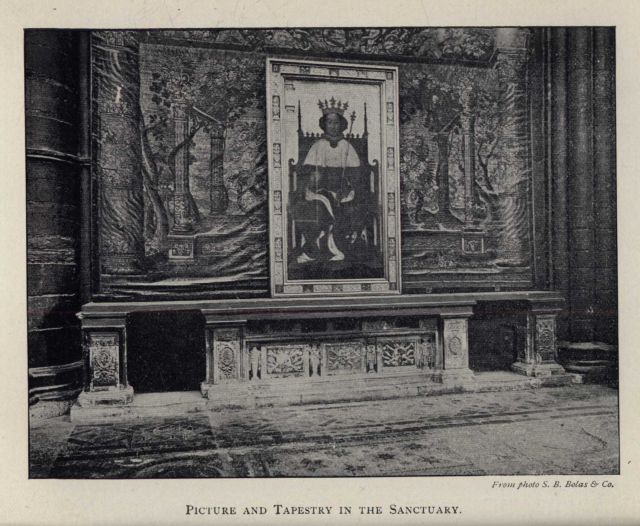
PICTURE AND TAPESTRY IN THE SANCTUARY.
This hall, repaired and strengthened by Richard II. and George IV., is in its way as full of interest as the Abbey, for here always took place the banquet, a part of the coronation ceremony, here were councils held, and here was the scene of many a great state trial. Thanks to the affection felt by Rufus for Gilbert the Abbot, the monastery was not taxed in the heavy way which had once seemed likely during a reign under which the whole nation groaned, and indeed the king granted some new charters to it, for the belief steadily grew that the burying-place of King Edward was the burial-place of a saint, and this general feeling of veneration could not be without its influence on Rufus. A new dignity, if that were needed, became attached to the royal tomb at this time, for on its being opened by Lanfranc, Archbishop of Canterbury, in company with many other bishops, the king was found to be sleeping there as peacefully as if he had been buried but a few hours, with no sign of change on his fair white face.
On the news that Rufus had been found dead in the new royal forest he had himself appropriated, his younger brother Henry arrived in hot haste at Westminster, to urge that he should be chosen and crowned king before his eldest brother, Robert, could get over from Normandy. He was better known, and therefore better liked, than Robert, so it came about as he wished; but as delay was thought to be dangerous, the ceremony was quite simple, "good swords being more thought of than costly robes." The fact, however, that Henry came to the council, asking for their support, gave them a power over him which they were ready to seize, and before the deed was finally done they obtained several important pledges from him as they met him in Westminster Hall. This partly explains, too, the reason why Henry sought to win the goodwill of the English nobles and the English people, for if Robert had come over from Normandy to fight for the crown, the Norman nobles could not all have been counted on. And so, to please the English, he determined to marry a princess of their race, the Princess Matilda, daughter of Malcolm of Scotland, and great-grand-daughter of King Edmund Ironside. Only one obstacle stood in the way, Matilda was a nun in the Abbey of Ramsey, but a nun against her will, forced to take the veil by her aunt Christina. "In her presence I wore the veil with grief and indignation," she said, "but as soon as I could get out of her sight I did snatch it from my head, fling it on the ground, and trample it under foot. That was the way, and none other, in which I was veiled."
Anselm, the large-hearted Archbishop of Canterbury, declared that a vow so taken was not binding, and to the great joy of the nation it was decided that she should be married and crowned on the same day in the Abbey. It was an English crowd which gathered to Westminster on that great Sunday of November 11, and the shouts of Englishmen resounded the heartfelt "Yea, yea," when Anselm from the pulpit asked them if they would that this marriage should take place.
Matilda, who was "a very mirror of piety and humility," and who was, moreover, shy at the sight of the "prodigious multitude" assembled to gaze on her, blushed a rosy red, the colour of her crimson robes, and was greatly overcome. She took up her residence at Westminster Palace, and the fame of her good deeds cemented still more closely the affection felt for her by her subjects. Henry loyally redeemed the promise he had made before his coronation, and this was put down entirely to the influence of his queen.
"Many are the good laws that were made in England through Matilda, the good queen, as I understand," wrote the monk Robert of Gloucester.
To the Abbey adjoining her palace she was a generous benefactress. Each day in Lent she went thither barefoot clothed in hair-cloth, and herself waited on the poorest beggars who sought the charity of the monks, even washing their feet.
"Madam, for Godde's love, is this well ado?" asked a courtier.
"Sir," answered the Queen, "our Lord Himself example gave for so to do."
Both Henry and his eldest son William were away in Normandy when this good queen died at Westminster in the year 1115, after eighteen years of happy married life "withouten strife," and she was buried close to her great-uncle, Edward the Confessor, all people mourning her with sad tears.
Henry died in the year 1135, leaving no son, as Prince William had been drowned in making an heroic effort to save his sister Mary, and England was still so much under foreign influence, that instead of his being succeeded by his daughter Matilda or Maud, his nephew, Stephen of Blois, was chosen king and crowned on St. Stephen's Day. In spite of this, a constant struggle went on against the supporters of Maud, who were many, and the whole reign was one of misery and misrule for England.
"King Henry had given peace to the realm and had been as a father to his people, but now was the whole kingdom thrown into trouble and confusion."
Westminster suffered many things at the king's hands, for he forced on the monastery an Abbot, Gervase de Blois, who "managed very ill, disposing of many Abbey lands, and being so lavish with the goods of the monastery, that the monks were afraid he would have made away even with the regalia," while many Abbey lands were ravished and laid bare as the result of the civil warfare between the Empress Maud and Stephen.
At last a compact was made that Stephen should reign for his lifetime, and that Maud's son, Henry of Anjou, should succeed him; and one year after this had been agreed upon, Stephen died, lamented by no one. Henry was a strong character, a great lover of justice and order; indeed, he may be called the father of English law, and to him we owe the system of trial by jury. He found two great powers in the land, the Church and the Barons, and he determined to hold in check the influence of both.
Westminster was fortunate in having for Abbot, Lawrence, a man of much learning, and what was even more important, of much tact, for he managed to keep on excellent terms with the king, whom he persuaded to repair and cover with lead the roofs of the building. It was he who gained for the Abbey the great honour for which the whole nation had been longing, and as the result of a sermon he preached before the king, the nobles, and a great assembly of people, an embassy was sent to Rome, praying that Edward the Confessor might be raised to the honour of a saint. More than once had this appeal been made and refused, but now the Pope, who feared Henry and had a great regard for Lawrence, decreed that "this glorious light was to be no more hid from the world."
Perhaps, too, the large sum of money, willingly offered by pious Englishmen, carried some little weight.
At midnight on October 13, 1163, Abbot Lawrence with the Archbishop Thomas à Beckett opened the grave of Edward, and the "body of the glorious king, who was henceforth to be honoured on earth as he was glorified in heaven," was removed into a "precious coffin," made ready by the order of Henry II. The celebrated "pilgrim ring" Lawrence drew from his finger to keep in the monastery as a precious relic, and the anniversary of this day was solemnly kept for many a long year.
The king was so anxious to make safe the succession of his eldest son, Prince Henry, that he insisted on his being crowned during his lifetime. But Prince Henry did not live to succeed to the throne, and it was Richard Coeur de Lion who was crowned as the next English king. A very vivid account has come down to us through the Chronicle of De Hoveden describing the doings on this day, telling how from the Palace to the Abbey the ground was covered with woollen cloth over which walked the long procession as it wended its way to the ringing of bells, the swinging of censers, lighted tapers shining everywhere. Then before the altar Duke Richard swore that he would all the days of his life observe peace, honour, and reverence towards God and the Holy Church, that he would put an end to any bad laws or customs that were in his kingdom, and confirm all good laws, in token of which Baldwin of Canterbury anointed him with oil on his head, his breast, and his limbs to signify glory, valour, and knowledge, afterwards placing the crown on his head.
But the people who were gathered together for the ceremony were filled with great forebodings of evil at the sight of a bat who fluttered round the king, though it was the bright part of the day, and at the sound of a peal of bells which rang mysteriously. And when some among them caught sight of a party of Jews, whose curiosity had overcome their prudence, Jews and witches having been commanded by a royal proclamation not to come near the Abbey or Palace lest they should work evil to the king, they fell upon them and beat them to death, thus laying the train for a series of horrible Jewish massacres throughout the country.
Richard, as you know, devoted himself to fighting the battles of the Cross in Palestine, and England was left to the mercy and the conflicts of the Barons.
When he fell in battle, his brother John succeeded in getting himself elected king, though by this time a right of inheritance had been established, and there was living Arthur, the son of John's elder brother, and therefore the lawful heir. Never perhaps has a king been crowned in Westminster who was so false to God, to man, and to his people. Even on his coronation day he jeered and mocked during the celebration of the Mass, and through the years which followed no gleam of light breaks through his deeds of treachery, cruelty, and crime. "Hell itself is defiled by his presence," wrote the uncompromising chronicler of his reign.
Although the desperate Barons had forced him to sign the Great Charter, they had no belief that he would abide by it, and certain of them therefore entered into treaty with Louis, the Dauphin of France, who came over to England prepared to accept the crown. Just at this moment, however, John died, and the French Prince was too hasty in assuming that the throne was his, for he began to divide up the kingdom and give lands to his French followers in a manner which roused the indignation of the stalwart Barons. John had left a little son of ten. Why not make him king, they reasoned? The Council could rule the land, and for adviser to the little Prince, who would be more likely to carry out the spirit of the Great Charter than that wise and trusted noble, William, Earl of Pembroke? So after a short struggle, Louis, who had taken possession of the Abbey and many other places in London, went back to France, and the boy king, who had been hurriedly crowned at Gloucester to make him secure, was crowned again in Westminster with great rejoicings on the Whit-Sunday of 1220. Once more the people of London felt that peace and prosperity would now be theirs, and never before had a coronation day been kept with such spontaneous joy.
The Abbot of Westminster was a certain Humez, a Norman, "the last of that country," Widmore tells us with glee, and he was anxious that the Abbey should not be behind the other great churches of the day through not having a special chapel dedicated to the Virgin Mary. For everywhere cathedrals and abbeys were being enlarged, and the Lady Chapel, stretching behind the high altar, held the place of honour.
Humez had obtained the necessary money from certain pious persons, and with much wisdom begged that the boy king should lay the foundation-stone of this new chapel on his coronation day. Henry, who from his childhood was deeply religious, readily agreed; perhaps it was on that day that the dream came to him of leaving behind him some such memorial as this of King Edward. Certainly it was from watching the building of this Lady Chapel, with its light pointed arches and its graceful form, representing as it did the "new style," that his dream took shape, so that twenty-five years later he commenced the work of completely rebuilding Edward's massive Abbey on the beautiful Early English lines. His reverence for the memory of Edward almost amounted to worship, and like his ancestor—for he proudly claimed to be of Edward's stock through Queen Matilda—his religion was more to him than anything else, for he spent the greater part of his days praying or in attending masses. But he was also a great lover of all that was costly and beautiful, and having married a French Princess, he had become familiar with many of the magnificent buildings of France. So he felt that the Abbey with its stately simplicity was not splendid enough to hold the shrine of the sainted king, and he determined to raise a building which was to be "the most lovable thing in Christendom."
It is for giving us this most lovable thing that we owe to Henry III. a deep measure of gratitude, and yet heavy was the price paid for it at the time by those who, being weak and defenceless, were powerless to resist the heavy taxes laid on them. The new Abbey was paid for by the people: sometimes money was cruelly extorted from them; sometimes a great fair was arranged in the fields near Westminster, and all the shops in the neighbourhood were commanded to be closed for many days, so that the crowds would be forced to flock round the Abbey and spend their money there; sometimes large sums were extorted from the Jews; sometimes the king was driven as a last resource to pawning the Abbey jewels and treasures. At all costs money had to be found, and money in abundance, for Henry's ideas were all on the most lavish scale, and could not be carried out with less than £500,000 of our money.
So, in every sense of the word, the Abbey is the church of the nation, built with the gold of the people. And there is another striking fact to remember. Gradually the clear-headed and patriotic among the Barons were beginning to realise that though they had made the king swear to observe the Great Charter, they had no power of putting into laws which had to be observed the different provisions of that Charter; and though Henry was neither cruel nor tyrannical by nature, as his father had been, he was weak, impulsive, changeable, and extravagant. His idea of power lay in the carrying out of his magnificent ideas at Westminster, regardless of the cost, till, says Matthew of Paris severely, "Oh shame! his folly, by frequent repetition, came to be looked on as a matter of course."
This is not the place to tell you at length how one of the barons, Simon de Montfort by name, fought the good fight by means of which the Charter became a living power in the land; you must read of him in other books, and learn how he came to be called the father of English Parliaments. What I want you to remember now is that it was he who determined to check the unjust taxation which was being imposed by Henry in his efforts to raise the money for the building of the Abbey. "Let the king," he said, "call together the barons and citizens, and let him tell them how much money it is that he wants, and what he wants it for, and then it will be for the barons and people to say how much money they will give, and how it shall be collected. If the king asks what is right and just, then what he asks will be given to him."
There was only one way by which king and people could thus come face to face—Henry must summon to Westminster a Parliament to discuss those matters with him, and it must be a Parliament not made up of bishops and barons only; all England must be represented.
So in the year 1265 the first real Parliament assembled at Westminster—twenty-three barons, a hundred and twenty churchmen, two knights from every county, and two burgesses from every town.
To-day the Houses of Parliament and Westminster Abbey stand side by side, a truly wondrous group of carved grey stone; but as you look at them, I want you to remember how it was through the building of the Abbey that the first Parliament which at all represented the people of England came into being.
Can you not imagine some of the scenes which took place round Westminster during those days? Can you not fancy the interest and anxiety with which those knights and burghers, many of them perhaps in London for the first time, walked around the nearly completed building, struck with amazement that so fair a thing could be fashioned out of stone? How closely they must have watched the workmen, some of them foreigners of great skill, but many of them entirely English, masons, carpenters, builders, carvers, all doing their part, all carrying out the designs of that unknown architect, now held to be an English master of the work, who had been sent by the king of France to learn there the new style. How eagerly they must have chatted with the monks, who during this rebuilding were living in the most uncomfortable manner, but who nevertheless would be ready enough to take the strangers inside, and point out to them one beauty after another. How their eyes must have been dazzled by the wealth of colour and the exquisite carvings in marble, stone, and oak. How they must have marvelled at the fairy lightness of those arches, the delicate tracery of the windows, the glint and glitter of the glass mosaic, the soft colours of the marble.
For in very truth this building of King Henry's exceeded everything they had dreamt of or imagined. In every way the new Abbey was far larger than the old, though a limit was set on its length by the Lady Chapel of Abbot Humez, which is now known to you as the Chapel of Henry VII. The old form of the Cross was kept, but a ring of chapels encircled the east end, while transepts, aisles, and cloisters were all made longer and far loftier. But the central point of magnificence was the shrine of Edward the Confessor, which lay immediately behind the high altar, made to stand even higher than the altar by a mound of earth said to have been brought all the way from the Holy Land.