Front matter (continued 3)
Reading edition
But though Elizabeth left the Sanctuary, she was once more to return to its kindly shelter. She had always a mistrust of her husband's favourite brother, the Duke of Gloucester, and when King Edward died in 1473, she at once went back to Westminster with her daughters and her second son, the Duke of York. Her eldest boy, Edward, was already in his uncle's power and in the Tower, although the Duke of Gloucester had made him enter London in state, he riding bare-headed before him, and saying to the people loudly, "Behold your prince and sovereign." But the queen was not to be deceived by this. "Woe worth him," she said bitterly; "he goeth about to destroy me and my blood."
This time Elizabeth and her children were given room in the Abbot's palace, probably in the dining-hall, and there the Archbishop of York came to her to deliver up, for the use of her son, the Great Seal, entrusted to him by Edward IV. He found her sitting on the floor, "alone on the rushes, desolate and dismayed, and about her was much rumble, haste, and business with conveyance of her household stuff into sanctuary. Every man was busy to carry, bear, and convey these stuffs, chests, and fardels, and no man was unoccupied." In the distance could be heard the noise of the workmen already beginning the preparations for the coronation of King Edward, which the Duke of Gloucester was apparently pushing forward with all haste. But as the Archbishop looked out of his window on to the Thames, he saw the river covered with boats full of the Duke of Gloucester's servants, keeping a watch over the queen's hiding-place.
Richard of Gloucester's next move was to get possession of the little Duke of York, and as he was now appointed Protector, having altogether deceived the Council as to his real intent, this was no very difficult matter. And the poor queen had only a mother's love and a mother's fears to set against these mighty men and the fair sounding argument "that the little king was melancholy and desired his brother for a playmate."
"I deliver him into your keeping, my lord," she said to the Archbishop of Canterbury, her face white, her voice trembling, "of whom I shall ask him again before God and the world. And I pray you, for the trust which his father reposed in you, that as you think I fear too much, so you be cautious that you fear not too little."
Then she threw her arms round the boy and covered him with kisses.
"Farewell, mine own sweet son," she sobbed; "God send you good keeping. And God knoweth when we shall kiss together again."
Her worst fears were realised. She never saw her boys again, never knew how they were murdered in the Tower, or even where they were buried. And from her dwelling-place within the Sanctuary precincts she could see and hear all the preparations that were being made for the coronation of Richard III., while she "sobbed and wept and pulled her fair hair, as she called by name her two sweet babes, and cried to God to comfort her."
For nearly a year she remained where she was, then Richard, having taken an oath before the Lord Mayor and the Council to protect her and her daughters, she moved out of Sanctuary into some humble lodgings near Westminster, where her one friend seems to have been a doctor named Lewis, who was also a priest, and apparently something of a politician too, for he began to plan with the queen for the marriage of her eldest daughter, Elizabeth, with Harry of Richmond, who, through his mother, Margaret Beaufort, was the hope of the Lancastrian party.
Richard III. was already hated in England, and as the story of the way in which he had caused his little nephews to be murdered became generally known, the hatred increased tenfold. So the Lancastrian party thought the moment had come for them to make another effort. Harry Richmond landed at Milford Haven from France with 3000 men, and soon an eager, willing army flocked to his standard. At Bosworth field he met Richard in battle.
"Let courage supply the want of our numbers," he cried. "And as for me, I propose to live with honour hereafter, or die with honour here."
Evening found him the victor of the day; Richard lay dead on the field, and his crown, which he had worn into battle, was found hanging on a bush. There on the scene of his triumph the crown was set on Henry's head, while the soldiers shouted joyfully, "God save King Henry VII.," and then burst into a solemn Te Deum.
In October Henry was formally crowned in the Abbey, and in the Abbey, too, a few months later, he married the Princess Elizabeth, once the helpless, homeless Sanctuary child. So were the Houses of York and Lancaster made one; so were the red roses and white roses grafted together, and the people of London celebrated the happy event with bonfires, dancing, songs, and banquet. Cardinal Bourchier, himself of Plantagenet stock, performed the marriage ceremony, and so, as an old writer prettily puts it, "his hand held the sweet posie wherein the white and red roses were first tied together."
Not till a year later was Elizabeth crowned, and by then a little son had been born to her, named Arthur at his father's wish, in memory of the stainless King Arthur, whom Henry VII. claimed as an ancestor through his Welsh grandfather, Owen Tudor.
It was about this time that a great change came over the people of England in regard to their opinion of Henry VI. They had begun by pitying him for his misfortunes; then they had called to mind his patience and humility, his kind deeds, his love of learning, and his pure life, till at last in their eyes he became nothing short of a saint. Richard III. had caused his body to be removed from Chertsey to Windsor, much to the anger of the priests at Chertsey, who had spread abroad stories of wonderful miracles performed at his tomb, which stories, being readily believed, had drawn many pilgrims to the place. And pilgrims never came empty-handed.
Henry VII. came under the influence of this feeling, and he resolved that honour should now be done to this king, whom men had liked and pitied, but had never honoured in life. He had already decided to build a new chapel to the Virgin Mary in the Abbey, or rather to entirely rebuild the Lady Chapel of Henry III., and here he intended Henry VI. should be reburied under a costly tomb. He went so far as to petition the Pope to add King Henry's name to the list of saints; but the Pope would only agree to do so for an extravagant sum of money, and Henry Tudor thought the money could be more profitably spent in other ways. So the matter was allowed to drop, and although the council which had been summoned to decide where Henry should finally be buried—in Windsor, Chertsey, or Westminster—gave their judgment in favour of Westminster, it is very doubtful if his body was ever moved to the Abbey at all. Certainly no monument was raised to his memory. However, the building of the Lady Chapel went on apace, only its purpose was changed. It was no longer to be the chantry of Henry VI., but the chapel of Henry VII., the burying-place of the Tudor kings and queens of his race.
Henry was a curious mixture of a desire to hoard up money, and a desire to build what he undertook on a very lavish scale. He saved more money than any other English king, and he certainly spent less, for he was simple in all his tastes, a silent, gloomy man. But he has left behind him in Westminster Abbey a piece of work as beautiful as wealth and art could make it, a building "stately and surprising, which brought this church to her highest pitch of glory," and though his original ideas as to its purpose were frustrated, his longings that here "three chantry monks should say prayers for his soul so long as the world endured," being ruthlessly disregarded by his own son, Henry VIII., his chapel still stands, so that with Edward the Confessor and Henry III. he ranks among the three great royal builders of the Abbey.
Before you go into this chapel stand for a minute in King Edward's shrine, with its stately simplicity; then pass under the chantry of Henry V., simple too, but telling of strength, of life, and vigour; walk up the steps of Henry's Chapel into the dark entrance, and then stay still in the doorway to drink in the matchless beauty before your eyes. Here, simplicity is a word unknown; everywhere, inside and out, is a wealth of carving; no spot or corner was deemed too hidden away to be ornamented; roof and walls alike are covered with delicate lacework and rich embroidery made out of stone.
"They dreamed not of a perishable house who thus could build."
The foundation-stone was laid one afternoon in the January of 1502 by Islip, "that wise and holy man who was Abbot of the Westminster monks," and the building was solemnly dedicated to the Blessed Virgin Mary by order of Henry VII., king of England and France and Lord of Ireland. The work went on quickly, for money was not lacking. Abbot Islip was a man of action, and Henry was feverishly anxious that the building should be completed in his lifetime. Here it was that he meant to be buried, for just because his claim to the throne was not a very good one, he was doubly anxious to link himself on by many different ways to the kings of the past. Everywhere in his chapel, round his tomb, on the roof, and on the doorways, you will find his different badges set up, as if to say, "Each one of these badges gave me the right to be king of England." You will see over and over again the York and Lancaster roses; the portcullis and the greyhound, both of them Beaufort badges, which had come to him through his mother, Margaret Beaufort, the direct descendant of John of Gaunt, Duke of Lancaster; the red dragon of Cadwallader of Wales, the last British king, whom Henry alone of all the English kings proudly claimed as his ancestor, through Owen Tudor, his father; and the lion, which always figured in the royal arms of England. These badges, everywhere carved, were Henry's challenge to any one who might dispute his claim.
"We will," said Henry, "that this chapel be wholly and perfectlie fynished with all spede; and the windows glazed with stories, imagies, badgies, and cognoisants; that the walles, doors, archies, windows, vaults, and imagies, within and without be painted, garnished, and adorned in as goodly and rich manner as such a work requireth and as to a king's work appertaigneth."
But in spite of all the speed the king died before the work was finished, and never saw his chapel in all its costly beauty. Only a few days before his death he gave the Abbot £5000 more, "in redy money by the hande," for the carrying on of the work, and his will showed how deep his interest lay, for he solemnly charged his executors to advance whatever money was needful, and to choose for the high altar "the greatest Image of our Lady we have in our Juel house; a Crosse of plate of gold upon tymber, chalices, altar suits, vestments, candlesticks, and ornaments," all of them to bear the royal badges. "And for the price and value of them," he concluded, "our mynde is, that thei bei of suche as appertaigneth to the gifte of a prynce; and therefore we wol that our executours in that partie have a special regarde to the lawe of God, the weal of our soule and our honour royal."
Queen Elizabeth had died some years before her husband, and had been impressively laid in some side chapel of the Abbey. Now, on Henry's death, both were buried together in the tomb which the king had ordered should be in the middle of the Chapel by the high altar, and about which he had left minute instructions as to the images of himself and the queen, the inscription, the tabernacles round the tomb with the images of saints and angels, and the grating of copper and gilt for its protection.
Certainly the tomb was made worthy of the exquisite chapel which enshrined it, and Henry's wishes were faithfully carried out in this respect. An Italian, Torregiano, made the images of the king and queen in gilt bronze, and Torregiano was something of a genius, for all his images have a wonderful life of their own. Yet he must have been anything but a pleasant visitor to the monastery precincts, for he was a bold man, with a loud voice, frowning eyebrows, and fierce gestures, who daily boasted of his feats among the beasts of Englishmen, and told how he had broken the nose of his rival Michael Angelo; or how he had shattered to pieces an image of the Virgin, because there was some dispute about the price to be paid him. However, we must forgive him his violent temper out of gratitude for his beautiful work.
The grating round the tomb was made by English workmen, and here again you will see everywhere the king's badges. And I want you to notice, too, the little angels who stand round the king and queen, for they look as if they had just flown there for a moment, so lightly are they poised. Then you must look at the carvings round the tomb, those Saints whom the king had chosen to be his guardians: the Virgin Mary with Christ in her arms and St. Michael at her side; St. John the Baptist pointing to a picture of the Lamb of God; St. John the Evangelist holding his Gospel in his hand, an eagle standing at his feet; St. George of England standing on the vanquished Dragon, and with him St. Anthony dressed as a monk; Mary Magdalene with her box of precious ointment; St. Barbara holding a three-windowed tower; St. Christopher bearing on his shoulder the Christ Child, and St. Edward the Confessor crowned in glory.
Just outside the screen must have stood a beautiful altar, also the work of Torrigiano, an altar of white marble, gilded with fine gold, enriched by inlay and carving, the central figure being "an image, erth coloured of Christ dead;" but this was wrecked by a fanatic named Marlow in the time of the Commonwealth, whose "ignorant zeal was such that he brake it into shivers, though it was a raritie not to be matched in any part of the world."
As you stand in the chapel I want you to gaze up at the vaulted roof, which seems as though it hung in mid air, so wonderful is the design with its fairy grace and lightness; for here you see a beautiful example of that fan-tracery vaulting which was peculiarly English in its style, and which in this case was probably the work of two English masons, John Hyharn and William Vertue. Then you must look around at the army of Saints and Martyrs who guard the walls; king, apostle, saint confessor, all are here, and the niches in which they stand are delicately carved and decorated. And you must try to imagine the glory of the windows in those early days when, filled with "goode, clene, sure, and perfyte glasse of oryent colours, and the imagery of the story of the olde lawe and the new lawe," they reflected their rich hues around. Now only one little part of those many painted windows remains, but that is a figure of Henry VII., who looks down over the chapel which he raised.
The carved oaken stalls intended for the monks were not all finished at this time, and as is so often the case with such stalls, there is nothing sacred about the character of the ornaments carved on them. On the contrary, they aim at being amusing; and you will find quaint figures of monkeys winnowing corn; of foxes in armour riding on the backs of cocks; of fiends seizing a miser; of turkeys chasing a boy; a bear playing on bagpipes, and so on. In the year 1725 George I. reconstructed the old order of Knights of the Bath, and as from the days of Richard II. it had been the custom only to create such knights at a coronation and when a Prince of Wales was created, the Order had many associations with Westminster. So this Chapel of Henry VII. was set apart as the Chapel of the Order, just as the Chapel of St. George's, Windsor, was set apart for the Order of the Garter; and here for nearly a hundred years every knight was installed; here was hung his banner; and here was fastened up over his stall the plate on which was emblazoned his coat of arms. But gradually the Order became so large that the many ceremonies connected with it had to cease, and now only the banners which hang here tell us of bygone days.
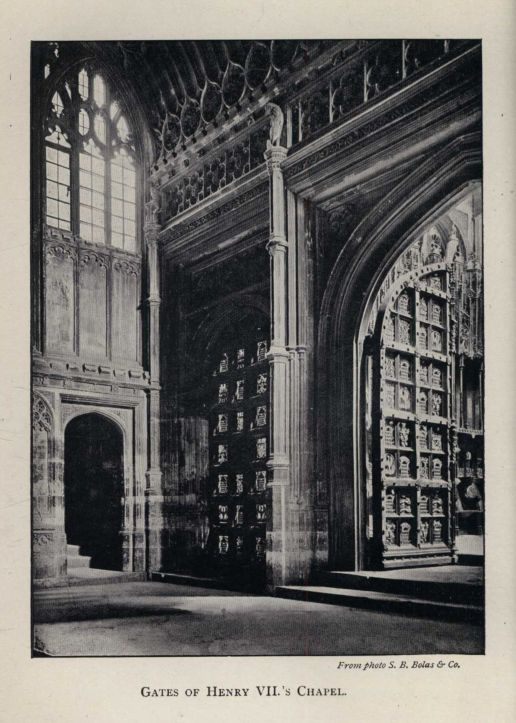
GATES OF HENRY VII.'s CHAPEL.
As you come out, take a last look at the massive gates of oak and metal serried with badges, and then stand once more in the middle of the sixteenth century, when that mass of carving was made yet more rich and beautiful by the colours which blazed everywhere, from the crimson, blue, and purple of the windows; the gold and silver vessels on the altar; the gleaming brass of the images; the gorgeous vestments of the priests; the dazzling whiteness of the marble; the glitter of the tapers round the tomb. Think of how Abbot Islip must have gloried in this new gem of dazzling beauty now added to the Abbey, already so rich in treasure; for Islip was of "a wakeful conscience" and held himself the steward of the house of God, so that he too did some building to this place, and evidently won the confidence of the king, who made him paymaster of the workmen.
As for Henry himself, the chapel has become a far greater memorial of him than he can ever have deemed possible. It matters little to us now what was his real motive in raising it, even if it were possible to point to any one unmixed motive which inspired him. For us it is enough that the chapel stands, and though we need not, with Fabyan the chronicler, wax enthusiastic over "the excellent wysdome, sugared eloquence, wonderfull dyscression, the exceedynge treasure and rychesse innumerabyll" of this silent, almost gloomy king, let us with the same chronicler "remember his beautyfull buildyngs and his liberell endowments at Westminster, and pray that he may attain that celestyall mansion whych he and all trew Christen soules are inheritors unto, the whyche God hym graunt."
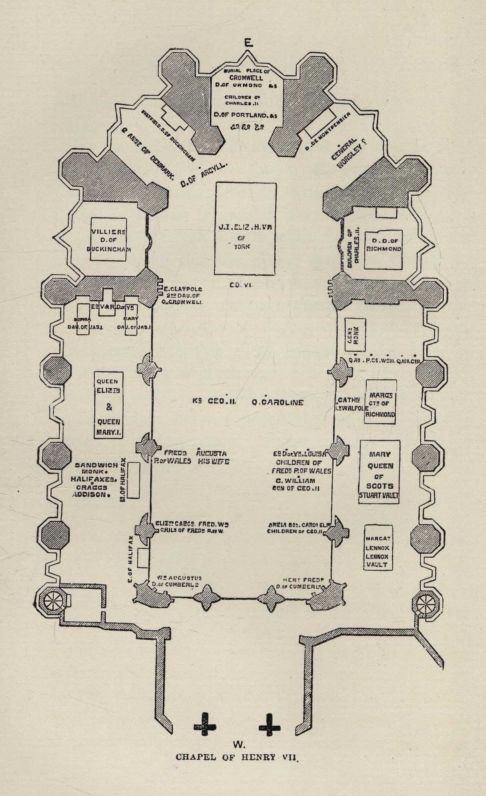
CHAPEL OF HENRY VII.
CHAPTER X
THE ABBEY AND THE REFORMATION
A few months after the death and burial of Henry VII., another royal funeral took place in this beautiful chapel of the Tudors, the funeral of his mother, Margaret, the "venerable lady," whose influence was far-reaching, and whose holiness had won for her such universal love and reverence.
"It would fill a volume to recount her good deeds," says her biographer, and he goes on to tell how she lived a life of prayer and simplicity, being a member of no leas than five religious houses; how she herself waited on the poor, the sick, the dying, and how she freely gave of her wealth for the encouragement of learning. "Her ears were spent in hearing the word of God, her tongue was occupied in prayer, her feet in visiting holy places, her hands in giving alms." She provided an almshouse for poor women near Westminster Abbey, and another at Hatfield, and besides founding schools and colleges, she maintained many poor scholars at her own expense. She also translated many works in the English tongue. It was in Westminster that she desired to be buried, and she made many gifts to the place which her son was so richly beautifying, stipulating in return that prayers should always be said here for herself and all her family. She was destined to outlive son, daughter-in-law, and grandson, and it was not till 1509 that her useful life of close on three-score years and ten came to an end, and she passed peacefully away, "the almoner of God, the friend of the poor, the supporter of true religion, the patroness of learning, the comforter of the sorrowing, the beloved of all." As you stand by her monument in the south aisle of Henry VII.'s Chapel, look at her strong, noble face, beautiful in its calm old age, her hands clasped in prayer as was their wont; and while you are lost in wonder at the skill of the sculptor, probably Torrigiano, I think you will realise something of the goodness and purity of Margaret Richmond, which this sleeping figure makes so vivid, and will understand how "every one that knew her loved her, for everything she said or did became her." It was well for her that she did not live long enough to see her clever imperious grandson seeking to destroy so many of the things which she had loved and guarded.
Henry VIII. came to the throne with splendid opportunities. He was gifted far above the average: his manners were genial and taking; he could talk many languages; he was devoted to sport, a good musician, an admirable wrestler; fond of amusement, but fond also of more serious things; and the people were prepared to love their King Hal, for he was in every way a contrast to his father, who had never won their affections. Henry was a strong man, who resolved to be no puppet in the hands of any party or minister. Yet it was his will which ruined his character, for it was a will entirely bent on gaining its own ends, unchecked by any sense of duty, untouched by any appeal to high or noble motives. What he desired he must have, and all that stood in his way must be swept aside: he would spare no one who thwarted him; nothing weighed in the balance against the gratification of his own whims and fancies.
You will remember that he was not the eldest son of Henry VII. His brother Arthur, Prince of Wales, had died in 1501, a few months after he had married Katherine, the Infanta of Spain, and chiefly because the idea was at first strongly opposed, Henry made up his mind to marry his widowed sister-in-law. When he came to the throne, he at once carried out his will in this matter, and brushed aside all the objections that were raised on account of the close relationship existing between the two. The marriage took place at Greenwich, and the double coronation followed at Westminster on Midsummer Day in the year 1509, "amid all the rejoicings in the world." Katherine made a beautiful queen, dressed in white with cloth of gold, her long hair hanging down to her feet, and little dreamt any of those who cheered her on her way of all that was to spring out of that marriage, for Henry seemed to be the most devoted of husbands. In 1511 their son was born, and had such an elaborate christening that he took a cold from which he never recovered. "His soul returned to among the Holy Innocents of God," says a Westminster manuscript, and we are told how "the queen made much lamentation, but by the king's persuasion she was at last comforted." The baby prince was certainly buried in the Abbey, though exactly where is unknown. But his death, unimportant as it must have seemed at the moment to those who took part in the funeral, had in reality a deep significance. Henry was incapable of loving any one for long, and as he began to grow weary of Katherine, he made it a grievance that her other child was a daughter and not a son. Furthermore, he argued to himself that he had done wrong in marrying his brother's widow, so that the death of his son was the sign of God's wrath, and then he began to devise how he could dissolve his marriage with her, to wed instead her fascinating maid of honour, Anne Boleyn. Only the Pope could grant him the divorce that he desired, and accordingly Henry sent his all-powerful favourite, Wolsey, to Rome to get this consent. But the Pope, much as he feared Henry, feared the Emperor Charles V., the nephew of Queen Katherine, much more, and Wolsey, on his side, was anxious not to offend the Pope, as his ambition was to succeed him, so it all ended in his going back to Henry without having the desired permission. Henry was furious, and Wolsey, disgraced, died broken-hearted. The king's next step was to defy the Pope, and to send round to all the ministers in Europe, asking them whether in their opinion his marriage with Katherine had been a legal one. But their answer in almost every case was the opposite answer to what Henry had determined on, and their opposition only increased his determination, till at last, urged thereto by Thomas Cromwell, Wolsey's successor in his favour, he took the bold step of declaring that he himself was the head of the Church in England, the defender of the faith, and that therefore the Pope had no power to forbid the divorce. He was clever enough to know that for many a long day the independent spirit of the English nation had rebelled against the power of the Pope in the land; that the revival of learning had set men thinking for themselves; that the teaching of Luther and the other reformers had prepared the way for a great change in England, and that he could count on his Parliament to support him in declaring himself supreme head of the Church in this land. Thus whilst pretending to cleanse and purify the Church, and reform the many errors which had crept in, Henry really was true to his general policy of sweeping out of the way any obstacle to his wishes. The Pope had opposed him, so from henceforward he would deprive the Pope of all authority in England. He divorced Katherine, and married Anne Boleyn, while those few men who refused to go against their conscience by declaring the king to be in the right on this question of his marriage, when they felt him to be in the wrong, did so at the cost of their lives.
But the king had not yet finished with the Pope; urged thereto by Cromwell, who earned for himself the name "The Hammer of the Monks," he proceeded to attack all the monasteries and religious houses in England, and there were many hundreds of them, which were under the immediate jurisdiction of Rome. To these religious houses England owed no small debt of gratitude: the monks had been teachers, scholars, chroniclers, architects, carvers, painters, translators, and illuminators; they had nursed the sick, they had relieved the needy; they had been the great employers of labour, the tillers of the soil, and, untouched by the ebb and flow of the tide outside, they had gone quietly on with their daily round of work and prayer, keeping their lights ever burning before the altar to signify that their house was "always watchynge to God." But, as they became rich and powerful, they fell away from their high ideals; the threefold vow of poverty, obedience, and purity ceased to sanctify their lives; luxury took the place of plain, frugal living; the monks no longer laboured with their own hands, but kept great retinues of servants, and the money that should have been spent for the glory of God and the church was squandered in extravagant living. The abbots were under no control save that of Rome, and Rome was far away, so that there was no power from outside to correct, to reform, and to purify. Gradually, too, the monasteries had lost their hold over the people; resting on their past, they made no effort to keep pace with the present; they bitterly opposed any education save that which they held in their own hands; they resented progress and enlightenment; they were no longer centres of light and learning; their fire had burnt out, quenched by covetousness, by wrong-doing and by luxurious living.
Cromwell saw in them an opportunity which Henry was all too ready to grasp. A Commission was formed to visit and report on the universities and all religious houses; and when the visitors had finished their work, which they had done carefully and thoroughly, they laid their verdict before the House of Commons in the famous Black Book, which was destroyed some years later by order of Queen Mary. Much of what it contained is therefore lost to us, but as the Commons, who sat, remember, in the Chapter-Room at Westminster, heard clause after clause read out, which told, with a few honourable exceptions, a terrible story against the monasteries, they could not restrain themselves, and over and over again shouts of "Down with the monks" rang through the vaulted building. Generally speaking, the largest of the monasteries had come well out of the inquiry, and Parliament therefore began by only dissolving the smaller houses, at the same time ordering that the lands and incomes of these latter should be handed over to the king, as head of the Church, to be spent in the "high and true interests of religion." Certainly the Commons had none but high motives in passing this Act, and never dreamt of a general dissolution, or the appropriation of all that immense wealth for anything but religious or educational purposes. They had not realised Henry's greed, "which no religion could moderate, or the force of his will, against which nothing, however sacred, seemed able to stand."
The monks at Westminster naturally heard very quickly all the particulars of the deliberations which had taken place inside the Chapter-Room. How they must have lingered about the cloisters that day; how eagerly and excitedly must they have talked during those hours when talking was allowed, wondering in what way all these things would end; how they must have speculated as to their own future, and that of the few other large monasteries in which the Commissioners had declared that "thanks be to God, religion had been right well kept and observed." They had not long to wait.
A general order issued shortly afterwards, ordering the removal of all shrines, images, and relics, made it clear that Henry and his ministers had other ideas beyond the reformation of religious houses; and the monks, who gauged the character of the king, hastily moved the body of St. Edward to some sacred spot, that, at least, this holy possession of the Abbey might not be lost to it. They managed, too, to hide some of the treasures which beautified Edward's shrine, but much of the gold and many of the jewels became the property of the king. Altogether nearly 800 monasteries fell into the hands of Henry, and without any compunction he appropriated their lands and their wealth, giving away to his favourites of the moment what he did not desire to keep for himself. Inside the religious houses the greatest excitement prevailed, and much diversity of opinion; for some there were among the abbots and monks who were prepared to lose their lives rather than willingly surrender themselves to the king's will, while others, more the children of this world than the children of light, deemed that by submission could they best hope to save something in this overwhelming deluge.
At Westminster, under Abbot Benson, the monks chose a prudent course, the abbot being one, as an old writer severely remarks, "whose conscience was not likely to stand in his way on any occasion," and in the January of 1540 the Abbey with all its wealth was voluntarily handed over to the king.
Partly perhaps on account of this absolute submission, but much more because even Henry had still reverence for a place which was peculiarly royal in all its associations, Westminster was in some degree saved. The old order indeed was destined to pass away; its wealth was to be a thing of the past, save for the wealth of beauty in sculptured stone which could not easily be taken from it, and which still remained unrivalled even when all the gold and jewels and plate excepting a silver pot, two gilt cups, three hearse clothes, twelve cushions and some other clothes, had been carried away to satisfy greedy courtiers, "leaving the place very bare."
But Henry converted the building into a cathedral, giving it a bishop, a dean, prebendaries, minor canons, all these offices with the exception of the Bishopric being filled by the monks belonging to the establishment. The Bishop, Thirleby, was ordered to make the abbot's house his palace; Abbot Benson, now Dean, took up his residence in humble quarters, and all the old glory of the monastery departed for ever, while Henry was quite £60,000 a year richer in our money. Those of the monks for whom no place could be found under the new system were pensioned off, and many of the buildings, such as the refectory and the smaller dormitory, no longer needed for the cowled figures who for so many generations had used them, were pulled down or put to fresh uses.
Nor was the monastery the only part of Westminster which fell from its greatness. Earlier in the reign of Henry a fire had destroyed much of the old Palace, and the king, who cared but little for it, set his heart on York House close by, at Whitehall, once the London house of the Bishops of York, afterwards the residence of Wolsey.
The Cardinal lived in state; indeed Westminster was but a humble dwelling compared to this magnificent palace, and on his disgrace, Henry took possession of it. For more than a hundred and fifty years it was the royal palace, with fine courts, halls and chambers, its own chapel and offices, its bowling-green, tent yard, cock-pit, and tennis courts, and meanwhile the gabled, sculptured Westminster Palace, the home of Saxon, Norman, and Plantagenet kings, fell to pieces. For us, both are now but phantom palaces, with hardly a trace of either remaining to recall the glories of the past.
But in the story of the Abbey, this change from Westminster to Whitehall had more than a passing effect; from henceforth the old intimate association between the Palace and Abbey ceased to exist, and Henry thus broke one more link with the traditions of his ancestors. Not even the chapel of his father, now no longer called the Lady Chapel, but instead St. Saviour's Chapel, had any attractions for one in whose nature reverent affection for old associations was entirely absent, and at his own desire, Henry was buried at Windsor, by his "true and loving wife, Jane Seymour," who had kept in his good graces by giving him a son, and then dying before he had time to grow weary of her. Of all his wives, only the plain and placid Anne of Cleves was buried in the Abbey, on the south side of the Altar, and "she had but half a monument," says Fuller, though her funeral was an elaborate one, by order of Mary, who was then queen.
King Edward VI., just ten years old, succeeded his father; and the members of his council, especially his uncle, the Duke of Somerset, strongly in favour of the Reformed Church, were determined that the Pope should not win back any of his old authority. In this, all the thinking people were of their opinion, but some of the poor people, who had formerly received much in charity from the monks, were very bitter, and there was more than one rebellion in favour of the monasteries. However, these were put down, and the reformers went on with their work. Edward was crowned as Head of the Church in England, and, for the first time, a Bible, translated into the English tongue, was set in his hands at the coronation service. For only within the last ten years had the Bible been read to the people in a language they could understand, and you will remember how first Wycliffe, and then Tyndale, had failed in their attempts to place this book in the hands of all, that all might read and learn of God's teachings, by the light of the understanding which God had given them. Two years after the coronation a Prayer-Book was published, also in English, not exactly the same Prayer-Book as we use now, for as time went on the spirit of the people changed in favour of a still simpler service than that which found favour with the early reformers in England, and in the reign of Charles II. a revised Prayer-Book was issued, as in the reign of James I. our present translation of the Bible was authorised. But it was in Edward's reign that an English Bible and Prayer-Book first found their way into the Abbey.
The plan of having a Bishop at Westminster does not seem to have succeeded. Thirleby was removed to Norwich, and Richard Cox became the Dean. But he remained in the simple quarters, near the Little Cloister, which had been assigned to Dean Boston, and the Abbot's house passed into the possession of a layman for the time being. Protector Somerset had certainly no feeling of veneration for the grand old pile of buildings. Not only did he put the Abbey under the Bishop of London, and insist on cart-loads of stone, which once had formed part of the solid monastery buildings, being used for his own palace, Somerset House, but of the few lands which still remained to the Abbey, he took some and made them over to St. Paul's, from time immemorial the rival of Westminster. You have often heard the saying "robbing Peter to pay Paul;" now you know its origin. And as if to cut off every possible association with the past, the House of Commons moved from the Chapter House to St. Stephen's Chapel, part of the old Westminster Palace, and there met until the great fire in 1834, after which the present Houses of Parliament were built.
But with the death of Edward, who had reigned seven years, and the defeat of the Protestant party, who had tried to set Lady Jane Grey on the throne, there came a flicker of prosperity to the Abbey, a dim reflection, as it were, of its bygone greatness. For Queen Mary was a devout Roman Catholic, and so soon as it lay in her power, she dissolved the chapter or cathedral body, restored the monastery, and gave the post of Abbot to Fakenham, who was "a person of learning, good-natured, and very charitable to the poor."
Edward was buried at Westminster, close to his grandfather, Henry VII., and underneath the altar of Torrigiano, of which I have already told you, so that the last Roman Catholic and the first really Protestant king of England lay side by side, under the same exquisite roof, a striking commentary on the fact that the Reformation was not a complete wrench with the past, but a transition from old to new according to the unchangeable law of progress.
Mary was crowned on October 10, and on the coronation morning she journeyed in the royal barge from Whitehall to the private waterstairs of old Westminster Palace, and from thence went into the Parliament chamber, where she robed. Blue cloth covered the ground all the way from Westminster Hall to the choir in the Abbey, but here the altar blazed with cloth of gold, and rich covers hung all around, while the floor was strewn with fresh rushes, a quaint contrast to everything else. The Archbishops of Canterbury and York and the Bishop of London were already in the Tower as prisoners, so it was Gardiner, Bishop of Winchester, who met the queen and performed the service, at which there was much dismay among the people, for they said it had ever boded ill for England when the Archbishop did not crown the sovereign. The old coronation service with its full ceremonial was used, and the queen was very devout, kneeling long in silent prayer.
Four days later, the queen again rode to the Abbey, this time to open her Parliament. But the occasion did not pass by without some disturbances, for some who refused to kneel while the Mass was being celebrated were turned out by force.
The restoration of her religion was the object dearer than all others to Mary's heart, and her unfaltering belief that in so doing she was working the will of God, added to her passionate enthusiasm for her faith, are the only excuses we can plead for her, when we shudder at the cruel persecutions which made England a land of terror during the next few years. Here it is only necessary to say that, as always, persecution purified and strengthened the very cause it was destined to destroy, and Mary, during her five years' reign, made her people hate her so bitterly, that nothing but her death prevented a general rebellion.
She died a wretched, lonely woman, conscious of her utter failure.
"My oppressed heart is pierced by many wounds," she said bitterly at the last.
Her funeral took place with much state, but the only real mourners were the priests and monks, who feared for their own fate. Mary had entreated that she might not be buried in royal array. Her crown had brought her no happiness, she said, and she did not wish to be encumbered by it now. Behind her coffin rode her ladies, with black trains so long that they swept the ground. Mass was said before the High Altar for the last time, while Fakenham, the last Abbot of Westminster, as he himself well knew, preached a great sermon on the dead queen, and, in a voice trembling with deep feeling, told how she was too good for earth, a veritable angel, who had found the realm poisoned with heresy, and had purged it.
But his words found no echo in the heart of those around, and the funeral ended in a scene of disorder, for the people had no respect for the dead, and plucked down all the hangings and draperies, while the Archbishop of York, "in the midst of the hurly-burly, pronounced that a collation was prepared," whereupon the lords, ladies, and knights, with the bishops and Abbot Fakenham, hurried to another part of the building for dinner.
And no monument was erected to the memory of her who was the last queen of the old faith to be buried in the Abbey.
CHAPTER XI
IN THE CHAPEL OF HENRY VII.
On November 17, 1558, Mary died, and that very day Parliament met in old Westminster Palace "to proclaim without further halt of time the Lady Elizabeth as queen of this realm." Shouts of "God save Queen Elizabeth" resounded through the walls, and outside the cry "Long live our Queen Elizabeth" was taken up with heartfelt intensity by the people, who believed, and not in vain, that with her their deliverance had come. She had suffered, they had suffered, both in the same great cause, and now together they were standing in the dawn of a day which promised to be fair and radiant. The Spanish influence, which they hated passionately, as Englishmen have ever been wont to hate foreign interference, had received its death-blow, for here was a queen, "born mere English, here among us, and therefore most natural to us," who understood them, and whom they could freely trust. No wonder that there were no signs of mourning for the dead queen, only irrepressible joy and relief at the accession of the new sovereign they were prepared to love so loyally. But no wonder either that the echoes of the cheers which reached the Abbey fell on some hearts which could not respond to them. To Fakenham, with his handful of monks, those shouts of joy were as a death-knell, though the Abbot himself may have had some hopes that Elizabeth would remember how he had pleaded with Mary for her freedom.
The coronation festivities, which began January 15, put London in a delirium of rejoicings, and though the royal exchequer was so low that there was no money available for costly preparations, the people more than compensated for this by the pageants and decorations they organised out of the fulness of their hearts. "The queen," says an officer who followed the procession, "as she entered the city was received with prayers, welcomings, cries and tender words, with all those signs which argue the earnest love of subjects towards their sovereign. She, by holding up her hands and glad countenance to such as stood afar off, and most tender language to those that stood near, showed herself no less thankful to receive the people's goodwill than they to offer it, and to such as bade 'God save her Grace,' she said in return, 'God save you all,' so that the people were wonderfully transported at the loving answers and gestures of the queen."
Only one bishop could be found to read the coronation service, as those few Protestants who had escaped with their lives across the seas had not yet returned from their exile, and the Roman Catholics refused to assist, though no alterations were introduced into the service, excepting that the Litany, the Gospel, and the Epistle were ordered to be read in English. This bishop, with the singers, met the queen at Westminster Hall on the following day, a Sunday, and to the fine old hymn, "Hail, Festal Day," the procession wended its way into the Abbey, and the solemn ceremony took place.
Nor did Elizabeth at first make any changes in the Abbey services. It was her desire, she declared at the opening of her Parliament ten days later, "to unite the people of the realm in one uniform order," and though she was determined that the English Church should be utterly severed from Roman control, and that the Bible should be an open book, she understood the bulk of her people well enough to know that, as Bishop Creighton has so clearly put it, "what they wished for was a national church, independent of Rome, with simple services, not too unlike those to which they had been accustomed." So, at the state service in the Abbey on this occasion, the Mass was celebrated with the usual ritual, though the sermon was preached by a certain Doctor Cox, who was a vigorous Protestant.
Elizabeth's first Parliament gave over to her all the religious houses revived by her sister, and she decided to once more make Westminster a Cathedral church, though without a bishopric. Possibly if Fakenham had been a more time-serving man, he might have managed to stay on under the new regime as Dean, but he was uncompromisingly true to his principles; he refused to acknowledge any one but the Pope as head of the Church, and in the House of Lords he made a strong speech against the English Prayer-Book. His reign at Westminster had been a short one, but he had not failed in his duty towards the precious trust committed to his care. The Confessor's Chapel, shrine of the English saint, was still the greatest treasure of the Abbey, and to this he had caused the body of the king, hidden, you will remember, by the monks at the first threat of dissolution, to be carried back "with the most goodly singing and chanting ever heard," after he had repaired the shrine itself to the best of his ability, assisted by Queen Mary, who had sent him some jewels. Moreover, in Parliament he successfully defended the right of sanctuary, so that this remained for some time longer at least an Abbey privilege, and altogether it is pleasant to remember this last Abbot as one who was true to the light as he saw it, a kindly, moderate, honest man, a firm friend, a fair enemy, a fine solitary figure standing out among his fellows. It is said that when in 1560 the bill was passed in Parliament which decided the fate of Westminster and the other remaining monasteries, a messenger who came to bring the news to Abbot Fakenham found him busy planting young elms in the Dean's yard.
"Cease thy labours, my lord Abbot," he said. "This planting of trees will avail thee nothing now."
But the old Abbot was not so mean-spirited.
"I verily believe," he made answer, "that so long as this church endureth, it shall be kept for a seat of learning."
And he went on contentedly with his work.
He lived for twenty-five years after he left the Abbey, under a certain amount of restraints, and great efforts were made to induce him to change his faith. But he never wavered, and so far as possible withdrew from all controversy, spending his time and his substance among the poor. "Like an axil tree, he stood firm and fixed in his own judgments," says Fuller, "while the times, like the wheels, turned backwards and forwards round him."
Westminster stood aloof from the keen religious controversies which raged around, and quietly stepped into its new position. It was now neither a monastery nor a cathedral, but a "collegiate church," as it is to-day, with its Dean and Chapter and its school. Very little, if anything, happened to disturb the peace of the Abbey under the rule of its three excellent Deans appointed by Elizabeth—Bill, Goodman, and Andrewes; the only sign of the times which deserves noticing being that more and more it became the custom to bury distinguished people not of royal blood within these honoured walls. Otherwise we may well quote the words of Widmore, who in summing up this epoch in Westminster history, concludes—"It may here be remarked that though misfortunes and disturbances in a place give opportunity to an historian to make observations and show his eloquence, while they also entertain the reader, yet peace and quietness are good proofs both of the happiness of the times and the discretion of those who govern."
On the 24th of March 1603, Elizabeth died after a reign of forty-four years, during which she had never lost her hold over the hearts and minds of her people. As a woman she had her failings and weaknesses, but as a queen she had done right well for England, and "round her, with all her faults, the England we know grew into the consciousness of its destiny.... She saw what England might become, and nursed it into the knowledge of its power."
The outburst of grief at her death was her people's acknowledgment of the debt they owed her. They had trusted her, and not in vain; she had understood them, had served them, and had loved them. On the day of her burying at Westminster "the city was surcharged with multitudes of all sorts, in the streets, houses, windows, leads, and gutters, and when they beheld her statue lying on the coffin, set forth in royal robes, having a crown upon the head thereof, a ball and sceptre in either hand, there was such a general sighing, weeping, and groaning as the like hath not been seen or known in the memory of man, neither doth any history mention any people, time, or state to make the like lamentation for the death of their sovereign."
Nor did her memory fade away with her life, for her tomb, which you will find in the north aisle of Henry VII.'s Chapel, became familiar to her people throughout the length and breadth of the land, "a lovely draught of it being pictured in the London and country churches."
The monument raised to her memory by James I. is a fine one of its kind, and the sculptor has given us an impression of her strength and power as she lies sleeping there in royal state, guarded by lions, though I think we cannot help missing the exquisite little figures of saints and angels banished in deference to the increasingly severe views of the English Churchmen. Here is the translation of the Latin inscription round the monument, which certainly described, and in no way exaggerated, the feelings of the nation towards her:—
"To the eternal memory of Elizabeth, Queen of England, France, and Ireland, Daughter of Henry VIII., Grand-daughter of Henry VII., Great-Grand-Daughter of Edward IV. Mother of her Country. A Nursing Mother of religion and all liberal Sciences, skilled in many languages, adorned with excellent adornments both of body and mind, and excellent for princely virtues beyond her sex. Religion to its primitive purity restored; peace settled; Money restored to its just value; Domestic Rebellions quelled; France relieved when involved with internal divisions; The Netherlands supported, the Spanish Armada vanquished; Ireland, almost lost by rebels, eased by routing the Spaniards; the Revenues of both Universities much enlarged; and lastly, all England enriched. Elizabeth, during forty-five years, a very prudent Governor, a victorious and triumphant Queen, most pious and most happy, at her calm death in her seventieth year, left her remains to be placed in this Church which she preserved, until the hour of her Resurrection in Christ."
In arranging for this lengthy epitaph, James could not fail to be reminded that Queen Mary, who lay in the same tomb as Elizabeth, was passed over in cold silence, so he added a simple sentence pathetic in its restraint, almost an appeal on behalf of the one whose life had been such a failure.
"Here rest we two sisters Elizabeth and Mary, fellows both in throne and grave, in the hope of one resurrection."
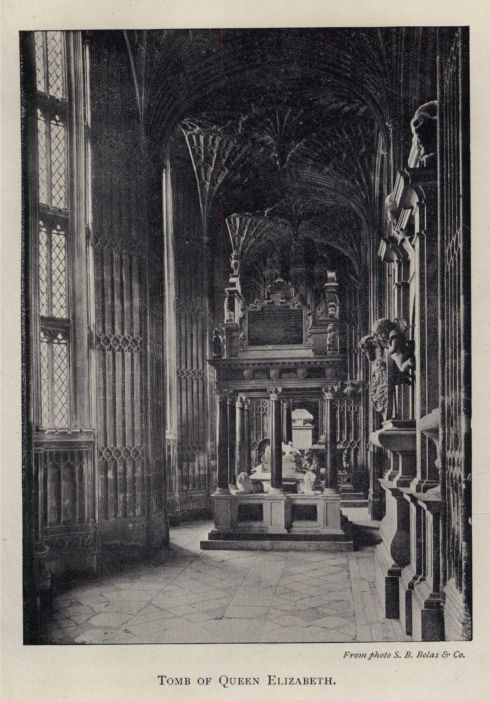
TOMB OF QUEEN ELIZABETH.
In life everything had tended to separate them, but in death they lay together at peace.
James erected another monument in this chapel, on the southern side, and this was to the memory of his mother, the ill-fated Mary Queen of Scots. She had been buried at Peterborough, but her son, when he came into the inheritance which was his, through her, very rightly caused her to be buried among the kings and queens of England. Here again death reconciled two implacable foes, so that Mary Queen of Scots lies opposite to Elizabeth in this chapel of the Tudors. The marble figure, with its sweet, finely-cut face and its graceful draperies and its delicate lacework, is full of charm, and makes familiar to us one whose fascinating beauty was her own undoing.
And now we come to a new phase in the history of the Abbey; for though after the days of Queen Elizabeth several kings and queens of England were buried within its walls, to none of them was a monument raised, not so much even as an inscription was cut on the stones over their graves. With the Stuarts began a new race of kings, and under their rule there grew up a new set of relations between king and subjects. They preached the doctrine of the divine right of kings, declaring themselves to be above any laws which their people might desire to make through Parliament, so the battle had to be fought out between king and Parliament, a battle so fierce that it brought once more civil war to England, cost Charles the First his life, and caused James II. to flee to foreign lands. But from that struggle with its many errors there at last developed
"That sober freedom out of which there springs
Our loyal passion for our temperate kings,"
which holds together to-day the throne and the nation as never before in our island story.
So you will see how, as the people became more and more the ruling force in England, it was the representatives of the people—statesmen, soldiers, sailors, writers, musicians, travellers, thinkers, discoverers, and benefactors—who stepped into the foremost places, and who were thought worthy of a resting-place among the great kings of old in the Abbey, while, with a few exceptions, the sovereigns of England were buried at Windsor, now the most important of all the royal palaces.
It is in Henry VII.'s Chapel that James I. himself was buried in the founder's tomb, and his wife Anne of Denmark lay close to him. Near at hand you will see a beautiful little monument of a baby in a cradle, which marks the grave of Princess Sophia, a baby daughter of James I. The king gave orders at her death that she should be buried "as cheaply as possible, without any solemnity," but in spite of this, and although she was only two days old, a great number of lords, ladies, and officers of state attended, followed the little coffin, which was brought up on a black draped barge from Greenwich, and which was met at the Abbey by the heralds, the dean and prebends, with the choir, while an antiphon was sung to the organ. The royal sculptor, Nicholas Pourtian, was allowed the sum of one hundred and forty pounds for her monument, and he must have been a great lover of children or he could not have thought out anything so charming as this yellow-tinted, lace-covered cradle with its tiny baby occupant.
Nor is the inscription less pretty in idea than the monument, for it tells us how Sophia, "Royal Rosebud, snatched away from her parents, James, King of Great Britain, Ireland and France, and Queen Anne, that she might flourish again in the Rosary of Christ, was placed here."
Next to her is her sister Mary who lived to be two, and then died of fever, saying many times over in her wanderings these same words, "I go, I go, away I go." Hers too is a very natural little figure, in spite of the stiff straight clothes and the quaint cap; and the carver has put a great deal of life into the weeping cherubs, to whom surely not the most rigid Puritan could have objected. In this same corner were laid, some years later, the bones found by some workmen under the stairs at the Tower of London, supposed to be those of the little princes who had been murdered there, so that at last King Edward the Fifth and his brother were honourably buried near their more fortunate sister Elizabeth of York.
The tomb of Mary Queen of Scots is really a Stuart vault, and it might almost be called the vault of Royal Children, for more than thirty are buried under it. Here, without any monument, but an inscription on the floor, lies Henry, Prince of Wales, the eldest son of James, who gave such high promise both of character and ability, that he had won the hearts of the people, and more especially of the Puritans, in a remarkable degree. James, though holding very unsatisfactory views as to the rights and duties of a king, had nevertheless brought up his son wisely and had educated him most carefully. Before he was six he had been instructed "how to behave towards God, how to behave when he should come to be king, and how to behave in all those matters which were right or wrong according as they were used;" and when he was only nine he wrote in Latin to his father giving an account of the books he had been reading, which included Cicero's Epistles.
According to the law of Scotland, the heir to the throne was not allowed to be brought up by his parents, but was sent to Stirling Castle, to be under the care of the Earl of Mar, who held the right to be the hereditary guardian, and this accounts for the many letters which passed between the little prince and the king and queen. When Elizabeth died and James became king of Great Britain, he had to go hastily to London, but about a year later he sent for the queen to come "with the bairns to Windsor, where he prayed God they should all have a blyth meeting." As they arrived there during the festival of St. George, Prince Henry was at once made a Knight of the Garter, and his "princely carriage and his learned behaviour" on that occasion greatly impressed every one who saw him. The coronation of James was fixed for St. James's Day, but because of the plague raging in London, all the fair pageants and the public rejoicings were hastily countermanded, so that the ceremony was almost a private one, even the usual procession through the city being left out. Great was the disappointment of the Londoners, though they were promised that so soon as the plague had disappeared the king, with the queen and their children, would visit the city with all the state of a coronation procession.
One part of this coronation service was of special interest; and to many people it meant the fulfilment of an old prophecy. For more than eight hundred years before these words had been roughly carved on the sacred stone of Scone—
If Fates go right, where'er this stone is found
The Scots shall monarchs of that realm be crowned.
And now, seated on the Coronation Chair which held that stone, James VI. of Scotland was crowned as James I. of England.
Prince Henry was still brought up away from home, first in company with his sister, the merry and witty little Princess Elizabeth, who afterwards married the Elector Palatine. Brother and sister were devoted to each other: both were full of the highest spirits, ready for any adventure; both loved riding and games, and would "mount horses of prodigious mettle;" and it was a great grief to them when they were parted, though, woman-like, Elizabeth fretted the longer. Prince Henry was more of a philosopher.
"That you are displeased to be left in solitude I can well believe," he wrote to her; "you women and damsels are sociable creatures. But you know those who love each other best cannot always be glued together."
Meanwhile Henry took up his residence at Hampton Court. The Gunpowder Plot left a deep impression on him, for had it succeeded he would have lost his life, and he became still more serious and thoughtful, making friends only with those who could teach him something about the many things in which he took an interest, ships, guns, fortifications, books, foreign lands, politics and so on. For Sir Walter Raleigh, that adventurous sailor and treasure-hunter, now a prisoner in the Tower, he had the greatest affection, and spent many hours walking up and down the terrace with him talking of ships and the sea, to the great delight of the old man, who found him an enthusiastic and intelligent companion and at one with him in his opinion that a strong navy meant peace for England. In vain Henry pleaded with his father to set free this prisoner who had committed no crime save that of offending Spain. But James and his son were of very different natures, and James was always doggedly obstinate. "No one but the King would shut up such a bird in a cage," said the boy sadly.
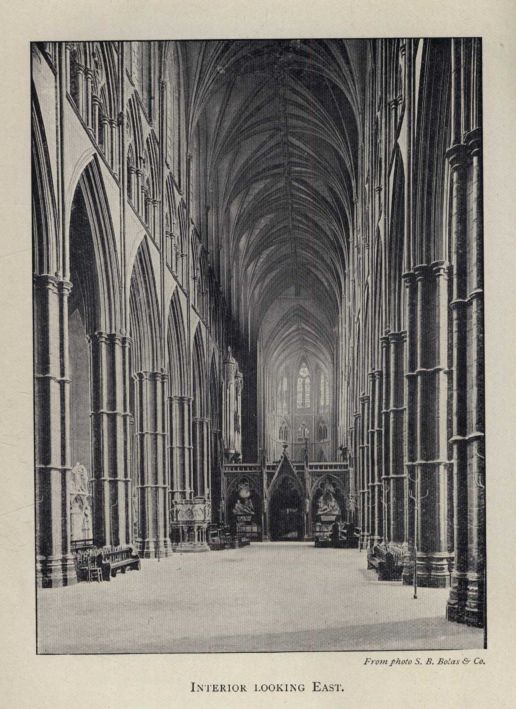
INTERIOR LOOKING EAST.
In 1610 he was created Prince of Wales and there were great festivities in the White Chamber of Westminster Palace, as there, in the presence of the Lords and Commons, he knelt before the king, wearing a robe of purple velvet, to receive the crown of Llewellyn. Once again he won all hearts, and the members of Parliament congratulated themselves that so worthy a prince was heir to the throne. He became more and more the idol of the people, and indeed rarely if ever since the days of Edward, the Black Prince, had a king's son been so full of promise. But to the utter grief of the nation he died two years later, after a short illness.
"Are you pleased to submit yourself to the will of God?" asked the Archbishop, when all hope was given up.
"With all my heart," the boy answered simply.
"I had written him a treatise on the 'Art of War by Sea,'" said Raleigh, when the sad news reached him. "But God hath spared me the labour of finishing it. I leave him therefore in the hands of God."
When the long funeral procession passed through the streets "there was a great outcry among all people," and it was to the sounds of weeping and wailing that the boy-prince, who had won so much love and respect, was carried to Westminster Abbey. There, close to him, was laid more than forty years later, his dearest sister, Elizabeth, Queen of Bohemia, who, after a sadly adventurous life, spent her last few years peacefully in London, cared for and watched over by Lord Craven, whose devotion to her had been lifelong, as unchanging as it was chivalrous.
Another brother and sister are buried here, Anne, the little daughter of Charles I., and Prince Henry, his third son. Anne died before all those troubles began, which saddened the childhood of her brothers and sisters, and made them prisoners in the hands of their father's enemies, as she was only four when she fell into a fast consumption.
"I am not able," she said wearily, the night she died, "to say my long prayer, but I will say my short one. 'Lighten mine eyes, O Lord, lest I sleep in death.'"
Little Henry, the Duke of Gloucester, was extraordinarily like his uncle Henry in every way, old for his age, clever, thoughtful, "with a sweet method of talking, and a judgment much beyond his years." He was taken from his father almost before he knew him, and was, with his sister, also a Princess Elizabeth, kept practically a prisoner in London by the Puritan party. But he was not unkindly treated, for so engaging was he both in conversation and in manners, that many of the Puritans thought he would make a good ruler for England if only he were strictly brought up, and kept away from the influence of his mother or the court.
When the sentence of death was passed on King Charles, he asked to see the two of his children who were in London, and after some delay the request was granted. Awe-struck, the little couple came into his presence, and the king seems to have grasped what was likely to happen. He lifted the Duke of Gloucester on to his knee. "Sweetheart," he said, "they will cut off thy father's head, and mark, child, perhaps they will make thee a king. But you must not be a king while your brothers Charles and James be living."
"I will be torn in pieces first," answered the white-faced child, with a determination which made so great an impression on Charles, that even at that sad moment he rejoiced exceedingly; while the little Duke, who up till now had rarely seen his father, could carry away as a last memory the picture of one whose courage was highest when the need for it was greatest, and who, if he had faced life weakly, met death bravely.
With his sister he was taken to Carisbrooke Castle, but here his existence was very sad, for Princess Elizabeth, like her sister Anne, fell into a consumption, and not being properly cared for, she died. So lonely was he now, that those who had the charge of him, still nursing the idea that one day he might become king, sent him abroad to Leyden, with a tutor, and here he won for himself the pleasant reputation of being "a most complete gentleman and rarely accomplished."
With the Restoration Henry gladly returned to England, and at once begged his brother to find him some work to do, as "he could not bear an idle life." So he was made Lord Treasurer. He proved himself to be a good man of business, while in his leisure hours he gathered round him men of letters and learning, and soon became as popular in London as he had been in Leyden. Then a sudden attack of smallpox killed him, and once again a funeral procession wended its way to Westminster amid signs of very real sorrow. For his fair life had won him many friends and never an enemy.
Of Prince Rupert, who was buried in this vault, that gallant soldier in the Royalist cause, more in another chapter, and this one shall end with a few words about the luckless "Lady Arabella Stuart." She was a cousin to James I., as her father's brother was the Earl of Darnley who had married Mary Queen of Scots; but besides this she was of royal birth, and her grandmother, the Countess of Lennox, whose tomb you will find close by, claimed, as you will see inscribed thereon, to have "to her great-grandfather Edward IV., to her grandfather Henry VII., to her uncle Henry VIII., to her grandchild James VI. and I." Arabella's father had committed the unpardonable offence of marrying without Queen Elizabeth's permission Elizabeth Cavendish, the daughter of the celebrated Bess of Hardwick, and for so doing the young couple were promptly sent to the Tower, in company with both the mothers-in-law, one of whom, the Countess of Lennox, had already twice been imprisoned for matters of love—an early attachment of her own to Thomas Howard, and the marriage of her elder son to Mary Queen of Scots. The young Earl of Lennox died very soon after his marriage, and Elizabeth relented so far as to allow yearly £400 a year to his widow and £200 to his little daughter Arabella.
When she was twelve, Arabella was sent for by the queen to London, and being very handsome as well as clever, she soon began to attract attention. The Roman Catholic party, always on the look-out for a weapon to use against the crown, turned their attentions to her, and her position became a dangerous one, though she herself was entirely loyal and very prudent. The great Lord Burleigh, however, was always her good friend, and when James came to the throne, he gave him a wise hint to "deal tenderly with this high-spirited and fascinating young lady." James took his advice, and Arabella lived at his court, nominally as the governess of the Princess Elizabeth, but actually as if she herself had been a daughter. She was a favourite with all, especially with Henry Prince of Wales, for she was highly educated and a most delightful companion. But though she had many lovers, she would look at none of them, declaring "she had no mind for marriage." However, unfortunately for her, she lost her heart to William Seymour, whom she married in spite of the disapproval of James. And then began her troubles, for Seymour was utterly unworthy of her, and had only married her to advance his own position. When he was put into the Tower, and his wife was kept as a prisoner at Lambeth, his only idea was to make good his own escape, leaving Arabella to her fate; whilst she, still believing in him, risked everything to set him free. It was only when she found that he had fled to Ostend without her that the full force of her sorrows overwhelmed her.
She had hardly a friend, for even Prince Henry seems to have sided for once with his father, and greatest of all was the bitterness of realising that her husband cared nothing for her. He did not even write to her, lest in so doing he might endanger his own safety.
She was sent to the Tower, where first her health, then her mind gave way, and she became as a little child, singing nursery songs, prattling of childish things. Death was a merciful release. Secretly, by dead of night, she was taken from the Tower to the Abbey on a barge, and buried without any ceremony in the vault under the tomb of her aunt. She had often described herself as the "most sorrowful creature living," and, indeed, I think that under this tomb in Henry VII.'s chapel lie three royal women of the Stuart race whose lives were all the saddest tragedies, Mary Queen of Scots, Elizabeth of Bohemia, and the Lady Arabella. "God grant them all a good ending," as the old chroniclers were wont to say. At least now, after life's fitful fever, they sleep well in the calm of the old Abbey.
CHAPTER XII
FROM THE STUARTS TO OUR OWN TIMES
When James I. came to the throne, Lancelot Andrewes was Dean of Westminster, and he devoted himself to the care of the school, which, under Elizabeth's endowments, was now prospering greatly. He had this excellent reputation, "that all the places where he had preferment were better for it," and it is certain that either he must have been a remarkable master or the Westminster boys must have been models of their kind, for this is how Hacket, once his pupil, rapturously describes him:—
"Who could come near the shrine of such a saint and not offer up a few pæans of glory on it? Or how durst I omit it? For he it was that first planted me in my tender studies and watered them continually with his bounty.... He did often supply the place of head-master and usher for the space of an whole week together, and gave us not an hour of loitering time from morning till night. He never walked to Chiswick for his recreation without a brace of this young fry, and in that wayfaring leisure had a singular dexterity to fill those narrow vessels with a funnel. And what was the greatest burden of his toil, sometimes twice in the week, sometimes oftener, he sent for the uppermost scholars to his lodgings at night and kept them with him from eight to eleven, unfolding to them the best rudiments of the Greek tongue and the elements of Hebrew grammar. And all this he did to boys without any compulsion or correction; nay, I never heard him to utter so much as a word of austerity."
Altogether Andrewes was a man of great influence and renown both as a scholar and a preacher, so he was promoted to a bishopric after a short time, and was succeeded by Richard Neile, who had himself been a boy of Westminster School, and who, therefore, in his turn carefully fostered its growth. He too became a bishop in three years, and of the two deans who followed him, Montague and Tounson, we know little except that the one was "a person of wit and entertaining conversation," and the other "one of a graceful presence and an excellent preacher, who left a widow and fifteen children unprovided for."
It is Hacket who again gives us an amusing picture of the excitement among all the divines when it became known that Tounson was to be Bishop of Salisbury and that the Deanery of Westminster was vacant.
"It was a fortunate seat," he says, "near the Court. Like the office over the king of Persia's garden at Babylon, stored with the most delicious fruits. He that was trusted with the garden was the Lord of the Palace."
Among those who earnestly desired the post was John Williams, one of the chaplains to James I., and in these words he applied for it through Lord Burleigh:—
"MY MOST NOBLE LORD,—I am an humble suitor, first to be acknowledged your servant, and then that I may with your happy hand be transplanted to Westminster if the Deanery shall still prove vacant. I trouble not your Honour for profit, but for convenience, for being unmarried and inclining so to continue, I do find that Westminster is fitter by much for that disposition. If your Honour be not bent upon an ancient servitor, I beseech you to think on me."
Fortunately for Westminster he obtained his heart's desire, and in 1620 began his useful rule. He took for his exemplars Abbot Islip and Dean Andrewes, imitating the first by carefully restoring the many parts of the Abbey which through neglect were falling in ruins, and the second by encouraging the school. Then, "that God might be praised with a cheerful noise in His sanctuary," he obtained, as Hacket tells us, "the sweetest music both for the organ and for voices of all parts that was ever heard in an English quire;" and in Jerusalem Chamber he gave many entertainments with music, which "the most famous masters of this delightful faculty frequented." To enlarge the boundaries of learning he turned one of the deserted rooms in the cloisters, of old used by the monks, into a library, bought out of his own means a large number of books from a certain Mr. Baker of Highgate, and was so public-spirited that he allowed men of learning from all parts of London to have access to those precious works.
He was in great favour with James, who made him Lord Keeper of the Seal and Bishop of Lincoln, allowing him to hold Westminster at the same time, and though his enemies had much to say on the subject of his holding so many offices, it must be said in justice that he got through an amazing amount of work. Under him it seemed as if some of the splendid hospitalities which had ceased since the days when the Abbots kept open house were to be revived, for Dean Williams entertained in Jerusalem Chamber the French ambassadors who came over to arrange for the marriage between Prince Charles and Princess Henriette.
Before the feast he led them into the Abbey, which was "stuck with flambeaux everywhere that they might cast their eyes upon the stateliness of the church," while "the best finger of the age, Dr. Orlando Gibbons," played the organ for their entertainment.
You will see a memorial of this banquet in the carvings over the mantelpiece in the Jerusalem Chamber for on one side is Charles I. and on the other side his French bride.
But with the death of James I., Lord Keeper, Bishop and Dean Williams fell upon evil days, for he was disliked by the Duke of Buckingham and Laud, who entirely influenced the king, and was not even allowed to officiate on the coronation day.
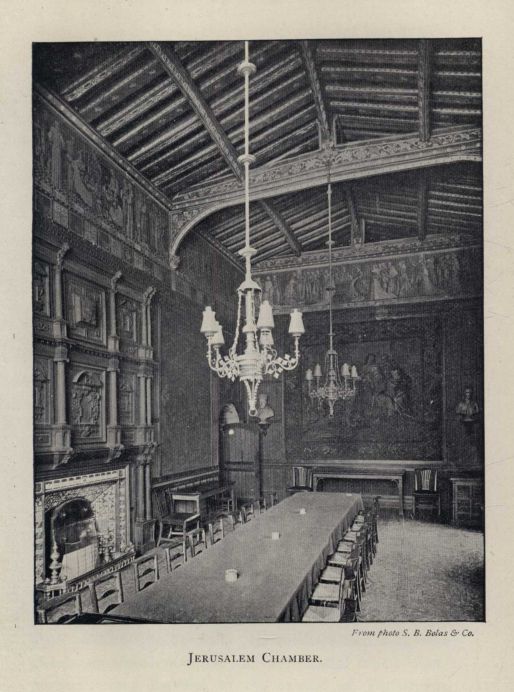
JERUSALEM CHAMBER.
Under the Commonwealth the Abbey fared badly, for with a fanatical horror of anything that reminded them of royalty or of Rome, the Parliamentarians had not the smallest regard for it, and delighted in showing their contempt for its past. How far the soldiers were allowed to desecrate its walls and its altars it is difficult to clearly ascertain, and we may fairly believe that the story of how they pulled down the organ, pawned the pipes for ale, and played boisterous games up and down the church "to show their Christian liberty," is a great exaggeration, even if any such thing took place at all. Certainly the altar in Henry VII.'s chapel, under which lay buried Edward VI., was destroyed, the copes and vestments were sold, and many windows and monuments supposed to teach lessons of superstition and idolatry were demolished. No dean was appointed. The church being put under a Parliamentary Committee, Presbyterian preachers conducted morning exercises, which took the place of the daily services, and Bradshaw, the President of the court which tried and condemned to death Charles I., settled himself into the deserted deanery. A strange sight indeed it must have been to those who noted it to watch this man going backwards and forwards between Abbot Islip's house and the Hall of Westminster Palace, holding in the hollow of his hand the life of the king of England!
Westminster School, which, under Elizabeth, had been set on its new and enlarged footing, and since then had vigorously expanded under the various head-masters, alone continued to flourish. Its scholars naturally were closely connected with the life that centred round Westminster: they listened to the debates of Parliament, they flocked to hear the trials in Westminster Hall, they attended the services in the Abbey. Their feelings ran high during the Civil War. Pym, Cromwell, and Bradshaw they hated; the execution of Charles roused their deepest indignation, and they listened in awed horror as Bushby, their master, read solemnly the prayer for the king at the very moment when the scaffold was being erected at Whitehall. It was the strong personality of Bushby and his tactful management which saved the school from being seriously interfered with at the hands of the all-powerful Parliament, so that for fifty-five years this model for head-masters "ruled with his rod and his iron will, and successfully piloted this bark through very stormy seas." He was full of enthusiasm and energy and he was more anxious that his pupils should become men of action and character than accomplished scholars. His monument, which is near the Poets' Corner shows him, in the words of the inscription, "such as he appeared to human eyes;" and the words which follow tell how he "sowed a plenteous harvest of ingenious men; discovered, managed, and improved the natural genius in every one; formed and nourished the minds of youths, and gave to the school of Westminster the fame of which it boasts."
But the Abbey was a national institution, too firmly builded on the rocks to be more than shaken by the passing storms. It had weathered the earthquake of the Reformation, it had survived the tempests of the Revolution. With the Restoration came the calm, and quietly the old life was resumed. I have but little more to tell you of the inner story of the Abbey, nor from this time forward do kings and queens play any very important part in its story. It is the tombs and monuments which now begin, more closely even than before, to cement the tie between Westminster and the pages of English history. So I will only tell you in a few words how Dean Sprat busied himself with the restoration of the great buildings, the architect being Sir Christopher Wren, who, as you know, designed St. Paul's Cathedral, and rebuilt so many of the old London churches which the Great Fire had destroyed, and how Dean Atterbury carried on the work, including the rebuilding of the great dormitory, until his devotion to the Stuart cause and his opposition to George I. caused him to be sent first to the Tower, and afterwards as an exile to France. Atterbury loved well his Abbey, and his last request was that he might walk through it once more, especially to see the glass which was his own gift to it, and which still exists in the beautiful rose window over the north door. But the sad thing about these so-called restorations is that so much of the matchless old work was destroyed, and nobody seemed in the least concerned at this. That was an age when the glories of medieval architecture appear to have lost all their charm in men's eyes, when the love of beautiful things was at its lowest ebb. The Westminster boys played their games in the chapels, and were allowed to skip from tomb to tomb in the Confessor's shrine; hideous monuments were erected and crowded together, nothing old was reverenced, and we can only be thankful that more was not destroyed or hopelessly ruined. And yet, in spite of this apparent indifference, here and there were men who found themselves stirred when they came within those walls as they were stirred nowhere else, so that many a writer, including Addison, Steele, and Goldsmith, and earlier still, John Milton, has paid homage, even in those unimaginative days, to that fair place, "so far exceeding human excellence that a man would think it was knit together by the fingers of angels."
One more dean I must tell you of, and that is Dean Stanley, who, with his wife, lies in the south aisle of Henry VII.'s Chapel. For it was when he was appointed to Westminster in 1864 that once again the Abbey became something more than a great memory of former days. First of all he unfolded the storied past, clearing up many a mystery, setting right many an error, and then, impelled by a deep reverence for all its great associations, he consistently carried on its history. In every trace of his work we find this same wise spirit of sympathy and understanding. To him the Abbey was our greatest national treasure; his ideal was, not only so to keep it, but to make it a living influence among all English-speaking people. And thanks in no small degree to him, Westminster Abbey is to-day a very magnet in the heart of the empire, to which high and low rich and poor, learned and ignorant are drawn from far and near, to drink in, as they are able, its memories and its beauties, to do homage to those great souls whom it honours there to read as from a book stories of Englishmen who whether as kings or statesmen, abbots or deans, nobles or commoners, poets or patriots, added at least some stones to that other building, not fashioned by hands alone, which grew up side by side with Edward's church, and thus became the builders of our nation.
But we have gone forward, quickly, and I must take you back for a moment to Henry VII.'s Chapel, where still after the Restoration some royal funerals took place. With the outburst of loyal feeling, it was felt by many that Charles I., who had been buried at Windsor, ought to be brought here, and Christopher Wren was commanded to prepare a costly monument. But nothing further was done in the matter. Charles II. was buried at midnight most unceremoniously, close to the monument of General Monk, and one who was probably present adds, by way of comment, "he was soon forgotten." Ten children of James II. were laid in the spacious vault under Mary Queen of Scots monument, but he himself, having fled from his kingdom, died abroad and was buried in Paris. William and Mary, Queen Anne and her husband, Prince George of Denmark, all lie near Charles II., and the seventeen children of Anne are just behind in what is really the Children's Vault. One of these children, Prince William Henry, another Duke of Gloucester, though he only lived to be eleven, was such a quaint little boy that his tutor wrote a biography of him. He was always very delicate, but though his body was weak his mind was precocious and his spirits were unfailingly high. From the time he was two his craze was for soldiers, and he had a company of ninety boys from Kensington for his bodyguard, whom he drilled and ruled by martial law. These boys he called his horse-guards, and they wore red grenadiers' caps and carried wooden swords and muskets; but, however much they may have pleased the little prince, who lived at Camden House, they were somewhat of a terror to the people of Kensington, as, "presuming on being soldiers, they were very rude and challenged men in the streets, which caused complaints." This tutor of his, Jenkin Lewis, who entered thoroughly into the spirit of the little Duke, gives a delightful account of a visit paid to him by his uncle, the grave William III., who appears to have been very fond of him.
Altogether the Duke must have been a charming little boy, plucky, generous, and remarkably bright. If he fell down and hurt himself, he would say, "A bullet in the war had grazed me," and though, to please the queen, he learnt dancing from an old Frenchman, he confided to his tutor that the only thing he loved in that way was the English march to a drum.
Greatly to his joy the king decided to make him a Knight of the Garter when he was only six years old, and to add to the honour William tied on the Garter himself.
"Now," said the boy proudly, "if I fight any more battles I shall give harder blows than ever."
He was as quick and interested at his lessons as he was at soldiering, and we bear of his making amazing progress under the Bishop of Marlborough in the history of the Bible, geography, constitutional history, and many other subjects, while his tutor had taught him "the terms of fortification and navigation, the different parts of a ship of war, and stories about Cæsar, Alexander, Pompey, Hannibal, and Scipio. It was his tutor who put into verse, and persuaded Mr. Church, one of the gentlemen of Westminster Abbey, to set to music, the Duke's words of command to his boys, which ran thus:—
"Hark, hark! the hostile drum alarms,
Let ours too beat, and call to arms;
Prepare, my boys, to meet the foe,
Let every breast with valour glow.
Soon conquest shall our arms decide,
And Britain's sons in triumph ride.
In order charge your daring band,
Attentive to your chief's command.
Discharge your volleys, fire away;
They yield, my lads, we gain the day.
March on, pursue to yonder town;
No ambush fear, the day's our own.
Yet from your hearts let mercy flow,
And nobly spare the captive foe!"
When in 1696 a plot formed against William III. was discovered, the Duke determined not to be behind the Houses of Parliament, who offered their loyal addresses to the king, so he drew up a little address of his own in these words, which was signed by himself and all his boys: "We, your Majesty's faithful subjects, will stand by you as long as we have a drop of blood."
On the 24th July 1700 he was eleven and had a birthday party, which of course meant a sham fight among his boys; and when on the next morning he complained of feeling ill, every one naturally thought he was only over-tired or excited. But a bad throat and high fever soon showed that there was serious mischief, and within a week he died. "To the inexpressible grief," wrote the Bishop of Salisbury, "of all good men who were well-wishers to the Protestant religion and lovers of their country."
George II. was the last king to be buried in the Abbey, and he was laid in the same stone coffin as his wife, Queen Caroline. You will find the gravestones in the nave of Henry VII.'s Chapel, and near to it are buried his two daughters, his son Frederick, Prince of Wales, and several grandchildren. Horace Walpole, the son of Robert Walpole, who had for twenty-one years been the Prime Minister of the king, thus describes to us the last royal funeral at Westminster:—
"The procession through a line of foot-guards, every seventh man bearing a torch, the horse-guards lining the outside, their officers with drawn swords and crape sashes, the drums muffled, the fifes, the bells tolling, and the minute guns, all this was very solemn. But the charm was the entrance to the Abbey, where we were received by the Dean and Chapter in rich robes, the choir and almsmen bearing torches, the whole Abbey so illuminated that one saw it to greater advantage than by day. When we came to the Chapel of Henry VII., all solemnity and decorum ceased, no order was observed, people sat or stood where they would or could; the Yeomen of the Guard were crying out for help, oppressed by the immense weight of the coffin. The Bishop read sadly and blundered in the prayers, and the anthem, besides being immeasurably tedious, would have served as well for a wedding.... The Duke of Newcastle fell into a fit of crying the moment we came into the chapel and flung himself back in a stall, the Archbishop towering over him with a smelling-bottle; but in two minutes his curiosity got the better of his hypocrisy, and he ran about the chapel with his glass to spy who was or was not there. Then returned his fear of getting cold, and the Duke of Cumberland, who felt himself weighed down, on turning round found it was the Duke of Newcastle standing upon his train to avoid the chill of the marble."
But though Westminster was no longer to be the church of the royal tombs, there was one ceremony she was still to claim undisputed as her own peculiar right. A Coronation meant the Abbey; no other place was ever dreamt of. Charles II. here commenced his reign with great glory. James II. characteristically grudged spending any money excepting £100,000 for the queen's dress and trinkets. William and Mary were crowned together, for Mary refused to be queen unless her husband became king with her, and it is for this joint-coronation that the second chair of state was made, which stands with the old Coronation Chair in the Confessor's Chapel. The members of the House of Commons were present and "hummed applause at the eloquent ending to Bishop Burnet's sermon, in which he prayed God "to bless the royal pair with long life and love, with obedient subjects, wise counsellors, faithful allies, gallant fleets and armies, and finally with crowns more glorious and lasting than those which glittered on the altar of the Abbey."
Queen Anne, fat, gouty, and childless, found the day a weary one. Unlike her sister Mary, she was crowned queen in her own right, and her husband was the first of the nobles to do her homage.
When George I. was crowned many difficulties had to be overcome, for everything had to be explained to the king, who knew no English, by ministers who stumbled badly over their German. But George II. had learnt the language of his people, and liking great ceremonies as much as his father had disliked them, his coronation day was celebrated in great state. Queen Caroline must have been ablaze with jewels, for besides wearing all her own, she had borrowed what pearls she could from the ladies of quality, and had hired all manner of diamonds from the Jews and jewellers. George IV. spent more money when he was crowned king than any other of his race, but the day was not without a very painful scene, as he refused to prepare any place for his wife, Queen Caroline, and she indignantly tried in vain to insist on her rights and to force her way into the Abbey. She failed, and her failure so broke her spirits that she fell ill, and a few weeks later she died.
William IV. was crowned at a critical moment, for the country was in a state of excitement concerning the Reform Bill, which, if passed, would give a vote to a great number of people who did not possess one, but which was being firmly opposed by the Duke of Wellington and a strong party. To avoid any risks of riots or demonstrations the usual procession was left out, even the usual banquet in the old palace, while everything was as simple and private as possible. But seven years later those old grey walls looked down on a Coronation Day which brought untold blessings to England. On June 28, 1838, Princess Victoria, a slender girl in the first freshness of her youth, was publicly recognised undoubted queen of the realm, and took her solemn oath in the sight of the people to perform and keep the promises demanded of her by the Archbishop. Here in the Sanctuary she was anointed; here the spurs and the sword of state were presented to her, and then laid on the altar; here the orb was placed in her hands and the royal robe about her shoulders; here the ring, the sceptre, the rod were delivered to her; here was the crown of pure gold set on her head, and the Bible, the royal law, placed in her hands; here she ascended the throne, while her nobles did her homage; here, taking off her crown, she received the Holy Communion, and then passed on into the Confessor's Chapel in accordance with the time-honoured usage.