Front matter (continued 4)
Reading edition
Vastly solemn indeed was the ceremony, calling to mind as it did the long procession of kings and queens who, without exception in that place, almost in those identical words, had accepted the great trust to which they had been called. Some had been faithful; some, through weakness or through wilful wrong-doing, had violated the vow. The strongest men had sometimes wavered, the bravest men had faltered before their task. But Queen Victoria never failed her people. Through weal and woe, through storm and sunshine, through good and evil days, she watched over them and guarded their interests. She ruled over their hearts at home and throughout those vaster dominions beyond the seas, she bound them to her with bonds of loyal devotion, so that when, in the dim light of a winter's day in February 1901, the Abbey was filled with a vast crowd of those who were there to pay their last tribute to her memory, their universal sorrow was no mere formality, but was in harmony with the sense of personal loss which was felt by all who had owned her as their Sovereign Lady.
PART II
AMONG THE MONUMENTS
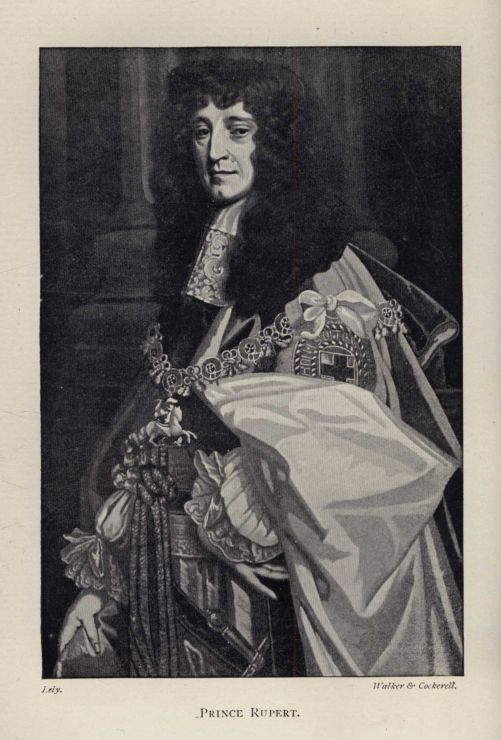
PRINCE RUPERT.
CHAPTER XIII
PURITANS AND CAVALIERS IN THE ABBEY
By a strange irony of fate, the royal chapel of the Tudors was destined to be, at least for awhile, the burying-place of many Parliamentary leaders, and perhaps stranger still it is to realise how Roundhead and Cavalier, disgraced minister and triumphant reformer, came at last to the old Abbey, which opened its arms to receive them, condemning no man, but committing all unto the care of Him who judgeth with righteous judgment. The Duke of Buckingham and Pym, Cromwell and Prince Rupert, Admiral Blake, Clarendon the historian of the great rebellion, Essex and General Monk, all were buried within a few feet of each other, and their names are still engraved on Abbey stones, though some of them sleep there no more.
These men, in their different ways, stood in the forefront of that hard-fought Revolution, and as I want Westminster to be something more to you than a place of names and monuments, I will try to tell you enough of each one for you to be able to fit them into their proper places in the history of those stormy days.
We will begin with Buckingham, who, as young George Villiers, was brought up to be a courtier, and taught only such accomplishments as would fit him for that part. He was an apt pupil, graceful, witty, versatile, full of charm, and from the moment he entered the service of James I. as cupbearer, his upward career began. He leapt from step to step with dazzling rapidity, and the king became a mere puppet in his hands. "I love the Earl of Buckingham more than anything else," he declared. "Whatsoever he desireth must be done." For awhile Buckingham did not seriously interfere with politics; his ambition was satisfied with personal power and court influence, while his own position concerned him much more closely than the affairs of the country. But eventually he was drawn into the vortex, to his own undoing, for his brilliancy was only superficial, his wild schemes collapsed one after the other, while his reckless extravagance, coupled with his disastrous undertakings, staggered the Parliament, which had for a brief moment believed in him. However, Charles, who was now king, implicitly believed in him through all his failures, and supported his exorbitant demands for money to carry on his unpopular and unsuccessful foreign policy. At last the gathering indignation burst.
"The Duke of Buckingham is the cause of all our miseries," was the deliberate statement made in the House of Commons, followed by a long list of charges, and the determination, for the first time, to hold a minister responsible to Parliament for his actions. The king was furious. "None of my servants shall be questioned by you, or it shall be the worse for you," he said scornfully, and he dissolved Parliament. But the trial of Buckingham was taken out of their hands, for shortly afterwards he was stabbed to death by a certain Fenton, a melancholy, malcontented gentleman, who declared that he did so to rid the country of an intolerable tyrant. He was buried quietly in the Abbey, and the king set up to his memory the elaborate but hardly beautiful monument which you see. You must notice, though, the three figures of his children, for one of them, Francis, a very gallant boy, "of rare beauty and comeliness," fell fighting for the king at Kingston, wounded nine times, yet scorning to ask quarter, standing with his back against an oak tree till he dropped.
General Monk, afterwards Duke of Albemarle, fought on the Parliamentary side, and after the defeat of the Royalists in England he was with Cromwell through his victorious campaigns in Scotland and Ireland, remaining behind as commander-in-chief for Scotland. But it was as a sailor rather than as a soldier that he made his greatest reputation, for when the struggle began between England and the Dutch for the command of the seas, the Dutch challenging the English right to it, Monk, and another Parliamentary officer, Blake, were appointed generals at sea, it being thought that their ability to lead, their energy and their good sense, would more than compensate for their lack of technical experience. So it eventually proved, and after some close fighting Monk was able to report that the English held the coast of Holland as if it were besieged. Parliament rewarded Monk with a vote of thanks, a medal and a chain worth £300, and he assured them that he had "no other thought but to defend the nation against all enemies, whether by sea or by land, as might be entrusted to him."
Not altogether approving of the arbitrary way in which Cromwell treated Parliament, he determined to keep clear of politics and to remain a "plain fighting man." But while employed by the Protector he was entirely loyal to him, and at once sent to him a letter he received from Charles II. suggesting negotiations. "An honest, very simple-hearted man," was Cromwell's remark on him.
But with the death of the Protector the whole aspect of things changed. Monk had fully intended to serve Richard Cromwell as he had served his father, only it became palpably evident that the new Protector was not in any way capable of controlling the country or the army, and within a few weeks dissatisfaction and discontent were evident everywhere—the pendulum had swung back, and England cried for a king once more. With Richard Cromwell at the head of affairs, Monk saw that the days of the Commonwealth were numbered. "He forsook himself or I had never faltered in my allegiance," he explained; for Dick Cromwell was as anxious as any one to be rid of his office. Through his brother, Nicholas Monk, a sturdy Royalist, afterwards made Bishop of Hereford, Charles sent a straightforward letter to the general, judging rightly that plain words were more likely to take effect with him. "If you take my interests to heart," wrote the king, "I will leave the way and manner to you and act as you advise."
For awhile Monk hesitated, then he accepted the situation. He met the king at Dover, and served him faithfully in whatever capacity it was desired of him, assisting in the settlement of Scotland, or going to sea with Prince Rupert, or keeping order in London during those years of panic when first the plague, then the Great Fire produced the wildest terror and confusion. He died "like a Roman general and a soldier, his chamber door open as if it had been a tent, his officers around him," and England mourned an honest, duty-loving man, brave on every point excepting where his wife was concerned, and here he frankly admitted to a "terror of her tongue and passions." The king, who had made him Duke of Albemarle, was present at his funeral, and undertook to pay all the expenses, besides erecting a monument to him. But his memory and gratitude were both short-lived, so that it was left to the second Duke to see that his father's name and fame were duly chronicled in the Abbey, that future generations might know him as "an honest man, who served his country."
Admiral Blake, buried in the Cromwell vault, first went to sea to settle Prince Rupert, who with his tiny fleet was a terror to English ships, and so successful was he, that at last Rupert was thankful to reach France in safety with his one remaining vessel. For reward, Parliament gave him a place in the council of state, and he devoted himself to making the navy more efficient, as he felt sure a war at sea with the Dutch was imminent. He desired to make his sailors men of the same stamp as Cromwell's famous Ironsides, but though he was a great disciplinarian he was very popular, and his men fought for him with a will. The war began with a victory for Blake, which, far from disheartening the Dutch, put them on their mettle, and off Dungeness they compelled the English admiral to retreat on Dover, after a fierce struggle. So elated was Van Tromp at this advantage, that as he passed along the Channel he had a broom fastened to the masthead of his ship to show how he meant to sweep the English from the seas. Blake was sorely grieved at his failure, and for a moment gave way to a depression which led him to entreat Parliament that he might be discharged from "an employment much too great for him." Then his old spirit returned, and he asked "for more men to fight again."
At the battle of Portland the fleets met once more, and it was a terrible fight. Though Blake was badly wounded, the victory lay with the English. He followed up the advantages he had gained, and near the North Foreland took eleven Dutch ships and 1350 prisoners, with a small loss. His wound had by now so affected his health, that he was compelled to return to England, leaving Monk to fight the last great fight, in which Van Tromp was killed, 6000 Dutchmen killed, wounded, or made prisoners, and twenty-six of their ships sunk or taken. However, though the Dutch were settled, it was necessary to assert the English power in the Mediterranean, especially where Spain was concerned, and Blake was the name to conjure with. So, in spite of his painful illness, he set out once more, "the one man able to preserve the commonwealth," Cromwell told him. At Santa Cruz he met the Spanish fleet and conquered it. "To God be all the glory," he wrote in his simply worded despatch which told of this great and popular victory.
Then, feeling his increasing weakness, he asked leave to return home, as "the work was done and the chain complete." But he died at sea, in sight of Plymouth Sound. His funeral in Westminster Abbey was a splendid one, worthy of the splendid service he had rendered to England, Cromwell having ordered that "no pomp was to be spared, so as to encourage all officers to venture their lives." A lasting shame it is indeed that at the Restoration his remains, with those of Deane, one of his admirals, and other Parliamentary officers, were taken from their graves, and buried without any mark of respect in one common grave in St. Margaret's Churchyard. Within the Abbey no monument marks his grave, though he had held for England the supremacy of the seas against vigorous attacks, and had made a reputation for himself "very wonderful, which will never be forgotten in Spain."
The very name of Prince Rupert breathes of romance and adventure. His mother was the fascinating and high-spirited Princess Elizabeth, daughter of James I., who had married Frederick, Prince Palatine of the Rhine, and had persuaded him to accept the crown of Bohemia when it was offered to him by the people, who had just wrested their independence from the Emperor of Austria. But his reign at Prague was short, for the Emperor won back his own, and the Queen of Hearts, as Elizabeth was affectionately called, had to escape with her children as best she could, Rupert being but a few weeks old. Her father, afraid of Spain and the Roman Catholic powers, would do nothing to help her, so she would have fared badly had it not been for some faithful English friends, headed by Lord Craven, and the people of Holland, who looked on the king of Bohemia as a sufferer in the Protestant cause, and who therefore gave his family a home besides a generous allowance. Frederick was not only deprived of his new kingdom, but lost also his old possessions, for the Emperor seized his lands on the Rhine and spoiled his palaces. Many a brave attempt he made to win back the Palatinate, always to be baffled, and at last, after the death of his eldest son, he fell into such a low state of health that he died of a fever. Elizabeth was left with three sons and two daughters, Rupert being her idol, for she believed him born to be a hero. And truly he was a boy to be proud of, excelling in everything he undertook, and such a true soldier that, when he was only fourteen, his tutors declared he was worthy to command a regiment. When Charles I. became king, he invited two of his nephews to England, and, with the queen, at once lost his heart to Rupert, who was then about eighteen. He proposed making him a bishop or marrying him to an heiress, but Rupert would hear of neither plan. A soldier's life, with plenty of adventure, was the only life for him.
On the 22nd of August in the year 1642, the Civil War broke out in England; the royal standard was set up at Nottingham, and Prince Rupert was made General of the Royal Horse, he being then but twenty-three. His very presence, brimming over as he was with enthusiasm, vigour, and determination, brought a breath of new life to the men who "could not hold back when the royal standard waved," yet "who did not like the quarrel, and heartily wished the king would yield and consent to what Parliament desired."
But Rupert was quite untouched by the general feeling of depression. The cause or its merits concerned him but little; he knew nothing of the intensity of the struggle, of the many unredressed grievances, of the arbitrary treatment of the nation's representatives in Parliament, of the total disregard for the opinions of the people which had at last made nothing but war possible between two such conflicting parties. He only saw the romantic side, a king called upon to defend himself in his own realm against rebels and traitors, and so heart and soul he espoused his uncle's cause. A cavalier of the cavaliers was Prince Rupert, with his handsome face, long flowing hair, clean-shaved cheeks, beplumed hat, and scarlet cloak, to which he added a very gallant bearing and a lordly manner. Directly he saw the cavalry he was to command, less than a thousand badly mounted untrained men, he dashed away like a whirlwind, to scour the country in search of more. Here, there, and everywhere he came and went like a flash, "in a short time heard of in many places at great distances," to quote a Parliamentary historian, till the very sound of his name had a magic effect. He charmed some, he terrified others, but he did what he would with them all, and in less than a month he rode back to join the court at Shrewsbury, with a picked force of three thousand men, well horsed and equipped. Contrasted with the indecision of Charles, Rupert's high-handed audacity was refreshing, and when the king left him free "to steer his own course," he at once set out for Worcester, which was threatened by Essex and the Parliamentary army.
The Royalist plan was to march on London, a plan which Parliament saw must at all costs be frustrated, so Essex received imperative orders to intercept and check the enemy. At Edgehill, near Banbury, the armies met, and the king, from his position on a hill-top, took view of Essex and his army in the vale.
"I shall give them battle," he said. "God assist the justice of my cause."
Then he called a council of war, at which many points of difference arose between the old soldiers and the young. Of course Rupert was the spokesman for the latter, and this was not the first time he had come into collision with the other generals of the Royalist army. Caution was a word unknown to him, and patience did not exist in his vocabulary. Slow and steady tactics he abhorred; he scorned the enemy, and pleaded vehemently for bold, dashing movements, which were, he said, best suited to the high-spirited soldiers of the king. As usual he prevailed, for he was never one who could be persuaded to change his opinion. His plan of battle was decided on, which meant that the Royal Horse should charge and drive the Roundhead Cavalry from the field, afterwards falling upon the flank of the enemy's infantry, while the Royalist infantry attacked them from the front.
"Then," he added, carried away by the thought of a victory which seemed so obvious, "the day is ours."
When the battle began in earnest Rupert charged with his cavalry, and so magnificently, that it seemed as if all his prophecies were fully justified, for the Roundheads were swept backwards till they broke and fled. But so excited and eager were the horsemen to pursue their flying foes, that they left all the Royalist infantry unprotected, and when Prince Rupert returned with such troops as he could rally from the chase, he found all confusion and uncertainty. Moreover, it was nearly dark, and no one was ready to support Rupert when he entreated that another charge might be made to settle the day. So, after all, it was only half a victory for the king's army, even though he held the road to London, while altogether quite 6000 Englishmen lay dead on the field.
Charles next made a move to Oxford, where he established his Court, for Oxford was almost the only city at that time "wholly devoted to his Majesty," and from here peace negotiations were again entered into, with the usual result that both sides were left still more bitterly opposed to each other. Rupert was charged with attacking two Parliamentary regiments at Brentford during the negotiations when all fighting was suspended. But with all his faults of impatience and impetuosity he was far too honourable a soldier to have willingly taken any unfair advantage of his foe, and it seems clear what he did was at the king's command, or when he was in ignorance of the stage which had been reached in the negotiations. While the king and the main army lay inactive though full of talk at Oxford, Rupert with his cavalry scoured the country round in search of men, horses, food, and forage, and indeed whatever they could lay hands on; for as Parliament held all the money, the king's soldiers had to live off the country as best they could, and wait patiently for pay which rarely came. The Prince, as was his wont, journeyed far and wide, his special object being to extend the king's territory all round Oxford and to take in all the west of England. So we hear of him, sometimes successful and sometimes baffled, at Cirencester, Banbury, Bristol, Gloucester, Birmingham, and Wales, then moving northwards in Leicester and Northamptonshire, till at the peremptory command of Charles he made his way towards York, which was in great danger, and which, "if lost," wrote the king, "would mean little less than the loss of the crown."
He relieved the town with great dash, but was so eager to press on that he would not even wait to speak to the governor, Lord Newcastle, who was very offended at what he considered to be a want of respect. Still more angry was he when he received a message from Rupert commanding him to follow the cavalry without delay. He made no haste to carry out this order, and Rupert, who was in close touch with the enemy, waited for him in vain. The delay cost the Royalists dear, for the battle of Marston Moor which ensued was a complete triumph for the Roundheads. But even then Rupert did not lose heart, as did so many of his party.
"'What will you do?' asked General King of him. 'I will rally my men,' sayes ye Prince. Sayes General King, 'Nowe what will my Lord Newcastle do?' Sayes he, 'I will go to Holland, for all is lost.'"
The defeat of the Northern army was decisive, and Rupert felt the only help lay in Wales and the west of England. But defeat followed defeat. At Naseby the Parliamentary army was again victorious; Bristol surrendered, then Oxford. Nor was this all. Among the king's nearest advisers were many who disliked Prince Rupert, especially Lord Digby, and when the Prince surrendered Bristol, he saw his opportunity for revenge. Very cleverly he worked on Charles to such an extent that he made it appear as if Rupert had weakly capitulated without any justification, and the king, who all too easily forgot the past, signed an order revoking the military authority and position he had bestowed on his nephew. The Prince was sorely hurt and indignant at this want of confidence. "It is Digby that is the cause of all the distraction," he said quietly, and then proceeded to defend his honour and his action, which he did in a manner that commended itself to all fair-minded men.
Having written a full account of the siege, and proved that holding out longer would have only meant a useless sacrifice of valuable lives, he followed this up by going straight to the king at Newark, in spite of having been forbidden to do so by Digby. "I am come, sir," he said, "to render an account of Bristol." At first Charles would not listen, but Rupert insisted on a court-martial, which at last was granted, and which completely cleared him. The king accepted the verdict, but in a half-hearted way, which nettled the Prince, who was already chafing at the unjust accusations made against his honour. A few days later he vigorously fought the battle of another officer who had been dismissed—also the victim of Digby's jealousy.
"No officer," he declared indignantly, "should be deprived of his commission without being able to defend himself against a council of war."
In his anger he applied to Parliament for permission to return to Holland, but when the message came that this would only be given on condition that he did not fight again, he indignantly refused the terms. His loyalty was deeper than his anger when it came to the test.
Ere long, however, the hopeless, weary struggle reached its end. The king threw himself on the mercy of his Scottish army, who for £400,000 gave him up to Parliament, and he was made a prisoner. Rupert found his way to France, and later on he joined the Prince of Wales in getting together a small fleet which it was proposed to send to Ireland. He entered enthusiastically into this new career. "The royal cause," he said, "is now at sea." Far and wide on the ocean he was to be heard of with his ships, round Spain, Portugal, in the Mediterranean and the West Indies, near Azores and Cape Verde, seizing wherever he could find them the treasure-ships belonging to the English Parliament. His name was a terror by sea as it had been by land, and the adventurous life was quite according to his liking. With the Restoration he came back to England, and Charles settled on him an allowance of £4000 a year, besides giving him an important command in the fleet. But no real scope was allowed him for his powers, and Charles, with all his foreign intrigues, found Rupert too inconveniently straightforward and resolute.
So the end of his life was a disappointment, though when action of one sort was denied him, his eager brain turned to science, chemistry, and inventions. Most of his old friends had vanished; his mother had died many years before, protected and comforted to the last by Lord Craven, who had taken for a motto the words "For God and for Her;" and of his sisters, one was an abbess, the other married to the Elector of Hanover.
He lived alone and quietly at his house in Spring Gardens at the top of Whitehall, and when he died, comparatively young, he was "generally lamented for an honest, brave, true-hearted man, whose life had embraced innumerable toils, and a variety of noble actions by land and by sea."
"It is an infinite pity he is not employed according to his genius," a friend of his mother's had written to her long years before. "He is full of spirit and action, and may be compared to steel, which is the commanding metal if it be rightly tempered and disposed. Whatever he wills, he wills vehemently."
And this criticism, which was true of him up to the day he died, contains the essence of his successes and of his failures.
It was in this vaulted chapel of the Tudor kings that Oliver Cromwell was buried with regal magnificence, his effigy robed in purple, surrounded by a sceptre, a sword, and an imperial crown, being also placed in the Abbey. Many of his friends and followers—Pym, the hero of his early days; Ireton, his son-in-law; Bradshaw, the President of the Court which had tried and condemned the King in Westminster Hall close by—were already by his desire buried in the Abbey, as were most of his immediate family; his old mother, who had always said "she cared nothing for her son's grandeur, and was always afraid when she heard a musket lest he should be shot, and his best loved daughter, Betty, Elizabeth Claypole. The latter was such an attractive girl, and "played the part of princess so naturally, and obliging all persons by her civility," that Cromwell feared lest her very charms should be a snare to her, leading her thoughts from God. His letters to her show all the tenderest side of his strong nature. "I watch thy growth as a Seeker after truth," he once wrote to her. "To be a Seeker is to be of the best sect, next to a Finder. And such a one shall every happy Seeker be at the end."
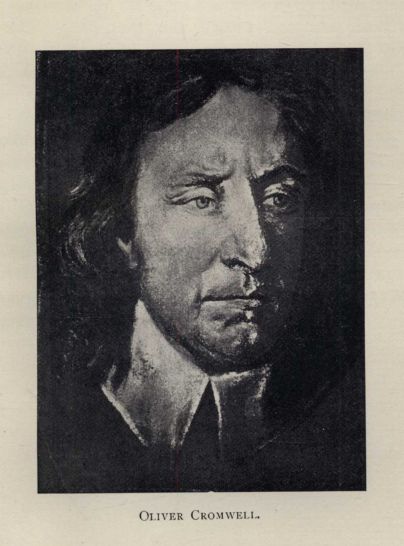
OLIVER CROMWELL.
Oliver Cromwell was ever a son of strife, and two years after his death, on the anniversary of the king's execution, his body was dragged from the grave by order of the Restoration Parliament and publicly hung, a similar revenge being meted out to Bradshaw and Ireton, and the "pure-souled patriot John Pym."
So to-day we do not even know where he is buried, and only a plate in the floor of Henry VII.'s chapel, put there by Dean Stanley, shows us where once the great man lay.
For great he surely was, even though narrow, relentless, arbitrary, and overbearing; great, that is to say, if high aims, honest ambitions, dogged courage, and unswerving obedience to what he held to be the Divine voice, count for ought in the standard we require of our public men.
CHAPTER XIV
CHAUCER
Geoffrey Chaucer was the first English poet or writer to be buried within the Abbey, and just as the Confessor's tomb drew kings and queens to lie around it, so Chaucer's grave, in a way undreamed of at the time, consecrated one part of Westminster as the Poets' Corner. And what more fitting than that he who has been so justly named the "poet of the dawn, the finder of our fair language, the father of English poetry," should rest, when his life's work was ended, near to those others with whose names our early history is studded?
He was born in London about the year 1335, the son of a merchant vintner, and throughout his life London was to him "a city very deare and sweete." He was well educated, though where we know not, in classics, divinity, astronomy, philosophy, and chemistry, and naturally spoke French fluently, as its use was general. From his boyhood he loved reading only less than he loved nature.
"On bokës for to rede, I me delyte,
Save certeynly whan that the moneth of May
Is comen, and that I here the foulës synge,
And that the flourës gynnen for to sprynge,
Farwel my boke and my devocïoun."
And almost equally, too, he loved to see life, to travel in foreign countries, to study, in a kindly sympathetic spirit, human nature in all its forms, neither criticising harshly nor condemning impatiently, but just observing and understanding.
Those early years of his life marked a great epoch in England, for Edward III. made the land ring with the fame of his victories at Crecy and Poitiers; the valour of his knights and soldiers; the fair and famous deeds done in the name of that chivalry which was then at its height; and young Chaucer seems to have caught the reflection of all that enthusiasm and vigour. He was the child of his age, but he heard its sobs as well as its laughter, the rattling chains of its slaves as well as the clanking steel and the trumpet notes of its armed men. The Black Death and the revolt of the downtrodden peasants made a grim setting to the picture of heart-stirring triumphs in the battle-field, and Chaucer saw both the setting and the picture.
When he was about twenty he became attached to the court in a humble capacity, but his pleasant manners and conversation, his cheerfulness and his straightforward simplicity, soon won him promotion, so that he was made first gentleman-in-waiting, then esquire to King Edward, who more than once spoke of him as his "beloved valet," and who trusted him well enough to send him on many important missions to foreign countries as his messenger. But Chaucer's greatest and unchanging ally at court was the king's brother, John of Gaunt. For more than forty years their friendship remained unbroken through many ups and downs of fortune.
In 1369 John of Gaunt's first wife, Blanche, died, young, beautiful, and beloved. Chaucer had already shown his power of writing excellent verse by a translation he had made from a celebrated French poem "Le Roman de la Rose," so it was only natural that John of Gaunt should turn to him when in the sorrow of the moment he desired the goodness and charm of his lady to be commemorated. The result was the "Book of the Duchess," a story told as an allegory, for Chaucer was under the spell of French literature, which revelled in allegory. In this book he tells how one May morning, the sun shining in at his windows, and the sound of the "sweete foule's carolling," drew him forth into the forest, where, led thereto by a faithful dog, he found a knight dressed in black, mourning all in a quiet spot among the mighty trees. His hands drooped, his face was pale, he could not be consoled. But finding the poet a sympathetic listener, he told him the story of his sorrow.
"My lady bright
Which I heve loved with all my might,
Is from me deed, and is agone ...
That was so fair, so fresh, so free."
Years of happiness he had spent with her, this sweet lady, who yet was so strong and helpful.
"When I hed wrong and she the right,
She wolde alwey so goodëly
Forgive me so débónnairly.
In alle my youth, in alle chance,
She took me in her governaunce.
Therewith she was alwày so trewe,
Our joys was ever y-liche newe."
And now she was dead. Words of comfort were of no avail. The poet could no longer intrude on grief so overwhelming. He could only silently sympathise, and then leave the mourning knight alone in his sorrow, with the parting words
"Is that your los? By God, hit is routhe."
Soon after he had written this touching tribute to the memory of a woman who had been his ideal of goodness and graciousness, Chaucer was sent on a mission to Genoa and Florence, a journey which left its influence upon him in a very marked manner, as he made the acquaintance of Francis Petrarch, the Italian poet, and through him he learned to know the works of Dante and the delightful stories of Boccaccio. A new world was opened out to him, and eagerly he wandered through it, eyes and mind open to every fresh vision that unfolded itself before him. From this time forward his works were tinged with Italian influence, and thereby became much the richer. For he lost none of his own sturdy individuality and fresh, pure style; he only added to this more warmth, more colouring, more romance.
On his return to England he was made Comptroller of the Customs of the Port of London, on the understanding that he did all the accounts himself, so important was it that this post should be filled by a man who was both shrewd and honest; and in addition to this both the king and John of Gaunt granted him certain allowances and privileges, so that in worldly affairs he prospered. Good fortune, however, did not cause him to become idle, and his poems followed each other in quick succession. There was the "Assembly of Fowles," of course an allegory, and written probably to celebrate the betrothal of young King Richard to the Princess Anne of Bohemia.
"Troilus and Cresside" was a much deeper poem, full of sadness, and Chaucer himself called it his "little Tragedie," adding the hope that one day God might send it to him to "write some Comedie." It is in this work that he refers to the great difficulty with which he, in common with the other writers of his day, had to contend—the unsettled state of the language. The struggle as to whether the French or English tongue should prevail had been a fierce one, but it was now in its last throes. Chaucer, through his works, helped more than any one else to develop our language as it is to-day, and strenuously avoided those "owre curyrows termes which could not be understood of comyn people, and which in every shire varied." But his own words show the difficulties which beset him.
"And for there is so great diversité
In English, and in writing of our tong,
So pray I God that none miswrite thee
Or thee mismetre for default of tong,
And red whereso thou be, or elles song,
That thou be understood, God I beseech."
And it is just because he wrote to be understood that the charm of Chaucer's style remains for ever fresh and entrancing.
In his "House of Fame" he had free scope for his pleasant wit, especially when he tells of all he saw and heard in the "House of Rumour," whither came shipmen, pilgrims, pardoners, couriers, and their like, each bringing scraps of news, which, whether true or false, were passed on, growing like a rolling snowball. He set fame at its true value, and for himself only desires that in life he might be able to "study and rite alway," while for the rest—
"It suffyceth me, as I were dedd,
That no wight have my name in honde,
I wot myself best how I stonde."
The "Legend of Good Women" was written in praise of all those maidens and wives who loved truly and unchangingly.
Hitherto Chaucer, whose married life was not an altogether happy one, had sung but little of love in its highest, purest form. But here, in a prologue sparkling and radiant as the morning he describes, he tells us how he went out to greet the daisy, the flower he loved, and would ever love anew till his heart did die.
"Kneeling alway, til it uncloséd was
Upon the swetë, softë, swotë gras
That was with flourës swote embroidered all.
In his dream there came to him the God of Love, with his queen, Alcestis, who, daisy-like, was clad in royal habits green—
"A fret of golde she hedde next her heer,
And upon that a white courone she beer."
She it was who made him swear that from henceforth he would "poetize of wommen trewe in lovying," "speke wel of love," and so make a glorious legend.
Chaucer had intended writing at least nineteen stories on the lines decreed by Alcestis, but his days of prosperity had come to an end for the time being, with the exile of John of Gaunt, and he became so poor after his dismissal from the Customs, that he had to raise money on his pension. And so the legend seems to have been laid aside.
When Henry of Lancaster became king five years later, he doubled the pension, remembering how his father, just dead, had loved the poet; and so the cloud, which had been heavy enough while it lasted, passed away. But it is to those dark days that we owe the greatest of all Chaucer's work—his "Canterbury Tales"—work, it must be remembered, which rings and re-rings with cheerfulness, courage, sympathy, and kindliness. We know so little of Chaucer as a man but this one fact stands out, that he never allowed his own troubles or anxieties, or even his pressing poverty, to over-cloud his heart or his mind. For him the sun shone always, though he saw it not, and because of that sunshine no trace of bitterness or harshness is to be found in his work.
In the prologue to the "Tales" Chaucer explains his plot in the most natural and personal way. One day in the spring, he says, he was waiting at the Tabard Inn, to rest before continuing a pilgrimage he had set out to make to Canterbury, when twenty-nine other pilgrims, all bound for the same destination, arrived. He soon made friends with them, and, finding their company very entertaining, arranged to join this party. Then came the proposal that each one should tell two tales to enliven the journey; a good supper at the end to be the reward of the pilgrim whose story found most favour. The jovial host of the inn decided to join them, and one morning in early spring the procession set out. What a motley crowd they were! Yet Chaucer, with his happy knack of describing people just as they appeared, has made them all so real to us, that it is easy to picture each one of them, and in so doing to get a vivid glimpse of the men and women whom the poet was accustomed to meet every day of his life. But for Chaucer we should know next to nothing about the people of his day. First came the knight, who "lovede chyvalrye," who had ridden far afield in his master's wars; a great soldier, but tender as a woman, "a verrey parfyte gentil knight." With him was his son, acting as his squire, great of strength, able to make brave songs, and to sit well his horse, handsomely dressed, yet in his manners "curteys, lowly, and servysable." His attendant was a yeoman, sunburnt and sturdy, who carried the sheaf of arrows, which he could dress right yeomanly. It seems likely that for a short while Chaucer served as a soldier in France, and if so, how familiar these three must have been to him. Then came the prioress, very "pleasant and semely," adopting court manners, and impressing every one with the idea that she was so compassionate and charitable that even to see a mouse in a trap made her weep. She had her own attendant nuns and priests. The monk was only interested in riding, but the friar, who was licensed to hear confessions, raise money, and perform the offices of the Church in a certain district, was merry, the good friend of all rich women, and reported to "hear confession very sweetly," being easy with the penances he ordered. Sometimes he lisped, "to make his English sweet upon the tongue," and when he sang to his guitar, "his eyes shone like stars on a frosty night." The merchant sat high on his horse, and talked loudly of his increased wealth, a great contrast to the poor clerk of Oxford, who looked hollow, wore a threadbare cloak, and had not been worldly enough to get a benefice. The sergeant-at-law, the landholder, the haberdasher, carpenter, weaver, dyer, tapestry-maker, the cook, the sailor, and the doctor, all had their special characteristics, but of these there is not space to speak. The wife of Bath had a bold face and wore bright clothes; had buried five husbands, all of whom she had ruled, and was quite willing to try a sixth. The poor parson, who was "a shepherd holy and vertuous, never despising sinful men, but teaching them the law of Christ, which he faithfully followed," was, I think, the pilgrim whom Chaucer most reverenced. The religion of the monks and friars revolted him, but those poor priests, leading their simple lives of work and worship, were to his eyes in very truth the servants of Christ, who witnessed loyally to their Master, in spite of the contempt with which their very poverty caused them to be treated. His brother, the ploughman, was in his way as good a man as the priest, for he was a true and honest labourer, who lived in charity with all, loved God, and would, for Christ's sake, "thresh, dyke, or delve for the poor widow's hire." The miller; the manciple, who bought the food for an Inn of Court; the reeve or steward; the summoner to the ecclesiastical courts; and the pardoner, with his packets of relics which he always sold successfully, made up the party; and all having agreed to the host's proposals as to the tales to be told, they drew lots to decide who should begin, the choice falling on the knight, whereat all rejoiced. "Tell us merry things," was the injunction of the host, who was rejoicing in a spell of freedom from his wife's sharp eyes and sharper tongue, and—
"Speak ye so plain at this time, we you pray,
That we may understandë what you say."
Just as Chaucer gave to each pilgrim his own individuality, so in every case he fitted the story to its teller. The knight had a tale of love, romance, and adventure; the clerk chose for heroine the patient, much-suffering Griselda; the prioress told of a child-martyr, and the poor parson, in earnest words, drew their thoughts upward to "that parfyt glorious pilgrimage which each and all must make to celestial Jerusalem." Chaucer did not live to finish all the tales he had planned out. In the year 1399 he had taken on a long lease a house at Westminster, which stood where now is Henry VII.'s chapel, and here he spent the last few months of his life, reading and writing contentedly to the end, in high favour at the Palace hard by, and the centre of a little group who loved and revered him. Probably the poor priest's tale was his last bit of work, and that significantly ends with words concerning the pilgrimage of man to the Heavenly City, "To thilke life He bring us, that bought us with His precious blood. Amen."
Chaucer's wife had been dead many years, and of his children we know nothing, except that to his son Lewis he gave an astrolabe, an instrument for taking the height of the stars, and wrote for him a "little treatise" on the subject, in which he craves pardon for his "rude inditing and his superfluity of words," explaining that a child is best taught by simple words and much repetition. But we can never think of Chaucer as alone or solitary in his old age. Rather was the house at Westminster a pleasant haven of rest where he anchored surrounded by his many comrades and friends. So greatly honoured was he, that when he died it was at once decided to bury him in the Abbey. The verses with which I end have been called Chaucer's Creed, and some say he repeated them just before his death. Certain it is that they guided his conduct through life.
THE GOOD COUNSEL OF CHAUCER
Flee from the crowd and dwell with truthfulness,
Contented with thy good, though it be small.
Treasure breeds hate and climbing dizziness;
The world is envious, wealth beguiles us all.
Care not for loftier things than to thee fall,
Counsel thyself, who counsel'st others' need,
And Truth shall thee deliver without dread.
Pain thee not all the crooked to redress,
Trusting to her who turneth as a ball;
For little meddling wins much easiness.
Beware lest thou dost kick against an awl!
Strive not, as doth a clay pot with a wall.
Judge thou thyself, who judgest others' deeds,
And Truth shall thee deliver without dread.
All that is sent receive with cheerfulness:
To wrestle with this world inviteth fall.
Here is no home, here is but wilderness.
Forth! pilgrim, forth! Forth, beast, out of thy stall!
Look up on high, and thank thy God for all!
Cast by ambition, let thy soul thee lead,
And Truth shall thee deliver, without dread.
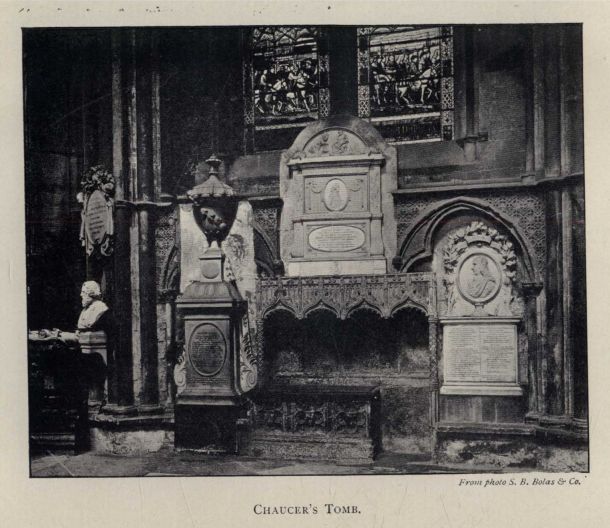
CHAUCER'S TOMB.
CHAPTER XV
SPENSER, ADDISON, AND THE POETS' CORNER
Chaucer was buried in the year 1400, and it was close upon two hundred years before another great poet, Edmund Spenser, "followed here the footing of his feet." During much of this interval England had been in a state of unrest and excitement. First the Wars of the Roses, then the Reformation, with the bitter persecutions that followed it, had stirred men to the very core. Their eyes had been dazzled by the sudden and vehement changes which had followed each other. English blood had flown freely, English life had been offered up on English soil, not only in the great battles of the Civil War, but on scaffolds and in fiery names. It had not been an age for poets or writers. Of the few who have left their mark on our literature during that time, John Wycliffe had not even been allowed to rest in peace after death, for his body was taken from its grave and burnt, and his ashes were thrown into the river Swift, while both Sir Thomas More and the Earl of Surrey had been executed at the command of Henry VIII. One important piece of work had indeed been commenced and carried on during those days of storm which affected both earlier and later writers, and which was distinctly connected with the Abbey. For in the year 1477, William Caxton had settled with his printing press in the Almonry at Westminster, and had issued his famous advertisement, in which he had made known the fact "that if it should plese ony man, spiritual or temporal, to bye ony pyes of two and three commemoracions of Salisbro's use, enpryntid after the forme of this present lettre, which been wel and truly correct, lete hym come to Westmonester into the Almonerye at the Red Pale, and he shal have them good chepe." He had learned his art in Cologne and Bruges, having lived for nearly thirty years in the latter place, where he traded as a merchant, and during those years he had translated a number of books into English. Why he settled on Westminster when at last he returned to England as a middle-aged man, we know not, unless it was that he fancied he should find quiet and security under the walls of the Abbey, or that the abbots and monks, as the patrons of learning, would prove themselves good friends to him. But here he came, and here from his study, "where lay many and diverse paunflettis and bookys," this wonderful man, who was master-printer, translator, corrector, and editor, worked and directed his apprentices. Over a hundred different books were issued from this press, among them being "The Canterbury Tales," the "fayre and ornate termes" of which gave Caxton "such greate playsir," that he desired to make them widely known. Many people, some friends, some strangers, found their way, full of curiosity and interest, to the quaint house, which was marked by a large white shield with a red bar, there to watch Master Caxton and his workmen at their strange new craft, and many shook their heads, declaring that "so many books could never find purchasers." But the wise printer heeded them not. He worked with a will from morn till eve, and marked his hours by the Abbey bells. It was not only Chaucer's writings that he gave to the public, but many other works which without him would long have remained unknown or forgotten, and more than any one else he helped to fix the language which Chaucer had used, by himself using the same in all his translations. His busy life came to an end in 1491, and he was buried in the Church of St. Margaret's, Westminster. But at the sign of the Red Pale his favourite apprentice, Wynken de Worde, carried on the master's work with the same extraordinary industry, producing no fewer than five hundred separate books up to the time of his death in 1535. This date brings us to within about twenty years of the time when Edmund Spenser, Walter Raleigh, and Philip Sidney, the singing birds and knightly spirits of the Elizabethan Court, were born. Like Chaucer, Spenser was a Londoner and he describes his birthplace as
"The merry London, my most kyndly nurse,
That to me gave this life's first active source."
He proudly declared that "he took his name from an ancient house," but we know little of his immediate family. His boyhood was spent at Smithfield, then within easy reach of woods and fields, and he has given us a glimpse of it in these words, which show that he was a boy very much like all other boys:—
"Whilome in youth, when flowed my joy full spring
Like swallow swift, I wandered here and there
for heat of headlesse lust me did so sting,
That I oft doubted daunger, had no fear:
I went the wastefull woodes and forrest wide
Withouten dread of wolves to bene espied.
"I wont to raunge amid the mazie thicket,
And gather nuttes to make my Christmas game,
And joyed oft to chase the trembling pricket,
Or hunt the hartlesse hare till she were tame.
What wrecked I of wintrie age's waste?
Tho' deemed I my spring would ever last.
"How often have I scaled the craggie oke,
All to dislodge the raven of her nest?
How have I wearied with many a stroke
The stately walnut tree, the while the rest
Under the tree fell all for nuttes at strife?
For like to me was libertye and life."
He was educated at the Merchant Taylors' School, and afterwards at Cambridge, where an old biographer declares "he mispent not his time, as the fruites of his labours doe manifest, for that he became an excellent scholar, especially most happy in English poetry." But no other memories remain to us of his university life except the names of his two great and lifelong friends, and all we know of him during the first few years after he left Cambridge is that he lived in the north, and that he fell violently in love with a certain Rosaline, "a gentlewoman both of nature and manners, worthy to be commended to immortalitie for her rare and singular virtues," but who apparently did not in any way return his ardent affections. He lamented her indifference so deeply that he left his home and made his way to London, "all weeping and disconsolate," and though he was by nature light-hearted and pleasure-loving, he treasured the memory of her many charms for fourteen years, until he met and married the Elizabeth whom he described as "my love, my life's last ornament." But if it was despair which drove Spenser to London, he had no cause ever to regret the move, for it led to his making the acquaintance of Sir Philip Sidney, who introduced him to his uncle, the all-powerful Earl of Leicester. Both received him cordially, and in a short time he was mixing in all the intellectual society of the day. England was at peace; Elizabeth's firm rule made for prosperity; the new learning had taken root; the spirit of adventure, of imagination, of chivalry had free scope; the spirit of growth, of progress, of enterprise pervaded the air. All was ready for the coming of a poet who could sing as Chaucer had done, and make sweet music with the national language. In the winter of 1579 Spenser published, not under his own name, his "Shepherdes Calendar," a series of shepherd tales, one for each of the twelve months of the year, and these he dedicated to "Maister Philip Sidney, that noble and vertuous gentleman, most worthy of all titles, both of learning and chevalrie." At once the "new poet" leapt into fame, though nothing could have been in greater contrast than Chaucer's Tales and Spenser's Calendar. The first faithfully pictured life as it was without romance or exaggeration; the second, according to the fashion of the day, was in the form of a masquerade: the heroes and heroines were all shepherds or shepherdesses; everything took place in the country, every one was a rustic, and the highest praise that could be given to Chaucer was to call him the "god of shepherds." So the Calendar had none of that simplicity and truthfulness which gave to Chaucer's work its great charm. Shepherds and shepherdesses, when put in all kinds of unnatural positions, could not fail to be unreal and artificial, especially when they were made to talk in the language of scholars. But Spenser's strength lay in the melody of his verse, in his sense of beauty and his power over language, and it has been truly said that though he is not the greatest of poets, his poetry is the most poetical of all poetry.
Fuller, who wrote on the "Worthies of England," tells us that Spenser was presented to Queen Elizabeth, who was so overcome by the beauties of his poem, that she ordered Lord Burleigh to give him a hundred pounds, to which the cautious Treasurer objected, saying it was too much. "Then give him what is reason," said the Queen. But it was evident that Burleigh had not a great liking for the new poet, probably because he was such a friend of Leicester's, and Spenser saw nothing of the money till he brought it to the Queen's remembrance in a little rhyme. He soon found that he could not live by his poetry, but he had no desire to exist on the favours of Leicester or Sidney, and preferred to earn his own daily bread in some honourable and independent way. An opening came unexpectedly. Ireland was causing much anxiety to the crown; one Lord Deputy after another sent from England had failed to restore to it order or good government, and had come home depressed and disheartened, if not actually disgraced. In 1579 the Government pressed Lord Grey de Wilton—the "good Lord Grey"—high-minded, religious, and fearless, to undertake the thankless task, and he, from a sense of duty, accepted the office of Lord Deputy. He invited Spenser to come with him, as his secretary, and the offer was at once accepted, though it must have cost the poet something to tear himself away from the centre of life and learning, from the society he so enjoyed, to bury himself in a country regarded as only half civilised, and which at that very time was in open rebellion. He left behind him Merrie England, with all that was pleasant to him, when he went to Ireland, which was then in a most turbulent and rebellious condition, and for the time being his writing had to be laid aside for sterner stuff. But all honour to him that he chose work rather than dependence.
Lord Grey de Wilton did not succeed any better than his predecessors had done. Naturally kind-hearted, he nevertheless deemed it his duty to carry out a policy of great severity, and himself almost a Puritan in his religious views, he saw no hope for the distressful country until Protestantism reigned there. Spenser adopted the same opinions as his master, and pitiless force was the only weapon used in the warfare. Of course it availed nothing, and Lord Grey was recalled, more or less under a cloud, for he had many enemies at home among those who found him too uncompromisingly straightforward and honourable, as well as among those who condemned his fanatical severity and his ruthlessly heavy hand. Spenser, who stayed behind in Ireland, always remained loyal to him, and sturdily defended that "most just and honourable personage, whose least virtues, of many most excellent, which abounded in his heroical spirit, they were never able to aspire to, who with evil tongues did most untruly and maliciously backbite and slander him."
For the next few years the poet held various clerkships and other posts, and at last he became the possessor of Kilcolman Castle, where he lived for some time, devoting his spare hours to the great work he so long had in contemplation, "The Faerie Queene." In 1590 he got permission to return for awhile to England that he might publish that part of his book which he had finished, a permission he owed to Raleigh, who had read much of the work when staying as his guest in Ireland, and who with generous sympathy longed to give to the poet the fame which was so justly his. Thanks to him, too, the Queen listened to some portions of the poem, and was greatly delighted with the many references made to herself. For Spenser had learnt how to flatter gracefully in his verse, and had realised that to find favour in the Queen's eyes he would do well
"To lyken her to a crowne of lillies
Upon a virgin bryde's adorned head,
With roses dight and goolds and daffadillies;
Or like the circlet of a Turtle true
In which alle colours of the rainbow bee.
Or like faire Phebes' garland shining new,
In which alle pure perfection one may see.
But vain it is to think by paragone
Of earthly things, to judge of things Divine."
He had dedicated his book to her, "The most High, Mightie, and Magnificent Empress, renowned for Pietie, Virtue, and alle gracious Government;" and at the end of the dedication expressed the humble hope that "thus his labours might live with the eternity of her fame." Elizabeth smiled graciously on one who added such glory to her court, and gave Spenser a pension of £50. "The Faerie Queene" was greeted with a chorus of enthusiastic praise, and the publisher, who in an introduction had begged gentle readers to "graciouslie entertain the new Poet," had no reason to complain of the warm welcome given to him.
Of course, the work was an allegory, a double allegory, so to speak; for besides having a general meaning to his story, he had a special one which referred to living people, such as the Queen, Sir Philip Sidney, Lord Grey, and so on. The whole poem, therefore, is rather complicated, and in great contrast to the well-arranged plots which Chaucer had woven into his stories. The general idea was that in a certain happy country there reigned a great Queen Gloriana, around whose presence had gathered a body of brave and fearless knights. The queen decided to hold a feast for twelve days, and on each day an adventure was to be undertaken by one of these knights for the purpose of righting some wrong, releasing some captive, or succouring some oppressed person. Spenser purposed to tell of these several adventures in twelve books, but only six were finished. Now if in "The Faerie Queene" we attempt to unravel the very knotted allegory, we shall soon get into difficulties, for Spenser's greatest gifts did not lie in his power of making a clear story, but in his perfectly chosen language, his lofty thoughts, and the never-failing music of his verse. So the wisest plan, I think, is to read the romances for their own beauty without trying to find a hidden meaning in every line, and even so, we shall everywhere discover rich gems.
It is strange that in spite of all the fame which "The Faerie Queene" gave the poet, it brought him neither wealth nor even work, and he "tourned back to his sheepe" in Ireland. He married, and poured out his joy in an exquisite song called "Epithalamion." Besides this, he wrote more books of his great work, many sonnets and hymns, and a treatise on Ireland. He was made Sheriff of Cork, and altogether his worldly affairs prospered; for Burleigh was dead, and it was Burleigh who had always checked the Queen's generosity towards him, "saying a song needed not such liberal payment." Suddenly a fresh and violent rebellion broke out in Ireland. Spenser's castle was attacked and set on fire; his little child was burned to death; and all his valued possessions were destroyed. He came back to London with his wife, homeless, penniless, broken-hearted. Over the next few months a veil is drawn; how it came to pass that his many friends and admirers knew nothing of his sufferings, or knowing did not raise a hand to help him, remains a mystery. This is certain, that he died of grief and for lack of bread in a street near Westminster. After his death, indeed, his friends came to the fore once more. The Earl of Essex paid all the expenses of his funeral, which took place in the Abbey. Poets and writers flocked to his grave-side, throwing on to his coffin their songs of woe. We may take it for granted that Shakespeare was among the mourners, and with him were all the brightest spirits of the day. Truly the broken-hearted poet was well honoured on that last event of his life. At some period of his career, probably near the end, he had written a poem on "Change and Mutabilitie." God grant that in those bitter closing days he found the ray of hope he thus did sing of:—
"Then gin I think on that which Nature sayd,
Of that same time when no more Change shall be,
But stedfast rest of all things firmly stayd,
Upon the Pillars of Eternitie,
That is contrayr to Mutabilitie.
For all that moveth does in change delight:
But thenceforth all shall rest eternally
With Him, that is the God of Sabbaoth hight:
O that great Sabbaoth God, grant me that Sabbaoth's sight."
True it is that Spenser, the herald of the Elizabethan day, gives to the Poets' Corner the reflected glory of that period, but we can never cease to regret that Shakespeare, its crown and its sun, lies so far away from Westminster. Only the Abbey seems a fitting monument to that great mind, our king of English literature.
"Thou art a monument without a tomb,
And art alive while still thy books doth live,
And we have wits to read, and praise to give."
So wrote Ben Jonson. With that thought, and the fact that, a hundred and twenty years after his death, a memorial to Shakespeare was put up in the Poets' Corner by public subscription, we must rest content. Ben Jonson himself was buried here, having in his imperious way demanded of the king "eighteen inches of ground in the Abbey," and so he remained in death "a child of Westminster." He had been educated at Westminster School, this turbulent, strong-spirited lad, with Border blood in him, who could never settle down to the trade of a builder, to which he had been apprenticed, and who was heard of among actors and playwriters. He was the friend of Shakespeare; indeed, it is said that the great man not only warmly praised his first play, "Every Man in his Humour," but acted in it himself at the Globe Theatre. Jonson produced a great number of plays and a still greater number of court masques. He was a master of plot, and everything he wrote was full of force and personality. Such a fiery character as his could hardly fail to lead him into a series of quarrels; but, in spite of this, he was held by his large circle of friends to be "the prince of good fellows," and the words, "O rare Ben Jonson," carved on his tomb by order of Sir John Young, "who, walking here when the grave was covering, gave the fellow eighteenpence to cut it," is an epitaph that came from the hearts of those who loved him and recognised his genius. Francis Beaumont, another Elizabethan playwriter, and the intimate friend of the whole group of dramatists, lies here; as does Michael Drayton, who wrote more than one hundred thousand lines of verse, and who, despite the fact that he was always quarrelling with his booksellers, whom he described as "a company of base knaves I scorn to kick," was known among his contemporaries as the "all-loved Drayton." Abraham Cowley, held in his day to be a great poet, had a magnificent funeral and a most flattering epitaph, but though one enthusiastic admirer went so far as to declare that the Great Fire left the Abbey untouched because Fate would that Cowley's tomb should be preserved, his works did not long survive him. Close to him was laid John Dryden, who as a boy had been well whipped by the great Doctor Busby. He says himself that he "endeavoured to write good English," and he produced several plays and some excellent political satires. He was not a great poet, but he had the knack of reasoning well in verse, of choosing apt words, and of writing vigorously. And we must remember that he lived in the days of the later Stuarts, when poets had well-nigh forgotten the sweet music of the Elizabethan age. Near to his tomb stands the bust of his bitter enemy, Shadwell, of whom he had written:—
"Shadwell alone of all my sons is he
Who stands confirmed in all stupidity.
The rest to some faint meaning made pretence,
But Shadwell never deviates into sense."
Even so did the Abbey unite these rival poets-laureate.
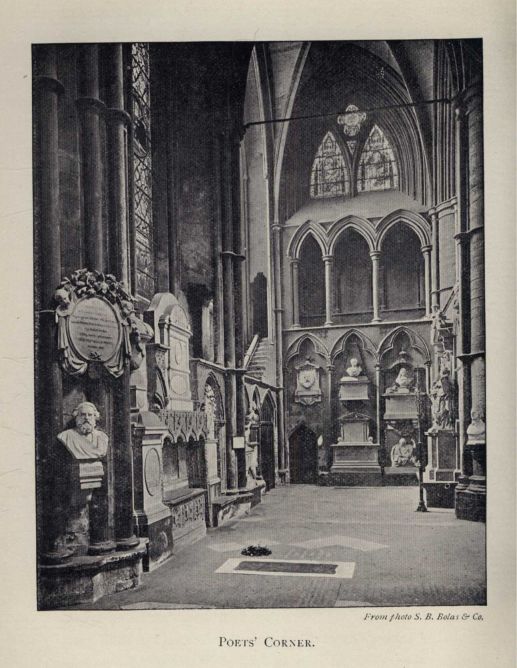
POETS' CORNER
Another satirist, Samuel Butler, has a monument, but not a tomb, in the Abbey. He also died in abject poverty, and of him these lines were written, which apply to more than one of those commemorated in the Poets' Corner:—
"When Butler, needy wretch, was yet alive,
No generous patron would a dinner give.
Behold him starved to death and turned to dust,
Presented with a monumental bust.
The poet's fate is here in emblem shown:
He asked for bread, and he received a stone."
Thomas May, the historian; Davenant, the Royalist poet-laureate; Sir John Denham, a Royalist versifier, and John Phillips, a devoted imitator of Milton, are little more than names to us; but then we must remember that, with few exceptions, neither the poets nor the poetry of that period which ended with the death of William III. have lived on through our literature. With the accession of Anne there came a burst of new life, and the next great name we come to in the Abbey is that of Joseph Addison, the most charming of our prose writers. To find his grave, however, we must leave the Poets' Corner and go to General Monk's vault in Henry VII.'s Chapel. For here, close to his friend Charles Montagu, Lord Keeper, he of "piercing wit, gentle irony, and sparkling humour," the regular contributor to our two earliest newspapers, the Tattler and the Spectator, was buried. His own words, from an article in the Spectator when it was about twelve days old, best describe both the man and his aims: "It is with much satisfaction that I hear this great city enquiring day by day after these my papers, and receiving my morning lectures with a becoming seriousness and attention. My publisher tells me that already three thousand of them are distributed every day, so that if I allow twenty readers to every paper, I may reckon about threescore thousand disciples in London and Westminster, who, I hope, will take care to distinguish themselves from the thoughtless herd of their ignorant and unattentive brethren. I shall spare no pains to make their instruction agreeable and their diversion useful. For which reason I shall endeavour to enliven morality with wit and to temper wit with morality.... I have resolved to refresh their memories from day to day, till I have recovered them from that desperate state of folly and vice into which the age is fallen. The mind that lies fallow but a single day sprouts up in follies that are only to be killed by assiduous culture. It was said of Socrates that he brought philosophy down from heaven to inhabit among men, and I shall be ambitious to have it said of me that I brought philosophy out of closets and libraries, schools and colleges, to dwell in clubs and assemblies, at tea-tables and in coffee-houses." Then, having given his general aim, he goes on to especially commend his paper to all well-regulated families; to those gentlemen of leisure who consider the world a theatre, and desire to form a right judgment of those who are the actors on it; and to those "poor souls called the blanks of society, who are altogether unfurnished with ideas, who ask the first men they meet if there is any news stirring, and who know not what to talk about till twelve o'clock in the morning, by which time they are pretty good judges of the weather, and know which way the wind sets;" while finally he appeals to the female world: "I have often thought," he says, "that there has not been sufficient pains taken to find out proper employments and diversions for the fair ones. Their amusements seem contrived for them rather as they are women than as they are reasonable creatures. The toilet is their great scene of business, and the right adjusting of their hair the principal employment of their lives. This, I say, is the state of ordinary women, though I know there are multitudes of those that move in an exalted sphere of knowledge and virtue, and that join all the beauties of mind to the ornaments of dress. I hope to increase the number of those by publishing this daily paper, which I shall always endeavour to make an innocent entertainment, and by that means at least divert the minds of my female readers from far greater trifles."
Faithfully and yet very pleasantly did Addison carry out his scheme. His humour was always kindly, his good sense was unvarying, his thoughts were always generous and true, and his easy unaffected language completed the charm. Instead of dropping to the level of his readers, he raised them to the much higher level on which he himself stood, and this without dull lecturing or violent denunciations. Religion, duty, love, honour, purity, truth, kindliness, and public-spiritedness were all real things to him, and he sought to make them everywhere realities too, gilding his little moral pills so cleverly, that until they were swallowed no one knew they were pills, and then they left nothing but a sweet taste behind.
"About an age ago," he writes, "it was the fashion in England for every one who would be thought religious to throw as much sanctity as possible into his face. The saint was of a sorrowful countenance, and generally was eaten up with melancholy. I do not presume to tax such characters with hypocrisy, as is done too frequently, that being a vice which, I think, none but He who knows the secrets of men's hearts should pretend to discover in another. But I think they would do well to consider whether such a behaviour does not deter men from religion.... In short, those who represent religion in so unamiable a light are like the spies sent out by Moses to make a discovery in the Land of Promise, when by their reports they discouraged the people from entering upon it. Those that show us the joys, the cheerfulness, the good-humour that naturally spring up in this happy state are like the spies bringing along with them clusters of grapes and delicious fruits that so invited their companions into the pleasant country which produced them."
Two of his articles have Westminster Abbey for their subject. On one occasion Addison, as the Spectator, goes there for a walk, and thus describes his feelings:—"I yesterday passed a whole afternoon in the Cloisters and the Church ... And I began to consider with myself what innumerable multitudes of people lay confused under the pavement of that ancient cathedral; how men and women, friends and enemies, priests and soldiers, monks and prebendaries were crumbled one against the other; how beauty, strength, and youth, with old age, weakness, and deformity, lay undistinguished in the same heap of matter.... Some of the monuments were covered with such extravagant epitaphs that, if it were possible for the dead person to be acquainted with them, he would blush at the praises which his friends bestowed on him. There were others so excessively modest that they deliver the character of the person departed in Greek or Hebrew so that they are not understood once in a twelvemonth. I found there were poets which had no monuments, and monuments which had no poets.... Sir Cloudesley Shovel's monument gave me great offence. Instead of the brave, rough English admiral, which was the distinguishing character of that plain gallant man, he is represented on his tomb by the figure of a beau, dressed in a long periwig, and reposing himself upon velvet cushions under a canopy of state. The Dutch, whom we are apt to despise for want of genius, show an infinitely greater taste.... The monuments of their admirals which have been erected at the public expense represent them like themselves, and are adorned with rostral crowns and naval ornaments, with beautiful festoons of seaweed, shells, and coral. When I look upon the tombs of the great, every emotion of envy dies in me; when I read the epitaphs of the beautiful, every inordinate desire goes out; when I meet with the grief of parents upon a tombstone, my heart melts with compassion; when I see the tombs of the parents themselves, I consider the vanity of grieving for those that we must quickly follow. When I see kings lying by those who deposed them, when I consider rival wits placed side by side, or the holy men that divided the world with their contests and disputes, I reflect with sorrow and astonishment on the little competitions, factions, and debates of mankind. When I read the several dates of the tombs, of some that died yesterday, and some six hundred years ago, I consider that great day when we shall all of us be contemporaries, and make our appearance together."
The next visit Spectator paid to the Abbey was in the company of Sir Roger de Coverley, his own creation, that gentleman of ancient descent, whose "singularities proceeded from his good sense, and were contradictions to the manners of the world only as he thought the world was in the wrong," and who was such a great lover of mankind, with such a mirthful cast in his behaviour, so cheerful, gay, and hearty, that "his tenants grew rich, his servants were satisfied, all young women professed love to him, and the young men were glad of his company." The squire was now spending one of his frequent visits to London, and informed the Spectator that having read his paper on Westminster Abbey, he should like to go there with him, never having visited the tombs since he read history.
"As we went up the body of the church, the knight pointed at the trophies on one of the new monuments, and cried out, 'A brave man! I warrant him!' Passing afterwards by Sir Cloudesley Shovel, he flung his head that way, and cried, 'Sir Cloudesley Shovel, a very gallant man!' As we stood before Busby's tomb the knight uttered himself again after the same manner. 'Doctor Busby, a great man! He whipped my grandfather; I should have gone to him myself, if I had not been a blockhead. A very great man!' Among several other figures he was very well pleased to see the statesman Cecil upon his knees.... Sir Roger, in the next place, laid his hand upon Edward III.'s sword, and leaning upon the pommel of it gave us the whole history of the Black Prince, concluding that, in Sir Richard Baker's opinion, Edward III. was one of the greatest princes that ever sat upon the English throne. We were then shown Edward the Confessor's tomb, upon which Sir Roger acquainted us that he was the first who touched for the evil, and afterwards Henry IV.'s, upon which he shook his head, and told us there was fine reading in the casualties of that reign. Our conductor then pointed to that monument where there is the figure of one of our English kings without a head, and upon giving us to know that the head, which was of beaten silver, had been stolen away years before, 'Some Whig, I warrant you!' says Sir Roger. 'You ought to lock your kings up better. They will carry off the body, too, if you don't take care!' The glorious names of Queen Elizabeth and Henry V. gave the knight great opportunities of shining. For my own part, I could not but be pleased to see the knight show such an honest passion for the glory of his country, and such a respectful gratitude to the memory of its princes."
Addison died when under fifty years of age, and the story goes that in his last moments he sent for young Lord Warwick, his stepson.
"Dear sir," said the lad, "any commands you may give me, I shall hold most sacred."
"See in what peace a Christian can die," answered the older man tenderly.
Years before, in his first letter as Spectator, he had written these honest words, "If I can in any way contribute to the improvement of the country in which I live, I shall leave it, when I am summoned out of it, with the secret satisfaction of thinking that I have not lived in vain." And the knowledge that he had been true to this pure ambition brought him a calm content in that hour when all the things of this life vanished into the dim background.
His funeral in the Abbey has been thus vividly described by Tickell, his friend:—
"Can I forget the dismal night that gave
My soul's best part for ever to the grave?
How silent did his old companions tread,
By midnight lamps, the mansions of the dead.
Through breathing statues, then unheeded things,
Through rows of warriors and through walks of kings!
What awe did the slow solemn march inspire,
The pealing organ and the pausing choir;
The duties by the lawn-robed prelate paid
And the last words that dust to dust conveyed!
While speechless o'er the closing grave we bend—
Accept those tears, thou dear departed friend!
Oh, gone for ever, take this last adieu,
And sleep in peace next thy loved Montagu."
CHAPTER XVI
GARRICK, JOHNSON, AND SHERIDAN
Near together and under the shadow of Shakespeare's monument lie three men whose lives brought them into close contact with each other: David Garrick, the actor and manager; Dr. Samuel Johnson, the critic and conversationalist; and Richard Brinsley Sheridan, prince of playwriters and parliamentary orators. Little Davy Garrick was the first of the trio on whom the curtain fell, and his funeral in the Abbey, which took place on the 1st of February 1779, was a most imposing one. The streets were crowded with people gathered to see the last of him they had so delighted in applauding. The procession extended far down into the Strand; players from Drury Lane and Covent Garden mourned the kindliest and most lovable of comrades; seven carriages were filled with the members of the Literary Club, and round the grave stood Edmund Burke, Charles James Fox, Sheridan, Dr. Johnson, with many another distinguished man. That was a day of triumph for the English stage. True, indeed, other players had been buried in Westminster—Anne Oldfield, who lies in the nave; Anne Bracegirdle and Mr. Cibber, whose graves are in the cloisters—but the death of David Garrick was accounted a national loss, and all desired to honour him, under whose wise guidance "the drama had risen from utter chaos into order, fine actors had been trained, fine plays had been written for the fine actors to act, and fine, never-failing audiences had assembled to see the fine plays which the fine actors had acted." It has often been said that even had he been neither an actor nor a public character his name would have gone down to future generations as a perfect English gentleman, so great was the spell of his charm and his influence. He was born in an inn at Hereford in the year 1716, the son of a penniless officer in the dragoons, who had married Miss Isabella Clough, the equally penniless daughter of the vicar-choral of Lichfield Cathedral. The lieutenant had to serve at Gibraltar, and little David, a bright lad, ever ready with a witty answer, got his early education in a free school at Lichfield, presided over by a master who used the rod freely, "to save his boys from the gallows," as he assured them for their comfort. An older boy at the same school was Samuel Johnson, the son of a highly respected bookseller in Lichfield. In spite of the great difference in their ages, he became David's friend, and together they used to patronise such plays as the companies of strolling players brought within their reach, the acting taking place in such barns as were available. David, full of enterprise, organised and drilled a little company of his own when he was barely eleven, which company performed a play called "The Recruiting Officer," to the admiration of a large and interested audience, composed mainly of parents. But funds did not allow of many such pastimes, and a year later David was sent out to Portugal to work in the office of an uncle, a prosperous wine merchant there. Never was boy more unfit for the daily routine of an office, a fact which, fortunately, his uncle soon recognised, for in a few months he was back again in Lichfield, slightly in disgrace, it is true, and was sent to his old school that "discipline might repair his deficiencies."
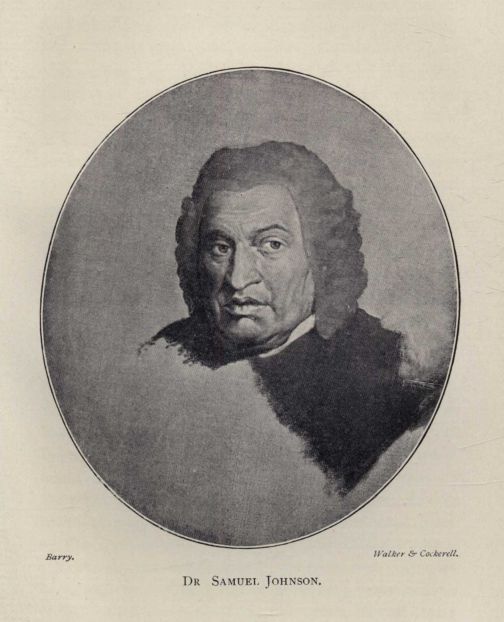
DR. SAMUEL JOHNSON.
Young Johnson, who by now had returned from Oxford, had, thanks to the assistance of a wealthy friend, Mr. Walmesley, set up a school of his own in the town, dignified by the name of "The Academy." At this seat of learning Garrick studied for a while, and years afterwards he wrote of his solemn ponderous master, "I honoured him, he endured me." But the academy did not prosper, and Johnson, who had already begun to write, determined to try his fate in London. Thither, too, young Garrick was bent, for it had been decided that he was to study law, and kind Mr. Walmesley had arranged to pay the expenses of the special instruction he would need, declaring him to be "of a good disposition, and as ingenious and promising a young man as ever I knew in my life." So together they set out, and together they lived for awhile, Johnson finding a scanty livelihood as a bookseller's assistant, David working as a student of Lincoln's Inn.
Soon afterwards Captain Garrick died, and at the same time died also the rich wine merchant uncle, who left a fair sum of money to his brother's children, with a special legacy to David, of whom he had been particularly fond. Then it was that for the first time the boy's ambition took definite shape: he knew there was only one life and one career for him, and that was summed up in the stage. His mother, though, shrank in horror from the idea, and to his eternal credit, rather than add to her sorrows, he set aside his own wishes, and made one more desperate effort to please his family by going into the wine business, as the London manager, with his brother Peter. Even in so doing, theatrical life pursued him, for his wines were so patronised by the coffee-houses and clubs to which the actors resorted, that he considered it part of his business to amuse and entertain his customers by "standing on the tables at the clubs to give his diverting and loudly applauded mimicries." To make a long story short, the genius that was in David would not allow him to settle down to a wine merchant's career; he became restless and dissatisfied, and one fine morning two letters fell like bombshells into the Garrick household at Lichfield: one from David, saying that his mind was so inclined to the stage that he could no longer resist it, and he hoped they would all forgive him when they found he had the genius of an actor; the other from an old friend, who hastened to assure the family how great a success Davy's first appearance had been, how the audience was in raptures, and how several men of judgment had wondered that he had kept off the stage so long. Richard II. was the ambitious part Garrick had undertaken. "I played the part to the surprise of every one," he wrote humbly to his furious brother. "It is what I doat upon, and I am resolved to pursue it." The Daily Post had an enthusiastic notice about this unknown gentleman who had never appeared before, "whose reception was the most extraordinary and great that was ever known, whose voice was clear, without monotony, drawling, affectation, bellowing, or grumbling; whose mien was neither strutting, slouching, stiff, nor mincing." Pope, most keen of critics, had watched him delightedly from a box. "That young man never had his equal, and never will have a rival," he remarked; adding, "I only fear lest he should become vain and ruined by applause."
But there was a simplicity of character and a fund of good sense in David which saved him from this latter fate, even though he quickly became the talk of the town, the man about whom the fashionable London world went mad. After acting with ever-increasing success in nineteen different parts, his London season came to an end for the time being, and in response to an urgent invitation he went over to Dublin, where the craze for him was so intense that, when a mild epidemic broke out, it was given the name of the Garrick fever. A second visit to that gay capital was even more successful, and Garrick finally returned to London with a clear £600 in his pocket.
It was then that various difficulties beset him, chiefly owing to the bad management of the theatres and the endless quarrels between the principal actors of the day; but at last, thanks to the many friends who firmly believed in him, and whose faith he never disappointed, he was able to invest £8000 in Drury Lane Theatre, and to become its manager as well as its leading actor. His determination was to "get together the best company in England," and it is characteristic of him that he let no past jealousies or quarrels interfere with his selection. Even Macklin, who had violently attacked him with tongue and pen, was engaged, as well as his wife, and he skilfully smoothed down the sensitive feelings of the various ladies. He insisted on rehearsals, which hitherto had seldom been enforced, and he also insisted that players should learn their parts, a very necessary proviso. On the opening night he remembered the friend with whom he had entered London, when triumphs such as this had been undreamt of, and it was Dr. Johnson whom he commissioned to write the prologue, which he himself gave with splendid effect. Later on he loyally did his best to make a success of Johnson's heavy and somewhat clumsy play "Irene," and thanks to his efforts and the money he freely spent on its staging, it ran for nine nights, so that the Doctor made the sum of £300. But with this the author was far from satisfied, and always declared that the actors had not done justice to their parts!
It would take too long to dwell on the many plays Garrick produced, the many parts he created, the wide range of writers new and old he explored, and the excellent standard he maintained. Whether it was a tragedy of Shakespeare's, or a comedy of Ben Jonson's, or a pantomime, he threw himself heartily into them all and never spared himself. He knew his public and catered for them, but at the same time he taught them to understand and applaud the best. His kindness to every one with whom he came in contact was proverbial; indeed, his greatest weakness lay in his good-nature. He could not bear to vex people by refusing them anything, and this trait often landed him into difficulties with the army of playwriters to whose entreaties that he would produce their works he seldom turned a deaf ear. And when these plays were too hopelessly bad to be dreamt of, David tried to soften the blow by a gift of money, sometimes actually a pension. As might have been expected, he had a wide circle of acquaintances from the highest in the land to the poorest Grub Street poets, and rarely was man so well liked. For in spite of his weaknesses—and he was restless and sensitive to the point of touchiness—he never allowed himself to be unjust or ungenerous to other people, and no thought of self ever interfered with the standard he had set up for his theatre and his own profession.
More than once he talked of retiring, for the strain of his life was heavy, and he looked forward to years of restful enjoyment with his "sweet wife," who had been before her marriage the celebrated dancer Mademoiselle Violette. But the very mention of such an idea raised a storm of excitement. Once even the king intervened when David had taken an unusually long holiday, and his Majesty requested Mr. Garrick to shortly appear again. The night when, thus commanded, he reappeared in "The Beggar's Opera," was one of his greatest triumphs; again "the town went half mad," and the theatre was crowded to an alarming extent. All ideas of retirement vanished from David's mind; the old magic had not lost its spell, and for more than ten years longer he went on with his work as vigorously as ever.
His fame became even more widespread, his public loved him even more dearly, and from far-away country places people journeyed to London so that they might boast of once having seen the great Mr. Garrick.
But in 1776, an illness, which he had long kept at bay, made itself felt, and he was the first to recognise that the time had nearly come for the curtain to fall. He gave a series of his greatest representations, ending with Richard II. "I gained my fame in Richard," he said, "and I mean to close with it."—Though he confessed to being in agonies of pain, in the eyes of his enraptured audience he was as great as he had ever been in his palmiest days of success, as graceful, as winsome, and as gay. His real farewell play, however, was "The Wonder," in which he took his favourite part, that of Don Felix, and "as his grand eyes wandered round the crowded house, he saw a sea of faces, friends, strangers, even foreigners, a boundless amphitheatre representing most affectionate sympathies and exalted admiration. He played as he had never played before. When the last note of applause had died away, the other actors left the stage and he stood there alone. The house listened in awe-struck silence. At first he tried in vain to speak; for once the ready words would not come for his calling. When at last he went on to thank his friends for their wonderful kindness to him, he broke down, and his tears fell fast. Sobs rang through the theatre. "Farewell! Farewell!" was cried in many a quivering voice. Mrs. Garrick wept bitterly in her box, and David slowly walked off the stage with one last wistful glance at the sea of faces all around him.
His interest in his theatre did not cease after he had left it, and he was disturbed at finding that the new manager, Sheridan, was sadly easy-going and unbusiness-like. But there was not much time left for such things to trouble him. Though he kept up his merry heart and his sprightly manner to the end, and though he delighted in the undisturbed companionship of his wife, the disease gained rapidly and he suffered much pain. Gradually a stupor crept over him, and though it sometimes lifted, so that with his old sweet smile he had a jest or a word of welcome for his friends, it never cleared, and he passed gently away in the early dawn of a January morning, 1779, "leaving that human stage where he had played with as much excellence and dignity as ever he had done on his own."
So ended a prosperous, pleasant life, and rarely was a man better liked by his fellows, or more genuinely mourned. Dr. Johnson, in this moment, forgot all his later coldness towards the Davy he had once so loved. He left a card on Mrs. Garrick, and "wished some endeavours of his could enable her to support a loss which the world cannot repair;" while he wrote those well-known words, which Mrs. Garrick had engraved on her husband's memorial monument in Lichfield Cathedral, and which form an inscription more appropriate than that on the Abbey tomb:—"I am disappointed by that stroke of death, which has eclipsed the gaiety of nations and impoverished the public stock of harmless pleasure."
David's devoted wife outlived him for over forty years, keenly interested to the last in all matters theatrical, and a well-known figure in the Abbey, where, little and bent, she often made her way to the tomb which held him she had so loved, and standing there would readily recount over and over again to willing listeners the triumphs of "her Davy."