Front matter (continued 6)
Reading edition
Next to the imposing monument of Chatham is a statue to Lord Palmerston, that most English of statesmen. He went into political life more from a sense of duty than from any particular liking for it, or from any feelings of ambition. But into every office that he held he carried with him a sturdy independence, a dogged tenacity of purpose, a fund of common sense, and a very clear idea of what he meant to attain. Add to this that he was the essence of good-nature, the most genial of friends, simple and straight, manly and cheery, and we have some idea of the man whom the nation insisted on having for Prime Minister, when he was over seventy years of age, at a critical moment when it was felt that only a strong, fearless, popular statesman could guide the ship out of the storm.
And then, in contrast to the kindly, contented Palmerston, comes the tomb of Lord Castlereagh, a statesman as much out of touch with the people as "Pam" was their hero. He was Secretary of State for War in those days when the struggle with France was beginning, and because at first things went badly he was made the scapegoat. It was he who planned that combination of forces which at last broke down the French resistance, but that was not realised till long afterwards; in those early days his policy was not successful, so it was unpopular. He stood aloof from all men; he was cold, indifferent, wanting in tact, with no gifts as a speaker, and yet, looking back now on his work, it is easy to see how well he faced a period of unexampled difficulty. Nevertheless, he was invariably misunderstood, and therefore unjustly disliked, so that at last his mind gave way under the storm of hatred and abuse levelled against him, and, in a dark moment, he put an end to his life. Even at his funeral in the Abbey, the crowds could not forget their dislike of him, and shouted exultantly as the coffin was carried inside the doors. But the Abbey gave him a welcome and a resting-place.
On the opposite side stand the statues of the three Cannings: George Canning, the statesman; his youngest son, Lord Canning, first Viceroy of India; and their cousin, Lord Stratford de Radcliffe, "the wise old man of the East," who was our ambassador at Constantinople during those years which led up to the Crimean War, and whose influence, supported by the Government at home and France, made it possible for Turkey to hold Russia at bay. The verse on the statue:
"Thou third great Canning, stand among our best
And noblest, now thy long day's work hath ceased;
Here silent, in our Minster of the West,
Who wert the voice of England in the East,"
is the work of Tennyson, who has only written one other epitaph in the Abbey. Close together are the monuments of Sir Robert Peel and Benjamin Disraeli, Earl of Beaconsfield. Peel was the Minister who, in the face of violent opposition, caused the tax on imported corn to be repealed, thereby making bread cheaper; and Disraeli, who first won his reputation by the persistent manner in which he fought this policy of Peel's, doggedly forged his way to the front against much prejudice, until he, though not an Englishman by race, held the proud position of being the loved and trusted Prime Minister of Queen Victoria. The statue of Beaconsfield—for by his own desire he was buried next to his wife in the country churchyard at Hughenden—casts its shadow over the grave of William Ewart Gladstone, whose family only consented to his being laid there on the condition that Mrs. Gladstone should eventually rest beside him, even as Lady Palmerston lay by her husband's side. The coffin which contained this old statesman, who was better loved and better hated perhaps than any public man of our generation, was placed for some time in Westminster Hall, and nearly a quarter of a million people passed through to pay their last token of respect. The time has not yet come when his place in English history as a statesman can be fairly judged, but friend and foe alike can bear tribute to his brilliant intellect; his talents as a financier; his excellent learning; his wonderful personality; his rich eloquence; his generous sympathies; his stainless private life; and to those other qualities which his political opponent Lord Salisbury so finely described as making him "a great Christian." "God bless you, and this place, and the land you love," had been his last public utterance, and in the spirit of that message we leave him, who in life stirred up such sharp dissensions, sleeping peacefully in the Abbey.
CHAPTER XX
INDIAN STATESMEN AND SOLDIERS: LAWRENCE AND THE HEROES OF THE MUTINY
The Indian Mutiny, which produced "such a breed of warlike men," the equals of whom have rarely, if ever, been found awaiting their country's need of them, is especially commemorated in the Abbey, which holds the graves of Lord Lawrence; Colin Campbell, Lord Clyde; and Sir James Outram. Only a monument does honour to Warren Hastings, whose name is so indissolubly linked with Westminster and with India, for it was at Westminster School that he was educated, the favourite pupil of the head-master Dr. Nichols, who found him "a hard student, bold, full of fire, ambitious in no ordinary degree;" and it was to India that he went, when eighteen, into the service of the East India Company. To the building up of the British Empire in India he gave his life, working with unfaltering courage under a thousand difficulties, sometimes no doubt making errors of judgment, more often the victim of other men's intrigues and treachery, but always the dauntless, enthusiastic servant of the State. And his reward was disgrace, confiscation, and impeachment. He was used by Ministers at home as a cat's-paw in the game of politics. Burke and Fox charged him in Parliament with cruelty, extortion, and corruption, while Sheridan's brilliant eloquence so dazzled the Commons as to obscure all their calm judgment, and they impeached Warren Hastings at the bar of the House of Lords for "high crimes and misdemeanours." In the February of 1788 this most famous of trials commenced in Westminster Hall, and it took Burke two days to get through his list of charges. All the force of his great powers as an orator was brought to bear against the accused, who "stood there small, spare, and upright, his bearing a mixture of deference and dignity, his soft sad eyes flashing defiance on his accusers; the lines of his mouth and chin firm, his face very pale but calm."
The trial lingered on and on; it was seven years before the verdict was given, a verdict which practically cleared Hastings, and proved that, if on occasions he had been unnecessarily ruthless or hard in his rule, he had not so acted from any selfish or unworthy motive, but because he believed that thereby he was best serving the interests both of England and of India. Though he was acquitted, he was practically a ruined man. The trial had cost him more than £70,000, and he was not rich, neither could he hope for any employment under Fox or Pitt. The East India Company voted him a pension for twenty-eight years, but refused him when he asked that it might be continued during the lifetime of his wife, "the dearest object of all his concerns." And so he died a bitterly disappointed man.
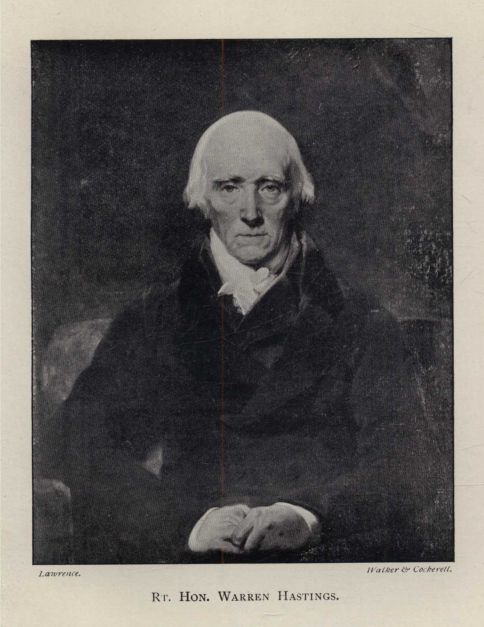
RT. HON. WARREN HASTINGS.
John Lawrence was the son of a soldier, and from boyhood he had chosen the army for his profession, as a matter of course. Three of his brothers had already gone to India, two into the cavalry, and one into the artillery, and John was hoping to enter the service of the East India Company in the same way, when to his disgust he was offered an appointment, not in their army, but in the Civil Service. There could be no question as to which of the two branches offered the better opening to any hard-working, ambitious young man, but John would hear none of this. "A soldier I was born, a soldier I will be," he said firmly. And he was only moved in his resolution by the simple, sensible arguments of his invalid sister Letitia, to whom he was entirely devoted. So to the East India College at Haileybury he went, and sailed for India at the age of eighteen, considered by his elders to be a reliable, intelligent lad, but nothing more. The old longing for a soldier's life came back to him on landing, and for the first few weeks he was so entirely miserable, that, as he said afterwards, "the offer of £100 a year would have taken me straight home again." Then he firmly pulled himself together and resolved that there should be no turning back now; he would go forward, and do the work which came to him with all his might. Delhi was his first destination, and soon he found himself in charge of a district, so good a reputation had he made for being both self-reliant and cautious. It was a turbulent, unsettled piece of country that he was given to bring into order, but his firmness, justice, and conscientious hard work accomplished wonders, and prepared him for greater things. Without a single soldier he kept perfect order among his people through the great drought, which filled his district with starving men and with bands of robbers, but at last his health gave way under the strain of eleven years' work, and he came home to England on sick leave. Two years later he returned to his post, now a married man, and was soon brought into close contact with that sturdy soldier, Sir Henry Hardinge, who was in command of the fierce campaign then being waged against the Sikhs. Hardinge entirely depended on being able to get sufficient supplies, guns, and ammunition from the base at Delhi, and it was to the civilian magistrate there, John Lawrence, that he appealed for help. Splendidly that help was given. Lawrence organised a system of carts, each to be driven by his owner; and in an incredibly short time a long train of guns, ammunition, and food of all sorts, reached the camp, as much to the delight as to the astonishment of the General. A few days after the arrival of these welcome supplies, the battle which ended the campaign was fought and won. Hardinge did not forget the man who had made this victory possible, and gave him for reward a most responsible piece of work, the charge of the newly won Sikh province of Jalandhar.
A second Sikh war, which ended in the complete submission of the Sikh army, gave the whole province of the Punjab into the hands of the Viceroy.
"What shall we do with it?" he asked of Lawrence.
"Annex it at once," was the answer; and when Lord Dalhousie pointed out the difficulties, Lawrence, who had known and realised them all, met every objection with the words: "Action, action, action!"
So the Punjab was annexed, and it was decided to govern it by a Board, which included Henry Lawrence and John Lawrence. Frankly, let us admit at once that the arrangement was not a happy one. Both brothers were men of strong character and great ability, but they saw things from very different points of view. Henry was enthusiastic, imaginative, and easily moved; John was entirely practical and clear-headed. Each loved and respected the other, but neither would give way on what seemed to each vital questions of importance. Finally, both sent in their resignations, and Lord Dalhousie, wisely recognising that John Lawrence was specially fitted for the special work required at the moment in the Punjab, made him the Chief Commissioner, and moved Henry to another field. It was a great province to reduce to law and order, even when it was divided into seven districts, ruled over by picked men. But Lawrence was a born organiser. Not only could he work himself indefatigably, but he knew how to choose other men for the posts that had to be filled, and having chosen them, he trusted them and supported them loyally. He had only to recognise "grit," or "metal," in a subordinate, and there was nothing he would not do to help him on. "Human nature is human nature," he would say, and "A strong horse if held with a tight hand will do more than a weak horse to whom you may give his head." So he managed to keep his brilliant colleagues all in one team; he smoothed over their disagreements, he dealt with them all quite frankly, criticising where he held it needful, praising generously whenever it was possible, and thus he gathered around him that band of men, including Nicholson, Chamberlain, and Edwardes, who came to the fore so vigorously a little later in the hour of the crisis. But Lawrence was to do still greater things in the near future.
A year later saw the outbreak of the Mutiny, which came as a thunderbolt to the British Government in India. The first rising, terrible in its suddenness, was at Meerut, where a maddened crowd of sepoys, thirsting for the blood of all Europeans, seized the arms and ammunition, released their prisoners, murdered whoever resisted them, and then made for Delhi, at which place all the rebels from the country round were assembling. Within Delhi, the native regiments joined the mutineers; Europeans were ruthlessly massacred, and though the tiny garrison made a magnificent defence, expecting every hour to be relieved by a strong British force, they at last had to realise that resistance was useless and that each one must escape for his life as best he could.
To Lawrence, just starting for his holiday, came the well-known message from Delhi, "The sepoys have come in from Meerut, and are burning everything. We must shut up," followed by a second telegram which told that Delhi was in the hands of the rebels. Strange to say nothing was being done from Meerut, where there was a fairly large force of British troops, to avenge the murderous outbreak.
John Lawrence, however, was a man of action, and his younger colleagues were not a whit less determined. At all costs Delhi must be regained—that was the first move unanimously agreed on; but every hour's delay meant danger, for each day brought recruits to the rebels, and the disarming of the doubtful native troops must be carried out at once if it were not to be too late. Lawrence had a twofold task. He must make safe and hold secure for England the Punjab, that vast inflammable province containing more than thirty thousand sepoys, for which work he knew he could rely on Chamberlain, Nicholson, and Edwardes; but more than this, he must put forth every power to assist in the retaking of Delhi. When at last an army of about three thousand men took up their stand on a ridge outside Delhi, they knew that within the walls of the city at least a hundred thousand foes awaited them, with numbers of guns and an unlimited supply of ammunition. Overwhelming indeed were the odds against them. But one fact gave them confidence. Behind them lay the road leading to the Punjab and to the man whom they knew would send along it, to their help, his best officers, his best troops, ample supplies and ammunition, who would never cease watching, working, and urging until once more the British flag waved over Delhi.
For twelve weary weeks the struggle waged, and Lawrence strained every nerve. The position in the Punjab was highly critical; only the ceaseless vigour of its Chief Commissioner, and his strong, fearless policy, held in check the rebellion all ready to break out. Had the Punjab failed, nothing but disaster could have overtaken the Delhi Field Force. But John Lawrence never doubted, never despaired, even when there reached him the appalling news of the Cawnpore massacre, followed by the tidings from beleaguered Lucknow, where Henry Lawrence had fallen at his post with the dying request that on his tomb might be recorded the words: "He tried to do his duty."
At last the tide turned. Delhi was saved, and though all was not yet won, Lawrence knew that the crisis was over. But that moment was clouded, for the man who, above all others, had brought about the capture of Delhi, was no more. John Nicholson had fallen in the proudest hour of his life, and when the news came to Lawrence he completely broke down.
"He was a glorious soldier," he said. "He seems to have been specially raised up for this juncture, and so long as British rule shall endure in India his fame shall never perish; without him, Delhi could not have fallen."
It was a generous tribute and a just one. But we must never forget that behind John Nicholson was John Lawrence.
"Not a bayonet or a rupee has reached Delhi from Calcutta or England," wrote Edwardes. "It has been recovered by Lawrence and his resources. Honour, all honour to Coachman John, and honour, too, to the team that pulled the coach. He alone was at the helm, and bore all the responsibility on his own shoulders"!
The district of which Delhi was the capital was at once handed over to the Punjab Government, and Lawrence hurried thither in a mail-cart, that law and order might be restored without delay. His policy was just what might have been expected of him—a generous combination of strength, mercy, and justice; and within six months he was able to report that "perfect order reigned throughout the Delhi territory."
It was just at this juncture that Colin Campbell arrived in India as Commander-in-Chief.
"When will you be ready to start?" Lord Palmerston had asked him in offering the command.
"To-morrow!" said the soldier promptly. And on the morrow he started.
He had distinguished himself in the Crimea. There he had held the command of the Highland Brigade, a post of all others for which he was fitted. A Highlander himself, he perfectly understood how to handle the men of his own race, and the advance on the Alma was splendidly made by his troops, who exhibited such rare courage combined with perfect coolness that when Lord Raglan rode up to compliment their commander, "his eyes filled with tears and his countenance quivered."
"The army is watching you, make me proud of the Highland Brigade," Campbell said to his men on the day of Balaclava. "Remember," he added, "there is no retreat from here! You die where you stand."
"Aye, aye, Sir Colin; we'll do that!" was the answer.
Rarely has a more touching farewell order been issued than that from Campbell to his men, when at the end of the campaign he was about to return to England. Part of it ran thus:—
"A long farewell! I am now old, and shall not be called to serve any more; and nothing will remain to me but the memory of my campaigns, and the memory too of the enduring, hardy, generous soldiers with whom I have been associated.... When you go home you will tell the story of your immortal advance up the heights of Alma, and you may speak of the old brigadier who led you and who loved you so well.... And the bagpipes will never sound near me without carrying me back to those bright days when I was at your head and wore the bonnet you gained for me, and the honourable decorations on my breast, many of which I owe to your conduct. Brave soldiers, kind comrades, farewell!"
But the old soldier had not done yet, and he promptly left England for India, where he arrived at the darkest hour, before the fall of Delhi, and when Havelock had been foiled in his brave attempt to relieve Lucknow.
Sir Colin and John Lawrence were old friends, and the Commander-in-Chief at once wrote: "It will be a matter of real gratification to me if we exchange our plans and ideas from time to time.... I am thankful you were in the Punjab to face the storm."
The chief concentrated all his energy on bringing order and organisation out of chaos at Calcutta, so that efficient reinforcements, properly equipped, might be speedily got together, and meanwhile Outram went to the assistance of Havelock. "Outram is a fine soldier and a fine man," Lawrence had written of him affectionately, and this "Bayard of India, who had served that country for forty years in war and council," as it is recorded in the Abbey, showed himself full worthy of the highest praises that could be bestowed on him. When he reached Cawnpore with reinforcements which would make possible the relief of Lucknow, he refused, though the senior officer, to take the command. Havelock had borne the heat and burden of the day, Havelock must be the hero when the hour of victory was at hand. "I cheerfully waive my rank and accompany the force to Lucknow, tendering my services to Brigadier-General Havelock as a volunteer," he said, with a fine chivalry which was characteristic of one "who ever esteemed others better than himself, who was valiant, self-denying, and magnanimous—in all the true knight!" The column forced its way into Lucknow, but even so, it was impossible to fully relieve the garrison. Once inside the walls Outram took over the command, and made the best of the position directly he realised that for the present he could only reinforce, not relieve. But Colin Campbell was on his way with the army of about five thousand men which he had collected after great efforts. A miscellaneous force indeed it was: Lancers, Sikhs, Punjab infantry, the Queen's, and the 93rd Highlanders, which the Commander-in-Chief had formed up, so that he might address them, and the Highlanders burst into cheers at the sight of their beloved General.
"You are my own lads," he said to them; "I rely on you to do yourselves and me credit."
"Aye, aye! Sir Colin," answered a voice from the ranks; "ye ken us, and we ken you. We'll bring the women and bairnies out of Lucknow, or we'll leave our ain banes there!"
Magnificently they kept their word. When it came to the last assault, Sikhs and Highlanders positively raced with each other to be first through the breach, and seemed impervious alike to the heavy fire poured on them, or the desperate hand-to-hand struggle. Over five hundred killed and wounded made up their casualty list; but the women and the bairnies were saved. And though Sir Colin longed to make a second decisive attack on the enemy, he held back with great self-control, deeming it his first duty to withdraw all the sick with the women and children in safety to Alumbagh, a feat difficult enough under any circumstances, and requiring all his available troops. Hardly had he accomplished this than news came that Cawnpore, with its tiny garrison, was once more surrounded by the enemy, and was, so the message said, "at its last gasp."
"How dare you say of her Majesty's troops that they are at their last gasp," thundered the chief. And forthwith made for the entrenchments, where his very presence saved the situation.
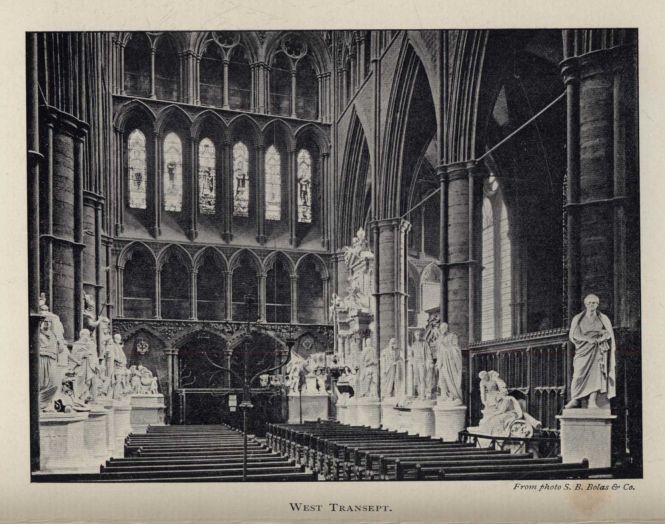
WEST TRANSEPT.
All this while John Lawrence had not relaxed his efforts, and just at this moment he sent the welcome intelligence to Sir Colin that he had three thousand cavalry and twelve guns waiting for him. With those and other welcome reinforcements the chief was able to make his final attack on Lucknow, which continued fiercely during nineteen days, but which ended in complete victory for the British troops, though they were but a force of 30,000 against 120,000 of the rebels. With the fall of Lucknow the burning flames of the Mutiny may be said to have been extinguished; what remained was the smouldering of the fire. To Sir Colin the Queen wrote an autograph letter which thrilled him with pride, part of which ran thus:—
"The Queen has had many proofs already of Sir Colin Campbell's devotion to his Sovereign and his country, and he has now greatly added to the debt of gratitude which both owe him. But Sir Colin must bear one reproof from his Queen, and this is, that he exposes himself too much. His life is most precious, and she entreats that he will neither put himself where his noble spirit would urge him to be—foremost in danger—nor fatigue himself so as to injure his health."
A little later her Majesty signified her intention of conferring on him a peerage.
"We dinna ken hoo tae address ye, Sir Colin, now that the Queen has made ye a lord!" said one of the Highlanders sadly.
"Just call me Sir Colin, John, the same as in the old times: I like the old name best," was the answer.
Although Lucknow was taken in the March of 1858, it was more than two years before Sir Colin Campbell was able to return to England, having finished his work; and then after three years spent at home, surrounded by "honour, love, and troops of friends," the old warrior passed away from the battle-field of life.
Lawrence, now a baronet, and greatly worn out by the heavy strain he had been through, had reached England in 1859, where he found the British public eager to shower honours on one whom they held to be the saviour of India. His great modesty led him to shrink from it all.
"If I was placed in a position of extreme danger and difficulty," he declared, "I was also fortunate in having around me some of the ablest civil and military officers in India. And I hope that some rewards will be extended to those who so nobly shared with me the perils of the struggle, and by whose aid my efforts were crowned with success."
He settled down to work as a member of the Council of India, and Lord Derby, then at the India Office, was deeply impressed not only by his great ability but by his "heroic simplicity." "Even if his opportunity had never come," he declared, "you would always have felt that you were in the presence of a man capable of accomplishing great things, and capable also of leaving the credit of them to any one who chose to take it."
The death of Outram was a great sorrow to Lawrence, and he it was who went to the Dean to beg that his old friend should be buried in the Abbey, as the one place worthy of him. He too made all the arrangements for the funeral, and it was at his suggestion that the sergeants of Outram's old regiment carried their beloved leader to his grave.
Quite unexpectedly the Government called on him to return to India as Viceroy, and though he would far rather have remained in England, he felt that he ought to go. To him the call of duty was ever the one call to which the heart of every true man must unfailingly respond. His appointment was for five years, and during this time he remained at his post, carrying out the policy of his life, by which he desired "to avoid complications, to consolidate our power in India, to give to its people the best government we can, to organise our administration in every department on a system which will combine economy with efficiency, and so to make our Government strong and respected."
"I do not wish to shorten my term of office, nor do I wish to prolong it," he said in answer to the question as to what his feelings were now that he was about to deliver over the government of the country.
"It was a proud moment for me," he added, "when I walked up the steps of this house, feeling that without political interest or influence I had been chosen to fill the highest office under the Crown, the Viceroy of the Queen. But it will be a happier moment for me when I walk down the steps with the feeling that I have tried to do my duty."
On his return home he was made a peer, and for some years he devoted himself untiringly to public and philanthropic work, acting as Chairman to the London School Board until his failing eyesight and his broken health put an end to his public life. "It is overpowering to see him thus laid low and worn out," wrote one who saw him daily. "But to us he seems grander than ever in his affliction, and we realise the truth that 'he who ruleth his spirit is greater than he who taketh a city.'"
Ten years after he had left India the end came, and Honest John, as he was affectionately called, was carried to the Abbey, to be buried there with all the honour that was his due.
CHAPTER XXI
DICKENS, BROWNING, AND TENNYSON
It is impossible to wander round the Poets' Corner without a longing that the Abbey could claim as her own all the great singers and seers who have made the literature of our country. Chaucer and Spenser indeed we have, with other writers of the Elizabethan and Stuart periods; but many familiar names are missing altogether, or marked only by a bust or slab. John Philips, Matthew Prior, John Gay, and Thomas Campbell—these were the last poets buried in Westminster for many a long day. Shakespeare, Milton, Goldsmith, Coleridge, Burns, Keble, Wordsworth, Thackeray, Matthew Arnold, Kingsley, Ruskin, have monuments, and so we have their names; but how many a one is there for whom we look in vain in this national temple of honour. Langland, Herrick, Herbert, Sidney, Pope, Byron, Shelley, Keats, Bunyan, Sir Thomas More, Defoe, and Swift are unknown English writers so far as the Abbey is concerned.
Towards the latter end of the nineteenth century, however, there came a change. Macaulay and Grote, historians, were both buried within its walls, and when Charles Dickens died in 1870, Dean Stanley at once suggested Westminster to his family, who declined the offer. Then there appeared an article in the Times declaring that the Abbey was the one place worthy to receive so distinguished a writer. Still his family hesitated, and at last only consented on the condition that the ceremony should be entirely private. So it came to pass that, one evening after dark, when the Abbey was closed, a grave was dug in the Poets' Corner close to Thackeray's bust, and in the early summer morning the funeral took place in solitary simplicity. But in a few hours the news had spread, and before the day was over thousands of persons had been to take a last look at the grave of the writer they loved, many of them the very poorest people, who yet brought with them a few flowers or some other humble token of remembrance.
There was no aspect of their life he had not understood and sympathised with, for his boyhood's days had been spent in their midst. His father, unable to pay his debts, had been cast into prison at Marshalsea, so the Dickens family had settled in the neighbourhood, little Charles supporting himself by pasting labels on to blacking-pots, and making the acquaintance of all those queer people and odd characters with whom his writings have taught us to be familiar. "David Copperfield" is to a great extent an autobiography of Charles Dickens himself, who started life "a prey to the cruel chances of the London streets, and who, for all the care that was taken of him, might easily have become a little robber or vagabond, but for the mercy of God," to use his own words. However, brighter days were in store for him, for the elder Dickens managed to get clear of his debts and became Parliamentary reporter to the Morning Herald; and Charles, after a few years at school, during which he had managed to learn as much as was possible, decided to take up newspaper work, though in many ways stage life was what attracted him most. "I was always an actor and a writer from a mere baby," he said.
Fortunately regular work was offered him on the staff of the Morning Chronicle, and before long he had made his name as the "best Parliamentary reporter in the Peers' Gallery." From henceforward he determined that writing should be his career, and under the name of Boz he launched a book of Sketches, "illustrating everyday life and everyday people," into the world. The sketches were just what they claimed to be, but it was a master-hand that had drawn them, and these everyday people were described with such a perfect touch that the general public, delighted and greatly entertained, at once set the young author on a pedestal of popularity.
The "Pickwick Papers," which followed shortly afterwards, increased his reputation and established his position. Here was a writer bubbling over with a fresh, keen sense of humour, and in every page of his book the humour came out, never strained or forced, always natural, kindly, and infectious. From "Pickwick" he turned to quite a different style, for in "Oliver Twist" he gave to the world a brilliant picture of the "dregs of life." The subject was sad enough, and Dickens, before all things a truthful writer, did not seek to conceal anything, and yet so wonderful was his sympathy with all humanity, even the most degraded, that he never failed to recognise goodness and nobleness however deep down they might be hidden away. He saw below the surface, and in all that he wrote he forced his readers to think the better of mankind. Dickens went on from one success to another; he thoroughly understood his public and his own line, and his great heart was so full, so responsive, so in tune with the tender emotions which belong to all men and women in common, that he never grew stale or dull. Master alike of pathos and of humour, he appealed direct to the hearts of his readers. "Nicholas Nickleby," "The Old Curiosity Shop," "Martin Chuzzlewit," "The Christmas Books," "Dombey & Son," "David Copperfield," "Bleak House," and "The Tale of Two Cities," in their turn won for him countless friends and admirers from every class of life in England and in America, for all his characters were living people, and though he never moralised or lectured, he always purified and uplifted.
"Do not harden your hearts," was his message to the world. "Sympathise, pity, help, understand, love. Laugh if you will, so long as you laugh not in scorn; but love always, love everywhere."
A gravestone in Westminster is his only monument there, but that was by his own desire. To a great crowd assembled in the Abbey on the Sunday after his funeral, Dean Stanley read aloud these words from his will, "sacred words," he said, "which come with a new meaning and a deeper force, because they come from the lips of a lost friend, because they are the most solemn utterance of lips now for ever closed in the grave":—
"'I direct that my name be inscribed in plain English letters on my tomb.... I conjure my friends on no account to make me the subject of any monument, memorial, or testimonial whatever. I rest my claims to be remembered of my country upon my published works, and to be remembered of my friends upon their experience of me in addition thereto.... And I exhort my dear children humbly to try to guide themselves by the teaching of the New Testament in its broad spirit, and to put no faith in any man's narrow construction of its letter here or there.'"
It was in this "broad spirit" of Christ's Teaching that Dickens lived and wrote. He tore down the veil that hid the lives of the poor and suffering from the lives of the rich and prosperous. The remembrance of those dark sights and scenes of his boyhood never passed away from him. "They pierce through my happiness, they haunt me day and night," he said. He could never rest till he had lifted up his voice in the cause of those "little ones" whom he loved and in whom he could recognise so much that was beautiful and true. Kindness, tenderness, sympathy, generosity, and divine pity, these were the stones with which he built up his monument, and they are stones which shall endure through the ages to come, a glorious memorial of him "who loved, with a rare and touching love, his friends, his country, and his fellow-men."
Robert Browning and Alfred Tennyson, the greatest poets of our generation, lie side by side, underneath Chaucer's monument, and to both of them was given a stately public funeral, which showed how honoured a place they held in the hearts of their countrymen. For more than fifty years Browning had been writing, and only very slowly, very gradually had he made his way in the public favour. He was not, except on occasions, a sweet singer; his rhymes did not flow gracefully and easily; his thoughts were great, but his words were clumsy; to himself what he taught was as clear as the day, but to his readers it was often sadly confused and hard to understand. Nor did he ever aim at winning popularity or success. He wrote more for the future than for the present, and he was quite content to wait.
"Were you never discouraged," a friend asked him once, "at the indifference of the public, and the enmity of the critics?"
"Never," was his emphatic answer.
And his reward came while he was still there to appreciate and rejoice, not after death as is so often the guerdon of him who sees what is hidden from his fellows. He set up a standard of thought and feeling, and slowly but steadily he saw the public coming up to that standard, and marching onward more hopefully, more bravely, more confidently. His life story is simply told. He was born in Camberwell, and most of his education was obtained at the London University. His father was a bank clerk, who hated the routine of office work, and had a perfect passion for books. He read in season and out of season, he was a familiar figure at all the old book-stalls, he knew many languages, and had a mind literally stored with treasures of culture and learning. Robert soon showed he had inherited the same love of books, and when he was fourteen coaxed his mother till, after some difficulty, she got him copies of the poems written by Keats and Shelley. "Those two poets came to me as two nightingales," he has told us, and from henceforward his mind was practically made up. He, too, would be a poet, and as if to begin a suitable course of training, he set himself to read and master the whole of Dr. Johnson's Dictionary. His father put no hindrances in his way, on the contrary he promised him every assistance, and an aunt came forward with offers of money, so firmly did she believe in the talents of her nephew. It was at her expense that his first book, "Pauline," was published anonymously, and though a very small public appreciated the work, here and there a friendly critic was found brave enough to say that the author, whoever he was, though he must not look for popularity or expect to make a sensation, was certainly a poet. "Paracelsus" followed, the story of a man who desired knowledge above all else, and who in the search for knowledge forgot to seek for love, hope, fear, and faith, those nobler qualities that give to life its true note and character; but at the time this shared the same fate as "Pauline," and was little appreciated. Then he tried his hand at dramatic writing, producing first "Stafford" and afterwards "The Blot in the Scutcheon," and though Dickens wrote enthusiastically concerning the latter, "This play has thrown me into a perfect passion of sorrow.... It is full of genius, natural and great thoughts, profound yet simple, and beautiful in its vigour," Browning contented himself with saying, "A pitfull of good-natured people applauded it." Then, with the buoyant hopefulness which was part of him, he added, "Failure will not discourage me from another effort: experience is yet to come, and earnest endeavour may yet remove many disadvantages."
And he continued to write. In 1844, being then thirty-two, he met Elizabeth Barrett, the invalid poetess with whose work he was already familiar, and from the first his heart went out to her. For some time she steadily refused to listen when he talked of marriage, on account of her ill health. But his persistence wore down her half-hearted resistance, especially as her happiness in the knowledge of his love proved a good doctor, and she showed signs of growing stronger. Her father, who seems to have objected to any of his daughters marrying, had made up his mind that Elizabeth would never leave home, and it was certain he would never have given his consent. So with some misgivings Miss Barrett consented to her lover's entreaties. They were married privately; he took her abroad, and in her newly found joy she rallied surprisingly. To the end of her life she was fragile, and it was never possible for her to stand side by side with him through all the daily ups and downs, but the sympathy between them was as complete as their love for each other was beautiful, and in spite of the many new responsibilities it laid upon him, his marriage with this rare mind brought a daily increasing happiness to the poet. From this time forward much of his time was spent in Italy, for the sake of his wife; but when in 1861, with her death, "the light of his life went out," he returned to London and lived here till the end, always working, always genial, drawn more and more into an ever-widening circle of friends, as the greatness of his mind and genius became known and appreciated. Active to the last, he died in 1889, while on a visit to Venice. But England claimed him as her own, and so strong was the feeling as to the Poets' Corner being the only place where he could be buried, that his son consented, in spite of the fact that Mrs. Browning slept under the blue skies of Italy.
It would be quite impossible now to talk of Robert Browning's poems by name; they are too many in number and too deep in thought to be lightly dealt with. But we can try to understand what it is that has made him so great a figure in English literature, why it is that he has left so powerful an influence on his age.
First of all he was a great teacher, he was a seer, as every true poet must be if his work is to live.
"To know the heart of all things was his duty;
All things did speak to him to make him wise,
And with a sorrowful and conquering beauty,
The soul of all looked grandly from his eyes.
He gazed on all within him and without him,
He watched the flowing of Time's steady tide,
And shapes of glory floated all about him,
And whispered to him, and he prophesied."
He looked on life as a great whole, part to be lived here, part to be lived beyond the grave, but each part belonging to the other. He believed that over all, guiding all and through all, was the Divine Power.
"God's in His Heaven:
All's well in the world."
He knew that human nature must work its way upwards by struggling bravely on through the darkness, certain of victory at last, because good and not evil was the all-conquering force. And so, while he was full of hope and full of confidence, his understanding and his sympathies were boundless.
Courage! unfailing, confident courage! is the refrain of which he never wearies. Aspire towards the highest; be your best; love for love's sake and not for reward; work your hardest; fight valiantly to the end; never listen to despair; never lessen your efforts. It is the struggle and the striving that makes life worth living, for—
"Life is probation, and this earth no goal
But starting-point of men."
Nor is there such a thing as failure to those who aspire rightly.
"A man's reach should exceed his grasp,
Or what's a Heaven for?"
And again—
"Then welcome each rebuff
That turns earth's smoothness rough,
Each sting that bids nor sit, nor stand, but go!
Be our joys three parts pain,
Strive, and hold cheap the strain;
Learn, nor account the pang: dare, never grudge the throe."
The power and the love of God, the possibilities within the reach of every man, and the unalterable certainty of the life beyond, these beliefs made it impossible for Browning to sing in any but a hopeful strain, and it is for this that we owe him our deepest debt of gratitude. For he always encourages us, he always inspires us, he always sends us on our way cheered by his own strong faith.
Sometimes, it is true, his verse is rough and rugged, often he is so absorbed in the sense of what he says that he cares very little how he says it, but every poem he wrote holds so many precious things that it is worth while wading through difficult places to get at them. And as he himself once said, "With care for a man or a book, most obstacles can be overcome."
Many a poem could I give to show you that Browning could pour out sweet music when he wrote of certain subjects. Here is one of his most charming songs—"Home Thoughts from Abroad":—
"Oh to be in England now that April's there,
And whoever wakes in England sees, some morning unaware,
That the lowest boughs and the brushwood sheaf
Round the elm-tree bole are in tiny leaf,
While the chaffinch sings on the orchard bough
In England—now!
And after April, when May follows,
And the white-throat builds, and all the swallows!
Hark, where my blossomed pear-tree in the hedge
Leans to the field and scatters on the clover
Blossoms and dewdrops—at the bent spray's edge,—
That's the wise thrush; he sings each song twice over,
Lest you think he never could recapture
The first, fine, careless rapture!"
On the day of his death there was published the last volume of his poems, and it had been a great pleasure to him to hear with how much interest they were expected. For more than fifty years he had waited, and at last his message to his generation was being understood. He had been "ever a fighter," and now, as he stood facing that "one fight more, the best and the last," which was at hand, he had still one fine marching song to send back to his fellow-men.
"Never say of me that I am dead," he had asked of a friend not long before.
"No work begun shall ever pause for death!
Love will be helpful to me more and more
In the coming course, the new path I must tread."
So when those who loved him read the words that told how Robert Browning had died at Venice, having lived more than his threescore years and ten, they turned for their comfort to his last stirring message, and remembered him as he had wished to be remembered—
"At the midnight, in the silence of the sleep time,
When you set your fancies free,
Will they pass to where—by death, fools think, imprisoned—
Low he lies, who once so loved you, whom you loved so.
Pity me?
Oh to love so, be so loved, yet so mistaken!
What had I on earth to do
With the slothful, with the mawkish, the unmanly?
Like the aimless, hopeless, did I drivel
Being who?
One who never turned his back, but marched breast forward,
Never doubted clouds would break,
Never dreamed though right were worsted wrong could triumph.
Held we fall to rise, are baffled to fight better,
Sleep to wake!
No, at noonday, in the bustle of men's work time,
Greet the unseen with a cheer.
Bid him forward, breast and back, as either should be.
'Strive and strive!' cry Speed—fight on, fare ever
There as here."
Three years after Browning's death a crowd of over eleven thousand persons filled Westminster to every corner, on the day when our other great poet, Alfred Tennyson, was borne here, to remain for ever "a citizen of the Abbey." His coffin, fitly draped with the Union Jack, because some of his finest lines had been called out by the thought of Empire, Flag, and Queen, was surrounded by all the most noteworthy men of the day as it was carried slowly through the aisles, "down the avenue of those men, princes and peers by right of intellect divine." Tennyson, like Browning, had written a last message to the world, but his was not a marching song. Instead it breathes of perfect peace, of the joy which came to him, "who throughout the night had trusted all to Him that held the helm, and then saw face to face, full flushed and glorious with the new morning's glow, the Pilot whom he had trusted."
"Twilight and evening bell,
And after that the dark!
And may there be no sadness of farewell
When I embark;
For though from out our bourne of Time and Place
The flood may bear me far,
I hope to see my Pilot face to face
When I have crost the bar."
These thoughts of his filled the Abbey with a sense of their restfulness; then there thundered out from thousands of voices the familiar hymn—
"Holy, holy, holy, Lord God Almighty!"
and the words recalled to many a mind that Vision of which the clear-souled poet had sung, the Gleam he had so faithfully followed, until now it had surely led him right up to the presence of God.
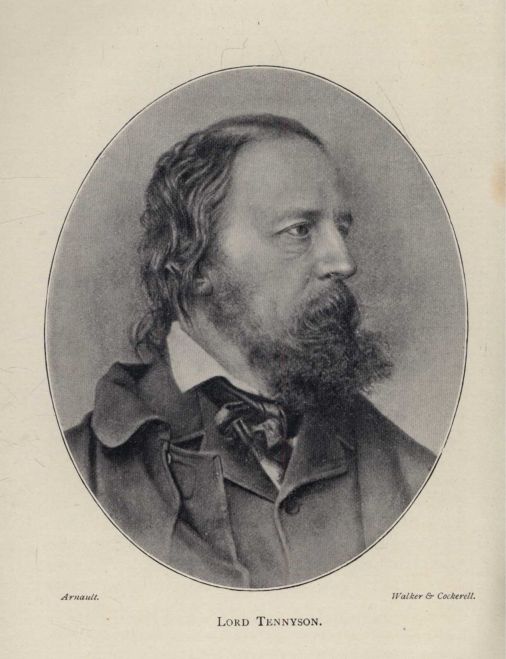
LORD TENNYSON.
Alfred Tennyson had been born at a country vicarage in Lincolnshire in the year 1809, and had begun to scribble verse almost as soon as he could write. When he was eight he produced such lines as—
"With slaughterous sons of thunder rolled the flood,"
which he thought "very grand" at the time; at twelve he wrote a poem of six thousand lines, and at fourteen a drama. He was not the sort of boy likely to be very happy at school, and he had, as he described it, "to shout his verses to the skies." But to his brother he was wont to say many a time, "Well, Arthur, I mean to be famous." He went to Cambridge, and when Thompson, that shrewd observer, afterwards Master of Trinity, saw him walk into the hall, "six feet high, broad-chested, strong-limbed, his face Shakespearean and with deep eyelids, his forehead ample, crowned with dark wavy hair, his head firmly poised," he remarked, "That man must be a poet!"
In 1829 he won the University Prize Poem on the not very inspiring subject of Timbuctoo, and soon afterwards published a volume of short poems, which was warmly welcomed and admired by his friends, one of whom, Arthur Hallam, remarked, "Tennyson will be the greatest poet of our generation." But the general public cared little for poetry, and preferred novels, so that Tennyson was thought to have scored quite a success when three hundred copies of his book had been sold.
In 1833 there fell on him a stunning blow. Arthur Hallam, the friend whom he had loved with an intense love, who was so full of exceptional promise that every one with whom he came in contact believed the greatest future was in store for him, died quite suddenly, and to Tennyson it seemed as if from henceforth the very light of his life had been snatched from him. Dark were the years that followed, rendered more so by the fact that the young poet was very poor and saw no chance of being able to marry the woman he loved. But gradually, as he "faced the need of going forward and braving the struggle of life" (to use his own words), a fuller understanding and a wider view opened out before him. Sorrow and work together led him out of the valley. He produced several volumes of short poems, each one showing more certainly his great poetic sense, his gift of using musical and beautiful language, and each one, too, making it clear from the subjects he chose, and his way of dealing with them, that he himself, like the poet of whom he wrote—
"Saw thro' life and death, thro' good and ill,
... Thro' his own soul,
The marvel of the Everlasting Will
An open scroll,
Before him lay."
Then came "The Princess," a longer work and a most delightful one, in which Tennyson, many years in advance of public opinion, pleaded the cause of women's education, and showed that "Woman's cause is man's; they rise or sink together;" and though "distinct in individualities," they must be "self-reverent each, and reverencing each," if they would in all their powers dispense the harvest, "sowing the To-be."
In 1850 he published his greatest work, "In Memoriam," the poem which came straight from his own heart, and went as straight to the hearts of all who ached under some crushing, desolating blow. It told of his love for his dead friend, and how this very love led him onwards and upwards, away from his own selfish sorrow, away from despair and darkness, till with this larger hope there came faith in God and faith in man; the certainty that good must be the final goal of ill; the conviction that Love was the great power working in all and through all, destined in the end to conquer all. "In Memoriam" has been rightly called "the triumph of a great love." The work brought him fame if not fortune, and at last he was able to marry her "who brought into his life," he said, "the peace of God." A year later he was made Poet Laureate, and settled down to a quiet country life at Farringford. "Maud," and some of his war poems, "The Ode to the Duke of Wellington," and "The Charge of the Light Brigade," were included in his work of the next few years, and then came what he considered the most ambitious thing he had attempted, "The Idylls of the King." The old mysterious story of King Arthur and his knights had fascinated many a poet before him, and the romance of it all laid full hold on his imagination. Nay, more than this, for he saw beyond the fragmentary story, and each one of the characters, under his hand, stands out in a new light. Arthur, Galahad, Percival, Bedivere, Lancelot, Guinevere, Enid, and Elaine—how real they all become to us! How intensely vivid are the scenes unfolded before our eyes, how great and noble are the ideals of the true chivalry as distinguished from the false, towards which Tennyson leads us, reverence for conscience, faithfulness to duty, pure-heartedness, love of truth, fear of sin, courtesy, gentleness, courage, pity, and forgiveness.
"A poet must teach, but not preach," Tennyson once said, and I think it is in these legendary stories of "The Idylls," told in the beautiful language of which he was master, that the poet has given some of his greatest lessons, and has held up his loftiest ideals to the age in which he lived. After "The Idylls" came some dramas, and many short poems, "Enoch Arden," perhaps, being the one best liked by the large public Tennyson could now command. But even to touch on the short poems is impossible here, so many and so varied are they; some, soul-stirring and patriotic, as "The Defence of Lucknow" or "The Revenge;" some, poems of nature; some, coloured with the quaint, north-country humour he knew so well; some, exquisite little word-pictures. His last volume of all was published in 1889, and it included "Merlin and the Gleam," an allegory of the ideals he had set before himself as a poet. He, as the old man, talks to the young mariners just about to set out. He tells of the Gleam which shines for every one who will see it; which calls, which beckons on through wilderness, desolate hollows, and wraiths of the mountain; past warbles of water and cataract music of falling torrents; by rolling of dragons and over the level of pasture and ploughland. Onwards, ever onwards, it leads. To follow it is to live, to die in the search for it is happiness, for the Gleam can never fail.
"Through the magic
Of Him that is mighty,
Who taught me in childhood,
There on the border
Of boundless Ocean
And all but in Heaven
Hovers the Gleam."
So to the young mariners, he, the old magician, gives his parting word of counsel—
"Down to the haven,
Launch your vessel
And crowd your canvas,
And, ere it vanishes
Over the margin,
After it, follow it,
Follow the Gleam."
"I want to go down to posterity," Tennyson once said, "as a poet who uttered nothing base." And the criticism which he declared was "the best and tenderest praise that came to cheer his old age," was the remark of a girl who said, "When I read his poems, I always rise determined to be better."
Much might be said about the perfect music of his poetry; the richness of his imagination; the faultless ear he had for words; the crystal clearness of his style; his power to see beauty and, having seen it, to shape it; his sympathy, his sensitive understanding, and his lofty ideals. His claim to greatness is based on all that and still more. Out of the depths of his pure soul he gazed on all things lovely, just, true, pure, and of good report; and translating these into language easy to be understood, he led those who listened to him along the Road Beautiful, till they too stood with him on
"The heights of life, with a glimpse of a height that is higher."
CHAPTER XXII
A LAST WANDER AROUND
There are still many monuments and memorials in the Abbey which do not come in under the broad headings we have made, and to some few of these I must take you in this our last wander round the aisles and chapels.
As we come in by the great north entrance and pass between the row of statesmen, we must stop for a moment by the Canning group and notice the monument to the "loyall Duke of Newcastle," who lost a large fortune and became an exile from England on account of his devoted faithfulness to Charles I. The Duchess, who came of a family in which "all the brothers were valiant and all the sisters virtuous," was, in the Duke's eyes at least, a very "wise, witty, and learned lady," though every one did not deem her so. Pepys, when he made her acquaintance, wrote: "She is a good, comely woman, but her dress is so antick, and her deportment so ordinary, that I did not like her at all. Nor did I hear her say anything that was worth hearing." It was curiosity, I suppose, that caused Pepys to stay at home one day "to read the history of my Lord of Newcastle, written by his wife." Certainly his criticisms were not favourable. "It shows her to be a mad, conceited, ridiculous woman," he said. "And he is an ass to suffer her to write what she writes to him and of him."
Perhaps the "loyall Duke" found his learned lady not always quite easy to restrain, for he is reported once to have declared to a friend, "Sir, a very wise woman may be a very foolish thing."
But she had better claims than her wit or wisdom to his love, as the inscription on her monument tells, for she proved herself to be "a louvinge carefull wife, who was with her lord all the time of his banishment and miseries, and when he came home, never parted from him in all his solitary retirements."
Round the west door, and underneath the statue of the younger Pitt, are a number of memorial monuments to men, many of whom lived and laboured in our own times. There is Lord John Russell, the great statesman, who throughout his life was true to the emblem and the motto of his house, which you will see on the pedestal—a mountain goat wending its way through dangerous precipices, but never losing its footing. And there is General Gordon, true type of the happy warrior, who lived for the poor, the needy, and the oppressed, and who fell at his post in far Khartoum, faithful unto death. On the one side is a spot sometimes called the Little Poets' Corner, and here, under a window given by an American to the memory of George Herbert and Cowper, "both Westminster scholars, and both religious poets," we find statues or busts of Wordsworth; of the two Arnolds, Dr. Arnold, the schoolmaster, and his son Matthew Arnold, the poet, whose beautiful verses about his father, telling of his radiant vigour, his buoyant cheerfulness, his strong soul, have inspired many a one struggling to be a leader, not a laggard, in the march of life. Here also is Keble, another religious poet, some of whose hymns, "Sun of my Soul" and "New every morning is the Love," are as well known to all of us as any poems in our language; and close by we find Maurice, the teacher and preacher who influenced so many young men to become knights of their own day; to war against all that was mean, or base, or false; to fight in the foremost rank for the wronged or the oppressed; to champion the unpopular cause, and defend the truth well-nigh forgotten. By those who loved him he was called the Prophet, because he stood, as it were, between God and man, because he looked beyond the present and the things that are seen, right into the hidden glories of the things eternal. Kingsley, too, lies here, the most famous of Maurice's disciples—the man who was scholar, poet, novelist, thinker, teacher, enthusiast, and leader all in one; who roused his listeners to a sense of the duty that lay at their door; who taught them to love the beautiful things in nature even as they loved nature's God; who made them enthusiastic for all that was chivalrous and soul-stirring; who himself so loved all humanity that round his grave the highest in the land, gipsies from the country lanes, and white-faced, sweated toilers from the great cities, mourned side by side, this their great-hearted friend.
Fittingly in this group comes Henry Fawcett, the most knightly figure in modern politics. For though he became blind through an accident when he was twenty-five, he refused to let that turn him aside from his purpose, and threw himself all the more earnestly into public life. At first when he tried to go into Parliament he was beaten, the electors actually being afraid of a blind candidate, but gradually his speeches, which showed how much he thought and cared, and how intensely alive he was to the needs of the working classes, broke down this foolish prejudice, and once in the House he was loved as he was trusted by men of both parties. His monument is quite one of the most beautiful among the modern monuments, and one great authority has declared that "the exquisite little figures which adorn it are the best of their kind since the little angels were placed on the tomb of Queen Philippa."
In the south aisle of the choir is the monument of Sir Cloudesley Shovel, which so annoyed Addison. And indeed it is rather hard on this British sailor, who worked his way up from the lowest rank till he became Commander-in-Chief of the Fleet, and was drowned in a shipwreck off the Isle of Stilly, to be handed down to posterity, dressed, not in the uniform he loved and wore so honourably, but in the armour of a Roman general!
Monuments to Doctor Isaac Watts the hymn writer and to John and Charles Wesley are here, and very appropriate is the Wesley inscription, "The whole world is my Parish," breathing as it does the great-hearted spirit of the Abbey.
Sir Godfrey Kneller, the only painter who has a monument in the Abbey, refused to be buried here, declaring he would not lie among fools, and he left money for a memorial to himself which was to be put up in Twickenham Church. But the place he had chosen had already been appropriated by Pope, who refused to give way, so that after all the monument had to be put up in Westminster, and Pope, by way of compensation, undertook to write the inscription, in which he declared that "Kneller was by Heaven, not by master taught."
Gilbert Thornburgh, a courtier, has a delightful Latin epitaph which states that
"He was always faithful To his God, his Prince, and his Friends. Formerly an earthly, now an Heavenly Courtier, It shall be no more said in the Age to come, Who must be good must leave the Court, When such shining Piety as his shall appear there."
Some epitaphs are humorous, as when we read of one Francis Newman, a Fellow of All Souls College in Oxford, who in 1649, "divested of Body was received among the seats of the Blessed Souls, and became truly a New-Man;" or of Sir John Fullerton, a courtier, who died "Fuller of Faith than of Feare, Fuller of Resolution than of Paines, Fuller of Honour than of Dayes."
Unconsciously humorous are the words on the tombstone of James Fox, who at the age of twelve fell ill of smallpox and took his flight to heaven. "He was a man even when a child, and a Hercules from his cradle; favoured with Beauty, Wisdom, and all Endowments of Mind and Body no less than were Adonis, Venus, and Apollo; a child of singular dutifulness and great sincerity."
"Oh parents! pity his parents.
Oh posterity! reflect upon your loss!"
It was smallpox which caused the death both of Richard Boothey—who was "of manly judgment even in his youth, of so happy a memory as to be envied, a flower, more beautiful than the rest, cut off in the spring of life"—and of Mr. Thomas Smith, buried in the little cloisters, "who through the spotted veil of smallpox rendered a pure unspotted soul to God, expecting but never fearing death."
More pathetic perhaps than any other is the little tablet in the cloisters which marks the grave of "Jane Lister, dear child," though almost as touching is the inscription which tells us of "Mary, daughter of William Green, more adorned with virtue than with high birth, who married William Bulmer, Gentleman, to whom she was no occasion of trouble except by leaving him at her death. She bore him one son, William, a youth of great genius, who was snatched away by too hasty death. His most tender mother chose to be buried near him, that she, though dead, might be united in death with him she so entirely loved while living." Right at the other end of the Abbey, in the Chapel of St. Erasmus, is the tomb of Mrs. Mary Kendall, which has these words for inscription:—
"She had great virtues, and as great a desire of concealing them. Was of a severe life, but of an easy conversation. Courteous to all, yet strictly sincere. Humble without meanness. Beneficent without ostentation. Devout without superstition. Those admirable qualities, In which she was equalled by few of her sex, surpassed by none, Rendered her in every way worthy of that close union and friendship In which she lived with the Lady Katherine Jones."
And in the adjoining Chapel of St. Andrew is the heart-broken tribute of the Earl of Kerry, "to his affectionately beloved wife, Anastatia, the dearest, most loved, most faithful companion that ever blessed man, who for thirty-one years rendered him the happiest of mankind."
The last of our epitaphs must be that of Archbishop Boulter, who pulled a great many political strings in Ireland, and lived a very eventful life. But his inscription reveals us none of these things, and only describes a series of promotions, for it relates that "He was born January the 4th, 1671: he was consecrated Bishop of Bristol 1718: he was translated to the Archbishoprick of Armagh in 1723, and from thence to Heaven, on Sep. 27, 1742."
Over Abbot Islip's Chapel is a chantry, now used for keeping the few wax effigies which remain. For, as you remember, it used to be the custom at royal funerals, or indeed at any important funerals, to carry the likeness of the dead man or woman before the coffin; these painted effigies being made of boiled leather, wood, or wax, dressed up in the clothes of the person they represented. Only eleven of these remain, though at one time there must have been quite a collection of royal figures in the Abbey which were open to the public, gaze, and evidently left to the mercy of the public. Queen Elizabeth can still be seen, gorgeously dressed, but weary and sad-looking; Charles II. is there, and the beautiful Duchess of Richmond of the Stuart race, whose monument, with that of her husband, is in Henry VII.'s Chapel. Then there is the Duchess of Buckinghamshire, proud and pomp-loving, who insisted on seeing the canopy for her funeral hearse, that she might be sure it was magnificent enough, and who made her attendants promise that even when she became unconscious they would still stand in her presence. By her is her little son, and near her, her eldest son, who also died young. Queen Anne beams on us; William and Mary have the crown set between them, and he stands on a stool so as not to appear smaller than his wife. General Monk's armour is there, much the worse for wear; and Pitt, Earl of Chatham, is splendid in his Parliamentary robes. Nelson was put here from a very worldly point of view, for when he was buried in St. Paul's, such crowds went to see his grave, that Westminster Abbey was neglected, and as the pence of the sightseers were too valuable to be lost, it was decided that some memorial of the great hero must be placed in the Abbey to attract people back again. All the clothes except the coat, and certainly the hat, belonged to Nelson, but a waxwork effigy hardly seems a worthy monument to him in the place which he must have loved and honoured, nay, must have dreamt of, when he cried to his men as he led them to attack, "Westminster Abbey, or glorious victory."
And now, leaving monuments, sleeping figures, epitaphs, inscriptions, and effigies, come and stand for a moment on the steps leading up to the High Altar, that we may take our last look at the Abbey from what is perhaps the most interesting spot in it. For, as you will remember, it is in this part of the Church that the coronation service takes place, it is here that every sovereign of England has been crowned from the days of Harold onwards.
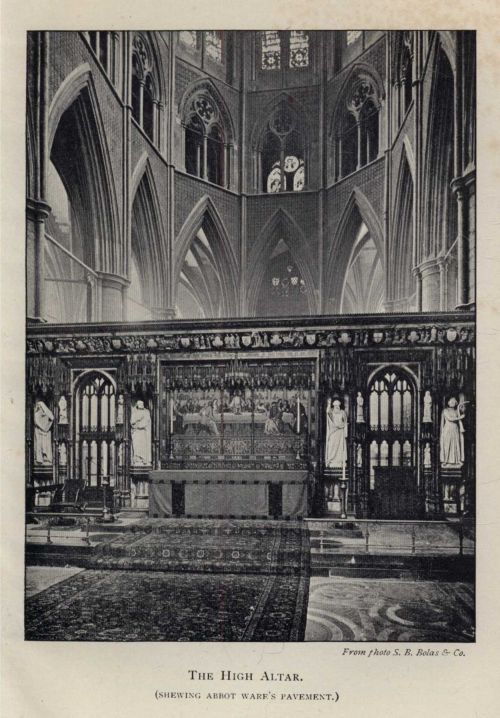
THE HIGH ALTAR. (SHEWING ABBOT WARE'S PAVEMENT.)
The pavement inside the rails is made of the mosaics brought back from Rome by Abbot Ware in 1267, where he went to be duly confirmed in his office by the Pope; the pillars near the altar are on the very bases which were put there when Edward the Confessor built his church. Here are the tombs of Aymer de Valence, of Edmund Crouchback, Earl of Lancaster, and of Aveline his young wife, who as a bride had stood in front of the altar but a few months before her death in the year 1269. Opposite, King Sebert is said to lie; under the pavement rests Abbot Ware, with other of his successors, and Richard the Second's sad helpless face looks at us from his portrait with its fine background of tapestry. The altar and the reredos which we see are both new, and just as the old frieze through in the Confessor's Chapel depicts scenes in the life of Edward, so the modern reredos gives us glimpses of Him in whose honour the Saxon king first raised these walls. From among the gold, four white figures stand out, "the four living creatures which have been thought worthy to stand round the central figure of our departing Master," as Dean Stanley described them when they were erected. On the right stands St. Peter, patron saint of the Abbey, holding in one hand the keys, and in the other a book, on which is written the great truth, "God is no respecter of persons," and next to him is Moses, the first statesman and lawgiver, looking towards the buried statesmen in the Abbey.
On the left stands St. Paul, grasping in his hand that Sword of the Spirit which he had named as the weapon of the Christian warrior, and by him is David, the sweet singer of Israel, whose face is turned towards the Poets' Corner as though he would claim those sleeping there for his brethren.
Through the glass we catch a glimpse of the Chapel of the Kings, and all around is a network of slender arches fashioned by master-hands into forms of stately but perfect beauty. High above are the three Eastern Windows, though in the course of the years these have been so constantly repaired with any scraps of glass available, that the effect is rather confusing. But the figure of a thorn-crowned Christ stands out, and near to Him are Edward the Confessor and St. John the Evangelist.
Now turn to the west, look at the glade of arches stretching down the nave, at the Statesmen's Corner on the right, where under the Rose Window Chatham's fine figure stands out almost with an air of proud satisfaction, and then towards the left to the monument of Oliver Goldsmith, and the more imposing memorial to the great Duke of Argyll, "an honest man, a constant friend, a general and an orator." Two commanding statues of Campbell and Addison loom out in the half light, Campbell casting a shadow over the graves of Abbot Litlington, Owen Tudor, and Dean Benson, and hiding from our view the dignified, thoughtful figure of William Shakespeare, who holds in his hands a scroll on which are those lines of his from the "Tempest":—
"The cloud-capt towers,
The gorgeous palaces,
The solemn temples,
The great globe itself,
Yea, all which it inherit
Shall dissolve,
And like the baseless fabric of a vision
Leave not a wreck behind."
Burns and Sir Walter Scott greet us from their niches; Grote and Thirlwall, the truth-loving writers of history; Camden, the Westminster master and antiquarian; Garrick the actor, Handel the musician, all cluster around us as we look down the southern aisle; and we can just see at the end the newest addition to the building, a bronze memorial to John Ruskin, a great teacher and writer of our own day. Some words of his come to my mind at this moment, as applying in a very special sense to the Abbey: "The greatest glory of a building is not in its stones, nor in its gold. The glory is in its age, and in that deep sense of voicefulness, of stern watching, of mysterious sympathy, nay, even of approval or condemnation, which we feel in walls that have long been washed by the passing waves of humanity.... It is in the golden stain of time that we are to look for the real light, and colour, and preciousness of architecture; and it is not until a building has assumed this character, till it has been entrusted with the fame and hallowed by the deeds of men, till its walls have been witnesses of suffering, and its pillars rise out of the shadows of death, that its existence, more lasting as it is than the natural objects of the world around it, can be gifted with even so much as those possess of language and of life. Therefore, when we build, let us think that we build for ever.... God has lent us the earth for our life; it is a great entail. It belongs as much to those who are to come after us, and whose names are already written in the Book of Creation, as to us."
And surely, too, the Abbey leads our thoughts towards other temples, which it is ours to guard, to honour, and to make honourable, temples not fashioned by human hands. Those old builders often worked in the dark; some corner, some piece was allotted to them, and into this they put all their skill, all their genius, caring little for fame or reward, knowing nothing of the whole plan which they would never live to see accomplished. Only this was their task, to beautify the little part entrusted to them. And because they were faithful to this ideal, we, who gaze on their completed work, do grateful homage to those nameless craftsmen, long since dead and forgotten. Nay more, we will make it our aim to labour as they laboured; to live not basely and selfishly in the Present, but nobly and truly, with the Future ever before our eyes; so that in days to come Englishmen shall still be able to say, "See! This our fathers did for us!" and generations, yet unborn, will deem that we were faithful to ourselves and to them.
THE END
Printed by BALLANTYNE, HANSON & Co. Edinburgh & London